 2014, Vol. 30


2. 云南云宝铂钯矿业有限公司, 大理 671000
2. Yunnan Yunbao Platinum & Palladium Company, Dali 671000, China
位于中国西南部和越南北部的峨眉山大火成岩省(ELIP)发育了大量规模不等的岩浆型Cu-Ni-PGE硫化物矿床。金宝山铂钯矿床作为区域内唯一的大型Pt-Pd矿床,区域上存在巨大找矿潜力。大量实践表明,对成矿的正确认识与新的找矿思路是勘查突破的关键(Deng et al., 2007,2011a,b,2014a,b; Yang and Badal, 2013; Yang et al., 2008,2014; 邓军等, 2010a,b,2011; 杨立强等, 2010,2011a,b; 杨利亚等,2013)。关于金宝山铂钯矿床的S饱和机制及矿床成因方面的研究,前人已取得一些重要成果。Wang et al.(2005,2010)通过对该矿床铬铁矿和岩矿石铂族元素地球化学的研究发现早期的S不饱和岩浆经历了橄榄石和铬铁矿的分离结晶致使硫化物熔体在深部岩浆房中发生熔离,在这一过程中可能发生了地壳混染作用。Tao et al.(2007)通过对橄榄石和S、Nd、Os同位素研究认为金宝山岩体原始岩浆在深部经历了橄榄石和铬铁矿的分离结晶,没有遭受明显的地壳混染。可见,橄榄石和铬铁矿的分离结晶是导致岩浆中S饱和并形成金宝山铂钯矿床的一个重要因素,然而对于地壳混染的研究尚存有争议,这也在一定程度制约了对引起岩浆中S达到饱和的可能机制的合理解释。为此,本文在剖析金宝山岩体岩相学特征的基础上,开展主量元素、微量元素、稀土元素和铂族元素(PGE)研究,分析岩浆在演化和上升过程中是否存在地壳混染、混染的程度如何等,进而探讨硫化物熔离机制和矿床成因,丰富对峨眉山大火成岩省岩浆活动规律的认识并促进对其成矿效应的研究。 2 地质概况
金宝山铂钯矿床位于扬子板块西缘,红河断裂东侧(图 1)。矿区内出露地层主要有泥盆系金宝山组第三段互层的板岩、变质砂岩、结晶灰岩(图 2)。矿区内岩浆岩以基性、超基性岩为主,主要为辉石橄榄岩,底部及边部可见一些小的橄榄岩、辉石岩和斜长角闪岩。超基性岩蛇纹石化和滑石化强烈,在岩体与围岩的接触带发育角岩化、大理岩化、滑石化和绿泥石化。
 | 图 1 峨眉山大火成岩省镁铁、超镁铁质岩体地质简图(据王生伟等,2012) Fig. 1 Distribution of continental flood basalts and contemporaneous mafic-ultramafic intrusions,the Emeishan large igneous province,South China(after Wang et al., 2012) |
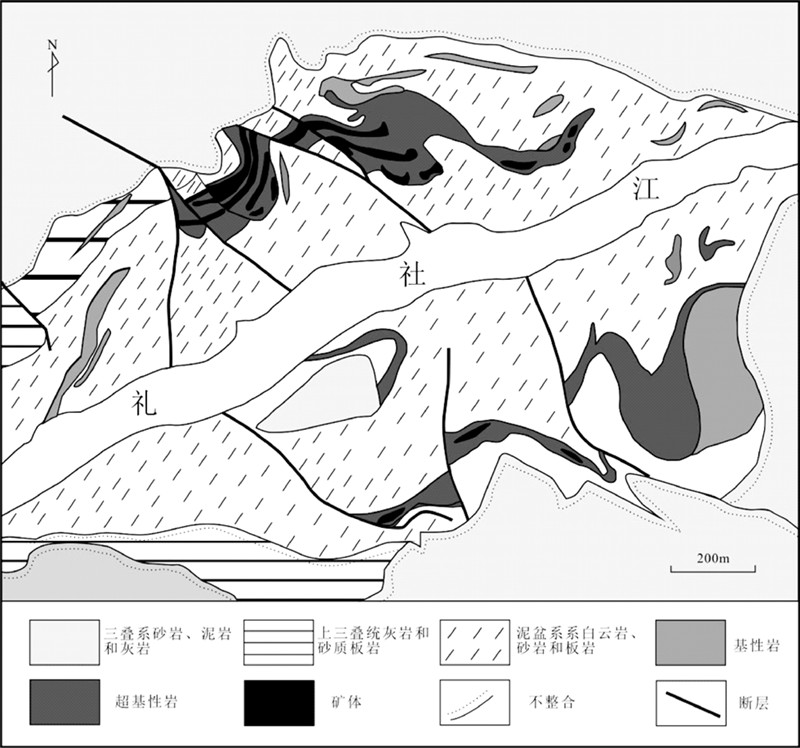 | 图 2 金宝山铂钯矿床矿区地质简图(据Wang et al., 2010) Fig. 2 Geological sketch map of the Jinbaoshan Pt-Pd ore district(after Wang et al., 2010) |
金宝山铂钯矿体呈似层状、透镜状,主要产于辉石橄榄岩中,其它超基性岩类也都有不同程度的矿化,个别地段近岩体的围岩也见有矿化。矿体与围岩呈渐变过渡,无明显岩性差异及界线。含矿超基性岩具致密块状构造,以半自形-他形粒状结构为主,矿石以稀疏浸染状构造为主,呈自形-半自形粒状结构、半自形-他形粒状结构和交代结构。矿床贫铜、镍,富铂、钯,矿石平均品位为0.5g/t,矿石基性程度越强,蚀变越强,铂钯丰度值越高。矿床中已知铂族矿物有5类25种,其中以自然元素及金属互化物类、锑化物类、铋碲化合物与碲化物类,砷铂矿为主。金属硫化物主要为磁黄铁矿,次为镍黄铁矿(紫硫镍铁矿)、黄铜矿和白铁矿。金属氧化物主要为磁铁矿、铬铁矿,次为针镍矿、辉钴矿和辉铁镍矿。 3 样品采集及分析方法 3.1 样品采集和岩相学特征
本次研究的7件辉石橄榄岩、2件橄榄岩及5件铂钯矿石样品均采自金宝山矿区PD1495和PD1508。辉石橄榄岩样品较为新鲜,中粗粒结构,块状构造。橄榄石成分在70%以上,发育堆晶结构,弱蚀变,斜方辉石充填于橄榄石裂隙中或包裹橄榄石形成包橄结构(图 3a,b)。橄榄岩样品风化严重,橄榄石蚀变强烈,发育蛇纹石化、碳酸盐化、伊丁石化等。矿石样品中硫化物呈条带状、团块状,碳酸盐化强烈。主要金属矿物有黄铜矿、黄铁矿、镍黄铁矿、针镍矿、紫硫镍矿、铬铁矿和磁铁矿等。铬铁矿作为主要副矿物,形态上包括自形六边形铬铁矿以及浑圆状环绕结构铬铁矿(图 3e)。黄铜矿、黄铁矿、镍黄铁矿常以共生矿物形式出现(图 3c),针镍矿在磁铁矿中交代紫硫镍矿(图 3d),少数镍黄铁矿赋存于铬铁矿间隙中,铬铁矿间隙可见铂族元素矿物(图 3f)。
 | 图 3 金宝山岩体部分岩矿石显微照片 Ol-橄榄石;Opx-斜方辉石;Pn-镍黄铁矿;Py-黄铁矿;Ccp-黄铜矿;Mlr-针镍矿;Vil-紫硫镍矿;Chr-铬铁矿;Mgt-磁铁矿;PGM-铂族元素矿物 Fig. 3 Microphotographs of rocks and ores from the Jinbaoshan intrusion |
主量元素、微量元素、稀土元素测试在澳实分析检测有限公司完成。主量元素分析使用荷兰PANalytical Axios Max荧光光谱仪(XRF)测定。微量元素分析使用美国Perkin Elmer Elan 9000电感耦合等离子体质谱仪、美国Varian VISTA电感耦合等离子体发射光谱仪。稀土元素分析使用美国Perkin Elmer Elan 9000等离子体质谱仪。
铂族元素及全岩硫含量由中国地质科学院国家地质实验测试中心测试。铂族元素分析使用等离子质谱ICP-MS。方法要点:称取试样,加入溶剂熔融,将熔融体注入铁模,冷却后,取出硫镍扣,粉碎后用HCl溶解;加入碲共沉淀剂沉淀后,过滤,王水溶解转入比色管中定容,ICP-MS检测。方法精密度RSD<10%。全岩硫含量分析使用高频红外碳硫仪HIR-944。方法要点:称取0.0500g样品,于高频感应炉的氧气流中加热燃烧,生成的二氧化硫(碳)由氧气载至红外线分析器中的测量室,二氧化硫(碳)吸收某特定波长的红外能,用红外吸收仪测定。 4 金宝山矿床地球化学特征 4.1 主量元素
金宝山岩体总体蚀变较强,因此烧失量较大,烧失量平均为11.4%,样品总体SiO2含量较低,SiO2均小于45%,属超基性岩类(表 1),利用主量元素的组成可以大致估算控制岩石微量、稀土元素成分的主要矿物相(如Pearce元素比值图解)。需要注意的是,由于在计算不含硫化物相成分时产生的误差,应用Pearce元素比值图解时数据和控制线常常吻合得不是很好,例如,图解中主要的一个参数TiO2,既是岩石中硅酸盐的组分,也是与硫化物伴生的磁铁矿的组分(王焰,2008)。尽管如此,在(Mg+Fe)/Ti-Si/Ti摩尔比值图解上(图 4),金宝山岩体样品均大致落在橄榄石控制线与斜方辉石控制线之间,这说明橄榄石和斜方辉石为金宝山岩体的主要组成矿物,与岩石薄片的观察结果一致。
 | 表 1 金宝山岩体的主量元素(wt%)和微量元素(×10-6)数据Table 1 Major elements(wt%) and trace elements(×10-6)compositions of the Jinbaoshan intrusion |
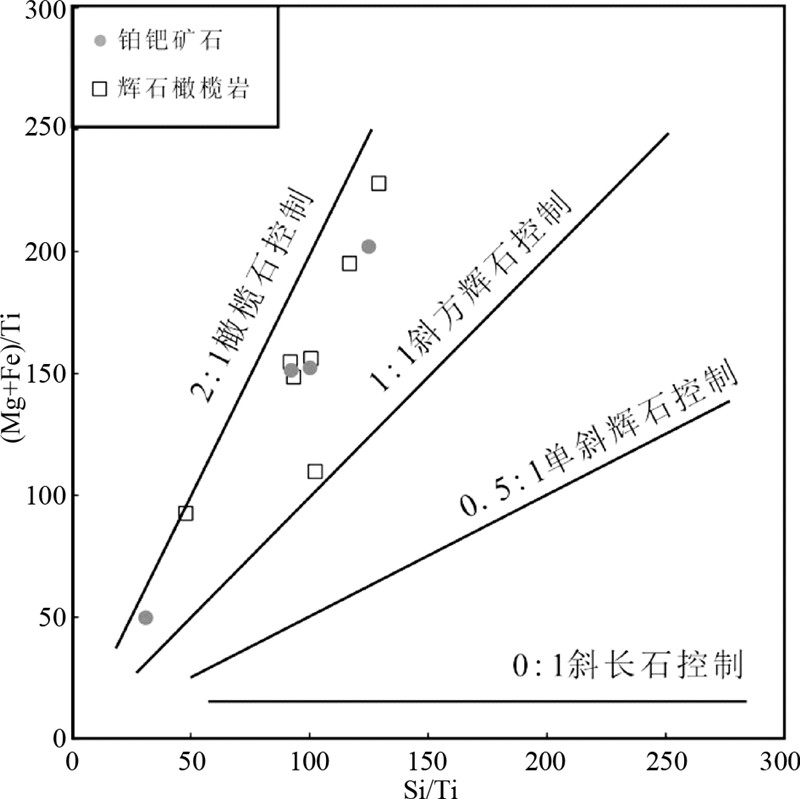 | 图 4 金宝山岩体Pearce元素比值图解 Fig. 4 A plot of Pearce element ratios for the rocks from the Jinbaoshan intrusion |
微量、稀土元素研究对象为金宝山岩体较为新鲜的辉石橄 榄岩与铂钯矿石(表 1),铂钯矿石出现较强烈的蛇纹石化和碳酸盐化。在原始地幔标准化微量元素配分图解上(图 5a),铂钯矿石与辉石橄榄岩相比,大离子亲石元素Rb、Ba、K、Sr差异性较大,而高场强元素Nb、Ta、Th差异性较小,表明热液蚀变过程中大离子亲石元素活动性较强,高场强元素相对稳定。在稀土元素球粒陨石标准化图中(图 5b),辉石橄榄岩与矿石样品均呈较为明显的右倾型,辉石橄榄岩样品稀土元素含量高于矿石样品,轻重稀土分馏程度相似,ΣREE=14.2×10⁻⁶~38.1×10⁻⁶,La/Sm=3.62~7.13,Gd/Yb=1.8~3.0,大多数样品表现为Eu的弱负异常,与金川相似,反映了金宝山原始岩浆曾经结晶分异出大量斜长石(陶琰等,2002)。
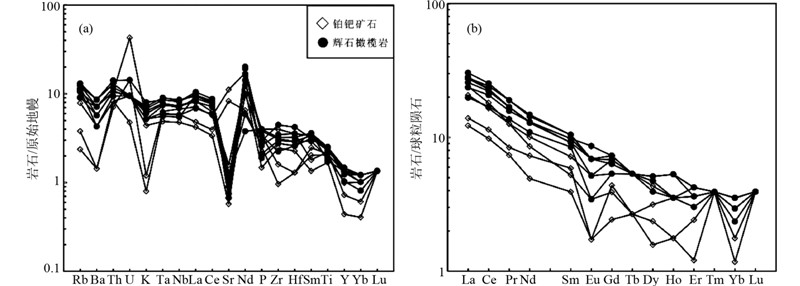 | 图 5 金宝山岩矿石样品原始地幔标准化微量元素配分图(a)和球粒陨石标准化稀土元素配分图(b)(标准化值据Sun and McDonough, 1989) Fig. 5 Primitive mantle-normalized trace element patterns(a) and chondrite-normalized REE patterns(b)for the rocks and ores from Jinbaoshan intrusion(normalization values after Sun and McDonough, 1989) |
金宝山铂钯矿床超基性岩和矿石的PGE含量总体相对于原始地幔较高(Sun et al., 1995),以PPGE(Pt,Pd)为主,PPGE含量明显高于IPGE(Ir,Ru,Rh)。其中,矿石样品中∑PGE含量较高,介于765×10-9~15954×10-9之间,平均为5525×10-9,超基性岩样品中∑PGE含量较低,介于22×10-9~625×10-9之间,平均为274×10-9。
金宝山铂钯矿中不同类型岩矿石进行铂族元素与Cu、Ni、S分析(表 2)。以原始地幔值标准化后作图(图 6),由图中可以看出,辉石橄榄岩与铂钯矿石具有相似的铂族元素原始地幔标准化配分曲线,均为左倾型,说明了二者母岩浆具有相似的性质,而蚀变橄榄岩相比其它样品表现的配分曲线不一致说明后期的热液蚀变对PGE的再分配产生了一定的影响,所有样品均出现了Ru的负异常,这可能是由于早期铬铁矿的结晶分异造成(Tao et al., 2007),因为Ru高度相容于铬铁矿(Righter et al., 2004)。总体上,金宝山岩体PGE强烈富集,辉石橄榄岩与矿石具有相似的“Pt-Pd”富集型配分模式,显示PPGE(Pt、Pd)相对富集,而IPGE(Ir、Ru、Rh)相对亏损的特征。S与Pt、Pd、Ir、Ru的相关图中(图 7),PGE与S均表现出良好的线性关系,表明PGE主要赋存于硫化物中。
| 表 2 金宝山岩体主要类型岩石及矿石的Cu、Ni(×10-6)、PGE(×10-9)及S(wt%)组成Table 2 Cu,Ni(×10-6),PGE(×10-9) and S(wt%)for the rocks and ores of the Jinbaoshan intrusion |
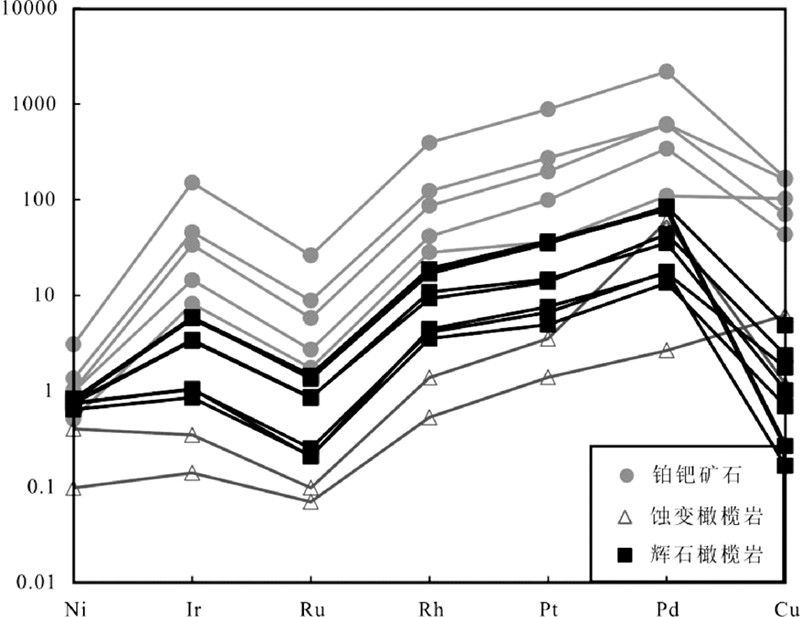 | 图 6 金宝山岩体及矿体Ni、Cu、PGE原始地幔标准化配分曲线(原始地幔值据McDonough and Sun, 1995) Fig. 6 Primitive mantle-normalized patterns of Ni-Cu-PGE for ores and rocks of the Jinbaoshan intrusion(normalization values after McDonough and Sun, 1995) |
 | 图 7 金宝山岩体S与Pt、Pd、Ir、Ru相关图 Fig. 7 Geochemical correlation diagrams between S and Pt,Pd,Ir,Ru for the Jinbaoshan intrusion |
R因子(硅酸盐岩浆/硫化物的质量比值)对研究岩浆质量平衡、硫化物熔离过程、铂族元素成矿潜力等有重要意义。因为铂族元素在硫化物与硅酸盐之间具有非常大的分配系数,对R因子具有很好的反映,可以利用R因子方程进行模拟计算(Naldrett,2004):Yi=Di×Xi×(R+1)/(R+D)。其中Yi指金属元素i最后在硫化物中的含量,R是硅酸盐岩浆与硫化物的质量比值,Xi指金属元素i在源区中的含量,Di指金属元素i在硫化物与硅酸盐之间的分配系数。
假设各PGE元素在硫化物熔体/硅酸盐熔体中的分配系数为20000(Fleet et al., 1993,1996)。以Pd和Ir为对象,根据R因子方程模拟得到R因子变化线(图 8),将本次采集的各类样品数据进行100%硫化物计算,数据点沿着Ir-Pd模拟线分布(图 8),暗示铂族元素主要受R因子控制,R值约为1000~20000,大部分样品位于1000~5000之间。
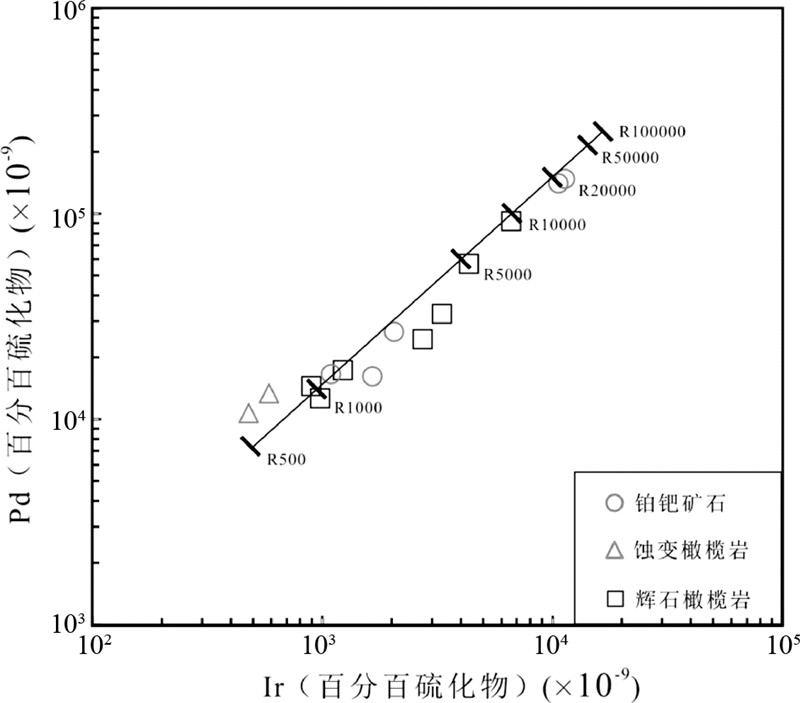 | 图 8 金宝山岩体中PGE元素变化模拟计算 Fig. 8 Modeling of PGE variations in sulfide liquids segregated from magma for the Jinbaoshan intrusion |
金宝山超基性岩体部分样品具有较高烧失量(LOI),岩石蚀变普遍,常见蛇纹石化、绿泥石化、透闪石化、阳起石化、滑石-碳酸盐化等,说明岩石发生了不同程度的变质和蚀变作用。岩浆后期、变质流体或大气降水作用,可能导致岩石样品的PGE发生分异(Barnes et al., 1985),而Crocket(2000)对比发现蚀变不是影响PGE分异的主要因素。
Ir在热液作用过程中较为稳定(Keays et al., 1982),金宝山岩体中Ir和其他PGE具良好的线性关系(图 9),说明后期热液蚀变并未改变岩体中PGE的配分模式,即使后期热液蚀变对金宝山矿床部分亲硫元素分布有较大的扰动,铂族元素体系并未发生本质变化(王生伟等,2012)。再者,PGE中一般Pd在热液活动中活动性最强,而Ir的活动性最差,从而导致蚀变过程中Ir、 Pd容易发生分离,因此Pd/Ir比值常用来评价热液活动的影响(Keays et al., 1982)。通常情况下岩浆硫化物矿床有相对低Pd/Ir比值(<100),而热液硫化物矿床Pd/Ir比值较高(>100),金宝山岩体除一个样品外(1508-B3)Pd/Ir比值都较低,平均值为18.9,远小于100,表明该矿床后期热液作用很局限(Keays,1995)。热液作用主要表现为就地改造,并未造成矿体形态、产状的根本变化(陶琰等,2003)。
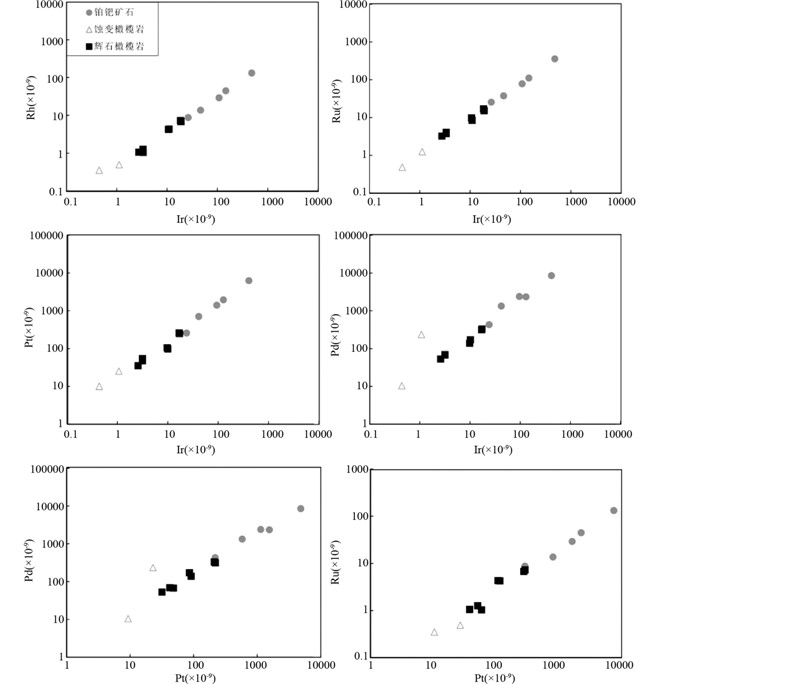 | 图 9 金宝山岩体铂族元素相关性图解 Fig. 9 Geochemical correlation diagrams between PGE for the Jinbaoshan intrusion |
地幔岩浆上升到地壳的过程一般被认为以近乎绝热快速上升为特征,压力是影响岩浆中硫化物饱和的主要因素,由于岩浆中S的溶解度与压力为负相关关系(Mavrogenes and ONeill, 1999),岩浆上升过程中,如果没有外来因素的干扰(如外来流体的加入或者同化混染等),岩浆中S无法达到饱和形成大型Cu-Ni-PGE矿床(Naldrett,2004),由此可见,地壳混染是形成大型Cu-Ni-PGE矿床的必要因素(Naldrett,2010)。
微量元素地球化学表明金宝山岩体经历了地壳混染作用,具体表现在辉石橄榄岩富集LREE,具有较高的Th/Yb与Zr/Ti比值,这些都是地壳岩石的典型特征(Lightfoot and Hawkesworth, 1997)。岩体遭受地壳混染的程度可以用原始地幔标准化的(Nb/Th)PM-(Th/Yb)PM值来计算,(Nb/Th)PM常被用来指示Nb异常,而(Th/Yb)PM是地壳混染的敏感指示剂。与N型洋中脊玄武岩(N-MORB)相比,金宝山辉石橄榄岩具有低(Nb/Th)PM比值、高(Th/Yb)PM比值,与较高程度的地壳混染一致。通过假定岩石成分是由幔源岩浆和地壳混染物相互混合的产物,可以估计地壳混染程度。对于幔源端元,应用两种成分,其一是N-MORB,另一个是峨眉山大火成岩省中两个最原始、受地壳混染影响最小的苦橄岩的平均值,对于地壳组分,利用代表ELIP通道位置的朱布岩体的云英片麻岩围岩。结果发现苦橄岩作为地幔端元与金宝山岩体样品的数据产生了较好的拟合,从该模型也可以看出,金宝山辉石橄榄岩受到了较强的地壳混染(图 10a)。地壳混染程度可以通过(Th/Yb)PM-(Nb/Yb)PM图解来估算,辉石橄榄岩样品组成的趋势线接近N-MORB与上地壳(含8×10-6 Th,35×10-6 Nb和2.2×10⁻⁶ Yb)二者的混合线(Taylor and McLennan, 1985),表明形成金宝山岩体的母岩浆经历了55%~70%的地壳混染(图 10b)。
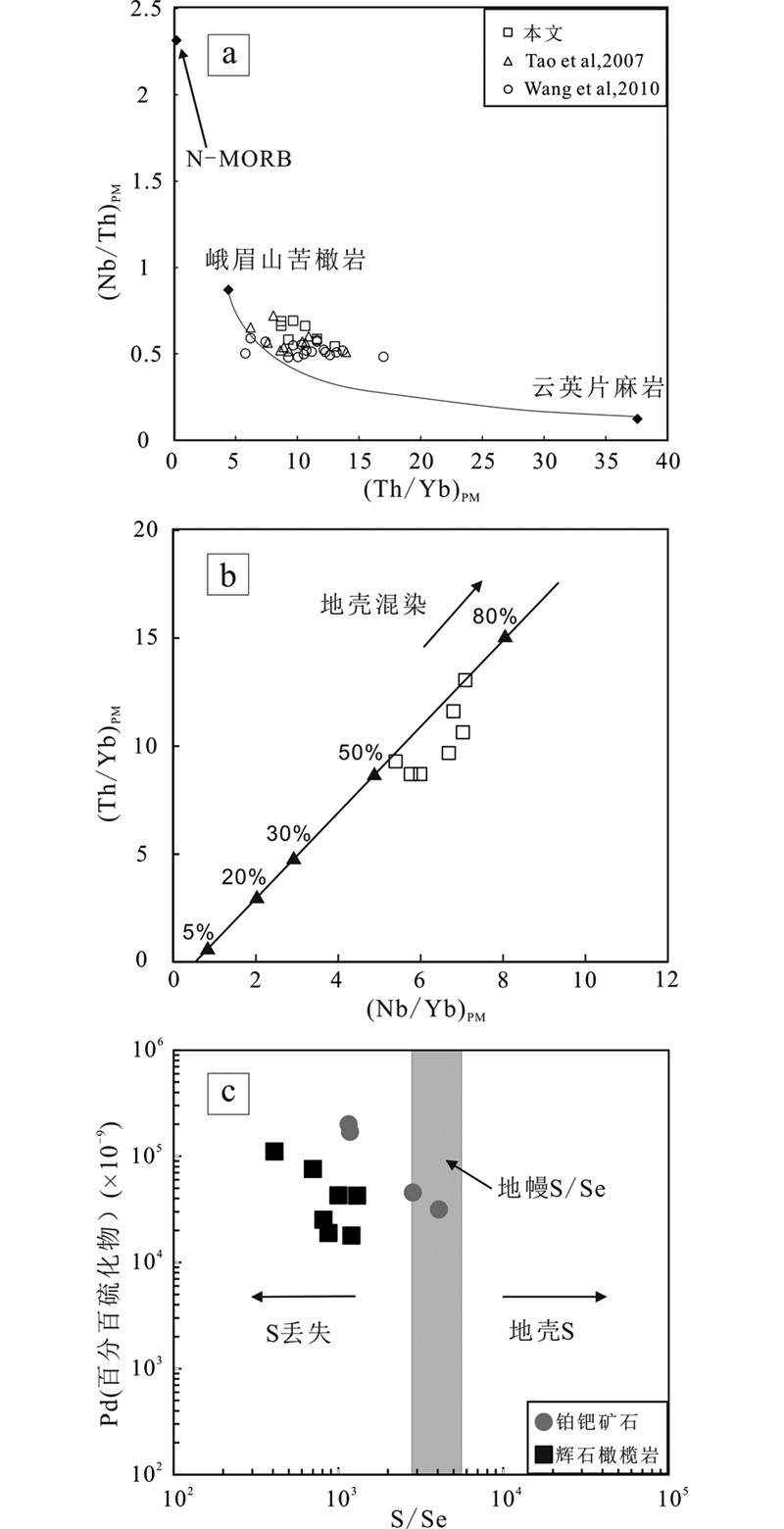 | 图 10 金宝山岩体微量元素地球化学对地壳混染的指示 (a)(Nb/Th)PM-(Th/Yb)PM图解(底图据Wang et al., 2006),岩体样品部分数据来自Tao et al., 2007和Wang et al., 2010;(b)(Th/Yb)PM-(Nb/Yb)PM图解(底图据Yuan et al., 2012);(c)Pd-S/Se图解Fig. 10 Scattergrams of(Nb/Th)PM vs.(Th/Yb)PM,(Th/Yb)PM vs.(Nb/Yb)PM and Pd vs. S/Se for the Jinbaoshan intrusion |
然而岩矿石的S/Se比值并没有显示出明显地壳混染的特征。S/Se-Pd图解显示S/Se比值与Pd的值存在负相关关系(图 10c),这种趋势表明贫PGE的围岩是相对富集S的,地壳岩石应具有较高的S/Se比值。金宝山岩体辉石橄榄岩与铂钯矿石S/Se比值在300~2828之间,低于原始地幔S/Se范围2850~4350(Eckstrand and Hulbert,1987),并没有表现出地壳岩石的特征。
这种“矛盾的”地壳混染现象并非金宝山铂钯矿床独有。Holwell et al.(2014)研究发现加拿大River Valley岩体经历了强烈的地壳混染作用,依然具有略低于原始地幔的S/Se比值,认为River Valley岩体的形成经历了早晚两期地壳混染作用。另外前人对于南非Bushveld杂岩体中的Platreef大型层状PGE矿床也做了较为详细的研究,普遍认为S的饱和发生在岩浆侵位之前,在深部岩浆房或岩浆通道中发生地壳混染,而晚阶段岩浆侵位过程中也发生了少量的就地混染(McDonald and Holwell, 2007; Ihlenfeld and Keays, 2011)。因此,与River Valley和Platreef矿床类似,金宝山岩体形成之前很有可能发生过两次地壳混染作用,早阶段发生在岩浆侵位之前,在深部岩浆房发生大规模的地壳混染使得硫化物发生熔离并产生富PGE硫化物熔体,晚阶段为就地混染,这次混染作用并未使得S饱和。 5.2 成矿模式
通过Cu与Pd的值可以用来判别岩浆是否发生过S的饱和(Barnes et al., 1993; Maier et al., 1996; Vogel and Keays, 1997)。Pd、Cu均为强不相容元素,因此将保留在岩浆结晶分异之后的残余熔体之中(Keays,1995)。PGE在硫化物/硅酸盐熔体中的分配系数为20000,远大于Cu的分配系数1000(Fleet et al., 1993,1996),岩浆中S一旦饱和发生硫化物熔离作用,Pd将比Cu更多地被带走,因为Pd在硫化物/硅酸盐熔体中的分配系数要远大于Cu,造成剩余岩浆中Cu/Pd比值明显升高(Keays,1995),这将使得岩浆中Cu/Pd比值远远大于原始地幔中Cu/Pd值,因此Cu/Pd常常可以用来判别硫化物是否发生熔离(Maier and Barnes, 1999)。如果金宝山岩体成矿岩浆发生了硫化物熔离,将导致Pd在残余岩浆中地大量亏损从而使得Cu/Pd比值显著升高。金宝山铂钯矿床成矿岩石除去样品1495-B5(1)外Cu/Pd比值介于25.56~7172.49,平均值为1092.88,远低于原始地幔的Cu/Pd比值(7.7×103)(McDonough and Sun, 1995)。利用Cu/Pd比值与Pd含量图解(Barnes et al., 1993; Maier et al., 1996)显示矿石与岩石样品基本均落于地幔与PGE富集地幔范围内(图 11),表明整个金宝山岩体均经历了硫化物从岩浆中富集PGE过程,而且反应了峨眉山地幔柱结晶分异和熔离金宝山岩体之前,可能未曾发生S饱和及硫化物的熔离作用(王生伟等,2012)。此外,利用Cu-Pd图解(Vogel and Keays, 1997)也说明形成金宝山岩体时岩浆并未发生S饱和(图 12)。前文计算得出金宝山矿床R值1000~5000,明显大于金川、图拉尔根、白马寨等典型岩浆硫化物矿床,较高的R值表明硫化物熔离程度较低(Li et al., 2001)。这些都说明金宝山岩体形成时岩浆中的硫化物熔离程度较低,并没有因为岩浆中S的饱和使得硫化物大规模的熔离。
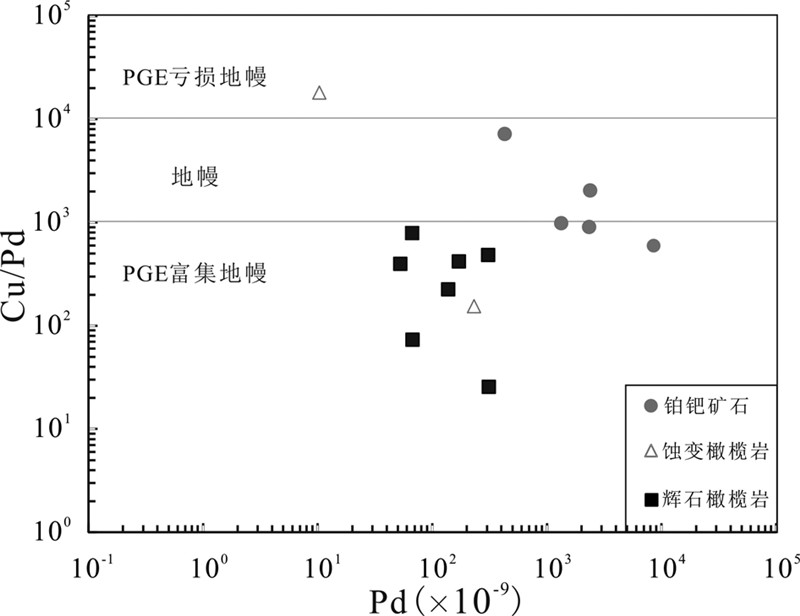 | 图 11 金宝山岩体的Pd-Cu/Pd图解(底图据Barnes et al., 1993) Fig. 11 Pd vs. Cu/Pd diagram of the Jinbaoshan intrusion(after Barnes et al., 1993) |
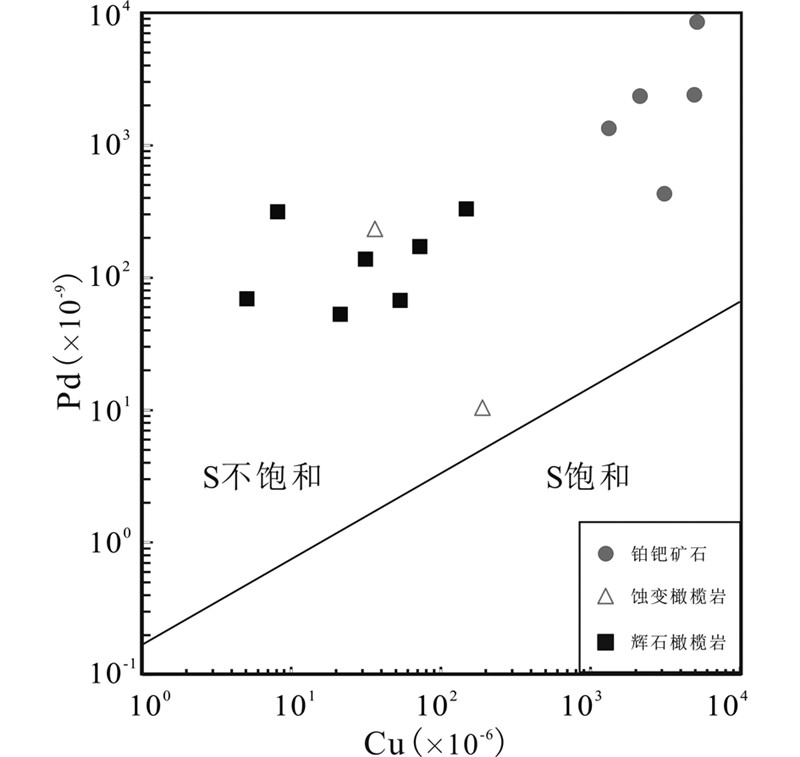 | 图 12 金宝山岩体Cu-Pd图解(底图据Vogel and Keays, 1997) Fig. 12 Cu vs. Pd diagram of the Jinbaoshan intrusion(after Vogel and Keays, 1997) |
Wang et al.(2010)认为金宝山岩体富PGE岩浆的形成源于一个开放岩浆通道系统“多阶段熔解叠加”过程,在岩浆侵位之前,在深部岩浆房中由于橄榄石和铬铁矿的分离结晶作用使得岩浆从S不饱和变饱和。然而这种解释忽略了地壳混染作用在成矿过程中的贡献。上文通过(Th/Yb)PM-(Nb/Yb)PM图解估算得出金宝山岩体地壳混染程度在55%~70%之间,混染程度比较高。然而样品的S/Se比值均等于或低于原始地幔的范围,此外,马言胜等(2009)报道了金宝山矿床的硫化物δ34S值为0.6‰~2.8‰,接近地幔硫(0±2‰),这些均没有展现出有明显地壳混染的特征。前人总结出这可能是由于两方面的原因。第一种是由于岩浆侵位之后热液作用使得S丢失,第二种便是由于这种“多阶段熔解叠加”过程,在岩浆侵位之前或侵位过程中硫化物发生部分熔解(Kerr and Leitch, 2005)。热液蚀变作用对元素迁移是非常有限的,金宝山岩体样品S/Se平均值为1318,即使与原始地幔S/Se比值下限相比,依然发生了一半以上的S的丢失,这是热液作用所无法做到的。相比之下,对于第二种方式Kerr and Leitch(2005)研究表明多期的S不饱和岩浆可以与硫化物熔体相互作用使得硫化物在深部岩浆房或岩浆通道中发生部分熔解过程。通过这种方式PGE与Se等具有高Dsul/sil(硫化物/硅酸盐熔体中的分配系数)值的元素将在岩浆中富集。Pd的Dsul/sil值为17000~92000(Naldrett,2011),Se的Dsul/sil值为1770(Peach et al., 1990),这些元素将优先进入到硫化物熔体当中;相反,一些具有较低分配系数的元素诸如Fe、S等将保留在残余岩浆中。岩浆中硫化物熔体从而富集Se、Pd,亏损S、Fe。因此通过硫化物的部分熔解可以使得原本具有地壳混染特征的岩矿石样品的S/Se比值降低。
由此我们推测,金宝山岩体PGE的富集源于岩浆侵位之前深部岩浆房中硫化物大规模发生熔离而非之后就地混染的结果。早阶段在深部岩浆房中强烈的地壳混染作用使得岩浆中的S饱和、硫化物发生熔离并形成富PGE岩浆,后续的不饱和岩浆与先前的硫化物熔体相互作用使得硫化物发生部分熔解,在这一过程中Pd、Se等元素在硫化物熔体中进一步聚集,而S、Fe等元素将会保留在残余岩浆之中。之后这种富PGE岩浆被带入到浅部岩浆房,与地壳发生少量就地混染作用,硫化物发生低程度、小规模熔离,岩浆中的S没有达到饱和(图 13)。这种富PGE岩浆的多阶段叠加形成的机制与同样产出于大型层状岩体的加拿大River Valley矿床与南非Bushveld杂岩体的Platreef矿床形成机制非常类似。
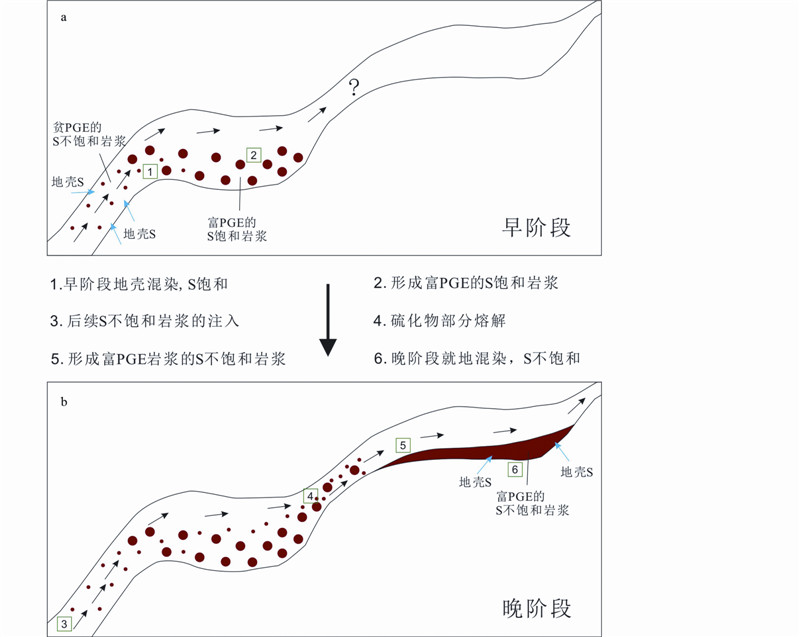 | 图 13 金宝山富PGE岩浆演化示意图 Fig. 13 The sketch map of the evolution of Jinbaoshan PGE-rich magma |
很多学者认为地壳混染作用在形成大型PGE矿床的过程中是必不可少的(Lesher and Keays, 2002; Wilson and Chunnett, 2006)。而且地壳S的加入被认为是成矿的不可或缺的重要条件(Keays and Lightfoot, 2010)。与一些其他大型PGE矿床类似,金宝山铂钯矿成矿岩浆发生了较为强烈的地壳混染,但S/Se比值与δ34S值依然较低。现在普遍认为这类矿床的成矿岩浆曾在深部岩浆房已达到了S饱和,并且发生过早、晚两期地壳混染作用(Holwell et al., 2007; Ihlenfeld and Keays, 2011)。相比晚期的就地混染,早阶段深部岩浆房中发生的地壳混染可以使得更多的硫化物发生部分熔解使得PGE富集,因此产生高品位PGE矿床的最佳条件为深部岩浆房或岩浆通道中地壳混染作用以及之后的硫化物部分熔解,这可以使得PGE在有限的空间内大量聚集,为后期含矿岩浆的运移提供物质基础。
流体对于Cu-Ni-PGE矿床成矿的作用目前尚存有争议,热液流体可以增强PGE的流动性并使得PGE在矿床中富集(Wood,2002)。近年来许多关于铂族矿物的研究表明,虽然热液活动改变了其矿物学特征,但并没有实际改变岩浆硫化物中PGE的分配情况,也就是并没有使得PGE发生“解耦”(Hutchinson and Kinnarid, 2005; Holwell et al., 2014)。所以,同期或后期的热液流体通常被认为对成矿所起的作用非常有限。金宝山岩体样品PGE元素均显示出良好的线性关系,这也进一步证明岩浆后期热液作用几乎不对PGE的再分配和重结晶产生影响。
Cu/Pd比值已经被成功用来指示岩浆中的S是否发生饱和。前人研究发现澳大利亚Munni杂岩体PGE矿层(Hoatson and Keays, 1989),南非Bushveld杂岩体(Maier et al., 1996),以及格陵兰Skaergaard岩体(Holwell and Keays, 2014)中矿体的Cu/Pd和Cu/Pt比值都会发生显著提高。因此Cu/Pd、Cu/Pt比值已经被广泛运用在PGE矿床勘查及判别一种岩体是否发生过S饱和从而判别矿体及矿化岩体的相对位置。例如位于Sudbury杂岩体Ni-Cu-PGE硫化物矿石接触带之上的苏长岩强烈亏损PGE、Cu、Ni等元素(Keays and Lightfoot, 2004)。这种位于硫化物矿石之上的围岩显著亏损亲铜元素的现象已经被广泛用于Sudbury地区Ni-Cu-PGE矿床的找矿勘查。
然而,诸如本文金宝山铂钯矿床等一些PGE矿床,Cu/Pd、Cu/Pt比值可以出现接近原始地幔甚至低于原始地幔范围的情况,表明虽然岩浆侵位时S未发生饱和,PGE依然高度富集。因而对于峨眉山大火成岩省中基性-超基性岩带内出现Cu/Pd、Cu/Pt值低的岩体,其仍有形成大型PGE矿床的潜力。 6 结论
地壳混染是金宝山铂钯矿床成矿的一个重要因素。其中早阶段地壳混染,使得硫化物在深部岩浆通道中发生S饱和继而发生硫化物大规模熔离,硫化物在深部岩浆房中富集PGE,硫化物的部分熔解使得其S/Se比值大大降低。晚阶段岩浆发生少量就地混染,S未能达到饱和,不饱和的岩浆与富PGE硫化物反应形成了现有的富PGE金宝山岩体。微量元素、铂族元素地球化学特征可以反映这一系列过程。说明金宝山岩体成矿的关键在于早阶段岩浆系统深部发生S饱和,晚阶段含矿岩浆与硫化物熔体被带到现有的位置聚集成矿。金宝山铂钯矿床与加拿大River Valley矿床和南非Bushveld的Platreef矿床成因机制类似,诸如此类岩浆多阶段侵位形成的岩浆型PGE矿床,通过Cu/Pd比值判断岩体是否成矿的认识可能并不全面,即出现Cu/Pd比值较低的岩体仍可能有较大的成矿潜力。
致谢野外工作得到了云南云宝铂钯矿业有限公司工作人员的帮助和支持;PGE测试分析得到国家地质实验测试中心相关工作人员的协助;魏博、张东阳和宋晨博士为论文的完善提出了宝贵的意见;研究生张良、郭耀宇和杨镇参加了部分研究工作;在此一并致以诚挚的感谢!
| [1] | Barnes SJ, Naldrett AJ and Gorton MP. 1985. The origin of the fractionation of platinum-group elements in terrestrial magmas. Chemical Geology, 53(3): 303-323 |
| [2] | Barnes SJ, Couture JF, Sawyer EW and Bouchaib C. 1993. Nickel-copper occurrences in the Belleterre-Angliers belt of the Pontiac subprovince and the use of Cu-Pd ratios in interpreting platinum-group element distributions. Economic Geology, 88(6): 1402-1418 |
| [3] | Crocket JH. 2000. PGE in fresh basalt, hydrothermal alteration products, and volcanic incrustations of Kilauea volcano, Hawaii. Geochimica et Cosmochimica Acta, 64(10): 1791-1807 |
| [4] | Deng J, Wang QF, Yang LQ, Gao BF, Huang DH, Liu Y, Xu H and Jiang SQ. 2007. Reconstruction of ore-controlling structures resulting from magmatic intrusion into the Tongling Ore Cluster Area during the Yanshanian Epoch. Acta Geologica Sinica, 81(2): 287-296 |
| [5] | Deng J, Yang LQ, Ge LS, Yuan SS, Wang QF, Zhang J, Gong QJ and Wang CM. 2010a. Character and post-ore changes, modifications and preservation of Cenozoic alkali-rich porphyry gold metallogenic system in western Yunnan, China. Acta Petrologica Sinica, 26(6): 1633-1645 (in Chinese with English abstract) |
| [6] | Deng J, Hou ZQ, Mo XX, Yang LQ, Wang QF and Wang CM. 2010b. Superimposed orogenesis and metal ogenesis in Sanjiang Tethys. Mineral Deposits, 29(1): 37-42 (in Chinese with English abstract) |
| [7] | Deng J, Wang QF, Xiao CH, Yang LQ, Liu H, Gong QJ and Zhang J. 2011a. Tectonic-magmatic-metallogenic system, Tongling ore cluster region, Anhui Province, China. International Geology Review, 53(5-6): 449-476 |
| [8] | Deng J, Wang QF, Wan L, Liu H, Yang LQ and Zhang J. 2011b. A multifractal analysis of mineralization characteristics of the Dayingezhuang disseminated-veinlet gold deposit in the Jiaodong gold province of China. Ore Geology Reviews, 40(1): 54-64 |
| [9] | Deng J, Yang LQ and Wang CM. 2011. Research advances of superimposed orogenesis and metallogenesis in the Sanjiang Tethys. Acta Petrologica Sinica, 27(9): 2501-2509 (in Chinese with English abstract) |
| [10] | Deng J, Wang QF, Li GJ, Li CS and Wang CM. 2014a. Tethys tectonic evolution and its bearing on the distribution of important mineral deposits in the Sanjiang region, SW China. Gondwana Research, 26(2): 419-437 |
| [11] | Deng J, Wang QF, Li GJ and Santosh M. 2014b. Cenozoic tectono-magmatic and metallogenic processes in the Sanjiang region, southwestern China. Earth-Science Reviews, DOI: 10.1016/j.earscirev.2014.05.015 |
| [12] | Eckstrand OR and Hulbert LJ. 1987. Selenium and the source of sulphur in magmatic nickel and platinum deposits. Geol. Assoc. Canada/Mineral Assoc. Canada: Program with Abstracts, 12: 40 |
| [13] | Fleet ME, Chryssoulis SL, Stone WE and Weisener CG. 1993. Partitioning of platinum-group elements and Au in the Fe-Ni-Cu-S system: Experiments on the fractional crystallization of sulfide melt. Contributions to Mineralogy and Petrology, 115(1): 36-44 |
| [14] | Fleet ME, Crocket JH and Stone WE. 1996. Partitioning of platinum-group elements (Os, Ir, Ru, Pt, Pd) and gold between sulfide liquid and basalt melt. Geochimica et Cosmochimica Acta, 60(13): 2397-2412 |
| [15] | Hoatson DM and Keays RR. 1989. Formation of platiniferous sulfide horizons by crystal fractionation and magma mixing in the Munni Munni layered intrusion, West Pilbara Block, Western Australia. Economic Geology, 84(7): 1775-1804 |
| [16] | Holwell DA and McDonald I. 2007. Distribution of platinum-group elements in the Platreef at Overysel, northern Bushveld Complex: A combined PGM and LA-ICP-MS study. Contributions to Mineralogy and Petrology, 154(2): 171-190 |
| [17] | Holwell DA and Keays RR. 2014. The formation of low-volume, high-tenor magmatic PGE-Au sulfide mineralization in closed systems: Evidence from precious and base metal geochemistry of the Platinova Reef, Skaergaard intrusion, East Greenland. Economic Geology, 109(2): 387-406 |
| [18] | Holwell DA, Keays RR, Firth EA and Findlay J. 2014. Geochemistry and mineralogy of platinum group element mineralization in the River Valley Intrusion, Ontario, Canada: A model for early-stage sulfur saturation and multistage emplacement and the implications for “contact-type” Ni-Cu-PGE sulfide mineralization. Economic Geology, 109(3): 689-712 |
| [19] | Hutchinson D and Kinnaird JA. 2005. Complex multistage genesis for the Ni-Cu-PGE mineralisation in the southern region of the Platreef, Bushveld Complex, South Africa. Applied Earth Science: Transactions of the Institutions of Mining and Metallurgy: Section B, 114(4): 208-224 |
| [20] | Ihlenfeld C and Keays RR. 2011. Crustal contamination and PGE mineralization in the Platreef, Bushveld Complex, South Africa: Evidence for multiple contamination events and transport of magmatic sulfides. Mineralium Deposita, 46(7): 813-832 |
| [21] | Keays RR, Nickel EH, Groves DI and McGoldrick PJ. 1982. Iridium and palladium as discriminants of volcanic-exhalative, hydrothermal, and magmatic nickel sulfide mineralization. Economic Geology, 77(6): 1535-1547 |
| [22] | Keays RR. 1995. The role of komatiitic and picritic magmatism and S-saturation in the formation of ore deposits. Lithos, 34(1): 1-18 |
| [23] | Keays RR and Lightfoot PC. 2004. Formation of Ni-Cu-platinum group element sulfide mineralization in the Sudbury impact melt sheet. Mineralogy and Petrology, 82(3-4): 217-258 |
| [24] | Keays RR and Lightfoot PC. 2010. Crustal sulfur is required to form magmatic Ni-Cu sulfide deposits: Evidence from chalcophile element signatures of Siberian and Deccan Trap basalts. Mineralium Deposita, 45(3): 241-257 |
| [25] | Kerr A and Leitch AM. 2005. Self-destructive sulfide segregation systems and the formation of high-grade magmatic ore deposits. Economic Geology, 100(2): 311-332 |
| [26] | Lesher CM and Keays RR. 2002. Komatiite-associated Ni-Cu-PGE deposits: Geology, mineralogy, geochemistry and genesis. In: Louis JC (ed.). The Geology, Geochemistry, Mineralogy, and Mineral Beneficiation of the Platinum-Group Elements. Canadian Institute of Mining, Metallurgy and Petroleum, 54: 579-617 |
| [27] | Li C, Maier WD and De Waal SA. 2001. Magmatic Ni-Cu versus PGE deposits: Contrasting genetic controls and exploration implications. South African Journal of Geology, 104(4): 309-318 |
| [28] | Lightfoot PC and Hawkesworth CJ. 1997. Flood basalts and magmatic Ni, Cu, and PGE sulphide mineralization: Comparative geochemistry of the Noril’sk (Siberian Traps) and West Greenland sequences. Geophysical Monograph Series, 100: 357-380 |
| [29] | Ma YS, Tao Y, Zhu FL and Wang XZ. 2009. The sulfur isotopic characteristics and geological significance of Jinbaoshan Pt-Pd deposit and Limahe nickel deposit. Bulletin of Mineralogy, Petrology and Geochemistry, 28(2): 123-127 (in Chinese with English abstract) |
| [30] | Maier WD, Barnes SJ, De Klerk WJ, Teigler B and Mitchell AA. 1996. Cu/Pd and Cu/Pt of silicate rocks in the Bushveld Complex: Implications for platinum-group element exploration. Economic Geology, 91(6): 1151-1158 |
| [31] | Maier WD and Barnes SJ. 1999. Platinum-group elements in silicate rocks of the lower, critical and main zones at union section, Western Bushveld Complex. Journal of Petrology, 40(11): 1647-1671 |
| [32] | Mavrogenes JA and O’Neill HSC. 1999. The relative effects of pressure, temperature and oxygen fugacity on the solubility of sulfide in mafic magmas. Geochimica et Cosmochimica Acta, 63(7): 1173-1180 |
| [33] | McDonald I and Holwell DA. 2007. Did lower zone magma conduits store PGE-rich sulphides that were later supplied to the Platreef? South African Journal of Geology, 110(4): 611-616 |
| [34] | McDonald I and Holwell DA. 2007. Did lower zone magma conduits store PGE-rich sulphides that were later supplied to the Platreef? South African Journal of Geology, 110(4): 611-616 |
| [35] | McDonough WF and Sun SS. 1995. The composition of the Earth. Chemical Geology, 120(3): 223-253 |
| [36] | Naldrett AJ. 2010. Secular variation of magmatic sulfide deposits and their source magmas. Economic Geology, 105(3): 669-688 |
| [37] | Naldrett AJ. 2011. Fundamentals of magmatic sulfide deposits. Reviews in Economic Geology, 17: 1-50 |
| [38] | Peach CL, Mathez EA and Keays RR. 1990. Sulfide melt-silicate melt distribution coefficients for the noble metals and other chalcophile metals as deduced from MORB: Implications for partial melting. Geochimica et Cosmochimica Acta, 54(12): 3379-3389 |
| [39] | Righter K, Campbell AJ, Humayun M and Hervig RL. 2004. Partitioning of Ru, Rh, Pd, Re, Ir, and Au between Cr-bearing spinel, olivine, pyroxene and silicate melts. Geochimica et Cosmochimica Acta, 68(4): 867-880 |
| [40] | Sun SS and McDonough WF. 1989. Chemical and isotopic systematics of oceanic basalts: Implications for mantle composition and processes. In: Saunders AD and Norry MJ (eds.). Magmatism in Oceanic Basins. Geological Society, London, Special Publications, 42(1): 313-345 |
| [41] | Sun SS and McDonough WF. 1989. Chemical and isotopic systematics of oceanic basalts: Implications for mantle composition and processes. In: Saunders AD and Norry MJ (eds.). Magmatism in Oceanic Basins. Geological Society, London, Special Publications, 42(1): 313-345 |
| [42] | Tao Y, Zhu D, Gao ZM and Luo TY. 2003 Study on PGE remobilization in Jinbaoshan PGE deposit. Bulletin of Mineralogy, Petrology and Geochemistry, 22(1): 32-37 (in Chinese with English abstract) |
| [43] | Tao Y, Li C, Hu RZ, Ripley EM, Du AD and Zhong H. 2007. Petrogenesis of the Pt-Pd mineralized Jinbaoshan ultramafic intrusion in the Permian Emeishan large igneous province, SW China. Contributions to Mineralogy and Petrology, 153(3): 321-337 |
| [44] | Tao Y, Li C, Hu RZ, Ripley EM, Du AD and Zhong H. 2007. Petrogenesis of the Pt-Pd mineralized Jinbaoshan ultramafic intrusion in the Permian Emeishan large igneous province, SW China. Contributions to Mineralogy and Petrology, 153(3): 321-337 |
| [45] | Vogel DC and Keays RR. 1997. The petrogenesis and platinum-group element geochemistry of the Newer Volcanic Province, Victoria, Australia. Chemical Geology, 136(3): 181-204 |
| [46] | Wang CY, Zhou MF and Zhao D. 2005. Mineral chemistry of chromite from the Permian Jinbaoshan Pt-Pd-sulphide-bearing ultramafic intrusion in SW China with petrogenetic implications. Lithos, 83(1): 47-66 |
| [47] | Wang CY, Zhou MF and Keays RR. 2006. Geochemical constraints on the origin of the Permian Baimazhai mafic-ultramafic intrusion, SW China. Contributions to Mineralogy and Petrology, 152(3): 309-321 |
| [48] | Wang CY, Zhou MF and Qi L. 2010. Origin of extremely PGE-rich mafic magma system: An example from the Jinbaoshan ultramafic sill, Emeishan large igneous province, SW China. Lithos, 119(1): 147-161 |
| [49] | Wang SW, Sun XM, Liao ZW, Zhou BG, Luo MJ, Guo Y, Jiang XF, Zhu HP, Ma D and Shen ZW. 2012. Platinum group elements geochemistry of Jinbaoshan Pt-Pd deposit in Yunnan Province and its exploration implications. Mineral Deposits, 31(6): 1259-1276 (in Chinese with English abstract) |
| [50] | Wang Y. 2008. Origin of the Permian Baimazhai magmatic Ni-Cu-(PGE) sulfide deposits, Yunnan: Implications for the relationship of crustal contamination and mineralization. Bulletin of Mineralogy, Petrology and Geochemistry, 27(4): 332-343 (in Chinese with English abstract) |
| [51] | Wilson A and Chunnett G. 2006. Trace element and platinum group element distributions and the genesis of the Merensky Reef, Western Bushveld Complex, South Africa. Journal of Petrology, 47(12): 2369-2403 |
| [52] | Wood SA. 2002. The aqueous geochemistry of the platinum-group elements with applications to ore deposits. The Geology, Geochemistry, Mineralogy and Mineral beBneficiation of Platinum-group Elements. CIM Spec., 54: 211-249 |
| [53] | Yang LQ, Deng J, Zhang J, Guo CY, Gao BF, Gong QJ, Wang QF, Jiang SQ and Yu HJ. 2008. Decrepitation thermometry and compositions of fluid inclusions of the Damoqujia gold deposit, Jiaodong gold province, China: Implications for metallogeny and exploration. Journal of China University of Geosciences, 19(4): 378-390 |
| [54] | Yang LQ, Liu JT, Zhang C, Wang QF, Ge LS, Wang ZL, Zhang J and Gong QJ. 2010. Superimposed orogenesis and metallogenesis: An example from the orogenic gold deposits in Ailaoshan gold belt, Southwest China. Acta Petrologica Sinica. 26 (6): 1723-1739 (in Chinese with English abstract) |
| [55] | Yang LQ, Liu JT, Zhang C, Wang QF, Ge LS, Wang ZL, Zhang J and Gong QJ. 2010. Superimposed orogenesis and metallogenesis: An example from the orogenic gold deposits in Ailaoshan gold belt, Southwest China. Acta Petrologica Sinica. 26 (6): 1723-1739 (in Chinese with English abstract) |
| [56] | Yang LQ, Deng J, Zhao K and Liu JT. 2011b. Tectono-thermochronology and gold mineralization events of orogenic gold deposits in Ailaoshan orogenic belt, Southwest China: Geochronological constraints. Acta Petrologica Sinica, 27(9): 2519-2532 (in Chinese with English abstract) |
| [57] | Yang LQ and Badal J. 2013. Mirror symmetry of the crust in the oil/gas region of Shengli, China. Journal of Asian Earth Sciences, 78: 327-344 |
| [58] | Yang LQ, Deng J, Goldfarb RJ, Zhang J, Gao BF and Wang ZL. 2014. 40Ar/39Ar geochronological constraints on the formation of the Dayingezhuang gold deposit: New implications for timing and duration of hydrothermal activity in the Jiaodong gold province, China. Gondwana Research, 25: 1469-1483 |
| [59] | Yang LQ, Deng J, Goldfarb RJ, Zhang J, Gao BF and Wang ZL. 2014. 40Ar/39Ar geochronological constraints on the formation of the Dayingezhuang gold deposit: New implications for timing and duration of hydrothermal activity in the Jiaodong gold province, China. Gondwana Research, 25: 1469-1483 |
| [60] | Yuan F, Zhou TF, Zhang DY, Jowitt SM, Keays RR, Liu S and Fan Y. 2012. Siderophile and chalcophile metal variations in basalts: Implications for the sulfide saturation history and Ni-Cu-PGE mineralization potential of the Tarim continental flood basalt province, Xinjiang Province, China. Ore Geology Reviews, 45: 5-15 |
| [61] | 邓军,杨立强,葛良胜,袁士松,王庆飞,张静,龚庆杰,王长明.2010a.滇西富碱斑岩型金成矿系统特征与变化保存.岩石学报,26(6):1633-1645 |
| [62] | 邓军,侯增谦,莫宣学,杨立强,王庆飞,王长明.2010b.三江特提斯复合造山与成矿作用.矿床地质,29(1):37-42 |
| [63] | 邓军,杨立强,王长明.2011.三江特提斯复合造山与成矿作用研究进展.岩石学报,27(9):2501-2509 |
| [64] | 马言胜,陶琰,朱飞霖,王兴阵.2009.金宝山铂-钯矿和力马河镍矿的硫同位素组成特征及地质意义.矿物岩石地球化学通报,28(2):123-127 |
| [65] | 陶琰,高振敏,罗泰义,祁敬东,禾英军,杨廷祥.2002.云南金宝山超镁铁岩原始岩浆成分反演. 岩石学报,18(1):70-82 |
| [66] | 陶琰,朱丹,高振敏,罗泰义.2003.金宝山铂族元素矿床铂族元素的热液活动研究.矿物岩石地球化学通报,22(1):32-37 |
| [67] | 王生伟,孙晓明,廖震文,周邦国,罗茂金,郭阳,蒋小芳,朱华平,马东,沈战武.2012.云南金宝山铂钯矿床铂族元素地球化学及找矿意义.矿床地质,31(6):1259-1276 |
| [68] | 王焰.2008.云南二叠纪白马寨铜镍硫化物矿床的成因:地壳混染与矿化的关系.矿物岩石地球化学通报,27(4):332-343 |
| [69] | 杨立强,刘江涛,张闯,王庆飞,葛良胜,王中亮,张静,龚庆杰.2010.哀牢山造山带金成矿系统:复合造山构造演化与成矿作用初探.岩石学报,26(6):1723-1739 |
| [70] | 杨立强,邓军,赵凯,刘江涛,葛良胜,周道卿,李士辉,曹宝宝.2011a.滇西大坪金矿床地质特征及成因初探.岩石学报, 27(12): 3800-3810 |
| [71] | 杨立强,邓军,赵凯,刘江涛.2011b.哀牢山造山带金矿成矿时序及动力学背景探讨.岩石学报,27(9):2519-2532 |
| [72] | 杨利亚,杨立强,袁万明,张闯,赵凯,于海军.2013.造山型金矿成矿流体来源与演化的氢-氧同位素示踪:夹皮沟金矿带例析.岩石学报,29(11):4025-4035 |