 2014, Vol. 30


2. 中国地质大学地质过程与矿产资源国家重点实验室, 北京 100083;
3. 新疆维吾尔自治区地质调查院, 乌鲁木齐 830000
2. State Key Laboratory of Geological Process and Mineral Resources, China University of Geosciences, Beijing 100083, China;
3. Xinjiang Institute of Geological Survey, Urumqi 830000, China
自1979年区域化探全国扫面计划开始和自1999年多目标区域地球化学调查开始至今,我国已获得覆盖陆地国土7百余万平方千米的水系沉积物和土壤样品的39项元素分析数据(Xie et al., 1997; 谢学锦和周国华,2002; 杨忠芳等,2007; 谢学锦等,2009; Gong et al., 2013; Xie and Cheng, 2014; Li et al., 2014)。所取得的海量地球化学数据在我国矿产资源勘查、基础地质研究、环境、生态及农业等研究方面发挥了重要的作用(Cheng et al., 2014; Yang et al., 2014a; Yang and Badal, 2013; Deng et al., 2010; Gong et al., 2008)。全国矿产资源潜力评价项目自2006年执行以来,全国化探工作组与大区、省级化探工作者共同补充完善了我国区域化探数据库,制定了化探资料应用技术流程(向运川等,2010)。这一成果为海量区域地球化学数据在基础地质、矿产勘查以及环境、生态等方面的应用提供了可靠的数 据。
区域地球化学数据是地表物质化学组成的直接反映,具有不同化学组成的地表物质其差异必将反映在区域地球化学数据之中,因此利用区域化探数据的空间分布特征可以推断地表地质体的空间分布规律。花岗岩类侵入体不仅是地表出露的主要岩石类型之一,而且与许多大型、超大型矿床关系密切(Hua et al., 2004; Yang et al., 2014b; Deng et al., 2014a; Wang et al., 2014a)。花岗岩类侵入体的主要地球化学特征在氧化物方面表现为富K2O贫Fe2O3(区域化探全国扫面计划所分析的7项氧化物不包括FeO),在微量元素方面表现为富高场强元素贫相容元素等(Yan and Chi, 2005; 史长义等,2005)。本文研究主要是基于花岗岩类侵入体的这一地球化学特征,依据区域化探数据在模型区构建推断花岗岩类侵入体的地球化学模型,进而将其应用到研究区。 2 模型区与研究区
根据全国矿产资源潜力评价化探资料应用研究成果,全国共划分出5个地球化学域和25个地球化学省(表 1、图 1)。全国5个一级地球化学域按照编号分别为1古亚洲地球化学域、2秦祁昆地球化学域、3特提斯地球化学域、4扬子地球化学域和5滨太平洋地球化学域。全国25个二级地球化学省编号采用2位编码,第1位为地球化学域编码,第2位为地球化学省编码,编码自北向南、自西向东顺序编号(图 1)。
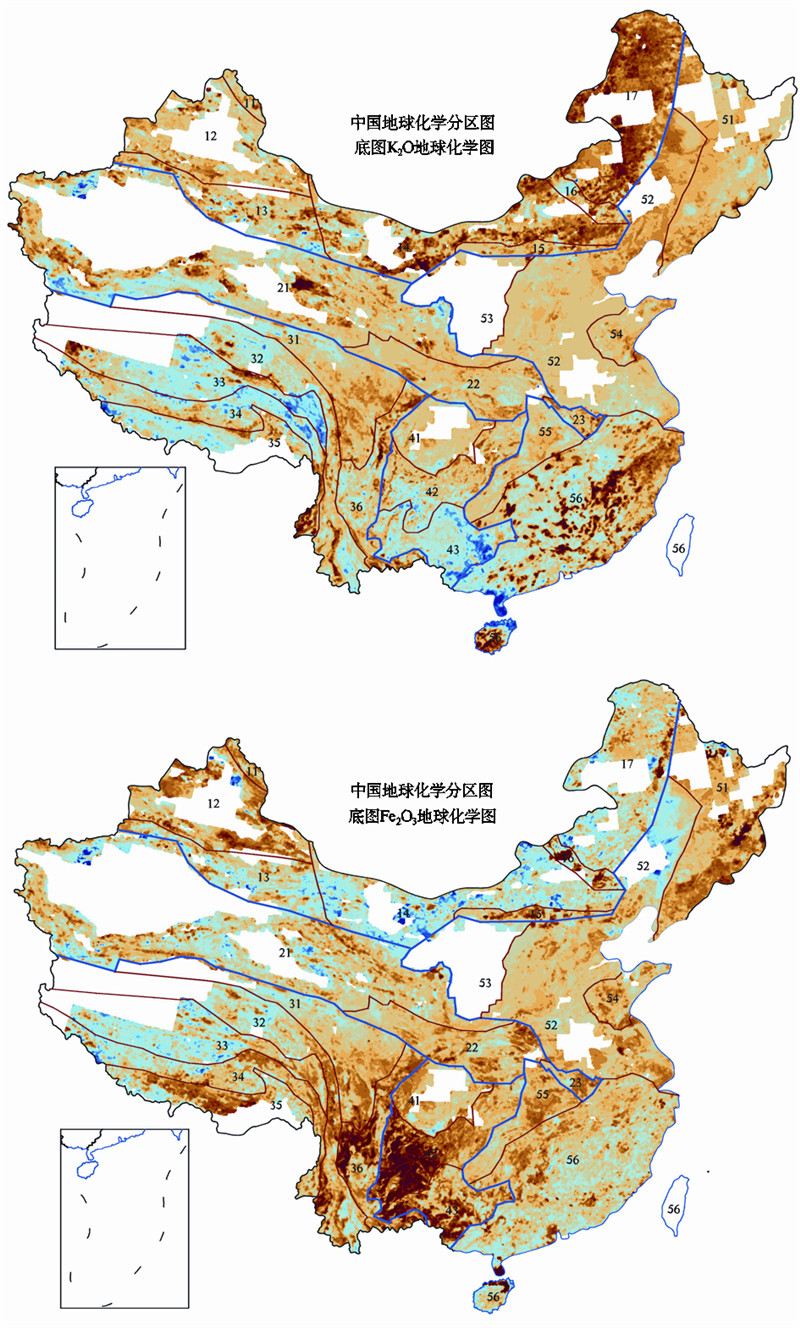 | 图 1 全国地球化学域和地球化学省划分方案 地球化学图采用GeoExpl软件中累频19级方法绘制,色标从深蓝色渐变至深红色代表从低值渐变至高值.此图为全国矿产资源潜力评价化探资料应用研究成果 Fig. 1 Classification of geochemical domain and geochemical province in Chin l and surface |
 | 表 1 全国二级地球化学省划分方案 Table 1 Classification of geochemical province in China l and surface |
图 1全国地球化学分区图中底图分别采用K2O和Fe2O3的地球化学图来表示,其目的有二。一是全国地球化学分区图的划分必然参考了K2O和Fe2O3的地球化学图,据此可以辨析地球化学分区的合理性;另一是花岗岩类侵入体具有富K2O贫Fe2O3的特征,据此可以推断可能的花岗岩类侵入体分布区。
对比图 1中的K2O和Fe2O3的地球化学图可以看出存在明显富K2O贫Fe2O3的地区有三处:大兴安岭地球化学省(图 1中17)、华南丘陵地球化学省(图 1中56)和云南西部的腾冲地球化学亚省(图 1中34南段)-哀牢山地球化学亚省(图 1中36南段)。
在大兴安岭地球化学省由于受森林景观影响目前对其基础地质研究程度不很高,不考虑将其作为已知区开展建模研究。在华南丘陵地球化学省目前对其基础地质研究程度高,尤其是对花岗岩类侵入体的空间分布也已基本查明,但花岗岩类侵入体在空间上呈零散片状分布,规律性不很明显,不易选为模型区。在云南西部的腾冲地球化学亚省和哀牢山地球化学亚省,花岗岩类侵入体分布相对比较集中,基本呈弧形带状和条带状分布,规律性比较强(图 2a)。因此本文选择云南西部的腾冲地球化学亚省和哀牢山地球化学亚省为模型区来构建花岗岩类侵入体的区域地球化学推断模型,进而选择华南丘陵地球化学省的中段为模型应用研究区以检验模型的适用性。
云南西部的腾冲地球化学亚省和哀牢山地球化学亚省是特提斯地球化学域的南段,即三江特提斯造山带和成矿带(Deng et al., 2013a,2014b)。三江特提斯成矿带以大型、超大型Au、Cu、Pb-Zn等矿床而备受关注,尤其是哀牢山金成矿带(Yang et al., 2010; 杨立强等, 2011a,b; 邓军等, 2012,2013b; Wang et al., 2013b,2014b; 张静等,2010; Zhang et al., 2013)。在澜沧江成矿带发育有云南著名的临沧花岗岩体和勐海花岗岩体(Gong et al., 2011),在腾冲地区发育有东河-明光花岗岩带、古永花岗岩带和槟榔江花岗岩带(江彪等,2012; Wang et al., 2013b)。 3 花岗岩类侵入体地球化学推断模型 3.1 模型区地球化学特征
基于花岗岩类侵入体富K2O和高场强元素贫Fe2O3和相容元素的地球化学特征,在全国矿产资源潜力评价成果之全国地球化学图中直接裁剪出云南西部地区部分高场强元素和相容元素(即在基性岩中富集和在花岗岩中贫化的元素)的地球化学图分别如图 2和图 3所示。
 | 图 2 全国侵入岩及高场强元素地球化学图中云南西部地区视图 图(a)侵入岩分布图引自全国矿产资源潜力评价研究成果,粉红色区域为花岗岩类侵入体分布区.绘图数据来源于全国区域化探数据库Fig. 2 Map of intrusions and geochemical map of high field strength elements in the western of Yunnan Province,China |
 | 图 3 全国相容元素地球化学图中云南西部地区视图 图区范围与图 2一致.绘图数据来源于全国区域化探数据库 Fig. 3 Geochemical map of compatible elements in the western of Yunnan Province,China |
从图 2可以看出,高场强元素Th、U、La、Y、Zr在澜沧江带均呈带状显著富集,在腾冲地区均呈弧形带状显著富集,其富集区与该区花岗岩类侵入体的空间分布区相吻合。
在图 3中,相容元素Co、Ni、V、Cr、Ti、Fe2O3在澜沧江带均出现贫化现象,但在其东侧出现带状富集现象;在腾冲地区相容元素均出现显著贫化现象,但在保山地区及其南部相容元素均出现显著富集的现象。
将图 2与图 3对比可以发现,相容元素Co、Ni、V、Cr、Ti、Fe2O3的贫化区均位于花岗岩类侵入体的分布区。该区花岗岩类侵入体的带状空间分布决定了高场强元素与相容元素的带状分布特征,这两类元素的富集与贫化区在云南西部地区似乎具有相间排列的规律。 3.2 模型构建
在云南西部模型区内上述高场强元素和相容元素富集与贫化具有相间排列的规律主要取决于该区花岗岩类侵入体的带状空间分布。区域化探全国扫面计划规定分析测试项目为39项,为了更好地揭示元素含量与矿床及其它地质体的关系,许多研究者提出了新的数据处理方法技术(Hao et al., 2014; Ma et al., 2014; Deng et al., 2011; Sun et al., 2010; 韩东昱等,2004)。本文为揭示反映花岗岩类侵入体的分析指标,此处利用因子分析首先查明指示花岗岩类侵入体的分析指标,进而依据因子载荷矩阵建立回归分析模型获得指示花岗岩类侵入体的综合指标。
在全国区域化探数据库中检索出云南西部模型区的39项分析测试数据,对模型区39项指标进行因子分析,采用主成分分析法利用特征根大于1提取公因子并采用方差极大法进行因子旋转获得旋转因子载荷矩阵(表 2)。
| 表 2 云南西部地区旋转因子载荷矩阵 Table 2 Rotated component matrix of geochemical survey data in the western of Yunnan Province,China |
在表 2中,F1主要代表Fe2O3、Ti、V、Co、Cr、Ni、SiO2、Mn、Cu、Nb计10项指标,主要为相容元素组合(除SiO2、Nb外)。F2主要代表Th、Y、U、Zr、La、K2O、Al2O3、Be计8项指标,主要为高场强元素组合(除K2O、Be、Al2O3外)。F3主要代表Zn、Cd、Pb元素组合,F4主要代表Li、F、B、Be元素组合,F5主要代表CaO、MgO元素组合,F6主要代表Sn、Bi元素组合,F7主要代表Hg、Sb、As元素组合,F8主要代表Ba、Sr、P元素组合,F9代表Na2O,F10代表Au。
在F1中因SiO2具有负相关性,因此在回归计算F1因子得分时只采用排在SiO2前的Fe2O3、Ti、V、Co、Cr、Ni计六项指标,回归系数采用旋转因子系数,即
F1=0.95Fe2O3+0.93V+0.93Ti+0.92Co+0.81Cr+0.80Ni。
该综合指标代表相容元素组合,在花岗岩类侵入体中应该具有较低数值。
在F2中8项指标均为正相关,因此在回归计算F2因子得分时全部采用这些指标,回归系数采用旋转因子系数,即
F2=0.87Th+0.86Y+0.77U+0.77Zr+0.67La+0.61K2O+0.58Al2O3+0.53Be。
该综合指标主要代表高场强元素组合(属于不相容元素组合),在花岗岩类侵入体中应该具有较高数值。
为了突出强化差异,选取在花岗岩类侵入体中具有较高值的F2与具有较低值的F1进行比值,获得F2/F1综合指标。利用GeoExpl软件绘制F2/F1累频19级等值线图(图 4a),在此基础上选择累频85%、92%、98%值分别作为其异 常外、中、内带起始值绘制F2/F1的异常图(图 4b)。图 4c为F2/F1的异常等值线与花岗岩类侵入体的空间套合关 系。
 | 图 4 F2/F1等值区及其异常与花岗岩类侵入体的关系 (a)为F2/F1等值区图,(b)为F2/F1异常等值线图,(c)为侵入体图叠加F2/F1异常等值线图,其中粉红色区域为花岗岩类侵入体分布区,F2/F1异常外带为黑色线,异常中带为浅红色线,异常内带为棕红色线 Fig. 4 Geochemical map and geochemical anomaly map of F2/F1 which overlays on the granitic intrusion map in the western of Yunnan Province,China |
从图 4可以看出,在花岗岩类侵入体分布区F2/F1显著富集。F2/F1的异常区与该区花岗岩类侵入体的空间分布区吻合较好。这表明基于因子分析结果利用代表高场强元素组合与代表相容元素组合的公因子比值所构建的模型可以较好的反映花岗岩类侵入体的空间分布范围。 4 地球化学推断模型应用
利用在云南西部地区构建的区域地球化学推断花岗岩类侵入体模型所确定的参数,即
F1=0.95Fe2O3+0.93V+0.93Ti+0.92Co+0.81Cr+0.80Ni
F2=0.87Th+0.86Y+0.77U+0.77Zr+0.67La+0.61K2O+0.58Al2O3+0.53Be
将其推广到全国范围进行推演。
基于全国区域化探上述F1与F2所涉及的14项元素含量数据计算F2/F1值。然后绘制全国F2/F1累频19级等值线地球化学图及其外、中、内三级异常图。在全国F2/F1等值区图及其异常图中直接裁剪出华南中部地区F2/F1的等值区图(图 5a)和异常图(图 5b)。将图 5b中异常等值线叠加到华南中部侵入体图中获得图 6。
 | 图 5 华南中部F2/F1等值区图及其异常图 (a)为F2/F1等值区图,(b)为F2/F1异常等值线图,图中地名与图 6中相同 Fig. 5 Geochemical map and geochemical anomaly map in the middle part of South China |
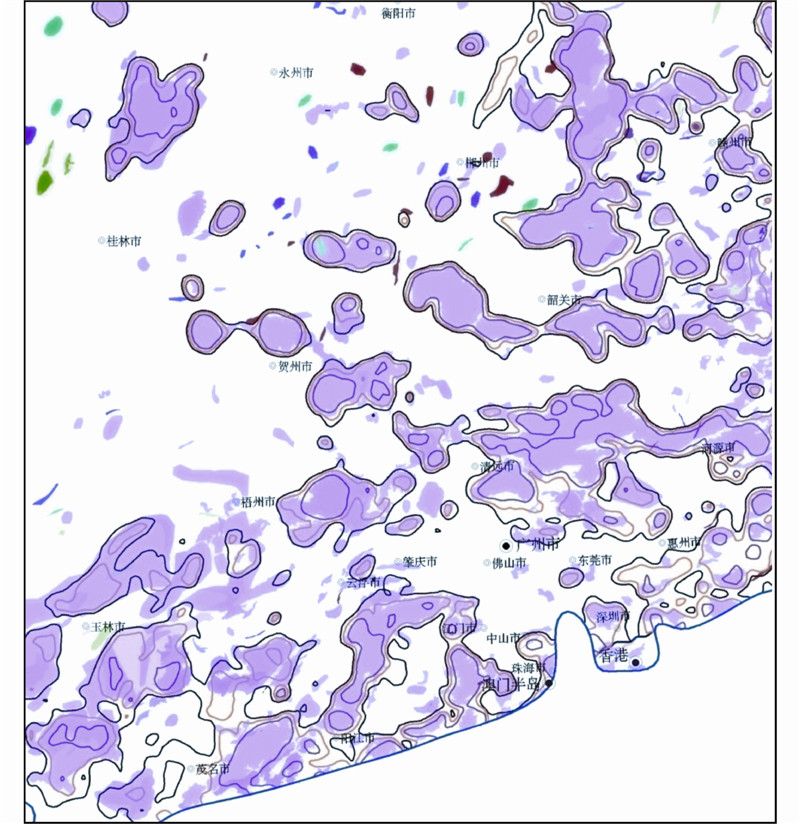 | 图 6 华南中部F2/F1异常等值线与侵入岩体空间关系 该区从全国图件中直接裁剪获得,图中粉红色区域为花岗岩类侵入体分布区,F2/F1异常外带为黑色线,异常中带为浅红色线,异常内带为棕红色线 Fig. 6 Geochemical anomaly map of F2/F1 which overlays on the granitic intrusion map in the middle part of South China |
从图 6可以看出,华南中部地区F2/F1异常区基本位于该区花岗岩类侵入体的空间分布区内,异常区形态和规模与侵入体的形态和规模吻合程度很高,尤其在韶关至桂林、贺州一带,花岗岩类侵入体边界与F2/F1勾绘的异常区边界几乎一致。此外还发现在局部地区F2/F1异常区范围明显大于实测花岗岩类侵入体的分布范围,如清远-惠州一带和茂名-阳江一带,据此推断这两处可能存在尚未证实的花岗岩类侵入体。
上述基于云南西部模型区建立的区域地球化学推断花岗岩类侵入体模型在华南中部地区得到有效检验。这一结果表明,在应用区域地球化学资料推断花岗岩类侵入体(或其它地质体)时只要方法技术合理、参数选择合适推断出的地质体有较强的可信性。这一方法技术在基础地质研究、矿产资源勘查及环境、生态等领域研究中将具有潜在应用价值。 5 结论
全国矿产资源潜力评价化探工作组编制了全国二级地球化学省划分方案,将全国共划分出5个地球化学域和25个地球化学省。在云南西部地区花岗岩类侵入体具有显著富K2O、Th、U、La、Y、Zr而贫Co、Ni、V、Cr、Ti、Fe2O3的特征。
选择云南西部地区利用因子分析数据处理技术构建了推断花岗岩类侵入体的区域地球化学推断模型。基于构建的推断模型在全国范围内进行推演并选择华南中部地区进行验证和应用,结果发现模型指标异常区与实测花岗岩类侵入体在空间形态和规模上相吻合,这不仅证实了所建模型的可行性,而且该模型在基础地质研究方面具有潜在应用价值。
致谢
研究工作得到了全国矿产资源潜力评价工作组,尤其是全国化探组及大区级、省级化探组成员的指导与帮助,在此致以诚挚的感谢!
| [1] | Cheng HX, Li M, Zhao CD, Li K, Peng M, Qin AH and Cheng XM. 2014. Overview of trace metals in the urban soil of 31 metropolises in China. Journal of Geochemical Exploration, 139: 31-52 |
| [2] | Deng J, Wang QF, Yang LQ, Wang YR, Gong QJ and Liu H. 2010. Delineation and explanation of geochemical anomalies using fractal models in the Heqing area, Yunnan Province, China. Journal of Geochemical Exploration, 105(3): 95-105 |
| [3] | Deng J, Wang QF, Wan L, Liu H, Yang LQ and Zhang J. 2011. A multifractal analysis of mineralization characteristics of the Dayingezhuang disseminated-veinlet gold deposit in the Jiaodong gold province of China. Ore Geology Reviews, 40(1): 54-64 |
| [4] | Deng J, Wang CM and Li GJ. 2012. Style and process of the superimposed mineralization in the Sanjiang Tethys. Acta Petrologica Sinica, 28(5): 1349-1361 (in Chinese with English abstract) |
| [5] | Deng J, Wang CM and Santosh M. 2013a. Orogenesis and metallogenesis in the Sanjiang Tethyan domain, China: Preface. Gondwana Research, doi: 10.1016/j.gr.2013.12.003 |
| [6] | Deng J, Wang QF, Li GJ, Li CS and Wang CM. 2013b. Tethys tectonic evolution and its bearing on the distribution of important mineral deposits in the Sanjiang region, SW China. Gondwana Research, doi: 10.1016/j.gr.2013.08.002 |
| [7] | Deng J, Gong QJ, Wang CM, Carranza EJM and Santosh M. 2014a. Sequence of Late Jurassic-Early Cretaceous magmatic-hydrothermal events in the Xiong’ershan region, Central China: An overview with new zircon U-Pb geochronology data on quartz porphyries. Journal of Asian Earth Sciences, 79: 161-172 |
| [8] | Deng J, Wang QF, Li GJ and Santosh M. 2014b. Cenozoic tectono-magmatic and metallogenic processes in the Sanjiang region, southwestern China. Earth-Science Reviews, doi: 10.1016/j.earscirev.2014.05.015 |
| [9] | Gong QJ, Deng J, Xiang YC, Wang QF and Yang LQ. 2008. Calculating pollution indices by heavy metals in ecological geochemistry assessment and a case study in parks of Beijing. Journal of China University of Geosciences, 19(3): 230-241 |
| [10] | Gong QJ, Deng J, Yang LQ, Zhang J, Wang QF and Zhang GX. 2011. Behavior of major and trace elements during weathering of sericite-quartz schist. Journal of Asian Earth Sciences, 42: 1-13 |
| [11] | Gong QJ, Deng J, Wang CM, Wang ZL and Zhou LZ. 2013. Element behaviors due to rock weathering and its implication to geochemical anomaly recognition: A case study on Linglong biotite granite in Jiaodong Peninsula, China. Journal of Geochemical Exploration, 128(1-2): 14-24 |
| [12] | Han DY, Gong QJ and Xiang YC. 2004. Some new fractal methods for regional geochemical survey data processing. Geological Bulletin of China, 23(7): 714-719 (in Chinese with English abstract) |
| [13] | Hao LB, Zhao XY, Zhao YY, Lu JL and Sun LJ. 2014. Determination of the geochemical background and anomalies in areas with variable lithologies. Journal of Geochemical Exploration, 139: 177-182 |
| [14] | Hua RM, Chen PR, Zhang WL, Liu XD, Lu JJ, Lin JF, Yao JM, Qi WH, Zhang ZS and Gu SY. 2004. Metallogenic systems related to Mesozoic and Cenozoic granitoids in South China. Science in China (Series D), 46(8): 816-829 |
| [15] | Jiang B, Gong QJ, Zhang J and Ma N. 2012. Late Cretaceous aluminium A-type granites and its geological significance of Dasongpo Sn deposit, Tengchong, West Yunnan. Acta Petrologica Sinica, 28(5): 1477-1492 (in Chinese with English abstract) |
| [16] | Li M, Xi XH, Xiao GY, Cheng HX, Yang ZF, Zhou GH, Ye JY and Li ZH. 2014. National multi-purpose regional geochemical survey in China. Journal of Geochemical Exploration, 139: 21-30 |
| [17] | Ma TH, Li CJ and Lu ZM. 2014. Estimating the average concentration of minor and trace elements in surficial sediments using fractal methods. Journal of Geochemical Exploration, 139: 207-216 |
| [18] | Shi CY, Yan MC, Liu CM, Chi QH, Hu SQ, Gu TX, Bu W and Yan WD. 2005. Abundances of chemical elements in granitoids of China and their characteristics. Geochimica, 34(5): 470-782 (in Chinese with English abstract) |
| [19] | Sun X, Gong QJ, Wang QF, Yang LQ, Wang CM and Wang ZL. 2010. Application of local singularity model to delineate geochemical anomalies in Xiong’ershan gold and molybdenum ore district, western Henan Province, China. Journal of Geochemical Exploration, 107(1): 21-29 |
| [20] | Wang CM, Deng J, Carranza EJM and Santosh M. 2013b. Tin metallogenesis associated with granitoids in the southwestern Sanjiang Tethyan Domain: Nature, deposit types, and tectonic setting. Gondwana Research, doi: 10.1016/j.gr.2013.05.005 |
| [21] | Wang CM, Deng J, Carranza EJM and Lai XR. 2014b. Nature, diversity and temporal-spatial distributions of sediment-hosted Pb-Zn deposits in China. Ore Geology Reviews, 56: 327-351 |
| [22] | Wang QF, Deng J, Li CS, Li GJ, Yu L and Qiao L. 2013a. The location of the suture between the Simao Block and Yangtze Craton: New constraints from detrital and xenocrystic zircons. Gondwana Research, doi: 10.1016/j.gr.2013.10.002 |
| [23] | Wang ZL, Yang LQ, Deng J, Santosh M, Zhang HF, Liu Y, Li RH, Huang T, Zheng XL and Zhao H. 2014a. Petrogenesis and tectonic setting of gold-hosting high Ba-Sr granitoids in the Xincheng gold deposit, Northwest Jiaodong Peninsula, East China: Mineralogy, geochemistry, zircon U-Pb and Lu-Hf isotopes. Journal of Asian Earth Sciences, doi: 10.1016/j.jseaes.2014.03.001 |
| [24] | Xiang YC, Ren TX and Mu XZ. 2010. The Technical Requirements of the Application of the Regional Geochemical Survey Data. Beijing: Geological Publishing House, 1-82 (in Chinese) |
| [25] | Xie XJ, Mu XZ and Ren TX. 1997. Geochemical mapping in China. Journal of Geochemical Exploration, 60(1): 99-113 |
| [26] | Xie XJ and Zhou GH. 2002. Multi-purpose regional geochemical mapping and multi-level environmental geochemistry monitoring network: Its basic concept and methodology. Geological Bulletin of China, 21(12): 809-816 (in Chinese with English abstract) |
| [27] | Xie XJ, Ren TX, Xi XH and Zhang LS. 2009. The implementation of the Regional Geochemistry-National Reconnaissance program (RGNR) in China in the past thirty years. Acta Geoscientica Sinica, 30(6): 700-716 (in Chinese with English abstract) |
| [28] | Xie XJ and Cheng HX. 2014. Sixty years of exploration geochemistry in China. Journal of Geochemical Exploration, 139: 4-8 |
| [29] | Yan MC and Chi QH. 2005. The Chemical Components of the Continental Crust and Rocks in the Eastern Part of China. Beijing: Science Press, 1-171 |
| [30] | Yang LQ, Liu JT, Zhang C, Wang QF, Ge LS, Wang ZL, Zhang J and Gong QJ. 2010. Superimposed orogenesis and metallogenesis: An example from the orogenic gold deposits in Ailaoshan gold belt, Southwest China. Acta Petrologica Sinica, 26(6): 1723-1739 (in Chinese with English abstract) |
| [31] | Yang LQ, Deng J, Zhao K and Liu JT. 2011a. Tectono-thermochronology and gold mineralization events of orogenic gold deposits in Ailaoshan orogenic belt, Southwest China: Geochronological constraints. Acta Petrologica Sinica, 27(9): 2519-2532 (in Chinese with English abstract) |
| [32] | Yang LQ, Deng J, Zhao K, Liu JT, Ge LS, Zhou DQ, Li SH and Cao BB. 2011b. Geological characteristics and genetic type of Daping gold deposit in the Ailaoshan orogenic belt, SW China. Acta Petrologica Sinica, 27(12): 3800-3810 (in Chinese with English abstract) |
| [33] | Yang LQ and Badal J. 2013. Mirror symmetry of the crust in the oil/gas region of Shengli, China. Journal of Asian Earth Sciences, 78: 327-344 |
| [34] | Yang LQ, Deng J, Goldfarb RJ, Zhang J, Gao BF and Wang ZL. 2014b. 40Ar/39Ar geochronological constraints on the formation of the Dayingezhuang gold deposit: New implications for timing and duration of hydrothermal activity in the Jiaodong gold province, China. Gondwana Research, 25(4): 1469-1483 |
| [35] | Yang ZF, Yu T, Feng HY, Hou QY, Wang HC, Zong SF and Xia XQ. 2007. Data statistic principles and methods for regional ecogeochemical assessments. Geological Bulletin of China, 26(11): 1405-1412 (in Chinese with English abstract) |
| [36] | Yang ZF, Yu T, Hou QY, Xia XQ, Feng HY, Huang CL, Wang LS, Lü YY and Zhang M. 2014a. Geochemical evaluation of land quality in China and its applications. Journal of Geochemical Exploration, 139: 122-135 |
| [37] | Zhang J, Deng J, Li SH, Yan N, Yang LQ, Ma N, Wang QF and Gong QJ. 2010. Petrological characteristics of magmatites and their relationship with gold mineralization in the Chang’an gold deposit in southern Ailaoshan metallogenic belt. Acta Petrologica Sinica, 26(6): 1740-1750 (in Chinese with English abstract) |
| [38] | Zhang J, Deng J, Chen HY, Yang LQ, Cooke D, Danyushevsky L and Gong QJ. 2013. LA-ICP-MS trace element analysis of pyrite from the Chang’an gold deposit, Sanjiang region, China: Implication for ore-forming process. Gondwana Research, doi: 10.1016/j.gr.2013.11.003 |
| [39] | 邓军, 王长明, 李龚键. 2012. 三江特提斯叠加成矿作用样式及过程. 岩石学报, 28(5): 1349-1361 |
| [40] | 韩东昱, 龚庆杰, 向运川. 2004. 区域化探数据处理的几种分形方法. 地质通报, 23(7): 714-719 |
| [41] | 江彪, 龚庆杰, 张静, 马楠. 2012. 滇西腾冲大松坡锡矿区晚白垩世铝质A型花岗岩的发现及其地质意义. 岩石学报, 28(5): 1477-1492 |
| [42] | 史长义, 鄢明才, 刘崇民, 迟清华, 胡树起, 顾铁新, 卜维, 鄢卫东. 2005. 中国花岗岩类化学元素丰度及特征. 地球化学, 34(5): 470-482 |
| [43] | 向运川, 任天祥, 牟绪赞. 2010. 化探资料应用技术要求. 北京: 地质出版社, 1-82 |
| [44] | 谢学锦, 周国华. 2002. 多目标地球化学填图及多层次环境地球化学监控网络——基本概念与方法. 地质通报, 21(12): 809-816 |
| [45] | 谢学锦, 任天祥, 奚小环, 张立生. 2009. 中国区域化探全国扫面计划三十年. 地球学报, 30(6): 700-716 |
| [46] | 杨立强, 刘江涛, 张闯, 王庆飞, 葛良胜, 王中亮, 张静, 龚庆杰. 2010. 哀牢山造山型金成矿系统: 复合造山构造演化与成矿作用初探. 岩石学报, 26(6): 1723-1739 |
| [47] | 杨立强, 邓军, 赵凯, 刘江涛. 2011a. 哀牢山造山带金矿成矿时序及其动力学背景探讨. 岩石学报, 27(9): 2519-2532 |
| [48] | 杨立强, 邓军, 赵凯, 刘江涛, 葛良胜, 周道卿, 李士辉, 曹宝宝. 2011b. 滇西大坪金矿床地质特征及成因初探. 岩石学报, 27(12): 3800-3810 |
| [49] | 杨忠芳, 余涛, 冯海艳, 侯青叶, 王洪翠, 宗思峰, 夏学齐. 2007. 区域生态地球化学评价数据的统计方法. 地质通报, 26(11): 1405-1412 |
| [50] | 张静, 邓军, 李士辉, 燕旎, 杨立强, 马楠, 王庆飞, 龚庆杰. 2010. 哀牢山南段长安金矿床岩浆岩的岩石学特征及其与成矿关系探讨. 岩石学报, 26(6): 1740-1750 |