 2014, Vol. 30


2. 山东黄金矿业(莱州)有限公司焦家金矿, 莱州 261441;
3. 山东黄金矿业股份有限公司新城金矿, 莱州 261438;
4. 山东中矿集团有限公司玲南金矿, 招远 265401
2. Jiaojia Gold Company, Shandong Gold Mining Co., Ltd., Laizhou 261441, China;
3. Xincheng Gold Company, Shandong Gold Mining Stock Co., Ltd., Laizhou 261438, China;
4. Shandong Zhongkuang Group Co., Ltd., Lingnan Gold Deposit, Zhaoyuan 265401, China
花岗质岩石是组成大陆地壳的重要岩石,在壳幔作用及大陆地壳演化过程中起着重要的角色(Bonin,2007; Clemens,2003)。关于花岗质岩石的分类影响最广泛的为Chappell and White(1974)提出的I型和S型花岗岩,随后I型花岗岩被进一步划分成A型(Loiselle and Wones, 1979)和M型(White,1979)。然而,除了一般具有较低Ba、Sr含量的传统的I、S、M和A型花岗岩外,Bonin(1990)和Tarney and Jones(1994)发现了另一类具有高Ba、Sr含量的花岗岩类岩石。Tarney and Jones(1994)根据花岗岩的微量元素地球化学特征将该高Ba、Sr含量的花岗岩类岩石命名为高Ba-Sr花岗岩,其Ba、Sr和LREE含量高,Rb、Th、U、Y和HREE含量较低,Nb、Ta、Ti和P强烈亏损,无明显的Eu负异常,Rb/Sr比值低,而Sr/Y和La/Yb比值高(Tarney and Jones, 1994; Fowler et al., 2001),与低Ba-Sr花岗岩具有不同的成因(Tarney and Jones, 1994)。高Ba-Sr花岗岩在太古代较普遍,在元古代和古生代罕见,而在早白垩世和第三纪造山带内大量发育,其在造山带地壳演化过程中起着重要的角色(Tarney and Jones, 1994)。Fowler et al.(2001,2008)通过系列研究认为高Ba-Sr花岗岩可能来源于地幔而不是地壳,其它成因模式包括俯冲洋岛或洋底高原的部分熔融(Tarney and Jones, 1994)以及基性下地壳的部分熔融(Ye et al., 2008)等。
胶东是我国最重要的金矿集区,金矿床产出环境和金成矿作用动力学背景在全球金矿中独具特色(Deng et al., 2000,2009,2011; Yang et al., 2007,2008; 杨立强等, 2014a,b)。20世纪70年代以来,随着深部成矿理论及勘查技术方法发展(Deng et al., 2014; 杨立强等, 2010,2011; Yang and Badal, 2013),胶东地区找矿勘查工作不断取得进展,已探明金资源量占全国近四分之一(Li et al., 2013; Yang et al., 2003,2009,2014; 邓军等, 2001,2010),其95%以上的金资源储量主要赋存在玲珑型和郭家岭型花岗质岩体内(图 1; Deng et al., 2006,2008; Goldfarb and Santosh, 2014; Yan et al., 2014; Yang et al., 2006)。然而,关于花岗岩类的成因,尤其是早白垩世郭家岭型花岗质岩石成因仍存有争议。Hou et al.(2007)和Zhang et al.(2010)将其归为Adakite岩石,认为其是由俯冲增厚的大陆地壳部分熔融形成(Zhang et al., 2010),或者是由拆沉的榴辉岩地壳与软流圈地幔相互作用形成;杨进辉等(2003)认为郭家岭花岗质岩的总体 地球化学特征类似于年轻的TTG(<3.0Ga)和Na质花岗岩,是由镁铁质下地壳部分熔融形成。Wang et al.(2014)将位于胶西北莱州市东北约35km处的新城超大型金矿床的赋矿围岩命名为新城花岗岩体(图 1、图 2),认为其与三山岛、上庄、北截、丛家、郭家岭等郭家岭型花岗质岩体(图 1)具有相似的地球化学性质,属于高Ba-Sr花岗 岩。
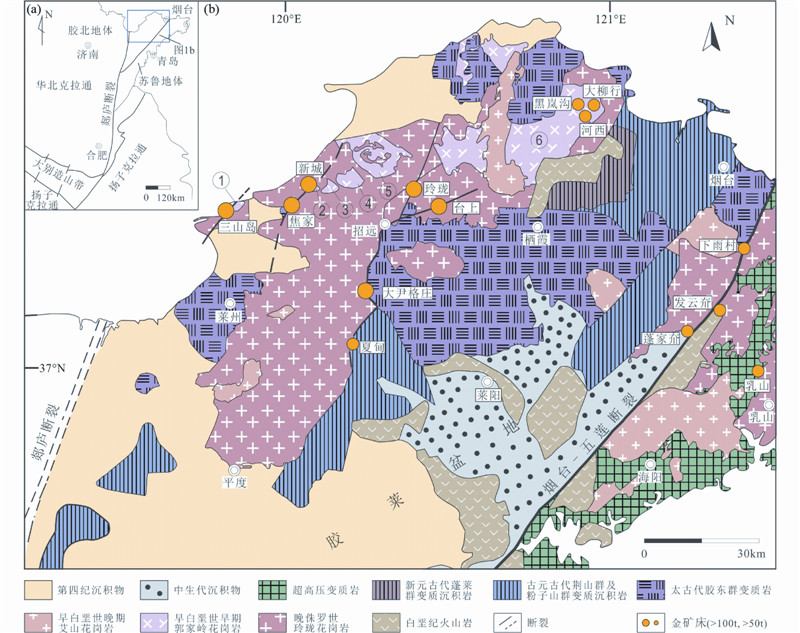 | 图 1 胶西北地质简图(据Wang et al., 2014) 岩体名称:①-三山岛;②-新城;③-上庄;④-北截;⑤-丛家;⑥-郭家岭 Fig. 1 Simplified geological map of the Northwest Jiaodong Peninsula(after Wang et al., 2014) Plutons: ①-Sansh and ao; ②-Xincheng; ③-Shangzhuang; ④-Beijie; ⑤-Congjia; ⑥-Guojialing |
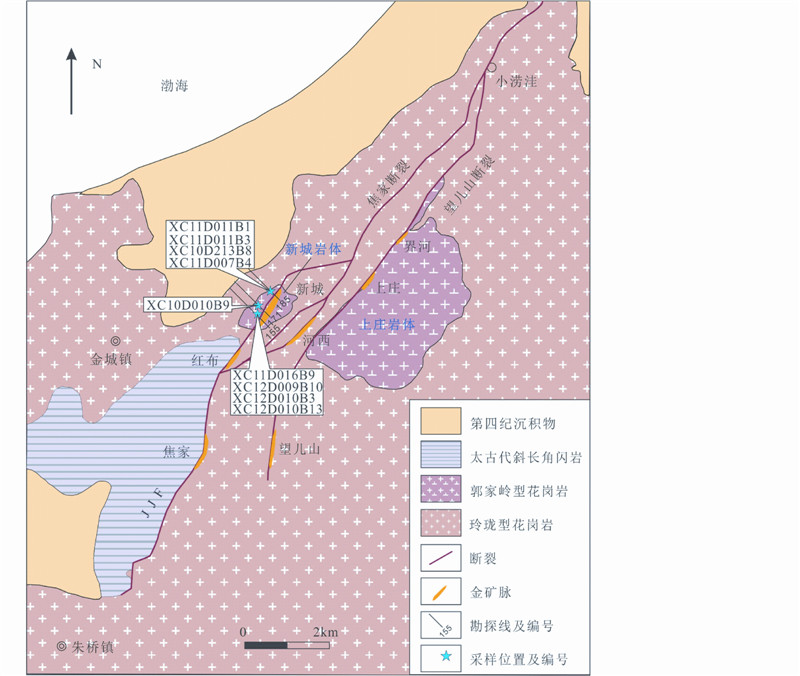 | 图 2 焦家-新城矿集区地质图及取样位置(据Wang et al., 2014) Fig. 2 Geological map of the Jiaojia-Xincheng gold ore deposits concentrating area,with sample locations of the monzogranites in this study(after Wang et al., 2014) |
本研究对新城花岗岩体进行了野外地质调查,在LA-ICP-MS锆石U-Pb年代学和Lu-Hf同位素研究的基础上(Wang et al., 2014),采集了相关分析样品,进行了系统的矿物化学、主微量元素地球化学和Sr-Nd同位素研究,进一步约束了其岩石成因,揭示了胶西北早白垩世高Ba-Sr郭家岭型花岗岩形成地球动力学背景;认为其是胶北地体基底岩石胶东群变质岩部分熔融形成的酸性岩浆与早先幔源岩浆底侵作用形成的年轻的镁铁质地壳的部分熔融形成的中性岩浆混合作用的结果,与古太平洋板块向华北板块俯冲的弧背景有关。 2 地质背景和岩体特征
胶西北位于华北克拉通东南缘胶东半岛的西北部(图 1; Deng et al., 2003a,b; Tan et al., 2008; 邓军等,2004),其变质岩建造主要由太古宙胶东岩群、下元古界荆山群和粉子山群及上元古界蓬莱群组成(Tam et al., 2011)。胶东岩群主要由TTG岩系及少量的角闪岩和基性麻粒岩组成,其原岩年龄分别为2.9~2.7Ga、2.5Ga和2.4Ga(Zhang et al., 2003; Tang et al., 2007)。下元古界荆山群和粉子山群不整合于胶东岩群之上,岩性主要为超镁铁质岩、斜长角闪岩、变粒岩、大理岩和硅线石-黑云片岩等,形成于2.4~1.9Ga(Wang et al., 1998)。粉子山群之上不整合了上元古界蓬莱群(杨忠芳等,1998),主要岩性为石英岩、大理岩、板岩、千枚岩、泥灰岩等(陈光远等,1993;杨敏之和吕古贤,1996)。
自侏罗纪以来,古太平洋板块已经俯冲到欧亚大陆之下(Li and Li, 2007),胶东半岛发育了广泛的岩浆活动(Sun et al., 2007),主要集中在晚侏罗纪和早白垩世两个时期(Ma et al., 2013)。晚侏罗纪花岗岩类通称为玲珑型花岗岩,侵位于胶西北基底岩石胶东群变质岩中,以黑云母花岗岩为主,其锆石LA-ICP-MS U-Pb年龄为166~149Ma(Jiang et al., 2012; Yang et al., 2012),被认为是加厚的下地壳(主要是太古界胶东岩群变质岩石)部分熔融的产物,没有任何地幔的成分加入(Zhang et al., 2010; Jiang et al., 2012)。与晚侏罗纪花岗岩类相比,早白垩世的花岗岩类分布相对广泛,且伴随有同时代的火山岩发育。分布在胶西北的早白垩世早期的花岗岩类被称为郭家岭型花岗质岩体,自西向东包括三山岛岩体、新城岩体、上庄岩体、北截岩体、丛家岩体和郭家岭岩体(图 1和图 2)。该郭家岭型花岗质岩体由石英二长岩、二长花岗岩和花岗闪长组成,于132~126Ma侵入到玲珑型花岗岩体中(Hou et al., 2007; Yang et al., 2012; 图 1)。早白垩世晚期的花岗岩类形成于118~110Ma,主要由二长花岗岩和正长花岗岩组成,被认为是基性岩浆底侵导致的中下地壳的部分熔融形成的酸性岩浆与幔源的基性岩浆的相互作用的结果,并且伴随有结晶分异作用发生(Goss et al., 2010)。
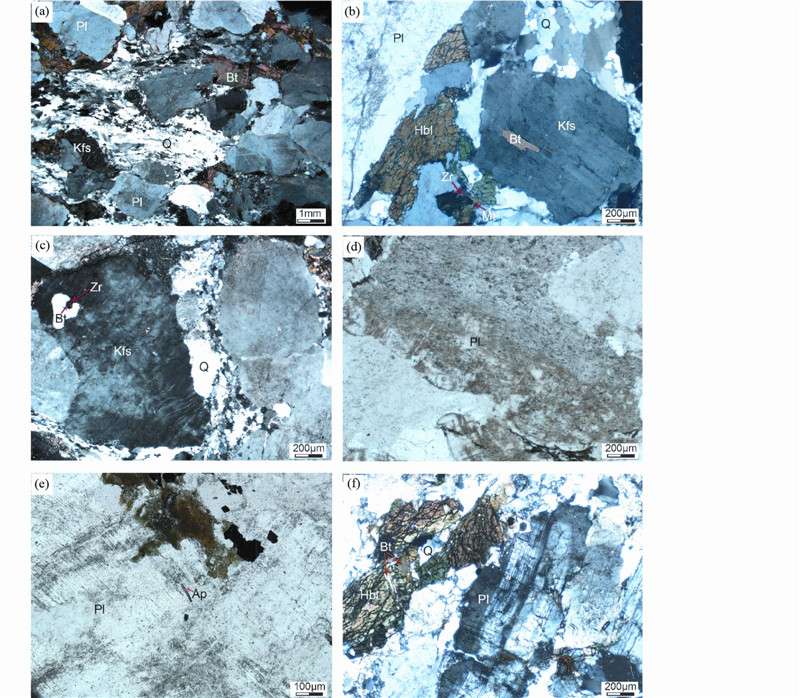 | 图 3 新城二长花岗岩矿物组成特征 (a)-半自形-自形钾长石、黑云母、斜长石和石英;(b)-半自形-自形角闪石、斜长石、钾长石、黑云母和石英,并含有磷灰石、锆石、磁铁矿等副矿物;(c)-半自形钾长石包含有黑云母和锆石;(d)-斜长石的溶蚀边;(e)-针状磷灰石包体(长宽比10 1);(f)-角闪石颗粒内部发育有叶片状黑云母包体.矿物代号:Q-石英;Pl-斜长石;Kfs-钾长石;Hbl-角闪石;Bt-黑云母;Ap-磷灰石;Zr-锆石 Fig. 3 Photomicrographs showing the mineralogy and textural features of the monzogranite in the Xincheng gold deposit (a)-subhedral to anhedral K-feldspar,biotite,plagioclase and quartz;(b)-subhedral to anhedral hornblende,plagioclase,K-feldspar,biotite and quartz,with accessory minerals of apatite,zircon and magnetite;(c)-subhedral K-feldspar with inclusions of biotite and zircon;(d)-plagioclase with resorption Rim;(e)-acicular apatites enclaves with ratios of length to width 101 in Plagioclase’s mantle;(f)-blade biotite enclaves developed in the hornblende grain. Mineral abbreviations: Q-quartz; Pl-plagioclase; Kfs-K-feldspar; Hbl-hornblende; Bt-biotite; Ap-apatite; Zr-zircon; Mt-magnetite |
与早白垩世花岗岩类同时代(130~110Ma)形成的火山岩主要分布在胶莱盆地及其边缘(Fan et al., 2001; Liu et al., 2009; 图 1),属高钾钙碱性岩石系列,主要有碱性玄武岩、玄武粗安岩、安粗岩和粗面岩组成,其富集轻稀土(LREE)和大离子亲石元素(LILE),但亏损高场强元素(HFSE),被认为是交代的富集岩石圈地幔部分熔融形成(Fan et al., 2001)。
新城花岗岩体是新城金矿床的赋矿围岩,呈北东向岩株状侵入到玲珑型花岗岩体中(图 2),主要由石英二长岩和二长花岗岩组成(Wang et al., 2014)。石英二长岩呈灰绿色-深灰色、中细粒结构、块状构造,二长花岗岩呈浅肉红色、中粗粒似斑状结构并发育有钾长石巨晶,二者之间呈渐变过渡关系;其LA-LA-ICP-MS锆石U-Pb年龄分别为132~128Ma和129~127Ma,εHf(t)分别为-21.3~-13.9和-24.7~-18.1(Wang et al., 2014),指示其为同一期岩浆活动产物。
3 样品与测试分析 3.1 样品特征
本研究在新城金矿床-530m、-630m、-680m中段内采集了新城花岗岩体样品,其岩性为似斑状二长花岗岩,具体采样位置见图 2。所有样品均远离新城金矿体,手标本及显微镜观察显示花岗岩样品较新鲜(图 3)。该样品呈浅肉红色,中粗粒似斑状结构,块状构造,斑晶约占15%~20%(图 3a,b)。斑晶矿物主要为钾长石,粒径多为1~3cm,最大可达6cm(图 3c);其次为斜长石,粒径多为0.5~1cm,最大可达2cm(图 3c);基质主要包括钾长石(25%~32%)、斜长石(30%~35%)、石英(20%~30%)、黑云母(3%~5%)和角闪石(<3%)(图 3d)。钾长石一般呈自形板状,斑晶内发育有黑云母、磁铁矿和锆石包体(图 3d);斜长石通常呈自形-半自形板条状,环带发育,斑晶边界熔蚀明显,有针状磷灰石(长宽比为10 1)分布在斜长石斑晶幔部(图 3e);角闪石呈粒柱状,内包裹小的叶片状黑云母(图 3f)。 3.2 分析方法
本研究用于主、微量及稀土元素测试分析的样品经人工破碎至200目,在核工业北京地质研究院分析测试研究中心完成。主量元素采用X射线荧光法(XRF)在X荧光光谱仪Philips PW2404上进行,精度优于1%;微量及稀土元素利用电感耦合等离子体质谱法在等离子质谱仪ELEMENT-I(Finnigan-MAT有限公司制造)上测试完成,精度优于5%。具体分析流程见Wang et al.(2013)。
本研究选择似斑状二长花岗岩中钾长石、斜长石斑晶在中国地质科学院矿产资源研究所电子探针实验室JXA-8230电子探针仪上进行矿物化学成份分析。加速电压为15kV,加速电流为20nA,束斑直径5μm,分析精度为0.1%。
本研究全岩Sr-Nd同位素分析在中国地质大学(武汉)利用FinniganMAT-261多通道质谱仪测试完成,详细的实验流程见Zhang et al.(2002)。Sr、Nd同位素比值测定分别采用86Sr/88Sr=0.1194和146Nd/144Nd=0.7219进行标准化。整个分析流程中实验本底为Sr<1ng和Nd<50pg,标样LaJolla的143Nd/144Nd值为0.511862±5(2σ),标样NBS-987的87Sr/86Sr值为0.710236±16(2σ)。 3.3 分析结果 3.3.1 元素地球化学
新城似斑状二长花岗岩的主量、微量及稀土元素分析结果列于表 1。该岩石SiO2含量变化于70.89%~73.35%,平均72.06%,属于酸性岩类;岩石全碱(K2O+Na2O)含量介于7.03%~8.68%,K2O/Na2O为0.47~1.01,在TAS图解(图 4)中落入花岗岩范围,在SiO2-K2O图解(图 5a)中属于高钾钙碱性-钙碱性岩石系列。Al2O3含量为14.41%~15.54%,CaO含量为1.46%~2.02%,铝饱和指数(A/CNK)=1~1.05,在A/CNK-A/NK图解(图 5b)中落入弱过铝质区域。MgO含量为0.21%~0.62%,Fe2O3T介于0.96%~1.57%,镁质数(Mg#)(Mg#=100×Mg2+/(Mg2++0.898×Fe2O3T))为17~31。TiO2和P2O5含量分别为0.08%~0.30%和0.02%~0.08%。
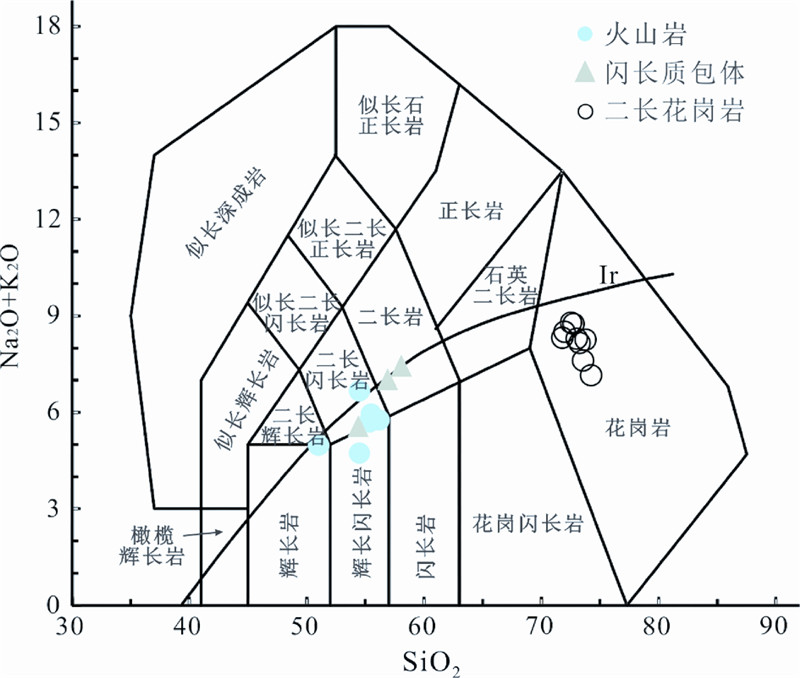 | 图 4 新城二长花岗岩TAS图解(据Middlemost,1994) 火山岩和闪长质包体的数据分别引自Fan et al.(2001)和曲晓明等(1997)Fig. 4 TAS diagram of the Xincheng monzogranites(after Middlemost,1994) The published data for volcanics(Fan et al., 2001) and dioritic enclaves(Qu et al., 1997)are included on the figures |
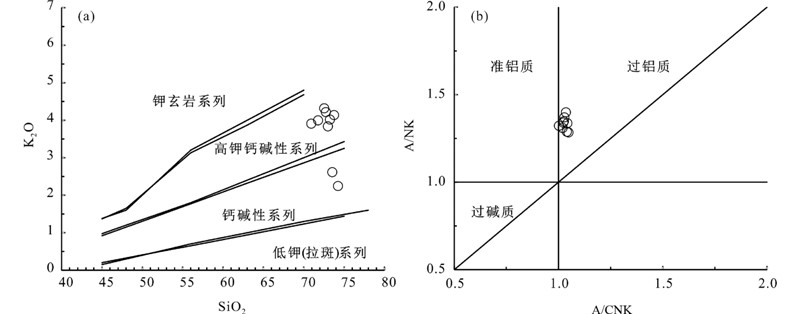 | 图 5 新城二长花岗岩SiO2-K2O图解(a,据Morrison,1980)和A/CNK-A/NK图解(b,据Middlemost,1994) Fig. 5 K2O vs. SiO2 diagram(a,after Morrison,1980) and A/NK vs. A/CNK diagram(b after Middlemost,1994)for the Xincheng monzogranites |
 | 表 1 新城二长花岗岩主量(wt%)和微量元素(×10-6)组成 Table 1 Major(wt%) and trace(×10-6)elements compositions of the Xincheng monzogranites |
相对球粒陨石而言,所有样品具有相似稀土配分模式(图 6a),岩石稀土元素总量为69.85×10⁻⁶~208.4×10⁻⁶,平均108.6×10⁻⁶,轻稀土元素(LREE)富集,重稀土元素(HREE)相对亏损,LREE/HREE比值为15.03~42.05,呈LREE高度富集的分布模式;(La/Yb)N=20.32~198.8,指示轻、重稀土元素发生了强烈分异;δEu为0.75~1.72,具有中等负铕异常到正铕异常。在原始地幔标准化微量元素蛛网图上(图 6b),二长花岗岩的微量元素显示了富集K、Rb、Sr、Ba、Pb等大离子亲石元素(LILE),如Sr>640×10-6,Ba>853×10-6,亏损Nb、Ta、P、Ti等高场强元素(HSFE)。
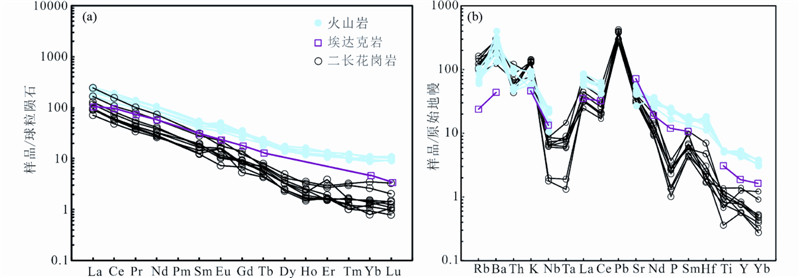 | 图 6 新城二长花岗岩球粒陨石标准化稀土元素配分图(a)和原始地幔标准化微量元素蛛网图(b)(标准化值据Sun and McDonough, 1989)火山岩和埃达克岩的数据分别引自Fan et al.(2001)和Martin(1999) Fig. 6 Chondrite-normalized REE patterns(a) and primitive mantle-normalized spider diagram(b)of the Xincheng monzogranites(normalization values after Sun and McDonough, 1989) The published data for volcanics and adakitic granitoids are from Fan et al.(2001) and Martin(1999),respectively |
对似斑状二长花岗岩中的斜长石和钾长石进行了电子探针分析,结果分别列于表 2、表 3。斜长石中的An介于12.9~22.9(表 2),均属于更长石(图 7a)。选取二长花岗岩XC12D009B10中发育环带的斜长石斑晶从核部到一边进行线扫描,其An值由核部到幔部呈现振荡韵律变化,介于21.70~16.98,且在幔部急剧降低到12.9,然后在边部升高到20.0,为典型的反环带结构(图 8a)。钾长石中的Or为81.24~93.69,Ab为6.26~18.54,An为0~0.49(表 3),均属于正长石(图 7b)。选取二长花岗岩XC10D010B9中发育环带的钾长石斑晶从核部到边缘垂直于边界的方向做了一条电子探针剖面分析,其Ab值由核部到边部发生振荡韵律变化,介于9.05~18.54;其中幔部最高,为18.54;边部最低,为9.05;核部高于边部,为16.14,呈典型的反环带结构(图 8b)。
| 表 2 新城二长花岗岩斜长石电子探针成分(wt%)Table 2 Electron-microprobe composition of plagioclase for the Xincheng monzogranites(wt%) |
| 表 3 新城二长花岗岩钾长石电子探针成分(wt%)Table 3 Electron-microprobe composition of K-feldspar for the Xincheng monzogranites(wt%) |
 | 图 7 斜长石(a)和钾长石(b)的三元分类图解(据Deer et al., 1992) Fig. 7 Ternary classification diagram for plagioclases(a) and K-feldspar(b)(after Deer et al., 1992) |
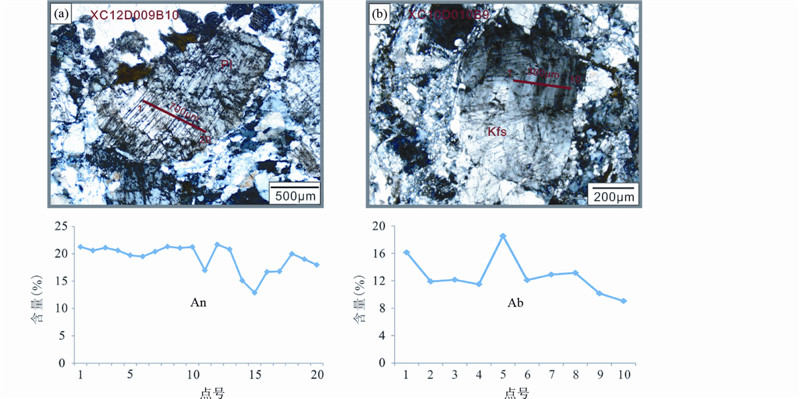 | 图 8 斜长石(a)和钾长石(b)的电子探针线剖面分析 上部为正交显微图片及测点位置Fig. 8 Electron microprobe line profile analyses of plagioclases(a) and K-feldspar(b)for the Xincheng monzogranites The top is the photomicrographs under transmitted light showing analyzed spots |
样品Sr-Nd同位素分析数据及计算结果列于表 4。岩石样品87Sr/86Sr和143Nd/144Nd值分别为0.711198~0.712353和0.511463~0.511677,初始87Sr/86Sr(Isr)和εNd(t)以二长花岗岩的形成年龄128Ma计算,其分别为0.71071~0.71172和-21.3~-17.1。该二长花岗岩的亏损地幔模式年龄(tDM2)为2310~2648Ma。
| 表 4 新城二长花岗岩的Rb-Sr、Sm-Nd同位素组成Table 4 Rb-Sr and Sm-Nd isotopic results of the Xincheng monzogranites |
新城二长花岗岩 具有高的全碱含量(K2O+Na2O=7.03%~8.68%),低的Al2O3(14.41%~15.54%)和MgO(0.21%~0.62%)(表 1)以及相对较为平坦的HREE,与典型的adakitic岩石明显不同(图 6a)。该花岗岩具有高Ba(>853×10-6)、Sr(>640×10-6)和低Rb(<103×10-6)含量的特征,明显不同于传统的I、S、M和A型花岗岩的相对高Rb和低Ba、Sr含量的特征。此外,该花岗岩轻稀土元素富集(>65.43×10⁻⁶)、重稀土相对亏损(<5.3×10⁻⁶),轻、重稀土元素分馏明显[(La/Yb)N=20.32~198.8],无明显的负铕异常(图 6a),明显亏损Nb(<6.14×10⁻⁶)、Ta<(0.599×10⁻⁶)、Th(<10.3×10⁻⁶)、U(<5.87×10⁻⁶)等高场强元素(表 1;图 6b),显示出典型的高Ba-Sr花岗岩所具有的地球化学特征(Fowler et al., 2001; Peng et al., 2013; Ye et al., 2008)。
高Ba-Sr新城二长花岗岩属于高钾钙碱性-钙碱性系列,其形成于早白垩世,IA-ICP-MS锆石U-Pb年龄为129~127Ma(Wang et al., 2014),与分布在其南部的胶莱盆地内的高钾钙碱性火山岩的形成年龄基本一致(Fan et al., 2001,图 1b);然新城二长花岗岩与火山岩具有不同的稀土及微量元素分配模式(图 6a,b),且二者之间存在着SiO2成分间隔(图 4),表明二长花岗岩不是火山岩结晶分异的产物。矿物化学研究表明新城二长花岗岩中的斜长石和钾长石均具有典型的反环带结构,其可能是由于岩浆失水或者温度升高(中-基性岩浆的注入)造成的(Anderson,1984)。然而,二长花岗岩的斜长石斑晶幔部发育有针状磷灰石包体(图 3d),且出现了斜长石被熔蚀的现象(图 3e);此外,角闪石斑晶内发育有叶片状黑云母包体(图 3e),因此反环带与中-基性岩浆加入有关,表明了新城二长花岗岩的岩浆混合成因(Wyllie et al., 1962; Xu et al., 2004)。二长花岗岩中斜长石和钾长石斑晶的电子探针剖面分析表明,相对于核部斜长石的幔部表现为低的An值,由幔部到核部及边部An值逐渐升高;而对于钾长石,其幔部相对核部表现为高的Ab值,从幔部向核部和边部Ab值逐渐降低,说明了在岩浆形成过程中长英质岩浆中混入了中基性岩浆(Tan et al., 2008)。杨进辉等(2003)通过对郭家岭花岗岩的地质地球化学特征研究表明认为郭家岭花岗岩是由早先基性岩浆底侵作用形成的下地壳镁铁质岩石脱水部分熔融作用形成的;Yang et al.(2012)认为在郭家岭型花岗岩的形成过程中有幔源成分的加入。因此,早白垩世的高Ba-Sr新城二长花岗岩可能是长英质酸性岩浆和中-基性岩浆混合作用的结果。
综上所述,本研究认为新城二长花岗岩是由壳源和幔源岩浆混合形成或者是长英质熔体与早先基性岩浆底侵作用形成的年轻的镁铁质下地壳部分熔融相互作用的结果。分布在胶莱盆地内与二长花岗岩同时代形成的高钾钙碱性火山岩被认为是交代的富集岩石圈地幔部分熔融形成的(Fan et al., 2001),然其与二长花岗岩之间存在着SiO2成分间隔,以及仅在丛家和郭家岭岩体中发育有暗色的镁铁质包体,且这些包体都是闪长质的(SiO2为54.52%~58.22%)(曲晓明等,1997;图 4),而在新城二长花岗岩和其他郭家岭型花岗岩体(三山岛、上庄、北截岩体)中未发育镁铁质包体,表明新城二长花岗岩和火山岩二者之间不存在成因联系;此外,该岩石的高SiO2(70.89%~73.35%)、低Mg#(17~31)的地球化学特征表明未有幔源物质参与成岩作用;因此,排除了新城二长花岗岩是局部富集岩石圈地幔岩浆与长英质酸性岩浆混合作用结果的可能性。地球物理研究表明,胶北地体底部发育有幔源岩浆底侵作用形成的镁铁质地壳(Yang et al., 2006),其与胶东半岛侏罗纪的地壳增厚和发生大规模侏罗纪岩浆活动事实是一致的(Zhou and Li, 2000; Wu et al., 2005)。此外,新城二长花岗岩的εNd(t)为-21.3~-17.1,在Sr-Nd相关图上与同时代的基性脉岩分布区不重合,而与玲珑花岗岩部分重叠(图 9),指示新城二长花岗岩与玲珑花岗岩很可能具有相似的岩浆来源。结合玲珑型花岗岩体是加厚的下地壳(主要是上太古界胶东岩群岩石)部分熔融的产物(Jiang et al., 2012; Zhang et al., 2010),以及二长花岗岩的Nd同位素模式年龄(tDM2)为2310~2648Ma,与古元古界-新太古界胶东群变质岩年龄一致,本研究认为早白垩世高Ba-Sr新城二长花岗岩是早先幔源岩浆底侵作用形成的年轻的镁铁质地壳部分熔融形成的中性岩浆和胶北地体的基底岩石胶东群变质岩部分熔融形成的酸性岩浆混合作用的结果。
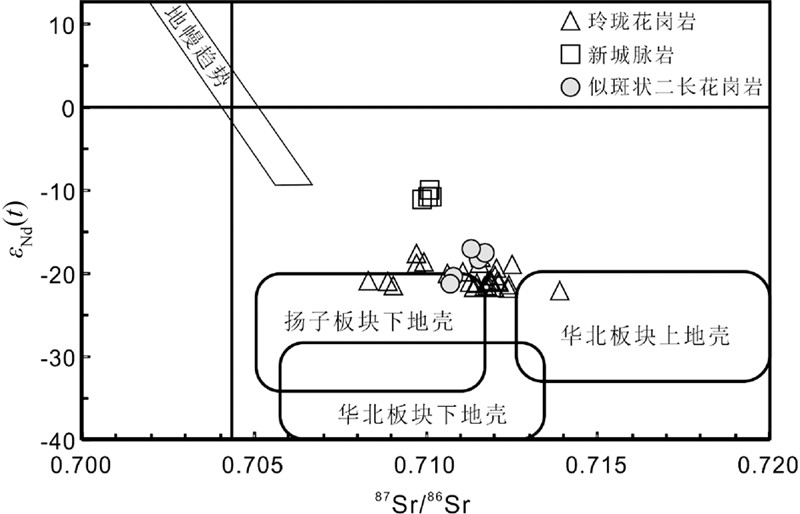 | 图 9 新城二长花岗岩εNd(t)-ISr图解 新城脉岩的数据引自Yang et al.(2004);玲珑花岗岩数据引自Zhang et al.(2010)、Yang et al.(2012)、Jiang et al.(2012)和Ma et al.(2013).扬子下地壳、华北上地壳和下地壳范围引自Jahn et al.(1999)Fig. 9 εNd(t)-ISr diagram for the Xincheng monzogranites The isotopic composition of the Xincheng mafic dykes(Yang et al., 2004) and Linglong granitoids(Zhang et al., 2010; Yang et al., 2012; Jiang et al., 2012; Ma et al., 2013)are shown for comparison. The fields for lower crust of the Yangtze Craton,upper and lower crusts of the NCC are from Jahn et al.(1999) |
高Ba-Sr花岗岩广泛分布于全球范围内显生宙以来尤其是早白垩世和第三纪造山带内(Tarney and Jones, 1994; Qian et al., 2003; Choi et al., 2009),蕴涵着丰富的大陆动力学信息,是揭示造山带岩浆作用过程、地壳演化及壳幔作用的有力窗口(Fowler et al., 2008)。然而,关于高Ba-Sr花岗岩的成因仍有争议,目前的观点包括:俯冲洋底高原的部分熔融和高Ba-Sr镁铁质岩浆的底侵(Tarney and Jones, 1994);受软流圈富碳酸岩流体(Tarney and Jones, 1994)或者大陆板块熔融(Jiang et al., 2012; Peng et al., 2013)交代形成的富集岩石圈地幔的部分熔融;镁铁质下地壳的部分熔融形成的中性岩浆与富集的幔源的中基性岩浆的混合(Ye et al., 2008; Choi et al., 2009);源于富集岩石圈地幔的碱性岩浆的结晶分异和不同程度的地壳混染(Fowler et al., 2001)。而本研究表明高Ba-Sr花岗岩可以由大陆下地壳的岩石部分熔融形成的酸性岩浆与早先幔源岩浆底侵作用形成的年轻的镁铁质地壳的部分熔融形成的中性岩浆混合形成。 5 结论
(1)高Ba-Sr新城二长花岗岩是胶北地体基底岩石胶东群变质岩部分熔融形成的酸性岩浆与早先幔源岩浆底侵作用形成的年轻的镁铁质地壳的部分熔融形成的中性岩浆混合作用的结果。
(2)古太平洋板块向华北板块的俯冲及其伴生的软流圈物质上涌是胶西北高Ba-Sr郭家岭型花岗岩形成的最可能的动力学机制。
致谢
中国地质大学(北京)龚庆杰教授和张华锋副教授在论文撰写过程中提出了宝贵意见;山东黄金矿业股份有限公司新城金矿赵海、王旭东等地质工程师在野外工作中给予了大力支持和帮助;中国地质大学(武汉)地质过程与国家重点实验室周炼老师在Sr-Nd同位素测试过程中提供了大量帮助;研究生刘跃、郭林楠、刘向东、张良、张炳林参与了部分研究工作;在此一并表示感谢。
| [1] | Anderson AT. 1984. Probable relations between plagioclase zoning and magma dynamics, Fuegovocano and Guatemala. American Mineralogist, 69(7-8): 660-676 |
| [2] | Bonin B. 1990. From orogenic to anorogenic settings: Evolution of granitoid suites after a major orogenesis. Geological Journal, 25(3-4): 261-270 |
| [3] | Bonin B. 2007. A-type granites and related rocks: Evolution of concept, problems and prospects. Lithos, 97(1): 1-29 |
| [4] | Chappell BW and White AJK. 1974. Two contrasting granite types. Pacific Geology, 8: 173-174 |
| [5] | Chen GY, Sun DS, Zhou XR, Shao W, Gong RT and Shao Y. 1993. Mineralogy of Guojialing Granodiorite and Its Relationship to Gold Mineralization in the Jiaodong Peninsula. Beijing: Chinese University of Geosciences Press, 1-230 (in Chinese with English abstract) |
| [6] | Choi SG, Rajesh VJ, Seo J, Park JW, Oh CW, Pak SJ and Kim SW. 2009. Petrology, geochronology and tectonic implications of Mesozoic high Ba-Sr granites in the Haemiarea, Hongseong Belt, South Korea. Island Arc, 18(2): 266-281 |
| [7] | Clemens JD. 2003. S-type granitic magmas: Petrogenetic issues, models and evidence. Earth-Science Reviews, 61(1-2): 1-18 |
| [8] | Deer WA, Howie RA and Zussman J. 1992. An Introduction to the Rock-forming Minerals. 2nd Edition. Harlow: Longman Group UK, 1-232 |
| [9] | Deng J, Zhai YS, Wang JP, Yang LQ, Fan Y and Sun ZS. 2000. Shear alteration, mass transfer and gold mineralization: An example from Jiaodong ore deposit concentrating area, Shandong, China. Journal of China University of Geoscience, 11(3): 281-287 |
| [10] | Deng J, Yang LQ, Liu W, Sun ZS, Li XJ and Wang QF. 2001. Gold origin and fluid ore-forming effect of Zhao-Ye ore deposits concentrating area in Jiaodong, Shandong, China. Chinese Journal of Geology, 36(3): 257-268 (in Chinese with English abstract) |
| [11] | Deng J, Yang LQ, Sun ZS, Wang JP, Wang QF, Xin HB and Li XJ. 2003a. Ametallogenic model of gold deposits of the Jiaodong granite-greenstone belt. Acta Geologica Sinica, 77(4): 537-546 |
| [12] | Deng J, Liu W, Sun ZS, Wang JP, Wang QF, Zhang QX and Wei YG. 2003b. Evidence of mantle-rooted fluids and multi-level circulation of ore-forming dynamics: A case study from the Xiadian gold deposit, Shandong Province, China. Science in China (Series D), 46(1): 138-142 |
| [13] | Deng J, Wang QF, Yang LQ, Wang JP, Gao BF and Liu Y. 2004. The geological settings to the gold metallogeny in northwestern Jiaodong Peninsula, Shandong Province. Earth Sciences Frontiers, 11(4): 527-533 (in Chinese with English abstract) |
| [14] | Deng J, Yang LQ, Ge LS, Wang QF, Zhang J, Gao BF, Zhou YH and Jiang SQ. 2006. Research advances in the Mesozoic tectonic regimes during the formation of Jiaodong ore cluster area. Progress in Natural Sciences, 16(8): 777-784 |
| [15] | Deng J, Wang QF, Yang LQ, Zhou L, Gong QJ, Yuan WM, Xu H, Guo CY and Liu XW. 2008. The structure of ore-controlling strain and stress fields in the Shangzhuang gold deposit in Shandong Province, China. Acta Geologica Sinica, 82(4): 769-780 |
| [16] | Deng J, Wang QF, Wan L, Yang LQ, Gong QJ, Zhao J and Liu H. 2009. Self-similar fractal analysis of gold mineralization of Dayingezhuang disseminated-veinlet deposit in Jiaodong gold province, China. Journal of Geochemical Exploration, 102(2): 95-102 |
| [17] | Deng J, Chen YM, Liu Q and Yang LQ. 2010. The Gold Metallogenic System and Mineral Resources Exploration of Sanshandao Fault Zone, Shandong Province. Beijing: Geological Publishing House, 1-371 (in Chinese) |
| [18] | Deng J, Wang QF, Wan L, Liu H, Yang LQ and Zhang J. 2011. A multifractal analysis of mineralization characteristics of the Dayingezhuang disseminated-veinlet gold deposit in the Jiaodong gold province of China. Ore Geology Reviews, 40(1): 54-64 |
| [19] | Deng J, Wang QF, Li GJ and Santosh M. 2014. Cenozoic tectono-magmatic and metallogenic processes in the Sanjiang region, southwestern China. Earth-Science Reviews, doi: 10.1016/j.earscirev.2014.05.015 |
| [20] | Fan WM, Guo F, Wang YJ, Lin G and Zhang M. 2001. Post-orogenic bimodal volcanism along the Sulu orogenic belt in eastern China. Physics and Chemistry of the Earth, Part A: Solid Earth and Geodesy, 26(9): 733-746 |
| [21] | Fowler MB, Henney PJ, Darbyshire DPF and Greenwood PB. 2001. Petrogenesis of high Ba-Sr granites: The Rogart pluton, Suther land. Journal of the Geological Society, 158(3): 521-534 |
| [22] | Fowler MB, Kocks H, Darbyshire DPF and Greenwood PB. 2008. Petrogenesis of high Ba-Sr plutons from the northern Highlands Terrane of the British Caledonian Province. Lithos, 105(1-2): 129-148 |
| [23] | Gao S, Rudnick RL, Carlson RW, McDonough WF and Liu YS. 2002. Re-Os evidence for replacement of ancient mantle lithosphere beneath the North China Craton. Earth and Planetary Science Letters, 198(3): 307-322 |
| [24] | Gao S, Zhang JF, Xu WL and Liu YS. 2009. Delamination and destruction of the North China Craton. Chinese Science Bulletin, 54(19): 3367-3378 |
| [25] | Goldfarb RJ and Santosh M. 2014. The dilemma of the Jiaodong gold deposits: Are they unique? Geoscience Frontiers, 5(2): 139-153 |
| [26] | Goss SC, Wilde SA, Wu F and Yang J. 2010. The age, isotopic signature and significance of the youngest Mesozoic granitoids in the Jiaodong Terrane, Shandong Province, North China Craton. Lithos, 120(3): 309-326 |
| [27] | Hou ML, Jiang YH, Jiang SY, Ling HF and Zhao KD. 2007. Contrasting origins of Late Mesozoic adakitic granitoids from the northwestern Jiaodong Peninsula, East China: Implications for crustal thickening to delamination. Geological Magazine, 144(4): 619-631 |
| [28] | Jahn BM and Condie KC. 1995. Evolution of the Kaapvaal craton as viewed from geochemical and Sm-Nd isotopic analyses of intracraton icpelites. Geochimica et Cosmochimica Acta, 59(11): 2239-2258 |
| [29] | Jahn BM, Wu FY, Lo CH and Tsai CH. 1999. Crust-mantle interaction induced by deep subduction of the continental crust: Geochemical and Sr-Nd isotopic evidence from post-collisional mafic-ultramafic intrusions of the northern Dabie complex, central China. Chemical Geology, 157(1-2): 119-146 |
| [30] | Jiang N, Chen JZ, Guo JH and Chang GH. 2012. In-situ zircon U-Pb, oxygen and hafnium isotopic compositions of Jurassic granites from the North China craton: Evidence for Triassic subduction of continental crust and subsequent metamorphism related 18O depletion. Lithos, 142: 84-94 |
| [31] | Li XC, Fan HR, Santosh M, Hu FF, Yang KF and Lan TG. 2013. Hydrothermal alteration associated with Mesozoic granite-hosted gold mineralization at the Sanshandao deposit, Jiaodong gold province, China. Ore Geology Review, 53: 403-421 |
| [32] | Li ZX and Li XH. 2007. Formation of the 1300-km-wide intracontinentalorogen and postorogenic magmatic province in Mesozoic South China: A flat-slab subduction model. Geology, 35(2): 179-182 |
| [33] | Liu S, Hu RZ, Gao S, Feng CX, Yu BB, Qi YQ, Wang T, Feng GY and Coulson IM. 2009. Zircon U-Pb age, geochemistry and Sr-Nd-Pb isotopic compositions of adakitic volcanic rocks from Jiaodong, Shandong Province, eastern China: Constraints on petrogenesis and implications. Journal of Asian Earth Sciences, 35(5): 445-458 |
| [34] | Loiselle MC and Wones DR. 1979. Characteristics and origin of anorogenic granites. Geological Society of America Abstracts with Programs, 11(7): 468 |
| [35] | Lugmair GW and Marti K. 1978. Lunarinitial 143Nd/144Nd: Differential evolution of the lunar crust and mantle. Earth and Planetary Science Letters, 39(3): 349-357 |
| [36] | Ma L, Jiang SY, Dai BZ, Jiang YH, Hou ML, Pu W and Xu B. 2013. Multiple sources for the origin of Late Jurassic Linglong adakitic granite in the Shandong Peninsula, eastern China: Zircon U-Pb geochronological, geochemical and Sr-Nd-Hf isotopic evidence. Lithos, 162-163: 251-263 |
| [37] | Martin H. 1999. Adakitic magmas: Modern analogues of Archean granitoids. Lithos, 46(3): 411-429 |
| [38] | Middlemost EA. 1994. Naming materials in the magma/igneous rock system. Earth-Science Reviews, 37(3-4): 215-224 |
| [39] | Miller RG and O'Nions RK. 1985. Source of Precambrian chemical and clastic sediments. Nature, 314: 325-330 |
| [40] | Morrison GW. 1980. Characteristics and tectonic setting of the shoshonite rock association. Lithos, 13(1): 97-108 |
| [41] | Peng TP, Wilde SA, Fan WM and Peng BX. 2013. Late Neoarchean potassic high Ba-Sr granites in the Taishan granite-greenstone terrane: Petrogenesis and implications for continental crustal evolution. Chemical Geology, 344: 23-41 |
| [42] | Qian Q, Chung SL, Lee TY and Wen DJ. 2003. Mesozoic high-Ba-Sr granitoids from North China: Geochemical characteristics and geological implications. Terra Nova, 15(4): 272-278 |
| [43] | Qu XM, Wang HN and Rao B. 1997. A study on the genesis of dioritic enclaves in Guojialing granite. Acta Mineralogica Sinica, 17(3): 302-309 (in Chinese with English abstract) |
| [44] | Santosh M. 2010. Assembling North China Craton within the Columbia supercontinent: The role of double-sided subduction. Precambrian Research, 178(1): 149-167 |
| [45] | Sun SS and McDonough WF. 1989. Chemical and isotope systematics of oceanic basalts: Implications for mantle composition and processes. In: Saunders AD and Norry MJ (eds.). Magmatism in Oceanic Basins. Geological Society, London, Special Publications, 42(1): 313-345 |
| [46] | Sun W, Ding X, Hu YH and Li XH. 2007. The golden transformation of the Cretaceous plate subduction in the west Pacific. Earth and Planetary Science Letters, 262(3): 533-542 |
| [47] | Tam PY, Zhao GC, Liu F, Zhou XW, Sun M and Li SD. 2011. Timing of metamorphism in the Paleoproterozoic Jiao-Liao-Ji Belt: New SHRIMP U-Pb zircon dating of granulites, gneisses and marbles of the Jiaobei massif in the North China Craton. Gondwana Research, 19(1): 150-162 |
| [48] | Tan J, Wei J, Guo L, Zhang K, Yao C, Lu J and Li H. 2008. LA-ICP-MS zircon U-Pb dating and phenocryst EPMA of dikes, Guocheng, Jiaodong Peninsula: Implications for North China Craton lithosphere evolution. Science in China (Series D), 51(10): 1483-1500 |
| [49] | Tang J, Zheng YF, Wu YB, Gong B and Liu XM. 2007. Geochronology and geochemistry of metamorphic rocks in the Jiaobei terrane: Constraints on its tectonic affinity in the Sulu orogen. Precambrian Research, 152(1-2): 48-82 |
| [50] | Tarney J and Jones CE. 1994. Trace element geochemistry of orogenic igneous rocks and crustal growth models. Journal of the Geological Society, 151(5): 855-868 |
| [51] | Wang LG, Qiu YM, McNaughton NJ, Groves DI, Luo ZK, Huang JZ, Miao LC and Liu YK. 1998. Constraints on crustal evolution and gold metallogeny in the northwestern Jiaodong Peninsula, China, from SHRIMP U-Pb zircon studies of granitoids. Ore Geology Reviews, 13(1): 275-291 |
| [52] | Wang W, Liu SW, Bai X, Li QG, Yang PT, Zhao Y, Zhang SH and Guo R. 2013. Geochemistry and zircon U-Pb-Hf isotopes of the Late Paleoproterozoic Jianping diorite-monzonite-syenitesuite of the North China Craton: Implications for petrogenesis and geodynamic setting. Lithos, 162-163: 175-194 |
| [53] | Wang ZL, Yang LQ, Deng J, Santosh M, Zhang HF, Liu Y, Li RH, Huang T, Zheng XL and Zhao H. 2014. Gold-hosting high Ba-Sr granitoids in the Xincheng gold deposit, Jiaodong Peninsula, East China: Petrogenesis and tectonic setting. Journal of Asian Earth Sciences, doi: 10.1016/j.jseaes.2014.03.001 |
| [54] | White AJR. 1979. Sources of granitic magma. Abstracts of Papers to be Presented at the Annual Meetings of the Geological Society of America and Associated Societies, San Diego, California, 11: 539 |
| [55] | Wu FY, Yang JH, Wilde SA and Zhang XO. 2005. Geochronology, petrogenesis and tectonic implications of Jurassic granites in the Liaodong Peninsula, NE China. Chemical Geology, 221(1): 127-56 |
| [56] | Wyllie PJ, Cox KG and Biggar GM. 1962. The habit of apatite in synthetic systems and igneous rocks. Journal of Petrology, 3(2): 238-242 |
| [57] | Xu XS, Fan QC, O'Reilly SY, Jiang SY, Griffin WL, Wang RC and Qiu JS. 2004. U-Pb dating of zircons from quartz diorite and its enclaves at Tongguanshan in Anhui and its petrogenetic implication. Chinese Science Bulletin, 49(19): 2073-2082 |
| [58] | Xu YG, Li HY, Pang CJ and He B. 2009. On the timing and duration of the destruction of the North China Craton. Chinese Science Bulletin, 54(19): 3379-3396 |
| [59] | Yan YT, Zhang N, Li SR and Li YS. 2014. Mineral chemistry and isotope geochemistry of pyrite from the Heilangou gold deposit, Jiaodong Peninsula, eastern China. Geoscience Frontiers, 5(2): 205-213 |
| [60] | Yang JH, Chu MF, Liu W and Zhai MG. 2003. Geochemistry and petrogenesis of Guojialing granodiorites from the northwestern Jiaodong Peninsula, eastern China. Acta Petrologica Sinica, 19(4): 692-700 (in Chinese with English abstract) |
| [61] | Yang JH, Chung SL, Zhai MG and Zhou XH. 2004. Geochemical and Sr-Nd-Pb isotopic compositions of mafic dikes from the Jiaodong Peninsula, China: Evidence for vein plus-peridotite melting in thelithospheric mantle. Lithos, 73(3-4): 145-160 |
| [62] | Yang KF, Fan HR, Santosh M, Hu FF, Wilde SA, Lan TG, Lu LN and Liu YS. 2012. Reactivation of the Archean lower crust: Implications for zircon geochronology, elemental and Sr-Nd-Hf isotopic geochemistry of Late Mesozoic granitoids from northwestern Jiaodong Terrane, the North China Craton. Lithos, 146-147: 112-127 |
| [63] | Yang LQ, Deng J, Zhang ZJ, Wang GJ and Wang JP. 2003. Crust-mantle structure and coupling effects on mineralization: An example from Jiaodong Gold Ore Deposits Concentrating Area, China. Journal of China University of Geosciences, 14(1): 42-51 |
| [64] | Yang LQ, Deng J, Wang QF and Zhou YH. 2006. Coupling effects on gold mineralization of deep and shallow structures in the northwestern Jiaodong Peninsula, eastern China. Acta Geologica Sinica, 80(3): 400-411 |
| [65] | Yang LQ, Deng J, Ge LS, Wang QF, Zhang J, Gao BF, Jiang SQ and Xu H. 2007. Metallogenic epoch and genesis of the gold deposits in Jiaodong Peninsula, eastern China: A regional review. Progress in Natural Sciences, 17(2): 138-143 |
| [66] | Yang LQ, Deng J, Zhang J, Guo CY, Gao BF, Gong QJ and Yu HJ. 2008. Decrepitation thermometry and compositions of fluid inclusions of the Damoqujia gold deposit, Jiaodong gold province, China: Implications for metallogeny and exploration. Journal of China University of Geosciences, 19(4): 378-390 |
| [67] | Yang LQ, Deng J, Guo CY, Zhang J, Jiang SQ, Gao BF, Gong QJ and Wang QF. 2009. Ore-forming fluid characteristics of the Dayingezhuang gold deposit, Jiaodong gold province, China. Resource Geology, 59(2): 182-195 |
| [68] | Yang LQ, Liu JT, Zhang C, Wang QF, Wang ZL, Zhang J and Gong QJ. 2010. Superimposed orogenesis and metallogenesis: An example from the orogenic gold deposits in Ailaoshan gold belt, Southwest China. Acta Petrologica Sinica, 26(6): 1723-1739 (in Chinese with English abstract) |
| [69] | Yang LQ, Deng J, Zhao K and Liu JT. 2011. Tectono-thermochronology and gold mineralization events of orogenic gold deposits in Ailaoshanorogenic belt, Southwest China: Geochronological constraints. Acta Petrologica Sinica, 27(9): 2519-2532 (in Chinese with English abstract) |
| [70] | Yang LQ and Badal J. 2013. Mirror symmetry of the crust in the oil/gas region of Shengli, China. Journal of Asian Earth Sciences, 78: 327-344 |
| [71] | Yang LQ, Deng J, Goldfarb RJ, Zhang J, Gao BF and Wang ZL. 2014. 40Ar/39Ar geochronological constraints on the formation of the Dayingezhuang gold deposit: New implications for timing and duration of hydrothermal activity in the Jiaodong gold province, China. Gondwana Research, 25(4): 1469-1483 |
| [72] | Yang LQ, Deng J and Wang ZL. 2014a. Ore-controlling structural pattern of Jiaodong gold deposits: Geological-geophysical integration constraints. In: Chen YT, Jin ZM, Shi YL, Yang WC and Zhu RX (eds.). The Deep-Seated Structures of Earth in China. Beijing: Sciences Press, 1006-1030 (in Chinese) |
| [73] | Yang LQ, Deng J, Wang ZL, Zhang L, Guo LN, Song MC and Zheng XL. 2014b. Mesozoic gold metallogenic system of the Jiaodong gold province, eastern China. Acta Petrologica Sinica, 30(9): 2447-2467 (in Chinese with English abstract) |
| [74] | Yang MZ and Lü GX. 1996. Geology and Geochemistry of Gold Deposits Occurred in Jiaodonggranitoid-Greenstone Terrain. Beijing: Geological Publishing House, 1-228 (in Chinese) |
| [75] | Yang QY, Santosh M, Shen JF and Li SR. 2013. Juvenile vs. recycled crust in NE China: Zircon U-Pb geochronology, Hf isotope and an integrated model for Mesozoic gold mineralization in the Jiaodong Peninsula. Gondwana Research, 25(4): 1445-1468 |
| [76] | Yang ZF, Xu JK, Zhao LS, Shen YL and Wu YB. 1998. Regional Crust Evolution and Geochemical Study on Gold Metallogenesis in Jiaodong Area, China. Beijing: Geological Publishing House, 1-157 (in Chinese) |
| [77] | Ye HM, Li XH, Li ZX and Zhang CL. 2008. Age and origin of high Ba-Sr appinite-granites at the northwestern margin of the Tibet Plateau: Implications for Early Paleozoic tectonic evolution of the Western Kunlunor orogenic belt. Gondwana Research, 13(1): 126-138 |
| [78] | Zhang HF, Gao S, Zhong ZQ, Zhang BR, Zhang L and Hu SH. 2002. Geochemical and Sr-Nd-Pb isotopic compositions of Cretaceous granitoids: Constraints on tectonic framework and crustal structure of the Dabieshan ultrahigh-pressure metamorphic belt, China. Chemical Geology, 186(3-4): 281-299 |
| [79] | Zhang J, Zhao ZF, Zheng YF and Dai M. 2010. Postcollisional magmatism: Geochemical constraints on the petrogenesis of Mesozoic granitoids in the Sulu orogen, China. Lithos, 119(3-4): 512-536 |
| [80] | Zhang XO, Cawood PA, Wilde SA, Liu R, Song H, Li W and Snee LW. 2003. Geology and timing of mineralization at the Cangshang gold deposit, northwestern Jiaodong Peninsula, China. Mineralium Deposita, 38(2): 141-153 |
| [81] | Zhou XM and Li WX. 2000. Origin of Late Mesozoic igneous rocks in southeastern China: Implications for lithosphere subduction and underplating of mafic magmas. Tectonophysics, 326(3): 269-87 |
| [82] | 陈光远, 孙岱生, 周珣若, 邵伟, 宫润谭, 邵岳. 1993. 胶东郭家岭花岗闪长岩成因矿物学与金矿化. 北京: 中国地质大学出版社, 1-230 |
| [83] | 邓军, 杨立强, 刘伟, 孙忠实, 李新俊, 王庆飞. 2001. 胶东招掖矿集区巨量金质来源和流体成矿效应. 地质科学, 36(3): 257-268 |
| [84] | 邓军, 王庆飞, 杨立强, 王建平, 高帮飞, 刘琰. 2004. 胶西北金矿集区成矿作用发生的地质背景. 地学前缘, 11(4): 527-533 |
| [85] | 邓军, 陈玉民, 刘钦, 杨立强. 2010. 胶东三山岛断裂带金成矿系统与资源勘查. 北京: 地质出版社, 1-371 |
| [86] | 曲晓明, 王鹤年, 饶冰. 1997. 郭家岭花岗闪长岩岩体中闪长质包体的成因研究. 矿物学报, 17(3): 302-309 |
| [87] | 杨进辉, 朱美妃, 刘伟, 翟明国. 2003. 胶东地区郭家岭花岗闪长岩的地球化学特征及成因. 岩石学报, 19(4): 692-700 |
| [88] | 杨立强, 刘江涛, 张闯, 王庆飞, 葛良胜, 王中亮, 张静, 龚庆杰. 2010. 哀牢山造山型金成矿系统: 复合造山构造演化与成矿作用初探. 岩石学报, 26(6): 1723-1739 |
| [89] | 杨立强, 邓军, 赵凯, 刘江涛. 2011. 哀牢山造山带金矿成矿时序及其动力学背景探讨. 岩石学报, 27(9): 2519-2532 |
| [90] | 杨立强, 邓军, 王中亮. 2014a. 胶东金矿控矿构造样式: 地质-地球物理综合约束. 见: 陈运泰, 金振民, 石耀霖, 杨文采, 朱日祥主编. 中国大陆地球深部结构与动力学研究——庆贺滕吉文院士从事地球物理研究60周年. 北京: 科学出版社, 1006-1030 |
| [91] | 杨立强, 邓军, 王中亮, 张良, 郭林楠, 宋明春, 郑小礼, 赵荣新. 2014b. 胶东中生代金成矿系统. 岩石学报, 30(9): 2447-2467 |
| [92] | 杨敏之, 吕古贤. 1996. 胶东绿岩带金矿地质地球化学. 北京: 地质出版社, 1-228 |
| [93] | 杨忠芳, 徐景奎, 赵伦山, 沈镛立, 吴悦斌. 1998. 胶东区域地壳演化与金成矿作用地球化学. 北京: 地质出版社, 1-157 |