 2014, Vol. 30


2. 中铁资源地质勘查有限公司, 北京 100039;
3. 招金矿业股份有限公司, 招远 265400
2. China Railway Resources Exploration Co., LTD., Beijing 100039, China;
3. Zhaojin Mining Industry Co., LTD., Zhaoyuan 265400, China
1 引言
胶东是我国最重要的金矿集区(图 1),区内密集分布着招远-莱州、蓬莱-栖霞和牟平-乳山三大金成矿带(Deng et al., 2000,2006,2008; Goldfarb and Santosh, 2014; Yang et al., 2003,2004,2006,2007a,2014),金总储量占全国现有储量的1/4强,(杨立强等, 2000,2014a;邓军等, 2001,2004;王中亮,2012)。胶东地区金矿的成因一直是国内外矿床地质学界研究和讨论的热点,尽管有学者将其归为前寒武纪变质热液成因(沈保丰等,1994;王义文,1992),但多数学者认为胶东金矿形成与中生代岩浆活动(杨进辉,2000;孙景贵等,2001;杨立强等,2014b; Deng et al., 2014)或碰撞造山作用有密切的联系(姚凤良等,1991; 朱军,1995; Goldfarb et al., 2013)。
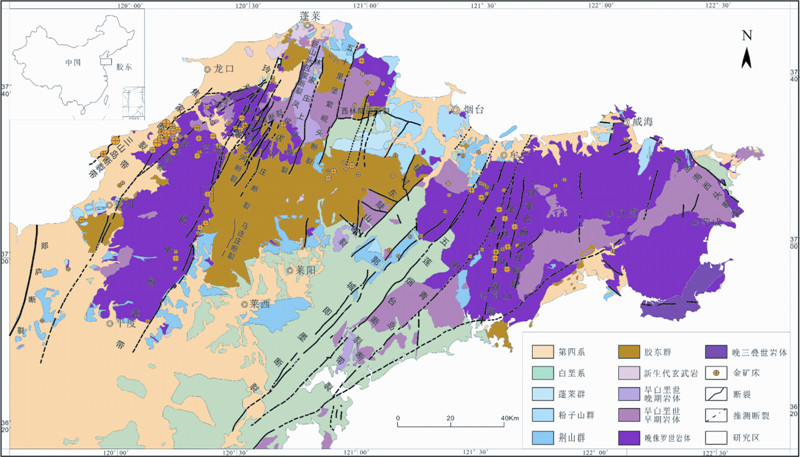 | 图 1 胶东区域地质图(据邓军等,2010; Wang et al., 2014a; Yang et al., 2014) Fig. 1 The regional geological map of Jiaodong Peninsula(after Deng et al., 2010; Wang et al., 2014a; Yang et al., 2014) |
流体包裹体成分分析可为建立古流体作用过程的地球化学模型提供准确的古流体组成信息,并进一步厘定成矿流体来源和矿床成因(王莉娟等,1998;孙贺和肖益林,2009)。然而,胶东金矿受多期次构造-成矿热液活动控制,具有多期多阶段叠加富集的特点(范宏瑞等,2005),同一矿石样品中往往发育不同阶段的流体包裹体,不同成矿阶段的包裹体成分代表不同的成矿作用(Yang et al., 2008,2009a,b),致使以往真空研磨法的群体包裹体气相成分分析是多个成矿阶段包裹体成分分析的综合结果,这增加了数据解释的不确定性和复杂性(卢焕章和郭迪江,2000)。单个流体包裹体分析可以准确地分析代表任何成矿阶段的包裹体,且其所提供的地质信息是确定的和唯一的,但胶东金矿包裹体非常小,通常是2~7μm,无法开展胶东金矿床单个流体包裹体研究(朱和平等,2003)。因此,需要尽可能选取代表性好的、且只含一个世代包裹体的样品,但这一方法是一项难度大、费时长的工作,目前研究薄弱,较难实现(朱和平等,2003)。而在根据真空爆裂取气法所提供的爆裂温度曲线区分不同成矿阶段的包裹体基础上,采用四极质谱测定不同成矿阶段的流体包裹体组成,即可以避免群体包裹体的气相成分分析不能区分不同成矿阶段包裹体组分的弊端,又克服了单个包裹体分析受包裹体大小和仪器灵敏度的限制的缺陷(朱和平和王莉娟,2001;朱和平等,2003),对研究不同成矿阶段流体组成、演化和深层次解释矿床成因具有重要意义,已经成为成矿流体研究的重要方法(王莉娟等, 2007,2008; Yang et al., 2008)。
招平断裂带是胶东金矿集区内规模最大的断裂-成矿带(图 2),其内已探明金资源量1500余吨(Yang et al., 2014; 杨立强等,2014a);大尹格庄金矿床是位于该金矿带中段的超大型金矿床,已探明金金属量约125t(Deng et al., 2003a,2009,2011; Yang et al., 2009a; 杨立强等,2013)。20世纪70年代以来,随着深部成矿理论及勘查技术方法发展(Yang et al., 2006; 杨立强等,2006a; 邓军等,2010),该矿床的找矿勘查工作不断取得进展,目前勘探深度近-800m。与找矿勘探的进展相比,该金矿床地质研究程度较低,以往研究主要集中在控矿构造和矿化空间结构及围岩蚀变地球化学等方面;关于成矿流体主要是通过常规的真空研磨法进行群体包裹体的气相成分分析(沈昆等,2000)。为此,论文在进一步查明矿床地质特征并进行成矿阶段划分的基础上,基于真空爆裂取气法所提供的爆裂温度曲线区分不同成矿阶段的包裹体,并采用四极质谱和离子色谱仪分析方法,获得不同成矿阶段的流体包裹体组分,探讨大尹格金矿床成矿流体的性质与演化。
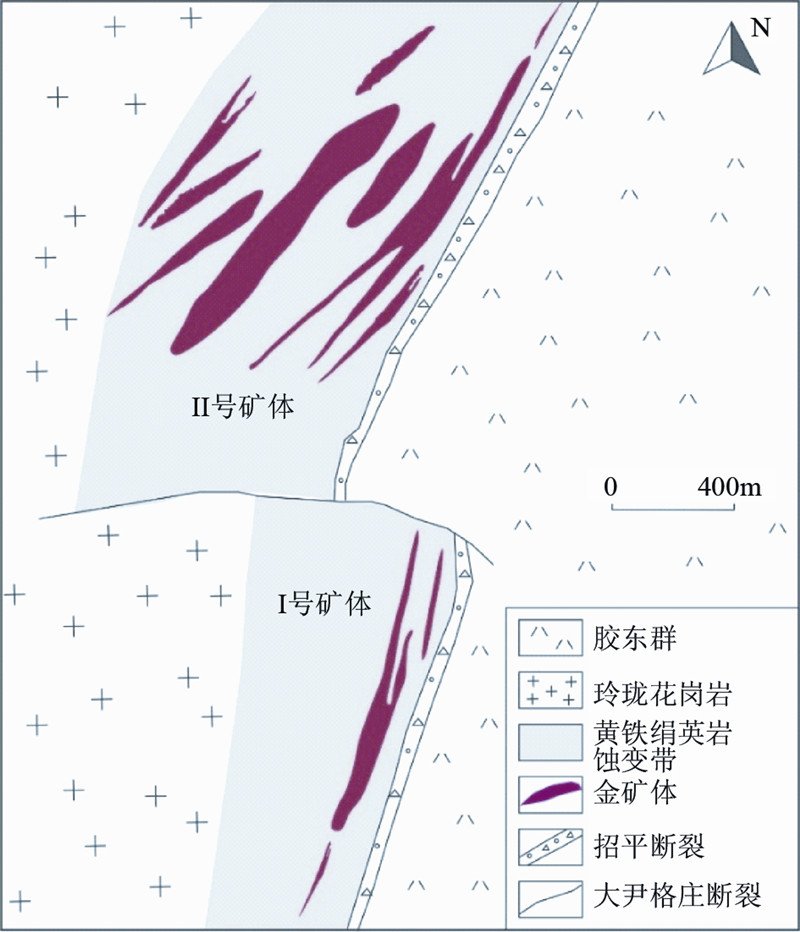 | 图 2 大尹格庄金矿床地质简图(据Yang et al., 2009a,2014) Fig. 2 Geological map of the Dayingezhuang gold deposit(after Yang et al., 2009a,2014) |
大尹格庄金矿床位于胶东半岛西北部招平断裂带的中段(图 1),其内出露地层为太古宇胶东群黑云斜长变粒岩、碳酸盐、片岩和斜长角闪岩及古元古代荆山群禄格庄组石榴夕线黑云片岩和黑云片岩,分布于矿区的中东部、招平断裂带的上盘。矿区内岩浆岩为玲珑黑云母花岗岩,分布于招平断裂下盘,为大尹格庄金矿床的主要赋矿围岩(图 2)。
招平断裂和大尹格庄断裂是大尹格庄金矿床主要控矿断裂。其中,招平断裂沿胶东群与玲珑花岗岩接触带发育,下盘普遍发育黄铁绢英岩化蚀变、钾化和硅化,其中黄铁绢英岩化和硅化与金矿化关系密切;上盘具有强烈的碳酸盐化。该断裂在大尹格金矿床内总体走向20°,倾向南东,倾角21°~58°,宽40~78m,最宽达140m,由糜棱岩、碎裂岩、碎斑岩及少量断层泥、角砾岩等组成。大尹格庄断裂走向280°,倾向北东,倾角43°~60°,宽1.8~35m,由碎裂岩、角砾岩及断层泥组成,呈波状弯曲,局部分枝复合;其错断招平断裂,上盘相对向左滑动,水平断距260~300m,显示其在成矿晚期具左行压扭性特征。此外,大尹格庄断裂上盘的玲珑黑云母花岗岩亦发育黄铁绢英岩化蚀变,表明该断裂至少经历了两期活动。Ⅰ号和Ⅱ号矿体分别位于大尹格庄断裂南北两侧,占该矿床探明储量的85%(Yang et al., 2014),均主要集中在招平断裂下盘约60m范围内(图 2),走向约NE20°,倾向南东,倾角27°~53°。其中I号矿体厚2~10m,长450~990m,金品位2~4.06g/t,平均2.69g/t;II号矿体厚10~30m,长260~1057m,金品位2.1~3.73g/t,平均2.56g/t。Ⅰ号和Ⅱ号矿体主要矿石矿物为黄铁矿,其次为方铅矿、闪锌矿和黄铜矿,比较而言,Ⅰ号矿体银含量高且含有更多Pb、Zn硫化物(Yang et al., 2014; 张良等,2014),明显不同于胶东其它地区金矿床内金矿体。
根据不同矿化类型矿体穿插关系和矿物共生组合特征,大尹格庄金矿床金矿成矿作用从早到晚大致可分为三个阶段:金-绢云母-石英-黄铁矿阶段(早)、金(银)-石英-多金属硫化物阶段(中)和石英-方解石-黄铁矿阶段(晚)。
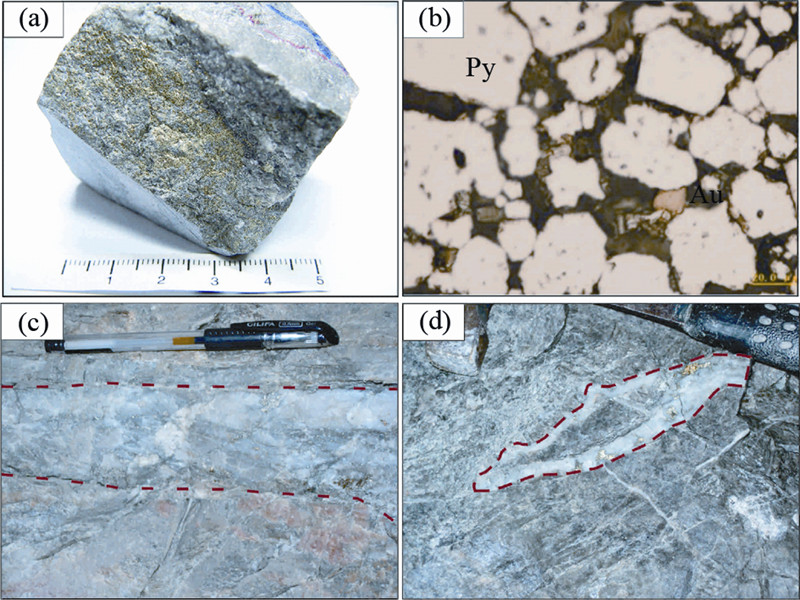 | 图 3 不同阶段矿石野外与镜下照片 (a)-早阶段黄铁绢英岩矿石;(b)-绢英岩镜下照片;(c)-中阶段石英-硫化物矿石;(d)-晚阶段脉状石英-黄铁矿矿石 Fig. 3 Sample photos of different stages of ore (a)-pytite phyllic ore of early stage;(b)-microscope photos of phyllic;(c)-quartz-sulphide ore of middle stage;(d)-quartz-pyrite vein ore of late stage |
早阶段即金-绢云母-石英-黄铁矿阶段:主要矿化产物为黄铁矿,并含有少量石英、绢云母、自然金。其中黄铁矿呈自形、半自形晶体,浸染状分布;石英呈半自形粒状嵌布在黄铁矿晶隙中。本阶段是金的主要沉淀期,形成自然金和银金矿,呈粒状、枝叉状及浑圆粒状,分布在碎裂岩中的黄铁矿内或黄铁矿和石英晶隙中(图 3a,b)。
中阶段即金(银)-石英-多金属硫化物阶段:矿化产物主要由石英、黄铁矿、黄铜矿、方铅矿、闪锌矿组成,并含少量银金矿、金银矿、磁黄铁矿、黝铜矿、辉铜铋矿、自然铋等,矿物组合复杂,一般呈团块状分布(图 3c)。其中石英呈灰色,半自形粒粒状,嵌布于黄铁矿晶隙中;黄铁矿呈黄色,半自形粒状,其晶隙中常被黄铜矿、闪锌矿、方铅矿、银金矿充填。黄铜矿与闪锌矿常构成乳浊结构。此阶段亦伴也有金(银金矿为主)的沉淀,叠加在前阶段之上形成金的局部富集。银金矿常呈粒状、细脉状嵌布于黄铁矿石英晶隙中或早阶段形成的黄铁矿裂隙中,或包于黄铜矿、闪锌矿、方铅矿内。
晚阶段即石英-方解石-黄铁矿阶段:方解石一般为乳白色粗粒自形晶集合体,形成石英+方解石+黄铁矿组合(图 3d)。
3 流体包裹体爆裂法测温及气液相成分 3.1 样品及分析方法
本研究在大尹格庄金矿床不同中段内系统采集了14件不同阶段样品,用于流体包裹体爆裂法测温及气液相成分分析(表 1)。样品经粉碎、过筛,在双目镜下挑选60~80目、纯度大于99%的石英和方解石样品,送至中国科学院地质与地球物理研究所矿物包裹体实验室及矿物资源探查研究中心分析。爆裂法测温采用DT-4型矿物包裹体爆裂测温仪,使用上海自动化仪表二厂函数记录仪,X轴选用1mv/cm(EU-2型热电偶),Y轴选用0.5mv/cm,测温范围:100~600℃。流体包裹体气液相成分群体分析,通过分阶段加热爆裂法提取100~240℃、240~330℃、330~500℃三个温度范围的气液体进行测试;其中气相成分分析采用日本真空技术株式会社RG202型四极质谱仪,具体测试方法参见朱和平和王莉娟(2001)及朱和平等(2003);液相成分分析采用日本岛津HIC-6A型离子色谱仪,具体测试方法参见张静等(2007)。
 | 表 1 流体包裹体研究样品采样位置及特征 Table 1 Positions and features of the samples for studying fluid inclusions |
爆裂法和均一法一样,在理论上具有同样的可靠性,在实际中也具有同样的应用价值(卢焕章等,2004)。根据大量包裹体的爆裂声响得到的爆裂谱线,可以求得爆裂起始温度、峰值和包裹体爆裂的爆裂次数。从大尹格庄金矿床石英样品的爆裂谱线可以看出,石英流体包裹体爆裂温度区间为330~510℃、240~330℃和160~240℃,在453℃爆裂强度最大。在575℃附近存在一个高峰,为石英的α-β相转变点(图 4和表 2)。
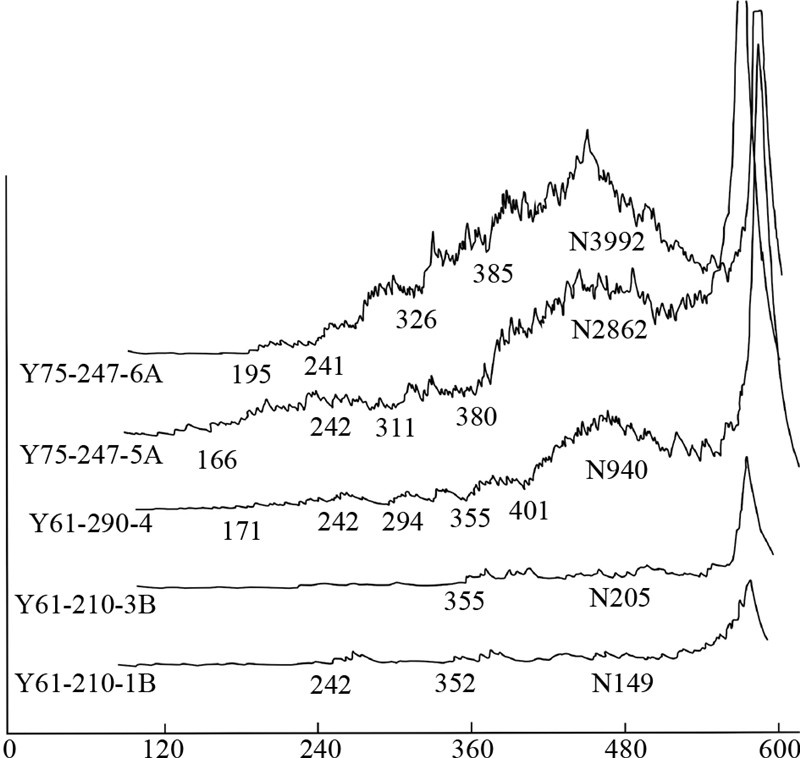 | 图 4 流体包裹体爆裂法测温曲线图 X轴单位为1mV/cm,Y轴单位为0.5mPa/cm,测试范围:100~600℃ Fig. 4 Decrepitation curves of samples X axis is in 1mV/cm,Y axis is in 0.5mPa/cm. The temperature ranges from100 to 600℃ |
| 表 2 大尹格庄金矿床流体包裹体爆裂法测温结果 Table 2 Decrepitation results of the fluid inclusions in the Dayingezhuang gold deposit |
朱和平等(2003)通过实验证明了包裹体爆裂法划分成矿阶段是可行的。大尹格庄金矿床矿石样品中包裹体主要在330~510℃、240~330℃和160~240℃发生爆裂,这三个温度区间指示成矿划分为三个阶段,即成矿早阶段、中阶段和晚阶段。样品爆裂区间与样品的阶段划分一致。例如样品Y62-210A为中阶段石英黄铁矿矿石,爆裂温度为326℃;样品Y75-247-6A既发育早阶段浸染状黄铁矿又存在中阶段细脉状黄铁矿,这两阶段对应的爆裂温度区间为326~515℃和241~326℃。 3.3 气相成分
大 尹格庄金矿床流体包裹体气相成分以H2O和CO2为主(表 3),含量分别为81.934mol%~98.897mol%和1.158mol%~14.927mol%,其余为少量的C2H6(0.004mol%~4.881mol%)、CH4(0.14mol%~12.695mol%)、H2S(0.018mol%~0.357mol%)、Ar(0.044mol%~0.462mol%)和N2(0.003mol%~0.717mol%)。
| 表 3 大尹格庄金矿床流体包裹体气相成分(mol%) Table 3 Gas contents(mol%)in fluid inclusions from the Dayingezhuang gold deposit |
大尹格庄金矿床流体包裹体液相成分中(表 4),阳离子主要为K+、Na+为主,含量分别为0.134×10⁻⁶~5.698×10⁻⁶和0.290×10⁻⁶~3.542×10⁻⁶,其次为少量Ca2+(0.074×10⁻⁶~1.463×10⁻⁶)。阴离子主要为SO2-4、Cl-及F-,含量分别为0.58×10⁻⁶~6.014×10⁻⁶(20.866×10⁻⁶与36.146×10⁻⁶为异常值)、0.445×10⁻⁶~4.712×10⁻⁶和0.444×10⁻⁶~3.104×10⁻⁶。
| 表 4 大尹格庄金矿床流体包裹体液相成分(×10-6) Table 4 Liquid contents(×10-6)in fluid inclusions from the Dayingezhuang gold deposit |
包裹体爆裂谱线起点(拐点)所对应的温度称为样品的爆裂温度值,爆裂温度值接近包裹体形成温度的上限值。大尹格庄金矿床早、中、晚阶段流体包裹体的爆裂温度分别集中在325~385℃,240~330℃和165~195℃。金沉淀主要发生在早阶段和中阶段,因此大尹格庄金成矿温度为240~385℃。盐度主要集中在3.0%~8.5% NaCleqv(Yang et al., 2009a)。综上,大尹格庄金矿床成矿流体属于中温、中低盐度流体。
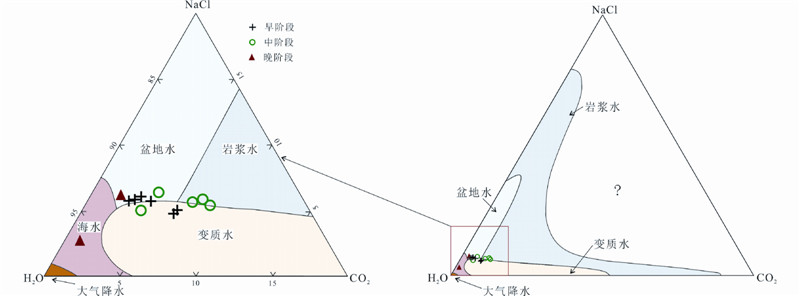 | 图 5 成矿流体NaCl-H2O-CO2图解(底图据Kesler,2005) Fig. 5 Scheme of NaCl-H2O-CO2 of different stages(modified after Kesler,2005) |
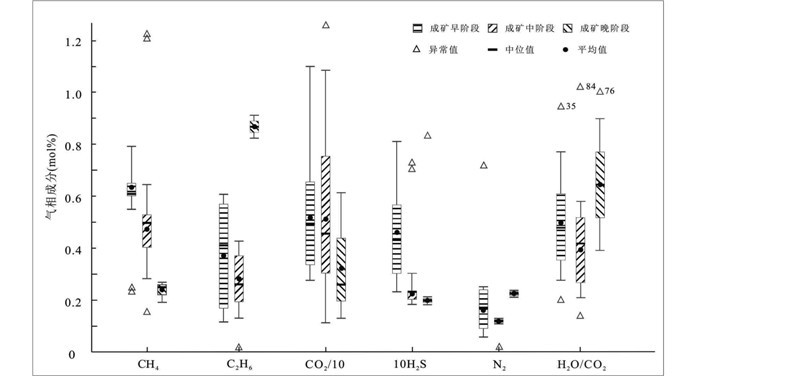 | 图 6 不同阶段流体包裹体气相成分(mol%)和比值 图中自下向上横线分别代表最小值、下四分卫值、中位值、上四分位值和最大值 Fig. 6 Gas composition of different stages and ratio Horizontal line from the bottom to up representing the minimum,the next quarterback value,median,the upper quartile and maximum values |
在NaCl-H2O-CO2图解中(图 5),成矿早阶段样品大多数投影在变质水区域内或变质水和盆地水区域交界处。Giggenbach et al.(1994)证实岩浆热液基本上不含C2H6,而变质热液具有较高含量的C2H6,结合大尹格庄金矿床流体含较多的C2H6(表 3和图 6),推断其成矿流体主要来源于变质热液。该认识与前人通过氢氧同位素获得的胶东金矿成矿流体主要来源于变质水认识一致(Yang et al., 2007b; 王中亮,2012; 郭林楠等,2014)。 4.2 流体组成演变与成矿机制
热液金矿床成矿流体往往经历了长距离迁移,其流体组成除了反映源区性质之外,还可能表征沿流体通道水/岩反应、源区和围岩或后期流体的混合特征(Beaudoin and Pitre, 2005; Deng et al., 2003b,2005; Yang et al., 2007b; 李楠等,2012; 杨利亚等,2013)。大尹格庄金矿床各阶段流体气液相成分见表 3。各阶段气液相成分组成相似,但含量有规律性的变化。
从成矿早阶段到晚阶段气相成分,CH4、H2S和CO2含量降低,C2H6和N2先降低后增高(图 6);CO2和H2S在金矿形成过程中扮演着重要角色(Fan et al., 2003)。Phillips and Evans(2004)认为金有效搬运离不开H2S和CO2,其中H2S 主要与金形成金硫络合物,而CO2通过调节流体pH值,提高金的溶解度。从早阶段到晚阶段H2S和CO2含量分别为0.047mol%→0.023mol%→0.023mol%和5.258mol%→5.247mol%→3.345mol%,早阶段具有较高含量的H2S,表明金硫络合物是大尹格庄金矿床金的一种运移方式(Yang et al., 2009a)。
沸腾作用使流体中CO2大量散逸,导致H2O/CO2增高,因此H2O/CO2增高可作为流体沸腾的标志之一(Phillips and Evans, 2004; Wang et al., 2014b)。大尹各庄金矿床早阶段和中阶段CO2明显高于晚阶段,并且成矿晚阶段H2O/CO2增高(图 6),说明流体有可能在中阶段的发生了沸腾作用,CO2大量散逸而造成H2O/CO2升高。
浅源大气降水比深源岩浆热液或变质热液具有更高的N2(Chen et al., 2001),大尹格庄金矿床早阶段和中阶段流体中N2较低,晚阶段升高(表 3和图 6),指示从早阶段到晚阶段流体系统逐渐开放,后期有大气降水的加入。
液相成分Cl-、Na+、K+和SO2-4含量下降,F-含量先降低后升高,Ca2+含量先升高后降低(图 7)。从成矿早阶段到晚阶段,Cl-/SO2-4和Na+/K+升高,分别为0.758→1.856→2.026和0.998→1.822→2.117,说明从成矿早阶段到晚阶段,流体从以K2SO4为主的体系演变为以NaCl为主的体系(图 7),即大尹格庄金矿床成矿流体从早阶段CO2-H2O-K2SO4类型流体逐步变为中阶段和晚阶段CO2-H2O-NaCl类型流体,流体类型的演变可能是引起金沉淀的一个重要因素(Yang et al., 2009a)。Na+、Cl-、K+和SO2-4和浓度逐渐降低,表明成矿流体从成矿早阶段到晚阶段盐度降低。
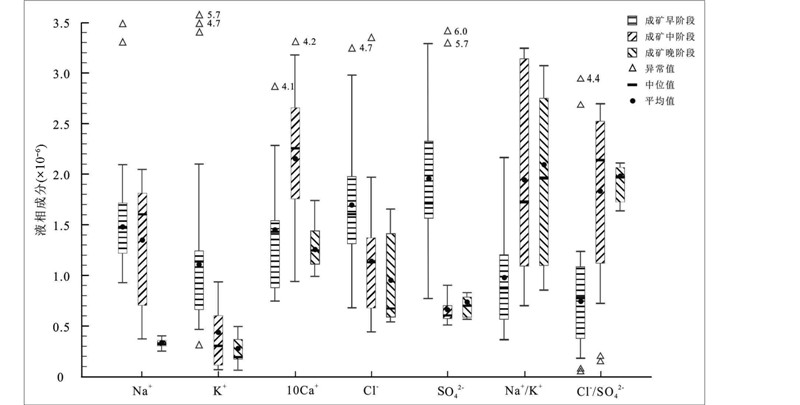 | 图 7 不同阶段流体包裹体液相成分和比值 Fig. 7 Liquid composition of different stages and ratio |
大尹格庄金矿床气液相成分的演化特征表明金硫络合物是金的一种运移方式;流体在中阶段有可能发生了沸腾作用,造成CO2大量散逸,导致H2O/CO2增高;从早阶段到晚阶段流体系统逐渐开放,后期有大气降水的加入。Cl-/SO2-4和Na+/K+比值显示流体类型发生了改变,这可能是导致金沉淀的重要因素。此外,离子浓度变化反映了成矿流体盐度从早阶段到晚阶段降低。
5 结论
(1)大尹格庄金矿床成矿流体属于中温(240~385℃),富CO2,含CH4、C2H6、H2S等挥发分的流体;流体主要来源于变质热液,晚阶段流体可能以大气降水为主。
(2)从早阶段到晚阶段,大尹格庄金矿床成矿流体温度和盐度降低,从CO2-H2O-K2SO4类型流体逐步演变为CO2-H2O-NaCl类型流体,并可能在中阶段的发生了沸腾作用。
(3)金硫络合物是大尹格庄金矿床金的一种运移方式。流体类型的演变和沸腾作用可能是导致大尹各庄金矿床金沉淀的重要因素。
致谢 龚庆杰教授、张静副教授和王中亮老师为本文提供了宝贵的修改意见;野外工作得到了大尹格庄金矿床相关工作人员的帮助和支持;同位素实验工作得到了中国科学院地质与地球物理研究所相关工作人员的协助;研究生张良、赵凯等参加了部分研究工作;在此一并致以诚挚的感谢!
| [1] | Beaudoin G and Pitre D. 2005. Stable isotope geochemistry of the Archean Val-d'Or (Canada) orogenic gold vein field. Mineralium Deposita, 40(1): 59-75 |
| [2] | Chen YJ, Sui YH and Gao XL. 2001. Fluid geochemistry of Tieluping Ag ore and its implication for the CPMF model. In: Cidu S (ed.). Proceedings of the Tenth International Symposium on Water-Rock Interaction. Villasimius, Italy, 10-15 JUly 2001. Lisse: Swets &Zeitlinger, 689-692 |
| [3] | Deng J, Zhai YS, Wang JP, Yang LQ, Fan Y and Sun ZS. 2000. Shear alteration, mass transfer and gold mineralization: An example from Jiaodong ore deposit concentrating area, Shandong, China. Journal of China University of Geoscience, 11(3): 281-287 |
| [4] | Deng J, Yang LQ, Liu W, Sun ZS, Li XJ and Wang QF. 2001. Gold origin and fluid ore-forming effect of Zhao-Ye ore deposits concentrating area in Jiaodong, Shandong, China. Chinese Journal of Geology, 36(3): 257-268 (in Chinese with English abstract) |
| [5] | Deng J, Yang LQ, Sun ZS, Wang JP, Wang QF, Xin HB and Li XJ. 2003a. A metallogenic model of gold deposits of the Jiaodong granite-greenstone belt. Acta Geologica Sinica, 77(4): 537-546 |
| [6] | Deng J, Liu W, Sun ZS, Wang JP, Wang QF, Zhang QX and Wei YG. 2003b. Evidence of mantle-rooted fluids and multi-level circulation of ore-forming dynamics: A case study from the Xiadian gold deposit, Shandong Province, China. Science in China (Series D), 46(Suppl.1): 123-134 |
| [7] | Deng J, Wang QF, Yang LQ, Wang JP, Gao BF and Liu Y. 2004. The geological settings to the gold metallogeny in northwestern Jiaodong Peninsula, Shandong Province. Earth Sciences Frontiers, 11(4): 527-533 (in Chinese with English abstract) |
| [8] | Deng J, Gao BF, Wang QF and Yang LQ. 2005. Formation and evolution of ore-forming fluid system. Geological Science and Technology Information, 24(1): 49-54 (in Chinese with English abstract) |
| [9] | Deng J, Yang LQ, Ge LS, Wang QF, Zhang J, Gao BF, Zho YH and Jiang SQ. 2006. Research advances in the Mesozoic tectonic regimes during the formation of Jiaodong ore cluster area. Progress in Natural Science, 16(8): 777-784 |
| [10] | Deng J, Wang QF, Yang LQ, Zhou L, Gong QJ, Yuan WM, Xu H, Guo CY and Liu XW. 2008. The structure of ore-controlling strain and stress fields in the Shangzhuang gold deposit in Shandong Province, China. Acta Geologica Sinica, 82(4): 769-780 |
| [11] | Deng J, Wang QF, Wan L, Yang LQ, Gong QJ, Zhao J and Liu H. 2009. Self-similar fractal analysis of gold mineralization of Dayingezhuang disseminated-veinlet deposit in Jiaodong gold province, China. Journal of Geochemical Exploration, 102(2): 95-102 |
| [12] | Deng J, Chen YM, Liu Q and Yang LQ. 2010. The Gold Metallogenic System and Mineral Resources Exploration to Sanshandao Fault Zone, Shandong Province. Beijing: Geological Publishing House, 1-371 (in Chinese) |
| [13] | Deng J, Wang QF, Wan L, Liu H, Yang LQ and Zhang J. 2011. A multifractal analysis of mineralization characteristics of the Dayingezhuang disseminated-veinlet gold deposit in the Jiaodong gold province of China. Ore Geology Reviews, 40(1): 54-64 |
| [14] | Deng J, Wang QF, Li GJ and Santosh M. 2014. Cenozoic tectono-magmatic and metallogenic processes in the Sanjiang region, southwestern China. Earth-Science Reviews, doi: 10.1016/j.earscirev.2014.05.015 |
| [15] | Fan HR, Zhai MG, Xie YH and Yang JH. 2003. Ore-forming fluids associated with granite-hosted gold mineralization at the Sanshandao deposit, Jiaodong gold province, China. mineralium Deposita, 38: 739-750 |
| [16] | Fan HR, Hu FF, Yang JH, Shen K and Zhai MG. 2005. Fluid evolution and large scale gold metallogeny during Mesozoic tectonic transition in the eastern Shandong Province. Acta Petrologica Sinica, 21(5): 1317-1328 (in Chinese with English abstract) |
| [17] | Giggenbach WF, Sheppard DS, Robinson BW et al. 1994. Grochemical structure and position of the Waiotopu geothermal field, New Zealand. Geothermaics, 23(5-6): 599-644 |
| [18] | Goldfarb RJ, Santosh M, Deng J and Yang LQ. 2013. The giant Jiaodong gold deposits, China: Orogenic gold in a unique tectonic setting or a unique gold deposit type? GSA Annual Meeting in Denver: 125th Anniversary of GSA |
| [19] | Goldfarb RJ and Santosh M. 2014. The dilemma of the Jiaodong gold deposits: Are they unique? Geoscience Frontiers, 5(2): 139-153 |
| [20] | Guo LN, Zhang C, Song YZ, Chen BH, Zhou Z, Zhang BL, Xu XL and Wang YW. 2014. Hydrogen and oxygen isotopes geochemistry of the Wang'ershan gold deposit, Jiaodong. Acta Petrologica Sinica, 30(9): 2481-2494 (in Chinese with English abstract) |
| [21] | Kesler SE. 2005. Ore-forming fluids. Elements, 1(1): 13-18 |
| [22] | Li N, Yang LQ, Zhang C et al. 2012. Sulfur isotope characteristics of the Yangshan gold belt, West Qingling: Constraints on ore-forming environment and material source. Acta Petrologica Sinica, 28(5):1577-1587 (in Chinese with English abstract) |
| [23] | Lu HZ and Guo DJ. 2000. Progress and trends of researches on fluid inclusions. Geological Review, 46(4): 385-392 (in Chinese with English abstract) |
| [24] | Lu HZ, Fan HR, Ni P, Ou GX, Shen K and Zhang WH. 2004. Fluid Inclusion. Beijing: Sciences Press, 186-195 (in Chinese) |
| [25] | Phillips GN and Evans KA. 2004. Role of CO2 in the formation of gold deposits. Nature, 429(6994): 860-863 |
| [26] | Shen BF and Luo H. 1994. The Metallogenetic characteristics of gold deposits of the Archean greenstone belts in North China platform. Jour. Geol. & Min. Res. North China, 9(1): 87-95 (in Chinese with English abstract) |
| [27] | Shen K, Hu SX, Sun JG, Ling HF, Zhao YY and Sun MZ. 2000. Characteristics of ore-forming fluids of the Dayingezhuang gold deposit in eastern Shangdong, China. Acta Petrologica Sinica, 16(4): 542-550 (in Chinese with English abstract) |
| [28] | Sun H and Xiao YL. 2009. Fluid inclusion: Latest development, geological applications and prospect. Advances in Earth Science, 24(10): 1105-1121 (in Chinese with English abstract) |
| [29] | Sun JG, Hu SX, Shen K and Yao FL. 2001. Research on C, O isotopic geochemistry of intermediate-basic and intermediate-acid dykes in goldfields of Jiaodong Peninsula. Acta Petrologica et Mineralogica, 20(1): 47-56 (in Chinese with English abstract) |
| [30] | Wang LJ. 1998. Analysis and study of the composition of fluid inclusions. Geological Review, 44(5): 496-501 (in Chinese with English abstract) |
| [31] | Wang LJ, Zhu HP and Wang M. 2007. Application of decrepitation method in ore deposits. Geology and Prospecting, 43(5): 88-91 (in Chinese with English abstract) |
| [32] | Wang LJ, Wang JB, Wang YW and Zhu HP. 2008. The characteristics of ore-fluid of gold deposits in Junggar-East Tianshan Mountains area, Xinjiang. Acta Petrologica Sinica, 24(4):753-761 (in Chinese with English abstract) |
| [33] | Wang YW. 1992. Remobilization metallogeny for gold deposits in margin of the North China platform. Geology and Mineral Resources Research, 7(1): 81-91 (in Chinese with English abstract) |
| [34] | Wang ZL. 2012. Metallogenic system of Jiaojia gold orefield, Shandong Province, China. Ph. D. Dissertation. Beijing: China University of Geosciences (in Chinese with English summary) |
| [35] | Wang ZL, Yang LQ, Deng J, Santosh M, Zhang HF, Liu Y, Li RH, Huang T, Zheng XL and Zhao H. 2014a. Gold-hosting high Ba-Sr granitoids in the Xincheng gold deposit, Jiaodong Peninsula, East China: Petrogenesis and tectonic setting. Journal of Asian Earth Sciences, doi:10.1016/j.jseaes.2014.03.001 |
| [36] | Wang ZL, Yang LQ, Guo LN, Erin M, Wang JP, Liu Y, Zhang C, Li RH, Zhang L and Zheng XL. 2014b. Fluid immiscibility and gold deposition in the Xincheng deposit, Jiaodong Peninsula, China: A fluid inclusion study. Ore Geology Reviews, doi:10.1016/j.oregeorev.2014.06.006 |
| [37] | Yang JH. 2000. Gold metallogenic epoch and geodynamic of Jiaodong: On the crust-mantle interaction and diagenetic mineralization. Ph. D. Dissertation. Institute of Geology and Geophysics, Chinese Academy of Sciences, 1-133 (in Chinese with English summary) |
| [38] | Yang LQ, Wang GJ, Zhang ZJ, Deng J, Zhao AH and Wang JP. 2000. Lithospheric structure and deep-seated mineralization in Jiaodong gold deposit concentration region, Shandong, China. Earth Science, 25(4): 421-427 (in Chinese with English abstract) |
| [39] | Yang LQ, Deng J, Zhang ZJ, Wang GJ and Wang JP. 2003. Crust-mantle structure and coupling effects on mineralization: An example from Jiaodong Gold Ore Deposits Concentrating Area, China. Journal of China University of Geosciences, 14(1): 42-51 |
| [40] | Yang LQ, Deng J, Wang JG, Wei YG, Wang JP, Wang QF and Lu P. 2004. Control of deep tectonics on the superlarge deposits in China. Acta Geologica Sinica, 78(2): 358-367 |
| [41] | Yang LQ, Deng J, Wang QF and Zhou YH. 2006. Coupling effects on gold mineralization of deep and shallow structures in the northwestern Jiaodong Peninsula, eastern China. Acta Geologica Sinica, 80(3): 400-411 |
| [42] | Yang LQ, Deng J, Wang QF, Gao BF and Xu H. 2006. Deep-seated tectonic and geological process controls on mineralization and mineral resources. Mineral Deposits, 25(Suppl.1): 107-110 (in Chinese with English abstract) |
| [43] | Yang LQ, Deng J, Ge LS, Wang QF, Zhang J, Gao BF, Jiang SQ and Xu H. 2007a. Metallogenic epoch and genesis of the gold deposits in Jiaodong Peninsula, eastern China: A regional review. Progress in Natural Science, 17(2): 138-143 |
| [44] | Yang LQ, Deng J, Zhang J, Wang QF, Gao BF, Zhou YH, Guo CY and Jiang SQ. 2007b. Preliminary studies of fluid inclusions in Damoqujia gold deposit along Zhaoping fault zone, Shandong Province, China. Acta Petrologica Sinica, 23(1): 153-160 |
| [45] | Yang LQ, Deng J, Zhang J, Guo CY, Gao BF, Gong QJ, Wang QF, Jiang SQ and Yu HJ. 2008. Decrepitation thermometry and compositions of fluid inclusions of the Damoqujia gold deposit, Jiaodong gold province, China: Implications for metallogeny and exploration. Journal of China University of Geosciences, 19(4): 378-390 |
| [46] | Yang LQ, Deng J, Guo CY, Zhang J, Jiang SP, Gao BF, Gong QJ and Wang QF. 2009a. Ore-forming fluid characteristics of the Dayingezhuang gold deposit, Jiaodong Gold Province, China. Resource Geology, 59(2): 181-193 |
| [47] | Yang LQ, Deng J, Li N and Guo CY. 2009b. Geology, geochemistry of ore-forming fluids and hydrothermal alteration dynamics of the Zhaoping gold belt in northwestern Jiaodong Peninsula, eastern China. Geochimica et Cosmochimica Acta, 73(Spec. Suppl.): A1477 |
| [48] | Yang LQ, Deng J, Goldfarb RJ, Zhang J and Wang ZL. 2013. Timing and duration of hydrothermal activity and geochronological constraints on the formation of the Dayingezhuang gold deposit, Jiaodong gold province, China. Geological Journal of China University, 19(Suppl.): 400 (in Chinese) |
| [49] | Yang LQ, Deng J, Goldfarb RJ, Zhang J, Gao BF and Wang ZL. 2014. 40Ar/39Ar geochronological constraints on the formation of the Dayingezhuang gold deposit: New implications for timing and duration of hydrothermal activity in the Jiaodong gold province, China. Gonwana Research, 25(4): 1469-1483 |
| [50] | Yang LQ, Deng J and Wang ZL. 2014a. Ore-controlling structural pattern of Jiaodong gold deposits: Geological-geophysical integration constraints. In: Chen YT, Jin ZM, Shi YL, Yang WC and Zhu RX (eds.). The Deep-Seated Structures of Earth in China. Beijing: Sciences Press, 1006-1030 (in Chinese) |
| [51] | Yang LQ, Deng J, Wang ZL, Zhang L, Guo LN, Song MC and Zheng XL. 2014b. Mesozoic gold metallogenic system of the Jiaodong gold province, eastern China. Acta Petrologica Sinica, 30(9): 2447-2467 (in Chinese with English abstract) |
| [52] | Yang LY, Yang LQ, Yuan WM, Zhang C, Zhao K and Yu HJ. 2013. Origin and evolution of ore fluid for orogenic gold traced by D-O isotopes: A case from the Jiapigou gold belt, China. Acta Petrologica Sinica, 29(11): 4025-4035 (in Chinese with English abstract) |
| [53] | Yao FL. 1991. Gold mineralization type and conditions in margin of the North China. Gold Science and Technology News, (11): 26-32 (in Chinese) |
| [54] | Zhang J, Qi JP, Qiu JJ, You SN and Li GP. 2007. Compositional study on ore fluid of the Yindongou silver deposit in Neixiang County, Henan Province, China. Acta Petrologica Sinica, 23(9): 2217-2226 (in Chinese with English abstract) |
| [55] | Zhang L, Liu Y, Li RH, Huang T, Zhang RZ, Chen BH and Li JK. 2014. Lead isotope geochemistry of Dayingezhuang gold deposit, Jiaodong Peninsula, China. Acta Petrologica Sinica, 30(9): 2468-2480 (in Chinese with English abstract) |
| [56] | Zhu HP and Wang LJ. 2001. Determination of fluid inclusions in the gas phase composition with a quadrupole mass spectrometer. Science in China (Series D), 31(7): 586-590 (in Chinese) |
| [57] | Zhu HP, Wang LJ and Liu JM. 2003. Determination of quadrupole mass spectrometer for gaseous composition of fluid inclusion from different mineralization stages. Acta Petrologica Sinica, 19(2): 314-318 (in Chinese with English abstract) |
| [58] | Zhu J. 1995. On genesis of gold deposit in Zhaoye district, Shandong. Journal of Institute of Gold Technology, 14(1): 8-15 (in Chinese with English abstract) |
| [59] | 邓军, 杨立强, 刘伟, 孙忠实, 李新俊, 王庆飞. 2001. 胶东招掖矿集区巨量金质来源和流体成矿效应. 地质科学, 36(3): 257-268 |
| [60] | 邓军, 王庆飞, 杨立强, 王建平, 高帮飞, 刘琰. 2004. 胶西北金矿集区成矿作用发生的地质背景. 地学前缘, 11(4): 527-533 |
| [61] | 邓军, 高帮飞, 王庆飞, 杨立强. 2005. 成矿流体系统的形成与演化. 地质科技情报, 24(1): 49-54 |
| [62] | 邓军, 陈玉民, 刘钦. 2010. 胶东三山岛断裂带金成矿系统与资源勘查. 北京: 地质出版社, 1-371 |
| [63] | 范宏瑞, 胡芳芳, 杨进辉, 沈昆, 翟明国. 2005. 胶东中生代构造体制转折过程中流体演化和金的大规模成矿. 岩石学报, 21(5): 1317-1328 |
| [64] | 郭林楠, 张潮, 宋宇宙, 陈炳翰, 周铸, 张炳林, 徐晓磊, 王彦玮. 2014. 胶东望儿山金矿床氢-氧同位素地球化学. 岩石学报, 30(9): 2481-2494 |
| [65] | 李楠, 杨立强, 张闯等. 2012. 西秦岭阳山金矿带硫同位素特征: 成矿环境与物质来源约束. 岩石学报, 28(5): 1577-1587 |
| [66] | 卢焕章, 郭迪江. 2000. 流体包裹体研究的进展及方向. 地质评论, 46(4): 385-392 |
| [67] | 卢焕章, 范宏瑞, 倪培, 欧光习, 沈昆, 张文淮. 2004. 流体包裹体. 北京: 科学出版社, 186-195 |
| [68] | 沈保丰, 骆辉. 1994. 华北陆台太古宙绿岩带金矿的成矿特征. 华北地质矿产杂志, 9(1): 87-95 |
| [69] | 沈昆, 胡受奚, 孙景贵, 凌洪飞, 赵毅英, 孙志明. 2000. 山东招远大尹格庄金矿成矿流体特征. 岩石学报, 16(4): 542-550 |
| [70] | 孙贺, 肖益林. 2009. 流体包裹体研究: 进展、地质应用及展望. 地球科学进展, 24(10): 1105-1121 |
| [71] | 孙景贵, 胡受奚, 沈昆, 姚凤良. 2001. 胶东金矿区矿田体系中基性-中酸性脉岩的碳、氧同位素地球化学研究. 岩石矿物学杂志, 20(1): 47-56 |
| [72] | 王莉娟. 1998. 流体包裹体成分分析研究. 地质评论, 44(5): 496-501 |
| [73] | 王莉娟, 朱和平, 王敏. 2007. 爆裂法测温在矿床地质上的应用. 地质与勘探, 43(5): 88-91 |
| [74] | 王莉娟, 王京彬, 王玉往, 朱和平. 2008. 新疆北部准噶尔-东天山地区金矿床成矿流体. 岩石学报, 24(4): 753-761 |
| [75] | 王义文. 1992. 金矿活化成矿论(以华北地台北缘为例). 地质找矿论丛, 7(1): 81-91 |
| [76] | 王中亮. 2012. 焦家金矿田成矿系统. 博士学位论文. 北京: 中国地质大学, 1-226 |
| [77] | 杨进辉. 2000. 胶东地区金矿床成矿时代及其成矿地球动力学背景——兼论壳幔相互作用与成岩成矿. 博士学位论文. 北京: 中国科学院地质与地球物理研究所, 1-133 |
| [78] | 杨立强, 王光杰, 张中杰, 邓军, 赵爱华, 王建平. 2000. 胶东金矿集中区岩石圈结构与深部成矿作用. 地球科学, 25(4): 421-427 |
| [79] | 杨立强, 邓军, 王庆飞, 高帮飞, 徐浩. 2006. 深部构造与地质过程控矿研究. 矿床地质, 25(S1): 107-110 |
| [80] | 杨立强, 邓军, Goldfarb RJ, 张静, 王中亮. 2013. 胶西北大尹格庄金矿床成矿年代学及热液活动时限. 高校地质学报, 19(增刊): 400 |
| [81] | 杨立强, 邓军, 王中亮. 2014a. 胶东金矿控矿构造样式: 地质-地球物理综合约束. 见: 陈运泰, 金振民, 石耀霖, 杨文采, 朱日祥主编. 中国大陆地球深部结构与动力学研究——庆贺滕吉文院士从事地球物理研究60周年. 北京: 科学出版社, 1006-1030 |
| [82] | 杨立强, 邓军, 王中亮, 张良, 郭林楠, 宋明春, 郑小礼. 2014b. 胶东中生代金成矿系统. 岩石学报, 30(9) : 2447-2467 |
| [83] | 杨利亚, 杨立强, 袁万明, 张闯, 赵凯, 于海军. 2013. 造山型金矿成矿流体来源与演化的氢-氧同位素示踪: 夹皮沟金矿带例析. 岩石学报, 29(11): 4025-4035 |
| [84] | 姚凤良. 1991. 华北陆台北缘带金矿类型及成矿条件. 黄金科技动态, (11): 26-32 |
| [85] | 张静, 祁进平, 仇建军, 尤世娜, 李国平. 2007. 河南省内乡县银洞沟银矿床流体成分研究. 岩石学报, 23(9): 2217-2226 |
| [86] | 张良, 刘跃, 李瑞红, 黄涛, 张瑞忠, 陈炳翰, 李金奎. 2014. 胶东大尹格庄金矿床铅同位素地球化学. 岩石学报, 30(9) : 2468-2480 |
| [87] | 朱和平, 王莉娟. 2001. 四级质谱测定流体包裹体中的气相成分. 中国科学(D辑), 31(7): 586-590 |
| [88] | 朱和平, 王莉娟, 刘建明. 2003. 不同成矿阶段流体包裹体气相成分的四级质谱测定. 岩石学报, 19(2): 314-318 |
| [89] | 朱军. 1995. 山东招掖地区金矿床成因的再认识. 沈阳黄金学院学报, 14(1): 8-15 |