 2014, Vol. 30


2. 怀俄明大学, 怀俄明州, Laramie 82071;
3. 斯坦福大学, 加州, CA 94305
 , GAO YuanHong1, LEI Min1, QIN HaiPeng1, LIU ChunHua1, LI MingZe1, B Ronald FROST2, Joseph LWOODEN3
2. University of Wyoming, Laramie 82071, USA;
3. Stanford University, CA 94305, USA
近十几年来,南阿尔金地区的研究成果主要集中在高压-超高压变质作用及蛇绿岩研究方面(刘良等, 2002,2005,2007,2009; 张建新等, 2001,2002,2007; Zhang et al., 2005; Mattinson et al., 2007; 刘永顺等, 2009,2010; 李向民等,2009; 杨经绥等,2009; 马中平等,2010; 曹玉亭等,2010; 董增产等,2011; 杨文强等,2012),花岗岩方面的研究成果相对较少,但仍取得了一些新的进展。如马铁球等(2002)研究认为,南阿尔金的花岗岩类主要为石英闪长岩、英云闪长岩、花岗闪长岩、二长花岗岩,其矿物学、岩石化学、微量元素、稀土元素及同位素地球化学特征表明,它们属钙碱性系列,并具有同源岩浆演化的特征,可能形成于活动大陆边缘,其中的花岗闪长岩Rb-Sr全岩等时线年龄为575Ma,属晚震旦世的产物(马铁球等,2002)。而早古生代花岗岩类以A型为主,断裂带附近I型增多,岩体规模较大、范围较广,总体呈北东东向-北东向展布;晚古生代花岗岩类以I型为主,岩体规模较小(伍跃中等,2009)。上述这些研究基本上是针对部分岩体开展的。另外,许多学者认为南阿尔金是柴北缘超高压带的西延(许志琴等,1999; Ritts and Biffi, 2000; Meng et al., 2001; Zhang et al., 2001; Sobel et al., 2001; Gehrels et al., 2003; 任收麦等,2003),但部分学者有不同的看法。刘良等(2009)分析总结了中国西部南阿尔金、柴北缘与北秦岭三个地区的高压-超高压岩石年代学研究取得的新进展,认为南阿尔金、柴北缘和秦岭可能并非是同一条超高压带。因为,南阿尔金、柴北缘与北秦岭高压-超高压岩石的变质时代分别为475~509Ma、420~457Ma与485~514Ma。可见,柴北缘高压-超高压岩石的变质时代明显滞后于南阿尔金约20~80Myr,而北秦岭高压-超高压岩石的变质时代485~514Ma亦明显不同于柴北缘。然而,南阿尔金古生代花岗质岩浆作用与超高压变质作用及其构造演化有何成因联系?与柴北缘超高压带上的花岗岩浆活动期次有无可比性?到目前为止,尚未见到这些方面的研究成果。本文试图通过南阿尔金茫崖地区早古生代花岗岩的锆石SHRIMP U-Pb定年和岩石地球化学研究,结合区域地质构造特征,对花岗质岩浆作用与构造演化的关系作一探讨。 2 地质背景
阿尔金地块是青藏高原北缘的一部分,位于塔里木、柴达木、阿拉善地块之间(图 1)。阿尔金山延绵约1000km,其北邻塔里木盆地,南为巨型的阿尔金左行走滑大断裂所限,整个阿尔金山为一复杂造山带。根据最新的区域地质资料,阿尔金造山带由北到南分别划为6个次级构造单元:阿北微地块、红柳沟-拉配泉蛇绿混杂岩带(结合带)、米兰河-金雁山阿中微地块,江尕勒萨依-巴什瓦克高压超高压带(结合带)、阿南地块、阿帕-茫崖早古生带蛇绿混杂岩带(结合带)(许志琴等,1999;刘永顺等,2009;赵恒乐等,2011)(图 1)。该区前中生代区域构造的演化特点与北祁连西段相似,经历了太古宙-古元古代陆核和结晶基底的形成(车自成等,1995;崔军文等,1999;陆松年和袁桂邦,2003)、中元古代稳定大陆边缘沉积、新元古代末期-早古生代板块扩张(郭召杰等,1998)、加里东期板块俯冲-碰撞(刘良等, 1998,1999; 许志琴等,1999; 周勇和潘裕, 1999; Sobel and Arnaud, 1999; Yin et al., 2007)、晚古生代剥露夷平和局部浅海沉积;印支期表现伸展作用和碱性岩浆侵位(尹安,2001;马铁球等,2002)。研究表明,南阿尔金主要由中新元古代-早古生代变质岩系呈残块状分布的金水口岩群和元古宙、加里东期花岗岩等地质体组成,其中的变质基性火山岩和变质基性岩墙的原岩成分以大洋拉斑玄武岩为主,少数为大陆拉斑玄武岩或钙碱性、碱性玄武岩,原岩形成的构造环境主要是M型洋中脊环境,其次为岛弧环境,它们代表了岛弧背景下的一套火山岩组合(覃小锋等, 2006,2007,2008)。南阿尔西段江格萨依一带榴辉岩的全岩-石榴石-绿辉石的Sm-Nd等时线年龄为500±10Ma,单颗粒锆石的U-Pb年龄为504±5Ma,可能代表了南阿尔金超高压变质岩石的峰期变质时代(张建新等,1999)。结合其原岩具有板内中基性火成岩的地球化学特征,认为原岩可能是源于大陆岩石圈地幔的基性岩浆演化的产物;再结合与其伴生的超高压石榴石二辉橄榄岩的发现和超高压含石榴石花岗片麻岩的研究结果(刘良等, 2002,2003,2005;王超等,
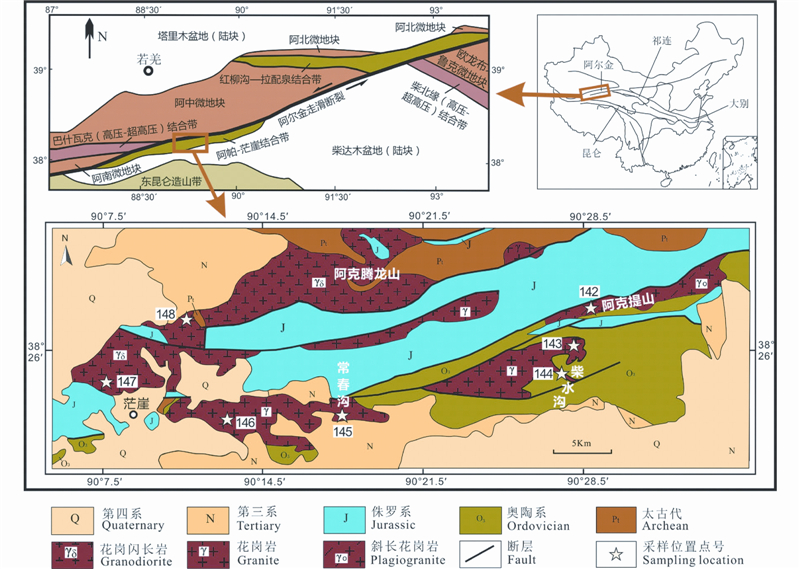 | 图 1 南阿尔金地区花岗岩类分布地质图 Fig. 1 Distribution of the granitoids from the southern Altun |
2006),证明该超高压岩石的形成是陆壳深俯冲作用的产物,而且俯冲深度可能达到>200km的地幔深处(刘良等,2005;张安达等,2004)。阿尔金左型走滑断裂以南的阿帕-茫崖早古生带蛇绿混杂岩带,是分割阿尔金造山带与祁漫塔格、柴南缘的构造边界。带中产出大量的与基性火山岩伴生的基性超基性岩岩块及花岗岩类。研究表明,该带上的超基性岩主要为蛇纹石化橄榄岩,基性岩主要为角闪辉长岩和拉斑玄武岩,玄武岩具有MORB和OIB的特征,同时,还有硅质岩、黑云斜长片麻岩、石英片岩、白云质大理岩等,构造了蛇绿岩组合(刘良等,1998;马中平等, 2009,2010)。其中变质基性火山岩的Sm-Nd等时线年龄为481±53Ma(刘良,1998),角闪辉长岩的锆石LA-ICP-MS U-Pb年龄为444.9±1.3Ma(董增产等,2011),说明早古生代南阿尔金存在洋盆、微古陆、多古陆、多岛洋的古地理格局。 3 岩体地质及岩相学特征
本文研究的花岗岩体位于阿尔金左型走滑断裂以南的阿帕-茫崖早古生带蛇绿混杂岩带上(图 1)。该带以发育奥陶纪海相火山-沉积岩和侏罗纪陆相碎屑岩为特征,花岗岩的围岩主要为奥陶纪的火山岩,部分岩体与奥陶系为侵入接触,部分为断层接触,而中、新生代地层覆盖在花岗岩体之上。各岩体的地质特征分述如下。 3.1 阿克提山岩体
该岩体位于阿尔金南缘断裂带上(采样点号:142,坐标位置:N38°26.948′,E90°27.350′,H3816m)。岩体走向北东向,明显地受断裂控制,呈狭窄的条带状,长约12km,宽0.5~1.5km,出露面积约8km2。岩体南部侵入到奥陶系,北部与侏罗系之间为断层接触。岩体中发育不规则团块状的灰绿色火山岩,可能是花岗岩侵位过程中虏获的尚未同化的奥陶系围岩残留体。在该岩体的东部和西部分别采集了样品(07CL-141-2、07CL-142-1,-2,-3、10CL-109-5)。主要岩石组合为石英闪长岩+花岗闪长岩+二长花岗岩,各类型岩石之间没有明显的穿插关系,岩性变化呈渐变过渡。石英闪长岩为深灰色,细粒结构,主要矿物为斜长石(60%~75%),其次为角闪石(15%~25%)、石英(5%~10%),少量的黑云母(5%),暗色矿物发生强烈的绿泥石化。花岗闪长岩为浅灰色,中粒结构,主要矿物为斜长石(55%~65%)、石英(15%~20%),其次为角闪石(10%~15%)、碱性长石(10%)。二长花岗岩为淡粉白色,中粒结构,主要矿物为斜长石(45%~55%)、钾长石(20%~25%)、石英(20%~25%),其次为黑云母(5%)。 3.2 柴水沟岩体
该岩体出露形态不规则(采样点号:143、144,两采样点坐标位置分别为:N38°26.410′,E90°28.229′,H3652m和N38°25.131′,E90°28.445′,H3549m),在2个点分别采集样品:07CL-143-2、07CL143-5、07CL143-7、10CL106-2、10CL107-2、10CL107-5、10CL107-8、07CL144-2。该岩体长轴方向北东向,围岩为奥陶系,岩体与围岩之间为断层接触。岩体长约9km,宽约1~3km,出露面积约12km2。岩体中发育不规则状辉绿岩脉块体,辉绿岩块体大小不一,延伸较长的为曲折状,延伸较短的为团块状,与花岗岩具有明显的接触界线。花岗岩主要为红色,中粒-中粗粒粒状结构,主要矿物为钾长石(50%~65%)、石英(20%~30%),其次为斜长石(10%~15%),少量的黑云母(5%)。岩体与辉绿岩接触带附近的花岗岩具有似斑状结构,斑晶为碱性长石,大小为4~8mm。辉绿岩为黑色,致密块体,辉绿结构,主要矿物为长条形的斜长石(65%~75%),其次为粒状的辉石(15%~20%)、磁铁矿等(10%~15%)。斜长石杂乱排列,构造近三角形的空隙,其中被粒状的辉石充填。 3.3 常春沟岩体
该岩体位于常春沟以西,呈不规则条带状岩株,长轴呈东西向分布,长约10km,宽约1~2km,出露面积约15km2。岩体中含有较多的基性岩脉,局部地方含有较多的暗色微粒闪长质包体。分别在岩体的东段(采样点号:145,坐标位置:N38°23.584′,E90°18.100′,H3358m)和西段(采样点号:146,坐标位置:N38°23.696′,E90°13.141′,H3398m)采取了样品07CL145-2、07CL145-4、10 CL 112-2、07CL146-2。主要岩性为石英闪长岩和花岗岩。石英闪长岩为灰色,中粒结构,主要矿物为斜长石(65%~75%),其次为石英(5%~10%)、碱性长石(10%)和角闪石(5%~10%)以及黑云母(5%),部分角闪石和黑云母蚀变成绿泥石。花岗岩为浅肉红色,中粒-中粗粒结构,主要矿物为碱性长石(55%~65%)和石英(20%~25%),其次为斜长石(10%~15%)、黑云母(5%)。部分碱性长石具有粘土化,部分斜长石具有绢云母化,黑云母具有绿泥石化。 3.4 茫崖镇北岩体
岩体位于研究区西边,茫崖镇以北(图 1),呈较大的岩株状,其长轴呈近东西向分布。岩体长约10km,宽约1~3km,出露面积约20km2。岩体侵入到下元古代硅化大理岩和奥陶纪安山岩之中。岩体地表风化较严重,大多被第四系覆盖,由于修建305国道,揭示出新鲜岩石露头(采样点号:147,坐标位置:N38°25.298′,E90°7.614′,H3136m)。主要岩性为石英闪长岩、花岗闪长岩和花岗岩,该点主要采集了花岗岩样品07CL147-2、10CL110-2、07CL148-2。花岗岩中包裹了石英闪长岩的块体。石英闪长岩为深灰色,中细粒结构,主要矿物为斜长岩(70%~80%),其次为角闪石(10%~15%)、石英(5%~10%)、黑云母(5%),其中的暗色造岩矿物大都蚀变成绿泥石。花岗岩为灰白色,中粒结构,主要矿物为斜长石(40%~50%)、钾长岩(25%~30%)、石英(20%~25%),其次为黑云母(5%)。 3.5 阿卡腾龙山岩体
岩体主要出露于阿卡腾龙山主峰以西,出露面积约80km2,呈较大的不规则状岩株。总体呈北东东向分布,岩体北部侵位于早元古界片岩、片麻岩、大理岩及混合岩中,岩体边部具有明显的同化混染现象。岩体南部被侏罗系覆盖,西部被第三系覆盖。该岩体主要岩性为石英闪长岩(采样点号:148,坐标位置:N38°27.129′,E90°10.102′,H3262m),采集样品07CL148-2。岩石浅灰色,中细粒结构,主要矿物为斜长石(60%~70%),其次为角闪石(10%~15%)、碱性长石(8%~10%)、石英(7%~10%),少量的黑云母(5%)。 4 分析方法 4.1 锆石SHRIMP U-Pb定年
野外分别在142、143、144、145、146、147、148地质点采集了样品07CL142、07CL143-6、07CL143-7、07CL144、07CL145、07CL146、07CL147、07CL148各约2kg,破碎至60~80目,用水淘洗粉尘后,先用磁铁除去磁铁矿等磁性矿物,再用重液选出锆石,最后在双目镜下选出锆石。锆石的分选由河北廊坊区调院完成。将锆石和标样一起粘在玻璃板上,用环氧树胶浇铸,制成薄片、抛光,并拍照正交偏光和阴极发光照片,最后在离子探针SHRIMP-RG上测定锆石的U、Th、Pb同位素含量及定年。样品制备、正交偏光和阴极发光照像以及SHRIMP定年均由作者在美国斯坦福大学离子探针实验室完成。实验选择的标样为R33(419±1.1Ma)(Black et al., 2004),数据的误差范围±1σ。数据处理使用美国Berkeley地质年代学中心Kenneth R. Ludwig编制的计算程序(Ludwig, 2001,2003)。 4.2 化学全分析
本项研究选择了19个较新鲜的岩石样品进行了化学全分析。分析单位是中国地质科学院测试所(国家地质实验测试中心)。氧化物用X荧光光谱仪3080E测试,执行标准分别为:Na2O、MgO、Al2O3、SiO2、P2O5、K2O、CaO、TiO2、MnO、Fe2O3、FeO,按GB/T 14506.28—1993标准;H2O+按GB/T 14506.2—1993标准;CO2按GB 9835—1988标准;LOI按LY/T 1253—1999标准;稀土元素La、Ce、Pr、Nd、Sm、Eu、Gd、Tb、Dy、Ho、Er、Tm、Yb、Lu、Y和微量元素Cu、Pb、Th、U、Hf、Ta、Sc、Cs、V、Co、Ni用等离子质谱Excell测试,执行标准为DZ/T 0223—2001;微量元素Sr、Ba、Zn、Rb、Nb、Zr、Ga用X荧光光谱仪2100测试,执行JY/T 016—1996标准。 4.3 锆石Hf同位素测定
锆石Hf同位素测试是在中国地质科学院矿产资源研究所国土资源部成矿作用与资源评价重点实验室完成,所用仪器为Neptune多接收等离子质谱和Newwave UP213紫外激光剥蚀系统(LA-MC-ICP-MS),实验过程中采用He作为剥蚀物质载气,根据锆石大小,剥蚀直径采用55μm或40μm,测定 时使用国际上通用的锆石标样GJ1作为参考物质,分析过程中锆石标准GJ1的176Hf/177Hf测试加权平均值为0.282015±8(2σ,n=10)。相关仪器运行条件及详细分析流程见侯可军等(2007)。
 | 表 1 南阿尔花岗岩类和辉绿岩锆石SHRIMP U-Pb定年结果 Table 1 Zircon SHRIMP U-Pb isotopic data of granitoids and diabase from the southern Altun |
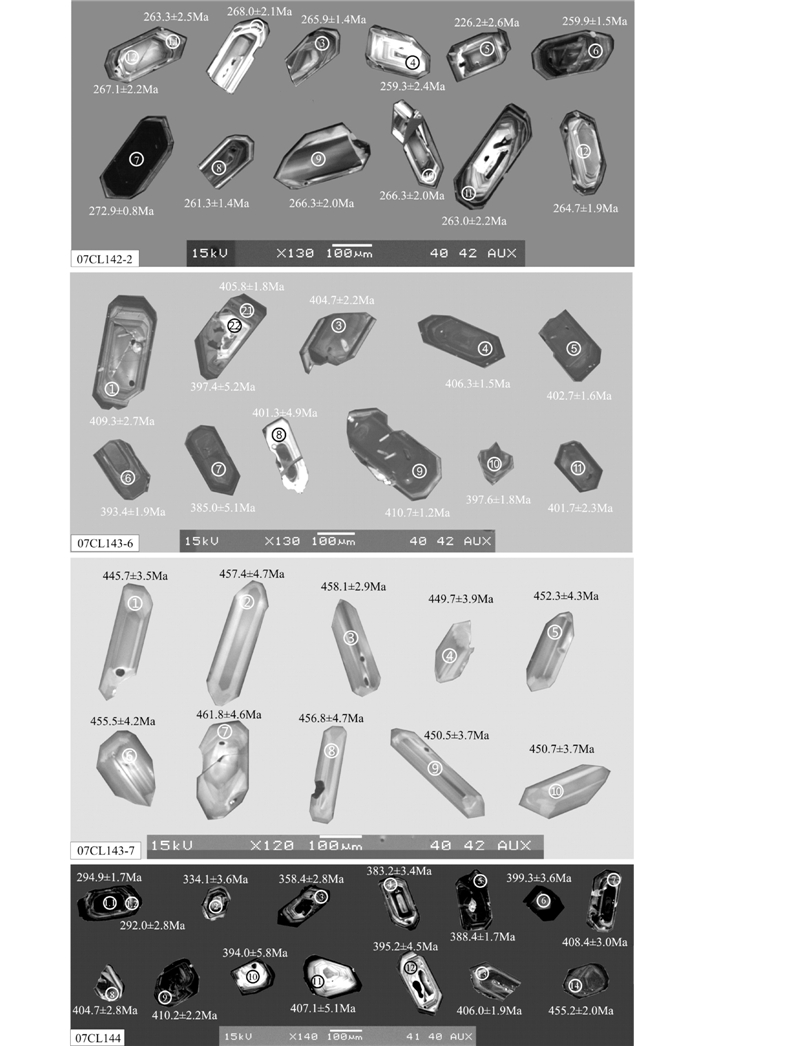 | 图 2 南阿尔金阿克提山和柴水沟花岗岩类及辉绿岩锆石阴极发光图像
样品07CL143-7为辉绿岩,其余样品均为花岗岩类
Fig. 2 Cathodoluminescence images of zircons of the granitoids and diabase from the southern Altun
|
5 结果 5.1 锆石SHRIMP定年
分别对样品07CL142、07CL143-6、07CL143-7、07CL144、07CL145、07CL146、07CL147、07CL148进行了锆石SHRIMP U-Pb定年研究,结果见表 1。各样品的锆石特征如下。 5.1.1 样品07CL142-2
取自阿克提山岩体的142号点(图 1)。岩石浅肉红色,中粒结构,岩性为正长花岗岩。样品中的锆石主要为柱状,长宽比主要为21,阴极发光图像显示出振荡环带(图 2)。测定了12颗锆石13个点的SHRIMP U-Pb年龄(表 1),结果表明,锆石的U、Th含量分别为218×10-6~2769×10-6和135×10-6~1325×10-6,Th/U比值为0.46~1.20,平均为0.70。锆石206Pb/238U年龄变化于226.2±2.6Ma~272.9±0.8Ma,在238U/206Pb-207Pb/206Pb谐和线上,除5号、7号测点外,所有的锆石测点都分布在谐和线上(图 3)。其中,5号锆石普通Pb的含量在所有测点中最高,达10.53×10⁻⁶,而7号锆石的放射性Pb的含量高达102.8×10⁻⁶,同时,U、Th的含量也特别高,分别为2769×10-6和1235×10-6,因此,前者可能发生了Pb丢失,而后者可能有外来Pb的加入。除去这两个测点,其余测点的206Pb/238U重量平均年龄为263.7±1.8Ma(MSWD=1.4,n=11)(图 3),该年龄可解释为花岗岩的结晶年龄。 5.1.2 样品07CL143-6
取自柴水沟岩体的143号点。岩石浅肉红色,中粒结构,岩性为正长花岗岩。样品中的锆石主要为柱状,长宽比主要为1.51~21,阴极发光图像显示出振荡环带(图 2)。测定了11颗锆石12个点的SHRIMP U-Pb年龄(表 1),结果表明,锆石的U、Th含量分别为85×10-6~1912×10-6和69×10-6~695×10-6,Th/U比值为0.35~1.14,平均为0.55。锆石年龄变化于385.0±5.1Ma~409.3±2.7Ma,在238U/206Pb-207Pb/206Pb谐和线上,除个别测点外,所有的锆石测点都分布在谐和线上(图 3)。除去高U的7号测点外,其余测点的206Pb/238U重量平均年龄为404.2±4.6Ma(图 3),可解释为花岗岩的结晶年龄。7号锆石内部颜色深,普通Pb的含量较高,为6.63×10⁻⁶,U的含量高达1912×10-6,可能受到后期流体的改造。 5.1.3 样品07CL143-7
该样品也取自柴水沟岩体的143号点(07CL143-6)附近的辉绿岩脉,该岩脉在花岗岩体中沿伸较大,岩脉的宽窄不一,与花岗岩体的接触界线清楚,形状棱角状。锆石为长柱状,长宽比为21~41。锆石的阴极发光图像显示出宽的条带状及振荡环带(图 2)。10颗锆石的测定结果表明,锆石的U、Th含量较低,分别为127×10-6~315×10-6和86×10-6~373×10-6,Th/U比值为0.7~1.22,平均为1.01,测定的锆石206Pb/238U年龄比较稳定,为445.7±3.5Ma~461.8±4.6Ma,平均为453.5Ma±3.5Ma(图 3),该年龄解释为辉绿岩的形成年龄。 5.1.4 样品07CL144
该样品与样品07CL143-6、7取自同一岩体(图 1),为二长花岗岩。锆石具有较好的锥面和柱面,长宽比一般为11~21。阴极发光照片显示,锆石具有环带构造,部分锆石含老的继承性核,如14号锆石即为一个岩浆型的碎屑锆石(图 2)。从14颗锆石15个测点的结果来看,U、Th的含量有一定的变化,分别为64×10-6~819×10-6、52×10-6~355×10-6,Th/U比值>0.4,为0.4~1.32,平均为0.75(表 1)。除14号锆石206Pb/238U年龄为455.2±2.0Ma外,其余测点年龄变化于294.9±1.7Ma~410.2±2.2Ma,其中14号测点是锆石的碎屑核,而测点1.1、1.2、2、3、4和5号锆石均具有微裂隙,CL图像上显示出黑色,可能受热液蚀变的影响,因此,这些测点除去后,获得206Pb/238U平均年龄为406±4Ma(图 3),该年龄与样品07CL143-6的结果在误差范围内基本一致,为花岗岩的结晶年龄。
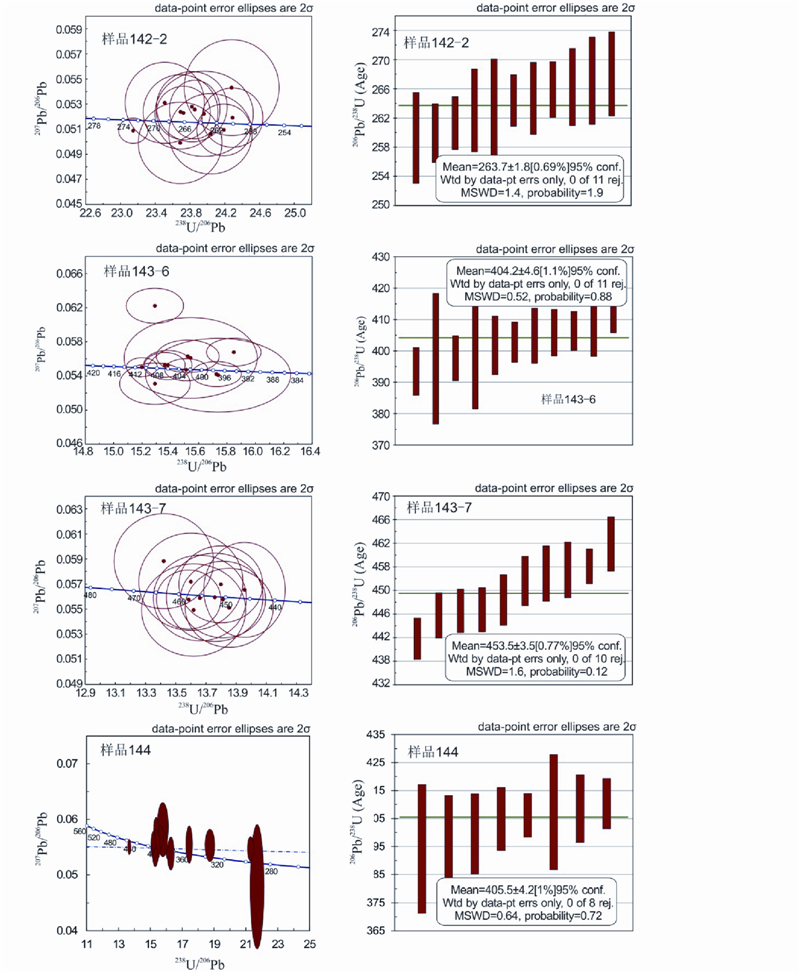 | 图 3 南阿尔金阿克提山(142点)和柴水沟(143、144点)花岗岩类及辉绿岩锆石207Pb/206U-238U/206Pb谐和曲线和平均年龄计算
Fig. 3 Zircon 207Pb/206Pb-238U/206Pb concordia diagram and averaged age of the granitoids and diabse located at 142,143 and 144 points from the southern Altun
|
该样品取自常春沟岩体的145号点,岩性为正长花岗岩。样品的锆石为短柱状,长宽比变化不大,一般为11~1.51。阴极发光照片显示,锆石具有环带构造(图 2)。从测定的12颗锆石结果来看,U、Th的含量变化不大,分别为231×10-6~870×10-6、110×10-6~383×10-6,Th/U比值为0.29~0.61,平均为0.47。各锆石的206Pb/238U年龄变化于399.9±3.0Ma~422.5±1.8Ma之间,平均为411.2±5.4Ma,可解释为花岗岩的结晶年龄(图 3)。 5.1.6 样品07CL146
取自常春沟岩体的146号点的中粗粒正长花岗岩。样品中的锆石主要为短柱状,少数为粒状,长宽比主要为11~21,阴极发光图像显示扇状构造和环带构造(图 4)。11颗锆石的SHRIMP U-Pb年龄测定结果表明(表 1),锆石的U、Th含量变化不大,分别为270×10-6~721×10-6和146×10-6~255×10-6,Th/U比值为0.31~0.82,平均为0.55。锆石年龄变化于378.8±2.9Ma~414.6±2.7Ma,在238U/206Pb-207Pb/206Pb谐和图上,除1号测点外,所有的锆石测点都分布在谐和线上(图 5)。1号测点横跨于继承性锆石核和岩浆结晶形成的锆石之间,而该部位CL图像颜色呈黑色,可能受到热液蚀变的影响(Corfu,2013)。除去不谐和的1号测点外,其余测点的206Pb/238U平均年龄为405.9±3.1Ma(图 5),可解释为花岗岩的结晶年龄。
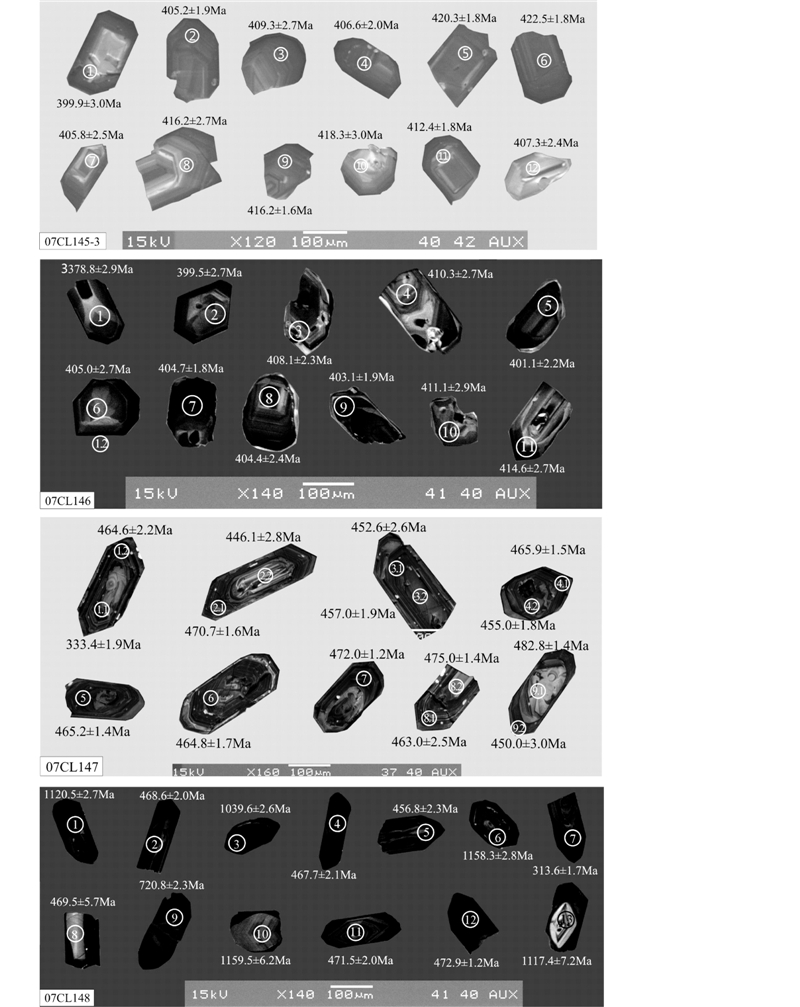 | 图 4 南阿尔金常春沟(145、146点)、茫崖北(147)和阿克腾龙山(148点)花岗岩类锆石阴极发光图像 样品07CL145和07CL146为花岗岩,07CL147为花岗闪长岩,07CL148为石英闪长岩 Fig. 4 Cathodoluminescence images of zircons for the granitoids from the southern Altun |
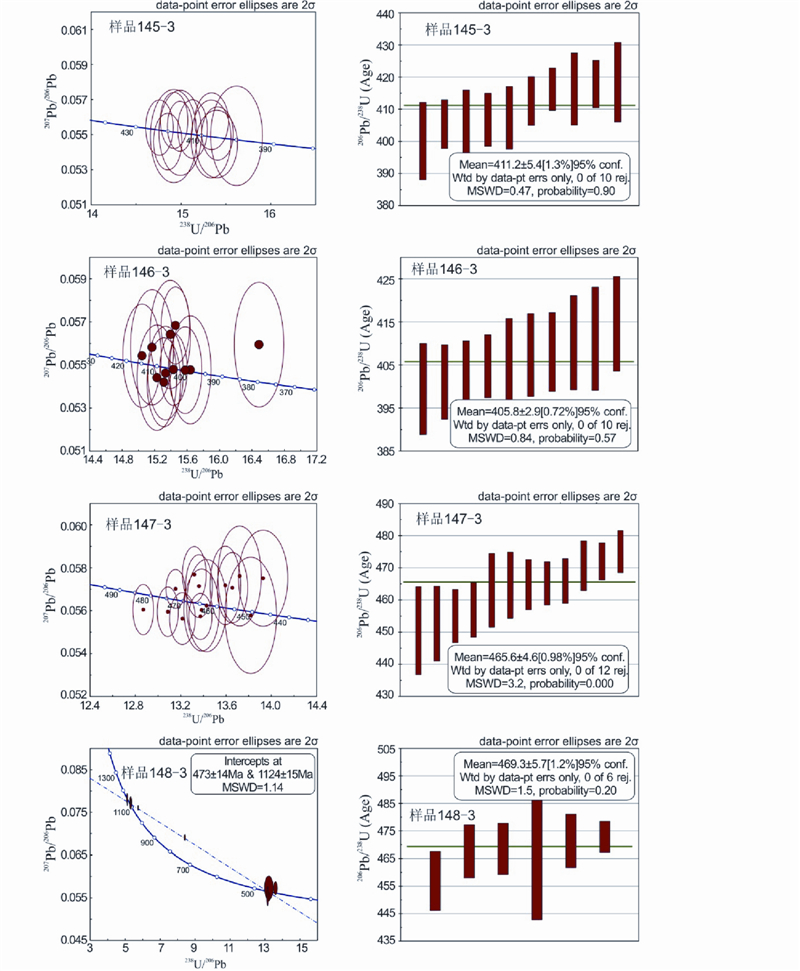 | 图 5 南阿尔金常春沟(145、146点)、茫崖北(147点)和阿克腾龙山(148点)花岗岩类锆石207Pb/206Pb-238U/206Pb谐和曲线和平均年龄计算 Fig. 5 Zircon 207Pb/206Pb-238U/206Pb concordia diagram and averaged age of granitoids located at point 146 from the southern Altun |
该样品取自茫崖镇北花岗岩岩体(148号点)。锆石为柱状,长宽比为21~31(图 4)。锆石的U、Th含量变化较大,分别为234×10-6~2331×10-6和58×10-6~2155×10-6,Th/U比值变化于0.13~0.96之间,平均为0.49,属岩浆成因的锆石(Pidgeon et al., 1998)。15颗锆石测出206Pb/238U年龄变化于333.4±1.3Ma~482.8±1.4Ma,12颗锆石年龄集中在450.5±3.0Ma~475.0±1.4Ma,平均年龄为465.6±4.5Ma(图 5)。1.1号测点普通Pb过高(5.76×10⁻⁶),年龄偏小(333.4±1.3Ma),可能有外来Pb的加入。
5.1.8 样品07CL148
该样品取自阿克腾山石英闪长岩体的148号点。锆石为柱状,长宽比为21~31。锆石的阴极发光图像显示出条带状及振荡环带(图 4)。部分锆石含有老的继承性锆石,如1、3、6、9、10、13等。13颗锆石的测定结果表明,锆石的U、Th含量变化较大,分别为81×10-6~3568×10-6和66×10-6~1416×10-6,Th/U比值为0.20~0.98,平均为0.51,其中,7号锆石测点的U含量最高,为3568×10-6,普通Pb的含量也最高,为8.05×10-6,CL图像为黑色,可能为后期流体改造所致。除去老的继承性锆石和受流体改造过的锆石外,余下的锆石得出206Pb/238U平均年龄为469.3±5.7Ma(WSMD=1.5,n=6)。在238U/206Pb-207Pb/206Pb谐和图上,所有的锆石测点都分布在不一致线上(图 5),分别得出上交点年龄为1124±15Ma、下交点年龄为473±14Ma,上交点年龄可解释为老的继承性锆石年龄,下交点年龄可解释为岩浆结晶年龄,且与平均年龄(469.3±5.7Ma)在误差范围内基本一致(图 5)。 5.2 地球化学
共采集了19个样品进行化学全分析,结果见表 2(表 2中样品号中省去了CL)。 5.2.1 主量元素
除辉绿岩外,本区花岗岩类SiO2含量为56.31%~76.71%,Na2O+K2O含量为6.61%~11.35%,部分样品具有钾化现象,所以K2O含量较高,导致K2O/Na2O比值变化较大(为0.41~3.79)。从硅碱图来看(图 6),样品大多数为花岗岩,少数为二长岩、正长岩和辉绿岩。花岗岩的铝饱和指数为0.76~1.05,大多数样品小于1(图 7),为准铝质,个别样品为过铝质和过碱质。按Frost et al.(2001)的分类,本区花岗岩类主要属镁质类型,个别为铁质类型(如样品10CL107-2为二长花岗岩),属钙碱性和碱钙性系列(图 8),个别为碱性系列(样品10CL112-2和07CL148-2均为石英闪长岩)。结合上面的锆石U-Pb定年结果和硅碱图分类得出,年龄为264Ma的花岗岩类落入二长岩、花岗岩区,年龄为404~411Ma的花岗岩类落入石英二长岩、花岗岩区,年龄>460Ma花岗岩类落入二长岩、正长岩、花岗岩区,辉绿岩主要落入辉长岩区。结合镜下观察,得出264Ma花岗岩类主要岩石组合为石英闪长岩-花岗闪长岩-二长花岗岩,404~411Ma花岗岩类为花岗闪长岩-二长花岗岩-正长花岗岩,>460Ma花岗岩类主要为闪长岩-石英闪长岩-花岗闪长岩-二长花岗岩。
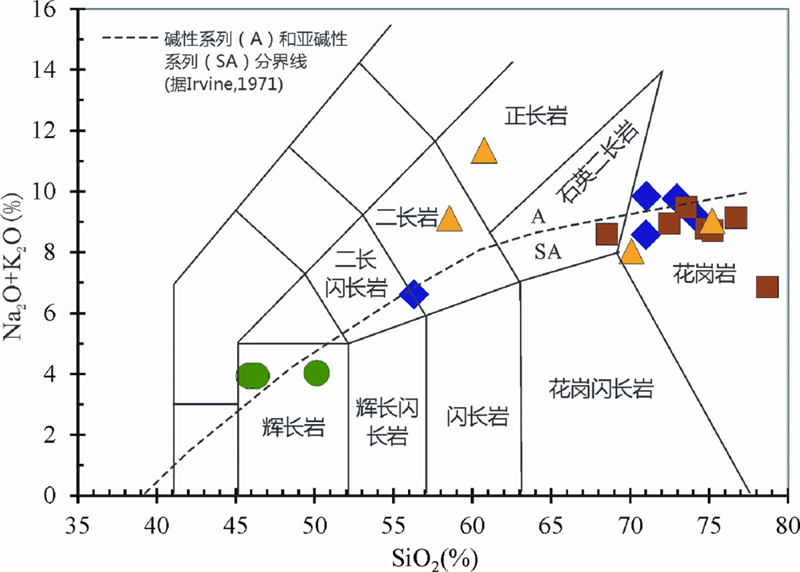 | 图 6 花岗岩类和辉绿岩的SiO2-(K2O+Na2O)图解(据Middlemost,1994; Irvine and Baragar, 1971) ●-辉绿岩;■-404~411Ma花岗岩类;▲->460Ma花岗岩类;◆-264Ma花岗岩类.图 7、图 8、图 12、图 15的图例同此图 Fig. 6 Diagram of SiO2-(Na2O+K2O)for granitoids and diabse from southern Altun(after Middlemost,1994; Irvine and Baragar, 1971) |
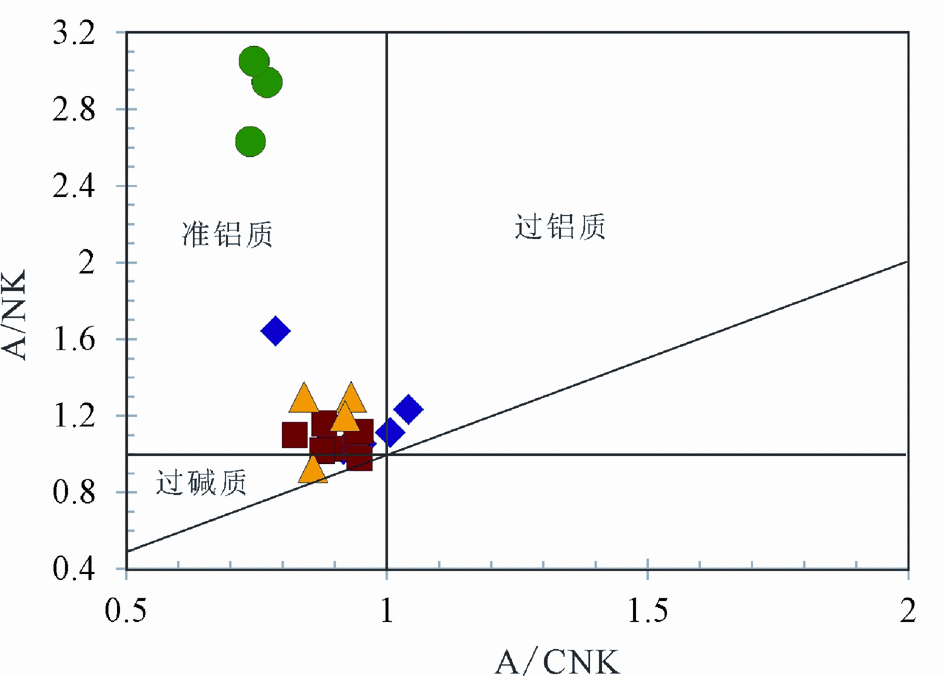 | 图 7 花岗岩类和辉绿岩的A/CNK-A/NK图解(据Maniar和Piccoli, 1989) Fig. 7 Diagram of A/CNK-A/NK for the granitoids and diabse from the southern Altun(after Maniar and Piccoli, 1989) |
年龄为264Ma的花岗岩类稀土总量变化较大,为107.5×10⁻⁶~312.4×10⁻⁶,平均为203.0×10⁻⁶,其中样品07CL141-2和07CL142-2的稀土总量分别为最高和最低,其余样品为190.4×10⁻⁶~213.7×10⁻⁶,轻重稀土元素比值(∑LREE/∑HREE)除样品07CL142-3较高外(18.40),其余样品变化于6.69~9.69之间,总平均为9.88,配分曲线具有 微弱-不明 显的负Eu异常,δEu值为0.50~0.86(平均为0.72)(图 9a);(La/Sm)N和(Gd/Yb)N比值(平均值)分别为3.99和2.19,说明轻稀土元素之间的分异程度略大于重稀土元素。年龄为404~411Ma的花岗岩类稀土总量变化不大,是所有花岗岩类中较高的一组,为237.5×10-6~375.0×10-6,平均为312.8×10-6,轻重稀土元素比值变化也不大,为4.77~7.78(平均为6.38),稀土配分曲线具有明显的负Eu异常,δEu值为0.18~0.39(平均为0.26)(图 9b)。本组花岗岩类的(La/Sm)N和(Gd/Yb)N比值(平均值)分别为3.50和1.28,是所有花岗岩中轻稀土元素之间的分异程度和重稀土元素之间的分异程度最小的,尤其是重稀土元素之间的分异程度最小,配分曲线几乎成水平状态;>460Ma花岗岩类稀土元素总量变化较大,为103.8×10-6~347.3×10-6(平均为249.2×10-6),其中样品07CL148-2和10CL110-2的稀土总量分别为最高和最低,前者为石英闪长岩,后者为花岗岩,两者的轻重稀土比值亦较大,分别为17.76和13.09,余下的样品轻重稀土元素比值为6.64~9.78(总平均为11.82)。这一组花岗岩类的稀土配分模式具有微弱-不明显的负Eu异常,δEu值为0.51~0.81(平均为0.68)(图 9c),类似于264Ma花岗岩类。本组花岗岩的(La/Sm)N和(Gd/Yb)N比值(平均值)分别为5.07和1.87,说明轻稀土元素之间的分异程度大,而重稀土元素之间的分异程度小。453Ma辉绿岩类稀土总量较稳定,为175.3×10-6~189.3×10-6(平均为182.2×10-6),轻重稀土元素比值为4.56~5.23(平均为4.92),稀土配分模式无明显的Eu异常,δEu值为0.90~0.95(平均为0.93)(图 9d),(La/Sm)N和(Gd/Yb)N比值(平均值)分别为1.87和2.08,说明轻稀土元素之间的分异程度小于重稀土元素。
| 表 2南阿尔金花岗岩类和辉绿岩全岩化学成分(主量元素:wt%;稀土和微量元素:×10-6) Table 2 Major(wt%) and trace(×10-6)element data of the granitoids and diabse from the southern Altun |
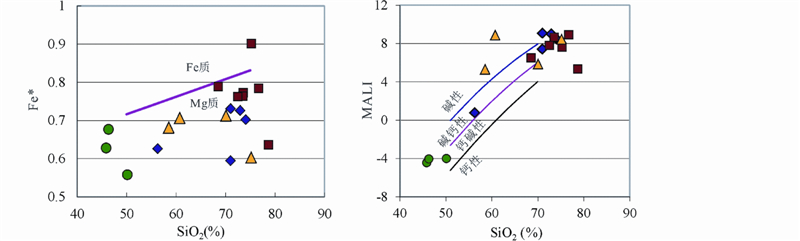 | 图 8 花岗岩类和辉绿岩的SiO2-Fe*和SiO2-MALI图解(据Frost et al., 2001,2008) Fe*=FeOT/(FeOT+MgO);MALI=Na2O+K2O-CaO Fig. 8 Diagram of SiO2-Fe* and SiO2-MALI for the granitoids and diabse from the southern Altun(after Frost et al., 2001,2008) |
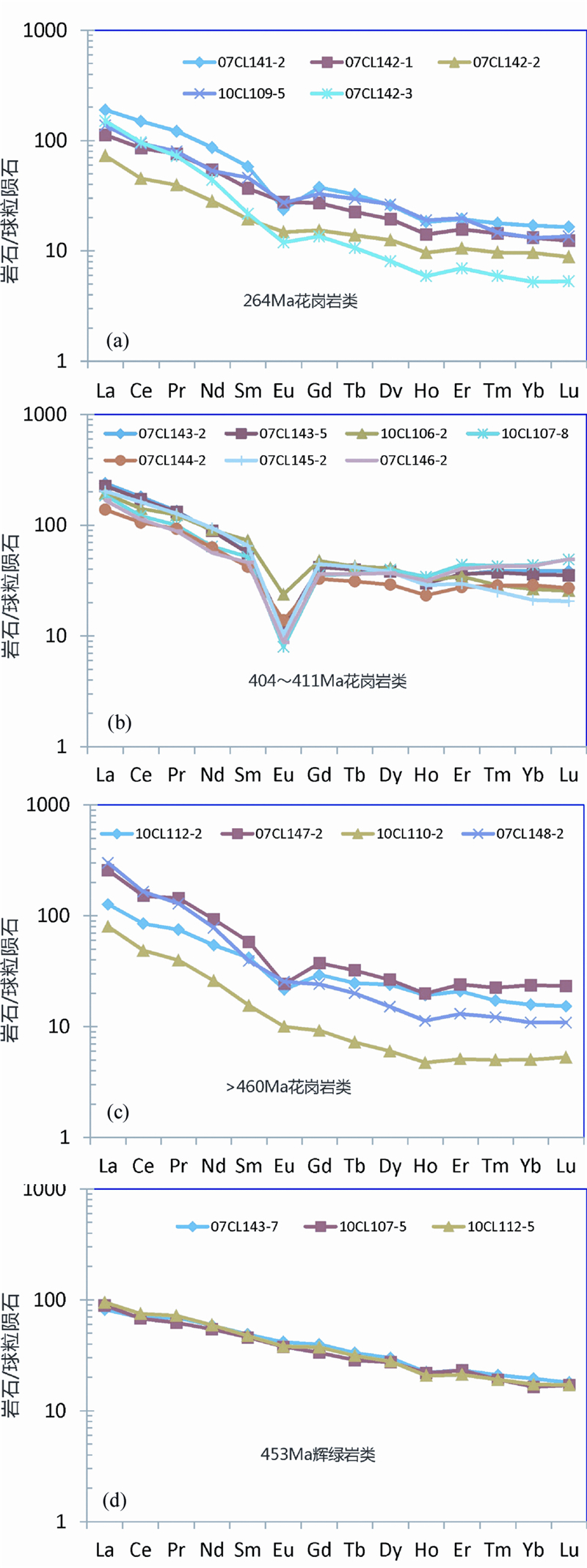 | 图 9 花岗岩类和辉绿岩稀土元素球粒陨石标准化曲线(标准化值据Taylor amd McLennan, 1985) Fig. 9 Chondrite-normalized rare earth element(REE)distribution patterns for the granitoids and diabse from the southern Altun(normalizing values after Taylor and McLennan, 1985) |
各样品均富含大离子亲石元素,亏损部分高场强元素,但不同样品具体的元素含量稍有差别。年龄264Ma的花岗岩类具有明显的Nb负异常,除样品07CL142-1外,其余样品具有Ba、Sr、P、Ti负异常(图 10a),而年龄为404~411Ma的花岗岩类,Nb的负异常没有年龄为264Ma的明显,但Ba、Sr、P、Ti具有强烈的负异常(图 10b)。>460Ma花岗岩类微量元素蛛网图上(图 10c),除样品07CL148-2的Ba、Sr异常不明显外,其余样品均具有弱的Ba、Nb、Sr、P、Ti负异常。453Ma辉绿岩类除弱的Nb负异常外,其余元素无明显的正负异常(图 10d),原始地幔标准化曲线基本上呈水平状态。所有花岗岩样品中,除年龄为404~411Ma的花岗岩类外,其余各年龄的花岗岩类样品的Sr/Y比值均大于1(2.29~25.33),而年龄为404~411Ma的花岗岩类Sr/Y比值小于1(0.27~0.99)。与Sr/Y比值相反,年龄为404~411Ma的花岗岩类具有较大的Rb/Sr比值,为2.86~14.62,平均为7.74,264Ma花岗岩类的Rb/Sr比值为0.14~2.79,平均为1.42,>460Ma花岗岩类为0.16~1.55,平均为0.78,辉绿岩类最低,为0.11~0.12。可见,年龄为264Ma和>460Ma的花岗岩类具有相似的微量元素特征,反映了它们的源岩相似,但它们与年龄为404~411Ma的花岗岩类明显的不同。 5.2.4 锆石Lu-Hf同位素
分别选择定年样品07CL144、07CL146、07CL148做锆石Lu-Hf同位素分析,结果如表 3(表中样品号省略了07CL)。
由表 3可见,样品07CL144(二长花岗岩)中的20颗锆石有9个锆石的176Lu/177Hf比值大于0.002外,其余锆石的均小于0.002,平均为0.00185(表 3、图 11a)。除锆石144-14的176Hf/177Hf比值为0.282333外,其余锆石的176Hf/177Hf比值变化于0.282611~0.282718之间,平均为0.282639。除一颗老的锆石(年龄为455Ma)εHf(t)值为负值外(-6.0),其余年龄的锆石εHf(t)值均为正值,变化于2.1~6.0之间,平均为+3.7(表 3、图 11a,b),二阶段模式年龄(tDM2)除老的锆石外(tDM2=1811Ma),其余锆石的为1015~1250Ma(表 3、图 11b),平均为1081Ma。
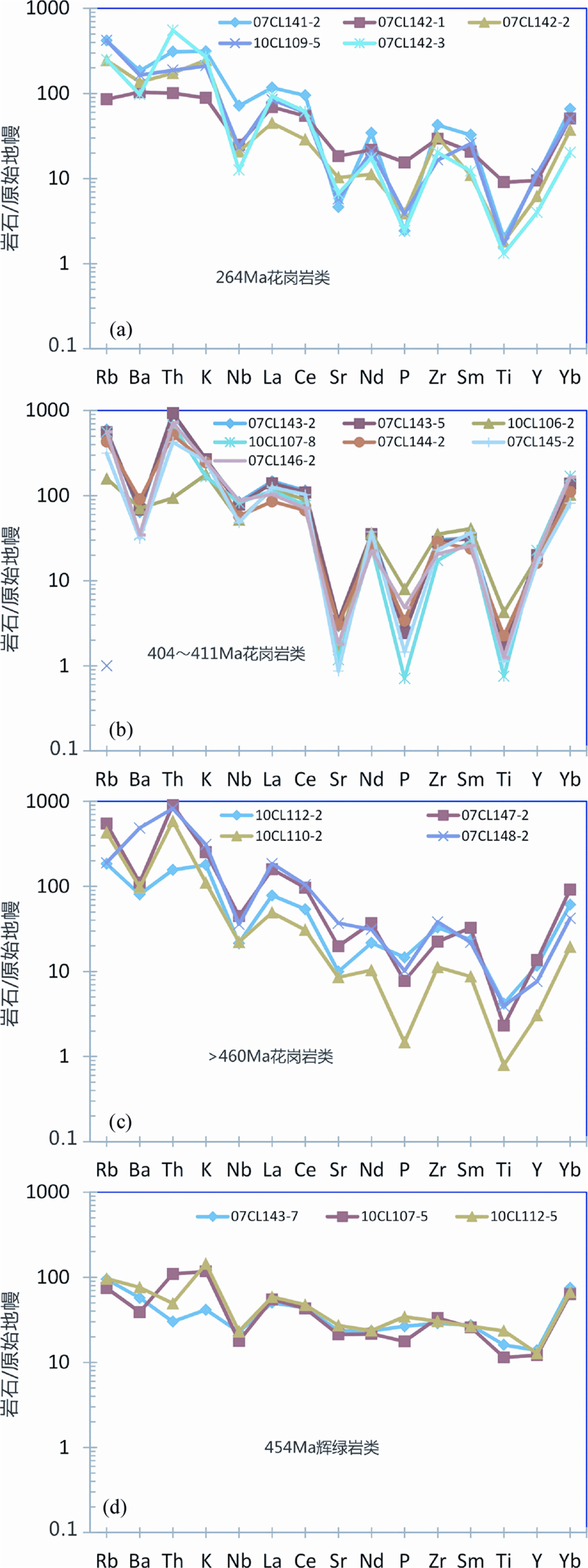 | 图 10 花岗岩类和辉绿岩微量元素蛛网图(标准化值据Sun and McDonough, 1989) Fig. 10 Primitive mantle-normalized trace-element spider diagrams for the granitoids and diabse from the southern Altun(normalizing values after Sun and McDonough, 1989) |
样品07CL146(正长花岗岩)中的20颗锆石中,除个别锆石的(146-12、17)176Lu/177Hf比值大于0.002外,其余锆石的均小于0.002,平均为0.00125(表 3,图 11c)。所有锆石的176Hf/177Hf比值变化于0.282554~0.282731之间,平均为0.282656,εHf(t)值均为正值,变化于0.7~7.1之间,平均为+4.4(表 3,图 11c,d),二阶段模式年龄(tDM2)为946~1349Ma(表 3、图 11d),平均为1115Ma。
样品07CL148(石英闪长岩)20颗石中,仅6颗锆石的176Lu/177Hf比值小于0.002,其余锆石的均大于0.002,平均值为0.002416(表 3、图 11e)。所有锆石的176Hf/177Hf比值变化于0.282247~0.282652之间,平均为0.282476,εHf(t)值变化较大(-4.7~+11.4),平均为+2.5(表 3、图 11e,f),二阶段模式年龄(tDM2)为1107~1744Ma(表 3、图 11f),平均为1411Ma。
| 表 3 部分花岗岩类锆石Lu-Hf分析结果 Table 3 Zircon Lu-Hf isotope data of some granitoids from the southern Altun |
研究表明,南阿尔金地区年龄>460Ma的花岗岩类ASI<1.05,大多数小于1,为准铝质,与花岗岩类的主要造岩矿物组成为斜长石、钾长石、石英、角闪石和少量的黑云母以及不出现富铝矿物相吻合。这些花岗岩类的岩石组合为石英闪长岩-花岗闪长岩-二长花岗岩,岩石的元素地球化学以富集大离子亲石元素,亏损高场强元素为特征(图 10),稀土元素以富集轻稀土、且轻稀土分异明显重稀土分异不明显、不具有或具有弱的负Eu异常为特征(图 9a),表现出岛弧I型花岗岩类地球化学属性。年龄为400~410Ma的花岗岩类不仅富集大离子亲石元素,而且还富集部分高场强元素(Zr、Y、Nb等),稀土元素配分曲线以明显的负Eu异常为特征(图 9b),具有A型花岗岩的地球化学特征(图 12a-d)。按张旗等(2010)的划分方案,这组花岗岩类似于华南A型花岗岩,以低Sr高Yb为特征。年龄为264Ma的一组花岗岩类岩石地球化学特征与年龄>460Ma的类似,说明它们具有相似的源岩。
实验岩石学证明,在非常宽的温度、压力条件下,多种源岩的部分熔融均可以产生花岗质熔体(Patino Douce and Johnston, 1996,1998; Rapp et al., 1991,1995; Wolf and Wyllie, 1994; Winther,1996; Skjerlie and Patino Douce,2002),熔体成分的变化取决于初始熔融物质的成分、熔融的温度和压力、初始物质的含水量(Jogvan et al., 2006),如泥质的沉积岩部分熔融可以产生强烈富铝和富钾的熔体,硬砂岩的部分熔融可以产生中等到强烈富铝的花岗闪长岩/花岗岩熔体,玄武质岩石的部分熔融可以产生云英质-奥长-花岗闪长质熔体(Rapp et al., 1991,1995; Wolf and Wyllie, 1994; Sen and Dunn, 1994; Winther,1996)。可见,只要源岩含水或存在含水相的矿物,部分熔融就可以产生花岗质熔体(Patino Douce and Johnston, 1996,1998)。本区花岗岩类锆石Lu-Hf分析结果表明,无论是岩浆结晶的锆石还是老的继承性锆石,其εHf(t)值都落入亏损地幔线以下,且大多数εHf(t)值为正值(图 13),表明花岗岩类的源岩为新生地壳物质的部分熔融(吴福元等,2007),而加入到大陆地壳中的新生组分可能主要为来自亏损地幔的玄武质岩浆,这种情况主要发生在俯冲增生带(Foley and Wheller, 1990; Sajona et al., 1996; Anthony,2005)。结合年龄分布(图 13),我们认为,新生地壳的部分熔融至少发生过两次,一次为中元古代末期,另一次为早古生代。 6.2 辉绿岩成因
上述的定年结果表明,年龄为404~411Ma的花岗岩中,产出年龄为454Ma的辉绿岩块体,根据辉绿岩呈不连续的脉状块体特征,应该是花岗岩侵位时捕获的。野外观察表明,脉状辉绿岩块体宽窄不一,且不连续,但局部与寄主花岗岩之间具有清楚的接触界线(图 14a,b)。此外,辉绿岩中锆石的形态及CL结构与寄主岩中的明显不同(图 2),为长柱状,CL图像表现出简单的宽条带状结构,Th/U比值大于0.7,变化于0.7~1.22之间,属典型的岩浆结晶锆石。基性岩浆中锆石的含量一般较低,但源区部分熔融反应时,锆石可能以包晶挟带的形式随岩浆迁移(Clemens and Stevens, 2012),因此,锆石应该是岩浆形成时源区部分熔融反应时形成,因此,该年龄应该代表基性岩浆形成的年龄。结合区域地质特征,作者认为,450Ma前,在该区岛弧的根部可能存在一个基性岩浆房,部分岩浆呈脉状侵入到地壳浅部的岛弧增生带,同时,基性岩浆房岩浆的热量使得上部增生楔低熔点组分发生部分熔融,形成花岗质岩浆,但先前侵位到增生楔中的基性岩脉并没有被花岗质岩浆所熔蚀,而是呈不规则脉状块体分布在花岗岩中,这样就形成了年轻的寄主花岗岩体包含了年龄较老的脉状辉绿岩块体的现象。因此,我们认为,本区辉绿岩的锆石SHRIMP U-Pb年龄(454Ma)可能代表了基性岩浆发生底侵的最晚时代。 6.3 岩浆活动的构造环境
研究表明,早古生代南阿尔金是存在洋盆、微古陆、多古陆、多岛洋的古地理面貌(刘良等,1998;许志琴等,1999;覃小锋等, 2006,2007,2008;马中平等, 2009,2010;董增产等,2011)。中阿地块和南阿地块之间的江尕勒萨依-巴什瓦克高压超高压带(结合带)的存在,说明南阿地块曾向南阿地块之下发生过深俯冲作用(刘良等, 2002,2003,2005;王超等,2006;张安达等,2004)。而阿尔金断裂以南的阿帕-茫崖早古生带蛇绿混杂岩带(结合带)则以奥陶纪海相火山岩及沉积岩为主(赵恒乐等,2011),其中存在大量的基性超基性岩块,在空间上构造了蛇绿岩组合,此外,奥陶系中分布有大量的早古生代花岗岩。本文研究得出,这些年龄>460Ma的花岗岩类具有岛弧火成岩的地球化学属性,暗示本区早古生代存在洋壳的俯冲。众所周知,俯冲带岩浆岩化学成分反映了多种成分的贡献,如地幔楔、洋壳、沉积岩和俯冲产生的流体加入到岩浆等(Hawkesworth et al., 1991,1993,1997; Pearce and Parkinson, 1993; Pearce and Peate, 1995; Pitcher,1997; Bartoli et al., 2013)。大多数源于弧的岩石比源于其它构造背景的岩石具有更高的LREE/HFSE和LILE/HFSE比值(Hawkesworth et al., 1993)。主要是因为俯冲作用形成的流体(Tatsumi et al., 1995)进入地幔楔形区后对地幔楔进行交代(Le Bel et al., 1985; Arculus and Powell, 1986; Hawkesworth et al., 1991)。一般来说,HFSE和HREE仍保留在俯冲板块中的副矿物中或不受流体活动的影响,而LILE和LREE通过熔融或脱水作用进入俯冲作用产生的岩浆中(Pearce and Peate, 1995)。
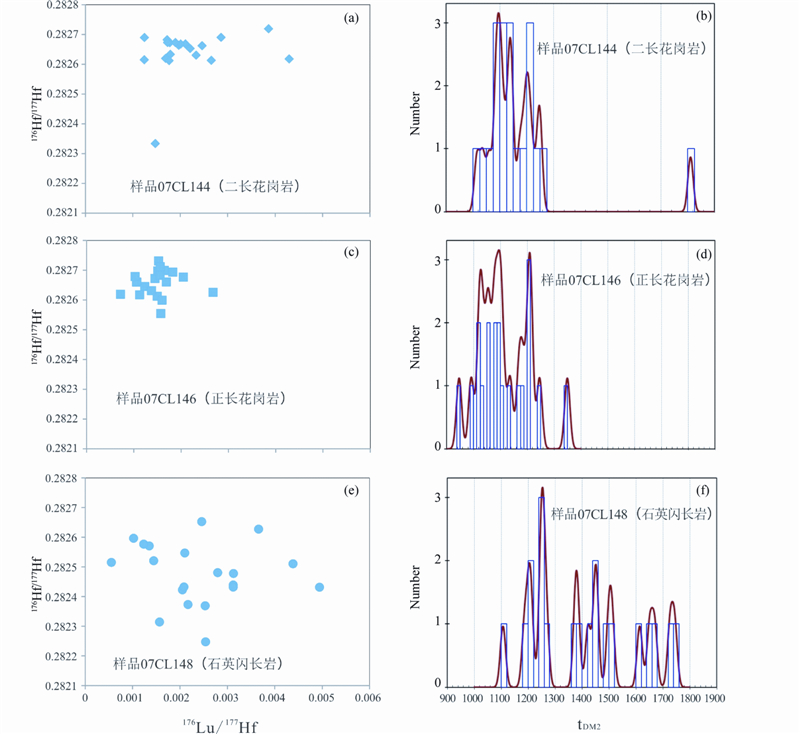 | 图 11 锆石176Lu/177Hf-176Hf/177Hf关系及锆石tDM2统计直方图
Fig. 11 Plot of 176Lu/177Hf vs. 176Hf/177Hf and tDM2 histogram of zircon for some granitoids from the southern Altun
|
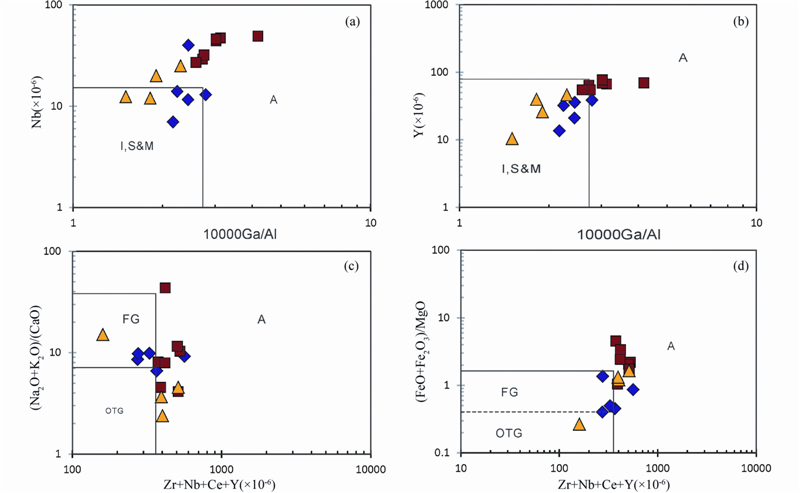 | 图 12 花岗岩类成因类型判别图解(据Whalen et al., 1987) A-A型花岗岩;I,S & M-分别为I型、S型和M型花岗岩;FG-分异的I型花岗岩;OGT-世界I型、S型和M型花岗岩 Fig. 12 Discrimination of granitoids genetic-types(after Whalen et al., 1987) |
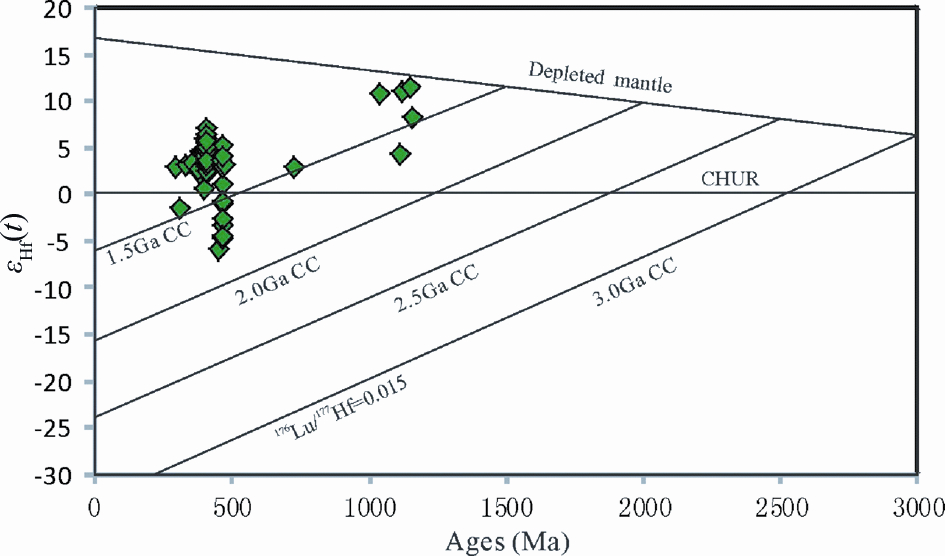 | 图 13 花岗岩类锆石Hf同位素演化图 Fig. 13 Zircon εHf(t)values vs. age(Ma)diagram of the granitoids from the southern Altun |
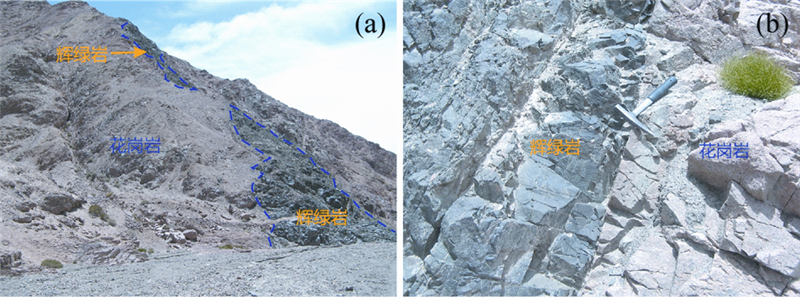 | 图 14 辉绿岩的产状及其与花岗岩的接触关系
Fig. 14 Contact relationship between diabase dike and host granite
|
然而,也有例外情况,如Th是HFSE元素,但它在弧环境中的行为表现出较强的活动性(Pearce and Peate, 1995),且Th的增加与弧岩浆中Ta的含量有关(Hawkesworth et al., 1997)。因此,弧岩浆比板内火成岩具有更高的Th/Ta比值。Gorton and Sch and l(2000)收集了世界上26个不同地方的花岗岩和中性火山岩的地球化学资料,利用不相容元素Ta、Th和Yb的丰度和比值,有效地区分出大洋岛弧、活动大陆边缘和板内火山岩带三种不同的构造环境。其中板内火山岩带的资料来自冰岛,埃塞俄比亚和新墨西哥的瓦勒斯火山,大陆活动边缘的有希腊,智利,阿根廷,日本,墨西哥,阿拉斯加和汤加-克马德克及伊豆小笠原弧(Tonga-Kermadec and Izu-Bonin arcs),大洋岛弧的有吕宋岛(Luzon arc)。三种构造环境中火成岩的Th逐步富集主要归因于弧的成分增加,Th/Ta比值1~6是板内火山岩带,6~20是活动大陆边缘,>20~90的是大洋岛弧(Gorton and Sch and l, 2000)。本区>460Ma的花岗岩类Th/Ta比值为4.6~35.0,平均为22.7,404~411Ma花岗岩类为2.9~18.8,平均为11.3,而年龄为264Ma花岗岩类变化较大,为2.8~65.6,可能反映了源岩成分变化大的特点。因此,本区古生代花岗岩浆活动的构造环境具有从岛弧到活动大陆边缘的变化特征。此外,花岗岩类富集Cs、K、Rb和Th,尤其是富集Na(Ta)和Ti,常被描述为与俯冲有关的构造环境(Foley and Wheller, 1990; Sajona et al., 1996)。根据Muller and Groves(1994)的Y-Zr和Zr/Al2O3-TiO2/Al2O3图解,本区不同时代花岗岩类的样品投点落入与弧相关的大陆和碰撞后区域(图 15a,b)。
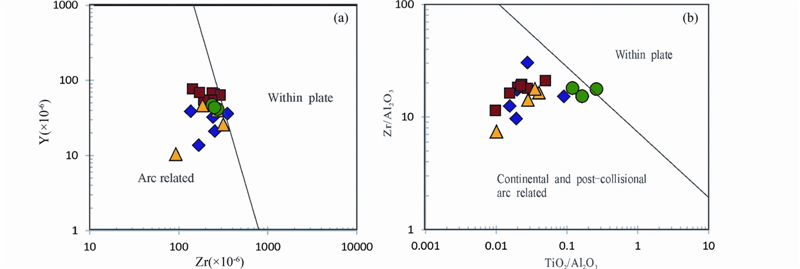 | 图 15 花岗岩类及辉绿岩Y-Zr和Zr/Al2O3-TiO2/Al2O3图解(据Muller and Groves, 1994) Fig. 15 Y vs. Zr and Zr/Al2O3 vs. TiO2/Al2O3 geotectonic discrimination diagrams for within-plate and from arc related granitoids(after Muller and Groves, 1994) |
阿帕-茫崖早古生带蛇绿混杂岩带上火山岩(481Ma,刘良等,1988)、超基性岩(445Ma,董增产等,2011)和花岗岩(264~465Ma,本文)的时代均晚于江尕勒萨依-巴什瓦克高压超高压带上的超高压岩石(504±5Ma、500±10Ma,张建新等,1999),而且在空间上,这两个带被阿尔金断裂分隔,两带在走向上也不协调一致,因此,这两个带上发生的俯冲作用不能同日而语。作者推测,中阿地块与南阿地块之间先是洋壳俯冲,继而发生陆相深俯冲;而南侧的柴达木地块与南阿地块之间的洋壳(暂称为南阿尔金洋)的斜向俯冲,导致中阿地块早期俯冲下去的块体拆沉,经历过超高压变质作用的陆块折返,形成江尕勒萨依-巴什瓦克高压超高压带上;同时,南阿尔金洋壳的俯冲,形成岛弧火山岩及侵位其中的花岗岩类。 6.4 岩石成因和深部过程
研究表明,阿帕-茫崖早古生代蛇绿混杂岩带上花岗岩具有岛弧火成岩地球化学特征,其成因与板块俯冲作用有关。一般来说,这种岛弧背景下的花岗岩有两种成因模式。一是起源于玄武质岩浆,通过AFC作用形成(Bacon and Druitt, 1988; Mingram et al., 2000; Peccerillo,2003),二是熔融、同化、储藏和均一化作用(MASH)(Hildreth and Moorbath, 1988)。MASH模式适用于整个谱系的岩浆产生的过程。接近幔-壳边界的地幔与地壳岩浆混合,建立了熔融阶段岩浆特有的化学特征,而AFC作用基本上改变了上升岩浆的成分,导致均一化阶段(Hildreth and Moorbath, 1988)。在第二个模式中,玄武质岩浆为地壳岩石的部分熔融提供了热(Kay and Mahlburg-Kay, 1991; Lustrino,2005),如基性岩浆的底侵作用,产生的热量足以使地壳发生部分熔融,同时,地幔的物质直接加入地壳(Collins,1996; Keay et al., 1997; Kemp et al., 2007,2009)。Wiebe et al.(2004)通过实验和计算得出,1g 1200℃玄武质岩浆冷却到775℃时产生的热量足以形成含熔体80%的3.5g花岗质岩浆。因此,结合本区花岗岩中产出脉状基性岩块体的特征,我们认为本区存在基性岩浆的底侵作用。特别是404~411Ma的花岗岩类形成,与基性岩浆的底侵作用密切相关。而>460Ma的花岗岩类则直接与大洋板块的俯冲作用密切相关。大洋板块俯冲产生的流体直接诱发岛弧区火成岩发生部分熔融,形成这一期花岗岩类。
根据区内花岗岩类的地球化学特征,结合锆石U-Pb定年结果,本区岩浆活动可初步划分为3期。第一期:>460~450Ma,岩石组合为石英闪长岩+花岗闪长岩+花岗岩,包括辉绿岩脉(453.5±2.5Ma);第二期:410~400Ma,岩石组合为花岗闪长岩+二长花岗岩+正长花岗岩;第三期:265Ma左右,主要为石英闪长岩+二长花岗岩。第一期花岗岩类具有典型的成熟岛弧的花岗岩类组合特征,反映早古生代南阿尔金存在大洋板块的俯冲,与柴北缘和北阿尔金第一期花岗质岩浆作用类似(吴才来等, 2005,2007a,b,2008,2010; Wu et al., 2006,2009; 戚学祥等, 2005a,b; 陈宣华等,2003),而辉绿岩的形成可能与板块俯冲后期的松驰过程有关,含锆石包晶的基性岩浆沿张性裂隙上侵而呈脉状产出。第二期花岗质岩浆作用在时代上类似于柴北缘和北阿尔金的第三期花岗岩(吴才来等, 2005,2007a,b,2008,2010; Wu et al., 2006,2009a; 戚学祥等, 2005a,b),但花岗岩的地球化学属性不同。北阿尔金400Ma的花岗岩类具有岛弧I型地球化学特征(戚学祥等, 2005a,b),而柴北缘400Ma花岗岩类具有I-S型过渡类型的特征,其形成与经历过超高压变质作用的块体折返有关(Wu et al., 2006,2009)。根据本文的研究结果,结合区域地质特征,我们认为,460Ma之前,南阿尔金地块和柴达木地块之间存在南阿尔金洋,洋壳向北俯冲,形成岛弧火山岩,同时形成奥陶纪沉积物。由于俯冲的大洋板块脱水作用,形成富含活动性元素的流体,流体对地幔楔进行交代,并诱发地幔楔部分熔融,形成玄武质岩浆喷发,产生大量的岛弧火山岩。同时,深部来源的岩浆、流体和热能促使岛弧根部的岩石发生部分熔融,形成>460Ma的花岗岩类。随着岛弧火山喷发作用的减弱,玄武质岩浆以底侵的方式在岛弧的根部逐渐聚集,形成深位岩浆房。大约450Ma,俯冲挤压出现松驰状态,深位岩浆房的一部分基性岩浆上侵到上部的岛弧区先前形成的火山岩中,形成基性岩脉(454Ma);随着深部来源的岩浆在岩浆房中不断地聚集,形成了巨大的岩浆房,岩浆房的热量使岛弧区火山岩发生部分熔融,形成年龄为400Ma的花岗岩类。花岗岩浆上侵到岛弧浅部时,捕获了岛弧区火山岩中的基性岩脉。而年龄为264Ma花岗岩类的形成存在两种可能性,一种可能是与阿尔金断裂左型走滑活动有关,因这一期花岗岩体的产出明显地受断裂控制。由于阿尔金断裂的走滑活动,导致在断裂带局部地方发生减压熔融作用,形成花岗岩类,其源岩仍以岛弧火山岩为主。另一种可能是与古特提斯构造演化有关。究竟是属于哪种情况,今后仍需要做更进一步的研究。 7 结论
(1)南阿尔金依吞布拉克花岗岩类锆石SHRIMP U-Pb定年结果表明,阿克提山岩体为263.7±1.2Ma,柴水沟岩体为404.2±4.6Ma、405.5±4.2Ma,其中的辉绿岩为453.5±3.5Ma,常春沟岩体东为411.2±5.4Ma,常春沟岩体西为405.8±2.9Ma,茫崖镇北石英闪长岩465.6±4.6Ma,阿卡龙山花岗岩为469.3±5.7Ma。
(2)各岩体的岩石地球化学特征表明,年龄大于460Ma的花岗岩类为准铝质钙碱性系列岩石,岩石组合为石英闪长岩+花岗闪长岩+二长花岗岩,具有岛弧I型火成岩的地球化学属性,404~411Ma的花岗岩类岩石组合为二长花岗岩+正长花岗岩,具有A型花岗岩的特点,而264Ma的花岗岩类岩石组合为石英闪长岩+二长花岗岩+正长花岗岩,也属I型。
(3)锆石Lu-Hf同位素研究表明,εHf(t)值大多数为正值,少数继承性锆石为负值,反映了它们的源岩以新生地壳的部分熔融为主,同时,也混有少量的古大陆壳的成分。
(4)不同时代花岗岩类元素地球化学研究表明,本区早古生代花岗岩类形成的构造环境具有从大洋岛弧到活动大陆边缘的变化特征。结合区域地质特征和上述研究结果,我们认为,460Ma南阿尔金存在洋壳的俯冲,形成岛弧I型花岗岩类,而404~411Ma属碰撞后阶段的活动大陆边缘,造山带不同块体之间的均衡调整、垮塌,应力处于松驰阶段,形成了具有A型特征的花岗岩类。而264Ma的花岗岩类可能与阿尔金断裂的走滑活动产生局部熔融有关。
| [1] | Anthony EY. 2005. Source regions of granites and their links to tectonic environment: Examples from the western United States. Lithos, 80(1-4): 61-74 |
| [2] | Arculus RJ and Powell R. 1986. Source component mixing in the regions of arc magma generation. J. Geophys. Res., 91(B6): 5913-5926 |
| [3] | Bacon CR and Druitt TH. 1988. Compositional evolution of the zoned calcalkaline magma chamber of Mount Mazama, Crater Lake, Oregon. Contributions to Mineralogy and Petrology, 98(2): 224-256 |
| [4] | Bartoli O, Cesare B, Poli S et al. 2013. Recovering the composition of melt and the fluid regime at the onset of crustal anatexis and S-type granite formation. Geology, 41(2): 115-118 |
| [5] | Black LP, Kamo SL and Allen CM. 2004. Improved 206Pb/238U microprobe geochronology by the monitoring of a trace-element related matrix effect: SHRIMP, ID-TIMS, EL-A-ICP-MS and oxygen isotope documentation for a series of zircon standards. Chem. Geol., 205: 115-140 |
| [6] | Cao YT, Liu L, Wang C, Yang WQ and Zhu XH. 2010. Geochemistry, zircon U-Pb dating and Hf isotope compositions studies for Tatelekebulake granite in South Altyn Tagh. Acta Petrologica Sinica, 26(11): 3259-3271 (in Chinese with English abstract) |
| [7] | Che ZC, Liu L, Liu HF and Luo JH. 1995. Discovery and occurrence of high-pressure metapelitic rocks from Altyn Mountain Areas. Chinese Science Bulletin, 40(23): 1988-1991 |
| [8] | Chen XH, George GE, Wang XF, Yang F and Chen ZL. 2003. Granite from north Altyn Tagh, NW China: U-Pb geochronology and tectonic setting. Bulletin of Mincralogy, Petrology and Geochemistry, 22(4): 294-298 (in Chinese) |
| [9] | Clemens JD and Stevens G. 2012. What controls chemical variation in granitic magmas? Lithos, 134-135: 317-329 |
| [10] | Collins WJ. 1996. S- and I-type granitoids of the eastern Lachlan Fold Belt: Products of three-component mixing. Transactions of the Royal Society of Edinburgh: Earth Sciences, 88: 171-179 |
| [11] | Corfu F. 2013. A century of U-Pb geochronology: The long quest towards concordance. GSA Bulletin, 125(1-2): 33-47 |
| [12] | Cui JW, Tang ZM and Deng JF. 1999. Altun Fault System. Beijing: Geological Publishing House, 1-249 (in Chinese with English abstract) |
| [13] | Dong ZC, Xiao PX, Xi RG, Guo L and Gao XF. 2011. Geochemical characteristics and isotopic dating of bojites in the tectonic melange belt on south margin of Altun. Geological Review, 57(2): 207-216 (in Chinese with English abstract) |
| [14] | Foley SF and Wheller GE. 1990. Parallels in the origin of the geochemical signatures of island arc volcanics and continental potassic igneous rocks: The role of residual titanites. Chem. Geol., 85(1-2): 1-18 |
| [15] | Frost BR, Barnes CG, Collins WJ, Arculus RJ, Ellis DJ and Frost CD. 2001. A geochemical classification for granitic rocks. Journal of Petrology, 42(11): 2033-2048 |
| [16] | Gehrels GE, Yin A and Wang XF. 2003. Detrital zircon geochronology of the northeastern Tibetan Plateau. Geol. Soc. Amer. Bull., 115(7): 881-896 |
| [17] | Gorton MP and Schandl ES. 2000. From continents to island arcs: A geochemical index of tectonics setting for arc-related and within-plate felsic to intermediate volcanic rocks. The Canadian Mineralogist, 38(5): 1065-1073 |
| [18] | Guo ZJ, Zhang ZC and Wang JJ. 1998. Sm-Nd isochron age of ophiolite zone in northern margin of Altun Mountains and its tectonic significance. Chinese Science Bulletin, 44(5): 456-458 |
| [19] | Hawkesworth CJ, Hergt JM, Mcdermott F and Ellam RM. 1991. Destructive margin magmatism and the contributions from the mantle wedge and subducted crust. Aust. J. Earth Sci., 38(5): 577-594 |
| [20] | Hawkesworth CJ, Gallagher K, Hergt JM and Mcdermott F. 1993. Mantle and slab contributions in arc magmas. Annu. Rev. Earth Planet. Sci., 21(1): 175-204 |
| [21] | Hawkesworth CJ, Turner SP, Mcdermott F, Peate DW and Van Calsteren P. 1997. U-Th isotopes in arc magmas: Implications for element transfer from the subducted crust. Science, 276(5312): 551-555 |
| [22] | Hildreth W and Moorbath S. 1988. Crustal contributions to arc magmatism in the Andes of central Chile. Contrib. Mineral. Petrol., 98(4): 455-489 |
| [23] | Hou KJ, Li YH, Zou TR et al. 2007. Laser ablation-MC-ICP-MS technique for Hf isotope microanalysis of zircon and its geological applications. Acta Petrologica Sinica, 23(10): 2595-2604 (in Chinese with English abstract) |
| [24] | Irvine TN and Baragar WRA. 1971. A guide to the chemical classification of the common volcanic rocks. Canadian Journal of Earth Sciences, 8(5): 523-548 |
| [25] | Jogvan O, Muntener O, Burg JP, Ulmer P and Jagoutz E. 2006. Lower continental crust formation through focused flow in km-scale melt conduits: The zoned ultramafic bodies of the Chilas complex in the Kohistan island arc (NW Pakistan). Earth Planet Sci. Lett., 242(3-4): 320-342 |
| [26] | Kay RW and Mahlburg-Kay S. 1991. Creation and destruction of lower continental crust. Geologische Rundschau, 80(2): 259-278 |
| [27] | Keay S, Collins WJ and McCulloch MT. 1997. A three-component Sr/Nd isotopic mixing model for granitoid genesis, Lachlan fold belt, eastern Australia. Geology, 25: 307-310 |
| [28] | Kemp AIS, Hawkesworth CJ, Foster GL, Paterson BA, Woodhead JD, Hergt JM, Gray CM and Whitehouse MJ. 2007. Magmatic and crustal differentiation history of granitic rocks from Hf/O isotopes in zircon. Science, 315(5814): 980-983 |
| [29] | Kemp AIS, Hawkesworth CJ, Collins WJ, Gray CM and Blevin PL. 2009. Isotopic evidence for rapid continental growth in an extensional accretionary orogen: The Tasmanides, eastern Australia. Earth and Planetary Science Letters, 284(3-4): 455-466 |
| [30] | Le Bel L, Cocherie A, Baubron JC, Fouillac AM and Hawkesworth CJ. 1985. A high-K, mantle-derived plutonic suite from 'Linga', near Arequipa (Peru). J. Petrol., 26(1): 124-148 |
| [31] | Leo AH and Jodo OS. 2003. Predominance of high Th/U, magmatic zircon in Brazilian Shield sandstones. Geology, 32(1): 73-76 |
| [32] | Li XM, Ma ZP, Sun JM, Xu XY, Lei Y, Wang LS and Duan XX. 2009. Characteristics and age study about the Yuemakeqi maficultramagic rock in the southern Altyn Fault. Acta Petrologica Sinica, 25(4): 862-872 (in Chinese with English abstract) |
| [33] | Liu L, Che ZC and Wang Y. 1998. The evidence of Sm-Nd isochron age for the Early Paleozoic ophiolite in Mangya area, Altun Mountains. Chinese Science Bulletin, 43(9): 754-756 |
| [34] | Liu L, Che ZC, Wang Y et al. 1999. The metrological characters and geotectonic setting of high-pressure metamorphic rock belts in Altun Mountains. Acta Petrologica Sinica, 15(1): 57-64 (in Chinese with English abstract) |
| [35] | Liu L, Sun Y, Xiao PX et al. 2002. Discovery of ultrahigh-pressure magnesite-bearing garnet lherzolite (>3.8GPa) in the Altyn Tagh, Northwest China. Chinese Science Bulletin, 47(11): 881-886 |
| [36] | Liu L, Sun Y, Luo JH et al. 2003. Ultrahigh-pressure metamorphism of granitic gneiss in the Yinggelisayi area, Altun Monutains, NW China. Science in China (Series D), 47(4): 338-346 |
| [37] | Liu L, Chen DL and Zhang AD. 2005. Ultrahigh pressure gneissic K-feldspar garnet clinopyroxenite in the Altyn Tagh, NW China: Evidence f rom clinopyroxene exsolution in garnet. Science in China (Series D), 48(7): 1000-1010 |
| [38] | Liu L, Zhang AD, Chen DL, Yang JX, Lao JH and Wang C. 2007. Implications based on LA-ICP-MS zircon U-Pb ages of eclogite and its country rock from Jianggalesayi area, Altyn Tagh. Earth Science Frontiers, 14(1): 98-107 (in Chinese with English abstract) |
| [39] | Liu L, Chen DL, Wang C, Zhang CL. 2009. New progress on geochronology of high-pressure/ultrahigh-pressure metamorphic rocks from the South Altyn Tagh, the North Qaidam and the North Qinling orogenic, NW China and their geological significance. Journal of Northwest University (Natural Science Edition), 39(3): 472-479 (in Chinese with English abstract) |
| [40] | Liu YS, Yu HF, Xin HT et al. 2009. Tectonic units division and Precambrian significant geological events in Altyn Tagh Mountain, China. Geological Bulletin of China, 28(10): 1430-1438 (in Chinese with English abstract) |
| [41] | Liu YS, Yu HF, Xiu QY et al. 2010. Characteristics and tectonic implications of eclogites in southern Altun area. Acta Petrologica et Mineralogica, 29(2): 166-174 (in Chinese with English abstract) |
| [42] | Lu SN and Yuan GB. 2003. Geochronology of Early Precambrian magmatic activities in Aketashitage, eastern Altyn Tagh. Acta Geologica Sinica, 77(1): 61-68 (in Chinese with English abstract) |
| [43] | Ludwig KR. 2001. Squid 1.02: A user's manual. Berkeley Geochronology Center Special Publication, 2: 15-35 |
| [44] | Ludwig KR. 2003. User's manual for Isoplot 3.00: A geochronological tool for Microsoft Excel. Berkeley Geochronology Center Special Publication, 4: 1-70 |
| [45] | Lustrino M. 2005. How the delamination and detachment of lower crust can influence basaltic magmatism. Earth-Science Reviews, 72(1-2): 21-38 |
| [46] | Ma TQ, Wang XH and Meng DB. 2002. Characteristic and geology meaning of alkaline calcium invade-rock zone at the SW fringe of Altun massif. Hunan Geology, 21(1): 12-16 (in Chinese with English abstract) |
| [47] | Ma ZP, Li XM, Sun JM et al. 2009. Discovery of layered mafic-ultramafic intrusion in Changshagou, Altyn Tagh, and its geological implication: A pilot study on its petrological and geochemical characteristics. Acta Petrologica Sinica, 25(4): 793-804 (in Chinese with English abstract) |
| [48] | Ma ZP, Sun JM and Tang Z. 2010. Discussions on the magmatic Cu-Ni-PGE sulfides mineralization potential of the Changshagou-Qingshuiquan layered mafic-ultramafic intrusions, Altyn Tagh. Northwestern Geology, 43(4): 18-24 (in Chinese with English abstract) |
| [49] | Maniar PD and Piccoli PM. 1989. Tectonic discrimination of granitoids. Geol. Soc. Am. Bull., 101: 635-643 |
| [50] | Mattinson CG, Wooden JL, Liou JG et al. 2006. Age and duration of eclogite-facies metamorphicsm, North Qaidam HP/UHP terrane, western China. American Journal of Science, 306(11): 683-711 |
| [51] | Mattinson CG, Menold CA, Zhang JX and Bird DK. 2007. High- and ultrahigh-pressure metamorphism in the North Qaidam and South Altyn terranes, western China. International Geology Review, 49(11): 969-995 |
| [52] | Meng QR, Hu JM and Yang FZ. 2001. Timing and magnitude of displacement on the Altun Tagh fault: Constraints from stratigraphic correlation of adjoining Tarim and Qaidam basins, NW China. Terra Nova, 13 (2): 86-91 |
| [53] | Middlemost EAK. 1994. Naming materials in magma/igneous rock system. Earth-Science Reviews, 37: 215-224, doi: 10.1016/0012-8252(94)90029-9 |
| [54] | Mingram B, Trumbull RB, Littman S and Gerstenberger H. 2000. A petrogenetic study of anorogenic felsic magmatism in the Cretaceous Paresis ring complex, Namibia: Evidence for mixing of crust and mantle-derived components. Lithos, 54: 1-22 |
| [55] | Muller D and Groves DI. 1994. Potassic Igneous Rocks and Associated Gold-copper Mineralization. Lect. Notes Earth Sci., 56 |
| [56] | Patino Douce AE and Beard JS. 1996. Effects of P, f(O2) and Mg/Fe ratio on dehydration melting of model metagreywackes. J. Petrol., 37(5): 999-1024 |
| [57] | Patino Douce AE and McCarthy TC. 1998. Melting of crustal rocks during continental collision and subduction. In: Hacker BR and Liou JG (eds.). When Continents collide: Geodynamics and Geochemistry of Ultrahigh-Pressure Rocks. Petrology and Structural Geology. Dordrecht: Kluwer Academic Publishers, 10: 27-55 |
| [58] | Pearce JA and Parkinson IJ. 1993. Trace element models for mantle melting: Application to volcanic arc petrogenesis: In Prichard HM, Alabaster T, Harris NBW and Neary CR (eds.). Magmatic Processes and Plate Tectonics. Nantwich, UK: Shiva Press, 373-403 |
| [59] | Pearce JA and Peate DW. 1995. Tectonic implications of the composition of volcanic arc magmas. Annu. Rev. Earth Planet. Sci., 23(1): 251-285 |
| [60] | Peccerillo A. 2003. Plio-Quaternary magmatism in Italy, Episodes, 26: 222-226 |
| [61] | Pidgeon RT, Nemchin AA and Hitchen GJ. 1998. Internal structures of zircons from Archaean granites from the Darling Range batholith: Implications for zircon stability and the interpretation of zircon U-Pb ages. Contributions to Mineralogy and Petrology, 132(3): 288-299 |
| [62] | Pitcher WS. 1997. The Nature and Origin of Granite. London: Chapman & Hall |
| [63] | Qi XX, Li HB, Wu CL, Yang JS, Meng FC, Shi RD and Chen SY. 2005a. The zircon SHRIMP U-Pb dating of the Qiashikayi granodiorite in northern Altun. Chinese Science Bulletin, 50(6): 570-575 (in Chinese) |
| [64] | Qi XX, Wu CL and Li HB. 2005b. SHRIMP U-Pb age of zircons from Kazisayi granite in the northern Altyn Tagh Mountains and its significations. Acta Petrologica Sinica, 21(3): 859-866 (in Chinese with English abstract) |
| [65] | Qin XF, Li J, Lu JP et al. 2006. Tectonic evolution of the western segment of the Altyn Tagh collisional orogen, Northwest China. Geological Bulletin of China, 25(1-2): 104-112 (in Chinese with English abstract) |
| [66] | Qin XF, Xia B, Li J et al. 2007. Geochemical characteristics and tectonic setting of the Early Paleozoic greenschist in the western segment of the southern Altyn Tagh marginal tectonic belt. Geology in China, 34(5): 799-807 (in Chinese with English abstract) |
| [67] | Qin XF, Xia B, Li J et al. 2008. Geochemical characteristics and tectonic settings of the diabase dyke swarms in the western segment of the southern Altun tectonic belt. Acta Petrologica et Mineralogica, 27(1): 14-22 (in Chinese with English abstract) |
| [68] | Rapp RP, Watson EB and Miller CF. 1991. Partial melting of amphibolite/eclogite and the origin of Archean trondhjemites and tonalities. Precamb. Res., 51(1-4): 1-25 |
| [69] | Rapp RP and Watson EB. 1995. Dehydration melting of metabasalt at 8-32kbar: Implications for continental growth and crust-mantle recycling. J. Petrol., 36: 891-931 |
| [70] | Ren SM, Ge XH and Liu YJ. 2003. Progress in Altyn fault belts research. Advance in Earth Sciences, 18(3): 386-391 (in Chinese with English abstract) |
| [71] | Ritts BD and Biffi U. 2000. Magnitude of post-Middle Jurassic (Bajocian) displacement on the central Altun Tagh fault system, Northwest China. Geol. Soc. Amer. Bull., 112(1): 61-74 |
| [72] | Sajona FG, Maury RC, Bellon H, Cotton J and Defant M. 1996. High field strength elements of Pliocene-Pleistocene island-arc basalts Zamboanga Peninsula, Western Mindanao (Philippines). Journal of Petrology, 37(3): 693-726 |
| [73] | Sen C and Dunn T. 1994. Dehydration melting of a basaltic composition amphibolite at 1.5 and 2.0GPa: Implications for the origin of adakites. Contrib. Mineral. Petrol., 117(4): 394-409 |
| [74] | Skjerlie KP and Patio Douce AE. 2002. The fluid-absent partial melting of a zoisite-bearing quartz eclogite from 1.0 to 3.2GPa: Implications for melting in thickened continental crust and for subduction-zone processes. J. Petrol., 43: 291-314 |
| [75] | Sobel ER and Arnaud N. 1999. A possible middle Paleozoic suture in the Altyn Tagh, NW China. Tectonics, 18(1): 64-74 |
| [76] | Sobel ER, Arnaud N, JolivetM et al. 2001. Jurassic to Cenozoic exhumation history of the Altun Tagh range, Northwest China, constrained by 40Ar/39Ar and apatite fission track thermochronology. In: Paleozoic and Mesozoic Tectonic Evolution of Central Asia: From Continental Assembly to Intracontinental Deformation. Geological Society of America Memoir, 194: 247-267 |
| [77] | Sun SS and McDonough WF. 1989. Chemical and isotopic systematics of oceanic basalts: Implications for mantle composition and processes. In: Saunders AD and Norry MJ (eds.). Magmatism in the Ocean Basins. Geological Society of London Special Publication, 42(1): 313-345 |
| [78] | Tatsumi Y, Kosligo T and Nohda S. 1995. Formation of a third volcanic chain in Kamchatka: Generation of unusual subduction-related magmas. Contrib. Mineral. Petrol., 120(2): 117-128 |
| [79] | Taylor SR and McLennan S. 1985. The Continental Crust: Its Composition and Evolution. Oxford: Blackwell, 1-312 |
| [80] | Wang C, Liu L, Che ZC et al. 2006. U-Pb geochronology and tectonic setting of the granitic gneiss in Jianggaleisayi eclogite belt, the southern edge of Altyn Tagh. Geological Journal of China Universities, 12(1): 74-82 (in Chinese with English abstract) |
| [81] | Whalen JB, Currie KL and Chappell BW. 1987. A-type granites: Geochemical characteristics, discrimination and petrogenesis. Contrib. Mineral. Petrol., 95(4): 407-419 |
| [82] | Wiebe RA, Manon MR and Hawkins DP. 2004. Late-Stage mafic injection and thermal rejuvenation of the Vinalhaven granite, coastal marine. Journal of Petrology, 45(11): 2133-2153 |
| [83] | Winther KT. 1996. An experimentally based model for the origin of tonalitic and trondhjemitic melts. Chem. Geol., 127(1-3): 43-59 |
| [84] | Wolf MB and Wyllie JP. 1994. Dehydration-melting of amphibolite at 10kbar: The effects of temperature and time. Contrib. Mineral. Petrol., 115(4): 369-383 |
| [85] | Wu CL, Yang JS, Yao SZ et al. 2005. Characteristics of the granitoid complex and its zircon SHRIMP dating at the south margin of the Bashikaogong Basin, North Altun, NW. Acta Petrologica Sinica, 21(3): 849-858 (in Chinese with English abstract) |
| [86] | Wu CL, Wooden JL, Yang JS et al. 2006. Granitic magmatism in the North Qaidam Early Paleozoic ultrahigh-pressure metamorphic belt, Northwest China. International Geology Review, 48(3): 223-240 |
| [87] | Wu CL, Gao YH, Wu SP, Chen QL, Wooden JL, Mazadab FK and Mattinson CG. 2007a. Zircon SHRIMP U-Pb dating of granites from the Da Qaidam area in the north margin of Qaidam Basin, NW China. Acta Petrologica Sinica, 23(8): 1861-1875 (in Chinese with English abstract) |
| [88] | Wu CL, Yao SZ, Zeng LS et al. 2007b. Characteristics of the granitoid complex and its zircon SHRIMP dating at the south margin of the Bashikaogong Basin-Simierbulake, North Altun, NW. Science in China (Series D), 37(1): 10-26 (in Chinese) |
| [89] | Wu CL, Wooden JL, Robinson PL, Gao YH, Wu SP, Chen QL, Mazadab FK and Mattinson CG. 2008. Geochemistry and zircon SHRIMP U-Pb dating of granitoids from the west segment of the North Qaidam. Science in China (Series D), 52(11): 1771-1790 |
| [90] | Wu CL, Yang JS, Robinson PT et al. 2009. Geochemistry, age and tectonic significance of granitic rocks in North Altun, Northwest China. Lithos, 113: 423-436 |
| [91] | Wu CL, Xu XY, Gao QM et al. 2010. Early Palaeozoic granitoid magmatism and tectonic evolution in North Qilian, NW China. Acta Petrologica Sinica, 26(4): 1027-1044 (in Chinese with English abstract) |
| [92] | Wu FY, Li XH, Zheng YF and Gao S. 2007. Lu-Hf isotopic systematics and their applications in petrology. Acta Petrologica Sinica, 23(2): 185-220 (in Chinese with English abstract) |
| [93] | Wu YZ, Wang Z, Guo L et al. 2009. Tectonic control for temporal and spatial variation of granitoids in southwest sector of Altyn Mountains: Evidence from changes of potassium and sodium in granitoids. Geotectonica et Metallogenia, 33(4): 573-587 (in Chinese with English abstract) |
| [94] | Xu ZQ, Yang JS, Zhang JX et al. 1999. A comparison between the tectonic units on the two sides of the Altun sinistral strike fault and the mechanism of lithospheric shearing. Acta Geologica Sinica, 73(3): 193-205 (in Chinese with English abstract) |
| [95] | Yang JS, Xu ZQ, Zhang JX, Zhang ZM, Liu FL and Wu CL. 2009. Tectonic setting of main high-and ultrahigh-pressure metamorphic belts in China and adjacent region and discussion on their subduction and exhumation mechanism. Acta Petrologica Sinica, 25(7): 1529-1560 (in Chinese with English abstract) |
| [96] | Yang WQ, Liu L, Ding HB et al. 2012. Geochemistry, geochronology and zircon Hf isotopes of the Dimunalike granite in South Altyn Tagn and its geological significance. Acta Petrologica Sinica, 28(12): 4139-4150 (in Chinese with English abstract) |
| [97] | Yin A. 2001. Geologic evolution of the Himalayan-Tibetan orogen: Phanerozoic growth of Asia continental. Acta Geoscientia Sinica, 22(3): 193-230 (in Chinese with English abstract) |
| [98] | Yin A, Craig EM, Oscar L et al. 2007. Early Paleozoic tectonic and thermomechanical evolution of ultrahigh-pressure (UHP) metamorphic rocks in the northern Tibetan Plateau, Northwest China. International Geology Review, 49(8): 681-716 |
| [99] | Zhang AD, Liu L, Chen DL, Wang Y and Luo JH. 2004. SHRIMP U-Pb dating of zircons and its geological significance from UHP granitoid gneiss in Altyn Tagh. Chinese Science Bulletin, 49(23): 2527-2532 |
| [100] | Zhang JX, Zhang ZM, Xu ZQ and Yang JS. 1999. The age of U-Pb and Sm-Nd for eclogite from the western segment of the Altyn Tagh tectonic belt. Chinese Science Bulletin, 44: 2256-2259 |
| [101] | Zhang JX, Zhang ZM, Xu ZQ et al. 2001. Petrology and geochronology of eclogites from the western segment of the Altun Tagh, northwestern China. Lithos, 56(2-3): 187-206 |
| [102] | Zhang JX, Xu ZQ, Yang JS et al. 2001. Petrology, geochemistry and geochronology of eclogites from the western segment of the Altun Tectonic Bel, northwestern China. Acta Geologica Sinica, 75(2): 186-197 (in Chinese with English abstract) |
| [103] | Zhang JX, Zhang ZM, Xu ZQ, Meng FC, Li HB and Shi RD. 2002. Evidence for UHP metamorphism of eclogites from the Altun Mountains. Chinese Science Bulletin, 47(9): 751-755 |
| [104] | Zhang JX, Meng FC and Yang JS. 2005. A new HP/LT metamorphic terrane in the northern Altyn Tagh, western China. Int. Geol. Rev., 47(4): 371-386 |
| [105] | Zhang JX, Meng FC and Mattinson CG. 2007. Progress, controversies and challenge of studies on South Altyn Tagh-North Qaidam HP/UHP metamorphic belt. Geological Journal of Chinese Universities, 13: 526-545 (in Chinese with English abstract) |
| [106] | Zhang Q, Jin WJ, Li CD and Wang YL. 2010. Revisiting the new classification of granitic rocks based on whole-rock Sr and Yb contents: Index. Acta Petrologica Sinica, 26(4): 985-1015 (in Chinese with English abstract) |
| [107] | Zhao HL, Cao FG, Li J et al. 2011. Geological characteristics and zircon SHRIMP U-Pb dating of Nanhua volcanic rocks from the northern Hongliugou in Altun area. Exploration Engineering, 23(9): 107-111 (in Chinese with English abstract) |
| [108] | Zhou Y and Pan YS. 1999. The initial shear sense of the Altun fault and its timing. Geological Review, 45(1): 1-9 (in Chinese with English abstract) |
| [109] | 曹玉亭, 刘良, 王超, 杨文强, 朱小辉. 2010. 阿尔金南缘塔特勒克布拉克花岗岩的地球化学特征、锆石U-Pb定年及Hf同位素组成. 岩石学报, 26(11): 3259-3271 |
| [110] | 车自成, 刘良, 刘洪福, 罗金海. 1995. 阿尔金山地区高压变泥质岩石的发现及其产出环境. 科学通报, 40(14): 1298-1300 |
| [111] | 陈宣华, Gehrels GE, 王小凤, 杨风, 陈正乐. 2003. 阿尔金山北缘花岗岩的形成时代及其构造环境探讨. 矿物岩石地球化学通报, 22(4): 294-298 |
| [112] | 崔军文, 唐哲明, 邓晋福. 1999. 阿尔金断裂系. 北京: 地质出版社 |
| [113] | 董增产, 校培喜, 奚仁刚, 过磊, 高晓峰. 2011. 阿尔金南缘构造混杂岩带中角闪辉长岩地球化学特征及同位素测年. 地质论评, 57(2): 207-216 |
| [114] | 郭召杰, 张志诚, 王建君. 1998. 阿尔金山北缘蛇绿岩带的Sm-Nd等时线年龄及其大地构造意义. 科学通报, 43(18): 1981-1984 |
| [115] | 侯可军, 李延河, 邹天人等. 2007. LA-MS-ICP-MS锆石Hf同位素的分析方法及地质应用. 岩石学报, 23(10): 2595-2604 |
| [116] | 李向民, 马中平, 孙吉明, 徐学义, 雷永孝, 王立社, 段星星. 2009. 阿尔金断裂南缘约马克其镁铁-超镁铁岩的性质和年代学研究. 岩石学报, 25(4): 862-872 |
| [117] | 刘良, 车自成, 王焰等. 1998. 阿尔金茫崖地区早古生代蛇绿岩的Sm-Nd等时线年龄证据. 科学通报, 43(8): 880-882 |
| [118] | 刘良, 车自成, 王焰. 1999. 阿尔金高压变质岩带的特征及其构造意义. 岩石学报, 15 (1): 57-63 |
| [119] | 刘良, 孙勇, 肖培喜等. 2002. 阿尔金发现超高压(>3.8GPa)石榴二辉橄榄岩. 科学通报, 47 (9): 657-662 |
| [120] | 刘良, 孙勇, 罗金海等. 2003. 阿尔金英格利萨依花岗质片麻岩超高压变质. 中国科学(D辑), 33(12): 1184-1192 |
| [121] | 刘良, 陈丹玲, 张安达. 2005. 阿尔金超高压(>7GPa) 片麻状(含)钾长石榴辉石岩-石榴子石出溶单斜辉石的证据. 中国科学(D辑), 35(2): 105-114 |
| [122] | 刘良, 张安达, 陈丹玲, 杨家喜, 罗金海, 王超. 2007. 阿尔金江尕勒萨依榴辉岩和围岩锆石LA-ICP-MS微区原位定年及其地质意义. 地学前缘, 14(1): 98-107 |
| [123] | 刘良, 陈丹玲, 王超, 张成立. 2009. 阿尔金、柴北缘与北秦岭高压-超高压岩石年代学研究进展及其构造地质意义. 西北大学学报(自然科学版), 39(3): 472-479 |
| [124] | 刘永顺, 于海峰, 辛后田等. 2009. 阿尔金山地区构造单元划分和前寒武纪重要地质事件. 地质通报, 28(10): 1430-1438 |
| [125] | 刘永顺, 于海峰, 修群业等. 2010. 南阿尔金地区榴辉岩特征及意义. 岩石矿物学杂志, 29(2): 166-174 |
| [126] | 陆松年, 袁桂邦. 2003. 阿尔金山阿克塔什塔格早前寒武纪岩浆活动的年代学证据. 地质学报, 77(1): 61-68 |
| [127] | 马铁球, 王先辉, 孟德保. 2002. 阿尔金地块西南缘钙碱性侵入岩带特征及其地质意义. 湖南地质, 21(1): 12-16 |
| [128] | 马中平, 李向民, 孙吉明等. 2009. 阿尔金山南缘长沙沟镁铁-超镁铁质层状杂岩体的发现与地质意义——岩石学和地球化学初步研究. 岩石学报, 25(4): 793-804 |
| [129] | 马中平, 孙吉明, 唐卓. 2010. 阿尔金山南缘长沙沟-清水泉一带镁铁-超镁质杂岩体Cu-Ni-PGE含矿性讨论. 西北地质, 43(4): 18-24 |
| [130] | 戚学祥, 李海兵, 吴才来, 杨经绥, 张建新, 孟繁聪, 史仁灯, 陈松永. 2005a. 北阿尔金恰什坎萨依花岗闪长岩的锆石SHRIMP U-Pb定年及其地质意义. 科学通报, 50(6): 570-575 |
| [131] | 戚学祥, 吴才来, 李海兵. 2005b. 北阿尔金喀孜萨依花岗岩锆石SHRIMP U-Pb定年及其构造意义. 岩石学报, 21(3): 859-866 |
| [132] | 覃小锋, 李江, 陆济璞等. 2006. 阿尔金碰撞造山带西段的构造特征. 地质通报, 25(1-2): 104-112 |
| [133] | 覃小锋, 夏斌, 李江等. 2007. 阿尔金南缘构造带西段早古生代绿片岩的地球化学特征及构造环境. 中国地质, 34(5): 799-807 |
| [134] | 覃小锋, 夏斌, 李江等. 2008. 阿尔金南缘构造带西段辉绿岩墙群的地球化学特征及构造环境. 岩石矿物学杂志, 27(1): 14-22 |
| [135] | 任收麦, 葛肖虹, 刘永江. 2003. 阿尔金断裂带研究进展. 地球科学进展, 18(3): 386-391 |
| [136] | 王超, 刘良, 车自成等. 2006. 阿尔金南缘榴辉岩带中花岗片麻岩的时代及构造环境探讨. 高校地质学报, 12(1): 74-82 |
| [137] | 吴才来, 杨经绥, 姚尚志等. 2005. 北阿尔金巴什考供盆地南缘花岗杂岩体特征及锆石SHRIMP U-Pb定年. 岩石学报, 21(3): 846-858 |
| [138] | 吴才来, 郜源红, 吴锁平, 陈其龙, Wooden JL, Mazadab FK, Mattinson CG. 2007a. 柴达木盆地北缘大柴旦地区古生代花岗岩锆石SHRIMP定年. 岩石学报, 23(8): 1861-1875 |
| [139] | 吴才来, 姚尚志, 曾令森等. 2007b. 北阿尔金巴什考供-斯米尔布拉克花岗杂岩特征及锆石SHRIMP U-Pb定年. 中国科学(D辑), 37(1): 10-26 |
| [140] | 吴才来, Wooden JL, Robinson PL, 郜源红, 吴锁平, 陈其龙, Mazadab FK, Mattinson CG. 2008. 柴北缘西段花岗岩锆石SHRIMP U-Pb定年及其岩石地球化学特征. 中国科学(D辑), 38(8): 930-949 |
| [141] | 吴才来, 徐学义, 高前明等. 2010. 北祁连早古生代花岗质岩浆作用及构造演化. 岩石学报, 26(4): 1027-1044 |
| [142] | 吴福元, 李献华, 郑永飞, 高山. 2007. Lu-Hf同位素体系及其岩石学应用. 岩石学报, 23(2): 185-220 |
| [143] | 伍跃中, 王战, 过磊等. 2009. 阿尔金山西南段花岗岩类的时空变化与构造作用——来自钾钠含量变化的证据. 大地构造与成矿学, 33(4): 573-587 |
| [144] | 许志琴, 杨经绥, 张建新等. 1999. 阿尔金断裂两侧构造单元的对比及岩石圈剪切机制. 地质学报, 73(3): 193-205 |
| [145] | 杨经绥, 许志琴, 张建新, 张泽明, 刘福来, 吴才来. 2009. 中国主要高压-超高压变质带的大地构造背景及俯冲/折返机制的探讨. 岩石学报, 25(7): 1529-1560 |
| [146] | 杨文强, 刘良, 丁海波等. 2012. 南阿尔金迪木那里克花岗岩地球化学、锆石U-Pb年代学与Hf同位素特征及其构造地质意义. 岩石学报, 28(12): 4139-4150 |
| [147] | 尹安. 2001. 喜马拉雅-青藏高原造山带地质演化——显生宙亚洲大陆生长. 地球学报, 22(3): 193-230 |
| [148] | 张安达, 刘良, 孙勇, 陈丹玲, 王焰, 罗金海. 2004. 阿尔金超高压花岗质片麻岩中锆石SHRIMP U-Pb定年及其地质意义. 科学通报, 49(22): 2335-2341 |
| [149] | 张建新, 张泽明, 许志琴, 杨经绥. 1999. 阿尔金构造带西段榴辉岩的Sm-Nd及U-Pb年龄——阿尔金构造带中加里东期山根存在的证据. 科学通报, 44(10): 1109-1112 |
| [150] | 张建新, 许志琴, 杨经绥等. 2001. 阿尔金西段榴辉岩岩石学、地球化学和同位素年代学研究及其构造意义. 地质学报, 75(2): 186-197 |
| [151] | 张建新, 杨经绥, 许志琴, 孟繁聪, 李海兵, 史仁灯. 2002. 阿尔金榴辉岩中超高压变质作用证据. 科学通报, 47: 231-234 |
| [152] | 张建新, 孟繁聪, Mattinson CG. 2007. 南阿尔金-柴北缘高压-超高压变质带研究进展、问题及挑战. 高校地质学报, 13(3): 526-545 |
| [153] | 张旗, 金惟俊, 李承东, 王元龙. 2010. 再论花岗岩按照Sr-Yb的分类: 标志. 岩石学报, 26(4): 985-1015 |
| [154] | 赵恒乐, 曹福根, 李佳等. 2011. 阿尔金红柳沟北南华纪火山岩地质特征及锆石U-Pb SHRIMP定年. 西部探矿工程, 23(9): 107-111 |
| [155] | 周勇, 潘裕生. 1999. 阿尔金断裂早期走滑运动方向及其活动时间探讨. 地质论评, 45(1): 1-9 |