 2014, Vol. 30


2. 北京大学地球与空间科学学院, 北京 100871;
3. 中国地质科学院矿产资源研究所, 北京 100037
2. School of Earth and Space Sciences, Peking University, Beijing 100871, China;
3. Institute of Mineral Resources, Chinese Academy of Geological Sciences, Beijing 100037, China
喜马拉雅造山带是世界上碰撞造山带的典例,经历了多期变质作用和构造岩浆作用,发育多种类型高级变质岩和淡色花岗岩,是理解中下地壳岩石如何响应碰撞造山作用的典型野外实验室(Liu and Zhong, 1997; Yin and Harrison, 2000; Zhang et al., 2004; 许志琴等,2006; Ding et al., 2005; Yin et al., 2006; Zeng et al., 2011; Zhang et al., 2011; Hou et al., 2012)。除了与印度-欧亚大陆相关的变质作用外,大量的研究已揭示喜马拉雅造山带中的高级变质岩经历了碰撞以前的多期变质作用(张泽明等,2008)和岩浆作用(许志琴等,2006; Cottle et al., 2009; Gao et al., 2011)。如何识别和恢复被后期变质作用强烈改造的高级变质岩的早期变质作用历史是陆陆碰撞造山带研究的重要课题之一(O’Brien and Rtzler,2003)。厘定这些早期变质作用的时限及其性质对于(1)限定喜马拉雅造山带各个构造单元组成及其来源(曾令森等,2008);(2)理解淡色花岗岩的源区及其地球化学特征不均匀的成因机理(Debon et al., 1986; Harris and Massey, 1994; Harrison et al., 1999; Zhang et al., 2004; Aoya et al., 2005; Aikman et al., 2008; 曾令森等,2009; King et al., 2011; Zeng et al., 2011,2012; Gao et al., 2011; Hou et al., 2012; 高利娥等,2013; Gao and Zeng, 2014);(3)限定喜马拉雅造山带的构造演化模型(如“地壳隧道流模型”、“构造楔模型”或“构造挤出模型”)(Beaumount et al., 2001; Tapponnier et al., 2001; Xu et al., 2013)和提出新模型等方面都有重要意义。
本文主要是通过南迦巴瓦陆块北部的混合岩和花岗片麻岩中锆石年龄的测定,结合该地区其他样品的年龄,得出该地区的岩石经历了~1600Ma,~1100Ma,~500Ma的岩浆变质作用,进一步揭示了南迦巴瓦地区新生代以前的岩浆变质作用历史,初步探讨了南迦巴瓦元古代时期的构造作用,从而更好地限定了南迦巴瓦复合体的来源以及喜马拉雅造山带的构造演化模型。
1 地质背景喜马拉雅造山带东西向延伸2500km,宽300~500km,南北边界分别为喜马拉雅主前锋逆冲断裂(MFT)和雅鲁藏布江缝合带,自北往南依次为特提斯喜马拉雅带、高喜马拉雅带和小喜马拉雅带(图 1)(Hodges,2000; Yin and Harrison, 2000; 许志琴等,2006)。特提斯喜马拉雅位于雅鲁藏布江缝合带(YTS)以南,藏南拆离系(STDS)以北,主要由晚古生代以来略有变形变质的沉积岩组成,与消亡的新特提斯大洋沉积有关,在其内部发育断续分布的北喜马拉雅穹窿。高喜马拉雅结晶岩系位于藏南拆离断层与主中央断裂带(MCT)之间,由高级变质岩及其中的新生代淡色花岗岩组成,大致沿着喜马拉雅山系主山脊分布。小喜马拉雅带位于主中央断裂带(MCT)与主边界逆冲断裂(MBT)之间。
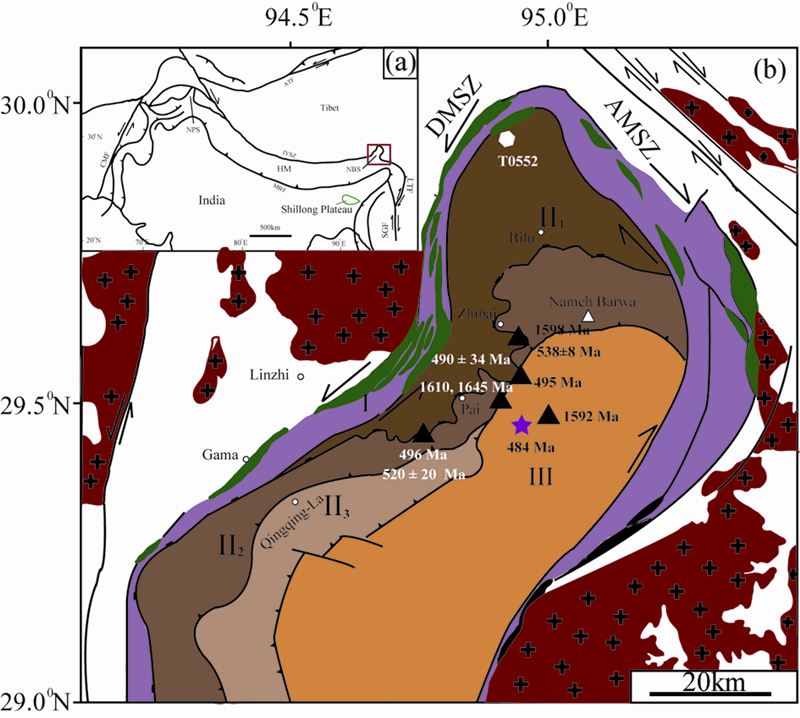 | 图 1 南迦巴瓦构造结的地质背景图(据Xu et al., 2012修改)
IYSZ:印度-雅鲁藏布江缝合带;DMSZ:东久-密林剪切带;AMSZ:阿尼桥-墨脱剪切带;NBS:南迦巴瓦构造结.I:印度-雅鲁藏布江缝合带;II:南迦巴瓦复合体(II1:比鲁板片;II2:直白板片;II3:清清拉板片);III:多雄拉混合岩穹隆.实心三角形代表的是源自Zhang et al.(2011)的数据,五角星代表的是源自Burg et al.(1998)的数据,五边形为本文的采样点 Fig. 1 Geologic map of Namche Barwa Syntax(modified after Xu et al., 2012) IYSZ: Indus-Yarlung suture zone; DMSZ: Dongjiu-Milin shear zone; AMSZ: Aniqiao-Motuo shear zone; NBS: Namche Barwa syntax. I: Indus-Yarlung suture zone; II: Namche Barwa complex(II1: Bilu slice; II2: Zhibai slice; II3: Qingqing-la slice); III: Duoxiongla migmatite Dome. Solid triangle represents data from Zhang et al.(2011),star represents data from Burg et al.(1998),pentagon is the location of our sample |
喜马拉雅造山带主带的两端是著名的东、西构造结——是喜马拉雅造山带东、西部的地质界线、构造格局发生急剧转折的地区,也是构造应力最强、隆升和剥蚀最快、新生代变质和深熔作用最强的地区(Xu et al., 2012)。东构造结分为三个构造单元:I:倒U形的雅鲁藏布江大拐弯缝合带,分割拉萨地块和南迦巴瓦变质体II:南迦巴瓦高压变质复合体,III:多雄拉混合岩穹隆(Xu et al., 2012)。后面的两个构造单元构成南迦巴瓦构造结中的高喜马拉雅结晶岩系,即为南迦巴瓦岩群。根据其原岩建造、变质程度的不同、变形样式的差异,孙志明等(2004)将其解体为直白、派乡、多雄拉三个岩组。
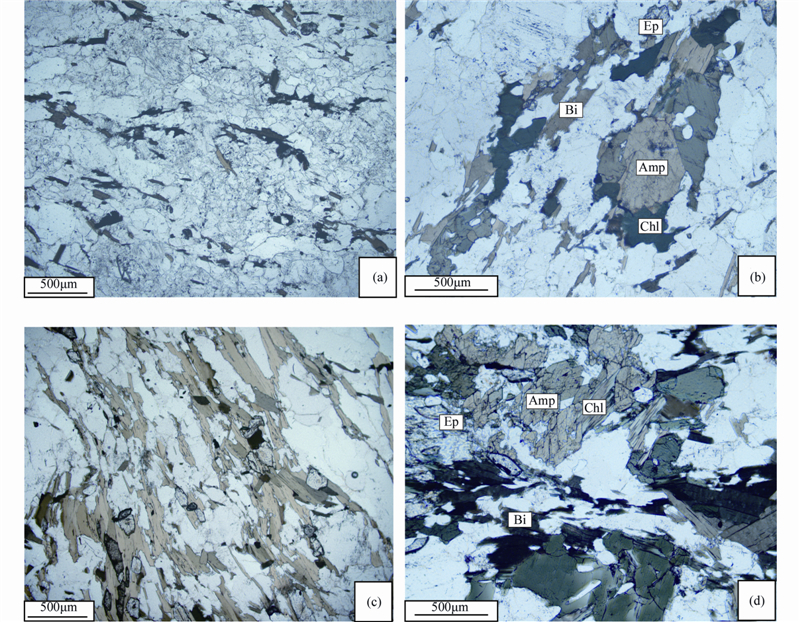 | 图 2 南迦巴瓦群花岗片麻岩和混合岩的显微照片
(a)-花岗片麻岩的矿物组合;(b)-花岗片麻岩的片麻状构造;(c)-混合岩的矿物组合;(d)-混合岩的片麻状构造.Bi-黑云母;Amp-角闪石;Chl-绿泥石;Ep-帘石 Fig. 2 Micrographs of granitic gneiss and migmatite from Namche Barwa syntax (a)-mineral assemblage of granitic gneiss;(b)-gneissic structure of granitic gneiss;(c)-mineral assemblage of the migmatite;(d)-gneissic structure of the migmatite. Bi-biotite; Amp-amphibole; Chl-chlorite; Ep-epidote |
南迦巴瓦高压变质复合体位于东构造结的西北部,沿其走向NE-WS方向延展150km,包括比鲁、直白、清清拉三个构造板片。南迦巴瓦变质体被认为呈背型构造插入雅江缝合带之下(Burg et al., 1998),是高喜马拉雅岩片东段的组成部分(许志琴等,2008)。背形构造的左侧为米林-鲁朗左行走滑断裂,右侧为阿尼桥-墨脱右行走滑断裂(章振根等,1992; Burg et al., 1998)。比鲁构造板片位于南迦巴瓦变质体西北部,位于雅鲁藏布江缝合线和直白构造板片之间,其SE侧以直白-丹娘韧性剪切带为界,与直白构造板片接触。其由派乡组片麻岩组成,主要为长英质片麻岩。
本文样品采集自南迦巴瓦高压变质复合体的北部,位于比鲁构造板片的北端(图 1)。样品T0552-1为混合岩,T0552-2为侵入在混合岩中的眼球状花岗片麻岩。混合岩是由黑云母、角闪石、绿泥石、帘石、石英、长石组成,具鳞片粒状变晶结构,片麻状构造。混合岩的矿物组合具有条带特征。花岗片麻岩的矿物组合为黑云母、角闪石、绿泥石、石英、长石,为鳞片粒状变晶结构,片麻状构造(图 2)。
2 分析方法 2.1 LA-MC-ICP-MS 锆石U-Pb定年为了准确厘定南迦巴瓦花岗片麻岩和混合岩的形成年代,从样品T0552-1和T0552-2中挑选锆石,经过手工挑选、制靶和抛光,然后进行阴极发光(CL)和扫描电镜背散射(BSE)成像观察,揭示锆石的内部结构。阴极发光成像在中国地质科学院地质研究所北京离子探针中心进行。在中国地质科学院地质研究所大陆构造与动力学国家重点实验室进行了BSE图像和锆石内部包裹体的成分测试。在阴极发光和BSE图像的指导下,揭示锆石不同生长域的细微区别特征,选取锆石U-Pb测试点。锆石U-Pb同位素定年测试在中国地质科学院矿产资源研究所成矿作用与资源评价重点实验室进行。所用仪器为德国Finnigan公司生产的 Neptune型激光多接收等离子体质谱(LA-MC-ICPMS),并结合美国New Wave公司生产的UP213nm激光剥蚀系统,激光剥蚀所用斑束直径为25μm,频率为10Hz,能量密度约为2.5J/cm2,以He为载气。U和Th含量以锆石标样M127(U: 923×10-6; Th: 439×10-6; Th/U: 0.475)为外标进行校正。在测试过程中,每测定10个样品点前后重复测量两次锆石标样 GJ-1和一次锆石标样Plesovice。分析数据的离线处理(包括对样品和空白信号的选择、仪器灵敏度漂移校正、元素含量及U-Th-Pb同位素比值和年龄计算)采用软件ICPMSDataCal完成(Liu et al., 2010),锆石年龄谐和图用Isoplot 3.0程序获得。测试结果见表 1。
 | 表 1 西藏南迦巴瓦花岗片麻岩(T0552-1)和混合岩(T0552-2)锆石U-Pb定年数据 Table 1 U-Pb isotopic data for granitic gneiss and migmatite from the Namche Barwa Massif,southern Tibet |
为精确限定南迦巴瓦花岗片麻岩和混合岩的地球化学特征,对样品进行了系统补充采集,分析了它们的全岩主量和微量元素组成。主量及微量元素的测试在国土资源部国家地质实验测试中心进行。主量元素通过XRF(X荧光光谱仪3080E)方法测试,分析精度为5%。微量元素和稀土元素(REE)通过等离子质谱仪(ICP-MS-Excell)分析,含量大于10×10-6的元素的测试精度为5%,而小于10×10-6的元素精度为10%。个别在样品中含量低的元素,测试误差大于10%。测试结果见表 2。
3 数据及结果 3.1 年龄我们对南迦巴瓦构造结地区中不同岩性的样品进行了锆石U-Pb的LA-MC-ICP-MS定年。样品中代表性锆石的CL图像见图(图 3、图 4)。
3.1.1 花岗片麻岩样品花岗片麻岩(T0552-1)的锆石呈无色,多为半自形-他形的棱柱状、柱状,颗粒长径在200~350μm之间。阴极发光图像显示锆石无核-边结构,表现为韵律生长环带特征,锆石边部多呈不规则状(图 3a),可能与后期变质溶解作用相关。在这些锆石中,Th和U的含量分别变化较大,分别在22.27×10⁻⁶~375.1×10⁻⁶和16.20×10⁻⁶~392.3×10⁻⁶,Th/U值在0.81~2.78之间(表 1)。典型的韵律生长环带和较高的Th/U比值都表明它们是岩浆成因的锆石。20个测试点给出的年龄相对比较集中,206Pb/238U年龄在454.1~529.8Ma之间,加权平均年龄为487.9±1.6Ma(MSWD=0.44)(图 3b,c),为花岗片麻岩原岩的岩浆结晶年龄,表明南迦巴瓦地区经历过~500Ma热构造岩浆事件。
| 表 2 西藏南迦巴瓦花岗片麻岩(T0552-1)和混合岩(T0552-2)全岩地球化学组成(主量元素:wt%;稀土和微量元素:×10-6) Table 2 Major(wt%) and trace(×10-6)element compositions of granitic gneiss and migmatite from the Namche Barwa Massif,southern Tibet |
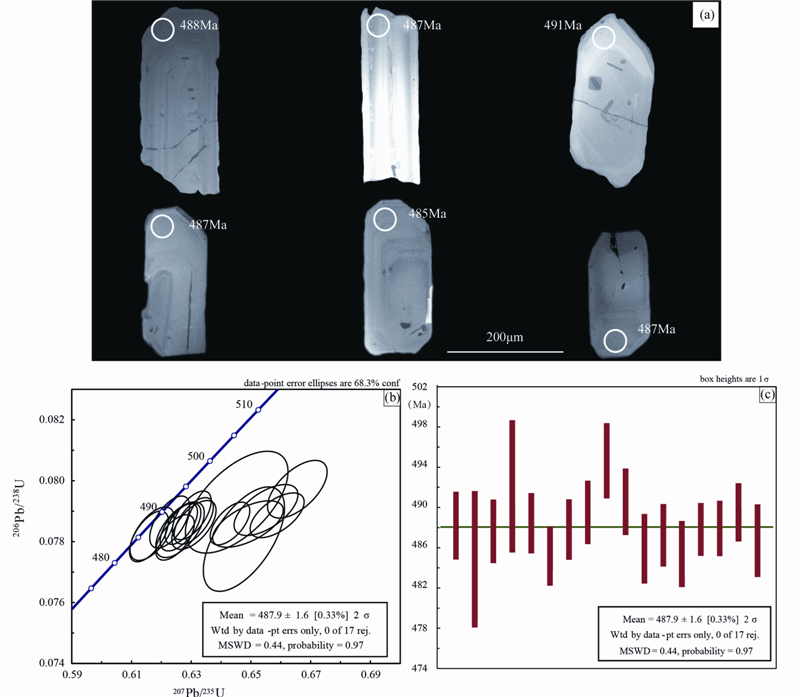 | 图 3 花岗片麻岩的锆石CL图像(a)、锆石U-Pb年龄协和图(b)和锆石加权平均(238U/206Pb)年龄直方图(c) Fig. 3 CL images(a),U-Pb concordia diagram(b) and weighted average(238U/206Pb)age histograms(c)of zircons from granitic gneiss |
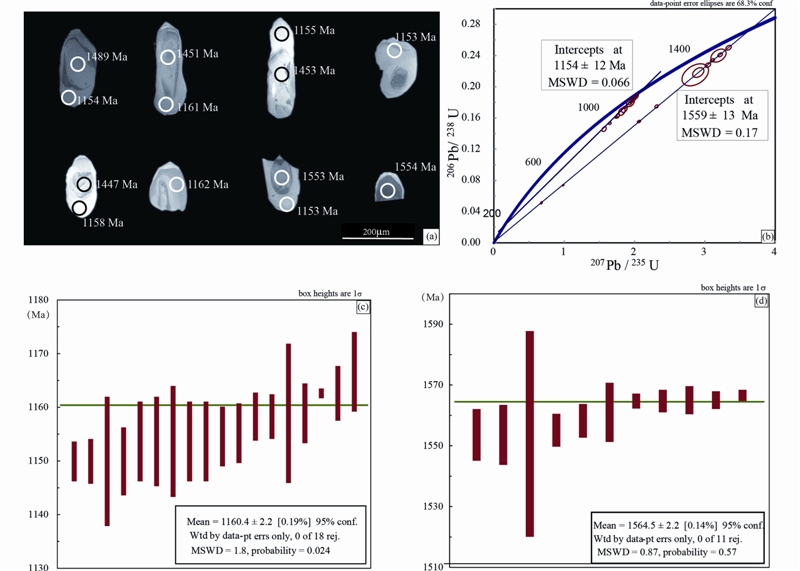 | 图 4 混合岩的锆石CL图像(a)、锆石U-Pb年龄协和图(b)及锆石边部的(c)和核部的(d)加权平均(207Pb/206Pb)年龄直方图 Fig. 4 CL images(a),U-Pb concordia diagram(b)for zircons and weighted average(207Pb/206Pb)age histograms of zircon rims(c) and of zircon cores(d)from migmatite |
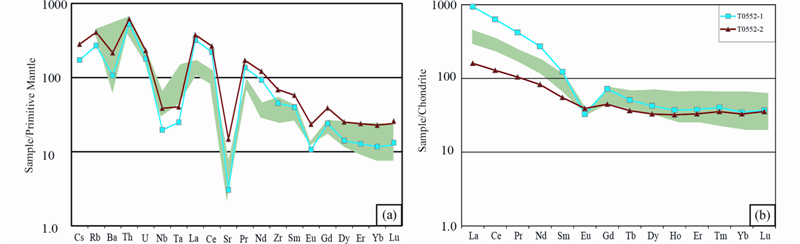 | 图 5 花岗片麻岩和混合岩的微量元素原始地幔标准化配分模式(a,标准化值据Sun and McDonough, 1989)和稀土元素球粒陨石标准化配分模式(b,标准化值据Masuda et al., 1973)
灰色区域为源自张泽明等(2008)的数据
Fig. 5 Primitive mantle-normalized trace element patterns(a,normalization values after Sun and McDonough, 1989) and chondrite-normalized REE patterns(b,normalization values after Masuda et al., 1973)of granitic gneiss and migmatite
Grey sections represent data from Zhang et al.(2008) |
样品混合岩(T0552-2)的锆石呈无色,大多数为他形的椭圆或不规则状,个别为半自形柱状,颗粒长径在100~250μm之间。阴极发光图像显示锆石具有明显的核-边结构(图 4a)。锆石核部发育韵律环带结构,Th和U的含量变化也较大,分别在194.1×10⁻⁶~817.8×10⁻⁶和89.6×10⁻⁶~624.2×10⁻⁶之间,Th/U值在0.72~1.24之间(表 1),为岩浆锆石。岩浆核多呈不规则状,边缘可呈港湾状,表明锆石岩浆核在后期被交代溶解;而且部分岩浆锆石核显示较弱的发光,结晶环带较模糊,可能是经历了较强烈变质作用的结果(Gerhard et al., 1999)。锆石边部发光强度相对较强,无明显环带,但锆石中U和Th的含量变化较大,分别在43.7×10⁻⁶~817.8×10⁻⁶和5.1×10⁻⁶~200.2×10⁻⁶之间,Th/U值在0.36~2.33之间(表 1)。
在该样品中,进行了40个点测试。由于年龄普遍大于900Ma,在以下讨论中,年龄为207Pb/206Pb年龄。在边部锆石中,17个点的年龄较集中,206Pb/207Pb年龄在1150~1166.7Ma之间,协和年龄为1154.6±6Ma,不协和线的交点年龄为1154±12Ma(图 4b,c)。在锆石核部,10个点的年龄落在1553.7~1566.7Ma这个区间内,给出不协和线的交点年龄为1559±13Ma(图 4b,d)。混合岩锆石具有明显的核边结构,锆石核部所记录的1559±13Ma为混合岩原岩年龄,边部的1154±12Ma为混合岩经历后期变质事件的年龄。同样的南迦巴瓦构造结直白地区的混合岩化角闪岩也记录了~1600Ma和~1000Ma这两个时代(待发表数据)。
3.2 地球化学花岗片麻岩和混合岩的硅和铝含量较高。花岗片麻岩高钾,Na2O/K2O小于1(~0.72),A/CNK也小于1(~0.87),因此花岗片麻岩原岩为富钾偏铝质花岗岩。而混合岩的Na2O/K2O>1.0,为富钠花岗岩。
片麻岩和混合岩的稀土元素含量在20~300倍球粒陨石REE含量之间,球粒陨石标准化模式显示LREE富集、HREE相对亏损和Eu负异常的特征。原始地幔标准化的微量元素蛛网图表现出Ba、Nb、Ta、Sr的负异常特征,与张泽明等(2008)采集于派乡和多雄拉山口的片麻岩相似(图 5),被认为与形成于俯冲或岩浆弧环境的花岗质岩石具有很多相似性。
4 讨论 4.1 南迦巴瓦地区的多期构造活动南迦巴瓦的眼球状片麻岩(T0552-1)中的锆石记录了487.9±1.6Ma这一年龄,同时根据我们待发表数据,南迦巴瓦构造结直白地区的不同类型的岩石都记录了这一期构造岩浆事件,如(1)淡色花岗岩岩脉和含石榴石淡色花岗岩的锆石核部记录了~500Ma的变质事件;(2)斜长角闪岩以及大理岩中也记录了~500Ma的变质事件。这些都表明该地区普遍经历了~500Ma的变质作用和构造热事件,与南迦巴瓦构造结的麻粒岩以及其他片麻岩的锆石中都记录的~500Ma的构造热事件是一致的(Su et al .,2012; Liu et al., 2007; Xu et al., 2012;许志琴等,2005)。同时,高喜马拉雅结晶岩系的其他地区的岩石也记录了同一时期的变质和岩浆热事件:尼泊尔中部的眼球状片麻岩(~484Ma)和蓝晶石-石榴石片岩(450~500Ma),尼泊尔东部的眼球状片麻岩(436~548Ma)(Godin et al., 2001; Gehrels et al., 2003; Catols et al., 2002)。因此,早古生代时期的岩浆热事件或变质作用在南迦巴瓦地区,甚至是喜马拉雅构造带是普遍存在的,进一步表明喜马拉雅造山带普遍经历了泛非-后泛非事件。
格林威尔期造山作用是指劳伦大陆与其他陆块(可能为Amazonia)在中元古晚期到新元古早期(1090~980Ma)发生的碰撞事件,对应于Rodinia超大陆的聚合(Hoffman,1991; Cawood and Pisarevski, 2006; Tohver et al., 2006; Li et al., 2008; Rivers et al., 2008)。本文中混合岩(T0552-2)的锆石边部记录的1154Ma的年龄,是岩石经历的后期深熔作用的时间。喜马拉雅中部定结地区的榴辉岩原岩年龄也是~1000Ma(Cottle et al., 2009; Rolfo et al., 2005; Liu et al., 2007),不丹喜马拉雅的花岗片麻岩中也有1100Ma的Rb-Sr年龄(Bhargava et al., 1995)。因此,喜马拉雅造山带也经历了中元古代晚期的格林威尔期的岩浆变质事件。
Nunn et al.(1988)厘定了拉布拉多期造山作用的持续时间,从1710Ma到1620Ma,高峰期为1680~1640Ma(Gower et al., 1992)。本文中混合岩锆石的核部年龄(1559Ma)是混合岩原岩的年龄,南迦巴瓦地区经历了一期~1600Ma岩浆事件,对应于拉布拉多期的造山作用。
4.2 高喜马拉雅构造演化对于高喜马拉雅的构造来源,主要有以下四种说法:(1)来源于印度板块的基底岩石(Gansser,1964);(2)源自泛非造山带的非洲东部,晚元古代时期,高喜马拉雅从非洲东部分离出来,向冈瓦纳大陆西部移动,在晚寒武-早奥陶时期汇聚到印度(DeCelles et al., 2000);(3)雅鲁藏布江缝合线北部的拉萨地块中地壳内存在大规模近水平下地壳流,陆陆碰撞挤压导致熔融状态的下地壳向南流动形成高喜马拉雅(Nelson et al., 1996);(4)起源于环东南极造山带(CEAO),因为CEAO及其周围克拉通与高喜马拉雅在年代上具有很好的一致性(Yoshida and Upreti, 2004)
西隆高原位于印度东北部,夹在两个弧形造山带-北部的喜马拉雅造山带和东部的缅甸造山带之间。西隆高原为喜马拉雅前缘地带唯一的隆升地貌,其沿两个相反的断层抬升,南部东西向的Dauki 断层以及北部的Olaham断层(Islam et al., 2011; Biswas et al., 2007)。西隆高原主要是由太古代的片麻岩复合体、石龙组变沉积岩、火成岩、斑状花岗岩以及超基性碱性-碳酸质岩浆复合体。Yin et al.(2010)对于印度克拉通东北部的西隆高原中花岗质岩石和正片麻岩锆石年龄的研究,表明印度克拉通东北部经历了~1600Ma,~1100Ma和~500Ma的三期岩浆事件。这一结果与Chatterjee et al.(2007)通过测试变质独居石得到的西隆高原基底岩石的变质年龄一致。
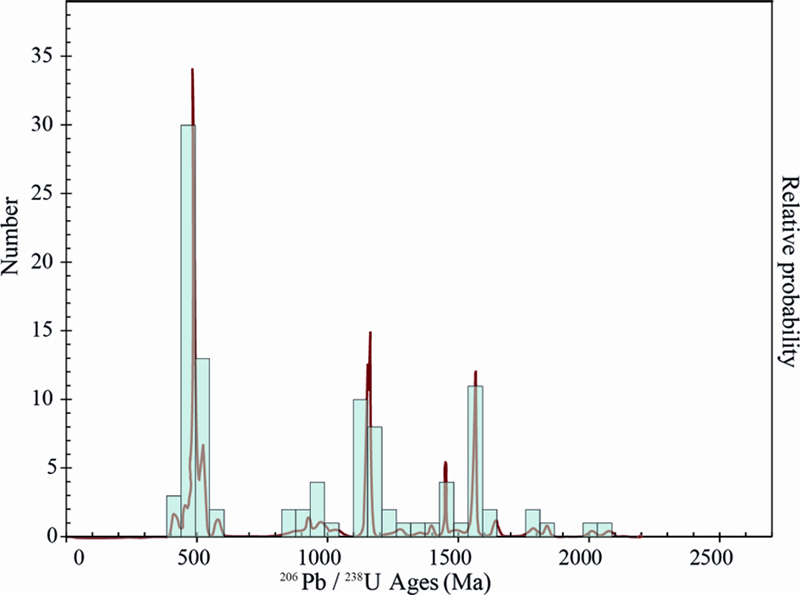 | 图 6 南迦巴瓦岩石样品年龄分布频率图
数据来源于本文中花岗片麻岩和混合岩以及未发表数据 Fig. 6 Plot of zircons U-Pb ages possibility from Namche Barwa rocks Data from this paper and unpublished |
在印度克拉通,西隆高原向南部延伸即为东高止造山带,其为沿印度东岸分布的元古代造山带,东以孟加拉湾为界,西向边界为太古代克拉通。东高止造山带南北向长约~1000km,主要是由高级正片麻岩、副片麻岩变质岩以及侵入其中的花岗岩、斜长岩和碱性岩组成(Rickers et al., 2001; Bose et al., 2011)。Ramakrishnan et al.(1998)根据不同的岩石组合将东高止造山带划分为四个纵向的带:东孔兹岩带、中混合岩带、西孔兹岩带以及西紫苏花岗岩带。该变质带西部(西紫苏花岗岩带)经历了中元古代时期(1760~1600Ma)的麻粒岩相变质作用,随后的区域性格林威尔(980~900Ma)事件(东孔兹岩带、中混合岩带、西孔兹岩带)以及后期泛非事件(~500Ma)的叠加(Shaw et al., 1997; Simmata and Raith, 2008; Dasguptaa et al., 2013; Rickers et al., 2001; Bose et al., 2011)。两者在岩浆作用和变质事件的相似性,说明~1600Ma、~1100Ma和~500Ma的造山作用是沿着印度大陆整个东部边缘延展的。
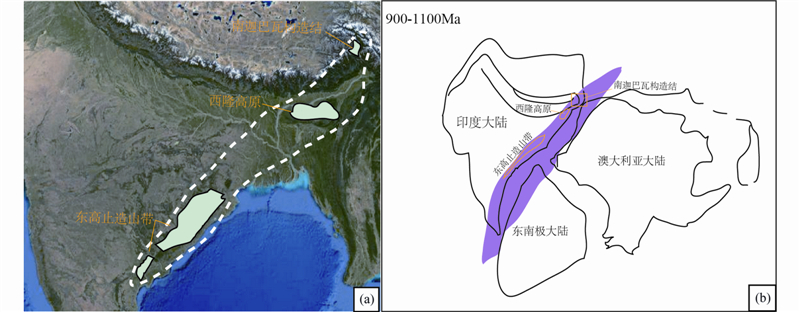 | 图 7 南迦巴瓦构造结、西隆高原和东高止造山带分布图(a)和900~1100Ma时期古大陆分布图(b)(据Li et al., 2008修改) Fig. 7 Present location of Namche Barwa syntaxis,Shillong Plateau and Eastern Ghats belts(a) and schematic map showing the Eastern Indian orogenic belt formed during the convergence among the Indian,Antactic, and Australian continents during the time period of 900~1100Ma(b)(modified after Li et al., 2008) |
根据本文中样品以及直白地区样品的年龄数据的年龄分布频率图(图 6),我们发现南迦巴瓦地区的岩石经历的岩浆变质作用的时期相对集中在~500Ma,~1100Ma和~1600Ma。南迦巴瓦地区岩浆构造活动的期次与印度克拉通西隆高原以及东高止造山带的期次具有高度的一致性,说明三者的基底岩石经历了相似的前寒武纪时期的构造演化,进一步支持高喜马拉雅来自于印度大陆。
4.3 南迦巴瓦构造结与超大陆演化Columbia超大陆形成于2000~1800Ma(Zhao et al., 2002),裂解发生在1600~1300Ma(Rogers and Santosh, 2002; Zhao et al., 2004)。Rodinia超大陆从形成到裂解持续时间为1100~700Ma。东和西冈瓦纳大陆拼合形成冈瓦纳超大陆是在600~500Ma之间。西隆高原记录了三期岩浆或变质事件,Yin et al.(2010)认为拉布拉多造山作用事件(~1600Ma)与古印度大陆形成时两陆块之间的碰撞有关;格林威尔期造山(~1100Ma)则与Rodinia超大陆的形成有关,在该造山作用期间,印度大陆与南极洲大陆、澳大利亚与西藏南部陆块之间发生碰撞,形成东高止造山带;泛非事件(~500Ma)与东冈瓦纳大陆的聚合有关,可能是印度陆块与南极洲大陆之间碰撞作用的记录。南迦巴瓦地区岩浆构造活动的期次与印度克拉通西隆高原以及东高止造山带期次的一致性,说明三者的基底岩石经历了相似的前寒武纪时期的构造演化。同时,Yin et al.(2010)认为东高止造山带可能是喜马拉雅造山带中~1100Ma碎屑锆石的源区。南迦巴瓦地区高级变质岩中具有大量~1100Ma的变质作用或部分熔融作用的年龄记录(张泽明等,2008; 张进江等, 2011,及待发表数据),表明在新元古代,南迦巴瓦应该与东高止造山带和西隆高原有密切的关系,可能是该造山带向北的延伸(图 7)。所以,南迦巴瓦构造结、西隆高原以及东高止造山带在元古代时期应该都位于印度克拉通的东缘(图 7b),一起经历了古印度大陆的形成、Rodinia超大陆的聚合和裂解以及东冈瓦那大陆的聚合等构造作用。
5 结论(1)喜马拉雅造山带东构造结的花岗片麻岩和混合岩中记录了~1600Ma,~1100Ma和~500Ma古生代以来发生的多期构造热事件和变质作用,分别对应着拉布拉多期造山、格林威尔期造山以及泛非事件。
(2)东构造结基底年龄与整个高喜马拉雅结晶岩系以及印度大陆基底岩石记录的古老年龄的一致性,进一步表明高喜马拉雅结晶岩系来源于印度古老克拉通。
(3)东构造结碰撞前的演化过程与印度大陆东高止造山带以及西隆高原具有高度的相似性,说明喜马拉雅东构造结可能是这两个地区北向延伸,共同组成印度大陆东部造山带,一起经历了哥伦比亚超大陆、Rodinia和冈瓦纳超大陆的聚合与裂解过程。
致谢 感谢许志琴院士、张建新研究员和戚学祥研究员仔细审阅稿件,提出众多建设性修改意见。
| [1] | Aikman AB, Harrison TM and Ding L. 2008. Evidence for Early (>44Ma) Himalayan crustal thickening, Tethyan Himalaya, southeastern Tibet. Earth and Planetary Science Letters, 274(1-2): 14-23 |
| [2] | Aoya M, Wallis SR, Terada K, Lee J, Kawakami T, Wang Y and Heizler M. 2005. North-south extension in the Tibetan crust triggered by granite emplacement. Geology, 33(11): 853-856 |
| [3] | Beaumont C, Jamieson RA, Nguyen MH and Lee B. 2001. Himalayan tectonics explained by extrusion of a low-viscosity crustal channel coupled to focused surface denudation. Nature, 414(6865): 738-742 |
| [4] | Bhargava ON. 1995. The Bhutan Himalaya: A geological account. Geological Survey of India Special Publication, 39: 244 |
| [5] | Biswas S, Coutand I, Grujic D, Hager C, Stckli D and Grasemann B. 2007. Exhumation and uplift of the Shillong plateau and its influence on the eastern Himalayas: New constraints from apatite and zircon (U-Th-)/He and apatite fission track analyses. Tectonics, 26(6), doi: 10.1029/2007TC002125 |
| [6] | Bose S, Dunkley DJ, Dasgupta S, Das K and Arima M. 2011 India-Antarctica-Australia-Laurentia connection in the Paleoproterozoic-Mesoproterozoic revisited: Evidence from new zircon U-Pb and monazite chemical age data from the Eastern Ghats Belt, India. Geological Society of America Bulletin, 123(9-10): 2031-2049 |
| [7] | Burg JP, Nievergelt P, Oberli F, Seward D, Davy P, Maurin JC, Diao ZZ and Meier M. 1998. The Namche Barwa syntaxis: Evidence for exhumation related to compressional crustal folding. Journal of Asian Earth Sciences, 16(2-3): 239-252 |
| [8] | Catlos EJ, Harrison TM, Manning CE, Grove M, Rai SM, Hubbard MS and Upreti BN. 2002. Records of the evolution of the Himalayan orogeny from in situ Th-Pb ion microprobe dating of monazite: Eastern Nepal and western Garhwal. Journal of Asian Earth Sciences, 20(5): 459-479 |
| [9] | Cawood PA and Pisarevski SA. 2006. Was Baltica right-way up or upside-down in the Neoproterozoic? Journal of the Geological Society, London, 163: 753-759 |
| [10] | Chatterjee N, Mazumdar AC, Bhattacharya A and Saikia RR. 2007. Mesoproterozoic granulites of the Shillong-Meghalaya Plateau: Evidence of westward continuation of the Prydz Bay Pan-African suture into northeastern India. Precambrian Research, 152(1-2): 1-26 |
| [11] | Cottle JM, Jessup MJ, Newell DL, Horstwood MSA, Noble SR, Parrish RR, Waters DJ and Searle MP. 2009. Geochronology of granulitized eclogite from the Ama Drime Massif: Implications for the tectonic evolution of the South Tibetan Himalaya. Tectonics, 28(1): TC1002, doi: 10.1029/2008TC002256 |
| [12] | Dasguptaa S, Boseb S and Dasc K. 2013. Tectonic evolution of the Eastern Ghats Belt, India. Precambrian Research, 227: 247-258 |
| [13] | Debon F, Le Fort P, Sheppard S and Sonet J. 1986. The four plutonic belts of the Transhimalaya-Himalaya: A chemical, mineralogical, isotopic, and chronological synthesis along a Tibet-Nepal Section. Journal of Petrology, 27(1): 219-250 |
| [14] | DeCelles PG, Gehrels GE, Quade J, LaReau B and Spurlin M. 2000. Tectonic implications of U-Pb zircon ages of the Himalayan orogenic belt in Nepal. Science, 288(5465): 497-499 |
| [15] | Ding L, Kapp P and Wan XQ. 2005. Paleocene-Eocene record of ophiolite obduction and initial India-Asia collision, south central Tibet. Tectonics, 24, TC3001, doi: 10.1029/2004TC001729TC3001 |
| [16] | Gansser A. 1964. The Geology of the Himalayas. New York: Wiley Interscience, 1-289 |
| [17] | Gao LE, Zeng LS and Xie KJ. 2011. Eocene high grade metamorphism and crustal anatexis in the North Himalaya Gneiss Domes, Southern Tibet. Chinese Science Bulletin, 57(6): 639-650 |
| [18] | Gao LE, Zeng LS, Hou KJ, Guo CL, Tang SH, Xie KJ, Hu GY and Wang L. 2013. Episodic crustal anatexis and the formation of Paiku composite leucogranitic pluton in the Malashan Gneiss Dome, Southern Tibet. Chinese Science Bulletin, 38(28-29): 3546-3563 |
| [19] | Gao LE and Zeng LS. 2014. Fluxed melting of metapelite and the formation of Miocene high-CaO two-mica granites in the Malashan gneiss dome, southern Tibet. Geochimica et Cosmochimica Acta, 130: 136-155 |
| [20] | Gehrels GE, DeCelles PG, Martin A, Ojha TP and Pinhassi G. 2003. Initination of the Himalayan Orogen as a nearly Paleozoicthin skinned thrust belt. GSA Today, 13: 4-9 |
| [21] | Gerhard V, Schmid R and Gebauer D. 1999. Internal morphology, habit and U-Th-Pb microanalysis of amphibolite to granulite faceies zircons: Geochronology of the Ivrea Zone (Southern Alps). Contributions to Mineralogy and Petrology, 134(4): 380-404 |
| [22] | Godin L, Parrish RR, Brown RL and Hodges KV. 2001. Crustal thickening leading to exhumation of the Himalayan metamorphic core of central Nepal: Insight from U-Pb geochronology and Ar-40/Ar-39 thermochronology. Tectonics, 20(5): 729-747 |
| [23] | Gower CF, Schrer U and Heaman LM. 1992. The Labradorian orogeny in the Grenville Province, eastern Labrador, Canada. Canadian Journal of Earth Science, 29(9): 1944-1957 |
| [24] | Harris N and Massey J. 1994. Decompression and anatexis of Himalayan metapelites. Tectonics, 13(6): 1537-1546 |
| [25] | Harrison TM, Grove M, Lovera OM, Catlos EJ and D'Andrea J. 1999. The origin of Himalayan anatexis and inverted metamorphism: Models and constraints. Journal of Asian Earth Sciences, 17(5-6): 755-772 |
| [26] | Hodges KV. 2000. Tectonics of the Himalaya and southern Tibet from two perspectives. GAS Bulletin, 112(3): 324-350 |
| [27] | Hoffman PF. 1991. Did the breakout of Laurentia turn Gondwanaland inside out? Science, 252(5011): 1409-1412 |
| [28] | Hou ZQ, Zheng YC, Zeng LS, Gao LE, Huang KX, Li W, Li QY, Fu Q, Liang W and Sun QZ. 2012. Eocene-Oligocene granitoids in southern Tibet: Constraints on crustal anatexis and tectonic evolution of the Himalayan orogen. Earth and Planetary Science Letters, 349-350: 38-52 |
| [29] | Islam MS, Shinjo R and Kayal JR. 2011. Pop-up tectonics of the Shillong Plateau in northeastern India: Insight from numerical simulations. Gondwana Research, 20(2-3): 395-404 |
| [30] | King J, Harris N, Argles T, Parrish R and Zhang HF. 2011. The contribution of crustal anatexis to the tectonic evolution of Indian crust beneath southern Tibet. Geological Society of America Bulletin, 123(1-2): 218-239 |
| [31] | Li ZX, Bogdanova SV, Collins AS, Davidson A, De Waele B, Ernst RE, Fitzsimons ICW, Fuck RA, Gladkochub DP, Jacobs J, Karlstrom KE, Lu S, Natapovm LM, Pease V, Pisarevsky SA, Thrane K and Vernikovsky V. 2008. Assembly, configuration, and break-up history of Rodinia: A synthesis. Precambrian Research, 160(1-2): 179-210 |
| [32] | Liu Y and Zhong D. 1997. Petrology of high-pressure granulites from the eastern Himalayan syntaxis. Journal of Metamorphic Geology, 15(4): 451-466 |
| [33] | Liu Y, Siebel W, Massonne H and Xiao X. 2007. Geochronological and petrological constraints for tectonic evolution of the central Greater Himalayan sequence in the Kharta area, southern Tibet. The Journal of Geology, 115(2): 215-242 |
| [34] | Liu YS, Gao S, Hu ZC, Gao CG, Zong KQ and Wang DB. 2010. Continental and oceanic crust recycling-induced melt-peridotite interactions in the Trans-North China Orogen: U-Pb dating, Hf isotopes and trace elements in zircons from mantle xenoliths. Journal of Petrology, 51(1-2): 537-571 |
| [35] | Masuda A, Nakamura N and Tanaka T. 1973. Fine structures of mutually normalized rare earth patterns of chondrites. Geochimica et Cosmochimica Acta, 37(2): 239-244 |
| [36] | Nelson KD, Zhao WJ, Brown LD, Kuo J, Che JK, Liu X, Klemperer SL, Makovsky Y, Meissner R, Mechie J, Kind R, Wenzel F, Ni J, Nabelek J, Leshou C, Tan H, Wei W, Jones AG, Booker J, Unsworth M, Kidd WSF, Hauck M, Alsdorf D, Ross A, Cogan M, Wu C, Sandvol E and Edwards M. 1996. Partially molten middle crust beneath southern Tibet, synthesis of project INDEPTH results. Science, 274(5293): 1684-1688 |
| [37] | Nunn GAG, Gower CF and Thomas AT. 1988. A synthesis of the 1680-1640Ma Labradorian Orogeny. Geological Association of Canada, Program with Abstracts, 13: A91 |
| [38] | O'Brien PJ and Rtzler J. 2003. High-pressure granulites: Formation, recovery of peak conditions and implications for tectonics. Journal of Metamorphic Geology, 21(1): 3-20 |
| [39] | Ramakrishnan M, Nanda JK and Augustine PF. 1998. Geological evolution of the Proterozoic Eastern Ghats mobile belt. Geol. Surv. India Spec., No. 44 |
| [40] | Rickers K, Mezger K and Raith MM. 2001. Evolution of the continental crust in the Proterozoic Eastern Ghats Belt, India and new constraints for Rodinia reconstruction: Implications from Sm-Nd, Rb-Sr and Pb-Pb isotopes. Precambrian Research, 112(3-4): 183-210 |
| [41] | Rivers T. 2008. Assembly and preservation of lower, mid, and upper orogenic crust in the Grenville Province: Implications for the evolution of large hot long-duration orogens. Precambrian Research, 167(3-4): 237-259 |
| [42] | Rogers JJW and Santosh M. 2002. Configuration of Columbia, a Mesoproterzoic Supercontinent. Gondwana Research, 5(1): 5-22 |
| [43] | Rolfo F, McClelland W and Lombardo B. 2005. Geochronological constraints on the age of the eclogite-facies metamorphism in the Eastern Himalaya. Paper Presented at the 20th Himalaya-Karakorum-Tibet Workshop, Lab. de Géodynamique des Cha^nes Alp., Aussois, France |
| [44] | Shaw RK, Arima M, Kagami H, Fanning CM, Shiraishi K and Motoyoshi Y. 1997. Proterozoic events in the Eastern Ghats granulite belt, India: Evidence from Rb-Sr, Sm-Nd systematics, and SHRIMP dating. The Journal of Geology, 105(5): 645-656 |
| [45] | Simmata R and Raith MM. 2008. U-Th-Pb monazite geochronometry of the Eastern Ghats Belt, India: Timing and spatial disposition of poly-metamorphism. Precambrian Research, 162(1-2): 16-39 |
| [46] | Su W, Zhang M, Liu XH, Lin JF, Ye K and Liu X. 2012. Exact timing of granulite metamorphism in the Namche-Barwa, eastern Himalayan syntaxis: New constrains from SIMS U-Pb zircon age. International Journal of Earth Science, 101(1): 239-252 |
| [47] | Sun SS and McDonough WF. 1989. Chemical and isotopic systematics of oceanic basalts: Implications for mantle composition and processes. In: Saunders AD and Norry MJ (eds.). Magmatism in the Ocean Basins. Geological Society of London, Special Publications, 42(1): 313-345 |
| [48] | Sun ZM, Geng QR, Lou XY, Zheng LL, Li S and Liao GY. 2004. The sundivision of the Namche Barwa Group Complex within the eastern Himalayan syntaxis, Xizang. Sediment. Geol. Teth. Geol., 24(2): 8-15 (in Chinese with English abstract) |
| [49] | Tapponnier P, Xu ZQ, Roger F, Meyer B, Arnaud N, Wittlinger G and Yang JS. 2001. Oblique stepwise rise and growth of the Tibet Plateau. Science, 294(5547): 1671-1677 |
| [50] | Tohver E, Teixeira B, van der Pluijm B, Geraldes MC, Bettencourt JS and Rizzotto G. 2006. Restored transect across the exhumed Grenville orogen of Laurentia and Amazonia. Geology, 34(8): 669-672 |
| [51] | Xu ZQ, Yang JS, Liang FH et al. 2005. Pan-African and Early Paleozoic orogenic events in the Himalaya terrane: Inference from SHRIMP U-Pb zircon ages. Acta Petrologica Sinica, 21(1): 1-12 (in Chinese with English abstract) |
| [52] | Xu ZQ, Yang JS, Li HB, Zhang JX, Zeng LS and Jiang M. 2006. The Qinghai-Tibet Plateau and continental dyamics: A review on terrain tectonics, collisional orogenesis, and processes and mechanisms for the rise of the plateau. Geology in China, 33(2): 221-238 (in Chinese with English abstract) |
| [53] | Xu ZQ, Cai ZH, Li HQ, Chen FY and Tang ZM. 2008. Tectonics and fabric kinematics of the Nache Barwa terrane. Acta Petrologica Sinica, 24(7): 1463-1476 (in Chinese with English abstract) |
| [54] | Xu ZQ, Ji SC, Cai ZH, Zeng LS, Geng QR and Cao H. 2012. Kinematics and dynamics of the Namche Barwa Syntaxis, eastern Himalaya: Constraints from deformation, fabrics and geochronology. Gondwana Research, 21(1): 19-36 |
| [55] | Xu ZQ, Wang Q, Pêcher A, Liang FH, Qi XX, Cai ZH, Li HQ, Zeng LS and Cao H. 2013. Orogen-parallel ductile extension and extrusion of the Greater Himalaya in the Late Oligocene and Miocene. Tectonics, 32(2): 191-215 |
| [56] | Yin A and Harrison TM. 2000. Geologic evolution of the Himalayan-Tibetan orogen. Annual Review of Earth and Planetary Science, 28(1): 211-280 |
| [57] | Yin A, Dubey CS, Kelty TK, Gehrels GE, Chou CY, Grove M and Lovera O. 2006. Structural evolution of the Arunachal Himalaya and implications for asymmetric development of the Himalayan orogen. Current Science, 90(2): 195-206 |
| [58] | Yin A, Dubey CS, Webb AAG, Kelty TK, Grove M, Gehrels GE and Burgess WP. 2010. Geologic correlation of the Himalayan orogen and Indian craton: Part 1. Structural geology, U-Pb zircon geochronology, and tectonic evolution of the Shillong Plateau and its neighboring regions in NE India. Geological Society of America Bulletin, 122(3-4): 336-359 |
| [59] | Yoshida M and Upreti BN. 2004. Commentary on the position of Himalayan basement in Gondwana Land. Abstracts of 19th Himalaya Karakoram Tibet Workshop, HKT19, Himalayan Journal of Science, 2: 286 |
| [60] | Zeng LS, Liang FH, Xu ZQ and Qi XX. 2008. Metapelites in the Himalayan orogenic belt and their protoliths. Acta Petrologica Sinica, 24(7): 1517-1527 (in Chinese with English abstract) |
| [61] | Zeng LS, Liu J, Gao LE, Xie KJ and Wen L. 2009. Early Oligocene crustal anatexis in the Yardoi gneiss dome, southern Tibet and geological implications. Chinese Science Bulletin, 54(1): 104-112 |
| [62] | Zeng LS, Gao LE, Xie KJ and Zeng LJ. 2011. Mid-Eocene high Sr/Y granites in the Northern Himalayan Gneiss Domes: Melting thickened lower continental crust. Earth and Planetary Science Letters, 303(3-4): 251-266 |
| [63] | Zeng LS, Gao LE, Dong CY and Tang SH. 2012. High-pressure melting of metapelite and the formation of Ca-rich granitic melts in the Namche Barwa Massif, southern Tibet. Gondwana Research, 21(1): 138-151 |
| [64] | Zhang HF, Harris N, Parrish R, Kelley S, Zhang L, Rogers N, Argles T and King J. 2004. Causes and consequences of protracted melting of the mid-crust exposed in the North Himalayan antiform. Earth and Planetary Science Letters, 228(1-2): 195-212 |
| [65] | Zhang JJ, Yang XY, Qi GW and Wang DC. 2011. Geochronology of the Malashan dome and its application in formation of the Southern Tibet detachment system (STDS) and Northern Himalayan gneiss domes (NHGD). Acta Petrologica Sinica, 27(12): 3535-3544 (in Chinese with English abstract) |
| [66] | Zhang ZG, Liu YH and Wang TW. 1992. Geology of Najabawa (Namjagbarwa) Areas. Beijing: Science Press (in Chinese) |
| [67] | Zhang ZM, Wang JL, Zhao GC and Shi C. 2008. Geochronology and Precambrian tectonic evolution of Namche Barwa complex from the eastern Himalayan syntaxis, Tibet. Acta Petrologica Sinica, 24(7): 1477-1487 (in Chinese with English abstract) |
| [68] | Zhang ZM, Dong X, Santosh M, Li F, Wang W, Yiu F, He ZY and Shen K. 2011. Petrology and geochronology of the Namche Barwa Complex in the eastern Himalayan syntaxis, Tibet: Constraints on the origin and evolution of the northeastern margin of the Indian Craton. Gondwana Research, 21: 123-137 |
| [69] | Zhao GC, Cawood PA, Wilde SA and Sun M. 2002. A review of the global 2.1-1.8Ga orogens: Implication for a pre-Rodinian supercontinent. Earth Science Review, 59: 125-162 |
| [70] | Zhao GC, Sun M, Wilde SA and Li SZ. 2004. A Paleo-Mesoproterozoic supercontinent: Assembly, growth and break-up. Earth Science Review, 67(1-2): 91-123 |
| [71] | 高利娥, 曾令森, 侯可军, 郭春丽, 唐索寒, 谢克家, 胡古月, 王莉. 2013. 藏南马拉山穹窿佩枯错复合淡色花岗岩体的多期深熔作用. 科学通报, 58(27): 2810-2822 |
| [72] | 孙志明, 耿全如, 楼雄英, 郑来林, 李生, 廖光宇. 2004. 东喜马拉雅构造结南迦巴瓦岩群的解体. 沉积与特提斯地质, 24(2): 8-15 |
| [73] | 许志琴, 杨经绥, 梁凤华等. 2005. 喜马拉雅地体的泛非-早古生代造山事件年龄记录. 岩石学报, 21(1): 1-12 |
| [74] | 许志琴, 杨经绥, 李海兵, 张建新, 曾令森, 姜枚. 2006. 青藏高原与大陆动力学——地体拼合、碰撞造山以及高原隆升的深部驱动力. 中国地质, 33(2): 221-238 |
| [75] | 许志琴, 蔡志慧, 张泽明, 李化启, 陈方远, 唐泽民. 2008. 喜马拉雅东构造结——南迦巴瓦构造及组构运动学. 岩石学报, 24(7): 1463-1476 |
| [76] | 曾令森, 梁凤华, 许志琴, 戚学祥. 2008. 喜马拉雅造山带变泥质岩系及其地球化学特征. 岩石学报, 24(7): 1517-1527 |
| [77] | 曾令森, 刘静, 高利娥, 谢克家, 文力. 2009. 藏南也拉香波穹隆早渐新世地壳深熔作用及其地质意义. 科学通报, 54(3): 373-381 |
| [78] | 张进江, 杨雄英, 戚国伟, 王德朝. 2011. 马拉山穹窿的活动时限及其在藏南拆离系-北喜马拉雅片麻岩穹窿形成机制的应用. 岩石学报, 27(12): 3535-3544 |
| [79] | 章振根, 刘玉海, 王天武等. 1992. 南迦巴瓦峰地区地质. 北京: 科学出版社 |
| [80] | 张泽明, 王金丽, 赵国春, 石超. 2008. 喜马拉雅造山带东构造结南迦巴瓦岩群地质年代学和前寒武纪构造演化. 岩石学报, 24(7): 1477-1487 |