 2014, Vol. 30


兴蒙造山带位于西伯利亚板块与中朝板块之间,是全球显生宙时期增生最为强烈的地区之一(Sengör and Natal’in,1996; Kovalenko et al., 2004; Windley et al., 2007)。自早古生代以来该地区经历多期次大洋板片俯冲、地壳增生、多块体聚合过程,最终完成了华北板块与西伯利亚板块的碰撞(Jahn et al., 2004; 郭锋等,2009)。古亚洲洋复杂的演化过程,一直是地学界关注的焦点(Tang,1990; 邵济安,1991; 唐克东,1992; Xu and Chen, 1997; Xiao et al., 2003; Chen et al., 2012; 晨辰等,2012; Xu et al., 2013; Ma et al., 2013; Shi et al., 2013; Zhang et al., 2013,2014)。但目前,洋盆最终关闭时限问题仍存在不同观点(邵济安,1991; 唐克东,1992; 包志伟等,1994; Sengör and Natal’in,1996; Chen et al., 2000; 张臣和吴泰然,2001; Shi et al., 2004; Miao et al., 2008; Xiao et al., 2009)。
兴蒙造山带北缘大范围发育晚古生代火山岩浆活动,是研究造山带构造演化、古亚洲洋闭合过程的重要地区之一。近年来,随着研究的不断深入,对该区域晚古生代岩浆活动的研究取得了一定的成果,但其形成的构造背景仍存在两种主要的认识:(1)古亚洲洋闭合造山后伸展或者类似于弧后盆地背景(Zhang et al., 2008,2011; 汤文豪等,2011; Chen et al., 2012);(2)安第斯型活动大陆边缘岛弧成因环境(Xiao et al., 2003,2009; 陶继雄等,2003; 卿敏等,2012)。这些不同的观点,主要受到缺乏精确定年代学资料建立晚古生代火山岩的时空格架影响。
为了更好地解决内蒙古中部地区晚古生代的构造演化问题及其与古亚洲洋闭合的关系,本文对苏尼特左旗北部巴彦乌拉地区晚古生代火山岩进行精确锆石SHRIMP U-Pb年龄测定,并结合地球化学特征,系统研究该地区晚古生代火山岩成因及大地构造环境,为华北板块与西伯利亚板块拼合的时间以及碰撞演化历史提供新的依据。
2 地质背景
巴彦乌拉地区位于苏尼特左旗北,紧邻索伦缝合带北部北造山带(早中古生代造山带)(图 1a),该地区长期以来是研究古亚洲洋演化的关键区域。研究区主要出露晚泥盆世,晚石炭世-早二叠世、晚侏罗世、早白垩世和新生代地层(图 1b)。其中,最发育的为晚古生代宝力格组火山-沉积地层。根据岩性组合特征的不同,宝力格组地层被划分为三个岩段:第一岩段由硬砂岩、含粉砂质板岩和砾岩组成,零星分布在研究区东北和西北部;第二岩段地层主要由灰绿色安山岩、玄武粗安岩、流纹岩等组成,中间夹有含角砾流纹质熔结凝灰岩、晶屑凝灰岩等火山碎屑岩层,火山岩主体为酸性岩浆,区域上具有下部以中基性火山岩浆为主,上部以酸性岩浆为主的特征,广泛分布于研究区巴彦乌拉苏木至阿尔善宝拉格,西部萨音温多尔音敖包及东北部锡林哈敖包一带,厚度大于3323m(内蒙古自治区地质矿产局,1991);第三段为灰绿色英安岩、玄武安山岩组成,局部夹凝灰岩、粉砂岩及灰岩透镜体,主要出露在研究区北部花敖包特一带。此外,宝力格组地层被晚古生代和中生代花岗岩岩体侵入。在巴彦乌拉苏木地区,早二叠世碱性花岗岩体侵入到宝力格组地层中,部分与宝力格组呈断层接触,构成北东向构造岩浆带。另外,研究区还有石英斑岩、花岗斑岩和正长斑岩脉产出。
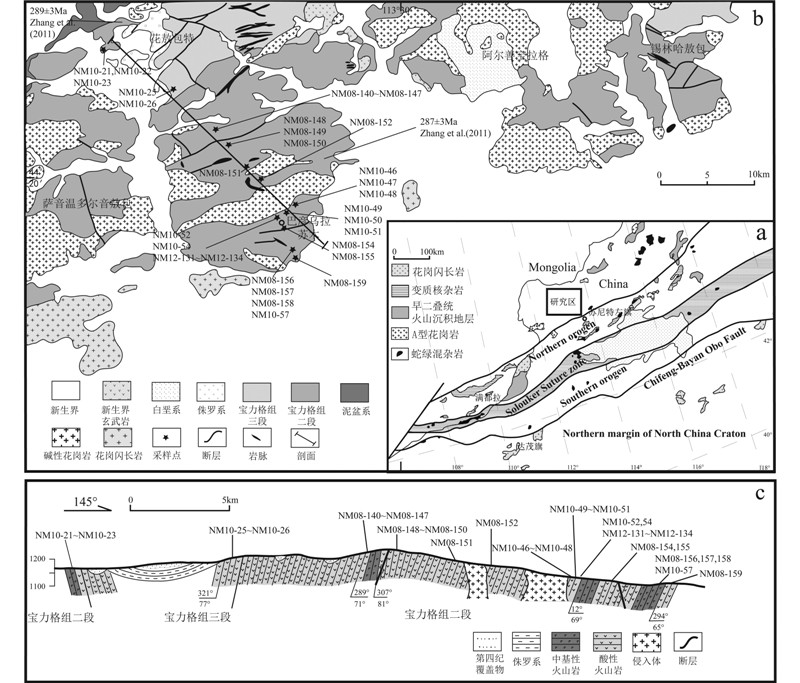 | 图 1 内蒙古巴彦乌拉地区地质图 (a)-大地构造缩略图(据Jian et al., 2010);(b)-巴彦乌拉地区地质简图(据内蒙古自治区地质局,1980①);(c)-研究区地质剖面图 Fig. 1 Geological sketch map of the Bayanwula area in Inner Mongolia (a)-tectonic geological setting(after Jian et al., 2010);(b)-simplified geological map of the Bayanwula area in Inner Mongolia;(c)-cross-section of the study area |
本次研究沿着巴彦乌拉公路采集了37件宝力格组火山岩样品(图 1c),采样点GPS见表 1。其中以第二岩段样品为主,并采有少量第三段岩样进行对比。薄片研究表明,玄武质粗安岩中,碱性长石斜长石颗粒自形完好,杂乱分布的长石格架中充填有它形辉石和磁铁矿物。安山岩样品长条状斜长石微晶呈定向或半定向排列,其间分布少量辉石和磁铁矿,具有交织结构特征。流纹岩样品斑状结构,斑晶以长石石英为主,基质主要是微晶质的长石石英,流纹构造明显,部分样品中可见晶形完好的石榴石斑晶。
 | 表 1 采样点GPS坐标位置 Table 1 The GPS data of all the samples |
对宝力格组二段NM08-140和三段NM10-25流纹岩样品进行SHRIMP U-Pb定年。样品的分选工作在廊坊诚信地质技术服务公司完成:将原岩样品破碎至100μm左右,先用磁法和重液分选,在双目镜下手工挑纯;然后将锆石与数粒标准锆石TEMORA置于环氧树脂中,研磨至1/2,暴露新鲜面后制靶,进行抛光、超声波处理和镀金;测试前在北京大学造山带地壳演化重点实验室和环境扫描电子显微镜实验室完成反射光和阴极发光(CL)照片;最后再在中国地质科学院北京离子探针中心完成SHRIMP锆石U-Pb定年测定。测试过程中,使用标样SL13(572Ma)标定所测样品的锆石U、Th、Pb含量,再用标样TEMORA(417Ma)进行元素间的分馏校正,样品分析流程见Compston et al.(1992),使用ISOPLOT和Squid程序(Ludwig,2003)进行实验数据处理以及谐和图绘制,置信度为95%。
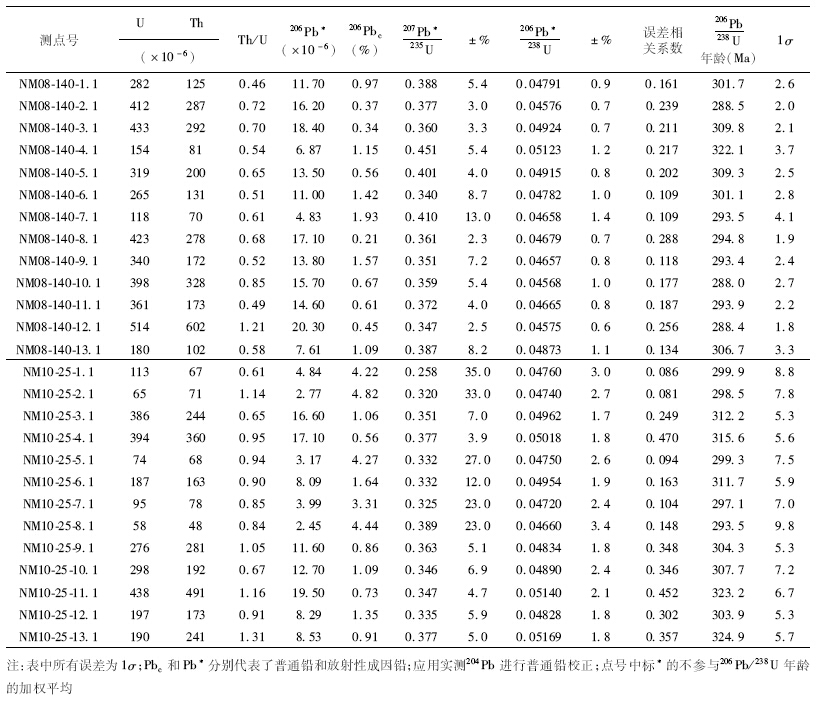
3.2 锆石特征及定年结果样品NM08-140中挑选出来的锆石颗粒具有完好的晶形结构(图 2a),锆石的长宽比在11~31,内部普遍发育环带结构。13颗锆石的离子探针测试结果见表 2,U、Th含量变化范围分别为118×10-6~514×10-6和70×10-6~602×10-6,锆石Th/U比值在0.46~1.21之间,基本都大于0.5,属岩浆成因锆石(Hanchar and Miller, 1993; Claesson et al., 2000; Belousova et al., 2002)。样品的13颗锆石定年数据点几乎都落在谐和线及其附近(图 2b),锆石颗粒的年龄测定值均很稳定,集中分布在307Ma附近,其加权平均年龄为307.1±6.3Ma(MSWD=0.63),代表火山岩的喷发年龄。
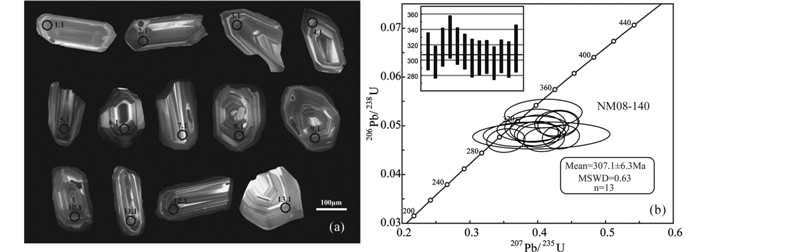 | 图 2 流纹岩(NM08-140)锆石阴极发光照片及SHRIMP测点位置(a)和锆石U-Pb年龄谐和图(b) Fig. 2 CL images and dating spots(a) and SHRIMP U-Pb concordia diagrams(b)for zircons of rhyolite(sample NM08-140)from the Baolige Formation |
| 表 2 宝力格组流纹岩锆石SHRIMP U-Pb分析结果 Table 2 SHRIMP U-Pb data of zircons from rhyolites in the Baolige Formation |
样品NM10-25中挑选出来的锆石颗粒具有长柱状或短柱状特征(图 3a),长宽比在1.51~31,晶面整洁光滑。在阴极发光照片上,未见有明显核部特征,大多数锆石都具有清晰的结晶环带,表明是岩浆结晶过程形成的。U、Th含量变化范围分别为58×10-6~438×10-6和48×10-6~491×10-6,锆石Th/U比值在0.61~1.31之间,属岩浆成因锆石。13颗锆石分析点给出了狭窄的年龄范围,在一致曲线上,这些数据点集中分布(图 3b),加权平均年龄为308.4±5.4Ma(MSWD=0.89),同时13个点还给出非常好的谐和年龄308.9±1.8Ma,解释为火山岩的喷发年龄。
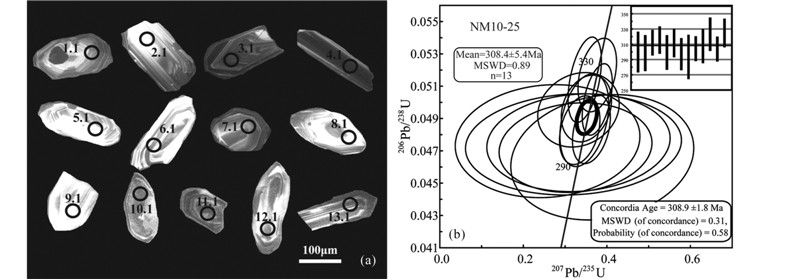 | 图 3 流纹岩(NM10-25)锆石阴极发光照片及SHRIMP测点位置(a)和锆石U-Pb年龄谐和图(b) Fig. 3 CL images and dating spots(a) and SHRIMP U-Pb concordia diagrams(b)for zircons of rhyolite(sample NM10-25)from the Baolige Formation |
样品主量元素的测定在北京大学造山带与地壳演化教育部重点实验室利用X光荧光光谱(XRF)分析完成,精度达1%。微量稀土元素测定在核工业北京地质研究院利用电感耦合等离子质谱仪(ICP-MS)测定完成,除Nb、Ta测试精度稍低在9%外,其余都在5%以内。同位素测定在核工业北京地质研究院分析测试中心利用ISOPROBE-T热电离质谱仪完成测定。 4.1 主量元素
本区岩石样品的SiO2含量变化范围较大,从50.38%~78.15%(表 3)。其中,绝大多数样品的SiO2含量在69.07%~78.15%之间,属典型的酸性岩,在TAS图解中(图 4a)投影在流纹岩区;其他岩石样品SiO2含量50.38%~64.34%,属中基性火山岩,在TAS图解中,1件样品落入粗安岩区、3件样品落入安山岩及其向英安岩过渡区,其余样品落入玄武质粗安岩区。所有样品均落于碱性和亚碱性系列过渡区域,在K2O-SiO2图解(图 4b)中,岩石样品具有钙碱性及高钾钙碱性岩石系列特征。
| 表 3 宝力格组火山岩地球化学分析结果(主量元素: wt%;微量和稀土元素: ×10-6 ) Table 3 The geochemical composition of volcanic rocks in the Baolige Formation(major element: wt%; trace element: ×10-6) |
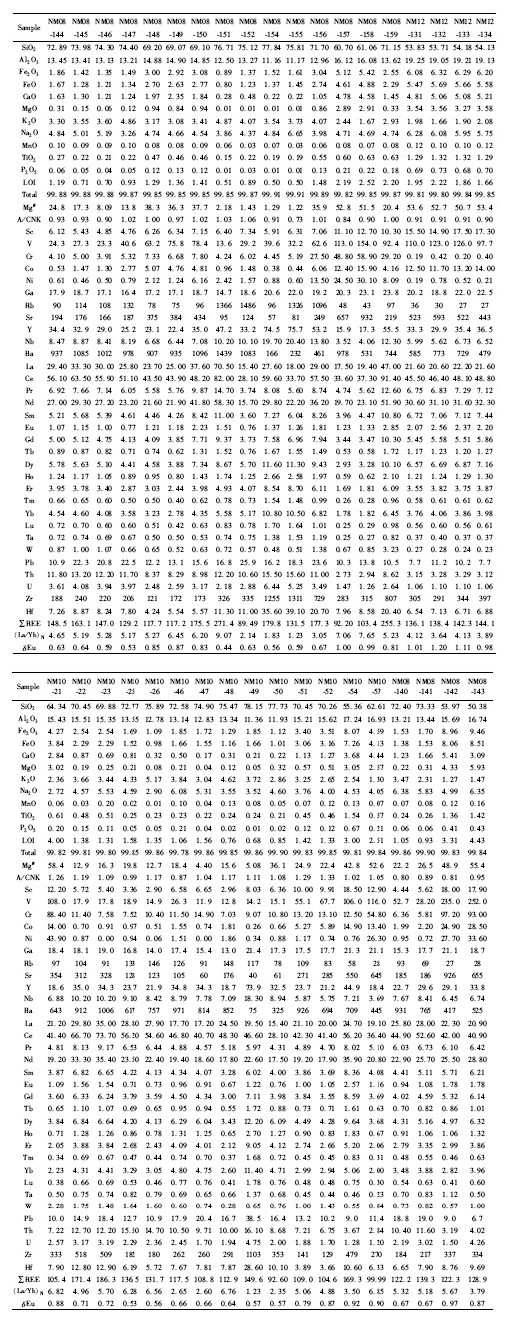
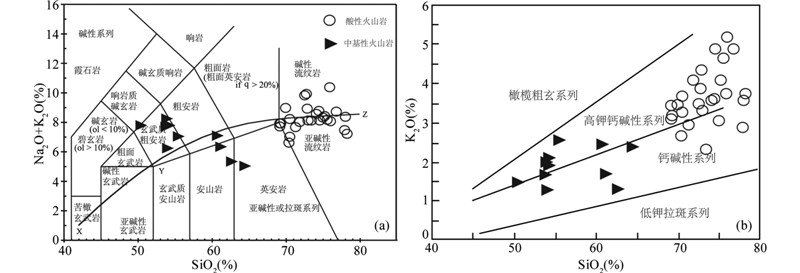 | 图 4 宝力格组火山岩TAS图解(a)和SiO2K2O图解(b)(据Le Maitre, 1989; Peccerillo and Taylor, 1976) Fig. 4 TAS (a) and SiO2 vs K2O (b) diagrams of volcanic rocks in the Baolige Formation (after Le Maitre, 1989; Peccerillo and Taylor, 1976) |
中基性岩石样品中TiO2含量低,变化在0.57%~1.54%;Al2O3含量变化在15.43%~19.25%,MgO为2.57%~5.93%,CaO为2.84%~5.41%,Na2O+K2O为5.08%~8.26%,P2O5为0.20%~0.73%;Mg#介于42.8~58.4之间。酸性岩石样品中TiO2含量低,变化在0.15%~0.63%之间;Al2O3为11.16%~15.62%,MgO为0.01%~0.94%,CaO为0.17%~2.35%,Na2O+K2O为6.65%~10.38%,P2O5为0.01%~0.21%。 4.2 稀土元素
稀土元素组成测试结果见表 3。中基性岩石样品∑REE介于92.20×10⁻⁶~169.3×10⁻⁶之间,(La/Yb)N在3.50~7.65之间;样品稀土元素配分模式都呈现LREE富集,HREE亏损的右倾型。δEu变化范围0.87~1.20,未出现明显的铕异常现象(图 5)。
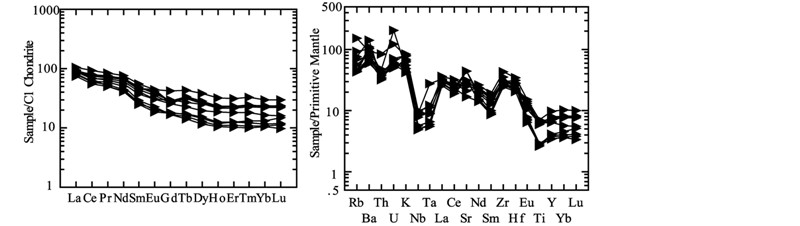 | 图 5 宝力格组中基性火山岩球粒陨石标准化REE图解和微量元素蛛网图(标准化值据Sun and McDonough, 1989) Fig. 5 Chondritenormalized REE and primary mantlenormalized trace element spider diagrams for intermediate to mafic rocks from the Baolige Formation (normalization values after Sun and McDonough, 1989) |
酸性流纹岩样品∑REE介于89.49×10⁻⁶~271.4×10⁻⁶之间,稀土含量较高,(La/Yb)N在1.23~9.07之间;多数样品的稀土元素配分模式具有LREE富集,HREE相对亏损的右倾型特征,个别样品轻重稀土分馏不明显(图 6)。δEu变化范围0.44~0.87,有较弱的铕负异常现象。
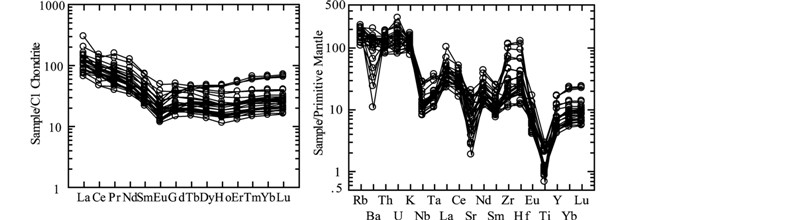 | 图 6 宝力格组酸性火山岩球粒陨石标准化REE图解和微量元素蛛网图(标准化值据Sun and McDonough, 1989) Fig. 6 Chondrite-normalized REE and primary mantle-normalized trace element spider diagrams for acid rocks from the Baolige Formation(normalization values after Sun and McDonough, 1989) |
原始地幔标准化蛛网图中,大多中基性岩石样品微量元素含量变化趋势基本一致(图 5),普遍都富集LILE(Rb、Ba、Th、Sr、U),明显亏损HFSE(Nb、Ta、Ti),Zr、Hf相对富集。酸性流纹岩样品除Ba,Sr变化较大外,其他微量元素一致表现为LILE(Rb、Th、U)高度富集,HFSE(Nb、Ta、Ti)明显亏损,Zr、Hf富集的特征(图 6)。 4.4 Sr、Nd同位素特征
对4件流纹岩样品进行同位素测定,测定结果见表 4。样品的87Rb/86Sr值相差较大,变化在1.1642~3.4376,147Sm/144Nd为0.1086~0.1215,计算得(87Sr/86Sr)i为0.702556~0.707645,(143Nd/144Nd)i为0.512421~0.512528,εNd(t)为3.46~5.54,tDM1为595~769Ma。
| 表 4 宝力格组流纹岩样品Sr-Nd同位素组成 Table 4 Sr-Nd isotopic compositions of the rhyolite samples from the Baolige Formation |

长期以来,宝力格组地层的时代划分存在较大的争议。1961年内蒙古地质局对其定名以及在1980年巴彦乌拉地区120万区域地质图中(内蒙古自治区地质局,1980),都将宝力格组划分到早二叠世;而1963年谢同伦根据腕足类化石碎片,将其归属于晚石炭世(转李文国,1981);1981年李文国从岩相学和生物群面貌特征入手,将该套地层划分为中石炭世(李文国,1981)。最近,Zhang et al.(2011)等对该地层中玄武安山岩及流纹岩样品锆石U-Pb定年结果为289Ma和287Ma,属早二叠世,并认为该套火山岩具有双峰式地球化学特征。
本次研究重新对宝力格组第二三岩段火山岩中流纹岩样品进行了锆石SHRIMP U-Pb定年,采样尽可能避开后期花岗岩侵入体。样品的锆石颗粒结晶较好,均具有岩浆锆石的特点,实验最终获得了精确的锆石U-Pb年龄307.1±6.3Ma和308.9±1.8Ma,两岩段样品的锆石年龄在误差范围内非常一致。由于研究区野外露头差,很难建立火山岩序列的喷出期次,但火山岩的地球化学特征与Zhang et al.(2011)测得的结果十分相似,因此推测两次研究选择的火山岩应属同一期火山活动的产物。尽管本次未对中基性火山岩定年,但现已获得的研究区东部阿尔善宝拉格地区宝力格组安山岩样品锆石LA-ICP-MS年龄为310Ma(未发表),与本次所获流纹岩样品年龄吻合。巴彦乌拉苏木附近侵入于宝力格组中的碱性花岗岩锆石U-Pb年龄为289±2Ma(韩宝福,未发表数据),也表明该组形成时代应早于早二叠世。由此判定,本区宝力格组火山岩形成于308Ma,结合前人结果,宝力格组地层形成时代应介于晚石炭世到早二叠世间。 5.2 岩浆源区特征
薄片研究显示,大部分岩石样品新鲜,蚀变程度较低(LOI<3%),集中在0.5%~2.5%,仅有2个样品达4%,火山岩地球化学元素信息可以用来表征原始岩浆特征。
中基性火山岩源区一般为软流圈或岩石圈地幔(Zhang et al., 2005)。研究区中基性岩LREE富集,HREE亏损,La/Yb=3.50~7.65,轻重稀土元素分异明显,Mg#为42.8~58.4。参考前人研究结果,该组中基性火山岩同位素具有亏损地幔性质(Zhang et al., 2011)。微量元素分析结果显示,样品相应富集LILE,亏损HFSE,Nb、Ta、Ti、P等元素负异常,Zr、Hf正异常,不符合软流圈地幔地球化学特征;另外La/Nb值3.08~5.18,更接近于陆壳La/Nb值(2.2)而非原始地幔(0.98~1)(Dungan et al., 1986);Nb/U值通常在MORB(47±11)和OIB(52±15)中比较稳定(郭锋等,2001),而所测样品的Nb/U值为1.58~6.15远小于原始地幔组分中比值;在La/Nb-La/Ba图解中(图略),样品的分布偏向于受俯冲改造的大陆岩石圈地幔,在La/Sm-La图解中(图略),所有中基性岩样品更趋向于部分熔融的演变趋势。综合以上考虑,宝力格组中基性火山岩可能形成于岩石圈地幔部分熔融作用。
研究区酸性火山岩LREE和LILE(Rb、Th、U)富集,HREE和HFSE(Nb、Ta、Ti)亏损,相对于中基性火山岩具有明显Eu负异常,及Ti、Sr和部分Ba元素强烈亏损的特征。在SiO2对Al2O3、CaO、TiO2及Sr图上(图略),酸性火山岩呈一致的线性分布,中基性火山岩分布零散;而在SiO2对MnO及Rb图中(图略)特征正好相反,反应两者可能具有不同的源区性质。流纹岩样品具有正εNd(t)值和低tDM1值,表现出增生陆壳的性质,和大兴安岭及我国东北部晚古生代花岗岩同位素特征相似(Wu et al., 2002,2003; Jahn et al., 2009; Meng et al., 2011)。另外,大部分岩石样品A/CNK<1.1,A/NK>1.0,在花岗岩分类图(图 7)中,样品数据点集中在过渡区域及附近,同时还具有I型花岗岩趋势演化特征而非S型(图 8),可见酸性火山岩兼有A和I型两类花岗岩的地球化学属性。宝力格组酸性火山岩的SiO2含量较高,不太可能直接由分离结晶作用形成(张旗等,2008),在La/Sm-La图(图略)中,更多的样品趋向于部分熔融的演变趋势分布。因此酸性火山岩可能为中基性岩浆底侵导致增生陆壳部分熔融作用的结果,与中亚造山带内古生代花岗质岩浆的成因特征类似(Wu et al., 2002,2003; Jahn et al., 2004,2009; Meng et al., 2011)。
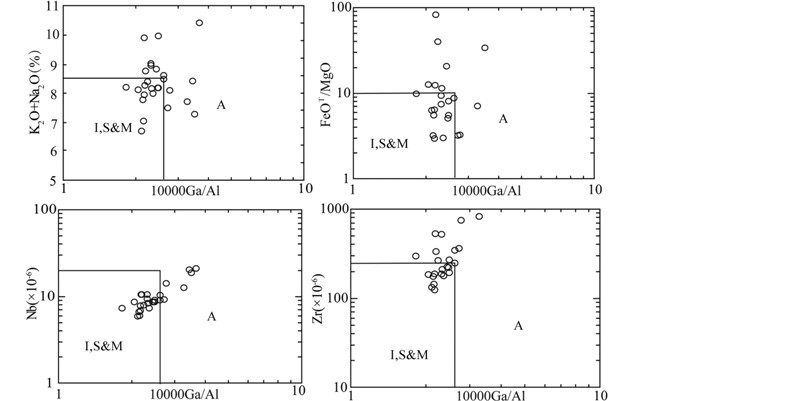 | 图 7 花岗岩类判别图(据Whalen et al., 1987) Fig. 7 Classification diagrams of granitoid(after Whalen et al., 1987) |
近年来,通过对兴蒙造山带北缘火山岩浆活动研究发现,该地区晚古生代主要存在两类岩浆,早期以钙碱性-高钾钙碱性系列为主,晚期以碱性系列岩浆为主,并在北造山带及其以北地区形成早期I型花岗质岩浆为主的岩浆岩带和晚期A型碱性花岗质岩浆带(洪大卫等,1994; Jahn et al., 2009)。但目前,对这些晚古生代岩浆构造背景的解释仍不统一,Chen et al.(2009)认为苏左旗地区存在310Ma左右的弧岩浆事件;Liu et al.(2013)报道了西乌旗地区与俯冲相关的岩浆年龄为314Ma和318Ma;然则另一些学者认为该期间已经进入造山后演化阶段(洪大卫等,1994; 鲍庆中等,2007; 周文孝,2012)。
本次研究选取的宝力格组酸性火山岩样品兼有I-A型两类花岗岩的地球化学属性,与同时产出的中基性火山岩样品一样,有碱性、钙碱性和高钾钙碱性系列特征。Liegeois et al.(1998)指出高钾钙碱性岩浆出现,并向安粗质岩浆过渡是造山演化到最后阶段的标志;多数造山带后碰撞花岗岩以中-高钾钙碱性I型花岗岩为主(韩宝福,2007),而A型及其相关碱性花岗岩的出现预示着进入后造山伸展阶段,因此在造山带演化后期,常伴有I-A型花岗岩产出(Wu et al., 2003)。邻区蒙古南部、内蒙古西部等地也广泛发育晚石炭世I-A型花岗岩(韩宝福等,2010),均指向后碰撞环境。在构造判别图中,中基性火山岩样品落入板内玄武岩区域(图 9a),酸性火山岩落入后碰撞花岗岩区域(图 9b-d)。由此推测,308Ma古亚洲洋已经闭合并处于造山后演化阶段。
区内更多的、与俯冲作用有关属于前碰撞的岩浆侵位时代多数介于490~422.8Ma(石玉若等, 2004,2005; Jian et al., 2008);与挤压相关的蚀变花岗岩年龄为418~326Ma(张臣和吴泰然,2001);近来,Jian et al.(2012)获得贺根山蛇绿岩中辉长岩和花岗岩可靠年龄值分别为354Ma和333Ma;Zhang et al.(2014)获得二连浩特地区蛇绿岩年龄为354.2~344.8Ma,与贺根山蛇绿岩形成时代基本一致;锡林郭勒杂岩中与碰撞造山相关的重要变质事件为337Ma(薛怀民等,2009),这些年龄证据说明晚石炭世时期本区可能已经处于后碰撞环境。同时,区域上还存在与晚石炭世火山岩同时期的大量岩浆活动,包括西乌旗地区323~313Ma的石英闪长岩(鲍庆中等,2007)及锡林浩特地区330~317Ma的花岗质岩浆(周文孝,2012),都被认为形成于后造山阶段。而后期巴彦乌拉-东乌珠穆沁旗带及整个中亚造山带内大范围的碱性花岗岩侵位时间在295~270Ma(洪大卫等,1994; Shi et al., 2004; Jahn et al., 2009);锡林浩特地区双峰式火山岩年龄为279Ma和281Ma(Zhang et al., 2008)。综上考虑,古亚洲洋在晚石炭世之前发生闭合,晚石炭世-早二叠世时期已经进入后造山阶段,并逐步向广泛的伸展构造环境转化。
6 结论
综上所述,巴彦乌拉地区宝力格组火山岩的成因可能为后碰撞背景下岩石圈地幔部分熔融,并在上涌底侵过程中,造成增生陆壳物质熔融作用的结果。SHRIMP U-Pb定年结果为307.1±6.3Ma和308.9±1.8Ma,表明晚石炭世时期,研究区已进入后造山演化阶段,并逐步向早二叠世广泛伸展环境转化。
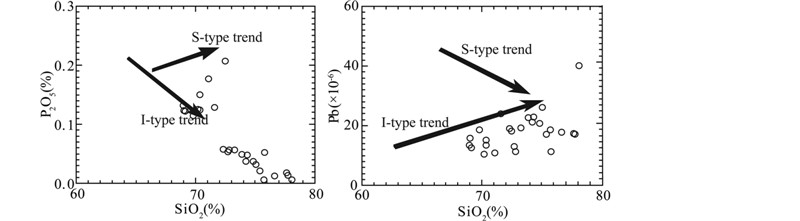
图 8 宝力格组流纹岩SiO2对P2O5及Pb图解(据Chappell and White, 1992)
Fig. 8 SiO2 vs. P2O5 and Pb variation diagrams of acid volcanic rocks from the Baolige Formation(after Chappell and White, 1992)
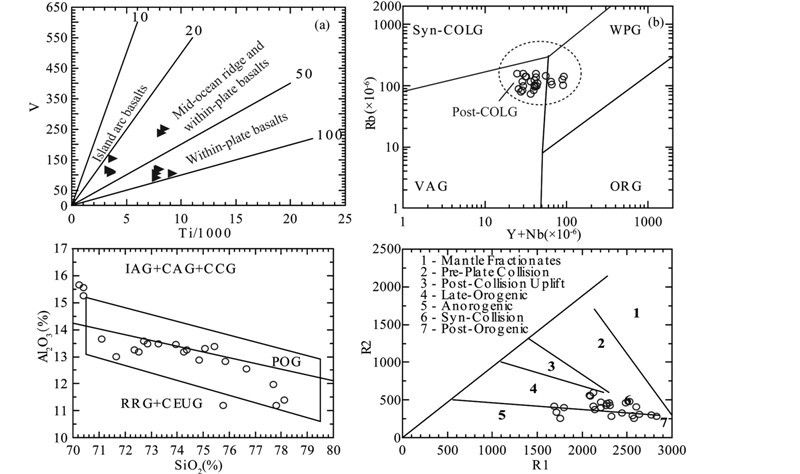
图 9 宝力格组火山岩构造环境判别图(据Pearce,1984; Batchelor and Bowden, 1985; Maniar and Piccoli, 1989)
Fig. 9 Tectonic discriminant diagrams of the volcanic rocks in Baolige Formation(boundaries of rock type after Pearce,1984; Batchelor and Bowden, 1985; Maniar and Piccoli, 1989)
| [1] | Bao QZ, Zhang CJ, Wu ZL, Wang H, Li W, Sang JH and Liu YS. 2007. SHRIMP U-Pb zircon geochronology of a Carboniferous quartz-diorite in Baiyingaole area, Inner Mongolia and its implications. Journal of Jilin University (Earth Science Edition), 37(1): 15-23 (in Chinese with English abstract) |
| [2] | Bao ZW, Chen SH and Zhang ZT. 1994. Study on REE and Sm-Nd Isotopes of Hegenshan ophiolote, Inner Mongolia. Geochimica, 23(4): 339-348 (in Chinese with English abstract) |
| [3] | Batchelor RA and Bowden P. 1985. Petrogenetic interpretation of granitoid rock series using multicationic parameters. Chemical Geology, 48(1-4): 43-55 |
| [4] | Belousova EA, Griffin WL, O’Reilly SY and Fisher NI. 2002. Igneous zircon: Trace element composition as an indicator of source rock type. Contributions to Mineralogy and Petrology, 143(5): 602-622 |
| [5] | Bureau of Geology and Mineral Resources of Nei Mongol Auntonomous Region. 1991. Regional Geology of Nei Mongol (Inner Mongolia) Autonomous Region. Beijing: Geological Publishing House, 1-725 (in Chinese) |
| [6] | Chappell BW and White AJR. 1992. I-and S-type granites in the Lachlan Fold Belt. Transactions of the Royal Society of Edinburgh: Earth Sciences, 83(1-2): 1-26 |
| [7] | Chen B, Jahn BM, Wilde SA and Xu B. 2000. Two contrasting Paleozoic magmatic belts in northern Inner Mongolia, China: Petrogenesis and tectonic implications. Tectonophysics, 328(1): 157-182 |
| [8] | Chen B, Jahn BM and Tian W. 2009. Evolution of the Solonker suture zone: Constraints from zircon U-Pb ages, Hf isotopic ratios and whole-rock Nd-Sr isotope compositions of subduction-and collision-related magmas and forearc sediments. Journal of Asian Earth Sciences, 34(3): 245-257 |
| [9] | Chen C, Zhang ZC, Guo ZJ, Li JF, Feng ZS and Tang WH. 2012. Geochronology, geochemistry, and its geological significance of the Permian Mandula mafic rocks in Damaoqi, Inner Mongolia. Science China Earth Sciences, 55(1): 39-52 |
| [10] | Claesson VS, Vetrin T and Bayanova HD. 2000. U-Pb zircon ages from a Devonian carbonatite dyke, Kola peninsula, Russia: A record of geological evolution from the Archean to the Palaeozoic. Lithos, 51(1): 95-108 |
| [11] | Compston W, Williams IS, Kirschvink JL, Zhang ZC and Guogan MA. 1992. Zircon U-Pb ages for the Early Cambrian time-scale. Journal of the Geological Society, 149(2): 171-184 |
| [12] | Dungan MA, Lindstrom MM, McMillan NJ, Moorbath S, Hoefs J and Haskin LA. 1986. Open system magmatic evolution of the Taos Plateau volcanic field, northern New Mexico: 1. The petrology and geochemistry of the Servilleta Basalt. Journal of Geophysical Research: Solid Earth (1978-2012), 91(B6): 5999-6028 |
| [13] | Guo F, Fan WM, Wang YJ and Lin G. 2001. Petrogenesis of the Late Mesozoic bimodal volcanic rocks in the southern Da Hinggan Mts, China. Acta Petrologica Sinica, 17(1): 161-168 (in Chinese with English abstract) |
| [14] | Guo F, Fan WM, Li CW, Miao LC and Zhao L. 2009. Early Paleozoic subduction of the Paleo-Asian Ocean: Geochronological and geochemical evidence from the Dashizhai basalts, Inner Mongolia. Science in China (Series D), 52(7): 940-951 |
| [15] | Han BF. 2007. Diverse post-collisional granitoids and their tectonic setting discrimination. Earth Science Frontiers, 14(3): 64-72 (in Chinese with English abstract) |
| [16] | Han BF, Zhang C, Zhao L, Ren R, Xu Z, Chen JF, Zhang L, Zhou YZ and Song B. 2010. A preliminary study of granitoids in western Inner Mongolia. Acta Petrologica et Mineralogica, 29(6): 741-749 (in Chinese with English abstract) |
| [17] | Hanchar JM and Miller CF. 1993. Zircon zonation patterns as revealed by cathodoluminescene and backscattered electron images: Implications for interpretation of complex crustal histories. Chemical Geology, 110(1): 1-13 |
| [18] | Hong DW, Huang HZ, Xiao YJ, Xu HM and Jin MY. 1994. Permian alkaline granites in central Inner Mongolia and their geodynamic significance. Acta Geologica Sinica, 68(3): 219-230 (in Chinese with English abstract) |
| [19] | Jahn BM, Windley B and Dobretsov N. 2004. Phanerozoic continental growth in Central Asia. Journal of Asian Earth Sciences, 23(5): 599-603 |
| [20] | Jahn BM, Litvinovsky BA, Zanvilevich AN and Reichow M. 2009. Peralkaline granitoid magmatism in the Mongolian-Transbaikalian Belt: Evolution, petrogenesis and tectonic significance. Lithos, 113(3): 521-539 |
| [21] | Jian P, Liu DY, Kröner A, Windley BF, Shi YR, Zhang FQ, Shi GH, Miao LC, Zhang W, Zhang Q, Zhang LQ and Ren JS. 2008. Time scale of an early to mid-Paleozoic orogenic cycle of the long-lived Central Asian Orogenic Belt, Inner Mongolia of China: Implications for continental growth. Lithos, 101(3-4): 233-259 |
| [22] | Jian P, Liu DY, Kröner A, Windley BF, Shi YR, Zhang W, Zhang FQ, Miao LC, Zhang LQ and Tomurhuu D. 2010. Evolution of a Permian intraoceanic arc-trench system in the Solonker suture zone, Central Asian Orogenic Belt, China and Mongolia. Lithos, 118(1-2): 169-190 |
| [23] | Jian P, Kröner A, Windley BF, Shi YR, Zhang W, Zhang LQ and Yang WR. 2012. Carboniferous and Cretaceous mafic-ultramafic massifs in Inner Mongolia (China): A SHRIMP zircon and geochemical study of the previously presumed integral "Hegenshan ophiolite". Lithos, 142: 48-66 |
| [24] | Kovalenko VI, Yarmolyuk VV, Kovach VP, Kotov AB, Kozakov IK, Salnikova EB and Larin AM. 2004. Isotope provinces, mechanisms of generation and sources of the continental crust in the Central Asian mobile Belt: Geological and isotopic evidence. Journal of Asian Earth Sciences, 23(5): 605-627 |
| [25] | Le Maitre RW. 1989. A Classification of Igneous Rocks and a Glossary of Terms: Recommendations of the International Union of Geological Sciences Subcommision on the Systematics of Igneous Rocks. Oxford: Blackwell |
| [26] | Li WG. 1981. Identify the time problem of Baolige Formation. Journal of Stratigraphy, 5(1): 46-49 (in Chinese with English abstract) |
| [27] | Liegeois JP, Navez J, Hertogen J and Black R. 1998. Contrasting origin of post-collisional high-K calc-alkaline and shoshonitic versus alkaline and peralkaline granitoids: The use of sidling normalization. Lithos, 45(1): 1-28 |
| [28] | Liu JF, Li JY, Chi XG, Qu JF, Hu ZC, Fang S and Zhang Z. 2013. A Late-Carboniferous to early Early-Permian subduction-accretion complex in Daqing pasture, southeastern Inner Mongolia: Evidence of northward subduction beneath the Siberian paleoplate southern margin. Lithos, 177: 285-296 |
| [29] | Ludwig RH. 2003. Isoplo 3.0-A Geochronological Toolkit for Microsoft Excel. Berkeley: Berkeley Geochromology Center Special Publication, 4: 1-70 |
| [30] | Ma X, Chen B, Chen JF and Niu XL. 2013. Zircon SHRIMP U-Pb age, geochemical, Sr-Nd isotopic, and in-situ Hf isotopic data of the Late Carboniferous-Early Permian plutons in the northern margin of the North China Craton. Science China Earth Sciences, 56(1): 126-144 |
| [31] | Maniar PD and Piccoli PM. 1989. Tectonic discrimination of granitoids. Geological Society of America Bulletin, 101(5): 635-643 |
| [32] | Meng E, Xu WL, Pei FP, Yang DB, Wang F and Zhang XZ. 2011. Permian bimodal volcanism in the Zhangguangcai Range of eastern Heilongjiang Province, NE China: Zircon U-Pb-Hf isotopes and geochemical evidence. Journal of Asian Earth Sciences, 41(2): 119-132 |
| [33] | Miao LC, Fan WM, Liu DY, Zhang FQ, Shi YR and Guo F. 2008. Geochronology and geochemistry of the Hegenshan ophiolitic complex: Implications for late-stage tectonic evolution of the Inner Mongolia-Daxinganling Orogenic Belt, China. Journal of Asian Earth Sciences, 32(5-6): 348-370 |
| [34] | Pearce JA, Harris NBW and Tindle AG. 1984. Trace element discrimination diagrams for the tectonic interpretation of granitic rocks. Journal of Petrology, 25(4): 959-983 |
| [35] | Peccerillo A and Taylor SR. 1976. Geochemistry of Eocene calc-alkaline volcanic rocks from the Kastamonu area, northern Turkey. Contributions to Mineralogy and Petrology, 58(1): 63-81 |
| [36] | Qing M, Tang MG, Ge LS, Han XJ, Feng JB, Yuan SS and Zhao YS. 2012. LA-ICP-MS zircon U-Pb age, geochemistry of andesite in Bilihe goldfield, Suniteyouqi, Inner Mongolia and its tectonic significance. Acta Petrologica Sinica, 28(2): 514-524 (in Chinese with English abstract) |
| [37] | Sengör AMC and Natal’in BA. 1996. Turkic-type orogeny and its role in the making of the continental crust. Annual Review of Earth and Planetary Sciences, 24(1): 263-337 |
| [38] | Shao JA. 1991. Crust Evolution in the Middle Part of the Northern Margin of Sino-Korean Plate. Beijing: Publishing House of Peking University (in Chinese) |
| [39] | Shi GH, Miao LC, Zhang FQ, Jian P, Fan WM and Liu DY. 2004. Emplacement age and tectonic implications of the Xilinhot A-type granites in Inner Mongolia, China. Chinese Science Bulletin, 49(7): 723-729 |
| [40] | Shi GZ, Faure M, Xu B, Zhao P, Chen Y. 2013. Structural and kinematic analysis of the Early Paleozoic Ondor Sum-Hongqi mélange belt, eastern part of the Altaids (CAOB) in Inner Mongolia, China. Journal of Asian Earth Sciences, 66: 123-139 |
| [41] | Shi YR, Liu DY, Zhang Q, Jian P, Zhang FQ, Miao LC, Shi GH, Zhang LQ and Tao H. 2004. SHRIMP dating of diorites and granites in southern Suzuoqi, Inner Mongolia. Acta Geologica Sinica, 78(6): 789-799 (in Chinese with English abstract) |
| [42] | Shi YR, Liu DY, Jian P, Zhang Q, Zhang FQ, Miao LC, Shi GH, Zhang LQ and Tao H. 2005. Ziron SHRIMP dating of K-rich granites in Sonid Zuoqi, central Inner Mongolia. Geological Bulletin of China, 24(5): 424-428 (in Chinese with English abstract) |
| [43] | Sun SS and McDonough WF. 1989. Chemical and isotopic systematics of oceanic basalts: Implications for mantle composition and processes. In: Saunders AD and Norry MJ (eds.). Magmatism in the Ocean Basins. Geological Society, London, Special Publications, 42(1): 13-345 |
| [44] | Tang KD. 1990. Tectonic development of Paleozoic foldbelts at the north margin of the Sino-Korean craton. Tectonics, 9(2): 249-260 |
| [45] | Tang KD. 1992. Tectonic Evolution and Minerogenetic Regularities of the Fold Belt along the Northern Margins of Sino-Korean plate. Beijing: Publishing House of Beijing University (in Chinese) |
| [46] | Tang WH, Zhang ZC, Li JF, Feng ZS and Chen C. 2011. Geochemistry of the Carboniferous volcanic rocks of Benbatu Formation in Sonid Youqi, Inner Mongolia and its geological significance. Acta Scientiarum Naturaliun Universitatis Pekinensis, 47(2): 321-330 (in Chinese with English abstract) |
| [47] | Tao JX, Bai LB, Bao JWLJ, Zheng WJ and Su MR. 2003. Rock record of Permian subducting orogenic process in Mandula, Innermongolia. Geological Survey and Research, 26(4): 241-249 (in Chinese with English abstract) |
| [48] | Whalen JB, Currie KL and Chappell BW. 1987. A-type granites: Geochemical characteristics, discrimination and petrogenesis. Contributions to Mineralogy and Petrology, 95(4): 407-419 |
| [49] | Windley BF, Alexeiev D, Xiao WJ, Kröner A and Badarch G. 2007. Tectonic models for accretion of the Central Asian Orogenic Belt. Journal of the Geological Society, 164(1): 31-47 |
| [50] | Wu FY, Sun DY, Li HM, Jahn BM and Wilde SA. 2002. A-type granites in northeastern China: Age and geochemical constraints on their petrogenesis. Chemical Geology, 187(1): 143-173 |
| [51] | Wu FY, Jahn BM, Wilde SA, Lo CH, Yui TF, Lin Q, Ge WC and Sun DY. 2003. Highly fractionated I-type granites in NE China (II): Isotopic geochemistry and implications for crustal growth in the Phanerozoic. Lithos, 67(3): 191-204 |
| [52] | Xiao WJ, Windley BF, Hao J and Zhai MG. 2003. Accretion leading to collision and the Permian Solonker suture, Inner Mongolia, China: Termination of the Central Asian Orogenic Belt. Tectonics, 22(6): 1069-1088 |
| [53] | Xiao WJ, Windley BF, Huang BC, Han CM, Yuan C, Chen HL, Sun M, Sun S and Li JL. 2009. End-Permian to Mid-Triassic termination of the accretionary processes of the southern Altaids: Implications for the geodynamic evolution, Phanerozoic continental growth, and metallogeny of central Asia. International Journal of Earth Sciences, 98(6): 1189-1217 |
| [54] | Xu B and Chen B. 1997. Framework and evolution of the Middle Paleozoic orogenic belt between Siberian and North China plates in northern Inner Mongolia. Science in China (Series D), 40(5): 463-469 |
| [55] | Xu B, Charvet J, Chen Y, Zhao P and Shi GZ. 2013. Middle Paleozoic convergent orogenic belts in western Inner Mongolia (China): Framework, kinematics, geochronology and implication for tectonic evolution of Central Asian Orogenic Belt. Gondwana Research, 23(4): 1342-1364 |
| [56] | Xue HM, Guo LJ, Hou ZQ, Zhou XW, Tong Y and Pan XF. 2009. The Xinlingele complex from the eastern part of the Central Asian-Mongolia Orogenic Belt, China: Products of Early Variscan orogeny other than ancient block: Evidence from zircon SHRIMP U-Pb ages. Acta Petrologica Sinica, 25(8): 2001-2010 (in Chinese with English abstract) |
| [57] | Zhang C and Wu TR. 2001. Crack and assembly events of Meso-Neoproterozoic-Palaeozoic continental blocks in the sourthern area of Suzuoqi, Inner Mongolia. Acta Petrologica Sinica, 17(2): 199-205 (in Chinese with English abstract) |
| [58] | Zhang HF, Sun M, Zhou XH and Ying JF. 2005. Geochemical constraints on the origin of Mesozoic alkaline intrusive complexes from the North China Craton and tectonic implications. Lithos, 81(1): 297-317 |
| [59] | Zhang Q, Wang YL, Jin WJ, Jia XQ and Li CD. 2008. Criteria for the recognition of pre-, syn-and post-orogenic granitic rocks. Geological Bulletin of China, 27(1): 1-18 (in Chinese with English abstract) |
| [60] | Zhang W, Wu TR, Feng JC, Zheng RG and He YK. 2013. Time constraints for the closing of the Paleo-Asian Ocean in the Northern Alxa Region: Evidence from Wuliji granites. Science China (Earth Sciences), 56(1): 153-164 |
| [61] | Zhang XH, Zhang HF, Tang YJ, Wilde SA and Hu ZC. 2008. Geochemistry of Permian bimodal volcanic rocks from central Inner Mongolia, North China: Implication for tectonic setting and Phanerozoic continental growth in Central Asian Orogenic Belt. Chemical Geology, 249(3): 262-281 |
| [62] | Zhang XH, Wilde SA, Zhang HF and Zhai MG. 2011. Early Permian high-K calc-alkaline volcanic rocks from NW Inner Mongolia, North China: Geochemistry, origin and tectonic implications. Journal of Geological Society, 168(2): 525-543 |
| [63] | Zhang ZC, Li K, Li JF, Tang WH, Chen Y and Luo ZW. 2014. Geochronology and geochemistry of the Eastern Erenhot ophiolitic complex: Implications for the tectonic evolution of the Inner Mongolia-Daxinganling Orogenic Belt. Journal of Asian Earth Sciences, doi:10.1016/j.jseaes.2014.06. 008 |
| [64] | Zhou WX. 2012. Studies of geochronology and geochemistry of Paleozoic magmatism in Xilinhot area, Inner Mongolia. Ph. D. Dissertation. Wuhan: China University of Geosciences (in Chinese with English summary) |
| [65] | 鲍庆中, 张长捷, 吴之理, 王宏, 李伟, 桑家和, 刘永生. 2007. 内蒙古白音高勒地区石炭纪石英闪长岩SHRIMP锆石U-Pb年代学及其意义. 吉林大学学报(地球科学版), 37(1): 15-23 |
| [66] | 包志伟, 陈森煌, 张桢堂. 1994. 内蒙古贺根山地区蛇绿岩稀土元素和Sm-Nd同位素研究. 地球化学, 23(4): 339-348 |
| [67] | 内蒙古自治区地质矿产局. 1991. 内蒙古自治区区域地质志. 北京: 地质出版社, 1-725 |
| [68] | 晨辰, 张志诚, 郭召杰, 李建锋, 冯志硕, 汤文豪. 2012. 内蒙古达茂旗满都拉地区早二叠世基性岩的年代学、地球化学及其地质意义. 中国科学(地球科学), 42(3): 343-358 |
| [69] | 郭锋, 范蔚铭, 王岳军, 林舸. 2001. 大兴安岭南段晚中生代双峰式火山作用. 岩石学报, 17(1): 161-168 |
| [70] | 郭锋, 范蔚茗, 李超文, 苗来成, 赵亮. 2009. 早古生代古亚洲洋俯冲作用: 来自内蒙古大石寨玄武岩的年代学与地球化学证据. 中国科学(D辑), 39(5): 569-579 |
| [71] | 韩宝福. 2007. 后碰撞花岗岩类的多样性及其构造环境判别的复杂性. 地学前缘, 14(3): 64-72 |
| [72] | 韩宝福, 张臣, 赵磊, 任荣, 徐钊, 陈家富, 张磊, 周印章, 宋彪. 2010. 内蒙古西部呼伦陶勒盖地区花岗岩类的初步研究. 岩石矿物学杂志, 29(6): 741-749 |
| [73] | 洪大卫, 黄怀曾, 肖宜君, 徐海明, 靳满元. 1994. 内蒙古中部二叠纪碱性花岗岩及其地球动力学意义. 地质学报, 68(3): 219-230 |
| [74] | 李文国. 1981. 宝力格组的时代问题辨. 地层学杂志, 5(1): 46-49 |
| [75] | 卿敏, 唐明国, 葛良胜, 韩先菊, 冯建兵, 袁士松, 赵玉锁. 2012. 内蒙古苏右旗毕力赫金矿区安山岩LA-ICP-MS锆石U-Pb年龄、元素地球化学特征及其形成的构造环境. 岩石学报, 28(2): 514-524 |
| [76] | 邵济安. 1991. 中朝板块北缘中段地壳演化. 北京: 北京大学出版社 |
| [77] | 石玉若, 刘敦一, 张旗, 简平, 张福勤, 苗来成, 施光海, 张履桥, 陶华. 2004. 内蒙古苏左旗地区闪长-花岗岩类SHRIMP年代学. 地质学报, 78(6): 789-799 |
| [78] | 石玉若, 刘敦一, 简平, 张旗, 张福勤, 苗来成, 施光海, 张履桥, 陶华. 2005. 内蒙古中部苏尼特左旗富钾花岗岩锆石SHRIMP U-Pb年龄. 地质通报, 24(5): 424-428 |
| [79] | 唐克东. 1992. 中朝板块北侧褶皱带构造演化及成矿规律. 北京: 北京大学出版社 |
| [80] | 汤文豪, 张志诚, 李建锋, 冯志硕, 晨辰. 2011. 内蒙古苏尼特右旗查干诺尔石炭系本巴图组火山岩地球化学特征及其地质意义. 北京大学学报, 47(2): 321-330 |
| [81] | 陶继雄, 白立冰, 宝音乌力吉, 郑武军, 苏茂荣. 2003. 内蒙古满都拉地区二叠纪俯冲造山过程的岩石记录. 地质调查与研究, 26(4): 241-249 |
| [82] | 薛怀民, 郭利军, 侯增谦, 周喜文, 童英, 潘晓菲. 2009. 中亚-蒙古造山带东段的锡林郭勒杂岩: 早华力西期造山作用的产物而非古老陆块?——锆石SHRIMP U-Pb年代学证据. 岩石学报, 25(8): 2001-2010 |
| [83] | 张臣, 吴泰然. 2001. 内蒙古苏左旗南部华北板块北缘中新元古代-古生代裂解-汇聚事件的地质记录. 岩石学报, 17(2): 199-205 |
| [84] | 张旗, 王元龙, 金惟俊, 贾秀勤, 李承东. 2008. 造山前、造山和造山后花岗岩的识别. 地质通报, 27(1): 1-18 |
| [85] | 周文孝. 2012. 内蒙古锡林浩特地区古生代岩浆作用的年代学与地球化学研究. 博士学位论文. 武汉: 中国地质大学 |