 2014, Vol. 30


2. 西北大学地质学系, 大陆动力学国家重点实验室, 西安 710069
2. State Key Laboratory of Continental Dynamics, Department of Geology, Northwest University, Xi'an 710069, China
富碱侵入岩的概念是涂光炽先生于1982年在南京大学召开的国际花岗岩学术会议上首先提出来的(涂光炽等,1984; 涂光炽,1989)。富碱侵入岩主要包括碱性岩和碱性花岗岩、以及和这两类岩石共生的碱含量很高的碱长花岗岩,其全碱含量(K2O+Na2O)一般>8%。碱性岩主要包括正长岩、霞石正长岩、辉石正长岩、霓霞正长岩、闪石正长岩等,在岩石化学上相对贫硅富铝高碱。碱性花岗岩是指含碱性角闪石、碱性辉石的花岗岩,相对富硅贫铝高碱。在各类侵入岩中,富碱侵入岩所占比例很小,其出露面积约占各类侵入岩出露总面积的2%。但是,富碱侵入岩却有重要的矿产和地质意义(涂光炽,1989; 任康绪,2003)。通过对碱性岩及其相关金属矿床的研究,可以获得有关壳幔物质组成、地球动力学状态和成岩成矿的物理化学条件等方面的重要信息,进而为有关岩石圈演化、找矿勘查和资源评价工作提供科学依据(赵振华等,2002; 任康绪,2003; 聂凤军等,2010; 及其参考文献)。
富碱侵入岩一般具有如下特征:(1)常呈线型(带状)展布,很难见到孤立的单个岩体产出、或者呈面状展布的富碱侵入岩群。(2)线型展布的富碱侵入岩带都受区域性大断裂的控制,常出现于裂谷或地堑等拉张环境;在板块碰撞后的一定时期,沿着缝合线发生拉张,在拉张环境中也可以形成富碱侵入岩。因此,富碱侵入岩的出现可能意味着某个时期板块俯冲和碰撞作用的结束。(3)无论是碱性岩还是碱性花岗岩,它们的岩体形态在地表常呈环状。(4)富碱侵入岩的同位素组成特征说明其成岩物质主要来自上地幔(也可能有少部分来自下地壳物质熔融产生的岩浆结晶分异的结果),还有不同程度的壳源物质的混染。考虑到富碱侵入岩的产出背景及其富含大离子亲石元素的特征,一般认为富碱岩浆的部分初始物质来源于富集型地幔(涂光炽,1989; 赵振华和周玲棣,1994)。
富碱侵入岩的研究越来越受到学者们的重视。例如,20世纪90年代以来,前人对我国北方显生宙富碱侵入岩的年代学、岩石学和地球化学等方面做了大量研究工作,取得了许多重要进展(如阎国翰等, 1988,2000,2001a,b,2002,2008; 牟保磊和阎国翰,1992; 赵振华和周玲棣,1994; Zhou and Zhao, 1996; 牟保磊等,2001; 韩宝福等,2004; 任荣等,2009)。但是,仍然有许多问题有待于深入研究,例如,富碱侵入岩的成因问题仍然没有很好地解决(原始岩浆起源于富集的岩石圈地幔、还是亏损的软流圈?岩浆上升过程中地壳物质混染的贡献如何?壳幔相互作用过程中岩浆是如何演化的?岩浆活动与成矿作用事件是否有确定的因果关系?岩石圈的富集是否与板块的俯冲消减作用有关?),碱性岩浆的形成机 制、演化过程及其深部动力学背景(形成于板内裂谷环境、板块俯冲挤压之后的拉张环境、还是与热点地幔柱有关系?阴山地区三叠纪岩浆活动事件能否为华北地块与西伯利亚南缘蒙古褶皱带最终碰撞拼合时代提供进一步的约束?)等重要的科学问题也都要求对其开展进一步的研究工作。本文旨在总结阴山及邻区三叠纪富碱侵入岩的年代学、岩石学和地球化学资料,在前人研究的基础上,进一步探讨其成因和指示意义,并为该区富碱侵入岩的下一步研究提供借 鉴。 1 阴山及邻区三叠纪富碱侵入岩的分布和形成年龄
燕辽-阴山地区目前已发现很多三叠纪的富碱侵入岩体,它们西起内蒙古包头市,东到吉林省的中部,向东一直延伸到朝鲜的北部,大体分布于北纬40°~42°之间(宽度约100km),构成一条近EW向、长达1500km的碱性岩带(阎国翰等,2000; 任荣等,2009; 张拴宏等,2010)。阴山地区位于华北克拉通的北缘,该区的三叠纪碱性侵入岩分布在包头、凉城、四子王旗、察哈尔右后旗和察哈尔右中旗地区,东边与之相邻的碱性侵入岩主要分布在天镇、阳原和矾山(图 1)。阎国翰等(2001b)将阴山地区的富碱侵入岩分为南、北两个带:南带由凉城霓辉正长岩体和包头东霓辉正长岩构成,东边与之相邻的天镇、阳原和矾山碱性杂岩体与前者处于同一纬度;北带由四子王旗黄合少碱性正长岩体、察哈尔右后旗古城碱性正长岩体和察哈尔右中旗义发泉正长岩体组成。
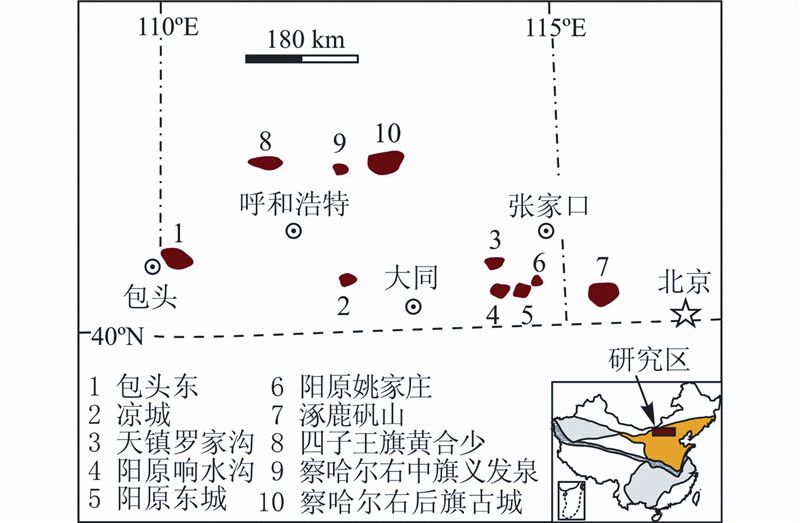 | 图 1 阴山及邻区三叠纪富碱侵入体的分布(据阎国翰等,2000) Fig. 1 The distribution of Triassic alkali-rich intrusions in the Yinshan and neighboring areas(after Yan et al., 2000) |
南带:凉城霓辉正长岩体和包头东霓辉正长岩体的Rb-Sr等时线年龄分别为190.3±5.6Ma和197.7±5.6Ma(阎国翰等,2000)。阳原的东城和姚家庄正长岩体的Rb-Sr等时线年龄分别为268.1±11Ma和235.9±5Ma(阎国翰等,2000),阳原响水沟霞石正长岩体和天镇罗家沟霓辉正长岩的K-Ar同位素年龄分布为248Ma和246~219Ma(牟保磊和阎国翰,1992)。河北矾山杂岩体的Rb-Sr等时线年龄为218±8Ma(牟保磊和阎国翰,1992),SHRIMP锆石U-Pb年龄为218±2Ma(任荣等,2009),二者在误差范围内相一致。
北带:四子王旗黄合少岩体的全岩Rb-Sr等时线年龄为203±4Ma(阎国翰等,2000);察哈尔右后旗古城和察哈尔右中旗义发泉正长岩体尚未年龄数据。根据现有的数据,阴山三叠纪富碱侵入岩的年龄为南带较年轻(197~190±5.6Ma),北带较老(203±4Ma)。而与之相邻的东边阳原和矾山岩体的年龄则更老(大约268~220Ma)。
前人早期获得的同位素年龄确定了上述岩体主要形成于三叠纪,表明阴山地区在三叠纪曾经存在碱性拉张型岩浆-构造活动(阎国翰等,2000)。然而,不同测年方法所得到的结果还存在较大的差别(和误差)。例如,利用K-Ar法测定的矾山岩体的形成年龄在248~203Ma之间,Rb-Sr等时线年龄为218±8Ma(牟保磊和阎国翰,1992及其参考文献),Sm-Nd等时线年龄则为243±9.7Ma(牟保磊等,2001),而锆石SHRIMP U-Pb年龄则为218±2Ma(任荣等,2009)。
这些数据说明上述岩体(除了矾山岩体)还需要开展进一步的定年工作,从而获得不同岩体精确的形成年龄,为探讨其成因和时空分布特征提供精确的年龄依据。
2 富碱侵入岩的岩石学特征
南带的凉城和包头东岩体均为霓辉正长岩体,其主要造岩矿物为正长石和霓辉石;阳原的东城和姚家庄正长岩体分别为霞霓正长岩体和环状次透辉岩-正长岩体。河北矾山杂岩体为层状超镁铁质岩-正长岩体,平面上呈环状,内环为正长岩系,外环为辉石岩系。北带则以碱性正长岩体为主,古城碱性正长岩的主要造岩矿物为条纹长石、微斜条纹长石,次要矿物为辉石、角闪石、钠长石和少量霞石;黄合少正长岩的造岩矿物以微斜长石为主,有少量霞石和霓石(阎国翰等, 2000,2001b; 牟保磊等,2001; 任荣等,2009)。
阴山地区碱性岩中的浅色矿物碱性长石为钾长石和钠长石。钾长石广泛出现在各个岩体中,含量可达80%。而钠长石仅出现在北带岩体中,含量可达15%(阎国翰等,2001b)。在显微镜下,南带包头东和凉城岩体中的钾长石为卡氏双晶发育的正长石,北带黄合少和古城岩体则以格子双晶发育的微斜长石为主,有少量条纹长石。根据X光粉晶衍射数据,计算出南带岩体的钾长石有序度为0.01~0.06,明显低于北带岩体钾长石的有序度(0.26~0.89),可能反映出南带的碱性岩比北带有较高的结晶温度(阎国翰等,2001b)。最新的研究在矾山杂岩体中发现了含钡和锶的钾长石(钡冰长石和锶钡冰长石),指示岩浆晚期锶、钡含量的明显提高,推测早中生代作为岩浆源区的岩石圈地幔有不断富集的趋势(牟保磊等,2013)。
在岩石化学组成上,阴山及邻区的三叠纪富碱侵入岩几乎全部落入碱性系列的范围内,但其组成变化范围很大(图 2),从辉石岩-碱玄岩-二长岩-正长岩到花岗岩呈连续变化(SiO2含量从35%增加到70%),主要组成元素之间显示出规律性的变化:TiO2、Fe2O3、CaO、P2O5和MgO与SiO2之间呈负相关性,Al2O3与SiO2呈正相关性。大多数正长岩位于超钾质系列和橄榄玄粗岩系列,矾山杂岩的K2O和Na2O变化范围非常大,少数位于钙碱性系列范围内(图 3)。相比之下,四子王旗和察哈尔地区的正长岩具有较高的SiO2和Al2O3含量,较低的TiO2、Fe2O3和MgO,这可能反映了它们是地幔源区物质较高程度部分熔融的产物(Tang et al., 2006),而且经历了相对较大程度的辉石、橄榄岩和角闪石的分离结晶作用(见下文)。绝大多数正长岩具有很低的MgO含量,落在了板片熔融实验(1~4GPa)所产生的熔体范围之内(图 2),部分样品具有相对较高的MgO含量和Mg#,落在了来源于大洋板片熔融所产生的埃达克岩范围内,说明这些岩石的形成可能与再循环的俯冲板片熔融有关(Tang et al., 2013)。辉石岩的母岩浆则主要来源于地幔物质的部分熔融。
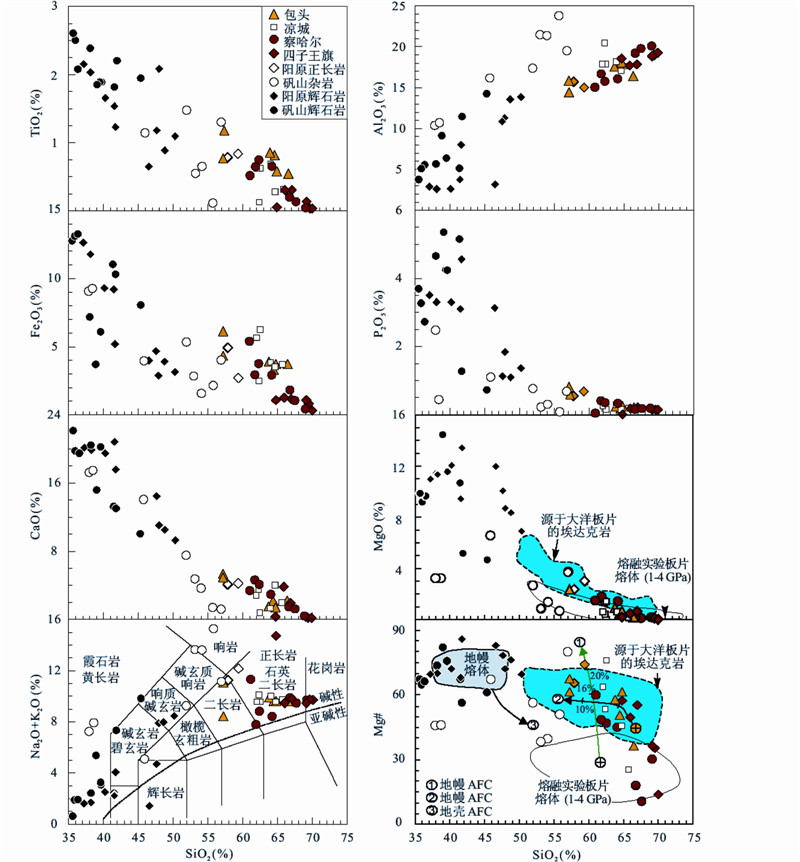 | 图 2 富碱侵入体的主量元素组成(底图据Tang et al., 2013及其参考文献) 杂岩体数据据牟保磊和阎国翰,1992; 侯增谦,1992; 阎国翰等,2001b.图 3、图 4、图 5、图 7数据来源同此图 Fig. 2 Major-oxide variations of the alkali-rich intrusive rocks(base map after Tang et al., 2013, and references therein) |
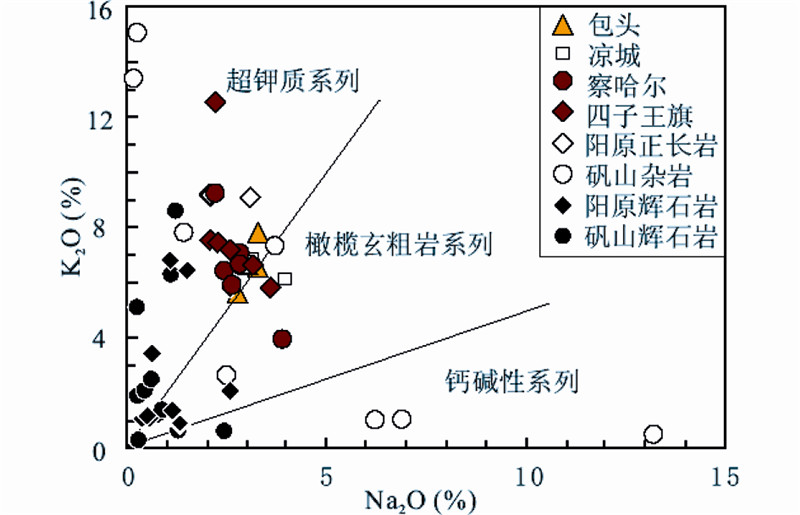 | 图 3 富碱侵入体的K2O和Na2O组成变化 Fig. 3 K2O-Na2O variations of the alkali-rich intrusive rocks |
研究区所有样品均显示出轻稀土元素富集的特征(图 4),与OIB的稀土元素配分形式相似,但是,北带四子王旗和察哈尔地区正长岩的稀土元素含量明显偏低(位于OIB配分曲线之下)。个别样品显示轻微的Eu异常,尽管同一岩体中不同岩石的稀土元素含量不同,但其配分模式大致平行,这些特征暗示它们为同源岩浆演化的产物(阎国翰等,2001b)。在微量元素蛛网图上(图 5),绝大多数样品显示出明显的大离子亲石元素(如Ba、K和Sr)富集、高场强元素(Nb、Ta、Ti)、Th、U和P的亏损。这些特征暗示富碱侵入岩的地幔源区曾经历了再循环的地壳物质的改造作用(阎国翰等,2001b; Tang et al., 2013),这与其MgO和SiO2含量变化所反映的地幔源区特征相一致(图 2)。
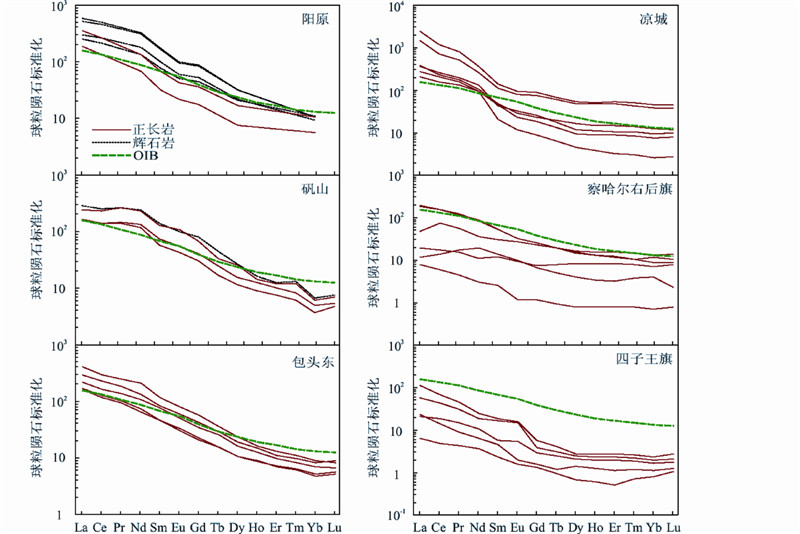 | 图 4 富碱侵入体的稀土元素球粒陨石标准化配分形式(球粒陨石值据Anders and Grevesse, 1989;OIB据Sun and McDonough, 1989) Fig. 4 Chondrite-normalized REE patterns of the alkali-rich intrusive rocks(chondrite values after Anders and Grevesse, 1989;OIB after Sun and McDonough, 1989) |
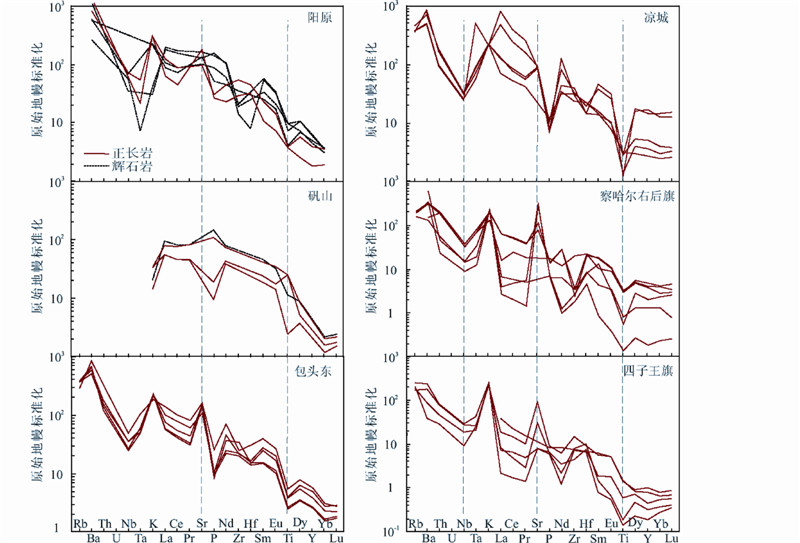 | 图 5 富碱侵入体的微量元素原始地幔标准化图解(标准化值据McDonough and Sun, 1995) Fig. 5 Primitive mantle-normalized trace-element diagrams for the alkali-rich intrusives(normalization values after McDonough and Sun, 1995) |
目前的同位素数据较少,根据现有的数据可知,阴山及邻区三叠纪富碱侵入岩具有富集的Sr-Nd同位素组成特征,其εNd(t)值从大约-17变化到大约-3(图 6a),(87Sr/86Sr)i比值从0.7054变化到0.7092,多数数据点落在了大洋沉积物的范围内,显示出II型富集地幔参与的特征,即这些正长岩的原始岩浆主要来源于富集的岩石圈地幔(阎国翰等,2000; 牟保磊等,2001)。四子王旗正长岩具有最低的εNd(t)值(-17),表明下地壳物质的贡献较大,这与其钾长石的Pb同位素组成特征相一致(阎国翰等,2001b)。
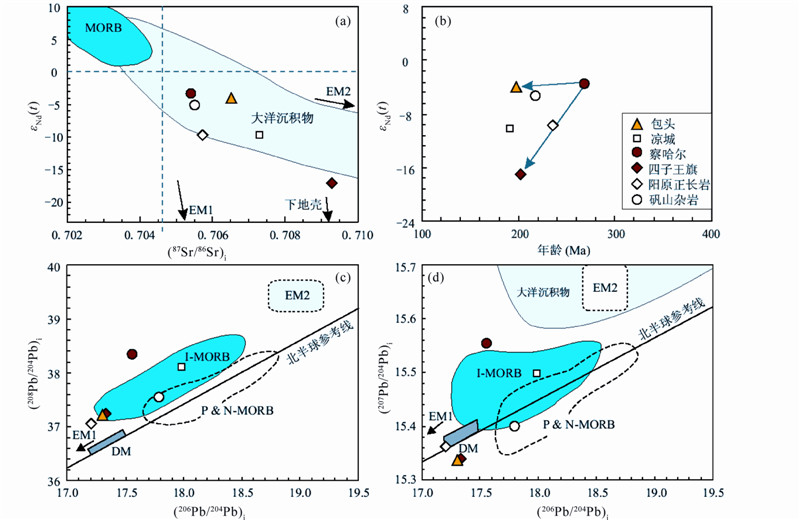 | 图 6 富碱侵入体的Sr-Nd-Pb同位素变化特征 MORB和大洋沉积物据Hofmann,2003;其他数据据牟保磊和阎国翰,1992; 阎国翰等,2000; 牟保磊等,2001; Pb同位素底图据Tang et al., 2006 Fig. 6 The diagrams showing the variations of Sr-Nd isotopes(a),εNd(t)-age(Ma)(b),Pb isotopes(c) and (d)for the alkali-rich intrusive rocks |
现有的Pb同位素数据也表明在研究区富碱侵入岩的岩浆形成过程中有大洋物质的参与(图 6c,d)。从εNd(t)值与侵入岩形成年龄的相关性变化(图 6b)可以看出,随着形成年龄的减小,下地壳物质的贡献在增加。由于数据较少,目前只能获得非常初步的认识,因此,相应的年代学和同位素地球化学工作有待加强,以便获得较为准确的信息,进而为揭示碱性岩浆的形成机制、岩浆活动的时空分布规律和岩石圈演化过程提供依据。
4 岩石成因意义
根据上述总结可知,阴山及邻区的三叠纪富碱侵入岩主要来源于富集的岩石圈地幔,并有或多或少的下地壳物质的贡献。根据微量元素Ba和Nb的判别图(图 7a),该区富碱侵入岩的母岩浆在上升过程中经历了小程度的地壳物质同化混染作用;根据岩石中相容元素Cr和Ni含量的变化关系(图 7b)可以看出,在岩浆演化的过程中有大量的单斜辉石、角闪石和橄榄石的分离结晶。不相容元素La和Yb的相关性变化(图 7c)表明,四子王旗和察哈尔地区的富碱侵入岩可能是地幔源区物质经历较高程度部分熔融的产物,而且经历了较大程度的单斜辉石和角闪石的分离结晶作用(图 7b),相比之下,凉城、包头、矾山和阳原富碱侵入岩则为源区物质较低程度部分熔融的产物,在La/Nb和Ba/Nb判别图上,后者明显具有岛弧熔岩的特征(图 7d),这与其主量元素(图 2)和同位素组成特征相一致(图 6),即在岩浆形成过程中有来源于俯冲的大洋板片物质的贡献。
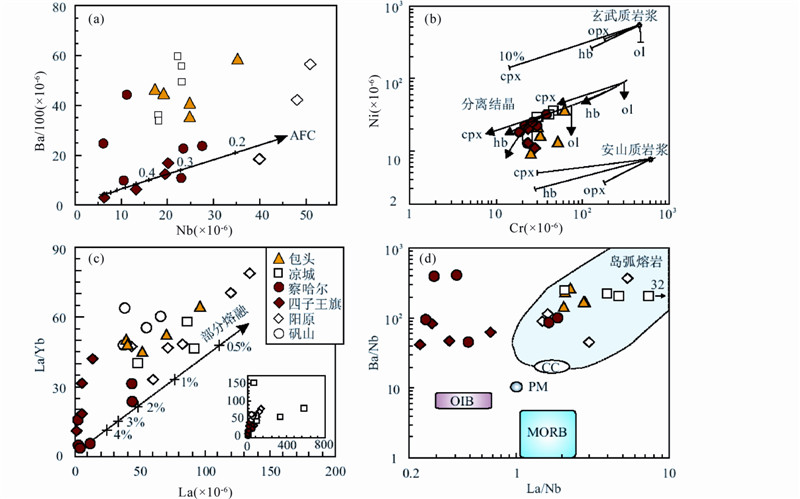 | 图 7 富碱侵入体的微量元素变化特征(底图据Yang et al., 2005; Tang et al., 2013) Fig. 7 The variations of selected trace elements for the alkali-rich intrusive rocks(base map after Yang et al., 2005; Tang et al., 2013) |
综述所述,阴山及邻区的三叠纪富碱侵入岩主要来源于富集的岩石圈地幔的部分熔融,该富集的岩石圈地幔是由于俯冲的大洋板片熔融所释放的熔体/流体交代而形成的。这说明华北北缘(阴山及东边邻区)的岩石圈地幔经历了俯冲的大洋板片物质的交代作用,该事件可能与古生代以来古亚洲洋的闭合密切相关。前人关于华北北缘中生代高镁安山岩和侵入岩的成因(Zhang et al., 2003,2004)、新生代玄武岩携带的辉石岩捕虏体(Xu,2002)和地幔橄榄岩捕虏体(Tang et al., 2007; Liu et al., 2010; Zhang et al., 2012)的研究均表明再循环的俯冲洋壳对华北北缘岩石圈地幔的改造作用。研究区三叠纪富碱侵入岩的形成所指示的拉张环境则意味着古亚洲洋的最终闭合以及华北与蒙古陆块俯冲/碰撞作用的结束。
5 结束语
目前对阴山及其邻区三叠纪富碱侵入岩的年代学和岩石地球化学的研究程度不高。现有的数据表明,该区三叠纪富碱侵入岩的形成年龄为268~190Ma,由于绝大多数年龄数据为Rb-Sr等时线、Sm-Nd等时线或K-Ar同位素年龄,年龄数据偏少,而且存在同一岩体的测定结果不一致的现象,还有一些岩体至今尚无年龄制约。由于精确的年龄测定对于探讨岩石成因、岩浆活动的时空分布规律和岩石圈演化过程都具有至关重要的作用,因此有必要对该区的富碱侵入岩开展进一步的定年工作。
该区三叠纪富碱侵入岩的地球化学特征表明,它们主要起源于经过俯冲的大洋板片熔融所释放的熔体/流体交代的富集型岩石圈地幔,并有不同程度的下地壳物质的参与。这些侵入岩的形成很可能标志着古亚洲洋的闭合和华北-蒙古陆块碰撞作用的结束。但不同岩体的形成年龄、岩石学和地球化学特征上的差异及其深部动力学背景仍需要进一步的研究。
致谢 衷心感谢两位评审专家对文章的修改提出的建设性意见。| [1] | Anders E and Grevesse N. 1989. Abundances of the elements: Meteoritic and solar. Geochimica et Cosmochimica Acta, 53(1): 197-214 |
| [2] | Han BF, Kagami H and Li HM. 2004. Age and Nd-Sr isotopic geochemistry of the Guangtoushan alkaline granite, Hebei Province, China: Implications for Early Mesozoic crust-mantle interaction in North China Block. Acta Petrologica Sinica, 20(6): 1375-1388 (in Chinese with English abstract) |
| [3] | Hofmann AW. 2003. Sampling mantle heterogeneity through oceanic basalts: Isotope and tract elements. In: Carlson RW (ed.). The Mantle and Core. Treatise on Geochemistry. Oxford: Elservier, 61-101 |
| [4] | Hou ZQ. 1992. Magma chemistry, melt structure and phosphorus potential of the P-rich (potassic) alkaline complexes in some areas of northern China. Acta Petrologica Sinica, 8(3): 222-233 (in Chinese with English abstract) |
| [5] | Liu YS, Gao S, Hu ZC et al. 2010. Continental and oceanic crust recycling-induced melt-peridotite interactions in the trans-north China orogen: U-Pb dating, Hf isotopes and trace elements in zircons from mantle xenoliths. Journal of Petrology, 51(1-2): 537-571 |
| [6] | McDonough WF and Sun SS. 1995. The composition of the earth. Chemical Geology, 120(3-4): 223-253 |
| [7] | Mu BL and Yan GH. 1992. Geochemistry of Triassic alkaline or subalkaline igneous compleses in the Yan-Liao area and their significance. Acta Geologica Sinica, 66(2): 108-121 (in Chinese with English abstract) |
| [8] | Mu BL, Shao JA, Chu ZY et al. 2001. Sm-Nd age and Sr, Nd isotopic characteristics of the Fanshan potassic alkaline ultramafite-syenite complex in Hebei Province, China. Acta Petrologica Sinica, 17(3): 358-365 (in Chinese with English abstract) |
| [9] | Mu BL, Shao JA, Zhang H, Lin B and Yan GH. 2013. The chemical composition and texture of the multicomponents feldspar in the Fanshan complex, and their implications. Bulletin of Mineralogy, Petrology and Geochemistry, 32(1): 70-80 (in Chinese with English abstract) |
| [10] | Nie FJ, Jiang SH, Liu YF et al. 2010. Copper-gold-uranium mineralization and alkaline magma activities. Mineral Deposits, 29(Suppl.): 247-248 (in Chinese) |
| [11] | Ren KX. 2003. Study progress of the alkaline rocks: A review. Geology of Chemical Minerals, 25(3): 151-163 (in Chinese with English abstract) |
| [12] | Ren R, Mu BL, Han BF et al. 2009. Zircon SHRIMP U-Pb dating of the Fanshan potassic alkaline ultramafite-syenite complex in Hebei Province, China. Acta Petrologica Sinica, 25(3): 588-594 (in Chinese with English abstract) |
| [13] | Sun SS and McDonough WF. 1989. Chemical and isotopic systematics of oceanic basalts: Implications for mantle composition and processes. In: Saunders AD and Norry MJ (eds.). Magmatism in the oceanic basins. Geological Society, London, Special Publication, 42(1): 313-345 |
| [14] | Tang YJ, Zhang HF and Ying JF. 2006. Asthenosphere-lithospheric mantle interaction in an extensional regime: Implication from the geochemistry of Cenozoic basalts from Taihang Mountains, North China Craton. Chemical Geology, 233(3-4): 309-327 |
| [15] | Tang YJ, Zhang HF, Nakamura E et al. 2007. Lithium isotopic systematics of peridotite xenoliths from Hannuoba, North China Craton: Implications for melt-rock interaction in the considerably thinned lithospheric mantle. Geochimica et Cosmochimica Acta, 71(17): 4327-4341 |
| [16] | Tang YJ, Zhang HF, Ying JF et al. 2013. Rapid eruption of the Ningwu volcanics in eastern China: Response to cretaceous subduction of the Pacific plate. Geochemistry, Geophysics, Geosystems, 14(6): 1703-1721 |
| [17] | Tu GC, Zhang YQ and Zhao ZH. 1984. Preliminary study on the two alkali-rich intrusive rock belts in South China. In: Xu KQ and Tu GC (eds.). Geology of Granites and their Metallogeneitc Relations. Nanjing, Jiangsu Science and Technology Press, 21-37 (in Chinese) |
| [18] | Tu GC. 1989. On the alkali-rich intrusive rocks. Mineral Resource and Geology, 3(3): 1-4 (in Chinese with English abstract) |
| [19] | Xu YG. 2002. Evidence for crustal components in the mantle and constraints on crustal recycling mechanisms: Pyroxenite xenoliths from Hannuoba, North China. Chemical Geology, 182(2-4): 301-322 |
| [20] | Yan GH, Mu BL and Zeng YS. 1988. Characteristics of REE, oxygen and strontium isotope composition for the Zijinshan alkalinne rocks-carbonatite complex in Shanxi Province. Acta Petrologica Sinica, (3): 26-36 (in Chinese with English abstract) |
| [21] | Yan GH, Mu BL, Xu BL et al. 1999. Triassic alkaline intrusives in the Yanliao-Yinshan area: Their chronology, Sr, Nd and Pb isotopic characteristics and their implication. Science in China (Series D), 42(6): 582-587 |
| [22] | Yan GH, Xu BL, Mu BL et al. 2001a. Characteristics and implications of Nd, Sr, Pb in Mesozoic alkaline-rich intrusions in North China. Bulletin of Mineralogy Petrology and Geochemistry, 20(4): 234-237 (in Chinese with English abstract) |
| [23] | Yan GH, Tan LK, Xu BL et al. 2001b. Petrogeochemical characteristics of indosinian alkaline intrusions in Yinshan area. Acta Petrologica et Mineralogica, 20(3): 281-292 (in Chinese with English abstract) |
| [24] | Yan GH, Mu BL, Xu BL et al. 2002. Characteristics and implications of Nd, Sr and Pb isotopes and chronology of Phanerozoic alkaline-rich intrusions in North China. Geological Review, 48(Suppl.): 69-76 (in Chinese with English abstract) |
| [25] | Yan GH, Cai JH, Ren KX et al. 2008. Nd, Sr and Pb isotopic geochemistry of Late-Mesozoic alkaline-rich intrusions from the Tanlu Fault zone: Evidence of the magma source. Acta Petrologica Sinica, 24(6): 1223-1236 (in Chinese with English abstract) |
| [26] | Yang JH, Chung SL, Wilde SA et al. 2005. Petrogenesis of post-orogenic syenites in the Sulu Orogenic Belt, East China: Geochronological, geochemical and Nd-Sr isotopic evidence. Chemical Geology, 214(1-3): 99-125 |
| [27] | Zhang HF, Sun M, Zhou XH et al. 2003. Secular evolution of the lithosphere beneath the eastern North China Craton: Evidence from Mesozoic basalts and high-Mg andesites. Geochimica et Cosmochimica Acta, 67(22): 4373-4387 |
| [28] | Zhang HF, Sun M, Zhou MF et al. 2004. Highly heterogeneous Late Mesozoic lithospheric mantle beneath the North China Craton: Evidence from Sr-Nd-Pb isotopic systematics of mafic igneous rocks. Geological Magazine, 141(1): 55-62 |
| [29] | Zhang HF, Sun YL, Tang YJ et al. 2012. Melt-peridotite interaction in the Pre-Cambrian mantle beneath the western North China Craton: Petrology, geochemistry and Sr, Nd and Re isotopes. Lithos, 149: 100-114 |
| [30] | Zhang SH, Zhao Y, Liu JM et al. 2010. Geochronology, geochemistry and tectonic setting of the Late Paleozoic-Early Mesozoic magmatism in the northern margin of the North China Block: A preliminary review. Acta Petrologica et Mineralogica, 29(6): 824-842 (in Chinese with English abstract) |
| [31] | Zhao ZH and Zhou LD. 1994. REE geochemistry of alkali-rich intrusions, China. Science in China (Series B), 24(10): 1109-1120 (in Chinese) |
| [32] | Zhao ZH, Xiong XL, Wang Q et al. 2002. Alkali-rich igneous rocks and associated large-ultra large-scale gold mineralization. Science in China (Series D), 32(Suppl.): 1-10 (in Chinese) |
| [33] | Zhou LD and Zhao ZH. 1996. Petrology and petrochemistry of alkali-rich intrusions, China. Science in China (Series D), 39(2): 162-172 |
| [34] | 韩宝福, 加加美宽雄, 李惠民. 2004. 河北平泉光头山碱性花岗岩体的时代、Nd-Sr同位素特征及其对华北早中生代壳幔相互作用的意义. 岩石学报, 20(6): 1375-1388 |
| [35] | 侯增谦. 1992. 华北某些富磷碱性-偏碱性杂岩岩浆成分和熔体结构与含矿性关系. 岩石学报, 8(3): 222-233 |
| [36] | 牟保磊, 阎国翰. 1992. 燕辽三叠纪碱性偏碱性杂岩体地球化学特征及意义. 地质学报, 66(2): 108-121 |
| [37] | 牟保磊, 邵济安, 储著银等. 2001. 河北矾山钾质碱性超镁铁质岩-正长岩杂岩体Sm-Nd年龄和Sr、Nd同位素特征. 岩石学报, 17(3): 358-365 |
| [38] | 牟保磊, 邵济安, 张辉, 林斌, 阎国翰. 2013. 矾山杂岩体多元长石的成分、结构及其研究意义. 矿物岩石地球化学通报, 32(1): 70-80 |
| [39] | 聂凤军, 江思宏, 刘翼飞等. 2010. 碱性岩浆活动与铜、金和铀成矿作用. 矿床地质, 29(增刊): 247-248 |
| [40] | 任康绪. 2003. 碱性岩研究进展述评. 化工矿产地质, 25(3): 151-163 |
| [41] | 任荣, 牟保磊, 韩宝福等. 2009. 河北矾山钾质碱性超镁铁岩-正长岩杂岩体的锆石SHRIMP U-Pb年龄. 岩石学报, 25(3): 588-594 |
| [42] | 涂光炽, 张玉泉, 赵振华. 1984. 华南两个富碱侵入岩带的初步研究. 见: 徐克勤, 涂光炽 主编. 花岗岩地质和成矿关系. 南京: 江苏科学技术出版社, 21-37 |
| [43] | 涂光炽. 1989. 关于富碱侵入岩. 矿产与地质, 3(3): 1-4 |
| [44] | 阎国翰, 牟保磊, 曾贻善. 1988. 山西临县紫金山碱性岩-碳酸岩杂岩体的稀土元素和氧锶同位素特征. 岩石学报, (3): 29-36 |
| [45] | 阎国翰, 牟保磊, 许保良等. 2000. 燕辽-阴山三叠纪碱性侵入岩年代学和Sr, Nd, Pb同位素特征及意义. 中国科学(D辑), 30(4): 383-387 |
| [46] | 阎国翰, 许保良, 牟保磊等. 2001a. 中国北方中生代富碱侵入岩钕、锶、铅同位素特征及其意义. 矿物岩石地球化学通报, 20(4): 234-237 |
| [47] | 阎国翰, 谭林坤, 许保良等. 2001b. 阴山地区印支期碱性侵入岩岩石地球化学特征. 岩石矿物学杂志, 20(3): 281-292 |
| [48] | 阎国翰, 牟保磊, 许保良等. 2002. 中国北方显生宙富碱侵入岩年代学和Nd、Sr、Pb同位素特征及其意义. 地质论评, 48(增刊): 69-76 |
| [49] | 阎国翰, 蔡剑辉, 任康绪等. 2008. 郯庐断裂带晚中生代富碱侵入岩Nd、Sr、Pb同位素特征及源区性质探讨. 岩石学报, 24(6): 1223-1236 |
| [50] | 张拴宏, 赵越, 刘建民等. 2010. 华北地块北缘晚古生代-早中生代岩浆活动期次、特征及构造背景. 岩石矿物学杂志, 29(6): 824-842 |
| [51] | 赵振华, 周玲棣. 1994. 我国某些富碱侵入岩的稀土元素地球化学. 中国科学(B辑), 24(10): 1109-1120 |
| [52] | 赵振华, 熊小林, 王强等. 2002. 我国富碱火成岩及有关的大型-超大型金铜矿床成矿作用. 中国科学(D辑), 32(增刊): 1-10 |