 2014, Vol. 30


2. 造山带与地壳演化教育部重点实验室, 北京大学地球与空间科学学院, 北京 100871
2. MOE Key Laboratory of Orogenic Belts and Crustal Evolution, School of Earth and Space Sciences, Peking University, Beijing 100871, China
从经典岛弧、陆缘弧环境斑岩Cu±Au±Mo矿床成矿模型的建立(Lowell and Guilbert, 1970; Sillitoe, 1972,1979),到近年来陆内环境(碰撞造山带或大陆板块内部)斑岩矿床的识别及其构造体制的完善(Richards,2009),人们对斑岩型矿床的成因认识和勘探找矿思路不断深入和发展。代表性成果之一是发现含矿斑岩往往具有高Sr/Y和La/Yb(或埃达克质)地球化学亲和性特征(Thiéblemont et al., 1997; Borisova et al., 2006),然而,如何合理解释这一地质事实也成为困扰矿床和岩石学家多年的难题,争议一直不断(Chiaradia et al., 2012及其引文)。“Adakite”一词最早出自Defant and Drummond(1990),用以描述源自年轻(<25Ma)俯冲洋壳具有高Sr(≥400×10-6)、低Y(≤18×10-6)和Yb(≤1.9×10⁻⁶)等独特地球化学特征的一套中酸性岩石组合。最初认为这些特征与俯冲洋壳发生部分熔融时在源区形成石榴子石±角闪石为主,而没有斜长石的残留有关(Martin,1986; Defant et al., 1992)。后来,部分学者把出现在陆内环境具有类似地球化学特征的岩石也称作“埃达克岩”,并提出了加厚榴辉岩相下地壳熔融的成因模式(Atherton and Petford, 1993; Petford and Atherton, 1996; Chung et al., 2003)。同样,部分学者在解释产于陆内环境与Cu、Au、Mo等金属矿化有关的高Sr/Y斑岩的成因时也引用了此模式(张旗等,2002; Wang et al., 2006; Hou et al., 2009)。
然而,一个至关重要的问题是,含矿斑岩具有高Sr/Y特征并非是岩浆源区信息的直接反映。因为含矿斑岩岩浆往往是经历过复杂演化后的最终产物(Richards and Kerrich, 2007),岩浆从最初的在源区形成、到随后的上升迁移和侵位,都很可能是在开放、变化的系统中进行(Davidson,1996),多种地质过程(例如AFC、MASH、岩浆混合作用等)均可以造成岩浆具有高Sr/Y特征(Castillo et al., 1999; Macpherson et al., 2006; Guo et al., 2007; Moyen,2009; Chen et al., 2013; Ma et al., 2013)。因此,人们已逐渐开始意识到埃达克岩不能代表原始岩浆,不可以简单地用高Sr/Y特征反演源区即存在含石榴子石残留相,甚或推断源区为加厚下地壳(Castillo,2012)。与此同时,越来越多的研究表明(Keith et al., 1997; Maughan et al., 2002; Ma et al., 2013),幔源组份(岩浆、流体及成矿物质)在斑岩矿床成岩及成矿过程中扮演着至关重要的角色。
本文将以一个产于陆内环境的斑岩矿床——敖仑花矿床为例,在对前人关于成矿岩体研究基础上,报道矿区内同期不成矿岩体的地质和地球化学特征,通过对比两者的差异来探讨含矿斑岩高Sr/Y的原因及控制成矿与否的关键因素。
1 野外地质和岩石学
位于大兴安岭南段的敖仑花矿床(图 1a),是西拉木伦多金属成矿带内近几年发现的以Mo、Cu矿化为主的斑岩型矿床(张连昌等,2010;曾庆栋和刘建明,2010)。区内与成矿相关的岩体是二长花岗斑岩,出露面积约1.2km2,以岩株形式侵位于上二叠统索伦组(P2s)中(图 1b)。通过SHRIMP锆石U-Pb定年获得该岩体的形成年龄为134Ma,与辉钼矿Re-Os等时线成矿年龄(132Ma)在误差范围内一致(马星华等, 2009,2010)。野外地质调查显示,含矿斑岩内发育镁铁质暗色包体(MMEs),大小不等(5~40cm),呈椭圆或浑圆状(图 1c,d),包体与寄主岩石的界限复杂多样,或截然分明或模糊过渡,有些包体表现出明显的流动拉伸形态,显示出岩浆包体的特征(Ma et al., 2013)。
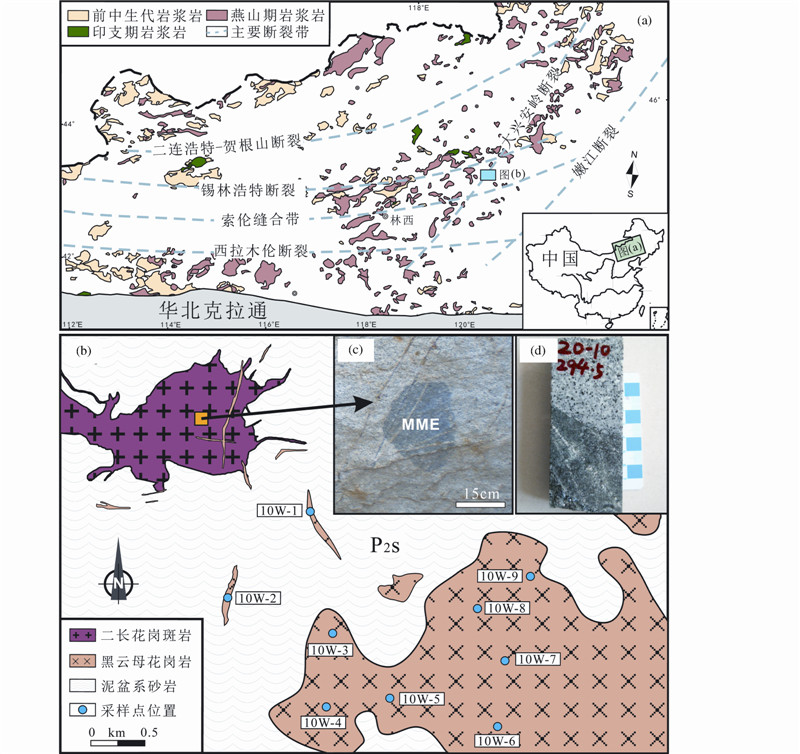 | 图 1 兴蒙造山带地质简图(a,据内蒙古自治区地质矿产局,1991修编)、敖仑花矿区地质图(b,据Ma et al., 2013修编)及含矿斑岩中的代表性暗色包体照片(c、d) Fig. 1 Geological sketch map of the Xing’an-Mongolian Orogenic Belt(a,modified after BGMRI,1991),geological map of the Aolunhua deposit(b,modified after Ma et al., 2013) and photographs of MMEs within the ore-bearing porphyry(c,d) |
在矿区东南部,出露一处不含矿的岩体(下文简称“贫矿岩体”)(图 1b),主要由黑云母花岗岩构成(面积约6km2),空间上该岩体向矿区方向延伸与石英斑岩(脉)相连。与含矿斑岩不同的是,贫矿岩体中不发育镁铁质包体。LA-ICP-MS锆石定年结果显示其形成于126Ma(邹滔等,2011),与成矿岩体同为大兴安岭地区早白垩世岩浆活动高峰期的产物。
敖仑花含矿二长花岗斑岩及其内部包体的岩石学特征已在Ma et al.(2013)中给出,结合本次新的岩相学观察,总结如下:含矿斑岩主要矿物组成包括斜长石、碱性长石、石英、黑云母和角闪石,斑晶矿物主要是自形角闪石和板状斜长石,斜长石常具有明显环带结构(图 2a);副矿物有锆石、榍石、磷灰石和磁铁矿等。暗色包体的成份以闪长质为主,具有细粒、等粒结构(图 2b),矿物组成包括角闪石、斜长石、钾长石、石英和黑云母;副矿物有榍石、锆石、磁铁矿、磷灰石等(图 2b,c)。
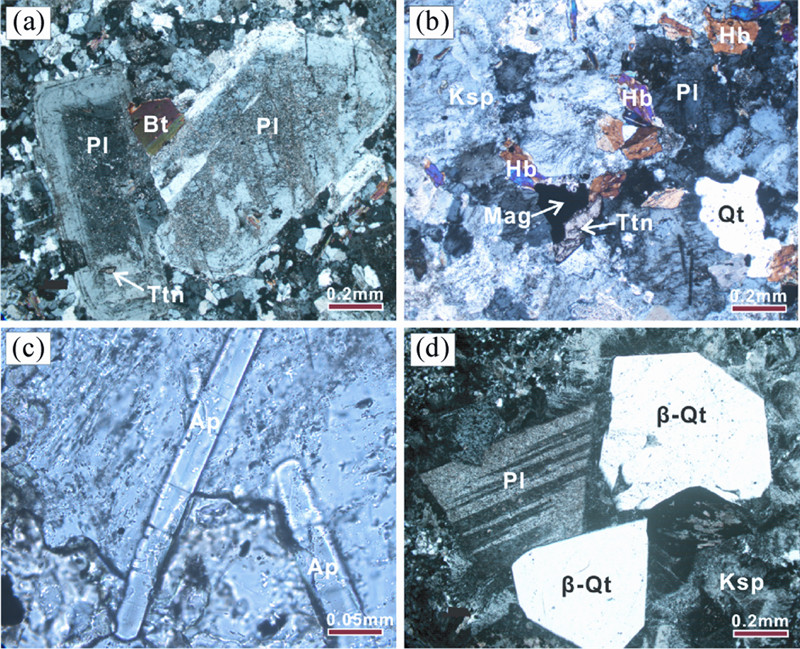 | 图 2 敖仑花矿区含矿斑岩(a)、包体(b)、包体中针状磷灰石(c)和贫矿花岗岩(d)岩相学照片 Hb-角闪石;Bt-黑云母;Pl-斜长石;Ksp-钾长石;β-Qt-β石英;Ttn-榍石;Mag-磁铁矿;Ap-磷灰石 Fig. 2 Representative petrographic photographs for the ore-bearing porphyry(a),MMEs(b),needlelike apatite in MMEs(c) and barren granite(d)of the Aolunhua deposit Hb-hornblende; Bt-biotite; Pl-plagioclase; Ksp-K-feldspar; β-Qtz-β-form quartz; Ttn-titanite; Mag-magnetite; Ap-apatite |
区内贫矿的黑云母花岗岩具有正常的花岗结构,其主要矿物包括石英(30%~40%)、钾长石(30%~45%)、斜长石(20%~25%)和黑云母(5%~8%),不含角闪石。其中黑云母多为它形充填结构,石英常以斑晶形式出现,具有高温β石英晶形(图 2d)。副矿物包括锆石、磷灰石、磁铁矿和钛铁矿等。
2 元素地球化学
选择9件黑云母花岗岩进行主、微量元素地球化学分析。测试在中国地质大学(北京)地学实验中心完成,主量元素通过Li2B4O7和LiBO2(6733)混合熔剂和加拿大Glaisse高温自动燃气熔样机制样,采用X-荧光光谱法(XRF)分析,测试条件为x射线工作电压40kV,电流60mA,分析误差在3%以内。微量和稀土元素分析采用ICP-MS方法完成,含量小于10×10-6的元素分析误差在10%,对含量超过10×10-6的元素误差为5%。
分析结果显示(表 1),敖仑花贫矿岩体具有高SiO2(74%~78%)和K2O(4.3%~4.9%),低CaO(0.2%~1.1%)、MgO(<0.3%)、TiO2和P2O5的特征,显示准铝质到过铝质性质(A/CNK=0.9~1.2)。此外,贫矿岩体具有较低的Mg#值(2~30),与实验模拟的基性下地壳熔体Mg#值一致(<40,Rapp and Watson, 1995),明显低于含矿斑岩(Mg#=45~52)(邹滔等,2011; Ma et al., 2013)。
 | 表 1 敖仑花矿区主要岩浆岩常量(wt%)和微量(×10-6)元素分析结果 Table 1 Major(wt%) and trace(×10-6)elements data for the igneous rocks of the Aolunhua deposit |
贫矿岩体相对富集轻稀土(LREE)、Th、U和Pb,亏损Sr、Ba、Eu和Ti等元素(图 3),稀土配分模式上显示出极负的Eu异常(δEu=0.05~0.2)。此外,贫矿岩体具有较低的Cr(1×10⁻⁶~6×10⁻⁶)和Ni(1.2×10⁻⁶~3.0×10⁻⁶)含量(表 1)。这些特征明显区别于含矿斑岩,例如后者Eu异常不明显(图 3),而富集Sr、Ba和Rb等大离子亲石元素(LILE),具有较高的Cr、Ni含量(邹滔等,2011; Ma et al., 2013)。在Sr/Y-Y和(La/Yb)N-YbN图解上(Martin,1986; Drummond and Defant, 1990),含矿斑岩和包体因具有较高的Sr/Y、(La/Yb)N和低的Y、YbN值,数据点基本投在埃达克岩区,而贫矿花岗岩样品则分布在正常的岛弧岩浆岩系列范围内(图 4)。
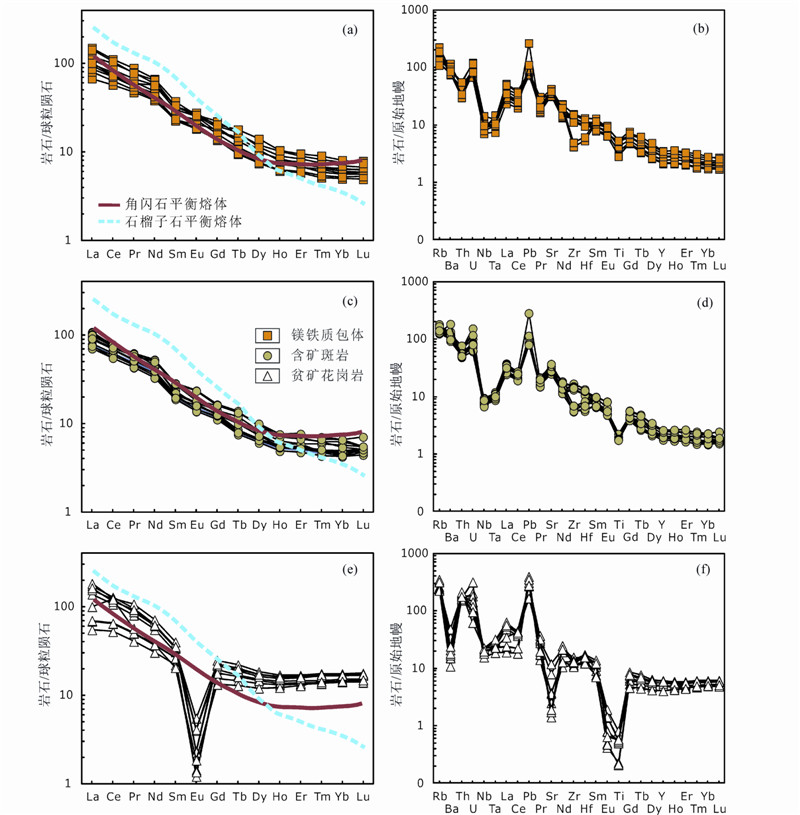 | 图 3 敖仑花矿区岩浆岩稀土和微量元素图解 矿物平衡熔体模拟引自Moyen(2009);贫矿岩体数据来自本文,其他数据邹滔等(2011)和Ma et al.(2013) Fig. 3 Chondrite-normalized rare earth elements patterns and primitive mantle-normalized trace elements diagrams of igneous rocks from the Aolunhua deposit Data for simulated melts are from Moyen(2009). Data for barren granite are from this study,data for MMEs and ore-bearing porphyries are from Zou et al.(2011) and Ma et al.(2013) |
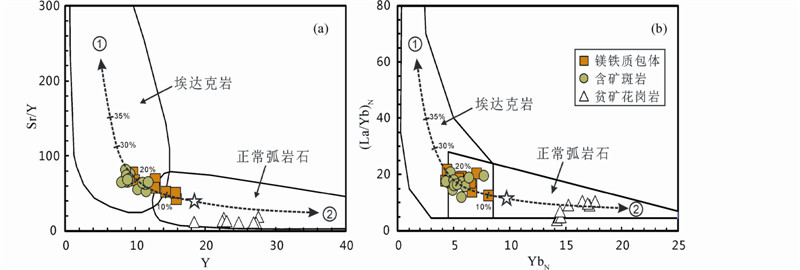 | 图 4 敖仑花矿区岩浆岩Sr/Y-Y和(La/Yb)N-YbN图解(底图据Martin,1986; Drummond and Defant, 1990) 贫矿岩体数据来自本文,其他数据邹滔等(2011)和Ma et al.(2013).角闪石(56%)+单斜辉石(31%)+榍石(5%)+磷灰石(5%)+磁铁矿(3%)分离结晶趋势线;②斜长石分离结晶趋势线 Fig. 4 Sr/Y vs. Y(a) and (La/Yb)N vs. YbN(b)discrimination diagrams for adakites and normal arc rocks from the Aolunhua deposit(after Martin,1986; Drummond and Defant, 1990) Data for barren granite are from this study,data for MMEs and ore-bearing porphyries are from Zou et al.(2011) and Ma et al.(2013). ①trends line of fractional crystallization of hornblende(56%)+clinopyroxene(31%)+titanite(5%)+apatite(5%)+magnetite(3%); ②trends line of fractional crystallization of plagioclase |
目前认为具有埃达克岩地球化学特征的岩石主要存在以下四种成因模式:(1)俯冲洋壳的熔融(Kay,1978; Defant and Drummond, 1990);(2)加厚的镁铁质下地壳熔融(Atherton and Petford, 1993; Petford and Atherton, 1996; Chung et al., 2003);(3)拆沉的下地壳熔融(Kay and Kay, 1993; Xu et al., 2002; Wang et al., 2006);(4)富水玄武质岩浆的分离结晶(Castillo et al., 1999; Macpherson et al., 2006)。显然,除了模式(4)认为高Sr/Y(或La/Yb)与岩浆演化过程有关外,其余三种模式均默认高Sr/Y是原始岩浆的固有性质(Chiaradia et al., 2012)。目前,对于非弧(non-arc)环境埃达克岩来说,最为流行的观点是加厚或拆沉的镁铁质下地壳熔融,特别是随着近年来陆内环境斑岩矿床的发现,众多学者应用该模式来解释含矿斑岩的高Sr(La)和低Y(Yb)特征(Wang et al., 2006; Hou et al., 2011)。
尽管熔融实验表明与石榴子石残留物平衡的熔体具有亏损Y和HREE(重稀土)的特点(Rapp and Watson, 1995),暗示加厚的下地壳(榴辉岩或角闪榴辉岩)似乎可以熔融出这种岩浆,然而,对于能够分异或出溶大量热液流体的含矿岩浆而言,还不得不考虑以下几个关键问题:(1)含矿岩浆是湿岩浆体系(一般H2O≥4%; Ridolfi et al., 2010),干的榴辉岩或角闪榴辉岩发生熔融是否能够生成这种足够富水的岩浆?(2)下地壳岩石中所含的成矿物质相对有限,并且其熔融形成的长英质熔体无论对金属元素(特别是Cu、Au)还是对络合元素(例如S、Cl等)的溶解度都不高(Kress,1997),因此,仅靠单一的下地壳熔融,是否能够提供成矿所需的巨量金属和络合剂?(3)成矿物质一般以硫化物的形式储集在源区,在熔融过程中硫化物若发生分解、释放金属,需要在较高的氧逸度(fO2>FMQ+2; Mungall,2002)条件下进行,而下地壳fO2较低且基本保持不变(Sillitoe,2010),难以形成较富矿的岩浆;(4)已发表的大量数据表明,含矿斑岩HREE相对于MREE(中稀土)并非十分亏损。正如图 3所示,敖仑花含矿斑岩稀土配分具有典型的凹曲式,相对亏损MREE,重稀土内部分馏不明显((Dy/Yb)N=1.3~1.8),与Moyen(2009)模拟的石榴子石平衡熔体的稀土配分模式(图 3中虚线表示)相差较大,而与角闪石平衡熔体的配分模式(实线)十分一致,说明角闪石是主要的分离相或残留相矿物,而非石榴子石。许多文献未能对含矿斑岩的凹曲式稀土配分特征给予重视,仅仅根据高Sr低Y就推测源区为含石榴子石的加厚下地壳,这种推断是不合适的。
3.2 含矿斑岩混合成因的证据及普遍性
如前文所述,敖仑花含矿斑岩中存在许多镁铁质暗色包体(MMEs)(图 1c,d)。目前认为发育在长英质岩石中的暗色包体主要有三种成因类型:(1)同源岩浆的矿物堆晶体(Noyes et al., 1983);(2)经历过部分熔融后的难熔残留体(White et al., 1999);(3)幔源岩浆包体,即代表添加到寄主长英质岩浆中的外来镁铁质岩浆(Holden et al., 1987; Chen et al., 2008; Feeley et al., 2008)。
Ma et al.(2013)通过对敖仑花含矿斑岩中暗色包体的详细研究,认为它们是幔源岩浆包体,而不是“堆晶体”或“残留体”,主要证据包括:(1)包体多呈椭圆或浑圆状(图 1c),显示塑性变形特征,暗示包体与寄主岩石曾经以岩浆状态共存;(2)包体不具有堆晶或变质结构,而是典型的岩浆结晶结构(图 2b);(3)与寄主岩石斑状结构不同,包体多为细、等粒结构,且发育针状磷灰石(图 2c),指示岩浆在混合时发生过淬冷过程;(4)暗色包体中可见具溶蚀结构的长石、石英,指示岩浆注入时曾发生过晶体交换;(5)锆石定年结果显示,包体和含矿斑岩年龄在误差范围内一致(~132Ma)(邹滔等,2011),锆石CL图像显示包体中无继承锆石,而含矿斑岩则存在继承锆石,说明两者来自不同的源区但近同时形成。如Ma et al.(2013)所述,寄主岩石含矿斑岩也保存了一系列岩浆混合的证据:(1)含矿斑岩中的斜长石存在结构和成份不平衡环带,An值从核部到边部突然升高,这与富Ca岩浆添加到低Ca岩浆中有关(Kemp,2004; Browne et al., 2006);(2)含矿斑岩Mg#值(45~52)明显高于玄武岩实验熔体Mg#值(≤40; Rapp and Watson, 1995),暗示含矿斑岩不可能单由地壳岩石熔融而来(Chen et al., 2008);(3)含矿斑岩中单颗粒锆石的核部和边部εHf值差别较大,这也与开放体系下岩浆发生混合作用有关(Griffin et al., 2002; Kemp and Hawkesworth, 2006)。
综上可知,含矿斑岩不是由单一的下地壳部分熔融而成,幔源岩浆在其形成过程中具有重要参与。含矿斑岩中普遍发育的镁铁质岩浆包体成为指示这一过程的最直观证据。值得注意的是,除了敖仑花矿床,目前国内外已有多个斑岩矿床的成矿岩体中发现了镁铁质岩浆包体,例如云南的普朗(曹殿华等,2009)和马厂箐(郭晓冬等,2012)、安徽的铜陵铜官山(杜杨松等,2004)、西藏的甲玛(彭惠娟等,2011)和驱龙(杨志明等,2008)、新疆的希勒库都克(龙灵利等,2010),以及俄罗斯的Zhireken(Berzina and Sotnikov, 2004)等斑岩矿床。因此,斑岩体中广泛发育的镁铁质暗色包体表明幔源岩浆对含矿斑岩成岩及成矿的贡献可能具有普遍意义。
3.3 含矿斑岩高Sr/Y成因
敖仑花含矿斑岩中的镁铁质包体显著富集Sr、Ba、LREE等LILE,亏损Nb、Ta、Ti等HFSE,显示出与典型弧岩浆类似的地球化学特征,加之其相对低硅、富镁(Mg#=54~63),具有中等放射性成因Nd和Hf同位素(Ma et al., 2013),说明包体岩浆很可能来自俯冲流体交代的富集岩石圈地幔,这与包体普遍发育自形角闪石、榍石和原生磁铁矿等矿物所指示的岩浆体系富H2O、高fO2性质是一致的。考虑到敖仑花矿床形成于早白垩世(~132Ma),此时华北板块和西伯利亚板块已完成碰撞对接(Ruzhentsev and Pospelov, 1992; Xiao et al., 2003),因此地幔的富集主要与陆-陆碰撞前的俯冲阶段(主要是古生代时期)古亚洲洋板片长期俯冲脱水、交代上覆岩石圈有关。
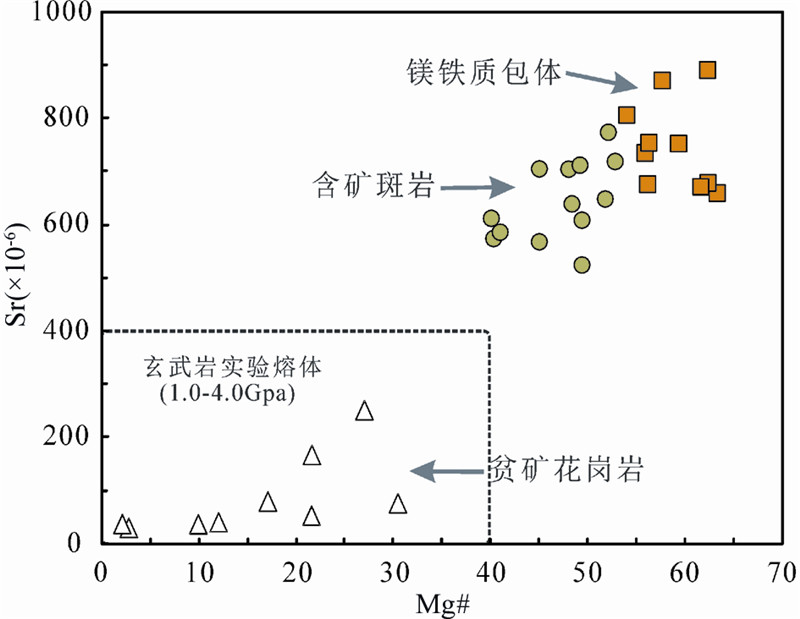
研究表明,经历过俯冲流体改造的富集岩石圈地幔发生熔融(陆内阶段再活化),容易形成极其富集LILE的玄武质岩浆(Sh and et al., 1994; Gibson et al., 1995)。以本文为例,敖仑花基性包体的Sr和Ba含量可以分别达到660×10-6~891×10-6和520×10-6~809×10-6(Ma et al., 2013)。当这种岩浆底侵至下地壳底部时诱发地壳岩石发生部分熔融形成长英质熔体,随后两者发生不同程度的混合形成高Mg的安山质混浆(Chen et al., 2013)。通过这一过程,幔源岩浆不仅向下地壳提供了足够的热使其熔融,更重要的是同时卷入到新生成的长英质岩浆中,通过混合作用改变了寄主岩浆的组成(Ma et al., 2013)。如图 5所示,敖仑花含矿斑岩富Sr、高Mg#,且两者显示出大致的正相关,表明幔源岩浆的加入造成了含矿岩浆元素的协同变化。同时,含矿斑岩HREE相对MREE分馏不明显(图 3),暗示石榴子石可能不是主要的分离相或残留相(Richards and Kerrich, 2007),与之平衡的熔体不会太富Sr(斜长石作为残留相矿物之一)。因此,含矿斑岩的高Sr特征可能主要还是与富LILE偏基性岩浆的加入有关(Ma et al., 2013)。
 | 图 5 敖仑花矿区岩浆岩Sr-Mg#图解 下地壳实验熔体数据引自Rapp and Watson(1995);贫矿岩体数据来自本文,其他数据邹滔等(2011)和Ma et al.(2013) Fig. 5 Sr-Mg# diagram for igneous rocks from the Aolunhua deposit Data for lower crustal melts are from Rapp and Watson(1995). Data for barren granite are from this study,data for MME and ore-bearing porphyries are from Zou et al.(2011) and Ma et al.(2013) |
一般基性下地壳部分熔融生成的中酸性熔体的含水量有限(Petford and Gallagher, 2001),而通过富集地幔来源的偏基性岩浆的不断加入,能够弥补寄主岩浆含水量的不足,同时改变其氧逸度条件(Chiaradia et al., 2012)。与镁铁质包体类似,敖仑花含矿斑岩中也发育自形角闪石、榍石、原生磁铁矿等矿物,显示出高fO2湿岩浆特性。在富H2O、高fO2环境下,角闪石以及榍石、磁铁矿、磷灰石和锆石等副矿物能够较早结晶(图 2b,c、图 6),而斜长石早期结晶会受到抑制(Müntener et al., 2001)。由于角闪石、榍石等矿物在安山质熔体中的DSr/Y、DLa/Yb值远小于1(Rollinson,1993),所以这些矿物的过早分离结晶会造成残余岩浆进一步向富Sr、La贫Y、Yb方向演化(模拟见图 4a,b),而斜长石分离结晶引起的效应则相反(但由于其结晶相对较晚,未能对岩浆Sr含量的减小造成明显影响),结果使得含矿斑岩具有更高的Sr/Y、La/Yb值(Ma et al., 2013)。综上可知,富集地幔起源的基性岩浆与壳源酸性岩浆发生混合及随后在富H2O、高fO2条件下发生以角闪石为主的分离结晶,可能是导致含矿斑岩具有埃达克岩地球化学特性的真正原因,即埃达克岩往往与斑岩型矿床紧密共生的根本所在。
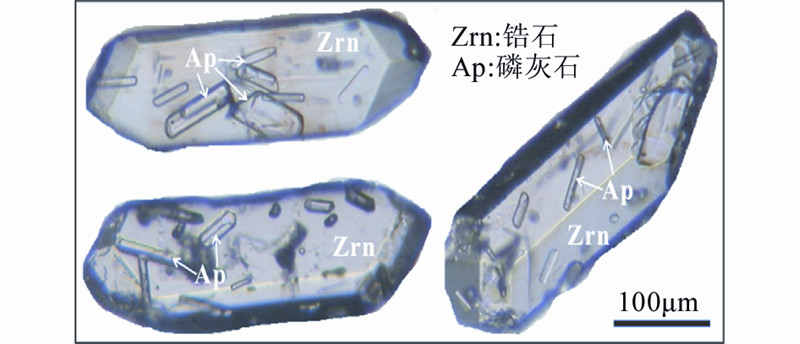 | 图 6 敖仑花含矿斑岩代表性锆石透射光照片(锆石中富含磷灰石等矿物晶体) Fig. 6 Transmission light images of representative zircons from the Aolunhua ore-bearing porphyry,showing apatite inclusions in zircons |
敖仑花贫矿岩体黑云母花岗岩的主要矿物组成包括石英、钾长石、斜长石和少量黑云母,不发育角闪石。其中黑云母呈他形充填结构,显示其较晚结晶,说明岩浆体系很晚才富水。部分石英具有高温β石英晶型(图 2d),表明岩浆相对高温的特征。岩体中副矿物除含有锆石、磷灰石外,还发育钛铁矿,指示较还原的氧逸度环境(Foley and Wheller, 1990)。全岩地球化学分析显示贫矿岩体具有较高的SiO2(74%~78%)、K2O(4.3%~4.9%)、Rb(143×10-6~222×10-6)和Pb(12×10-6~28×10-6)含量,而MgO(<0.3%)、CaO(0.2%~1.1%)和Cr(1.1×10⁻⁶~5.8×10⁻⁶)含量较低,A/CNK介于0.9~1.2之间,具有显著的Eu负异常(δEu=0.05~0.2)。此外,所有样品的Mg#值较低(2~30),Sr含量均小于400×10-6(表 1),与实验获得的玄武岩熔体Mg#值和Sr含量范围一致(图 5;Rapp and Watson, 1995)。因此,这些岩石学和地球化学特征表明,敖仑花贫矿岩体很可能是正常厚度的基性下地壳部分熔融的产物。
贫矿岩体与含矿斑岩在空间上相邻,不同的是前者出露规模明显大于后者,形成时间(126Ma)略晚于含矿斑岩(132Ma)(邹滔等,2011),与Wu et al.(2002)统计的东北地区最后一期A型花岗岩的大规模形成时间(130~120Ma)一致。因此,敖仑花贫矿岩体很可能是区内岩石圈进一步伸展,软流圈物质上涌引发下地壳更大规模活化并发生部分熔融的结果。但由于贫矿岩体中不发育镁铁质岩浆包体,岩石学和地球化学特征也均表现出普通壳源岩浆的特性,因此地幔组份可能没有或很少参与到岩浆的形成(见图 7模式图)。同时,这种相对贫水、低氧逸度的岩浆也不利于形成斑岩型矿床(Sillitoe,2010)。
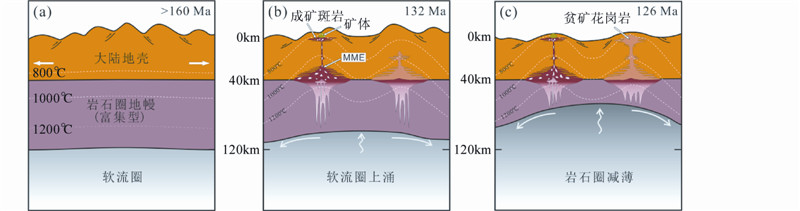 | 图 7 壳幔岩浆混合作用与陆内环境斑岩型矿床形成示意图 Fig. 7 Model diagram for magma mixing and metallogenesis of the intracontinental porphyry deposit |
斑岩Cu±Au±Mo矿床形成于富H2O、S和高fO2的岩浆体系(Mungall,2002; Richards,2011)。亲铜和亲铁元素主要以硫化物的形式储集在地幔中(Sillitoe,1979; Hamlyn et al., 1985)。在高fO2的条件下(>SSO; Mungall,2002),硫化物将发生分解,释放的S和金属元素以硫酸盐等形式进入熔体形成含矿岩浆(Jugo et al., 2001),之后随着含矿岩浆不断向地壳浅部运移,形成富含挥发分和矿质的岩浆-热液系统,伴随岩浆的侵位、结晶,含矿流体最终发生出溶、成矿(Burnham,1997)。之所以世界上绝大部分的斑岩型矿床沿俯冲带分布,正是因为俯冲带之上的弧岩浆很容易具备这样的条件(Sillitoe,2010)。
对于产于陆内环境的斑岩矿床而言,也理应满足上述类似的条件,可能的形成过程为:经历过俯冲板片脱水流体交代的岩石圈地幔,进入陆内演化阶段仍然保留了富集性质,在新的构造环境下(挤压向伸展转换等)受到活化,部分熔融形成富H2O、高fO2的玄武质岩浆(Sillitoe,2010)。这种岩浆有利于萃取和携带地幔中的金属元素进入到熔体,同时,当其底侵至地壳与壳源花岗质熔体发生混合时,形成的混浆由于继承了幔源岩浆的性质(特别是高fO2),会进一步促进地壳中的成矿元素迁移到岩浆中,最终形成富矿的斑岩岩浆-热液系统。敖仑花矿床流体包裹体C、H、O和硫化物S、Pb同位素研究表明,成矿流体也显示出地幔和地壳双重来源特征(马星华和陈斌,2011)。因此,幔源组分(岩浆、流体和矿质)在陆内环境斑岩型矿床的形成过程中具有重要贡献。对斑岩型Cu±Au±Mo矿床找矿而言,这一认识的实际意义在于,除关注斑岩体中是否含有指示岩浆富水的角闪石斑晶外(Richards et al., 2011),镁铁质岩浆包体的发育程度或许可以成为另一个判断成矿潜力的初步标志。
致谢 两位评审专家和特约编辑对本文提出了宝贵的修改建议,谨此一并表示感谢。| [1] | Atherton MP and Petford N. 1993. Generation of sodium-rich magmas from newly underplated basaltic crust. Nature, 362(6416): 144-146 |
| [2] | Berzina AN and Sotnikov VI. 2005. Contribution from mafic melt to the Zhireken porphyry Mo-Cu deposit, eastern Transbaikalia, Russia: Evidence from mafic microgranular enclaves. International Journal of Economic and Environment Geology, 1(1): 42-45 |
| [3] | Borisova AY, Pichavant M, PolvéM, Wiedenbeck M, Freydier R and Candaudap F. 2006. Trace element geochemistry of the 1991Mt. Pinatubo silicic melts, Philippines: Implications for ore-forming potential of adakitic magmatism. Geochimica et Cosmochimica Acta, 70(14): 3702-3716 |
| [4] | Browne BL, Eichelberger JC, Patino LC, Vogel TA, Uto K and Hoshizumi H. 2006. Magma mingling as indicated by texture and Sr/Ba ratios of plagioclase phenocrysts from Unzen volcano, SW Japan. Journal of Volcanology and Geothermal Research, 154(1):103-116 |
| [5] | Bureau of Geology and Mineral Resources of Inner Mongolia Autonomous Region (BGMRI). 1991. Regional Geology of Inner Mongolia Autonomous Region. Beijing: Geological Publishing House, 128-651 (in Chinese) |
| [6] | Burnham CW. 1997. Magmas and hydrothermal fluids. In: Barnes HL (ed.). Geochemistry of Hydrothermal Ore Deposits. 3rd Edition. New York: John Wiley and Sons, 63-123 |
| [7] | Cao DH, Wang AJ, Li WC, Wang GS, Li RP and Li YK. 2009. Magma mixing in the Pulang porphyry copper deposit: Evidence from petrology and element geochemistry. Acta Geologica Sinica, 83(2): 166-175 (in Chinese with English abstract) |
| [8] | Castillo PR, Janney PE and Solidum RU. 1999. Petrology and geochemistry of Camiguin Island, southern Philippines: Insights into the source of adakite and other lavas in a complex arc tectonic setting. Contributions to Mineralogy and Petrology, 134(1): 33-51 |
| [9] | Castillo PR. 2012. Adakite petrogenesis. Lithos, 134-135: 304-316 |
| [10] | Chen B, Tian W, Jahn BM and Chen ZC. 2008. Zircon SHRIMP U-Pb ages and in-situ Hf isotopic analysis for the Mesozoic intrusions in South Taihang, North China craton: Evidence for hybridization between mantle-derived magmas and crustal components. Lithos, 102(1): 118-137 |
| [11] | Chen B, Jahn BM and Suzuki K. 2013. Petrological and Nd-Sr-Os isotopic constraints on the origin of high-Mg adakitic rocks from the North China Craton: Tectonic implications. Geology, 41(1): 91-94 |
| [12] | Chiaradia M, Ulianov A, Kouzmanov K and Beate B. 2012. Why large porphyry Cu deposits like high Sr/Y magmas? Scientific Reports 685, doi: 10.1038/srep00685 |
| [13] | Chung SL, Liu DY, Ji JQ et al. 2003. Adakites from continental collision zones: Melting of thickened lower crust beneath southern Tibet. Geology, 31(11): 1021-1024 |
| [14] | Davidson JP. 1996. Deciphering mantle and crustal signatures in subduction zone magmatism. Geophysical Monograph Series, 96: 251-262 |
| [15] | Defant MJ and Drummond MS. 1990. Derivation of some modern arc magmas by melting of young subducted lithosphere. Nature, 347(6294): 662-665 |
| [16] | Defant MJ, Jackson TE, Drummond MS, De Boer JZ, Bellon H, Feigenson MD, Maury RC and Stewart RH. 1992. The geochemistry of young volcanism throughout western Panama and southeastern Costa Rica: An overview. Journal of the Geological Society (London), 149(4): 569-579 |
| [17] | Drummond MS and Defant MJ. 1990. A model for trondhjemite-tonalite-dacite genesis and crustal growth via slab melting: Archaean to modern comparisons. Journal of Geophysical Research, 95(B13): 21503-21521 |
| [18] | Du YS, Qin XL and Tian SH. 2004. Mesozoic magmatic to hydrothermal process in the Tongguanshan ore field, Tongling, Anhui Province, China: Evidence from xenoliths and their hosts. Acta Petrologica Sinica, 20(2): 339-350 (in Chinese with English abstract) |
| [19] | Feeley TC, Wilson LF and Underwood SJ. 2008. Distribution and compositions of magmatic inclusions in the Mount Helen Dome, Lassen Volcanic Center, California: Insights into magma chamber processes. Lithos, 106(1-2): 173-189 |
| [20] | Foley SF and Wheller GE. 1990. Parallels in the origin of the geochemical signatures of island arc volcanics and continental potassic igneous rocks: The role of residual titanites. Chemical Geology, 85(1-2): 1-18 |
| [21] | Gibson SA, Thompson RN, Leonardos OH, Dickin AP and Mitchell JG. 1995. The Late Cretaceous impact of the Trindade mantle plume: Evidence from large-volume, mafic, potassic magmatism in SE Brazil. Journal of Petrology, 36(1): 189-229 |
| [22] | Griffin WL, Wang X, Jackson SE, Pearson NJ and O’Reilly SY. 2002. Zircon geochemistry and magma mixing, SE China: In-situ analysis of Hf isotopes, Tonglu and Pingtan igneous complexes. Lithos, 61(3-4): 237-269 |
| [23] | Guo F, Nakamuru E, Fan WM, Kobayoshi K and Li CW. 2007. Generation of Palaeocene adakitic andesites by magma mixing, Yanji Area, NE China. Journal of Petrology, 48(4): 661-692 |
| [24] | Guo XD, Ge LS, Wang L, Wang ZH and Shi XC. 2012. Characteristics of deep-derived enclaves and its zircon LA-ICP-MS U-Pb age of Machangjing complex, Yunnan Province. Acta Petrologica Sinica, 28(5): 1413-1424 (in Chinese with English abstract) |
| [25] | Hamlyn PR, Keays RR, Cameron WE, Crawford AJ and Waldron HM. 1985. Precious metals in magnesian low-Ti lavas: Implications for metallogenesis and sulfur saturation in primary magmas. Geochimica et Cosmochimica Acta, 49(8): 1797-1811 |
| [26] | Holden P, Halliday AN and Stephens WE. 1987. Neodymium and strontium isotope content of microdiorite enclaves points to mantle input to granitoid production. Nature, 330(6143): 53-56 |
| [27] | Hou ZQ, Yang ZM, Qu XM, Meng XJ, Li ZQ, Beaudoin G, Rui ZY and Gao YF. 2009. The Miocene Gangdese porphyry copper belt generated during post-collisional extension in the Tibetan Orogen. Ore Geology Reviews, 36(1-3): 25-51 |
| [28] | Jugo PJ, Luth RW and Richards JP. 2001. Experimental determination of sulfur solubility in basaltic melts at sulfide vs. sulfate saturation: Possible implications for ore formation. AGU Fall Meeting Abstracts, 1: 5 |
| [29] | Kay RW. 1978. Aleutian magnesian andesites: Melts from subducted Pacific Ocean crust. Journal of Volcanology and Geothermal Research, 4(1-2): 117-132 |
| [30] | Kay RW and Kay MS. 1993. Delamination and delamination magmatism. Tectonophysics, 219(1-3): 177-189 |
| [31] | Keith JD, Whitney JA, Hattori K, Ballantyne GH, Christiansen EH, Barr DL, Cannan TM and Hook CJ. 1997. The role of magmatic sulfides and mafic alkaline magmas in the Bingham and Tintic Mining Districts, Utah. Journal of Petrology, 38(12): 1679-1690 |
| [32] | Kemp AIS. 2004. Petrology of high-Mg, low-Ti igneous rocks of the Glenelg River Complex (SE Australia) and the nature of their interaction with crustal melts. Lithos, 78(1-2): 119-156 |
| [33] | Kemp AIS and Hawkesworth CJ. 2006. Using hafnium and oxygen isotopes in zircons to unravel the record of crustal evolution. Chemical Geology, 226(3): 144-162 |
| [34] | Kress V. 1997. Magma mixing as a source for Pinatubo sulphur. Nature, 389(6651): 591-593 |
| [35] | Long LL, Wang YW, Wang JB, Wang HJ, Li QL, Wang SL, Pu KX, Zhang HQ and Liao Z. 2010. Magma mixing in the Xilekuduke Cu-Mo ore district in Xinjiang: Evidence from zircon U-Pb chronology. Acta Petrologica Sinica, 26(2): 449-456 (in Chinese with English abstract) |
| [36] | Lowell JD and Guilbert JM. 1970. Lateral and vertical alteration-mineralization zoning in porphyry copper ore deposits. Economic Geology, 65(4): 373-408 |
| [37] | Ma XH, Chen B, Lai Y and Lu YH. 2009. Petrogenesis and mineralization chronology study on the Aolunhua porphyry Mo deposit, Inner Mongolia, and its geological implications. Acta Petrologica Sinica, 25(11): 2939-2950 (in Chinese with English abstract) |
| [38] | Ma XH, Chen B, Lai Y, Dou JL and Zou T. 2010. Fluid exsolution, evolution and mineralization in porphyry Cu-Mo deposit: A case study from Aolunhua deposit, southern Da Xing’an Mts. Acta Petrologica Sinica, 26(5): 1397-1410 (in Chinese with English abstract) |
| [39] | Ma XH and Chen B. 2011. The source of hydrothermal fluids and mineralization in the Aolunhua porphyry Mo-Cu deposit, southern Da Hinggan Mountains: Constraints from stable (C, H, O and S) and Radiogenic Pb isotopes. Journal of Jilin University (Earth Science Edition), 41(6): 1770-1783 (in Chinese with English abstract) |
| [40] | Ma XH, Chen B and Yang MC. 2013. Magma mixing origin for the Aolunhua porphyry related to Mo-Cu mineralization, eastern Central Asian Orogenic Belt. Gondwana Research, 24(3-4): 1152-1171 |
| [41] | Macpherson CG, Dreher ST and Thirlwall MF. 2006. Adakites without slab melting: High pressure differentiation of island arc magma, Mindanao, the Philippines. Earth and Planetary Science Letters, 243(3-4): 581-593 |
| [42] | Martin H. 1986. Effect of steeper Archean geothermal gradient on geochemistry of subduction-zone magmas. Geology, 14(9): 753-756 |
| [43] | Maughan DT, Keith JD, Christiansen EH, Pulsipher T, Hattori K and Evans NJ. 2002. Contribution from mafic alkaline magmas to the Bingham porphyry Cu-Au-Mo deposit, Utah, USA. Mineralium Deposita, 37(1): 14-37 |
| [44] | Moyen JF. 2009. High Sr/Y and La/Yb ratios: The meaning of the "adakitic signature". Lithos, 112(3-4): 556-574 |
| [45] | Mungall JE. 2002. Roasting the mantle: Slab melting and the genesis of major Au and Au-rich Cu deposits. Geology, 30(10): 915-918 |
| [46] | Müntener O, Kelemen PB and Grove TL. 2001. The role of H2O during crystallization of primitive arc magmas under uppermost mantle conditions and genesis of igneous pyroxenites: An experimental study. Contributions to Mineralogy and Petrology, 141(6): 643-658 |
| [47] | Noyes HJ, Frey FA and Wones DR. 1983. A tale of two plutons: Geochemical evidence bearing on the origin and differentiation of the Red Lake and Eagle Peak Plutons, Central Sierra Nevada, California. The Journal of Geology, 91(5): 487-509 |
| [48] | Peng HJ, Wang XW, Axel M, Qin ZP, Hou L and Zhou Y. 2011. Magma mixing in Jiama Cu-polymetalic deposit of Tibet: Evidence from quartz and feldspar phenocrysts. Mineral Deposits, 30(2): 249-265 (in Chinese with English abstract) |
| [49] | Petford N and Atherton M. 1996. Na-rich partial melts from newly underplated basaltic crust: The Cordillera Blanca Batholith, Peru. Journal of Petrology, 37(6): 1491-1521 |
| [50] | Petford N and Gallagher K. 2001. Partial melting of mafic (amphibolitic) lower crust by periodic influx of basaltic magma. Earth and Planetary Science Letters, 193(3-4): 483-499 |
| [51] | Rapp RP and Watson EB. 1995. Dehydration melting of metabasalt at 8-32kbar: Implications for continental growth and crust-mantle recycling. Journal of Petrology, 36(4): 891-931 |
| [52] | Richards JP and Kerrich R. 2007. Special paper: Adakite-like rocks: Their diverse origins and questionable role in metallogenesis. Economic Geology, 102(4): 537-576 |
| [53] | Richards JP. 2009. Postsubduction porphyry Cu-Au and epithermal Au deposits: Products of remelting of subduction-modified lithosphere. Geology, 37(3): 247-250 |
| [54] | Richards JP. 2011. High Sr/Y magmas and porphyry Cu±Mo±Au deposits: Just add water. Economic Geology, 106(7): 1075-1081 |
| [55] | Ridolfi F, Renzulli A and Puerini M. 2010. Stability and chemical equilibrium of amphibole in calc-alkaline magmas: An overview, new thermobarometric formulations and application to subduction-related volcanoes. Contributions to Mineralogy and Petrology, 160(1): 45-66 |
| [56] | Rollinson HR. 1993. Using Geochemical Data: Evaluation, Presentation, Interpretation. London: Pearson Education Limited, 89 |
| [57] | Ruzhentsev SV and Pospelov II. 1992. The south Mongolian Variscan fold system. Geotectonics, 26: 383-395 |
| [58] | Shand P, Gaskarth JW, Thirlwall MF and Rock NMS. 1994. Late Caledonian lamprophyre dike swarms of Southeastern Scotland. Mineralogy and Petrology, 51(2-4): 277-298 |
| [59] | Sillitoe RH. 1972. A plate tectonic model for the origin of porphyry copper deposits. Economic Geology, 67(2): 184-197 |
| [60] | Sillitoe RH. 1979. Some thoughts on gold-rich porphyry copper deposits. Mineralium Deposita, 14(2): 161-174 |
| [61] | Sillitoe RH. 2010. Porphyry copper systems. Economic Geology, 105(1): 3-41 |
| [62] | Thiéblemont D, Stein G and Lescuyer JL. 1997. Epithermal and porphyry deposits: The adakite connection. Earth and Planetary Sciences Letters, 325: 103-109 |
| [63] | Wang Q, Xu JF, Jian P, Bao ZW, Zhao ZH, Li CF, Xiong XL and Ma JL. 2006. Petrogenesis of adakitic porphyries in an extensional tectonic setting, Dexing, South China: Implications for the genesis of porphyry copper mineralization. Journal of Petrology, 47(1): 119-144 |
| [64] | White AJR, Chappell BW and Wyborn D. 1999. Application of the restite model to the Deddick granodiorite and its enclaves: A reinterpretation of the observations and data of Maas et al. (1997). Journal of Petrology, 40(3): 413-421 |
| [65] | Wu FY, Sun DY, Li HM, Jahn, BM and Wilde SA. 2002. A-type granites in northeastern China: Age and geochemical constraints on their petrogenesis. Chemical Geology, 187(1): 143-173 |
| [66] | Xiao WJ, Windley BF, Hao J and Zhai MG. 2003. Accretion leading to collision and the Permian Solonker suture, Inner Mongolia, China: Termination of the central Asian orogenic belt. Tectonics, 22(6), 1069, doi: 10. 1029/2002TC001484 |
| [67] | Xu JF, Shinjo R, Defant MJ, Wang Q and Rapp RP. 2002. Origin of Mesozoic adakitic intrusive rocks in the Ningzhen area of East China: Partial melting of delaminated lower continental crust? Geology, 30(12): 1111-1114 |
| [68] | Yang ZM, Hou ZQ, Song YC, Li ZQ, Xia DX and Pan FC. 2008. Qulong superlarge porphyry Cu deposit in Tibet: Geology, alteration and mineralization. Mineral Deposits, 27(3): 279-318 (in Chinese with English abstract) |
| [69] | Zeng QD and Liu JM. 2010. Zircon SHRIMP U-Pb dating and geological significance of the granite porphyry from the Banlashan porphyry molybdenum deposit in Xilamulun molybdenum metallogenic belt. Journal of Jilin University (Earth Science Edition), 40(4): 828-834 (in Chinese with English abstract) |
| [70] | Zhang LC, Wu HY and Xiang P. 2010. Ore-forming processes and mineralization of complex tectonic system during the Mesozoic: A case from the Xilamulun Mo-Cu metallogenic belt. Acta Petrologica Sinica, 26(5): 1351-1362 (in Chinese with English abstract) |
| [71] | Zhang Q, Wang YL, Zhang FQ, Wang Q and Wang Y. 2002. Adakite and porphyry copper deposit. Geology and Mineral Resources of South China, (3): 85-90 (in Chinese with English abstract) |
| [72] | Zou T, Wang JB, Wang YW, Yuan JM, Lin LJ and Dou JL. 2011. Geochemical characteristics of the granitic rocks in the Aolunhua porphyry copper-molybdenum deposit, Inner Mongolia. Acta Geologica Sinica, 85(2): 213-223 (in Chinese with English abstract) |
| [73] | 曹殿华, 王安建, 李文昌, 王高尚, 李瑞萍, 李以科. 2009. 普朗斑岩铜矿岩浆混合作用: 岩石学及元素地球化学证据. 地质学报, 83(2): 166-175 |
| [74] | 杜杨松, 秦新龙, 田世宏. 2004. 安徽铜陵铜官山矿区中生代岩浆-热液过程: 来自岩石包体及其寄主岩的证据. 岩石学报, 20(2): 339-350 |
| [75] | 郭晓冬, 葛良胜, 王梁, 王治华, 史小翠. 2012. 云南马厂菁岩体中深远包体特征及其锆石LA-ICP-MS U-Pb年龄. 岩石学报, 28(5): 1413-1424 |
| [76] | 龙灵利, 王玉往, 王京彬, 王莉娟, 李秋立, 王书来, 蒲克信, 张会琼, 廖震. 2010. 新疆希勒库都克铜钼矿区岩浆混合作用:来自锆石U-Pb年代学的证据. 岩石学报, 26(2): 449-456 |
| [77] | 马星华, 陈斌, 赖勇, 鲁颖淮. 2009. 内蒙古敖仑花斑岩钼矿床成岩成矿年代学及地质意义. 岩石学报, 25(11): 2939-2950 |
| [78] | 马星华, 陈斌, 赖勇, 窦金龙, 邹滔. 2010. 斑岩铜钼矿床成矿流体的出溶、演化与成矿: 以大兴安岭南段敖仑花矿床为例. 岩石学报, 26(5): 1397-1410 |
| [79] | 马星华, 陈斌. 2011. 大兴安岭南段敖仑花斑岩钼(铜)矿床成矿流体来源与成矿作用:稳定同位素C、H、O、S和放射性Pb同位素约束. 吉林大学学报(地球科学版), 41(6): 1770-1783 |
| [80] | 内蒙古自治区地质矿产局. 1991. 内蒙古自治区区域地质志. 北京: 地质出版社, 128-651 |
| [81] | 彭惠娟, 汪雄武, Axel M, 秦志鹏, 侯林, 周云. 2011. 西藏甲玛铜多金属矿区成矿斑岩的岩浆混合作用: 石英及长石斑晶新证据. 矿床地质, 30(2): 249-265 |
| [82] | 杨志明, 侯增谦, 宋玉财, 李振清, 夏代详, 潘凤雏. 2008. 西藏驱龙超大型斑岩铜矿床: 地质、蚀变与成矿. 矿床地质, 27(3): 279-318 |
| [83] | 曾庆栋, 刘建明. 2010. 西拉木伦钼矿带半拉山斑岩钼矿床花岗斑岩锆石SHRIMP U-Pb测年及其地质意义. 吉林大学学报(地球科学版), 40(4): 828-834 |
| [84] | 张连昌, 吴华英, 相鹏. 2010. 中生代复杂构造体系的成矿过程与成矿作用: 以华北大陆北缘西拉木伦钼铜多金属成矿带为例. 岩石学报, 26(5): 1351-1362 |
| [85] | 张旗, 王元龙, 张福勤, 王强, 王焰. 2002. 埃达克岩与斑岩铜矿. 华南地质与矿产, (3): 85-90 |
| [86] | 邹滔, 王京彬, 王玉往, 袁继明, 林龙军, 窦金龙. 2011. 内蒙古敖仑花斑岩铜钼矿床花岗岩类地质地球化学特征. 地质学报, 85(2): 213-223 |