 2014, Vol. 30


2. 中国海洋大学海洋地球科学学院, 青岛 266003
2. College of Marine Geosciences, Ocean University of China, Qingdao 266003, China
华北板块北缘东段是否存在早古生代陆缘增生带是近年来地学界研究的热点问题之一,一些学者曾认为吉林省中东部地区出露的一些镁铁-超镁铁质岩为蛇绿岩残片,并结合古生代地质体的时空分布特征将吉林中东部地区划分出早古生代陆缘增生带和晚古生代陆缘增生带,认为华北板块北缘东段古生代陆缘增生带和佳木斯地块西南缘古生代陆缘增生带具有相向增生的特点(陈作文等,1982; 田昌烈和杨芳林,1983; 王东方等,1992; 赵春荆等,1996)。然而,近年来,华北板块北缘东段的早古生代陆缘增生带遭到部分学者的质疑,这主要表现在蛇绿岩和火成岩研究方面。首先,华北板块北缘东段是否存在蛇绿岩,是地学界一直争论的焦点问题。由于植被的覆盖和后期构造破坏,那些前人曾确定为蛇绿岩的地质体,多残缺不全,不具备完整的蛇绿岩层序,推测多为造山作用的产物(张旗,1992; 彭玉鲸和王占福,1997; Wu et al., 2004);另外,随着锆石U-Pb年代学测试方法的改进和应用,许多作为增生带存在重要证据的早古生代地层(如呼兰群、下二台群盘岭组)和花岗质侵入体(大玉山岩体和黄泥岭岩体等)实际上是晚古生代或中生代的产物(张艳斌等,2002; 孙德有等,2004; 王志伟等,2013)。近年来,虽然华北板块北缘东段晚古生代火成岩的研究已经取得了部分成果(曹花花等,2012; Cao et al., 2013; 王志伟等,2013; 王子进等,2013),但由于到目前为止在该地区尚未发现早古生代火成岩,从而造成人们对华北板块北缘东段早古生代构造演化历史的认识一直处于空白。作者在吉林省中部地区进行野外地质调查过程中,在张家屯组底部发现了与张家屯组呈沉积接触关系的早古生代英云闪长岩,进一步通过岩相学、锆石U-Pb年代学、地球化学以及锆石Hf同位素的分析研究,对其源区性质及构造背景进行了探讨,本文的研究对于华北板块北缘东段早古生代构造演化历史的研究提供了重要资料。 1 地质背景与样品描述
研究区位于吉林省中部地区永吉县的西北部。大地构造上位于长春-吉林-蛟河对接带以南(赵春荆等,1996),松辽盆地以东,敦化-密山断裂以西,华北板块北部槽台边界断裂——开原-山城镇断裂的北部,研究区属于张广才岭带的南部(彭玉鲸和陈跃军,2007)。该区出露的最老地层——晚志留世-早泥盆世张家屯组主要分布于张家屯村附近(廖卫华等,1995),区内还广泛分布着二叠纪范家屯组、大河深组和杨家沟组、侏罗纪小蜂蜜顶子组、一拉溪组和南楼山组以及晚古生代-中生代的花岗质侵入体(吉林省地质矿产局,1988)。本文研究的花岗岩主要分布于张家屯村西山上,仅在山脊及南坡产出,出露面积约100m2(图 1),岩体周围被晚志留世-早泥盆世张家屯组地层覆盖,与张家屯组呈沉积接触关系。张家屯组由底部的砾岩、中部的含砾砂岩及上部的粉砂岩和红色凝灰质粉砂岩组成,底部砾岩中见有花岗质砾石、火山岩砾石以及硅质岩砾石等,其中含有珊瑚和腕足类化石,据生物化石研究结果认为张家屯组形成于晚志留世-早泥盆世(廖卫华等,1995)。张家屯英云闪长岩被后期的辉绿岩墙侵入,在接触带附近的辉绿岩中残留有英云闪长岩中的粗粒长石和石英等矿物颗粒,同时在英云闪长岩的产出区域附近见有碳酸盐岩,但与张家屯英云闪长岩的接触关系不明。
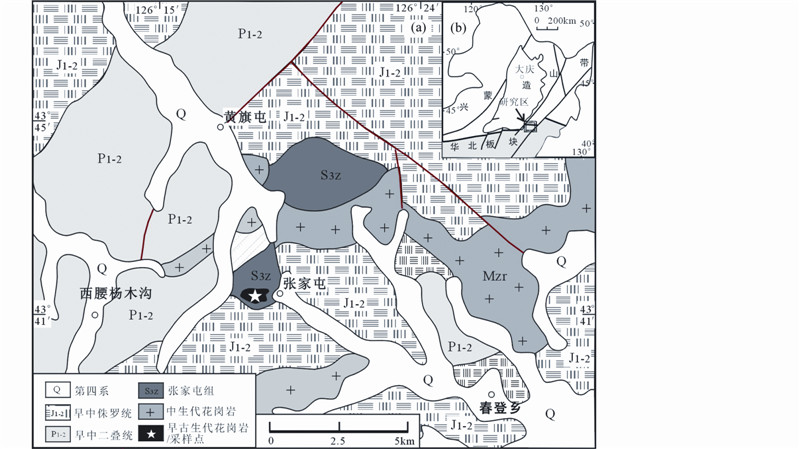 | 图 1 研究区地质略图(a)和构造分区图(b) Fig. 1 Geological sketch map of the study area(a) and tectonic division map(b) |
张家屯英云闪长岩样品的岩相学特征如下(图 2):
 | 图 2 张家屯英云闪长岩显微照片 (a、c)为单偏光下;(b、d)为正交偏光下.Q-石英;Pl-斜长石;Bi-黑云母 Fig. 2 Microphotographs showing mineral compositions and textures of the Zhangjiatun tonalites (a,c)under plane-polarized light;(b,d)under cross-polarized light. Q-quartz; Pl-plagioclase; Bi-biotite |
灰白色不等粒英云闪长岩(12JL4-1,GPS坐标:N126°17.674′;E43°41.345′):风化面肉红色,新鲜面灰白色,不等粒结构,块状构造。主要矿物组成:石英,他形粒状,粒度1~3mm,含量约25%;斜长石,自形-半自形板状,可见聚片双晶,粒度2~5mm,含量约66%,部分斜长石显示绿帘石化蚀变,绿帘石呈粒状,粒度1mm左右,暗色矿物均已绿泥石化,个别颗粒显示出片状的特点,含量约8%。副矿物(1%)包括锆石、磷灰石、铁钛氧化物(钛铁矿和钛磁铁矿)等。
2 分析方法
锆石LA-ICP-MS U-Pb同位素分析在中国地质大学(武汉)地质过程与矿产资源国家重点实验室的Agilent 7500a ICP-MS仪器上采用标准测定程序进行,详细的实验原理和流程见(Liu et al., 2008; Liu et al., 2010a)。应用标准锆石91500进行分馏校正,标准锆石TEMORA 1作为未知样品测定获得的年龄为415±4Ma(MSWD=0.112,n=24),该锆石的ID-TIMS 年龄为416.75±0.24Ma(Black et al., 2003)。激光束的束斑为32μm。实验获得的数据采用(Andersen,2002)的方法进行同位素比值的校正,以扣除普通Pb的影响,然后用ISOPLOT宏程序进行年龄协和图的生成和处理(Ludwig,2003)。
锆石Hf同位素测试在中国地质大学(武汉)地质过程与矿产资源国家重点实验室配有193nm激光取样系统的Neptune多接收电感耦合等离子体质谱仪(MC-ICP-MS)上进行,仪器的运行条件和详细的分析流程见(Liu et al., 2010b)。测定时用锆石国际标样91500作外标,分析时激光束直径为44μm,所用的激光脉冲速率为6~8Hz,激光束脉冲能量为100mJ。
主量和微量元素分析均在中国地质大学(武汉)地质过程与矿产资源国家重点实验室完成(Liu et al., 2008,2010a)。主要元素采用X-荧光光谱法(XRF)分析;微量元素的分析则采用电感耦合等离子质谱(ICP-MS)分析方法。对国际标样BCR-2(玄武岩)、BHVO-1(玄武岩)和AGV-1(安山岩)的分析结果表明,主要元素分析精度和准确度优于5%,微量元素的分析精度和准确度优于10%。
3 分析结果
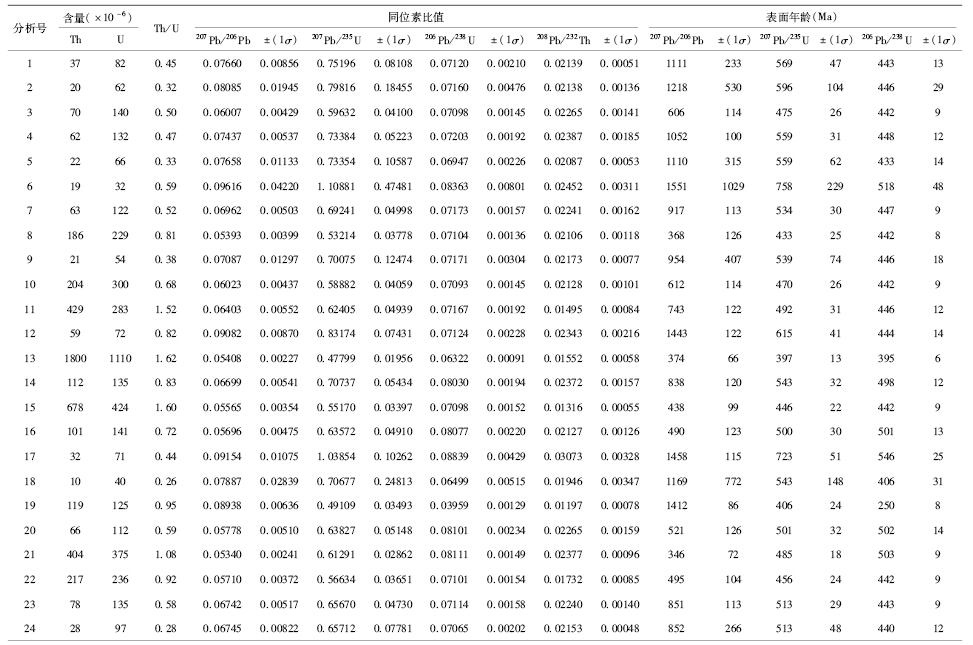
张家屯英云闪长岩的LA-ICP MS锆石U-Pb定年结果见表 1,锆石CL图像见图 3,英云闪长岩的主量和微量元素分析结果见表 2,锆石Hf同位素分析结果见表 3。
 | 表 1 张家屯英云闪长岩LA-ICP MS锆石U-Pb分析结果 Table 1 LA-ICP MS zircon U-Pb isotope data for the Zhangjiatun tonalities in the central Jilin Province |
| 表 2 吉林中部地区张家屯英云闪长岩主量(wt%)及微量元素(×10-6)分析数据 Table 2 Major(wt%) and trace(×10-6)element data for the Zhangjiatun tonalite in the central Jilin Province |
| 表 3 吉林中部地区张家屯英云闪长岩锆石Lu-Hf同位素分析结果 Table 3 Lu-Hf isotopic analyzed data of zircons from the Zhangjiatun tonalite in the central Jilin Province |
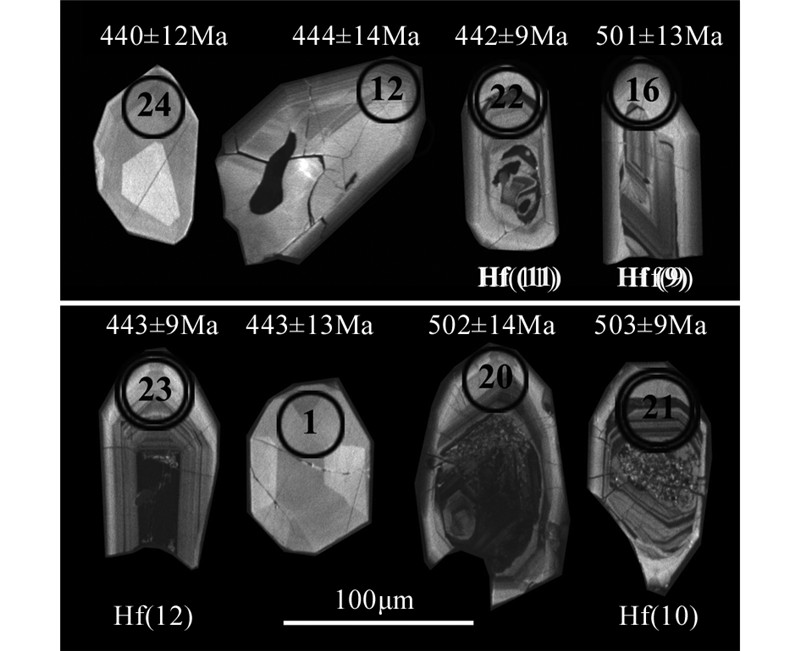 | 图 3 张家屯英云闪长岩中部分锆石的CL图像 图中大圈和Hf(9,11,12)分别代表锆石Hf同位素的分析位置及分析点号,小圈及内部数字代表锆石年龄的分析位置及点号 Fig. 3 CL images of selected zircons from the Zhangjiatun tonalites |
张家屯英云闪长岩的锆石CL图像显示(图 3),锆石分为两大类,一类锆石具有明显的核边结构,核部显示后期水热变质特征,边部具有岩浆成因振荡生长环带,锆石的Th和U的含量较高(表 1);另一类锆石没有核边结构,从核部到边部色调均匀,并具有岩浆成因的生长环带,锆石的Th和U的含量较低。张家屯英云闪长岩中锆石的Th和U的含量分别介于10×10-6~1800×10-6和32×10-6~1110×10-6,Th/U比值介于0.26~1.62(表 1),上述特征显示所分析的锆石均为岩浆成因。位于谐和线及其附近的测点的206Pb/238U年龄可分为两组(图 4):较老的一组206Pb/238U年龄介于498±12Ma和503±9Ma,4个测点的加权平均年龄为501±11Ma(MSWD=0.038),该年龄代表了研究区早期岩浆作用的时代;较年轻的一组206Pb/238U年龄介于440±12Ma和448±12Ma,14个测点的加权平均年龄为443±5Ma(MSWD=0.085),该年龄代表了张家屯英云闪长岩的形成时代,即晚奥陶世-早志留世。谐和线最下部395±6Ma的年龄的打点位置打到了变质增生边上,给出的是混合年龄,该年龄明显比岩浆结晶年龄年轻(图 4)。
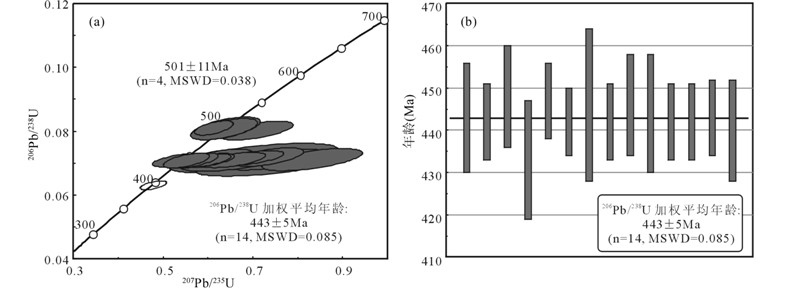 | 图 4 张家屯英云闪长岩锆石U-Pb谐和图(a)和频数图(b) Fig. 4 Concordia diagram(a) and frequency diagram(b)showing LA-ICP-MS zircon U-Pb dating result for the Zhangjiatun tonalites |
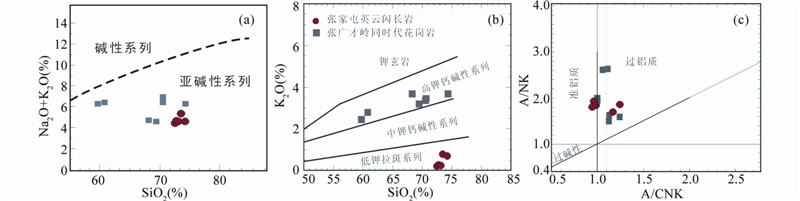 | 图 5 张家屯英云闪长岩主量元素判别图解 (a)-硅碱图;(b)-硅钾图;(c)-A/CNK-A/NK图解 Fig. 5 Discrimination diagrams of major elements for the Zhangjiatun tonalities (a)-SiO2 vs. Na2O+K2O diagram;(b)-SiO2 vs. K2O diagram;(c)-A/CNK vs. A/NK diagram |
张家屯英云闪长岩稀土总量介于15.3×10⁻⁶~23.4×10⁻⁶,具有轻稀土呈右倾型[(La/Sm)N=3.65~4.90]和平坦的重稀土分配型式[(Gd/Yb)N=0.94~1.03],并显示明显的正铕异常(Eu/Eu*=1.85~2.59,图 6a)。微量元素蛛网图显示,具有明显的大离子亲石元素Rb、Ba、Th和Sr的富集以及高场强元素Nb和Ta的亏损(图 6b)。张家屯英云闪长岩以较低的稀土和微量元素丰度与张广才岭 同时代的花岗岩相区别(Wang et al., 2012)。
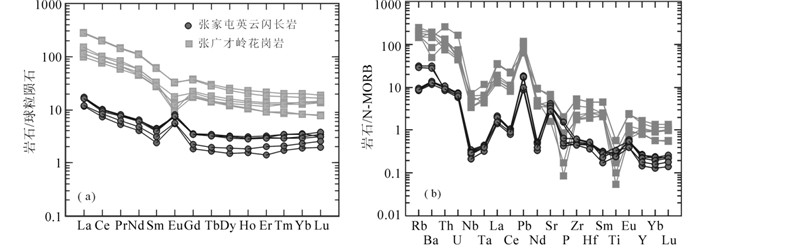 | 图 6 张家屯英云闪长岩球粒陨石标准化稀土元素配分图(a,标准化值据Henderson,1984)和正常大洋中脊标准化微量元素蛛网图(b,标准化值据Sun and McDonough, 1989) Fig. 6 Chondrite-normalized REE patterns(a,normalization values after Henderson,1984) and N-MORB-normalized trace element spider diagrams(b normalization values after Sun and McDonough, 1989)for the Zhangjiatun tonalities |
张家屯英云闪长岩的Hf同位素分析结果见表 3,样品的176Lu/177Hf值变化较大(0.001061~0.005838),176Hf/177Hf值介于0.282815~0.282856,εHf(t)值介于9.92~13.6,从501Ma到443Ma,其εHf(t)值逐渐降低,显示早期岩浆事件的源区亏损较强(图 7)。其单阶段亏损地幔模式年龄介于567~674Ma,两阶段亏损地幔模式年龄介于648~911Ma。其εHf(t)值明显高于同时代的张广才岭花岗岩(图 7,Wang et al., 2012)。
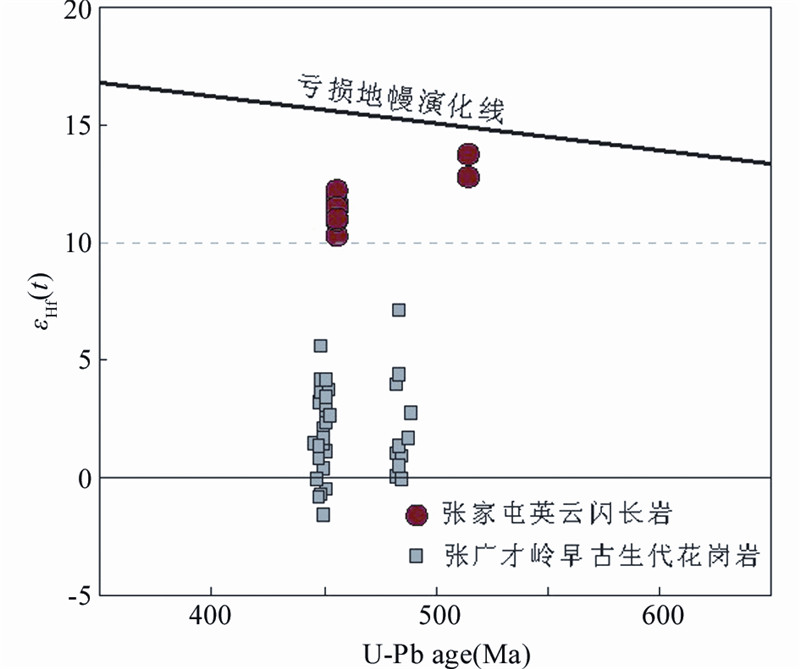 | 图 7 张家屯英云闪长岩锆石Hf同位素特征 Fig. 7 Zircon Hf isotopic compositions for the Zhangjiatun tonalites |
对于张家屯英云闪长岩的形成时代,目前为止没有同位素定年资料,前人仅根据与其呈沉积接触关系的张家屯组地层中化石的时代(晚志留世-早泥盆世),将其时代确定为加里东期(李东津,1997)。本文中锆石具有岩浆成因的生长环带,它们的Th/U比值介于0.26~1.62,暗示这些锆石为岩浆成因,其定年结果应代表了岩浆事件的时代,因此,张家屯英云闪长岩(443±5Ma)的产出表明吉林中部地区存在晚奥陶世-早志留世岩浆事件。这与张广才岭地区早古生代花岗岩的形成时代(443~451Ma)相对应(Wang et al., 2012)。同时501Ma的捕获锆石的年龄暗示该地区可能还存在寒武纪晚期的岩浆事件。
4.2 张家屯英云闪长岩的源区特征
张家屯英云闪长岩虽具有轻稀土元素略富集的特征,但其K2O和不相容元素含量偏低,暗示来源于强烈亏损的源区,这也被较高的εHf(t)值所证实。尽管张家屯英云闪长岩的Na2O的含量较高,Yb的含量较低,但其较低的Sr含量和Sr/Y比值以及Al2O3含量不同于洋壳部分熔融形成的埃达克岩(Defant and Drummond, 1990)。张家屯英云闪长岩极低的K2O和TiO2含量、微量元素丰度以及低的(La/Yb)N值也明显不同于加厚陆壳环境或俯冲带环境源区残留石榴石和角闪石条件下(≥8kbar)变玄武质岩石部分熔融的熔体成份(Rapp et al., 1991; Rapp and Watson, 1995)。岩相学上,张家屯英云闪长岩矿物组成与大洋斜长花岗岩相似(Le Maitre et al., 1989),同时张家屯英云闪长岩也与大洋斜长花岗岩具有相似的地球化学特征(图 8,Barker et al., 1985; Rapp et al., 1991; Koepke et al., 2004,2007)。关于大洋斜长花岗岩的成因,主要有以下四种观点:(1)大洋中脊拉斑玄武质岩浆(MORB型)结晶分异成因(Coleman and Donato, 1979; Aldiss,1981; Floyd et al., 1998);(2)含水流体存在条件下,堆晶辉长岩高温(>900℃)低压下部分熔融成因(Koepke et al., 2004,2007);(3)与大洋拉斑玄武质熔体有关的不混熔成因(Dixon and Rutherford, 1979);(4)变玄武质岩石部分熔融成因(Gerlach et al., 1981; Pedersen and Malpas, 1984; Kimura et al., 2002)。首先,张家屯英云闪长岩具有轻稀土和大离子亲石元素富集,高场强元素及重稀土亏损的特征,这明显不同于传统意义上的大洋斜长花岗岩(大洋拉斑玄武质岩浆结晶分异成因)。其次,张家屯英云闪长岩的具有低TiO2(小于1%)、K2O、P2O5含量以及FeOT/MgO比值(图 8),排除了其它玄武质岩石(或变玄武质岩石)部分熔融形成的长英质岩石或不混熔成因的高硅侵入岩的成因模式。张家屯英云闪长岩的地球化学特征与大洋岩石圈中堆晶辉长岩富水条件和高温低压条件下部分熔融形成的斜长花岗岩的地球化学特征相似(Koepke et al., 2004,2007),具有MORB型亏损的Hf同位素特征也说明了这一点。其大离子亲石元素富集和高场强元素亏损的特征可能与俯冲流体的加入有关。基于上述分析认为,张家屯英云闪长岩的原始熔体可能来源于有俯冲流体参与的高温低压条件下大洋堆晶辉长岩的部分熔融。
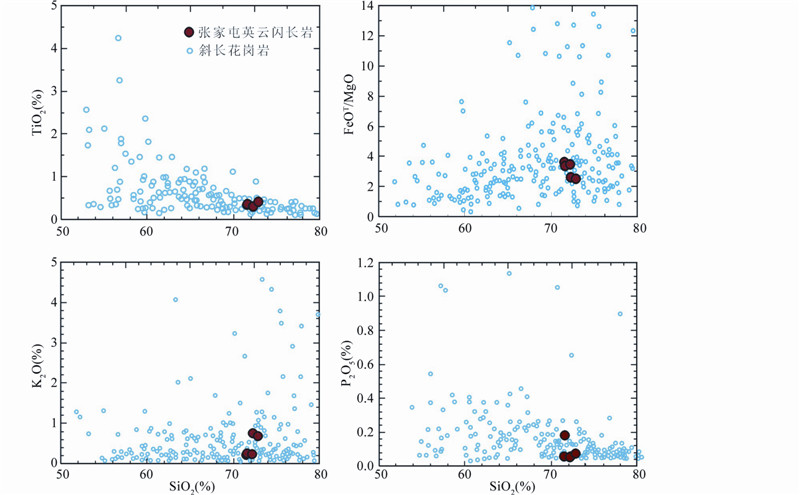 | 图 8 张家屯英云闪长岩TiO2、FeOT/MgO、K2O和P2O5与SiO2相关图 图中斜长花岗岩主量元素数据来自Koepke et al.(2007)中相关文献 Fig. 8 Plots of SiO2 vs. TiO2,FeOT/MgO,K2O and P2O5 for the Zhangjiatun tonalities Major element data of plagiogranites from the relative references in Koepke et al.(2007) |
斜长花岗岩可以产出于多种构造环境中(如大洋中脊附近以及超俯冲带的弧前、弧内裂谷和弧后环境)。张家屯英云闪长岩具有Nb和Ta亏损以及轻稀土富集的特征,暗示与俯冲带环境的亲缘性,张家屯英云闪长岩中锆石的Th、U含量变化较大(表 1),锆石核部显示退变质现象,表明源区可能经历了强烈的高温流体作用,暗示张家屯英云闪长岩可能形成于构造活动带,其正铕异常和平坦的重稀土分配型式暗示为低压条件下的部分熔融,源区不存在石榴石的残留,说明张家屯英云闪长岩可能形成于俯冲带的弧前环境(Shervais,2001)。其年轻的Hf模式年龄表明源岩——堆晶辉长岩的时代略早于张家屯英云闪长岩。上述特征说明晚奥陶世-早志留世研究区可能存在大洋板块的俯冲作用,同时也说明至少在早志留世之前,研究区存在古大洋。那么,到底是洋陆俯冲背景下的大陆边缘环境还是洋洋俯冲背景下的岛弧环境?首先,张家屯英云闪长岩较低K2O和微量元素含量以及强烈亏损的Hf同位素组成(最高为12.7),暗示源区主要由亏损地幔来源的、新增生的物质组成。其次,区域上同时代的桃山组笔石页岩具有弧间盆地的沉积特征,另外,其地球化学特征也与弧前环境相似,这些特点都明显不同于同时代的张广才岭早古生代花岗岩,暗示张家屯英云闪长岩形成于岛弧环境(Floyd et al., 1998; Shervais,2001; Stern,2002; Dilek and Flower, 2003; Dilek and Furnes, 2011)。前人研究表明,与张家屯英云闪长岩呈沉积接触关系的晚志留世-早泥盆世张家屯组具有磨拉石建造的沉积特征,吉中地区晚志留世-早泥盆世张家屯组、二道沟组和小绥河组的沉积建造特征以及古生物特征可与内蒙古中部的西别河组(Upper Ludlovian)进行对比(王友勤等,1997; Johnson et al., 2001; 张允平等,2010),而且,张家屯组、二道沟组和小绥河组中的珊瑚和腕足动物化石显示为华北北缘型(廖卫华等,1995; 赵春荆等,1996),上述事实证明华北板块北缘东段早古生代陆缘增生带是存在的,晚奥陶世-早志留世研究区处于岛弧环境,晚志留世-早泥盆世可能发生了弧陆或陆陆碰撞,形成了具磨拉石建造特点的西别河组沉积,西别河组与下伏加里东期花岗岩之间区域性的角度不整合的接触关系是加里东运动在华北板块北缘的体现(张允平等,2010)。
5 结论
根据张家屯英云闪长岩的锆石U-Pb定年结果、全岩主量和微量元素以及锆石Hf同位素特征,同时结合前人的研究成果,得出如下结论:
(1)LA-ICP MS 锆石U-Pb定年结果显示,张家屯英云闪长岩形成于443±5Ma,即晚奥陶世-早志留世。
(2)张家屯英云闪长岩的矿物组成和地球化学特征与超俯冲带环境下的大洋斜长花岗岩相似,来源于俯冲流体参与下大洋堆晶辉长岩在低压高温条件下的部分熔融。
(3)张家屯英云闪长岩形成于洋壳俯冲背景下的岛弧环境,暗示华北板块北缘东段早古生代陆缘增生带的存在。
致谢 衷心感谢中国地质大学(武汉)地质过程与矿产资源国家重点实验室在锆石LA-ICP-MS U-Pb年龄测定和锆石Hf同位素分析,以及全岩主量和微量元素测试过程中给予的帮助。| [1] | Aldiss DT. 1981. Plagiogranites from the ocean crust and ophiolites. Nature, 289(5798): 577-578 |
| [2] | Andersen T. 2002. Correction of common lead in U-Pb analyses that do not report 204Pb. Chemical Geology, 192(1-2): 59-79 |
| [3] | Barker F, McLellan EL and Plafker G. 1985. Partial melting of amphibolite to trondhjemite at Nunatak Fiord, St. Elias Mountains, Alaska. Geological Society of America Abstracts with Programs, 17(7): 518-519 |
| [4] | Black LP, Kamo SL, Allen CM et al. 2003. TEMORA 1: A new zircon standard for Phanerozoic U-Pb geochronology. Chemical Geology, 200(1-2): 155-170 |
| [5] | Bureau of Geology and Mineral Resources Jilin Province (BGMRJ). 1988. Regional Geology of Jilin Province. Beijing: Geological Publishing House (in Chinese) |
| [6] | Cao HH, Xu WL, Pei FP et al. 2012. Permian tectonic evolution of the eastern section of the northern margin of the North China Plate: Constraints from zircon U-Pb geochronology and geochemistry of the volcanic rocks. Acta Petrologica Sinica, 28(9): 2733-2750 (in Chinese with English abstract) |
| [7] | Cao HH, Xu WL, Pei FP et al. 2013. Zircon U-Pb geochronology and petrogenesis of the Late Paleozoic-Early Mesozoic intrusive rocks in the eastern segment of the northern margin of the North China Block. Lithos, 170-171: 191-207 |
| [8] | Chen ZW, Zhao CJ, Li ZT et al. 1982. The Caledonian granite belt in southern Jilin Province. Bull. Shenyang Inst. Geol. Min. Res. Chinese Acad. Geol. Sci., (3): 29-46 (in Chinese with English abstract) |
| [9] | Coleman RG and Donato MM. 1979. Oceanic plagiogranite revisited. In: Barker F (ed.). Trondhjemites, Dacites, and Related Rocks. Amsterdam: Elsevier, 149-168 |
| [10] | Defant MJ and Drummond MS. 1990. Derivation of some modern arc magmas by melting of young subducted lithosphere. Nature, 347(6294): 662-665 |
| [11] | Dilek Y and Flower MFJ. 2003. Arc-trench rollback and forearc accretion: 2. A model template for ophiolites in Albania, Cyprus, and Oman. In: Dilek Y and Robinson PT (eds.). Ophiolites in Earth History. London: Geological Society, London, Special Publication, 218: 43-68 |
| [12] | Dilek Y and Furnes H. 2011. Ophiolite genesis and global tectonics: Geochemical and tectonic fingerprinting of ancient oceanic lithosphere. Geological Society of America Bulletin, 123(3-4): 387-411 |
| [13] | Dixon S and Rutherford MJ. 1979. Plagiogranites as late-stage immiscible liquids in ophiolite and mid-ocean ridge suites: An experimental study. Earth and Planetary Science Letters, 45(1): 45-60 |
| [14] | Floyd PA, Yaliniz MK and Goncuoglu MC. 1998. Geochemistry and petrogenesis of intrusive and extrusive ophiolitic plagiogranites, central Anatolian crystalline complex, Turkey. Lithos, 42(3-4): 225-241 |
| [15] | Gerlach DC, Leeman WP and Lallemant HGA. 1981. Petrology and geochemistry of plagiogranite in the Canyon Mountain ophiolite, Oregon. Contributions to Mineralogy and Petrology, 77(1): 82-92 |
| [16] | Henderson P. 1984. Rare Earth Element Geochemistry. Amsterdam: Elsevier |
| [17] | Johnson ME, Rong JY, Wang CY et al. 2001. Continental island from the Upper Silurian (Ludfordian stage) of Inner Mongolia: Implications for eustasy and paleogeography. Geology, 29(10): 955-958 |
| [18] | Kimura JI, Yoshida T and Iizumi S. 2002. Origin of low-K intermediate lavas at Nekoma volcano, NE Honshu arc, Japan: Geochemical constraints for lower-crustal melts. Journal of Petrology, 43(4): 631-661 |
| [19] | Koepke J, Feig ST, Snow J et al. 2004. Petrogenesis of oceanic plagiogranites by partial melting of gabbros: An experimental study. Contributions to Mineralogy and Petrology, 146(4): 414-432 |
| [20] | Koepke J, Berndt J, Feig ST et al. 2007. The formation of SiO2-rich melts within the deep oceanic crust by hydrous partial melting of gabbros. Contributions to Mineralogy and Petrology, 153(1): 67-84 |
| [21] | Le Maitre RW, Bateman P, Dudek A et al. 1989. A classification of igneous rocks and glossary of terms. Recommendations of the International Union of Geological Sciences Subcommission on the Systematics of Igneous rocks. London: Blackwell Scientific Publications |
| [22] | Li DJ. 1997. Stratigraphy (Lithostratic) of Jilin Province. Wuhan: Press of China University of Geosciences (in Chinese with English abstract) |
| [23] | Liao WH, Rong JY, Hu ZX et al. 1995. Silurian-Devonian biostratigraphy, synecology and palaeobiogeography from central Jilin, NE China. Journal of Stratigraphy, 19(4): 241-249 (in Chinese with English abstract) |
| [24] | Liu YS, Hu ZC, Gao S et al. 2008. In situ analysis of major and trace elements of anhydrous minerals by LA-ICP-MS without applying an internal standard. Chemical Geology, 257(1-2): 34-43 |
| [25] | Liu YS, Hu ZC, Zong KQ et al. 2010a. Reappraisement and refinement of zircon U-Pb isotope and trace element analyses by LA-ICP-MS. Chinese Science Bulletin, 55(15): 1535-1546 |
| [26] | Liu YS, Gao S, Hu ZC et al. 2010b. Continental and oceanic crust recycling-induced melt-peridotite interactions in the trans-north China orogen: U-Pb dating, Hf isotopes and trace elements in zircons from mantle xenoliths. Journal of Petrology, 51(1-2): 537-571 |
| [27] | Ludwig KR. 2003. User’s manual for Isoplot 3.00: A geochronological toolkit for Microsoft Excel. Berkeley Geochronology Center Special Publication, California, 4: 70 |
| [28] | Pedersen RB and Malpas J. 1984. The origin of oceanic plagiogranites from the Karmoy ophiolite, western Norway. Contributions to Mineralogy and Petrology, 88(1-2): 36-52 |
| [29] | Peng YJ and Wang ZF. 1997. The ophiolite of Jilin Province. Jilin Geology, 16(1): 17-29 (in Chinese with English abstract) |
| [30] | Peng YJ and Chen YJ. 2007. Location of structural boundary between Ji-Hei orogenic zone and Kaiyuan-Shanchen town section of North China Platform. Global Geology, 26(1): 1-6, 74 (in Chinese with English abstract) |
| [31] | Rapp RP, Watson EB and Miller CF. 1991. Partial melting of amphibolite/eclogite and the origin of Archean trondhjemites and tonalites. Precambrian Research, 51(1-4): 1-25 |
| [32] | Rapp RP and Watson EB. 1995. Dehydration melting of metabasalt at 8-32kbar: Implications for continental growth and crust-mantle recycling. Journal of Petrology, 36(4): 891-931 |
| [33] | Shervais JW. 2001. Birth, death, and resurrection: The life cycle of suprasubduction zone ophiolites. Geochemistry, Geophysics, Geosystems, 2(1): doi: 10. 1029/2000GC000080 |
| [34] | Stern RJ. 2002. Subduction zones. Reviews of Geophysics, 40(4): 1-38 |
| [35] | Sun DY, Wu FY, Zhang YB and Gao S. 2004. The final closing time of the west Lamulun river-Changchun-Yanji plate suture zone: Evidence from the Dayushan granitic pluton, Jilin Province. Journal of Jilin University (Earth Science Edition), 34(2): 174-181 (in Chinese with English abstract) |
| [36] | Sun SS and McDonough WF. 1989. Chemical and isotopic systematics of oceanic basalts: Implications for mantle composition and processes. In: Saunders AD and Norry MJ (eds.). Magmatism in the Ocean Basins. Geological Society, London, Special Publication, 42(1): 313-345 |
| [37] | Tian CL and Yang FL. 1983. Petrographic characteristics of the ophiolites in Northeast China. Bull. Shenyang Inst. Geol. Min. Res. Chinese Acad. Geol. Sci., (6): 34-56 (in Chinese with English abstract) |
| [38] | Wang DF, Chen CY, Yang S et al. 1992. The Continental Geology in Northern Margin of Sino-Korean Platform. Beijing: Seismological Press (in Chinese with English abstract) |
| [39] | Wang F, Xu WL, Meng E, Cao HH, Gao FH. 2012. Early Paleozoic amalgamation of the Songnen-Zhangguangcai Range and Jiamusi massifs in the eastern segment of the Central Asian Orogenic Belt: Geochronological and geochemical evidence from granitoids and rhyolites. Journal of Asian Earth Sciences, 49: 234-248 |
| [40] | Wang YQ, Su YZ and Liu EY. 1997. Regional Stratigraphy in Northerstern China. Wuhan: Press of China University of Geosciences, 1-175 (in Chinese with English edition) |
| [41] | Wang ZJ, Xu WL, Pei FP and Cao HH. 2013. Middle Permian-Early Triassic mafic magmatism and its tectonic implication in the eastern section of the southern margin of the Xing’an-Mongolian Orogenic Belt, NE China: Constraints from zircon U-Pb geochronology and geochemistry. Geological Bulletin of China, 32(2-3): 374-387 (in Chinese with English abstract) |
| [42] | Wang ZW, Pei FP, Cao HH, Wang ZJ and Xu WL. 2013. Earliest Carboniferous magmatic event in the eastern section of the northern margin of the North China Plate and its tectonic implications: Evidence from rock association and zircon U-Pb geochronology. Geological Bulletin of China, 32(2-3): 279-286 (in Chinese with English abstract) |
| [43] | Wu FY, Wilde SA, Zhang GL et al. 2004. Geochronology and petrogenesis of the post-orogenic Cu-Ni sulfide-bearing mafic-ultramafic complexes in Jilin Province, NE China. Journal of Asian Earth Sciences, 23(5): 781-797 |
| [44] | Zhang Q. 1992. The mafic-ultramafic rocks and Wilson cycle. Acta Petrologica Sinica, 8(2): 168-176 (in Chinese with English abstract) |
| [45] | Zhang YB, Wu FY, Li HM et al. 2002. Single grain zircon U-Pb ages of the Huangniling granite in Jilin Province. Acta Petrologica Sinica, 18(4): 475-481 (in Chinese with English abstract) |
| [46] | Zhang YP, Su YZ and Li JC. 2010. Regional tectonics significance of the Late Silurian Xibiehe Formation in central Inner Mongolia, China. Geological Bulletin of China, 29(11): 1599-1605 (in Chinese with English abstract) |
| [47] | Zhao CJ, Peng YJ, Dang ZX et al. 1996. Tectonic Framework and Crust Evolution of Eastern Jilin and Heilongjiang Provinces. Shenyang: Liaoning University Press, 1-186 (in Chinese with English abstract) |
| [48] | 曹花花, 许文良, 裴福萍等. 2012. 华北板块北缘东段二叠纪的构造属性: 来自火山岩锆石U-Pb年代学与地球化学的制约. 岩石学报, 28(9): 2733-2750 |
| [49] | 陈作文, 赵春荆, 李之彤等. 1982. 吉林南部加里东期花岗岩带. 中国地质科学院沈阳地质矿产研究所所刊, (3): 29-46 |
| [50] | 吉林省地质矿产局. 1988. 吉林省区域地质志. 北京: 地质出版社 |
| [51] | 李东津. 1997. 吉林省岩石地层. 武汉: 中国地质大学出版社 |
| [52] | 廖卫华, 戎嘉余, 胡兆珣等. 1995. 吉林中部志留-泥盆纪生物地层、群落生态及生物古地理. 地层学杂志, 19(4): 241-249 |
| [53] | 彭玉鲸, 王占福. 1997. 吉林省蛇绿岩问题. 吉林地质, 16(1): 17-29 |
| [54] | 彭玉鲸, 陈跃军. 2007. 吉黑造山带与华北地台开原-山城镇段构造边界位置. 世界地质, 26(1): 1-6, 74 |
| [55] | 孙德有, 吴福元, 张艳斌, 高山. 2004. 西拉木伦河-长春-延吉板块缝合带的最后闭合时间——来自吉林大玉山花岗岩体的证据. 吉林大学学报(地球科学版), 34(2): 174-181 |
| [56] | 田昌烈, 杨芳林. 1983. 东北地区蛇绿岩岩石学特征. 中国地质科学院沈阳地质矿产研究所所刊, (6): 34-56 |
| [57] | 王东方, 陈从云, 杨森等. 1992. 中朝陆台北缘大陆构造地质. 北京: 地震出版社 |
| [58] | 王友勤, 苏养正, 刘尔义. 1997. 东北区区域地层. 武汉: 中国地质大学出版社, 1-175 |
| [59] | 王子进, 许文良, 裴福萍, 曹花花. 2013. 兴蒙造山带南缘东段中二叠世末-早三叠世镁铁质岩浆作用及其构造意义: 来自锆石U-Pb年龄与地球化学的证据. 地质通报, 32(2-3): 374-387 |
| [60] | 王志伟, 裴福萍, 曹花花, 王子进, 许文良. 2013. 华北板块北缘东段石炭纪早期的岩浆事件及其构造意义: 锆石U-Pb年龄与岩石组合证据. 地质通报, 32(2-3): 279-286 |
| [61] | 张旗. 1992. 镁铁-超镁铁岩与威尔逊旋回. 岩石学报, 8(2): 168-176 |
| [62] | 张艳斌, 吴福元, 李惠民等. 2002. 吉林黄泥岭花岗岩体的单颗粒锆石U-Pb年龄. 岩石学报, 18(4): 475-481 |
| [63] | 张允平, 苏养正, 李景春. 2010. 内蒙古中部地区晚志留世西别河组的区域构造学意义. 地质通报, 29(11): 1559-1605 |
| [64] | 赵春荆, 彭玉鲸, 党增欣等. 1996. 吉黑东部构造格架及地壳演化. 沈阳: 辽宁大学出版社, 1-186 |