 2014, Vol. 30


2. 东华理工大学, 抚州 330013;
3. 中国地质大学, 北京 100083
2. East China Institute of Technology, Fuzhou 330013;
3. China University of Geosciences, Beijing 100083, China
大兴安岭位于中亚造山带东段或兴蒙造山带中西段,其经历了西伯利亚板块与华北板块碰撞和之后向古太平洋体制转换的过程(赵越等,1994; Wu et al., 2002,2011a)以及可能的蒙古-鄂霍茨克洋体制的叠加(李锦轶等, 2004,2009),因此,是研究中国乃至东北亚中生代构造岩浆演化的重要地区之一。该地区及整个东北发育5期重要的花岗质岩浆活动,分别为475~505Ma、310~340Ma、240~270Ma、170~200Ma、115~145Ma,其中大兴安岭地区主要分布有晚古生代(310~340Ma)和早白垩世(115~145Ma)花岗岩(Wu et al., 2011a; 张兴洲等,2012)。在晚中生代,整个东北亚发生了巨型的地壳伸展(Davis et al., 2001; Wang et al., 2011)和大规模岩浆作用(葛文春等,1999; 林强等,2004; 邵济安等,2005; Wu et al., 2011a)。大兴安岭及邻区广布的晚中生代花岗岩类是这一大规模构造岩浆事件的重要表现。在大兴安岭中南段,特别是林西地区,晚侏罗世和早白垩世花岗岩已有报道和研究,认为两者具有相同的构造岩浆演化背景(邵济安等,1998; 祝洪臣等,2005; 刘伟等,2007)。事实上该区晚侏罗世花岗岩研究很弱,它们与早白垩世岩浆活动是否具有相似的性质,指示何种构造背景,还有待于进一步研究确定。相对而言,大兴安岭中南段中部甘珠尔庙地区目前未见有晚中生代花岗岩的报道,因此制约了整个大兴安岭中南段晚中生代的构造岩浆演化的认识。
本文报道了甘珠尔庙地区5个晚中生代花岗岩的锆石年龄和地球化学、锆石Hf同位素数据,分析了晚侏罗世与早白垩世花岗岩的岩浆成因及物源,同时结合区域相关资料,进一步讨论了区域上晚中生代花岗岩浆年代学格架、成因演化及构造背景。该研究为完整认识大兴安岭中南段地区晚中生代构造岩浆演化及其环境提供了新的依据。 2 区域地质背景
大兴安岭中南段北邻兴安地块,南邻华北北缘构造带,东为松嫩地块,西接锡林浩特中间陆块(图 1a,张兴洲等,2006)。该区主要由显生宙地层组成(邵济安等,2005),西部锡林浩特地区曾认为存在前寒武变质基底(李双林和欧阳自远,1998; 任纪舜等,1999),后来的研究认为代表该基底的锡林郭勒杂岩可能是晚古生代杂岩(陈斌等,2009; 薛怀民等,2009),但最新的年代学资料显示,该区的确存在元古代变质岩系(孙立新等,2013)。甘珠尔庙地区主要出露晚古生代浅-微变质的火山沉积岩系(王成文等,2009),以及晚中生代侏罗系和白垩系陆相中-酸性火山岩及陆相碎屑沉积岩(郭锋等,2001; Guo et al., 2010),主要为侏罗系新民组(浅色凝灰岩、炭质页岩及酸性凝灰岩)、满克 头鄂博组(流纹岩、凝灰岩及凝灰质砂岩)、玛尼吐组(安山岩、流纹岩安山岩及凝灰岩、凝灰质砂岩)、白音高老组(流纹岩、凝灰岩、流纹安山岩及凝灰岩、凝灰质砂岩);其次为晚古生代寿山沟组(滨海相砂、板岩组合)、大石寨组(分布广泛,为浅海-滨海相的细碧岩、角斑岩及凝灰岩组合)、哲斯组地层(下部为黄绿色砂砾岩、灰色生物碎屑岩和硅质岩,上部为灰色块状炭质粉砂岩、板岩);另外,还有少量的白垩系平山组地层(中-基性熔岩及火山碎屑岩,酸性凝灰岩)。前人报道有甘珠尔庙晚古生代变质核杂岩(张履桥等,1998),本次野外调研初步显示其可能为穹隆构造。
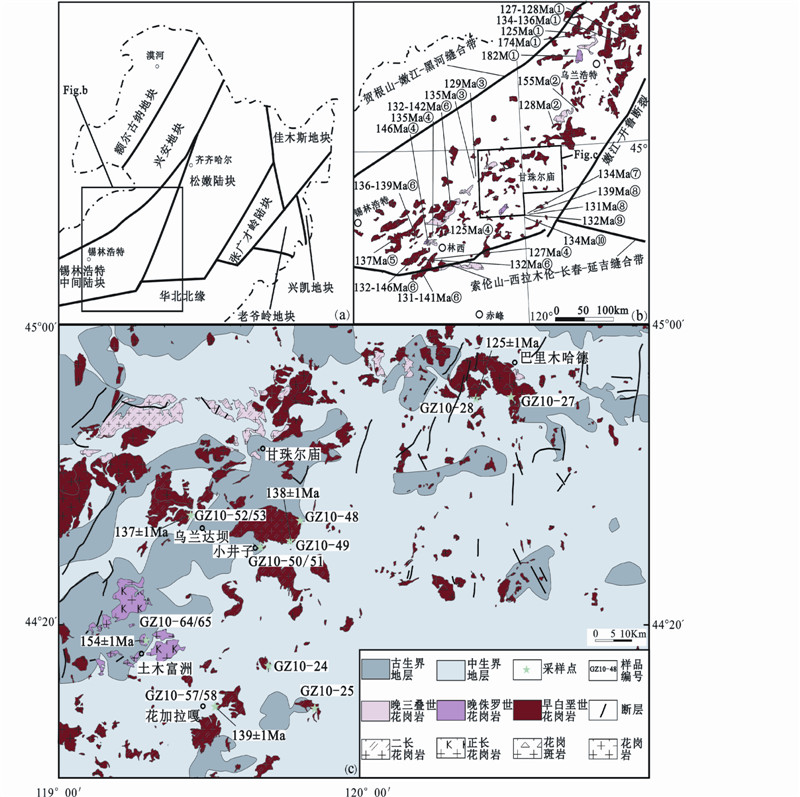 | 图 1 甘珠尔庙地区地质简图(大地构造位置分区图(图 1a)据张兴洲等,2006) 图 1b中花岗岩年龄资料来源: ①葛文春等,2005; ②江思宏等,2011a; ③江思宏等,2011b; ④Liu et al., 2005; ⑤Zhou et al., 2012; ⑥Wu et al., 2011a; ⑦马星华等,2009; ⑧Wu et al., 2011b;⑨曾庆栋和刘建明,2010; ⑩张晓静等,2010 Fig. 1 Geological sketch map of Ganzhuermiao region(Fig. 1a,modified after Zhang et al., 2006) Sources of ages of granitoids in the Fig 1b: ①Ge et al., 2005; ②Jiang et al., 2011a; ③Jiang et al., 2011b; ④Liu et al., 2005; ⑤Zhou et al., 2012; ⑥Wu et al., 2011a; ⑦Ma et al., 2009; ⑧Wu et al., 2011b;⑨Zeng and Liu, 2010; ⑩Zhang et al., 2010 |
大兴安岭中南段地区的岩浆作用十分发育,其中晚侏罗世火山岩分布面积占该区的60%(邵济安等, 1999a,b),而甘珠尔庙地区的三叠纪至早白垩世花岗岩基本侵位于二叠系或侏罗系地层,其岩性主要为正长花岗岩、二长花岗岩-花岗岩斑岩。
位于贺根山-嫩江-黑河缝合带与索伦山-西拉木沦-长春-延吉缝合带之间东部的甘珠尔庙地区,经历二叠纪末至三叠纪初沿后者的古亚洲洋的最后闭合(Xiao et al., 2003),侏罗纪晚期蒙古-鄂霍茨克造山带完成,早白垩世进入后碰撞阶段,后期开始受到古太平洋的影响(李锦轶等,2004)。
3 晚中生代花岗岩体基本特征与样品概况 3.1 岩体特征
本研究在甘珠尔庙地区鉴别出的晚中生代花岗岩体主要有晚侏罗世土木富洲岩体,早白垩世早阶段乌兰达坝岩体、小井子岩体、花加拉嘎岩体,早白垩世晚阶段巴里木哈德岩体(图 1c)。
土木富洲岩体位于甘珠尔庙地区的西南部,由数十个小岩体及岩株组成,出露面积约100km2,侵位于二叠纪和侏罗系地层中。在岩体中发育有残留顶盖,岩体与围岩的边界平直或呈锯齿状,显示了明显的侵入关系。该岩体主体为中粒黑云母正长花岗岩。
乌兰达坝和小井子岩体位于甘珠尔庙地区的中部,呈岩基状产出,主体侵位于二叠系。同时代花加拉嘎岩体位于甘珠尔庙地区的南部,主要呈岩株状产出,侵位于二叠系和侏罗系地层。这三个岩体出露总面积超过180km2,主体岩性为中粒黑云母二长花岗岩。
巴里木哈德岩体位于甘珠尔庙地区的西部,呈北向透镜状岩基产出,面积约90km2,主体侵位于侏罗系火山岩,界限清楚,外接触带具有角岩化和硅化;内带边缘为钾质花岗斑岩,向岩体中心逐渐变化为中细粒正长花岗岩。岩体中残留顶盖和捕虏体较多,为中浅层岩体,剥蚀程度较弱。
3.2 样品概况
在野外观察及岩相学研究的基础上,选择典型的花岗质岩石,共采集了14件地球化学样品(图 1c),其中5件锆石U-Pb定年样品分别采自以下5个岩体。
样品GZ10-65为黑云母正长花岗岩,采自土木富洲岩体。岩石呈灰白色,块状构造。主要矿物组合为石英(20%)+钾长石(60%)+斜长石(15%)+黑云母(5%)+角闪石(<1%),含少量锆石、磷灰石、磁铁矿等副矿物。
样品GZ10-57为黑云母二长花岗岩,采自花加拉嘎岩体。岩石呈灰白色,二长结构,块状构造。主要矿物组合为石英(20%)+碱长石(30%)+斜长石(40%)+黑云母(8%),含少量锆石、磷灰石、磁铁矿等副矿物。
样品GZ10-52为黑云母二长花岗岩,采自乌兰达坝岩体。岩石呈灰白色,以块状构造为主。主要矿物组合为石英(30%)+钾长石(30%)+斜长石(30%)+黑云母(8%)。钾长石主要为条纹长石,有少量的微斜长石,含少量锆石、磷灰石、磁铁矿等副矿物。岩石具有典型的花岗结构。
样品GZ10-49为黑云母二长花岗岩,采自小井子岩体。岩石呈浅肉红色,具有显微文象结构,块状构造。主要矿物组合为石英(20%)+钾长石(40%)+斜长石(35%)+黑云母(<5%),钾长石主要为条纹长石,有少量的微斜长石,含少量锆石、磷灰石、磁铁矿等副矿物。
样品GZ10-28为花岗斑岩,采自巴里木哈德岩体。岩石呈肉红色,具块状构造,典型的似斑状结构,斑晶主要为石英和钾长石,共约占20%±,其中钾长石以微斜条纹长石为主,少数为条纹长石和正长石,基质由钾长石、石英和斜长石微晶组成。
4 分析方法及结果 4.1 分析方法
样品在河北省廊坊区域地质调查研究所采用常规方法进行粉碎、分选。锆石U-Pb同位素分析在天津地质矿产研究所同位素实验室完成,数据处理采用中国地质大学Liu et al.(2008)编写的ICPMSDataCal程序和Ludwing(1999)的Isoplot程序进行作图,采用204Pb对普通铅进行校正。利用NIST612作为外标计算锆石样品的Pb、U、Th含量。
样品主量元素、微量元素分析测试是在加拿大温哥华Acme分析实验室进行的,除了Fe2O3之外,分别由电感耦合等离子光谱分析(ICP-AES)和电感耦合等离子质谱仪(ICP-MS)完成。
锆石原位Lu-Hf同位素分析在中国地质科学院矿产资源研究所的等离子体质谱仪(LA-MC-ICP-MS)上进行测试具体流程及仪器运行条件等见文献(侯可军等,2007)。
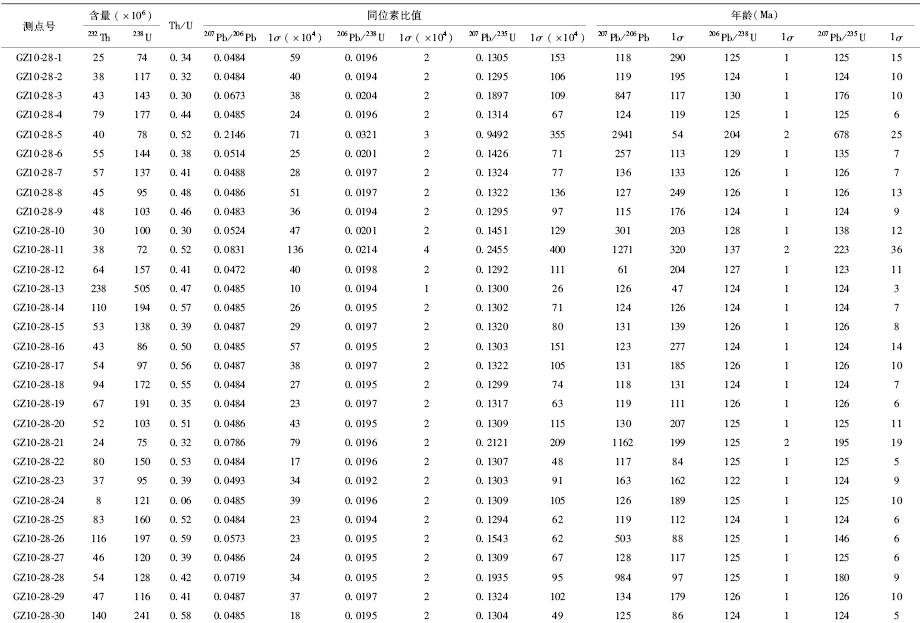
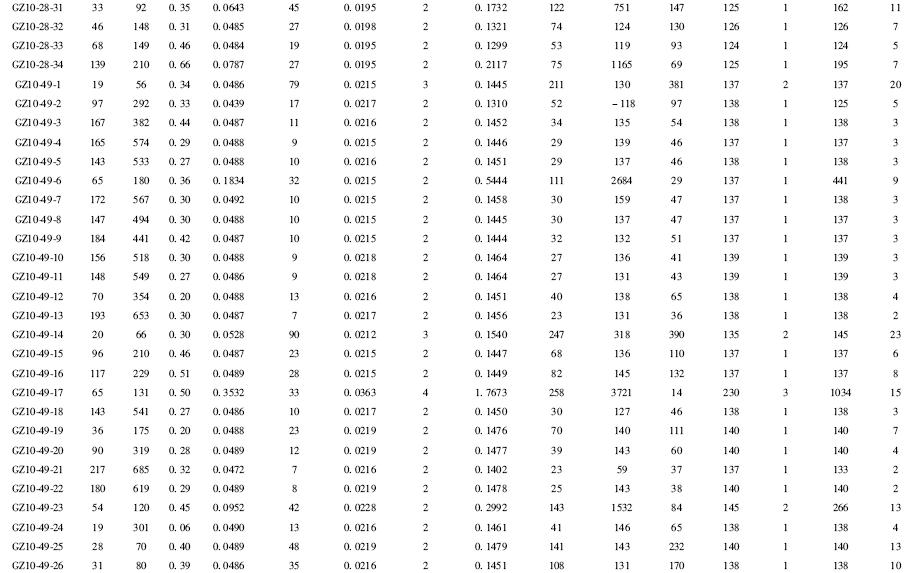
4.2 分析结果 4.2.1 锆石U-Pb定年 锆石U-Pb测定结果数据见表 1和图 2。CL图像显示,锆石晶型较好,呈单锥或双锥状,发育典型的岩浆韵律环带和明暗相间的条带结构。这些样品的测试点基本位于锆石的边缘部位。
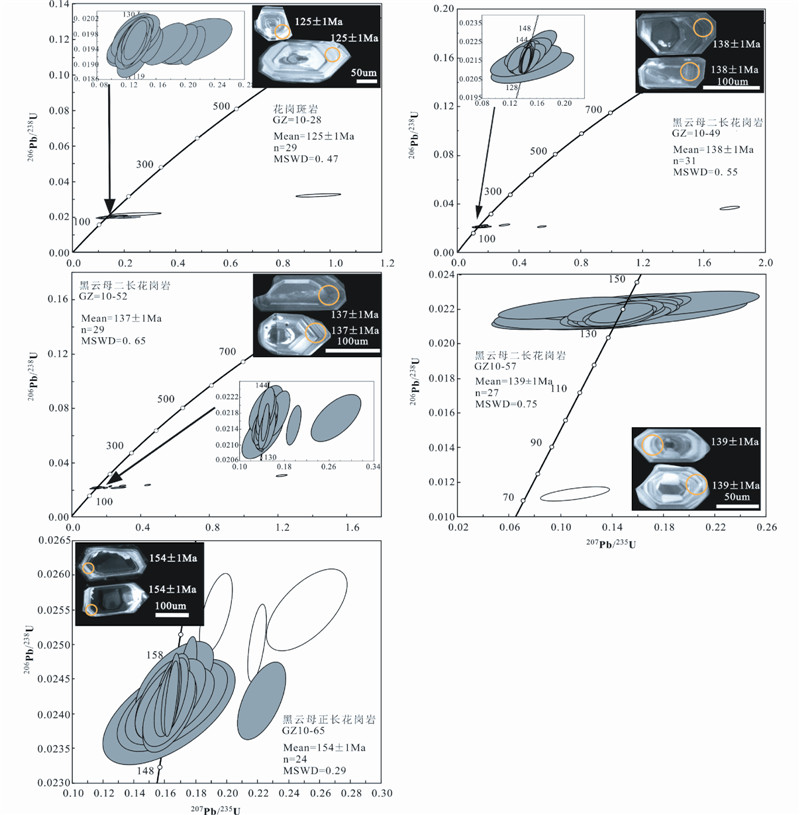 | 图 2 甘珠尔庙地区晚中生代花岗岩锆石U-Pb年龄协和图 Fig. 2 Zircon U-Pb dating concordia diagrams of the Late Mesozoic granites in the Ganzhuermiao region |

|
表 1 甘珠尔庙地区晚中生代花岗岩锆石 LA-ICP-MS U-Pb分析结果 Table 1 LA-ICP-MS zircon U-Pb data of the Late Mesozoic granites in the Ganzhuermiao region |
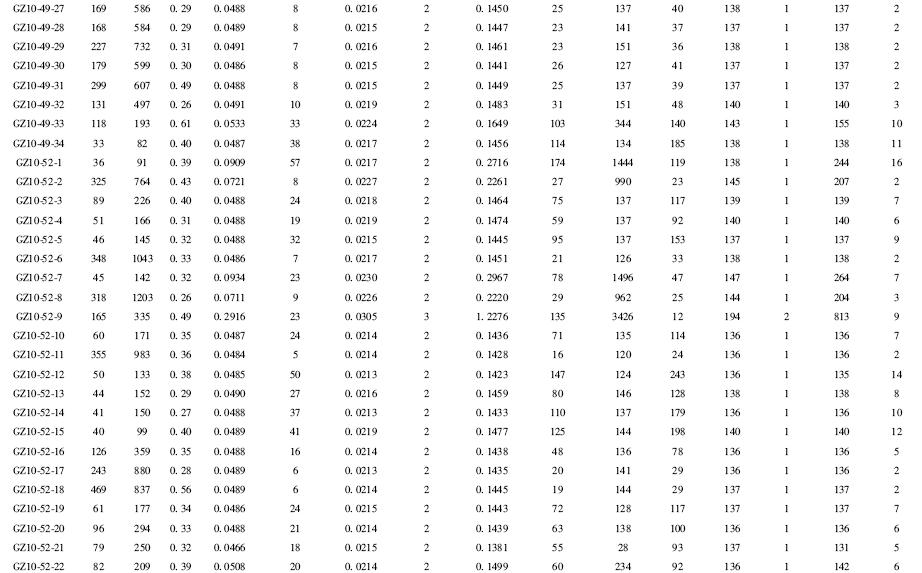
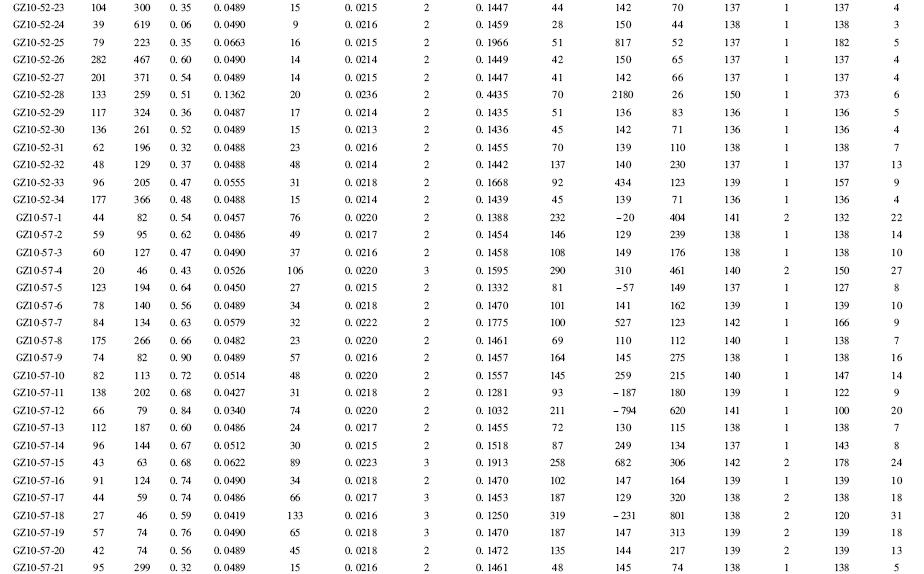
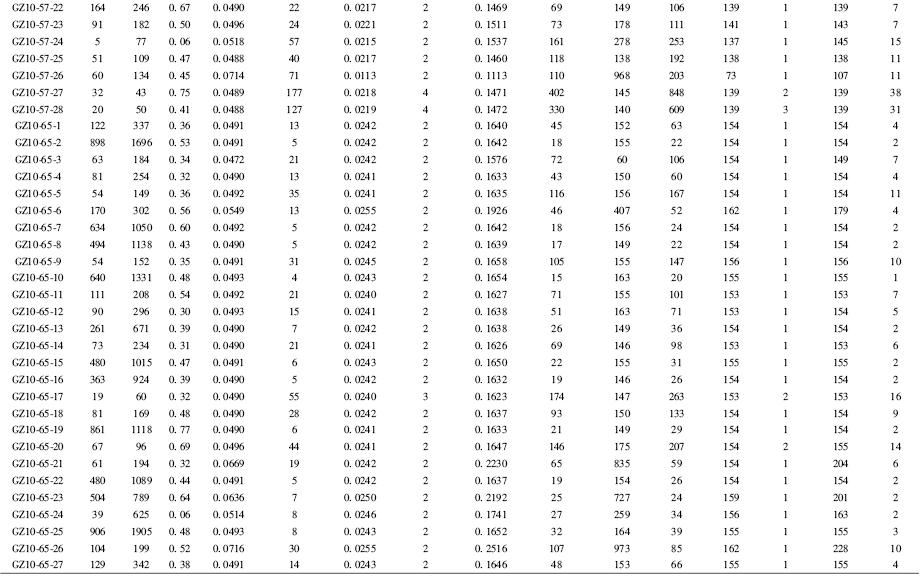
样品GZ10-65获得27个测点。除6号、23号、26号点距锆石核部较近外(可能为核幔混合年龄外),其余24个点基本位于锆石幔部和边部的结晶环带部位,位于谐和线上及其附近,206Pb/238U加权平均年龄为154±1Ma,MSWD=0.29,代表锆石结晶年龄,故可代表土木富洲花岗岩体形成年龄。
样品GZ10-57获得28个测点。26号数据可能因Pb丢失,获得206Pb/238U年龄明显偏年轻,其余27个点基本位于谐和线上及其附近,206Pb/238U加权平均年龄为139±1Ma,MSWD=0.75,可代表花加拉嘎花岗岩形成年龄。
样品GZ10-52获得34个测点,可能由于Pb丢失,造成1号、2号、7号、8号、9号具有明显的不谐和年龄,其余29个点基本位于谐和线上及其附近,206Pb/238U加权平均年龄为137±1Ma,MSWD=0.65,应代表乌兰达坝岩体形成年龄。
样品GZ10-49获得34个测点,除6号、17号、23号点数据具有明显的不谐和年龄外(信号极其不稳),其余31个点基本位于谐和线上及其附近,206Pb/238U加权平均年龄为138±1Ma,MSWD=0.55,代表小井子岩体形成年龄。
样品GZ10-28获得34个测点,可能由于Pb丢失,5号、11号、21号、28号、34号点具有明显的不谐和年龄,其余29个点基本位于谐和线上及其附近,206Pb/238U加权平均年龄为125±1Ma,MSWD=0.47,可以代表巴里木哈德岩体形成年龄。 4.2.2 岩石地球化学特征
各花岗岩体样品的主微量元素分析结果见表 2。
|
|
表 2 甘珠尔庙地区晚中生代花岗岩主量元素和(wt%)和微量元素(×10-6) Table 2 Major(wt%) and trace(×10-6)element composition of the Late Mesozoic granites in Ganzhuermiao region |
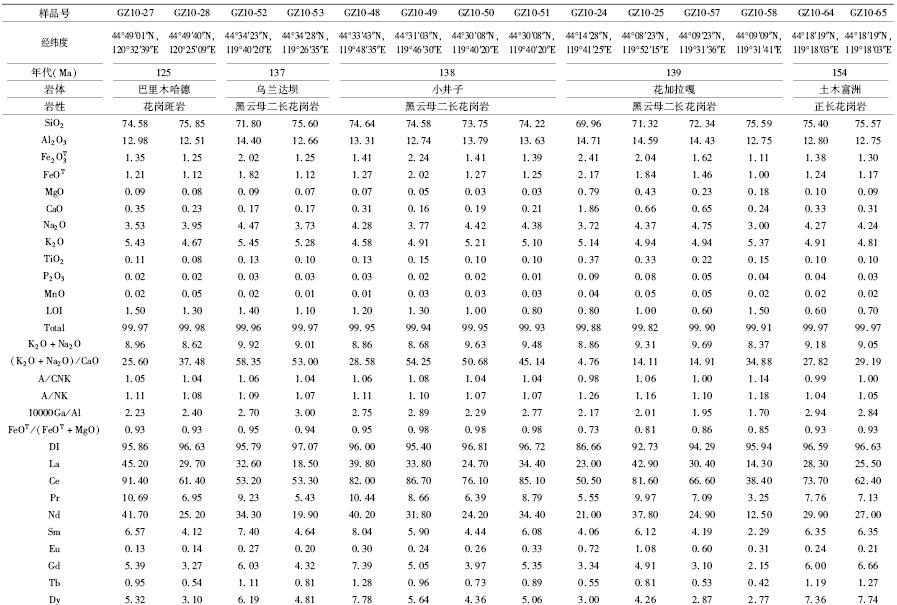
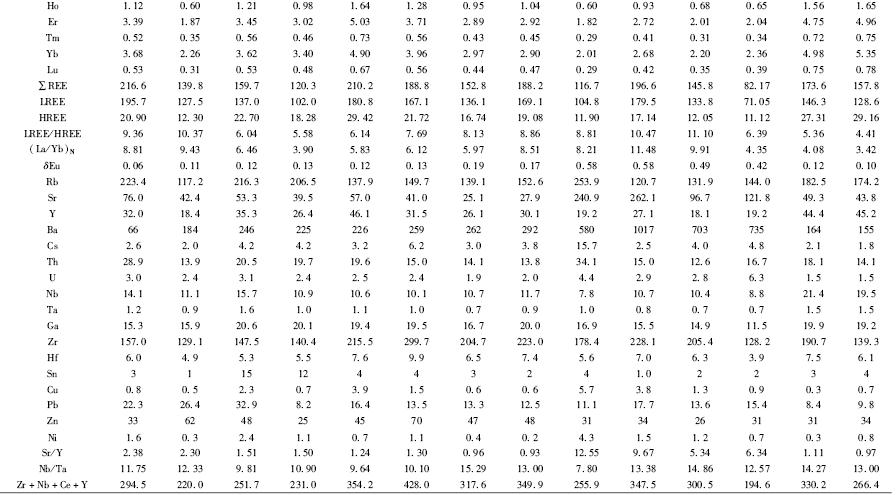
晚侏罗世土木富洲岩体2件样品的SiO2含量范围为75.40%~75.57%,全碱(Na2O+K2O)为9.05%~9.18%,CaO为0.31%~0.33%,MgO为0.09%~0.10%,A/CNK范围为0.99~1.00,为弱过铝质,属于高钾钙碱性系列(图 3)。其稀土元素∑REE=157.8×10⁻⁶~173.6×10⁻⁶,(La/Yb)N为3.42~4.08,在稀土元素配分模式图中(图 4),表现为右倾海鸥型,具有明显负Eu异常,δEu值为0.10~0.12。
早白垩世早阶段3个岩体(乌兰达坝、小井子、花加拉嘎)的10件样品的SiO2含量范围69.96%~75.60%,全碱(Na2O+K2O)范围为8.7%~9.9%,CaO为0.16%~1.9%,MgO为0.03%~0.79%,A/CNK为0.98~1.14,为弱过铝质,属于高钾钙碱性系列(图 3)。上述10件样品的稀土元素∑REE=82.2×10⁻⁶~210.2×10⁻⁶,(La/Yb)N为3.9~11.48,在稀土元素球粒陨石标准化图(图 4)中,成右倾海鸥型;其δEu值为0.12~0.58。
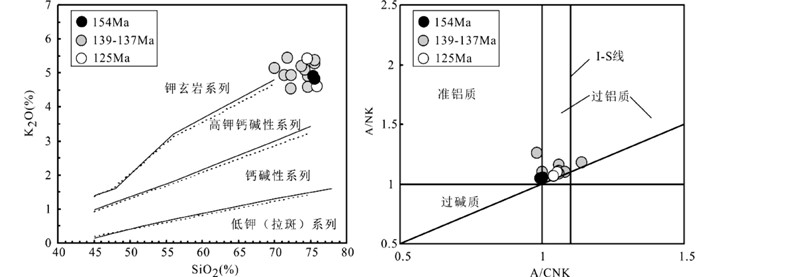 | 图 3 甘珠尔庙地区晚中生代花岗岩SiO2-K2O(底图据Ewart,1982)和A/CNK-A/NK图解 Fig. 3 SiO2-K2O(after Ewart,1982) and A/CNK-A/NK diagrams of the Late Mesozoic granites in Ganzhuermiao region |
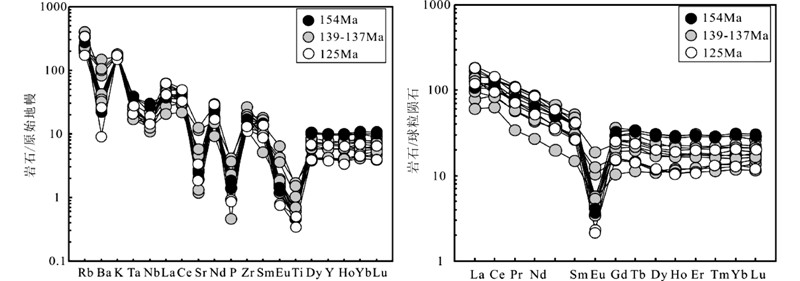 | 图 4 甘珠尔庙地区晚中生代花岗岩微量元素蛛网图和稀土元素配分模式图(标准化值据Sun and McDonough, 1989) Fig. 4 Trace element and REE diagrams of the Late Mesozoic granites in Ganzhuermiao region(normalization values are after Sun and McDonough, 1989) |
早白垩世晚阶段巴里木哈德岩体的2件样品的SiO2含量范围为74.58%~75.85%,全碱(Na2O+K2O)为8.62%~8.96%,CaO为0.23%~0.35%,MgO为0.08%~0.09%,A/CNK范围为1.04~1.05,为弱过铝质,也属于高钾钙碱性系列(图 3)。其稀土元素∑REE=139.8×10⁻⁶~216.6×10⁻⁶,(La/Yb)N为8.81~9.43,在稀土元素球粒陨石标准化图(图 4)中,成右倾海鸥型,δEu值为0.06~0.11。
总之,5个岩体的稀土元素球粒陨石标准化图皆成右倾海鸥型,但Eu负异常程度不同,晚侏罗世花岗岩比早白垩世花岗岩轻重稀土分馏弱。在微量元素的原始地幔标准化图解上,总体表现为不同程度的富集大离子亲石元素(Rb、Th、K等)和相应的亏损高场强元素(Nb、Ta、P 等)。 4.2.3 Hf同位素特征
选取具有谐和年龄的典型锆石进行Hf同位素测试,每颗锆石εHf(t)值以自身锆石年龄计算,结果见表 3,各岩体锆石Hf同位素特征分述如下:
| 表 3 甘珠尔庙地区晚中生代花岗岩锆石Hf同位素分析结果 Table 3 Zircon Hf isotopic compositions of the Late Mesozoic granites in Ganzhuermiao region |
晚侏罗世土木富洲岩体样品GZ10-65共分析15个点,εHf(t)值为+9.9~+15.9,加权平均值为+12.1,峰值为+10~+14之间,两阶段Hf模式年龄为185~571Ma(n=15)。
早白垩世早阶段的3个岩体(花加拉嘎、小井子、乌兰达坝)样品GZ10-57、GZ10-49和GZ10-52分别分析了13个、12个和13个点。其中GZ10-57的εHf(t)值为+2.9~+7.9,加权平均值为+5.32,峰值为+5~+6之间,两阶段Hf模式年龄为688~1005Ma(n=13)。GZ10-49的εHf(t)值为+5.8~+13.9,加权平均值为+7.8,峰值为+6~+7之间,两阶段Hf模式年龄为302~821Ma。GZ10-52的εHf(t)值为+5.6~+13.8,加权平均值为+9.2,峰值为+8左右,两阶段Hf模式年龄为310~836Ma。
早白垩世晚阶段巴里木哈德岩体样品GZ10-28分析了14个点,其εHf(t)值范围为+3.4~+8.1,加权平均值为+5.61,峰值为+4~+5左右,两阶段Hf模式年龄为663~968Ma(n=14)。
5 讨论 5.1 晚中生代花岗岩浆活动时代和期次
甘珠尔庙地区5个岩体锆石U-Pb测年的分析点多位于锆石的边部和幔部结晶环带部位,数据点大都位于U-Pb谐和线附近,表明这些测年结果代表锆石的结晶年龄,进而可以代表各个岩体侵位的年龄。分析结果显示,甘珠尔庙地区晚中生代花岗岩形成于晚侏罗世晚期(154Ma)和早白垩世,后者又可以分为两个阶段(139~137Ma与125Ma)。
就整个大兴安岭中南段而言,本文及区域上前人发表的40个(葛文春等,2005; Liu et al., 2005; 江思宏等, 2011a,b; Wu et al., 2011a,b; 马星华等,2009; 曾庆栋和刘建明,2010; 张晓静等,2010; Zhou et al., 2012,图 1b)晚中生代花岗岩类锆石U-Pb年龄统计显示(图 5),其岩浆活动主要发育于早白垩世(142~124Ma),只发育少量的侏罗纪花岗岩(182~146Ma)。
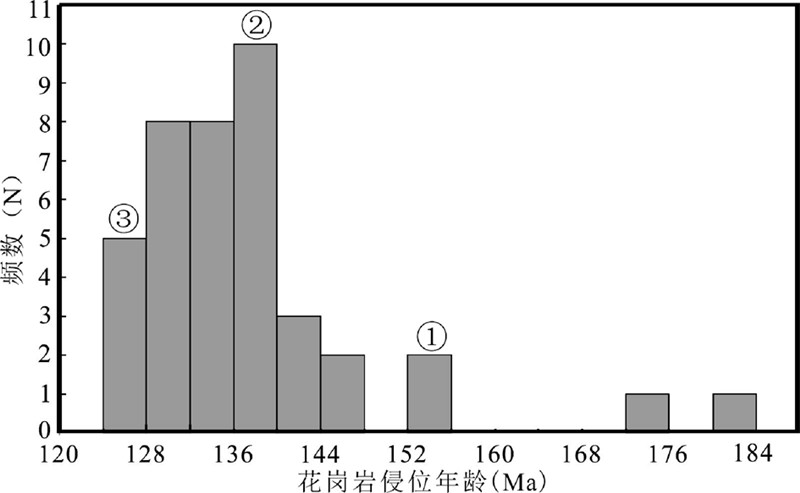 | 图 5 大兴安岭中南段晚中生代花岗岩年龄统计图 图中①、②、③分别代表本文154Ma、139~137Ma、125Ma花岗岩所处年龄段 Fig. 5 Age histogram of the Late Mesozoic granites in central and southern Da Hinggan Range ①,② and ③ represent 154Ma,139~137Ma and 125Ma of this paper,respectively |
前人研究认为东北早中侏罗纪花岗岩主要分布在额尔古纳地块、小兴安岭-张广才岭和吉林东部(Wu et al., 2011a),晚侏罗世岩浆活动主要体现在大兴安岭地区发育的NNE向的火山岩(张兴洲等,2012),而本文获得的154Ma花岗岩在大兴安岭地区不多见。另外值得注意的是,甘珠尔庙地区125Ma与139~137Ma花岗岩,两者发育时代间隔较大。但前人研究认为大兴安岭北段和中南段花岗岩形成时代是以早白垩世为主体(佘宏全等,2012; Wu et al., 2011a),并未进一步细分期次。Zhang et al.(2010)曾将大兴安岭中南段的火山岩分为173~150Ma和141~122Ma两期,而同一地区的火山岩和花岗岩在发育时代上具有一定的可比性。因此根据大兴安岭中南段花岗岩年龄统计(图 5),并结合整个大兴安岭地区花岗岩发育情况,125Ma与139~137Ma花岗岩似乎仍然是同一期岩浆事件的产物。另外,值得注意的是,该期花岗岩在大兴安岭以西乃至中蒙边界亚干地区(Wang et al., 2004)也有发育,显示它们可能具有相同的地质背景。
综上所述,甘珠尔庙地区晚侏罗世与早白垩世花岗岩应该属于两期岩浆事件的产物,不仅与大兴安岭中南段的晚中生代岩浆活动期次完全可以对比,也与同区火山岩发育期次很类似。
5.2 岩石成因类型和物源 5.2.1 岩石成因类型
本次研究的5个花岗岩体,皆属于准铝质-弱过铝质高钾钙碱性系列,高硅富碱特征与大兴安岭中南段的晚中生代花岗岩地球化学性质相似(Liu et al., 2005; 周振华等,2010; 周漪等,2011)。大部分甘珠尔庙晚中生代花岗岩具较强Eu异常,具有相对低的Sr/Y值和Ba含量。文中花岗岩样品分异指数(DI)为92.73~97.07(除样品GZ10-24,其DI为86.66),表明原始岩浆的结晶分异强烈,由CIPW标准矿物计算结果可知,部分样品出现刚玉分子,但是含量很低,符合准铝质-弱过铝质的特征。另外,晚侏罗世花岗岩的(La/Yb)N为3.42~4.08,小于早白垩世花岗岩的4.35~11.48,说明两期花岗岩的轻重稀土分异不同。
在A型花岗岩判别图解中(图 6),这些样品皆位于高分异花岗岩与A型花岗岩边界附近。图 7显示大部分点落在高分异I型与A型花岗岩过渡区域内。图 8中除三个样品外,其余点全部落入高分异的钙碱性花岗岩区域,进一表明甘珠尔庙晚中生代花岗岩属于高分异钙碱性I型花岗岩,与典型的巴尔哲(125±2Ma,Rb-Sr)、碾子山(125±1Ma,Rb-Sr)A型花岗岩不同(王一先和赵振华,1997; 李培忠和于津生,1993)。综上认为,甘珠尔庙地区晚中生代花岗岩为高分异钙碱性I-A过渡型花岗岩。晚侏罗世花岗岩轻重稀土分馏弱于早白垩世花岗岩。
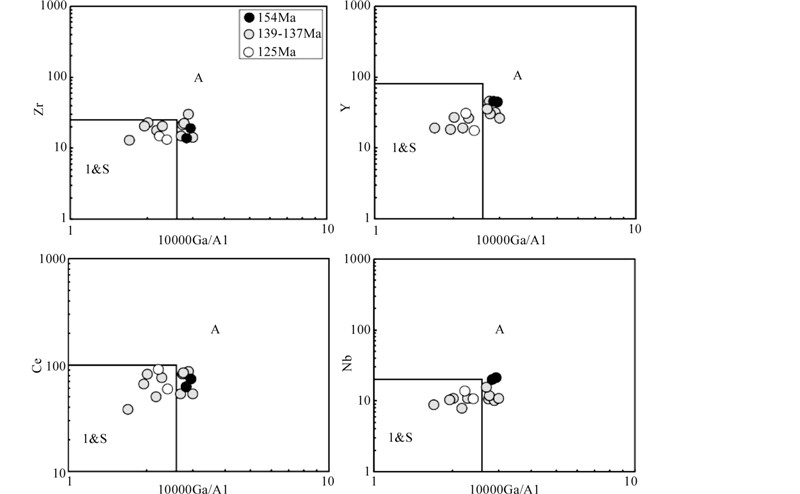 | 图 6 甘珠尔庙地区晚中生代花岗岩岩石成因图解(据Whalen et al., 1987) Fig. 6 10000Ga/Al vs. Zr,Y,Ce and Nb diagrams of the Late Mesozoic granites in Ganzhuermiao region(after Whalen et al., 1987) |
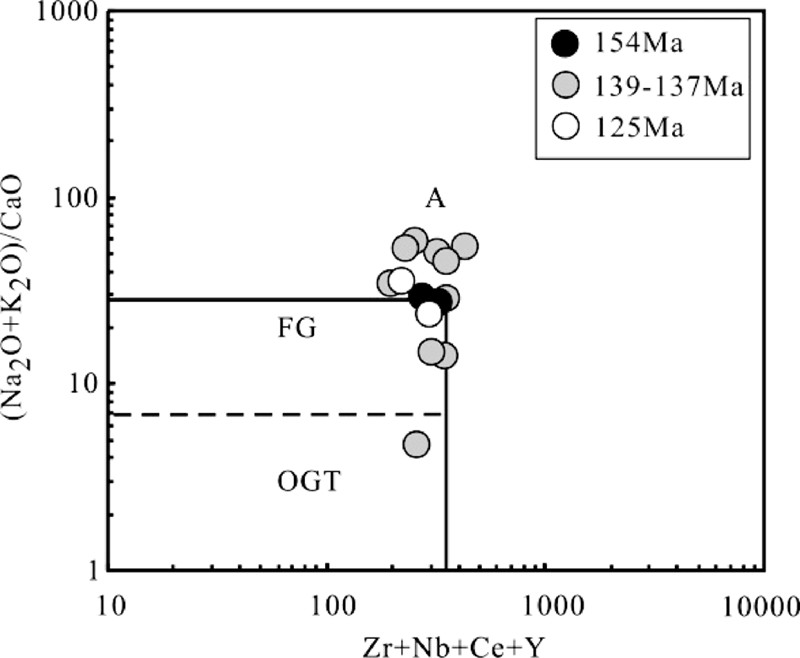 | 图 7 甘珠尔庙地区晚中生代花岗岩(Zr+Nb+Ce+Y)-(K2O+Na2O)/CaO图解(据Whalen et al., 1987) FG-分异的I,S型花岗岩;OGT-I,S,M型花岗岩分布区 Fig. 7(Zr+Nb+Ce+Y)vs.(K2O+Na2O)/CaO diagram of the Late Mesozoic granites in Ganzhuermiao region(after Whalen et al., 1987) |
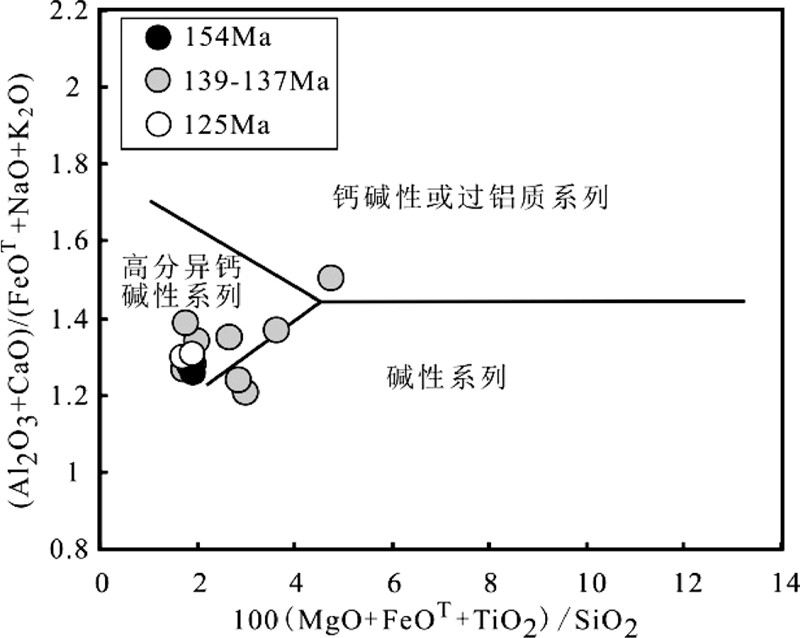 | 图 8 甘珠尔庙地区晚中生代花岗岩100(MgO+FeOT+TiO2)/SiO2-(Al2O3+CaO)/(FeOT+Na2O+K2O)图解(底图据Sylvester,1989) Fig. 8 100(MgO+FeOT+TiO2)/SiO2 vs.(Al2O3+CaO)/(FeOT+Na2O+K2O)diagram of the Late Mesozoic granites in Ganzhuermiao region(after Sylvester,1989) |
甘珠尔庙地区晚中生代花岗岩εHf(t)均大于零(+3.4~+15.9),说明年轻物质是其主要的来源。εHf(t)-t图解显示(图 9),晚侏罗世花岗岩数据点基本落于大兴安岭中南段的新生底侵下地壳演化线(Liu et al., 2005)之上,说明其源区需要更加年轻的物质,很可能有新底侵物质的加入。早白垩世晚阶段花岗岩数据点落于大兴安岭南区新生底侵的下地壳演化线之下与古生代俯冲增生杂岩演化线(Liu et al., 2005)之上,暗示其物源可能主要来自新生底侵的下地壳和古生代俯冲增生杂岩混源。而早白垩世早阶段花岗岩的εHf(t)值变化范围最大,暗示物源极不均一。这些花岗岩的Nb/Ta值范围为7.8~15.29,平均为12.97,介于全球下地壳(Nb/Ta=8.3,Rudnick and Gao, 2003)与亏损地幔之间(Nb/Ta=17.7,Sun and McDnough, 1989),因此也显示其具有壳幔混源的特点,而三件早白垩世早阶段(139~137Ma)花岗岩样品地球化学特征不完全一致,说明该时期花岗岩源区较为复杂。
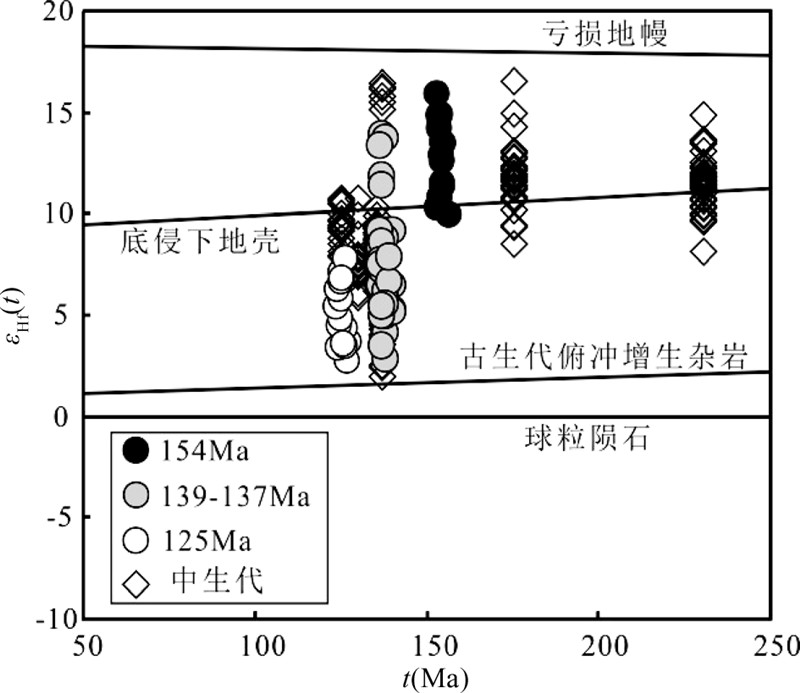 | 图 9 甘珠尔庙地区晚中生代花岗岩εHf(t)-t图 底侵下地壳与古生代俯冲增生杂岩演化线据Liu et al.(2005);乌兰浩特与林西地区中生代花岗岩εHf(t)数据(◇)分别周漪等(2011)和Zhou et al.(2012) Fig. 9 εHf(t)-t diagram of the Late Mesozoic granites in Ganzhuermiao region The evolution lines of the underplated lower crust and Paleozoic subducted accretionary complexes modified after Liu et al.(2005),εHf(t)values(◇)of the Mesozoic granites from Wulanhaote and Linxi region are from Zhou et al.(2011) and Zhou et al.(2012) |
甘珠尔庙地区晚中生代花岗岩随着侵位年龄的逐渐变小,εHf(t)值明显降低。这个特点在乌兰浩特、林西及黄岗地区同样有较明显的表现(Liu et al., 2005; 周漪等,2011; Zhou et al., 2012),反映这些花岗岩岩浆源区中的年轻物质相对减少,同时发现εHf(t)值突变节点在139~137Ma之间(Zhou et al., 2011; Zhou et al., 2012),大兴安岭中南段花岗质岩浆发育的高峰也是在这个时期(毛景文等,2005)。在同一个地区,晚侏罗世到早白垩世花岗岩物源如此变化的原因和地球动力学背景还不是很清楚。一种解释是晚侏罗世花岗岩高εHf(t)值特点与地幔岩浆底侵有关,早白垩世(139~137Ma)相对低εHf(t)值花岗岩可能由于底侵物质的冷却造成较厚的地壳(下地壳物质和古生代俯冲增生杂岩)物源有关(刘伟等,2007; Liu et al., 2005)。
综上所述,大兴安岭中南段晚侏罗世和早白垩世高分异钙碱性I-A过渡型花岗岩物源主要为底侵的幔源基性物质、新生下地壳和古生代的俯冲增生杂岩三者不同时代不同程度的混合产物,进一步表明该地区可能不存在古老的基底。 5.3 构造背景
在微量元素构造环境判别图上(图 10),文中花岗岩样品点均落于板内和同碰撞区域,特别是与该地区早期的同造山花岗岩相比(李锦轶等,2007),它们出现向后碰撞和板内区域偏移的趋势。这可能揭示了该时期后造山板内的大地构造背景的信息,这与该期花岗岩的特性也是一致的。本文确定的晚侏罗世与早白垩世花岗岩具有高钾钙碱性特征,一般而言,高钾钙碱性系列花岗岩产生在陆弧环境或后碰撞环境(Pitcher,1983)。同时依据区域后造山伸展背景(Wang et al., 2011),该时期甘珠尔庙地区确为后碰撞伸展环境。
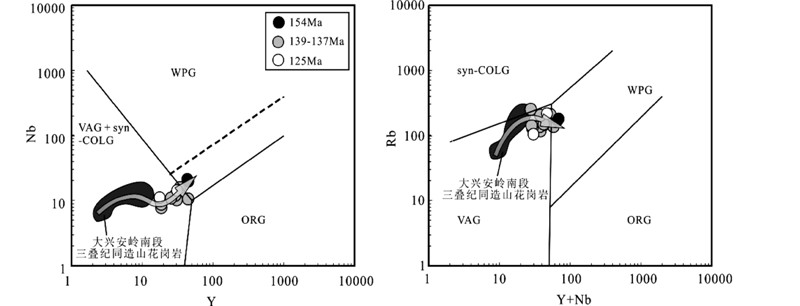 | 图 10 甘珠尔庙地区晚中生代花岗岩构造环境判别图(底图据Pearce et al., 1984) 大兴安岭南段三叠纪同造山花岗岩数据李锦轶等(2007) Fig. 10 Discrimination diagrams for tectonic setting of the Late Mesozoic granites in Ganzhuermiao region(after Pearce et al., 1984) Data of synorognic Triassic granites in the southern Da Hinggan range are from Li et al.(2007) |
区域上,晚中生代地壳伸展的构造背景受何种体制制约还不是很清楚。一种可能的情况是,古亚洲洋最后消亡后的后造山环境(邵济安等,1997; Chen et al., 2000; 陈斌等, 2001,2009; Xiao et al., 2003; 王成文等,2008; 李锦轶等,2009; 佘宏全等,2012; 张兴洲等,2012),但是后碰撞阶段过程持续到晚中生代的可能性不大。另一种情况是,由于古太平洋板块俯冲方向的改变(Maruyama,1997; Sagong et al., 2005),中生代期间大兴安岭以及整个中国东部有可能经历了由挤压到伸展的转换过程(Davis et al., 2001; Meng,2003)。但是,学者们对古太平洋板块俯冲影响大兴安岭地区的时间还存疑问,李锦轶等(2004)认为白垩世中晚期至古近纪初,中国东北及邻区的大陆才开始在古太平洋俯冲作用的影响下,遭受了伸展及岩石圈减薄作用的改造。张旗(2013)认为太平洋板块的向西俯冲对中国东部中生代岩浆活动影响有限,因为太平洋真正向西俯冲时间只有125~110Ma和43~0Ma两个时间段。值得注意的是,本文的花岗岩侵位年龄主要为晚侏罗世及早白垩世。近年来,蒙古-鄂霍茨克造山带对东北地区地质演化历史作用的研究越来越受到重视(李锦轶等,2004; Tomurtogoo et al., 2005; 佘宏全等,2012),该造山带碰撞造山作用结束于晚侏罗世晚期,之后的碰撞伸展可能是导致大兴安岭特别是以西地壳伸展的主因(Wang et al., 2011)。
6 结论
(1)通过锆石U-Pb定年,在大兴安岭中南段甘珠尔庙地区鉴别出5个晚中生代花岗岩体,其形成于晚侏罗世(154Ma)、早白垩世(139~137Ma与125Ma),与大兴安岭中南段岩浆作用时限大体一致,这为全面认识区域上晚中生代岩浆活动提供了新依据。
(2)甘珠尔庙地区晚中生代花岗岩属于高钾钙碱性系列,为高分异钙碱性I-A过渡型花岗岩。晚侏罗世花岗岩具有较高的εHf(t)值(+9.9~+15.9),源区以年轻的新底侵物质为主;早白垩世花岗岩εHf(t)值略低(+3.4~+13.9),物源主要来自新生下地壳和古生代俯冲增生杂岩混源。推测该区存在古老地壳的可能性不大。
(3)甘珠尔庙地区晚中生代花岗岩形成于后造山伸展背景。这种背景很可能形成于蒙古-鄂霍茨克洋闭合碰撞后伸展背景,其次在后期可能叠加古太平洋俯冲的影响。
致谢 李舢博士和徐颖超硕士在成文过程中提供了帮助;两位匿名评审人提供了宝贵的意见;在此一并深表谢意。
| [1] | Chen B, Jahn BM, Wilde SA and Xu B. 2000. Two contrasting paleozoic magmatic belts in northern Inner Mongolia, China: Petrogenesis and tectonic implications. Tectonophysics, 328(1-2): 157-182 |
| [2] | Chen B, Zhao GC and Wilde SA. 2001. Subduction-and collision-related granitoids from southern Sonidzuoqi, Inner Mongolia: Isotopic ages and tectonic implications. Geological Review, 47(4): 361-367 (in Chinese with English abstract) |
| [3] | Chen B, Ma XH, Liu AK and Zari M. 2009. Zircon U-Pb ages of the Xilinhot metamorphic complex and blueschist, and implications for tectonic evolution of the Solonker suture. Acta Petrologica Sinica, 25(12): 3123-3129 (in Chinese with English abstract) |
| [4] | Davis GA, Zheng YD, Wang C, Darby BJ, Zhang CH and Gehrels GE. 2001. Mesozoic tectonic evolution of the Yanshan fold and thrust belt, with emphasis on Hebei and Liaoning provinces, northern China. Geological Society of America Memoirs, 194: 171-197 |
| [5] | Ewart A. 1982. The mineralogy and petrology of Tertiary-Recent orogenic volcanic rocks: With special reference to the andesitic-basaltic compositional range. In: Thorpe RS (ed.). Andesites: Orogenic Andesites and Related Rocks. New York: John Wiley and Sons, 25-95 |
| [6] | Ge WC, Lin Q, Sun DY, Wu FY, Won CW, Lee MW, Jin MS and Yun SY. 1999. Geochemical characteristics of the Mesozoic basalts in Da Hinggan Ling: Evidence of the mantle-crust interaction. Acta Petrologica Sinica, 15(3): 396-407 (in Chinese with English abstract) |
| [7] | Ge WC, Wu FY, Zhou CY and Zhang JH. 2005. Zircon U-Pb ages and its significance of the Mesozoic granites in the Wulanhaote region, central Da Hinggan Mountain. Acta Petrologica Sinica, 21(3): 749-762 (in Chinese with English abstract) |
| [8] | Guo F, Fan WM, Wang YJ and Lin G. 2001. Petrogenesis of the Late Mesozoic bimodal volcanic rocks in the southern Da Hinggan Mts, China. Acta Petrologica Sinica, 17(1): 161-168 (in Chinese with English abstract) |
| [9] | Guo F, Fan WM, Gao XF, Li CW, Miao LC, Zhao L and Li HX. 2010. Sr-Nd-Pb isotope mapping of Mesozoic igneous rocks in NE China: Constraints on tectonic framework and Phanerozoic crustal growth. Lithos, 120(3-4): 563-578 |
| [10] | Hou KJ, Li YH, Zou TR, Qu XM, Shi YR and Xie GQ. 2007. Laser ablation-MC-ICP-MS technique for Hf isotope microanalysis of zircon and its geological applications. Acta Petrologica Sinica, 23(10): 2595-2604 (in Chinese with English abstract) |
| [11] | Jiang SH, Nie FJ, Liu YF, Hou WR, Bai DM, Liu Y and Liang QL. 2011a. Geochronology of intrusive rocks occurring in and around the Mengentaolegai silver-polymetallic deposit, Inner Mongolia. Journal of Jilin University (Earth Science Edition), 41(6): 1755-1769 (in Chinese with English abstract) |
| [12] | Jiang SH, Nie FJ, Bai DM, Liu YF and Liu Y. 2011b. Geochronology evidence for Indosinian mineralization in Baiyinnuoer Pb-Zn deposit of Inner Mongolia. Mineral Deposits, 30(5): 787-798 (in Chinese with English abstract) |
| [13] | Li JY, Mo SG, He ZJ, Sun GH and Chen W. 2004. The timing of crustal sinistral strike-slip movement in the northern Great Khing’an ranges and its constraint on reconstruction of the crustal tectonic evolution of NE China and adjacent areas since the Mesozoic. Earth Science Frontiers, 11(3): 157-168 (in Chinese with English abstract) |
| [14] | Li JY, Gao LM, Sun GH, Li YP and Wang YB. 2007. Shuangjingzi Middle Triassic syn-collisional crust-derived granite in the East Inner Mongolia and its constraint on the timing of collision between Siberian and Sino-Korean paleo-plates. Acta Petrologica Sinica, 23(3): 565-582 (in Chinese with English abstract) |
| [15] | Li JY, Zhang J, Yang TN, Li YP, Sun GH, Zhu ZX and Wang LJ. 2009. Crustal tectonic division and evolution of the southern part of the north Asian orogenic region and its adjacent areas. Journal of Jilin University (Earth Science Edition), 39(4): 584-605 (in Chinese with English abstract) |
| [16] | Li PZ and Yu JS. 1993. Nianzishan miarolitic alkaline granite stock, Heilongjiang: Its ages and geological implication. Geochimica, (4): 389-398 (in Chinese with English abstract) |
| [17] | Li SL and Ouyang ZY. 1998. Tectonic framework and evolution of Xing’an Ling: Mongolian orogenic belt (XMOB) and its adjacent region. Marine Geology & Quaternary Geology, 18(3): 45-54 (in Chinese with English abstract) |
| [18] | Lin Q, Ge WC, Wu FY, Sun DY and Cao L. 2004. Geochemistry of Mesozoic granites in Da Hinggan Ling ranges. Acta Petrologica Sinica, 20(3): 403-412 (in Chinese with English abstract) |
| [19] | Liu W, Siebel W, Li XJ and Pan XF. 2005. Petrogenesis of the Linxi granitoids, northern Inner Mongolia of China: Constraints on basaltic underplating. Chemical Geology, 219(1-4): 5-35 |
| [20] | Liu W, Pan XF, Xie LW and Li H. 2007. Sources of material for the Linxi granitoids, the southern segment of the Da Hinggan Mts. : When and how continental crust grew? Acta Petrologica Sinica, 23(2): 441-460 (in Chinese with English abstract) |
| [21] | Liu YS, Hu ZC, Gao S, Günther D, Xu J, Gao CG and Chen HH. 2008. In situ analysis of major and trace elements of anhydrous minerals by LA-ICP-MS without applying an internal standard. Chemical Geology, 257(1-2): 34-43 |
| [22] | Ludwing KR. 1999. Using Isoplot/Ex Version 2: A Geochronological Toolkit for Microsoft Excel. Berkeley: Berkeley Geochronological Special Publications, 1-47 |
| [23] | Ma XH, Chen B, Lai Y and Lu YH. 2009. Petrogenesis and mineralization chronology study on the Aolunhua porphyry Mo deposit, Inner Mongolia, and its geological implications. Acta Petrologica Sinica, 25(11): 2939-2950 (in Chinese with English abstract) |
| [24] | Mao JW, Xie GQ, Zhang ZF, Li XF, Wang YT, Zhang CQ and Li YF. 2005. Mesozoic large-scale metallogenic pulses in North China and corresponding geodynamic settings. Acta Petrologica Sinica, 21(1): 169-188 (in Chinese with English abstract) |
| [25] | Maruyama S. 1997. Pacific-type orogeny revisited: Miyashiro-type orogeny proposed. Island Arc, 6(1): 91-120 |
| [26] | Meng Q. 2003. What drove Late Mesozoic extension of the northern China-Mongolia tract? Tectonophysics, 369(3-4): 155-174 |
| [27] | Pearce JA, Harris NBW and Tindle AG. 1984. Trace element discrimination diagrams for the tectonic interpretation of granitic rocks. Journal of Petrology, 25(4): 956-983 |
| [28] | Pitcher WS. 1983. Granite type and tectonic environment. In: Hsu K ( ed.). Mountain Building Processes. London: AcademicPress |
| [29] | Ren JS, Niu BG and Liu ZG. 1999. Soft collision, superposition orogeny and polycyclic suturing. Earth Science Frontiers, 6(3): 85-93 (in Chinese with English abstract) |
| [30] | Rudnick RL and Gao S. 2003. Composition of the continental crust. In: Turekian KK and Holland HD (eds.). Treatise on Geochemistry. Oxford: Pergamon, 1-64 |
| [31] | Sagong H, Kwon ST and Ree JH. 2005. Mesozoic episodic magmatism in South Korea and its tectonic implication. Tectonics, 24(5): doi: 10. 1029/2004TC001720 |
| [32] | Shao JA, Mu BL, He GQ and Zhang LQ. 1997. Geological process in northern margin of North China Craton during synergic process of Paleo-Asian Ocean and paleo-Pacific plate. Science in China (Series D), 27(5): 390-394 (in Chinese) |
| [33] | Shao JA, Zhang LQ and Mu BL. 1998. Mesozoic tectonic-thermal evolution in the middle-south part of the Da Hinggan Mountains. Science in China (Series D), 28(3): 193-200 (in Chinese) |
| [34] | Shao JA, Zhang LQ and Mu BL. 1999a. Magmatism in the Mesozoic extending orogenic process of Da Hinggan MTS. Earth Science Frontiers, 6(4): 339-346 (in Chinese with English abstract) |
| [35] | Shao JA, Zhao GL, Wang Z and Han GQ. 1999b. Tectonic setting of mesozoic volcanism in Da Hinggan Mountains, northeastern China. Geological Review, 45(Suppl.1): 422-430 (in Chinese with English abstract) |
| [36] | Shao JA, Zhang LQ, Xiao QH and Li XB. 2005. Rising of Da Hinggan Mts in Mesozoic: A possible mechanism of intracontinental orogeny. Acta Petrologica Sinica, 21(3): 789-794 (in Chinese with English abstract) |
| [37] | She HQ, Li JW, Xiang AP, Guan JD, Yang YC, Zhang DQ, Tan G and Zhang B. 2012. U-Pb ages of the zircons from primary rocks in middle-northern Daxinganling and its implications to geotectonic evolution. Acta Petrologica Sinica, 28(2): 571-594 (in Chinese with English abstract) |
| [38] | Sun LX, Ren BF, Zhao FQ, Gu YC, Li YF and Liu H. 2013. Zircon U-Pb dating and Hf isotopic compositions of the Mesoporterozoic granitic gneiss in Xilinhot Block, Inner Mongolia. Geological Bulletin of China, 32(2-3): 327-340 (in Chinese with English abstract) |
| [39] | Sun SS and McDonough WF. 1989. Chemical and isotopic systematics of oceanic basalts: Implications for mantle composition and processes. In: Saunders AD and Norry MJ (eds.). Magmatism in the Ocean Basins. Geological Society, London, Special Publications, 42(1): 313-345 |
| [40] | Sylvester PJ. 1989. Post-collisional alkaline granites. The Journal of Geology, 97(3): 261-280 |
| [41] | Tomurtogoo O, Windley BF, Krner A, Badarch G and Liu DY. 2005. Zircon age and occurrence of the Adaatsag ophiolite and Muron shear zone, central Mongolia: Constraints on the evolution of the Mongol-Okhotsk Ocean, suture and orogen. Journal of the Geological Society, 162(1): 125-134 |
| [42] | Wang CW, Jin W, Zhang XZ, Ma ZH, Chi XG, Liu YJ and Li N. 2008. New understanding of the Late Paleozoic tectonics in northeastern China and adjacent areas. Journal of Stratigraphy, 32(2): 119-136 (in Chinese with English abstract) |
| [43] | Wang CW, Sun YW, Li N, Zhao GW and Ma XQ. 2009. Tectonic implications of Late Paleozoic stratigraphic distribution in Northeast China and adjacent region. Science in China (Series D), 39(10): 1429-1437 (in Chinese) |
| [44] | Wang T, Zheng YD, Li TB and Gao YJ. 2004. Mesozoic granitic magmatism in extensional tectonics near the Mongolian border in China and its implications for crustal growth. Journal of Asian Earth Sciences, 23(5): 715-729 |
| [45] | Wang T, Zheng YD, Zhang JJ, Zeng LS, Donskaya T, Guo L and Li JB. 2011. Pattern and kinematic polarity of Late Mesozoic extension in continental NE Asia: Perspectives from metamorphic core complexes. Tectonics, 30(6): doi: 10. 1029/2011TC002896 |
| [46] | Wang YX and Zhao ZH. 1997. Geochemistry and origin of the Baerzhe REE-Nb-Be-Zr superlarge deposit. Geochimica, 26(1): 24-35 (in Chinese with English abstract) |
| [47] | Whalen JB, Currie KL and Chappell BW. 1987. A-type granites: Geochemical characteristics, discrimination and petrogenesis. Contributions to Mineralogy and Petrology, 95(4): 407-419 |
| [48] | Wu FY, Sun DY, Li HM, Jahn BM and Wilde SA. 2002. A-type granites in northeastern China: Age and geochemical constraints on their petrogenesis. Chemical Geology, 187(1-2): 143-173 |
| [49] | Wu FY, Sun DY, Ge WC, Zhang YB, Grant ML, Wilde SA and Jahn BM. 2011a. Geochronology of the Phanerozoic granitoids in northeastern China. Journal of Asian Earth Sciences, 41(1): 1-30 |
| [50] | Wu HY, Zhang LC, Wan B, Chen ZG, Zhang XJ and Xiang P. 2011b. Geochronological and geochemical constraints on Aolunhua porphyry Mo-Cu deposit, Northeast China, and its tectonic significance. Ore Geology Reviews, 43(1): 78-91 |
| [51] | Xiao WJ, Windley BF, Hao J and Zhai MG. 2003. Accretion leading to collision and the Permian Solonker suture, Inner Mongolia, China: Termination of the central Asian orogenic belt. Tectonics, 22(6): 1069. doi: 10. 1029/2002TC00148 |
| [52] | Xue HM, Guo LJ, Hou ZQ, Zhou XW, Tong Y and Pan XF. 2009. The Xilingele complex from the eastern part of the Central Asian-Mongolia Orogenic Belt, China: Products of Early Variscan orogeny other than ancient block: Evidence from Zircon SHRIMP U-Pb ages. Acta Petrologica Sinica, 25(8): 2001-2010 (in Chinese with English abstract) |
| [53] | Zeng QD and Liu JM. 2010. Zircon SHRIMP U-Pb dating and geological significance of the granite porphyry from Banlashan porphyry molybdenum deposit in Xilamulun Molybdenum Metallogenic Belt. Journal of Jilin University (Earth Science Edition), 40(4): 828-834 (in Chinese with English abstract) |
| [54] | Zhang JH, Gao S, Ge WC, Wu FY, Yang JH, Wilde SA and Li M. 2010. Geochronology of the Mesozoic volcanic rocks in the Great Xing’an Range, northeastern China: Implications for subduction-induced delamination. Chemical Geology, 276(3-4): 144-165 |
| [55] | Zhang LQ, Shao JA and Zheng GR. 1998. Metamorphic core complex in ganzhuermiao, Inner Mongolia. Scientia Geologica Sinica, 33(2): 140-146 (in Chinese with English abstract) |
| [56] | Zhang Q. 2013. Is the Mesozoic magmatismin eastern China related to the westward subduction of the Pacific plate? Acta Petrologica et Mineralogica, 32(1): 113-128 (in Chinese with English abstract) |
| [57] | Zhang XJ, Zhang LC, Jin XD, Wu HY, Xiang P and Chen ZG. 2010. U-Pb ages, geochemical characteristics and their implications of Banlashan molybdenum deposit. Acta Petrologica Sinica, 26(5): 1411-1422 (in Chinese with English abstract) |
| [58] | Zhang XZ, Yang BJ, Wu FY and Liu GX. 2006. The lithosphere structure in the Hingmong-Jihei (Hinggan-Mongolia-Jilin-Heilongjiang) region, northeastern China. Geology in China, 33(4): 816-823 (in Chinese with English abstract) |
| [59] | Zhang XZ, Ma YX, Chi XG, Zhang FX, Sun YW, Guo Y and Zeng Z. 2012. Discussion on phanerozoic tectonic evolution in northeastern China. Journal of Jilin University (Earth Science Edition), 42(5): 1269-1285 (in Chinese with English abstract) |
| [60] | Zhao Y, Yang ZY and Ma XH. 1994. Geotectonic transition from Paleo-Asian system and Paleo-Tethyan system to Paleo-Pacific active continental margin in eastern Asia. Scientia Geologica Sinica, 29(2): 105-119 (in Chinese with English abstract) |
| [61] | Zhou Y, Ge WC and Wang QH. 2011. Petrogenesis of Mesozoic granite in Wulanhaote region, central Da Hinggan Mountains: Constraints from geochemistry and Sr-Nd-Hf isotope. Acta Petrologica et Mineralogica, 30(5): 901-923 (in Chinese with English abstract) |
| [62] | Zhou ZH, Lü LS, Yang YJ and Li T. 2010. Petrogenesis of the Early Cretaceous A-type granite in the Huanggang Sn-Fe deposit, Inner Mongolia: Constraints from zircon U-Pb dating and geochemistry. Acta Petrologica Sinica, 26(12): 3521-3537 (in Chinese with English abstract) |
| [63] | Zhou ZH, Mao JW and Lyckberg P. 2012. Geochronology and isotopic geochemistry of the A-type granites from the Huanggang Sn-Fe deposit, southern Great Hinggan Range, NE China: Implication for their origin and tectonic setting. Journal of Asian Earth Sciences, 49: 272-286 |
| [64] | Zhu HC, Zhang JF and Quan H. 2005. Two stages of mesozoic lithogenesis and mineralization in Daxing’anling Mountains. Journal of Jilin University (Earth Science Edition), 35(4): 436-442 |
| [65] | 陈斌, 赵国春, Wilde SA. 2001. 内蒙古苏尼特左旗南两类花岗岩同位素年代学及其构造意义. 地质论评, 47(4): 361-367 |
| [66] | 陈斌, 马星华, 刘安坤, 木合塔尔·扎日. 2009. 锡林浩特杂岩和蓝片岩的锆石U-Pb年代学及其对索仑缝合带演化的意义. 岩石学报, 25(12): 3123-3129 |
| [67] | 葛文春, 林强, 孙德有, 吴福元, 元钟宽, 李文远, 陈明植, 尹成孝. 1999. 大兴安岭中生代玄武岩的地球化学特征: 壳幔相互作用的证据. 岩石学报, 15(3): 396-407 |
| [68] | 葛文春, 吴福元, 周长勇, 张吉衡. 2005. 大兴安岭中部乌兰浩特地区中生代花岗岩的锆石U-Pb年龄及地质意义. 岩石学报, 21(3): 749-762 |
| [69] | 郭锋, 范蔚茗, 王岳军, 林舸. 2001. 大兴安岭南段晚中生代双峰式火山作用. 岩石学报, 17(1): 161-168 |
| [70] | 侯可军, 李延河, 邹天人, 曲晓明, 石玉若, 谢桂青. 2007. LA-MC-ICP-MS锆石Hf同位素的分析方法及地质应用. 岩石学报, 23(10): 2595-2604 |
| [71] | 江思宏, 聂凤军, 刘翼飞, 侯万荣, 白大明, 刘妍, 梁清玲. 2011a. 内蒙古孟恩陶勒盖银多金属矿床及其附近侵入岩的年代学. 吉林大学学报(地球科学版), 41(6): 1755-1769 |
| [72] | 江思宏, 聂凤军, 白大明, 刘翼飞, 刘妍. 2011b. 内蒙古白音诺尔铅锌矿床印支期成矿的年代学证据. 矿床地质, 30(5): 787-798 |
| [73] | 李锦轶, 莫申国, 和政军, 孙桂华, 陈文. 2004. 大兴安岭北段地壳左行走滑运动的时代及其对中国东北及邻区中生代以来地壳构造演化重建的制约. 地学前缘, 11(3): 157-168 |
| [74] | 李锦轶, 高立明, 孙桂华, 李亚萍, 王彦斌. 2007. 内蒙古东部双井子中三叠世同碰撞壳源花岗岩的确定及其对西伯利亚与中朝古板块碰撞时限的约束. 岩石学报, 23(3): 565-582 |
| [75] | 李锦轶, 张进, 杨天南, 李亚萍, 孙桂华, 朱志新, 王励嘉. 2009. 北亚造山区南部及其毗邻地区地壳构造分区与构造演化. 吉林大学学报(地球科学版), 39(4): 584-605 |
| [76] | 李培忠, 于津生. 1993. 黑龙江碾子山晶洞碱性花岗岩岩体年龄及其意义. 地球化学, (4): 389-398 |
| [77] | 李双林, 欧阳自远. 1998. 兴蒙造山带及邻区的构造格局与构造演化. 海洋地质与第四纪地质, 18(3): 45-54 |
| [78] | 林强, 葛文春, 吴福元, 孙德有, 曹林. 2004. 大兴安岭中生代花岗岩类的地球化学. 岩石学报, 20(3): 403-412 |
| [79] | 刘伟, 潘小菲, 谢烈文, 李禾. 2007. 大兴安岭南段林西地区花岗岩类的源岩: 地壳生长的时代和方式. 岩石学报, 23(2): 441-460 |
| [80] | 马星华, 陈斌, 赖勇, 鲁颖淮. 2009. 内蒙古敖仑花斑岩钼矿床成岩成矿年代学及地质意义. 岩石学报, 25(11): 2939-2950 |
| [81] | 毛景文, 谢桂青, 张作衡, 李晓峰, 王义天, 张长青, 李永峰. 2005. 中国北方中生代大规模成矿作用的期次及其地球动力学背景. 岩石学报, 21(1): 169-188 |
| [82] | 任纪舜, 牛宝贵, 刘志刚. 1999. 软碰撞、叠覆造山和多旋回缝合作用. 地学前缘, 6(3): 85-93 |
| [83] | 邵济安, 牟保磊, 何国琦, 张履桥. 1997. 华北北部在古亚洲域与古太平洋域构造叠加过程中的地质作用. 中国科学(D辑), 27(5): 390-394 |
| [84] | 邵济安, 张履桥, 牟保磊. 1998. 大兴安岭中南段中生代的构造热演化. 中国科学(D辑), 28(3): 193-200 |
| [85] | 邵济安, 张履桥, 牟保磊. 1999a. 大兴安岭中生代伸展造山过程中的岩浆作用. 地学前缘, 6(4): 339-346 |
| [86] | 邵济安, 赵国龙, 王忠, 韩庆军. 1999b. 大兴安岭中生代火山活动构造背景. 地质论评, 45(增刊): 422-430 |
| [87] | 邵济安, 张履桥, 肖庆辉, 李晓波. 2005. 中生代大兴安岭的隆起——一种可能的陆内造山机制. 岩石学报, 21(3): 789-794 |
| [88] | 佘宏全, 李进文, 向安平, 关继东, 杨郧城, 张德全, 谭刚, 张斌. 2012. 大兴安岭中北段原岩锆石U-Pb测年及其与区域构造演化关系. 岩石学报, 28(2): 571-594 |
| [89] | 孙立新, 任邦方, 赵凤清, 谷永昌, 李艳峰, 刘卉. 2013. 内蒙古锡林浩特地块中元古代花岗片麻岩的锆石U-Pb年龄和Hf同位素特征. 地质通报, 32(2-3): 327-340 |
| [90] | 王成文, 金巍, 张兴洲, 马志红, 迟效国, 刘永江, 李宁. 2008. 东北及邻区晚古生代大地构造属性新认识. 地层学杂志, 32(2): 119-136 |
| [91] | 王成文, 孙跃武, 李宁, 赵国伟, 马小琴. 2009. 中国东北及邻区晚古生代地层分布规律的大地构造意义. 中国科学(D辑), 39(10): 1429-1437 |
| [92] | 王一先, 赵振华. 1997. 巴尔哲超大型稀土铌铍锆矿床地球化学和成因. 地球化学, 26(1): 24-35 |
| [93] | 薛怀民, 郭利军, 侯增谦, 周喜文, 童英, 潘晓菲. 2009. 中亚-蒙古造山带东段的锡林郭勒杂岩: 早华力西期造山作用的产物而非古老陆块?——锆石SHRIMP U-Pb年代学证据. 岩石学报, 25(8): 2001-2010 |
| [94] | 曾庆栋, 刘建明. 2010. 西拉沐伦钼矿带半拉山斑岩钼矿床花岗斑岩锆石SHRIMP U-Pb测年及其地质意义. 吉林大学学报(地球科学版), 40(4): 828-834 |
| [95] | 张履桥, 邵济安, 郑广瑞. 1998. 内蒙古甘珠尔庙变质核杂岩. 地质科学, 33(2): 140-146 |
| [96] | 张旗. 2013. 中国东部中生代岩浆活动与太平洋板块向西俯冲有关吗? 岩石矿物学杂志, 32(1): 113-128 |
| [97] | 张晓静, 张连昌, 靳新娣, 吴华英, 相鹏, 陈志广. 2010. 内蒙古半砬山钼矿含矿斑岩U-Pb年龄和地球化学及其地质意义. 岩石学报, 26(5): 1411-1422 |
| [98] | 张兴洲, 杨宝俊, 吴福元, 刘国兴. 2006. 中国兴蒙-吉黑地区岩石圈结构基本特征. 中国地质, 33(4): 816-823 |
| [99] | 张兴洲, 马玉霞, 迟效国, 张凤旭, 孙跃武, 郭冶, 曾振. 2012. 东北及内蒙古东部地区显生宙构造演化的有关问题. 吉林大学学报(地球科学版), 42(5): 1269-1285 |
| [100] | 赵越, 杨振宇, 马醒华. 1994. 东亚大地构造发展的重要转折. 地质科学, 29(2): 105-119 |
| [101] | 周漪, 葛文春, 王清海. 2011. 大兴安岭中部乌兰浩特地区中生代花岗岩的成因——地球化学及Sr-Nd-Hf同位素制约. 岩石矿物学杂志, 30(5): 901-923 |
| [102] | 周振华, 吕林素, 杨永军, 李涛. 2010. 内蒙古黄岗锡铁矿区早白垩世A型花岗岩成因: 锆石U-Pb年代学和岩石地球化学制约. 岩石学报, 26(12): 3521-3537 |
| [103] | 祝洪臣, 张炯飞, 权恒. 2005. 大兴安岭中生代两期成岩成矿作用的元素、同位素特征及其形成环境. 吉林大学学报(地球科学版), 35(4): 436-442 |