 2014, Vol. 30


2. 西北大学大陆动力学重点实验室, 西安 710069;
3. 萨尔茨堡大学地质地理系, 萨尔茨堡 A-5020;
4. 吉林大学古生物学与地层学研究中心, 长春 130061
 , LIU YongJiang1, NEUBAUER Franz3, GENSER Johann3, LIANG ChenYue1,3, WEN QuanBo1, ZHAO YingLi1,4
2. State Key Laboratory of Continental Dynamics, Northwest University, Xi'an 710069, China;
3. Department Geography and Geology, University of Salzburg, Salzburg A-5020, Austria;
4. Research Center of Paleontology and Stratigraphy, Jilin University, Changchun 130061, China
松辽盆地西缘边界断裂带,又称嫩江-八里罕断裂带(内蒙古自治区地质矿产局,1991),为大兴安岭隆起的东界;其大地构造位置位于中亚造山带的东段,黑龙江中、小地块群(谢鸣谦,2000;张兴洲等,2006)(图 1),满洲地块(Sengör and Natal’in,1996)或佳蒙地块(王成文等,2008)的中部。嫩江-八里罕断裂带沿黑龙江、吉林省与内蒙古自治区的边界呈NNE向展布,向南延伸入河北省,与平场-桑园大断裂相接,长度1200km以上(内蒙古自治区地质矿产局,1991),为东北地区乃至中国东部的重要的NE向断裂之一(图 1)。目前对于断裂带性质的研究主要集中北段(嫩江断裂),但侧重区域地球物理方面,通过布格重力异常、航磁异常、深反射剖面研究确定了断裂带的走向、展布位置,及伸展拆离断层或大型低角度正断层的性质(傅维洲和贺日政,1999;秦志宏,1999;张振法和葛昌宝,2000;赵文智和李建忠,2004;陈洪洲等,2004);断裂带南段(红山-八里罕断裂)的研究,主要与喀喇沁隆起的形成时间、性质、演化阶段等方面相联系(杨承先等,1984; 王玉芳等,1994; Han et al., 2001; 邵济安等,2001; 方曙等,2001; Zhang et al., 2002; 刘伟等,2003; 王新社和郑亚东,2005; 王新社等,2006; Wang et al., 2007);断裂带中段,多被松辽盆地沉积覆盖,对其研究少有报道。故断裂带南段红山-八里罕断裂和北段嫩江断裂是否可以看作是同一断裂带的南北两段,断裂带经历了怎样的演化过程,其在松辽盆地沉降、大兴安岭隆升过程中伴演何种角色等诸多问题都没有定论,而松辽盆地西缘断裂带性质的深入研究无疑是解决这些问题的突破口。
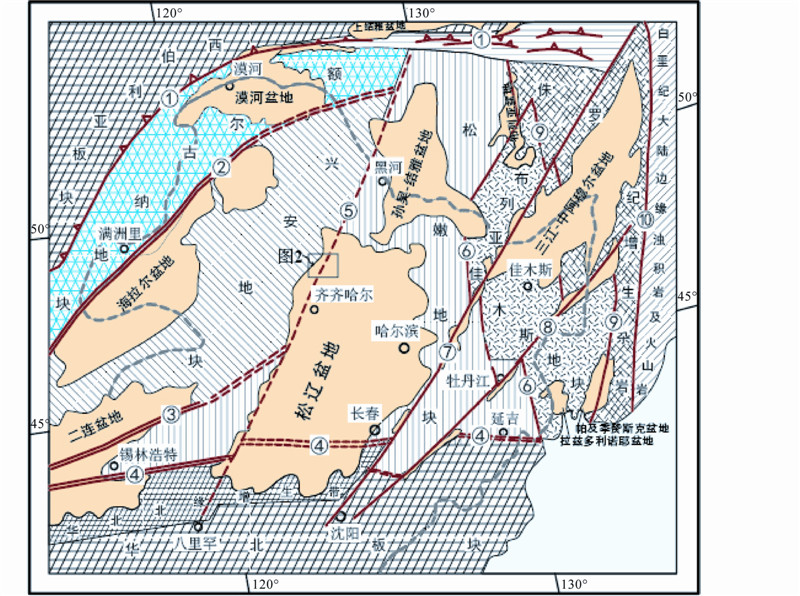 | 图 1 东北地区构造地质简图(据张兴洲等,2006修改) ①蒙古-鄂霍次克构造带;②德尔布干构造带;③贺根山构造带;④西拉木伦河构造带;⑤嫩江-八里罕断裂带;⑥牡丹江构造带;⑦佳木斯-伊通断裂带;⑧敦化-密山断裂带;⑨锡霍特阿林拼合带;⑩锡霍特阿林中央构造带 Fig. 1 Tectonic sketch map of NE China(after Zhang et al,2006) |
笔者通过对松辽盆地西缘边界断裂带进行野外考察,在断裂带中南部吉林省岭下地区和中北部尼尔基地区发现具有左旋走滑性质的韧性剪切带。对岭下韧性剪切带的韧性变形岩石进行了详细的几何学、运动学和年代学研究(韩国卿等, 2009a,b; Han et al., 2012),并同断裂带南部——红山-八里罕断裂带楼子店地区进行系统的对比,证实松辽盆地西缘边界断裂带南段红山-八里罕断裂带早期走滑阶段(~130Ma)至少可以向北延伸至中段岭下地区。然而,尼尔基地区剪切带的构造样式与岭下和楼子店地区有所不同,呈现单一的L型构造岩特征,下文将对尼尔基地区变形岩石的构造变形特征及构造年代学进行研究,进一步揭示松辽盆地西缘断裂带的构造性质,讨论松辽盆地的成因及演化。
2 构造变形特征 2.1 野外构造特征
尼尔基剪切带出露于松辽盆地西缘边界断裂带中北段,尼尔基水库东南,沿嫩江支流东侧呈“孤岛”产出,被第四纪河漫滩沉积环绕(图 2)。该剪切带原岩为二叠纪花岗闪长岩(内蒙古自治区地质矿产局,1991),岩体普遍遭受强烈韧性变形改造(图 3),NE走向的共轭节理发育(图 3a),后期被0.4~1.5m宽度不等的NW走向基性岩脉切割(图 3b)。变形岩石拉伸线理发育(图 3a-d),倾伏向北东,倾角舒缓(42°~45°∠5°),呈杆状构造;面理不发育,倾向SE,倾角中等-高角度(125°~130°∠34°~70°),呈现L构造岩特征(图 3d),野外构造要素产状见图 2。长英质残斑构成眼球状构造,指示其具有左行剪切运动特征(图 3e,f)。
 | 图 2 尼尔基地区地质简图 Fig. 2 Geological sketch of the Nierji area |
 | 图 3 尼尔基剪切带野外照片 (a)-L构造岩野外宏观照片,面理及后期节理发育,镜头方向NE;(b)-NW走向基性岩脉切割韧性剪切带,镜头方向朝下;(c)-测年样品野外照片,位置见(a);(d)-拉伸线理野外照片;(e)-S-C组构及长石旋转残斑,指示左行剪切作用;(f)-钾长石旋转残斑,指示左行剪切作用,镜头方向朝下 Fig. 3 Field outcrop photos of the Nierji ductile shear zone |
尼尔基剪切带变形岩石原岩为花岗闪长岩,其岩石组合主要由粗粒残斑(0.5~3mm)和细粒基质组成,残斑以长石为主,主要为斜长石,微斜长石次之,少量石英、黑云母;基质以长石、石英为主,少量白云母,另外还有少量的硬绿泥石、绿帘石等蚀变矿物(图 4)。残斑和基质所占比例分别为60%~65%和35%~40%,按照钟增球和郭宝罗(1988)的命名方案,定为初糜棱岩-糜棱岩。变形岩石在X-Z面发育矿物拉伸线理,Y-Z面线理不发育,矿物颗粒呈近等轴状(图 4a,b),与野外露头尺度表现的L构造岩特征一致。石英普遍发育波状消光、带状消光现象,长石部分发育弱 波状消光;长石出溶构造明显,具体表现为微斜长石应力条纹(图 4c)、出溶页理、蠕英构造等,个别长石可见轻微的塑性弯曲(图 4e,f);石英动态重结晶现象明显,单偏光镜下呈石英条带状(图 4e,f),正交偏光下可见石英条带为重结晶石英集合体状,且石英颗粒边界镶嵌现象明显,为亚晶粒旋转(SR)向颗粒边界迁移(GBM)重结晶过渡阶段(Stipp et al., 2002);长石动态重结晶现象不显著,主要为膨凸(BLG)现象。综合长石和石英的重结晶特征指示,该初糜棱岩-糜棱岩的变质条件为高绿片岩相(纪沫等,2008),估计变形温度在500℃左右(Stipp et al., 2002; 杨天南和徐宏顺,2008);长石旋转残斑、“多米诺”骨牌结构指示其具有左行剪切特征。
 | 图 4 尼尔基剪切带显微镜下照片 L构造岩正交偏光下不同切片方向显微照片:(a)为X-Z面和(b)为Y-Z面;(c)-微斜长石应力条纹及斜长石蠕英构造;(d)-石英动态重结晶;石英动态重结晶条带和长石弯曲显微照片:(e)为单偏光下和(f)为正交偏光下.Qtz-石英;Pl-斜长石;Ms-白云母;Bt-黑云母;Per-条纹长石 Fig. 4 Microstructure photos of the Nierji ductile shear zone |
本文依据Fry法的测量原理(Fry,1979; 郑亚东和常志忠,1985),进行了适当的改进,对尼尔基韧性变形岩石切制定向薄片(X-Z、Y-Z面),在显微镜下对颗粒分布较为均匀的区域采集显微照片;在Corel DRAW 软件上对显微照片中长石残斑中心进行标定,选取图片中心为原点,将原点移至某一残斑中心,按照上述传统方法标定其余长石残斑的中心,往复标定至覆盖全部残斑中心。长石残斑中心平移后的图像中心空白区域代表了应变椭圆,对其长短轴进行测量,具体测量数据见表 1。
对尼尔基地区变形岩石有限应变测量结果用Flinn图解进行判别,可见K值远大于1,属于典型的拉长型剪切。
 | 表 1 尼尔基地区韧性剪切带有限应变测量数据表 Table 1 Date of finite strain measurement of the Nierji ductile shear zone |
 | 图 5 锆石CL图像(a)和锆石U-Pb谐和图(b) Fig. 5 CL images(a) and concordia plot(b)of zircons from L-type tectonite |
为了确定尼尔基L构造岩原岩的形成时代,本文对测年样品275NE-1(GPS:48°29′4.0″N,124°34′6.4″E)进行了锆石U-Pb年代学研究。锆石分选在河北廊坊地质调查院完成,锆石U-Pb定年工作在西北大学大陆动力学国家重点实验室完成。将人工重砂分离出的锆石颗粒用环氧树脂固定并抛光,使颗粒露出核部。样品在测定之前用体积百分比为3%的HNO3清洗样品表面,以除去样品表面的污染。然后进行透射光和反射光照相,并在英国Gatan公司生产的Mono CL3+阴极发光装置系统上进行阴极发光(CL)照相。锆石定年工作所用的ICP-MS 为Agilient公司最新一代带有Shield Torch 的Agilient 7500a。采用的激光剥蚀系统为德国MicroLas 公司生产的GeoLas200M,该系统由德国Lambda Physik 公司的ComPex102 Excimer 激光器(工作物质ArF,波长193nm)与MicroLas 公司的光学系统组成。锆石U-Pb 定年及微量元素分析的ICP-MS使用一台激光剥蚀系统,对样品进行一次性剥蚀完成,由ICP-MS仪器采集的信号,具体测试过程详见Yuan et al., 2008和Diwu et al., 2008。激光剥蚀以氦气作为剥蚀物质的载气,斑束直径为44μm,频率为10Hz,激光能量为90mJ,每个分析点的气体背景采集时间为30s,信号采集时间为40s。年龄计算采用国际标准程序Isoplot(ver3.23)(Ludwig,2003),本文绘制谐和图所采用的207Pb/235U比值与206Pb/236U比值的误差相关系数为0.65。 3.1.2 测试结果
锆石均为无色到浅褐色,短柱状为主,长宽比多介于1.5:1到2:1之间。从阴极发光图像上看,所有锆石均发育致密的韵律环带,显示了岩浆成因特征(图 5a)。锆石U-Pb测年结果见表 2,20个点的测试结果显示锆石的Th/U比值介于0.06至1.25之间,也反映了岩浆成因的特征。在锆石U-Pb年龄谐和图中(图 5b),有18个点的测试结果分布在谐和线上,锆石的260Pb/238U年龄大体分为两个区间258~403Ma(n=5)和207~174Ma(n=15)。年龄范围在258~403Ma的锆石普遍具有“核-边”结构,一个测点显示边部年龄为196±2Ma(图 5a,测点1)。年龄范围在207~174Ma的锆石年龄相对集中,加权平均年龄为190.0±6.1Ma(图 5b),进一步分析可知,部分锆石呈现~190Ma核部年龄(图 5a,测点12和13),因边部过窄而未获得代表的后期岩浆事件的边部形成时间的年龄数据,但有两个测点获得了最为年轻的和谐年龄,分别是174±2Ma和173±2Ma(图 5a,测点4和11),指示本地区经历多期岩浆事件,该岩体的最后的形成时代应该为中侏罗世早期。
| 表 2 尼尔基地区L构造岩锆石U-Pb同位素数据 Table 2 Results of LA-ICP-MS zircon U-Pb age dating for the L-type tectonite from the Nierji area |
云母测试样品275NE-1镜下观察显示,细小白云母颗粒呈鳞片状,主要存在基质中(图 4c,d),部分为长石等矿物的压力影组成部分,指示其可能为构造变形过程中形成的新生白云母,与定向摆列的黑云母产出状态显著不同(图 4a)。样品人工用铁质研钵将岩石样品粉碎至40目以下,经不同粒径筛子对岩石粉末分离,对适合粒级岩石粉末用水反复浮选,初选白云母矿物最后在双目镜下人工提纯。
激光阶段加热40Ar/39Ar测试工作在奥地利萨尔茨堡大学地质地理系激光ARGONAUT 同位素测年实验室完成,样品的照射工作在匈牙利布达佩斯MTA KFKI反应堆进行,照射时间为16h,校正参数及计算过程见Wijbrans et al.(1995),本文选用的修正值来源于Hinsbergen et al.(2008),实验仪器及流程详见Liu et al.(2005,2006)。 3.2.2 测试结果
样品每个阶段的原始数据经过K、Ca同位素校正和大气氩矫正,再通过年龄公式计算出每个温度阶段的阶段年龄。
根据样品各阶段的39Ar析出量(表 3)和阶段年龄绘制该样品的年龄谱(图 6)。激光阶段加热方法对样品进行加热,其中11个阶段中有7个阶段析出39Ar累计为97.2%,并给出一个稳定的年龄坪为158.99±0.61Ma。
 | 图 6 尼尔基地区L构造岩白云母40Ar/39Ar年龄图谱 Fig. 6 40Ar/39Ar plateau ages of muscovite in the L-type tectonite from the Nierji area |
| 表 3 尼尔基地区L构造岩白云母40Ar/39Ar分析数据 Table 3 40Ar/39 Ar analytical data of muscovite in the L-type tectonite from the Nierji area |
尼尔基L构造岩的原岩形成时代一致被认为是二叠纪(内蒙古自治区地质矿产局,1991),本文的锆石U-Pb年龄测试结果显示该地区存在多期晚古生代岩浆事件,尼尔基岩体最后的侵位事件可能发生于中侏罗世早期(~170Ma)。结合根据L构造岩变形组构特征所估算的后期剪切变形温度(在500℃左右)高于白云母的封闭温度(300~400℃)(Ehlers et al., 2005),故认为白云母激光40Ar/39Ar年龄(158.99±0.61Ma)应代表了L构造岩左行剪切变形后的快速隆升时间。
4 讨论
对于松辽盆地的成因或动力学机制,一直以来存在多种认识,简单归纳为以下几类:(1)中国东部裂谷系中的裂谷盆地(童崇光,1980; Ma et al., 1989; Li,1995; Jin and McCabe, 1998);(2)东 亚边缘的双弧后盆地和弧后陆内裂谷盆地(赵海玲等,1996;刘德来等,1996;刘德来和马莉,1998;马莉和刘德来,1999);(3)由于周边板块的相互作用使中国东部由左旋挤压应力场转化为右旋张扭应力场(Li et al., 1988); (4)太平洋板块斜向俯冲引起陆缘发生左行剪切,剪切引发热流被动上涌产生斜向伸展(刘立等,1994;刘招君等,1994);(5)地幔柱相关的盆地(Okada,1999)。并且,这些认识均建立在东北地区在晚古生代期间已经形成了统一的陆块——额尔古纳-兴安-松嫩-佳木斯联合陆块的认识上,一些学者称这一地块为黑龙江中、小地块群(谢鸣谦,2000;张兴洲等,2006),满洲地块(Sengör and Natal’in,1996)或佳蒙地块(王成文等,2008)。然而,最新的研究表明,佳木斯地块与松嫩地块的拼贴时间可能不是传统观点所认识的早古生代(~500Ma)(张兴洲,1992),原作为佳木斯和松嫩地块之间牡丹江缝合带标志的黑龙江群可能为一套侏罗纪增生杂岩(Wu et al., 2007)。虽然,佳木斯地块在~500Ma是否同松辽地块存在拼贴事件仍存在争论(张兴洲,1992; Wu et al., 2007; Meng et al., 2010),但在二叠-三叠纪期间,佳木斯地块和松辽地块之间存在一个残余或新生洋盆已被黑龙江群蓝片岩中基性岩和碎屑岩中锆石年龄所证实(图 7a)(Wu et al., 2007; Zhou et al., 2009,2010),并在松辽地块东缘发育大量216±4Ma至184±4Ma之间的I型花岗岩岩浆弧(Wu et al., 2000,2007),对应现今的张广才岭;中侏罗世发生强烈的俯冲,黑龙群蓝片岩快速折返,俯冲的时限可能从190~145Ma,峰期年龄在171±6.2Ma(图 7a,b)(Wu et al., 2007; Li et al., 2009,2010; 赵英利等,2010; 赵亮亮和张兴洲,2011)。此峰期年龄与本文所获得的尼尔基L构造岩原岩的侵位年龄一致,略早于岩体的走滑剪切变形年龄,与剪切带中白云母Ar-Ar年龄所代表的快速隆升时间相差10Myr左右。
 | 图 7 黑龙江群蓝片岩原岩形成时间和变质时间 (a)-原岩形成时间和变质时间,数据源自Wu et al., 2007; Zhou et al., 2009,2010;(b)-变质时间加权平均,数据源自Wu et al., 2007; Li et al., 2009,2010; 赵英利等,2010; 赵亮亮和张兴洲,2011 Fig. 7 The distribution of formation and metamorphic time of the blue schist from Heilongjiang Group |
此外,近年来对中国东部地区著名的北东向走滑断裂——郯庐断裂的性质及演化阶段等方面的研究已取得了重要的成果(陈宣华等,2000; Zhu et al., 2001; 朱光等,2005; Wang et al., 2006; 张青等,2008; 张岳桥和董树文,2008)。对现有报道的年代学数据初步分析,郯庐断裂带至少存在三期走滑事件:(1)中三叠世236~238Ma,华北与华南板块碰撞的深俯冲阶段,可能起源于陆内转换断层,并延续到三叠纪末期(张青等,2008;陈宣华等,2000);(2)中-晚侏罗世155~165Ma,左行挤压走滑期(Wang et al., 2006);(3)早白垩世早期137~143Ma,左行走滑剪切期(Zhu et al., 2001; 朱光等,2005)。在东北地区,对作为郯庐断裂北延的佳-伊断裂和敦-密断裂的走滑时间的报道主要有:孙晓猛(2008)在敦-密断裂带北段密山县知一镇左行走滑型糜棱岩剪切带获得黑云母单矿物40Ar/39Ar年龄为161±3Ma,并认为其代表了郯庐断裂第二期左行走滑事件在东北地区的响应(孙晓猛等,2008);窦立荣等(1996)对佳-伊断裂带内云母石英片岩的黑云母和辉绿岩辉石进行单矿物40Ar/39Ar分析获得坪年龄为100±2.3Ma和105Ma,其年龄值可能反应了断裂带后期伸展事件(窦立荣等,1996);殷长建等(2005)在佳-伊断裂带内乐山镇达子沟获得压碎中细粒黑云母二长花岗岩中黑云母单矿物40Ar/39Ar坪年龄133.13±0.31Ma,靠山镇北口获得中细粒碎裂白云母/二云母花岗岩白云母单矿物40Ar/39Ar坪年龄135.66±0.11Ma,其年龄在数值上与郯庐断裂第三期左行走滑时间相当,但碎裂花岗岩云母年龄可能反映花岗岩岩体形成后的隆升事件。本文在松辽盆地西缘边界断裂带中北段尼尔基地区获得的L构造岩变形后快速隆升的年龄为158.99±0.61Ma,其变形年龄应略早于159Ma,在误差范围内与郯庐断裂第二期走滑挤压时间,以及敦-密断裂的走滑事件一致。另外,在断裂带中段岭下地区和南段楼子店地区均发现了~130Ma的NE向的左行走滑或是斜滑剪切事件(Zhang et al., 2002; 刘伟等,2003; 王新社和郑亚东,2005; Han et al., 2012),与郯庐断裂带的第三期走滑事件相当。松辽盆地内NNE向基底断裂左旋走滑派生次级断裂的构造物理模拟实验也很好的拟合了盆内断陷呈NNE向带状分布的现象,进一步证实了中-晚侏罗世NNE向左旋走滑基底断裂的存在(葛荣峰等,2010)。
从动力学背景上考虑,在~180Ma Farallon板块在向欧亚大陆NW向俯冲的同时,向NE方向以10.7cm/y的速度扩张,其无疑将对欧亚大陆东缘起到NE向的拖动作用;~150Ma Izanazi 板块向欧亚大陆N向高速俯冲(30cm/y),对欧亚大陆产生NW向挤压的同时,沿NE向的大陆边缘产生较大的NE向走滑分量(Maruyama et al., 1997)。结合先前对郯庐断裂带、东北地区NE向断裂走滑相关年龄及黑龙江群蓝片岩快速俯冲折返的年龄的总结,可以看出,在中国东北地区、乃至中国东部地区存在着~160Ma NE向走滑剪切事件,与西太平洋板块(包括Farallon和Izanazi板块)向欧亚大陆俯冲过程中角度的变化及其导致的相关地块或地体拼贴过程中的走滑调整有关(赵越等,1994; Maruyama et al., 1997)。松辽盆地裂谷前期演化可能受控于~160Ma的NE向左行走滑剪切作用,随后NW-SE向伸展组分逐渐增加,在~130Ma走滑或斜滑剪切仍影响着盆地演化,之后进入了大规模的盆地伸展凹陷阶段(葛荣峰等,2010)。
5 结论
通过对松辽盆地西缘边界断裂带中北段尼尔基剪切带的构造变形特征及年代学的综合研究,结合东北地区新近报道的年代学数据,得出以下几点认识:
(1)尼尔基剪切带为典型L构造岩,并具有左行剪切特征,应变类型属于拉长型剪切,带内构造岩变形程度为初糜棱岩-糜棱岩,变形温度在500℃左右;
(2)尼尔基地区存在多期晚古生代岩浆事件,变形岩体侵位时间为~170Ma,并非前人所认为的二叠纪;L构造形成后快速隆升的时间为158.99±0.61Ma;
(3)尼尔基剪切带~160Ma的左行剪切作用可能受控于西太平洋板块向欧亚大陆斜向俯冲导致的地块或地体拼贴过程及其的响应的走滑调整,松辽盆地断陷早期演化可能受控于西缘断裂为代表的左行走滑剪切作用。
致谢 感谢东北亚矿产资源评价国土资源部重点实验室的资助。
| [1] | Bureau of Geology and Mineral Resources of Inner Mongolia Autonomous Region. 1991. Regional Geology of Inner Mongolia Autonomous Region. Beijing: Geological Publishing House, 1-725 (in Chinese with English abstract) |
| [2] | Chen HZ, Yu ZY, Xu XY, Tao RP and Gao F. 2004. Characteristics of Nenjiang fracture structure and the relation between this fracture and earthquake activity. Seismological Research of Northeast China, 20(4): 43-49 (in Chinese with English abstract) |
| [3] | Chen XH, Wang XF, Zhang Q, Chen BL, Chen ZL, Harrison TM and Yin A. 2000. Geochronologic study of the formation and evolution of the Tan-Lu fault zone. Journal of Jilin University (Earth Science Edition), 30(3): 215-220 (in Chinese with English abstract) |
| [4] | Diwu CR, Sun Y, Yuan HL, Wang HL, Zhong XP and Liu XM. 2008. U-Pb ages and Hf isotopes for detrital zircons from quartzite in the Paleoproterozoic Songshan Group on the southwestern margin of the North China Craton. Chinese Science Bulletin, 53(18): 2828-2839 |
| [5] | Dou LR, Song JG and Wang Y. 1996. Chronology of the formation of the northern Tan-Lu fault zone and its implications. Geological Review, 42(6): 508-513 (in Chinese with English abstract) |
| [6] | Ehlers TA, Chaudhri T, Kumar S, Fuller CW, Willett SD, Ketcham RA, Brandon MT, Belton DX, Kohn BP, Gleadow AJW, Dunai TJ and Fu FQ. 2005. Computational tools for low-temperature thermochronometer interpretation. Reviews in Mineralogy and Geochemistry, 58(1): 589-622 |
| [7] | Fang S, Zhu HS, Zhu HZ, Jia W, Zhang QZ and Zhao WL. 2001. Evolution of the Kalaqin fault-uplifts at southern fringe of North China platform. Geology in China, 28(3): 5-11 (in Chinese with English abstract) |
| [8] | Fry N. 1979. Random point distributions and strain measurements in rocks. Tectonophysics, 60(1-2): 89-105 |
| [9] | Fu WZ and He RZ. 1999. Structural characteristics of earthquakes in Songliao basin and its peripheral regions. Global Geology, 18(2): 31-33 (in Chinese with English abstract) |
| [10] | Ge RF, Zhang QL, Wang LS, Xie GA, Xu SY, Chen J and Wang XY. 2010. Tectonic evolution of Songliao Basin and the prominent tectonic regime transition in eastern China. Geological Review, 56(2): 180-195 (in Chinese with English abstract) |
| [11] | Han BF, Zheng YD, Gang JW and Chang ZS. 2001. The Louzidian normal fault near Chifeng, Inner Mongolia: Master fault of a quasi-metamorphic core complex. International Geology Review, 43(3): 254-264 |
| [12] | Han GQ, Liu YJ, Jin W, Wen QB, Li W, Liang CY and Liang TJ. 2009a. The distribution of Xar Moron River Fault under Songliao Basin. Geology in China, 36(5): 1010-1020 (in Chinese with English abstract) |
| [13] | Han GQ, Liu YJ, Wen QB, Zou YX, Liang DJ, Zhao YL, Li W and Zhao LM. 2009b. The characteristics of structural deformation for the Lingxia ductile shear zone of Nenjing-Balihan fault belt in northeastern China. Journal of Jilin University (Earth Science Edition), 39(3): 397-405 (in Chinese with English abstract) |
| [14] | Han GQ, Liu YJ, Neubauer F, Genser J, Zou YX, Li W and Liang CY. 2012. Characteristics, timing, and offsets of the middle-southern segment of the western boundary strike-slip fault of the Songliao Basin in Northeast China. Science China (Earth Sciences), 55(3): 464-475 |
| [15] | Ji M, Hu L, Liu JL and Cao SY. 2008. Dynamic recrystallization and metamorphic conditions of main rock-forming minerals. Earth Science Frontiers, 15(3): 226-233 (in Chinese with English abstract) |
| [16] | Jin Q and McCabe PJ. 1998. Genetic features of petroleum systems in rift basins of eastern China. Marine and Petroleum Geology, 15(4): 343-358 |
| [17] | Koschek G. 1993. Origin and significance of the SEM cat hodoluminescence from zircon. Journal of Microscopy, 171(3): 223-232 |
| [18] | Li DS. 1995. Hydrocarbon habitat in the Songliao rift basin, China. Geological Society, London, Special Publications, 80(1): 317-329 |
| [19] | Li ST, Yang SG, Wu CL, Huang JF, Cheng ST, Xia WC and Zhao GR. 1988. Late Mesozoic rifting in Northeast China and Northeast Asia fault basin system. Science in China (Series B), 31(2): 246-256 |
| [20] | Li WM, Takasu A, Liu YJ, Genser J, Neubauer F and Guo XZ. 2009. 40Ar/39Ar ages of the high-P/T metamorphic rocks of the Heilongjiang Complex in the Jiamusi Massif, northeastern China. Journal of Mineralogical and Petrological Sciences, 104(2): 110-116 |
| [21] | Li WM, Takasu A, Liu YJ and Guo XZ. 2010. Newly discovered garnet-barroisite schists from the Heilongjiang Complex in the Jiamusi Massif, northeastern China. Journal of Mineralogical and Petrological Sciences, 105(2): 86-91 |
| [22] | Liu DL, Chen FJ, Guan DF, Tang JR and Liu CR. 1996. A study on lithospheric dynamics of the origin and evolution in the Songliao Basin. Scientia Geologica Sinica, 31(4): 397-407 (in Chinese with English abstract) |
| [23] | Liu DL and Ma L. 1998. Relation between prerift volcanics and the rift basin and geodynamic processes. Geological Review, 44(2): 130-135 (in Chinese with English abstract) |
| [24] | Liu L, Wang XL, Liu ZJ, Liu WZ, Xue F and Zhao MP. 1994. Tectonic-sedimentary evolution of Mesozoic and Cenozoic rift basins within Manzhouli-Suifenhe geoscience transect region. In: M-SGT Geology Group (ed.). Geological Studies of Lithospheric Structure and Evolution of Manzhouli-Suifenhe Geotransect, China. Beijing: Seismic Press, 1-13 (in Chinese with English abstract) |
| [25] | Liu W, Yang JH and Li CF. 2003. Thermochronology of three major faults in the Chifeng area, Inner Mongolia of China. Acta Petrologica Sinica, 19(4): 717-728 (in Chinese with English abstract) |
| [26] | Liu YJ, Genser J, Neubauer F, Jin W, Ge XH, Handler R and Takasu A. 2005. 40Ar/39Ar mineral ages from basement rocks in the Eastern Kunlun Mountains, NW China and their tectonic implications. Tectonophysics, 398(3-4): 199-224 |
| [27] | Liu YJ, Neubauer F, Genser J, Takasu A, Ge XH and Handler R. 2006. 40Ar/39Ar ages of the blueschist facies pelitic schists from Qingshuigou in the northern Qilian Mountains, western China. Island Arc, 15(1): 187-198 |
| [28] | Liu ZJ, Wang XL, Liu WZ, Xue F and Zhao MP. 1994. Formation mechanism of Songliao and Hailaer Mesozoic basins of Manzhouli-Suifenhe geoscience transect region. In: M-SGT Geology Group (ed.). Geological Studies of Lithospheric Structure and Evolution of Manzhouli-Suifenhe Geotransect, China. Beijing: Seismic Press, 14-25 (in Chinese with English abstract) |
| [29] | Ludwig KR. 2003. ISOPLOT 3: A Geochronological Toolkit for Microsoft Excel. Berkeley Geochronology Centre, Special Publication, 4: 1-72 |
| [30] | Ma L, Yang JL and Ding ZG. 1989. Songliao Basin: An intercontinental sedimentary basin of the combination type. In: Zhu X (ed.). Chinese Sedimentary Basins. Amsterdam: Elsevier, 78-87 |
| [31] | Ma L and Liu DL. 1999. The origin and evolution of Songliao Basin and its relation with asthenosphere convection model. Scientia Geologica Sinica, 34(3): 365-374 (in Chinese with English abstract) |
| [32] | Maruyama S, Isozaki Y, Kimura G and Terabayash M. 1997. Paleogeographic maps of the Japanese Islands: Plate tectonic synthesis from 750Ma to the present. Island Arc, 6(1): 121-142 |
| [33] | Meng E, Xu WL, Pei FP, Yang DB, Yu Y and Zhang XZ. 2010. Detrital-zircon geochronology of Late Paleozoic sedimentary rocks in eastern Heilongjiang Province, NE China: Implications for the tectonic evolution of the eastern segment of the Central Asian Orogenic Belt. Tectonophysics, 485(1-4): 42-51 |
| [34] | Okada H. 1999. Plume-related sedimentary basins in East Asia during the Cretaceous. Palaeogeography, Palaeoclimatology, Palaeoecology, 150(1-2): 1-11 |
| [35] | Qin ZH. 1999. Character comparison of Jiufengshan Formation on the two sides of Nenjiang fault and coal exploration. Coal Technology, 18(6): 31-33 (in Chinese with English abstract) |
| [36] | Sengör AMC and Natal’in BA. 1996. Paleotectonics of Asia: Fragments of a synthesis. In: Yin A and Harrison M (eds.). the Tectonic Evolution of Asia. Cambridge: Cambridge University Press, 486-641 |
| [37] | Shao JA, Zhang LQ, Jia W and Wang PY. 2001. Harkin metamorphic core complex in Inner Mongolia and its upwelling mechanism. Acta Petrologica Sinica, 17(2): 283-290 (in Chinese with English abstract) |
| [38] | Stipp M, Stünitz H, Heilbronner R and Schmid SM. 2002. The eastern Tonale fault zone: A 'natural laboratory’ for crystal plastic deformation of quartz over a temperature range from 250 to 700℃. Journal of Structural Geology, 24(12): 1861-1884 |
| [39] | Sun XM, Liu YJ, Sun QC, Han GQ, Wang SQ and Wang YD. 2008. 40Ar/39Ar geochronology evidence of strike-slip movement in Dunhua-Mishan fault zone. Journal of Jilin University (Earth Science Edition), 38(6): 965-972 (in Chinese with English abstract) |
| [40] | Tong CG. 1980. Some characteristics of petroleum geology of the rift system in eastern China. Acta Petrolei Sinica, 1(4): 19-26 (in Chinese with English abstract) |
| [41] | Van Hinsbergen DJJ, Straathof GB, Kuiper KF, Cunningham WD and Wijbrans J. 2008. No vertical axis rotations during Neogene transpressional orogeny in the NE Gobi Altai: Coinciding Mongolian and Eurasian Early Cretaceous apparent polar wander paths. Geophysical Journal International, 173(1): 105-126 |
| [42] | Wang CW, Jin W, Zhang XZ, Ma ZH, Chi XG, Liu YJ and Li N. 2008. New understanding of the Late Paleozoic tectonics in northeastern China and adjacent areas. Journal of Stratigraphy, 32(2): 119-136 (in Chinese with English abstract) |
| [43] | Wang XS and Zheng YD. 2005. 40Ar/39Ar age constraints on the ductile deformation of the detachment system of the Louzidian core complex, southern Chifeng, China. Geological Review, 51(5): 574-582 (in Chinese with English abstract) |
| [44] | Wang XS, Zheng YD, Liu YL, Bradley R and Scott F. 2006. The formation age of the chloritized zone in the Louzidian extensional detachment fault south of Chifeng, Inner Mongolia, China. Progress in Natural Science, 16(7): 902-906 (in Chinese with English abstract) |
| [45] | Wang XS, Zheng YD and Wang T. 2007. Strain and shear types of the Louzidian ductile shear zone in southern Chifeng, Inner Mongolia, China. Science in China (Series D), 50(4): 487-495 |
| [46] | Wang Y. 2006. The onset of the Tan-Lu fault movement in eastern China: Constraints from zircon (SHRIMP) and 40Ar/39Ar dating. Terra Nova, 18(6): 423-431 |
| [47] | Wang YF, Cui WY and Sun CZ. 1994. The Louzidian-Dachengzi detachment fault and its tectonic evolution, South Chifeng, Inner Mongolia. In: Qian XL (ed.). Studies of Extentional Tectonics. Beijing: Geologic Publishing House, 99-108 (in Chinese with English abstract) |
| [48] | Wijbrans JR, Pringle MS, Koppers AAP and Scheveers R. 1995. Argon geochronology of small samples using the Vulkaan argon laserprobe. Proceedings of the Koninklijke Akademie van Wetenschappen, 98(2): 185-218 |
| [49] | Wu FY, Jahn BM, Wilde SA and Sun DY. 2000. Phanerozoic crustal growth: U-Pb and Sr-Nd isotopic evidence from the granites in northeastern China. Tectonophysics, 328(1-2): 89-113 |
| [50] | Wu FY, Yang JH, Lo CH, Wilde SA, Sun DY and Jahn BM. 2007. The Heilongjiang Group: A Jurassic accretionary complex in the Jiamusi Massif at the western Pacific margin of northeastern China. Island Arc, 16(1): 156-172 |
| [51] | Xie MQ. 2000. Amalgamating Plate Tectonic and Its Droved Mechanism-Tectonic Evolution of Northeast China and Adjacent Area. Beijing: Science Press, 1-252 (in Chinese with English abstract) |
| [52] | Yang CX, Wang GH and Chen J. 1984. The Hongshan-Balihan fault zone, Inner Mongolia: Its geologic features and seismicity. Journal of Seismological Research, 7(4): 391-398 (in Chinese with English abstract) |
| [53] | Yang TN and Xu HS. 2008. Mechanisms of dynamic recrystallization: Recognition from natural tectonites. Geological Bulletin of China, 27(9): 1459-1467 (in Chinese with English abstract) |
| [54] | Yin CJ, Peng YJ, Wang YS, Li R and Chen YJ. 2005. New evidences of chronology of rift belt of Yitong-Shulan. Jilin Geology, 24(1): 6-15 (in Chinese with English abstract) |
| [55] | Yuan HL, Gao S, Dai MN, Zong CL, Günther D, Fontaine GH, Liu XM and Diwu CR. 2008. Simultaneous determinations of U-Pb age, Hf isotopes and trace element compositions of zircon by excimer laser-ablation quadrupole and multiple-collector ICP-MS. Chemical Geology, 247(1-2): 100-118 |
| [56] | Zhang Q, Zhu G, Liu GS, Teyssier C and Dunlapet WJ. 2008. Sinistral transpressive deformation in the northern part of Zhangbaling uplift in the Tan-Lu fault zone and its 40Ar/39Ar dating. Earth Science Frontiers, 15(3): 234-249 (in Chinese with English abstract) |
| [57] | Zhang XH, Li TS, Pu ZP and Wang H. 2002. 40Ar-39Ar ages of Louzidian-Dachengzi ductile shear zone in Chifeng, Inner Mongolia and its tectonic significance. Chinese Science Bulletin, 47(15): 1292-1297 |
| [58] | Zhang XZ. 1992. Heilongjiang mélange: The evidence of Caledonian suture zone of the Jiamusi. Journal of Changchun University of Earth Sciences, 22(Suppl.1): 94-101 (in Chinese with English abstract) |
| [59] | Zhang XZ, Yang BJ, Wu FY and Liu GX. 2006. The lithosphere structure in the Hingmong-Jihei (Hinggan-Mongolia-Jilin-Heilongjiang) region, northeastern China. Geology in China, 33(4): 816-823 (in Chinese with English abstract) |
| [60] | Zhang YQ and Dong SW. 2008. Mesozoic tectonic evolution history of the Tan-Lu fault zone, China: Advances and new understanding. Geological Bulletin of China, 27(9): 1371-1390 (in Chinese with English abstract) |
| [61] | Zhang ZF and Ge CB. 2000. Discussion on deep structure features and geoteotonicst in the eastern part of Inner Mongolia. Geology of Inner Mongolia, (3): 6-18, 37 (in Chinese with English abstract) |
| [62] | Zhao HL, Deng JF, Chen FJ, Liu HX, Hu Q and Di YJ. 1996. Petrology and tectonic setting of Mesozoic volcanic rocks along southeastern margin of Songliao Basin. Earth Science, 21(4): 421-427 (in Chinese with English abstract) |
| [63] | Zhao LL and Zhang XZ. 2011. Petrological and geochronological evidences of tectonic exhumation of Heilongjiang complex in the eastern part of Heilongjiang Province, China. Acta Petrologica Sinica, 27(4): 1227-1234 (in Chinese with English abstract) |
| [64] | Zhao WZ and Li JZ. 2004. Control of basement faults on hydrocarbon accumulation in southern Songliao basin. Acta Petrolei Sinica, 25(4): 1-6 (in Chinese with English abstract) |
| [65] | Zhao Y, Yang ZY and Ma XH. 1994. Geotectonic transition from Paleoasian system and Paleotethyan system to Paleopacific active continental margin in Eastern Asia. Scientia Geologica Sinica, 29(2): 105-119 (in Chinese with English abstract) |
| [66] | Zhao YL, Liu YJ, Li WM, Wen QB and Han GQ. 2010. High-pressure metamorphism in the Mudanjiang area, southern Jiamusi massif: Petrological and geochronological characteristics of the Heilongjiang complex, China. Geological Bulletin of China, 29(2-3): 243-253 (in Chinese with English abstract) |
| [67] | Zheng YD and Chang ZZ. 1985. Finite Strain Measurement and Ductile Shear Zones. Beijing: Geological Publishing House, 1-185 (in Chinese with English abstract) |
| [68] | Zhong ZQ and Guo BL. 1991. Tectonite and Micro-structure. Wuhan: China University of Geology Press, 1-128 (in Chinese with English abstract) |
| [69] | Zhou JB, Wilde SA, Zhang XZ, Zhao GC, Zheng CQ, Wang YJ and Zhang XH. 2009. The onset of Pacific margin accretion in NE China: Evidence from the Heilongjiang high-pressure metamorphic belt. Tectonophysics, 478(3-4): 230-246 |
| [70] | Zhou JB, Wilde SA, Zhao GC, Zhang XZ, Zheng CQ and Wang H. 2010. New SHRIMP U-Pb zircon ages from the Heilongjiang high-pressure belt: Constraints on the Mesozoic evolution of NE China. American Journal of Science, 310(9): 1024-1053 |
| [71] | Zhu G, Song CZ, Wang DX, Liu GS and Xu JW. 2001. Studies on 40Ar/39Ar thermochronology of strike-slip time of the Tan-Lu fault zone and their tectonic implications. Science in China (Series D), 44(11): 1002-1009 |
| [72] | Zhu G, Niu ML, Liu GS, Wang, YS, Xie CL and Li CC. 2005. 40Ar/39Ar dating for the strike-slip movement on the Feidong part of the Tan-Lu Fault Belt. Acta Geologica Sinica, 79(3): 303-316 (in Chinese with English abstract) |
| [73] | 陈洪洲, 余中元, 许晓艳, 陶汝朋, 高峰. 2004. 嫩江断裂构造及其与地震活动的关系. 东北地震研究, 20(4): 43-49 |
| [74] | 陈宣华, 王小凤, 张青, 陈柏林, 陈正乐, Harrison TM, Yin A. 2000. 郯庐断裂带形成演化的年代学研究. 吉林大学学报(地球科学版), 30(3): 215-220 |
| [75] | 窦立荣, 宋建国, 王瑜. 1996. 郯庐断裂带北段形成的年代学及其意义. 地质论评, 42(6): 508-513 |
| [76] | 方曙, 朱洪森, 朱慧忠, 贾文, 张庆洲, 赵万莉. 2001. 华北地台北缘喀喇沁断隆隆升机制. 中国地质, 28(3): 5-11 |
| [77] | 傅维洲, 贺日政. 1999. 松辽盆地及周边地带地震构造特征. 世界地质, 18(2): 31-33 |
| [78] | 葛荣峰, 张庆龙, 王良书, 解国爱, 徐士银, 陈娟, 王锡勇. 2010. 松辽盆地构造演化与中国东部构造体制转换. 地质论评, 56(2): 180-195 |
| [79] | 韩国卿, 刘永江, 金巍, 温泉波, 李伟, 梁琛岳, 梁道俊. 2009a. 西拉木伦河断裂在松辽盆地下部的延伸. 中国地质, 36(5): 1010-1020 |
| [80] | 韩国卿, 刘永江, 温泉波, 邹运鑫, 梁道俊, 赵英利, 李伟, 赵立敏. 2009b. 嫩江-八里罕断裂带岭下韧性剪切带变形特征. 吉林大学学报(地球科学版), 39(3): 397-405 |
| [81] | 纪沫, 胡玲, 刘俊来, 曹淑云. 2008. 主要造岩矿物动态重结晶作用及其变质条件. 地学前缘, 15(3): 226-233 |
| [82] | 刘德来, 陈发景, 关德范, 唐建人, 刘翠荣. 1996. 松辽盆地形成、发展与岩石圈动力学. 地质科学, 31(4): 397-407 |
| [83] | 刘德来, 马莉. 1998. 松辽盆地裂谷期前火山岩与裂谷盆地关系及动力学过程. 地质论评, 44(2): 130-135 |
| [84] | 刘立, 汪筱林, 刘招君, 刘万洙, 薛放, 赵满平. 1994. 满洲里-绥芬河地学断面域内中新生代裂谷盆地构造-沉积演化. 见: M-SGT地质课题组编. 中国满洲里-绥芬河地学断面域内岩石圈结构及其演化的地质研究. 北京: 地质出版社, 1-13 |
| [85] | 刘伟, 杨进辉, 李潮峰. 2003. 内蒙赤峰地区若干主干断裂带的构造热年代学. 岩石学报, 19(4): 717-728 |
| [86] | 刘招君, 汪筱林, 刘万洙, 薛放, 赵满萍. 1994. 满洲里-绥芬河地学断面域松辽-海拉尔中生代盆地形成机制. 见: M-SGT地质课题组编. 中国满洲里-绥芬河地学断面域内岩石圈结构及其演化的地质研究. 北京: 地质出版社, 14-25 |
| [87] | 马莉, 刘德来. 1999. 松辽盆地成因演化与软流圈对流模式. 地质科学, 34(3): 365-374 |
| [88] | 内蒙古自治区地质矿产局. 1991. 内蒙古自治区地质志. 北京: 地质出版社, 1-725 |
| [89] | 秦志宏. 1999. 嫩江断裂两侧九峰山组特征对比及找煤方向. 煤炭技术, 18(6): 31-33 |
| [90] | 邵济安, 张履桥, 贾文, 王佩瑛. 2001. 内蒙古喀喇沁变质核杂岩及其隆升机制探讨. 岩石学报, 17(2): 283-290 |
| [91] | 孙晓猛, 刘永江, 孙庆春, 韩国卿, 王书琴, 王英德. 2008. 敦密断裂带走滑运动的40Ar/39Ar年代学证据. 吉林大学学报(地球科学版), 38(6): 965-972 |
| [92] | 童崇光. 1980. 中国东部裂谷系盆地的石油地质特征. 石油学报, 1(4): 19-26 |
| [93] | 王成文, 金巍, 张兴洲, 马志红, 迟效国, 刘永江, 李宁. 2008. 东北及邻区晚古生代大地构造属性新认识. 地层学杂志, 32(2): 119-136 |
| [94] | 王新社, 郑亚东. 2005. 楼子店变质核杂岩韧性变形作用的40Ar/39Ar年代学约束. 地质论评, 51(5): 574-582 |
| [95] | 王新社, 郑亚东, 刘玉琳, Bradley R, Scott F. 2006. 内蒙赤峰南部楼子店拆离断层系绿泥石化带的形成时代. 自然科学进展, 16(7): 902-906 |
| [96] | 王玉芳, 崔文元, 孙承志. 1994. 内蒙赤峰南部娄子店-大城子拆离断层及其构造演变. 见: 钱祥麟编. 伸展构造研究. 北京: 地质出版社, 99-108 |
| [97] | 谢鸣谦. 2000. 拼帖板块构造及其驱动机理——中国东北及邻区的大地构造演化. 北京: 科学出版社, 1-252 |
| [98] | 杨承先, 王贵华, 陈健. 1984. 内蒙红山-八里罕断裂带地质特征及其地震活动性. 地震研究, 7(4): 391-398 |
| [99] | 杨天南, 徐宏顺. 2008. 通过构造岩鉴别岩石动态重结晶的机制. 地质通报, 27(9): 1459-1467 |
| [100] | 殷长建, 彭玉鲸, 王彦生, 李睿, 陈跃军. 2005. 伊舒断裂带年代学新证据. 吉林地质, 24(1): 6-15 |
| [101] | 张青, 朱光, 刘国生, Teyssier C, Dunlap WJ. 2008. 郯庐断裂带张八岭隆起北段的左旋走滑挤压变形及其40Ar/39Ar 定年. 地学前缘, 15(3): 234-249 |
| [102] | 张兴洲. 1992. 黑龙江岩系——古佳木斯地块加里东缝合带的证据.长春地质学院学报, 22(增刊): 94-101 |
| [103] | 张兴洲, 杨宝俊, 吴福元, 刘国兴. 2006. 中国兴蒙-吉黑地区岩石圈结构基本特征. 中国地质, 33(4): 816-823 |
| [104] | 张岳桥, 董树文. 2008. 郯庐断裂带中生代构造演化史: 进展与新认识. 地质通报, 27(9): 1371-1390 |
| [105] | 张振法, 葛昌宝. 2000. 内蒙古东部区深部构造特征和大地构造问题浅议. 内蒙古地质, (3): 6-18, 37 |
| [106] | 赵海玲, 邓晋福, 陈发景, 刘厚祥, 胡泉, 狄永军. 1996. 松辽盆地东南缘中生代火山岩及其盆地形成的构造背景. 地球科学, 21(4): 421-427 |
| [107] | 赵亮亮, 张兴洲. 2011. 黑龙江杂岩构造折返的岩石学与年代学证据. 岩石学报, 27(4): 1227-1234 |
| [108] | 赵文智, 李建忠. 2004. 基底断裂对松辽南部油气聚集的控制作用. 石油学报, 25(4): 1-6 |
| [109] | 赵英利, 刘永江, 李伟民, 温泉波, 韩国卿. 2010. 佳木斯地块南缘牡丹江地区高压变质作用: 黑龙江杂岩的岩石学和地质年代学. 地质通报, 29(2-3): 243-253 |
| [110] | 赵越, 杨振宇, 马醒华. 1994. 东亚大地构造发展的重要转折. 地质科学, 29(2): 105-119 |
| [111] | 郑亚东, 常志忠. 1985. 岩石有限应变测量及韧性剪切带. 北京: 地质出版社, 1-185 |
| [112] | 钟增球, 郭宝罗. 1991. 构造岩与显微构造. 武汉: 中国地质大学出版社, 1-128 |
| [113] | 朱光, 牛漫兰, 刘国生, 王勇生, 谢成龙, 李长城. 2005. 郯庐断裂带肥东段走滑运动的40Ar/39Ar法定年. 地质学报, 79(3): 303-316 |