 2014, Vol. 30


2. 中国地质科学院地质研究所, 北京 100037;
3. 大陆构造与动力学国家重点实验室, 北京 100037
2. Institute of Geology, Chinese Academy of Geological Sciences, Beijing 100037, China;
3. State Key Laboratory of Continental Tectonics and Dynamic, Beijing 100037, China
华北克拉通周缘地区广泛发育的早白垩世变质核杂岩被认为是对克拉通破坏的一种构造标志(Lin and Wang, 2006; 王涛等,2007; 刘俊来等,2008; Zhu et al., 2011; Wang et al., 2012; Lin et al., 2013)。变质核杂岩形成的时代是了解核杂岩构造演化的重要内容之一,它能够限定变质核杂岩演化时限及抬升历史,而不同变质核杂岩构造年代学的比较与关联研究还可获得整个区域的伸展构造发育演化规律(Lin and Wang, 2006; Wang et al., 2011,2012; Lin et al., 2013)。目前该方面研究的常用方法是:用与韧性剪切带交割岩体的锆石U-Pb年龄限定韧性剪切活动的时限(Guo et al., 2012b; Wang et al., 2012);根据不同矿物40Ar-39Ar年龄和K-Ar体系封闭温度获得拆离断层韧性剪切带冷却曲线(Davis et al., 2002; Yang et al., 2007; Davis and Darby, 2010; Lin et al., 2011,2013; Wang et al., 2012)。
华北克拉通北缘西部发育的呼和浩特变质核杂岩是我国研究程度较高的变质核杂岩之一,其周缘发育拆离断层被认为是对应于核部杂岩拆离折返的重要证据(Darby et al., 2001; Davis et al., 2002; Davis和郑亚东,2002; 王新社等,2002; Davis and Darby, 2010; 刘江等,2011; Guo et al., 2012a,b)。另一方面,大青山地区发育晚侏罗世-早白垩世大型逆冲推覆构造(郑亚东等,1998;戚国伟等,2007;张进江等,2009)。先前由岩浆锆石U-Pb年龄研究限定了大青山拆离断层韧性剪切带活动的时限大致为148~132Ma(Guo et al., 2012b)。而拆离断层40Ar-39Ar冷却年龄为122~120Ma(Davis et al., 2002; Davis and Darby, 2010),表明二者之间存在明显的差别。值得注意的是,同一地区逆冲推覆带中同构造白云母40Ar-39Ar定年的结果也是~120Ma(刘正宏等,2003;张进江等,2009)。呼和浩特变质核杂岩拆离断层与大青山逆冲推覆断层之间的空间关系和它们的活动时限是急需解决的问题。
本文在野外考察和显微结构观察的基础上,选择呼和浩特变质核杂岩拆离断层中韧性剪切带不同矿物进行逐步升温40Ar-39Ar定年,具体包括拆离断层带中作为包体的弱变形基性岩中的角闪石、千糜岩中平行面理(S面理)的白云母、弱变形花岗岩钾长石和黑云母。然后,由不同矿物40Ar-39Ar年龄与封闭温度一一对应,结合已有的构造年代学数据,得出拆离断层带的冷却曲线,并赋予其构造意义。
2 地质背景
大青山位于华北板块北缘,是中生代阴山-燕山板内造山带的重要组成部分(图 1a)。南与新生代河套断陷盆地相邻,北与古生代天山-兴蒙造山带相接,东西绵延近200km。本文研究区呼和浩特段属大青山东段,从西部的乌兰板申至东部乌兰合雅(图 1b)。
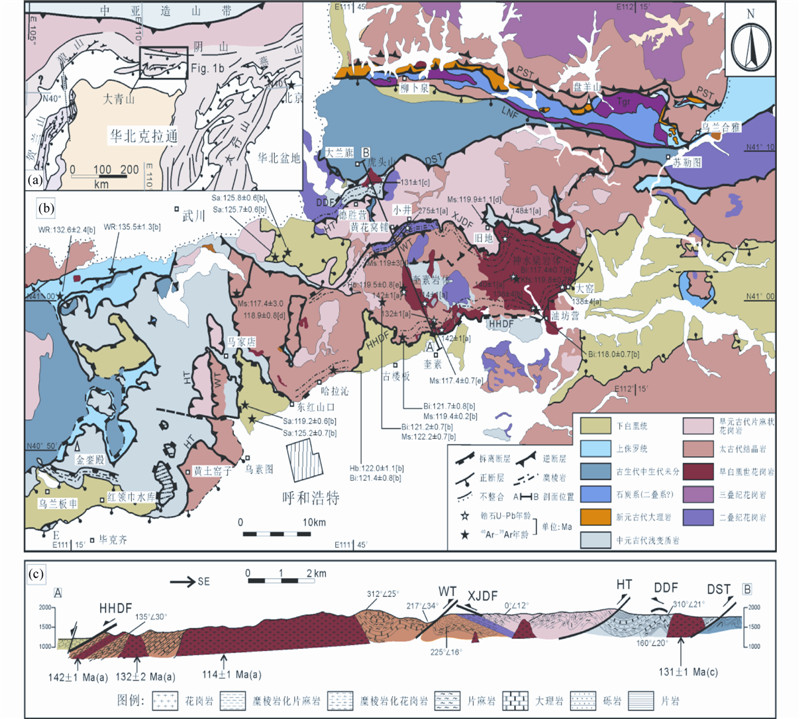 | 图 1 大青山呼和浩特段地质简图及剖面图 (a)-研究区在华北北缘阴山造山带中的位置(据Davis and Darby, 2010修改);(b)-研究区构造简图(据Guo et al., 2012b修改);(c)-图 1b线段AB剖面图,竖直方向未放大,盘羊山地区:PST-盘羊山逆冲断层,LNF-柳卜泉正断层;大青山逆冲推覆体系:DST-大青山逆冲断层,HT-黄土窑-马家店-德胜营逆冲断层,WT-乌素图-黄花窝铺-苏勒图逆冲断层;呼和浩特变质核杂岩拆离断层:HHDF-呼和浩特拆离断层,XJDF-小井拆离断层,DDF-德胜营拆离断层.40Ar-39Ar法定年数据样品缩写:Hb-角闪石;Ms-白云母;Bi-黑云母;Kfs-钾长石;Sa-火山岩透长石;WR-玄武岩全岩.年龄数据来源:[a]-Guo et al.(2012b);[b]-Davis and Darby(2010);[c]-贺元凯(2010);[d]-张进江等(2009);[e]-本文 Fig. 1 Simplified geological map of Daqing Shan near Hohhot and its cross section |
区内主要由前寒武纪变质岩和古-中生代沉积地层组成。前寒武纪变质岩组成大青山主体,包括太古代大理岩及片麻岩、元古代片麻状花岗岩和元古代浅变质沉积岩岩,后者由千枚岩、变质砾岩及大理岩构成(图 1b)。古生代地层为浅变质的石炭纪、二叠纪灰黑色砂岩、粉砂岩、炭质页岩互层夹少量砾岩及煤线,局部为碳酸岩。中生代地层分布于大青山两侧,北侧主要为侏罗纪紫红色砾岩、砂岩、粉砂岩及泥岩;南侧为下白垩世紫红色砾岩,砾石成分主要为前寒武纪大理岩和片麻岩。
2.2 主要构造
晚侏罗世盘羊山逆冲断层 位于大青山北侧,近东西走向延伸~55km,上盘向南逆冲,将晚元古代糜棱状大理岩、太古代糜棱岩、片麻岩逆冲到浅变质石炭系砂岩之上(图 1b)。该逆冲断层尚无准确构造年代学数据限定。我们野外考察和朱绅玉等(1997)认为盘羊山断裂与大青山组沉积近乎同时。近期研究认为大青山组时代为上侏罗世(彭向东等,2003),因此,盘羊山逆冲断层活动时代也为此期,与燕山地区“前张家口组”地壳缩短变形时间相当(赵越等,2004)。
晚侏罗世-早白垩世呼和浩特变质核杂岩 位于大青山核心部位,变质核杂岩由太古代片麻岩、元古宇片麻状花岗岩、浅变质岩和中生代花岗岩体(锆石U-Pb年龄148~114Ma,Guo et al., 2012a,b)构成。地表出露三条近东西走向的拆离断层(图 1b,c),由南往北依次为大青山山前的呼和浩特拆离断层(HHDF)、小井拆离断层(XJDF)和德胜营拆离断层(DDF)。拆离断层主要以出露花岗质糜棱岩、千糜岩为标志。拆离断层上盘为元古宇片麻状花岗岩和浅变质岩,以及早白垩世快速堆积碎屑物。
呼和浩特拆离断层西起土默特左旗以北的乌兰板申,经东红山口、奎素、哈拉沁,东至大窑村,长度超过100km,发育中温糜棱岩(500±50℃)、绿泥石化角砾岩和微角砾岩组成的典型拆离断层构造岩组合。大青山北侧出露沿大窑-小井-黄花窝铺一线高温糜棱岩(650±50℃)为标志的小井拆离断层和低温千糜岩(400±50℃)为标志的德胜营拆离断层(Guo et al., 2012b)。受岩体隆升(刘江等,2011)、东西走向的褶皱作用以及瓦隆构造(Davis et al., 2002; Davis and Darby, 2010)的影响,大青山南侧的糜棱面理倾向南西-南-南东,北侧则倾向北西-北-北东。糜棱岩的矿物及矿物集合体的拉伸线理倾伏向较为一致,以~130°(南侧)和310°(北侧)为主。运动学剪切指向标志一致表明拆离断层上盘向南东方向(~130°)拆离。Davis等根据变质核杂岩的基本构造格局,认为大青山北侧小井拆离断层(第一期)和德胜营拆离断层(第二期)在拆离断层发育早期曾经均为核杂岩主拆离断层,后因主拆离断层沿更高角度的“糜棱岩前锋”发育而依次被摒弃进入下盘(Davis和郑亚东,2002; Davis et al., 2002; Davis and Darby, 2010)。我们野外考察认为这些拆离断层韧性剪切带后来作为大青山逆冲推覆体系断层上盘向北西逆冲(图 1b)。
呼和浩特拆离断层糜棱状花岗岩的锆石U-Pb年龄为148~138Ma(Guo et al., 2012b),而侵入糜棱面理、未发生塑性变形的奎素沟花岗岩岩体(呼和浩特拆离断层)和虎头山花岗岩岩体(德胜营拆离断层)U-Pb年龄分别为132Ma(Guo et al., 2012b)和131Ma(贺元凯,2010),表明拆离断层糜棱岩带主要活动于142~132Ma之间(Guo et al., 2012b)。拆离断层上盘快速碎屑堆积物火山岩夹层年龄为127~125Ma之间(Davis and Darby, 2010),可能代表了拆离断层晚期脆性伸展变形阶段(Guo et al., 2012b)。糜棱岩角闪石、白云母和黑云母122~118Ma 40Ar-39Ar年龄代表拆离断层快速冷却阶段,则明显晚于上述年龄(Davis and Darby, 2010)。
早白垩世大青山逆冲推覆体系 覆盖整个大青山地区,主要由北东东走向,上盘向北西运动的大型逆冲断层和由其分割出的逆冲席体及原地系构成(图 1;郑亚东等,1998;戚国伟等,2007;张进江等,2009)。3条逆冲断层由北往南依次是:1)最外缘的大青山逆冲断层(DST),将元古代浅变质岩推覆于原地系沉积岩之上;2)黄土窑子-马家店-德胜营断层(HT),将元古代片麻状花岗岩推覆于元古界浅变质岩之上;3)乌素图-黄花窝铺-苏勒图断层(WT),将大青山变质结晶岩席(太古代副片麻岩和大理岩)推覆于元古代片麻状花岗岩之上(戚国伟等,2007;张进江等,2009)。郑亚东等(1998)和我们野外考察均表明大青山逆冲推覆体系在东部乌兰合雅附近切割盘羊山逆冲断层,二者并非南北对冲关系,大青山逆冲推覆体系晚于盘羊山逆冲断层。
该逆冲推覆在图 1b西部的毕克齐将前寒武系地层推到早白垩世碎屑沉积之上,推覆前缘被挤压褶皱的基性火山岩全岩40Ar-39Ar年龄为135~132Ma,说明逆冲推覆发生于132Ma之后(图 1b,Davis and Darby, 2010)。逆冲体系晚期的同构造绢云母40Ar-39Ar年龄为120~119Ma(张进江等,2009),研究区西侧毗邻的白石头沟附近由南向北逆冲断层同构造白云母40Ar-39Ar年龄为121.6±1.6Ma(刘正宏等,2003)。
早白垩世以来高角度正断层 切割低角度大青山拆离断层(韧性剪切带),逆冲断层、白垩系盆地沉积等。锆石和磷灰石裂变径迹年龄表明大青山地区在100~90Ma之间及~50Ma经历多次隆升(吴中海和吴珍汉,2003; Davis and Darby, 2010),可能与这些正断层活动相关。
3 呼和浩特拆离断层40Ar-39Ar定年 3.1 样品描述
样品DQ08-55(N41°00.717′,E111°50.473′)采自大青山南缘生态园,位于呼和浩特拆离断层下盘(图 1b),为变形闪长岩包体(图 2a)。野外可见透镜状基性岩包体长达数米、甚至达10m以上,其扁平面平行于糜棱岩面理,微弱变形,由粗粒角闪石(60%)和角闪石颗粒间填充的细粒斜长石集合体(40%)组成(图 2b)。受构造变形影响,其内部发育的面理与区域展布的面状构造一致,确定为构造前或同构造侵位。
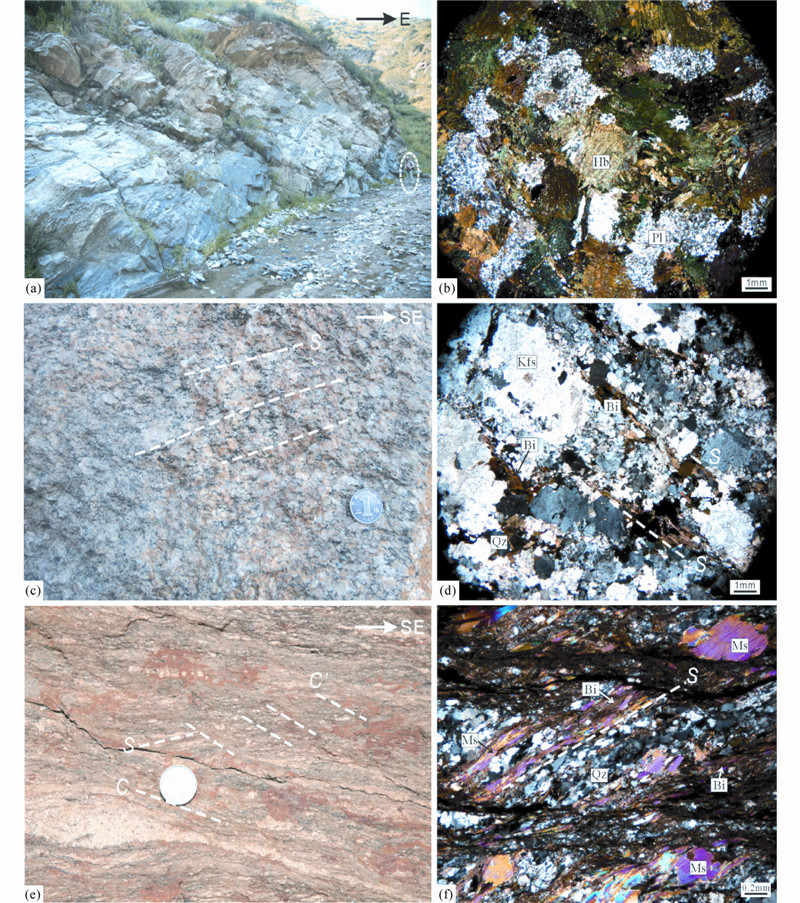 | 图 2 呼和浩特变质核杂岩拆离断层韧性剪切带野外露头和显微构造 (a)-大青山南缘生态园花岗质糜棱岩(浅色)中夹平行糜棱面理的基性岩包体(暗灰色,DQ08-55);(b)-闪长岩(DQ08-55)由粗粒角闪石和细粒斜长石集合体组成,微弱变形;(c)-油坊营弱变形花岗岩(DQ-100);(d)-弱变形花岗岩(Hu09-100)中长石、石英波状消光,黑云母平行面理定向排列;(e)-大青山南缘奎素沟千糜岩(Hu09-4);(f)-千糜岩(Hu09-4)白云母为云母鱼或平行S面理定向排列.所有样品都平行线理,垂直面理方向切片,显微照片均为正交偏光.S-S面理;C-C面理,平行剪切带边界;C’-伸展褶劈理;Hb-角闪石;Pl-斜长石;Kfs-钾长石;Qz-石英;Ms-白云母;Bi-黑云母 Fig. 2 Macrostructure and microstructure of ductile shear zones of Hohhot metamorphic core complex |
样品DQ08-100(N41°01.417′,E112°03.802′)采自大青山油坊营以北(图 2c),位于神水梁岩体南部,属弱面理化的中-粗粒花岗岩。花岗岩主要由长石(70%)、石英(20%)、黑云母(5%)组成。长石和石英弱定向排列,具有波状消光,动态重结晶微弱(图 2d),黑云母弱定向排列形成面理(图 2c,d)。该岩体锆石U-Pb年龄为140±1Ma(Guo et al., 2012b)。
样品Hu09-4(N40°58.287′,E111°53.448′)采自奎素沟,千糜岩(图 2e)。主要矿物为石英(70%)、长石(10%)、白云母(10%)及黑云母(5%)(图 2f)。长石以脆性变形为主,石英发生亚颗粒旋转和边界迁移动态重结晶。白云母分为两组,一组为云母鱼残斑,另一组为平行S面理(石英条带)排列的细粒晶体。黑云母多沿S面理与C(剪切)面理分布,但因为颗粒过于细小,很难分拣,不宜作为40Ar-39Ar定年矿物。同一位置花岗质糜棱岩锆石U-Pb年龄为142±1Ma(Guo et al., 2012b)。
本次研究挑选样品DQ08-55中角闪石、DQ08-100中黑云母和钾长石及Hu09-4中白云母进行40Ar-39Ar定年。
3.2 实验方法
根据样品地质背景估计的年龄和钾含量,称取20~60mg分选好的样品(0.18~0.28mm)封闭包装后,在中国原子能科学研究院进行中子照射。照射24h,用于中子通量监测的样品是ZBH-25(132.7Ma)、Bern 4M(18.6Ma)、FCs(28.2Ma)。同时,对纯物质CaF2和K2SO4进行同步照射。照射后的样品冷置后,密封去气72h以上。
样品测试在北京大学造山带与地壳演化教育部重点实验室常规40Ar/39Ar定年系统完成。采用钽(Ta)熔样炉对样品进行逐步加热熔样,每个样品分10~16步加热释气,温阶范围600~1500℃,每个加热阶段在恒温状态下保持20min。系统分别用活性炭冷井及锆钒铁吸气剂炉对气体进行纯化。使用RGA10型质谱仪记录五组Ar同位素信号。质谱峰循环测定9次。采用该实验室编写的40Ar/39Ar Dating 1.2数据处理程序校正计算各组Ar同位素测试数据,再采用Isoplot 3.0计算坪年龄及等时线年龄(Ludwig,2003)。
3.3 实验结果
40Ar-39Ar定年实验所得结果见表 1和图 3。
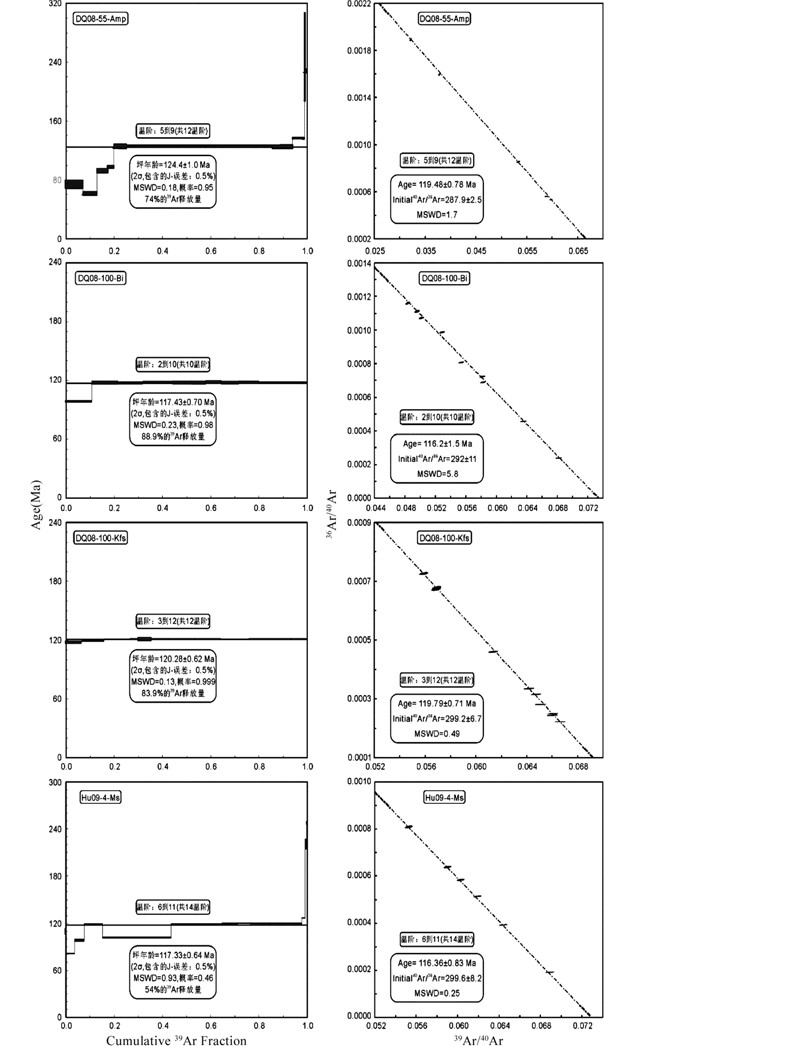 | 图 3 单矿物40Ar/39Ar坪年龄及反等时线年龄 Fig. 3 40Ar/39Ar plateau ages and inverse isochrones of different minerals |
 | 表 1 糜棱岩40Ar/39Ar逐步加热分析结果 Table 1 Step heating 40Ar/39Ar isotopic analyses on minerals from mylonite |
DQ08-55:角闪石坪年龄124.4±1.0Ma,5个温阶,74%的39Ar释放量,MSWD=0.18。反等时线年龄为119.5±0.8Ma,MSWD=1.7,初始40Ar/36Ar比值为287.9±2.5,略低于大气比值,反等时线年龄较可靠。
DQ08-100:黑云母坪年龄117.4±0.7Ma,9个温阶,88.9%的39Ar释放量,MSWD=0.23。反等时线年龄为116.2±1.5Ma,MSWD=5.8,初始40Ar/36Ar比值为292±11。坪年龄和反等时线年龄一致。钾长石坪年龄120.3±0.6Ma,10个温阶,83.9%的39Ar释放量,MSWD=0.13。反等时线年龄为119.8±0.7Ma,MSWD=0.49,初始40Ar/36Ar比值为299.2±6.7。需要注意的是,该样品中钾长石年龄较黑云母年龄偏大,除钾长石和黑云母分别有少量的Ar过剩和丢失影响之外,也与糜棱岩在这一时期的快速抬升有关。
Hu09-4:白云母坪年龄117.3±0.6Ma,6个温阶,54%的39Ar释放量,MSWD=0.93。反等时线年龄为116.4±0.8Ma,初始40Ar/36Ar比值为299.6±8.2,接近大气比值。 4 讨论 4.1 拆离断层冷却曲线
拆离断层韧性剪切带不同单矿物40Ar-39Ar年龄(本文;Davis and Darby, 2010),油坊营附近磷灰石裂变径迹年龄(96Ma)(见Davis and Darby, 2010文中图 10),及韧性剪切带中糜棱岩化花岗岩和切割韧性剪切带但未变形的花岗岩锆石U-Pb年龄(Guo et al., 2012b),结合不同定年方法中矿物的封闭年龄,构建了韧性剪切带早白垩世冷却曲线(图 4)。其中,锆石U-Pb封闭温度在700℃以上;石英动态重结晶亚颗粒结构和c-轴组构指示研究区糜棱岩变形温度最高达到650℃(刘江等,2011; Guo et al., 2012b);角闪石、白云母、黑云母、钾长石Ar封闭温度分别为500~550℃、~350℃、~300℃和220~250℃(McDougall and Harrison, 1999; 陈文等,2011);磷灰石裂变径迹封闭温度与化学成分有关,一般为100±40℃(Donelick et al., 2005; Tagami and O’Sullivan,2005)。
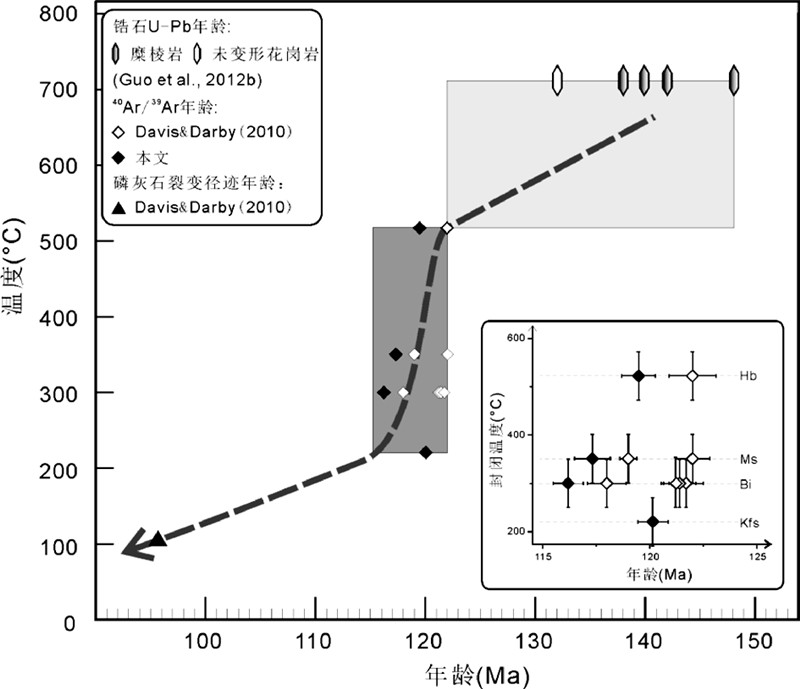 | 图 4 呼和浩特变质核杂岩韧性剪切带冷却曲线 右下角附图为单矿物40Ar/39Ar年龄的放大图,温度误差为±50℃;40Ar/39Ar定年矿物缩写与图 2相同 Fig. 4 Cooling curve for the ductile shear zone of the Hohhot MCC |
从冷却曲线(图 4)来看,韧性剪切带在早白垩世经历三个冷却阶段:122Ma之前,由650℃以上降低到角闪石Ar封闭温度(550~500℃);122~115Ma之间由角闪石封闭温度快速降至钾长石封闭温度(250~220℃);115Ma之后则缓慢降温。前两次降温分别降低了>150℃和~300℃,对应>5km和10km的抬升量(以30℃/km低温梯度估算)。韧性剪切带由115Ma开始从250~220℃地温层位(7~8km深)抬升至地表。
4.2 区域地质意义
大青山地区在中生代经历了复杂的构造演化。不同矿物40Ar-39Ar年龄反映了糜棱岩带冷却温度与时间的关系,需结合已有构造解析和具有构造演化意义的年代学数据赋予其地质意义。
晚侏罗世,向南逆冲的盘羊山逆冲断层代表大青山地区地壳的缩短增厚。早白垩世,变质核杂岩发育上盘向南东拆离使地壳发生伸展减薄,长英质糜棱岩(锆石U-Pb年龄148~138Ma)被未变形、锆石U-Pb年龄132~131Ma的花岗岩切割,说明拆离断层塑性变形主要发生于132Ma之前(Guo et al., 2012b),40Ar-39Ar年龄并不代表韧性剪切带变形年龄。拆离断层上盘快速沉积物火山岩夹层40Ar-39Ar年龄(Davis and Darby, 2010)说明拆离断层活动可能持续到约127~125Ma之后。大青山逆冲推覆体系使武川西南部、全岩40Ar-39Ar年龄为135.5~132.6Ma的玄武岩发生褶皱(Davis et al., 2002; Davis and Darby, 2010),说明大青山逆冲体系发生于132Ma之后。
野外考察结果表明逆冲推覆体系晚于拆离断层(图 1b,c):研究区西部红领巾水库和乌兰板升地区糜棱岩带作为逆冲断层上盘向北西逆冲;大青山山前毕克齐北西方向,元古代大理岩逆冲到早白垩世快速沉积物之上;小井村附近上盘向北逆冲使糜棱岩带发生错段,并将太古宇大理岩逆冲到呼和浩特变质核杂岩拆离断层带的糜棱岩之上。因此,野外观察和同位素年代学分析数据都表明拆离断层快速冷却过程更可能是后期向北西逆冲推覆改造的结果。逆冲推覆带中同构造绢云母40Ar-39Ar年龄给出了120~119Ma的年龄(张进江等,2009),和研究区西侧毗邻的白石头沟附近逆冲推覆同构造白云母40Ar-39Ar年龄为121.6±1.6Ma相近(刘正宏等,2003),都表明大青山逆冲推覆体系形成于早白垩世伸展构造之后,并于~120Ma左右结束。我们对大青山韧性剪切带不同矿物40Ar-39Ar年龄所构成的冷却史的研究结果与此一致,因此推测糜棱岩带所记录的快速冷过程并非对应于呼和浩特变质核杂岩拆离折返的冷却过程,而是对大青山逆冲推覆体系构造过程的反映。
5 结论
40Ar-39Ar年龄进一步限定了呼和浩特变质核杂岩韧性剪切带于122Ma(500~550℃,角闪石Ar封闭温度)至115Ma(220~250℃,钾长石Ar封闭温度)期间存在一个快速冷却过程。不同于前人的认识,这个快速冷却过程并非对应于呼和浩特变质核杂岩拆离折返的冷却过程,而是大青山逆冲推覆体系构造过程的反映,是糜棱岩受后期逆冲抬升的结果。
致谢 感谢论文评审人为改进本文提出的宝贵修改意见和建议。
| [1] | Chen W, Wan YS, Li HQ et al. 2011. Isotope geochronology: Technique and application. Acta Geologica Sinica, 85(11): 1917-1947 (in Chinese with English abstract) |
| [2] | Darby BJ, Davis GA, Zheng YD et al. 2001. Evolving geometry of the Huhhot metamorphic core complex, Inner Mongolia, China. Geological Society of America Abstracts with Programs, 33(3): 32-32 |
| [3] | Davis GA and Zheng YD. 2002. Metamorphic core complexes: Definition, types and tectonic setting. Geological Bulletin of China, 21(4-5):185-192 (in Chinese with English abstract) |
| [4] | Davis GA, Darby BJ, Zheng YD et al. 2002. Geometric and temporal evolution of an extensional detachment fault, Hohhot metamorphic core complex, Inner Mongolia, China. Geology, 30(11): 1003-1006 |
| [5] | Davis GA and Darby BJ. 2010. Early Cretaceous overprinting of the Mesozoic Daqing Shan fold-and-thrust belt by the Hohhot metamorphic core complex, Inner Mongolia, China. Geoscience Frontiers, 1(1): 1-20 |
| [6] | Donelick RA, O’Sullivan PB and Ketcham RA. 2005. Apatite fission-track analysis. Review in Mineralogy and Geochemistry, 58(1): 49-94 |
| [7] | Guo L, Wang T, Castro A et al. 2012a. Petrogenesis and evolution of Late Mesozoic granitic magmatism in the Hohhot metamorphic core complex, Daqing Shan, North China. International Geology Review, 54(16): 1885-1905 |
| [8] | Guo L, Wang T, Zhang JJ et al. 2012b. Evolution and time of formation of the Hohhot metamorphic core complex, North China: New structural and geochronologic evidence. International Geology Review, 54(11): 1309-1331 |
| [9] | He YK. 2010. Coupling of Mesozoic shallow and deep tectonic-magma evolution in the middle segment of the northern margin of North China Plate. Ph. D. Dissertation. Beijing: Peking University (in Chinese with English summary) |
| [10] | Lin W and Wang QC. 2006. Late Mesozoic extensional tectonics in the North China block: A crustal response to subcontinental mantle removal? Bulletin de la SociétéGéologique de France, 177(6): 287-297 |
| [11] | Lin W, MoniéP, Faure M et al. 2011. Cooling paths of the NE China crust during the Mesozoic extensional tectonics: Example from the South-Liaodong Peninsula metamorphic core complex. Journal of Asian Earth Science, 42(5): 1048-1065 |
| [12] | Lin W, Faure M, Chen Y et al. 2013. Late Mesozoic compressional to extensional tectonics in the Yiwulüshan massif, NE China and its bearing on the evolution of the Yinshan-Yanshan orogenic belt: Part I: Structural analyses and geochronological constraints. Gondwana Research, 23(1): 54-77 |
| [13] | Liu J, Zhang JJ, Guo L et al. 2011. Kinematic vorticity of the Daqingshan detachment fault and its structural implications. Geotectonica et Metallogenia, 35(1): 1-11 (in Chinese with English abstract) |
| [14] | Liu JL, Davis GA, Ji M et al. 2008. Crustal detachment and destruction of the North China craton: Constraints from Late Mesazoic extensional structures. Earth Science Frontiers, 15(3): 72-81 (in Chinese with English abstract) |
| [15] | Liu ZH, Xu ZY and Yang ZS. 2003. 40Ar-39Ar dating of Daqingshan thrust. Chinese Science Bulletin, 48(24): 2734-2738 |
| [16] | Ludwig KR. 2003. User’s manual for Isoplot 3.0: A geochronological toolkit for Microsoft Excel. Berkeley Geochronology Center Special Publication, (4): 1-70 |
| [17] | McDougall I and Harrison TM. 1999. Geochronology and Thermochronology by the 40Ar/39Ar Method. New York: Oxford University Press, 263-269 |
| [18] | Peng XD, Xu ZY and Liu ZH. 2003. Revision of the Middle and Upper Jurassic Daqingshan Formation in Daqingshan area, Inner Mongolia. Journal of Stratigraphy, 27(1): 66-70 (in Chinese with English abstract) |
| [19] | Qi GW, Zhang JJ, Wang XS et al. 2007. Mesozoic thrusts and extensional structures in the Daqingshan orogen, Inner Mongolia, and their temporal and spatial relationship. Progress in Natural Science, 17(2): 177-186 |
| [20] | Tagami T and O’Sullivan PB. 2005. Fundamentals of fission-track thermochronology. Reviews in Mineralogy and Geochemistry, 58(1): 19-47 |
| [21] | Wang T, Zheng YD, Zhang JJ et al. 2007. Some problems in the study of Mesozoic extensional structure in the North China craton and its significance for the study of lithospheric thinning. Geological Bulletin of China, 26(9): 1154-1166 (in Chinese with English abstract) |
| [22] | Wang T, Zheng YD, Zhang JJ et al. 2011. Pattern and kinematic polarity of Late Mesozoic extension in continental NE Asia: Perspectives from metamorphic core complexes. Tectonics, 30(6), doi: 10. 1029/2011TC002896 |
| [23] | Wang T, Guo L, Zheng YD et al. 2012. Timing and processes of late Mesozoic mid-lower-crustal extension in continental NE Asia and implications for the tectonic setting of the destruction of the North China Craton: Mainly constrained by zircon U-Pb ages from metamorphic core complexes. Lithos, 154(1): 315-345 |
| [24] | Wang XS, Zheng YD, Zhang JJ et al. 2002. Extensional kinematics and shear type of the Hohhot metamorphic core complex, Inner Mongolia. Geological Bulletin of China, 21(4-5): 238-245 (in Chinese with English abstract) |
| [25] | Wu ZH and Wu ZH. 2003. Uplift history of the Daqing Mountain since the Late Cretaceous. Acta Geoscientia Sinica, 24(3): 205-210 (in Chinese with English abstract) |
| [26] | Yang JH, Wu FY, Chung SL et al. 2007. Rapid exhumation and cooling of the Liaonan metamorphic core complex: Inferences from 40Ar/39Ar thermochronology and implications for Late Mesozoic extension in the eastern North China Craton. Geological Society of America Bulletin, 119(11/12): 1405-1414 |
| [27] | Zhang JJ, Qi GW, Guo L et al. 2009. 40Ar-39Ar dating of the Mesozoic thrusting in Daqingshan thrust-nappe system, Inner Mongolia, China. Acta Petrologica Sinica, 25(3): 609-620 (in Chinese with English abstract) |
| [28] | Zhao Y, Zhang SH, Xu G et al. 2004. The Jurassic major tectonic events of the Yanshanian intraplate deformation belt. Geological Bulletin of China, 23(9-10): 854-863 (in Chinese with English abstract) |
| [29] | Zheng YD, Davis GA, Wang C et al. 1998. Major thrust sheet in the Daqing Shan Mountains Inner Mongolia, China. Science in China (Series D), 41(5): 553-560 |
| [30] | Zhu RX, Chen L, Wu FY et al. 2011. Timing, scale and mechanism of the destruction of the North China Craton. Science China Earth Sciences, 54(6): 789-797 |
| [31] | Zhu SY. 1997. Nappe tectonics in Sertengshan-Daqingshan, Inner Mongolia. Geology of Inner Mongolia, 84(1): 41-47 (in Chinese with English abstract) |
| [32] | 陈文, 万渝生, 李华芹等. 2011. 同位素地质年龄测定技术及应用. 地质学报, 85(11): 1917-1947 |
| [33] | Davis GA, 郑亚东. 2002. 变质核杂岩的定义、类型及构造背景. 地质通报, 21(4-5): 185-192 |
| [34] | 贺元凯. 2010. 华北板块北缘中生代构造岩浆演化的深浅部耦合.博士学位论文. 北京: 北京大学 |
| [35] | 刘江, 张进江, 郭磊等. 2011. 大青山伸展拆离断层运动学涡度研究及构造指示意义. 大地构造与成矿学, 35(1): 1-11 |
| [36] | 刘俊来, Davis GA, 纪沫等. 2008. 地壳的拆离作用与华北克拉通破坏: 晚中生代伸展构造约束. 地学前缘, 15(3): 72-81 |
| [37] | 刘正宏, 徐仲元, 杨振升. 2003. 大青山逆冲推覆构造形成时代的40Ar/39Ar年龄证据. 科学通报, 48(20): 2193-2197 |
| [38] | 彭向东, 徐仲元, 刘正宏. 2003 内蒙古大青山地区中、上侏罗统大青山组的修订. 地层学杂志, 27(1): 66-70 |
| [39] | 戚国伟, 张进江, 王新社等. 2007. 内蒙古大青山中生代逆冲-伸展构造格局及空间关系. 自然科学进展, 17(3): 329-338 |
| [40] | 王涛, 郑亚东, 张进江等. 2007. 华北克拉通中生代伸展构造研究的几个问题及其在岩石圈减薄研究中的意义. 地质通报, 26(9): 1154-1166 |
| [41] | 王新社, 郑亚东, 张进江等. 2002. 呼和浩特变质核杂岩伸展运动学特征及剪切作用类型. 地质通报, 21(4-5): 238-245 |
| [42] | 吴中海, 吴珍汉. 2003. 大青山晚白垩世以来的隆升历史. 地球学报, 24(3): 205-210 |
| [43] | 张进江, 戚国伟, 郭磊等. 2009. 内蒙古大青山逆冲推覆体系中生代逆冲构造活动的40Ar/39Ar定年. 岩石学报, 25(3): 609-620 |
| [44] | 赵越, 张拴宏, 徐刚等. 2004. 燕山板内变形带侏罗纪主要构造事件. 地质通报, 23(9-10): 854-863 |
| [45] | 郑亚东, Davis GA, 王琮等. 1998. 内蒙古大青山大型逆冲推覆构造. 中国科学(D辑), 28(4): 289-295 |
| [46] | 朱绅玉. 1997. 内蒙古色尔腾山-大青山地区推覆构造. 内蒙古地质, 84(1): 41-47 |