 2014, Vol. 30


2. 中国科学院大学, 北京 100039;
3. 中国石油勘探开发研究院西北分院, 兰州 730020
3. Northwest Branch, Research Institute of Petroleum Exploration and Development, PetroChina, Lanzhou 730020, China
轻矿物是相对于重矿物而言的,是指比重小于2.85的矿物,主要包括石英、长石、方解石及沸石等,含量约占陆源碎屑的99.5%~99.9% (Folk, 1980)。轻矿物碎屑岩的主要组成部分,也是物源研究的重要对象。轻矿物物源分析可分为两个方面:一是多矿物组合,从20世纪70年代开始,得到了迅速发展和应用,其中以Dickinson图解(Dickinson et al., 1979;Ingersoll et al., 1984;Dickinson, 1985)应用最为普遍。许多学者对其进行了应用与改进(Zuffa, 1980;Ingersoll, 1990;Molinaroli et al., 1991;Graham et al., 1993;Rooney and Basu, 1994;李忠等, 1999;Weltje, 2006;Garzanti et al., 2007),同时在使用过程中也暴露出了许多问题(Mack, 1984;Molinaroli et al., 1991;Graham et al., 1993;Rooney and Basu, 1994;Garzanti et al, 2008, 2009);二是单矿物分析,主要是对稳定矿物石英的研究,Basu et al. (1975)最早利用石英的波状消光和结晶类型区别不同的源岩种类。随着技术手段的进步,新方法如石英阴极发光(Zinkernagel, 1978;Matter and Ramseyer, 1985;Owen, 1991;Götze et al., 2001;Boggs et al., 2002;Augustsson and Bahlburg, 2003;Bernet and Bassett, 2005;徐惠芬等, 2006)、石英氧同位素(Blatt, 1987;Barton et al., 1992;Graham et al., 1996;Mizota et al., 1996;肖益林等, 1998;Aleon et al., 2002;Crespin et al., 2006)等为物源分析开辟了新的领域。碎屑岩从源岩到沉积盆地并最终成岩,经历了复杂的物理化学改造(Johnsson, 1993;Weltje and Eynatten, 2004),造成物源信息不同程度的丢失。另外,方法自身也存在一些不足,在使用时如不注意,会得出错误的结论。因此,有必要总结各方法的优点与缺陷。本文对近十年来轻矿物物源分析的研究进展进行综述,并提出其适用条件、存在的问题以及未来的发展趋势,以期对各位同行有所帮助。
石英、长石和岩屑(岩屑不是单一矿物,但沉积岩中岩屑以长英质为主,相当于长石、石英的集合体)是砂岩的主要组成部分,其所占比例大、分布广,易于在显微镜下鉴定和统计,在追溯和推断物源区构造背景方面具有十分重要的作用。Crook (1974)最早将砂岩类型与各种板块构造环境下的特定物源区和沉积盆地联系起来。Dickinson et al. (1979)、Dickinson (1985)进一步收集了世界上典型构造环境的砂岩碎屑组分,进行了详细的划分和定量统计,编绘出物源判断模式图——Dickinson图解。该图解主要通过常规岩石薄片的镜下成分统计,包括石英(Q)、长石(F)、岩屑(L)、单晶石英(Qm)、多晶石英(Qp)等9个成分端元(图1),利用QtFL、QmFLt、QpLvLs、QmPK模式图来鉴别稳定陆块、岩浆弧和再旋回造山带3个主要板块构造单元物源区和7个次级构造单元物源区。该方法简便易行,得到了广泛应用,一些学者在此基础上进行了完善和发展(Ingersoll et al., 1993; Garzanti et al., 2002; Weltje, 2002; Cavazza and Ingersoll, 2005; Garzanti et al., 2007)。Ingersoll et al. (1993)通过对现代Rio Grande流域不同级别的支流进行取样投图,提出Dickinson图解只适合于三级水流体系,一二级水流能较好保存物源信息,但不能反映构造环境。Weltje (2002, 2006)、 Weltje and Eynatten (2004)利用Aitchison对数比值法重新对Dickinson图解的各构造环境边界进行了优化计算,并检验图解的大地构造环境分辨能力,发现计算所得三大源区(稳定陆块、岩浆弧和再旋回造山)边界与原图解存在很大差异(图1),且各环境间存在很大重叠区域。四个图解中QpLvLs分辨能力最强,依次为QtFL、QmFLt,QmPK最差。最后文章提出三端元图解对于物源的区分能力有限,应该考虑发展新的六端元图解(包括Qm、Qp、P、K、Lv、Ls或者其他变量)。Garzanti et al. (2007)在Dickinson图解的基础上,将岩屑细分,增加了变质岩(Lm)、基性岩屑(Lu)、角闪石(A)、辉石+橄榄石+尖晶石(P+O+S)、其它透明重矿物(&tHM)五个端元和蛇绿岩套、碰撞变质带两类构造环境,提出新的Q-F-L、Lm-(Lv+Lu)-Ls、&tHM-A-(P+O+S)图解,并探讨了各构造环境剥蚀隆升过程中各矿物组分的变化趋势(图2)。
 | 图1 Dickinson图解(据Dickinson, 1985; Weltje, 2006) Qt-石英总量(Qt=Qm+Qp); F-长石(F=P+K); L-不稳定岩屑(L=Lv+Ls); Qm-单晶石英(>0.0625mm); Qp-多晶石英(包括燧石); Lv-火山/变火山岩屑; Ls-沉积/变沉积岩屑;Lt-岩屑总量(Lt=L+Qp); P-斜长石;K-碱性长石.点线分界为Weltje (2006)的计算结果,A-稳定陆块;B-岩浆弧;C-再旋回造山带.灰色区域为99%置信度的平均值 Fig.1 Dickinson diagrams (after Dickinson, 1985; Weltje, 2006) Qt-total quartzose grains (Qt=Qm+Qp); F-total feldspar grains (F=P+K); L-unstable lithic fragments (L=Lv+Ls); Qm-monocrystalline quartz (>0.0625mm); Qp-polycrystalline quartz (including chert); Lv-volcanic/metavolcanic lithic fragments; Ls-sedimentary/metasedimentary lithic fragments; Lt-total lithic fragments (Lt=L+Qp); P-plagioclase grains; K-K-feldspar grains. Dotted lines calculated by Weltje (2006), A-stable craton; B-magmatic arc; C-recycled orogen; Grey area for 99% confidence region about the mean |
 | 图2 岩浆弧去顶剥蚀过程(据Garzanti et al., 2007) Q-石英; F-长石; L-岩屑(包括灰岩岩屑); Lm-变沉积岩和长英质变岩浆岩岩屑; Lv-火山岩、变火山岩以及基性变岩浆岩岩屑; Lu-超基性岩屑(蛇纹岩、蛇纹石片岩); Ls-沉积岩屑; &tHM-其它透明重矿物; A-角闪石;P+O+S-辉石、橄榄石、尖晶石 Fig.2 Unroofing evolution of magmatic arc (after Garzanti et al., 2007) Q-quartz; F-feldspar; L-lithic fragments (including carbonate lithics); Lm-metasedimentary and felsic metaigneous lithic fragments; Lv-volcanic, metavolcanic and mafic metaigneous lithic fragments; Lu-ultramafic lithic fragments (serpentinite, serpentine schist); Ls-sedimentary lithic fragments; &tHM-other transparent heavey minerals; A-amphiboles; P+O+S-pyroxenes+olivine+spinel |
(1)采用Gazzi-Dickinson计数法。与传统的计数法相比,该方法对含>0.0625mm矿物颗粒的岩屑成分采取不同的处理方式:如果十字丝交点指向岩屑中>0.0625mm矿物颗粒时,不计为岩屑成分,而计为相应的长石或石英端元;如果十字丝交点指向岩屑中<0.0625mm矿物颗粒或指向基质时,则计为岩屑成分。另外,灰岩岩屑和重矿物不参与计数(Dickinson, 1970; Ingersoll et al., 1984)。由于该计数法将含长石、石英的岩屑分解,降低了粒度对成分的影响,最大程度的反映物源组成,却扭曲了砂岩的结构组成,不适于解释气候、搬运历史和成岩作用,仅适用于构造环境解释(Ingersoll et al., 1984; Suttner and Basu, 1985)。
(2)采样点应为三级流域体系。Ingersoll (1990)将不同尺度的水流体系分为三个级别:一级水流指单一岩性或局部混合的山麓堆积物、冲积扇和局部水流;二级指受山脉影响的水流;三级指大的河流、三角洲及滨岸环境,取决于盆地的大地构造背景。只有三级水流能够用于盆地大地构造环境的判别,一二级水流仅反映局部物源,可用于局部古地理和古构造的重建。在岩性相对均一的岩浆弧和前陆逆冲褶皱带,采样水流级别对结果影响不大(Ingersoll, 1990; Ingersoll et al., 1993; Critelli et al., 1997)。
(3)砂岩杂基含量<25% ( Dickinson and Suczek, 1979; 李忠等, 1999)。也有学者将杂基限制为20% ( Devaney and Ingersoll, 1993)。并非所有砂岩都适于物源分析,很多杂砂岩的基质是火山岩屑或泥质岩屑成岩蚀变形成的假杂基(Pettijohn et al., 1987),这时基质越多,格架矿物相对含量越偏离物源的真实值(Rooney and Basu, 1994)。
(4)无严重机械、化学风化作用。在地势平缓、气候湿热的滨海环境下长石等不稳定矿物易遭受风化分解,导致砂岩稳定组分含量明显升高,产生错误的结果(Mack, 1984; Johnsson, 1993; Kairo et al., 1993)。有许多热带强风化成因石英砂岩的记录( Akhtar and Ahmad, 1991; Schulz and White, 1999; Smyth et al., 2008)。其中,Smyth et al. (2008)对热带爪哇岛新生代石英砂岩投影,发现来自岩浆岛弧的砂岩均被投到再旋回造山带中。因此,投图前需要结合地层的沉积环境和气候,排除风化严重的样品。
(5)各图解相互配合使用。图解由四个子图组成,分别侧重于不同的方面,QtFL强调砂岩成熟度,QmFLt注重源岩,QpLvLs体现岩屑含量,QmPK则主要显示各矿物的相对含量(Dickinson, 1985),其中QpLvLs和LmLvLs的区分能力最强(Ingersoll et al., 1985)。不结合其它图解,单独使用QtFL可能导致错误的结论(Ingersoll, 1983)。
(1)粒度影响。因密度差异,不同矿物的相对含量随粒度变化而变化,一定程度上粒度是碎屑岩成分的函数(Weltje and Eynatten, 2004。Gazzi-Dickinson计数法虽能降低侵蚀、搬运和原地风化过程中破碎产生的粒度变化,却无法改变矿物因密度、形态不同而产生的水动力分选(Ingersoll et al., 1984; Garzanti et al., 2003),所以该技术并没有完全消除粒度对成分的影响。许多学者探讨了成分与粒度之间的关系(Blatt et al., 1972;Johnsson, 1993; Solano-Acosta and Dutta, 2005; Tolosana-Delgado and von Eynatten, 2009; Garzanti et al., 2009),认为粒度在沉积过程中遵守等效沉降原理(Settling-equivalenc principle),即粗粒低密度颗粒与细粒高密度颗粒同时沉降(Garzanti et al., 2008)。有学者(Morton, 1985; Suttner and Dutta, 1986; Weltje and Eynatten, 2004)通过限定统计粒径的范围,只统计中-粗砂来降低粒度对成分的影响(即窄窗口策略,narrow window strategy)。事实上,在等效沉降作用的影响下,不同粒度的选择带来很大的偏差(Garzanti et al., 2009)。最好的办法是对不同粒度的碎屑都进行成分统计(即宽窗口策略,wide window strategy),但这会带来很大的工作量,且仅适用于松散沉积物,对于砂岩则不适用。目前,尚没有任何方法能消除粒度对成分的影响(Garzanti et al., 2003)。
(2)岩屑分类过于简单,仅分为沉积岩屑和岩浆岩屑,而且去掉了灰岩组分。岩屑是源区信息最直接的反映(Ingersoll, 1990),过于简单的分类容易造成岩屑中重要物源信息的丢失,如蛇绿岩套和碰撞变质带源区则不能反映。在海相砂岩中,灰岩碎屑的来源(内源碎屑还是陆源碎屑?)难以断定,在砂岩中也并不常见,且成岩过程中易遭受溶解。因此,Dickinson (1985)在建立图解时排除了灰岩碎屑。灰岩碎屑的排除可能导致物源区的扭曲。Mack (1984)曾就新墨西哥州南部Florida山Lobo组的含灰岩岩屑砂岩进行了投影检验,Ls端元包括灰岩岩屑时,源区为再旋回造山带,排除则得到错误源区——稳定陆壳和被动大陆边缘。在陆相地层中,灰岩只在陆相萨勃哈等少数环境出现,在断定盆地不发育灰岩的前提下,将灰岩岩屑纳入沉积岩屑Ls端元是可取的。但与图解的构造环境对比时应排除灰岩岩屑,以保持与原图解的一致性(Graham et al., 1993)。
(3)成岩蚀变。砂岩中的火山岩、基性侵入岩和泥岩岩屑,容易发生蚀变,形成表杂基或假杂基(Dickinson, 1970; Pettijohn et al., 1987; Velloni et al., 1991),很难与原杂基相区分。另外,长石也容易发生碳酸盐交代、钠长石化、压溶或蚀变成粘土矿物(Mcbride, 1987; Helmold, 1985)。假杂基与交代矿物应按原先矿物种类统计(Dickinson, 1988)。Rooney and Basu (1994)提出对泥质砂岩进行X射线能谱(EDX)分析,将细粒基质和蚀变岩屑复原,并估算出改正系数,求出改正后的QFL值,称之为新Gazzi-Dickinson计数法(Rooney and Basu, 1994)。对于受成岩蚀变严重影响的样品,如Maxon砂岩,亚长石砂岩中的长石全部被方解石或白云石交代(McBride, 1987),不能用于图解分析。
(4)各构造环境存在时空上的过渡与重叠。当研究区的投影点位于图解两构造环境的相邻区域,如稳定陆块与再旋回造山带、未切割岛弧与再旋回造山带、切割岛弧与隆起基底(图1),则无法断定其物源性质。Ingersoll (1990)、Molinaroli et al. (1991)和Weltje (2006)分别利用不同的数学方法对图解进行验证,均证实了这种重叠的存在。另外,对于叠合盆地而言,不同的构造环境决定了盆地不同的发展阶段。盆地的构造环境发生变化,而源岩可能保持不变,这种构造环境与物源之间的滞后性是普遍存在的。Mack (1984)以新墨西哥州南部第三系砂岩为例,论述了物源区由岛弧环境变为大陆裂谷环境后,投点却落在岛弧区。Graham et al. (1993)利用Dickinson图解对中国西部的叠合盆地进行研究,认为叠合盆地是对前期盆地的活化和继承,物源也保持这种延续性,所以仅靠图解的构造环境判断是远远不够的。中国的中新生代盆地多为陆相叠合盆地,在使用该图解时应谨慎。
(5)统计误差。所有成分图解均存在计数误差,只能通过增加计数点尽可能的减小误差,而不能完全消除。例如统计300个点,含量20%的长石相对误差达20%以上,如果将计数点提高到5000点,则误差减小到6%。对于不同的变量(如Q、F、Lt等)其误差也有所差别(Molinaroli et al., 1991)。过高的计数点带来很大的工作量,不便于操作,一般计数点在300以上,即可满足统计要求(Galehouse, 1971)。同时,不同的实验人员,对于矿物的识别能力存在差异,也会产生一定的偏差,为此一般采用薄片染色( Marsaglia and Tazaki, 1992)和几个人重复计数(Graham et al., 1976)等方法来提高精度。在解释构造环境时应意识到误差的存在,特别对于投影点处于两构造环境的过渡区域时,误差可能会产生决定性作用。
不同的大地构造环境决定了盆地的地貌形态和沉积要素(包括源岩、风化、搬运、沉积),造成石英、长石和岩屑三部分的比例差异,对三级水流采样就是使各组分充分混合,利用平均相对含量的不同,反演源区信息和构造环境。由于地势、气候、沉积过程的差异以及后期成岩的改造,相同物源可能形成不同的砂岩组分,不同的物源也可发育相似的众数模式,导致众数模式的过渡与重叠,相应的构造环境解释也就产生了多解性。如何消除这种多解性,是物源分析必须面对的问题,也决定了其未来的发展趋势。需要定量化的分析,严格约束不同构造环境下的成分变化,同时结合其它的技术手段,并根据需要发展更高辨别能力的新图解:
(1)定量化研究。Basu (2003)提出了定量物源分析(QPA)的非正式定义——“物源区提供碎屑的种类、数量以及速率”。 Weltje and Eynatten (2004)进一步阐述了定量物源分析(QPA)的研究内容,包括:①对沉积物特征的分析、统计和数据方法;②正演模拟,定量预测沉积物的供给;③反演各源岩类型的贡献量、构造活动和侵蚀速率。目前这方面的研究很少,一些研究者利用判别分析验证Dickinson图解的可靠性(Ingersoll, 1990; Molinaroli et al., 1991; Cavazza and Ingersoll, 2005; Weltje, 2006),部分学者对成分数据统计分析方法进行改进(Aitchison, 1982, 1986; Aitchison and Egozcue, 2005)。总体来说,这些研究缺少可靠的理论基础,以半定量研究为主,且多为简单的单变量统计,仅能描述具体地区某个地质过程的相对变化,无法进行普遍沉积过程的绝对评价( Weltje and Eynatten, 2004)。
(2)与新的技术手段相结合。受后期成岩作用的影响,不稳定岩屑往往发生严重的次生交代,常规光学显微镜下难以识别,需要结合扫描电镜、阴极发光(详见本文2.1)或X射线能谱等手段恢复先存组分。
(3)发展新的图解。在图解适用的前提下,其结果是可以参考的,但图解本身并不能全面反映源区的信息,不能代替岩石学研究。物源区岩石组合是复杂多变的,套用单一模式是不现实的,必须结合各地区的实际情况,增加新的矿物端元或建立三维以上的多变量图解以适应需求。Garzanti et al. (2007)针对不同构造环境源区的特点,将岩屑分类细化,增加了角闪石、辉石和橄榄石等重矿物组分,发展了Lm-(Lv+Lu)-Ls、&tHM-A-(P+O+S)等新图解。图2即为岩浆弧物源区隆升剥蚀过程中的各图解矿物众数模式。在隆升剥蚀过程中,模式变化趋势比较明显,是多矿物组合物源研究的有益尝试。
单一轻矿物的成因分析,也是物源研究的一个重要方面,在早期主要根据矿物的结构、形态、光学性质探讨源岩性质。Helmold (1985)利用长石的化学成分、生长环带、双晶类型和结构形态来解释物源,但长石的机械、化学性质不稳定,导致风化、搬运、埋藏过程中发生机械磨蚀、交代、溶解和钠长石化,影响源岩解释的真实性。在砂岩的组成矿物中,石英最为稳定和普遍,因而成为物源分析的理想载体。Basu et al. (1975)提出的石英成因分类图,就是根据石英的波状消光和多晶石英的颗粒数,来区分侵入岩、中高级变质岩和低级变质岩(图3a)。由于图解的使用要求较多,包括单物源(此处指单一岩性)、第一旋回砂岩、非石英砂岩和中粒等,另外石英的波状消光易受成岩重结晶和后期构造活动的影响,因此图解的准确度也大打折扣。Tortosa et al. (1991)通过西班牙中央山系石英的物源分析,对该图解进行验证和修改,发现该图解对低级变质岩的识别能力较强,却无法区分中高级变质岩与花岗岩(图3b)。另外在不同的花岗岩源区,由于应力历史和结晶条件的差别,多晶石英(Qp)含量变化较大。因此,在花岗岩区使用时应特别注意。随着技术手段的进步,人们开始探求更可靠、有效的手段来确定物源,主要的研究方法有:石英阴极发光、氧同位素、电子顺磁共振(ESR)定年和热释光测年等方法,其中后两者只限于第四纪沉积物,本文只讨论前两种。
 | 图3 石英成因分类图解
(a)为Basu et al. (1975)的原图解;(b)为Tortosa et al. (1991)修改后的图解.Qp2-3指由2~3个晶体组成的多晶石英颗粒;Qnu指非波状消光的单晶石英;Qu指波状消光的单晶石英;Qp>3指3个以上的晶体组成的多晶石英颗粒.Qp>3的含量占总多晶石英的25%以上时投点到下部三角,否则用上部三角 Fig.3 Diagrams of quartz genesis variety (a) after Basu et al. (1975); (b) after Tortosa et al. (1991). Qp2-3: 2~3 crystal units per polycrystalline quartz grain; Qnu: non-undulatory monoquartz; Qu: undulatory monoquartz; Qp>3: >3 crystal units per polycrystalline quartz grain (if Qp>3 polycrystalline grains >25%, then the lower triangle is used; otherwise the upper triangle) |
由于晶体内部晶格缺陷和微量元素的含量差别,不同成因的石英在电子照射下呈现不同的阴极发光特征,这使得利用石英发光性差异鉴别成因环境成为可能(Matter and Ramseyer, 1985; Owen, 1991; Götze et al., 2001; Gotte and Richer, 2006)。Zinkernagel (1978)提出了第一个石英阴极发光色谱划分方案:蓝色-紫色石英来源于深成岩、火山岩或热接触变质岩,棕色石英来源于变火山岩、变沉积岩、接触变质岩外带、区域变质岩和回火沉积岩中的自生石英,不发光石英源于沉积岩中的自生石英(表1)。随后许多学者对石英发光性及其成因类型进行了验证( Matter and Ramseyer, 1985; Owen, 1991; Seyedolali et al., 1997; Walderhaug and Rykkje, 2000; Boggs et al., 2002; Gotte, 2006),但不同的研究者对阴极发光颜色的辨别带有极大的主观性,对于颜色判断会出现偏差。为此,有研究者将阴极发光(CL)与扫描电镜(SEM)相结合,得到不同成因石英的红光、蓝光和绿光光谱,并对光谱进行定量分析,称为CL/SEM技术(Walker and Burley, 1991; Boggs et al., 2002; Kwon and Boggs, 2002)。Seyedolali et al. (1997)则利用CL/SEM从石英颗粒的生长环带、裂缝、节理、CL条纹和团块、斑点以及均匀性等方面进行成因类型划分。Boggs et al. (2002)对火山岩、侵入岩、变质岩和热液等各种成因石英进行光谱分析,发现除深红色变质石英可以与其它种类的石英很好区分外,火山岩与侵入岩石英、岩浆岩与变质岩石英、侵入岩与热液石英之间均存在重叠(图4),提出石英阴极发光的物源分析结果并不可靠,而CL/SEM组构分析则是可信的。Augustsson and Bahlburg(2003)在利用石英阴极发光研究安第斯古生代变沉积岩物源时,也发现了不同成因石英阴极发光光谱的重叠性。针对阴极发光颜色重叠引起的物源多解性, Bernet and Bassett (2005)在Seyedolali et al. (1997) 和 Kwon and Boggs (2002)的基础上将SEM-CL和传统光学分析相结合,分析新西兰始新世-渐新世Broken河组石英砂岩物源,并总结了不同成因石英的SEM-CL和光学特征。该技术对于中-粗粒砂岩具有很强的分辨能力,但很难区分细粒的火山石英、脉石英和一些变质石英,因为它们具有相似的CL颜色和非波状-微弱波状消光。
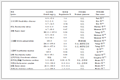 | 表1 石英阴极发光颜色与源岩类型(据Zinkernagel, 1978) Table 1 Quartz CL images and source rocks (after Zinkernagel, 1978) |
 | 图4 不同成因石英的阴极发光强度(据Boggs, 2002) Fig.4 Mean relative luminosity of CL images of different quartz (after Boggs, 2002) |
目前没有证据表明微量元素对阴极发光的控制作用,石英的发光行为可能受控于晶体内在的缺陷,这些缺陷取决于石英形成时的温度、压力和流体成分等条件( Gotte and Richer, 2006),但尚不清楚不同晶格缺陷与特征阴极发光性之间的关系(Preusser et al., 2009)。石英阴极发光判断物源是建立在相同条件下形成的石英具有相同发光性的假设之上( Gotte and Richer, 2006)。事实上,相同发光性的石英可能具有不同的成因,反之亦然(Boggs et al., 2002)。 Walderhaug and Rykkje (2000)认为同一成因石英的不同发光性可能与相对结晶轴的切片方向有关。受方法自身缺陷、认识水平及实验条件的限制,石英阴极发光在许多方面尚不完备,例如无法识别无次生加大边的再旋回石英(Kwon and Boggs, 2002; Augustsson and Bahlburg, 2003);石英在沉积后若受到变质作用的影响,会导致变质岩石英含量比真实值高(Augustsson and Bahlburg, 2003);发光性受电子轰击时间影响,热液与低变质石英尤为明显(Richter et al., 2003; Gotte and Richer, 2006);不同的磁激条件也会引起发光性的变化( Augustsson and Bahlburg, 2003)。在实验过程中应谨慎对待,并需要对石英的阴极发光原理、影响因素等方面做进一步研究。尽管石英阴极发光尚存在很多不足之处,但利用其在次生加大、晶体内部结构及裂缝识别等方面的优势,结合传统的光学分析,石英阴极发光必将成为物源分析的有力工具。另外,在以往的研究中往往只注重可见光的光谱特征,而与可见光相比,紫外线(UV)波段光谱重叠性小,可能是未来重要的发展方向(Boggs et al., 2002)。
石英氧同位素可用于源区示踪,主要有以下几个优点:1)石英在岩浆岩、变质岩和沉积岩中分布广泛,足以代表源区的岩石类型;2)石英氧同位素以标准平均大洋水为参考值(δ18OSMOW=([18O/16O]sple/[18O/16O]smow-1)×1000),其比值由高温的岩浆石英(6‰)到低温沉积石英(达40‰)变化明显,总体趋势随形成温度的升高而降低;3)矿物一旦形成,在没有发生重结晶的前提下,氧同位素在地表过程和成岩过程中保持不变(Clayton et al., 1978),保留了源区的信息。许多学者对不同成因的石英氧同位素进行过研究(Clayton et al., 1978; Blatt, 1987; Aleon et al., 2002),各种成因石英的氧同位素含量存在明显差别(图5):侵入岩中石英形成温度高,结晶颗粒大,氧同位素变化较小,其中花岗岩中为8‰~14‰,基性岩中7‰~8‰;变质石英和沉积自生石英受结晶背景、硅质来源、温度和流体等多重因素的影响,氧同位素比值变化范围较大,变质岩中8‰~20‰,燧石15‰~35‰;砂岩中石英主要来自岩浆岩和变质岩,其石英氧同位素接近岩浆岩为9‰~13‰;页岩中发育自生石英,故其结果比砂岩要高很多,与燧石接近,为15‰~24‰;热液改造的岩石为4‰~10‰。
 | 图5 不同成因石英氧同位素变化 页岩氧同位素结果来自全岩(Clayton et al., 1972; Blatt, 1987; Aleon et al., 2002) Fig.5 δ18O variation of quartz from different rocks δ18O of shale results from bulk (modified after Clayton et al., 1972; Blatt, 1987; Aleon et al., 2002) |
石英氧同位素在第四纪风成沉积的物源分析中应用较为广泛(Mizota et al., 1996; Aleon et al., 2002; Hou et al., 2003; Yang et al., 2008)。传统的方法一般采用石英单矿物集合体,每次需要5~15mg,得到的是全岩石英的平均氧同位素值,无法区分不同成因的石英颗粒。Clayton (1972)发现不同粒级石英的δ18O值存在矿物分馏作用,即氧同位素的比值随粒度的升高而降低。因此,对相同粒级石英颗粒δ18O值的比较,才能降低矿物分馏的影响。Mizota et al. (1996)对非洲西部红层不同粒级石英进行氧同位素测定,认为细砂和粉砂级石英(<105μm)来自撒哈拉沙漠,较粗石英(>105μm)则来自本地基岩。Yang et al. (2008)将中国不同地区的沙漠进行石英氧同位素对比,发现在巴丹吉林沙漠随粒度增加δ18O值降低,但总体变化不大,在9.5‰~14.9‰之间;塔克拉玛干沙漠没有明显粒度对应关系,δ18O值较高,在13.3‰~19.7‰;浑善达克沙地总体δ18O值较低,在6.9‰~9.8‰之间;认为各沙漠具有不同的风沙来源。事实上,即便是同一粒级的石英,也是多种成因石英的混合,以细粒为例,其成分复杂,可能来源于自生石英、低级变质岩、火成岩等石英颗粒的碎片。Hou et al. (2003)测定马兰黄土中不同粒级石英δ18O值,在8.9‰~20.5‰之间,认为粒径为4~16μm的黄土粉尘石英是高温和低温成因石英的混合物。新技术离子探针和激光探针分析使得单颗粒分析成为现实(Graham et al., 1996; Aleon et al., 2002; Alexandre et al., 2006)。Schieber et al. (2000)借助离子探针和CL图像,对美国东部晚泥盆世黑色页岩中的石英颗粒和次生加大边进行氧同位素对比,发现泥岩中粉砂粒级的自生石英占20%~40%,提出在沉积环境解释时应注意自生石英的存在。Aleon et al. (2002)将非洲西海岸Cape Verde岛<10μm的沙尘颗粒与撒哈拉沙漠不同地区砂样进行单颗粒石英氧同位素对比,发现Cape Verde岛的沙尘石英δ18O值与尼日尔的Air-Tenere地区一致,但不能排除Moroccan地区的来源。离子探针大大提高了空间分辨率,实现了单颗粒的微区研究,但与传统方法相比,这一方法由于样品不均匀和仪器的不确定性,其分析精度是传统方法的1/5~1/10(肖益林等, 1998)。为此,Alexandre et al. (2006)和Crespin et al. (2006)提出了激光氟化技术,仅需样品0.5mg,精度与传统方法相同,缺点是其样品分离不完全,仍存在部分混合。总之,石英δ18O值在现代的风成沉积物的物源分析中应用较多。由于不同粒级的矿物难以筛选,固结岩石中应用很少,仅用于石英岩或燧石砾石的全岩氧同位素示踪(Barton et al., 1992; Vennemann et al., 1992)。随着离子探针等技术手段的普及,该方法将在老地层中得到应用。
尽管众多学者对石英氧同位素做了许多研究,取得了一些进展,但是在应用时必须考虑到方法本身的缺陷,需要特别注意以下两点:
(1)变质石英和自生石英的形成环境多变,造成花岗岩与变质岩石英、片岩石英与燧石之间的δ18O值存在重叠(图5)。另外,燧石在成岩过程中可与孔隙水发生氧同位素交换,导致燧石随埋深增加δ18O值降低( Yeh and Savin, 1977; Vennemann et al., 1992; Knauth and Lowe, 2003)。
(2)石英δ18O值可区分源岩的成因,尤其对岩浆石英与沉积石英具有很强的辨别能力,但没有时代限定,可能为相同成因、不同时代的混合物。因此,需要结合年代学手段全面反映物源信息。
碎屑岩成分取决于几个一级参数,包括源岩成分、化学风化、机械磨蚀、水动力分选、自生矿物和成岩作用,而这些参数不同程度地受到源区构造环境、搬运体系和水动力环境、气候、地形、植被以及再旋回等因素影响(图6)。这些因素间相互关联、彼此制约,形成一个主动与反馈的复杂系统,如构造环境不仅控制了源区露头的岩石组合,同时塑造了盆地边缘的地形地貌。在陡坡区,侵蚀速率大于风化速率,缓坡区则相反,间接影响了化学风化的持续时间。在极端地貌情况下可以阻挡大气环流,对气候产生影响。气候的变化可以影响化学风化 的强度,冲积平原可以延长碎屑遭受化学风化的时间,而冲积平原的稳定性取决于河流的碎屑载荷量以及植被。载荷量则受源区构造活动、源岩成分和气候的影响。植被可有效调节碎屑岩的供应速率,同时植被的丰富程度又受控于地 形和气候(Johnsson, 1993; Critelli et al., 1997)。任何一个因素的改变,都会导致其他因素的连锁反应,其中构造起主导作用。另外,多物源混合、再旋回沉积更增加了物源分析的复杂性。Ingersoll (1990)提出的三级水流采样,从一定程度上说是采集经过沉积过程混合后的样品,这种混合是同一构造环境内不同岩性的混合,并非不同构造环境内物源的混合。前者为单一环境物源,后者为混合环境物源。二者往往在结果上表现一致,所以区分相当困难。再旋回沉积在沉积物中普遍存在,只能通过高磨圆度、古生物以及胶结物来识别,但如果这些标志不发育则无法识别。在恢复源岩组合时,需要扣除其它因素的影响,并注意各因素间的相互关系。
 | 图6 砂岩成分的影响因素 Fig.6 Schematic representation of system controlling on composition of clastic sediments |
碎屑岩的成分和结构反映了源岩从风化到成岩的改造历史,通过砂岩特征可以反推其物源、风化、搬运、沉积和成岩作用,这个反演过程称为后验(a posteriority)。然而这些影响因素是相互关联的,且在改造过程中发生了一定的信息丢失,那么不可能所有因素都得到合理解译(Weltje and Eynatten, 2004)。因此,在研究某几个影响因素时,常选择现代的合适环境,以现代环境中的构造、气候、水流体系、地形等为边界条件,分析目标因素的变化规律,为正演过程,也称为先验(a priori)。以Dickinson图解为例,图解的确立是根据许多已知构造环境的砂岩成分总结出来的,属于正演,而利用图解判定未知盆地的构造环境则属于反演。两种方法是相辅相成的。正演是反演的前提,没有科学严格的正演,反演就无从谈起。没有反演,正演本身也没有意义。以往的研究中,反演比较多,正演相对少,这种缺少正演的反演会导致错误的解释。有许多学者对现代环境中的碎屑成分进行了正演研究,包括不同岩性受沉积搬运过程的改造(Picard and Mcbride, 2007)、气候和成壤作用对风化作用的影响(Scarciglia et al., 2007)、不同气候带的砂岩成分变化(Girty et al., 2003)、再旋回物源的成分分异(Cavazza et al., 1993; James et al., 2007)、岩屑丰度与源岩结构、粒度、气温、降雨及地形的关系(Heins, 1993)、不同沉积环境下砂岩成分变化(Kairo et al., 1993)等方面,尚局限于局部环境内的个例,远没有形成广泛的系统认识,需要进一步工作。同时在利用正演成果进行反演时,应该牢记现代体系与地球过去体系之间的差别,例如更新世冰川作用与人类活动对风化和成壤的影响(Johnsson, 1993)。
碎屑岩从源岩到沉积物然后成岩,经历了复杂的物理化学改造,其保存的源岩信息也不同程度的丢失。由于大地构造背景、气候、盆地类型、沉积环境的差别,碎屑岩所包含的地质信息也不尽相同,这时单一方法往往不能奏效,需要根据研究区的实际,采用多种方法优势互补,以达到全面、准确的分析物源的目的(Kutterolf et al., 2008),见表2。轻矿物能够指示源岩的结构和成因,但相同成因的岩石可能形成于不同的时代。尤其是火山岩,对于盆地的性质而言,同时代火山岩与古火山岩的区分意义重大。碎屑锆石年龄可以限定物源时代,但碎屑锆石给出的年龄往往是最终物源的年龄,无法体现再旋回沉积物,而轻矿物的次生加大、燧石等自生矿物能够指示再沉积物源。轻矿物分析仅限于砂岩,沉积盆地中占相当比例的泥岩无法进行格架矿物分析。地球化学则可以分析各种粒度的碎屑岩(复合砂岩除外),但容易受重矿物、粘土矿物以及基质的成分、丰度和种类的干扰,另外石英的存在也会稀释微量元素,特别是稀土元素(Basu, 2003)。地球化学家常选择经过有效混合的泥岩,其元素地球化学特征更接近源岩。值得注意的是泥岩全岩样品中可能包含自生矿物,造成分析结果偏离物源真实值Weltje and Eynatten, 2004)。重矿物之间具有严格的共生关系,因而可以利用重矿物组合来分析物源。但缺点是易受水动力和成岩过程中压溶、蚀变的影响,故一般采用具有相同水动力和成岩行为的重矿物比值,如ATi(磷灰石/电气石)、RZi(金红石/锆石)等重矿物特征指数( Morton and Hallsworth, 1999),或者采用单颗粒化学成分,如石榴子石(Morton, 1985),进行物源分析。盆地沉积环境是造山带构造活动的直接响应,与源区存在重要的耦合关系,利用横向的古地理单元分布和纵向上的环境演变可追踪源区,通过交错层理、底模、砾石扁平面等沉积构造的产状可恢复古流向。然而地层结构、构造及产状易受后期构造作用改造,产生一定的不确定性。另外,分析轻矿物组合在地层垂向序列上的变化(如Dickinson图解),可以反演源区的隆升历史,但沉积物从源区到盆地存在一定的滞留时间,以致于不能准确界定源区的隆升时间。碎屑锆石、磷灰石等矿物的裂变径迹可准确记录源区的隆升时间,但缺点是退火温度低,锆石200~350℃,磷灰石70~125℃(Tagami et al., 1996; Bernet and Garver, 2005),复杂的热历史会抹掉源区信息。Hf、Nd同位素是壳幔演化的重要示踪元素,可以用来分析板块构造各圈层的物质贡献,提供大的格架限定,也是研究地壳增生的有力工具,但不能识别具体的源岩组合。总之,不存在完美的方法,只有综合多学科研究的优势,取长补短(表2),才能准确合理的限定物源(Kutterolf et al., 2008)。值得注意的是,并非以上方法都适用于所有碎屑岩,需要根据实际情况选择合适、有效的方法。
| 表2 各种物源分析方法的优点与缺陷 Table 2 Advantages and disadvantages of all kinds of methods on provenance study |

近些年,新的技术手段(如裂变径迹、碎屑锆石U-Pb年龄等)得到迅速发展,为物源研究提供了新的途径,但轻矿物分析依旧是物源研究的重要手段,特别对于复合砂岩,有其不可替代的作用。Dickinson图解有其适用条件,且存在一定的多解性,不能代替岩石学分析,需要根据具体对象的特点发展新的统计图解。同时结合其它手段如阴极发光、氧同位素、年代学等,从多角度限定源岩特征。在结果解译时应避免解释过度,牢记多因素影响的复杂性,排除气候、水动力、地形等因素的干扰。
致谢 与William R. Dickinson教授关于Gazzi-Dickinson计数法的探讨使作者受益匪浅;R.N. Clayton教授为本文提供了石英氧同位素方面的参考文献;两位审稿专家提出了重要的修改建议;在此一并感谢。
| [1] | Aitchison J. 1982. The staticstical analysis of compositional data. Journal of the Royal Statistical Society Series B, 44(2): 139-177 |
| [2] | Aitchison J. 1986. The Staticstical Analysis of Compositional Data. London: The Blackburn Press, 1-416 |
| [3] | Aitchison J and Egozcue JJ. 2005. Compositional data analysis: Where are we and where should we be heading? Mathematical Geology, 37(7): 829-850 |
| [4] | Akhtar K and Ahmad AHM. 1991. Single-cycle cratonic quartzarenites produced by tropical weathering-the Nimar sandstone (Lower Cretaceous), Narmada basin, India. Sedimentary Geology, 71(1-2): 23-32 |
| [5] | Aleon J, Chaussidon M, Marty B, Schuiz L and Jaenicke R. 2002. Oxygen isotopes in single micrometer-sized quartz grains: Tracing the source of Saharan dust over long-distance atmospheric transport. Geochimica et Cosmochimica Acta, 66(19): 3351-3365 |
| [6] | Alexandre A, Basile-Doelsch I, Sonzogni C, Sylvestre F, Parron C, Meunier JD and Colin F. 2006. Oxygen isotope analyses of fine silica grains using laser-extraction technique: Comparison with oxygen isotope data obtained from ion microprobe analyses and application to quartzite and silcrete cement investigation. Geochimica et Cosmochimica Acta, 70(11): 2827-2835 |
| [7] | Augustsson C and Bahlburg H. 2003. Cathodoluminescence spectra of detrital quartz as provenance indicators for Paleozoic metasediments in southern Andean Patagonia. Journal of South American Earth Sciences, 16(1): 15-26 |
| [8] | Barton JM, Wenner DB and Hallbauer DK. 1992. Oxygen isotopic study of the nature and provenance of large quartz and chert clasts in gold-bearing conglomerates of South-Africa. Geology, 20(12): 1123-1126 |
| [9] | Basu A, Young SW, Suttner LJ, James WC and Mack GH. 1975. Re-evaluation of the use of undulatory extinction and polycrystallinity in detrital quartz for provenance interpretation. Journal of Sedimentary Research, 45(4): 873-882 |
| [10] | Basu A. 2003. A perspective on quantitative provenance analysis. In: Valloni R and Basu A (eds.). Quantitative Provenance Studies in Italy. Memorie Descrittive della Carta Geologica dell'Italia, 11-22 |
| [11] | Bernet M and Bassett K. 2005. Provenance analysis by single-quartz-grain SEM-CL/Optical microscopy. Journal of Sedimentary Research, 75(3): 492-500 |
| [12] | Bernet M and Garver JI. 2005. Fission-track analysis of detrital zircon. Reviews in Mineralogy and Geochemistry, 58(1): 205-237 |
| [13] | Blatt H, Middleton G and Murray R. 1972. Origin of Sedimentary Rocks. Prentice-Hall: Englewood Cliffs, 273 |
| [14] | Blatt H. 1987. Perspectives: Oxygen isotopes and the origin of quartz. Journal of Sedimentary Research, 57(2): 373-377 |
| [15] | Boggs S, Kwon YI, Goles GG, Rusk BG, Krinsley D and Seyedolali A. 2002. Is quartz cathodoluminescence color a reliable provenance tool? A quantitative examination. Journal of Sedimentary Research, 72(3): 408-415 |
| [16] | Cavazza W, Zuffa GG, Camporesi C and Ferretti C. 1993. Sedimentary recycling in a temperate climate drainage basin (Senio river, north-central Italy): Compostion of source rock, soil profiles, and fluvial deposits. The Geological Society of America Special Paper, 284: 247-261 |
| [17] | Cavazza W and Ingersoll RV. 2005. Detrital modes of the Ionian forearc basin fill (Oligocene-Quaternary) reflect the tectonic evolution of the Calabria-Peloritani terrane (southern Italy). Journal of Sedimentary Research, 75(2): 268-279 |
| [18] | Clayton RN, Syers JK, Jackson ML and Rex RW. 1972. Oxygen isotope abundance in quartz from Pacific pelagic sediments. Journal of Geophysical Research, 77(21): 3907-3915 |
| [19] | Clayton RN, Jackson ML and Sridhar K. 1978. Resistance of quartz silt to isotopic exchange under burial and intense weathering conditions. Geochimica et Cosmochimica Acta, 42(10): 1517-1522 |
| [20] | Crespin J, Alexandre A, Sonzogni C and Sylvestre F. 2006. A new protocol for oxygen isotope analysis of authigenic and biogenic fine silica grains using laser-extraction technique. Journal of Geochemical Exploration, 88(1-3): 423-426 |
| [21] | Critelli S, LePera E and Ingersoll RV. 1997. The effects of source lithology, transport, deposition and sampling scale on the composition of southern California sand. Sedimentology, 44(4): 653-671 |
| [22] | Crook KAW. 1974. Lithogenesis and geotectonics: The significance of compositional variation in flysch arenites (graywackes). The Society of Economic Paleontologists and Mineralogists, SP19: 304-310 |
| [23] | Devaney KA and Ingersoll RV. 1993. Provenance evolution of Upper Paleozoic sandstones of north-central New Mexio. The Geological Society of America Special Paper, 284: 91-108 |
| [24] | Dickinson WR. 1970. Interpreting detrital modes of graywacke and arkose. Journal of Sedimentary Petrology, 40(2): 695-707 |
| [25] | Dickinson WR, Helmold KP and Stein JA. 1979. Mesozoic lithic sandstones in Central Oregon. Journal of Sedimentary Research, 49(2): 501-516 |
| [26] | Dickinson WR and Suczek CA. 1979. Plate-tectonics and sandstone compositions. Bulletin-American Association of Petroleum Geologists, 63(12): 2164-2182 |
| [27] | Dickinson WR. 1985. Interpreting provenance relations from detrital modes of sandstones. In: Zuffa GG (eds.). Provenance of Arenites. Netherlands: D. Reidel Publishing Company, 333-361 |
| [28] | Dickinson WR. 1988. Provenance and sediment dispersal in relation to paleotectonics and paleogeography of sedimentary basins. In: Kleinspehn KL and Paola C (eds.). New Perspectives in Basin Analysis. New York: Springer-Verlag, 3-25 |
| [29] | Folk RL. 1980. Petrology of Sedimentary Rocks. Austin: Hemphill Publishing Company, 1-182 |
| [30] | Galehouse JS. 1971. Point counting. In: Carver RE (ed.). Procedures in Sedimentary Petrology. New York: Wiley-Interscience, 385-407 |
| [31] | Garzanti E, Canclini S, Foggia FM and Petrella N. 2002. Unraveling magmatic and orogenic provenance in modern sand: The back-arc side of the Apennine thrust belt, Italy. Journal of Sedimentary Research, 72(1): 2-17 |
| [32] | Garzanti E, Vezzoli G, Senna P and Berra F. 2003. Discriminating source rock and environmental control from detrital modes of Permo-Triassic fluvio-deltaic sandstones: Ⅱ. Austroalpine domain(Livigno, Italy). In: Valloni R and Basu A (eds.). Quantitative Provenance Studies in Italy. Memorie Descrittive della Carta Geologica dell'Italia, 85-98 |
| [33] | Garzanti E, Doglioni C, Vezzoli G and Andò S. 2007. Orogenic belts and orogenic sediment provenance. Journal of Geology, 115(3): 315-334 |
| [34] | Garzanti E, Andò S and Vezzoli G. 2008. Settling equivalence of detrital minerals and grain-size dependence of sediment composition. Earth and Planetary Science Letters, 273(1-2): 138-151 |
| [35] | Garzanti E, Andò S and Vezzoli G. 2009. Grain-size dependence of sediment composition and environmental bias in provenance studies. Earth and Planetary Science Letters, 277(3-4): 422-432 |
| [36] | Girty GH, Marsh J, Meltzner A, McConnell JR, Nygren D, Nygren J, Prince GM, Randall K, Johnson D, Heitman B and Nielsen J. 2003. Assessing changes in elemental mass as a result of chemical weathering of granodiorite in a Mediterranean (hot summer) climate. Journal of Sedimentary Research, 73(3): 434-443 |
| [37] | Gotte T and Richer DK. 2006. Cathodoluminescence characterization of quartz particles in mature arenites. Sedimentology, 53(6): 1347-1359 |
| [38] | Götze J, Pltze M and Habermann D. 2001. Origin, spectral characteristics and practical applications of the cathodoluminescence (CL) of quartz-a review. Mineralogy and Petrology, 71(3-4): 225-250 |
| [39] | Graham CM, Valley JW and Winter BL. 1996. Ion microprobe analysis of O-18/O-16 in authigenic and detrital quartz in the St. Peter sandstone, Michigan basin and Wisconsin Arch, USA: Contrasting diagenetic histories. Geochimica et Cosmochimica Acta, 60(24): 5101-5116 |
| [40] | Graham SA, Ingersoll RV and Dickinson WR. 1976. Common provenance for lithic grains in Carboniferous sandstones from Ouachita Mountains and Black Warrior basin. Journal of Sedimentary Research, 46(3): 620-632 |
| [41] | Graham SA, Hendrix MS, Wang LB and Carroll AR. 1993. Collisional successor basins of western China: Impact of tectonic inheritance on sand composition. Geological Society of America Bulletin, 105(3): 323-344 |
| [42] | Heins WA. 1993. Source rock texture versus climate and topography as controls on the composition of modern, plutoniclastic sand. The Geological Society of America Special Paper, 284: 135-146 |
| [43] | Helmold KP. 1985. Provenance of feldspathic sandstones-the effect of diagenesis on provenance interpretations: A review. In: Zuffa GG (eds.). Provenance of Arenites. Netherlands: D. Reidel Publishing Company, 139-163 |
| [44] | Hou SS, Yang SL, Sun JM and Ding ZL. 2003. Oxygen isotope compositions of quartz grains (4-16μm) from Chinese eolian deposits and their implications for provenance. Science in China (Series D), 46(10): 1003-1011 |
| [45] | Ingersoll RV. 1983. Petrofacies and provenance of Late Mesozoic fore-arc basin, northern and central California. Bulletin-American Association of Petroleum Geologists, 67(7): 1125-1142 |
| [46] | Ingersoll RV, Fullard TF, Ford RL, Grimm JP, Pickle JD and Sares SW. 1984. The effect of grain size on detrial modes: A test of the Gazzi-Dickinson point-counting method. Journal of Sedimentary Petrology, 54(1): 103-116 |
| [47] | Ingersoll RV, Bullard TF, Ford RL and Pickle JD. 1985. The effect of grain size on detrial modes: A test of the Gazzi-Dickinson point-counting method-Discussion. Journal of Sedimentary Petrology, 55(4): 617-618 |
| [48] | Ingersoll RV. 1990. Actualistic sandstone petrofacies: Discriminating modern and ancient source rocks. Geology, 18(8): 733-736 |
| [49] | Ingersoll RV, Kretchmer AG and Valles PK. 1993. The effect of sampling scale on actualistic sandstone petrofacies. Sedimentology, 40(5): 937-953 |
| [50] | James DE, Devaughn AM and Marsaglia KM. 2007. Sand and gravel provenance in the Waipaoa river system: Sedimentary recycling in an actively deforming forearc basin, North Island, New Zealand. The Geological Society of America Special Paper, 420: 253-276 |
| [51] | Johnsson M. 1993. The system controlling the composition of clastic sediments. Geological Society of America Special Paper, 420: 1-19 |
| [52] | Kairo S, Suttner LJ and Dutta PK. 1993. Variability in sandstone composition as a function of depositional environment in coarse-grained delta systems. Geological Society of America Special Paper, 284: 263-283 |
| [53] | Knauth LP and Lowe DR. 2003. High Archean climatic temperature inferred from oxygen isotope geochemistry of cherts in the 3.5Ga Swaziland supergroup, South Africa. Geological Society of America Bulletin, 115(5): 566-580 |
| [54] | Kutterolf S, Diener R, Schacht U and Krawinkel H. 2008. Provenance of the Carboniferous hochwipfel formation (Karawanken mountains, Austria/Slovenia)-geochemistry versus petrography. Sedimentary Geology, 203(3-4): 246-266 |
| [55] | Kwon YI and Boggs S. 2002. Provenance interpretation of tertiary sandstones from the Cheju basin (NE East China Sea): A comparison of conventional petrographic and scanning cathodoluminescence techniques. Sedimentary Geology, 152(1-2): 29-43 |
| [56] | Li Z, Li RW, Sun S, Jiang MS and Zhang WH. 1999. Detrital composition and provenance tectonic attributes of Jurassic sandstones, south Hefei basin. Acta Petrologica Sinica, 15(3): 438-454 (in Chinese with English abstract) |
| [57] | Mack GH. 1984. Exceptions to the relationship between plate tectonics and sandstone composition. Journal of Sedimentary Research, 54(1): 212-220 |
| [58] | Marsaglia KM and Tazaki K. 1992. Diagenetic trends in leg 126 sandstones. Proceedings of the Ocean drilling program, Scientific Results, 125-138 |
| [59] | Matter A and Ramseyer K. 1985. Cathodoluminescence microscopy as a tool for provenance studies of sandstones. In: Zuffa GG (ed.). Provenance of Arenites. Netherlands: D. Reidel Publishing Company, 191-211 |
| [60] | McBride EF. 1987. Diagenesis of the Maxon sandstone (Early Cretaceous), Marathon region, Texas: A diagenetic quartzarenite. Journal of Sedimentary Research, 57(1): 98-107 |
| [61] | Mizota C, Faure K and Yamamoto M. 1996. Provenance of quartz in sedimentary mantles and laterites overlying bedrock in West Africa: Evidence from oxygen isotopes. Geoderma, 72(1-2): 65-74 |
| [62] | Molinaroli E, Blom M and Basu A. 1991. Methods of provenance determination tested with discriminant function-analysis. Journal of Sedimentary Petrology, 61(6): 900-908 |
| [63] | Morton AC. 1985. A new approach to provenance studies: Electron microprobe analysis of detrital garnets from middle Jurassic sandstones of the northern North Sea. Sedimentology, 32(4): 553-566 |
| [64] | Morton AC and Hallsworth CR. 1999. Processes controlling the composition of heavy mineral assemblages in sandstones. Sedimentary Geology, 124(1-4): 3-29 |
| [65] | Owen MR. 1991. Application of cathodoluminescence to sandstone provenance. In: Barker CE and Kopp OC (eds.). Luminescence Microscopy and Spectroscopy: Qualitative and Quantitative Applications. SEPM Short Course, 25: 67-75 |
| [66] | Pettijohn FJ, Potter PE and Siever R. 1987. Sand and Sandstone. 2nd Version. New York: Springer-Verlag, 553 |
| [67] | Picard MD and Mcbride EF. 2007. Comparision of river and beach sand composition with source rocks, dolomite Alps drainage basins, northeastern Italy. The Geological Society of America Special Paper, 420: 1-12 |
| [68] | Preusser F, Chithambo ML, Gotte T, Martini M, Ramseyer K, Sendezera EJ, Susino GJ and Wintle AG. 2009. Quartz as a natural luminescence dosimeter. Earth-Science Reviews, 97(1-4): 184-214 |
| [69] | Richter DK, Gtte T, Götze J and Neuser RD. 2003. Progress in application of cathodoluminescence (CL) in sedimentary petrology. Mineralogy and Petrology, 79(3-4): 127-166 |
| [70] | Rooney CB and Basu A. 1994. Provenance analysis of muddy sandstones. Journal of Sedimentary, 64(1): 2-7 |
| [71] | Scarciglia F, Pera EL and Critelli S. 2007. The onset of the sedimentary cycle in a mid-latitude upland environment: Weathering, pedogenesis, and geomorphic process on plutonic rocks (Sila massif, Calabria). The Geological Society of America Special Paper, 420: 149-166 |
| [72] | Schieber J, Krinsley D and Riciputi L. 2000. Diagenetic origin of quartz silt in mudstones and implications for silica cycling. Nature, 406(6799): 981-985 |
| [73] | Schulz MS and White AF. 1999. Chemical weathering in a tropical watershed, Luquillo mountains, Puerto Rico iii: Quartz dissolution rates. Geochimica et Cosmochimica Acta, 63(3-4): 337-350 |
| [74] | Seyedolali A, Krinsley DH, Boggs S, O'hara PF, Dypvik H and Goles GG. 1997. Provenance interpretation of quartz by scanning electron microscope-cathodoluminescence fabric analysis. Geology, 25(9): 787-790 |
| [75] | Smyth HR, Hall R and Nichols GJ. 2008. Significant volcanic contribution to some quartz-rich sandstones, east Java, Indonesia. Journal of Sedimentary Research, 78(5-6): 335-356 |
| [76] | Solano-Acosta W and Dutta PK. 2005. Unexpected trend in the compositional maturity of second-cycle sand. Sedimentary Geology, 178(3-4): 275-283 |
| [77] | Suttner LJ and Basu A. 1985. The effect of grain size on detrial modes : A test of the gazzi-dickinson point-counting method-Discussion. Journal of Sedimentary Petrology, 55(4): 0616-0627 |
| [78] | Suttner LJ and Dutta PK. 1986. Alluvial sandstone composition and paleoclimate, I. framework mineralogy. Journal of Sedimentary Research, 56(3): 329-345 |
| [79] | Tagami T, Carter A and Hurford AJ. 1996. Natural long-term annealing of the zircon fission-track system in Vienna basin deep borehole samples: Constraints upon the partial annealing zone and closure temperature. Chemical Geology, 130(1-2): 147-157 |
| [80] | Tolosana-Delgado R and von Eynatten H. 2009. Grain-size control on petrographic composition of sediments: Compositional regression and rounded zeros. Mathematical Geosciences, 41(8): 869-886 |
| [81] | Tortosa A, Palomares M and Arribas J. 1991. Quartz grain types in Holocene deposits from the Spanish central system: Some problem in provenance analysis. In: Morton AC, Todd SP and Haughton PDW (eds.). Developments in Sedimentary Provenance Studies. London: The Geological Society, 47-65 |
| [82] | Velloni R, Lazzari D and Calzolari MA. 1991. Selective alteration of arkose framework in Oligo-Miocene turbidites of the northern Apennines forland: Impact on sedimentary provenance analysis. In: Morton AC, Todd SP and Haughton PDW (eds.). Developments in Sedimentary Provenance Studies. London: The Geological Society, 125-135 |
| [83] | Vennemann TW, Kesler SE and Oneil JR. 1992. Stable isotope compositions of quartz pebbles and their fluid inclusions as tracers of sediment provenance: Implications for gold-bearing and Uranium-bearing quartz pebble conglomerates. Geology, 20(9): 837-840 |
| [84] | Walderhaug O and Rykkje J. 2000. Some examples of the effect of crystallographic orientation on the cathodoluminescence colors of quartz. Journal of Sedimentary Research, 70(3): 545-548 |
| [85] | Walker G and Burley S. 1991. Luminescence petrography and spectroscopic studies of diagenetic minerals. In: Barker CE and Kopp OC (eds.). Luminescence Microscopy and Spectroscopy: Qualitative and Quantitative Applications. SEPM Short Course 25, 83-96 |
| [86] | Weltje GJ. 2002. Quantitative analysis of detrital modes: Statistically rigorous confidence regions in ternary diagrams and their use in sedimentary petrology. Earth-Science Reviews, 57(3-4): 211-253 |
| [87] | Weltje GJ and von Eynatten H. 2004. Quantitative provenance analysis of sediments: Review and outlook. Sedimentary Geology, 171(1-4): 1-11 |
| [88] | Weltje GJ. 2006. Ternary sandstone composition and provenance: An evaluation of the 'Dickinson model'. Compositional Data Analysis in the Geosciences: From Theory to Practice, 264: 79-99 |
| [89] | Xiao YL, Fu B and Zheng YF. 1998. Applications of laserprobe method to Oxygen isotope geochemistry. Earth Science Frontiers, 5(1-2): 283-294 (in Chinese with English abstract) |
| [90] | Xu HF, Cui JG and Qiu XP. 2006. Applications of Cathodeluminescence to Petrology and Ore Deposits. Beijing: Geological Publishing House, 1-77 (in Chinese) |
| [91] | Yang XP, Zhang F, Fu XD and Wang XM. 2008. Oxygen isotopic compositions of quartz in the sand seas and sandy lands of northern China and their implications for understanding the provenances of aeolian sands. Geomorphology, 102(2): 278-285 |
| [92] | Yeh HW and Savin SM. 1977. Mechanism of burial metamorphism of argillaceous sediment: 3. O-isotope evidence. Geological Society of America Bulletin, 88(9): 1321-1330 |
| [93] | Zinkernagel U. 1978. Cathodoluminescence of quartz and its application to sandstone petrology. Contributions to Sedimentology, 8: 1-69 |
| [94] | Zuffa GG. 1980. Hybrid arenites: Their composition and classification. Journal of Sedimentary Research, 50(1): 21-29附中文参考文献 |
| [95] | 李忠, 李任伟, 孙枢, 江茂生, 张文华. 1999. 合肥盆地南部侏罗系砂岩碎屑组分及其物源构造属性. 岩石学报, 15(3): 438-454 |
| [96] | 肖益林, 傅斌, 郑永飞. 1998. 激光探针分析在氧同位素地球化学研究中的应用. 地学前缘, 5(1-2): 283-294 |
| [97] | 徐惠芬, 崔京钢, 邱小平. 2006. 阴极发光技术在岩石学和矿床学中的应用. 北京: 地质出版社, 1-77 |