 2013, Vol. 29


2. 北京城市学院,北京 100083
3. 中国地质博物馆,北京 100034
2. Beijing City University, Beijing 100083, China
3. Geological Museum of China, Beijing 100034,China
峨眉山大火成岩省(ELIP)是我国目前唯一被国际地学界承认的大火成岩省(Chung and Jahn,1995;Xu et al.,2001;Zhang et al.,2009;Sun et al.,2010;刘成英和朱日祥,2009;李凯明等,2003),主要以二叠纪时期大规模喷发的典型的大陆溢流玄武岩(峨眉山玄武岩)为主体,分布于我国西南川、滇、黔三省境内,面积约5×10⁵ km2(宋谢炎等,1998;Hanski et al.,2004;He et al.,2007),峨眉山玄武岩根据厚度、成分、岩性变化以及侵入岩的岩石组合和规模在空间上的规律性变化,可划分成内、中、外三个带(何斌等,2003;Xu et al.,2004;Chung and Jahn,1995;陈雷等,2007)。喷发时间主要集中于晚二叠世(263~251Ma)(朱江等,2011;He et al.,2007;Jian et al.,2009;Pang et al.,2010)。绝大多数学者认为峨眉山大火成岩省是地幔柱活动的产物(Chung and Jahn,1995;Xu et al.,2001;徐义刚和钟孙霖, 2001; 徐义刚等,2007;宋谢炎,2001,2002,2005;李凯明等, 2003; 何斌等,2003;张招崇和王福生, 2003; 张招崇,2001,2005, 2006;高振敏等,2004;胡瑞忠等, 2005; Ali et al.,2005;Xiao et al.,2008;Kerr et al.,2005;Chen et al.,2012),其主要根据是喷发前存在千米级隆升(何斌等,2003;He et al.,2003,Xu et al.,2004)、高温苦橄岩(Zhang et al.,2006)和巨型放射状岩墙群(李宏博,2010,2013)。接近原始岩浆成分的苦橄岩,由于其是在高温条件下形成的,因此通常被作为地幔柱存在的岩石学证据(张招崇,2004,2005,2006)。然而,按照Campbell and Griffiths (1990)的地幔柱模型,地幔柱的中心或者轴部位置应该是温度最高的以及隆升幅度最大的地区,因此在中心地区也应该是苦橄岩产出最多的,并且向两侧逐渐减少,表明地幔温度逐渐降低。但是以前的研究表明有确切依据的丽江苦橄岩(形成温度>1600℃,张招崇等,2006;Zhang et al.,2006)没有位于何斌等(2003)和Xu et al. (2004)划分的内带(即隆起幅度最大的地区),而是在内带和过渡带的边缘上,显然这与地幔柱模型不一致,所以峨眉山地幔柱模型需要进一步检验。检验该模型的关键为丽江苦橄岩出露区的两侧是否存在苦橄岩,或者地幔温度是否逐渐降低,或者源区深度发生规律性的变化。
笔者对云南丽江地区西侧的虎跳峡和东侧的金安峨眉山玄武岩剖面进行了地球化学特征的研究,以期为峨眉山大火成岩省地幔柱模型提供重要约束。
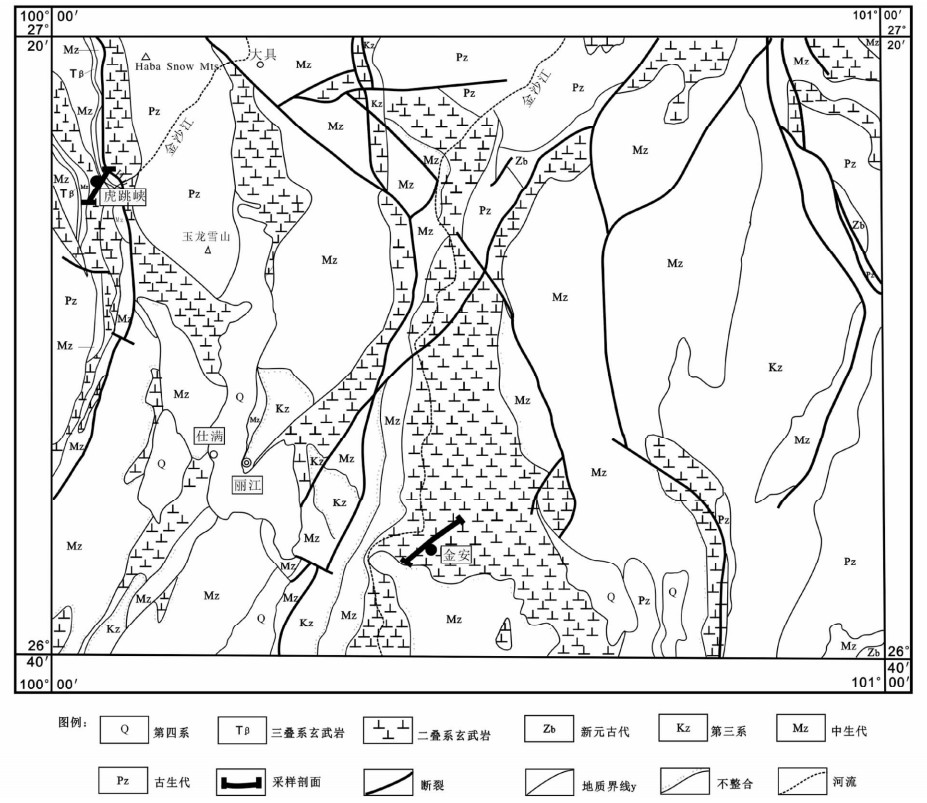
虎跳峡(HTX)和金安(JA)峨眉山玄武岩剖面位于扬子板块西缘的ELIP西部,紧邻金沙江古特提斯缝合带(Chung and Jahn,1995)(图1)。
|
图1 丽江地区地质图(底图据张招崇等,2006) fig.1 geological map of the Lijiang area (after Zhang et al.,2006) |
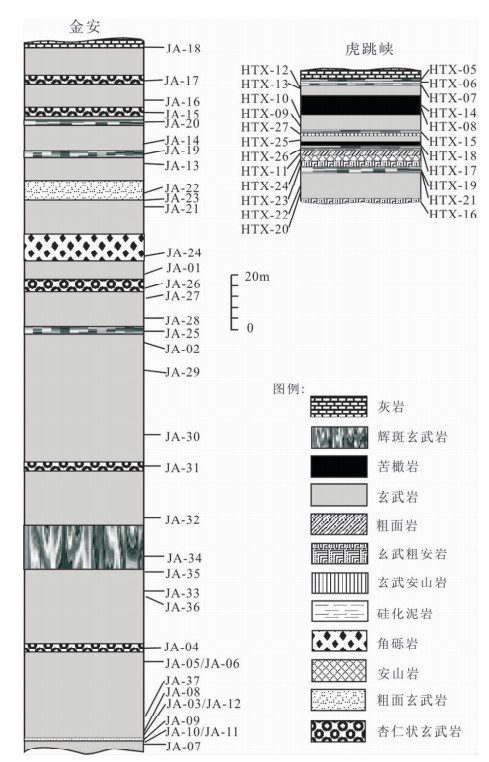
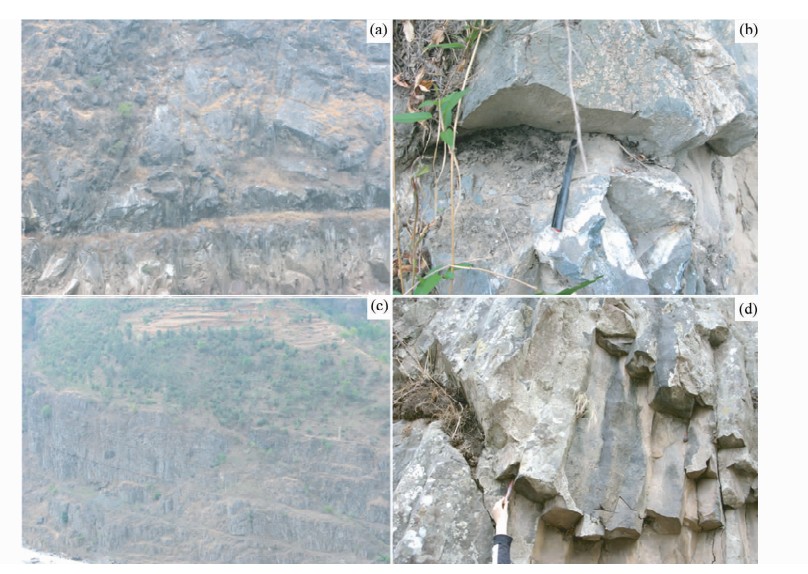
虎跳峡区内二叠系发育,主要集中分布于金沙江、硕多岗河谷两岸,呈北北西和北北东向展布(云南省地质局,1997)。区内岩石以辉斑玄武岩和玄武岩为主,少量苦橄岩、杏仁状玄武岩,夹两层玄武粗安岩、粗面玄武岩、玄武安山岩和安山岩,上部出现一层中酸性火山岩,厚度约1m,有双峰式火山岩的特点(图 2)。苦橄岩位于岩层剖面的中部,其他岩性的接触界线并不十分清晰,外表与玄武岩比较接近。虎跳峡熔岩由于受新生代喜马拉雅碰撞影响,岩石已发生较强的变形变质作用(图 3a),气孔、杏仁和辉石微晶等被压扁、拉长,岩石片理化,部分具条纹构造。部分柱状节理已蚀变(图 3b),蚀变矿物主要为绿泥石、绿帘石、方解石、蛇纹石和绢云母,以绿泥石化较为常见。
|
图2 金安和虎跳峡剖面柱状图,同时已标出采样位置 Fig.2 Simplified stratigraphic columns of the Jin’an and Hutiaoxia sections with sample locations |
|
图3 虎跳峡熔岩(a、b)和金安玄武岩(c、d)野外照片 Fig.3 The field photos of lava and basalt from Hutiaoxia (a, b) and Jin’an (c, d) |
|
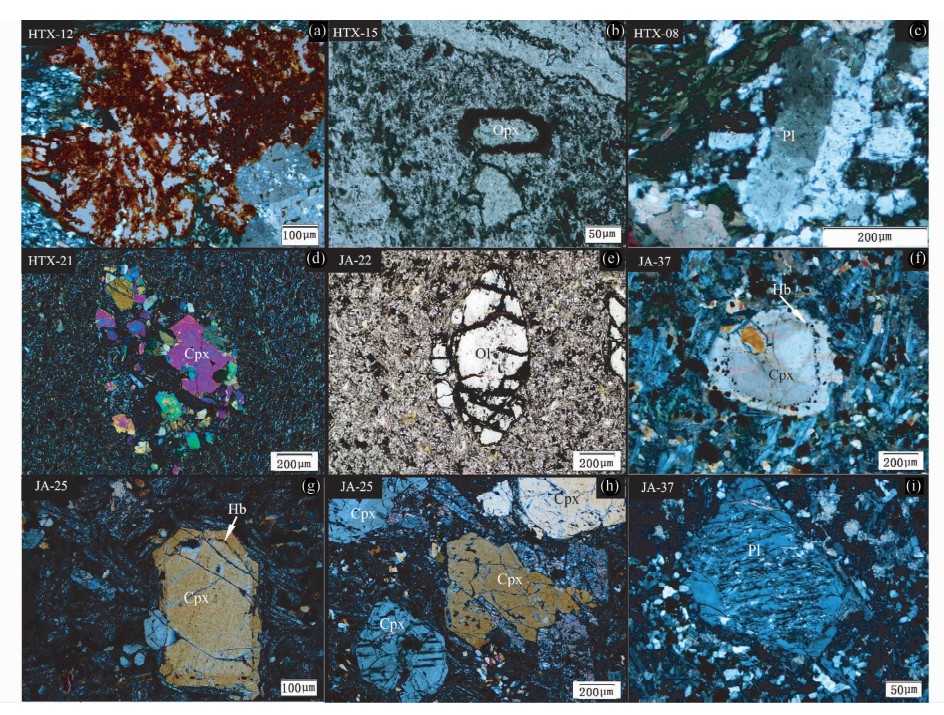
图4 虎跳峡熔岩(a-d)与金安玄武岩斑晶(e-i)镜下特征(正交偏光) (a)-玄武岩中伊丁石化橄榄石斑晶;(b)-玄武岩中易变辉石斑晶;(c)-苦橄岩基质中斜长石;(d)-辉斑玄武岩聚斑状结构;(e)-粗面玄武岩橄榄石假象;(f)-玄武岩单斜辉石砂钟构造及角闪石反应边;(g)-辉斑玄武岩六边形单斜辉石及角闪石反应边;(h)-辉斑玄武岩单斜辉石聚斑;(i)-玄武岩长石出溶 Fig.4 Characteristics of phenocryst s of Hutiaoxia lava (a-d) and Jin’an basalt (e-i) (crossed nicols) (a)-olivine phenocryst iddingsited of basalt;(b)-pigeonige phenocryst of basalt;(c)-plagioclase in groundmass of picrite;(d)-poly speckle structure of augitophyre;(e)-olivine pseudomorph of trachybasalt;(f)-hourglass structure of clinopyxene and reaction rim of hornblende of basalt;(g)-hexagonal clinopyroxene and the olivine pseudomorph;(h)-poly speckle structurein of clinopyxene of augitophyre;(i)-plagioclase exsolution of basalt |
安山岩呈肉红色,斑状结构;有绿帘石化及明显钾化蚀变,红褐色铁质沿原斑晶矿物边缘网脉状分布,破碎严重,少量辉石残留,他形粒状,许多石英细小颗粒与蚀变碳酸盐斑晶交织在一起。暗色金属矿物含量占5%,基质斜长石颗粒细小,含量30%左右。
玄武粗安岩为灰黑紫色,粒状、斑状变晶结构。斑晶主要为斜长石,自形-半自形,长柱状,晶形比较完整,简单接触双晶发育,部分斑晶碳酸岩蚀变,绿帘石化,边缘黑褐色物质充填,具有辉石假象,大小762~1276μm,突起明显,黄铁矿含量1%~2%。基质为间粒结构,颗粒细小,基质有长石、石英和暗色矿物等。
金安剖面厚度约300m,产状接近水平,由数十层玄武质熔岩流组成,平均每层大于5m厚(图 2、图 3c图 3d)。岩石由玄武岩、少量玄武粗安岩和角砾岩组成,可见熔岩流分层和玄武岩绿底红顶现象,未见双峰式火山岩。岩石基本没有蚀变。
玄武岩呈斑状、辉绿、中-细粒结构;块状、杏仁状、条带状构造。斑晶约占10%~15%,主要由普通辉石和斜长石组成,少量橄榄石假象(图 4e图 4f);多数有环带,宽0.02~0.04mm,反映出成分从核部到边部具较为明显的变化,部分普通辉石有角闪石反应边(图 4f,g);少量大斑晶辉石环带不明显,裂理发育,有时呈聚斑状结构(图 4)。斜长石呈短柱状-长柱状,大小0.1~1mm左右,部分岩石聚片双晶发育,有拉长石和钠长石出溶(图 4i)。基质主要由斜长石(20%)和普通辉石(30%)组成,有少量的他形磁铁矿。
按岩层顺序系统采集了ELIP内带丽江岩区的虎跳峡二叠纪玄武岩剖面27个样品和金安二叠纪玄武岩剖面37个样品,进行显微镜下观察,从中选取38件有代表性样品进行了主量元素、微量元素和稀土元素分析,并对其中的13件样品进行了全岩Rb、Sr、Sm、Nd同位素分析,13件样品进行了Pb同位素分析。稀土和微量元素在中国地质大学(北京)地学实验中心完成,测试仪器为英国Micromass公司等离子质谱仪(ICP-MS),实验室分析详细方法见Han et al. (2007)。主量元素在西北大学大陆动力学实验室完成的测试,除烧失量(LOI)采用标准湿化学法分析外,其他主量元素用制成的碱熔玻璃片在RIX2100X射线荧光光谱仪(XRF)上测定,并经BCR-2和GBW07105标样监控,元素分析误差<5%。Rb-Sr和Sm-Nd 同位素在中国科学院地质与地球物理研究所固体同位素地球化学实验室完成。测量仪器为德国 Finnigan 公司 MAT-262热电离质谱计。Rb-Sr和Sm-Nd的全流程本底分别为100pg和50pg左右。浓度(147Sm/144Nd和87Rb/86Sr比值)误差小于0.5%。化学流程和同位素比值测试可参见(Pin and Zalduegui,1997;Chen et al.,2002)。Rb/Sr和Sm/Nd比值的不确定度分别小于±2%和±0.5%。测试过程中分别对Sr标准溶液(NBS987)测得87Sr/86Sr=0.710262,Nd标准溶液(Jndi-1)测得143Nd/144Nd=0.512118,均与参考值吻合。对USGS标准物质BCR-2进行了测试,测得143Nd/144Nd =0.512646。U-Th-Pb含量和206Pb/204Pb、207Pb/204Pb、208Pb/204Pb同位素比值检测在南京大学现代分析中心同位素质谱室完成。U-Th-Pb化学分析流程和质谱分析方法见王银喜等(2006)。依据JY/T004-1996表面热电离质谱法,利用英国VG354同位素质谱仪(型号:INSTRUMENT)进行铅同位素测量。
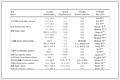
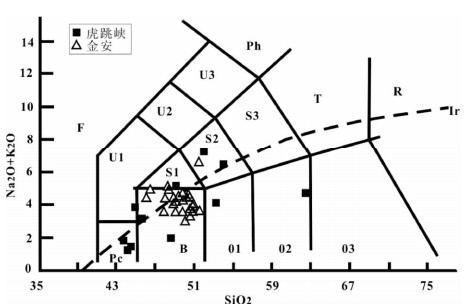
虎跳峡与金安火山岩主要元素和微量元素分析结果列于表 1。去掉烧失量以后,进行火山岩TAS投图(图 5)。虎跳峡样品岩性复杂,既有苦橄岩,又有安山岩,其中样品 HTX-05投点为玄武岩,但其MgO含量17.10%,应为苦橄质岩石(Le Bas,2000)。金安样品岩性比较单一,大部分样品落入玄武岩中,仅1件样品落入玄武粗安岩范围中,1件样品落入粗面玄武岩中。
|
表1 虎跳峡苦橄岩与玄武岩及金安玄武岩主量元素(wt%)与微量元素(×106)分析结果 Table 1 Analyses of major (wt%) and trace elements (×106) of whole-rocks |
|
图5 虎跳峡与金安岩石样品的火山岩TAS图解 Fig.5 The TAS diagram of Igneous Rocks from Hutiaoxia and Jin’an |
虎跳峡玄武岩的MgO和Mg#与大具、仕满玄武岩的MgO和Mg#相当(分别为6.79%~12%和0.54~0.67)。虎跳峡苦橄岩和玄武岩中的CaO/Al2O3达到了0.80~1.34,与大具、仕满苦橄岩和玄武岩中的CaO/Al2O3(0.84~1.11)相当。但金安玄武岩的CaO/Al2O3为0.46~0.79,反映了形成压力从虎跳峡到金安逐渐降低的特点(Hirose and Kushiro,1993;Baker and Stolper,1994;张招崇等,2006)。虎跳峡熔岩中的Cr和Ni的含量,远远大于金安玄武岩的Cr和Ni的含量,这也反映了演化岩浆的特点。
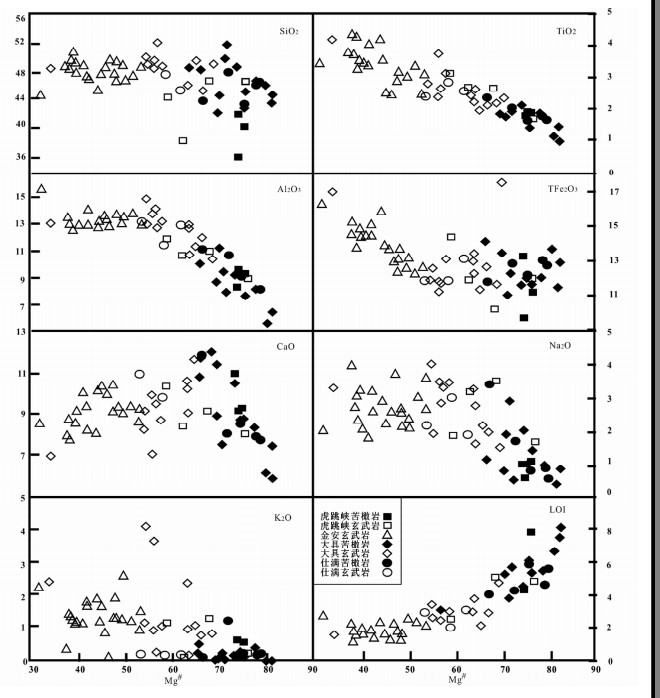
从图6中也可以看出,虎跳峡苦橄岩的Mg#、SiO2、TiO2、Al2O3、Fe2O3T、CaO、Na2O、K2O、LOI都介于大具和仕满苦橄岩范围内;金安玄武岩Mg#的含量明显低于虎跳峡、大具和仕满玄武岩的,TiO2的含量要高于大具和仕满玄武岩的。对虎跳峡、大具、仕满苦橄质岩石来说,随着Mg#的降低,其CaO、Al2O3、TiO2和Na2O的含量升高,说明发生过橄榄石的分离结晶作用;而Al2O3的增高以及没有明显的Fe2O3T富集,说明很少或没有斜长石的分离结晶作用,这一点与苦橄质岩石中没有斜长石斑晶的现象一致。另外,图中玄武岩的Mg#与CaO、Al2O3、Na2O、SiO2的相关性都不明显,但与Fe2O3T呈负相关,说明有斜长石的分离结晶作用,这与金安玄武岩中有斜长石斑晶的现象一致。
本区火山岩均遭受了不同程度的蚀变,因而主要元素分析时其烧失量较高,虎跳峡苦橄岩约 4.27%~7.79%,玄武岩约2.41%~5.01%,比金安玄武岩的烧失量(1.13%~2.67%)高很多(表1)。大具、仕满苦橄岩烧失量为3.98~8.11%,玄武岩烧失量为1.93~3.73%(张招崇等,2006),与虎跳峡熔岩的烧失量相当,远高于金安玄武岩的。岩石中Mg#越高,烧失量越大,蚀变程度也越高(图 6)。尽管蚀变作用没有完全模糊主要元素之间的相互关系,但是一些主要元素的氧化物和Mg#缺乏明显的相关关系则可能与蚀变作用有关,如Mg#与K2O没有相关性。
|
图6 虎跳峡、大具、仕满苦橄岩和玄武岩及金安玄武岩的Mg#与主要氧化物和烧失量图解 大具、仕满数据引自张招崇等,2006 Fig.6 Mg# vs. Major element oxides and LOI for lavas of the Hutiaoxia, Daju, Shiman and Jin’an Datas of Daju and Shiman basalts are from Zhang et al.,2006 |
在原始地幔标准化图解上(图 7图 7a,c, ),这与蚀变作用有关。虎跳峡苦橄岩具有Ba的正异常,苦橄岩比玄武岩有更强的Sr负异常,Eu没有负异常,说明Sr的负异常并不是斜长石的分离结晶作用引起,而是由蚀变作用引起的(Lindstrom and Haskin,1981;Clague and Frey,1982;Fleming et al.,1992);部分具有Pb的正异常,可能与蚀变作用有关;P的负异常反映源区缺少磷灰石或者熔融程度很低。
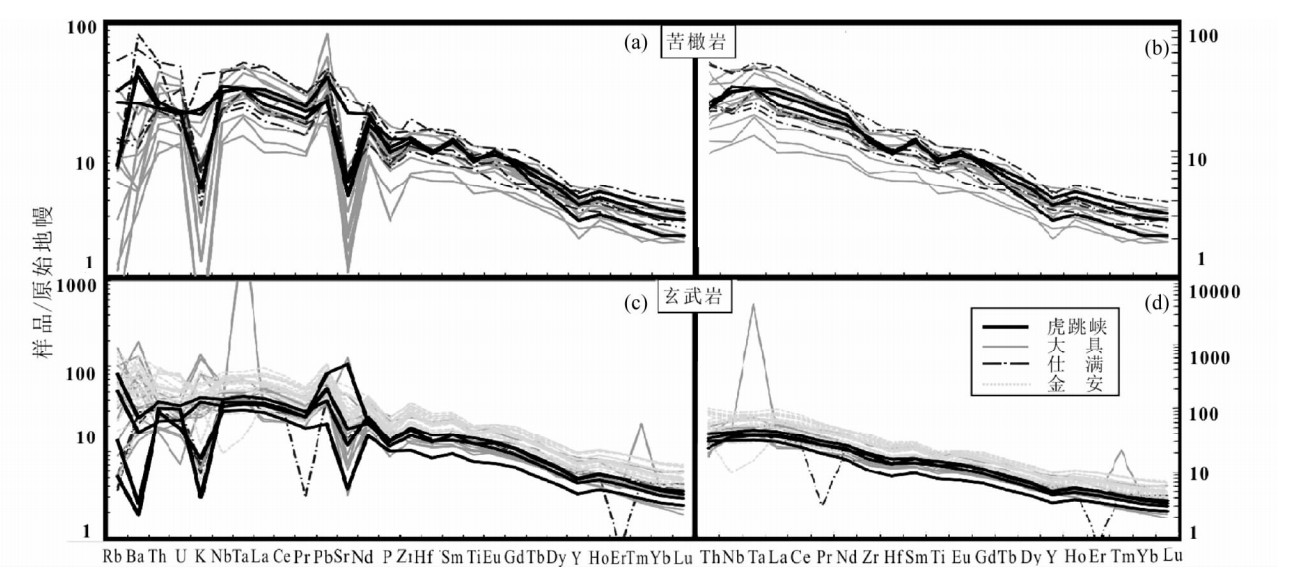 | 图7 丽江虎跳峡、金安、仕满和大具苦橄岩(a,b)和玄武岩(c,d)的微量元素原始地幔标准化图解(标准化值据Sun and McDonough, 1989)
(b)和(d)只有抗蚀变元素.大具、仕满数据引自张招崇等,2006 Fig.7 Incompatible-element patterns of Lijiang-area picritics (a, b) and basaltic lavas (c, d) (normalization values after Sun and McDonough, 1989) Panels (b) and (d) show alteration-fesistant elements only. Data of Daju and Shiman basalts are from Zhang et al.,2006 |
虎跳峡苦橄岩和玄武岩εNd(t)变化范围较小(假定t=250Ma),εNd(t)值为-0.8~+0.3,(87Sr/86Sr)t为0.70512~ 0.70526,金安玄武岩εNd(t)值变化范围为-0.2~+3.5,(87Sr/86Sr)t为0.70422~0.70554,基本落在丽江大具、仕满苦橄岩和玄武岩范围内(张招崇等,2006)(表2、图 8)。ELIP其它地区玄武岩的εNd(t)和(87Sr/86Sr)t分别为+4.8~-4.8和0.70393~0.70759 (Xu et al.,2001;张招崇和王福生,2003;Xu et al.,2010;侯增谦等,2005;姜常义等,2007)。
|
|
表2 Nd、Sr、Pb同位素组成 Table 2 Nd,Srand Pb istotpic data |
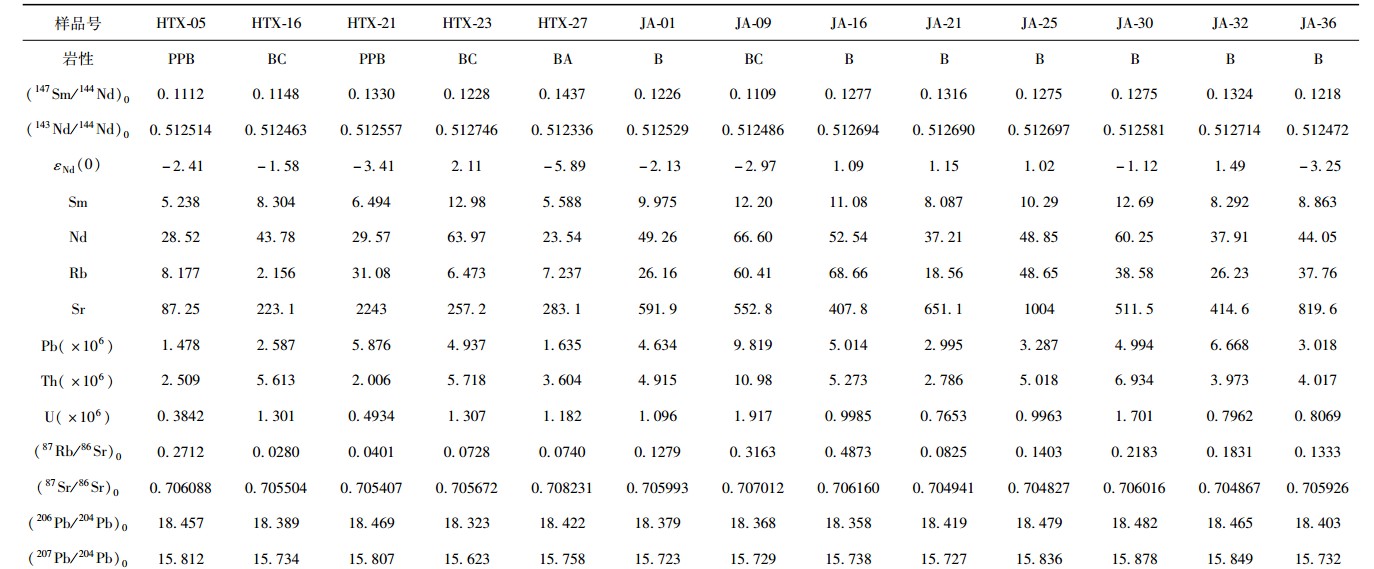

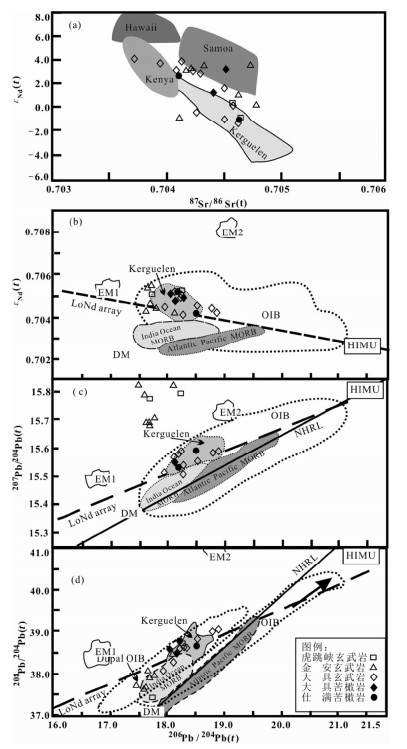 | 图8 丽江地区熔岩的Sr、Nd、Pb多元同位素图解(t=250Ma)
大具、仕满数据引自张招崇等(2006);HIMU、OIB、Dupal OIB、EM1和EM2同位素组成引自Hawkesworth et al. (1984)、Hart (1984,1988)、Hamelin and Allègre (1985)、Hart et al. (1986)及Weaver(1991);低Nd带和北半球的参考线(NHRL)引自Hart (1984);印度洋MORB、大西洋-太平洋MORB和Kerguelen岛数值来自Hamelin and Allègre (1985)、Barling and Goldstein (1990)、Deniel (1998);Hawaii、Kenya、Kergulen和Samoa数据引自Hawkesworth et al. (1984)、Hart (1988)和Weaver (1991)
Fig.8 Sr, Nd and Pb poly-endmember diagrams of Lijiang area lavas (t=250Ma) Data of Daju and Shiman basalts are from Zhang et al.,2006; The field of HIMU,OIB,Dupal OIB,EM1 and EM2 are from Hawkesworth et al. (1984)、Hart (1984, Hamelin and Allègre (1985)、Hart et al. (1986), Weaver(1991). The LoNd array and Northern Hemisphere Reference Line (NHRL) are from Hart (1984).The fields of Indian Ocean MORB,Atlantic-Pacific MORB and Kerguelen are from Hamelin and Allègre (1985),Barling and Goldstein (1990)、Deniel (1998).The fields for Hawaii,Kenya,Kergulen,and Samoa are from Hawkesworth et al. (1984)、Hart (1988) and Weaver (1991) |
从图9可以看出,εNd(t)和(87Sr/86Sr)t值与抗蚀变不相容元素比值的相关性不十分明显。虎跳峡和金安的低εNd(t)值的玄武岩具有低的Nd/La。金安玄武岩具有比虎跳峡,大具和仕满玄武岩更低的(Th/Nd)PM,四个地区样品的(La/Yb)PM、(Nb/La)PM和(Th/Nd)PM比值范围相当。
岩石中Mg#越高,烧失量越大,蚀变程度也越高(图 6)。本区大部分苦橄岩和玄武岩均有不同程度的风化和蚀变,在采样时力求新鲜,但分析结果中虎跳峡熔岩的烧失量(LOI)都偏高。其苦橄岩和玄武岩的烧失量为2.41%~7.79%;虎跳峡粗面玄武岩、玄武粗安岩及安山岩的烧失量 (LOI)为1.76~4.18%,比金安相应的岩性 (1.39~2.42%)高,说明虎跳峡熔岩的蚀变程度相对于金安较高。
蚀变作用可能导致了虎跳峡和金安熔岩部分主量元素(如Mg和Fe、K)、微量元素(Rb、Sr和Ba)浓度和同位素比值的变化;也模糊了一些主要元素之间的相互关系(表1、图 7)。如本研究区部分高烧失量熔岩MgO偏高而Fe2O3T降低,说明蚀变作用可能导致岩石中Mg增加和Fe流失;烧失量大熔岩微量元素一般有很强的K、Rb、Sr和Ba异常。因此,为了避免较强蚀变对结果精度的影响,在同位素测试时剔除掉了高烧失量的样品(HTX-08,HTX-12),并依据高场强元素(Ti、Zr、Y、Nb、Ta、Hf)、Th和稀土元素等不活泼元素进行成因和源区性质讨论。
本文使用PRIMELTS软件(Herzberg and Asimow,2008;李永生,2012)来恢复峨眉山大火成岩省原始岩浆成分。利用软件将全岩MgO>5%的金安玄武岩恢复到MgO=8%;再根据PRIMELT2.XLS公式,将恢复到MgO=8%的金安玄武岩和全岩MgO>8%的虎跳峡熔岩的熔融温度进行计算,结果见表 3。从恢复的原始岩浆成分上看,虎跳峡熔岩和金安玄武岩原始岩浆的MgO含量分别为15.81%~20.89%和8.06%~13.84%。
|
|
表3 虎跳峡苦橄岩、玄武岩及金安玄武岩原始岩浆熔融温度 Table 3 The estimate of primary magma liquation temperature from Hutiaoxia and Jin’an |
丽江熔岩源区为石榴子石相,是在较深的范围内(135km)较低部分熔融程度下形成的;原始地幔标准化后的(Sm/Yb)PM和(La/Sm)PM分别为2.92~6.74和1.69~3.74(张招崇等,2006)。虎跳峡熔岩的则分别为3.47~5.89和1.99~3.04,金安玄武岩的分别为2.75~3.78与2.07~3.78,二者均在丽江熔岩的变化范围内。由表 3可知虎跳峡苦橄岩和玄武岩源区为石榴石橄榄岩相,其粗面玄武岩和金安玄武岩主要为尖晶石二辉橄榄岩相,显示出由虎跳峡到金安原始岩浆的形成压力和深度逐渐降低,这与李永生(2012)利用Niu and Batiza (1991)模型得出的结论保持一致,即以丽江、木里和渡口为中心向周围地区的熔融深度和压力有逐渐降低的趋势。
虎跳峡和金安熔岩均位于丽江熔岩εNd(t)和(206Pb/204Pb)t范围内(图 9),丽江地区高εNd(t)和高(206Pb/204Pb)t值的熔岩在同位素组成上与现代大洋热点相似(250Ma),并且抗蚀变元素原始地幔标准化图解也与洋岛玄武岩相似,由此表明其源区为对流地幔,并且与地幔柱头部成因模式一致(张招崇等,2006)。通常认为,亏损端元DM来自软流圈地幔或地幔柱,EM2富集端元则与壳源有关,或者与再循环的洋壳有关(Glazner and Farmer,1992),EM1富集端元一般认为其存在于岩石圈地幔中,与软流圈或地幔柱来源的小体积富挥发分熔体(Haw et al.,1990; Menzies,1989, 1990)或古老俯冲带下插板块的脱水作用释放的富大离子亲石元素(LILE)、贫高场强元素(HFSE)流体(Haw et al.,1990; Tatsumoto et al.,1992; Liu et al.,1994)对岩石圈地幔的交代作用有关。
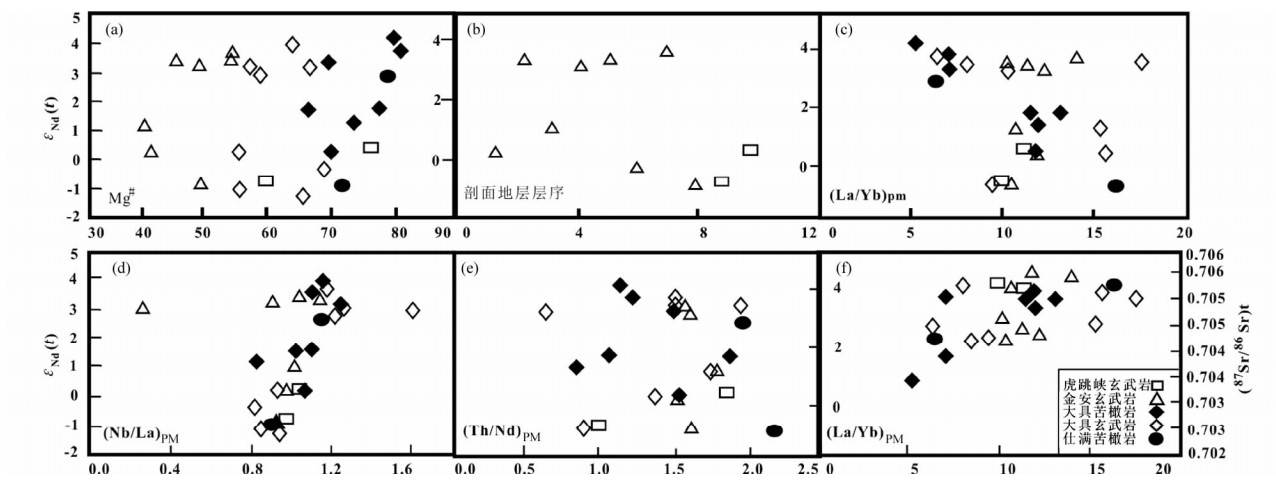 | 图9 虎跳峡、金安、大具、仕满剖面的εNd(t)对Mg# (a)、剖面地层层序(b)、(La/Yb)PM (c)、(Nb/La)PM (d)和(Th/Nd)PM (e)图解以及(87Sr/86Sr)t-(La/Yb)PM图解(f) 大具、仕满数据引自张招崇等,2006 Fig.9 Variation of εNd(t) with Mg#(a), stratigraphic order in the Hutiaoxia, Jin’an section (b), (La/Yb)PM (c), (Nb/La)PM (d), (Th/Nd)PM (e), and variation of (87Sr/86Sr)t with (La/Yb) PM (f) Data of Daju and Shiman basalts are from Zhang et al.,2006 |
一般来说,混入下地壳物质后,其(Th/Ta)PM接近于1,而(La/Nb)PM比值则大于1;如果混入上地壳物质,则2个比值一般均在2以上(Peng et al.,1994)。虎跳峡熔岩(La/Nb)PM比值为0.79~1.03,(Th/Ta)PM比值为0.65~0.93,说明可能有少量下地壳物质的混染。虎跳峡熔岩La/Sm(1.99~3.04)与La/Ta(0.74~0.98)比金安相应比值La/Sm(2.07~3.78)、La/Ta(0.84~2.52)的范围都要小,也说明地壳物质的混染更少。
由表 2可知,少量样品有相对低的εNd(t)、(206Pb/204Pb)t和高的(87Sr/86Sr)t,也说明源区有低εNd(t)物质的混染或者岩浆中有元古宙岩石圈(地壳或地幔)的混染。这种低εNd(t)物质比高εNd(t)的地幔源区具有相对富集高度不相容元素和低的Nb/La比值(图 9c-e)。虎跳峡和金安地区的εNd(t)具有很小的负值,并且缺乏负的Nb和Ta异常,推测源区中大陆岩石圈或者俯冲沉积物的数量很少。虎跳峡熔岩中斜长石斑晶很少,说明其上升速度很快。金安玄武岩与虎跳峡熔岩相比,有更多的斜长石斑晶和更低的Mg#值,表明受到地壳的混染和岩石圈地幔的混染相对要多。ELIP其它地区的玄武岩具有比金安玄武岩更大的负εNd(t)和明显的负Nb和Ta异常,可以解释为相当多的地壳物质和/或岩石圈地幔混染的结果(Xu et al.,2001;Zhang and Wang,2002;Xiao et al.,2004;张招崇等,2006)。
前人根据盐源-丽江地区玄武岩的喷发显示出极大的岩浆产率,并有苦橄岩和橄榄玄武岩出露,判断其为地幔柱的活动中心;峨眉山地幔柱的轴部位置在丽江-大理-攀枝花为中心的苦橄岩分布三角区内;丽江地区代表峨眉山地幔柱头部熔融产物的苦橄岩层熔融温度为1630~1680℃,通过PRIMELT2计算出的峨眉山地幔柱头部熔融温度为1627℃,推断地幔柱的轴部位置位于云南丽江地区(宋谢炎等,2002;侯增谦等,2005;张招崇和王福生, 2003; 张招崇,2004, 2006;He et al.,2010)。李永生(2012)通过建立峨眉山地幔柱熔融模型计算出丽江地区是地幔柱的轴心部位。
从ELIP苦橄岩和玄武岩原始岩浆熔融温度示意图(图 10)可以看出,在丽江地区范围内,自丽江仕满(1630~1680℃)、虎跳峡(1493~1611℃)到康司地区(1445~1448℃)苦橄岩熔融温度依次降低;同时,自丽江仕满,分别到树底桥(1408~1466℃)和金安(1055~1474℃) 原始岩浆形成温度也呈降低趋势。在ELIP范围内,以丽江地区为中心,向东至渡口(1471~1580℃)、二滩(1426~1521℃)、米易(1437~1486℃)、龙舟山(1430~1564℃)、外带广西西部(1451~1535℃)和会东(1461℃)原始岩浆形成温度为降低趋势;自丽江地区沿其东南方向至中带宾川(1431~1544℃)、外带金平颂达地区(1428~1547℃)原始岩浆熔融温度为降低趋势(Shellnutt and Zhou,2008;Li et al.,2010;He et al.,2010;Xu et al.,2001;严再飞等2006;Fan et al.,2008,李永生,2012)。另外,金安玄武岩熔融温度(1055~1474℃)也比丽江苦橄岩熔融温度低得多。显然,丽江地区苦橄岩熔融温度比周边所有地区都高,表现出原始岩浆熔融温度以丽江为中心,向两侧逐渐降低的趋势。同时,在ELIP中,苦橄岩仅在渡口地区、丽江地区、木里地区及越南北部地区被发现(Zhang and Wang,2002; Zhang et al.,2006,Chung and Jahn,1995;Li et al.,2010;Hanski et al.,2004),其中丽江是已知数据中苦橄岩出露最多的,本次研究发现苦橄岩沿丽江西侧虎跳峡和东侧金安含量逐渐减少(图 10),由此推测丽江地区可能是地幔柱的中心位置。
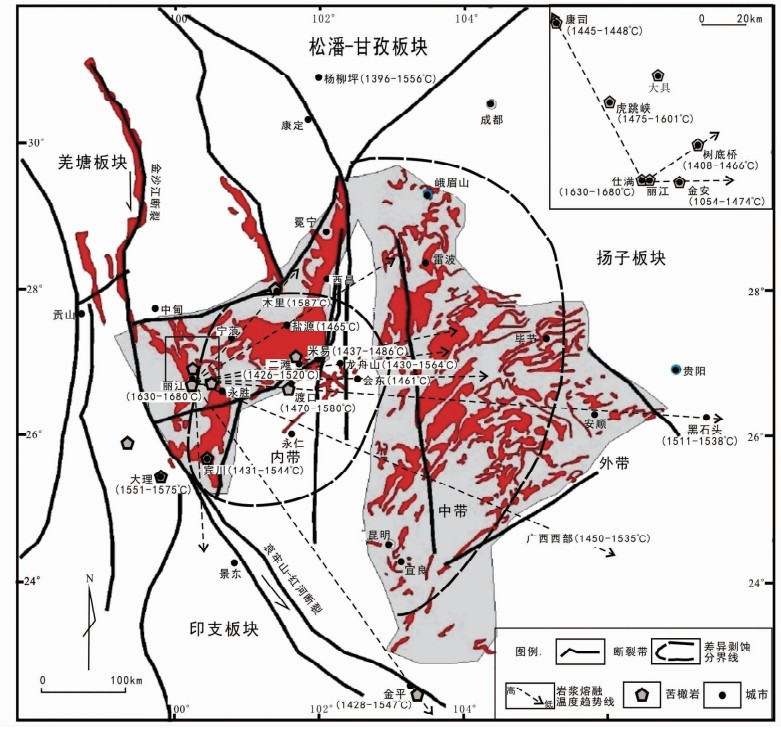 | 图10 ELIP苦橄岩和玄武岩原始岩浆熔融温度示意图(数据来源于张招崇等,2006;李永生,2012;底图据李永生,2012) Fig.10 The schematic diagram of the primitive magma melting temperatures of picrites and basalts of ELIP (data from Zhang et al., 2006; Li, 2012; base map after Li, 2012) |
虎跳峡和金安二叠纪玄武岩、苦橄岩的不相容元素原始地幔标准化图解以及Sr-Nd-Pb同位素地球化学特征总体上均与丽江苦橄岩和玄武岩相似,也与OIB相似,并且显示出很少受到岩石圈地幔或地壳物质的混染。两个地区原始岩浆MgO含量分别为14.95%~20.89%和8.06%~13.84%,其相应的熔融温度分别为1493~1611℃和1055~1474℃,并且与ELIP其他地区二叠纪苦橄岩和玄武岩原始岩浆熔融温度一样都低于丽江仕满苦橄岩的熔融温度(1630~1680℃),表现出ELIP原始岩浆熔融温度以丽江为中心,向两侧有逐渐降低的趋势,推测丽江地区可能是地幔柱的中心部位。
致谢
野外工作得到中国地质大学张东阳博士、张舒、董淑云、李莹等硕士的帮助;实验分析工作得到中国地质大学地学实验中心苏犁、西北大学大陆动力学国家重点实验室杨雪、中国科学院地质与地球物理研究所李潮峰、南京大学现代分析中心王银喜等老师的帮助;评审专家提出了中肯宝贵的修改意见;在此一并表示诚挚的感谢!
| [1] | Ali JR, Thompson GM, Zhou MF and Song XY. 2005. Emeishan large igneous province, SW China. Lithos, 79(3-4): 475-489 |
| [2] | Baker MB and Stolper EM. 1994. Determining the composition of high-pressure mantle melts using diamond aggregates. Geochimica et Cosmochimica Acta, 58(13): 2811-2827 |
| [3] | Barling J and Goldstein SL. 1990. Extreme isotopic variations in Heard Island lavas and the nature of mantle reservoirs. Nature, 348(6296): 59-62 |
| [4] | Campbell IH and Griffiths RW. 1990. Implications of mantle plume structure for the evolution of flood basalts. Earth and Planetary Science Letters, 99(1-2): 79-93 |
| [5] | Chen F, Siebel W, Satir M, Terziogˇlu MN and Saka K. 2002. Geochronology of the Karadere basement (NW Turkey) and implications for the geological evolution of the Istanbul zone. International Journal of Earth Sciences, 91(3): 469-481 |
| [6] | Chen JY, Yang XS, Xiao L and He Q. 2012. Coupling of basaltic magma evolution and lithospheric seismic structure in the Emeishan Large Igneous Province: MELTS modeling constraints. Lithos, 119(1-2): 61-74 |
| [7] | Chen L, Zhi XC, Zhang ZC and Shi RD. 2007. Preliminary study on Re-Os isotope geochemistry of picrites from Lijiang area, Yunnan Province. Geological Journal of China Universities, 13(2): 337-343 (in Chinese with English abstract) |
| [8] | Chung SL and Jahn BM. 1995. Plumb-lithosphere interaction in generation of the Emeishan flood basalts at the Permian-Triassic boundary. Geology, 23(10): 889-892 |
| [9] | Clague DA and Frey FA. 1982. Petrology and trace element geochemistry of the Honolulu Volcanics, Oahu: Implications for the oceanic mantle below HawaⅡ. Journal of Petrology, 23(3): 447-504 |
| [10] | Deniel C. 1998. Geochemical and isotopic (Sr, Nd, Pb) evidence for plume-lithosphere interactions in the genesis of Grande Comore magmas (Indian Ocean). Chemical Geology, 144(3-4): 281-303 |
| [11] | Fan WM, Zhang CH, Wang YJ, Guo F and Peng TP. 2008. Geochronology and geochemistry of Permian basalts in western Guangxi Province, Southwest China: Evidence for plume-lithosphere interaction. Lithos, 102(1-2): 218-236 |
| [12] | Fleming TH, Elliot DH, Jones LM, Bowman JR and Siders MA. 1992. Chemical and isotopic variations in an iron-rich lava flow from the Kirkpatrick basalt, North Victoria Land, Antarctica: Implications for low-temperature alteration. Contributions to Mineralogy and Petrology, 111(4): 440-457 |
| [13] | Gao ZM, Zhang Q, Tao Y and Luo TY. 2004. An analysis of the mineralization connected with Emeishan mantle plume. Acta Mineralogica Sinica, 24(2): 99-104 (in Chinese with English abstract) |
| [14] | Glazner AF and Farmer GL. 1992. Production of isotopic variability in continental basalts by cryptic crustal contamination. Science, 255(5040): 72-74 |
| [15] | Hamelin B and Allègre CJ. 1985. Large scale regional units in the depleted upper mantle revealed by an isotopic study of the south-west Indian ridge. Nature, 315(6016): 196-198 |
| [16] | Han YG, Zhang SH, Franco PJ and Zhang YH. 2007. Evolution of the Mesozoic granites in the Xiong'ershan-Waifangshan region, western Henan Province, China, and its tectonic implications. Acta Geologica Sinica, 81(2): 253-265 |
| [17] | Hanski E, Walker RJ, Huhma H, Polyakov GV, Balykin PA, Hoa TT and Phuong NT. 2004. Origin of the Permian-Triassic komatⅡtes, northwestern Vietnam. Contributions to Mineralogy and Petrology, 147(4): 453-469 |
| [18] | Hart SR. 1984. A large-scale isotope anomaly in the Southern Hemisphere mantle. Nature, 309(5971): 753-757 |
| [19] | Hart SR, Gerlach DC and White WM. 1986. A possible new Sr-Nd-Pb mantle array and consequences for mantle mixing. Geochimica et Cosmochimica Acta, 50(7): 1551-1557 |
| [20] | Hart SR. 1988. Heterogeneous mantle domains: Signatures, genesis and mixing chronologies. Earth and Planetary Science Letters, 90(3): 273-296 |
| [21] | Hawkesworth CJ, Rogers NW, Van Calsteren PW and Menzies MA. 1984. Mantle enrichment processes. Nature, 311(5984): 331-335 |
| [22] | Hawkesworth CJ, Kempton PD, Rogers NW, Ellam RM and Van Calsteren PW. 1990. Continental mantle lithosphere, and shallow level enrichment processes in the earth's mantle. Earth and Planetary Science Letters, 96(3-4): 256-268 |
| [23] | He B, Xu YG, Chung SL, Xiao L and Wang YM. 2003. Sedimentary evidence for a rapid, kilometer-scale crustal doming prior to the eruption of the Emeishan flood basalts. Earth and Planetary Science Letters, 213(3-4): 391-405 |
| [24] | He B, Xu YG, Xiao L, Wang KM and Sha SL. 2003. Generation and spatial distribution of the Emeishan Large Igneous Province: New evidence from stratigraphic records. Acta Geologica Sinica, 77(2): 194-202 (in Chinese with English abstract) |
| [25] | He B, Xu YG, Hang XL, Luo ZY, Shi YR, Yang QJ and Yu SY. 2007. Age and duration of the Emeishan flood volcanism, SW China: Geochemistry and SHRIMP zircon U-Pb dating of silicic ignimbrites, post-volcanic Xuanwei Formation and clay tuff at the Chaotian section. Earth and Planetary Science Letters, 255(3-4): 306-323 |
| [26] | He Q, Xiao L, Brian B, Gao R and Chen JY. 2010. Variety and complexity of the Late-Permian Emeishan basalts: Reappraisal of plume-lithosphere interaction processes. Lithos, 119(1-2): 91-107 |
| [27] | Herzberg C and Asimow PD. 2008. Petrology of some oceanic island basalts: PRIMELT2. XLS software for primary magma calculation. Geochemistry, Geophysics, Geosystem, 9(9): doi: 10. 1029GC002057 |
| [28] | Hirose K and Kushiro I. 1993. Partial melting of dry peridotites at high pressures: Determination of compositions of melts segregated from peridotite using aggregates of diamond. Earth and Planetary Science Letters, 114(4): 477-489 |
| [29] | Hou ZQ, Lu JR and Lin SZ. 2005. The axial zone consisting of pyrolite and eclogite in the Emei Mantle Plume: Major, trace Element and Sr-Nd-Pb isotope evidence. Acta Geologica Sinica, 79(2): 200-219 (in Chinese with English abstract) |
| [30] | Hu RZ, Tao Y, Zhong H, Huang ZL and Zhang ZW. 2005. Mineralization systems of a mantle plume: A case study from the Emeishan Igneous Province, Southwest China. Earth Science Frontiers, 12(1): 42-54 (in Chinese with English abstract) |
| [31] | Jian P, Liu DY, Alfred K, Zhang Q, Wang YZ, Sun XM and Zhang W. 2009. Devonian to Permian plate tectonic cycle of the Paleo-Tethys Orogen in southwest China (Ⅱ): Insights from zircon ages of ophiolites, arc/back-arc assemblages and within-plate igneous rocks and generation of the Emeishan CFB province. Lithos, 113(3-4): 767-784 |
| [32] | Jiang CY, Qian ZZ, Jiang HB, Tang DM, Zhang PB and Zhu SF. 2007. Petrogenesis and source characteristics of low-Ti basalts and picrites at Binchuan-Yongsheng-Lijiang region, Yunnan, China. Acta Petrologica Sinica, 23(4): 777-792 (in Chinese with English abstract) |
| [33] | Kerr AC, England RW and Wignall PB. 2005. Mantle plumes: Physical processes, chemical signatures, biological effects. Lithos, 79(3-4): vⅡ-x |
| [34] | Klein EM and Langmuir CH. 1987. Global correlations of ocean ridge basalt chemistry with axial depth and crustal thickness. Journal of Geophysical Research, 92(B8): 8089-8115 |
| [35] | Le Bas MJ. 2000. IUGS reclassification of the high-Mg and picritic volcanic rocks. Journal of Petrology, 41(10): 1467-1470 |
| [36] | Le Maitre RW, Bateman P, Dudek A and Lameyre JA. 1989. A Classification of Igneous Rocks and Glossary of Terms. Oxford: Blackwell, 1-193 |
| [37] | Li HB, Zhang ZC and LÜ LS. 2010. Geometry of the mafic dyke swarms in Emeishan large igneous province: Implications for mantle plume. Acta Petrologica Sinica, 26(10): 3143-3152 (in Chinese with English abstract) |
| [38] | Li HB, Zhang ZC, Li YS and Wang YF. 2013. The location of the tail of Emeishan mantle plume. Geological Review, 59(2): 201-208 (in Chinese with English abstract) |
| [39] | Li J, Xu JF, Suzuki K, He B, Xu YG and Ren ZY. 2010. Os, Nd and Sr isotope and trace element geochemistry of the Muli picrites: Insights into the mantle source of the Emeishan Large Igneous Province. Lithos, 119(1-2): 108-122 |
| [40] | Li KM, Wang Y, Zhao JH, Zhao HL and Di YJ. 2003. Mantle plume, large igneous province and continental breakup-additionally discussing the Cenozoic and Mesozoic mantle plume problems in East China. Acta Seismologica Sinica, 25(3): 314-323 (in Chinese with English abstract) |
| [41] | Li YS. 2012. Quantitative modeling of the Emeishan large igneous province magmatism processes. Ph. D. Dissertation. Beijing: China University of Geoscienses, 1-163 (in Chinese with English summary) |
| [42] | Lindstrom MM and Haskin LA. 1981. Compositional inhomogeneities in a single Icelandic tholeⅡte flow. Geochimica et Cosmochimica Acta, 45(1): 15-31 |
| [43] | Liu CQ, Masuda A and Xie GH. 1994. Major-and trace-element compositions of Cenozoic basalts in eastern China: Petro-genesis and mantle source. Chemical Geology, 114(1-2): 19-42 |
| [44] | Liu CY and Zhu RX. 2009. Discussion on geodynamic significance of the Emeishan basalts. Earth Science Frontiers, 16(2): 52-69 (in Chinese with English abstract) |
| [45] | Menzies MA. 1989. Cratonic, circumcratonic and oceanic mantle domains beneath the western United States. Journal of Geophysical Research, 94(B6): 7899-7915 |
| [46] | Menzies MA. 1990. Archaean, Proterozoic, and Phanerzoic lithospheres. In: Menzies MA (ed.). Continental Mantle. Oxford: Oxford Science Publications, 67-86 |
| [47] | Niu YL and Batiza R. 1991. An empirical method for calculating melt compositions produced beneath mid-ocean ridges: Application for axis and off-axis (seamounts) melting. Journal of Geophysical Research, 96(B13): 21753-21777 |
| [48] | Pang KN, Zhou MF, Qi L, Shellnutt G, Wang CY and Zhao DG. 2010. Flood basalt-related Fe-Ti oxide deposits in the Emeishan large igneous province, SW China. Lithos, 119(1-2): 123-136 |
| [49] | Peng ZX, Mahoney J, Hooper P, Harris C and Beane J. 1994. A role for lower continental crust in flood basalt genesis? Isotopic and incompatible element study of the lower six formations of the western Deccan Traps. Geochimica et Cosmochimica Acta, 58(1): 267-288 |
| [50] | Pin C and Zalduegui JS. 1997. Sequential separation of light rare-earth elements, thorium and uranium by miniaturized extraction chromatography: Application to isotopic analyses of silicate rocks. Analytica Chimica Acta, 339(1-2): 79-89 |
| [51] | Shellnutt JG and Zhou MF. 2008. Permian, rifting related fayalite syenite in the Panxi region, SW China. Lithos, 101(1-2): 54-73 |
| [52] | Song XY, Wang YL, Cao ZM, Jin JF, Li JC and When CQ. 1998. Emeishan basalts, Emei tafrogeny and mantle plume. Geology Geochemistry, (1): 47-52 (in Chinese with English abstract) |
| [53] | Song XY, Hou ZQ, Cao ZM, Lu JR, Wang YL, Zhang CJ and Li YG. 2001. Geochemical characteristics and period of the Emei Igneous Province. Acta Geologica Sinca, 75(4): 498-506 (in Chinese with English abstract) |
| [54] | Song XY, Hou ZQ, Wang YL, Zhang CJ, Cao ZM and Li YG. 2002. The mantle plume features of Emeishan basalts. Journal of Mineralogy and Petrology, 22(4): 27-32 (in Chinese with English abstract) |
| [55] | Song XY, Zhang CJ, Hu RZ, Zhong H, Zhou MF, Ma RZ and Li YG. 2005. Genetic links of magmatic deposits in the Emeishan large Igneous Province with dynamics of mantle plume.Journal of Mineralogy and Petrology, 25(4): 35-44 (in Chinese with English abstract) |
| [56] | Sun SS and McDonough WF. 1989. Chemical and isotopic systematics of oceanic basalts: Implications for mantle composition and processes. In: Saunders AD and Norry MJ (eds.). Magmatism in the Ocean Basins. Geological Society, London, Special Publications, 42(1): 313-345 |
| [57] | Sun YD, Lai XL, Wignall PB, Widdowson M, Ali JR, Jiang HS, Wang W, Yan CY, Bond DPG and Védrine S. 2010. Dating the onset and nature of the Middle Permian Emeishan large igneous province eruptions in SW China using conodont biostratigraphy and its bearing on mantle plume uplift models. Lithos, 119(1-2): 20-33 |
| [58] | Tatsumoto M, Basu AR, Huang WK, Wang J and Xie G. 1992. Sr, Nd, and Pb isotopes of ultramafic xenoliths in volcanic rocks of eastern China: Enriched components EMⅠand EMⅡ in subcontinental lithosphere. Earth and Planetary Science Letters, 113(1-2): 107-128 |
| [59] | Wang YX, Gu LX, Zhang ZZ, Wu CZ, Zhang KJ, Li HM and Yang JD. 2006. Geochronology and Nd-Sr-Pb isotops of the bimodal volcanic rocks of the Bogda rift. Acta Petrologica Sinica, 22(5): 1215-1224 (in Chinese with English abstract) |
| [60] | Weaver BL. 1991. The origin of ocean island basalt end-member compositions: Trace element and isotopic constraints. Earth Planet. Sci. Lett., 104(2-4): 381-397 |
| [61] | Xiao L, Xu YG, Mei HJ, ZhengYF, He B and Pirajno F. 2004. Distinct mantle sources of low-Ti and high-Ti basalts from the western Emeishan large igneous province, SW China: Implications for plume-lithosphere interaction. Earth and Planetary Science Letters, 228(3-4): 525-546 |
| [62] | Xiao L, He Q, Pirajno F, Ni PZ, Du JX and Wei QR. 2008. Possible correlation between a mantle plume and the evolution of Paleo-Tethys Jinshajiang Ocean: Evidence from a volcanic rifted margin in the Xiaru-Tuoding area, Yunnan, SW China. Lithos, 100(1-4): 112-126 |
| [63] | Xu YG and Chung SL. 2001. The Emeishan Large Igneous: Evidence for mantle plume activity and melting conditions. Geochimica, 30(1): 1-9(in Chinese with English abstract) |
| [64] | Xu YG, Chung SL, Jahn BM and Wu GY. 2001. Petrologic and geochemical constraints on the petrogenesis of Perman-Triassic Emeishan flood basalts in southern China. Lithos, 58(3-4): 145-168 |
| [65] | Xu YG, He B, Chung SL, Menzies MA and Frey FA. 2004. Geologic, geochemical, and geophysical consequences of plume involvement in the Emeishan flood-basalt province. Geology, 32(10): 917-920 |
| [66] | Xu YG, He B, Huang XL, Luo ZY, Zhu D, Ma JL and Shao H. 2007. The debate over mantle plumes and how to test the plume hypothesis. Earth Science Frontiers, 14(2): 1-9 (in Chinese with English abstract) |
| [67] | Xu YG, Chung SL, Shao H and He B. 2010. Silicic magmas from the Emeishan large igneous province, Southwest China: Petrogenesis and their link with the end-Guadalupian biological crisis. Lithos, 119(1-2): 47-60 |
| [68] | Yan ZF, Huang ZL, Xu C, Wen CQ and Zhang ZL. 2006. Geochemical fature of Emeishan Basalts from Ertan area. Journal of Mineralogy and Petrology, 26(3): 77-84 (in Chinese with English abstract) |
| [69] | Zhang ZC, Wang FS, Fan WM, Deng HL, Xu YG, Xu JF and Wang YJ. 2001. A discussion on some problems concerning the study of the Emeishan Basalts. Acta Petrologica et Mineralogica, 20(3): 239-246 (in Chinese with English abstract) |
| [70] | Zhang ZC and Wang FS. 2002. Geochemistry of two types of basalts in the Emeishan basaltic province: Evidence for mantle plume-lithosphere interaction. Acta Geologica Sinica, 76(2): 229-237 |
| [71] | Zhang ZC and Wang FS. 2003. Sr, Nd and Pb isotopic characteristics of Emeishan basalt province and discussion on their source region. Earth Science, 28(4): 431-439 (in Chinese with English abstract) |
| [72] | Zhang ZC, Wang FS, Hao YL and Mahoney JJ. 2004. Geochemistry of the picrites and associated basalts from the Emeishan large igneous basalt province and constraints on their source region. Acta Geologica Sinica, 78(2): 171-180 (in Chinese with English abstract) |
| [73] | Zhang ZC, Wang FS, Hao YL and Mahoney JJ. 2005. A geochemical comparison between the Emeishan and Siberian large igneous provinces and its petrogenetic implications. Acta Petrologica et Mineralogica, 24(1): 12-20 (in Chinese with English abstract) |
| [74] | Zhang ZC, Mahoney JJ, Mao JW and Wang FS. 2006. Geochemistry of picritic and associated basalt flows of the western Emeishan Flood Basalt Province, China. Journal of Petrology, 47(10): 1997-2019 |
| [75] | Zhang ZC, Mahoney JJ, Wang FS, Zhao L, Ai Y and Yang TZ. 2006. Geochemistry of picritic and associated basalt flows of the western Emeishan flood basalt province, China: Evidence for a plume-head origin. Acta Petrologica Sinica, 22(6): 1538-1552(in Chinese with English abstract) |
| [76] | Zhang ZC, Mao JW, Saunders AD, Ai Y, Li Y and Zhao L. 2009. Petrogenetic modeling of three mafic-ultramafic layered intrusions in the Emeishan large igneous province, SW China, based on isotopic and bulk chemical constraints. Lithos, 113(3-4): 369-392 |
| [77] | Zhu J, Zhang ZC, Hou T and Kang JL. 2011. LA-ICP-MS zircon U-Pb geochronology of the tuffs on the uppermost of the Emeishan basalt succession in Panxian County, Guizhou Province: Constraints on genetic link between Emeishan large igneous province and the mass extinction. Acta Petrologica Sinica, 27(9): 2743-2751 (in Chinese with English abstract) |
| [78] | 陈雷, 支霞臣, 张招崇, 史仁灯. 2007. 云南丽江苦橄岩Re-Os同位素地球化学初步研究. 高校地质学报, 13(2): 337-343 |
| [79] | 高振敏, 张乾, 陶琰, 罗泰义. 2004. 峨眉山地幔柱成矿作用分析. 矿物学报, 24(2): 99-104 |
| [80] | 何斌, 徐义刚, 肖龙, 王康明, 沙绍礼. 2003. 峨眉山大火成岩省的形成机制及空间展布: 来自沉积地层学的新证据. 地质学报, 77(2): 194-202 |
| [81] | 侯增谦, 卢记仁, 林盛中. 2005. 峨眉地幔柱轴部的榴辉岩-地幔岩源区: 主元素、痕量元素及Sr、Nd、Pb同位素证据. 地质学报, 79(2): 200-219 |
| [82] | 胡瑞忠, 陶琰, 钟宏, 黄智龙, 张正伟. 2005. 地幔柱成矿系统: 以峨眉山地幔柱为例.地学前缘, 12(1): 42-54 |
| [83] | 姜常义, 钱壮志, 姜寒冰, 唐冬梅, 张蓬勃, 朱士飞. 2007. 云南宾川-永胜-丽江地区低钛玄武岩和苦橄岩的岩石成因与源区性质. 岩石学报, 23(4): 777-792 |
| [84] | 李宏博, 张招崇, 吕林素. 2010. 峨眉山大火成岩省基性墙群几何学研究及对地幔柱中心的指示意义. 岩石学报, 26(10): 3143-3152 |
| [85] | 李宏博, 张招崇, 李永生, 汪云峰. 2013. 峨眉山地幔柱轴部位置的讨论. 地质论评, 59(2): 201-208 |
| [86] | 李凯明, 汪洋, 赵建华, 赵海玲, 狄永军. 2003. 地幔柱、大火成岩省及大陆裂解--兼论中国东部中、新生代地幔柱问题. 地震学报, 25(3): 314-323 |
| [87] | 李永生. 2012. 峨眉山大火成岩省岩浆作用过程的定量模拟. 博士学位论文. 北京: 中国地质大学, 1-163 |
| [88] | 刘成英, 朱日祥. 2009. 试论峨眉山玄武岩的地球动力学含义. 地学前缘, 16(2): 52-58 |
| [89] | 宋谢炎, 王玉兰, 曹志敏, 金景福, 李巨初, 温春齐. 1998. 峨眉山玄武岩、峨眉地裂运动与幔热柱. 地质地球化学, (1): 47-52 |
| [90] | 宋谢炎, 侯增谦, 曹志敏, 卢纪仁, 汪云亮, 张成江, 李佑国. 2001. 峨眉大火成岩省的岩石地球化学特征及时限. 地质学报, 75(4): 498-506 |
| [91] | 宋谢炎, 侯增谦, 汪云亮, 张成江, 曹志敏, 李佑国. 2002. 峨眉山玄武岩的地幔热柱成因. 矿物岩石, 22(4): 27-32 |
| [92] | 宋谢炎, 张成江, 胡瑞忠, 钟宏, 周美夫, 马润则, 李佑国. 2005. 峨眉火成岩省岩浆矿床成矿作用与地幔柱动力学过程的耦合关系. 矿物岩石, 25(4): 35-44 |
| [93] | 王银喜, 顾连兴, 张遵忠, 吴昌志, 张开均, 李惠民, 杨杰东. 2006. 博格达裂谷双峰式火山岩地质年代学与Nd-Sr-Pb同位素地球化学特征. 岩石学报, 22(5): 1215-1224 |
| [94] | 徐义刚, 钟孙霖. 2001. 峨眉山大火成岩省: 地幔柱活动的证据及其熔融条件. 地球化学, 30(1): 1-9 |
| [95] | 徐义刚, 何斌, 黄小龙, 罗震宇, 朱丹, 马金龙, 邵辉. 2007. 地幔柱大辩论及如何验证地幔柱假说. 地学前缘, 14(2): 1-9 |
| [96] | 严再飞, 黄智龙, 许成, 温春齐, 张振亮. 2006. 峨眉山二滩玄武岩地球化学特征. 矿物岩石, 26(3): 77-84 |
| [97] | 张招崇, 王福生, 范蔚茗, 邓海琳, 徐义刚, 许继峰, 王岳军. 2001. 峨眉山玄武岩研究中的一些问题的讨论. 岩石矿物学杂志, 20(3): 239-246 |
| [98] | 张招崇, 王福生. 2003. 峨眉山玄武岩Sr、Nd、Pb同位素特征及其物源探讨. 地球科学-中国地质大学学报, 28(4): 431-439 |
| [99] | 张招崇, 王福生, 郝艳丽, Mahoney JJ. 2004. 峨眉山大火成岩省中苦橄岩与其共生岩石的地球化学特征及其对源区的约束. 地质学报, 78(2): 171-180 |
| [100] | 张招崇, 王福生, 郝艳丽, Mahoney JJ. 2005. 峨眉山大火成岩省和西伯利亚大火成岩省地球化学特征的比较及其成因启示. 岩石矿物学杂志, 24(1): 12-20 |
| [101] | 张招崇, Mahoney JJ, 王福生, 赵莉, 艾羽, 杨铁铮. 2006. 峨眉山大火成岩省西部苦橄岩及其共生玄武岩的地球化学: 地幔柱头部熔融的证据. 岩石学报, 22(6): 1538-1552 |
| [102] | 朱江, 张招崇, 侯通, 康健丽. 2011. 贵州盘县峨眉山玄武岩系顶部凝灰岩LA-ICP-MS锆石U-Pb年龄: 对峨眉山大火成岩省与生物大规模灭绝关系的约束. 岩石学报, 27(9): 2743-2751 |