 2013, Vol. 29


2. 中国地质科学院矿产资源研究所国土资源部成矿作用与资源评价重点开放实验室,北京 100037
3. 国土资源部科技与国际合作司,北京 100812
4. 广东省地质建设工程集团公司,广州 510080
 ,CHEN MaoHong2
 ,ZHAO HaiJie2,ZHAO CaiSheng3,HOU KeJun2,LIU JianXin4,LI XueMeng4 and CHANG LiZhong1
2. Key Laboratory of Metallogeny and Mineral Assessment, Ministry of Land and Resources, Institute of Mineral Resources, Chinese Academy of Geological Sciences, Beijing 100037, China
3. Technology and International Cooperation Department, Ministry of Land and Resources, Beijing 100812, China
4. Geological Construction Engineering Group Corporation of Guangdong Province, Guangzhou 510080, China
钦杭成矿带在大地构造位置属于华夏与扬子两个古陆块在新元古代碰撞拼接所形成的板块缝合带(图 1)。该成矿带南西自广西钦洲湾,经湘东和赣中,往北东延伸至浙江杭州湾,总体呈NE向反S状弧形展布,全长约2000km,宽100~300km(杨明桂和梅勇文,1997)。随着研究工作的不断深入,人们逐渐认识到钦杭成矿带不仅是扬子与华夏陆块的碰撞拼接带,而且也是华南地区一条独具特色的铜金和钨锡多金属成矿带,尤其对于金铜铅锌铁等紧缺矿产资源找矿前景良好(蒋少涌等,2008;杨明桂等,2009;毛景文等,2011;周永章等,2012;徐德明等,2012;郭春丽等,2013)。周永章等(2012)根据内部结构的不均一性又将钦杭成矿带细分为北、中、南 3 段,北段指南岭以北地区,即绍兴-江山-萍乡一带,以铜、铁和贵金属等为主;中段与南岭带大体一致,主要分布在北纬24°~27°之间,是世界著名的花岗岩省和重要的钨锡多金属矿产地;南段位于南岭以南区域,大致与云开-十万大山带相当,优势矿种包括金、银多金属等,主要分布在云开、大瑶山和十万大山地区。毛景文等(2011)将钦杭成矿带矿床类型划分为两个成矿系列和三个成矿亚系列,主要包括海底喷流沉积型铜锌矿、斑岩型铜钼矿、浅成低温热液型铅锌银金矿、矽卡岩型钨锡矿、石英脉型钨锡矿以及剪切带型金矿等。矿床的成矿时代主要可以分成4个时期:(1)新元古代(黄有年,1992;贺菊瑞等,2008);(2)中晚侏罗世(175~160Ma)(雷泽恒等,2010;王永磊等,2009;王登红等,2009;钟立峰等,2010;李晓峰等,2006;姚军明等,2007);(3)晚侏罗世(160~150Ma)(李红艳等,1996;毛景文等,2007;Yuan et al., 2007,2008,2011; 刘晓菲等,2012;袁顺达,2012a,b);(4)白垩纪(135~80Ma)(张家菁等,2009;孙晓明等,2003;赵海杰等,2012;余长发等,2012;郑伟,2013a,b)。尽管华南地区研究程度较高,大规模岩浆活动和成矿作用一直是研究热点,但是对于区内的构造演化仍然存在争议:(1)活动大陆边缘构造-岩浆作用模式(Jahn,1974;Jahn et al., 1976;Xu et al., 1987;Charvet et al., 1994;Lapierre et al., 1997;Zhou and Li, 2000,2006;Su et al., 2013);(2)阿尔卑斯型大陆碰撞模式(Hsü et al., 1988,1990);(3)大陆拉张-裂解模式(Gilder et al., 1991,1996;Li and Li, 2007);(4)地幔柱成因模式(毛景文等,1998;谢桂青等,2001)。之所以存在以上的争议,表明还有较多科学问题研究的不太全面和深入,甚至许多矿床还缺少精确的成矿时代数据以及地球化学研究等。
 | 图 1 钦杭结合带及邻区构造分区略图(据杨明桂和梅勇文,1997) 1-古板块结合带(断线为推测部分);2-断层及构造分区界线;3-过渡性构造带边界;4-蛇绿岩体;Ⅰ1-扬子陆块;Ⅰ11-江南地块;Ⅰ12-下扬子坳陷;Ⅰ2-湘桂陆缘造山带;Ⅰ21-湘中坳陷;Ⅰ22-右江裂谷带;Ⅱ1-浙粤陆缘造山带;Ⅱ10-罗-仙霞前缘褶冲带;Ⅱ11-罗仙褶皱带;Ⅱ12-武夷褶皱带;Ⅱ13-东南沿海火山断裂带;Ⅱ14-云开褶皱带;Ⅱ15-粤东褶皱带;Ⅱ16-海南褶皱带;Ⅱ2-华夏陆块-琼南残留地块;Ⅰ-Ⅱ1-浙西地体;Ⅰ-Ⅱ2-万年地体;Ⅰ-Ⅱ3-萍-乐坳陷;Ⅰ-Ⅱ4-湘东南坳陷;Ⅰ-Ⅱ5-南岭复合带;Ⅰ-Ⅱ6-钦洲坳陷 Fig.1 Sketch map of Qing-Hang conbined belt and adjacent regions (after Yang and Mei, 1997) 1-ancient combining belt (the dotted lines are inferred parts); 2-faults and boundaries of tectonic units; 3-boundaries of transitional tectonic belts; 4-ophiolite; Ⅰ1-Yangtze block;Ⅰ11-Jiangnan Massif;Ⅰ12-Lower Yangtze depression;Ⅰ2-continental orogenic belt in Hunan-Guangxi;Ⅰ21-depression in central Hunan;Ⅰ22-Youjiang rift;Ⅱ1-continental orogenic zone in Zhejiang;Ⅱ10-Luo-Xian fore folded punch belt;Ⅱ11-Luo-Xian fold belt; Ⅱ12-Wuyi fold belt; Ⅱ13-volcanic fault belt in Southeast coast; Ⅱ14-Yunkai fold belt; Ⅱ15-eastern Guangdong fold belt;Ⅱ16-Hainan fold belt; Ⅱ2-Cathaysian Block-South Hainan residual block; Ⅰ-Ⅱ1-West Zhejiang Terrane; Ⅰ-Ⅱ2-Wannian Terrane; Ⅰ-Ⅱ3-Ping-Le depression; Ⅰ-Ⅱ4-Southeast depression;Ⅰ-Ⅱ5-Nanling compound zone; Ⅰ-Ⅱ6-Qinzhou depression |
粤西地区是钦杭成矿带内重要的金、银、锡、铜、钨多金属成矿区之一,大地构造上属于华南加里东褶皱系,东界为吴川-四会断裂带附近,北至佛岗-丰良构造岩浆岩带,西至粤、桂两省交界,南界以湛江-遂溪断裂为界,面积大约占4万平方千米。区内分布有多个较大的中-新生代盆地,例如罗定盆地、高明三洲盆地、怀集盆地、茂名盆地以及琼雷盆地等。盆地周缘矿床分布比较多。区内地层比较齐全,包括元古界、古生界、中生界和新生界地层。其中震旦系大绀山组和寒武系的高滩组是主要的Au赋矿层位,而泥盆系的碳酸盐岩建造是粤西地区Pb、Zn、Ag、Cu等的最重要的赋矿层位,沉积型油页岩、高岭土矿主要产于第三系地层中。
粤西地区的构造比较复杂,形成多组不同方向的构造带,但以北东向和北北东向构造为主,主要受吴川-四会断裂带和罗定-广宁构造带控制。许多的大型、中型金银矿沿广宁-罗定及吴川-四会断裂带呈带状分布,构成连山-怀集-德庆-信宜-廉江金银成矿密集带。彭少梅等(1995)将区内的构造演化阶段划分为5个:前晋宁期的陆核和古陆壳生长、晋宁期的张裂拉伸、加里东期的水平韧性剪切及褶皱隆起、海西-印支期的碰撞造山和逆冲推覆以及燕山-喜马拉雅期的陆内伸展。
区内岩浆活动强烈,种类多样。成岩时代大致可分为加里东期、印支期和燕山期三期(Zhou et al., 2006)。显生宙三期强烈的岩浆活动以燕山期的岩浆活动最为强烈,众多的金属和非金属矿床的形成均与该期岩浆作用有密切关系。李献华等(2001)在粤西的阳春地区发现一些钾玄质侵入岩,如马山二长岩、岗尾-轮水石英二长岩和花岗闪长岩和石菉花岗闪长岩体,随着它们的成岩年龄逐渐从164Ma→154Ma→126Ma变年轻,岩浆成分也从钾玄质系列过渡到钙碱性系列。耿红燕等(2006)通过对马鞍山流纹英安岩和周公顶流纹英安岩、德庆二长花岗岩、杏花花岗闪长岩以及调村花岗闪长岩等一系列的火山岩-侵入岩进行成岩年龄的确定以及地球化学特征的研究,发现这些岩浆活动均发生在100Ma左右,从而表明粤西地区甚至中国东南部广大地区在白垩纪时期曾发生过一次重要的岩石圈拉张伸展事件。茂名地区火山岩更为发育,包含有中性、中酸性火山岩岩被、酸性火山岩熔岩流、火山碎屑锥以及火山颈等(吴茂富等,2004)。
鹦鹉岭矿区位于阳春盆地南西端,根据矿床成矿地质条件、矿化特征、矿体赋存状态和矿化类型等因素分析,认为其矿床类型为斑岩-矽卡岩型铜钨钼多金属矿床(图 2)。矿区出露地层主要为泥盆系,石炭系和第四系。矿区处于一NWW向背斜构造内,背斜轴部为上泥盆统天子岭组,向外依次为上泥盆统帽子峰组、下石炭统孟公坳组、测水组。矿区东部由于受英武岭岩体侵入隆起形成一个穹窿,其处在吴川-四会断裂与信宜-阳江断裂交汇部位南侧,阳春-岗美-潭水-永宁环状断裂西侧。矿区主体岩性为黑云母花岗岩,其与天子岭组呈正常侵入接触,局部接触界线呈锯齿状,局部还可见规模不大的超覆接触(如大冲坑一带),岩体东及北东部倾斜较陡,南及西北部倾斜较缓。沿次级断裂发育多种酸性岩脉,包括有花岗斑岩脉、伟晶岩脉和花岗岩脉等。矿区矿体主要赋存于斑状黑云母花岗岩、矽卡岩、角岩和矽卡岩化大理岩中,受内外接触带附近的网状裂隙和围岩层间裂隙控制,外接触带矿体形态多呈似层状、长透镜状、脉状或扁豆状等平行接触面产出,内接触带矿体形态多呈团块状、囊状及边缘不规则的筒状产出。
 | 图 2 鹦鹉岭铜多金属矿床地质图(据广东省地质建设工程勘察院,2008) 1-第四系砾石、砂和砂质粘土;2-孟公坳组粉砂岩及砂岩;3-帽子峰组石英粉砂岩、泥质页岩和板岩;4-泥质条带灰岩、泥质粉砂岩夹粉砂质石英砂岩;5-泥质条带灰岩夹泥质粉砂岩;6-矽卡岩;7-云英岩;8-云英岩化花岗岩;9-细粒黑云母花岗岩;10-斑状黑云母花岗岩;11-花岗斑岩;12-细粒花岗岩脉;13-花岗斑岩脉;14-钼矿体;15-钨锡矿体;16-铜矿体;17-铜铅矿体;18-钨锡铜矿体;19-铁矿体;20-锡矿体;21-铅矿体;22-砷矿体;23-断层;24-钻孔及采样位置 Fig.2 Geological sketch of the Yingwuling copper polymetallic deposit 1-Quaternary Formation of gravel, sandstone and sandy clay; 2-Menggongao Formation of siltstone, sandstone; 3-Maozifeng Formation of quartzsiltite, argillaceous shale, slate; 4-shaly and braid limestone, pelitic siltstone and silty quartz sandstone; 5-shaly and braid limestone and argillaceous siltstone; 6-skarn; 7-greisen; 8-greisenization of granite; 9-fine biotite granite; 10-phyric biotite granite; 11-granite porphyry; 12-fine vein of granite; 13-granite-porphyry vein; 14-molybdenum orebody; 15-tungsten-tin orebody; 16-copper orebody; 17-copper-lead orebody; 18-tungsten-tin-copper orebody; 19-iron orebody; 20-tin orebody; 21-lead orebody; 22-arsenium orebody; 23-fault; 24-holes and sampling location |
 | 图 3 大坪矿段28号勘探线地质剖面图(据广东省地质建设工程勘察院,2008) Fig.3 Geological cross section along No.28 exploration line of the Daping ore block |
斑岩-矽卡岩型多金属矿床是阳春地区比较重要的矿床类型,目前鹦鹉岭钨多金属矿床仍处于普查阶段,故对于所有岩性的侵入体样品进行系统采集具有一定的困难。本文首次对该矿床的含矿岩体斑状黑云母花岗岩进行锆石U-Pb年龄的厘定以及相应Hf同位素特征的分析。本次研究的样品采自矿区钻孔ZK2805的234m处。手标本岩石(图 4)新鲜面灰白色,似斑状结构,块状构造,斑晶主要为长石和石英。主要矿物成分:石英(25%~30%)、碱性长石(30%~40%)、斜长石(20%~25%)、黑云母(10%~15%),副矿物主要为锆石和磷灰石等。其中,石英为他形粒状晶体,粒径大小不一,从0.01~5mm均有,集中分布在0.2~2mm,具裂纹;碱性长石包括钾长石、微斜长石和条纹长石,半自形和自形板状,钾长石卡式双晶比较发育,粒径约为0.2~1.5mm,且表面常发生粘土化;条纹长石具典型的条纹结构,粒径约为1~2mm;微斜长石格子双晶发育,常发生绢云母化,粒径约为0.5~2mm;斜长石呈半自形、他形,粒径从小到大不等,集中分布在0.5~2.5mm之间,发育聚片双晶,平行于c 轴的板状晶体可见一组完全解理。可见部分斜长石被石英和碱性长石交代,局部颗粒粘土化和绢云母化严重,蚀变多开始于斜长石晶体的核部,边部残留的可见典型聚片双晶的斜长石;黑云母多呈中细粒鳞片状集合体出现,部分板状,他形,粒径大约0.1~1.2mm,单偏光镜下呈黄色-红褐色,具多色性,部分蚀变为绿泥石,部分蚀变黑云母析出金属矿物;副矿物以磷灰石、铌铁矿、独居石、磷钇矿、锆石为主。
 | 图 4 鹦鹉岭黑云母花岗岩样品及显微镜照片(正交偏光) Bi-黑云母;Pl-斜长石;Q-石英;Chl-绿泥石;Se-绢云母;Kf-钾长石;Mi-微斜长石 Fig.4 Photos of hand specimens and microphotographs of the Yingwuling biotite granite (crossed polarized light) Bi-biotite; Pl-plagioclase; Q-quartz; Chl-chlorite; Se-sericite; Kf-K-feldspar; Mi-microcline |
用于锆石 U-Pb 年代学测试的样品,经人工破碎后按照常规方法分选锆石,在双目镜下挑选透明、晶形完好的锆石颗粒,粘于环氧树脂表面,固化后打磨抛光至露出一个光洁平面,不镀金(宋彪等,2002)。然后进行透、反射照相和阴极发光(CL)成像,结合这些图像选择最佳锆石进行定年测试。样品测试之前用酒精轻微擦拭表面,以除去可能的污染。LA-ICP-MS 锆石U-Pb定年测试分析在中国地质科学院矿产资源研究所国土资源部成矿作用与资源评价重点实验室完成,锆石定年分析所用仪器为 Finnigan Neptune 型 MC-ICP-MS 及与之配套的 Newwave UP213激光剥蚀系统。激光剥蚀所用斑束直径为25μm,频率为10Hz,能量密度约为2.5J/cm2,以He为载气。激光剥蚀采样采用单点剥蚀的方式,数据分析前用锆石 GJ-1 进行仪器调试,使之达到最优状态,锆石 U-Pb 定年以锆石 GJ-1 为外标,U、Th 含量以锆石 M127 为外标进行校正。测试过程中在每测定5~7个样品前后重复测定两个锆石 GJ1 对样品进行校正,并测量一个锆石 Plesovice,观察仪器的状态以保证测试的精确度。详细实验测试过程可参见侯可军等(2009) 。数据处理采用 ICPMSDataCal 程序(Liu et al., 2010),锆石年龄谐和图用 Isoplot 3. 0 程序获得。
Hf同位素测试分析在在中国地质科学院矿产资源研究所MC-ICP-MS实验室完成,所用仪器为Finnigan Neptune型MC-ICP-MS及与之配套的Newwave UP 213激光剥蚀系统。激光剥蚀直径根据锆石大小不同,采用55μm或40μm,测定时使用锆石国际标样GJ1和Plesovice作为参考物质,分析点与U-Pb定年分析点为同一位置。相关仪器运行条件及详细分析流程见侯可军等(2007)。分析过程中锆石标准GJ1的176Hf/177Hf 测试加权平均值分别为0.282007±0.000007(2σ,n=36),与文献报道值(Morel et al., 2008;侯可军等,2007)在误差范围内完全一致。
黑云母花岗岩样品中部分测定锆石的阴极发光(CL)图像(图 5)显示。 阴极发光图像是揭示锆石内部结构的有效手段,对锆石内部结构进行详细分析是合理并正确解释所测年龄的重要依据(Vavra et al., 1996, 1999;吴元保等,2003)。该岩体锆石透明,少量半透明,裂纹不发育,无核或核部小,为柱状、长柱状自形晶,部分锆石边缘呈港湾状,表明其形成后曾受到一定程度的溶蚀。具金刚石光泽,锆石粒度多为 0.05~0.15mm,晶体长宽比为1?1~4?1。锆石内部结构清楚,表现出典型的岩浆生长振荡环带和韵律性结构,属于岩浆结晶的产物(吴元保等,2003)。另外少数锆石含有不透明的包裹体,偶见个别锆石存在高亮度白边,这可能与后期热事件或流体作用有关(杜利林等,2005)。
 | 图 5 鹦鹉岭花岗岩体锆石阴极发光图像 Fig.5 Zircon CL images of the Yingwuling granitoid pluton |
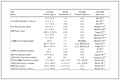
测试样品的代表性LA-ICPMS锆石U-Pb测年分析结果见表 1。根据这些数据所做的U-Pb谐和图以及采用206Pb/238U年龄进行加权平均值计算的年龄图均见图 6。本次研究共选择了21粒锆石,分析了24个点。从黑云母花岗岩中选取的锆石颗粒大多数晶形较好,这些分析点多位于岩浆环带明显,并且是避开裂纹和包裹体的部位,其中分析点10、14和20处于核部部位。如图 6所示21粒锆石的22个点的分析结果在谐和图上组成密集的一簇。
|
表 1 鹦鹉岭花岗岩体LA-ICPMS锆石U-Pb年龄测定结果 Table 1 LA-ICPMS zircon U-Pb date of the Yingwuling granitoid pluton |
 | 图 6 鹦鹉岭花岗岩体中黑云母花岗岩锆石U-Pb谐和图 Fig.6 Zircon U-Pb concordia diagram for the biotite granite from the Yingwuling granitoid pluton |
大量研究表明,不同成因的锆石有不同的U、Th含量与 Th/U 比值。一般情况下,岩浆锆石的Th、U含量较高,Th/U比值大于0.5,且U和Th之间具有明显的正相关关系;而变质成因锆石的Th、U含量低,且Th/U比值小于<0.1(Hoskin and Black,2000)。典型的岩浆成因锆石Th/U 比值一般为0.1~1.0 (Belousova et al., 2002)。如果Th/U比值变化较大,则表明锆石形成于化学成分相对不均匀的岩浆结晶条件下。本次分析所有测点的 U 含量分布在 43.96×10⁻⁶~3702×10-6的范围内,Th 含量变化在43.61×10⁻⁶~4683×10-6之间,Pb 总含量位于0.36×10⁻⁶~741×10-6之间。Th/U比值介于0.22~2.10之间,均大于0.1,极少数有可能受到后期热液的影响使得值相对偏大。另外Th和U之间具有明显的正相关性(图 7),显示了岩浆锆石Th /U比值的典型特征(Hoskin and Black,2000)。所有测点的206Pb/238U年龄范围分布在66~83Ma之间。核部的三个分析点10、14和20的206Pb/238U 与其他处于岩浆环带的年龄几乎一致, 22个测点的206Pb/238U 表面年龄相对集中, 介于78~83Ma 之间。
 | 图 7 鹦鹉岭岩体锆石Th-U协变图 Fig.7 The covariant diagram of Th-U for zircons from Yingwuling intrusion |
对锆石U-Pb年龄进行测试后,在锆石年龄分析点的部位又进行了Hf同位素分析,分析结果见表 2。斑状黑云母花岗岩样品ZK2805-Y-1中所测的176Hf/177Hf比值为0.282561~0.282760,由对应的测点年龄计算得到的Hf同位素初始比值(176Hf/177Hf)i为0.282562~0.282771,Hf同位素组成变化范围宽泛,εHf(t)变化于-5.72~1.40,只有13点和22点为正值。两阶段模式年龄tDM2=1.06~1.51Ga,由两阶段Hf模式年龄(tDM2)和εHf(t)直方图(图 8a, b)可以看出,εHf(t)主体在-2~-2.5范围内,tDM2主体1.3~1.4Ga范围内。
|
|
表 2 鹦鹉岭花岗岩体的锆石Hf同位素分析结果 Table 2 Hf isotopic data of zircon of the Yingwuling granitoid pluton |
 | 图 8 鹦鹉岭花岗岩体锆石εHf(t)和二阶段模式年龄(tDM2)频率分布图 Fig.8 Zircon secondary model age and Hf isotopic compositions of the granites from the Yingwuling granitoid pluton |
本文首次对鹦鹉岭钨钼多金属矿床含矿岩体开展了锆石 LA-ICP-MS U-Pb 同位素定年和Hf同位素特征研究,锆石从形态、结晶振荡环带结构及元素含量均显示出岩浆成因的特点,因此锆石U-Pb年龄可代表该岩体的岩浆结晶年龄。该锆石206Pb/238U同位素加权平均年龄为81.3±0.6Ma,故黑云母花岗岩岩浆的侵位年代可精确地限定于中生代燕山晚期,这与已获得的辉钼矿Re-Os年龄83.0±1.7Ma在误差允许的范围内保持一致,表明鹦鹉岭钨多金属矿床的成岩成矿作用同时形成于晚白垩世时期。
锆石是各种成因岩石中常见的副矿物,封闭温度高且抗 风化能力强,不但是U-Pb同位素定年的重要对象,同时也是Hf同位素分析的理想矿物。锆石Hf含量较高(通常在0.5%~2%之间),Lu/Hf比值很低(通常小于0.002),由176Lu衰变产生的176Hf极少,所以测定的176Hf/177Hf比值基本代表了其形成时体系的Hf同位素组成(Amelin et al., 1999)。样品ZK2805-Y-1除少数分析点外(点4、13、22、23),大部分分析点的176Lu/177Hf比值均低于0.002,表明绝大多数锆石形成后的放射性成因Hf积累十分有限。因此,所测定的176Lu/177Hf比值能较好地反映其形成过程中Hf同位素的组成特征,从而可以用Hf同位素示踪来有效示踪一些重要的地球化学储库的源区(杨进辉等,2007;高一鸣等,2011)。
研究发现,不同地球化学储源库的176Hf/177Hf同位素组成明显不同:球粒陨石和亏损地幔的176Hf/177Hf比值较大(≥0.282772),εHf(t)值为零或者正值;地壳及富集地幔有较小的176Hf/177Hf比值,且εHf(t)为负值(Vervoort et al., 1996;吴福元等,2007)。鹦鹉岭斑状黑云母花岗岩体的176Hf/177Hf比值都小于0.282772,平均值为0.282670,其176Hf/177Hf平均值均小于球粒陨石值(≥0.282772),表明该岩体成岩物质来自于地壳或富集地幔。εHf(t)大多数为负值,少量大于0,变化于-5.72~1.40,平均值为-2.09,表明其成岩物质主要来自于壳源。在εHf(t)-t图解(图 9)上,εHf(t)均落在球粒陨石演化线之下,具弱亏损特点,说明地壳部分熔融所形成的岩浆可能有少量地幔物质的加入。岩体的fLu/Hf值介于-0.98~-0.78之间,平均值为-0.94,小于硅铝质地壳的fLu/Hf值-0.72(Vervoort et al.,1996)和镁铁质地壳的fLu/Hf值-0.34(Amelin et al.,2000),因此两阶段模式年龄更能反映鹦鹉岭含矿岩体-黑云母花岗岩的源区物质从亏损地幔被抽取的时间(或其源区物质在地壳的平均存留年龄)(赵海杰等,2010)。本文研究样品的两阶段Hf模式年龄为1056~1506Ma,表明其主要来源于中元古代古老地壳岩石的部分熔融。综上所述,鹦鹉岭黑云母花岗岩来自于中元古代古老地壳的部分熔融,并可能有少量地幔物质的加入,但是其εHf(t)为绝对值不大的负值,既可以是花岗岩形成时的壳幔两种岩浆混合成因,也又可能是壳幔物质混合源区(即硅铝质地壳中包含有或侵入有幔源基性岩石)部分熔融成因。野外地质观察并没有发现暗色岩浆包体等现象,故需要详细结合地球化学特征等方面的分析进行进一步的深入判断。
 | 图 9 鹦鹉岭花岗岩体的锆石εHf(t)对U-Pb年龄图解 Fig.9 εHf(t) vs. U-Pb ages of ziron from Yingwuling granite stock |
燕山晚期属于华南中生代大规模成矿的三个阶段之一(毛景文,2004,2007,2008,2011 ;华仁民等,2005;李晓峰等,2008),分布面积广泛,呈不连续的矿集区形式出现,成矿作用明显受断陷盆地或断陷隆起和变质核杂岩的控制,显示出区内岩石圈处于伸展的大环境下(毛景文,2007, 2008,2009;胡瑞忠等,2010)。晚中生代的花岗岩不仅与基性岩墙群、辉长岩密切共生,同时还与双峰式火山岩、A型花岗岩、碱性正长岩密切共生,同样表明区内已处于伸展应力的体制下(徐夕生,2008)。Xie et al.(2006a,b)认为武夷山以东与以西的白垩纪基性岩墙性质有所不同,分别处于活动大陆边缘和板内环境。李献华等(2001)发现粤西岗尾-轮水以及马山二长闪长岩均为钾玄质-高钾钙碱性系列,而钾玄质系列岩石主要起源于大洋岛弧、大陆弧和后碰撞环境(Morrison, 1980;Foley and Peccerillo, 1992;Müller and Groves, 1995)。不同的环境所富集的矿化也有所不同,铜金银矿化主要分布在大陆边缘及其内侧,钨锡多金属矿相对在大陆内部(毛景文等,2009)。160~150Ma作为南岭地区一次比较集中的大规模钨锡成矿阶段已被许多地质学家所认可,但是135~80Ma期间区内是否也有一次钨锡大规模成矿事件呢?
王德滋等(1994)获得与会昌盆地中的锡矿成矿有关的黄玉花岗岩和黄玉花岗斑岩的Rb-Sr等时线年龄为114.1±0.6Ma,湘南界牌岭锡矿与成矿有关的黑云母40Ar/39Ar年龄为91.1±1.1Ma(毛景文等,2007),铜坑嶂斑岩钼矿的辉钼矿Re-Os同位素年龄为134.3±1.6Ma~133.4±1.8Ma(许建祥等,2007),香炉山钨矿的花岗岩岩体的年龄为126.2±2.6Ma(张家菁等,2008),银岩斑岩锡矿含矿岩体花岗斑岩的Rb-Sr等时线年龄为86.9±6Ma(胡祥昭,1989),都龙锡石TIMSU-Pb等时线年龄为82.0±9.6Ma,隐伏花岗岩和花岗斑岩的锆石SHRIMP法U-Pb年龄分别为92.9±1.9Ma和86.9±1.4Ma(刘玉平等,2007),个旧锡矿田的辉钼矿Re-Os等时线年龄为83.4±2.1Ma(杨宗喜等,2008),与成矿有关的等粒花岗岩的锆石U-Pb年龄为85.0±0.9Ma(程彦博等,2008),大明山钨矿的辉钼矿Re-Os等时线年龄为95.4±1.0Ma(李水如等,2008),王社铜钨矿的辉钼矿Re-Os等时线年龄为93.8±4.6Ma(蔺志永等,2008)。以上所获得的精确年龄只是作为华南地区中生代大爆发成矿最为集中的燕山晚期所获得的年龄的少许部分,足以看出区内在燕山晚期形成的钨锡多金属矿床的数量还是非常可观的。
中国东部中生代大规模成矿的启动机制是什么到目前为止仍存在较大争议。如此大规模的成岩成矿作用到底是如何被华南西缘古特提斯的闭合、华南南缘印支地块的碰撞作用以及华南东缘古太平洋板块的俯冲消减三个作用所制约?对于燕山晚期成岩成矿作用而言,研究者在如下方面已取得一些共识:日本列岛发育的侏罗纪的增生杂岩(Isozaki, 1997;Taira, 2001)暗示中国东部可能在晚中生代存在大洋板块的俯冲,全球地震层析同样也揭示出中国东部大陆下的地幔过渡带内存在一水平分布的高速体,即俯冲的太平洋板块(Fukao et al., 1992;Zhao, 2004)。Zhou and Li(2000)、Zhou et al.,(2006)和Sun et al.(2007)认为板块俯冲对中国东部的构造运动和岩浆活动起着决定性的作用。徐夕生(2008)等通过统计岩浆活动的年龄,发现燕山期岩浆活动具有从内陆向沿海方向越来越年轻的特征,展布方向以北东向为主,正好与太平洋板块向北西方向发生俯冲的事件相耦合,从而表明华南晚中生代岩浆活动确实与太平洋板块的俯冲存在一定的成因联系。尽管已经取得了很大的进步与认识,但依然存在着较多的争议和问题:孙卫东等(2008)认为125Ma太平洋板块运动方向发生转变,随后与华北克拉通及整个欧亚大陆形成安第斯式的俯冲挤压,岩石圈停止减薄和部分熔融,出现岩浆宁静期。随着俯冲的深入,到110Ma前后俯冲板块后撤,形成弧后拉张,岩浆活动又重新开始;毛景文等(2009)认为135Ma太平洋板块的俯冲方向发生改变,造成中国东部岩石圈减薄,软流圈卸载上涌,发生减压部分熔融,故太平洋板块俯冲方向何时发生改变还有待进一步深入研究;对于不同类型的花岗岩岩浆活动,成矿作用的类型不同,那么具体在花岗岩浆活动与成矿作用的整个演化过程中,导致成矿元素超常富集,进而大爆发成矿的各种耦合机制又是什么?白垩纪矿化虽然持续了54Myr,但峰期在110~80Ma,主要矿床组合为浅成低温热液型铜金银矿床和花岗岩有关的锡多金属矿床(毛景文等,2009),中间的间歇期又是受何种因素所影响?如果燕山晚期同样存在一期大规模的钨锡多金属成矿,那么与燕山早期的成矿机制等又有何异同呢?鹦鹉岭矿床正好处于燕山晚期这一成矿高峰期,位于桂东-粤西地区,构成一条北西向展布的钨、锡多金属成矿带。毋庸置疑是大陆岩石圈大面积伸展背景下的产物,但是该矿床的详细的成矿过程和成矿机制还有待进一步深入研究,以期为对华南大花岗岩省形成演化和成矿作用认识提供一定的资料。
(1)鹦鹉岭钨多金属矿床黑云母花岗岩锆石206Pb/238U同位素加权平均年龄为81.3±0.6Ma,这与已获得的辉钼矿Re-Os年龄83.0±1.7Ma在误差允许的范围内保持一致,表明的成岩成矿作用同时形成于晚白垩世时期。
(2)该矿床黑云母花岗岩的锆石εHf(t)值大多数为负值,少部分大于0,变化于-5.72~1.40,平均值为-2.09。εHf(t)-t图解上,εHf(t)均落在球粒陨石演化线之下,两阶段模式年龄tDM2=1.06~1.51Ga,指示成岩物质主要来源于中元古代古老地壳岩石的部分熔融,可能有少量地幔物质的加入。
(3)鹦鹉岭矿床正好处于粤西燕山晚期这一成矿高峰期,构成一条北西向展布的钨、锡多金属成矿带,是大陆岩石圈大面积伸展背景下的产物。
致谢
本文完成过程中得到了毛景文研究员和袁顺达副研究员、中国地质大学(北京)张东阳、余长发、杨阳、水新芳、刘明的帮助;野外地质工作期间,得到了广东省地质调查院、广东省有色金属地质局和广东省地质建设工程集团公司的大力支持和帮助;审稿专家对论文提出了许多建设性的意见;在此一并表示感谢!
| [1] | Amelin Y, Lee DC, Halliday AN and Pidgeon RT. 1999. Nature of the Earth's earliest crust from hafnium isotopes in single detrital zircons. Nature, 399(6733): 252-255 |
| [2] | Amelin Y, Lee DC and Halliday AN. 2000. Early-Middle Archaean crustal evolution deduced from Lu-Hf and U-Pb isotopic studies of single zircon grains. Geochimica et Cosmochimica Acta, 64(24): 4205-4225 |
| [3] | Belousova E, Griffin W, O'Reilly SY and Fisher N. 2002. Igneous zircon: Trace element composition as an indicator of source rock type. Contrib. Mineral. Petrol., 143(5): 602-622 |
| [4] | Blichert-Toft J and Albarède F. 1997. The Lu-Hf isotope geochemistry of chondrites and the evolution of the mantle-crust system. Earth Planet. Sci. Lett., 148(1-2): 243-258 |
| [5] | Charvet J, Lapierre H and Yu YW. 1994. Geodynamic significance of the Mesozoic volcanism of southeastern China. Journal of Southeast Asian Earth Sciences, 9 (4): 387-396 |
| [6] | Cheng YB, Mao JW, Xie GQ, Chen MH, Zhao CS, Yang ZX, Zhao HJ and Li XQ. 2008. Petrogenesis of the Laochang-Kafang granite in the Gejiu area, Yunnan Province: Constraints from geochemistry and zircon U-Pb dating. Acta Geologica Sinica, 82 (11): 1480-1495 (in Chinese with English abstract) |
| [7] | Du LL, Zhang YS, Yang CH, Wan YS and Wang XS. 2005. SHRIMP U-Pb zircon chronology of fine-grained amphibolite in the Mengjiatun area, western Shandong. Acta Geoscientica Sinica, 26 (5): 429-434 (in Chinese with English abstract) |
| [8] | Foley S and Peccerillo A. 1992. Potassic and ultrapotassic magmas and their origin. Lithos, 28(3-6): 181-185 |
| [9] | Fukao Y, Obayashi M, Inoue H and Nenbai M. 1992. Subducting slabs stagnant in the Mantle Transition Zone. Journal of Geophysical Research, 97 (B4): 4809-4822 |
| [10] | Gao YM, Chen YC, Wang CH and Hou KJ. 2011. Zircon Hf isotopic characteristics and constraints on petrogenesis of Mesozoic-Cenozoic magmatic rocks in Nyainqentanglha region, Tibet. Mineral Deposits, 30 (2): 279-291 (in Chinese with English abstract) |
| [11] | Geng HY, Xu XS, O'Reilly SY, Zhao M and Sun T. 2006. The Cretacous volcanic and intrusion in western Guangdong Province, and their geological implication. Science in China (Series D), 36(7): 601-617 (in Chinese) |
| [12] | Gilder SA, Keller GR, Luo M and Goodell PC. 1991. Eastern Asia and the Western Pacific timing and spatial distribution of rifting in China. Tectonophysics, 197(2-4): 225-243 |
| [13] | Gilder SA, Gill J, Coe RS, Zhao XX, Liu ZW, Wang GX, Yuan KR, Liu WL, Kuang GD and Wu HR. 1996. Isotopic and paleomagnetic constraints on the Mesozoic tectonic evolution of South China. Journal of Geophysical Research, 101(B7): 16137-16154 |
| [14] | Griffin WL, Pearson NJ, Belousova, E, Jackson SE, van Achterbergh E, O'Reilly SY and Shee SR. 2000. The Hf isotope composition of cratonic mantle: LAM-MC-ICPMS analysis of zircon megacrysts in kimberlites. Geochimica et Cosmochimica Acta, 64(1): 133-147 |
| [15] | Griffin WL, Wang X, Jackson SE, Pearson SE, O'Reilly SY, Xu XS and Zhou XM. 2002. Zircon chemistry and magma mixing, SE China: In-situ analysis of Hf isotopes, Tonglu and Pingtan igneous complexes. Lithos, 61(3-4): 237-269 |
| [16] | Guo CL, Xu YM, Lou FS and Zheng JH. 2013. A comparative study of the Middle Jurassic granodiorite related to Cu and the Late Jurassic granites related to Sn in the Qin-Hang metallogenic belt and a tentative discussion on their tectonic dynamic setting. Acta Petrologica et Mineralogica, 32(4):463-484 (in Chinese with English abstract) |
| [17] | He JR, Wang AG, Rui XJ, Zeng Y and Li CH. 2008. Middle Proterozoic submarine volcanic exhalative metallogenesis of Tieshajie, Yiyang, Jiangxi Province. Resources Survey & Environment, 29(4): 261-269 (in Chinese with English abstract) |
| [18] | Hoskin PWO and Black LP. 2000. Metamorphic zircon formation by solid-state recrystallization of protolith igneous zircon. Journal of Metamorphic Geology, 18(4): 423-439 |
| [19] | Hou KJ, Li YH, Zou TR, Shi YR and Xie GQ. 2007. Laser ablation-MC-ICP-MS technique for Hf isotope microanalysis of zircon and its geological applications. Acta Petrologica Sinica, 23(10): 2595-2604 (in Chinese with English abstract) |
| [20] | Hou KJ, Li YH and Tian YR. 2009. In situ U-Pb zircon dating using laser ablation-multi ion counting -ICP-MS. Mineral Deposits, 28(4): 481-492 (in Chinese with English abstract) |
| [21] | HsÜ KJ, Sun S, Li JL, Chen HH, Pen HP and Sengor AMC. 1988. Mesozoic overthrust tectonics in south China. Geology, 16(5): 418-421 |
| [22] | HsÜ KJ, Li JL, Chen HH, Wang QC, Sun S and Sengör AMC. 1990. Tectonics of South China: Key to understanding west Pacific geology. Tectonophysics, 183(1-4): 9-39 |
| [23] | Hu RZ, Mao JW, Fan WM, Hua RM, Bi XW, Zhong H, Song XY and Tao Y. 2010. Some scientific questions on the intra-continental metallogeny in the South China continent. Earth Science Frontiers, 17(2): 13-26 (in Chinese with English abstract) |
| [24] | Hu XZ. 1989. The origin and petrology of the Yinyan tin-bearing granite porphyry. Geochimica, 18(3): 251-263 (in Chinese with English abstract) |
| [25] | Hua RM, Chen PR, Zhang WL and Lu JJ. 2005. Three major metallogenic events in Mesozoic in South China. Mineral Deposits, 24(2): 99-107 (in Chinese with English abstract) |
| [26] | Huang YN. 1992. Characteristics of Xiqiu Cu-massive sulfide deposit, Zhejiang and the metallogenic model. Contributions to Geology and Mineral Resources Research, 7 (3): 22-34 (in Chinese with English abstract) |
| [27] | Isozaki Y. 1997. Jurassic accretion tectonics of Japan. The Island Arc, 6(1): 25-51 |
| [28] | Jahn BM. 1974. Mesozoic thermal events in Southeast China. Nature, 248(5448): 480-483 |
| [29] | Jahn BM, Chen PY and Yen TP. 1976. Rb-Sr ages of granitic rocks in southeastern China and their tectonic significance. Geological Society of America Bulletin, 87(5): 763-776 |
| [30] | Jiang SY, Zhao KD, Jiang YH and Dai BZ. 2008. Characteristics and genesis of Mesozoic A-type granites and associated mineral deposits in the southern Hunan and northern Guangxi provinces along the Shi-Hang Belt, South China. Geological Journal of China Universities, 14(4): 283-294 (in Chinese with English abstract) |
| [31] | Lapierre H, Jahn BM, Charvet J and Yu YW. 1997. Mesozoic felsic arc magmatism and continental olivine tholeⅡtes in Zhejiang Province and their relationship with the tectonic activity in southeastern China. Tectonophysics, 274(4): 321-338 |
| [32] | Lei ZH, Chen FW, Chen ZH, Xu YM, Gong SQ, Li HQ, Mei YP, Qu WJ and Wang DH. 2010. Petrogenetic and metallogenic age determination of the Huangshaping lead-zinc polymetallic deposit and its geological significance. Acta Geoscientica Sinica, 31(4): 532-540 (in Chinese with English abstract) |
| [33] | Li HY, Mao JW, Sun YL, Zhou XQ, He HL and Du AD. 1996. Re-Os isotopic chronology of molybdenites in the Shizhuyuan polymetallic tungsten deposit, southern Hunan. Geological Review, 42(3): 261-267 (in Chinese with English abstract) |
| [34] | Li SR, Wang DH, Liang T, Qu WJ and Ying LJ. 2008. Metallogenic epochs of the Damingshan tungsten deposit in Guangxi and its prospecting potential. Acta Geologica Sinica, 82(7): 873-879 (in Chinese with English abstract) |
| [35] | Li XH, Zhou HW, Liu Y, Lee CY, Chen CH, Yu JS and Gui XT. 2001. Mesozoic shoshonitic intrusives in the Yangchun Basin, western Guangdong, and their tectonic significance: Ⅱ. Trace elements and Sr-Nd isotopes. Geochimica, 30(1): 57-65 (in Chinese with English abstract) |
| [36] | Li XF, Chen W, Mao JW, Wang CZ, Xie GQ and Feng ZH. 2006. 40Ar/39Ar dating of sericite from altered dacite porphyry and quartz porphyry in Yinshan polymetallic deposit of Jiangxi Province and its geological significance. Mineral Deposits, 25(1): 17-26 (in Chinese with English abstract) |
| [37] | Li XF, Yasushi W, Hua RM and Mao JW. 2008. Mesozoic Cu-Mo-W-Sn mineralization and Ridge/Triple subduction in South China. Acta Geologica Sinica, 82(5): 625-640 (in Chinese with English abstract) |
| [38] | Li ZX and Li XH. 2007. Formation of the 1300-km-wide int racontinental orogen and postorogenic magmatic province in Mesozoic South China: A flat-slab subduction model. Geology, 35(2): 179-182 |
| [39] | Lin ZY, Wang DH and Li SR. 2008. Re-Os isotopic age of mmolybdenite from the Wangshe copper-tungsten deposit in Guangxi Province and their implcations. Acta Geologica Sinica, 82(11): 1569-1575 (in Chinese with English abstract) |
| [40] | Liu M, Zhao ZD, Guan Q, Dong GC, Mo XX, Liu YS and Hu ZC. 2010. Tracing magma mixing genesis of the middle Early-Jurassic host granites and enclaves in Nyanrong microcontinent, Tibet from zircon LA-ICP-MS dating and Hf isotopes. Acta Petrologica Sinica, 27(7): 1931-1937 (in Chinese with English abstract) |
| [41] | Liu XF, Yuan SD and Wu SH. 2012. Re-Os dating of the molybdenite from the Jinchuantang Tin-Bismuth deposit in Hunan Province and its geological significance. Acta Petrologica Sinica, 28 (1): 39-51 (in Chinese with English abstract) |
| [42] | Liu YP, Li ZX, Li HM, Guo LG, Xu W, Ye L, Li CY and Pi DH. 2007. U-Pb geochronology of cassiterite and zircon from the Dulong Sn-Zn deposit: Evidence for Cretaceous large-scale granitic magmatism and mineralization events in southeastern Yunnan Province, China. Acta Petrologica Sinica, 23(5): 967-976 (in Chinese with English abstract) |
| [43] | Mao JW, Li HY, Wang DH and Peng C. 1998. Ore-forming of Mesozoic polymetallic deposits in South China and its relationship with mantle plum. Bulletin of Mineralogy Petrology and Geochemistry, 19(2): 130-132 (in Chinese with English abstract) |
| [44] | Mao JW, Zhang ZH, Yu JJ, Wang YT and Niu BG. 2003. Geodynamic settings of Mesozoic large-scale mineralization in North China and adjacent areas: Implication from the highly precise and accurate ages of metal deposits. Science in China (Series D), 46(8): 838-851 |
| [45] | Mao JW, Xie GQ, Li XF, Zhang CQ and Mei YX. 2004. Mesozoic large scale mineralization and multiple lithospheric extension in South China. Earth Science Frontiers, 11(1): 45-55(in Chinese with English abstract) |
| [46] | Mao JW, Xie GQ, Guo CL and Chen YC. 2007. Large-scale tungsten-tin mineralization in the Nanling region, South China: Metallogenic ages and corresponding geodynamic processes. Acta Petrologica Sinica, 23(10): 2329-2338 (in Chinese with English abstract) |
| [47] | Mao JW, Xie GQ, Guo CL, Yuan SD, Cheng YB and Chen YC. 2008. Spatial-temporal distribution of Mesozoic ore deposits in South China and their metallogenic settings. Geological Journal of China Universities, 14 (4): 510-526 (in Chinese with English abstract) |
| [48] | Mao JW, Xie GQ, Cheng YB and Cheng YC. 2009. Mineral deposit models of Mesozoic ore deposits in South China. Geological Review, 55(3): 347-354 (in Chinese with English abstract) |
| [49] | Mao JW, Chen MH, Yuan SD and Guo CL. 2011. Geochlogical characteristics of the Qinhang (or Shihang) metallogenic belt in South China and spatial-temporal distribution regularity of mineral deposits. Acta Geologica Sinica, 85(5): 636-658 (in Chinese with English abstract) |
| [50] | Morel MLA, Nebel O, Nebel-Jacobsen YJ, Miller JS and Vroon PZ. 2008. Hafnium isotope characterization of the GJ-1 zircon reference material by solution and laser-ablation MC-ICPMS. Chemical Geology, 255(1-2): 231-235 |
| [51] | Morrison GW. 1980. Characteristics and tectonic setting of the shoshonite rock association. Lithos, 13(1): 97-108 |
| [52] | MÜller D and Groves DI. 1995. Potassic Igneous Rocks and Associated Gold-Copper Mineralization. Berlin: Springer-Verlag, 1-210 |
| [53] | Peng SM, Fu LF and Zhou GQ. 1995. Tectonic Evolution of Yunkai Massif and Its Shearing Anatectic Origin of Gneissic Granitic Rocks. Wuhan: China University of Geosciences Press, 80-159 (in Chinese with English abstract) |
| [54] | Söderlund U, Patehett PJ, Vervoort JD and Isachsen CE. 2004. The 176Lu decay constant determined by Lu-Hf and U-Pb isotope systematic of Precambrian mafic intrusions. Earth and Planetary Science Letters, 219(3-4): 311-324 |
| [55] | Song B, Zhang YH, Wan YS and Jian P. 2002. Mount Making and Procedure of the SHRIMP Dating. Geological Review, 48(Suppl.1): 26-30 (in Chinese with English abstract) |
| [56] | Su HM, Mao JW, Santosh M and Xie GQ. 2013. Petrogenesis and tectonic significance of Late Jurassic-Early Cretaceous volcanic-intrusive complex in the Tianhuashan basin, South China. Ore Geology Reviews, 56: 566-583 |
| [57] | Sun WD, Ding X, Hu YH and Li XH. 2007. The golden transformation of the Cretaceous plate subduction in the West Pacific. Earth and Planetary Science Letters, 262(3-4): 533-542 |
| [58] | Sun WD, Ling MX, Wang FY, Ding X, Hu YH, Zhou JB and Yang XY. 2008. Pacific Plate subduction and Mesozoic geological event in eastern China. Bulletin of Mineralogy, Petrology and Geochemistry, 27 (3): 218-225 (in Chinese) |
| [59] | Sun XM, Chen W, Wang M, Xue T, Sun K and Chen BH. 2003. Isochron ages of microprobe about fine disseminated type of gold deposit: Explame as Changkeng large-scale gold deposit. Chinese Science Bulletin, 48 (12): 1355-1358 (in Chinese) |
| [60] | Taira A. 2001. Tectonic evolution of the Japanese island arc system. Annual Review of Earth and Planet Sciences, 29(1): 109-134 |
| [61] | Vavra G, Gebauer D, Schmid R and Compston W. 1996. Multiple zircon growth andrecrystallization during polyphase Late Carboniferous to Triassicmetamorphism in granulites of the Ivrea Zone (Southern Alps): Anion microprobe (SHRIMP) study. Contrib. Mineral. Petrol., 122(4): 337-358 |
| [62] | Vavra G, Schmid R and Gebauer D. 1999. Internal morphology, habit and U-Th-Pb microanalysis of amphibolite-to-granulite facieszircon: Geochronology of the Ivren Zone(Southern Alps). Contrib. Mineral. Petrol., 134(4): 380-404 |
| [63] | Vervoort JD, Pachelt PJ, Gehrels GE and Nutman AP. 1996. Constraints on early earth differentiation from hafnium and neodymium isotopes. Nature, 379(6566): 624-627 |
| [64] | Wang DH, Li HQ, Qin Y, Mei YP, Chen ZH, Qu WJ, Wang YB, Cai H, Gong SQ and He XP. 2009. Rock-forming and ore-forming ages of the Yaogangxian tungsten deposit of Hunan Province. Rock and Mineral Analysis, 28(3): 201-208 (in Chinese with English abstract) |
| [65] | Wang DZ, Shen WZ, Liu CS and Xiong XL. 1994. Geochemical features and origin of volcanic-intrusive complex in Yanbei, Jiangxi. Science in China (Series B), 24 (5): 531-538 (in Chinese) |
| [66] | Wang Y and Deng JF. 2003. Geodynamic implication of petrochemical features of Yanshanian strongly peraluminous granitoids in Wuchuan-Sihui fracture belt of Guangdong. Geotectonica et Metallogenia, 27(1): 56-63 (in Chinese) |
| [67] | Wang YL, Pei RF, Li JW, Wang HB and Liu XF. 2009. Geochemical characteristics of granites from the Jiangjunzhai tungsten deposit of Southeast Hunan Province and its Re-Os isotopic dating. Rock and Mineral Analysis, 28(3): 274-278 (in Chinese with English abstract) |
| [68] | Wu FY, Li XH, Zheng YF and Gao Shan. 2007. Lu-Hf isotopic systematics and their applications in petrology. Acta Petrologica Sinica, 23(2): 185-220 (in Chinese with English abstract) |
| [69] | Wu MF, Wei ZG and Zhang SN. 2004. Basic characteristics of the majority of volcanic in Maoming region of Guangdong Province. West-China Exploration Engineering, 16(7): 93-95 (in Chinese) |
| [70] | Wu YB, Chen DG, Xia QK, Tu XL, Cheng H and Yang XZ. 2003. In situ trace element analyses and Pb-Pb dating of zircon in granulite from Huangtuling, Dabieshan by LAM-ICP-MS. Science in China (Series D), 46(11): 1161-1170 |
| [71] | Xie CF, Zhu JC, Ding SJ, Zhang YM, Fu TA and Li ZH. 2006a. Identification of Hercynian shoshonitic intrusive rocks in central Hainan Island and its geotectonic implications. Chinese Science Bulletin, 51(20): 2507-2519 (in Chinese with English abstract) |
| [72] | Xie GQ, Hu RZ, Zhao HJ and Jiang GH. 2001. Mantle plume and the relationship between it and Mesozoic large-scale metallogenesis in Southeastern China: A preliminary discussion. Geotectonica et Metallogenia, 25(2): 179-186 (in Chinese with English abstract) |
| [73] | Xie GQ, Hu RZ, Mao JW, Pirajno F, Li RL, Cao JJ, Jiang GH and Zhao JH. 2006b. K-Ar dating, geochemical, and Sr-Nd-Pb isotopic systematics of Late Mesozoic mafic daykes, southern Jiangxi province, Southeastern China: Petrogenesis and tectonic implications. International Geology Review, 48(11): 1023-1051 |
| [74] | Xu DM, Lin ZY, Long WG, Zhang K, Wang L, Zhou D, Huang H. 2012. Research history and current situation of Qinzhou-Hangzhou Metallogenic Belt, South China. Geology and Mineral Resources of South China, 28(4):277-289(in Chinese with English abstract) |
| [75] | Xu JW, Zhu G, Tong WX, Cui KR and Liu Q. 1987. Formation and evolution of the Tancheng-Lujiang wrench fault system: A major shear system to the northwest of the Pacific Ocean. Tectonophysics, 134(4): 273-310 |
| [76] | Xu JX, Zeng ZL, Li XQ, Liu JS, Chen ZH, Liu SB, Guo CL and Wang CH. 2007. Geological characteristics and mineralization age of the Tongkengzhang molybdenum deposit in Xunwu County, South Jiangxi Province, China. Acta Geologica Sinica, 81(7): 924-928 (in Chinese with English abstract) |
| [77] | Xu XS. 2008. Several problems worthy to be noticed in the research of granites and volcanic rocks in SE China. Geological Journal of China Universities, 14(3): 283-294 (in Chinese with English abstract) |
| [78] | Yang JH, Wu FY, Xie LW and Liu XM. 2007. Petrogenesis and tectonic implications of Kuangdonggou syenites in the Liaodong Peninsula, east North China Craton: Constraints from in-situ zircon U-Pb ages and Hf isotopes. Acta Petrologica Sinica, 23 (2): 263-276 (in Chinese with English abstract) |
| [79] | Yang MG and Mei YW. 1997. Characteristics of geology and metatllization in the Qinzhou-Hangzhou paleoplate juncturs. Geology and Mineral Resources of South China, (3): 52-58 (in Chinese with English abstract) |
| [80] | Yang MG, Huang SB, Lou FS, Tang WX and Mao SB. 2009. Lithospheric structure and large-scale metallogenic process in Southeast China continental area. Geology in China, 36(3): 528-543 (in Chinese with English abstract) |
| [81] | Yang ZX, Mao JW, Chen MH, Tong X, Wu JD, Cheng YB and Zhao HJ. 2008. Re-Os dating of molybdenite from the Kafang skarn copper(tin)deposit in the Gejiu tin polymetallic ore district and its geological significance. Acta Petrologica Sinica, 24 (8): 1937-1944 (in Chinese with English abstract) |
| [82] | Yao JM, Hua RM, Qu WJ, Qi HW, Lin JF and Du AD. 2007. Re-Os isotopic dating of molybdenite from the Huangshaping Pb-Zn-W-Mo deposit and its significance. Science in China (Series D), 37 (4): 471-477 (in Chinese) |
| [83] | Yu CF, Mao JW, Zhao HJ, Chen MH, Luo DL and Guo M. 2012. Geological characteristics and ages of granites and related mineralization in the Dajinshan tungsten-tin polymetallic deposit, western Guangdong Province. Acta Petrologica Sinica, 28 (12): 3967-3979 (in Chinese with English abstract) |
| [84] | Yuan SD, Peng JT, Shen NP, Hu RZ and Dai TM. 2007. 40Ar-39Ar isotopic dating of the Xianghualing Sn-polymetallic orefield in southern Hunan, China and its geological implications. Acta Geologica Sinica, 81(2): 278-286 |
| [85] | Yuan SD, Peng JT, Hu RZ, Li HM, Shen NP and Zhang DL. 2008. A precise U-Pb age on cassiterite from the Xianghualing tin-polymetallic deposit (Hunan, South China). Mineralium Deposita, 43(4): 375-382 |
| [86] | Yuan SD, Peng JT, Hao S, Li HM, Geng JZ and Zhang DL. 2011. In situ LA-MC-ICP-MS and ID-TIMS U-Pb geochronology of cassiterite in the giant Furong tin deposit, Hunan Province, South China: New constraints on the timing of tin-polymetallic mineralization. Ore Geology Reviews, 43(1): 235-242 |
| [87] | Yuan SD, Zhang DL, Shuang Y, Du AD and Qu WJ. 2012a. Re-Os dating of molybdenite from the Xintianling giant tungsten-molybdenum deposit in southern Hunan Province, China and its geological implications. Acta Petrologica Sinica, 28 (1): 27-38 (in Chinese with English abstract) |
| [88] | Yuan SD, Liu XF, Wang XD, Wu SH, Yuan YB, Li XK and Wang TZ. 2012b. Geological characteristics and 40Ar-39Ar geochronology of the Hongqiling tin deposit in southern Hunan Province. Acta Petrologica Sinica, 28 (12): 3787-3797 (in Chinese with English abstract) |
| [89] | Zhang JJ, Mei YP, Wang DH, Li HQ. 2008. Isochronology study on the Xianglushan scheelite deposit in North Jiangxi Province and its geological significance. Acta Geologica Sinica, 82(7): 927-931 (in Chinese with English abstract) |
| [90] | Zhang JJ, Wu MS, Chen ZH, Liu SB, Li LX, Qiu LM, Wu B, Huang AJ and Zhu PJ. 2009. Geochronologic study on the Jinzhuping molybdenum-polymetallic deposit from Shangrao of Jiangxi Province. Rock and Mineral Analysis, 28(3): 228-232 (in Chinese with English abstract) |
| [91] | Zhao DP. 2004. Global tomographic images of mantle plumes and subducting slabs: Insight into deep earth dynamics. Physics of the Earth and Planetary Interiors, 146(1-2): 3-34 |
| [92] | Zhao HJ, Mao JW, Ye HS, Hou KJ and Liang HS. 2010. Chronology and petrogenesis of Shijiawan granite porphyry in Shaanxi Province: Constrains from zircon U-Pb geochronology and Hf isotopic compositions. Mineral Deposits, 29(1): 143-157 (in Chinese with English abstract) |
| [93] | Zhao HJ, Zheng W, Yu CF, Hu YG and Tian Y. 2012. Re-Os dating of molybdenite from the Shilu Cu(Mo) deposit in western Guangdong Province and its geological implications. Geology in China, 39 (6): 1604-1613 (in Chinese with English abstract) |
| [94] | Zheng W, Chen MH, Xu LG, Zhao HJ, Ling SB, Wu Y, Hu YG, Tian Y and Wu XD. 2013a. Rb-Sr isochron age of Tiantang Cu-Pb-Zn polymetallic deposit in Guangdong Province and its geological significance. Mineral Deposits, 32(2): 259-272 (in Chinese with English abstract) |
| [95] | Zheng W, Zhao HJ, Chen MH, Xu LG, Liu JX, Luo DL and Hu YG. 2013b. Re-Os isotopic dating of molybdenites from the Yingwuling polymetallic deposit in Guangdong Province and its geological significance. Journal of Mineralogy and Petrology, 33(3): 38-46 (in Chinese with English abstract) |
| [96] | Zhong JQ. 2011. The geological characteristics of Yingwuling polymetallic ore deposit in Yangchun of Guangdong Province. Science & Technology Association Forum, (2): 98-99 (in Chinese) |
| [97] | Zhong LF, Xia B, Liu LW, Li J, Lin XG, Xu LF and Lin LZ. 2010. Metallogenic geochronology of Yuanzhuding Cu-Mo deposit in western Guangdong-eastern Guangxi metallogenic belt and its geological significance. Mineral Deposits, 29(3): 395-404 (in Chinese with English abstract) |
| [98] | Zhou XM and Li WX. 2000. Origin of Late Mesozoic igneous rocks in southeastern China: Implications for lithosphere subduction and underplating of mafic magmas. Tectonophysics, 326(3-4): 269-287 |
| [99] | Zhou XM, Sun T, Shen WZ, Liang SS and Niu YL. 2006. Petrogenesis of Mesozoic granitoids and volcanic rocks in South China: A response to tectonic evolution. Episodes, 29(1): 26-33 |
| [100] | Zhou YZ, Zeng CY, Li HZ, An YF, liang J, LÜ WC, Yang ZJ, He JG and Shen WJ. 2012. Geological evolution and ore-prospecting targets in southern segment of Qinzhou Bay-Hangzhou Bay juncture orogenic belt, southern China. Geological Bulletin of China, 31(2-3): 486-491 (in Chinese with English abstract) |
| [101] | 程彦博, 毛景文, 谢桂青, 陈懋弘, 赵财胜, 杨宗喜, 赵海杰, 李向前. 2008. 云南个旧老厂-卡房花岗岩体成因:锆石U-Pb年代学和岩石地球化学约束. 地质学报, 82(11): 1480-1495 |
| [102] | 杜利林, 庄育勋, 杨崇辉, 万渝生, 王新社.2005. 鲁西孟家屯一种细粒斜长角闪岩的锆石 SHRIMP年代学.地球学报, 26(5): 429-434 |
| [103] | 高一鸣, 陈毓川, 王成辉, 侯可军. 2011. 亚贵拉-沙让-洞中拉矿集区中新生代岩浆岩Hf同位素特征与岩浆源区示踪. 矿床地质, 30(2): 279-291 |
| [104] | 耿红燕, 徐夕生, O'Reilly SY, 赵明, 孙涛. 2006. 粤西白垩纪火山-侵入岩浆活动及其地质意义. 中国科学(D 辑), 36(7): 601-617 |
| [105] | 郭春丽, 许以明, 楼法生, 郑佳浩. 2013. 钦杭带侏罗纪与铜和锡矿有关的两类花岗岩对比及动力学背景探讨. 岩石矿物学杂志, 32(4): 463-484 |
| [106] | 贺菊瑞, 王爱国, 芮行健, 曾勇, 李春海. 2008. 江西弋阳铁砂街中元古代海底火山喷流成矿作用. 资源调查与环境, 29(4): 261-269 |
| [107] | 华仁民, 陈培荣, 张文兰, 陆建军. 2005. 论华南地区中生代3次大规模成矿作用. 矿床地质, 24(2): 99-107 |
| [108] | 侯可军, 李延河, 邹天人, 曲晓明, 石玉若, 谢桂青. 2007. LA-MS-ICPMS锆石Hf同位素的分析方法及其地质应用.岩石学报, 23(10): 2595-2604 |
| [109] | 侯可军, 李延河, 田有荣. 2009. LA-MC-ICP-MS锆石微区原位U-Pb定年技术. 矿床地质, 28(4): 481-492 |
| [110] | 胡瑞忠, 毛景文, 范蔚茗, 华仁民, 毕献武, 钟宏, 宋谢炎, 陶琰. 2010. 华南陆块陆内成矿作用的一些科学问题. 地学前缘, 17(2): 13-26 |
| [111] | 胡祥昭. 1989. 银岩含锡花岗斑岩的岩石学特征及成因探讨.地球化学, 18(3): 251-263 |
| [112] | 黄有年. 1992. 浙江西裘含铜块状硫化物矿床特征及成矿模式. 地质找矿论丛, 7(3): 22-34 |
| [113] | 蒋少涌, 赵葵东, 姜耀辉, 戴宝章. 2008. 十杭带湘南-桂北段中生代A型花岗岩带成岩成矿特征及成因讨论. 高校地质学报, 14(4): 496-509 |
| [114] | 雷泽恒, 陈富文, 陈郑辉, 许以明, 龚述清, 李华芹, 梅玉萍, 屈文俊, 王登红. 2010. 黄沙坪铅锌多金属矿成岩成矿年龄测定及地质意义. 地球学报, 31(4): 532-540 |
| [115] | 李红艳, 毛景文, 孙亚莉, 邹晓秋, 何红蓼, 杜安道. 1996. 柿竹园钨多金属矿床的Re-Os同位素等时线年龄研究. 地质论评, 42(3): 261-267 |
| [116] | 李水如, 王登红, 梁婷, 屈文俊, 应立娟. 2008. 广西大明山钨矿区成矿时代及其找矿前景分析. 地质学报, 82(7): 873-879 |
| [117] | 李献华, 周汉文, 刘颖, 李寄嵎, 陈正宏, 于津生, 桂训唐. 2001. 粤西阳春中生代钾玄质侵入岩及其构造意义:Ⅱ. 微量元素和Sr-Nd同位素地球化学. 地球化学, 30(1): 57-65 |
| [118] | 李晓峰, 陈文, 毛景文, 王春增, 谢桂青, 冯佐海. 2006. 江西银山多金属矿床蚀变绢云母40Ar/39Ar年龄及其地质意义. 矿床地质, 25(1): 17-26 |
| [119] | 李晓峰, Yasushi W, 华仁民, 毛景文. 2008. 华南地区中生代Cu-(Mo)-W-Sn矿床成矿作用与洋岭/转换断层俯冲. 地质学报, 82(5): 625-640 |
| [120] | 蔺志永, 王登红, 李水如. 2008. 广西王社铜钨矿床的Re-Os同位素年龄及其地质意义. 地质学报, 82(11): 1569-1575 |
| [121] | 刘晓菲, 袁顺达, 吴胜华. 2012. 湖南金船塘锡铋矿床辉钼矿Re-Os同位素测年及其地质意义.岩石学报, 28(1): 39-51 |
| [122] | 刘玉平, 李正祥, 李惠民, 郭利果, 徐伟, 叶霖, 李朝阳, 皮道会. 2007. 都龙锡锌矿床锡石和锆石U-Pb年代学:滇东南白垩纪大规模花岗岩成岩-成矿事件. 岩石学报, 23(5): 967-976 |
| [123] | 毛景文, 李红艳, 王登红, 彭聪. 1998. 华南地区中生代多金属矿床形成与地幔柱关系. 矿物岩石地球化学通报, 17(2): 130-132 |
| [124] | 毛景文, 张作衡, 余金杰, 王义天, 牛宝贵. 2003. 华北及邻区中生代大规模成矿的地球动力学背景:从金属矿床年龄精测得到启示. 中国科学(D辑), 33(4): 289-299 |
| [125] | 毛景文, 谢桂青, 李晓峰, 张长青, 梅燕雄. 2004. 华南地区中生代大规模成矿作用与岩石圈多阶段伸展. 地学前缘, 11(1): 45-55 |
| [126] | 毛景文, 谢桂清, 郭春丽, 陈毓川. 2007. 南岭地区大规模钨锡多金属成矿作用:成矿时限及地球动力学背景. 岩石学报, 23(10): 2329-2338 |
| [127] | 毛景文, 谢桂青, 郭春丽, 袁顺达, 程彦博, 陈毓川. 2008.华南地区中生代主要金属矿床时空分布规律和成矿环境. 高校地质学报, 14(4): 510-526 |
| [128] | 毛景文, 谢桂青, 程彦博, 陈毓川. 2009. 华南地区中生代主要金属矿床模型. 地质论评, 55(3): 347-354 |
| [129] | 毛景文, 陈懋弘, 袁顺达, 郭春丽. 2011. 华南地区钦杭成矿带地质特征和矿床时空分布规律. 地质学报, 85(5): 636-658 |
| [130] | 彭少梅, 符力奋, 周国强. 1995. 云开地块构造演化及片麻状花岗质岩石的剪切深熔成因. 武汉:中国地质大学出版社, 80-159 |
| [131] | 孙卫东, 凌明星, 汪方跃, 丁兴, 胡艳华, 周继彬, 杨晓勇. 2008. 太平洋板块俯冲与中国东部中生代地质事件. 矿物岩石地球化学通报, 27(3): 218-225 |
| [132] | 宋彪, 张玉海, 万渝生, 简平. 2002. 锆石SHRIMP样品靶制作、年龄测定及有关现象讨论. 地质论评, 48(S1): 26-30 |
| [133] | 孙晓明, 陈文, 王敏, 薛婷, 孙凯, 陈炳辉. 2003. 微细浸染型金矿激光微区40Ar/39Ar等时线测年:以长坑大型金矿为例. 科学通报, 48(12): 1355-1358 |
| [134] | 王德滋, 沈渭洲, 刘昌实, 熊小林. 1994. 江西岩背火山侵入杂岩的地球化学特征和成因. 中国科学(B辑), 24(5): 531-538 |
| [135] | 王登红, 李华芹, 秦燕, 梅玉萍, 陈郑辉, 屈文俊, 王彦斌, 蔡红, 龚述清, 何晓平. 2009. 湖南瑶岗仙钨矿成岩成矿作用年代学研究. 岩矿测试, 28(3): 201-208 |
| [136] | 汪洋, 邓晋福. 2003. 广东吴川-四会断裂带燕山期强过铝质花岗岩岩石化学特征的地球动力学意义. 大地构造与成矿学, 27(1): 56-63 |
| [137] | 王永磊, 裴荣富, 李进文, 王浩琳, 刘喜峰. 2009. 湘东南将军寨钨矿花岗岩地球化学特征及铼-锇同位素定年. 岩矿测试, 28(3): 274-278 |
| [138] | 吴福元, 李献华, 郑永飞, 高山. 2007. Lu-Hf 同位素体系及其岩石学应用. 岩石学报, 23(2): 185-220 |
| [139] | 吴茂富, 韦枝桂, 张少宁. 2004. 广东茂名地区火山岩基本特征. 西部探矿工程, 16(7):93-95 |
| [140] | 吴元保, 陈道公, 夏群科, 涂湘林, 程昊, 杨晓志. 2003. 大别山黄土岭麻粒岩中锆石 LAM-ICP-MS微区微量元素分析和Pb-Pb定年. 中国科学(D辑), 33(1): 20-28 |
| [141] | 谢桂青, 胡瑞忠, 赵红军, 蒋国豪. 2001. 中国东南部地幔柱及其与中生代大规模成矿关系初探. 大地构造与成矿学, 25(2): 179-186 |
| [142] | 许建祥, 曾载彬, 李雪琴, 刘俊生, 陈郑辉, 刘善宝, 郭春丽, 王成辉. 2007. 江西寻乌铜坑嶂钼矿床地质特征及其形成时代. 地质学报, 81(7): 924-928 |
| [143] | 徐夕生. 2008. 华南花岗岩-火山岩成因研究的几个问题. 高校地质学报, 14(3): 283-294 |
| [144] | 徐德明, 蔺志永, 龙文国, 张鲲, 王磊, 周岱, 黄皓. 2012. 钦杭成矿带的研究历史和现状. 华南地质与矿产, 28(4): 277-289 |
| [145] | 杨进辉, 吴福元, 谢烈文, 柳小明. 2007. 辽东矿洞沟正长岩成因及其构造意义:锆石原位微区U-Pb年龄和Hf同位素制约. 岩石学报, 23(2): 263-276 |
| [146] | 杨明桂, 梅勇文. 1997. 钦-杭古板块结合带与成矿带的主要特征. 华南地质与矿产, (3): 52-58 |
| [147] | 杨明桂, 黄水保, 楼法生, 唐维新, 毛素斌. 2009. 中国东南陆区岩石圈结构与大规模成矿作用. 中国地质, 36(3): 528-543 |
| [148] | 杨宗喜, 毛景文, 陈懋弘, 童祥, 武俊德, 程彦博, 赵海杰. 2008. 云南个旧卡房矽卡岩型铜(锡)矿Re-Os年龄及其地质意义. 岩石学报, 24(8): 1937-1944 |
| [149] | 姚军明, 华仁民, 屈文俊, 戚华文, 林锦富, 杜安道. 2007. 湘南黄沙坪铅锌钨钼多金属矿床辉钼矿的Re-Os同位素定年及其意义. 中国科学(D辑), 37(4): 471-477 |
| [150] | 余长发, 毛景文, 赵海杰, 陈懋弘, 罗大略, 郭敏. 2012. 粤西大金山钨锡多金属矿床地质特征及成岩成矿年代学研究. 岩石学报, 28(12): 3967-3979 |
| [151] | 袁顺达, 张东亮, 双燕, 杜安道, 屈文俊. 2012a. 湘南新田岭大型钨钼矿床辉钼矿Re-Os同位素测年及其地质意义. 岩石学报, 28(1): 27-38 |
| [152] | 袁顺达, 刘晓菲, 王旭东, 吴胜华, 原垭斌, 李雪凯, 王铁柱. 2012b. 湘南红旗岭锡多金属矿床地质特征及Ar-Ar同位素年代学研究. 岩石学报, 28(12): 3787-3797 |
| [153] | 张家菁, 梅玉萍, 王登红, 李华芹. 2008. 赣北香炉山白钨矿床的同位素年代学研究及其地质意义. 地质学报, 82(7): 927-931 |
| [154] | 张家菁, 吴木森, 陈郑辉, 刘善宝, 李立兴, 邱良明, 吴斌, 黄安杰, 祝平俊. 2009. 江西省上饶县金竹坪钼多金属矿床成矿年代学研究. 岩矿测试, 28(3): 228-232 |
| [155] | 赵海杰, 毛景文, 叶会寿, 侯可军, 梁慧山. 2010. 陕西洛南县石家湾钼矿相关花岗斑岩的年代学及岩石成因:锆石U-Pb年龄及Hf同位素制约. 矿床地质, 29(1): 143-157 |
| [156] | 赵海杰, 郑伟, 余长发, 胡耀国, 田云. 2012. 粤西石菉铜钼矿床Re-Os同位素年龄及其地质意义. 中国地质, 39(6): 1604-1613 |
| [157] | 郑伟, 陈懋弘, 徐林刚, 赵海杰, 凌世彬, 吴越, 胡耀国, 田云, 吴晓东. 2013a. 广东天堂铜铅锌多金属矿床Rb-Sr等时线年龄及其地质意义. 矿床地质, 32(2): 259-272 |
| [158] | 郑伟, 赵海杰, 陈懋弘, 徐林刚, 刘建新, 罗大略, 胡耀国. 2013b. 广东鹦鹉岭多金属矿床辉钼矿的Re-Os同位素定年及其意义. 矿物岩石, 33(3): 38-46 |
| [159] | 钟建桥. 2011. 广东阳春市鹦鹉岭多金属矿床地质特征. 科协论坛, (2): 98-99 |
| [160] | 钟立峰, 夏斌, 刘立文, 李杰, 林秀广, 徐力峰, 林良庄. 2010. 粤西-桂东成矿带园珠顶铜钼矿床成矿年代学及其地质意义. 矿床地质, 29(3): 395-404 |
| [161] | 周永章, 曾长育, 李红中, 安燕飞, 梁锦, 吕文超, 杨志军, 何俊国, 沈文杰. 2012. 钦州湾-杭州湾构造结合带(南段)地质演化和找矿方向. 地质通报, 31(2-3): 486-491 |