 2013, Vol. 29


冈底斯带岩浆岩被广泛认为与印度-欧亚板块作用有关而一直是地学界关注的热点之一(Pearce and Mei, 1988; 莫宣学等, 2001, 2003, 2005; 董国臣等, 2008, 2011)。研究成果主要集中在冈底斯带的中北部和西部,而林芝地区地处冈底斯与三江地区交接带,地势高切割深,研究程度较低,特别是对于波密地区的侵入岩体,缺乏系统的研究。已有研究表明,冈底斯带东段在早白垩世发生了大规模的岩浆作用(Zhu et al., 2009),关于这些岩浆作用的成因,目前研究较少且争议较大。区域上,拉萨地块中东部申扎等地的花岗岩为~113Ma区域大规模岩浆爆发事件的体现(张亮亮等, 2011),但东部波密岩体的形成是否也是受这一岩浆事件的影响还有待进一步研究。
本文通过详细的野外调研,对拉萨地块林芝东侧波密侵入岩体进行了岩石学、地球化学、锆石U-Pb年龄及Hf同位素的测定,进一步与中、北部岩浆作用对比,探索波密地区岩浆作用可能的形成机制及地质意义。
2 区域地质概况及岩石学特征波密岩体位于班公湖-怒江蛇绿混杂岩带与印度河-雅鲁藏布蛇绿混杂岩带之间的冈底斯弧背断隆带,而冈底斯弧背断隆带在波密地区受新特提洋壳向NE方向呈楔形插入,形成挤压而弯曲,导致从喀喇昆仑向东进入藏东高黎贡地区之后变窄甚至消失,造成以波密为分界点,东西两侧构造单元无法准确划分。
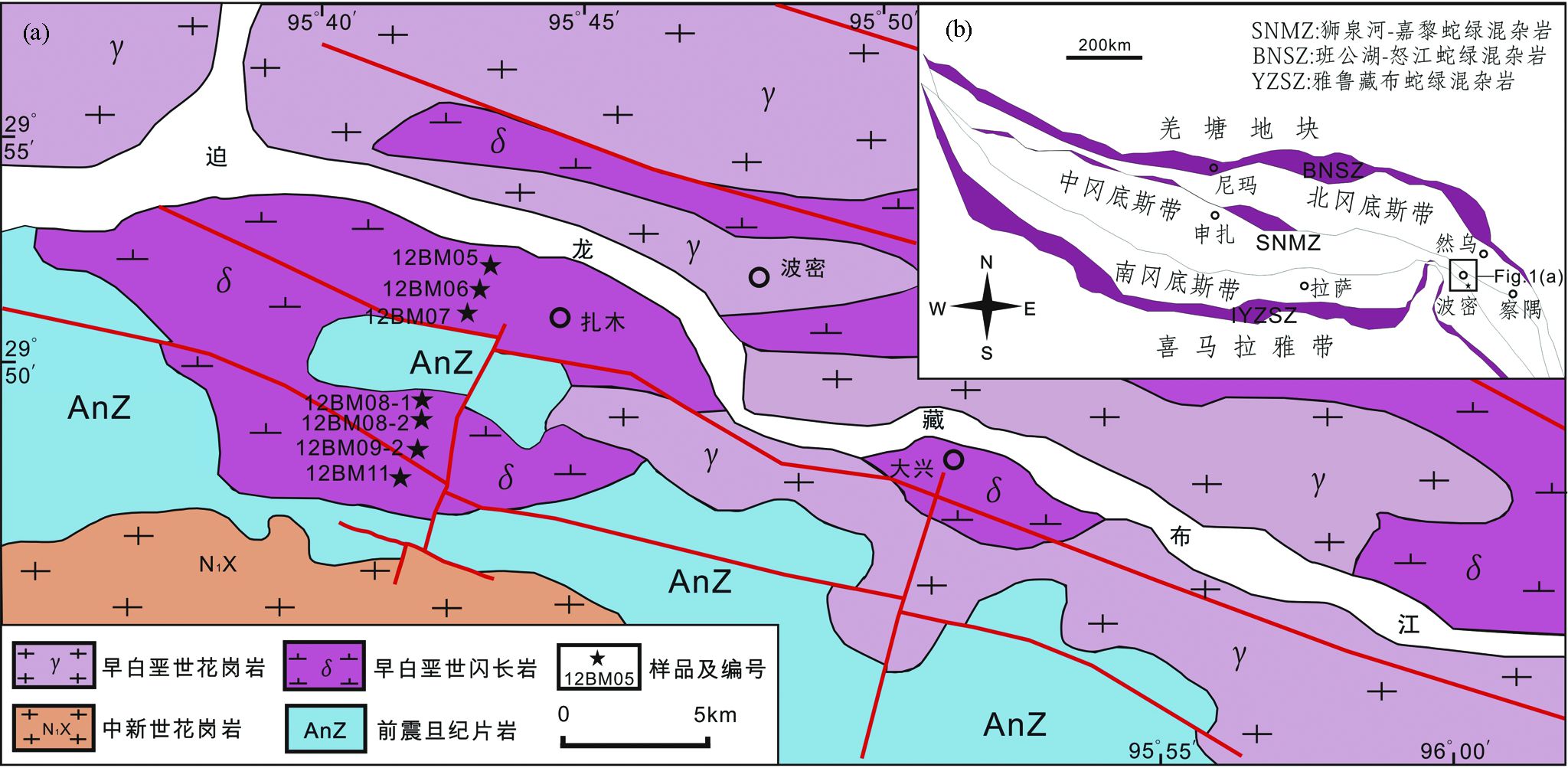
波密地区岩体呈NW-SE方向展布,出露面积约29km2,简称为波密岩体(图 1a),岩性主要为黑云母花岗闪长岩、黑云母石英闪长岩。黑云母花岗闪长岩整体灰白色,中细粒结构,块状构造,主要矿物为石英20%~35%,斜长石45%~55%,钾长石15%~25%,黑云母5%~10%,角闪石小于2%,石英呈他形粒状,部分石英因构造作用发生定向破碎,形成多米诺骨牌构造;黑云母石英闪长岩中,石英15%~20%,斜长石(中长石)55%~65%,钾长石15%~25%,黑云母5%~10%,角闪石约为2%,可见少量磁铁矿。斜长石呈半自形板状,有明显的环带结构,可见聚片双晶和卡纳复合双晶,多绢云母化。钾长石半自形板状,具有卡氏双晶,不同程度的高岭土化。暗色矿物以黑云母为主,多数受构造应力发生变形或破碎,部分黑云母呈定向排列。
|
图 1 西藏波密地区地质图 (a)-研究区地质图;(b)-青藏高原构造单元划分 Fig. 1 Simplified geological map in the Bomi region, Tibet (a)-geological map of the studied area; (b)-geological sketch map of tectonic outline of the Tibetan Plateau |
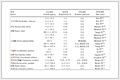
本文选取7件样品进行岩石化学和地球化学分析(表 1)。
|
表 1 波密早白垩世闪长岩主要元素(wt%)、微量元素和稀土元素(×10-6)含量 Table 1 Whole-rock major (wt%) and trace (×10-6) element data of the Bomi granitoids |
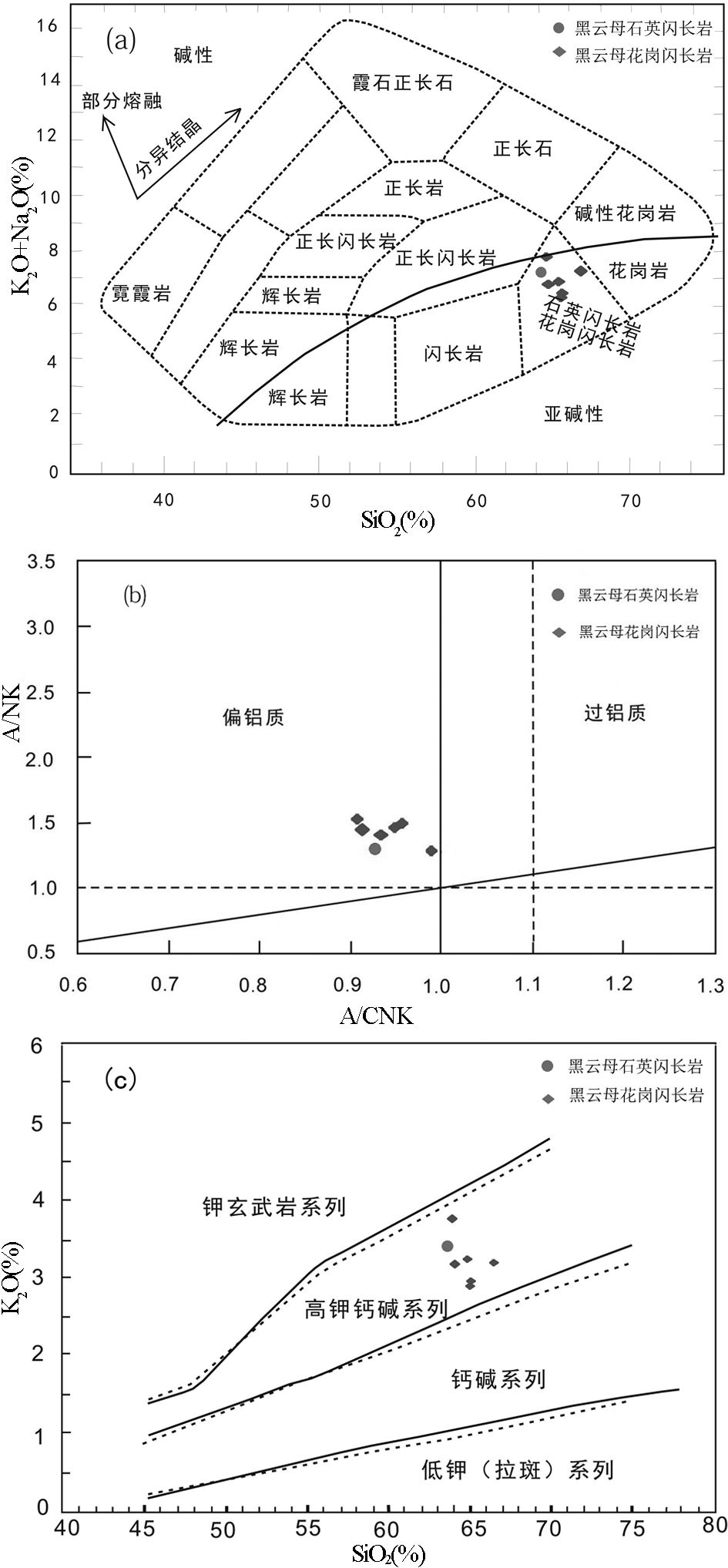
所有花岗岩类的SiO2介于64.11%~66.63%间,K2O+Na2O=6.36%~7.54%,Na2O含量大于均3.20%,在全碱-硅分类图解中 (图 2a),投点落入石英闪长岩和花岗闪长岩的区域,与镜下鉴定结果一致;具有较低的Al2O3(15.54%~16.54%),铝饱和指数(A/CNK)为0.80~0.95,属偏铝质岩(图 2b);在K2O-SiO2图解中属于高钾钙碱系列(图 2c)。CIPW标准矿物计算显示,7件样品均不含刚玉分子,但含较多透辉石分子(0.32%~2.93%),显示偏铝质的I 型花岗岩系列特征。
|
图 2 波密岩体类型及系列划分图解 (a)-SiO2-(Na2O+K2O)图解(据Wilson, 1989);(b)-A/NK-A/CNK图解(据Maniar and Piccoli, 1989);(c)-K2O-SiO2图解(实线据Peccerillo and Taylor, 1976;虚线据Middlemost, 1985) Fig. 2 Classification and series diagrams of the Bomi granitoids (a)-SiO2-(Na2O+K2O) diagram (after Wilson, 1989); (b)-A/NK-A/CNK diagram(after Maniar and Piccoli, 1989); (c)-K2O-SiO2 diagram (solid line after Peccerillo and Taylor, 1976; dash line after Middlemost, 1985) |
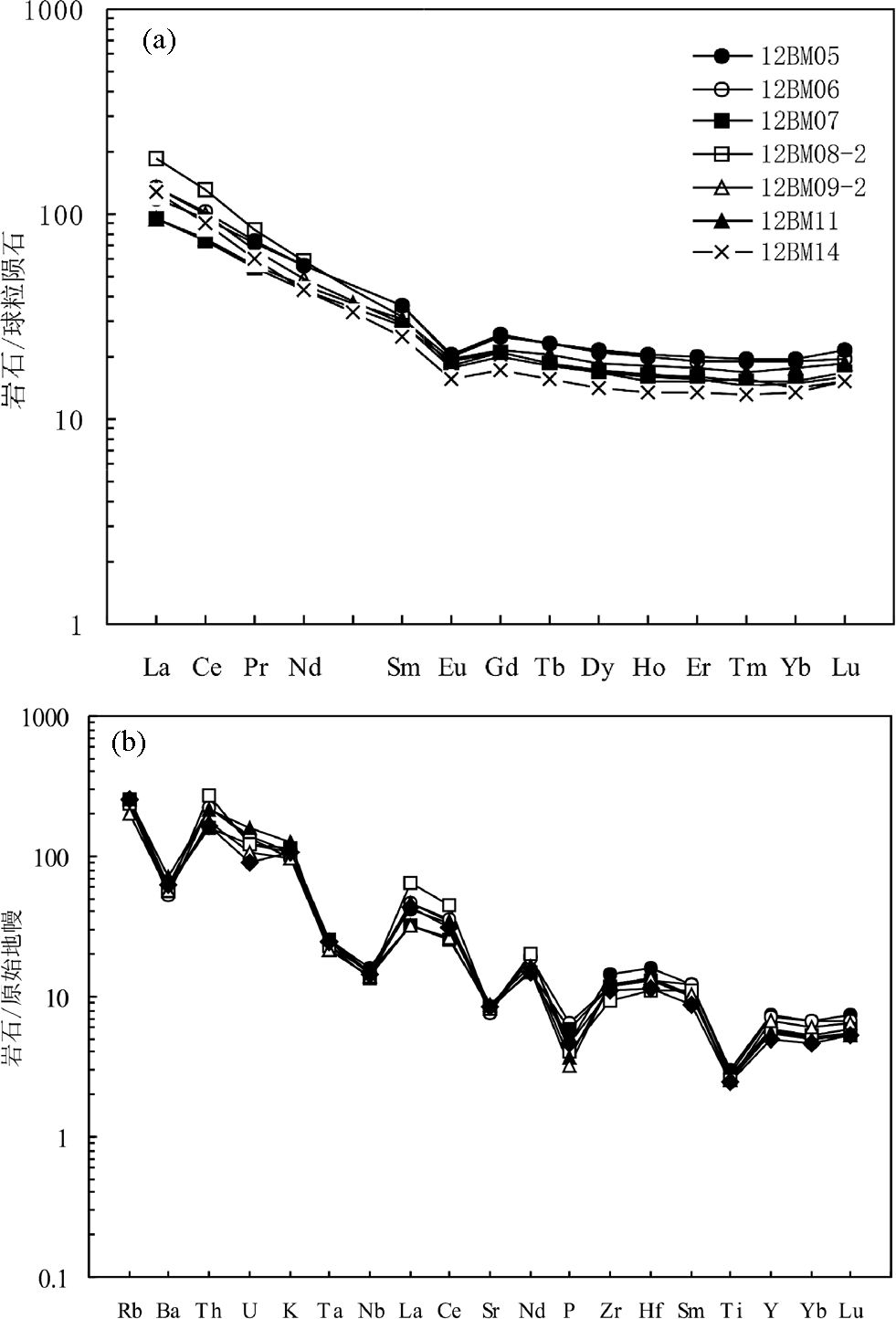
7件样品微量元素的球粒陨石标准化稀土元素图解(图 3a)均呈现右倾的趋势,所有样品均显示轻稀土元素(LREE)富集,重稀土元素(HREE)相对亏损的规律。根据所选样品测得的数据在球粒陨石标准化图解中Eu的位置上均出现“谷”,经过计算得所有样品δEu<1。
|
图 3 波密早白垩世侵入岩稀土元素球粒陨石标准化图解(a,据Boynton, 1984)和微量元素蛛网图(b, 据Sun and McDonough, 1989) Fig. 3 Chondrite-normalized REE patterns (a, after Boynton, 1984) and primitive mantle-normalized trace element patterns (b, after Sun and McDonough, 1989) for the Bomi granitoids |
稀土元素含量为ΣREE=114.9×10⁻⁶~182.8×10⁻⁶,(La/Yb)N=5.3×10-6~12.5×10-6, δEu= 0.7~0.8,平均为0.71。值得注意的是7件样品的(La/Yb) N值均大于4.3,说明可能具有LREE丰度相对较高的壳源物质在岩浆作用过程中参与进来。
在原始地幔标准化微量元素蜘蛛网图解上(图 3b),两种岩石表现出一致的曲线变化形态,均富集大离子亲石元素(Rb、K),亏损高场强元素(Nb、Ta、P、Ti),显示了岛弧型岩浆岩的基本特征(Wilson, 1989)。此外,波密岩体的微量元素特征与拉萨地块中北部广泛出露的早白垩世高钾钙碱性系列侵入岩的微量元素特征非常相似,如申扎地区早白垩世的花岗岩(张亮亮等,2011)等,很可能说明波密岩体是中冈底斯早白垩世带状岩浆大爆发事件在东部的延续。
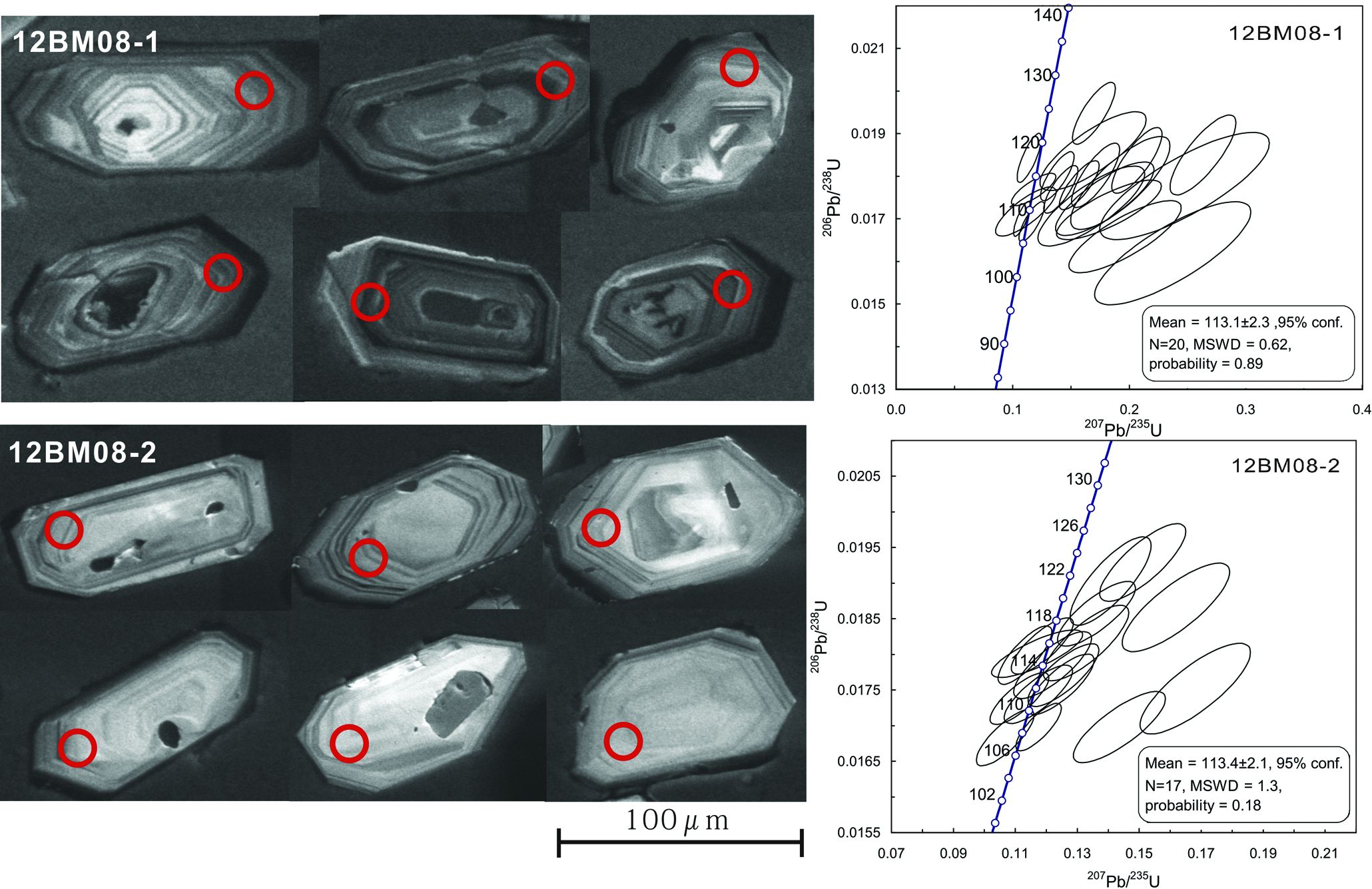
4 锆石U-Pb年代学特征本文对2件黑云母花岗闪长岩样品(12BM08-1和12BM08-2)进行了LA-ICP-MS锆石U-Pb测年(表 2)。测试工作在中国地质大学(武汉)地质过程与矿产资源国家重点实验室完成。所有锆石样品均为短柱状,绝大多数长度在90~120μm之间。阴极发光图像显示了清晰的振荡环带(图 4)。锆石的Th/U比值均大于0.1,为典型的岩浆成因锆石(Hoskin and Schaltegger, 2003)。扎木区采得12BM08-2样品17个测点给出的206Pb/238U年龄在107.6~123.2Ma,在置信度为95%时加权平均年龄为113.4±2.1Ma(MSWD=1.3)12BM08-1样品的20个测点给出的206Pb/238U年龄在108.2~124.4Ma,在置信度为95%时加权平均年龄为113.1±2.3Ma(MSWD=0.62)。两件样品的U-Pb年龄数据非常接近,属早白垩世晚期。
|
|
表 2 早白垩世波密岩体锆石U-Pb定年结果分析表 Table 2 LA-ICP-MS zircon U-Pb analytical data of the Bomi granitoids |
|
图 4 波密花岗岩类样品(12BM08-1和12BM08-2)锆石U-Pb年龄谐和图和阴极发光图 Fig. 4 U-Pb age concordia plots and cathodoluminescence images of zircon grains (12BM08-1 and 12BM08-2) from the Bomi granitoids |
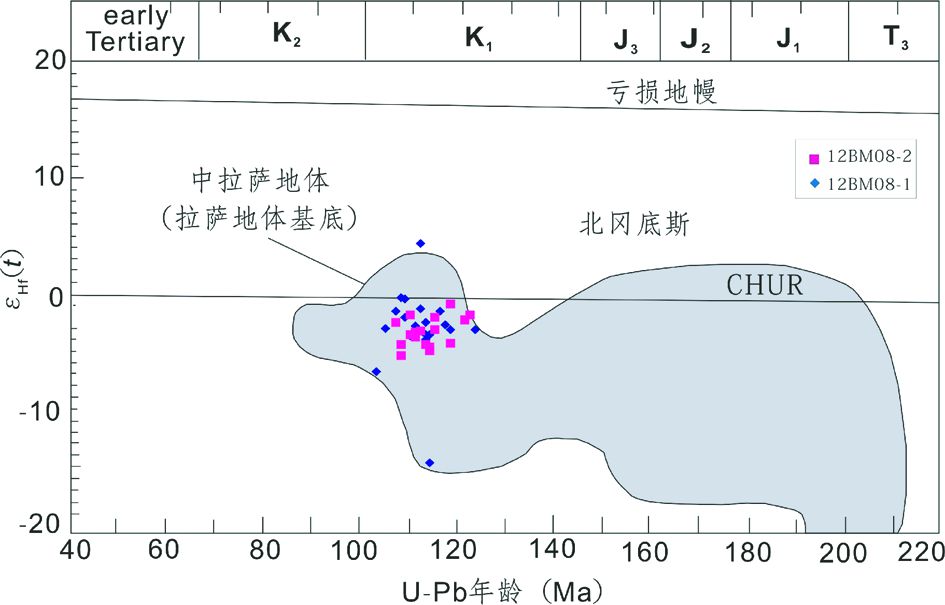
本文对2件样品(12BM08-1与12BM08-2)进行了Hf同位素测试。2件样品锆石的176Yb/177Hf比值为0.0233~0.1085,176Lu/177Hf比值为0.0007~0.0035(表 3)几乎都小于 0.002,表明这些锆石形成以后,仅有少量放射性成因的Hf积累。因此,可用初始176Hf/177Hf比值代表锆石形成的176Hf/177Hf比值(吴福元等,2007)。样品的fLu/Hf平均值为-0.96,明显小于铁镁质地壳fLu/Hf (-0.34,Amelin et al., 2000)和硅铝质地壳的fLu/Hf(-0.72,Amelin et al., 2000),所以二阶段模式年龄更能反映源区物质从亏损地幔被抽取的时间。从图 5中可以看出,投点几乎全部落入中拉萨地体的范围内,说明波密岩体的岩浆来源与中拉萨地体具有密切联系。
|
|
表 3 波密岩体锆石Hf同位素数据 Table 3 Zircon Hf isotopic data of the Bomi grantoids |
|
图 5 波密岩体花岗岩类εHf(t)-U-Pb年龄图解(据常青松等,2011) Fig. 5 εHf(t) values vs. U-Pb ages plot of the Bomi granitoids (after Chang et al., 2011) |
计算所得的εHf(t)除了一个正值4.43外,其余均小于0,在-13.72~-0.08之间,显示出一定的不均一性,尤其是12BM08-1样品,有1个点的εHf(t)大于0,初步推断可能有一定量幔源物质的贡献,但总体反映岩浆来源以壳源为主;地壳模式年龄(tDMC)介于891~2047Ma之间(表 3),多集中在1.3Ga,而在中冈底斯和冈底斯弧背断隆带,早白垩世岩浆活动发生在143~102Ma,这些岩浆岩主要显示负的锆石εHf(t)值(-14.2~+3.4), 对应的tDMC主要为古元古代-中元古代早期(0.8~2.1Ga)(朱弟成等,2009), 与本文测得结果基本一致,具有很好的可比性。因此,初步推断波密岩体可能是中冈底斯及弧背断隆带早白垩世岩浆爆发事件在东部的延续。
6 讨论 6.1 岩浆活动时间波密岩体的黑云母花岗闪长岩、黑云母石英闪长岩的U-Pb平均年龄均在113Ma左右,年龄非常接近,我们认为两者是同期岩浆演化的产物。这个年龄数据与然乌岩体(114.2±0.9Ma,刘敏,2009),申扎花岗岩(约113Ma,张亮亮等,2011)等岩体的形成时间也基本同期,恰好也是中冈底斯地区在早白垩113 Ma 左右发生大规模带状爆发的时间(Zhu et al., 2009;周长勇等,2008;陈越等,2010;张亮亮等,2011),指示波密岩体的成因可能与以上地区岩体成因相同,均受到同期的构造作用的影响。
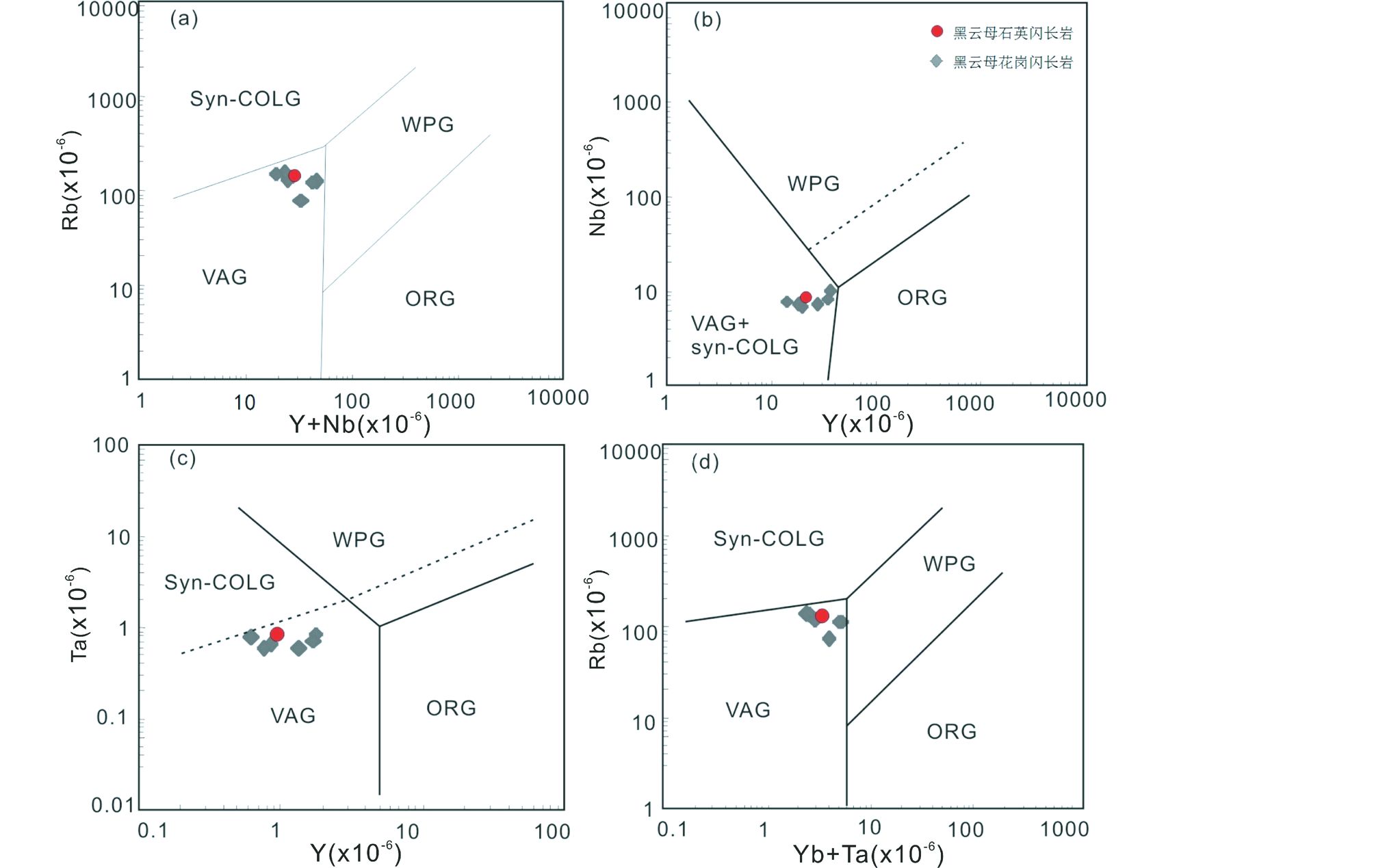
6.2 构造判别及岩浆源区地球化学数据显示,高场强元素Nb、Ta、P、Ti等均出现亏损,这是岩浆来源于岛弧岩浆的最直观的证据。另外,根据微量元素的Rb-(Y+Nb)、Nb-Y、Ta-Yb和Rb-(Yb+Ta)构造环境判别图(图 6),投图结果显示,所有点均落在岛弧型岩浆区域,反映板块俯冲-碰撞的形成机制。
|
图 6 波密岩体班公湖-怒江缝合带岛弧型花岗岩Rb-(Y+Nb)、Nb-Y、Ta-Yb和Rb-(Yb+Ta)构造环境判别图(据杜德道等,2011) Fig. 6 Diagrams of Rb-(Y+Nb), Nb-Y, Ta-Yb and Rb-(Yb+Ta) for the arc granitoids in the east segment of Bangonghu-Nujiang suture zone (after Du et al., 2011) |
相比全岩的Nd同位素,锆石的Hf同位素更能反映岩浆的来源(Griffin et al., 2002; Beloisova et al., 2006; Yang et al., 2006a, b ; 李皓扬,2007)。对于Hf同位素规律性的研究表明,176Hf/177Hf及εHf(t)往往指示岩浆来源。当两者值均较低时,暗示岩浆来源于地壳;而两者有较高的值的时候,则反映岩浆来自于幔源物质(Peter and Roland, 2003)。波密岩体花岗闪长岩与石英闪长岩具有较低的εHf(t)值-13.72~-0.08(去除1个正值4.43),主要集中在-4.44~-1.70;在εHf(t)-U-Pb年龄图解中,12BM08-1与12BM08-2样品点几乎全部落在球粒陨石演化线之下的壳源区域,这与西部的申扎岩体(εHf(t)=-7.9~-5.0,tDMC=1.55~1.80,张亮亮等,2011),东部的然乌岩体(εHf(t)=-4.2~1.7,tDMC=0.85~1.58,刘敏等,2009)均有很高的相似性,很可能具有相似的岩浆来源。
7 结论(1) 由约113Ma岩浆侵位形成的波密岩体有高K,高Si,低P的特点,A/CNK为0.80~0.95,大离子亲石元素(Rb、K)富集,高场强元素(Nb、Ta、P、Ti)亏损,属于偏铝质Ⅰ型花岗岩。
(2) 波密岩体的锆石Hf同位素特征的区域性对比,显示波密岩体岩浆来源于壳源,很可能是中冈底斯早白垩世岩浆大爆发事件在东部的延续。
致谢 常量元素分析由中国地质大学(北京)实验室完成,微量元素分析和锆石LA-ICP-MS U-Pb测年在中国地质大学(武汉)完成;Hf同位素测试在天津地质矿产研究所实验室完成,得到耿建珍工程师的悉心指导;在此一并表示衷心的感谢。| [] | Amelin Y, Lee DC, Hallidy AN. 2000. Early-middle Archaean crustal evolution deduced from Lu-Hf and U-Pb isotopic studies of single zircon grains. Geochimica et Cosmochimica Acta, 64(24): 4205–4225. DOI:10.1016/S0016-7037(00)00493-2 |
| [] | Beloisova BA, Griffin WL, O'Reilly SY. 2006. Zircon crystal morphology, trace element signatures and Hf Isotope composition as a tool for petrogenetic modelling: Examples from Eastern Australian granitoids. Journal of Petrology, 47(2): 329–353. |
| [] | Blichert-Toft J, Albarède F. 1997. The Lu-Hf isotope geochemistry of chondrites and the evolution of the mantle-crust system. Earth and Planetary Science Letters, 148: 243–258. DOI:10.1016/S0012-821X(97)00040-X |
| [] | Boynton WV. 1984. Geochmistry of the rate earth elements: Meteorite studies. In: Henderson P(ed.). Rare Earth Element Geochemistry. Amsterdam: Elsevier, 63-114 |
| [] | Chang QS, Zhu DC, Zhao ZD, Dong GC, Mo XX, Liu YS, Hu ZC. 2011. Zircon U-Pb geochronology and Hf isotopes of the Early Cretaceous Rena-Co rhyolites from southern margin of Qiangtang, Tibet, and their implications. Acta Petrologica Sinica, 27(7): 2034–2044. |
| [] | Chen Y, Zhu DC, Zhao ZD, Zhang LL, Liu M, Yu F, Guan Q, Mo XX. 2010. Geochronology, geochemistry and petrogenesis of the Bamco andesites from the northern Gangdese, Tibet. Acta Petrologica Sinica, 26(7): 2193–2206. |
| [] | Dong GC, Mo XX, Zhao ZD, Zhu DC, Song YT, Wang L. 2008. Gabbros from southern Gangdese: Implication for mass exchange between mantle and crust. Acta Petrologica Sinica, 24(2): 203–210. |
| [] | Dong GC, Mo XX, Zhao ZD, Zhu DC, Xie XF, Dong ML. 2011. The Neocene magmatism from Namuru intrusion in western Gangdese, Tibet and its tectonic significance. Acta Petrologica Sinica, 27(7): 1983–1992. |
| [] | Du DD, Qu XM, Wang GH, Xin HB, Liu ZB. 2011. Bidirectional subduction of the Middle Tethys oceanic basin in the west segment of Bangonghu-Nujing suture, Tibet: Evidence from zircon U-Pb LAICPMS dating and petrogeochemistry of arc granites. Acta Petrologica Sinica, 27(7): 1993–2002. |
| [] | Griffin WL, Pearson NJ, Belousova E, Jackson SE, van Achterberge E, O'Reilly SY, Shee SR. 2000. The Hf isotope composition of cratonic mantle: LAM-MC-ICPMS analysis of zircon megacrysts in kimberlites. Geochimica et Cosmochimica Acta, 64(1): 133–147. DOI:10.1016/S0016-7037(99)00343-9 |
| [] | Griffin WL, Wang X, Jackson SE, Person NJ, O'Reilly SY, Xu X, Zhou X. 2002. Zircon chemistry and magma mixing, SE China: Insitu analysis of Hf isotopes, Tonglu and Pingtan igneous complexes. Lithos, 61: 237–269. DOI:10.1016/S0024-4937(02)00082-8 |
| [] | Hoskin PWO, Schaltegger U. 2003. The composition of zircon and igneous and metamorphic petrogenesis. Reviews of Mineralogy and Geochemistry, 53(1): 27–62. DOI:10.2113/0530027 |
| [] | Lee HY, Chung SL, Wang YB, Zhu DC, Yang JH, Song B, Liu DY, Wu FY. 2007. Age, petrogenesis and geological significance of the Linzizong volcanic successions in the Linzhou basin, southern Tibet: Evidence from zircon U-Pb dates and Hf isotopes. Acta Petrologica Sinica, 23(2): 493–500. |
| [] | Liu M, Zhu DC, Zhao ZD, et al. 2009. Early Cretaceous magma mixing in Ranwu Area of Eastern Gangdese, Tibet: Evidence from zircon SHRIMP U-Pb age and Hf isotopic composition. Earth Science Frontiers, 16(2): 152–160. |
| [] | Maniar PD, Piccoli PM. 1989. Tectonic discrimination of granitoids. Geological Society of America Bulletin, 101(5): 635–643. DOI:10.1130/0016-7606(1989)101<0635:TDOG>2.3.CO;2 |
| [] | Middlemost EAK. 1985. Magmas and Magmatic Rocks: An Introduction to Igneous Petrology. London: Longman: 1-26. |
| [] | Mo XX, Deng JF, Dong FL, Yu XH, Wang Y, Zhou S, Yang WG. 2001. Volcanic petrotectonic assemblages in Sanjiang Orogenic Belt, SW China and implication for tectonics. Geological Journal of China Universities, 7(2): 122–138. |
| [] | Mo XX, Zhao ZD, Deng JF, Dong GC, Zhou S, Zhang SQ, Wang LL. 2003. Response of volcanism to the India-Asian collision. Earth Science Frontiers, 10(3): 135–148. |
| [] | Mo XX, Dong GC, Zhao ZD, Zhou S, Wang LL, Qiu RZ, Zhang FQ. 2005. Spatial and temporal distribution and characteristics of granitoids in the Gangdese, Tibet and implication for crustal growth and evolution. Geological Journal of China Universities, 11(3): 281–290. |
| [] | Pearce JA, Harris NBW, Tigdle AG. 1984. Trace element discrimination diagrams for the tectonic interpretation of granitic rocks. Journal of Petrology, 25(4): 956–983. DOI:10.1093/petrology/25.4.956 |
| [] | Pearce JA, Mei HJ. 1988. Volcanic rocks of the 1985 Tibet Geotraverse: Lhasa to Golmud. Philosophical Transactions of the Royal Society of London, Series A, Mathematical and Physical Sciences, 327(1594): 169–201. DOI:10.1098/rsta.1988.0125 |
| [] | Peccerillo A, Taylor SR. 1976. Geochemistry of Eocene calc-alkaline volcanic rocks from the Kastamonu area, Northern Turkey. Contributions to Mineralogy and Petrology, 58(1): 63–81. DOI:10.1007/BF00384745 |
| [] | Peter DK, Roland M. 2003. Lu-Hf and Sm-Nd isotope systems in zircon. Reviews in Mineralogy and Geochemistry, 53(1): 327–341. DOI:10.2113/0530327 |
| [] | Soderlund U, Patchett PJ, Vervoort JD, Isachsen CE. 2004. The 176Lu decay constant determined by Lu-Hf and U-Pb isotope systematic of Precambrian mafic intrusions. Earth and Planetary Science Letters, 219: 311–324. DOI:10.1016/S0012-821X(04)00012-3 |
| [] | Sun SS, McDonough WF. 1989. Chemical and isotopic systematics of oceanic basalts: Implications for mantle composition and processes. In: Saunders AD and Norry MJ (eds.). Magmatism in the Ocean Basins. Geological Society, London, Special Publication, 42(1): 313–345. DOI:10.1144/GSL.SP.1989.042.01.19 |
| [] | Wilson BM. 1989. Igneous Petrogenesis. London: Allen and Unwin. |
| [] | Wu FY, Li XH, Zheng YF, Gao S. 2007. Lu-Hf isotopic systematics and their applications in petrology. Acta Petrologica Sinica, 23(2): 185–220. |
| [] | Yang JH, Wu FY, Chung SL, Wilde SA, Chu MF. 2006a. A hybrid origin for the Qiansha A-type granite, Northeast China: Geochemical and Sr-Nd-Hf isotopic evidence. Lithos, 89(1-2): 89–106. DOI:10.1016/j.lithos.2005.10.002 |
| [] | Yang JH, Wu FY, Wilde SA, Xie LW, Yang YH, Liu XM. 2006b. Trace magma mixing in granite genesis: In-situ U-Pb dating and Hf-isotope analysis of zircons. Contributions to Mineralogy and Petrology, 153: 177–190. DOI:10.1007/s00410-006-0139-7 |
| [] | Zhang LL, Zhu DC, Zhao ZD, Liao ZL, Wang LQ, Mo XX. 2011. Early Cretaceous granitoids in Xainza, Tibet: Evidence of slab break-off. Acta Petrologica Sinica, 27(7): 1938–1948. |
| [] | Zhou CY, Zhu ZD, Xu JF, Wang LQ, Chen HH, Xie LW, Dong GC, Zhou S. 2008. Petrogenesis of Daxiong pluton in western Gangdese, Tibet: Zircon U-Pb dating and Hf isotopic constraints. Acta Petrologica Sinica, 24(2): 348–358. |
| [] | Zhu DC, Mo XX, Niu YL, Zhao ZD, Wang LQ, Liu YS, Wu FY. 2009. Geochemical investigation of Early Cretaceous igneous rocks along an east-west traverse throughout the central Lhasa Terrane, Tibet. Chemical Geology, 268(3-4): 298–312. DOI:10.1016/j.chemgeo.2009.09.008 |
| [] | Zhu DC, Mo XX, Wang LQ, et al. 2009. Petrogenesis of highly fractionated I-type granites in the Zayu area of eastern Gangdese, Tibet: Constraints from zircon U-Pb geochronology, geochemistry and Sr-Nd-Hf isotopes. Science in China (Series D), 39(7): 833–848. |
| [] | 常青松, 朱弟成, 赵志丹, 董国臣, 莫宣学, 刘勇胜, 胡兆初. 2011. 西藏羌塘南缘热那错早白垩世流纹岩锆石U-Pb年代学和Hf同位素及其意义. 岩石学报, 27(7): 2034–2044. |
| [] | 陈越, 朱弟成, 赵志丹, 张亮亮, 刘敏, 于枫, 管琪, 莫宣学. 2010. 西藏北冈底斯巴木错安山岩的年代学、地球化学及岩石成因. 岩石学报, 26(7): 2193–2206. |
| [] | 董国臣, 莫宣学, 赵志丹, 朱弟成, 宋云涛, 王磊. 2008. 西藏冈底斯南带辉长岩及其所反映的壳幔作用信息. 岩石学报, 24(2): 203–210. |
| [] | 董国臣, 莫宣学, 赵志丹, 朱弟成, 谢许峰, 董美玲. 2011. 冈底斯带西段那木如岩体始新世岩浆作用及构造意义. 岩石学报, 27(7): 1982–1992. |
| [] | 杜德道, 曲晓明, 王根厚, 辛洪波, 刘治博. 2011. 西藏班公湖-怒江缝合带西段中特提斯洋盆的双向俯冲: 来自岛弧型花岗岩锆石U-Pb年龄和元素地球化学的证据. 岩石学报, 27(7): 1993–2002. |
| [] | 李皓扬, 锺孙霖, 王彦斌, 朱弟成, 杨进辉, 宋彪, 刘敦一, 吴福元. 2007. 藏南林周盆地林子宗火山岩的时代、成因及其地质意义: 锆石U-Pb年龄和Hf同位素证据. 岩石学报, 23(2): 493–500. |
| [] | 刘敏, 朱弟成, 赵志丹, 王立全, 莫宣学, 周长勇. 2009. 西藏冈底斯东部然乌地区早白垩世岩浆混合作用: 锆石SHRIMP U-Pb年龄和Hf同位素证据. 地学前缘, 16(2): 152–160. |
| [] | 莫宣学, 邓晋福, 董方浏, 喻学惠, 王勇, 周肃, 杨伟光. 2001. 西南三江造山带火山岩-构造组合及其意义. 高校地质学报, 7(2): 122–138. |
| [] | 莫宣学, 赵志丹, 邓晋福, 董国臣, 周肃, 郭铁鹰, 张双全, 王亮亮. 2003. 印度-亚洲大陆碰撞过程的火山作用响应. 地学前缘, 10(3): 135–148. |
| [] | 莫宣学, 董国臣, 赵志丹, 周肃, 王亮亮, 邱瑞照, 张风琴. 2005. 西藏冈底斯带花岗岩的时空分布特征及地壳生长演化信息. 高校地质学报, 11(3): 281–290. |
| [] | 吴福元, 李献华, 郑永飞, 高山. 2007. Lu-Hf同位素体系及其岩石学应用. 岩石学报, 23(2): 185–220. |
| [] | 张亮亮, 朱弟成, 赵志丹, 廖忠礼, 王立全, 莫宣学. 2011. 西藏申扎早白垩世花岗岩类: 板片断离的证据. 岩石学报, 27(7): 1938–1948. |
| [] | 周长勇, 朱弟成, 赵志丹, 许继峰, 王立全, 陈海红, 谢烈文, 董国臣, 周肃. 2008. 西藏冈底斯带西部达雄岩体的岩石成因: 锆石U-Pb年龄和Hf同位素约束. 岩石学报, 24(2): 348–358. |
| [] | 朱弟成, 莫宣学, 王立全, 赵志丹, 牛耀龄, 周长勇, 杨岳衡. 2009. 西藏冈底斯东部察隅高分异I型花岗岩的成因: 锆石U-Pb年代学、地球化学和Sr-Nd-Hf同位素约束. 中国科学(D辑), 39(7): 833–848. |