 2013, Vol. 29


2. 中国地质大学地质过程与矿产资源国家重点实验室, 中国地质大学地球科学学院, 武汉 430074
 , WANG Qing1, ZHU DiCheng1
 , ZHAO ZhiDan1, CHEN Yue1, JIA LiLi1, ZHENG JianPing2, MO XuanXue1
2. State Key Laboratory of Geological Processes and Mineral Resources, Faculty of Earth Sciences, China University of Geosciences, Wuhan 430074, China
拉萨地体内部松多大洋型榴辉岩出露于拉萨市北东方向约200km的松多乡一带(杨经绥等, 2007; 陈松永等, 2008),自发现以来就引起了极大的关注。这些榴辉岩和该带南部出露一些已经强烈蛇纹石化、原岩被推测为方辉橄榄岩的超基性岩块(Chen et al., 2009)一起,被解释为代表了松多特提斯的洋壳残余(Li et al., 2009; Yang et al., 2009)。已有研究指示松多榴辉岩的高压变质作用发生在中二叠世末期(262±5Ma, Yang et al., 2009),与其东约100km的工布江达皮康村过铝质S型花岗岩侵位时代基本相同(约263Ma, Zhu et al., 2009)。结合同期的区域性角度不整合,这些位于同一构造带的同期构造岩浆和变质事件被解释为代表了松多特提斯洋关闭的时间(Zhu et al., 2009, 2010, 2013),从而意味着松多特提斯洋的演化时间下限可能持续到中二叠世。另外,松多榴辉岩南部与超镁铁岩接触的绿片岩地层中火山熔岩的锆石U-Pb年龄为晚石炭世(305Ma; Chen et al., 2009),与榴辉岩全岩Sm-Nd等时线年龄(306 ± 50Ma; Li et al., 2009)在误差范围内一致,这些结果指示松多特提斯洋可能在晚石炭世末期就已经存在。但对其开启时间,目前尚未进行讨论。另一方面,虽然近年来先后有不同学者报道了拉萨地体南缘发现了晚泥盆世-石炭纪早期花岗岩类(董昕等, 2010; Ji et al., 2012; Zhang et al., 2012),但由于地球化学数据的缺乏,其岩浆起源和岩石成因并未得到很好讨论,直接限制了对这些花岗岩类构造意义的理解。本文目的是,报道拉萨地体南缘朗县石炭纪早期花岗岩类的岩石学、锆石U-Pb年代学、全岩主量元素和微量元素数据、锆石Hf同位素数据,约束其岩浆源区和岩石成因,结合区域同期的岩浆活动记录和沉积地层资料,探讨其对松多特提斯洋演化的意义。
2 地质背景和样品青藏高原自北向南由一系列构造块体组成,分别为松潘-甘孜复理石杂岩带、北(东)羌塘、南(西)羌塘、拉萨和喜马拉雅。分隔这些块体的边界主要是各个时期的特提斯洋残留,从北到南依次是金沙江缝合带(JSSZ)、龙木错-双湖缝合带(LSSZ)、班公湖-怒江缝合带(BNSZ)和印度河-雅鲁藏布缝合带(IYZSZ)(图 1a; Zhu et al., 2011, 2013)。其中,拉萨地体是夹持于印度河-雅鲁藏布缝合带(IYZSZ)和班公湖-怒江缝合带(BNSZ)之间的一条长约 2500km,宽约 150~300km的巨型构造-岩浆岩带。拉萨地体内部以狮泉河-纳木错蛇绿混杂岩带(SNMZ)和洛巴堆-米拉山断裂带(LMF)为界,可以进一步划分为3个次级地体,即:北部拉萨地体,中部拉萨地体和南部拉萨地体(朱弟成等, 2012; Zhu et al., 2013)(图 1a)。北部拉萨地体以新生地壳为特征,上覆中三叠统到白垩系沉积盖层,富含丰富的早白垩世火山岩和同期花岗岩类(朱弟成等, 2006; Zhu et al., 2013);中部拉萨地体则是一个具有元古代和太古代结晶基底的古老微陆块,而南部拉萨地体也以新生地壳为特征,其东部可能存在老的结晶基底(Zhu et al., 2013)。南部拉萨地体以白垩纪-第三纪冈底斯岩基(莫宣学等, 2005)和古近纪林子宗火山岩为主(莫宣学等, 2003; Mo et al., 2008; Ji et al., 2009; Zhu et al., 2011),记录了雅鲁藏布特提斯洋壳北向俯冲以及随后的印度-欧亚大陆碰撞等构造过程(Chung et al., 2005, 2009; Mo et al., 2008; Zhu et al., 2011, 2013)。

|
图 1 青藏高原大地构造单元划分图(a, 据朱弟成等, 2012修改)及研究区地质简图(b, 据陈应明等, 2003) JSSZ-金沙江缝合带; LSSZ-龙木错-双湖缝合带; BNSZ-班公湖-怒江缝合带; SNMZ-狮泉河-纳木错蛇绿混杂岩带; LMF-洛巴堆-米拉山断裂带; IYZSZ-印度-雅鲁藏布缝合带 Fig. 1 Tectonic framework of the Tibetan Plateau (a, modified after Zhu et al., 2012) and simplified geological sketch map (b) of the study area JSSZ=Jinsha Sutre Zone; LSSZ=Longmu Tso-Shuanghu Suture zone; BNSZ=Bangong-Nujiang Suture Zone; SNMZ=Shiquanhe-Nam Tso Ophiolitic Mélange Zone; LMF=Luobadui-Milashan Fault; YZSZ= Indus-Yarlung Zangbo Suture Zone |
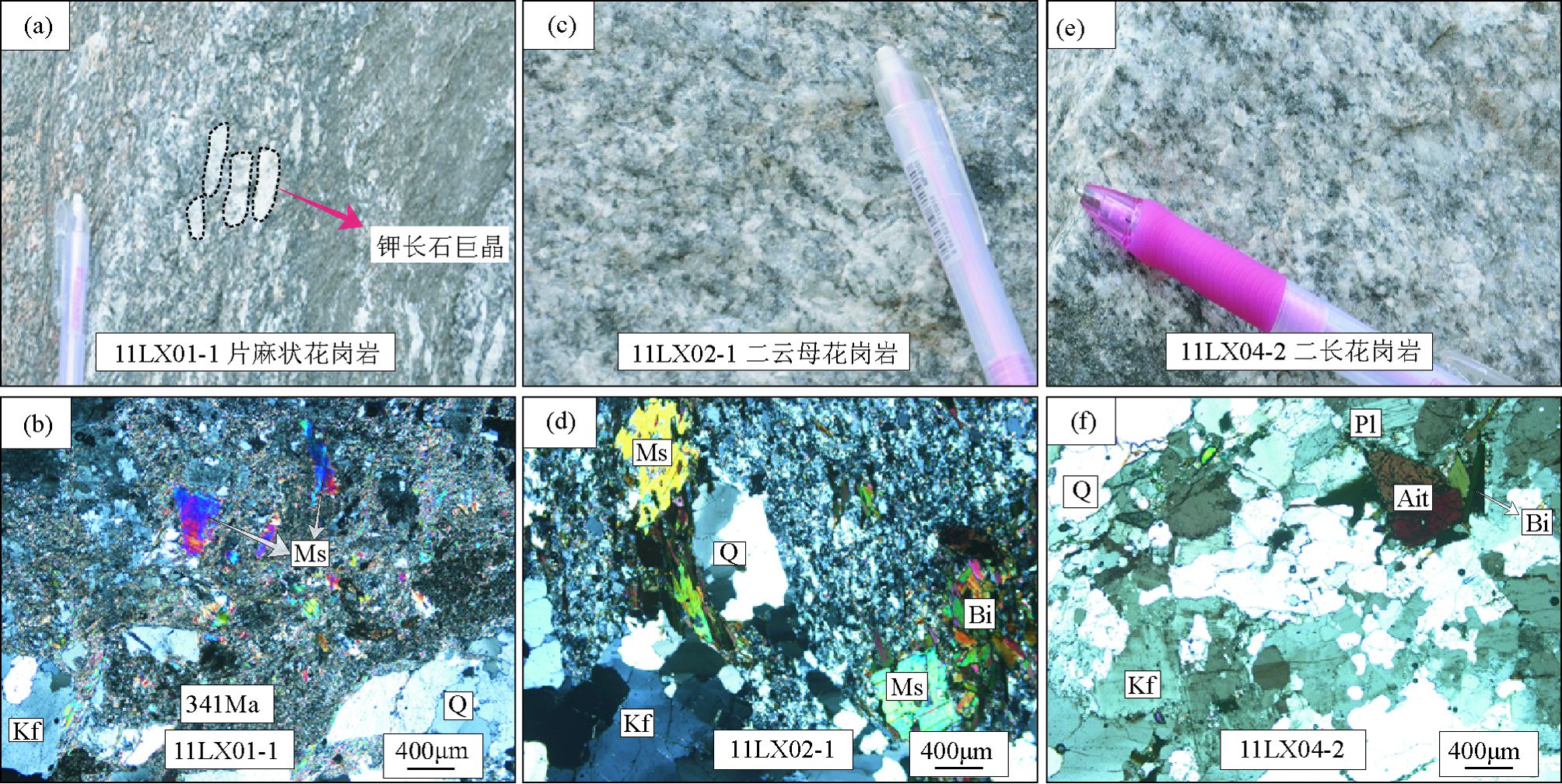
本文研究区位于南部拉萨地体南缘的朗县地区,1:25万林芝县幅区调报告(陈应明等, 2003①)认为这里出露有寒武纪、白垩纪和第三纪三个不同时期的岩浆岩。其中,寒武纪岩石以片麻状花岗岩类为特征(但本文和最近的研究均证实其为石炭纪岩石),出露面积约18km2,侵位于念青唐古拉岩群八拉岩组黑云斜长片麻岩和二云斜长片麻岩中。本文样品来自朗县县城以北2~7km处(图 1b),均为较新鲜的具片麻状构造的花岗岩类(图 2a)。这些花岗岩类具似斑状结构(图 2b)、中粗粒花岗结构(图 2c, e),片麻状构造,常发育定向排列的长石巨晶(图 2a),可见定向拉长的闪长质包体。片麻状花岗岩类的矿物成分包括钾长石(25%~30%)、斜长石(20%~25%,部分绢云母化)、石英(20%~25%)、黑云母(15%,部分绿泥石化)和白云母(约7%)(图 2d),副矿物则有褐帘石(图 2f)、绿帘石和赤铁矿等。
|
图 2 朗县早石炭世片麻状花岗岩类的野外露头及岩相学特征 (a)-样品11LX01-1的片麻状构造;(b)-样品11LX01-1的似斑状结构; (c)-样品11LX02-1野外露头;(d)-样品11LX02-1的白云母(正交偏光);(e)-样品11LX04-2野外露头;(f)-样品11LX04-2的副矿物褐帘石(正交偏光).Bi-黑云母;Mus-白云母;Q-石英;Kf-钾长石;Pl-斜长石;Ait-褐帘石 Fig. 2 Field occurrences and petrographical observations of the Early Carboniferous gneissic granitoids from Nang (a)-gneissic structure of the sample 11LX01-1; (b)-porphyric texture of the sample 11LX01-1; (c)-outcrops of the sample 11LX02-1; (d)-muscovite in the sample 11LX02-1; (e)-outcrops of the sample 11LX04-2; (f)-allanite as the accessory mineral in the sample 11LX04-2 |
①陈应明, 尹光候, 包俊跃等. 2003. 1:25万林芝县幅区域地质调查报告
3 分析方法锆石是在河北廊坊物化勘察研究所采用浮选和电磁选方法获得的。锆石阴极发光(CL)显微照相在北京锆年领航科技有限公司完成。样品11LX01-1的锆石U-Pb定年测试在中国地质大学(武汉)地质过程与矿产资源国家重点实验室利用LA-ICP-MS完成,所用仪器为Agilent 7700a,激光剥蚀系统为GeoLas 2005,每个时间分辨分析数据包括大约20~30s的空白信号和50s的样品信号。实验完成后,采用ICPMSDataCal软件(Liu et al., 2008, 2010)对分析数据进行离线处理(对样品和空白信号选择﹑仪器灵敏度漂移校正、元素含量及U-Th-Pb同位素比值等),并用Andersen(2002) 的方法进行普通铅校正。样品11LX05-9的锆石U-Pb定年测试在矿产资源研究所成矿作用与资源评价重点实验室进行,所用仪器为Neptune系列激光多接收等离子体质谱(LA-MC-ICPMS),Newwave UP213激光剥蚀系统,以He为载气。U和Th含量以锆石标样M127(U: 923×10-6;Th: 439×10-6;Th/U: 0.475)为外标进行校正。在测试过程中,每测定10个样品点前后重复测量两次锆石标样GJ-1和一次锆石标样Plesovice。分析数据的离线处理与样品11LX01-1相同。
锆石Hf同位素测试是在国土资源部成矿作用与资源评价重点实验室Neptune多接收等离子质谱和Newwave UP213紫外激光剥蚀系统(LA-MC-ICP-MS)上进行的,实验过程中采用He作为剥蚀物质载气,剥蚀直径55μm或40μm,测定时使用锆石国际标样GJ-1和Plesovice作为参考物质,分析点与U-Pb定年点位置相同。相关仪器运行条件及详细分析流程见侯可军等(2007) 。分析过程中,锆石标准GJ-1和Plesovice的176Hf/177Hf加权平均值分别为0.282007±0.000007 (2σ, n=36)和0.282476±0.000004 (2σ, n=27),与文献报道值(侯可军等, 2007; Morel et al., 2008)在误差范围内一致。εHf(t)根据每个测点的锆石U-Pb年龄计算,采用的176Lu衰变常数为1.865×10⁻¹¹a(Scherer et al., 2001),利用平均大陆壳的176Lu/177Hf值(=0.015)计算锆石Hf同位素地壳模式年龄(tDMC)。
全岩地球化学分析测试在中国地质大学(武汉)地质过程与矿产资源国家重点实验室进行。其中,主量元素由XRF法测试,分析精度优于5%;微量元素由Agilent 7500a等离子体质谱仪(ICP-MS)测定,分析精度优于5%~10%,详细测试方法和分析流程见Gao et al.(2002) 。测试过程中,根据同时测定的BHV0-1、AGV-1和G-2等标样来监测测试精度,具体测试方法详见Liu et al.(2008) 。
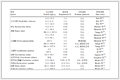
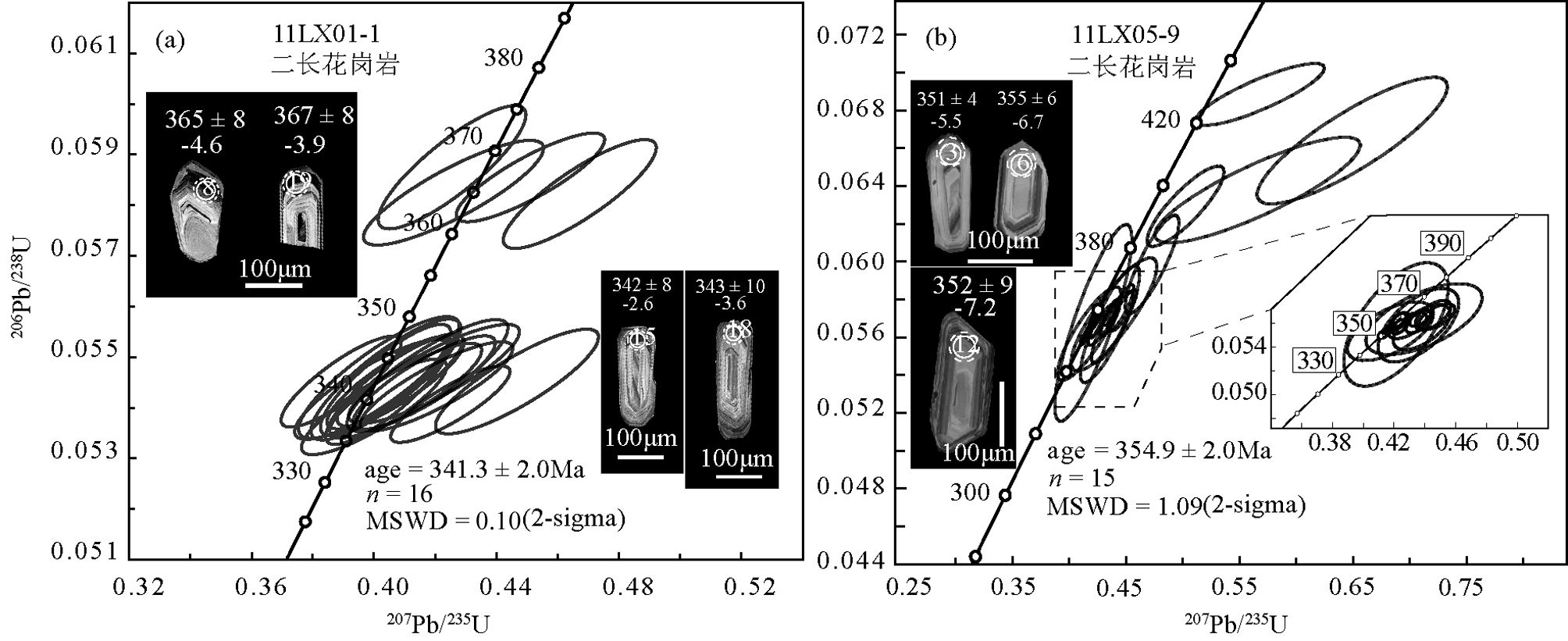
4 分析结果 4.1 锆石U-Pb年代学本文对朗县2件片麻状花岗岩样品进行了锆石U-Pb定年,分析结果见表 1和图 3。样品11LX01-1的锆石多为规则的长柱状晶体,长宽比为2:1~4:1,发育清晰的振荡环带;锆石的232Th含量为100×10-6~244×10-6,238U含量为368×10-6~850×10-6,Th/U比值为0.16~0.59,表明所测试锆石为典型的岩浆成因锆石(Hoskin and Schaltegger, 2003)。20个测点均靠近U-Pb谐和线,其中16个测点的206Pb/238U年龄变化于339~343Ma,加权平均年龄为341.3±2.0Ma (MSWD=0.10),其余4个测点的206Pb/238U年龄变化于365~368Ma,加权平均年龄为366.1±4.0Ma (MSWD=0.10)(图 3a)。
|
表 1 南部拉萨地体朗县地区早石炭世片麻状花岗岩类锆石U-Pb年代学数据 Table 1 Zircon U-Pb geochronological data of the Early Carboniferous gneissic granitoids from Nang in the southern Lhasa subterrane |


|
图 3 朗县早石炭世片麻状花岗岩类锆石U-Pb年龄谐和图 Fig. 3 Zircon U-Pb concordia diagrams of the Early Carboniferous gneissic granitoids from Nang |
样品11LX05-9的锆石为同样具长柱状晶形的岩浆锆石,长宽比为2:1~5:1,其232Th和238U含量分别为4×10⁻⁶~338×10-6和10×10-6~1401×10-6,Th/U比值为0.24~0.59,亦为典型的岩浆成因锆石。在20个测点中,除5个测点的206Pb/238U年龄变化于375~429Ma,为老的继承锆石点外,剩余15个测点的206Pb/238U年龄范围为351~361Ma,加权平均年龄为 354.9±2.0Ma (MSWD=1.10)(图 3b)。
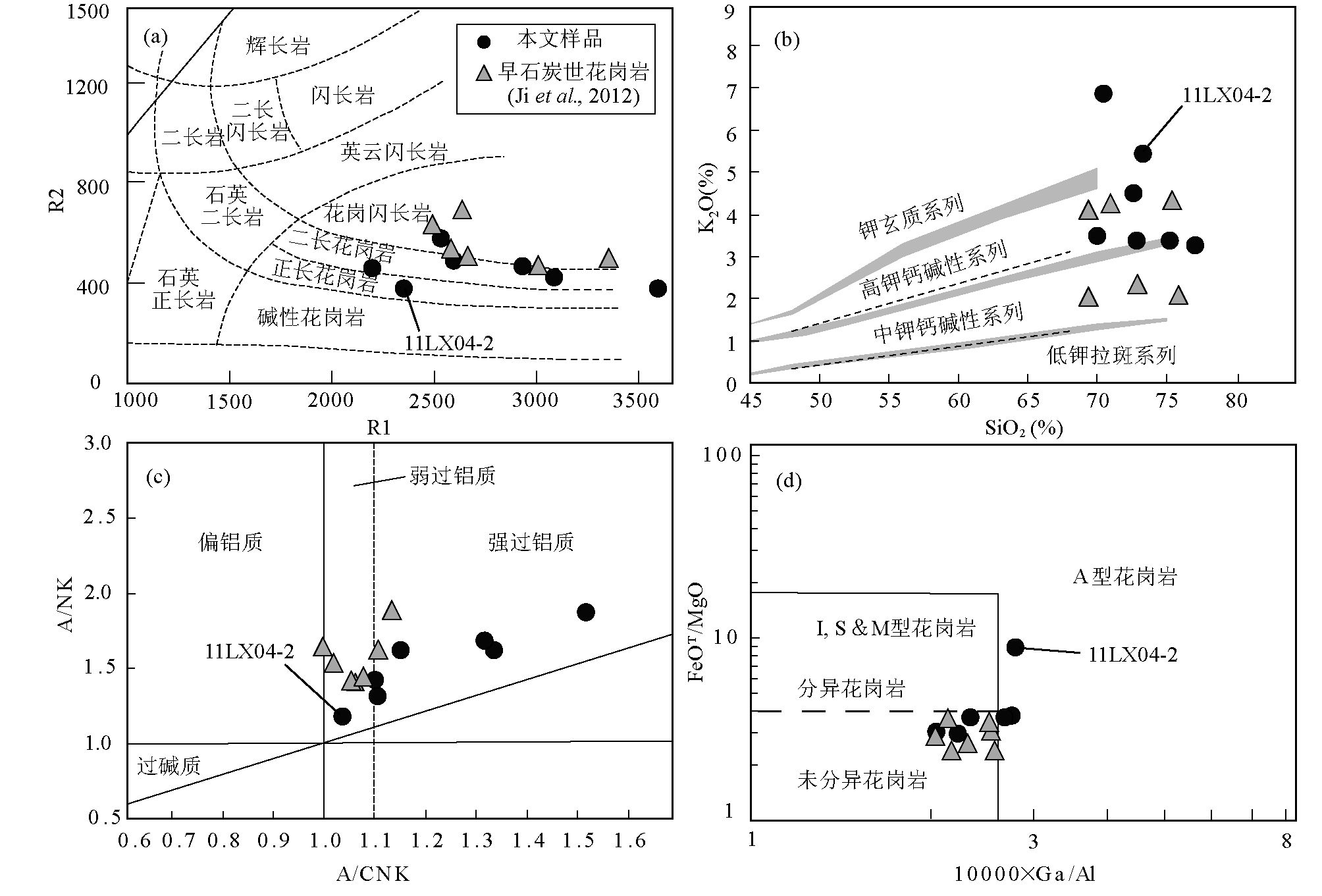
4.2 全岩地球化学朗县片麻状花岗岩样品以具有较高的SiO2含量(69.18%~75.64%)、全碱含量(Na2O+K2O=5.04%~9.10%)及高的K2O/Na2O比值(1.04~3.04)为特征(表 2),在成分上属高钾钙碱性到钾玄质系列的花岗闪长岩、二长花岗岩和正长花岗岩(图 4a, b)。除样品11LX04-2的分异指数较高外(DI=91),其它样品的分异指数均较低(DI=80~87)、铝饱和指数(A/CNK=1.10~1.52)和CIPW标准矿物中的刚玉分子数(1.39%~4.4%),为一套分异程度较低的弱过铝质-强过铝质花岗岩类(图 4c, d)。本文获得的数据,与Ji et al. (2012) 报道的朗县同期花岗岩(345~353Ma)数据略有不同,这些作者报道的样品主要为片麻状花岗闪长岩。
|
|
表 2 南部拉萨地体朗县地区早石炭世片麻状花岗岩类的全岩地球化学数据(主量元素:wt%;稀土和微量元素:×10-6) Table 2 Whole-rock geochemical data of the Early Carboniferous gneissic granitoids from Nang in the southern Lhasa subterrane (Major elements: wt%; Trace elements: ×10-6) |
|
图 4 朗县早石炭世片麻状花岗岩类选择性地球化学图解 (a)-R1-R2图解(据De La Roche et al., 1980);(b)-SiO2-K2O图解(据Rollinson, 1993);(c)-A/CNK-A/NK图解(据Maniar and Piccoli, 1989);(d)-10000×Ga/Al-FeOT/MgO图解(据Whalen et al., 1987) Fig. 4 Selected geochemical diagrams of the Early Carboniferous gneissic granitoids from Nang (a)-Plots of R1vs. R2 for the granitoids (after De La Roche et al., 1980); (b)-K2O vs. SiO2 diagram for classification of rock series (after Rollinson, 1993); (c)-A/NK vs. A/CNK diagram for the granitic rocks (after Maniar and Piccoli, 1989); (d)-FeOT/MgO vs. 10000×Ga/Al classification diagram for the samples (after Whalen et al., 1987) |
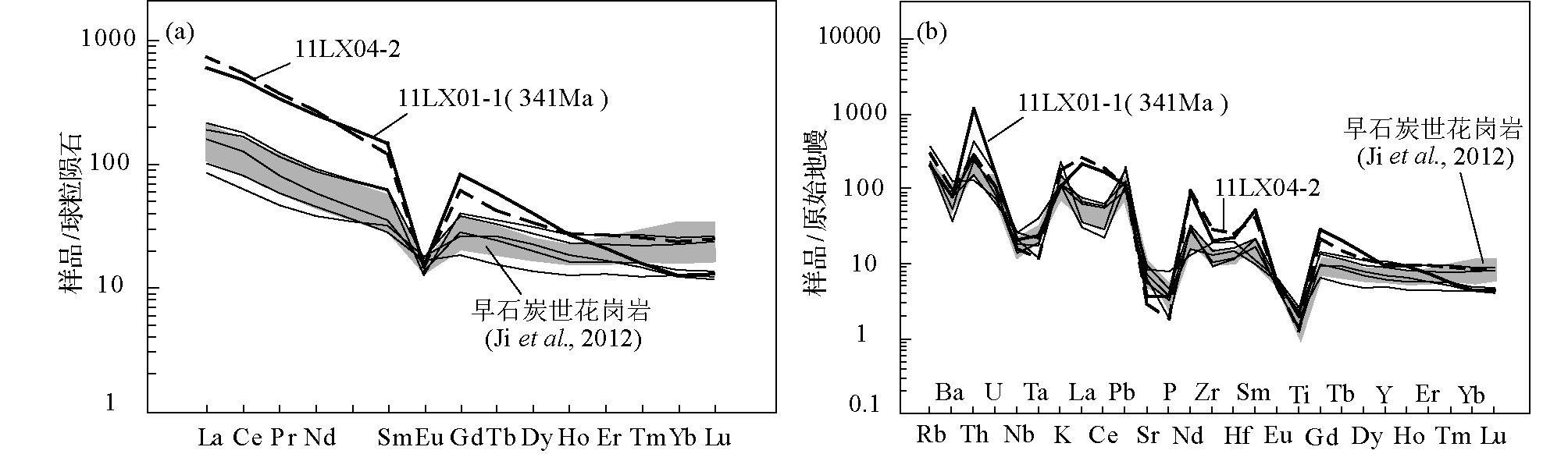
本文分析的片麻状花岗岩,除2件样品外(11LX01-1和11LX04-2),其余均表现出相似的稀土元素配分型式:不同程度地富集轻稀土元素〔LREE/HREE=4.65~17.15,(La/Yb)N=6.95~13.01〕(图 5a),具中等的负Eu异常(δEu=0.25~0.71)。在原始地幔标准化微量元素蜘蛛图上,样品富集大离子亲石元素(如Rb、K、Th和U)和Pb,明显亏损高场强元素(如Nb、Ta、P和Ti)以及Ba、Sr等(图 5b)。以上这些数据特征,与Ji et al. (2012) 报道的朗县片麻状花岗岩微量元素地球化学特征类似。样品11LX01-1和11LX04-2表现出非常显著的轻重稀土元素分异〔LREE/HREE=16.58~20.36,(La/Yb)N=31.21~48.51〕和负Eu异常(δEu=0.13~0.16)(图 5a)。在原始地幔标准化微量元素蜘蛛图上,这2件样品显著富集大离子亲石元素,亏损高场强元素(图 5b)。
|
图 5 朗县早石炭世片麻状花岗岩类稀土元素模式图(a)和微量元素蜘蛛图(b)(球粒陨石数值和原始地幔数值均据Sun and McDonough, 1989) 阴影部分数据据Ji et al. (2012) Fig. 5 Chondrite-normalized REE (a) and primitive mantle-normalized trace element patterns (b) of the Early Carboniferous gneissic granitoids from Nang (chondrite values and primitive mantle values after Sun and McDonough, 1989) Shaded area from Ji et al. (2012) |
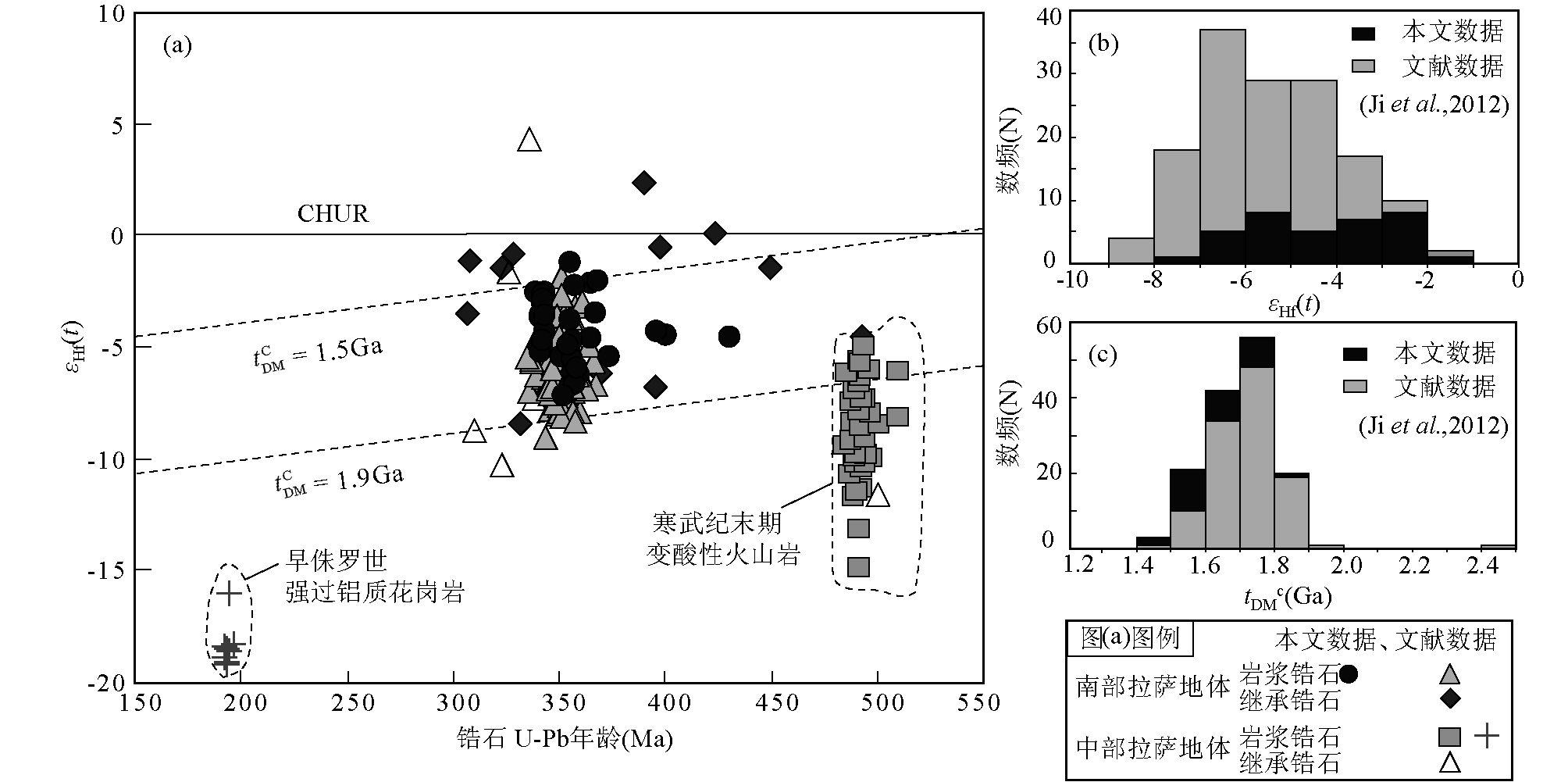
朗县片麻状花岗岩类样品11LX01-1的16个锆石测点的εHf(t)值为-5.0~-2.6 (表 3),对应的锆石Hf同位素地壳模式年龄(tDMC)为1.51~1.68Ga;另外4个继承锆石测点的εHf(t)值为-4.6~-2.1,tDMC为1.50~1.66Ga。样品11LX05-9的15个测点的εHf(t)值为-7.2~-1.2,tDMC为1.43~1.81Ga;另外4个继承锆石测点的εHf(t)值为-5.4~-4.2,tDMC为1.65~1.71Ga。由此可见,这2件样品具有近似的锆石εHf(t)值和tDMC模式年龄,其结果与近期报道的(Ji et al., 2012)朗县片麻状花岗岩类似(图 6)。
|
|
表 3 南部拉萨地体朗县地区早石炭世片麻状花岗岩锆石Hf同位素数据 Table 3 Zircon Hf isotopic data of the Early Carboniferous gneissic granitoids from Nang in the southern Lhasa subterrane |
|
图 6 朗县片麻状花岗岩类的锆石Hf同位素图解 (a)-锆石U-Pb年龄-εHf(t)图解(数据来源:本文; 李皓扬等, 2007; Chung et al, 2009; Ji et al., 2012); (b)-锆石εHf(t)值直方图(数据来源:本文; Ji et al., 2012); (c)-锆石Hf地壳模式年龄(tDMC)直方图(数据来源同图b) Fig. 6 Zircon Hf isotope diagrams of the gneissic granitoids from Nang (a)-plots of zircon U-Pb age vs εHf(t) (data sources: this study; Lee et al., 2007; Chung et al., 2009; Ji et al., 2012); (b)-histogram of zircon εHf(t) value for the granitoids (data sources: this study; Ji et al., 2012); (c)-histogram of zircon crustal model age (tDMC) for the granitoids (data sources are same as the figure 6b) |
本文获得的2件朗县片麻状花岗岩类的锆石U-Pb年龄分别为341Ma和355Ma,这表明朗县片麻状花岗岩浆活动发生在石炭纪早期。近年来,一些研究者先后报道了拉萨地体的晚泥盆-早石炭世岩浆岩。在中部拉萨地体东延部分的然乌地区,早石炭世诺错组地层中发育顺层产出的变玄武安山岩(约20m厚)以及少量薄层状变英安岩,被认为是石炭纪早期火山活动的产物(耿全如等, 2007)。在南部拉萨地体中,董昕等(2010) 首次报道了加查地区的晚泥盆世片麻状花岗岩(367Ma),Ji et al.(2012) 在加查和朗县地区分别发现了早石炭世岩浆岩(345~353Ma),这些岩石主要为片麻状花岗闪长岩,还包括同期的闪长质包体以及长英质岩脉。在中部拉萨地体和南部拉萨地体南缘出露的二叠纪-渐新世岩浆岩以及林子宗火山岩中,均含有中-晚泥盆世到石炭纪末期(390~300Ma)的继承锆石(Chu et al., 2006; 李皓扬等,2007; Zhu et al., 2009; 纪伟强, 2010)。另外,在晚白垩世日喀则弧前盆地碎屑沉积岩(Wu et al., 2010)和朗县北部雅鲁藏布江支流的现代河沙(Zhang et al., 2009)中,均报道有晚泥盆-早石炭世碎屑锆石。最近,笔者还在中部拉萨地体的申扎地区还发现了约365Ma的镁铁质岩浆活动记录(朱弟成等,未刊数据)。这些数据表明,拉萨地体发生了目前很难约束岩浆活动规模的晚泥盆-早石炭世岩浆活动(340~370Ma),其现今分布位置跨越了松多榴辉岩带。
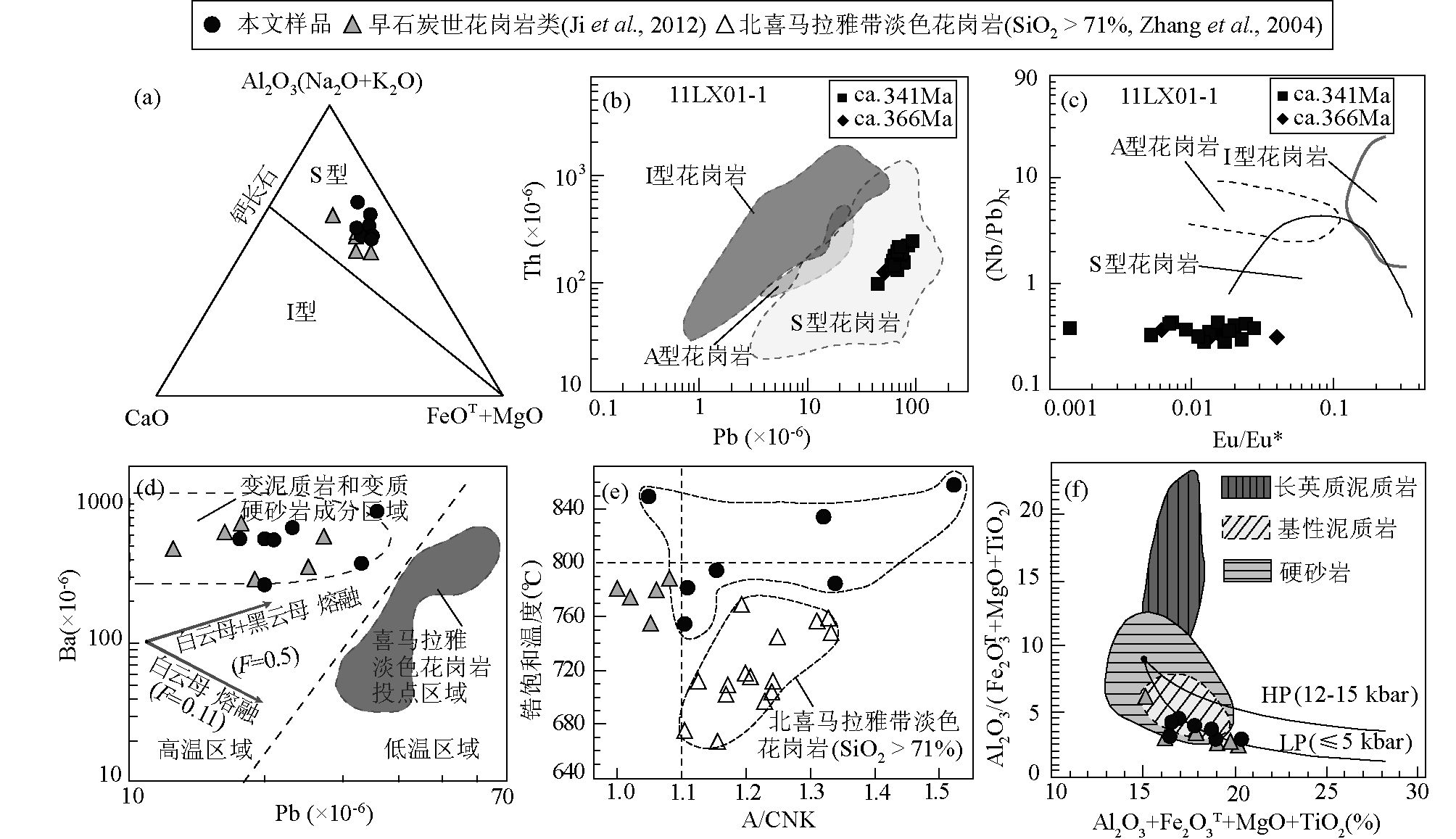
5.2 岩浆起源和岩石成因野外和岩相学观察表明,样品中均未出现角闪石,而出现一些富铝矿物(如原生白云母)。除11LX04-2外,其它样品均显示过铝质特征(A/CNK≥1.1,刚玉分子数>1%),表明其母岩浆来源于富铝岩石(如变泥质岩,包括大陆沉积物或成熟上地壳物质)的部分熔融。在ACF图上(图 7a;Chappell and White, 1992),样品全落入S型花岗岩区域。其中,样品11LX01-1的锆石以高的Pb丰度、低的Eu/Eu*和(Nb/Pb)N比值为特征,明显不同于I型花岗岩而类似于S型花岗岩(图 7b, c)(Wang et al., 2012)。这些信息表明,朗县片麻状花岗岩样品属S型花岗岩。与此不同的是,样品11LX04-2具有高的分异指数(DI=91),并且10000×Ga/Al比值=2.79(图 4d),Zr=316×10-6,Zr+Nb+Ce+Y=707×10-6,刚玉分子数低(0.57%),非常类似于A型花岗岩,很可能与其经历了高程度分异作用有关。
|
图 7 朗县片麻状花岗岩类的岩石成因类型及岩浆起源温度-压力条件判别图解 (a)-ACF图解(据Chappell and White, 1992); (b)-锆石Pb-Th图解(据Wang et al., 2012);(c)-锆石 Eu/Eu*-(Nb/Pb)N图解(据Wang et al., 2012);(d)-Pb-Ba图解(据Finger and Schiller, 2012);(e)-铝饱和指数(A/CNK)-锆饱和温度图解(北喜马拉雅淡色花岗岩数据引自Zhang et al. (2004) );(f)-早石炭世花岗岩类的成分与不同压力条件下实验熔体成分对比图(据Patiño Douce, 1999).其中:粗的实线代表反应线,HP为高压条件(P=12~15kbar); LP为低压条件(P≤5kbar) Fig. 7 Diagrams showing genetic types of the granitoids and P-T conditions of magma generation (a)-ACF diagram (A=Al2O3-(K2O+Na2O), C=CaO, F=FeOT+MgO, Chappell and White, 1992); (b)-Pb-Th diagram of zircons from the granitoids (Wang et al., 2012); (c)-plot of Eu/Eu* vs. (Nb/Pb)N of zircons from the granitoids (after Wang et al., 2012); (d)-Pb-Ba diagram (Finger and Schiller, 2012); (e)-plot of A/CNK vs temperature calculated by zircon saturation thermometry of the granitoids. Data sources: Northern Himalaya leucogranites (Zhang et al., 2004); (f)-compositions of the Early Carboniferous granitoids compared to melts produced by experiments during different pressure conditions (Patiño Douce, 1999). The thick solid lines represent the reaction curves: HP (P=12~15kbar), LP (P≤5kbar) |
一般认为,I型花岗岩由壳内变中基性火成岩部分熔融而来,而S型花岗岩则来源于中上地壳的变沉积岩(Chappell and Stephens, 1988; Chappell and White, 1992; Chappell, 1999)。朗县片麻状花岗岩高的K2O、TiO2、Rb和Cs含量、高K2O/Na2O比值(>1.0)、Rb/Sr比值(>1.0)和低Al2O3/TiO2比值(< 200)很可能指示其来源于含云母的变沉积岩的脱水熔融(Castro et al., 1999; Miller, 1985),而不是角闪岩类的脱水熔融(Gerdes et al., 2002)。朗县片麻状花岗岩类以负的锆石εHf(t)值(平均-4.4,图 6b)和古老的Hf同位素地壳模式年龄(1.5~1.8Ga, 图 6c)为特征,表明其很可能来源于南部拉萨地体自身古老地壳物质的重熔。但与中部拉萨地体主要来源于古老地壳物质重熔形成的寒武纪末期变质酸性火山岩(εHf(t)=-14.7~-4.8; 朱弟成等, 2012)和早侏罗世强过铝质S型花岗岩(εHf(t)=-20.5~-16.0; Zhu et al., 2011)相比(图 6a),朗县片麻状花岗岩具有明显增高的锆石εHf(t)值,这很可能暗示幔源物质在其形成过程中发挥了作用。这一解释还得到了下述三点观察的支持:(1) Finger and Schiller (2012) 根据不同温度条件下,Pb和Ba在熔体及残留相之间分配性质的差异,识别出了高温和低温S型花岗岩,本文朗县片麻状花岗岩样品属于高温S型花岗岩(图 7d);(2) 朗县片麻状花岗岩具有较高的锆饱和温度(Watson and Harrison, 1983),变化于754~859℃(平均为808℃)(图 7e),明显高于北喜马拉雅S型花岗岩;(3) 朗县片麻状花岗岩类中同期的闪长质包体(Ji et al., 2012),也暗示了幔源物质或新生地壳(很可能是前者)在朗县片麻状花岗岩形成过程中的作用。
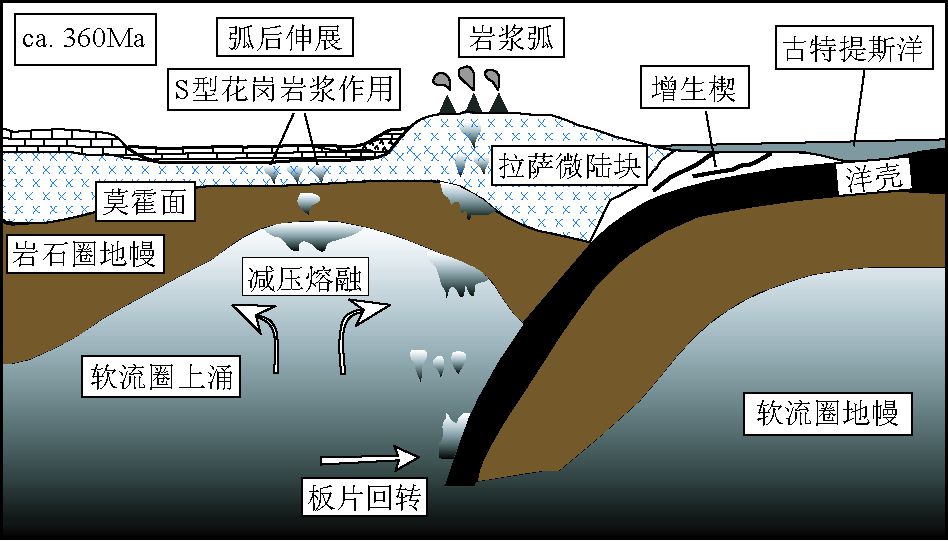
5.3 地球动力学解释早期研究一般认为S型花岗岩形成于碰撞(挤压)背景(Pitcher, 1997; Barbarin, 1999),但近来的研究已揭示S型花岗岩很多情况下是形成于晚造山或后造山伸展背景(Clemens, 2003; 吴福元等, 2007),甚至非造山环境(Li et al., 2003)。本文所获得数据中,除样品11LX04-2为高分异岩石外,其它均属未分异花岗岩类(图 4d)。除样品11LX04-2外,其他样品低Sr(Sr<172×10-6)和低Sr/Y比值(Sr/Y<7)均指示源区形成深度较浅。在已有实验模拟结果图解上,本文样品和低压反应线趋势一致(图 7f, Patiño Douce, 1999),表明其母岩浆很可能起源于15km的地壳深度以上(P<5kbar)。朗县片麻状花岗岩地球化学数据所揭示的这种低压高温环境,指示其很可能形成于一种伸展背景。结合拉萨地体泥盆纪地层以细碎屑岩和火山碎屑岩夹火山岩为特征的地质事实(潘桂棠等, 2004; 耿全如等, 2007; 王立全等, 2008),本文提出朗县片麻状花岗岩类很可能形成于弧后伸展背景(图 8),位于朗县以北中部拉萨地体上的石炭-二叠纪来姑组和诺错组弧火山岩(王立全等, 2008)可能代表了对应的岩浆弧。
|
图 8 朗县早石炭世花岗岩类的成因模式图(据Collins et al., 2008修改) Fig. 8 Schematic illustration for the generation of the Early Carboniferous granitoids from Nang (modified after Collins et al., 2008) |
研究表明,在大约470Ma印度大陆北部的Bhimphedian造山作用结束之后(Cawood et al., 2007),冈瓦纳大陆北缘转换为被动大陆边缘,或由于俯冲带后撤形成了开阔的弧后盆地(Cawood et al., 2009),并可能持续到古特提斯开启之时(朱弟成等, 2012)。古特提斯洋最初可能在奥陶纪晚期以弧后盆地的方式开启,到泥盆纪时期已经发展到一定规模并发生了北向俯冲(Stampfli and Borel, 2002; Metcalfe, 2009)。位于冈瓦纳大陆北缘的拉萨(以及南羌塘等)微陆块上泥盆纪末期-石炭纪早期岩浆活动记录,指示古特提斯洋那时可能发生了向冈瓦纳大陆北缘的俯冲。随后的岩浆作用可能与俯冲的古特提斯洋岩石圈的回转有关,其结果是引起软流圈上涌并发生减压熔融,导致古老地壳来源的花岗质熔体中幔源物质的明显增加,这类似于环太平洋造山带中侵位于弧后伸展背景的S型花岗岩(Collins and Richards, 2008)。已有研究(王立全等, 2008)和本文数据为这种推测的岩浆弧-弧后伸展系统的解释提供了年代学、岩石学和地球化学支持。
如前所述,目前发现的晚泥盆-早石炭世岩浆活动(340~370Ma)分布位置跨越了松多榴辉岩带,这意味着松多特提斯洋在那时尚未开启。随着弧后伸展进一步发育,就可能形成弧后盆地并最终发展成以松多榴辉岩为代表的松多特提斯洋(Chen et al., 2009; Li et al., 2009; Yang et al., 2009),并在中二叠世末期关闭(Zhu et al., 2009, 2010, 2013)。如果这种解释是合理的,那么很可能意味着松多特提斯洋的持续时间不超过80Myr(即从340 Ma到260 Ma)。
6 结论(1) 新的锆石U-Pb定年结果表明朗县片麻状花岗岩类的侵位时代为早石炭世(341~355Ma)。
(2) 朗县片麻状花岗闪长岩和二长花岗岩属于高钾钙碱性-钾玄质系列,均富集轻稀土元素和大离子亲石元素,明显亏损Ba、Eu、Sr和高场强元素。
(3) 矿物组合、全岩主量和微量元素、锆石微量元素等多种指标指示朗县片麻状花岗岩类属于高温型过铝质S型花岗岩,来源于南部拉萨地体自身古老地壳物质的重熔,并混入了明显的幔源物质。
(4) 区域沉积记录和朗县片麻状花岗岩类的高温低压性质指示其很可能形成于弧后伸展背景,该弧后伸展区的进一步发育可能形成弧后盆地并最终发展成以松多榴辉岩为代表的松多特提斯洋。
| [] | Andersen T. 2002. Correction of common lead in U-Pb analyses that do not report 204Pb. Chemical Geology, 192(1-2): 59–79. DOI:10.1016/S0009-2541(02)00195-X |
| [] | Barbarin B. 1999. A review of the relationships between granitoid types, their origins and their geodynamic environments. Lithos, 46(3): 605–626. DOI:10.1016/S0024-4937(98)00085-1 |
| [] | Blichert TJ, Albarede F. 1997. The Lu-Hf geochemistry of chondrites and the evolution of the mantle-crust system. Earth and Planetary Science Letters, 148(1-2): 243–258. DOI:10.1016/S0012-821X(97)00040-X |
| [] | Castro A, Patiño Douce AE, Gurllermo Corretgé L, De la Rosa JD, El-Biad M, El-Hmidi H. 1999. Origin of peraluminous granites and granodiorites, Iberian massif, Spain: An experimental test of granite petrogenesis. Contributions to Mineralogy and Petrology, 135(2-3): 255–276. DOI:10.1007/s004100050511 |
| [] | Cawood PA, Johnson MRW, Nemchin AA. 2007. Early Palaeozoic orogenesis along the Indian margin of Gondwana: Tectonic response to Gondwana assembly. Earth and Planetary Science Letters, 255(1-2): 70–84. DOI:10.1016/j.epsl.2006.12.006 |
| [] | Cawood PA, Kröner A, Collins WJ, Kusky TM, Mooney WD, Windley BF. 2009. Accretionary orogens through Earth history. Geological Society, London, Special Publications, 318(1): 1–36. DOI:10.1144/SP318 |
| [] | Chappell BW, Stephens WE. 1988. Origin of infracrusta (I-type) granite magmas. Transactions of the royal society of Edinburgh-Earth Sciences, 79(2-3): 71–86. DOI:10.1017/S0263593300014139 |
| [] | Chappell BW, White AJR. 1992. I- and S-type granites in the Lachlan Fold Belt. Transactions of the Royal Society of Edinburgh: Earth Sciences, 83(1-2): 1–26. DOI:10.1017/S0263593300007720 |
| [] | Chappell BW. 1999. Aluminium saturation in I- and S-type granites and the characterization of fractionated haplogranites. Lithos, 46(3): 535–551. DOI:10.1016/S0024-4937(98)00086-3 |
| [] | Chen SY, Yang JS, Xu XZ, Li HQ, Yang YH. 2008. Study of Lu-Hf geochemical tracing and LA-ICPMS U-Pb isotopic dating of the Sumdo eclogite from the Lhasa Block, Tibet. Acta Petrologica Sinica, 24(7): 1528–1538. |
| [] | Chen SY, Yang JS, Li Y, Xu XZ. 2009. Ultramafic blocks in Sumdo region, Lhasa Block, eastern Tibet Plateau: An ophiolite unit. Journal of Earth Science, 20(2): 332–347. DOI:10.1007/s12583-009-0028-x |
| [] | Chu MF, Chung SL, Song B, Liu DY, O'Reilly SY, Pearson NJ, Ji JQ, Wen DJ. 2006. Zircon U-Pb and Hf isotope constraints on the Mesozoic tectonics and crustal evolution of southern Tibet. Geology, 34(9): 745–748. DOI:10.1130/G22725.1 |
| [] | Chung SL, Chu MF, Zhang YQ, Xie YW, Lo CH, Lee TY, Lan CY, Li XH, Zhang Q, Wang YZ. 2005. Tibetan tectonic evolution inferred from spatial and temporal variations in post-collisional magmatism. Earth-Science Reviews, 68(3-4): 173–196. |
| [] | Chung SL, Chu MF, Ji JQ, O'Reilly SY, Pearson NJ, Liu DY, Lee TY, Lo CH. 2009. The nature and timing of crustal thickening in southern Tibet: Geochemical and zircon Hf isotopic constraints from postcollisional adakites. Tectonophysics, 477(1-2): 36–42. DOI:10.1016/j.tecto.2009.08.008 |
| [] | Clemens JD. 2003. S-type granitic magmas-petrogenetic issues, models and evidence. Earth-Science Reviews, 61(1-2): 1–18. DOI:10.1016/S0012-8252(02)00107-1 |
| [] | Collins WJ, Richards SW. 2008. Geodynamic significance of S-type granites in circum-Pacific orogens. Geology, 36(7): 559–562. DOI:10.1130/G24658A.1 |
| [] | De La Roche H, Leterrier J, Grande Claude P, Marchal M. 1980. A classification of volcanic and Plutonic rocks using R1-R2 diagrams and major element analysis: Its relationships with current nomenclature. Chemical Geology, 29: 183–210. DOI:10.1016/0009-2541(80)90020-0 |
| [] | Dong X, Zhang ZM, Geng GS, Liu F, Wang W, Yu F. 2010. Devonian magmatism from the southern Lhasa terrane, Tibetan Plateau. Acta Petrologica Sinica, 26(7): 2226–2232. |
| [] | Finger F, Schiller D. 2012. Lead contents of S-type granites and their petrogenetic significance. Contributions to Mineralogy and Petrology, 164(5): 747–755. DOI:10.1007/s00410-012-0771-3 |
| [] | Gao S, Liu XM, Yuan HL, Hattendorf B, Günther D, Chen L, Hu SH. 2002. Determination of forty two major and trace elements in USGS and NIST SRM glasses by laser ablation-inductively coupled plasma-mass spectrometry. Geostandards Newsletter, 26(2): 181–196. DOI:10.1111/ggr.2002.26.issue-2 |
| [] | Geng QR, Wang LQ, Pan GT, Jin ZM, Zhu DC, Liao ZL, Li GM, Li FQ. 2007. Carboniferous marginal rifting in Gangdese: Volcanic rocks and stratigraphic constraints, Xizang (Tibet), China. Acta Geologica Sinica, 81(9): 1259–1276. |
| [] | Gerdes A, Montero P, Bea F, Fershater G, Borodina N, Osipova T, Shardakova G. 2002. Peraluminous granites frequently with mantle-like isotope compositions: The continental-type Murzinka and Dzhabyk batholiths of the eastern Ural. International Journal of Earth Sciences, 91(1): 3–19. DOI:10.1007/s005310100195 |
| [] | Griffin WL, Wang X, Jackson SE, Pearson NJ, O'Reilly SY, Xu XS, Zhou XM. 2002. Zircon chemistry and magma mixing, SE China: In-situ analysis of Hf isotopes, Tonglu and Pingtan igneous complexes. Lithos, 61(3-4): 237–269. DOI:10.1016/S0024-4937(02)00082-8 |
| [] | Hoskin PWO, Schaltegger U. 2003. The composition of zircon and igneous and metamorphic petrogenesis. In: Manchar JM and Hoskin PWO (eds.). Zircon. Reviews of Mineralogy and Geochemistry, 53: 27–62. DOI:10.2113/0530027 |
| [] | Hou KJ, Li YH, Zou TR, Qu XM, Shi YR, Xie GQ. 2007. Laser ablation-MC-ICP-MS technique for Hf isotope microanalysis of zircon and its geological applications. Acta Petrologica Sinica, 23(10): 2595–2604. |
| [] | Ji WQ, Wu FY, Chung SL, Li JX, Liu CZ. 2009. Zircon U-Pb geochronology and Hf isotopic constraints on petrogenesis of the Gangdese batholith, southern Tibet. Chemical Geology, 262(3-4): 229–245. DOI:10.1016/j.chemgeo.2009.01.020 |
| [] | Ji WQ. 2010. Geochronology and petrogenesis of granitic rocks from east segment of the Gangdese batholith, southern Tibet. Ph. D. Dissertation. Beijing:Institute of Geology and Geophysics, Chinese Academy of Sciences (in Chinese with English summary) |
| [] | Ji WQ, Wu FY, Chung SL, Liu CZ. 2012. Identification of Early Carboniferous granitoids from southern Tibet and implications for terrane assembly related to the Paleo-Tethyan evolution. The Journal of Geology, 120(5): 531–541. DOI:10.1086/666742 |
| [] | Lee HY, Chung SL, Wang YB, Zhu DC, Yang JH, Song B, Liu DY, Wu FY. 2007. Age, petrogenesis and geological significance of the Linzizong volcanic successions in the Linzhou basin, Southern Tibet: Evidence from zircon U-Pb data and Hf isotopes. Acta Petrologica Sinica, 23(2): 493–500. |
| [] | Li XH, Li ZX, Ge WC, et al. 2003. Neoproterozoic granitoids in South China: Crustal melting above a mantle plume at ca. 825Ma. Precambrian Research, 122(1-4): 45–83. DOI:10.1016/S0301-9268(02)00207-3 |
| [] | Li ZL, Yang JS, Xu ZQ, Li TF, Xu XZ, Ren YF, Robinson PT. 2009. Geochemistry and Sm-Nd and Rb-Sr isotopic composition of eclogite in the Lhasa terrane, Tibet, and its geological significance. Lithos, 109(3-4): 240–247. DOI:10.1016/j.lithos.2009.01.004 |
| [] | Liu YS, Hu ZC, Gao S, Günthe D, Xu J, Gao CG, Chen HH. 2008. In situ analysis of major and trace elements of anhydrous minerals by LA-ICP-MS without applying an internal standard. Chemical Geology, 257(1-2): 34–43. DOI:10.1016/j.chemgeo.2008.08.004 |
| [] | Liu YS, Hu ZC, Zong KQ, Gao CG, Gao S, Xu J, Chen HH. 2010. Reappraisement and refinement of zircon U-Pb isotope and trace element analyses by LA-ICP-MS. Chinese Science Bullletin, 55(15): 1535–1546. DOI:10.1007/s11434-010-3052-4 |
| [] | Maniar PD, Piccoli PM. 1989. Tectonic discrimination of granitoids. Geological Society of America Bulletin, 101(5): 635–643. DOI:10.1130/0016-7606(1989)101<0635:TDOG>2.3.CO;2 |
| [] | Metcalfe I. 2009. Late Palaeozoic and Mesozoic tectonic and palaeogeographical evolution of SE Asia. The Geological Society, London, Special Publications, 315: 7–23. DOI:10.1144/SP315.2 |
| [] | Miller CF. 1985. Are strongly peraluminous magmas derived from pelitic sedimentary sources. The Journal of Geology, 93(6): 673–689. DOI:10.1086/628995 |
| [] | Mo XX, Zhao ZD, Deng J, Dong GC, Zhou S, Guo TY, Zhang SQ, Wang LL. 2003. Response of volcanism to the India-Asia collision. Earth Sciences Frontiers, 10(3): 135–148. |
| [] | Mo XX, Dong GC, Zhao ZD, Zhou S, Wang LL, Qiu RZ, Zhang FQ. 2005. Spatial and temporal distribution and characteristics of granitoids in the Gangdese, Tibet and implication for crustal growth and evolution. Geological Journal of China Universities, 11(3): 281–290. |
| [] | Mo XX, Niu YL, Dong GC, Zhao ZD, Hou ZQ, Zhou SQ, Ke S. 2008. Contribution of syncollisional felsic magmatism to continental crust growth: A case study of the Paleogene Linzizong volcanic succession in southern Tibet. Chemical Geology, 250(1-4): 49–67. DOI:10.1016/j.chemgeo.2008.02.003 |
| [] | Morel MLA, Nebel O, Nebel-Jacobsen YJ, Miller JS, Vroon PZ. 2008. Hafnium isotope characterization of the GJ-1 zircon reference material by solution and laser-ablation MC-ICPMS. Chemical Geology, 255(1-2): 231–235. DOI:10.1016/j.chemgeo.2008.06.040 |
| [] | Pan GT, Wang LQ, Zhu DC. 2004. Thoughts on some important scientific problems in regional geological survey of the Qinghai-Tibet Plateau. Geological Bulletin of China, 23(1): 12–19. |
| [] | Patiño Douce AE. 1999. What do experiments tell us about the relative contributions of crust and mantle to the origin of granitic magmas. Geological Society, London, Special Publications, 168(1): 55–75. DOI:10.1144/GSL.SP.1999.168.01.05 |
| [] | Pitcher WS. 1997. The Nature and Origin of Granite. 2nd Edition. London: Chapman and Hall. |
| [] | Rollinson HR. 1993. Using Geochemical Data: Evaluation, Presentation, Interpretation. New York: Longman Scientific & Technical: 1-352. |
| [] | Scherer E, Munker C, Mezger K. 2001. Calibration of the Lutetium-Hafnium clock. Science, 293(5530): 683–687. DOI:10.1126/science.1061372 |
| [] | Soderlund U, Patchett PJ, Vervoort JD, Isachsen CE. 2004. The 176Lu decay constant determined by Lu-Hf and U-Pb isotope systematics of Precambrian mafic intrusions. Earth and Planetary Science Letters, 219(3-4): 311–324. DOI:10.1016/S0012-821X(04)00012-3 |
| [] | Stampfli GM amd Borel GD. 2002. A plate tectonic model for the Paleozoic and Mesozoic constrained by dynamic plate boundaries and restored synthetic oceanic isochrons. Earth and Planetary Science Letters, 196(1-2): 17–33. DOI:10.1016/S0012-821X(01)00588-X |
| [] | Sun SS, McDonough WF. 1989. Chemical and isotopic systematics of oceanic basalts: Implications for mantle composition and processes. In: Saunders AD and Norry MJ (eds.). Magmatism in the Ocean Basins. Geological Society, London, Special Publication, 42(1): 313–345. DOI:10.1144/GSL.SP.1989.042.01.19 |
| [] | Wang LQ, Pan GT, Zhu DC, Zhou CY, Yuan SH, Zhang WP. 2008. Carboniferous-Permian island arc orogenesis in the Gangdise belt, Tibet, China: Evidence from volcanic rocks and geochemistry. Geological Bulletin of China, 27(9): 1509–1534. |
| [] | Wang Q, Zhu DC, Zhao ZD, Guan Q, Zhang XQ, Sui QL, Hu ZC, Mo XX. 2012. Magmatic zircons from I-, S- and A-type granitoids in Tibet: Trace element characteristics and their application to detrital zircon provenance study. Journal of Asian Earth Sciences, 53: 59–66. DOI:10.1016/j.jseaes.2011.07.027 |
| [] | Watson EB, Harrison TM. 1983. Zircon saturation revisited: Temperature and composition effects in a variety of crustal magma types. Earth and Planetary Science Letters, 64(2): 295–304. DOI:10.1016/0012-821X(83)90211-X |
| [] | Whalen JB, Currie KL, Chappell BW. 1987. A-type granites: Geochemical characteristics, discrimination and petrogenesis. Contributions to Mineralogy and Petrology, 95(4): 407–419. DOI:10.1007/BF00402202 |
| [] | Wu FY, Li XH, Yang JH, Zheng YF. 2007. Discussions on the petrogenesis of granites. Acta Petrologica Sinica, 23(6): 1217–1238. |
| [] | Wu FY, Ji WQ, Liu CZ, Chung SL. 2010. Detrital zircon U-Pb and Hf isotopic data from the Xigaze fore-arc basin: Constraints on Transhimalayan magmatic evolution in southern Tibet. Chemical Geology, 271(1-2): 13–25. DOI:10.1016/j.chemgeo.2009.12.007 |
| [] | Yang JS, Xu ZQ, Li TF, Li HQ, Li ZL, Ren YF, Xu XZ, Chen SY. 2007. Oceanic subduction-type eclogite in the Lhasa block, Tibet, China: Remains of the Paleo-Tethys ocean basin. Geological Bulletin of China, 26(10): 1277–1287. |
| [] | Yang JS, Xu ZQ, Li ZL, Xu XZ, Li TF, Ren YF, Li HQ, Chen SY, Robinson PT. 2009. Discovery of an eclogite belt in the Lhasa block, Tibet: A new border for Paleo-Tethys. Journal of Asian Earth Sciences, 34(1): 76–89. DOI:10.1016/j.jseaes.2008.04.001 |
| [] | Zhang HF, Harris N, Parrish R, et al. 2004. Causes and consequences of protracted melting of the mid-crust exposed in the North Himalayan antiform. Earth and Planetary Science Letters, 228(1-2): 195–212. DOI:10.1016/j.epsl.2004.09.031 |
| [] | Zhang JY, Yin A, Wu FY, Dai JG and Liu W. 2009. Coupled U-Pb dating and Hf isotopic analysis of detrital zircons from modern sand of the Yalu River system (Yarlung Tsangpo) in southern Tibet: Implications for Himalayan provenance analysis and drainage reconstruction. In: American Geophysical Union, Fall Meeting 2009, abstract JHJT43B-2072 |
| [] | Zhang ZM, Dong X, Santosh M and Zhao GC. 2012. Metamorphism and tectonic evolution of the Lhasa terrane, Central Tibet. Gondwana Research, doi: 10.1016/j.gr.2012.08.24 |
| [] | Zhu DC, Pan GT, Mo XX, Wang LQ, Liao ZL, Zhao ZD, Dong GC, Zhou CY. 2006. Late Jurassic-Early Cretaceous geodynamic setting in middle-northern Gangdese: New insights from volcanic rocks. Acta Petrologica Sinica, 22(3): 534–546. |
| [] | Zhu DC, Mo XX, Niu YL, Zhao ZD, Wang LQ, Pan GT, Wu FY. 2009. Zircon U-Pb dating and in-situ Hf isotopic analysis of Permian peraluminous granite in the Lhasa terrane, southern Tibet: Implications for Permian collisional orogeny and paleogeography. Tectonophysics, 469(1-4): 48–60. DOI:10.1016/j.tecto.2009.01.017 |
| [] | Zhu DC, Mo XX, Zhao ZD, Niu YL, Wang LQ, Chu QH, Pan GT, Xu JF, Zhou CY. 2010. Presence of Permian extension- and arc-type magmatism in southern Tibet: Paleogeographic implications. Geological Society of America Bulletin, 122(7-8): 979–993. DOI:10.1130/B30062.1 |
| [] | Zhu DC, Zhao ZD, Niu YL, Mo XX, Chung SL, Hou ZQ, Wang LQ, Wu FY. 2011. The Lhasa Terrane: Record of a microcontinent and its histories of drift and growth. Earth and Planetary Science Letters, 301(1-2): 241–255. DOI:10.1016/j.epsl.2010.11.005 |
| [] | Zhu DC, Zhao ZD, Niu YL, Wang Q, Dilek Y, Dong GC, Mo XX. 2012. Origin and Paleozoic tectonic evolution of the Lhasa Terrane. Geological Journal of China Universities, 18(1): 1–15. |
| [] | Zhu DC, Zhao ZD, Niu YL, Dilek Y, Hou ZQ, Mo XX. 2013. The origin and pre-Cenozoic evolution of the Tibetan Plateau. Gondwana Research, 23(4): 1429–1454. DOI:10.1016/j.gr.2012.02.002 |
| [] | 陈松永, 杨经绥, 徐向珍, 李化启, 杨岳衡. 2008. 西藏拉萨地块松多榴辉岩的锆石Lu/Hf同位素研究及LA-ICPMS U-Pb定年. 岩石学报, 24(7): 1528–1538. |
| [] | 董昕, 张泽明, 耿官升, 刘峰, 王伟, 于飞. 2010. 青藏高原拉萨地体南部的泥盆纪花岗岩. 岩石学报, 26(7): 2226–2232. |
| [] | 耿全如, 王立全, 潘桂棠, 金振民, 朱弟成, 廖忠礼, 李光明, 李奋其. 2007. 西藏冈底斯带石炭纪陆缘裂陷作用: 火山岩和地层学证据. 地质学报, 81(9): 1259–1276. |
| [] | 侯可军, 李延河, 邹天人, 曲晓明, 石玉若, 谢桂青. 2007. LA-MC-ICP-MS锆石Hf同位素的分析方法及地质应用. 岩石学报, 23(10): 2595–2604. |
| [] | 纪伟强. 2010. 藏南冈底斯岩基东段花岗质岩石的年代与成因. 博士学位论文. 北京: 中国科学院地质与地球物理研究所 |
| [] | 李皓扬, 钟孙霖, 王彦斌, 朱弟成, 杨进辉, 宋彪, 刘敦一, 吴福元. 2007. 藏南林周盆地林子宗火山岩的时代、成因及其地质意义: 锆石U-Pb年龄和Hf同位素证据. 岩石学报, 23(2): 493–500. |
| [] | 莫宣学, 赵志丹, 邓晋福, 董国臣, 周肃, 郭铁鹰, 张双全, 王亮亮. 2003. 印度-亚洲大陆主碰撞过程的火山作用响应. 地学前缘, 10(3): 135–148. |
| [] | 莫宣学, 董国臣, 赵志丹, 周肃, 王亮亮, 邱瑞照, 张风琴. 2005. 西藏冈底斯带花岗岩的时空分布特征及地壳生长演化信息. 高校地质学报, 11(3): 281–290. |
| [] | 潘桂棠, 王立全, 朱弟成. 2004. 青藏高原区域地质调查中几个重大科学问题的思考. 地质通报, 23(1): 12–19. |
| [] | 王立全, 潘桂棠, 朱弟成, 周长勇, 袁四化, 张万平. 2008. 西藏冈底斯带石炭纪-二叠纪岛弧造山作用: 火山岩和地球化学证据. 地质通报, 27(9): 1509–1534. |
| [] | 吴福元, 李献华, 杨进辉, 郑永飞. 2007. 花岗岩成因研究的若干问题. 岩石学报, 23(6): 1217–1238. |
| [] | 杨经绥, 许志琴, 李天福, 李化启, 李兆丽, 任玉峰, 徐向珍, 陈松永. 2007. 青藏高原拉萨地块中的大洋俯冲型榴辉岩: 古特提斯洋盆的残留. 地质通报, 26(10): 1277–1287. |
| [] | 朱弟成, 潘桂棠, 莫宣学, 王立全, 廖忠礼, 赵志丹, 董国臣, 周长勇. 2006. 冈底斯中北部晚侏罗世-早白垩世地球动力学环境: 火山岩约束. 岩石学报, 22(3): 534–546. |
| [] | 朱弟成, 赵志丹, 牛耀龄, 王青, DilekY, 董国臣, 莫宣学. 2012. 拉萨地体的起源和古生代构造演化. 高校地质学报, 18(1): 1–15. |