 2013, Vol. 29


2. 中国科学院大学,北京 100049
2. University of Chinese Academy of Sciences, Beijing 100049, China
大火成岩省中亏损亲硫元素的玄武岩与共生的硫化物矿床有密切的成因联系(Naldrett, 1992, 1999; Naldrett et al., 1992, 1996; Song et al., 2006; Li and Ripley, 2009)。岩浆在演化过程中受不同机制的作用,岩浆中的硫达到饱和并发生硫化物熔体的熔离。由于亲硫元素(Ni,Cu和PGE等)具有很高的硫化物-硅酸盐熔体分配系数,导致这些元素强烈进入硫化物相,而使硅酸盐熔体亏损这些元素。亏损亲硫元素的岩浆侵位喷发,形成亏损这些元素的玄武岩。研究表明,存在多种因素促使岩浆达到硫饱和而发生硫化物熔体的熔离(Li et al., 2001;Wang et al., 2007, 2010; Tao et al., 2007)。这些因素包括:地壳富硅物质的加入;岩浆的分离结晶作用;不同成分岩浆的混合;岩浆过度冷却;地壳硫的加入(Li et al., 2001; Li and Ripley, 2005; Naldrett, 1999; Ripley et al., 2003)。不同的矿床,其硫饱和可能是上面一种或多种因素共同作用的结果。
位于中国西南部和越南北部的峨眉山LIP发育了大量规模不等的岩浆型硫化物矿床和含硫化物的侵入岩体(Zhou et al., 2002; Song et al., 2008a)。根据硫化物含量以及PGE的含量,这些矿床被分为富硫化物贫PGE的Cu-Ni硫化物矿床包括力马河,白马寨等;富硫化物含中等程度PGE的Cu-Ni-PGE硫化物矿床包括青矿山和杨柳坪等;以及贫硫化物富PGE的硫化物矿床如金宝山和朱布等(Song et al., 2008a)。陶琰等(陶琰等,2007;Tao et al., 2008)对力马河硫化物矿床进行了研究,提出早期原始岩浆在深部发生地壳同化混染和橄榄石分离结晶导致硫化物熔离形成了亏损PGE的岩浆,这种亏损PGE的岩浆在后期上升过程中再次同化混染地壳物质而使硫饱和发生硫化物熔离形成富集Cu、Ni而贫PGE的熔体。金宝山硫化物矿以富含Pt-Pd为特征,被认为是早期未发生硫化物分离的原始岩浆发生大量铬铁矿和橄榄石的分离结晶导致硫过饱和的,由于Pt-Pd对于铬铁矿和橄榄石来说为不相容元素(Barnes and Lightfoot, 2005; Naldrett, 2010),这两种矿物的分离结晶将导致残余岩浆中的Pt-Pd含量升高;熔离的硫化物在岩浆通道内与流经的岩浆不断反应而越来越富集Pt和Pd(Wang et al., 2005, 2010; Tao et al., 2007)。白马寨铜镍硫化物矿床中块状矿石和硅酸盐侵入体具有相似的Pd/Pt和Cu/Pd比值,且侵入体具有负的εNd值,被认为是岩浆经历硅酸盐矿物分离结晶及地壳同化混染达到硫饱和,发生一次硫化物熔离形成的(Wang and Zhou, 2006; Wang et al., 2006)。这主要是由于Pt、Pd和Cu在硫不饱和的岩浆中总分配系数各不相同,随着岩浆演化,Pd/Pt和Cu/Pd比值将发生变化,当岩浆只经历一次硫化物熔离过程时,才能形成均一的元素比值(Lightfoot and Keays, 2005)。青矿山硫化物矿既含有较高的Cu和Ni,又具有中等含量的PGE,被认为是早期经历中等程度(0.01%~0.025%)硫化物熔离的岩浆再次硫饱和发生硫化物熔离而形成的(Song et al., 2008a; 朱飞霖等, 2011)。上述研究普遍认为地壳混染以及矿物分离结晶作用在硫化物成矿过程中发挥了重要作用。然而这些研究都只做了定性的研究,没有定量化地确定矿物的分离结晶量,矿物结晶对成矿元素含量的影响以及岩浆的硫饱和度的演变等问题。本文以白马寨铜镍硫化物矿为例,拟通过选取合理的原生岩浆,利用MELTS程序(Ghiorso and Sack, 1995; Asimow and Ghiorso, 1998; Smith and Asimow, 2005),详细刻画岩浆的演化成矿过程,将定量化地给出矿物的分离结晶量,矿物结晶对岩浆中成矿元素含量的影响,岩浆硫饱和度的演变以及硫化物的熔离情况。
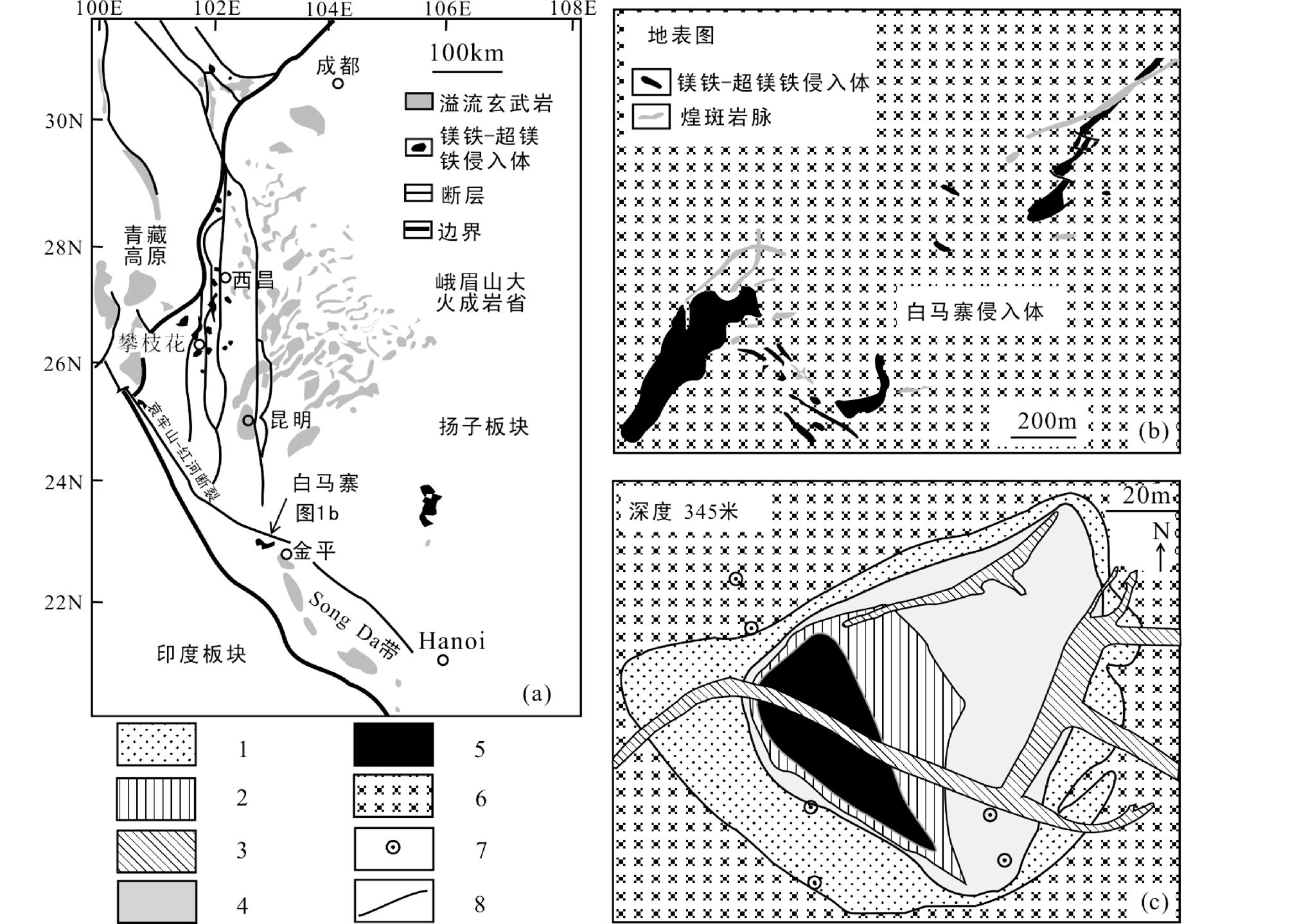
1 地质背景和岩体特征在哀牢山-红河断裂和哀牢山-Song Ma(越南北部)断裂围限的金平-Song Da地区出露了一个狭长北西向的二叠纪溢流玄武岩和相关镁铁-超镁铁侵入体分布带(图 1a),构成了峨眉山LIP最南端部分。金平地区的玄武岩地层厚度达到4.5km,其下为早二叠世阳新组,其上被三叠纪个旧组覆盖。白马寨铜镍硫化物矿床位于该带的北部,赋存在一个镁铁-超镁铁侵入体中。该侵入体的围岩为奥陶纪砂岩和板岩。研究区还出露有古元古代片岩和片麻岩以及元古代花岗岩。白马寨侵入体呈同心状,中心为块状的硫化物矿,向外依次为斜方辉石岩,二辉石岩和辉长岩(图 1b, c)。锆石SHRIMP定年结果显示侵入体的形成年龄为258.5±3.5Ma(Wang et al., 2006),块状硫化物Re-Os等时线年龄为259±20Ma(Sun et al., 2008),与峨眉山LIP形成年龄一致(Zhou et al., 2002; He et al., 2003; Fan et al., 2004)。有关白马寨矿体和相关火山岩的详细野外产状及岩相学描述可参见Wang and Sun (2006) , Wang et al. (2007) 和Zhang et al. (2010) 。
|
图 1 白马寨岩体在峨眉山大火成岩省中的位置(a)、白马寨地区镁铁-超镁铁侵入体分布(b)和白马寨侵入体345m深处的平面图(c)(据Wang et al., 2006) 1-辉长岩;2-斜方辉石岩;3-煌斑岩;4-二辉石岩;5-块状硫化物;6-奥陶纪地层;7-钻孔;8-断层 Fig. 1 The tectonic location of the Baimazhai intrusion in Emeishan large igneous province (a), surface map showing the mafic-ultramafic intrusions in the Baimazhai area (b) and a planar of the Baimazhai intrusion at 345m depth (c) (after Wang et al., 2006) |
王焰等(Wang and Sun, 2006; Wang et al., 2006, 2007; 王焰, 2008)对白马寨铜镍硫化物矿床的研究得到了下面的认识:1)白马寨侵入体及矿体相似的Pd/Pt和Cu/Pd比值指示矿体形成过程中只经历了一次硫化物分离过程;2)强不相容元素比值及Nd同位素显示岩浆在演化形成白马寨侵入体过程中发生了强烈的地壳混染作用;3)侵入体中含有高达20%的块状硫化物,这些硫化物含量远高于岩浆能够溶解的量,所以白马寨侵入体中的硫化物是由更大规模的岩浆演化而来的。可能是在动态的岩浆通道中流经的岩浆不断发生硫化物分离累积的结果。而参与白马寨矿床形成的岩浆最后侵位或者喷发将亏损亲硫元素并具有显著的地壳混染特征。
Wang et al. (2007) 研究了分布于金平-Song Da地区的二叠纪溢流玄武岩和镁铁质侵入岩,根据Xu et al. (2001) 的分类方法,这些岩石被分为高钛系列和低钛系列。研究表明高钛系列岩石并未经历硫化物分离过程;而低钛系列岩石显示变化的Y/Pd、Cu/Pd和Cu/Zr比值:具有高的Y/Pd、Cu/Pd和低的Cu/Zr比值的低钛系列岩浆经历了硫化物的分离过程,而具有较低的Y/Pd、Cu/Pd和较高的Cu/Zr比值的低钛系列岩浆没有经历硫化物的分离过程(Wang et al., 2007)。这主要是由于Pd相对于Cu和Y具有更高的亲硫性,而亲硫元素Cu相对于亲石元素Zr也具有更高的硫化物-硅酸盐熔体分配系数。当岩浆达到硫饱和发生硫化物熔离时将造成Pd相对于Cu和Y以及Cu相对于Zr更加强烈的进入硫化物相,从而造成Y/Pd和Cu/Pd升高,Cu/Zr降低(Lightfoot et al. 1994; Li and Naldrett 1999)。经历硫化物分离的低钛系列岩石同时显示了强烈的地壳混染特征(εNd(t): -0.9到-10.2;相对较高的Th/Nb:~2,Wang et al., 2007)。
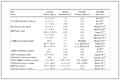
2 原生岩浆在模拟白马寨硫化物矿形成过程之前,首先需要确定白马寨侵入体的原生岩浆成分。原生岩浆被定义为:直接来源于源岩部分熔融的熔体,在从源区上升达地表过程中无任何化学变异(Carmichael et al., 1974)。O’Hara (1968) 认为原生玄武质岩浆是高镁的苦橄质岩浆。峨眉山LIP中多处地方出露有苦橄岩,不同的研究者对这些苦橄岩的岩石成因作了研究(Chung and Jahn, 1995; Xu et al., 2001; Zhang et al., 2006; Wang et al., 2007; Hanski et al., 2010; Kamenetsky et al., 2012)。Chung and Jahn (1995) 首先提出峨眉山LIP是地幔柱头减压熔融的产物。Xu et al. (2001) 根据Ti/Y比值将峨眉山LIP中的岩石分为了低Ti和高Ti两个系列。多数研究认为低Ti系列岩浆(Ti/Y<500)起源于地幔中尖晶石稳定区域,源区部分熔融程度比较大,其原生岩浆MgO达到16%~25%;而高Ti系列岩浆(Ti/Y >500)起源于更深的石榴子石稳定区域,源区部分熔融程度较小,其原生岩浆MgO达到19.8%~22.9%(徐义刚和钟孙霖,2001;Xu et al., 2001; Zhang et al., 2006; Wang et al., 2007, 2011; Song et al., 2008b)。Kamenetsky et al. (2012) 将峨眉山LIP中的岩石分为了低Ti、中Ti和高Ti三个系列。并认为低Ti系列源区母岩为橄榄岩,而中Ti和高Ti系列的源区含有不同比例的辉石岩组分。本研究选择Wang et al. (2007) 报道的金平地区的低钛苦橄岩HK-41作为白马寨侵入体的原生岩浆。选择的依据主要是从以下四个方面考虑的:1)低Ti苦橄岩HK-41与白马寨侵入体都位于哀牢山-红河断裂和哀牢山-Song Ma断裂围限的Song Da构造区块上。 2)HK-41的Mg#值[100Mg/(Mg+Fe2+)](摩尔比)为71.6,位于与地幔橄榄岩平衡的原生岩浆的Mg#变化范围内(Green, 1975; 邓晋福等, 2004)。3)取Fe、Mg在橄榄石和熔体间的交换系数为0.3(Kd=(Fe/Mg)橄榄石/(Fe/Mg)熔体,据Roeder and Emslie (1970) ),计算发现,样品HK-41与峨眉山LIP低钛系列岩石中具有最高Fo值(~91mol%,据Kamenetsky et al.(2012) )的橄榄石是平衡的。4)Sr、Nd同位素显示样品HK-41没有受到地壳混染的影响(Wang et al., 2007)。所以本研究选择样品HK-41的成分来代表原生岩浆的成分(表 1)。Wang et al. (2007) 通过研究认为这些低钛苦橄质岩浆是尖晶石二辉橄榄岩发生~25%的部分熔融形成的。苦橄质岩浆在上升降温过程中,发生硅酸盐矿物的分离结晶,到达上地壳浅部岩浆房时演变为高镁玄武质岩浆。演化的岩浆在浅部岩浆房内同化混染围岩,同时继续发生硅酸盐矿物的分离结晶,最终导致岩浆的硫饱和,发生硫化物熔体的分离(Wang et al., 2007)。
|
表 1 MELTS程序模拟原生岩浆在深部的橄榄石分离结晶 Table 1 Simulation for olivine crystallization of primary magma based on MELTS program |
MELTS是Ghiorso and Sack (1995) 和Asimow and Ghiorso (1998) 开发的用来进行岩浆系统相平衡热力学模拟的软件包。该程序可以模拟温度在500~2000℃,压力在0~3GPa范围内的岩浆岩体系的相平衡关系。已有大量研究者使用MELTS程序进行了岩浆起源和演化等方面的研究(Hauri, 1996; Ren et al., 2004; Li et al., 2001, 2012; Naldrett, 2010; Hong et al., 2013)。
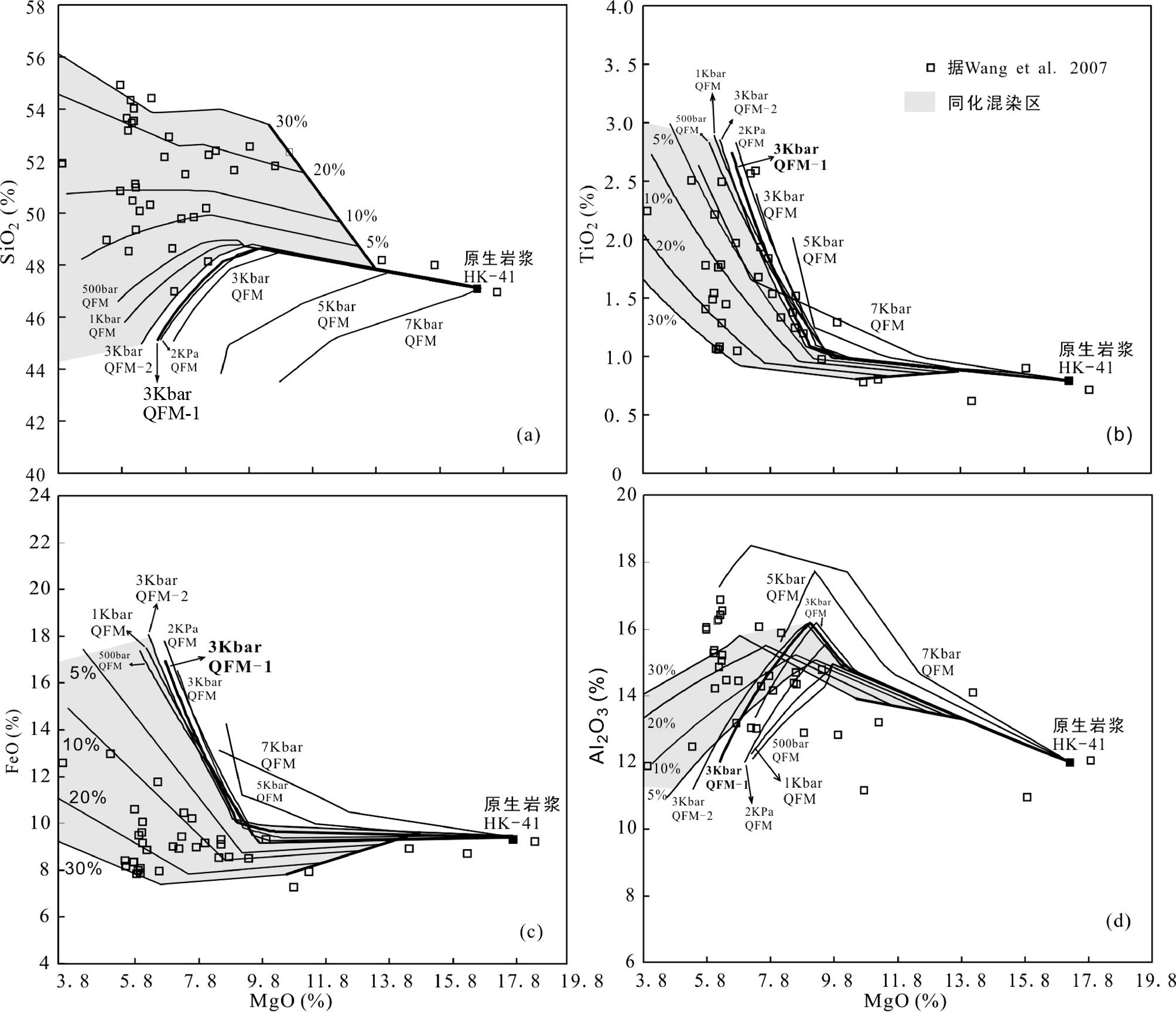
3.1 深部橄榄石结晶分离我们使用MELTS程序,以HK-41作为原生岩浆(其主量元素和微量元素列于表 1),在不同的压力(0.5~7kb),氧逸度(QFM-QFM-2),含水量为0.01%(据Hanski et al., 2004)的条件下,模拟了岩浆的分离结晶过程。除了Ni和Cu以外的微量元素在硅酸盐矿物和熔体间的分配系数采用MELTS的默认值(McKenzie et al., 1991, 1995),Ni和Cu的分配系数采用Naldrett (2010) 提供的数值(表 2)。模拟显示,当模拟条件设定为压力3kb,氧逸度为QFM-QFM-2的变化范围时,模拟的岩浆演化趋势十分相似,均可以获得与金平-Song Da地区玄武岩较为一致的结晶趋势(图 2)。结合已有的硫化物矿床氧逸度的研究(Li et al., 2001; Jugo et al., 2005; Naldrett, 2010),我们将氧逸度设定为QFM-1。当温度下降到1414℃时橄榄石首先从岩浆中结晶出来,此时与岩浆平衡的橄榄石的Fo值高达91mol%。当9.6%(质量分数)的橄榄石分离结晶后,与残余岩浆平衡的橄榄石的Fo值下降到87mol%,与峨眉山硫化物矿床中橄榄石的最高Fo值一致(Wang et al., 2005; 陶琰等,2007; Tao et al., 2008; Wang et al., 2012),此时残余岩浆MgO 含量为~14%(表 1),为高镁玄武质岩浆(Chai and Naldrett, 1992),与王生伟等(2006) 和Sun et al. (2008) 通过铂族元素对比得到的白马寨母岩浆成分一致。
|
|
表 2 Ni和Cu在硅酸盐矿物、硫化物和岩浆间的分配系数(据Naldrett, 2010) Table 2 The partition coefficients of Ni and Cu between silicate minerals, sulfide and silicate magma (after Naldrett, 2010) |
|
图 2 MgO对主量元素图解 曲线为MELTS模拟的结果,曲线上的压力和氧逸度为使用MELTS模拟岩浆在深部发生分离结晶的条件.百分数代表的是岩浆在浅部岩浆房内同化混染的围岩量.方框为金平-Song Da地区的低钛玄武岩,数据来自Wang et al. (2007) .可以看到使用压力3kb和氧逸度QFM-QFM-2范围的氧逸度的条件均可获得与实际样品较一致的结果.结合前人研究,本文将氧逸度设定为QFM-1 Fig. 2 Variation diagrams of major elements Solid lines are the MELTS simulation results. The pressure and oxygen fugacity on the line are different parameters for MELTS simulation. The percentages indicate the degree of wall rock assimilation of the magma in shallow magma chamber. The low-Ti basalt data (squares) after Wang et al. (2007) . Note that using 3kb pressure and QFM-QFM-2 buffer simulation condition shows an accordant result with the low-Ti basalts |
Li and Ripley (2005) 依据岩浆成分和温压条件给出了一个计算岩浆S饱和度的经验性公式:

|
(1) |
其中,温度T的单位为开尔文,压力P的单位为千巴,X表示氧化物的摩尔分数。我们使用此公式对演化岩浆的硫饱和度进行了估计。计算表明,岩浆在发生橄榄石分离结晶过程中硫含量由476×10-6上升到526×10-6,硫饱和度(SCSS)由2753×10-6下降到2183×10-6(表 1),硫含量始终远小于岩浆的硫饱和度,即岩浆未达到硫饱和,未发生硫化物分离。MELTS模拟显示,由于Ni具有较高的橄榄石-熔体分配系数6.5, 据(Naldrett, 2010),大量橄榄石的结晶,使岩浆的Ni含量由初始的526×10-6下降到了 302×10-6(表 1);而Cu对于橄榄石来说为不相容元素,橄榄石的结晶使岩浆更富集Cu(由初始的 125×10-6上升到139×10-6)(表 1)。由于未测试HK-41的S含量,我们采用了下面的方法对岩浆中的S含量进行了估计。Salter and Stracke (2004) 给出了地幔中的S含量(119×10-6)。Naldrett (2010) 指出地幔熔融程度大于20%时,源区中的硫化物将全部进入熔体相。所以HK-41的S含量就等于地幔源区的S含量除以地幔源区部分熔融程度(25%,据Wang et al. (2007) ),为476×10-6(这一估计值是位于Kamenetsky et al. (2012) 测试的峨眉山LIP低Ti苦橄岩中的橄榄石中的熔体包裹体的S含量的变化范围内的)。当岩浆上升发生9.6%的橄榄石分离结晶后,由于S对于橄榄石为不相容元素,残余岩浆中的S含量将上升到526×10-6(476/(1-0.096))。
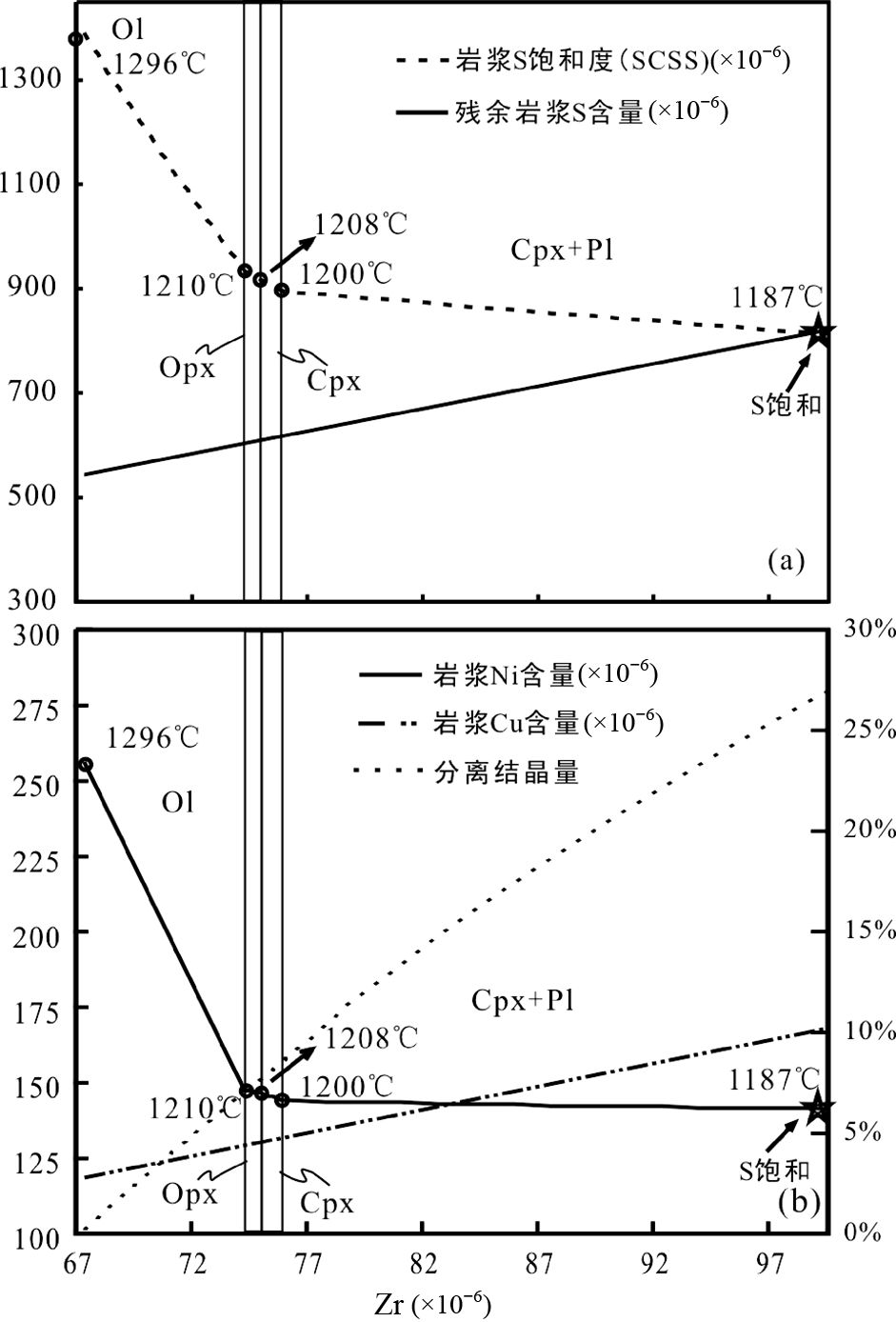
3.2 上地壳浅部岩浆房内同化混染和分离结晶MELTS模拟结果的主量元素协变图(图 2)显示,当压力大于3kb时,岩浆的演化趋势明显与实际样品不符合,所以地幔源区部分熔融形成的原生岩浆在深部几乎没有发生矿物分离结晶作用,当岩浆上升到地壳浅部(深度约10km),才出现了橄榄石的分离结晶。模拟结果同时显示,当岩浆演化到与Fo值为87的橄榄石平衡时发生地壳同化混染作用,可以获得与金平地区低Ti玄武岩十分一种的演化趋势。MELTS模拟采用Rudnick and Gao (2003) 给出的上地壳成分来代表围岩的平均成分。压力设定为1kb,氧逸度设定为QFM条件(我们在500bar压力下也做了模拟,模拟显示在500bar的压力下需要很大的地壳混染量(>30%)才会出现斜方辉石结晶,如此大的混染量将使演化岩浆的SiO2含量超过54%,明显与实际样品不相符,所以我们采用了1kbar的模拟压力;玄武质岩浆从深部上升到地壳浅部过程中氧化还原状态将逐渐演变到QFM条件(Mathez, 1984))。我们设置了不同比例的围岩混染量,MELTS程序模拟显示,只有当围岩混染量超过18%时,混合岩浆的结晶路径上才会出现斜方辉石,而白马寨岩体含有很高的斜方辉石比例,说明岩浆确实经历了强烈的地壳同化混染作用。从MELTS模拟结果的Hark图解(图 2)上可以看到,岩浆的地壳同化混染量最大可能达到了30%。Wang et al.(2006, 2007)利用微量元素、Sr-Nd同位素以及Sun et al. (2008) 利用Os同位素的模拟也显示了强烈的地壳混染特征(混染量4%~34%)。岩浆同化混染18%的围岩后,当温度降到1296℃时,开始结晶橄榄石,在结晶9.8%的橄榄石后结晶相变为斜方辉石,当温度降到1208℃时,结晶相变为单斜辉石,在结晶1.8%的单斜辉石后,岩浆开始同时结晶单斜辉石和斜长石(表 3、图 3)。模拟获得的矿物结晶顺序与Wang et al. (2006) 通过薄片观察获得结果是基本吻合的(Opx→Opx+Cpx→Cpx+Pl)。白马寨侵入体中未见大量橄榄石,可能是由于早期分离结晶的橄榄石堆积在岩体底部而未被钻探到。
|
|
表 3 MELTS程序模拟岩浆在浅部岩浆房内的围岩同化混染和硅酸盐矿物的分离结晶 Table 3 Simulation for crustal contamination and fractional crystallization in the shallow magma chamber based on MELTS program |
|
图 3 岩浆中S含量和S饱和度的变化(a)和Ni、Cu含量以及分离结晶量的变化(b) Fig. 3 Variations of the concentrations of S and SCSS (the S content at sulfide saturation) (a) and variations of the concentrations of Ni and Cu (b) in magma Ol-olivine; Opx-orthopyroxene; Cpx-clinopyroxene; Pl-plagioclase |
Zr在岩浆演化过程中倾向于保留在熔体中,随着岩浆分离结晶硅酸盐矿物(橄榄石,斜方辉石,单斜辉石和斜长石等)的进行,残余岩浆中的Zr含量将越来越高,所以可以用Zr含量来指示岩浆的演化程度。图 3a为浅部岩浆房中,伴随着矿物分离结晶,岩浆的S含量以及S饱和度随Zr含量的变化。由公式(1) 知,岩浆的S饱和度主要受控于岩浆中FeO、SiO2、Na2O、K2O和MgO的含量。S饱和度与SiO2、Na2O、MgO和K2O的含量呈负相关关系,而与FeO含量呈正相关关系。同时,S饱和度随岩浆温度的降低而降低。岩浆刚开始结晶橄榄石时,由于橄榄石不含Na2O和K2O,SiO2含量也较低,所以橄榄石的结晶使得岩浆中Na2O、K2O和SiO2含量快速上升,虽然对于高Fo的橄榄石来说,MgO含量较高,结晶橄榄石将使岩浆中MgO含量下降,但其仍然不能抵消Na2O、K2O和SiO2含量升高以及温度下降引起的S饱和度的快速下降(图 3a、表 3)。原因可以从公式1中得到:SiO2,Na2O+K2O项的系数(分别为6.166,9.153)显著大于MgO项的系数(1.914),也就是说SiO2,Na2O+K2O含量的变化对硫饱和度造成的影响比MgO含量变化造成的影响要更大。当岩浆的主要结晶相变为单斜辉石和斜长石后,岩浆S饱和度的下降速度变慢。由于S在橄榄石、斜方辉石、单斜辉石和斜长石中为不相容元素,所以随着这些硅酸盐矿物结晶的进行,岩浆中的S含量越来越高。图 3a中显示,当岩浆中Zr含量上升到100×10-6(温度下降到1187℃)时,岩浆中S含量的演化线与岩浆硫饱和度演化线相交,也就是说,此时岩浆中的S达到了饱和,橄榄石、斜方辉石、单斜辉石和斜长石的结晶量分别为9.8%,0.3%,7.1%和10.1%。进一步的结晶将引起S过饱和,形成不混溶硫化物熔体。
4.2 矿物结晶对Ni和Cu含量的影响图 3b是岩浆中Ni和Cu的含量随着Zr含量的变化趋势,图中同时给出了岩浆体系的分离结晶量。可以清楚地看到,由于Ni具有较高的橄榄石-熔体分配系数,随着橄榄石的结晶分离,残余岩浆中的Ni含量迅速下降(由257×10-6下降到147×10-6)(表 3);而当岩浆停止结晶橄榄石后,随着其他硅酸盐矿物(斜方辉石、单斜辉石和斜长石)的结晶,Ni含量只是略有降低,岩浆达到硫饱和时Ni的含量为141×10-6。而Cu对于上述硅酸盐矿物为强不相容元素,其含量随着硅酸盐矿物的晶出将持续稳定上升,岩浆达到硫饱和时Cu的含量为167×10-6(表 3)。
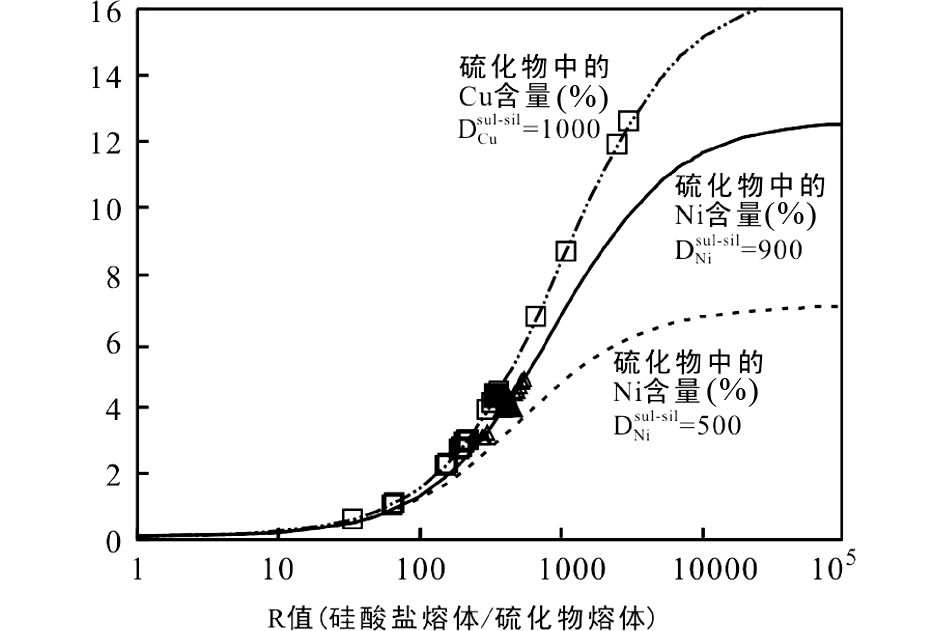
4.3 R值的计算R值表示的是与硫化物相平衡的硅酸盐熔体和硫化物的质量比值。计算R值可以反映出有多少岩浆参与了硫化物的熔离。我们使用Campbell and Naldrett (1979) 给出的公式对R值进行了计算。公式如下:

|
(2) |
其中Yi表示微量元素i在硫化物熔体相中的含量,Xi表示元素i在初始硅酸盐熔体相中的含量,D为元素i在硫化物相-硅酸盐熔体相间的分配系数。我们以岩浆达到硫饱和时的Ni和Cu的含量(分别为141×10-6和167×10-6)为硅酸盐熔体中的初始含量。图 4为不同R值的情况下硫化物相中的Ni和Cu含量。Wang and Zhou (2006) 测试了17个块状硫化物样品的Ni和Cu含量,对样品进行百分之百硫化物计算后17个样品的平均Ni和Cu的含量分别为4.1%和4.3%。计算结果显示,对应Ni含量的R值为670;对应Cu含量的R值为350。通过Ni和Cu两个元素获得的R值存在较大的差异可能和这两个元素在原始岩浆中含量的选取以及它们在硫化物相和硅酸盐熔体相间的分配系数的选取有关。如果取Ni在硫化物和硅酸盐熔体间的分配系数为900(该值在Jana and Walker (1997) 和Sattari et al. (2002) 给出的范围内),那么,使用Ni含量计算的R值为420,与通过Cu含量获得的R值相近。
|
图 4 硫化物中Ni和Cu含量与R值(硅酸盐熔体/硫化物熔体)的相关关系 白色方框和三角是根据Wang and Zhou MF (2006) 测试的白马寨块状硫化物样品的Ni和Cu含量计算获得的;黑色方框和三角是Wang and Zhou MF (2006) 测试的平均值的计算结果 Fig. 4 The relationship between the concentrations of Ni and Cu of sulfide and the R factor (silicate magma/sulfide liquid) Open squares and triangles are calculated from Wang and Zhou MF (2006) ; filled squre and triangle are the mean values |
如果取R值为500,通过质量平衡计算,经过硫化物熔离后的残余岩浆中的Ni和Cu的含量分别为71×10-6和56×10-6,这与Wang et al. (2007) 给出的金平-Song Da地区显示硫过饱和趋势的低钛玄武岩的Ni和Cu平均含量是基本吻合的(分别为61×10-6和77×10-6)。
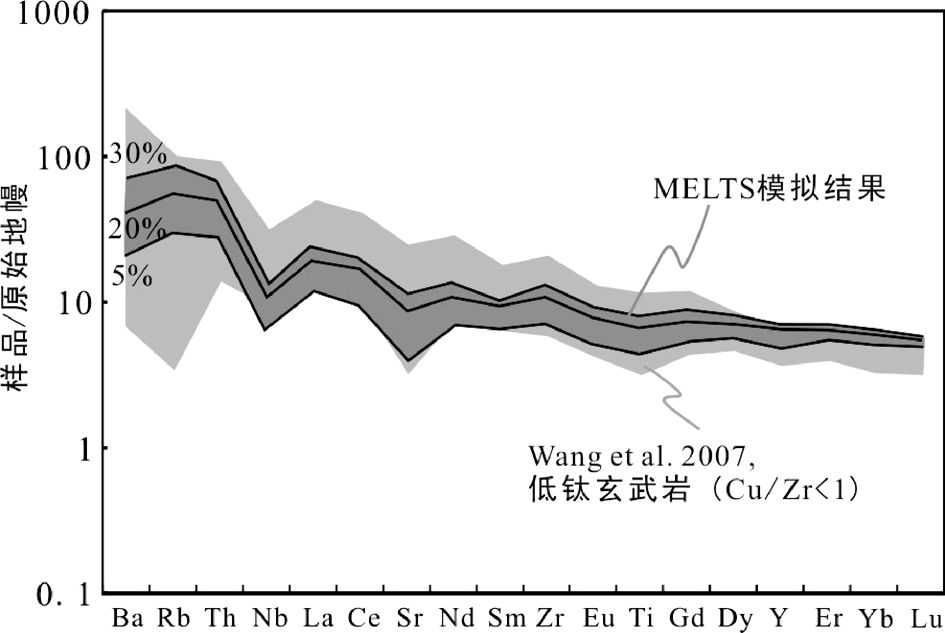
4.4 残余硅酸盐熔体中的微量元素不相容亲石元素对于硫化物来说为强不相容元素(韩吟文等, 2003),所以岩浆在发生很少量的硫化物分离后这些元素在残余岩浆中的含量将基本保持不变。我们选取不同的地壳混染量下岩浆达到硫饱和时的微量元素含量的变化,与金平-Song Da地区经历硫化物分离的低钛玄武岩的微量元素组成(Wang et al., 2007, 所有选取的样品的Cu/Zr<1)进行了对比(原生岩浆采用Wang et al. (2007) 中的低Ti苦橄岩HK-41的成分;岩浆同化混染的上地壳成分据Rudnick and Gao (2003) ;分别模拟了同化混染5%,20%和30%的地壳物质后的结果)。图 5为MELTS模拟结果和金平-Song Da地区低钛玄武岩微量元素原始地幔标准化图。模拟结果与实际样品的微量元素含量显示了较好的一致性。两者都显示了Ba、Rb和Th的正异常,以及Nb和Sr的负异常。实际样品Ba、Rb和Th较大的变化范围可能是后期流体活动造成的。Nb的负异常反映了地壳同化混染作用,Sr的负异常是由于斜长石的分离结晶造成的。残余岩浆的Cu/Zr<1,与金平-Song Da地区经历硫化物分离的低钛玄武岩的Cu/Zr比值一致。模拟结果和金平地区低钛玄武岩的微量元素良好的一致性表明我们的模拟计算是可信的。说明白马寨侵入体和金平地区低Ti玄武岩在形成过程中经历了不同程度的地壳混染作用。
|
图 5 微量元素原始地幔标准化图解 曲线上的数字表示地壳物质的混染量. 标准化数据据Sun and McDoungh (1989) ,上地壳成分据Rudnick and Gao (2003) Fig. 5 Primitive mantle-normalized trace element patterns The percentages indicate the degree of wall rock assimilation of the magma in shallow magma chamber. Normalization values after Sun and McDonough (1989) . The composition of upper crust after Rudnick and Gao (2003) |
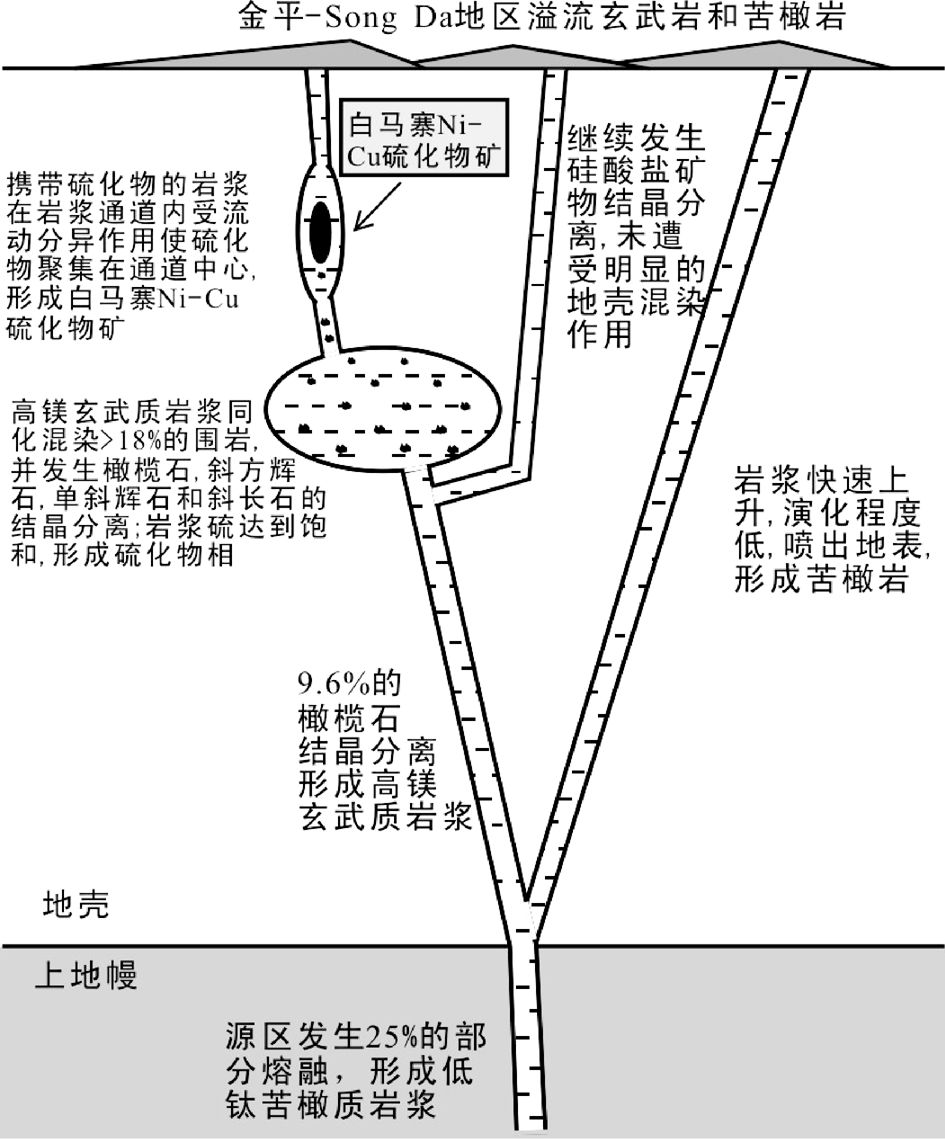
图 6展示了白马寨硫化物矿的形成过程。受峨眉山地幔柱的作用,金平-Song Da地区上地幔浅部热的源区发生较大程度(~25%)的部分熔融,形成低钛苦橄质岩浆(Wang et al., 2007)。MELTS模拟结果表明,苦橄质岩浆在上升过程中不断分离结晶橄榄石,到达上地壳浅部岩浆房时演变为高镁玄武质岩浆。在浅部岩浆房内,高镁玄武质岩浆发生大规模(最高达到30%)的围岩同化混染以及橄榄石、斜方辉石、单斜辉石和斜长石的分离结晶(~27%),促使岩浆中的S达到饱和,硫化物从岩浆中分离。携带有硫化物熔体的岩浆在上升侵位过程中受流动分异作用(Wang and Zhou MF, 2006),使得硫化物熔体聚集在岩浆通道中心,形成了白马寨呈同心状分布的矿体。发生硫化物熔离的岩浆喷出地表,形成金平-Song Da地区具有低Cu/Zr比值的低钛玄武岩。而未经历明显地壳混染和硫化物分离的岩浆喷发,形成高Cu/Zr比值的低钛玄武岩。从地幔源区快速上升,演化程度很低的苦橄质岩浆喷出地表形成苦橄岩。
|
图 6 白马寨Ni-Cu硫化物矿演化模式 Fig. 6 Schematic diagram illustrating our model for the formation of the Baimazhai intrusion and the associated sulfide mineralization |
| [] | Asimow PD, Ghiorso MS. 1998. Algorithmic modifications extending MELTS to calculate subsolidus phase relations. American Mineralogist, 83: 1127–1132. DOI:10.2138/am-1998-9-1022 |
| [] | Barnes SJ, Lightfoot PC. 2005. Formation of magmatic nickel sulfide ore deposits and processes affecting their copper and platinum group element contents. In: Hedenquist JW, Thompson JFH, Goldfarb RJ and Richards JP (eds.). Economic Geology 100th Anniversary Volume. Littleton: Society of Economic Geologists: 179-213. |
| [] | Camichael ISE, Turner FJ, Verhoogen J. 1974. Igneous Petrology. New York: McGraw-Hill: 1-739. |
| [] | Campbell IH, Naldrett AJ. 1979. The influence of silicate: Sulfide ratios on the geochemistry of magmatic sulfides. Economic Geology, 74(6): 1503–1505. DOI:10.2113/gsecongeo.74.6.1503 |
| [] | Chai G, Naldrett AJ. 1992. The Jinchuan ultramafic intrusion: Cumulate of a high-Mg basaltic magma. Journal of Petrology, 33(2): 277–303. DOI:10.1093/petrology/33.2.277 |
| [] | Chung SL, Jahn BM. 1995. Plume-lithosphere interaction in generation of the Emeishan flood basalts at the Permian-Triassic boundary. Geology, 23: 889–892. DOI:10.1130/0091-7613(1995)023<0889:PLIIGO>2.3.CO;2 |
| [] | Deng JF, Luo ZH, Su SG, Mo XX, Yu BS, Lai XY, Chen HW. 2004. Petrogenesis, Tectonics and Metallogenesis. Beijing: Geological Publishing House: 5-20. |
| [] | Fan WM, Wang YJ, Peng TP, Miao LC, Guo F. 2004. Ar-Ar and U-Pb geochronology of Late Paleozoic basalts in western Guangxi and its constraints on the eruption age of Emeishan basalt magmatism. Chinese Science Bulletin, 49(21): 2318–2327. DOI:10.1360/04wd0201 |
| [] | Ghiorso MS, Sack RO. 1995. Chemical mass transfer in magmatic processes. IV. A revised and internally consistent thermodynamic model for the interpolation and extrapolation of liquid-solid equilibria in magmatic systems at elevated-temperatures and pressures. Contributions to Mineralogy and Petrology, 119(2-3): 197–212. DOI:10.1007/BF00307281 |
| [] | Green DH. 1975. Genesis of archean peridotitic magmas and constraints on Archean geothermal gradients and tectonics. Geology, 3(1): 15–18. DOI:10.1130/0091-7613(1975)3<15:GOAPMA>2.0.CO;2 |
| [] | Han YW, Ma ZD, Zhang HF, Zhang BR, Li FL, Gao S, Bao ZY. 2003. Geochemistry. Beijing: Geological Publishing House: 56-60. |
| [] | Hanski E, Walker RJ, Huhma H, Polyakov GV, Balykin PA, Hoa TT, Phuong NT. 2004. Origin of the Permian-Triassic komatiites, northwestern Vietnam. Contributions to Mineralogy and Petrology, 147(4): 453–469. DOI:10.1007/s00410-004-0567-1 |
| [] | Hanski E, Kamenetsky VS, Luo ZY, Xu YG, Kuzmin DV. 2010. Primitive magmas in the Emeishan Large Igneous Province, southwestern China and northern Vietnam. Lithos, 119: 75–90. DOI:10.1016/j.lithos.2010.04.008 |
| [] | Hauri EH. 1996. Major-element variability in the Hawaiian mantle plume. Nature, 382(6590): 415–419. DOI:10.1038/382415a0 |
| [] | He B, Xu YG, Chung SL, Xiao L, Wang YM. 2003. Sedimentary evidence for a rapid, kilometer-scale crustal doming prior to the eruption of the Emeishan flood basalts. Earth and Planetary Science Letters, 213(3-4): 391–405. DOI:10.1016/S0012-821X(03)00323-6 |
| [] | Hong LB, Zhang YH, Qian SP, Liu JQ, Ren ZY, Xu YG. 2013. Constraints from melt inclusions and their host olivines on the petrogenesis of Oligocene-Early Miocene Xindian basalts, Chifeng area, North China Craton. Contributions to Mineralogy and Petrology, 165(2): 305–326. DOI:10.1007/s00410-012-0810-0 |
| [] | Jana D, Walker D. 1997. The influence of sulfur on partitioning of siderophile elements. Geochimica et Cosmochimica Acta, 61(24): 5255–5277. DOI:10.1016/S0016-7037(97)00307-4 |
| [] | Jugo PJ, Luth RW, Richards JP. 2005. An experimental study of the sulfur content in basaltic melts saturated with immiscible sulfide or sulfate liquids at 1300℃ and 1. 0GPa. Journal of Petrology, 46(4): 783–798. |
| [] | Kamenetsky VS, Chung SL, Kamenetsky MB, Kuzmin DV. 2012. Picrites from the Emeishan large igneous province, SW China: A compositional continuum in primitive magmas and their respective mantle sources. Journal of Petrology, 53(10): 2095–2113. DOI:10.1093/petrology/egs045 |
| [] | Li CS, Naldrett AJ. 1999. Geology and petrology of the Voisey’s Bay intrusion: Reaction of olivine with sulfide and silicate liquids. Lithos, 47(1-2): 1–31. DOI:10.1016/S0024-4937(99)00005-5 |
| [] | Li CS, Maier WD, Waal SA. 2001. Magmatic Ni-Cu versus PGE deposits: Contrasting genetic controls and exploration implications. South African Journal of Geology, 104(4): 309–318. DOI:10.2113/gssajg.104.4.309 |
| [] | Li CS, Ripley EM. 2005. Empirical equations to predict the sulfur content of mafic magmas at sulfide saturation and applications to magmatic sulfide deposits. Mineralium Deposita, 40(2): 218–230. DOI:10.1007/s00126-005-0478-8 |
| [] | Li CS, Ripley EM. 2009. Sulfur contents at sulfide-liquid or anhydrite saturation in silicate melts: Empirical equations and example applications. Economic Geology, 104(3): 405–412. DOI:10.2113/gsecongeo.104.3.405 |
| [] | Li CS, Zhang MJ, Fu PE, Qian ZZ, Hu PQ, Ripley EM. 2012. The Kalatongke magmatic Ni-Cu deposits in the Central Asian Orogenic Belt, NW China: Product of slab window magmatism. Mineralium Deposita, 47(1-2): 51–67. DOI:10.1007/s00126-011-0354-7 |
| [] | Lightfoot PC, Naldrett AJ, Gorbachev NS, Fedorenko VA, Hawkesworth CJ and Doherty W. 1994. Chemostratigraphy of the Siberian trap lavas, Noril’sk district, Russia: Implications for the source of flood basalt magmas and their associated Ni-Cu mineralization. In: Lightfoot PC and Naldrett AJ (eds.). Proceedings of the Sudbury-Noril’sk Symposium. Ontario: Ontario Geological Survey Special Publication, 5: 283-312 |
| [] | Lightfoot PC, Keays RR. 2005. Siderophile and chalcophile metal variations in flood basalts from the Siberian Trap, Noril’sk Region: Implications for the origin of the Ni-Cu-PGE sulfide ores. Economic Geology, 100(3): 439–462. DOI:10.2113/gsecongeo.100.3.439 |
| [] | Mathez EA. 1984. Influence of degassing on oxidation states of basaltic magmas. Nature, 310(5976): 371–375. DOI:10.1038/310371a0 |
| [] | McKenzie D, O’Nions RK. 1991. Partial melt distributions from inversion of rare earth element concentrations. Journal of Petrology, 32(5): 1021–1091. DOI:10.1093/petrology/32.5.1021 |
| [] | McKenzie D, O’Nions RK. 1995. The source regions of ocean island basalts. Journal of Petrology, 36(1): 133–159. DOI:10.1093/petrology/36.1.133 |
| [] | Naldrett AJ. 1992. A model for the Ni-Cu-PGE ores of the Noril’sk region and its application to other areas of flood basalt. Economic Geology, 87(8): 1945–1962. DOI:10.2113/gsecongeo.87.8.1945 |
| [] | Naldrett AJ, Lightfoot PC, Fedorenko V, Doherty W, Gorbachev NS. 1992. Geology and geochemistry of intrusions and flood basalts of the Noril’sk region, USSR, with implications for the origin of the Ni-Cu ores. Economic Geology, 87(4): 975–1004. DOI:10.2113/gsecongeo.87.4.975 |
| [] | Naldrett AJ, Fedorenko VA, Asif M, Lin SS, Kunilov VE, Stekhin AI, Lightfoot PC, Gorbachev NS. 1996. Controls on the composition of Ni-Cu sulfide deposits as illustrated by those at Noril’sk, Siberia. Economic Geology, 91(4): 751–773. DOI:10.2113/gsecongeo.91.4.751 |
| [] | Naldrett AJ. 1999. World-class Ni-Cu-PGE deposits: Key factors in their genesis. Mineralium Deposita, 34(3): 227–240. DOI:10.1007/s001260050200 |
| [] | Naldrett AJ. 2010. Secular variation of magmatic sulfide deposits and their source magmas. Economic Geology, 105(3): 669–688. DOI:10.2113/gsecongeo.105.3.669 |
| [] | O'Hara MJ. 1968. The bearing of phase equilibria studies in synthetic and natural systems on the origin and evolution of basic and ultrabasic rocks. Earth-Science Reviews, 4: 69–133. DOI:10.1016/0012-8252(68)90147-5 |
| [] | Ren ZY, Takahashi E, Orihashi Y, Johnson KTM. 2004. Petrogenesis of tholeiitic lavas from the submarine Hana Ridge, Haleakala Volcano, Hawaii. Journal of Petrology, 45(10): 2067–2099. DOI:10.1093/petrology/egh076 |
| [] | Ripley EM, Lightfoot PC, Li CS, Elswick R. 2003. Sulfur isotopic studies of continental flood basalts in the Noril’sk region: Implications for the association between lavas and ore-bearing intrusions. Geochimica et Cosmochimica Acta, 67(15): 2805–2817. DOI:10.1016/S0016-7037(03)00102-9 |
| [] | Roeder PL, Emslie RF. 1970. Olivine-liquid equilibrium. Contributions to Mineralogy and Petrology, 29(4): 275–289. DOI:10.1007/BF00371276 |
| [] | Rudnick RL and Gao S. 2003. Composition of the continental crust. In: Rudnick RL (ed.). The Crust: Treatise on Geochemistry, Volume 3. Amsterdam, NL: Elsevier, 1-64 |
| [] | Salters VJM, Stracke A. 2004. Composition of the depleted mantle. Geochemistry, Geophysics, Geosystems, 5(5). DOI:10.1029/2003GC000597 |
| [] | Sattari P, Brenan JM, Horn I, McDonough WF. 2002. Experimental constraints on the sulfide- and chromite-silicate melt partitioning behavior of rhenium and platinum-group elements. Economic Geology, 97(2): 385–398. DOI:10.2113/gsecongeo.97.2.385 |
| [] | Smith PM, Asimow PD. 2005. Adiabat_1ph: A new public front-end to the MELTS, pMELTS, and pHMELTS models. Geochemistry, Geophysics, Geosystems, 6(2). DOI:10.1029/2004GC000816 |
| [] | Song XY, Zhou MF, Keays RR, Cao ZM, Sun M, Qi L. 2006. Geochemistry of the Emeishan flood basalts at Yangliuping, Sichuan, SW China: Implications for sulfide segregation. Contributions to Mineralogy and Petrology, 152(1): 53–74. DOI:10.1007/s00410-006-0094-3 |
| [] | Song XY, Zhou MF, Tao Y, Xiao JF. 2008a. Controls on the metal compositions of magmatic sulfide deposits in the Emeishan large igneous province, SW China. Chemical Geology, 253(1-2): 38–49. DOI:10.1016/j.chemgeo.2008.04.005 |
| [] | Song XY, Qi HW, Robinson PT, Zhou MF, Cao ZM, Chen LM. 2008b. Melting of the subcontinental lithospheric mantle by the Emeishan mantle plume: Evidence from the basal alkaline basalts in Dongchuan, Yunnan, southwestern China. Lithos, 100(1-4): 93–111. DOI:10.1016/j.lithos.2007.06.023 |
| [] | Sun SS, McDonough WF. 1989. Chemical and isotopic systematics of oceanic basalts: Implications for mantle composition and processes. In: Saunders AD and Norry MJ (eds.). Magmatism in Oceanic Basins. Geological Society, London, Special Publications, 42(1): 313–345. DOI:10.1144/GSL.SP.1989.042.01.19 |
| [] | Sun XM, Wang SW, Sun WD, Shi GY, Sun YL, Xiong DX, Qu WJ, Du AD. 2008. PGE geochemistry and Re-Os dating of massive sulfide ores from the Baimazhai Cu-Ni deposit, Yunnan Province, China. Lithos, 105(1-2): 12–24. DOI:10.1016/j.lithos.2008.02.002 |
| [] | Tao Y, Li CS, Hu RZ, Ripley EM, Du AD, Zhong H. 2007. Petrogenesis of the Pt-Pd mineralized Jinbaoshan ultramafic intrusion in the Permian Emeishan Large Igneous Province, SW China. Contributions to Mineralogy and Petrology, 153(3): 321–337. DOI:10.1007/s00410-006-0149-5 |
| [] | Tao Y, Hu RZ, Qi L, Lu TY. 2007. Geochemical characteristics and metallogenesis of the Limahe mafic-ultramafic intrusion, Sichuan. Acta Petrologica Sinica, 23(11): 2785–2800. |
| [] | Tao Y, Li CS, Song XY, Ripley EM. 2008. Mineralogical, petrological, and geochemical studies of the Limahe mafic-ultramatic intrusion and associated Ni-Cu sulfide ores, SW China. Mineralium Deposita, 43(8): 849–972. DOI:10.1007/s00126-008-0207-1 |
| [] | Wang CY, Zhou MF, Zhao DG. 2005. Mineral chemistry of chromite from the Permian Jinbaoshan Pt-Pd-sulfide-bearing ultramafic intrusion in SW China with petrogenetic implications. Lithos, 83(1-2): 47–66. DOI:10.1016/j.lithos.2005.01.003 |
| [] | Wang CY, Zhou MF. 2006. Genesis of the Permian Baimazhai magmatic Ni-Cu-(PGE) sulfide deposit, Yunnan, SW China. Mineralium Deposita, 41(8): 771–783. DOI:10.1007/s00126-006-0094-2 |
| [] | Wang CY, Zhou MF, Keays RR. 2006. Geochemical constraints on the origin of the Permian Baimazhai mafic-ultramafic intrusion, SW China. Contributions to Mineralogy and Petrology, 152(3): 309–321. DOI:10.1007/s00410-006-0103-6 |
| [] | Wang CY, Zhou MF, Qi L. 2007. Permian flood basalts and mafic intrusions in the Jinping (SW China)-Song Da (northern Vietnam) district: Mantle sources, crustal contamination and sulfide segregation. Chemical Geology, 243(3-4): 317–343. DOI:10.1016/j.chemgeo.2007.05.017 |
| [] | Wang CY, Zhou MF, Qi L. 2010. Origin of extremely PGE-rich mafic magma system: An example from the Jinbaoshan ultramafic sill, Emeishan large igneous province, SW China. Lithos, 119: 147–161. DOI:10.1016/j.lithos.2010.07.022 |
| [] | Wang CY, Zhou MF, Qi L. 2011. Chalcophile element geochemistry and petrogenesis of high-Ti and low-Ti magmas in the Permian Emeishan large igneous province, SW China. Contributions to Mineralogy and Petrology, 161(2): 237–254. DOI:10.1007/s00410-010-0529-8 |
| [] | Wang CY, Zhou MF, Sun YL, Arndt NT. 2012. Differentiation, crustal contamination and emplacement of magmas in the formation of the Nantianwan mafic intrusion of the ~260Ma Emeishan large igneous province, SW China. Contributions to Mineralogy and Petrology, 164(2): 281–301. DOI:10.1007/s00410-012-0738-4 |
| [] | Wang SW, Sun XM, Shi GY, Xiong DX, Zhai W. 2006. Platinum group elements (PGE) geochemistry of Baimazhai Ni-Cu sulfide deposit and its constraints on the ore genesis. Acta Geologica Sinica, 80(9): 1474–1486. |
| [] | Wang Y. 2008. Origin of the permian Baimazhai magmatic Ni-Cu-(PGE) sulfide deposits, Yunnan: Implications for relationship of crustal contamination and mineralization. Bulletin of Mineralogy, Petrology and Geochemistry, 27(4): 332–343. |
| [] | Xu YG, Zhong SL. 2001. The Emeishan large igneous province: Evidence for mantle plume activity and melting conditions. Geochimica, 30(1): 1–9. |
| [] | Xu YG, Chung SL, Jahn BM, Wu GY. 2001. Petrologic and geochemical constraints on the petrogenesis of Permian-Triassic Emeishan flood basalts in southwestern China. Lithos, 58(3-4): 145–168. DOI:10.1016/S0024-4937(01)00055-X |
| [] | Zhang XS, Pirajno F, Qin DX, Fan ZG, Liu GL, Nian H. 2010. Baimazhai, Yunnan Province, China: A hydrothermally modified magmatic nickel-copper-PGE sulfide deposit. International Geology Review, 48(8): 725–741. |
| [] | Zhang ZC, Mahoney JJ, Mao JW, Wang FH. 2006. Geochemistry of picritic and associated basalt flows of the western Emeishan flood basalt province, China. Journal of Petrology, 47: 1997–2019. DOI:10.1093/petrology/egl034 |
| [] | Zhou MF, Malpas J, Song XY, Kennedy AK, Robinson PT, Sun M, Lesher CM, Keays RR. 2002. A temporal link between the Emeishan large igneous province (SW China) and the end-Guadalupian mass extinction. Earth and Planetary Science Letters, 196(3-4): 113–122. DOI:10.1016/S0012-821X(01)00608-2 |
| [] | Zhu FL, Tao Y, Hu RZ, Yu SY, Qu WJ, Du AD. 2011. Re-Os isotopic constraints on the ore-forming mechanism for the Qingkuangshan Ni-Cu-PGE deposit in the Huili County, Sichuan Province. Acta Petrologica Sinica, 27(9): 2655–2664. |
| [] | 邓晋福, 罗照华, 苏尚国, 莫宣学, 于炳松, 赖兴运, 谌宏伟. 2004. 岩石成因、构造环境与成矿作用. 北京: 地质出版社: 5-20. |
| [] | 韩吟文, 马振东, 张宏飞, 张本仁, 李方林, 高山, 鲍征宇. 2003. 地球化学. 北京: 地质出版社: 56-60. |
| [] | 陶琰, 胡瑞忠, 漆亮, 罗泰义. 2007. 四川力马河镁铁-超镁铁质岩体的地球化学特征及成岩成矿分析. 岩石学报, 23(11): 2785–2800. |
| [] | 王生伟, 孙晓明, 石贵勇, 熊德信, 翟伟. 2006. 云南白马寨铜镍硫化物矿床铂族元素地球化学及其对矿床成因的制约. 地质学报, 80(9): 1474–1486. |
| [] | 王焰. 2008. 云南二叠纪白马寨铜镍硫化物矿床的成因: 地壳混染与矿化的关系. 矿物岩石地球化学通报, 27(4): 332–343. |
| [] | 徐义刚, 钟孙霖. 2001. 峨眉山大火成岩省: 地幔柱活动的证据及其熔融条件. 地球化学, 30(1): 1–9. |
| [] | 朱飞霖, 陶琰, 胡瑞忠, 于宋月, 屈文俊, 杜安道. 2011. 四川省会理县青矿山 Ni-Cu-PGE 矿床成因机制的Re-Os 同位素证据. 岩石学报, 27(9): 2655–2664. |