 2013, Vol. 29


2. 中国地质科学院地质研究所 大陆动力学国家重点实验室,北京 100037;
3. 中国地质调查局西安地调中心,西安 710054
2. State Key Laboratory of Continental Geodynamics, Institute of Geology, CAGS, Beijing 100037, China;
3. Xi’an Center of Geological Survey, CGS, Xi’an 710054, China
在新生代印度/欧亚碰撞作用下,关于青藏高原北部的构造演化过程长期以来一直存在争议。一些学者(England and Molnar, 1997)提出在印度板块向北碰撞挤压作用下,青藏高原北部刚性块体向东逃逸并伴随着顺时针旋转(~1°/Myr),另一些学者则认为青藏高原北部的构造变形主要分布在阿尔金断裂和喀喇昆仑断裂带区域,而块体的旋转作用很有限(Holt et al., 2000)。印度/欧亚板块新生代的碰撞拼合造成天山造山带早中新世的强烈变形和构造缩短(Sobel and Dumitru, 1997; Burchfiel et al., 1999),Avouac et al. (1993) 根据天山造山带自西向东南北向构造缩短的差异,认为塔里木地块新生代以来发生了7±2.5°的顺时针旋转。而且,基于最近的全球GPS测量和地震资料分析,塔里木地块新生代以来可能以0.5°/Myr的速度发生顺时针旋转(Abdrakhmatov et al., 1996; Bendick et al., 2000; Molnar and Ghose, 2000)。
阿尔金断裂两侧及柴达木盆地白垩纪-第三纪古地磁结果表明,阿尔金断裂的左旋走滑作用并没有造成柴达木地块大规模的顺时针旋转作用(Dupont-Nivet et al., 2002a, 2003; Sun et al., 2006; 孙知明等, 2012),其左旋走滑作用主要通过其东侧的中新生代盆地(如昌马盆地、旱峡盆地等)旋转作用来调节和吸收(孙知明等, 2012)。早期有学者Rumelhart et al. (1999) 通过古地磁资料推算西昆仑断裂带以普鲁地区为旋转点发生了28°的顺时针旋转,并由此提出了塔里木地块西南缘的构造演化模式,认为西昆仑断裂带顺时针旋转作用是由于帕米尔高原晚新生代以来持续向亚洲大陆北向挤压引起的, 但这一认识是在对研究区磁偏角期望值错误地换算后推算得出的,后来作者对这一认识提出了纠正(Yin, 2000)。本次研究在塔里木盆地西南部及塔里木地块西缘新生代地层开展了古地磁取样和测试分析研究,试图从构造-古地磁角度,定量分析研究区地块的旋转和运动学特征,进而更好地验证在新生代印度/欧亚碰撞作用下帕米尔-西昆仑地区新生代以来的运动学模式。
2 地质背景与古地磁采样古地磁采样剖面位于帕米尔高原东侧和北侧(图 1),本次研究选择塔里木盆地西南部(和田朗如乡、策勒恰恰、叶城柯克亚乡)及塔里木地块西缘(阿图什、乌恰康苏镇)新生代地层开展了古地磁取样。其中,塔里木盆地西南部和田朗如乡古近纪剖面(剖面位置:36°56.863′N/79°33.365′E)地层中采集了6个采点,策勒恰哈古近纪剖面(剖面位置:36°25.934′N/80°33.414′E)红层中采集了15个采点,叶城柯克亚乡新近纪剖面(剖面位置:37°19.751′N/77°7.027′E) 地层中采集了17个采点。帕米尔高原东北缘喀什阿图什新近纪剖面(剖面位置:39°35.275′N/75°58.513′E)地层中采集了8个采点,乌恰康苏镇古近纪剖面(剖面位置:39.6°N/75°E)红层中采集了5个采点。对研究剖面用轻便古地磁钻机采集古地磁定向样品,每个采点采集10块左右,共计51个采点,采集定向岩心标本510块,样品在室内加工成2.54cm长的标准样品。

|
图 1 西昆仑山及周边地区活动构造及其地貌特征图 黑圆圈为本次研究剖面位置.1-和田朗如乡古近纪;2-策勒恰哈;3-叶城柯克亚乡;4-阿图什;5-乌恰康苏镇 Fig. 1 Schematic tectonic and topographic map of the western Kunlun and adjacent region |
古地磁样品的系统剩磁测试均在中国地质科学院地质力学研究所磁实验室2G-755R超导磁力仪上进行,样品的系统热退磁处理是利用美制TD-48大型热退磁炉完成。样品的热退磁处理和剩磁测试均在磁屏蔽空间中进行,以避免周围磁场对样品测试数据的影响,热退磁温度在低温段间隔大(50~100℃),高温段则较密(10~20℃),全部样品均经过了13步以上的系统热退磁处理。样品的剩磁组分利用主向量法(Kirschvink, 1980),最后以采样点为单位进行统计分析(Fisher, 1953)。
热退磁结果表明,其总体退磁特征相似。图 2给出了部分代表样品的系统热退磁矢量正交投影图。从图可以看出,大部分样品的热退磁结果表明样品中存在2个磁分量:低温分量(0~240℃)和中、高温分量(240~680℃)。其中低温分量为一凌乱的粘滞剩磁;中、高温分量可以从大多数样品中获得,并随着温度增高,逐渐趋向原点(图 2a-j)。

|
图 2 研究剖面代表样品的退磁Zijderveld正交矢量投影图(地层产状校正前) (a、b)-和田朗如乡;(c、d)-策勒恰恰古近纪;(e、f)-叶城柯克亚乡新近纪;(g、h)-阿图什新近纪;(i、j)-乌恰康苏镇古近纪 Fig. 2 Orthogonal demagnetization diagrams of representative rocks from studied areas |
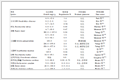
在和田朗如古近纪剖面6个采点中获得了较可靠的古地磁特征方向(图 3、表 1),高温特征剩磁古地磁结果为:Dg=13.3°,Ig=12.9°,κg=28.2,N=6,α95=12.8(地理坐标下);Ds=17.0°,Is=40.0°,κs=28.2,α95=12.8°(层面坐标下),相对应的古地磁极位置为:69.6°N,208.8°E,A95=12.0°。

|
图 3 和田朗如乡古近纪高温特征剩磁分量赤平投影图 五角星代表样品平均方向的位置;实心圆、空心圆分别代表上、下球面投影 Fig. 3 Stereo-plots of site-mean direction calcalates using characteristic high temperature component from Hetian Langru section |
|
表 1 和田朗如乡古近纪的古地磁结果(参考点:36.9°N/79.6°E) Table 1 Paleogene paleomagnetic results from Hetian Langru area (reference spot: 36.9°N/79.6°E) |
在策勒恰哈古近纪剖面15个采点中获得了较可靠的古地磁特征方向(图 4、表 2),高温特征剩磁古地磁结果为:Dg=36.2°,Ig=45.4°,κg=5.4,N=15,α95=18.2(地理坐标下);Ds=40.6,Is=30.6°,κs=21.3,α95=9.6°(层面坐标下),相对应的古地磁极位置为:49.0°N,188.7°E,A95=8.0°。

|
图 4 策勒恰哈地区古近纪高温特征剩磁分量赤平投影图 五角星代表样品平均方向的位置;实心圆、空心圆分别代表上、下球面投影 Fig. 4 Stereo-plots of site-mean direction calcalates using characteristic high temperature component from Cele Qiaha section |
|
|
表 2 策勒恰哈地区古近纪的古地磁结果(参考点:36.4°N/80.6°E) Table 2 Paleogene paleomagnetic results from Cele Qiaha area (reference spot: 36.4°N/80.6°E) |
在叶城柯克亚乡新近纪剖面9个采点中获得了较可靠的古地磁特征方向(图 5、表 3),高温特征剩磁古地磁结果为:Dg=101.4°,Ig=85.4°,κg=20.8,N=9,α95=11.6(地理坐标下);Ds=15.2,Is=27.1°,κs=36.2,α95=8.7°(层面坐标下),相对应的古地磁极位置为:63.1°N,222.9°E,A95=7.0°。

|
图 5 叶城柯克亚乡新近纪高温特征剩磁分量赤平投影图 五角星代表样品平均方向的位置;实心圆、空心圆分别代表上、下球面投影 Fig. 5 Stereo-plots of site-mean direction calcalates using characteristic high temperature component from Yecheng Kekeya section |
|
|
表 3 叶城柯克亚乡新近纪的古地磁结果(参考点:36.4°N/80.6°E) Table 3 Neogene paleomagnetic results from Yecheng Kekeya area (reference spot: 36.4°N/80.6°E) |
在喀什阿图什新近纪剖面8个采点中获得了较可靠的古地磁特征方向(图 6、表 4),高温特征剩磁古地磁结果为:Dg=161.1°,Ig=-32.1°,κg=29.1,N=8,α95=10.4;Ds=163.1°(地理坐标下),Is=-40.8°,κs=35.7,α95=9.4°(层面坐标下),相对应的古地磁极位置为:68.4°N,302.3°E,A95=8.9°。

|
图 6 阿图什新近纪高温特征剩磁分量赤平投影图 五角星代表样品平均方向的位置;实心圆、空心圆分别代表上、下球面投影 Fig. 6 Stereo-plots of site-mean direction calcalates using characteristic high temperature component from Atushi section |
|
|
表 4 阿图什新近纪的古地磁结果(参考点:39.6°N/76.0°E) Table 4 Paleogene paleomagnetic results from Atushi area (reference spot: 39.6°N/76.0°E) |
在乌恰古近纪剖面5个采点中获得了较可靠的古地磁特征方向(图 7、表 5),高温特征剩磁古地磁结果为:Dg=12.7°,Ig=54.1°,κg=32.6,N=5,α95=13.6;Ds=347.4,Is=51.0°,κs=34.4,α95=13.2°(层面坐标下),相对应的古地磁极位置为:77.1°N,311.1°E,A95=14.7°。

|
图 7 乌恰康苏镇地区古近纪高温特征剩磁分量赤平投影图 五角星代表样品平均方向的位置;实心圆、空心圆分别代表上、下球面投影 Fig. 7 Stereo-plots of site-mean direction calcalates using characteristic high temperature component from Wuqia Kangsu section |
|
|
表 5 乌恰康苏镇地区古近纪的古地磁结果(参考点:39.6°N/75°E) Table 5 Paleogene paleomagnetic results from Wuqia Kangsu area (reference spot: 39.6°N/75°E) |
由于上述采样剖面为单斜地层,无法对所获得的古地磁结果进行褶皱检验,但从图 3-图 7可以看出,其地理坐标下平均的高温特征剩磁方向远离现代地磁场方向,且和田朗如乡古近纪、策勒恰恰古近纪、叶城柯克亚乡新近纪刨面所获得的古地磁结果具有正、反2种极性,由此,我们认为以上剖面的高温特征剩磁很可能代表了岩石形成时的原生剩磁方向。
4 讨论与结论将塔里木盆地西南缘、西缘及内部白垩纪以来古地磁结果列于表 6和图 8,从表和图可以看出,塔里木地块南缘(阿尔金断裂和西昆仑前陆盆地)除了策勒古近纪以来相对稳定欧亚大陆块体发生了近30°顺时针旋转外,自东至西(和田-叶城)在古地磁误差范围内并没有发生了明显的水平旋转作用。从更大区域范围内看,不仅仅是柴达木块体新生代未发生显著的相对旋转(Dupont-Nivet et al., 2002a, b ,2003; Sun et al., 2006; 孙知明等, 2012),而且中亚塔拉斯-费尔干纳断裂以东的天山山间盆地、准噶尔、以及塔里木地块均未发生显著的相对旋转(Huang et al., 2004);正如阿尔金断裂的左旋走滑(靠近断裂附近的断块可能发生了显著的局部相对旋转)可能吸收了大型断裂附近的构造变动一样,高原北缘及中亚地区对新生代印度与亚洲大陆的构造响应很可能主要发生在大型断裂附近,而未引起块体整体的刚性运动(Huang et al., 2009)。这一研究结果表明西昆仑断裂带与阿尔金断裂一样并没有发生明显的顺时针旋转作用,表明西昆仑断裂带有可能是阿尔金断裂带的西向延伸(Avouac and Tapponnier, 1993)。

|
图 8 西昆仑山及周边地区新生代古地磁磁偏角实测值与期望值对比图 灰色箭头:磁偏角期望值;黑色箭头:磁偏角实测值 Fig. 8 Paleomagnetic results since Paleogene from rocks of the western Kunlun and adjacent region |
|
|
表 6 西昆仑山及周边地区早白垩世以来古地磁数据及相对稳定欧亚大陆块体旋转量(参考点:38.7°N/79.9°E) Table 6 Paleomagnetic poles and rotations compared to expected directions since the Early Cretaceous in the weastern Kunlun and adjacent region (reference spot: 38.7°N/79.9°E) |
塔里木地块内部麻扎塔格剖面古地磁结果表明了研究区中新世以来发生了20°~30°的顺时针旋转作用(Dupont-Nivet et al., 2002b),然而这种旋转作用是采样区局部的构造旋转,还更大范围代表塔里木地块的旋转作用还需进一步厘定。基于构造地质资料、第四纪断裂走滑速率分析以及GPS测量(Avouac et al., 1993; Peltzer and Saucier, 1996),推测塔里木地块发生了顺时针旋转作用,但这种旋转作用发生的具体时间和规模难以确定。最新的磁性地层研究表明麻扎塔格剖面的地质年代为20Ma,从麻扎塔格新近纪剖面磁倾角-厚度变化曲线,揭示了其磁偏角在13~14Ma开始明显发生变化,由NE方向转向NW方向,这表明在13~14Ma开始麻扎塔格山发生了明显的逆冲构造运动。这一逆冲运动可能与印度板块向北对欧亚大陆的俯冲,导致帕米尔高原向北的持续挤压有关(李海兵,个人通讯)。
从表 6可以看出,在塔里木地块西缘地区(帕米尔高原东北缘)包括托云(Huang et al., 2005)、乌恰、阿图什(本次研究),该地区早白垩世-新近世的古地磁旋转角度存在明显的差异,如早白垩世-晚白垩世相对欧亚大陆在古地磁误差范围内并没有发生明显的构造旋转作用(1°~1.6°),始新世以来相对欧亚大陆则发生了明显的逆时针旋转(22°~38°)。从乌恰渐新世-喀什新近纪古地磁结果可以看出,其逆时针旋转量没有发生明显的改变,由此推测该地区逆时针旋转发生的时间可能晚于中新世,该地区的逆时针旋转作用可能与塔拉斯-费尔干纳断裂新生代以来的右旋走滑作用有关。帕米尔高原西翼Tajik盆地中新世以来相对欧亚大陆同样发生了大规模的逆时针旋转(33.3±13.0°)(Thomas et al., 1994)。由此可见,帕米尔-西昆仑地区新生代构造演化伴随着在帕米尔高原西翼和帕米尔高原东北缘以逆时针旋转作用为主(Bazhenov and Mikolaichuk, 2004;本文),而在帕米尔高原以东则主要以沿大型走滑断裂的走滑作用为主(Peltzer and Tapponnier, 1988), 并没有发生明显的旋转作用(图 8)。
| [] | Abdrakhmatov K, Aldazhanov SA, Hager BH, et al. 1996. Relatively recent construction of the Tien Shan inferred from GPS measurements of present-day crustal deformation rates. Nature, 384(6608): 450–453. DOI:10.1038/384450a0 |
| [] | Avouac JP, Tapponnier P. 1993. Kinematic model of active deformation in central Asia. Geophys. Res. Lett., 20(10): 895–898. DOI:10.1029/93GL00128 |
| [] | Avouac JP, Tapponnier P, Bai M, et al. 1993. Active thrusting and folding along the northern Tien Shan and Late Cenozoic rotation of the Tarim relative to Dzungaria and Kazakhstan. Journal of Geophysical Research, 98(B4): 6755–6804. DOI:10.1029/92JB01963 |
| [] | Bazhenov ML, Mikolaichuk AV. 2004. Structural evolution of Central Asia to the North of Tibet: A synthesis of paleomagnetic and geological data. Geotectonics, 38(5): 379–393. |
| [] | Bendick R, Bilham R, Freymueller J, et al. 2000. Geodetic evidence for a low slip rate in the Altyn Tagh fault system. Nature, 404(6773): 69–72. DOI:10.1038/35003555 |
| [] | Besse J, Courtillot V. 2002. Apparent and true polar wander and the geometry of the geomagnetic field over the last 200Myr. Journal of Geophysical Research, 107(B11): 101029–101060. |
| [] | Burchfiel BC, Brown ET, Deng QD, et al. 1999. Crustal shortening on the margins of the Tien Shan, Xinjiang, China. Int. Geol. Rev., 41(8): 665–700. DOI:10.1080/00206819909465164 |
| [] | Chen Y, Cogné JP, Courtillot V. 1992. New Cretaceous paleomagnetic poles from the Tarim basin, northwestern China. Earth and Planetary Science Letters, 114(1): 17–38. DOI:10.1016/0012-821X(92)90149-P |
| [] | Dupont-Nivet G, Butler RF, Yin A, et al. 2002a. Paleomagnetism indicates no Neogene rotation of the Qaidam Basin in northern Tibet during Indo-Asian collision. Geology, 30(3): 263–266. DOI:10.1130/0091-7613(2002)030<0263:PINNRO>2.0.CO;2 |
| [] | Dupont-Nivet G, Guo Z, Butler RF, et al. 2002b. Discordant paleomagnetic direction in Miocene rocks from the central Tarim Basin: Evidence for local deformation and inclination shallowing. Earth and Planetary Science Letters, 199(3-4): 473–482. DOI:10.1016/S0012-821X(02)00566-6 |
| [] | Dupont-Nivet G, Butler RF, Yin A, et al. 2003. Paleomagnetism indicates no Neogene vertical axis rotations of the northeastern Tibetan Plateau. Journal of Geophysical Research, 108(B8): 263–266. |
| [] | England P, Molnar P. 1997. The field of crustal velocity in Asia calculated from Quaternary rates of slip on faults. Geophysical Journal International, 130(3): 551–582. DOI:10.1111/gji.1997.130.issue-3 |
| [] | Fisher RA. 1953. Dispersion on a sphere. Proc. R. Soc London, Ser. A, 217(1130): 295–305. DOI:10.1098/rspa.1953.0064 |
| [] | Holt WE, Chamot-Rooke N, Le Pichon X, et al. 2000. Velocity field in Asia inferred from Quaternary fault slip rates and Global Positioning System observations. Journal of Geophysical Research, 105(B8): 19185–19209. DOI:10.1029/2000JB900045 |
| [] | Huang BC, Wang YC, Liu T, et al. 2004. Paleomagnetism of Miocene sediments from the Turfan Basin, Northwest China: No significant vertical-axis rotation during Neotectonic compression within the Tian Shan Range, Central Asia. Tectonophysics, 384(1-4): 1–21. DOI:10.1016/j.tecto.2004.01.003 |
| [] | Huang BC, Piper JDA, Wang YC, et al. 2005. Paleomagnetic and geochronological constraints on the post-collisional northward convergence of the southwest Tian Shan, NW China. Tectonophysics, 409(1-4): 107–124. DOI:10.1016/j.tecto.2005.08.018 |
| [] | Huang BC, Piper JDA, Zhu RX. 2009. Paleomagnetic constraints on neotectonic deformation in the Kashi depression of the western Tarim Basin, NW China. Int. J. Earth Sci., 98(6): 1469–1488. DOI:10.1007/s00531-008-0401-5 |
| [] | Kirschvink JL. 1980. The Least-Squares line and plane and the analysis of palaeomagnetic data. Geophys. J. Int., 62(3): 699–718. DOI:10.1111/gji.1980.62.issue-3 |
| [] | Molnar PS, Ghose S. 2000. Seismic moments of major earthquakes and the rate of shortening across the Tien Shan. Geophysical Research Letters, 27(16): 2377–2380. DOI:10.1029/2000GL011637 |
| [] | Peltzer G, Tapponnier P. 1988. Formation and evolution of strike-slip faults, rifts, and basins during the India-Asia collision: An experimental approach. Journal of Geophysical Research, 93(B12): 15085–15117. DOI:10.1029/JB093iB12p15085 |
| [] | Peltzer G, Saucier F. 1996. Present-day kinematics of Asia derived from geologic fault rates. Journal of Geophysical Research, 101(B12): 27943–27956. DOI:10.1029/96JB02698 |
| [] | Rumelhart PE, Yin A, Cowgill E, et al. 1999. Cenozoic vertical-axis rotation of the Altyn Tagh fault system. Geology, 27(9): 819–822. DOI:10.1130/0091-7613(1999)027<0819:CVAROT>2.3.CO;2 |
| [] | Sobel ER, Dumitru TA. 1997. Thrusting and exhumation around the margins of the western Tarim basin during the India-Asia collision. Journal of Geophysical Research, 102(B3): 5043–5063. DOI:10.1029/96JB03267 |
| [] | Sun ZM, Ya ng, Z Y, Pei JL, et al. 2006. New Early Cretaceous paleomagnetic data from volcanic and red beds of the eastern Qaidam Block and its implications for tectonics of Central Asia. Earth and Planetary Science Letters, 243(1-2): 268–281. DOI:10.1016/j.epsl.2005.12.016 |
| [] | Sun ZM, Li HB, Pei JL, et al. 2012. Strike-slip movement of the Altyn Tagh fault and implications for mountain formation inferred from paleomagnetic data in northeastern Tibetan Plateau. Acta Petrologica Sinica, 28(6): 1928–1936. |
| [] | Thomas JC, Chauvin A, Gapais D, et al. 1994. Paleomagnetic evidence for Cenozoic block rotations in the Tadjik depression (Central Asia). Journal of Geophysical Research, 99(B8): 15141–15160. DOI:10.1029/94JB00901 |
| [] | Yin A. 2000. Cenozoic vertical-axis rotation of the Altyn Tagh fault system. Geology, 28(5): 480. DOI:10.1130/0091-7613(2000)28<480:CVROTA>2.0.CO;2 |
| [] | 孙知明, 李海兵, 裴军令, 等. 2012. 阿尔金断裂走滑作用对青藏高原东北缘山脉形成的古地磁证据. 岩石学报, 28(6): 1928–1936. |