 2013, Vol. 29


2. 教育部含油气盆地构造研究中心, 杭州 310027;
3. 东方地球物理公司研究院, 涿州 072751
2. Research Center for Structures in Oil & Gas Bearing Basins, Ministry of Education, Hangzhou 310027, China;
3. Research Institute of BGP inc., China National Petroleum Corporation, Zhuozhou 072751, China
长达1600km的阿尔金断裂是青藏高原的北界,是一条现今仍在活动的巨型左旋走滑断裂,它连接着青藏高原北缘几乎所有的造山带和冲断系统(图 1),对研究青藏高原隆升及其应力传递过程有着重要的意义 (Cowgill et al., 2003)。近代对于阿尔金断裂的研究始于20世纪70年代Molnar和Tapponnier对遥感影像的解译 (Molnar and Tapponnier, 1975; Tapponnier and Molnar, 1977)。近40年来,大量地质学家从盆地填充 (Yue et al., 2001; Yin et al., 2002; 陈正乐等, 2005; 冯志硕等, 2010)、山体隆升 (Sobel et al., 2001; 陈正乐等, 2001, 2006)、深部地球物理探测 (Wittlinger et al., 1998; Herquel et al., 1999; Zhao et al., 2006)、岩浆事件 (汤文豪等, 2012)等多角度论述了阿尔金断裂显生宙以来的演化历史,内容涉及到阿尔金断裂的规模(地壳尺度还是岩石圈尺度)、走滑活动时间、位移量、滑移速率以及活动方式等方方面面,其中对其新生代大规模走滑时间的认定是一个最为重要、也是争论非常激烈的话题,因为它关系到青藏高原北缘应力传递、分配以及变形机制等一系列关键的科学问题。

|
图 1 青藏高原北部构造简图 (据Yin et al., 2002修改) 部分主要断裂:1-三危山断裂;2-若羌-米兰断裂;3-车尔臣河断裂;4-北阿尔金断裂;5-金雁山断裂;6-索尔库里断裂;7-党河南山断裂;8-柴达木北缘断裂;9-铁克里克断裂;10-阿尔塔什断裂.部分新生代沉积盆地:JB-酒泉盆地;MB-民乐盆地;SCB-石包城盆地;SB-肃北盆地;XKB-索尔库里盆地;GHB-共和盆地;NXB-宁夏盆地;KKB-库木库里盆地.主要缝合带:IYS-印度-雅鲁藏布江缝合带;BNS-班公湖-怒江缝合带;JS-金沙江缝合带;AKMS-阿尼玛卿-昆仑-玛扎塔格缝合带;KS-库地缝合带 Fig. 1 Sketch tectonic map of the northern Tibetan Plateau (modified after Yin et al., 2002) Major faults: 1-Sanweishan fault; 2-Ruoqiang-Milan fault; 3-Cheerchenhe fault; 4-North Altyn Fault; 5-Jinyanshan fault; 6-Xolkol fault; 7-Danghe Nanshan fault; 8-northern Qaidam fault; 9-Tiekelike fault; 10-Aertashi fault. Cenozoic sedimentary basins: JB-Jiuquan Basin; MB-Minle Basin; SCB-Shibaocheng Basin; SB-Subei Basin; XKB-Xolkol Basin; GHB-Gonghe Basin; NXB-Ningxia Basin; KKB-Komukol Basin. Major sutures: IYS-India-Yaluzangbo suture; BNS-Banggonghu-Nujiang suture; JS-Jinshajiang suture; AKMS-Animaqing-Kunlun-Mazha Tagh suture; KS-Kudi suture |
前人通过对断裂带内元古界中的大型弧形构造和流变褶曲 (周勇和潘裕生, 1998)以及奥陶系中的塑性变形构造 (周勇和潘裕生, 1999)的认定、对韧性剪切伴生矿物的定年 (Wang et al., 2005; 李海兵等, 2006; Liu et al., 2007; 刘永江等, 2007; 陈应涛等, 2010; 崔军文, 2011)、以及对柴达木盆地和河西走廊盆地群中生界原型的分析 (Vincent and Allen, 1999; 钟建华等, 2006; 段宏亮等, 2007)等提出阿尔金断裂早在新生代以前就有过活动,其中以侏罗-白垩纪最为强烈。汤文豪等(2012) 也将昌马盆地和酒西盆地内产出的一套早白垩世晚期的中基性火山岩作为阿尔金断裂东端白垩纪活化的重要佐证。尽管如此,阿尔金断裂的现今形态主要是新生代印藏碰撞的产物这一观点依然是不争的事实。对其新生代的走滑活动时间,大量的研究认为自晚始新世-渐新世启动 (Meng et al., 2001; Yue et al., 2001; Chen et al., 2004; 陈正乐等, 2006; Guo et al., 2009),另有少量研究认为是在中新世 (袁四化等, 2008; Wang et al., 2010; Wu et al., 2012a)。第一种观点将阿尔金山自晚始新世-渐新世以来的隆升统统归因于阿尔金断裂的左旋走滑,然而物理模拟的结果表明大规模地表走滑前的基底剪切(走滑)也能产生大范围的地表隆升 (Le Guerroué and Cobbold, 2006)。而且,现今阿尔金山明显是由多个不同时期形成的不同方向构造相互叠加而成 (Wu et al., 2012b),单一的走滑隆升模式很难解释这种现象。第二种观点或从柴达木盆地对走滑运动的沉积和构造响应入手,或将阿尔金断裂的大规模左旋走滑与青藏高原北缘的强烈隆升相联系,能在一定程度上解释阿尔金断裂左旋走滑位移量的消减方式,但还需要更多的资料去完善和证实。
由于阿尔金断裂规模巨大,本身具有极大的复杂性,很难通过直接证据来限定阿尔金断裂大规模走滑时间。本文从阿尔金断裂大规模走滑引起的一系列地质响应入手,来综合限定其活动时间,包括(1) 柴达木盆地西侧来自阿尔金山的沉积物源变化;(2) 塔西南走滑挤压挠曲盆地的形成时间;(3) 阿尔金断裂左旋走滑位移量的消减方式--青藏高原北缘的上地壳缩短变形;(4) 走滑相关盆地的形成;(5) 与阿尔金断裂相平行的线性山脉的隆升时间等等。
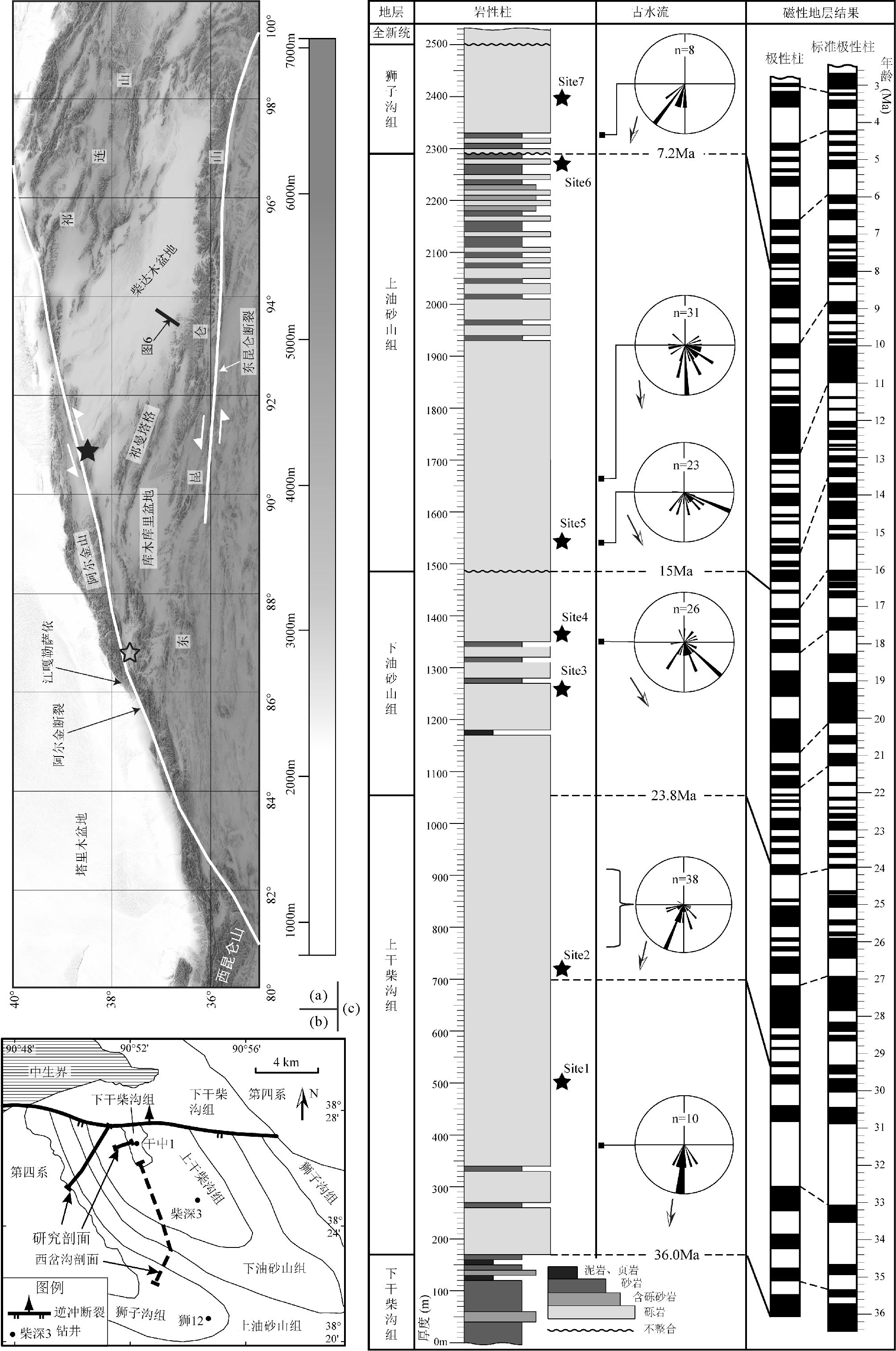
2 阿尔金断裂走滑的地质响应 2.1 沉积物源区变化在走滑体系中,受走滑断裂水平错移的影响,沉积物源区往往会随时间不断发生变化,该变化可以较好的限定该地区的起始走滑时间。受阿尔金断裂活动的影响,阿尔金山在新生代发生隆升并成为两侧盆地(如柴达木和塔里木盆地)的物源区 (Wu et al., 2012a, b ),这些沉积区的新生代物源变化特征是判断阿尔金断裂新生代走滑时间的重要证据。该方法需要有出露完整的新生代沉积剖面,可以对其整个新生代的物源进行系统研究。柴达木盆地西北缘的干柴沟背斜出露有阿尔金断裂两侧最完整的新生代层序,是研究阿尔金断裂新生代活动过程的理想地区。该背斜位于阿尔金断裂中段南侧、柴达木盆地英雄岭西端,呈北西-南东走向并向南东倾伏,向北被一条北倾的阿尔金分支断裂所截断,是一个上新世以后形成的断鼻构造(图 2b)。本文所研究的剖面位于该背斜的西翼,自下而上依次出露了下干柴沟组、上干柴沟组、下油砂山组、上油砂山组以及狮子沟组(图 2b, c)。
|
图 2 青藏高原北缘DEM图(a)、柴达木盆地西部干柴沟地区地质简图(b)和干柴沟剖面岩性柱状图和古水流 (c, 据Wu et al., 2012a) 图(a)中实心五角星为图(b)的位置,空心五角星为图(b)沿着阿尔金断裂向西移动约360km后的位置;图(c)位置见图(b),磁性地层结果来自东侧约6km的西岔沟剖面 (张伟林, 2006) Fig. 2 DEM map of the northern Tibetan Plateau (a), sketch geological map of the Ganchaigou area in western Qaidam Basin (b) and lithology and paleocurrents of the Ganchaigou section (c, after Wu et al., 2012a) Solid star in (a) shows the location of (b), while blank star shows the location of (b) after 360km westward displacement along the Altyn Tagh Fault. Location of (c) is shown in (b), and magnetostratigraphic result is cited from adjacent Xichagou section (Zhang, 2006) |
下干柴沟组主要出露在背斜核部,岩性为红色泥岩、粉砂岩、砂岩,夹少量的砾岩和含砾砂岩,发育水平层理。在距离本剖面约6km的柴深3井中(图 2b),该地层的上部发育一套厚约100m的泥灰岩,说明当时的沉积环境比较稳定,可能为辫状河三角洲相或滨湖相。从上干柴沟组开始,沉积物主要为一套块状砾岩夹少量砂、泥岩,直到上油砂山组上部河流相砂岩才逐渐增多,至狮子沟组中下部很快又全部变为块状砾岩。狮子沟组上部被全新统松散的水平砾石层所覆盖(图 2c)。
2.1.2 地层时代前人曾对该剖面东侧约6km的西岔沟剖面(图 2b)做了详细的磁性地层测年 (张伟林, 2006),得出下干柴沟组时代为>36.0Ma,上干柴沟组时代为36.0~23.8Ma,下油砂山组时代为23.8~15Ma,上油砂山组时代为15~7.2Ma,狮子沟组时代为<7.2Ma。由于西岔沟剖面与本文所测剖面相隔很近,且同处于背斜的西南翼,在遥感图和野外均可很好追踪对比,故本文采用西岔沟的磁性地层结果来限定地层的时代,得出该剖面砾石大量出现时间约为36Ma(图 2c)。
值得注意的是,前人对西岔沟的研究将本文上干柴沟组的下部(700m以下)统统划为下干柴沟组 (如张伟林, 2006),据此得出的上、下干柴沟组界线的绝对年龄约为29.3Ma(图 2c)。然而前人在红三旱一号地区测定的该界线年龄为35.5Ma (Sun et al., 2005b),在大红沟地区测定的该界线年龄则为>34Ma (Lu and Xiong, 2009),可见前人在干柴沟地区所定的上、下干柴沟组的界线在全盆地范围内并不可对比。本文从等时性的角度将该界线暂时下移至现在的位置。从构造层序的角度,本文所定的界线正好是砾岩开始大量出现的时间,与红三旱一号剖面该界线之上砾岩开始出现的事实也相吻合 (Wu et al., 2012b)。
2.1.3 物源分析对该剖面自约36Ma开始沉积的大套砾岩开展了物源分析,包括古水流测量和砾石岩性统计。
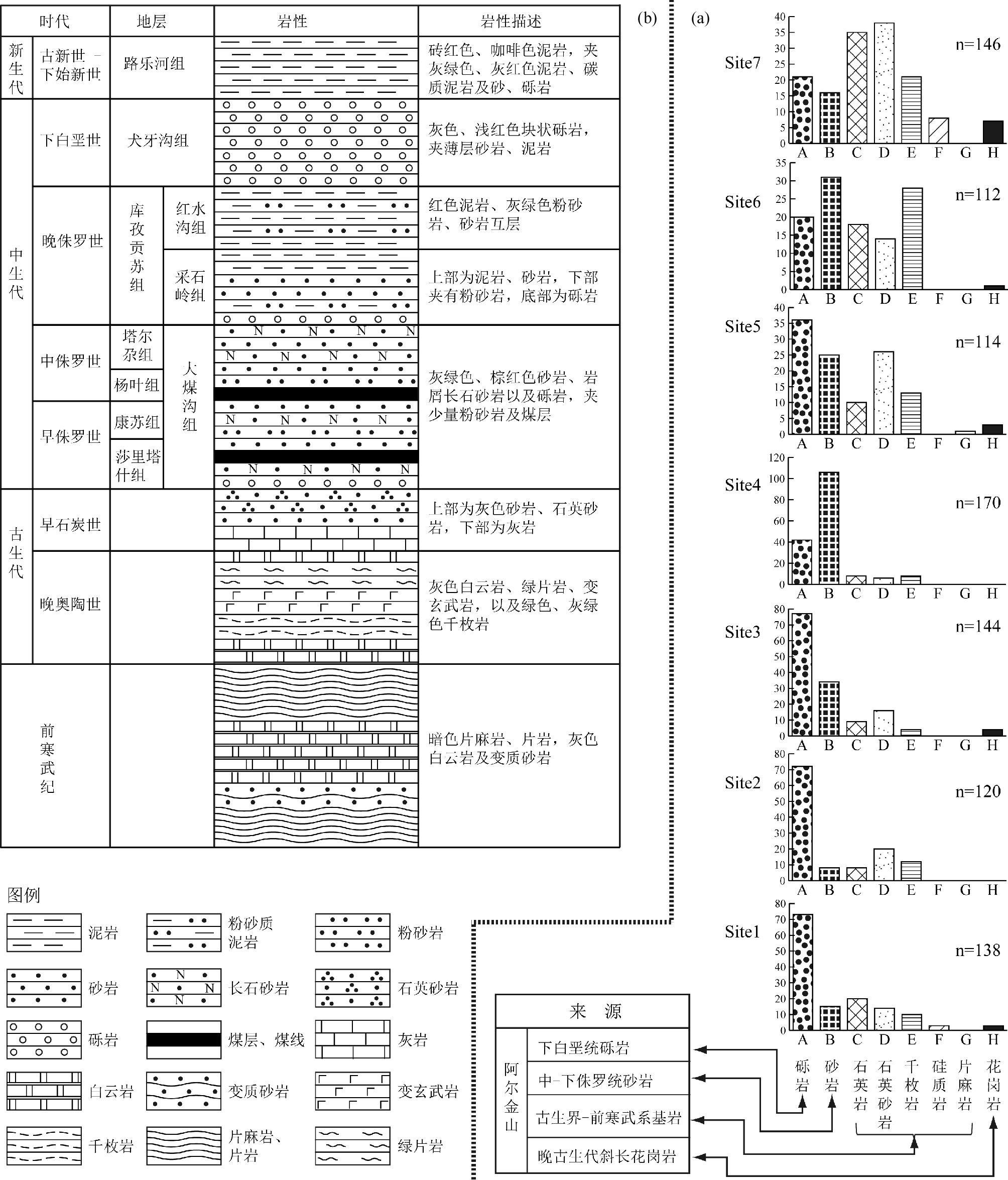
古水流主要来自倾斜砾石的扁平面产状,结果显示自36Ma以来古水流一直向南(图 2c)。在砾岩中挑选了7个点开展砾石统计工作。其中Site1和Site2位于上干柴沟组,Site3和Site4位于下油砂山组,Site5和Site6分别位于上油砂山组的底部和顶部,Site7位于狮子沟组(图 2c)。对每一个测量点,在1m×1m的范围内随机挑选砾石110颗以上并对其岩性进行识别。结果显示这些砾石的岩性主要有砾岩、砂岩、石英岩、石英砂岩、千枚岩、硅质岩、片麻岩和花岗岩8种(图 3a)。
|
图 3 干柴沟剖面砾石岩性统计结果(a, 据Wu et al., 2012a)和阿尔金山索尔库里盆地以西部分的前寒武-新生代早期岩性柱状图(b, 据青海省地质矿产局, 1991; Ritts and Biffi, 2000; Wu et al., 2011改编) Fig. 3 Result of clasts rock types of the Ganchaigou section (a, after Wu et al., 2012a) and Precambrian-Early Cenozoic bedrocks in the Altyn Mountain west of the Xolkol Basin (b, compiled after BGMRQ, 1991; Ritts and Biffi, 2000; Wu et al., 2011) |
向南的古水流意味着物源来自研究区北方,大量快速堆积的块状砾岩则表明物源区很近。在这两个条件的约束下,阿尔金断裂北侧的阿尔金山地区就成为了研究区自36Ma以来最可能的物源区。而且,研究区自晚侏罗世以来沿着阿尔金断裂向北东移动了约360km (Ritts and Biffi, 2000),据此得出阿尔金山江嘎勒萨依至研究区之间的部分都是其新生代的物源区(图 2a)。为了更好的进行对比,我们归纳出了这些地区的前新生代岩性(图 3b),并与砾石岩性统计结果进行对比,发现二者吻合得非常好:砾岩砾石与下白垩统岩性一致;砂岩砾石和中-下侏罗统岩性一致,均为棕红色长石岩屑砂岩、含砾砂岩;石英砂岩和硅质岩在古生界沉积岩中广泛分布;石英岩、千枚岩和片麻岩则是前寒武系地层的主要岩性;花岗岩砾石与阿尔金山古生代花岗岩一致,均为灰白色斜长花岗岩(图 3)。可见,阿尔金山自约36Ma就已经显著隆升,成为柴达木盆地西部地区的物源区。
从Site1到Site4,来自下白垩统的砾岩砾石含量从60%减少至25%,而来自中-下侏罗统的砂岩砾石含量则从约10%增加至62%(图 3a)。由于其他几种砾石成分在这4个分析点中含量较少,上述变化反映了一个稳定的中生界物源持续遭受剥蚀的情况,表明在此期间,研究区的物源没有发生变化,也就意味着阿尔金断裂在此时尚未产生明显的地表位移。从Site5开始,砾石成分突然变得异常复杂,石英岩、石英砂岩、变质砂岩这些来自于阿尔金山古生界-元古界地层的砾石含量也开始增多,反映阿尔金山的持续隆升使得老地层逐渐剥露出来(图 3a)。另一个显著的变化是下白垩统的砾岩砾石含量突然增多,并维持在一个比较高的水平,由于在Site4中这种下白垩统的砾岩砾石已经很少,说明物源在Site4之后发生很大改变,否则这种砾岩砾石含量应该持续减少。也就是说,干柴沟剖面的物源在Site4和Site5之间发生了改变,时间大约在上、下油砂山组之间,绝对年龄约为15Ma。
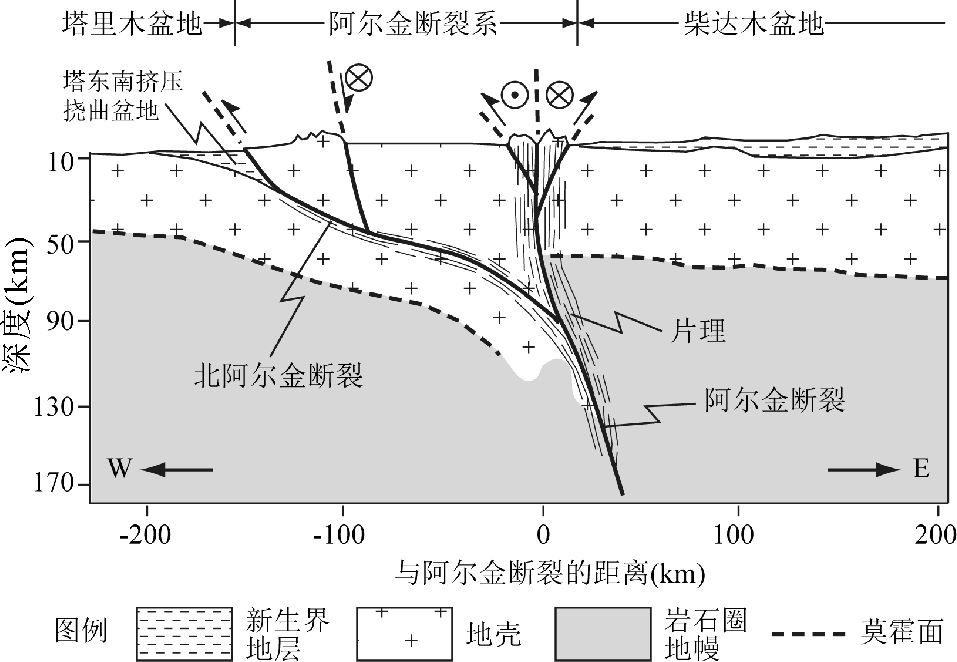
2.2 塔东南走滑挤压挠曲盆地的形成时间塔里木盆地东南缘(以下简称“塔东南”)是指位于阿尔金断裂和阿尔金山以北、车尔臣河断裂以南、呈NE展布的狭长区域(图 1)。由于紧邻阿尔金山和阿尔金断裂,其沉积和演化过程与阿尔金断裂息息相关。目前有部分学者认为塔东南与柴达木盆地在新生代早期为统一的沉积盆地,后期被阿尔金断裂的左旋走滑所错断 (Meng et al., 2001; Meng and Fang, 2008)。与柴达木盆地不同的是,塔东南并没有随着青藏高原一起隆升,反而沿着阿尔金断裂系向SE方向俯冲 (Wittlinger et al., 1998),形成走滑挤压挠曲盆地 (贾承造, 2005; 陈汉林等, 2009; 杨树锋等, 2009)(图 4)。因此,塔东南走滑挤压挠曲盆地的形成时间也是限定阿尔金断裂大规模走滑的要素之一。
|
图 4 塔里木盆地东南缘、阿尔金断裂系及青藏高原北缘大地构造剖面 (据Wittlinger et al., 1998) Fig. 4 Tectonic profile across the SE Tarim Basin, the Altyn Tagh Fault system and northern Tibetan Plateau (after Wittlinger et al., 1998) |
塔东南绝大部分地区地表都被第四系覆盖,仅在其东南缘阿尔金山北麓的江嘎勒萨依、米兰河口出露有部分古近系和新近系(图 5)。自下而上可分为库姆格列木群、乌恰群、阿图什组、西域组、乌苏群和新疆群,总体为一套向上变粗的灰色、红色陆相碎屑岩系 (新疆维吾尔自治区区域地层表编写组, 1981)。

|
图 5 塔里木盆地东南缘新生代地层等厚图 (据程晓敢等, 2008) (a)-库姆格列木群等厚度;(b)-乌恰群等厚图;(c)-阿图什组及以上地层等厚图 Fig. 5 Isopach maps of the Cenozoic strata in SE Tarim Basin (after Cheng et al., 2008) (a)-Kumugeliemu Group; (b)-Wuqia Group; (c)-Atushi Formation and overlying stratum |
由于一直以来缺乏可靠的化石报道,对塔东南各组地层的时代目前并没有一个可信的方案。最早的区域地质调查将库姆格列木群划为古-始新统,将乌恰群划为渐新统-中新统,将阿图什组划为上新统,将西域组、乌苏群和新疆群均划至更新统-全新统 (新疆维吾尔自治区区域地层表编写组, 1981)。Yin et al. (2002) 对江嘎勒萨依地区乌恰群下段约500m厚的河流相砂泥岩进行了磁性地层定年,认为其年龄约在22.5~18Ma或26~23Ma之间。Yue et al. (2004) 综合前人的资料认为库姆格列木群上部(Unit1)属渐新统,乌恰群和阿图什组(Unit2)属中新统,西域组和乌苏群(Unit3)属上新统。Ritts et al. (2009) 首次在米兰河口剖面中阿图什组底部的泥岩夹层中找到以卷转虫(Ammonia beccrii)为主的有孔虫类以及浮游生物化石,有力的证明了阿图什组底部的沉积年代为中新世中期,约15Ma。
在这些研究的基础上,结合前人对邻近的塔西南地区西域组底界的定年工作 (Zheng et al., 2000),本文提出以下较为合理的方案:库姆格列木群时代为古近纪(>23Ma),乌恰群时代为早中新世(23~15Ma),阿图什组时代为晚中新世-早上新世(15~3.5Ma),西域组时代为晚上新世,乌苏群和新疆群则属于更新世。
|
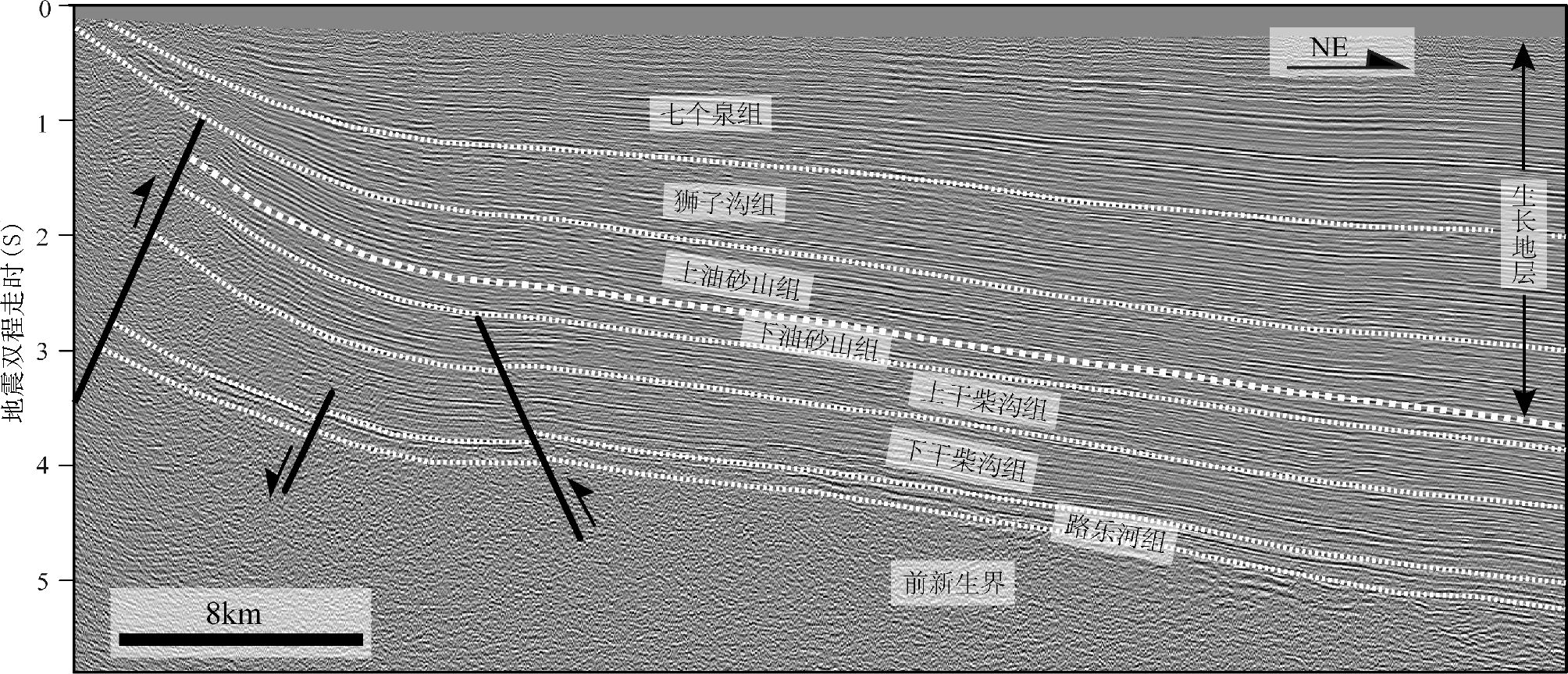
图 6 柴达木盆地南缘的地震剖面及其地质解释 位置见图 2a Fig. 6 A seismic profile with geological interpretation in the southern Qaidam Basin For location see Fig. 2a |
塔东南地区新生代各地层的厚度等值线图 (程晓敢等, 2008)表明库姆格列木群的沉积厚度在整个塔东南地区变化不大,大多在400~500m之间,没有明显的堆积中心,反映当时沉积稳定,构造活动较弱(图 5a);乌恰群仅在塔东南西端存在一个幅度不是很大的堆积中心,最大厚度达1500m,向北东地层厚度又趋于稳定,维持在500~750m之间,可能反映当时西昆仑山开始微弱隆升(图 5b);至阿图什组沉积以后,塔东南地区存在两个明显的堆积中心,最大厚度达2500m以上,分别位于西昆仑与阿尔金交汇部位的民丰-于田一带以及阿尔金山前的若羌一带,向NW方向迅速减薄,具有明显的挤压挠曲盆地沉积特征(图 5c)。可见,塔东南新生代走滑挤压挠曲盆地开始形成于阿图什组沉积时,约15Ma以后。
2.3 青藏高原北缘上地壳大规模缩短变形时间阿尔金断裂的左旋走滑在其中段产生了约400~500km的地表位移 (如Ritts and Biffi, 2000; Yue et al., 2001; Cowgill et al., 2003),如此大的位移量必然需要青藏高原北缘(东昆仑、柴达木、祁连山以及河西走廊地区)以一定的方式来吸收。尽管有学者提出阿尔金断裂曾经与其东北侧的阿拉善断裂连在一起并一直延伸到鄂霍茨克洋 (Yue and Liou, 1999; Darby et al., 2005),使得约有200km的位移量被鄂霍茨克洋的洋中脊所吸收,然而最新的地震、沉积和大地测量学证据则均显示阿尔金断裂向东最远仅延伸到河西走廊北东的合黎山-龙首山一带 (陈文彬和徐锡伟, 2006; 张进等, 2007)。因此,青藏高原北缘上地壳在阿尔金断裂走滑后必然产生强烈的NE-SW向缩短变形,以此来吸收后者的左旋位移量,二者在时间上应该是同时的。该推论目前已得到最新GPS测量结果的支持 (Zheng et al., 2012)。
目前限定一个地区隆升变形起始时间的方法有很多,比如沉积学、沉积物同位素、盆地地震资料分析以及热年代学等。前三种方法在有精细地层年龄的前提下是非常可靠的,因为它们都有详细的年代序列,能够清晰反映研究区在整个地质历史时期的变化。而单一的热年代学方法(如磷灰石裂变径迹)仅仅反映研究区某一时间点的隆升历史,具有很大的片面性,因此往往需要多种方法(如锆石、磷灰石的裂变径迹和U-Th/He)同时使用才能得到较为可靠的结果,但目前在青藏高原北缘尚未有类似的结果(尤其是低温热年代学)报道。因此,在本文中我们仅仅采用前三种方法的结果来限定青藏高原的强烈隆升时间。
图 6是柴达木盆地南缘的一条地震剖面及其解释方案,该地区构造平缓,地层变形幅度很小,下油砂山组及以下地层厚度稳定且向南(东昆仑)略微增厚,表明当时的盆地范围应远大于现今,甚至有可能越过东昆仑山与可可西里盆地相接 (Yin et al., 2007; 蔡雄飞等, 2009);从上油砂山组开始出现向南减薄的生长地层,意味着此时(绝对年龄约15Ma,图 2c)盆地南缘的东昆仑山开始逐渐抬升。
南祁连山位于柴达木盆地北侧,在二者结合部位发育新生代右行走滑冲断带 (王步清等, 2005)。在该地区尽管也存在一些推覆构造 (吴珍汉等, 2009),但研究表明大部分主要断层的走滑量远大于冲断量,导致在柴北缘并没有典型的前陆盆地发育。Lu and Xiong (2009) 对绿梁山南侧大红沟剖面做了详细的岩性、沉积相以及磁性地层研究,认为南祁连强烈隆升成为物源区发生在上油砂山组下部,绝对年龄约12Ma。Fang et al. (2007) 则对柴北缘东侧的怀头他拉剖面做了沉积和磁性地层年代学分析,并根据沉积速率的变化认为南祁连强烈隆升始于~14.7Ma,同样位于上油砂山组的底部。刘志宏等(2005) 利用地震剖面对柴北缘地区发育的主要背斜进行了分析,发现这些背斜也主要形成于中中新世以后,与沉积学结果一致。
北祁连山位于河西走廊盆地群南侧,二者之间发育有较为典型的北祁连前陆冲断带 (陈汉林等, 2006; 杨树锋等, 2007),并在山前地区形成了新生代前陆盆地,且以西侧的酒泉盆地最为典型,研究程度也最高(图 1)。Bovet et al. (2009) 对酒西、酒东盆地的几条露头剖面做了详细的岩性、沉积相以及物源分析,认为在13Ma之前该地区的物源主要来自南祁连,13Ma之后北祁连开始隆升并控制了酒泉地区的沉积。Palumbo et al. (2009) 通过测得的隆升和剥蚀速率,并结合现今高程反推得出北祁连山前榆木山的隆升时间约为3.7±0.9Ma。前人对北祁连前陆冲断带的研究结果表明其开始变形时间约在疏勒河组胳塘段上部沉积之前 (陈汉林等, 2006),根据该地区的磁性地层结果 (Fang et al., 2005a)得出其绝对年龄约在9.0Ma。
青藏高原东北缘是指青海湖以东地区,包括贵德盆地、循化盆地以及六盘山地区等。Lease et al. (2007) 利用碎屑锆石的U-Pb定年对拉脊山和西秦岭的锆石特征年龄谱进行了分析,对比得出拉脊山的隆升时间约为8Ma;Lin et al. (2010) 对六盘山地区寺口子剖面进行了系统的研究,得出该地区的隆升时间为9.5Ma。Hough et al. (2011) 对积石山两侧的循环盆地和临夏盆地中的钙质沉积物的稳定同位素进行了分析对比,认为二者在16~11Ma开始发生分异,意味着积石山在此时开始隆升。此外,西宁盆地和贵德盆地的一些沉积剖面的研究结果也支持该地区的隆升时间在中中新世以后 (Pares et al., 2003; Fang et al., 2005b; Wang et al., 2012)。
可见,青藏高原北缘的隆升主要发生在中中新世中期以后,绝对年龄约在15±2Ma。最新对亚洲飞尘中Nd同位素 (Li et al., 2011)以及中亚地区中中新世以来的干旱事件 (Miao et al., 2012)的研究结果也支持该结论。
2.4 其他证据 2.4.1 走滑相关盆地在阿尔金断裂带内部,分布着大大小小十数个新生代沉积盆地,它们有些是走滑形成的拉分盆地或挠曲盆地,前者如索尔库里盆地和石包城盆地,后者如肃北盆地(图 1);有些则是早期盆地被后来的阿尔金断裂所改造,如北索尔库里盆地、吐拉盆地和敦煌盆地 (郭召杰和张志诚, 1998)。这些盆地的沉积和构造演化与阿尔金断裂的活动息息相关,是研究阿尔金断裂的理想场所。本文将综合前人研究对索尔库里盆地、石包城盆地以及肃北盆地进行一些介绍,探讨这些盆地的形成时间。
索尔库里盆地(90°E,38.5°N)位于阿尔金断裂中段北侧的阿尔金山中,石包城盆地(95.7°E,39.7°N)则位于阿尔金断裂东段南侧的祁连山西端(图 1)。它们形态均呈不规则三角形,盆地内地表平坦,除紧邻阿尔金断裂的这一侧外,其余边界断裂均与阿尔金断裂斜交,指示它们属于典型的松弛分叉型走滑拉分盆地 (郭召杰等, 1998; 冯志硕等, 2010)。由于目前仍在伸展,盆地地表基本都被第四纪沉积物覆盖,也缺乏钻井、地震等深部地质、地球物理资料。在盆地边缘地区出露一些新生代晚期地层(上中新统-上新统)不整合于前新生代地层之上,应该代表着该类盆地的最早沉积地层,意味着这两个盆地形成于晚中新世以后。
肃北盆地(94.7°E,39.5°N)位于甘肃省肃北县以西约10km处(图 1),发育一系列近东西向的褶皱 (Yin et al., 2002)。由于阿尔金断裂在该处发生拐弯,使其正好处于走滑断裂的受阻弯曲(restraining bend)部位,这种独特的构造位置吸引了一大批的地质学家对其进行研究。Van der Woerd et al. (2001) 最早对该地区的活动构造进行了研究。Gilder et al. (2001) 和Yin et al. (2002) 则对盆地内西水沟剖面的新生代地层进行了磁性地层定年。Wang et al. (2003) 对肃北盆地西水沟和铁匠沟剖面进行了详细的地质调查,并利用新的化石证据对Gilder et al. (2001) 的磁性地层结果进行校正,认为肃北盆地南侧的党河南山地区在晚中新世(9~12Ma)才开始大规模隆升,并在盆地内沉积了大量的粗碎屑物。Sun et al. (2005a) 在铁匠沟剖面所做的磁性地层结果也表明肃北盆地周缘的挤压事件发生在13.7 Ma以后。
可见与阿尔金断裂左旋走滑相关的拉分及挤压盆地均形成于晚中新世(约14Ma)以后。
2.4.2 阿尔金断裂两侧线性山脉的隆升现今的阿尔金山由多个不同方向的隆起组成,如近东西向、北东东向和北东向 (Wu et al., 2012b)。其中北东东向隆起宽约40km,沿着阿尔金断裂呈线性分布,是真正受阿尔金断裂左旋走滑摩擦挤压所产生,其隆升也是限定阿尔金断裂左旋走滑时间的重要因素。另两个方向的隆起构造可能与阿尔金断裂走滑前的活动有关 (Wu et al., 2012b)。前人在北东东向隆起做了很多热年代学(磷灰石裂变径迹)工作 (万景林等, 2001; 陈正乐等, 2002, 2006),均显示北东东向隆起快速隆升于10~8Ma以后。
3 阿尔金断裂新生代大规模走滑时间的综合厘定上述结果表明,大量与阿尔金断裂左旋走滑相关的地质响应均出现在中中新世以后,如柴达木盆地西缘的物源变化以及塔里木盆地东南缘走滑挤压挠曲盆地均形成于约15Ma,青藏高原北缘上地壳强烈的NE-SW向缩短变形发生在中中新世(15±2Ma)以后,走滑相关的拉分及挤压盆地均形成于晚中新世(约14Ma)以后,以及与阿尔金断裂走滑断裂相伴生的线性山脉显著隆升于10Ma以后等等。这些证据意味着阿尔金断裂新生代大规模的走滑始于中中新世,绝对年龄约在15±2Ma。Wang et al. (2010) 将柴达木盆地西部沿着阿尔金断裂分布的中中新世不整合面(上油砂山组与下伏地层界线)作为阿尔金断裂左旋走滑起始的标志,也与本文观点一致。
4 讨论 4.1 阿尔金断裂左旋走滑速率如果认为阿尔金断裂中段的左旋位移量约为375±25km (Yue et al., 2001)且全部产生于新生代的话,本文结果需要阿尔金断裂中段的新生代长期滑移速率为25±6mm/y,该速率要远高于前人通过第四纪河流阶地和大地测量手段得出的速率(<15mm/y) (如Bendick et al., 2000; Elliott et al., 2008; Cowgill et al., 2009; Cowgill and Gold, 2009; Gold et al., 2009),这也是很多学者反对将阿尔金断裂的走滑起始时间放在中新世的重要原因。造成这种矛盾的根本问题在于上述位移量的确定往往是基于前寒武-侏罗系的地质对应体,即得出的是阿尔金断裂至少自侏罗纪以来的位移量。越来越多的证据表明阿尔金断裂在侏罗纪、白垩纪均有过活动,因此上述位移量不单单是新生代所产生,从而造成得到的长期滑移速率偏高。目前阿尔金断裂系中尚无可靠的新生代总位移量数据报道,一旦能够剥离出新生代的总位移量,就能得出较为可靠的长期滑移速率。
4.2 阿尔金山隆升与阿尔金断裂左旋走滑的关系现在一般认为阿尔金山隆升于晚始新世-渐新世 (Meng et al., 2001; Wu et al., 2012a)且与阿尔金断裂的左旋走滑息息相关。该隆升时间与本文得出的阿尔金断裂走滑时间并不一致,那么阿尔金山与阿尔金断裂左旋走滑之间到底是什么关系呢?
Wu et al. (2012b) 对柴达木盆地西部新生代沉积特征进行综合研究后发现,阿尔金山自晚始新世的隆升基本都发生在其近东西向的隆起上,它们呈雁列式分布于阿尔金断裂两侧,控制这些隆起的断裂倾向基本都是朝向阿尔金断裂,并被后者所切割。也就是说,阿尔金山的早期隆升并不是平行于阿尔金断裂的线性山脉,而是由一系列与阿尔金断裂斜交的雁列式隆起组成。这一现象很难用简单的阿尔金断裂左旋走滑模式来解释,而很可能受控于大规模地表走滑前的基底剪切(走滑)作用。即在晚始新世-中中新世时期,阿尔金断裂的走滑主要发生在深部,浅层(上地壳)以雁列式的近东西向逆断层和隆升来吸收这些走滑。阿尔金断裂在中中新世以后的左旋走滑对这些早期隆起进行了改造,最终形成了阿尔金山现今的复杂构造格局。这种两阶段的阿尔金断裂发育模式 (Wu et al., 2012a, 2012b)能很好的解释阿尔金山中不同方向构造的形成机制以及阿尔金山隆升与阿尔金断裂之间的关系 (肖安成等, 2013)。
4.3 青藏高原北缘新生代的构造应力转换及与阿尔金断裂左旋走滑的关系印藏碰撞的远程效应在晚始新世时就传递到了高原北缘,此时由于应力为近NS向挤压,形成的构造也多是近EW向。Clark et al. (2010) 在东昆仑山前报道的晚始新世的断裂(EW向)活动应该就是这一阶段的产物。在塔里木盆地与青藏高原北部的边界处,由于二者岩石圈强度的差异,该应力被改造成沿边界分布的基底剪切应力,形成了一系列呈雁列式分布的EW向构造,造成了阿尔金山的早期隆升(Wu et al., 2012b)。当阿尔金断裂发生大规模走滑以后,高原北缘的应力方向被改造成了与阿尔金断裂近平行的NE-NEE向,形成的挤压构造以NW向或NNW向为主,也就是高原北缘现今的主要构造形态。Lease et al. (2011) 和Liu et al. (2012) 发现在青藏高原东北部,近东西向的拉脊山隆升时间要早,约在22Ma;而NNW向的积石山的隆升时间则相对较晚,约在13Ma以后;以此提出在高原北缘中中新世时存在一期构造应力从近NS到近NEE向的转换。该转换无论是从时间上还是从机制上都能用阿尔金断裂中中新世的左旋走滑启动来很好解释。
5 结论本文从多个角度对阿尔金断裂新生代走滑起始时间这一科学问题进行了综合阐述,包括柴达木盆地西缘的物源变化(约15Ma)、塔里木盆地东南缘走滑挤压挠曲盆地的形成(约15Ma)、青藏高原北缘上地壳强烈的NE-SW向缩短变形(15±2Ma)、走滑相关盆地的形成(<14Ma)以及与走滑断裂相伴生的线性隆起形成(<10Ma)等等。这些结果表明大量与阿尔金断裂左旋走滑相关的地质响应均出现在中中新世以后,约束得出阿尔金断裂新生代大规模的走滑始于约15±2Ma。此外还分析了利用本文结果得出的阿尔金断裂新生代长期滑移速率与实测的第四纪滑移速率矛盾的原因,并讨论了阿尔金断裂左旋走滑与阿尔金山的隆升和青藏高原东北缘在中中新世的构造应力转换之间的关系。
| [] | Bendick R, Bilham R, Freymueller J, Larson K, Yin GH. 2000. Geodetic evidence for a low slip rate in the Altyn Tagh fault system. Nature, 404(6773): 69–72. DOI:10.1038/35003555 |
| [] | Bureau of Geology and Mineral Resources of Qinghai Province (BGMRQ). 1991. Regional Geology of Qinghai Province. Beijing: Geological Publishing House. |
| [] | Bovet PM, Ritts BD, Gehrels G, Abbink AO, Darby B, Hourigan J. 2009. Evidence of Miocene crustal shortening in the North Qilian Shan from Cenozoic stratigraphy of the western Hexi Corridor, Gansu Province, China. American Journal of Science, 309(4): 290–329. DOI:10.2475/00.4009.02 |
| [] | Cai XF, Liu DM, Yuan YM, Li DW, Luo ZJ. 2009. Relationship of the Paleocene-Miocene strata between the Qaidam and Kekexili basins. Journal of Stratigraphy, 33(3): 276–282. |
| [] | Chen HL, Yang SF, Xiao AC, Pan ZZ, Cheng XG, Chen JJ, Fan MT, Tian DW. 2006. Deformation characteristics and time of Cenozoic thrust belt in southern margin of Jiuquan basin. Oil & Gas Geology, 27(4): 488–494. |
| [] | Chen HL, Luo JC, Guo QY, Liao L, Xiao ZR, Cheng XG, Yang SF, Wang BQ. 2009. Deformation history and tectonic evolution of southeastern Tarim Basin in Mesozoic and Cenozoic. Geotectonica et Metallogenia, 33(1): 38–45. |
| [] | Chen WB, Xu XW. 2006. Sinistral strike-slip faults along the southern Alashan margin and eastwards extending of the Altun Fault. Seismology and Geology, 28(2): 319–324. |
| [] | Chen YT, Zhang GW, Lu RK, Zhang YQ. 2010. 40Ar/39Ar geochronology of the Guozhacuo fault in the northwestern margin of Qinghai-Tibet Plateau: New evidence for the western extension of Altyn Tagh Fault. Geological Bulletin of China, 29(8): 1129–1137. |
| [] | Chen ZL, Zhang YQ, Wang XF, Chen XH, Washburn Z, Arrowsmith J. 2001. Fission track dating of apatite constrains on the Cenozoic uplift of the Altyn Tagh Mountain. Acta Geoscientia Sinica, 22(5): 413–418. |
| [] | Chen ZL, Wang JL, Wang XF, Chen XH, Pan JH. 2002. Rapid strike-slip of the Altyn Tagh Fault at 8Ma and its geological implications. Acta Geoscientia Sinica, 23(4): 295–300. |
| [] | Chen ZL, Wang XF, Yin A, Chen BL, Chen XH. 2004. Cenozoic left-slip motion along the central Altyn Tagh Fault as inferred from the sedimentary record. International Geology Review, 46(9): 839–856. DOI:10.2747/0020-6814.46.9.839 |
| [] | Chen ZL, Liu J, Sun ZM, Wang XF, Pei JL, Gong HL. 2005. Cenozoic erosional history of the Altyn Tagh Mountains inferred from the sedimentary record of the foreland basin. Geological Bulletin of China, 24(4): 302–308. |
| [] | Chen ZL, Gong HL, Li L, Wang XF, Chen BL, Chen XH. 2006. Cenozoic uplifting and exhumation process of the Altyn Tagh Mountains. Earth Science Frontiers, 13(4): 91–102. |
| [] | Cheng XG, Liao L, Chen HL, Chen LF, Yang SF, Wang BQ, Xiao ZY, Luo JC. 2008. Research of Cenozoic structural deformation in southeastern Tarim Basin, northwest China. Acta Petrologica Sinica, 24(4): 645–654. |
| [] | Clark MK, Farley KA, Zheng DW, Wang ZC, Duvall AR. 2010. Early Cenozoic faulting of the northern Tibetan Plateau margin from apatite (U-Th)/He ages. Earth and Planetary Science Letters, 296(1-2): 78–88. DOI:10.1016/j.epsl.2010.04.051 |
| [] | Cowgill E, Yin A, Harrison TM, Wang XF. 2003. Reconstruction of the Altyn Tagh fault based on U-Pb geochronology: Role of back thrusts, mantle sutures, and heterogeneous crustal strength in forming the Tibetan Plateau. Journal of Geophysical Research, 108(B7): 1–28. |
| [] | Cowgill E, Gold R. 2009. Building a latest Quaternary slip history for the central altyn tagh fault: Implications for deep-time paleoseismology. Abstracts with Programs-Geological Society of America, 41(7): 659. |
| [] | Cowgill E, Gold RD, Chen XH, Wang XF, Arrowsmith JR, Southon J. 2009. Low Quaternary slip rate reconciles geodetic and geologic rates along the Altyn Tagh Fault, northwestern Tibet. Geology, 37(7): 647–650. DOI:10.1130/G25623A.1 |
| [] | Cui JW. 2011. Ductile shearing age of the South Altun Fault and its tectonic implications. Acta Petrologica Sinica, 27(11): 3422–3434. |
| [] | Darby BJ, Ritts BD, Yue YJ, Meng QR. 2005. Did the Altyn Tagh Fault extend beyond the Tibetan Plateau. Earth and Planetary Science Letters, 240(2): 425–435. DOI:10.1016/j.epsl.2005.09.011 |
| [] | Duan HL, Zhong JH, Ma F, Zhang YZ, Li Y, Wen ZF. 2007. Prototypes and evolution of the Mesozoic basin in western Qaidam. Acta Geoscientica Sinica, 28(4): 356–368. |
| [] | Editorial Group of Regional Stratigraphy in Xinjiang Province. 1981. Regional Stratigraphy in Northwestern China-Xinjiang Province Part. Beijing: Geological Publishing House. |
| [] | Elliott JR, Biggs J, Parsons B, Wright TJ. 2008. InSAR slip rate determination on the Altyn Tagh Fault, northern Tibet, in the presence of topographically correlated atmospheric delays. Geophysical Research Letters, 35(12): L12309. |
| [] | Fang XM, Zhao ZJ, Li JJ, Yan MD, Pan BT, Song CH, Dai S. 2005a. Magnetostratigraphy of the Late Cenozoic Laojunmiao anticline in the northern Qilian Mountains and its implications for the northern Tibetan Plateau uplift. Science in China (Series D), 48(7): 1040–1051. DOI:10.1360/03yd0188 |
| [] | Fang XM, Yan MD, Van der Voo R, Rea DK, Song CH, Pares JM, Gao JP, Nie JS, Dai S. 2005b. Late Cenozoic deformation and uplift of the NE Tibetan Plateau: Evidence from high-resolution magnetostratigraphy of the Guide Basin, Qinghai Province, China. Geological Society of America Bulletin, 117(9-10): 1208–1225. |
| [] | Fang XM, Zhang WL, Meng QQ, Gao JP, Wang XM, King J, Song CH, Dai S, Miao YF. 2007. High-resolution magnetostratigraphy of the Neogene Huaitoutala section in the eastern Qaidam Basin on the NE Tibetan Plateau, Qinghai Province, China and its implication on tectonic uplift of the NE Tibetan Plateau. Earth and Planetary Science Letters, 258(1-2): 293–306. DOI:10.1016/j.epsl.2007.03.042 |
| [] | Feng ZS, Zhang ZC, Li JF, Guo ZJ. 2010. Cenozoic tectonics and sedimentation of Shibaocheng basin, Gansu Province and its relationship with Altyn Tagh Fault. Chinese Journal of Geology, 45(1): 181–193. |
| [] | Gilder S, Chen Y, Sen S. 2001. Oligo-Miocene magnetostratigraphy and rock magnetism of the Xishuigou section, Subei (Gansu Province, western China) and implications for shallow inclinations in central Asia. Journal of Geophysical Research, 106(B12): 30505–30521. DOI:10.1029/2001JB000325 |
| [] | Gold RD, Cowgill E, Arrowsmith JR, Gosse J, Chen XH, Wang XF. 2009. Riser diachroneity, lateral erosion, and uncertainty in rates of strike-slip faulting: A case study from Tuzidun along the Altyn Tagh Fault, NW China. Journal of Geophysical Research, 114(B4): B04401. |
| [] | Guo ZJ, Zhang ZC. 1998. Structural style and tectonic evolution of the basins in the Altun region. Geological Review, 44(4): 257–264. |
| [] | Guo ZJ, Zhang ZC, Wang JJ. 1998. Formation and evolution of the Xorkol Basin and its relation to the Altun Tagh Fault. Geological Journal of China Universities, 4(1): 59–63. |
| [] | Guo ZJ, Lu JM, Zhang ZC. 2009. Cenozoic exhumation and thrusting in the northern Qilian Shan, northeastern margin of the Tibetan Plateau: Constraints from sedimentological and apatite fission-track data. Acta Geologica Sinica, 83(3): 562–579. DOI:10.1111/j.1755-6724.2009.00045.x |
| [] | Herquel G, Tapponnier P, Wittlinger G, Mei J, Danian S. 1999. Teleseismic Shear wave splitting and lithospheric anisotropy beneath and across the Altyn Tagh Fault. Geophysical Research Letters, 26(21): 3225–3228. DOI:10.1029/1999GL005387 |
| [] | Hough BG, Garzione CN, Wang ZC, Lease RO, Burbank DW, Yuan DY. 2011. Stable isotope evidence for topographic growth and basin segmentation: Implications for the evolution of the NE Tibetan Plateau. Geological Society of America Bulletin, 123(1-2): 168–185. DOI:10.1130/B30090.1 |
| [] | Jia CZ. 2005. Foreland thrust-fold belt features and gas accumulation in Midwest China. Petroleum Exploration and Development, 32(4): 9–15. |
| [] | Le Guerroué E, Cobbold PR. 2006. Influence of erosion and sedimentation on strike-slip fault systems: Insights from analogue models. Journal of Structural Geology, 28(3): 421–430. DOI:10.1016/j.jsg.2005.11.007 |
| [] | Lease RO, Burbank DW, Gehrels GE, Wang ZC, Yuan DY. 2007. Signatures of mountain building: Detrital zircon U/Pb ages from northeastern Tibet. Geology, 35(3): 239–242. DOI:10.1130/G23057A.1 |
| [] | Lease RO, Burbank DW, Clark MK, Farley KA, Zheng DW, Zhang HP. 2011. Middle Miocene reorganization of deformation along the northeastern Tibetan Plateau. Geology, 39(4): 359–362. DOI:10.1130/G31356.1 |
| [] | Li GJ, Pettke T, Chen J. 2011. Increasing Nd isotopic ratio of Asian dust indicates progressive uplift of the north Tibetan Plateau since the Middle Miocene. Geology, 39(3): 199–202. DOI:10.1130/G31734.1 |
| [] | Li HB, Yang JS, Xu ZQ, Sun ZM, Tapponnier P, Van Der Woerd J, Meriaux AS. 2006. The constraint of the Altyn Tagh fault system to the growth and rise of the northern Tibetan Plateau. Earth Science Frontiers, 13(4): 59–79. |
| [] | Lin XB, Chen HL, Wyrwoll K, Cheng XG. 2010. Commencing uplift of the Liupan Shan since 9.5Ma: Evidences from the Sikouzi section at its east side. Journal of Asian Earth Sciences, 37(4): 350–360. |
| [] | Liu SF, Zhang GW, Pan F, Zhang HP, Wang P, Wang K, Wang Y. 2012. Timing of Xunhua and Guide basin development and growth of the northeastern Tibetan Plateau, China. Basin Research, 25(1): 74–96. |
| [] | Liu YJ, Neubauer F, Genser J, Ge XH, Takasu A, Yuan SH, Chang LH, Li WM. 2007. Geochronology of the initiation and displacement of the Altyn Strike-Slip Fault, western China. Journal of Asian Earth Sciences, 29(2-3): 243–252. DOI:10.1016/j.jseaes.2006.03.002 |
| [] | Liu YJ, Franz N, Ge XH, Johann G, Yuan SH, Li WM, Gong QL, Chen YZ. 2007. Geochronology of the Altun fault zone and rising of the Altun Mountains. Chinese Journal of Geology, 42(1): 134–146. |
| [] | Liu ZH, Wan CB, Yang JG, Liu ZW, Gao JY. 2005. Cenozoic structural features and deformation regularities of the northern Qaidam Basin, China. Chinese Journal of Geology, 40(3): 404–414. |
| [] | Lu HJ, Xiong SF. 2009. Magnetostratigraphy of the Dahonggou section, northern Qaidam Basin and its bearing on Cenozoic tectonic evolution of the Qilian Shan and Altyn Tagh Fault. Earth and Planetary Science Letters, 288(3-4): 539–550. DOI:10.1016/j.epsl.2009.10.016 |
| [] | Meng QR, Hu JM, Yang FZ. 2001. Timing and magnitude of displacement on the Altyn Tagh fault: Constraints from stratigraphic correlation of adjoining Tarim and Qaidam basins, NW China. Terra Nova, 13(2): 86–91. DOI:10.1046/j.1365-3121.2001.00320.x |
| [] | Meng QR, Fang X. 2008. Cenozoic tectonic development of the Qaidam Basin in the northeastern Tibetan Plateau. Geological Society of America Special Papers, 444: 1–24. |
| [] | Miao YF, Herrmann M, Wu FL, Yan XL, Yang SL. 2012. What controlled Mid-Late Miocene long-term aridification in Central Asia? Global cooling or Tibetan Plateau uplift: A review. Earth-Science Reviews, 112(3-4): 155–172. DOI:10.1016/j.earscirev.2012.02.003 |
| [] | Molnar P, Tapponnier P. 1975. Cenozoic tectonics of Asia: Effects of a Continental collision. Science, 189(4201): 419–426. DOI:10.1126/science.189.4201.419 |
| [] | Palumbo L, Hetzel R, Tao MX, Li XB, Guo JM. 2009. Deciphering the rate of mountain growth during topographic presteady state: An example from the NE margin of the Tibetan Plateau. Tectonics, 28(4): TC4017. |
| [] | Pares JM, Van Der Voo R, Downs WR, Yan MD, Fang XM. 2003. Northeastward growth and uplift of the Tibetan Plateau: Magnetostratigraphic insights from the Guide Basin. Journal of Geophysical Research, 108(B1): EPM1-1–EPM-1-11. DOI:10.1029/2001JB001349 |
| [] | Ritts BD, Biffi U. 2000. Magnitude of post-Middle Jurassic (Bajocian) displacement on the central Altyn Tagh fault system, Northwest China. Geological Society of America Bulletin, 112(1): 61–74. DOI:10.1130/0016-7606(2000)112<61:MOPJBD>2.0.CO;2 |
| [] | Ritts BD, Yue YJ, Graham SA, Sobel ER, Abbink OA, Stockli D. 2009. From sea level to high elevation in 15 million years: Uplift history of the northern Tibetan Plateau margin in the Altun Shan. American Journal of Science, 308(5): 657–678. |
| [] | Sobel ER, Arnaud N, Jolivet M, Ritts BD and Brunel M. 2001. Jurassic to Cenozoic exhumation history of the Altyn Tagh range, Northwest China, constrained by 40Ar/ 39Ar and apatite fission track thermochronology. In: Hendrix MS and Davis GA (eds.). Paleozoic and Mesozoic Tectonic Evolution of Central Asia: From Continental Assembly to Intracontinental Deformation. Boulder, Colorado: Geological Society of America, 247-267 |
| [] | Sun JM, Zhu RX, An ZS. 2005a. Tectonic uplift in the northern Tibetan Plateau since 13.7Ma ago inferred from molasse deposits along the Altyn Tagh Fault. Earth and Planetary Science Letters, 235(3-4): 641–653. |
| [] | Sun ZM, Yang ZY, Pei JL, Ge XD, Wang XS, Yang TS, Li WM, Yuan SH. 2005b. Magnetostratigraphy of Paleogene sediments from northern Qaidam Basin, China: Implications for tectonic uplift and block rotation in northern Tibetan Plateau. Earth and Planetary Science Letters, 237(3-4): 635–646. DOI:10.1016/j.epsl.2005.07.007 |
| [] | Tang WH, Zhang ZC, Li JF, Chen C, Li K. 2012. Geochemical characteristics and tectonic significance of the Cretaceous volcanic rocks in the eastern terminal of the Altyn Tagh fault zones. Earth Science Frontiers, 19(4): 51–62. |
| [] | Tapponnier P, Molnar P. 1977. Active faulting and tectonics in China. Journal of Geophysical Research, 82(20): 2905–2929. DOI:10.1029/JB082i020p02905 |
| [] | Van der Woerd J, Xu XW, Li HB, Tapponnier P, Meyer B, Ryerson FJ, Meriaux AS, Xu ZQ. 2001. Rapid active thrusting along the northwestern range front of the Tanghe Nan Shan (western Gansu, China). Journal of Geophysical Research, 106(B12): 30475–30504. DOI:10.1029/2001JB000583 |
| [] | Vincent SJ, Allen MB. 1999. Evolution of the Minle and Chaoshui basins, China: Implications for Mesozoic strike-slip basin formation in Central Asia. Geological Society of America Bulletin, 111(5): 725–742. DOI:10.1130/0016-7606(1999)111<0725:EOTMAC>2.3.CO;2 |
| [] | Wan JL, Wang Y, Li Q, Wang F, Wang EQ. 2001. FT evidence of northern Altyn uplift in Late Cenozoic. Bulletin of Mineralogy Petrology and Geochemistry, 20(4): 222–224. |
| [] | Wang BQ, Xiao AC, Cheng XG, He GY, Chen HL, Yang SF. 2005. Geometry and kinematics of Cenozoic right-lateral strike-slip thrust structural belt in the north margin of the Qaidam Basin. Journal of Zhejiang University (Science Edition), 32(2): 225–230. |
| [] | Wang L, Xiao AC, Gong QL, Liu D, Wu L, Zhou SP, Shen ZY, Lou QQ, Sun XW. 2010. The unconformity in Miocene sequence of western Qaidam Basin and its tectonic significance. Science China (Earth Sciences), 53(8): 1126–1133. DOI:10.1007/s11430-010-4006-z |
| [] | Wang XM, Wang BY, Qiu ZX, Xie GP, Xie JY, Downs W, Qiu ZD, Deng T. 2003. Danghe area (western Gansu, China) biostratigraphy and implications for depositional history and tectonics of northern Tibetan Plateau. Earth and Planetary Science Letters, 208(3-4): 253–269. DOI:10.1016/S0012-821X(03)00047-5 |
| [] | Wang XY, Lu HY, Vandenberghe J, Zheng SH and van Balen R. 2012. Late Miocene uplift of the NE Tibetan Plateau inferred from basin filling, planation and fluvial terraces in the Huang Shui catchment. Global and Planetary Change, 88-89: 10–19. DOI:10.1016/j.gloplacha.2012.02.009 |
| [] | Wang Y, Zhang XM, Wang E, Zhang JF, Li Q, Sun GH. 2005. 40Ar/39Ar thermochronological evidence for formation and Mesozoic evolution of the northern-central segment of the Altyn Tagh fault system in the northern Tibetan Plateau. Geological Society of America Bulletin, 117(9-10): 1336–1346. |
| [] | Wittlinger G, Tapponnier P, Poupinet G, Mei J, Shi DN, Herquel G, Masson F. 1998. Tomographic evidence for localized lithospheric shear along the Altyn Tagh Fault. Science, 282(5386): 74–76. DOI:10.1126/science.282.5386.74 |
| [] | Wu L, Xiao AC, Wang LQ, Shen ZY, Zhou SP, Chen YZ, Wang L, Liu D, Guan JY. 2011. Late Jurassic-Early cretaceous northern Qaidam Basin, NW China: Implications for the Earliest Cretaceous intracontinental tectonism. Cretaceous Research, 32(4): 552–564. DOI:10.1016/j.cretres.2011.04.002 |
| [] | Wu L, Xiao AC, Yang SF, Wang LQ, Mao LG, Wang L, Dong YP, Xu B. 2012a. Two-stage evolution of the Altyn Tagh Fault during the Cenozoic: New insight from provenance analysis of a geological section in NW Qaidam Basin, NW China. Terra Nova, 24(5): 387–395. DOI:10.1111/ter.2012.24.issue-5 |
| [] | Wu L, Xiao AC, Wang LQ, Mao LG, Wang L, Dong YP, Xu B. 2012b. EW-trending uplifts along the southern side of the central segment of the Altyn Tagh Fault, NW China: Insight into the rising mechanism of the Altyn Mountain during the Cenozoic. Science China (Earth Sciences), 55(6): 926–939. DOI:10.1007/s11430-012-4402-7 |
| [] | Wu ZH, Hu DG, Wu ZH, Ye PS, Zhou CJ. 2009. Quaternary sinistral-slip thrusting in north margin of Qaidam Basin. Quaternary Sciences, 29(3): 599–307. |
| [] | Xiao AC, Wu L. 2013. Tectonic processes of the Cenozoic Altyn Tagh Fault and its coupling with the Qaidam Basin, NW China. Acta Petrologica Sinica, 29(8): 2826–2836. |
| [] | Yang SF, Chen HL, Cheng XG, Xiao AC, Chen JJ, Fan MT, Tian DW. 2007. Structural Characteristics and Oil & Gas Prospect of the North Qilian Thrust Belt. Beijing: Science Press. |
| [] | Yang SF, Chen LF, Xiao ZY, Luo JC, Chen HL, Wang BQ, Cheng XG, Liao L. 2009. The Cenozoic fault system of southeastern Tarim Basin. Geotectonica et Metallogenia, 33(1): 33–37. |
| [] | Yin A, Rumelhart PE, Butler R, Cowgill E, Harrison TM, Foster DA, Ingersoll RV, Zhang Q, Zhou XQ, Wang XF, Hanson A, Raza A. 2002. Tectonic history of the Altyn Tagh fault system in northern Tibet inferred from Cenozoic sedimentation. Geological Society of America Bulletin, 114(10): 1257–1295. DOI:10.1130/0016-7606(2002)114<1257:THOTAT>2.0.CO;2 |
| [] | Yin A, Dang YQ, Zhang M, Mcrivette MW, Burgess WP, Chen XH. 2007. Cenozoic tectonic evolution of Qaidam Basin and its surrounding regions (Part 2): Wedge tectonics in southern Qaidam Basin and the eastern Kunlun Range. Special Papers-Geological Society of America, 433: 369–390. |
| [] | Yuan SH, Liu YJ, Ge XH, Wu GD, Hu Y, Guo XZ, Li WM. 2008. Uplift period of the northern margin of the Qinghai-Tibet Plateau: Evidences from the Altyn Mountains and Qaidam Basin. Acta Petrologica et Mineralogica, 27(5): 413–421. |
| [] | Yue YJ, Liou JG. 1999. Two-stage evolution model for the Altyn Tagh Fault, China. Geology, 27(3): 227–230. DOI:10.1130/0091-7613(1999)027<0227:TSEMFT>2.3.CO;2 |
| [] | Yue YJ, Ritts BD, Graham SA. 2001. Initiation and long-term slip history of the Altyn Tagh Fault. International Geology Review, 43(12): 1087–1093. DOI:10.1080/00206810109465062 |
| [] | Yue YJ, Ritts BD, Hanson AD, Graham SA. 2004. Sedimentary evidence against large strike-slip translation on the northern Altyn Tagh Fault, NW China. Earth and Planetary Science Letters, 228(3-4): 311–323. DOI:10.1016/j.epsl.2004.10.008 |
| [] | Zhang J, Li JY, Li YF, Ma ZJ. 2007. The Cenozoic deformation of the Alxa block in central Asia: Question on the northeastern extension of the Altyn Tagh Fault in Cenozoic time. Acta Geologica Sinica, 81(11): 1481–1497. |
| [] | Zhang WL. 2006. High-resolution Cenozoic magnetostratigraphy in the Qaidam Basin and the uplift of Tibetan Plateau. Ph. D. Dissertation. Langzhou: Langzhou University (in Chinese with English summary) |
| [] | Zhao JM, Mooney WD, Zhang XK, Li ZC, Jin ZJ, Okaya N. 2006. Crustal structure across the Altyn Tagh Range at the northern margin of the Tibetan Plateau and tectonic implications. Earth and Planetary Science Letters, 241(3-4): 804–814. DOI:10.1016/j.epsl.2005.11.003 |
| [] | Zheng HD, Powell CM, An ZS, Zhou J, Dong GR. 2000. Pliocene uplift of the northern Tibetan Plateau. Geology, 28(8): 715–718. DOI:10.1130/0091-7613(2000)28<715:PUOTNT>2.0.CO;2 |
| [] | Zheng WJ, Zhang PZ, He WG, Yuan DY, Shao YX, Zheng DW, Ge WP and Min W. 2012. Transformation of displacement between strike-slip and crustal shortening in the northern margin of the Tibetan Plateau: Evidence from decadal GPS measurements and Late Quaternary slip rates on faults. Tectonophysics, 584, doi: 10.1016/j.tecto.2012.01.006 |
| [] | Zhong JH, Yin CM, Duan HL, Ma F, Wang HQ, Wen ZF. 2006. Mesozoic paleocurrent properties in the southern edge of Altyn Mountain in the western Qaidam Basin. Acta Petrolei Sinica, 27(2): 20–27. |
| [] | Zhou Y, Pan YS. 1998. Determination of the dextral slip of Mangya-Subei segment of Altun Fault. Scientia Geologica Sinica, 33(1): 9–16. |
| [] | Zhou Y, Pan YS. 1999. The initial shear sense of the Altun Fault and its timing. Geological Review, 45(1): 1–9. |
| [] | 蔡雄飞, 刘德民, 袁晏明, 李德威, 罗中杰. 2009. 试论柴达木和可可西里盆地古近纪-中新世地层的亲缘性. 地层学杂志, 33(3): 276–282. |
| [] | 陈汉林, 杨树锋, 肖安成, 潘正中, 程晓敢, 陈建军, 范铭涛, 田多文. 2006. 酒泉盆地南缘新生代冲断带的变形特征和变形时间. 石油与天然气地质, 27(4): 488–494. |
| [] | 陈汉林, 罗俊成, 郭群英, 廖林, 肖中尧, 程晓敢, 杨树锋, 王步清. 2009. 塔里木盆地东南缘中新生代变形史与构造演化. 大地构造与成矿学, 33(1): 38–45. |
| [] | 陈文彬, 徐锡伟. 2006. 阿拉善地块南缘的左旋走滑断裂与阿尔金断裂带的东延. 地震地质, 28(2): 319–324. |
| [] | 陈应涛, 张国伟, 鲁如魁, 张永强. 2010. 青藏高原西北缘郭扎错断裂40Ar/39Ar年代学研究——阿尔金断裂西延的新证据. 地质通报, 29(8): 1129–1137. |
| [] | 陈正乐, 张岳桥, 王小凤, 陈宣华, WashburnZ, ArrowsmithJR. 2001. 新生代阿尔金山脉隆升历史的裂变径迹证据. 地球学报, 22(5): 413–418. |
| [] | 陈正乐, 万景林, 王小凤, 陈宣华, 潘锦华. 2002. 阿尔金断裂带8Ma左右的快速走滑及其地质意义. 地球学报, 23(4): 295–300. |
| [] | 陈正乐, 刘健, 孙知明, 王小凤, 裴军令, 宫红良. 2005. 阿尔金山脉新生代剥露历史——前陆盆地沉积记录. 地质通报, 24(4): 302–308. |
| [] | 陈正乐, 宫红良, 李丽, 王小凤, 陈柏林, 陈宣华. 2006. 阿尔金山脉新生代隆升-剥露过程. 地学前缘, 13(4): 91–102. |
| [] | 程晓敢, 廖林, 陈汉林, 陈立锋, 杨树锋, 王步清, 肖中尧, 罗俊成. 2008. 塔里木盆地东南缘新生代构造变形特征研究. 岩石学报, 24(4): 645–654. |
| [] | 崔军文. 2011. 南阿尔金断裂的韧性剪切作用时代及其构造意义. 岩石学报, 27(11): 3422–3434. |
| [] | 段宏亮, 钟建华, 马锋, 张跃中, 李勇, 温志峰. 2007. 柴达木盆地西部中生界原型盆地及其演化. 地球学报, 28(4): 356–368. |
| [] | 冯志硕, 张志诚, 李建锋, 郭召杰. 2010. 甘肃石包城盆地新生代沉积特征及与阿尔金断裂的关系研究. 地质科学, 45(1): 181–193. |
| [] | 郭召杰, 张志诚. 1998. 阿尔金盆地群构造类型与演化. 地质论评, 44(4): 257–264. |
| [] | 郭召杰, 张志诚, 王建君. 1998. 索尔库里盆地的形成、演化及其与阿尔金断裂带的关系研究. 高校地质学报, 4(1): 59–63. |
| [] | 贾承造. 2005. 中国中西部前陆冲断带构造特征与天然气富集规律. 石油勘探与开发, 32(4): 9–15. |
| [] | 李海兵, 杨经绥, 许志琴, 孙知明, Tapponnier P, Van Der Woerd J, Meriaux A. 2006. 阿尔金断裂带对青藏高原北部生长、隆升的制约. 地学前缘, 13(4): 59–79. |
| [] | 刘永江, FranzN, 葛肖虹, JohannG, 袁四化, 李伟民, 巩庆林, 陈元忠. 2007. 阿尔金断裂带年代学和阿尔金山隆升. 地质科学, 42(1): 134–146. |
| [] | 刘志宏, 万传彪, 杨建国, 刘振文, 高军义. 2005. 柴达木盆地北缘地区新生代构造特征及变形规律. 地质科学, 40(3): 404–414. |
| [] | 青海省地质矿产局. 1991. 青海省区域地质志. 北京: 地质出版社. |
| [] | 汤文豪, 张志诚, 李建锋, 晨辰, 李可. 2012. 阿尔金断裂东端白垩纪火山岩地球化学特征及其地质意义. 地学前缘, 19(4): 51–62. |
| [] | 万景林, 王瑜, 李齐, 王非, 王二七. 2001. 阿尔金山北段晚新生代山体抬升的裂变径迹证据. 矿物岩石地球化学通报, 20(4): 222–224. |
| [] | 王步清, 肖安成, 程晓敢, 何光玉, 陈汉林, 杨树锋. 2005. 柴达木盆地北缘新生代右行走滑冲断构造带的几何学和运动学. 浙江大学学报 (理学版), 32(2): 225–230. |
| [] | 吴珍汉, 胡道功, 吴中海, 叶培盛, 周春景. 2009. 柴达木盆地北缘第四纪左旋斜冲推覆构造运动. 第四纪研究, 29(3): 599–307. |
| [] | 肖安成, 吴磊. 2013. 阿尔金断裂新生代活动方式及其与柴达木盆地的耦合分析. 岩石学报, 29(8): 2826–2836. |
| [] | 新疆维吾尔自治区区域地层表编写组. 1981. 西北地区区域地层表: 新疆维吾尔自治区分册. 北京: 地质出版社 |
| [] | 杨树锋, 陈汉林, 程晓敢, 肖安成, 陈建军, 范铭涛, 田多文. 2007. 祁连山北缘冲断带构造特征及含油气远景. 北京: 科学出版社. |
| [] | 杨树锋, 陈立峰, 肖中尧, 罗俊成, 陈汉林, 王步清, 程晓敢, 廖林. 2009. 塔里木盆地东南缘新生代断裂系统. 大地构造与成矿学, 33(1): 33–37. |
| [] | 袁四化, 刘永江, 葛肖虹, 吴光大, 胡勇, 郭新转, 李伟民. 2008. 青藏高原北缘的隆升时期——来自阿尔金山和柴达木盆地的证据. 岩石矿物学杂志, 27(5): 413–421. |
| [] | 张进, 李锦轶, 李彦峰, 马宗晋. 2007. 阿拉善地块新生代构造作用——兼论阿尔金断裂新生代东向延伸问题. 地质学报, 81(11): 1481–1497. |
| [] | 张伟林. 2006. 柴达木盆地新生代高精度磁性地层与青藏高原隆升. 博士学位论文. 兰州: 兰州大学 |
| [] | 钟建华, 尹成明, 段洪亮, 马锋, 王海侨, 温志峰. 2006. 柴西阿尔金山南缘中生界古流特征. 石油学报, 27(2): 20–27. |
| [] | 周勇, 潘裕生. 1998. 茫崖-肃北段阿尔金断裂右旋走滑运动的确定. 地质科学, 33(1): 9–16. |
| [] | 周勇, 潘裕生. 1999. 阿尔金断裂早期走滑运动方向及其活动时间探讨. 地质论评, 45(1): 1–9. |