 2013, Vol. 29


2. 教育部含油气盆地构造研究中心, 杭州 310027;
3. 东方地球物理公司研究院, 涿州 072751;
4. 中国石油青海油田分公司研究院, 敦煌 736200
2. Research Center for Structures in Oil & Gas Bearing Basins, Ministry of Education, Hangzhou 310027, China;
3. Research Institute of BGP inc., China National Petroleum Corporation, Zhuozhou 072751, China;
4. Research Center of Qinghai Oilfield Company, China National Petroleum Corporation, Dunhuang 736200, China
自从Molnar and Tapponnier (1975) 和Tapponnier and Molnar (1977) 通过对遥感影像的解译识别出阿尔金断裂并指出它可以与北美圣安德烈斯(San Andreas)断裂相提并论以来,这条长达1600km的至今仍在活动的巨型左旋走滑断裂就一直成为地质学家们关注的热点。阿尔金断裂是青藏高原的北界,分隔着坚硬的塔里木板块和相对较软的青藏高原,连接着高原北缘几乎所有的造山带及其冲断系统,对研究青藏高原的生长过程、应力传递、应变吸收等等方面有着重要的意义。四十年来,人们对其规模(岩石圈尺度还是地壳尺度) (Jiang et al., 2004; Zhao et al., 2006; Xiao et al., 2011)、活动时间和方式 (Yue and Liou, 1999; Yin et al., 2002; Wu et al., 2012a)、第四纪以及现今的滑移速率 (Bendick et al., 2000; 李海兵等, 2008; Gold et al., 2011)、显生宙以来的滑移量 (Ritts and Biffi, 2000; Yue et al., 2001; 李海兵等, 2007)等等各方面开展了工作,取得了一系列瞩目的成果。然而,由于本身地质情况复杂、地理条件艰苦,其研究程度与San Andreas断裂相比仍非常薄弱,很多重大问题还存在较大争议,如其新生代的活动方式(体现在阿尔金断裂何时开始活动、是否一直表现为大规模的地表走滑)、与阿尔金山隆升的关系等等,亟需深入研究。
柴达木盆地是青藏高原内部最大的沉积盆地,它西侧紧邻阿尔金断裂,自侏罗纪以来持续发育,沉积了巨厚的中、新生代地层。目前盆地构造走向为NW-NNW向,与阿尔金断裂近似垂直;盆地内褶皱多呈雁列式展布,走滑特征明显;从地层出露特征上看,其新生代变形具有西强东弱的特点 (Yin et al., 2008),这一切都表明其新生代以来的构造历史与阿尔金断裂的活动息息相关。受地理位置的限制,柴达木盆地尽管经历了长达六十多年的油气勘探,其研究程度目前仍然很低,与阿尔金断裂的新生代耦合关系更是少有人涉及。本文从受阿尔金断裂活动所控制的阿尔金山的形态入手,结合前人研究资料,指出阿尔金断裂新生代以来的活动存在从基底剪切到地表走滑的转换,并在此基础上分析了这种两阶段的活动方式与新生代柴达木盆地之间的耦合关系。该研究对走滑作用控制下的盆山关系研究有着重要的意义。
2 地质背景 2.1 阿尔金断裂阿尔金断裂在平面上呈NEE走向的线性构造,断裂两侧的海拔相差很大且向东逐渐变小:在西段达3500m,在中段柴达木盆地附近变为2500~3000m,至东段的祁连山一带仅为1500m左右。阿尔金断裂的东端一般认为和祁连山冲断系统以及海原左旋走滑断裂相连 (Yin and Harrison, 2000; Yin et al., 2002),向北经宽台山、金塔-花海盆地并向东消失在阿拉善地块南缘的合黎山-龙首山一带 (陈文彬和徐锡伟, 2006; 张进等, 2007)。其西端分为两支:北支与西昆仑冲断带和喀喇喀什断裂相连,南支经龙木措-郭扎措断裂与甜水海断裂系相连 (Cowgill et al., 2003; 陈应涛等, 2010),并可能一直向西与喀喇昆仑走滑断裂相接 (Yin et al., 2002)。在阿尔金断裂的北侧,发育一些与其平行或呈小角度相交的线性走滑断裂,如三危山断裂、若羌-米兰断裂、车尔臣河断裂以及北阿尔金断裂(江嘎勒萨依断裂)等,他们的形态和运动特征与阿尔金断裂相似,被认为是阿尔金断裂系的一部分 (郭召杰和张志诚, 1998; Cowgill et al., 2000; Yin et al., 2002; Wang et al., 2010a)。其中北阿尔金断裂曾被认为是阿尔金断裂系的主断裂位置,后期被现今的阿尔金(南缘)断裂所取代(图 1) (Yin et al., 2002)。

|
图 1 阿尔金山中断裂体系示意图(a, 据Wu et al., 2012b修改)和阿尔金山中不同方向构造的热年代学年龄直方图(b) (a)中右下角为中国西部及邻区大地构造简图,阴影部分为青藏高原(Sobel, 1999) .白色方框中的文字为前人发表的阿尔金山中的热年代学年龄:a-Jolivet et al. (2001) ; b-万景林等(2001) ; c-陈正乐等(2001) ; d-陈正乐等(2002) ; e-陈正乐等(2006) ; f-Ritts et al. (2008) .符号缩写:I-北东东向构造;II-北东向构造;III-东西向构造;AFT-磷灰石裂变径迹;AHe-磷灰石(U-Th)/He; ZHe-锆石(U-Th)/He; ATF-阿尔金断裂;TB-塔里木盆地;QB-柴达木盆地 Fig. 1 Sketch map of the fault systems in the Altyn Mountain (a, modified after Wu et al., 2012b) and histogram of reported thermochronological ages of uplifts in the Altyn Mountain (b) Inset in (a) is a simplified tectonic map of western China with the Tibetan Plateau marked by grey shading (Sobel, 1999). Texts boxed by white rectangles in (a) are reported thermochonological ages in the Altyn Mountain from: a-Jolivet et al. (2001) ; b-Wan et al. (2001) ; c-Chen et al. (2001) ; d-Chen et al. (2002) ; e-Chen et al. (2006) ; f-Ritts et al. (2009) . Abbreviation: I-NEE-trending structure; II-NE-trending structure; III-EW-trending structure; AFT-apatite fission track; AHe-apatite (U-Th)/He; ZHe-zircon (U-Th)/He; ATF-Altyn Tagh Fault; TB-Tarim Basin; QB-Qaidam Basin |
阿尔金断裂中段第四纪以来的滑移速率约为10~15mm/yr (Cowgill et al., 2009; Gold et al., 2011; Mériaux et al., 2012),显生宙以来的总位移量约为350~400km (Yue et al., 2001)。其新生代起始活动时间一般认为是在晚始新世-渐新世,但对其活动方式的争议却非常大,归纳起来主要有以下三种模式:(1) 渐新世-中中新世时阿尔金断裂快速走滑,走滑量被3000km以外的鄂霍茨克洋中脊吸收,中中新世以后走滑速率减慢而以青藏高原北缘的地壳缩短为主 (Yue and Liou, 1999; Yue et al., 2003);(2) 晚白垩世-始新世中期,阿尔金断裂以深部韧性走滑为主,地表的走滑响应则起始于始新世中期 (刘永江等, 2001);(3) 一直以明显的地表走滑为主,但49~30Ma时,走滑主要沿着北阿尔金断裂发生,30Ma以后现今的阿尔金主断裂开始发育,切割并错断了早期构造 (Yin et al., 2002)。
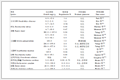
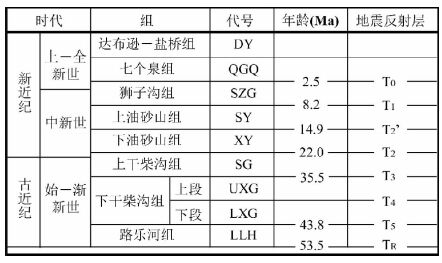
2.2 柴达木盆地柴达木盆地夹持在祁连山、东昆仑-祁曼塔格山以及阿尔金山之间,呈三角形态,面积约12万平方千米;新生代以来一直是一个大型陆内坳陷,并没有前陆盆地发育,沉积中心一直位于其中轴线上,并存在自西向东的迁移 (Yin et al., 2008)。柴达木盆地新生界最厚达10000m以上,盆地中央及南部东昆仑山-祁曼塔格山前一带覆盖严重,在北缘和西缘则出露较好,自下而上可划分为路乐河组、下干柴沟组、上干柴沟组、下油砂山组、上油砂山组、狮子沟组以及七个泉组(表 1)。各组之间在盆地内部多呈整合接触,在边缘地区则存在地区性的角度不整合面,如柴西阿尔金山前的上、下油砂山组之间 (Wang et al., 2010b)以及七个泉组与上伏上更新统地层之间 (任收麦等, 2006)等。此外,盆地内的化石对比 (杨平等, 2000; 张海泉等, 2006; Wang et al., 2007)及磁性地层定年工作 (杨藩等, 1992; Sun et al., 2005; Fang et al., 2007; Lu and Xiong, 2009) 也陆续有人开展(表 1),为不同地区的地层对比提供了较为准确的年龄和化石约束。
|
表 1 柴达木盆地新生代综合地层表 Table 1 Cenozoic stratigraphy in the Qaidam Basin |
地理上的阿尔金山是指位于阿尔金断裂中段、夹持在阿尔金断裂和北阿尔金断裂之间的三角形山脉(图 1)。为阐述方便,本文将受控于阿尔金断裂的山脉统统称为阿尔金山,它包括现今地理意义上的阿尔金山以及位于祁连山和东昆仑-祁曼塔格山西端、沿着阿尔金断裂分布的线性山脉(图 1a)。目前一般将阿尔金山新生代的隆升简单归因于阿尔金断裂系的左旋走滑,而对其构造形态及与阿尔金断裂新生代活动的关系缺乏深入的研究。与世界上其他由走滑断层所控制的线性山脉不同,阿尔金山的宽度在走向上变化很大:西段和东段为平行阿尔金断裂的线性山脉,宽度一般为15~50km;中段则呈三角形,最宽处达110km。与之对应的阿尔金断裂则延伸相对稳定,并无大的走向变化(图 1a)。是什么原因导致阿尔金山的形态如此多变呢?
将阿尔金山中的主要断裂叠加到DEM图中可以清晰的看出,阿尔金山其实是由三个方向的隆起所组成(图 1a):(1) 北东东向,呈线性展布,分布于现今阿尔金主断裂两侧狭小的范围内(10~20km),明显受现今阿尔金主断裂走滑挤压的控制;(2) 北东向,主要分布在阿尔金断裂和北阿尔金断裂之间,变形非常强烈;(3) 近东西向,呈雁列式分布于阿尔金断裂的两侧,宽度一般25~40km,长度变化较大(40~>150km),主要断裂以向北倾为主。北东东向构造明显切割另两组构造,表明其形成时间相对较晚。对阿尔金山中的热年代学结果(主要为磷灰石裂变径迹结果)进行统计后发现:北东东向构造的中值年龄大都小于10Ma,北东向构造的中值年龄大多位于30~10Ma之间,而近东西向构造的则较早,约40Ma甚至更早(图 1b)。尽管这些年龄不一定能准确代表不同构造的开始隆升时间,却意味着这些不同走向的构造很有可能形成于不同时间、不同构造环境中,简单的用阿尔金断裂的走滑隆升效应无法很好解释。实际上真正受现今阿尔金主断裂左旋走滑所直接控制的山体宽度很小,仅局限在断裂两侧狭小的范围内(北东东向,图 1a)。
3.2 阿尔金断裂新生代活动方式在阿尔金山中的三个方向的构造中,近东西向构造对了解阿尔金断裂的早期活动尤其重要,原因在于它们隆升时间相对较早,与北东向构造相比较好的保存了其原始形态;且彼此之间呈雁列展布,明显与走滑作用相关。对其成因,部分学者提出了一些的解释方案。Yin et al. (1999) 认为阿尔金断裂北侧东西向的金雁山-索尔库里断裂带是党河南山-昌马断裂带的西延部分,在中新世以后被现今的阿尔金断裂所错断。Wang et al. (2008) 根据对索尔库里盆地周缘线理方向的测量结果提出阿尔金山的三角形结构是早期的线性山脉受阿喀图弯曲(Akato bend) (Cowgill et al., 2004a, b ) 的阻挡而沿着竖直轴发生弯曲旋转造成的。这些观点都能在一定程度上解释阿尔金断裂北侧拉配泉附近的东西向构造的成因,却很难解释为什么在柴达木盆地西北缘(阿尔金断裂中段南侧)以及肃北附近(阿尔金断裂东段北侧)也存在一些东西向隆起构造(图 1a)。另一种可能解释是这些东西向的断裂为走滑早期的P剪切面,但是物理模拟结果表明走滑早期最发育的是R剪切而非P剪切 (Le Guerroué and Cobbold, 2006),而且R、P剪切目前往往只是在地震破裂时才会表现出来,规模一般只有几米或者几十上百米,很少能达到这种几十千米的规模。
Wu et al. (2012b) 对发育在阿尔金断裂中段南侧、柴达木盆地西北缘的三个东西向隆起的形成时间进行了详细的论述,发现这三个雁列式的隆起基本上都是开始形成于约36Ma以后,并控制了柴达木盆地西北部后来的沉积格局。吴磊等(2013) 从多个角度综合论证了阿尔金断裂的左旋地表走滑发生在中中新世以后。也就是说,阿尔金山自晚始新世开始的早期隆升是由一些雁列式的东西向隆起所组成,然而此时阿尔金断裂的地表走滑还未发生。为了解释这些东西向隆起的成因,Wu et al. (2012b) 提出了一种新的阿尔金断裂新生代活动方式模型(图 2)。

|
图 2 阿尔金断裂新生代两阶段活动模型(据Wu et al., 2012b修改) 1-中中新世以后沉积地层;2-晚始新世-中中新世沉积地层; 3-中生界和新生代早期沉积地层;4-古生代地层和元古界基底;5-上地壳; 6-青藏高原中下地壳;7 -塔里木盆地中下地壳.各层厚度仅为示意性 Fig. 2 Two-stage model of the Cenozoic Altyn Tagh Fault (modified after Wu et al., 2012b) 1-sediments deposited since Mid-Miocene; 2-sediments deposited during Late Eocene-Mid-Miocene; 3-the Mesozoic and the Early Cenozoic rocks; 4-the Paleozoic rocks and the Proterozoic basement; 5-the upper crust; 6-the relatively elastic middle-lower crust of the northern Tibetan Plateau; 7-the rigid middle-lower crust of the Tarim Basin. That thickness of each layer is just indicative |
印藏碰撞的远程效应在约36Ma时传到青藏高原北部,由于该过程本身就是一个由深部主导(下地壳和岩石圈地幔)的地球动力学过程,使得应力传递主要在深部进行。又由于青藏高原与塔里木板块的岩石圈强度差异 (Wei et al., 2010),该应力极易在二者边界(也就是现今的北阿尔金断裂位置)附近聚集 (Dayem et al., 2009; Molnar and Dayem, 2010),并由于应力方向与边界斜交而在中下地壳形成了一个基底韧性剪切带。该剪切带即为阿尔金断裂带发育的早期形式,使得青藏高原北缘沿塔里木盆地东南侧一带的地壳增厚,在上地壳产生一系列近东西向的、较大规模的雁列式褶皱和以北倾为主的断裂,形成阿尔金山的雏形(图 2b)。
由于印度板块向北的持续挤压,阿尔金山地区也遭受着持续的剪切变形,在中中新世时上地壳终于完全破裂,阿尔金断裂带的大规模走滑开始。值得注意的是,阿尔金主断裂并不是严格沿着塔里木板块与青藏高原的边界处破裂,向东稍微南偏;二者边界处最终形成了北阿尔金断裂。由于走滑大部分发生在现今的阿尔金主断裂上,北阿尔金断裂的走滑量相对较少,以逆冲为主 (Yue et al., 2004)。阿尔金断裂和北阿尔金断裂对早期形成的雁列式褶皱、断裂进行了改造,最终形成了现今阿尔金山的构造格局(图 2c)。该模型意味着在祁连山的西端靠近阿尔金断裂的位置应该也存在一些东西向的构造,但由于后期祁连山的强烈变形而大部分被破坏掉了。党河南山的西端虽然也呈近东西向,但那是由于阿尔金断裂在肃北地区存在一个受阻弯曲(restraining bend)所造成。而柴达木盆地的后期变形相对较弱,这些东西向的构造才得以保存下来。
4 新生代柴达木盆地与阿尔金断裂活动的耦合分析 4.1 柴达木盆地内的两套断裂系统位于阿尔金断裂中段南侧的柴达木盆地在新生代受阿尔金、祁连山和昆仑山三大造山带和构造体系的共同影响,内部断裂非常发育。图 3为盆地内T4地震反射层(下干柴沟组上段底,表 1)的断裂图,从中可以看出盆地内明显存在近东西向和北西向两套断裂系统。

|
图 3 柴达木盆地地震T4反射层(下干柴沟组上段底,表 1)断裂体系图 I-近EW向断裂发育地区;II-NW向断裂发育地区 Fig. 3 The Fault system projected on the seismic reflecting layer T4 (bottom of the Upper Xiaganchaigou Fm., Table 1) in the Qaidam Basin I-where EW-trending faults abundantly developed; II-where NW-trending faults abundantly developed |
近东西向断裂系统断面大多北倾,与阿尔金主断裂呈小角度相交,雁列式分布于一条宽约40km的、平行于阿尔金断裂的断裂带内,控制了柴达木盆地西北缘中生界、古生界以及元古界的分布,阿尔金断裂中段南侧一系列东西向隆起的边界断裂也属于该系统(图 3)。
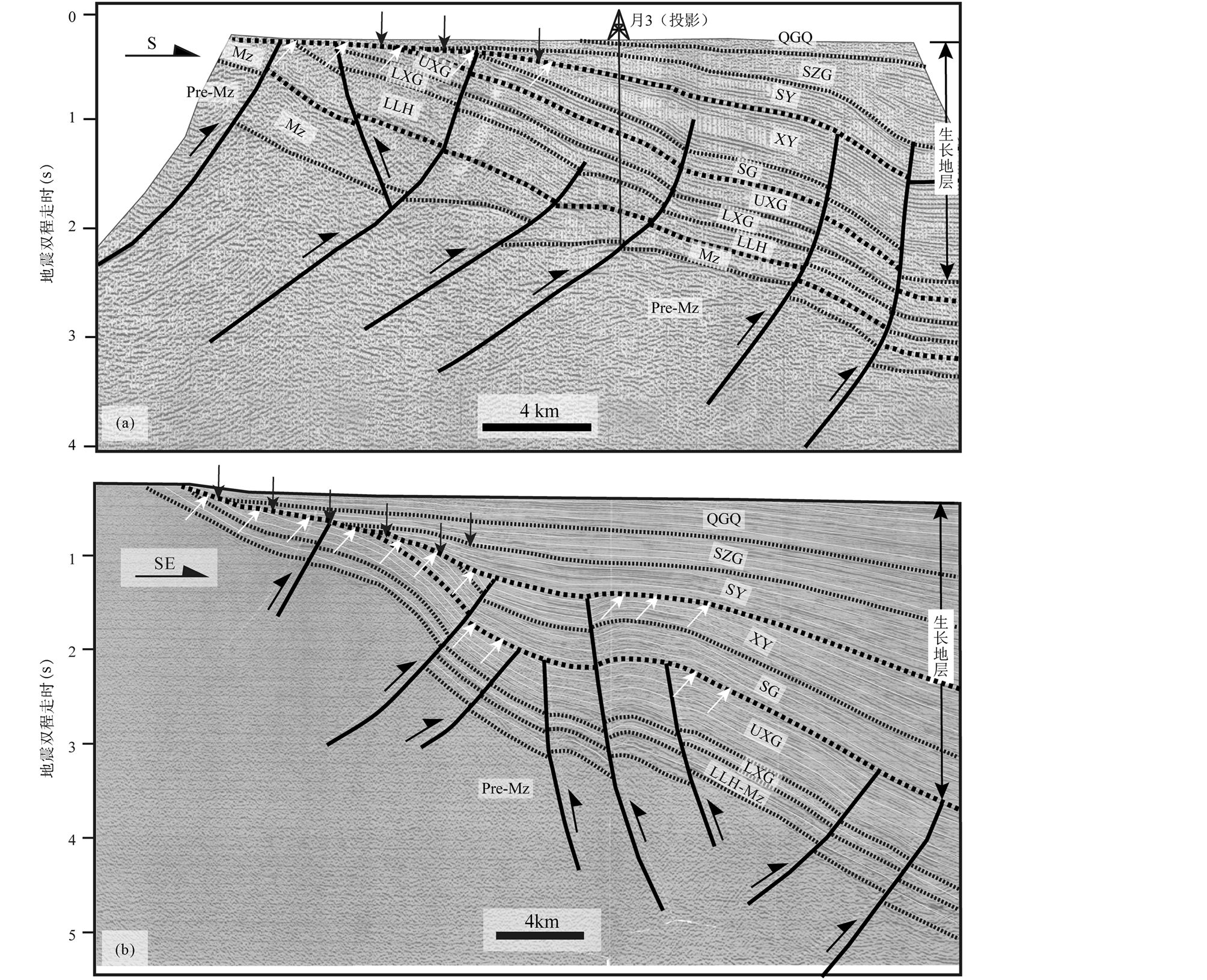
图 4是横切这些东西向断裂的2条地震剖面,可以发现它们在断裂形态和活动时间上具有很大的相似性,归纳起来有以下特征:(1) 断面大多北倾,断面较陡直,向下深切至基底,向上则一般仅切穿下油砂山组,少数能突破至上油砂山组及以上地层;(2) 断裂断距一般不大,其活动以向南的地层掀斜为主,使得基底自南向北逐渐抬高;(3) 断裂最早自下干柴沟组沉积末期(约36Ma,表 1)开始活动并持续发育,导致上干柴沟组及以上地层中大量出现向北减薄的生长地层;(4) 断裂最强烈的一次活动发生在下油砂山组沉积末期,使得地层向南强烈掀斜抬升且遭受大量剥蚀,形成了在柴达木盆地西北缘广泛存在的T2’(上油砂山组底)角度不整合;(5) 上油砂山组沉积以后,大部分断裂的活动强度明显减弱,仅少数断裂有过明显的活动。
|
图 4 穿过柴达木盆地东西向断裂系统的两条地震剖面及其解释方案 剖面位置见图 3.图中白色箭头指示地层削蚀位置,黑色箭头指示地层超覆位置.地层代号:PreMz-前中生界;Mz-中生界;LLH-路乐河组;LXG-下干柴沟组下段;UXG-下干柴沟组上段;SG-上干柴沟组;XY-下油砂山组;SY-上油砂山组;SZG-狮子沟组;QGQ-七个泉组 Fig. 4 Two seismic profiles with geological interpretation across the EW-trending faults in Qaidam Basin The locations are shown in Fig. 3. White and black arrows point out the locations of erosion and onlap respectively. Stratigraphic symbols: PreMz-Pre-Mesozoic; Mz-Mesozoic; LLH-Lulehe Fm.; LXG-Lower Xiaganchaigou Fm.; UXG-Upper Xiaganchaigou Fm.; SG-Shangganchaigou Fm.; XY-Xiayoushashan Fm.; SY-Shangyoushashan Fm.; SZG-Shizigou Fm.; QGQ-Qigequan Fm. |
北西向断裂系统主要位于柴达木盆地内部,沿着冷湖-红三旱一号-干柴沟一线与北侧的近东西向断裂系统相连(图 3)。这些北西向的断裂断面倾向以南西为主,北东次之,与阿尔金断裂呈大角度相交,与东昆仑山以及南祁连山的走向大致平行。它们控制着柴达木盆地内一系列背斜带的发育。这些背斜核部出露地层自西向东逐渐变新,即隆升幅度向东变弱,受阿尔金断裂影响明显。
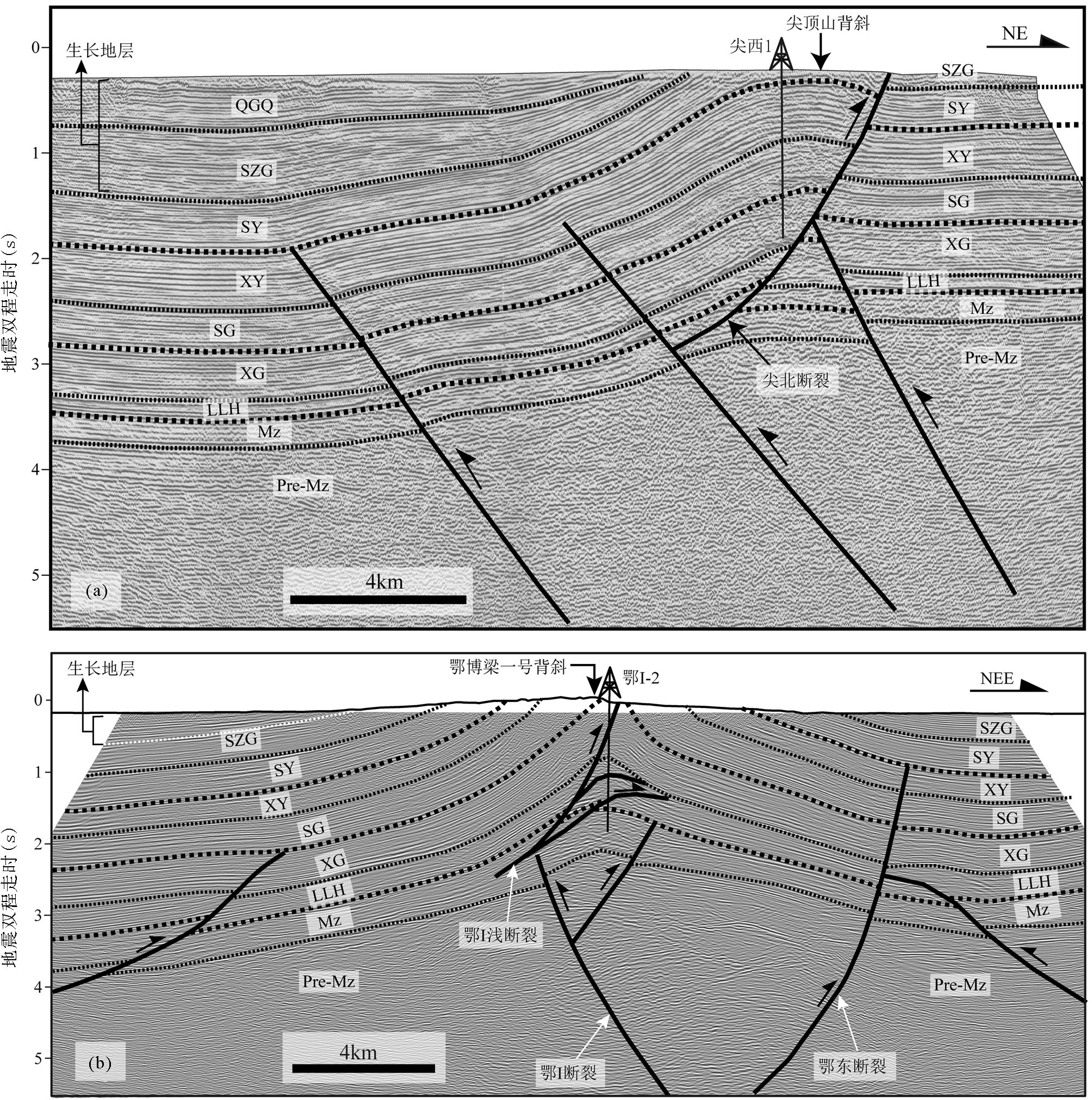
图 5是横切北西向断裂的两条典型地震剖面,其中图 5a切过尖顶山背斜,图 5b切过鄂博梁一号背斜。可以看出它们的断裂形态和活动时间也非常相似,主要表现为以下两点特征:(1) 具有明显的两层结构:深部为陡倾的基底断裂,断距较小,形成的背斜宽缓,浅层为反向的滑脱断层,控制了现今地表紧闭背斜的发育;(2) 生长地层表明这些断裂的起始活动时间大都在狮子沟组沉积时,绝对年龄约在8.2Ma以后,且七个泉组地层也被卷入变形,说明其活动一直持续到2.5Ma以后(表 1)。
|
图 5 穿过柴达木盆地北西向断裂系统的两条地震剖面及其解释方案 剖面位置见图 3.地层代号:PreMz-前中生界;Mz-中生界;LLH-路乐河组;XG-下干柴沟组;SG-上干柴沟组;XY-下油砂山组;SY-上油砂山组;SZG-狮子沟组;QGQ-七个泉组 Fig. 5 Two seismic profiles with geological interpretation across the NW-trending faults in Qaidam Basin The locations are shown in Fig. 3. Stratigraphic symbols: PreMz-Pre-Mesozoic; Mz-Mesozoic; LLH-Lulehe Fm.; XG-Xiaganchaigou Fm.; SG-Shangganchaigou Fm.; XY-Xiayoushashan Fm.; SY-Shangyoushashan Fm.; SZG-Shizigou Fm.; QGQ-Qigequan Fm. |
北西向断裂系统中广泛发育的双层结构一直以来是研究柴达木盆地的地质学者们非常关注的问题。周建勋等(2003) 通过实验室砂箱模拟认为柴达木盆地的这种构造形态是在基底收缩作用参与下、以祁连山为主的侧向不对称挤压作用的结果。也就是说,深层的基底断裂在柴达木盆地内部的变形中起着主要作用,地表背斜则受基底收缩所引发的浅层滑脱断层的控制。地震剖面还揭示出,深层基底断裂的断距往往较浅层滑脱断层的断距要小,即深、浅部在变形量上不协调(图 5),意味着这些基底断裂还具有一定的走滑特征。
4.1.3 与阿尔金断裂活动的耦合分析通过上述分析可知,柴达木盆地内的东西向和北西向断裂在形态、分布、活动时间上均存在很大差异,二者并不构成弧形逆冲 (崔军文等, 2002)或者不对称共轭剪切 (王步清等, 2005)。图 6是穿过阿尔金断裂、东西向断裂系统(月牙山背斜)和北西向断裂系统(红沟子背斜和咸水泉背斜)的一条地质剖面。除靠近阿尔金断裂的部分是通过地质图构建,其他地区都是基于地震剖面得出。从中可以看出,近东西向断裂与阿尔金断裂系具有很好的协调性,一起构成向柴达木盆地逆冲的断裂系统,暗示着其形成与阿尔金断裂的活动有着直接的关系;而北西向断裂系统则仅仅受盆地内部的一些基底断裂所控制,说明其形成与盆地北东-南西方向的基底收缩密切相关。两套断裂系统在深部并未相连。柴达木盆地内部的近东西向断裂系统和北西向断裂系统是在不同时间、不同区域、不同控制条件下形成的两套断裂系统。
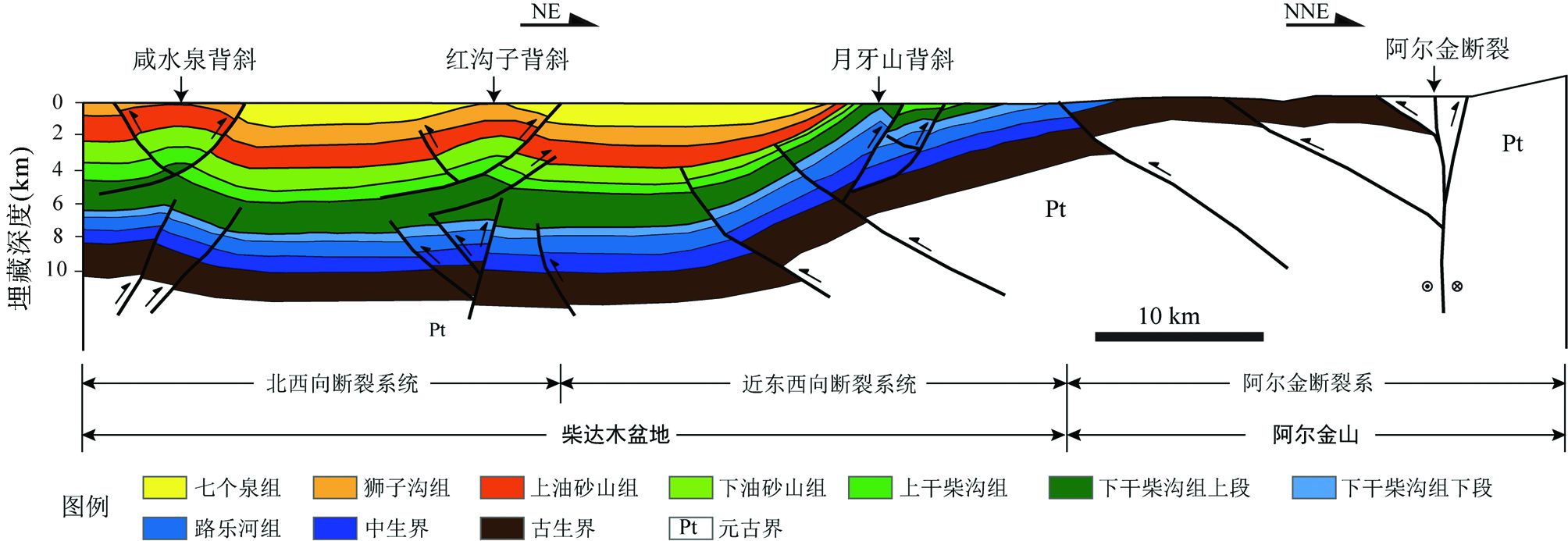
|
图 6 穿过柴达木盆地北西向和东西向断裂系统以及阿尔金断裂的地质剖面 位置见图 3 Fig. 6 A geological profile across the NW- and EW-trending fault systems in Qaidam Basin as well as the Altyn Tagh Fault The location is shown in Fig. 3 |
将上述阿尔金断裂的两阶段活动方式与柴达木盆地的这两套断裂系统对比,会发现二者具有很好的吻合性:早期的近东西向断裂系统紧邻阿尔金断裂呈雁列式分布,断裂活动造成基底向南掀斜抬升,这与阿尔金断裂早期基底剪切形成的近东西向地表断裂特征非常吻合;晚期的北西向断裂与阿尔金断裂近垂直,是阿尔金断裂走滑后,青藏高原北缘为了吸收其走滑位移而发生强烈的NE-SW向地壳缩短变形所形成。也就是说,正是阿尔金断裂的活动方式在中中新世时由基底剪切变为地表走滑才造成了盆地东西向与北西向断裂系统的转换。
其实,早期的近东西向断裂系统并不仅仅发育在阿尔金断裂两侧,在整个青藏高原北缘应该都有发育。因为当时阿尔金断裂尚未开始走滑,整个高原内部的应力场方向应该与南侧印藏碰撞的应力场方向一致,均为近南北向,会形成一些以南倾为主的近东西向断裂(阿尔金断裂南侧的东西向断裂基本都是北倾的原因是局部应力场被深部的阿尔金基底剪切所改造的缘故,见图 2b)。但是由于后期NE-SW向的挤压变形过于强烈,青藏高原内部的这些近东西向断裂或被改造、或深埋与地下,很难发现。徐波等(2013) 通过对柴达木盆地西部小梁山地区的三维地震属性分析,证实了在盆地内部也存在早期的近东西向构造。Lease et al. (2011) 通过对青藏高原东北部拉脊山和积石山地区的研究提出挤压应力在中中新世时从近NS转换到近NEE向,该转换与阿尔金断裂从基底剪切到地表走滑的转换无论从时间还是从机制上都非常吻合。
4.2 柴达木盆地西部中新世内部的角度不整合图 4也显示出在柴达木盆地西北缘,上油砂山组底部存在一个沿着阿尔金断裂分布的角度不整合面T2’,其宽约30~40km,向盆地内部迅速过渡为整合接触 (Wang et al., 2010b)。在不整合面以下,地层向南掀斜遭受剥蚀,且越向北剥蚀得越厉害,表明阿尔金山在中中新世时发生过快速抬升,且抬升幅度、范围可能远远超过现在。在不整合面以上,上油砂山组、狮子沟组、七个泉组持续向阿尔金山方向超覆,沉积范围越来越大,部分地区甚至到达现今阿尔金山内部,表明阿尔金山的隆升幅度及范围(宽度)在中中新世以后逐渐减小。这种现象意味着阿尔金山的范围存在一个先增大后减小的过程。该过程利用阿尔金断裂的两阶段模式可以很好解释。在阿尔金断裂的早期(基底剪切)阶段,由于大部分应力都被用来使阿尔金山抬升,所以其范围及幅度当然会比较大,并在中中新世时达到最大;然而此时的剪切应力却超过了地壳岩石所能承受的范围,导致地壳发生贯穿性的破裂,阿尔金断裂大规模走滑由此启动。此后的大部分应力被左旋走滑所释放,阿尔金山隆升范围因而逐渐减小。前人的物理模拟结果也表明,随着走滑量的增大,走滑隆升的范围是逐渐减小的 (Le Guerroué and Cobbold, 2006),与本文所观察到的现象一致。
5 结论(1) 在对阿尔金山中不同方向隆起构造进行分析的基础上,综合前人资料论证了阿尔金断裂新生代存在两种不同的活动方式:在晚始新世-中中新世时以基底剪切为主,中中新世以后才以大规模地表走滑为主。
(2) 柴达木盆地新生代存在近东西向和北西向两套不同的断裂系统。近东西向断裂系统分布在盆地西北缘紧邻阿尔金断裂并与之平行的狭长区域内,彼此呈雁列式排布;断面大多北倾,向下深切至基底,彼此构成叠瓦状向南逆冲,使基底向南掀斜抬升;主要活动时间在晚始新世-中中新世,其后活动相对较弱。而北西向断裂系统则分布在盆地内部的广阔区域,控制着盆地内一系列背斜带的发育;它们断面倾向北东或南西,具有两层结构:深部为陡倾的基底断裂,形成宽缓背斜,浅层为反向的薄皮滑脱断层,在地表形成较紧闭背斜;活动时间为晚中新世以后。这两套断裂系统与阿尔金断裂的活动有着很好的耦合关系:早期的近东西向断裂系统是阿尔金断裂早期基底剪切的产物;晚期的北西向断裂系统是大规模走滑后NE-SW向基底收缩的结果。
(3) 柴达木盆地西北侧的沉积、构造特征表明阿尔金山的隆升幅度和范围在中中新世达到最大,随后则逐渐减小。这种变化与阿尔金断裂从基底剪切到地表走滑的转换非常吻合。
| [] | Bendick R, Bilham R, Freymueller J, Larson K, Yin GH. 2000. Geodetic evidence for a low slip rate in the Altyn Tagh Fault system. Nature, 404(6773): 69–72. DOI:10.1038/35003555 |
| [] | Chen WB, Xu XW. 2006. Sinistral strike-slip faults along the southern Alashan margin and eastwards extending of the Altun Fault. Seismology and Geology, 28(2): 319–324. |
| [] | Chen YT, Zhang GW, Lu RK, Zhang YQ. 2010. 40Ar/39Ar geochronology of the Guozhacuo fault in the northwestern margin of Qinghai-Tibet Plateau: New evidence for the western extension of Altyn Tagh Fault. Geological Bulletin of China, 29(8): 1129–1137. |
| [] | Chen ZL, Zhang YQ, Wang XF, Chen XH, Washburn Z, Arrowsmith JR. 2001. Fission track dating of apatite constrains on the Cenozoic uplift of the Altyn Tagh Mountain. Acta Geoscientia Sinica, 22(5): 413–418. |
| [] | Chen ZL, Wan JL, Wang XF, Chen XH, Pan JH. 2002. Rapid strike-slip of the Altyn Tagh Fault at 8Ma and its geological implications. Acta Geoscientia Sinica, 23(4): 295–300. |
| [] | Chen ZL, Gong HL, Li L, Wang XF, Chen BL, Chen XH. 2006. Cenozoic uplifting and exhumation process of the Altyn Tagh Mountains. Earth Science Frontiers, 13(4): 91–102. |
| [] | Cowgill E, Yin A, Wang XF, Zhang Q. 2000. Is the North Altyn fault part of a strike-slip duplex along the Altyn Tagh fault system. Geology, 28(3): 255–258. DOI:10.1130/0091-7613(2000)28<255:ITNAFP>2.0.CO;2 |
| [] | Cowgill E, Yin A, Harrison TM, Wang XF. 2003. Reconstruction of the Altyn Tagh fault based on U-Pb geochronology: Role of back thrusts, mantle sutures, and heterogeneous crustal strength in forming the Tibetan Plateau. Journal of Geophysical Research, 108(B7): 1–28. |
| [] | Cowgill E, Arrowsmith JR, Yin A, Wang XF, Zhang SH. 2004a. The Akato Tagh bend along the Altyn Tagh fault, Northwest Tibet 2: Active deformation and the importance of transpression and strain hardening within the Altyn Tagh system. Geological Society of America Bulletin, 116(11-12): 1443–1464. DOI:10.1130/B25360.1 |
| [] | Cowgill E, Yin A, Arrowsmith JR, Wang XF, Zhang SH. 2004b. The Akato Tagh bend along the Altyn Tagh fault, northwest Tibet 1: Smoothing by vertical-axis rotation and the effect of topographic stresses on bend-flanking faults. Geological Society of America Bulletin, 116(11-12): 1423–1442. DOI:10.1130/B25359.1 |
| [] | Cowgill E, Gold RD, Chen XH, Wang XF, Arrowsmith JR, Southon J. 2009. Low Quaternary slip rate reconciles geodetic and geologic rates along the Altyn Tagh fault, northwestern Tibet. Geology, 37(7): 647–650. DOI:10.1130/G25623A.1 |
| [] | Cui JW, Zhang XW, Li PW. 2002. The Altun Fault: Its geometry, nature and mode of growth. Acta Geoscientia Sinica, 23(6): 509–516. |
| [] | Dayem KE, Houseman GA, Molnar P. 2009. Localization of shear along a lithospheric strength discontinuity: Application of a continuous deformation model to the boundary between Tibet and the Tarim Basin. Tectonics, 28(3): TC3002. |
| [] | Fang XM, Zhang WL, Meng QQ, Gao JP, Wang XM, King J, Song CH, Dai S, Miao YF. 2007. High-resolution magnetostratigraphy of the Neogene Huaitoutala section in the eastern Qaidam Basin on the NE Tibetan Plateau, Qinghai Province, China and its implication on tectonic uplift of the NE Tibetan Plateau. Earth and Planetary Science Letters, 258(1-2): 293–306. DOI:10.1016/j.epsl.2007.03.042 |
| [] | Gold RD, Cowgill E, Arrowsmith JR, Chen X, Sharp WD, Cooper KM, Wang XF. 2011. Faulted terrace risers place new constraints on the Late Quaternary slip rate for the central Altyn Tagh Fault, Northwest Tibet. Geological Society of America Bulletin, 123(5-6): 958–978. DOI:10.1130/B30207.1 |
| [] | Guo ZJ, Zhang ZC. 1998. Structural style and tectonic evolution of the basins in the Altun Region. Geological Review, 44(4): 257–264. |
| [] | Jiang XD, Jin Y, Mcnutt MK. 2004. Lithospheric deformation beneath the Altyn Tagh and West Kunlun faults from recent gravity surveys. Journal of Geophysical Research, 109(B5): B05406. |
| [] | Jolivet M, Brunel M, Seward D, Xu Z, Yang J, Roger F, Tapponnier P, Malavieille J, Arnaud N, Wu C. 2001. Mesozoic and Cenozoic tectonics of the northern edge of the Tibetan plateau: Fission-track constraints. Tectonophysics, 343(1-2): 111–134. DOI:10.1016/S0040-1951(01)00196-2 |
| [] | Le Guerroué E, Cobbold PR. 2006. Influence of erosion and sedimentation on strike-slip fault systems: Insights from analogue models. Journal of Structural Geology, 28(3): 421–430. DOI:10.1016/j.jsg.2005.11.007 |
| [] | Lease RO, Burbank DW, Clark MK, Farley KA, Zheng D, Zhang H. 2011. Middle Miocene reorganization of deformation along the northeastern Tibetan Plateau. Geology, 39(4): 359–362. DOI:10.1130/G31356.1 |
| [] | Li HB, Xu ZQ, Yang JS, Qi XX, Tapponnier P. 2007. The maximum cumulative strike-slip displacement of the Altyn Tagh Fault-900km. Geological Bulletin of China, 26(10): 1288–1298. |
| [] | Li HB, Van der Woerd J, Sun ZM, Mériaux AS, Tapponnier P, Ryerson FJ, Si JL, Pan JW. 2008. Late Quaternary left-slip rate and large earthquake recurrence time along the Kangxiwar (or Karakax) segment of the Altyn Tagh Fault, northern Tibet. Quaternary Sciences, 28(2): 197–213. |
| [] | Liu YJ, Ge XH, Ye HW, Liu JL, Franz N, Genser J, Pan HX, Ren SM. 2001. Strike-slip model for Altyn Tagh Fault developed since Late Mesozoic. Acta Geoscientia Sinica, 22(1): 23–28. |
| [] | Lu HJ, Xiong SF. 2009. Magnetostratigraphy of the Dahonggou section, northern Qaidam Basin and its bearing on Cenozoic tectonic evolution of the Qilian Shan and Altyn Tagh Fault. Earth and Planetary Science Letters, 288(3-4): 539–550. DOI:10.1016/j.epsl.2009.10.016 |
| [] | Mériaux AS, Van der Woerd J, Tapponnier P, Ryerson FJ, Finkel RC, Lasserre C, Xu XW. 2012. The Pingding segment of the Altyn Tagh Fault (91°E): Holocene slip-rate determination from cosmogenic radionuclide dating of offset fluvial terraces. Journal of Geophysical Research: Solid Earth, 117(B9): B09406. |
| [] | Molnar P, Tapponnier P. 1975. Cenozoic tectonics of Asia: Effects of a continental collision. Science, 189(4201): 419–426. DOI:10.1126/science.189.4201.419 |
| [] | Molnar P, Dayem KE. 2010. Major intracontinental strike-slip faults and contrasts in lithospheric strength. Geosphere, 6(4): 444–467. DOI:10.1130/GES00519.1 |
| [] | Ren SM, Ge XH, Yang ZY, Lin YX, Hu Y, Liu YJ, Genser J, Rieser AB. 2006. Application of 36Cl-dating to the last rapid uplift of the Tibet Plateau. Acta Geologica Sinica, 80(8): 1110–1117. |
| [] | Ritts BD, Biffi U. 2000. Magnitude of post-Middle Jurassic (Bajocian) displacement on the central Altyn Tagh fault system, Northwest China. GSA Bulletin, 112(1): 61–74. DOI:10.1130/0016-7606(2000)112<61:MOPJBD>2.0.CO;2 |
| [] | Ritts BD, Yue Y, Graham SA, Sobel ER, Abbink OA, Stockli D. 2008. From sea level to high elevation in 15 million years: Uplift history of the northern Tibetan Plateau margin in the Altun Shan. American Journal of Science, 308(5): 657–678. DOI:10.2475/05.2008.01 |
| [] | Sobel ER. 1999. Basin analysis of the Jurassic-Lower Cretaceous Southwest Tarim Basin, Northwest China. Geological Society of America Bulletin, 111(5): 709–724. DOI:10.1130/0016-7606(1999)111<0709:BAOTJL>2.3.CO;2 |
| [] | Sun ZM, Yang ZY, Pei JL, Ge XH, Wang XS, Yang TS, Li WM, Yuan SH. 2005. Magnetostratigraphy of Paleogene sediments from northern Qaidam Basin, China: Implications for tectonic uplift and block rotation in northern Tibetan plateau. Earth and Planetary Science Letters, 237(3-4): 635–646. DOI:10.1016/j.epsl.2005.07.007 |
| [] | Tapponnier P, Molnar P. 1977. Active faulting and tectonics in China. Journal of Geophysical Research, 82(20): 2905–2929. DOI:10.1029/JB082i020p02905 |
| [] | Wan JL, Wang Y, Li Q, Wang F, Wang EQ. 2001. FT evidence of northern Altyn Uplift in Late-Cenozoic. Bulletin of Mineralogy, Petrology and Geochemistry, 20(4): 222–224. |
| [] | Wang BQ, Xiao AC, Cheng XG, He GY, Chen HL, Yang SF. 2005. Geometry and kinematics of Cenozoic right-lateral strike-slip thrust structural belt in the north margin of the Qaidam Basin. Journal of Zhejiang University (Science Edition), 32(2): 225–230. |
| [] | Wang E, Xu FX, Zhou JX, Wang SF, Fan C, Wang G. 2008. Vertical-axis bending of the Altyn Tagh belt along the Altyn Tagh fault: Evidence from Late Cenozoic deformation within and around the Xorkol Basin. GSA Special Papers, 444: 25–44. |
| [] | Wang L, Xiao AC, Gong QL, Liu D, Wu L, Zhou SP, Shen ZY, Lou QQ, Sun XW. 2010b. The unconformity in Miocene sequence of western Qaidam Basin and its tectonic significance. Science China (Earth Sciences), 53(8): 1126–1133. DOI:10.1007/s11430-010-4006-z |
| [] | Wang XM, Qiu ZD, Li Q, Wang BY, Qiu ZX, Downs WR, Xie GP, Xie JY, Deng T, Takeuchi GT, Tseng ZJ, Chang M, Liu J, Wang Y, Biasatti D, Sun ZC, Fang XM, Meng QQ. 2007. Vertebrate paleontology, biostratigraphy, geochronology, and paleoenvironment of Qaidam Basin in northern Tibetan Plateau. Palaeogeography, Palaeoclimatology, Palaeoecology, 254(3-4): 363–385. DOI:10.1016/j.palaeo.2007.06.007 |
| [] | Wang Y, Sun G, Li J. 2010a. U-Pb (SHRIMP) and 40Ar/39Ar geochronological constraints on the evolution of the Xingxingxia shear zone, NW China: A Triassic segment of the Altyn Tagh fault system. Geological Society of America Bulletin, 122(3-4): 487–505. DOI:10.1130/B26347.1 |
| [] | Wei SQ, Chen YJ, Sandvol E, Zhou SY, Yue H, Jin G, Hearn TM, Jiang MM, Wang HY, Fan WY, Liu Z, Ge ZX, Wang YB, Feng YG, Ni J. 2010. Regional earthquakes in northern Tibetan Plateau: Implications for lithospheric strength in Tibet. Geophysical Journal International, 37(19): L19307. |
| [] | Wu L, Xiao AC, Yang SF, Wang LQ, Mao LG, Wang L, Dong YP, Xu B. 2012a. Two-stage evolution of the Altyn Tagh Fault during the Cenozoic: New insight from provenance analysis of a geological section in NW Qaidam Basin, NW China. Terra Nova, 24(5): 387–395. DOI:10.1111/ter.2012.24.issue-5 |
| [] | Wu L, Xiao AC, Wang LQ, Mao LG, Wang L, Dong YP, Xu B. 2012b. EW-trending uplifts along the southern side of the central segment of the Altyn Tagh Fault, NW China: Insight into the rising mechanism of the Altyn Mountain during the Cenozoic. Science China (Earth Sciences), 55(6): 926–939. DOI:10.1007/s11430-012-4402-7 |
| [] | Wu L, Gong QL, Qin SH. 2013. When did Cenozoic left-slip along the Altyn Tagh Fault initiate? A comprehensive approach. Acta Petrologica Sinica, 29(8): 2837–2850. |
| [] | Xiao QB, Zhao GZ, Dong ZY. 2011. Electrical resistivity structure at the northern margin of the Tibetan Plateau, and tectonic implications. Journal of Geophysical Research, 116(B12): B12401. DOI:10.1029/2010JB008163 |
| [] | Xu B, Xiao AC, Wu L, Mao LG, Dong YP, Jia D. 2013. Two-stage activity of the Altyn Tagh Fault during the Cenozoic: Evidence from seismic attributes analysis. Acta Petrologica Sinica, 29(8): 2859–2866. |
| [] | Yang F, Ma ZQ, Xu TC, Ye SJ. 1992. A Tertiary paleomagnetic stratigraphic profile in Qaidam Basin. Acta Petrolei Sinica, 13(2): 97–101. |
| [] | Yang P, Sun ZC, Li DM, Jing MC, Xu FT, Liu HM. 2000. Ostracoda extinction and explosion events of the Mesozoic-Cenozoic in Qaidam Basin, Northwest China. Journal of Palaeogeography, 2(3): 69–74. |
| [] | Yin A, Gehrels GE, Chen X, Wang X. 1999. Evidence for 280km of Cenozoic left slip motion along the eastern segment of the Altyn Tagh fault. EOS (Transactions of the American Geophysical Union), 80: F1018. |
| [] | Yin A, Harrison MT. 2000. Geologic evolution of the Himalayan-Tibetan Orogen. Annual Review of Earth and Planetary Sciences, 28(1): 211–280. DOI:10.1146/annurev.earth.28.1.211 |
| [] | Yin A, Rumelhart PE, Butler R, Cowgill E, Harrison TM, Foster DA, Ingersoll RV, Zhang Q, Zhou XQ, Wang XF, Hanson A, Raza A. 2002. Tectonic history of the Altyn Tagh fault system in northern Tibet inferred from Cenozoic sedimentation. Geological Society of America Bulletin, 114(10): 1257–1295. DOI:10.1130/0016-7606(2002)114<1257:THOTAT>2.0.CO;2 |
| [] | Yin A, Dang YQ, Zhang M, Chen XH, Mcrivette MW. 2008. Cenozoic tectonic evolution of the Qaidam basin and its surrounding regions (Part 3): Structural geology, sedimentation, and regional tectonic reconstruction. Geological Society of America Bulletin, 120(7-8): 847–876. DOI:10.1130/B26232.1 |
| [] | Yue YJ, Liou JG. 1999. Two-stage evolution model for the Altyn Tagh Fault, China. Geology, 27(3): 227–230. DOI:10.1130/0091-7613(1999)027<0227:TSEMFT>2.3.CO;2 |
| [] | Yue YJ, Ritts BD, Graham SA. 2001. Initiation and long-term slip history of the Altyn Tagh Fault. International Geology Review, 43(12): 1087–1093. DOI:10.1080/00206810109465062 |
| [] | Yue YJ, Ritts BD, Graham SA, Wooden JL, Gehrels GE, Zhang ZC. 2003. Slowing extrusion tectonics: Lowered estimate of post-Early Miocene slip rate for the Altyn Tagh Fault. Earth and Planetary Science Letters, 217(1-2): 111–122. |
| [] | Yue YJ, Ritts BD, Hanson AD, Graham SA. 2004. Sedimentary evidence against large strike-slip translation on the Northern Altyn Tagh Fault, NW China. Earth and Planetary Science Letters, 228(3-4): 311–323. DOI:10.1016/j.epsl.2004.10.008 |
| [] | Zhang HQ, Sun ZC, Jing MC, Lu YL, Dong N, Yuan XJ, Cao L. 2006. Significance of first appearance datum of Cyprideis for division of Shangyoushashan and Xiayoushashan formations in Qaidam Basin. China Petroleum Exploration, 11(6): 104–112. |
| [] | Zhang J, Li JY, Li YF, Ma ZJ. 2007. The Cenozoic deformation of the Alxa block in central Asia: Question on the northeastern extension of the Altyn Tagh Fault in Cenozoic time. Acta Geologica Sinica, 81(11): 1481–1497. |
| [] | Zhao JM, Mooney WD, Zhang XK, Li ZC, Jin ZJ, Okaya N. 2006. Crustal structure across the Altyn Tagh Range at the northern margin of the Tibetan Plateau and tectonic implications. Earth and Planetary Science Letters, 241(3-4): 804–814. DOI:10.1016/j.epsl.2005.11.003 |
| [] | Zhou JX, Xu FY, Zhu ZJ. 2003. Physical modeling of the Cenozoic deformation in northern Qaidam Basin. Acta Geoscientia Sinica, 24(4): 299–304. |
| [] | 陈文彬, 徐锡伟. 2006. 阿拉善地块南缘的左旋走滑断裂与阿尔金断裂带的东延. 地震地质, 28(2): 319–324. |
| [] | 陈应涛, 张国伟, 鲁如魁, 张永强. 2010. 青藏高原西北缘郭扎错断裂40Ar/39Ar年代学研究——阿尔金断裂西延的新证据. 地质通报, 29(8): 1129–1137. |
| [] | 陈正乐, 张岳桥, 王小凤, 陈宣华, WashburnZ, ArrowsmithJR. 2001. 新生代阿尔金山脉隆升历史的裂变径迹证据. 地球学报, 22(5): 413–418. |
| [] | 陈正乐, 万景林, 王小凤, 陈宣华, 潘锦华. 2002. 阿尔金断裂带8Ma左右的快速走滑及其地质意义. 地球学报, 23(4): 295–300. |
| [] | 陈正乐, 宫红良, 李丽, 王小凤, 陈柏林, 陈宣华. 2006. 阿尔金山脉新生代隆升-剥露过程. 地学前缘, 13(4): 91–102. |
| [] | 崔军文, 张晓卫, 李朋武. 2002. 阿尔金断裂: 几何学、性质和生长方式. 地球学报, 23(6): 509–516. |
| [] | 郭召杰, 张志诚. 1998. 阿尔金盆地群构造类型与演化. 地质论评, 44(4): 257–264. |
| [] | 李海兵, 许志琴, 杨经绥, 戚学祥, TapponnierP. 2007. 阿尔金断裂带最大累积走滑位移量——900km. 地质通报, 26(10): 1288–1298. |
| [] | 李海兵, Vander Woerd J, 孙知明, MériauxAS, TapponnierP, RyersonFJ, 司家亮, 潘家伟. 2008. 阿尔金断裂带康西瓦段晚第四纪以来的左旋滑移速率及其大地震复发周期的探讨. 第四纪研究, 28(2): 197–213. |
| [] | 刘永江, 葛肖虹, 叶慧文, 刘俊来, FranzN, GenserJ, 潘宏勋, 任收麦. 2001. 晚中生代以来阿尔金断裂的走滑模式. 地球学报, 22(1): 23–28. |
| [] | 任收麦, 葛肖虹, 杨振宇, 林源贤, 胡勇, 刘永江, GenserJ, RieserAB. 2006. 36Cl断代法应用于青藏高原末次快速隆升的构造事件研究. 地质学报, 80(8): 1110–1117. |
| [] | 万景林, 王瑜, 李齐, 王非, 王二七. 2001. 阿尔金山北段晚新生代山体抬升的裂变径迹证据. 矿物岩石地球化学通报, 20(4): 222–224. |
| [] | 王步清, 肖安成, 程晓敢, 何光玉, 陈汉林, 杨树锋. 2005. 柴达木盆地北缘新生代右行走滑冲断构造带的几何学和运动学. 浙江大学学报 (理学版), 32(2): 225–230. |
| [] | 吴磊, 巩庆霖, 覃素华. 2013. 阿尔金断裂新生代大规模走滑起始时间的厘定. 岩石学报, 29(8): 2837–2850. |
| [] | 徐波, 肖安成, 吴磊, 毛黎光, 董有浦, 贾丹. 2013. 阿尔金断裂新生代构造活动的两阶段性——来自3D地震属性分析的证据. 岩石学报, 29(8): 2859–2866. |
| [] | 杨藩, 马志强, 许同春, 叶素娟. 1992. 柴达木盆地第三纪磁性地层柱. 石油学报, 13(2): 97–101. |
| [] | 杨平, 孙镇城, 李东明, 景民昌, 徐凤廷, 刘化民. 2000. 柴达木盆地中、新生代介形类爆发与绝灭事件. 古地理学报, 2(3): 69–74. |
| [] | 张海泉, 孙镇城, 景民昌, 路艳丽, 董宁, 袁秀君, 曹丽. 2006. 正星介(Cyprideis)初现面对柴达木盆地上油砂山组和下油砂山组分界的意义. 中国石油勘探, 11(6): 104–112. |
| [] | 张进, 李锦轶, 李彦峰, 马宗晋. 2007. 阿拉善地块新生代构造作用——兼论阿尔金断裂新生代东向延伸问题. 地质学报, 81(11): 1481–1497. |
| [] | 周建勋, 徐凤银, 朱战军. 2003. 柴达木盆地北缘新生代构造变形的物理模拟. 地球学报, 24(4): 299–304. |