 2013, Vol. 29


2. 中国地质大学地球科学与资源学院,北京 100083
2. Faculty of Earth Science and Mineral Resources, China University of Geosciences, Beijing 100083, China
秦岭造山带是中国大陆中央造山系的重要组成部分,是典型的复合型大陆造山带(张国伟等,2001)。沿秦岭造山带南缘勉略缝合带发育一条长约400km,呈东西向展布的印支期花岗岩带(甘肃省地质矿产局,1989;李先梓等,1993;Meng and Zhang, 1999;张国伟等,2001;冯益民等,2002),该花岗岩带是秦岭造山带形成和演化过程的重要记录,成因上被认为是同造山(Sun et al., 2002)或者后碰撞型花岗岩(张成立等,2005)。秦岭造山带印支期花岗岩带的岩石类型多样,包括闪长岩、二长闪长岩、花岗闪长岩、石英二长岩和花岗岩等,花岗岩中大多含有闪长质微粒包体,包体的形成被认为与岩浆混合作用有关(长安大学地质调查研究院,2004①;Qin et al., 2009, 2010)。
①长安大学地质调查研究院. 2004. 1:250000天水市幅(I48C002003)区域地质调查(修测)成果报告. 长安大学, 1-627
出露于西秦岭地区勉略缝合带以北的糜署岭花岗岩体,是该花岗岩带的一部分,通过详细的年代学和地球化学研究,探讨其岩浆来源和大地构造背景,可以对勉略缝合带的恢复和重建、秦岭造山带的形成演化以及华北地块与扬子地块的碰撞拼合过程进行约束。
前人对糜署岭岩体的岩浆来源和演化过程的研究(张宏飞等,2005;李注苍等,2005;Qin et al., 2009)有不同的认识。李注苍等(2005) 认为糜署岭岩体及其暗色包体均具S型花岗岩的特征,是同时形成的但非同源,是壳幔岩浆混合的产物,寄主岩来自壳源岩浆,暗色包体来自幔源岩浆。张宏飞等(2005) 则认为该岩体属Ⅰ型花岗岩,岩浆均来自于地壳中高K(Rb)玄武质岩石的部分熔融。Qin et al.(2009) 测得糜署岭岩体和暗色包体的锆石U-Pb年龄分别为213±3Ma和212±5Ma,认为西秦岭在晚三叠世存在同期的长英质和镁铁质岩浆活动,该岩体是岩石圈地幔来源的镁铁质岩浆和基性下地壳来源的花岗质岩浆混合作用的产物。鉴于此,本文选取糜署岭花岗岩体及其中的包体进行年代学和地球化学方面的研究,探讨其岩浆来源、形成过程和大地构造背景。
2 区域地质背景秦岭造山带经历了新太古代-古元古代早前寒武纪基底的形成与演化阶段、新元古代-古生代的板块构造演化阶段及中生代以来的陆内造山阶段3个重要演化过程(张国伟,1991),形成了目前自北向南的商丹缝合带、勉略缝合带以及由其分隔的华北板块、秦岭微地块和华南板块的三块两缝构造格局(Meng and Zhang, 1999;张国伟等,2001)。商丹缝合带是秦岭地区发生早古生代洋-陆相互作用和其后发生大陆碰撞作用的主边界(张国伟等,2001),其北侧为北秦岭构造带,南侧与勉略缝合带之间为南秦岭构造带(张国伟,1991;张国伟等,2001)。北秦岭构造带具有活动大陆边缘性质,以发育早古生代和早中生代岩浆侵入作用为特征,而南秦岭构造带主要发育早中生代岩浆侵入作用,缺少早古生代岩浆侵入作用(张宏飞等,1997;卢欣祥等,2000;张本仁等,2002)。勉略缝合带是秦岭微地块与扬子板块于印支期完成主体拼合的主要缝合带(张国伟等,2001;裴先治等,2002),是华北与扬子板块发生全面拼接与碰撞、秦岭造山带主要构造格局最终形成的标志(Mattauer et al., 1985;Hsu et al., 1987;Meng and Zhang, 1999)。扬子板块在印支期俯冲进入华北板块之下发生高压/超高压变质作用(Zheng et al., 2009)。
南秦岭出露的基底岩石由以佛坪、小磨岭和陡岭杂岩等为代表的古元古代结晶基底和以武当山群和耀岭河群为代表的中新元古代基性火山岩系组成,古生界为一套连续或平行不整合的被动陆缘沉积(Yin and Nie, 1993;张国伟等,2001),中三叠世时向前陆盆地沉积转化,至侏罗纪出现大规模的陆相沉积(张国伟等,2004)。南秦岭印支期花岗岩较为发育。
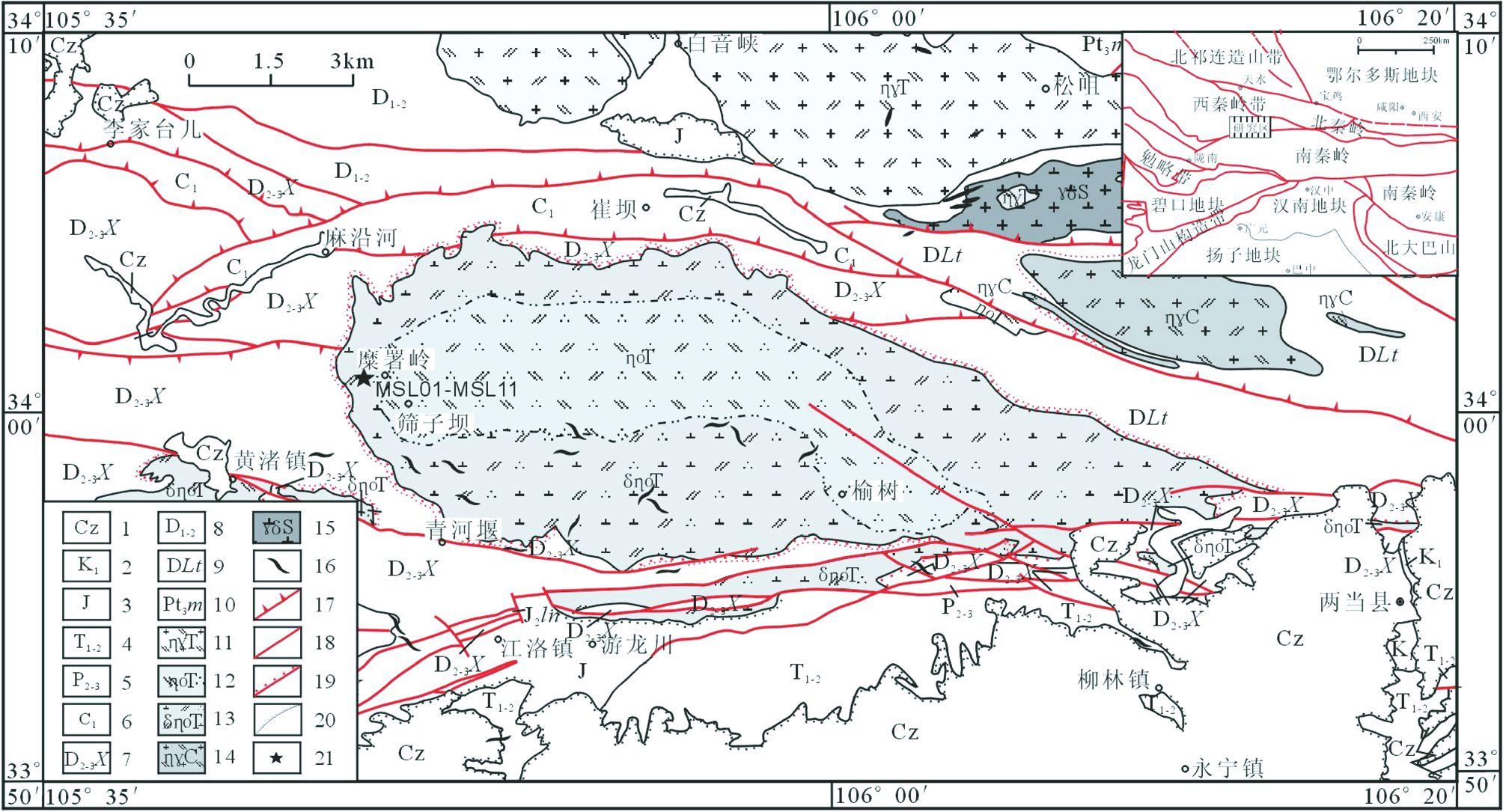
糜署岭花岗岩体侵位于勉略构造带北侧的礼县-麻沿河断裂与黄褚关断裂之间(图 1),主要分布在甘肃徽县麻沿河乡糜署岭-榆树一带,为较大的花岗岩基,出露面积约480km2,空间展布上呈东西向西宽东窄的三角形,长约45km,最宽处约15km,长轴方向与区域构造线基本一致(图 1)。沿断裂带向西有黄渚关、草关等小型岩体相伴,其中黄渚关花岗岩中心相和边缘相年龄分别为214±1Ma和213±3Ma,厂坝花岗岩年龄为213±2Ma,两者均表现出典型的弧岩浆岩的特点,为后碰撞花岗岩(王天刚等,2010)。糜署岭岩体主要侵位于中上泥盆统西汉水群(双狼沟组、红岭山组、黄家沟组)浅变质沉积岩系之中,西北缘局部侵位于下石炭统碎屑岩中,东缘侵位于泥盆系龙潭构造地层体中,在岩体南缘游龙川北侧被中侏罗统龙家沟组含砾砂岩以角度不整合覆盖。岩体周缘角岩化较为发育,成环带状或不规则环带状出露。
|
图 1 西秦岭地区糜署岭岩体分布图 1-新生界;2-下白垩统;3-侏罗系;4-中下三叠统;5-中上二叠统;6-下石炭统;7-中上泥盆统西汉水群;8-中下泥盆统;9-泥盆系龙潭沟构造地层体;10-新元古界木其滩岩组;11-三叠纪二长花岗岩;12-三叠纪石英二长岩;13-三叠纪黑云石英二长闪长岩;14-石炭纪二长花岗岩;15-志留纪花岗闪长岩;16-中酸性岩脉;17-区域逆冲断层;18-断层;19-接触变质带;20-角度不整合;21-采样位置 Fig. 1 Distribution of the Mishuling intrusion in the western Qinling |
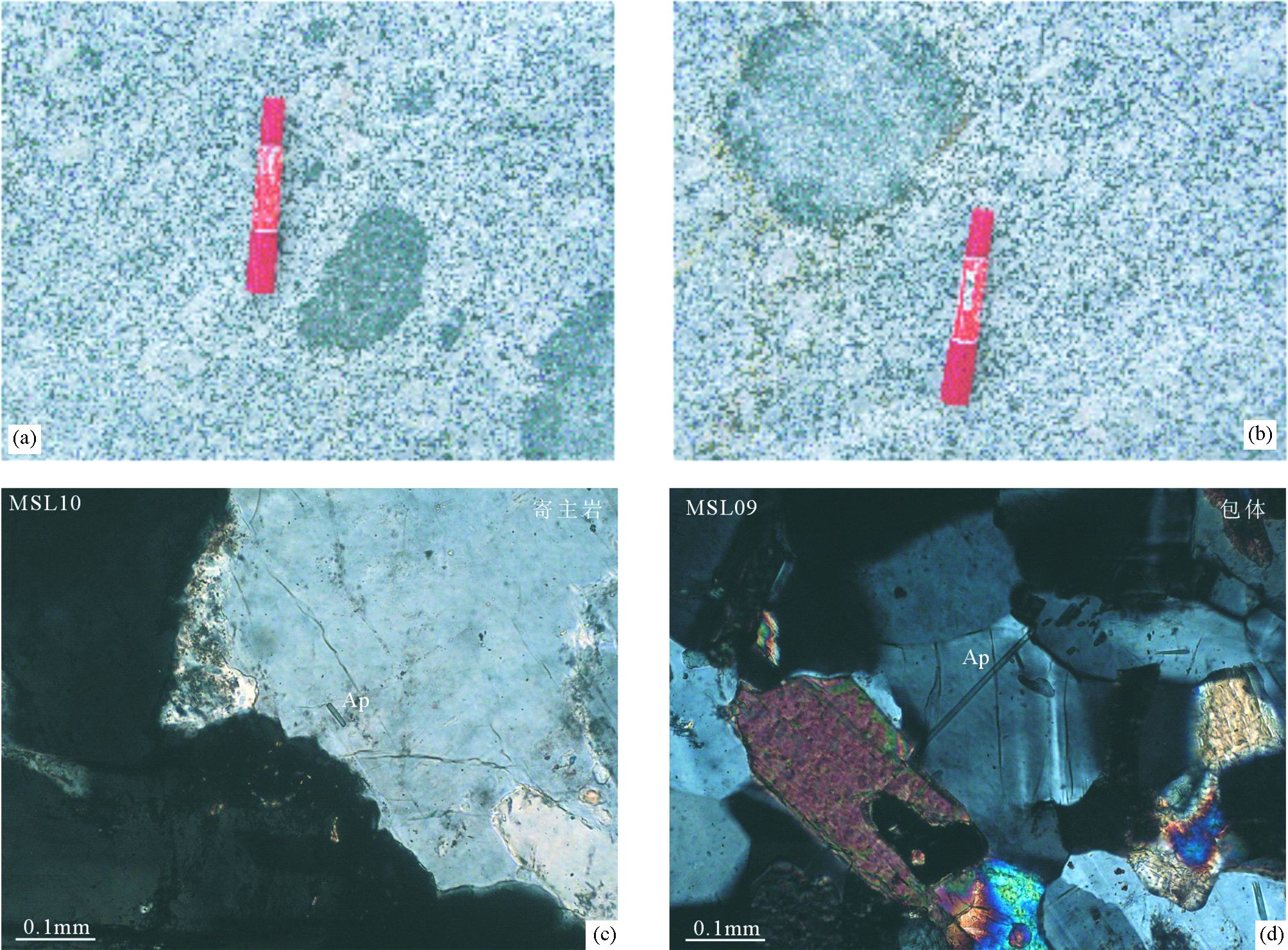
糜署岭岩体岩性为浅灰色-灰色中粗粒似斑状黑云母石英二长闪长岩-黑云石英二长岩组合,岩相界线为渐变过渡,边缘相为石英二长闪长岩,中心相为石英二长岩。岩石呈块状构造,除断层附近外,无变形变质作用。岩石中暗色包体较为发育,岩体的边部多于核部,包体与寄主岩的界线在宏观上以截然突变多见(图 2a),部分暗色包体可以清楚看到冷凝边现象(图 2b)。包体形态多为浑圆状、圆状、透镜状及不规则状,少数棱角状,包体大小10~55cm,小的仅0.5~2.5cm。糜署岭岩体寄主岩中磷灰石呈短柱状(图 2c),长宽比3:1~5:1;暗色包体中磷灰石呈针状和长柱状(图 2d),长宽比10:1~30:1。
|
图 2 糜署岭岩体野外露头照片和磷灰石显微照片(正交偏光) Fig. 2 Field photographs of the monzodiorite enclaves in the Mishuling intrusion and micrographs of the apatite (crossed polarizers) |
寄主岩呈浅灰-灰色,中粗粒花岗结构和似斑状结构,块状构造。岩石主要由斜长石(35%~40%)、钾长石(25%~30%)、石英(10%~20%)组成,暗色矿物以黑云母(10%±)为主,含有少量的角闪石,副矿物有磁铁矿、黄铁矿、锆石、榍石、磷灰石、方铅矿等。斜长石呈灰白色,半自形柱状、板柱状,具聚片双晶结构,颗粒大小一般在0.5~2mm×1~4mm之间。石英呈灰白色,他形粒状结构,石英颗粒大小在1~3mm之间,常碎裂成亚颗粒,有时可见波状消光现象。角闪石和黑云母零散分布于岩石中。斑晶为钾长石,呈灰白色,大小为1.5~4cm×0.8~3cm,含量约3%~5%。钾长石自形程度略差于斜长石,为半自形状,具卡纳复合双晶。
包体岩性为细粒二长闪长岩,包体含量自西向东减少;由南至中心增多,向北界又骤然减少。大小通常在10~55cm之间,自西向东减小。包体呈深灰色,具细粒半自形粒状结构和斑状结构,斑晶为钾长石。包体的主要矿物组成为斜长石(30%~35%)、钾长石(25%~30%)、石英(5%~10%)、黑云母(10%~15%)、角闪石(5%)、辉石(5%)等。副矿物主要是锆石、磷灰石和榍石等。包体形态多呈椭球状、浑圆状、透镜状,表明包体与寄主岩石可能是大致同时代的。
4 分析方法 4.1 锆石U-Pb 年龄分析方法用于锆石测年研究的样品为黑云母石英二长闪长岩,采集1件(MSL01),样品先采用常规方法进行粉碎至80~100目,并用常规浮选和电磁选方法进行分选,再在双目镜下挑选出晶形和透明度较好的锆石颗粒作为测定对象。将锆石颗粒粘在双面胶上,然后用无色透明的环氧树脂固定,待环氧树脂充分固化后,对其表面进行抛光至锆石内部暴露,然后进行反射光和透射光照相。锆石的反射光和透射光显微照相及阴极发光(CL)显微照相在北京离子探针中心扫描电镜实验室完成。测试点的选取首先根据锆石反射光和透射光显微照片进行初选,再与CL图像反复对比,力求避开内部裂隙和包体以及不同成因的区域,以期获得较准确的年龄信息。
锆石U-Pb年龄测试在西北大学大陆动力学国家重点实验室加载有Geolas200M型激光剥蚀系统的LA-ICP-MS仪器上进行。分析仪器为Elan 6100DRC型四极杆质谱仪,激光器为193nmArF准分子激光器。激光剥蚀斑束直径为30μm,激光剥蚀样品的深度为20~40μm。详细的实验原理和流程及仪器参数见袁洪林等(2003) 和Yuan et al.(2004) 。
锆石年龄计算均采用国际标准锆石91500作为外标,元素含量采用美国国家标准物质局人工合成的硅酸盐玻璃NIST SRM610作为外标,29Si作为内标元素进行校正,样品的同位素比值和元素含量数据处理采用GLITTER(4.0版,Macquarie University)软件,并采用Andersen(2002) 软件对测试数据进行普通铅校正,年龄计算及谐和图采用ISOPLOT(2.49版,Ludwig,2003)软件完成。
4.2 岩石地球化学分析方法岩石地球化学样品采集11件,其中寄主岩8件(MSL01、MSL02、MSL04、MSL06、MSL07、MSL08、MSL10、MSL11),包体3件(MSL03、MSL05、MSL09)。样品分别进行主量元素和微量元素分析。样品磨碎至200目后,在中国科学院地质与地球物理研究所岩石圈演化国家重点实验室进行主量和微量元素分析测试。主量元素使用X-射线荧光光谱仪(XRF-1500)法测试。用0.5g样品和5g四硼酸锂制成的玻璃片在Shimadzu XRF-1500上测定氧化物的含量,精度优于2%~3%。微量元素及稀土元素利用酸溶法制备样品,使用ICP-MS(Element Ⅱ)测试,分析精度为:按照GSR-1和GSR-2国家标准,当元素含量大于10×10-6时,精度优于5%,当含量小于10×10-6时,精度优于10%。化学分析测试流程参考Chen et al.(2000, 2002)。
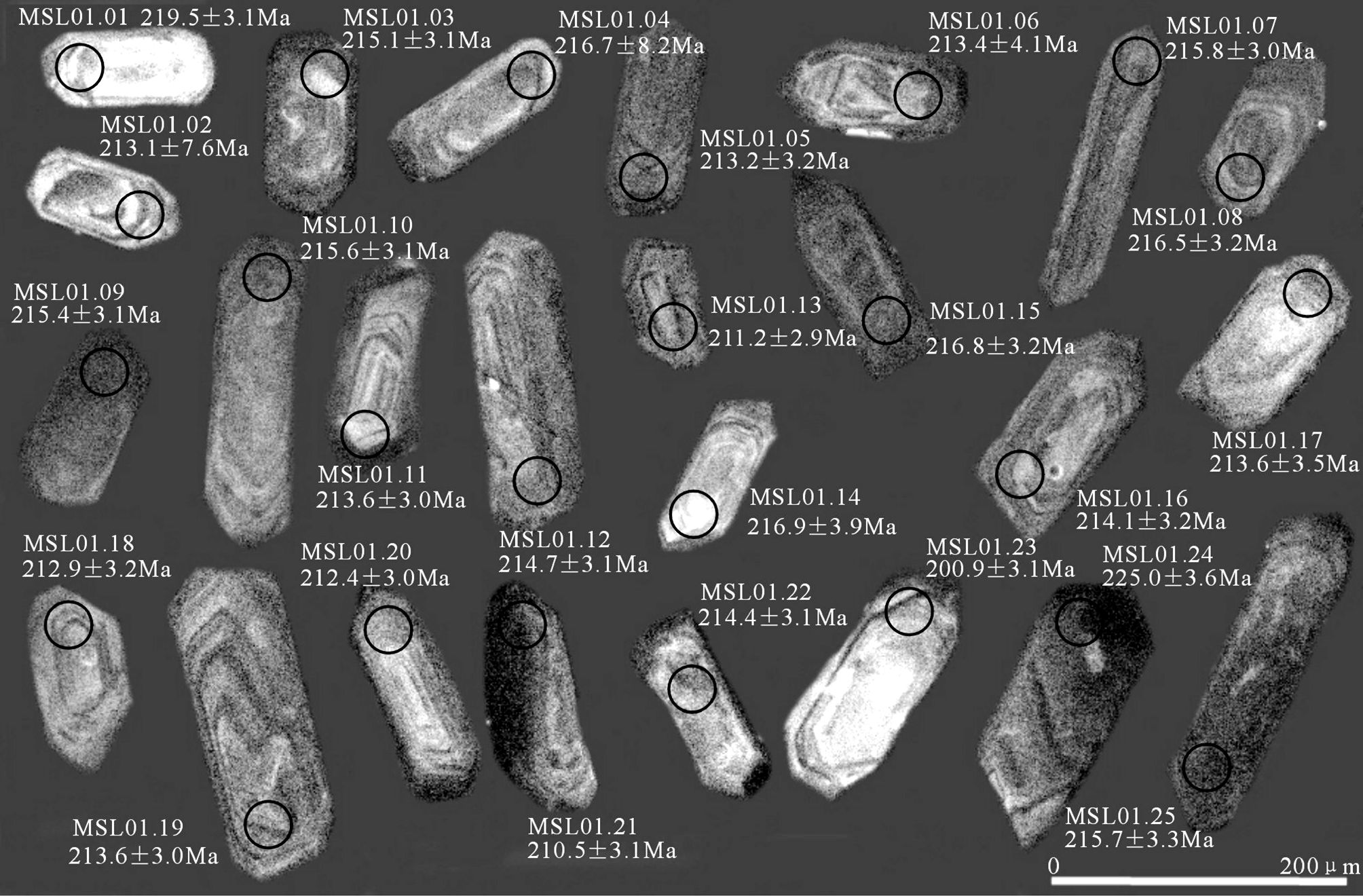
5 分析结果 5.1 锆石U-Pb年龄糜署岭岩体寄主岩样品(MSL01)中锆石为自形晶,浅黄色-无色透明色。锆石的阴极发光(CL)图像(图 3)大多较暗,内部呈现典型的岩浆生长振荡环带结构,属岩浆结晶产物(Belousova et al., 2002;吴元保和郑永飞,2004;Siebel et al., 2005)。锆石呈长柱状和半截锥状,粒径介于50~200μm之间,晶体长宽比为2:1~5:1。
|
图 3 糜署岭岩体寄主岩(MSL01)锆石CL图像和年龄值 Fig. 3 CL images and 206Pb/238U ages of single zircon of the host rock(sample MSL01)in Mishuling intrusion |
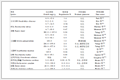
在25个测点中(表 1),锆石的Th含量为78.63×10⁻⁶~391.3×10⁻⁶,U含量为227.8×10⁻⁶~583.3×10⁻⁶,Th/U比值为0.34~0.72,均大于0.1,表明这些锆石为岩浆锆石(Belousova et al., 2002;吴元保和郑永飞,2004;Siebel et al., 2005)。
|
表 1 西秦岭廉暑岭黑云石英二长岩( MSL01) LA-1CP-MS 错石 U-Pb 分析数据 Table 1 LA-1CP-MS zirC0n U-Pb analytic data for Mishuling intrusion of West Qinling |
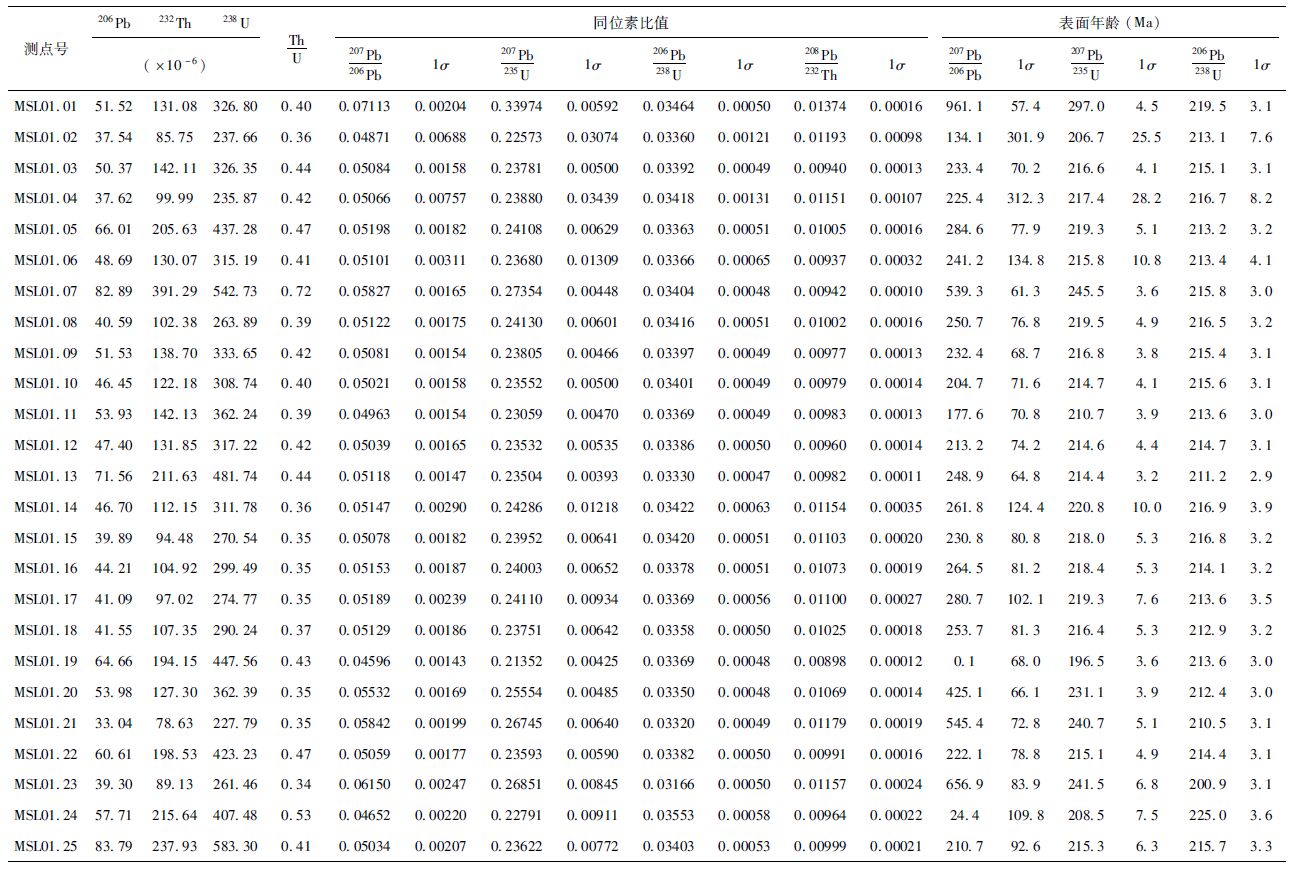
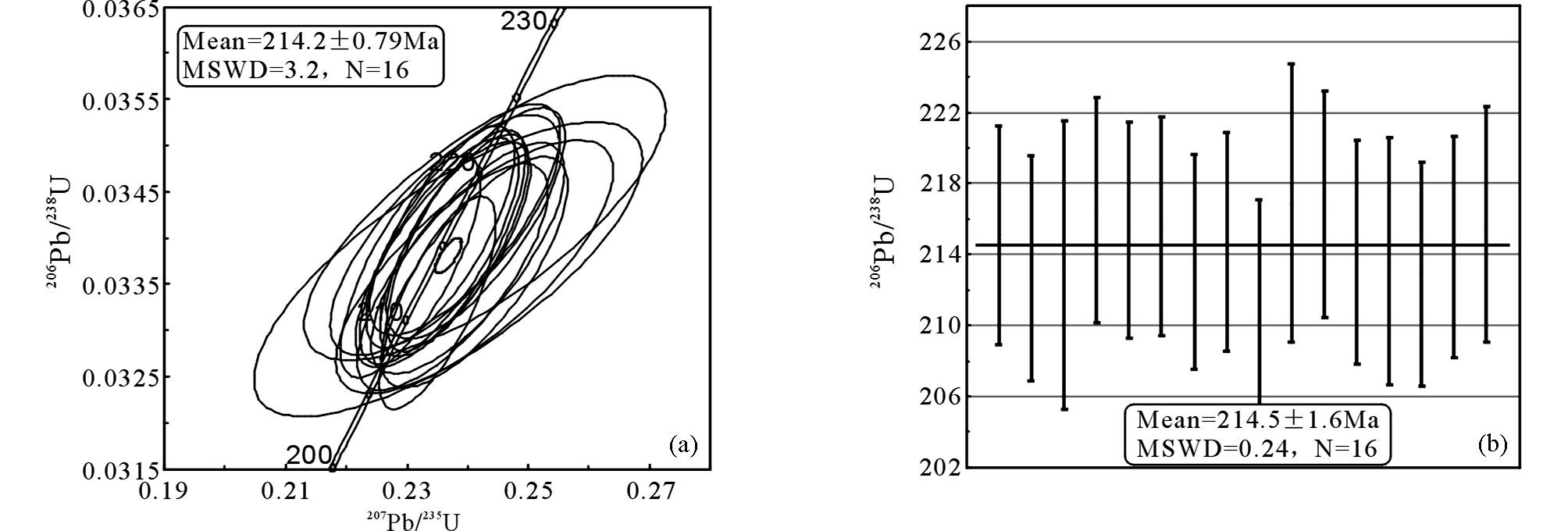
寄主岩的锆石U-Pb年龄较为集中,206Pb/238U年龄介于200.9~225.0Ma之间(图 3,表 1),大多数测点的206Pb/238U和207Pb/235U谐和性较好,有效数据点共16个,其谐和年龄为214.2±0.79Ma(MSWD=3.2,图 4a),206Pb/238U加权平均年龄为214.5±1.6Ma(MSWD=0.24,图 4b),代表黑云石英二长闪长岩的结晶年龄。该年龄与Qin et al.(2009) 测得的年龄(213±3Ma)在误差范围内一致,为晚三叠世。
|
图 4 糜署岭岩体寄主岩(MSL01)LA-ICP-MS锆石U-Pb年龄图 (a)-206Pb/238U和207Pb/235U谐和年龄图;(b)-206Pb/238U加权平均年龄图 Fig. 4 LA-ICP-MS zircon U-Pb concordia diagram of the host rock(MSL01)in Mishuling intrusion |
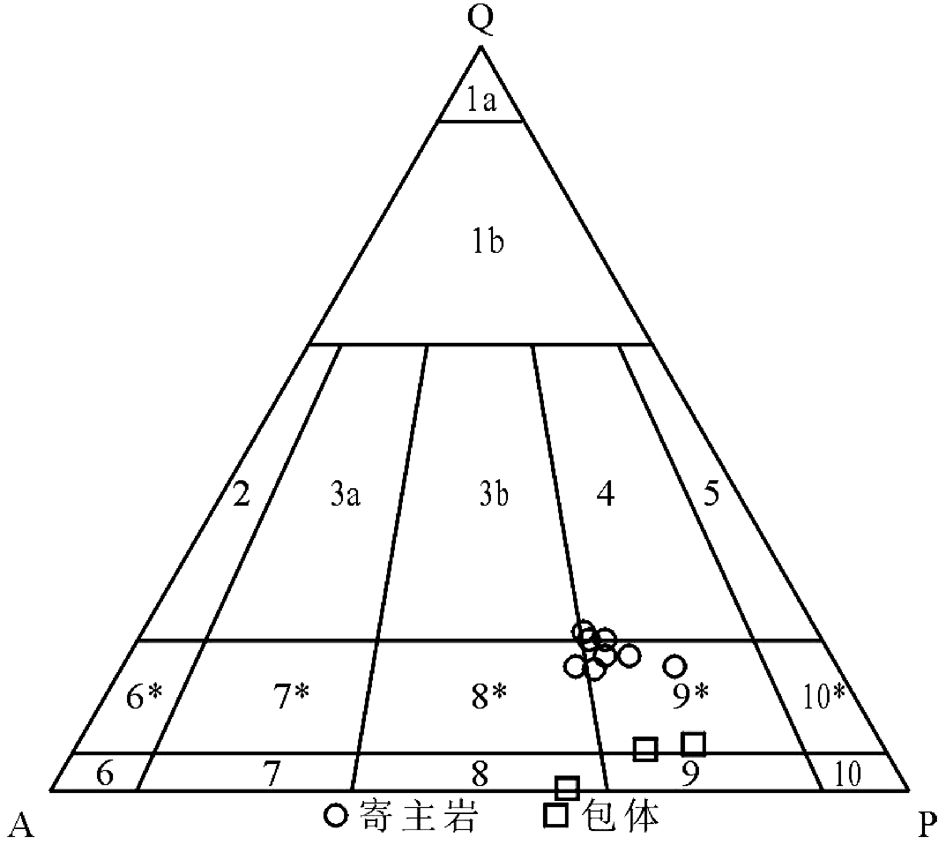
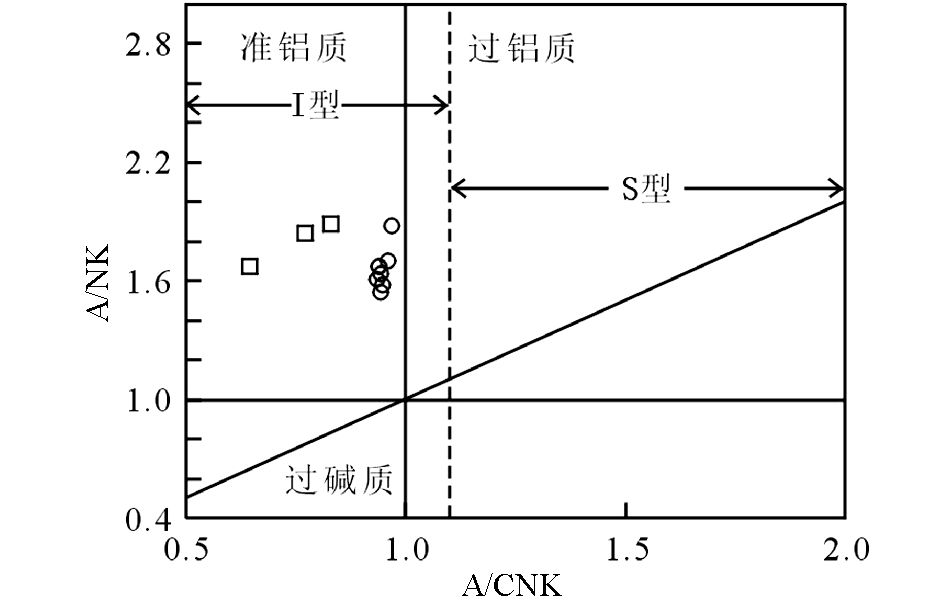
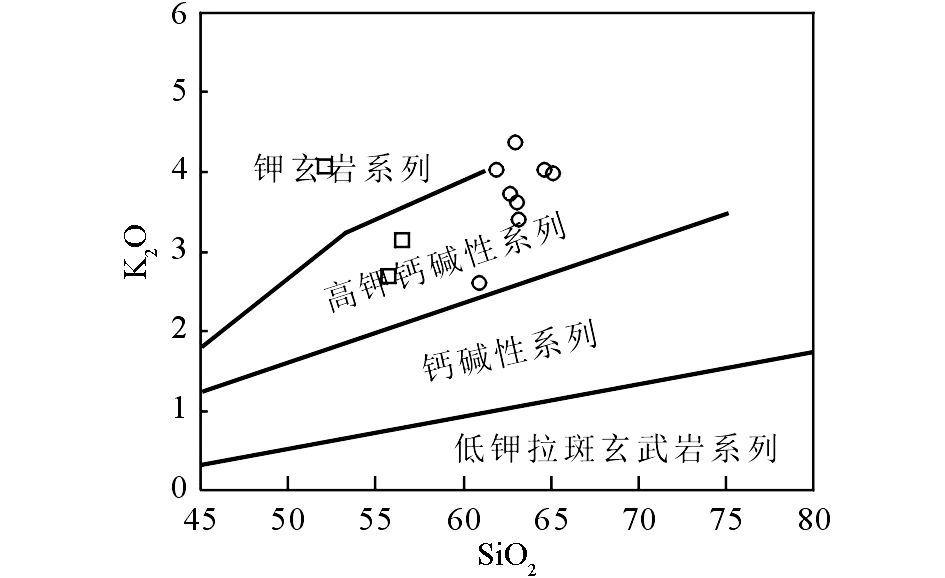
糜署岭岩体寄主岩的SiO2含量变化范围较窄(60.96%~65.12%,表 2)。在Q-A-P岩石分类图解(图 5)上,样品多数落入石英二长岩和石英二长闪长岩界线附近。Al2O3含量在15.76%~16.68%之间,A/CNK在0.94~0.97之间,平均为0.95;FeO/(FeO+MgO)比值较低(1.66~1.75),显示准铝质特征,在A/NK-A/CNK图解上(图 6)数据点均落入准铝质Ⅰ型花岗岩区域内。全碱含量较低(6.27%~7.69%),K2O/Na2O比值在0.72~1.32之间,平均为1.08,相对富钾(2.05%~4.38%),里特曼指数σ在2.19~2.96之间,在K2O-SiO2图解中(图 7)样品多落入高钾钙碱性系列范围。
|
|
表 2 西秦岭糜署岭岩体主量元素(wt%)和微量元素(×10-6)组成 Table 2 Major element data components (wt%) and trace element abundance(×10-6) for Mishuling intrusion of West Qinling |
|
图 5 糜署岭岩体QAP图解(据Streckeisen,1973) 图例下同 Fig. 5 QAP diagrams for Mishuling intrusion(after Streckeisen,1973) |
|
图 6 糜署岭岩体A/NK-A/CNK图解(据Maniar and Piccoli, 1989; 虚线代表Ⅰ型和S型花岗岩之间的边界, 据Chappell and White, 1992) Fig. 6 A/NK-A/CNK diagrams for Mishuling intrusion(after Maniar and Piccoli, 1989; dashed line represents boundary between I- and S-type granitoides, after Chappell and White, 1992) |
|
图 7 糜署岭岩体K2O-SiO2图解(据Rickwood,1989) Fig. 7 K2O vs. SiO2 diagrams for Mishuling intrusion(after Rickwood,1989) |
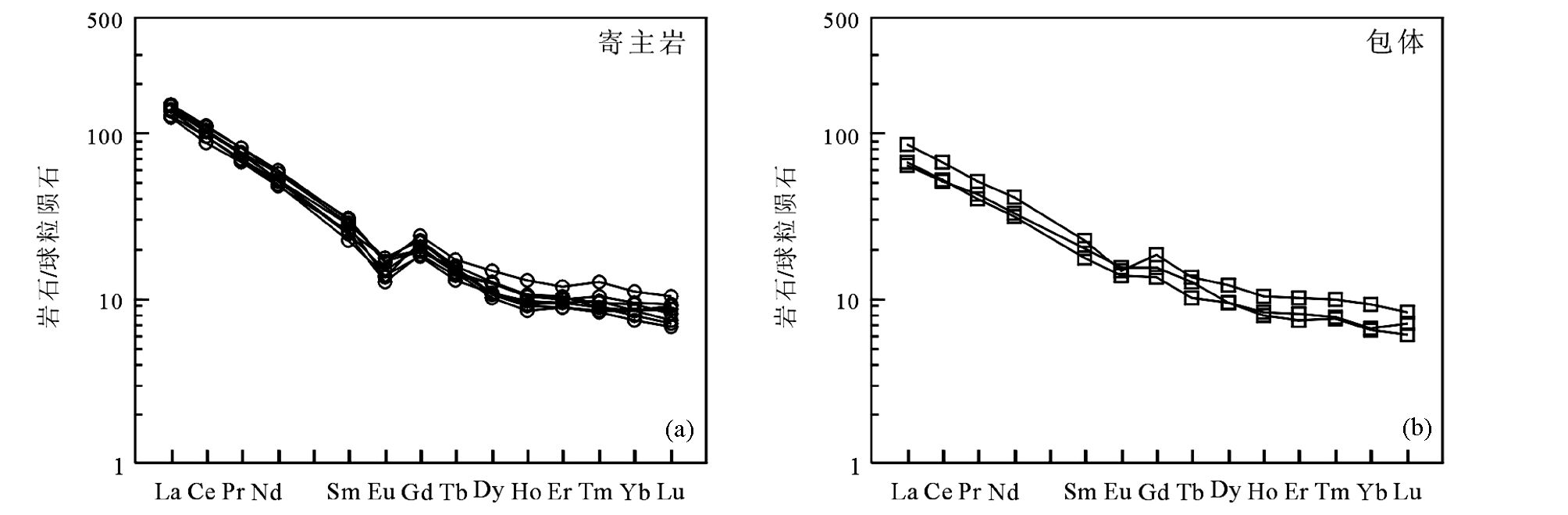
寄主岩稀土元素(表 2)特征显示,REE总量较高(197.3×10⁻⁶~246.6×10⁻⁶,平均为223.3×10⁻⁶);轻、重稀土元素之间分馏较明显(LREE/HREE为10.38~12.04,平均为11.50)。LREE相对富集,HREE相对亏损,LREE内部分异较为明显,(La/Sm)N为4.96~6.22,平均为5.36。在稀土元素配分图上(图 8a)显示为右倾型,Eu具有中等的负异常,δEu为0.58~0.61,平均为0.60,区别于幔源型花岗岩和花岗岩化型花岗岩。
|
图 8 糜署岭岩体稀土元素球粒陨石标准化曲线(标准化值据Sun and McDonough, 1989) Fig. 8 Chondrite-normalized REE patterns for Mishuling intrusion (normalization values after Sun and McDonough, 1989) |
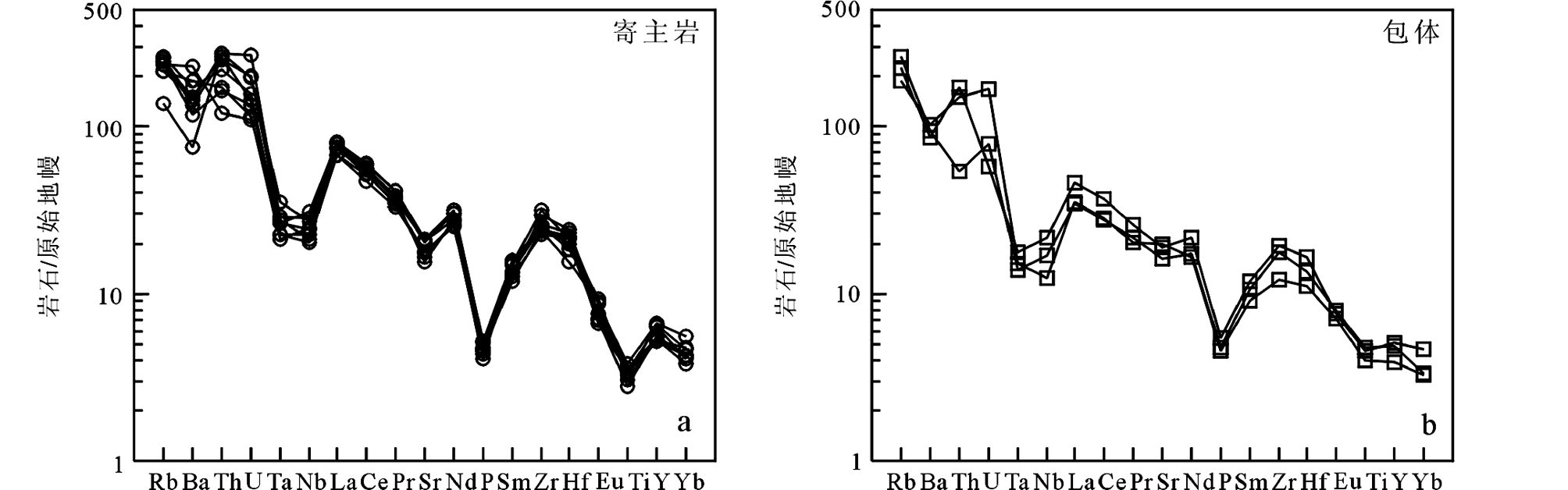
由表 2和图 9可知,寄主岩微量元素具高Rb、低Sr、低Ba和高的K/Rb(90.14~125.43)比值的特征。在原始地幔标准化蛛网图上(图 9),显示高场强元素Ta、Nb、P、Ti和大离子亲石元素Ba、Sr明显亏损,而Th、Rb、U、La、Zr、Hf、Nd、Y等元素具有明显的正异常。各样品的微量元素蛛网图与稀土元素配分曲线形态几乎完全一致,表明其为同时代和同来源的产物。
|
图 9 糜署岭岩体微量元素蛛网图(标准化值据Sun and McDonough, 1989) Fig. 9 Trace element spider diagram for Mishuling intrusion(normalization values after Sun and McDonough, 1989) |
糜署岭岩体中包体的主量元素(表 2)具有如下特征:岩石的SiO2含量变化范围较窄(52.14%~56.56%),与寄主岩相比含量较低。在Q-A-P岩石分类图解(图 5)上,包体多数落入石英二长闪长岩/石英二长辉长岩区域内。Al2O3含量在15.25%~16.98%之间,A/CNK在0.64~0.83之间,平均为0.75;FeO/FeO+MgO比值较低(2.11~5.15),显示准铝质特征,在A/NK-A/CNK图解上(图 6)数据点均落入准铝质Ⅰ型花岗岩区域内。全碱含量较低(6.13%~6.92%),K2O/Na2O比值在0.74~1.44之间,平均为1.08,相对富钾(2.72%~4.08%),里特曼指数σ在3.19~5.24之间,在K2O-SiO2图解中(图 7)大多落入高钾钙碱性系列范围,有一个点落入钾玄岩系列。
包体的稀土元素(表 2)特征表明,REE总量较高(120.7×10⁻⁶~157.0×10⁻⁶,平均为133.2×10⁻⁶),但相对寄主岩稀土元素含量较低,轻、重稀土元素之间分馏较明显(LREE/HREE为7.68~8.32,平均为8.00),(La/Yb)N为9.94~10.82,平均为10.36,LREE内部分异较为明显,(La/Sm)N为3.24~3.90,平均为3.68,特征参数均与寄主岩相近。在稀土元素配分图(图 8b)上也显示出与寄主岩的配分曲线相似的特征,为右倾型,Eu具有弱-中等的负异常,δEu为0.73~0.89,平均为0.83。
由表 2和图 9b可知,包体的微量元素具有如下特征:高Rb、低Sr、低Ba和高的K/Rb(79.66~111.5)比值。在原始地幔标准化蛛网图上(图 9b),显示高场强元素Ta、Nb、P、Ti和大离子亲石元素Sr、Ba明显亏损,而Rb、U、La、Zr、Hf、Nd、Y等元素具有明显的正异常。包体的微量元素蛛网图与寄主岩的微量元素蛛网图极为相似。
6 讨论 6.1 花岗岩岩石类型及源岩判断 6.1.1 岩石类型的判断从矿物学上,糜署岭岩体中普遍出现了Ⅰ型花岗岩的典型矿物学标志角闪石,副矿物组合中普遍出现榍石、磁铁矿,而未见富铝矿物,CIPW标准矿物中大多出现了刚玉分子,但含量较低(0%~0.63%),均小于1%,区别于S型花岗岩(Chappell and White, 1974)。
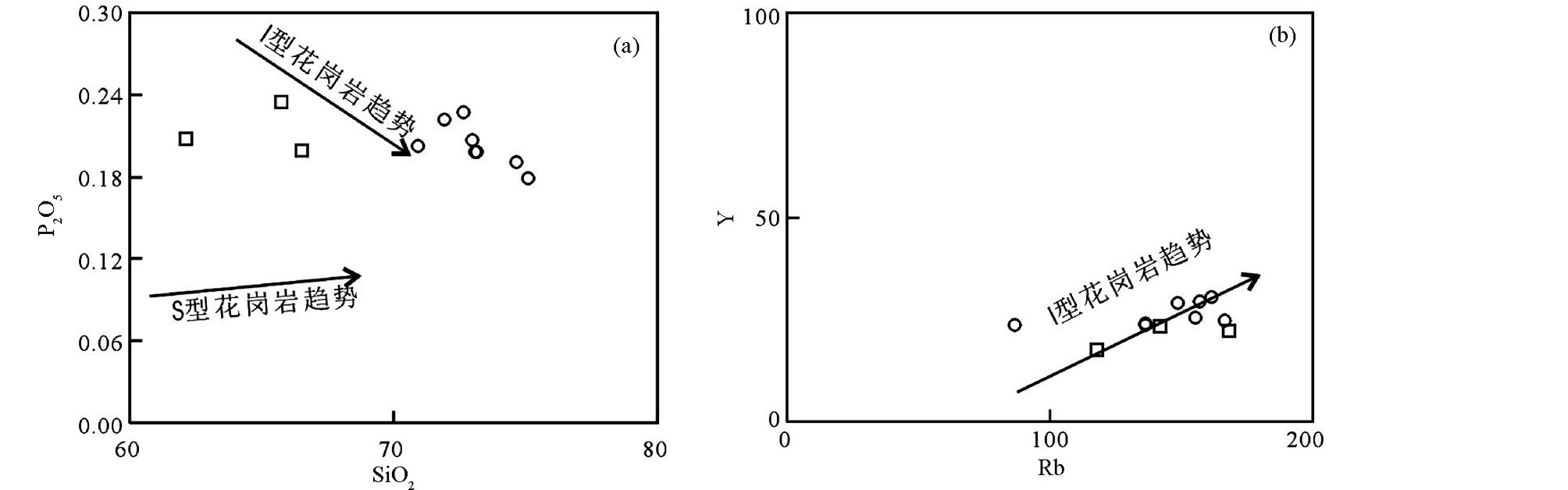
已有的研究表明,在准铝质到弱过铝质岩浆中,磷灰石的溶解度很低,并在岩浆分异过程中随SiO2的增加而降低;而在强过铝质岩浆中,磷灰石溶解度变化趋势与此相反(Wolf and Wyllie, 1994)。磷灰石在Ⅰ型和S型花岗岩浆中这种不同行为已被成功地用于区分Ⅰ型和S型花岗岩类(Chappell,1999;Wu et al., 2003)。另外,Ⅰ型花岗岩的Y含量高,并与Rb含量呈正相关关系(Li et al., 2006)。王德滋和刘昌实(1993) 认为Rb和K有相似的地球化学性质,随着壳幔的分离和陆壳的逐渐演化,Rb富集于成熟度高的地壳中;Sr和Ca有相似的地球化学行为,Sr富集于成熟度低、演化不充分的地壳中。因此,Rb/Sr比值能灵敏地记录源区物质的性质,当Rb/Sr>0.9时,为S型花岗岩;Rb/Sr<0.9时,为Ⅰ型花岗岩。糜署岭岩体为准过铝质岩石(A/CNK<1.1),Rb/Sr 在0.25~0.50之间,P2O5随 SiO2的增加而呈现明显的降低趋势(图 10a),与S型花岗岩演化趋势具有明显差异,与Ⅰ型花岗岩演化趋势一致。这种趋势也可以得到A/CNK-A/NK(图 6)和Rb-Y图解(图 10b)的支持。因此,糜署岭岩体寄主岩和包体均属于Ⅰ型花岗岩类。
|
图 10 糜署岭岩体P2O5-SiO2和Y-Rb图解 Fig. 10 P2O5-SiO2 and Y-Rb diagrams for Mishuling intrusion |
通常花岗岩的Rb/Sr>5指示熔融反应与白云母的脱水熔融作用有关,而Rb/Sr<5则与黑云母的脱水熔融作用有关(Visonà and Lombardo,2002)。在糜署岭岩体中寄主岩和包体的Rb/Sr比值在0.25~0.50之间,均远远小于5,表明这些花岗岩与源区黑云母的脱水熔融作用有关。
糜署岭岩体中包体与寄主岩的界线在宏观上以截然突变多见(图 2a),部分暗色包体可以清楚看到冷凝边现象(图 2b),而包体的冷凝边表明包体与寄主岩石存在较大的温差,是快速冷凝的结果(Castro et al., 1991;李昌年等,1997;邵济安等,1999;吴福元等,1999),暗色包体是基性岩浆团注入、裂解的产物(刘成东等,2002),包体在其被包裹时并非固态,表明包体和寄主岩很有可能进行了岩浆混合作用。包体具岩浆结构,其组成矿物与寄主岩相似,但铁镁矿物含量更高,包体富含黑云母、斜长石,但缺乏深源变晶矿物,指示这种包体不可能是其源区残留体(王德滋等,1992;Clemens,2003),排除包体是部分熔融残留体或变质捕虏体,而更可能是基型岩浆分异演化或岩浆混合的结果。寄主岩中磷灰石呈短柱状(图 2c),包体中磷灰石呈针状和长柱状(图 2d),指示形成包体的岩浆较寄主岩的岩浆有较大温度差,结晶过程中有快速的放热作用,表明岩浆混合作用的存在(Wyllie et al., 1962;Barbarin,1988;Didier and Ferrand, 1987;Barbarin and Didier, 1992;周金城等,1994)。
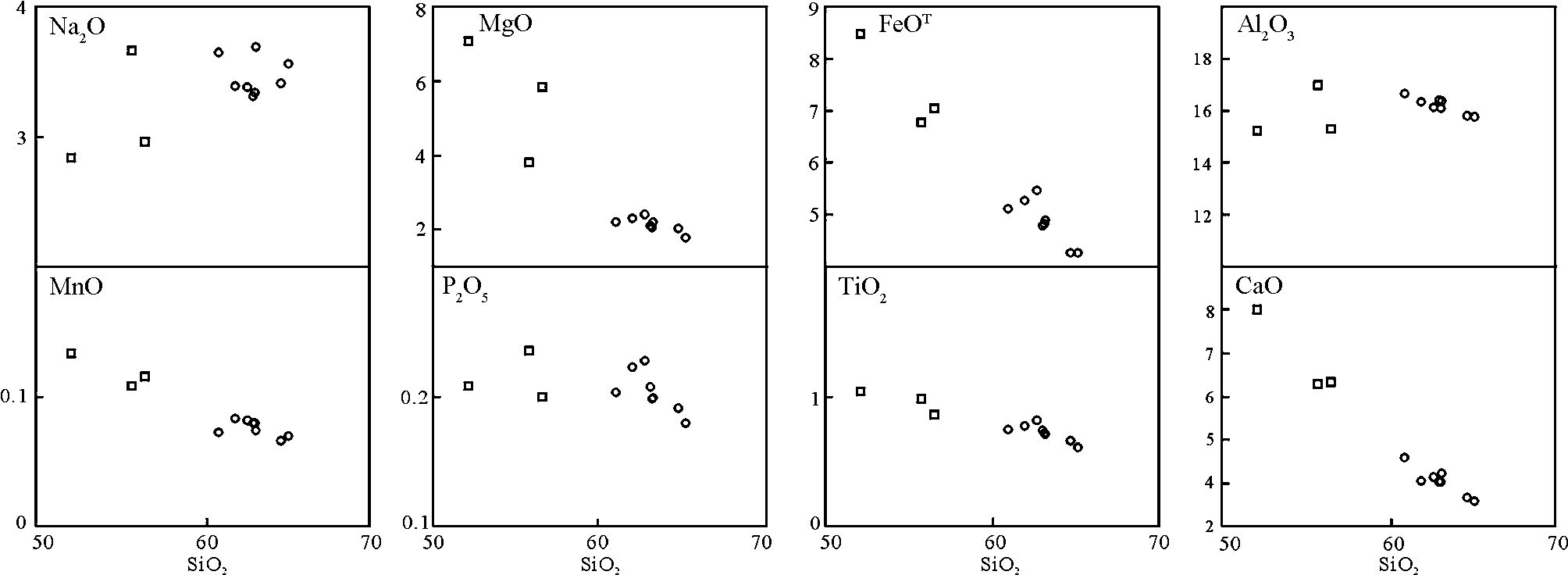
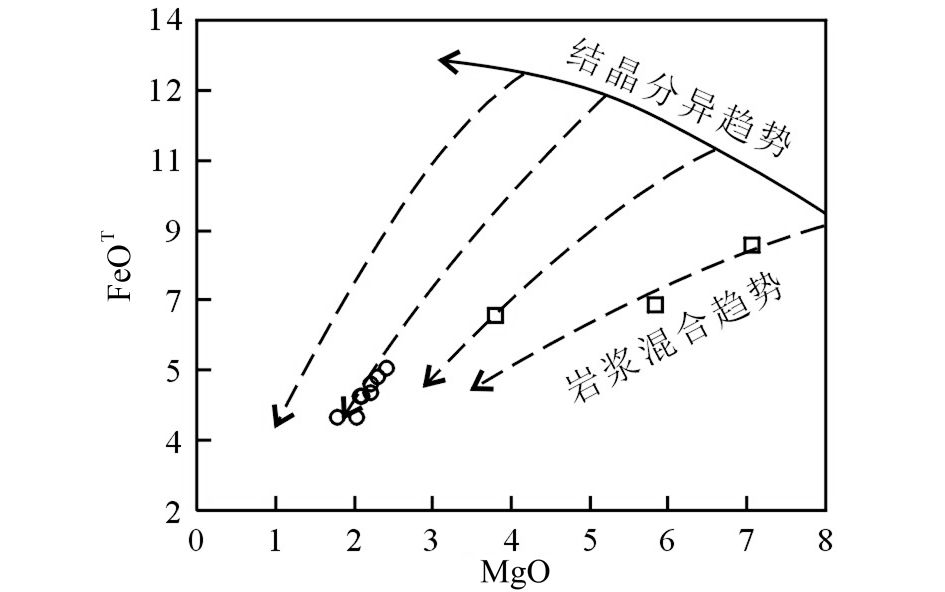
在主量元素与SiO2的Harker图解(图 11)中,均构成线性很好的岩浆混合线(李昌年等,1997),在稀土元素配分图解和微量元素蛛网图上也显示出包体与寄主岩具有相同的演化趋势,反映了寄主花岗岩和包体可能为混合作用的演化趋势;在反映岩浆演化方式的FeOT-MgO图解(图 12)上,成分均落在了混合趋势线上,反映曾经发生过化学混合(Castro et al., 1991;曲晓明等,1997;江万等,1999)。包体的特征参数均与寄主岩相近,且包体的稀土元素相对寄主岩稀土元素含量较低,指示稀土元素将向岩浆演化方向正向富集(赵寒冬等,2005)。反映包体与寄主岩的原始岩浆可能为同源和同时代岩浆演化的产物。
|
图 11 糜署岭岩体的Harker图解 Fig. 11 Harker diagrams of Mishuling intrusion |
|
图 12 糜署岭岩体FeOT-MgO图解(据Zorpi,1989) Fig. 12 FeOT vs. MgO diagrams of Mishuling intrusion(after Zorpi,1989) |
糜署岭岩体寄主岩和包体的Eu具有弱-中等的负异常,Eu的负异常可能是斜长石的分离引起。La/Nb(1.96~3.51,平均2.75)均大于1.0而区别于地幔来源的岩浆(DePaolo and Daley, 2000),Rb/Sr比值介于0.25~0.50之间,平均值为0.37,远小于0.9,接近大陆壳的平均值(0.24)(Taylor and McLennan, 1985),表明该花岗岩的源岩来自于陆壳物质,前述的地球化学特征也显示出寄主岩和包体具有相似的地球化学特征,岩浆来自于地壳。在稀土元素配分图上(图 8)显示出重稀土明显亏损的特征,这可能是残留体中含较大数量的极富重稀土的石榴子石和角闪石(Patiño-Douce and Johnston, 1991)造成的可能是在陆壳底部高压力下源区岩石脱水熔融形成的。Nb、P的亏损指示斜长石作为熔融残留相或结晶分离相存在,即在熔融过程中斜长石没有耗尽(Patiño-Douce and Beard, 1995;Patiño-Douce,1999)。Sr、P、Ti的亏损表明了花岗岩具有正常大陆弧花岗岩的特征,Nb的亏损指示其与成熟大陆弧花岗岩相异,反映该花岗岩更具有大陆壳的特征,是增生在大陆边缘的新地壳。Zr的富集和Nb、Ta、Ti的亏损表明岩浆源区岩石中以陆壳组分为主(Green and Pearson, 1987;Green,1995;Barth et al., 2000)。Ti的亏损可能同钛铁矿的分离结晶作用有关。Nb亏损同时还伴随着Nb/Ta比值下降,Nb/Ta比值较低(13.30~20.42,平均为16.69),这表明Nb/Ta这一对互代元素已开始分馏,是一种典型的壳源的成因类型。
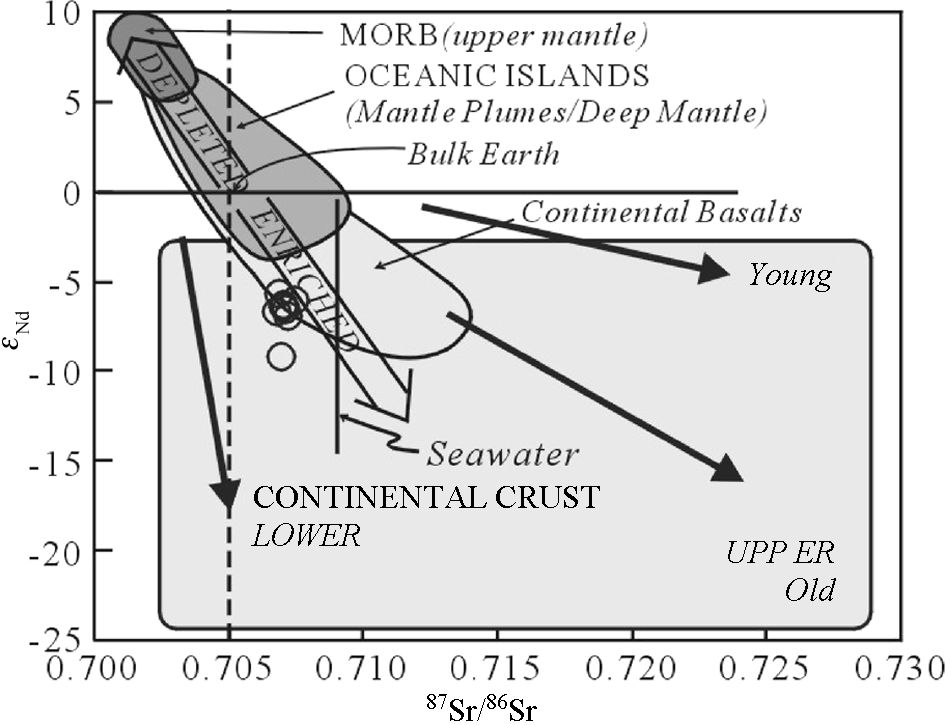
实验岩石学研究表明地壳中基性岩类(玄武质成分)的部分熔融形成化学成分偏基性的准铝质的花岗岩类(Wolf and Wyllie, 1989;Beard and Lofgren, 1991;Johannes and Holtz, 1996;Sisson et al., 2005),而地壳中碎屑沉积岩类部分熔融形成偏酸性的过铝质花岗岩类(Johannes and Holtz, 1996;Patiño-Douce and Harris, 1998; Patiño-Douce and McCarty, 1998b)。糜署岭岩体的A/NCK值在0.64~0.97之间,为准铝质花岗岩,因此其源岩可能为中基性岩类。寄主岩的εNd(t)=-9.2~-5.7,(87Sr/86Sr)i=0.7068~0.7071,包体的εNd(t)=-6.5,(87Sr/86Sr)i=0.707069~0.707138,与寄主岩的相当,均具有低的(87Sr/86Sr)t值和负的εNd(t)值(张宏飞等,2005;Qin et al., 2009),暗示了两者的同源性,也表明岩浆来自于下地壳的部分熔融,没有地幔物质的加入,在εNd-87Sr/86Sr图解(图 13)中,数据点均落入大陆玄武岩区域。
|
图 13 糜署岭岩体物质来源示踪(据White et al., 2001;同位素数据据张宏飞等,2005;Qin et al., 2009) Fig. 13 εNd-87Sr/86Sr diagram for Mishuling intrusion(after White et al., 2001; isotope data after Zhang et al., 2005; Qin et al., 2009) |
从野外地质来看,糜署岭岩体侵位于勉略带北侧的泥盆系沉积地层中而本身未受变形,并且其展布方向与区域构造线一致,指示糜署岭岩体形成于主碰撞和区域构造变形之后,其形成应晚于勉略带主变形期。
糜署岭岩体的地球化学特征显示为高钾钙碱性花岗岩,而高钾钙碱性花岗岩可以出现在不同的地球动力学环境中,指示构造体制的变化,它既可产生在将碰撞事件主峰期分开的张弛阶段,也可以产生在从挤压体制转变成拉张体制的过程中(Barbarin,1999;肖庆辉等,2002),总之,通常认为高钾钙碱性系列岩浆岩是后碰撞岩浆活动的重要特征之一(Zhao et al., 1996;Liégeois et al., 1998)。因此,糜署岭岩体可能为后碰撞花岗岩类,形成于构造体制转换环境。
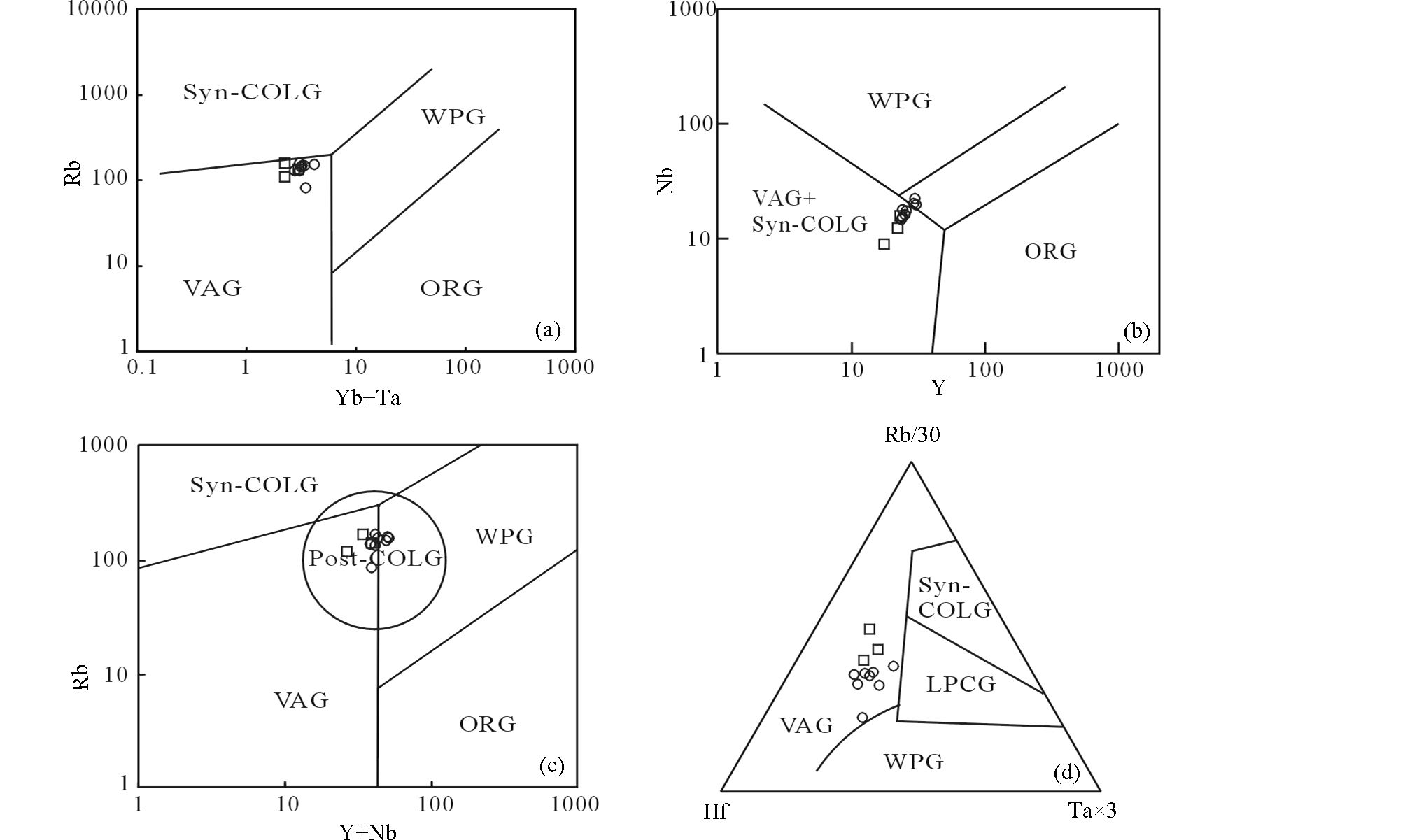
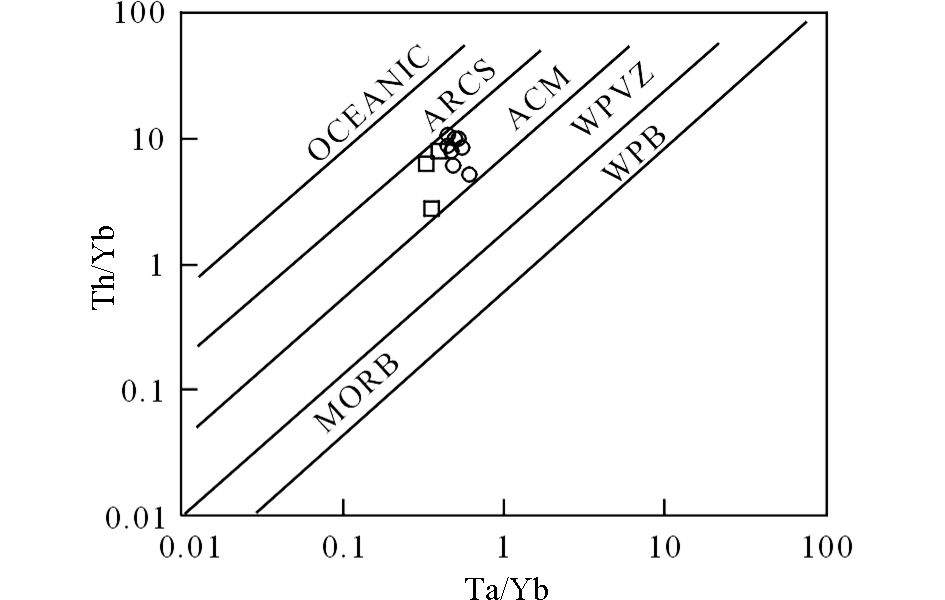
在Rb-(Yb+Ta)和Nb-Y图解(图 14a, b)上,数据点落入火山弧花岗岩(VAG)和同碰撞花岗岩(Syn-COLG)界线附近。在Rb-(Y+Nb)图解(图 14c)上,数据点落入火山弧花岗岩(VAG)和后碰撞花岗岩(Post-COLG)重叠区域内,显示糜署岭岩体形成于后碰撞环境。在Rb/30-Hf-Ta×3判别图解(图 14d)上投点落入火山岛弧区和碰撞后花岗岩区的边界附近,所有的样品都表现出负Nb异常,其它高场强元素也相对亏损,这是与俯冲有关的岩浆的共同特征(Briqueu et al., 1984),也可见于以岛弧物质为物源的壳源花岗岩中(Ma et al., 1998),在中酸性火山岩的Th/Yb-Ta/Yb构造环境判别图解(图 15)中,花岗岩落入活动大陆边缘范围内,岩浆亏损Sr表明与消减作用无关(图 9),因此认为该花岗岩应属于活动大陆边缘环境。
|
图 14 糜署岭岩体微量元素构造环境判别图解(a、b, 据Pearce et al., 1984; c, 据Pearce,1996;d, 据Harris et al., 1986) Post-COLG-后碰撞花岗岩;WPG-板内花岗岩;VAG-火山弧花岗岩;Syn-COLG-同碰撞花岗岩;ORG-洋脊花岗岩;LPCG-晚碰撞-碰撞后花岗岩 Fig. 14 Diagrams of the tectonic setting of trace elements for Mishuling intrusion (a, b, after Pearce et al., 1984; c, after Pearce,1996;d, after Harris et al., 1986) |
|
图 15 糜署岭岩体Th/Yb-Ta/Yb图解(据Michael and Eva, 2000) OCEANIC ARCS-大洋岛弧;ACM-活动大陆边缘;WPVZ-板内火山岩带; WPB-板内玄武岩;MORB-大洋中脊玄武岩 Fig. 15 Th/Yb vs. Ta/Yb diagrams for Mishuling intrusion(after Michael and Eva, 2000) |
目前的研究认为,秦岭造山带沿南秦岭勉略带-大别山的碰撞主要发生在中生代早期,形成南秦岭造山带,并最终完成扬子板块与华北板块的全面碰撞(Li et al., 1993;张宏飞等,1996;张国伟等, 1997, 2001;Hacker et al., 1998;郑永飞,2008),是秦岭花岗岩的强烈岩浆活动期(Meng and Zhang, 1999;张国伟等,2001),形成了巨量的中生代花岗岩。碰撞作用主要发生在254~220Ma(李曙光等,1996;Hacker et al., 1998;张国伟等,2001;张宏飞等,2001;郑永飞,2008)。对于碰撞的峰期存在三种认识:242±21Ma(李曙光等,1996)、240Ma(Yin et al., 1991)和235~238Ma左右(Zheng et al., 2009),归纳起来其峰期应在235~242Ma之间。而糜署岭岩体侵位时(214Ma)整个区域俯冲作用早已结束(254~220Ma,李曙光等,1996;Hacker et al., 1998),这表明糜署岭岩体不是与俯冲相关的花岗岩,而是与岛弧相关的火成岩部分熔融的产物。214Ma的岩体结晶年龄,正好处于挤压环境向伸展松弛环境转换的过渡时期(Yin et al., 1991;李曙光等,1996;张宏飞等, 1996, 2001;卢欣祥等,1999;赖绍聪等,2003;郑永飞,2008),该时期在秦岭造山带及松潘-甘孜造山带、碧口微地块以及祁连造山带侵入了较多的花岗岩体,其出露位置并未受到各构造单元边界的限制,显然这些岩体形成晚于构造单元之间的相对运动时间。这些岩体的形成时代较为集中,在220~205Ma之间,多为高钾过铝质-准铝质岩石,其主量元素和微量元素具有后碰撞花岗岩的特征,显示它们是在地壳明显增厚背景下由幔源的基性岩浆诱使地壳熔融形成的,是造山晚期或后造山期增厚基性下地壳发生拆沉作用的产物(张宏飞等, 1997, 2007;卢欣祥等,1999;张宗清等,1999;孙卫东等,2000;王晓霞等,2003;Roger et al., 2004;胡健民等, 2004, 2005;金维浚等,2005;晏云翔和张成立,2005;张成立等,2008;Qin et al., 2008, 2009, 2010;赵永久等,2007;李佐臣等, 2007, 2009, 2010;王婧等,2008;陈旭等,2009;吴峰辉等,2009;弓虎军等, 2009a, b ;张帆等,2009;朱赖民等,2009;Cao et al., 2011;骆金诚等,2010;王天刚等,2010;Zhu et al., 2011)。因此在华北与扬子板块的主碰撞期后,碧口微地块、秦岭造山带、松潘-甘孜造山带以及祁连造山带发生了面型的岩浆侵入活动,这些岩体略晚于南秦岭勉略构造带洋盆的闭合及大别山超高压变质时代,显示了它们的形成与勉略古生代洋盆演化及扬子板块与华北板块碰撞之间的内在联系,形成于地壳明显增厚背景下的后碰撞环境,即秦岭造山带中三叠世最终发生碰撞造山而后转入板内活动的重要转折时期(张国伟等,2001),它们的形成代表了扬子、华北两大板块主碰撞造山地壳增厚背景下下部地壳熔融后的拆沉作用产物(张本仁等,2002;张成立等,2002)。也支持华北、扬子两大板块在印支期全面碰撞的观点(李曙光等,1996;Hacker et al., 1998;Meng and Zhang, 1999;张国伟等,2003;Zheng et al., 2006)。
7 结论通过对糜署岭岩体寄主岩及其二长闪长质包体锆石U-Pb年龄、地质和地球化学特征及其构造环境的详细研究,得出如下结论:
(1) 糜署岭岩体寄主岩的LA-ICP-MS锆石U-Pb年龄为214.5±1.6Ma(MSWD=0.24),形成于晚三叠世。
(2) 糜署岭岩体寄主岩和二长闪长质包体具有准过铝质特征,寄主岩和包体是同源岩浆演化而来,岩浆均来源于陆壳,是在陆壳底部岩石脱水熔融形成的,其物源是以基性岩成分为主的部分熔融形成的花岗质岩浆上升侵位形成的,为Ⅰ型花岗岩。
(3) 糜署岭岩体形成于同碰撞(挤压环境)向碰撞后(伸展环境)转化阶段,即后造山期,为后造山花岗岩类,是扬子与华北板块全面碰撞导致的地壳增厚下地壳部分熔融的产物,是印支期沿勉略带发生的岩浆侵入活动在西秦岭的体现。
致谢 锆石阴极发光(CL)显微照相得到北京离子探针中心周慧女士的帮助;同位素年代学测试工作得到了西北大学大陆动力学国家重点实验室柳小明博士、第五春荣博士的指导和帮助;主量元素和微量元素分析测试工作得到了中国科学院地质与地球物理研究所岩石圈演化国家重点实验室李禾老师的帮助;西北大学秦江峰博士在成文过程中给予了帮助!一起参与野外工作的还有高景民、魏方辉、吴树宽、王银川、杨杰等硕士;在此一并谨致谢忱!| [] | Andersen T. 2002. Correction of common lead in U-Pb analyses that do not report 204Pb. Chemical Geology, 192(1-2): 59–79. DOI:10.1016/S0009-2541(02)00195-X |
| [] | Barbarin B. 1988. Field evidence for succesive mixing and mingling between the Piloard diorite and the Saint-Julien-La-Vetre monzogranite (Nord-Forez, Massif Central, France). Canadian Journal of Earth Sciences, 25(1): 49–59. DOI:10.1139/e88-005 |
| [] | Barbarin B, Didier J. 1992. Genesis and evolution of mafic microgranular enclaves through various types of interaction between coexisting felsic and mafic magmas. Transactions of the Royal Society of Edinburgh: Earth Sciences, 83(1-2): 145–153. DOI:10.1017/S0263593300007835 |
| [] | Barbarin B. 1999. A review of the relationships between granitoid types, their origins and their geodynamic environments. Lithos, 46(3): 605–626. DOI:10.1016/S0024-4937(98)00085-1 |
| [] | Barth MG, McDonough WF, Rudnick RL. 2000. Tracking the budget of Nb and Ta in the continental crust. Chemical Geology, 165(3-4): 197–213. DOI:10.1016/S0009-2541(99)00173-4 |
| [] | Beard JS, Lofgren GE. 1991. Dehydration melting and water-saturated melting of basaltic and andesitic greenstones and amphibolites at 1. 3 and 6.9 kb. Journal of Petrology, 32(2): 365–401. |
| [] | Belousova EA, Griffin WL, O’Reilly SY, Fisher NI. 2002. Igneous zircon: Trace element composition as an indicator of source rock type. Contributions to Mineralogy and Petrology, 143(5): 602–622. DOI:10.1007/s00410-002-0364-7 |
| [] | Briqueu L, Bougault H, Joron JL. 1984. Quantification of Nb, Ta, Ti and V anomalies in Magmas associated with subduction zones: Petrogenetic implications. Earth and Planetary Science Letters, 68(2): 297–308. DOI:10.1016/0012-821X(84)90161-4 |
| [] | Bureau of Geology, Mineral Research of Gansu Province. 1989. Regional Geology of Gansu Province. Beijing: Geological Publishing House: 1-752. |
| [] | Cao XF, Lü XB, Yao SZ, Mei W, Zou XY, Chen C, Liu ST, Zhang P, Su YY, Zhang B. 2011. LA-ICP-MS U-Pb zircon geochronology, geochemistry and kinetics of the Wenquan ore-bearing granites from West Qinling, China. Ore Geology Reviews, 43(1): 120–131. DOI:10.1016/j.oregeorev.2010.03.004 |
| [] | Castro A, Moreno-Ventas I, De La Rosa JD. 1991. H-type (hybrid) granitoids: A proposed revision of the granite type classification and nomenclature. Earth Science Reviews, 31(3-4): 237–253. DOI:10.1016/0012-8252(91)90020-G |
| [] | Chappell BW, White AJR. 1974. Two contrasting granite types. Pacific Geology, 8: 173–174. |
| [] | Chappell BW, White AJR. 1992. I- and S-type granites in the Lachlan Fold Belt. Transactions of the Royal Society of Edinburgh: Earth Sciences, 83(1-2): 1–26. DOI:10.1017/S0263593300007720 |
| [] | Chappell BW. 1999. Aluminium saturation in I- and S-type granites and the characterization of fractionated haplogranites. Lithos, 46(3): 535–551. DOI:10.1016/S0024-4937(98)00086-3 |
| [] | Chen FK, Hegner E, Todt W. 2000. Zircon ages and Nd isotopic and chemical compositions of orthogneisses from the Black Forest, Germany: Evidence for a Cambrian magmatic arc. International Journal of Earth Sciences, 88(4): 791–802. DOI:10.1007/s005310050306 |
| [] | Chen FK, Siebel W, Satir M, Terzioglu MN, Saka K. 2002. Geochronology of the Karadere basement (NW Turkey) and implications for the geological evolution of the Istanbul zone. International Journal of Earth Sciences, 91(3): 469–481. DOI:10.1007/s00531-001-0239-6 |
| [] | Chen X, Liu SW, Li QG, Wu FH, Yang K, Zhang F, Chen YZ. 2009. EPMA monazite U-Th-Pb chemical dating for monzogranites from Guangtoushan intrusion in western Qinling Mountains, Central China and its geological significance. Geological Bulletin of China, 28(7): 888–895. |
| [] | Clemens JD. 2003. S-type granitic magmas petrogenetic issues, models and evidence. Earth Science Reviews, 61(1-2): 1–18. DOI:10.1016/S0012-8252(02)00107-1 |
| [] | DePaolo DJ, Daley EE. 2000. Neodymium isotopes in basalts of the southwest basin and range and lithospheric thinning during continental extension. Chemical Geology, 169(1-2): 157–185. DOI:10.1016/S0009-2541(00)00261-8 |
| [] | Didier J, Ferrand C. 1987. Contribution of enclave studies to the understanding of origin and evolution of granitic magmas. Geologische Rundschau, 76(1): 41–50. DOI:10.1007/BF01820572 |
| [] | Feng YM, Cao XD, Zhang EP, Hu YX, Pan XP, Yang JL, Jia QZ, Li WM. 2002. Orogenic Belt Structure, Orogenic Processes and Dynamics of West Qinling. Xi’an: Xi’an Map Publishing House: 1-263. |
| [] | Gong HJ, Zhu LM, Sun BY, Li B, Guo B. 2009a. Zircon U-Pb ages and Hf isotope characteristics and their geological significance of the Shahewan, Caoping and Zhashui granitic plutons in the South Qinling orogen. Acta Petrologica Sinica, 25(2): 248–264. |
| [] | Gong HJ, Zhu LM, Sun BY, Li B, Guo B, Wang JQ. 2009b. Zircon U-Pb ages and Hf isotopic composition of the Dongjiangkou granitic pluton and its mafic enclaves in the South Qinling terrain. Acta Petrologica Sinica, 25(11): 3029–3042. |
| [] | Green TH, Pearson NJ. 1987. An experimental study of Nb and Ta partitioning between Ti-rich minerals and silicate liquids at high pressure and temperature. Geochimica et Cosmochimica Acta, 51(1): 55–62. DOI:10.1016/0016-7037(87)90006-8 |
| [] | Green TH. 1995. Significance of Nb/Ta as an indicator of geochemical processes in the crust-mantle system. Chemical Geology, 120(3-4): 347–359. DOI:10.1016/0009-2541(94)00145-X |
| [] | Hacker BR, Ratsehbacher L, Webb L, et al. 1998. U-Pb zircon ages constrain the architecture of the ultrahigh-pressure Qinling-Dabie Orogen, China. Earth and Planetary Science Letters, 161(1-4): 215–230. DOI:10.1016/S0012-821X(98)00152-6 |
| [] | Harris NBW, Pearce JA, Tindle AG. 1986. Geochemical characteristics of collision-zone Magmatism. In: Coward MP and Reis AC (eds.). Collision Tectonics. Geological Society of London, Special Publication, 19(1): 67–81. DOI:10.1144/GSL.SP.1986.019.01.04 |
| [] | Hsu KJ, Wang QC, Li JL, Zhou D, Sun S. 1987. Tectonic evolution of Qinling Mountains, China. Eclogae Geologicae Helvetiae, 80: 735–752. |
| [] | Hu JM, Cui JT, Meng QR, Zhao CY. 2004. The U-Pb age of zircons separated from the Zhashui granite in Qinling Orogen and its significance. Geological Review, 50(3): 323–329. |
| [] | Hu JM, Meng QR, Shi YR, Qu HJ. 2005. SHRIMP U-Pb dating of zircons from granitoid bodies in the Songpan-Ganzi terrane and its implications. Acta Petrologica Sinica, 21(3): 867–880. |
| [] | Jiang W, Mo XX, Zhao CH, Guo TY, Zhang SQ. 1999. Geochemistry of granitoid and its mafic-microgranular enclave in Gangdise belt, Qinghai-Xizang Plateau. Acta Petrologica Sinica, 15(1): 89–97. |
| [] | Jin WJ, Zhang Q, He DF, Jia XQ. 2005. SHRIMP dating of adakites in western Qinling and their implications. Acta Petrologica Sinica, 21(3): 959–966. |
| [] | Johannes W, Holtz F. 1996. Petrogenesis and Experiment Petrology of Granitic Rock. Berlin: Springer-Verlag: 1-254. |
| [] | Lai SC, Zhang GW, Dong YP, Pei XZ, Chen L. 2004. Geochemistry and regional distribution of ophiolites and associated volcanics in Mianlue suture, Qinling-Dabie Mountains. Science in China (Series D), 47(4): 289–299. DOI:10.1360/02YD0474 |
| [] | Li CN, Xue CS, Liao QA, Zhao LZ. 1997. Petrology of Gangbian magma-mixed complex body and their genesis, Henfeng County, Jiangxi Province. Earth Science, 22(3): 261–266. |
| [] | Li SG, Xiao YL, Liu DL. 1993. Collision of the North China and Yangtze blocks and form action of coesite-bearing eclogites: Timing and processes. Chemical Geology, 109: 89–111. DOI:10.1016/0009-2541(93)90063-O |
| [] | Li SG, Sun WD, Zhang GW, Chen JY, Yang YC. 1996. Chronology and geochemistry of metavolcanic rocks from Heigouxia Vallley in the Mian-lue tectonic zone, South Qinling: Evidence for a Paleozoic oceanic basin and its close time. Science in China (Series D), 39(3): 300–310. |
| [] | Li XH, Li ZX, Sinclair JA, Li WX, Carter G. 2006. Revisiting the“Yanbian Terrane”: Implications for Neoproterozoic tectonic evolution of the western Yangtze, South China. Precambrian Research, 151(1-2): 14–30. DOI:10.1016/j.precamres.2006.07.009 |
| [] | Li XZ, Yan Z, Lu XX. 1993. Qinling-Dabie Granite. Beijing: Geological Publishing House: 1-218. |
| [] | Li ZC, Li YJ, Zeng JJ, Feng BZ, Bi MB, Yang JQ. 2005. Geochemical features of Mishuling hybrid magma granite and its tectonic significance in western Qinling. Journal of Earth Science and Environmental, 27(2): 12–16. |
| [] | Li ZC, Pei XZ, Ding SP, Liu ZQ Wang F, Li GY, Li RB, Li FJ. 2007. Zircon U-Pb dating of the Nanyili granodiorite in the Pingwu area, northwestern Sichuan, and its geological significance. Geology in China, 34(6): 1003–1012. |
| [] | Li ZC, Pei XZ, Ding SP, Liu ZQ, Li RB, Li GY, Li FJ, Wang F. 2009. Geochemical features and tectonic setting of the Nanyili granite in the Pingwu area, northwestern Sichuan. Acta Geologica Sinica, 83(2): 260–271. |
| [] | Li ZC, Pei XZ, Ding SP, Liu ZQ, Li RB, Sun Y, Feng JY, Zhang YF. 2010. Geochemical features and tectonic setting of the Laohegou granite and the Shaiziyan granite in Bikou Block, in Northwest Sichuan. Acta Geologica Sinica, 84(3): 343–356. |
| [] | Liégeois JP, Navez J, Hertogen J, Black R. 1998. Contrasting origin of post-collisional high-K calc-alkaline and shoshonitic versus alkaline and peralkaline granitoids. The use of sliding normalization. Lithos, 45(1-4): 1–28. |
| [] | Liu CD, Zhang WQ, Mo XX, Luo ZH, Yu XH, Li SW, Zhao X. 2002. Features and origin of mafic microgranular enclaves in the Yuegelu granite in the Eastern Kunlun. Regional Geology of China, 21(11): 739–744. |
| [] | Lu XX, Wei XD, Xiao QH, Zhang ZQ, Li HM, Wang W. 1999. Geochronological studies of rapakivi granites in Qinling and its geological implications. Geological Journal of China Universities, 15(4): 372–377. |
| [] | Lu XX, Xiao QH, Dong Y, Chang QL, Li XB. 2000. Tectonic Map of Qinling Granite and Manual. Beijing: Geological Publishing House: 1-33. |
| [] | Ludwig KR. 2003. Isoplot 3.0 Age chronological toolkit for Microsoft Excel. Berkeley Geochronology Center. Special Publication(4): 1–70. |
| [] | Luo JC, Lai SC, Qin JF, Li HB, Li XJ, Zang WJ. 2010. Geochemistry and geological significance of Late Triassic Yanzhiba pluton from the Southern Qinling Orogenic Belt. Geological Review, 56(6): 792–800. |
| [] | Ma CQ, Li ZC, Ehlers C, Yang KG, Wang RJ. 1998. A post-collisional magmatic plumbing system: Mesozoic granitoid plutons from the Dabieshan high-pressure and ultrahigh-pressure metamorphic zone, east-central China. Lithos, 45(1-4): 431–456. DOI:10.1016/S0024-4937(98)00043-7 |
| [] | Maniar PD, Piccoli PM. 1989. Tectonic discrimination of granitoids. Geological Society of America Bulletin, 101(5): 635–643. DOI:10.1130/0016-7606(1989)101<0635:TDOG>2.3.CO;2 |
| [] | Mattauer M, Matte Ph, Malavieille J, Tapponnier P, Maluski H, Xu ZQ, Lu YL, Tang YQ. 1985. Tectonics of the Qinling belt: Build-up and evolution of eastern Asia. Nature, 317(6037): 496–500. DOI:10.1038/317496a0 |
| [] | Meng QR, Zhang GW. 1999. Timing of collision of the North and South China blocks: Controversy and reconciliation. Geology, 27(2): 123–126. DOI:10.1130/0091-7613(1999)027<0123:TOCOTN>2.3.CO;2 |
| [] | Michael PG, Eva SS. 2000. From continents to island arcs: A geochemical index of tectonic set ting for arc-related and within-plate felsic to intermediate volcanic rocks. Canada Mineralogy, 38: 1065–1073. DOI:10.2113/gscanmin.38.5.1065 |
| [] | Patiño-Douce AE, Johnston AD. 1991. Phase equilibria and melt productivity in the pelitic system: Implications for the origin of peraluminous granitoids and aluminous granulites. Contributions to Mineralogy and Petrology, 107(2): 202–218. DOI:10.1007/BF00310707 |
| [] | Patiño-Douce AE, Beard JS. 1995. Dehydration-melting of biotite gneiss and quartz amphibolite from 3 to 15 kbar. Journal of Petrology, 36(3): 707–738. DOI:10.1093/petrology/36.3.707 |
| [] | Patiño-Douce AE, Harris N. 1998. Experimental constraints on Himalayan anatexis. Journal of Petrology, 39(4): 689–710. DOI:10.1093/petroj/39.4.689 |
| [] | Patiño-Douce AE, McCarty TC. 1998. Melting of crustal rocks during continetal collision and subduction. In: Hacker BR and Liu JG (eds.). When Continents Collide: Geodynamics and Geochemistry of Ultrahigh-Pressure Rocks. Netherlands: Kluwer Academic Publisher: 27-55. |
| [] | Patiño-Douce AE. 1999. What do experiments tell us about the relative contributions of crust and mantle to the origin of granitic magmas? In: Castro A, Fernandez C and Vigneresse J (eds. ). Understanding Granites: Integrating New and Classical Techniques. Geological Society, Special Publications, 168: 55–75. |
| [] | Pearce JA, Harris NBW, Tindle AG. 1984. Trace element discrimination diagrams for the tectonic interpretation of granitic rocks. Journal of Petrology, 25(4): 956–983. DOI:10.1093/petrology/25.4.956 |
| [] | Pearce JA. 1996. Sources and settings of granitic rocks. Episodes, 19(4): 120–125. |
| [] | Pei XZ, Zhang GW, Lai SC, Li Y, Chen L, Gao M. 2002. Main geological features of the Mianlue tectonic belt on the southern margin of the West Qinling. Geological Bulletin of China, 21(8-9): 486–494. |
| [] | Qin JF, Lai SC, Wang J, Li YF. 2008. Zircon LA-ICPMS U-Pb age, Sr-Nd-Pb isotopic compositions and geochemistry of the Triassic post-collisional Wulong adakitic granodiorite in the South Qinling, Central China, and its petrogenesis. Acta Geologica Sinica, 82(2): 425–437. |
| [] | Qin JF, Lai SC, Grapes R, Diwu CR, Ju YJ, Li YF. 2009. Geochemical evidence for origin of Magma mixing for the Triassic monzonitic granite and its enclaves at Mishuling in the Qinling orogen (central China). Lithos, 112(3-4): 259–276. DOI:10.1016/j.lithos.2009.03.007 |
| [] | Qin JF, Lai SC, Diwu CR, Ju YJ, Li YF. 2010. Magma mixing origin for the post-collisional adakitic monzogranite of the Triassic Yangba pluton, northwestern margin of the South China block: Geochemistry, Sr-Nd isotopic, zircon U-Pb dating and Hf isotopic evidences. Contributions to Mineralogy and Petrology, 159(3): 389–409. DOI:10.1007/s00410-009-0433-2 |
| [] | Qu XM, Wang HN, Rao B. 1997. A study on the genesis of dioritic enclaves in Guojialing granite. Acta Mineralogica Sinica, 17(3): 302–309. |
| [] | Rickwood PC. 1989. Boundary lines within petrologic diagrams which use oxides of major and minor elements. Lithos, 22(4): 247–263. DOI:10.1016/0024-4937(89)90028-5 |
| [] | Roger F, Malavieille J, Leloup PH, Calassou S, Xu Z. 2004. Timing of granite emplacement and cooling in the Songpan-Ganze Fold Belt (eastern Tibetan Plateau) with tectonic implications. Journal of Asian Earth Sciences, 22(5): 465–481. DOI:10.1016/S1367-9120(03)00089-0 |
| [] | Shao JA, Han QJ, Zhang LQ, Mu BL, Qiao GS. 1999. Two kinds of vertical accretion of the continental crust: An example of the Da Hinggan Mts. Acta Petrologica Sinica, 15(4): 600–605. |
| [] | Siebel W, Blaha U, Chen FK, Rohrmuller J. 2005. Geochronology and geochemistry of a dyke-host rock association and implications for the formation of the Bavarian Pfahl shear zone, Bohemian Massif. International Journal of Earth Sciences, 94(1): 8–23. DOI:10.1007/s00531-004-0445-0 |
| [] | Sisson TW, Ratajeski K, Hankins WB, Glazner AF. 2005. Voluminous granitic magmas from common basaltic sources. Contributions to Mineralogy and Petrology, 148(6): 635–661. DOI:10.1007/s00410-004-0632-9 |
| [] | Streckeisen AL. 1973. Plutonic rocks: Classification and nomenclature recommended by the IUGS subcommission on the systematics of igneous rocks. Geotimes, 18(7): 26–30. |
| [] | Sun SS, McDonough WF. 1989. Chemical and isotopic systematics of oceanic basalts: Implications for Mantle composition and processes. In: Saunders AD and Norry MJ (eds.). Magmatism in the Ocean Basins. Geological Society, London, Special Publication, 42(1): 313–345. DOI:10.1144/GSL.SP.1989.042.01.19 |
| [] | Sun WD, Li SG, Chen YD, Li YJ. 2000. Zircon U-Pb dating of granitoids from South Qinling, Central China and their geological significance. Geochimica, 29(3): 209–216. |
| [] | Sun WD, Li SG, Chen YD, Li YJ. 2002. Timing of synorogenic granitoids in the South Qinling, Central China: Constraints on the evolution of the Qinling-Dabie orogenic belt. The Journal of Geology, 110(4): 457–468. DOI:10.1086/340632 |
| [] | Taylor SR, McLennan SM. 1985. The Continental Crust: Its Composition and Evolution. Oxford: Blackwell Scientific Publication: 1-132. |
| [] | Visonà D, Lombardo B. 2002. Two-mica and tourmaline leucogranites from the Everest-Makalu region (Nepal-Tibet). Himalayan leucogranite genesis by isobaric heating? Lithos, 62(3-4): 125–150. |
| [] | Wang DZ, Zhou XM, Xu XS, Yao YP. 1992. On geneses of microgranitoid enclaves. Journal of Guilin Institute of Technology, 12(3): 235–241. |
| [] | Wang DZ, Liu CS. 1993. The contrast between Tonglu I-type and Xiangshan S-type clastoporphyritic lava. Acta Petrologica Sinica, 9(1): 44–54. |
| [] | Wang J, Zhang HF, Xu WC, Cai HM. 2008. Petrogenesis of granites from Dangchuan area in West Qinling Orogenic Belt and its tectonic implication. Earth Science, 33(4): 474–486. |
| [] | Wang TG, Ni P, Sun WD, Zhao KD, Wang XD. 2011. Zircon U-Pb ages of granites at Changba and Huangzhuguan in western Qinling and implications for source nature. Chinese Science Bulletin, 56(7): 659–669. DOI:10.1007/s11434-010-4319-5 |
| [] | Wang XX, Wang T, Lu XX, Xiao QH. 2003. Laojunshan and Qinlingliang rapakivi-textured granitoids in North Qinling and their tectonic setting: A possible orogenic-type rapakivi granitoids. Acta Petrologica Sinica, 19(4): 650–660. |
| [] | White AF, Bullen TD, Schulz MS, Blum AE, Huntington TG, Peters NE. 2001. Differential rates of feldspar weathering in granitic regoliths. Geochimica et Cosmochimica Acta, 65(6): 847–869. DOI:10.1016/S0016-7037(00)00577-9 |
| [] | Wolf MB, Wyllie PJ. 1989. The formation of tonalitic liquids during the vapor-absent partial melting of amphibolite at 10kbar. Eos, 70: 506–518. |
| [] | Wolf MB, Wyllie PJ. 1994. Dehydration-melting of amphibolite at 10kbar: The effects of temperature and time. Contributions to Mineralogy and Petrology, 115(4): 369–383. DOI:10.1007/BF00320972 |
| [] | Wu FH, Liu SW, Li QG, Wang ZQ, Su L, Yang K, Zhang F, Yan QR, Yan Z. 2009. Zircon U-Pb geochronology and geological significance of Guangtoushan granitoids from Western Qinling, Central China. Acta Scientiarum Naturalium Universitatis Pekinensis, 45(5): 811–818. |
| [] | Wu FY, Sun DY, Lin Q. 1999. Petrogenesis of the Phanerozoic granites and crustal growth in Northeast China. Acta Petrologica Sinica, 15(2): 181–189. |
| [] | Wu FY, Jahn BM, Wilde SA, Lo CH, Yui TF, Lin Q, Ge WC, Sun DY. 2003. Highly fractionated I-type granites in NE China (I): Geochronology and petrogenesis. Lithos, 66(3-4): 241–273. DOI:10.1016/S0024-4937(02)00222-0 |
| [] | Wu YB, Zheng YF. 2004. Genesis of Zircon and its constraints on interpretation of U-Pb age. Chinese Science Bulletin, 49(15): 1544–1569. |
| [] | Wyllie PJ, Cox KG, Biggar GM. 1962. The habit of apatite in synthetic systems and igneous rocks. Journal of Petrology, 3(2): 238–242. DOI:10.1093/petrology/3.2.238 |
| [] | Xiao QH, Deng JF, Ma DQ, Hong DW, Mo XX, Lu XX, Li ZC, Wang XW, Ma CQ, Wu FY, Luo ZH, Wang T, et al. 2002. The Ways of Investigation on Granitoids. Beijing: Geological Publishing House: 1-294. |
| [] | Yan YX, Zhang CL. 2005. Geochemical characteristics and tectonic setting of Zhangjiaba and Xinyuan plutons in South Qinling. Geological Journal of China Universities, 11(3): 425–433. |
| [] | Yin A, Nie SY. 1993. An indentation model for the North and South China collision and the development of the Tan-Lu and Honam fault systems, eastern Asia. Tectonics, 12(4): 801–813. DOI:10.1029/93TC00313 |
| [] | Yin Q, Jagote and Kroner A. 1991. Precambrian(?) blueschist-bearing ecologite belt in central China. Terra Abstract, 3: 85–86. |
| [] | Yuan HL, Wu FY, Gao S, Liu XM, Xu P, Sun DY. 2003. Determination of U-Pb age and rare earth element concentrations of zircons from Cenozoic intrusions in northeastern China by laser ablation ICP-MS. Chinese Science Bulletin, 48(22): 2411–2421. |
| [] | Yuan HL, Gao S, Liu XM, Li HM, Günther D, Wu FY. 2004. Accurate U-Pb age and trace element determinations of zircon by laser ablation-Inductively coupled plasma-mass spectrometry. Geostandards and Geoanalytical Research, 28(3): 353–370. DOI:10.1111/ggr.2004.28.issue-3 |
| [] | Zhang BR Gao S, Zhang HF, Han YW, et al. 2002. Geochemistry of Qinling Orogenic Belt. Beijing: Science Press: 1-187. |
| [] | Zhang CL, Luo JL, Li M, Wang Y. 2002. Geochemical characteristics and geological significance of Xiba granite, porphyry and porphyrite in East Qinling. Journal of Northwest University (Natural Science Edition), 32(4): 384–388. |
| [] | Zhang CL, Zhang GW, Yan YX, Wang Y. 2005. Origin and dynamic significance of Guangtoushan granitic plutons to the north of Mianlue zone in southern Qinling. Acta Petrologica Sinica, 21(3): 711–720. |
| [] | Zhang CL, WangT and Wang XX. 2008. Origin and tectonic setting of the Early Mesozoic granitoids in Qinling Orogenic Belt. Geological Journal of China Universities, 14(13): 304–316. |
| [] | Zhang F, Liu SW, Li QG, Wang ZQ, Han YG, Yang K, Wu FH. 2009. LA-ICP-MS Zircon U-Pb geochronology and geological significance of Xiba granitoids from Qinling, Central China. Acta Scientiarum Naturalium Universitatis Pekinensis, 45(5): 833–840. |
| [] | Zhang GW. 1991. A discussion on basic features of tectonic development of lithosphere of the Qinling Belt. Journal of Northwest University (Natural Science Edition), 21(2): 77–87. |
| [] | Zhang GW, Dong YP, Yao AP. 1997. The crustal compositions, structures and tectonic evolution of the Qinling orogenic belt. Geology of Shaanxi, 15(2): 1–14. |
| [] | Zhang GW, Zhang BR, Yuan XC, Xiao QH. 2001. Qinling Orogenic Belt and Continental Dynamics. Beijing: Science Press: 1-855. |
| [] | Zhang GW, Dong YP, Lai SC, Guo AL, Meng QR, Liu SF, Chen SY, Yao AP, Zhang ZQ, Pei XZ, Li SZ. 2003. Mianlue tectonics belt and Mianlue paleo-suture on the southern margin of the Qinling-Dabie Orogenic Belt. Science in China (Series D), 33(12): 1121–1135. |
| [] | Zhang GW, Cheng SY, Guo AL, Dong YP, Lai SC, Yao AP. 2004. Mianlue paleo-suture on the southern margin of the Central Orogenic System in Qinling-Dabie: With a discussion of the assembly of the main part of the continent of China. Geological Bulletin of China, 23(9-10): 846–853. |
| [] | Zhang HF, Zhang BR, Zhao ZD, Luo TC. 1996. Continental crust subduction and collision along Shangdan tectonic belt of East Qinling, China: Evidence from Pb, Nd, and Sr isotopes of granitoids. Science in China (Series D), 39(3): 273–282. |
| [] | Zhang HF, Ouyang JP, Ling WL, Chen YL. 1997. Pb, Sr, Nd isotope composition of Ningshan Granitoids, South Qinling and their deep geological information. Acta Petrologica et Mineralogica, 16(1): 22–32. |
| [] | Zhang HF, Zhong ZQ, Gao S, Zhang BR, Li HM. 2001. Zircon U-Pb ages of deformation features of garnet-bearing granites. Chinese Science Bulletin, 46(10): 843–846. DOI:10.1007/BF02900436 |
| [] | Zhang HF, Jin LL, Zhang L, Harris N, Zhou L, Hu SH, Zhang BR. 2007. Geochemical and Pb-Sr-Nd isotopic compositions of granitoids from western Qinling belt: Constraints on basement nature and tectonic affinity. Science in China (Series D), 50(2): 184–196. DOI:10.1007/s11430-007-2015-3 |
| [] | Zhang HF, Xiao L, Zhang L, Yuan HL, Jin LL. 2007. Geochemical and Pb-Sr-Nd isotopic compositions of Indosinian granitoids from the Bikou block, northwest of the Yangtze plate: Constraints on petrogenesis, nature of deep crust and geodynamics. Science in China (SeriesD), 50(7): 972–983. DOI:10.1007/s11430-007-0014-z |
| [] | Zhang ZQ, Zhang GW, Tang SH, Lu XX. 1999. Age of the Shahewan rapakivi granite in the Qinling Orogen, China, and its constraints on the end time of the main orogenic stage of this orogen. Chinese Science Bulletin, 44(21): 2001–2004. DOI:10.1007/BF02887128 |
| [] | Zhao HD, Han ZZ, Zhao HB, Niu YH, Ma LL. 2005. Features and origin of inclusions in the Jiliuhe granite, northeastern Inner Mongolia, China. Geological Bulletin of China, 24(9): 841–847. |
| [] | Zhao XX, Coe RS, Gilder SA, Frost GM. 1996. Palaeomagnetic constraints on the palaeogeography of China: Implications for Gondwanaland. Australian Journal of Earth Sciences, 43(6): 643–672. DOI:10.1080/08120099608728285 |
| [] | Zhao YJ, Yuan C, Zhou MF, Yan DP, Long XP, Li JL. 2007. Geochemistry and petrogenesis of Laojungou and Mengtonggou granites in western Sichuan, China: Constraints on the nature of Songpan-Ganzi basement. Acta Petrologica Sinica, 23(5): 995–1006. |
| [] | Zheng JP, Griffin WL, O’Reilly SY, Zhang M, Pearson N. 2006. Zircons in mantle xenoliths record the Triassic Yangtze-North China continental collision. Earth and Planetary Science Letters, 247(1-2): 130–142. DOI:10.1016/j.epsl.2006.05.011 |
| [] | Zheng YF. 2008. The research progress of UHP metamorphism and continental collision: Take Dabie-Sulu orogen for example. Chinese Science Bulletin, 53(18): 2129–2152. |
| [] | Zheng YF, Ye K, Zhang LF. 2009. Developing the plate tectonics from oceanic subduction to continental collision. Chinese Science Bulletin, 54: 2549–2555. |
| [] | Zhou JC, Xu XS, Tao XC. 1994. Geochemical constraints on microgranitoid enclaves by host granites. Geochimica, 23(3): 254–261. |
| [] | Zhu LM, Ding ZJ, Yao SZ, Zhang GW, Song SG, Qu WJ, Guo B, Li B. 2009. Ore-forming event and geodynamic setting of molybdenum deposit at Wenquan in Gansu Province, western Qinling. Chinese Science Bulletin, 54(13): 2309–2324. DOI:10.1007/s11434-009-0094-6 |
| [] | Zhu LM, Zhang GW, Chen YJ, Ding ZJ, Guo B, Wang F, Lee B. 2011. Zircon U-Pb ages and geochemistry of the Wenquan Mo-bearing granitioids in West Qinling, China: Constraints on the geodynamic setting for the newly discovered Wenquan Mo deposit. Ore Geology Reviews, 39(1-2): 46–62. DOI:10.1016/j.oregeorev.2010.10.001 |
| [] | Zorpi MJ, Coulon C, Orsini JB, Cocirta C. 1989. Magma mingling, zoning and emplacement in calc-alkaline granitoid plutons. Tectonophysics, 157(4): 315–329. DOI:10.1016/0040-1951(89)90147-9 |
| [] | 陈旭, 刘树文, 李秋根, 吴峰辉, 杨凯, 张帆, 陈友章. 2009. 西秦岭勉县北部光头山二长花岗岩独居石电子探针U-Th-Pb化学法定年及其地质意义. 地质通报, 28(7): 888–895. |
| [] | 冯益民, 曹宣铎, 张二朋, 胡云绪, 潘晓萍, 杨军录, 贾群子, 李文明. 2002. 西秦岭造山带结构造山过程及动力学. 西安: 西安地图出版社: 1-263. |
| [] | 甘肃省地质矿产局. 1989. 甘肃省区域地质志. 北京: 地质出版社: 1-752. |
| [] | 弓虎军, 朱赖民, 孙博亚, 李犇, 郭波. 2009a. 南秦岭沙河湾、曹坪和柞水岩体锆石U-Pb 年龄、Hf 同位素特征及其地质意义. 岩石学报, 25(2): 248–264. |
| [] | 弓虎军, 朱赖民, 孙博亚, 李犇, 郭波, 王建其. 2009b. 南秦岭地体东江口花岗岩及其基性包体的锆石U-Pb 年龄和Hf 同位素组成. 岩石学报, 25(11): 3029–3042. |
| [] | 胡健民, 崔建堂, 孟庆任, 赵长缨. 2004. 秦岭柞水岩体锆石U-Pb年龄及其地质意义. 地质论评, 50(3): 323–329. |
| [] | 胡健民, 孟庆任, 石玉若, 渠洪杰. 2005. 松潘-甘孜地体内花岗岩锆石SHRIMP U-Pb定年及其构造意义. 岩石学报, 21(3): 867–880. |
| [] | 江万, 莫宣学, 赵崇贺, 郭铁鹰, 张双全. 1999. 青藏高原冈底斯带中段花岗岩类及其中铁镁质微粒包体地球化学特征. 岩石学报, 15(1): 89–97. |
| [] | 金维浚, 张旗, 何登发, 贾秀勤. 2005. 西秦岭埃达克岩的SHRIMP定年及其构造意义. 岩石学报, 21(3): 959–966. |
| [] | 赖绍聪, 张国伟, 董云鹏, 裴先治, 陈亮. 2003. 秦岭-大别勉略构造带蛇绿岩与相关火山岩的性质及其时空分布. 中国科学(D辑), 33(12): 1174–1183. |
| [] | 李昌年, 薛重生, 廖群安, 赵良政. 1997. 江西横峰县港边岩浆混合杂岩体岩石学研究及其成因探讨. 地球科学, 22(3): 261–266. |
| [] | 李曙光, 孙卫东, 张国伟, 陈家义, 杨永成. 1996. 南秦岭勉略构造带黑沟峡变质火山岩的年代学和地球化学——古生代洋盆及其闭合时代的证据. 中国科学(D辑), 26(3): 223–230. |
| [] | 李先梓, 严阵, 卢欣祥. 1993. 秦岭-大别山花岗岩. 北京: 地质出版社: 1-218. |
| [] | 李注苍, 李永军, 曾俊杰, 冯备战, 毕明波, 杨俊泉. 2005. 西秦岭糜署岭岩浆混合花岗岩地球化学特征及构造意义. 地球科学与环境学报, 27(2): 12–16. |
| [] | 李佐臣, 裴先治, 丁仨平, 刘战庆, 王飞, 李高阳, 李瑞保, 李夫杰. 2007. 川西北平武地区南一里花岗闪长岩锆石U-Pb定年及其地质意义. 中国地质, 34(6): 1003–1012. |
| [] | 李佐臣, 裴先治, 丁仨平, 刘战庆, 李瑞保, 李高阳, 李夫杰, 王飞. 2009. 川西北平武地区南一里花岗岩体地球化学特征及其构造环境. 地质学报, 83(2): 260–271. |
| [] | 李佐臣, 裴先治, 丁仨平, 刘战庆, 李瑞保, 孙雨, 冯建赟, 张亚峰. 2010. 川西北碧口地块老河沟岩体和筛子岩岩体地球化学特征及其构造环境. 地质学报, 84(3): 343–356. |
| [] | 刘成东, 张文秦, 莫宣学, 罗照华, 喻学惠, 李述为, 赵欣. 2002. 东昆仑约格鲁岩体暗色微粒包体特征及成因. 地质通报, 21(11): 739–744. |
| [] | 卢欣祥, 尉向东, 肖庆辉, 张宗清, 李惠民, 王卫. 1999. 秦岭环斑花岗岩的年代学研究及其意义. 高校地质学报, 5(4): 373–377. |
| [] | 卢欣祥, 肖庆辉, 董有, 常秋玲, 李晓波. 2000. 秦岭花岗岩大地构造图及说明书. 北京: 地质出版社: 1-33. |
| [] | 骆金诚, 赖绍聪, 秦江锋, 李海波, 李学军, 臧文娟. 2010. 南秦岭晚三叠世胭脂坝岩体的地球化学特征及地质意义. 地质论评, 56(6): 792–800. |
| [] | 裴先治, 张国伟, 赖绍聪, 李勇, 陈亮, 高明. 2002. 西秦岭南缘勉略构造带主要地质特征. 地质通报, 21(8-9): 486–494. |
| [] | 曲晓明, 王鹤年, 饶冰. 1997. 郭家岭花岗闪长岩岩体中闪长质包体的成因研究. 矿物学报, 17(3): 302–309. |
| [] | 邵济安, 韩庆军, 张履桥, 牟保磊, 乔广生. 1999. 陆壳垂向增生的两种方式: 以大兴安岭为例. 岩石学报, 15(4): 600–605. |
| [] | 孙卫东, 李曙光, ChenYD, 李育敬. 2000. 南秦岭花岗岩锆石U-Pb定年及其地质意义. 地球化学, 29(3): 209–216. |
| [] | 王德滋, 周新民, 徐夕生, 姚玉鹏. 1992. 微粒花岗岩类包体的成因. 桂林冶金地质学院学报, 12(3): 235–241. |
| [] | 王德滋, 刘昌实. 1993. 桐庐Ⅰ型和相山S型两类碎斑熔岩对比. 岩石学报, 9(1): 44–54. |
| [] | 王婧, 张宏飞, 徐旺春, 蔡宏明. 2008. 西秦岭党川地区花岗岩的成因及其构造意义. 地球科学, 33(4): 474–486. |
| [] | 王天刚, 倪培, 孙卫东, 赵葵东, 王旭东. 2010. 西秦岭勉略带北部黄渚关和厂坝花岗岩锆石 U-Pb 年龄及源区性质. 科学通报, 55(36): 3493–3505. |
| [] | 王晓霞, 王涛, 卢欣祥, 肖庆辉. 2003. 北秦岭老君山和秦岭梁环斑结构花岗岩及构造环境——一种可能的造山带型环斑花岗岩. 岩石学报, 19(4): 650–660. |
| [] | 吴峰辉, 刘树文, 李秋根, 王宗起, 苏犁, 杨恺, 张帆, 闫全人, 闫臻. 2009. 西秦岭光头山花岗岩锆石U-Pb年代学及其地质意义. 北京大学学报(自然科学版), 45(5): 811–818. |
| [] | 吴福元, 孙德有, 林强. 1999. 东北地区显生宙花岗岩的成因与地壳增生. 岩石学报, 15(2): 181–189. |
| [] | 吴元保, 郑永飞. 2004. 锆石成因矿物学研究及其对U-Pb年龄解释的制约. 科学通报, 49(16): 1589–1604. |
| [] | 肖庆辉, 邓晋福, 马大铨, 洪大卫, 莫宣学, 卢欣祥, 李志昌, 汪雄武, 马昌前, 吴福元, 罗照华, 王涛, 等. 2002. 花岗岩研究思维与方法. 北京: 地质出版社: 1-294. |
| [] | 晏云翔, 张成立. 2005. 南秦岭张家坝岩体和新院岩体地球化学特征及其形成环境. 高校地质学报, 11(3): 425–433. |
| [] | 袁洪林, 吴福元, 高山, 柳小明, 徐平, 孙德有. 2003. 东北地区新生代侵入体的锆石激光探针 U-Pb 年龄测定与稀土元素成分分析. 科学通报, 48(14): 1511–1520. |
| [] | 张本仁, 高山, 张宏飞, 韩吟文, 等. 2002. 秦岭造山带地球化学. 北京: 科学出版社: 1-187. |
| [] | 张成立, 罗静兰, 李淼, 王煜. 2002. 东秦岭西坝花岗岩体及其脉岩的地球化学特征. 西北大学学报(自然科学版), 32(4): 384–388. |
| [] | 张成立, 张国伟, 晏云翔, 王煜. 2005. 南秦岭勉略带北光头山花岗岩体群的成因及其构造意义. 岩石学报, 21(3): 711–720. |
| [] | 张成立, 王涛, 王晓霞. 2008. 秦岭造山带早中生代花岗岩成因及其构造环境. 高校地质学报, 14(13): 304–316. |
| [] | 张帆, 刘树文, 李秋根, 王宗起, 韩以贵, 杨恺, 吴峰辉. 2009. 秦岭西坝花岗岩LA-ICP-MS锆石U-Pb年代学及其地质意义. 北京大学学报(自然科学版), 45(5): 833–840. |
| [] | 张国伟. 1991. 试论秦岭造山带岩石圈构造演化基本特征. 西北大学学报(自然科学版), 21(2): 77–87. |
| [] | 张国伟, 董云鹏, 姚安平. 1997. 秦岭造山带基本组成与结构及其构造演化. 陕西地质, 15(2): 1–14. |
| [] | 张国伟, 张本仁, 袁学诚, 肖庆辉. 2001. 秦岭造山带与大陆动力学. 北京: 科学出版社: 1-855. |
| [] | 张国伟, 董云鹏, 赖绍聪, 郭安林, 孟庆任, 刘少峰, 程顺有, 姚安平, 张宗清, 裴先治, 李三忠. 2003. 秦岭-大别造山带南缘勉略构造带与勉略缝合带. 中国科学(D辑), 33(12): 1121–1135. |
| [] | 张国伟, 程顺有, 郭安林, 董云鹏, 赖绍聪, 姚安平. 2004. 秦岭-大别中央造山系南缘勉略古缝合带的再认识——兼论中国大陆主体的拼合. 地质通报, 26(9-10): 846–853. |
| [] | 张宏飞, 张本仁, 赵志丹, 骆庭川. 1996. 东秦岭商丹构造带陆壳俯冲碰撞——花岗质岩浆源区同位素示踪证据. 中国科学(D辑), 26(3): 231–236. |
| [] | 张宏飞, 欧阳建平, 凌文黎, 陈岳龙. 1997. 南秦岭宁陕地区花岗岩类Pb、Sr、Nd 同位素组成及其深部地质信息. 岩石矿物学杂志, 16(1): 22–32. |
| [] | 张宏飞, 钟增球, 高山, 张本仁, 李惠民. 2001. 大别山西部面理化含榴花岗岩锆石U-Pb年龄. 科学通报, 46(10): 843–846. |
| [] | 张宏飞, 靳兰兰, 张利, HarrisN, 周炼, 胡圣虹, 张本仁. 2005. 西秦岭花岗岩类地球化学和Pb-Sr-Nd 同位素组成对基底性质及其构造属性的限制. 中国科学(D辑), 35(10): 914–926. |
| [] | 张宏飞, 肖龙, 张利, 袁洪林, 靳兰兰. 2007. 扬子陆块西北缘碧口块体印支期花岗岩类地球化学和Pb-Sr-Nd 同位素组成: 限制岩石成因及其动力学背景. 中国科学(D辑), 37(4): 460–470. |
| [] | 张宗清, 张国伟, 唐索寒, 卢欣祥. 1999. 秦岭沙河湾奥长环斑花岗岩的年龄及其对秦岭造山带主造山期结束时间的限制. 科学通报, 44(9): 981–983. |
| [] | 赵寒冬, 韩振哲, 赵海滨, 牛延宏, 马丽玲. 2005. 内蒙古东北部激流河花岗岩中包体的特征及成因. 地质通报, 24(9): 841–847. |
| [] | 赵永久, 袁超, 周美夫, 颜丹平, 龙晓平, 李继亮. 2007. 川西老君沟和孟通沟花岗岩的地球化学特征、成因机制及对松潘-甘孜地体基底性质的制约. 岩石学报, 23(5): 995–1006. |
| [] | 郑永飞. 2008. 超高压变质与大陆碰撞研究进展: 以大别-苏鲁造山带为例. 科学通报, 53(18): 2129–2152. |
| [] | 周金城, 徐夕生, 陶仙聪. 1994. 寄主花岗岩对微花岗岩类包体的地球化学制约. 地球化学, 23(3): 254–261. |
| [] | 朱赖民, 丁振举, 姚书振, 张国伟, 宋史刚, 屈文俊, 郭波, 李犇. 2009. 西秦岭甘肃温泉钼矿床成矿地质事件及其成矿构造背景. 科学通报, 54(16): 2337–2347. |