 2013, Vol. 29


新元古代是地球演化历史上最重大的变革时期之一, 其中包括Rodinia超大陆的聚合与裂解(如:Li et al., 2003a; 郑永飞, 2003)。该期重大地质事件在我国主要两大板块——华南和华北的表现截然不同, 并且是区分它们的主要特征之一(郑永飞和张少兵, 2007)。华南存在广泛产出的新元古代岩浆岩, 尤其是820Ma和750Ma这两期大规模岩浆活动(Zhou et al., 2002a, b, 2006a, b; Li et al., 2003b; Zheng et al., 2004a, 2008a; Wang et al., 2006, 2012; Wu et al., 2006; Zhao and Zhou, 2007a, b; Zhao et al., 2010, 2011; Zhang and Zheng, 2012), 然而在华北这期岩浆活动很少发育, 仅个别零星出露, 例如山西855~604Ma基性岩墙(周宝和, 1983①), 晋北冀西731~601Ma基性和碱性岩墙(邵济安等, 2002), 大石沟920Ma基性岩墙群(Peng et al., 2011a), 栾川830Ma的辉长岩(Wang et al., 2011), 信阳周庄859Ma变辉长岩(高秋灵等, 2009), 徐淮地区933~890Ma(王清海等, 2011)和976Ma(柳永清等, 2005)基性岩墙群, 以及朝鲜的899Ma Sariwon基性岩墙群(Peng et al., 2011b)。华北与华南存在这一显著差异的真实原因是什么, 至今没有得到很好的解决。鉴于此, 本文汇总了华北四个深源岩石包体(复县金伯利岩中的基性麻粒岩、涉县金伯利岩中石榴石辉石岩、信阳火山岩中的橄榄岩及汉诺坝玄武岩中橄榄岩)的相关同位素年龄, 这对揭示华北和华南当时在Rodinia超大陆裂解中心的相对位置以及二者在新元古代时期岩石圈厚度问题具有重要意义。
① 周宝和. 1983. 山西省基性侵入岩. 山西省地矿局区域地质调查队一分队内部资料, 68-77
2 地质背景与样品描述华北是世界上著名的古老陆块之一, 它具有~3.8Ga的漫长历史, 有着复杂的多阶段的构造演化, 在约2.5Ga时基本完成克拉通化, 在约~1.85Ga整体受到高级变质作用, 最终完成了克拉通化作用(Kusky et al., 2007; 翟明国, 2008, 2011), 并在中生代又发生了破坏减薄(郑建平, 2009)。Zhai et al.(2005)依据综合的地质研究, 结合2.7~2.6Ga古老绿岩带和2.5Ga花岗-绿岩带将华北划分为七大微陆块:阿拉善, 集宁, 鄂尔多斯, 许昌, 迁怀, 徐淮和胶辽。在华北大部分微陆块的火山岩中都有岩石包体的产出, 寄主岩时代跨度大, 从古生代到新生代都有分布, 且包体类型非常丰富, 从地幔橄榄岩到下地壳麻粒岩再到中地壳的角闪岩都有产出(Zheng et al., 2012)。本文所选取的华北四个深源岩石包体区, 包括:辽宁复县古生代金伯利岩中的基性麻粒岩、河北涉县碳酸岩化金伯利岩中石榴石辉石岩、河南信阳中生代火山岩中的橄榄岩及河北汉诺坝新生代玄武岩中橄榄岩(图 1)。

|
图 1 华北板块简图及所研究包体的出露位置(据Zhai and Santosh, 2011修改) Fig. 1 Sketch map of the North China Block showing the studied xenoliths localities(modified after Zhai and Santosh, 2011) |
辽宁复县地区的石榴麻粒岩包体, 它们常见粗粒结构并保存完好的花岗变晶结构, 部分中细粒包体发育线理, 典型的矿物组合为石榴石(22%~69%)+斜长石(9%~50%)+辉石(2%~58%)±钾长石±石英, 副矿物常见金红石和金云母。石榴石颗粒一般较大, 直径在2~3mm之间, 同时存在包裹斜长石, 锆石, 金云母和钛铁矿的变嵌晶。钾长石和石英仅在少数样品中出现。另外所有的辉石都蚀变成绿泥石和蛇纹石, 推测大部分辉石可能是斜方辉石(Zheng et al., 2004b)。
河北涉县主要产出的是石榴辉石岩包体, 大小在4~10cm不等, 粗粒结构, 矿物组合为石榴石(28%~49%)+单斜辉石(50%~71%), 副矿物常见磷灰石。样品中部分单斜辉石蚀变成角闪石、绿泥石和蛇纹石。大部分的石榴石呈单斜辉石的出溶物定向排列其中, 出溶页片最长为7mm, 宽0.1~1mm。石榴石也呈独立的颗粒产出。金红石则呈针状分布在粒状石榴石中。石榴石和单斜辉石从核部到边部的化学成分均一, 表明这两种矿物未受后期扰动(池际尚和路凤香, 1996)。
信阳橄榄岩包体多呈圆形, 大小在8~10cm不等, 常见残碎斑状结构、剪切结构和细粒结构, 以贫单斜辉石尖晶石相方辉橄榄岩和/或亏损的二辉橄榄岩为主。其中橄榄石和顽火辉石都被滑石和少量的蛇纹石取代。透辉石一般具有高的Mg#(0.92~0.93)和Cr#(0.19~0.23), 低的Na2O(0.80%~2.11%)和TiO2(0.02%~0.18%)(Zheng et al., 2005)。尖晶石也具有高的Cr#(0.47~0.53)(胡宝群, 2001), 因此, 这些包体可能来源于难熔的尖晶石相橄榄岩(Zheng et al., 2006)。
汉诺坝地区的橄榄岩包体, 样品新鲜, 多呈椭球状, 大小在5~30cm不等。以尖晶石二辉橄榄岩为主, 另有少量的方辉橄榄岩。常见中、粗粒结构, 矿物组合为Ol+Opx+Cpx±Sp, 橄榄石含量约40%~75%, 斜方辉石占5%~42%, 单斜辉石5%~25%, 尖晶石<5%。橄榄石扭折带发育, 具细粒结构的样品常可见三联点结构, 说明这样的橄榄岩经历了重结晶作用。大多样品包含非常丰富的硫化物, 并表现如下两种不同产状(余淳梅等, 2007):(1)被包裹在以橄榄石为主的硅酸盐矿物(如橄榄石)中, 形态多为浑圆状, 少数呈次圆状, 个别大者直径可达100μm, 小者仅数微米;(2)以填隙状产出, 分布在矿物颗粒之间或沿微裂隙分布, 形态不规则。橄榄石的Mg#为86.4~92.8, 单斜辉石和尖晶石的Cr#值变化比较大(分别为3.2~28.0和7.2~59.5)。单斜辉石的稀土配分型式多样, 除个别样品稀土元素呈平坦型分布外, LREE分别呈富集型和亏损型分布(余淳梅等, 2006)。
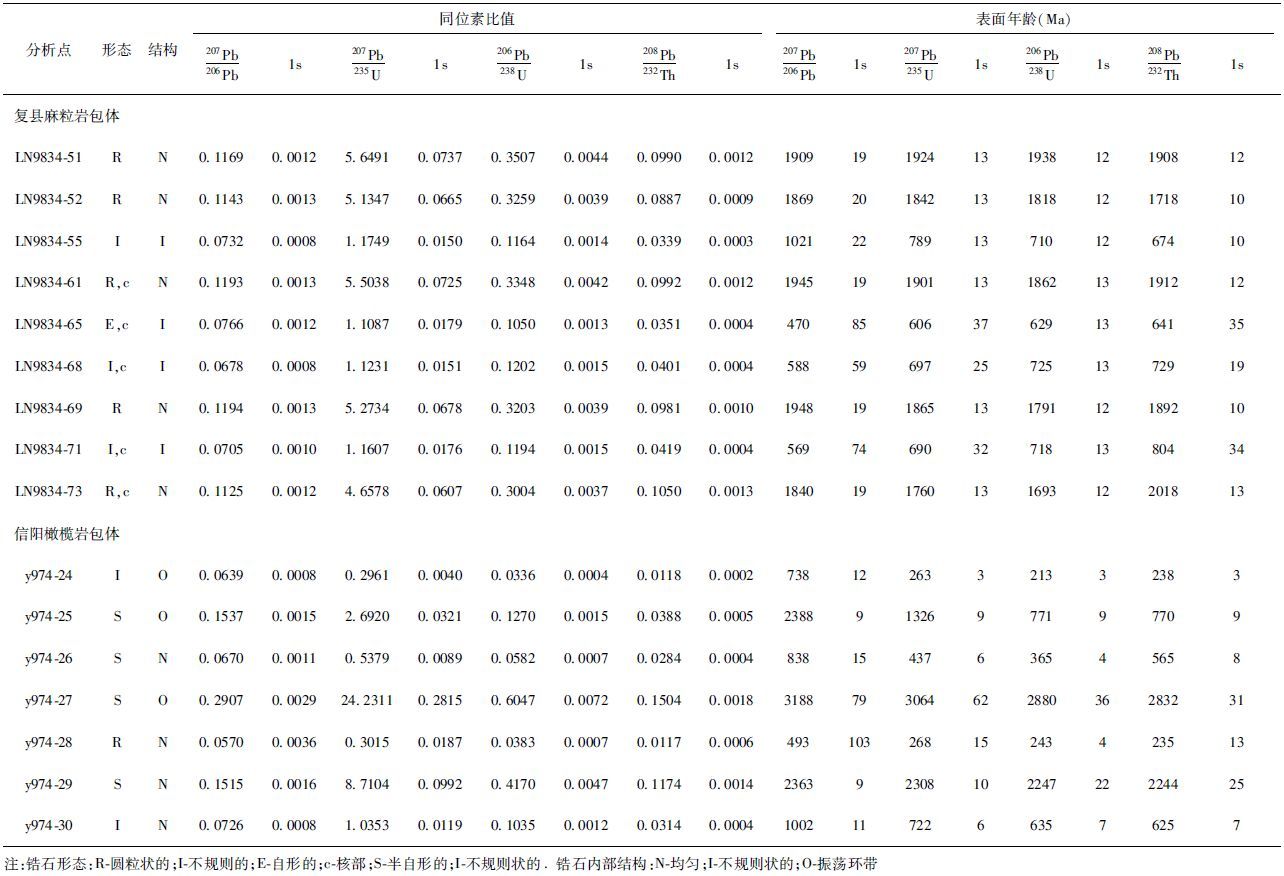
3 分析方法复县基性麻粒岩包体和信阳橄榄岩包体为基性和超基性岩石, 锆石较少, 因此在分选的过程中特别小心以免混染或锆石丢失。样品经过手工破碎、淘洗、电磁选、重液分选, 之后, 在双目镜下将锆石挑选出来并粘在双面胶上, 制成靶。这些锆石的测试工作在澳大利亚Macquarie大学GEMOC中心完成。背散射/阴极发光分析在CamecaSX-50探针上进行, 加速电压15kV, 工作电流20nA。锆石U-Pb同位素原位分析(表 1)在Agilent HP4500电感耦合等离子体质谱与定制的266nm UV激光剥蚀探针的联机上进行的。激光束直径20~30μm, 激光剥蚀样品的深度为30~50μm, 激光脉冲速率10Hz, 激光束脉冲能量1mJ。详细的测试技术说明见www.es.mq.edu.au/GEMOC/AnMethods。普通Pb采用Andersen(2002)所描述的方法进行扣除。LAM-ICPMS测年的精度和分析误差等见Belousova et al.(2002)和Jackson et al.(2004)。
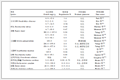
|
表 1 复县基性麻粒岩包体和信阳橄榄岩包体锆石U-Pb同位素数据 Table 1 U-Pb data for zircons from the Fuxian mafic granulite xenolith and Xinyang peridotite xenolith |
对涉县石榴辉石岩包体的全岩、石榴石和单斜辉石进行了Sm-Nd同位素分析(表 2)。石榴石和单斜辉石均经过双目显微镜下仔细挑选, 尽量选择无包裹体的石榴石和无绿泥石化、角闪石化和蛇纹石化的单斜辉石。Sm-Nd同位素样品的化学分离是在“地矿部壳幔体系组成、物质交换及动力学研究”开放实验室进行, 并在该实验室MAT-261上完成测试。全流程Nd的本底为1×10-11~3×10-11g, Nd同位素比值的质谱分馏校正采用146Nd/144Nd=0.7219, GBW04411(国家标样)的测定值:143Nd/144Nd=0.512740±8(2σ), La Jolla的测定值:143Nd/144Nd=0.511860±10(2σ)。计算初始Nd同位素比值采用的参数为(143Nd/144Nd)CHUR(0)=0.512638, (147Sm/144Nd)CHUR(0)=0.1967, λ=6.54×10⁻¹² a-1。
|
|
表 2 河北涉县石榴辉石岩Sm-Nd同位素数据 Table 2 Sm-Nd data for the Shexian granet pyroxenite xenolith |
汉诺坝橄榄岩捕虏体中不同产状的硫化物的原位Re-Os同位素测定均在澳大利亚Macquarie大学GEMOC中心完成(表 3)。 将橄榄岩样品磨制成3×2×1cm的块体或探针片, 并将表面抛光, 在显微镜反光下寻找粒度>30μm的硫化物颗粒用以激光原位分析其Re-Os同位素. 若为块体样, 做完测试后要将上部约200μm厚度的样品磨掉并重新抛光, 以剥蚀出更深部的硫化物, 这样的程序通常重复3~4次, 以保证每个样品中的硫化物均能最大程度地被测试。硫化物的Re-Os同位素是在多接收器的电感耦合Nu等离子体质谱与Merchantek EO LUV 266nm激光剥蚀探针(LAM-MC-ICPMS)的联机上进行。以He作为载气以提高灵敏度和减少元素分馏, 激光束直径为50μm, 激光脉冲速率为5Hz, 激光束的脉冲能量为3~5mJ。以合成NiS(PGE-A, Os=194.2×10⁻⁶)作为内标。在测试中, 每测完一个样品需重新测一次标样。通常经过一天的运作测试, 仪器系统误差<1%。
|
|
表 3 汉诺坝橄榄岩捕虏体中硫化物Re-Os同位素分析数据 Table 3 Re-Os analyses of sulfides from the Hannuoba peridotite xenoliths |
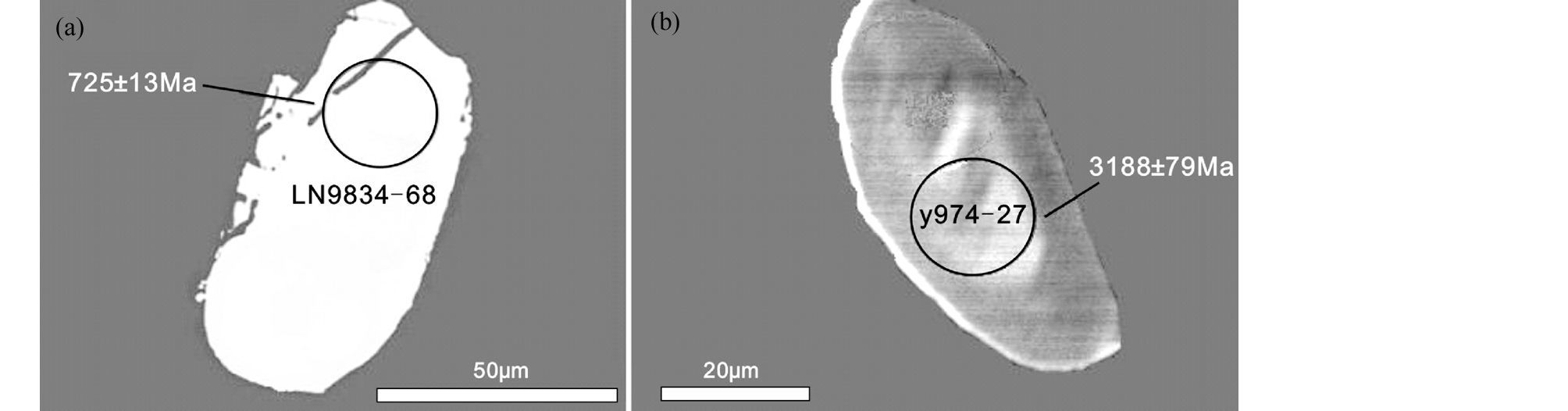
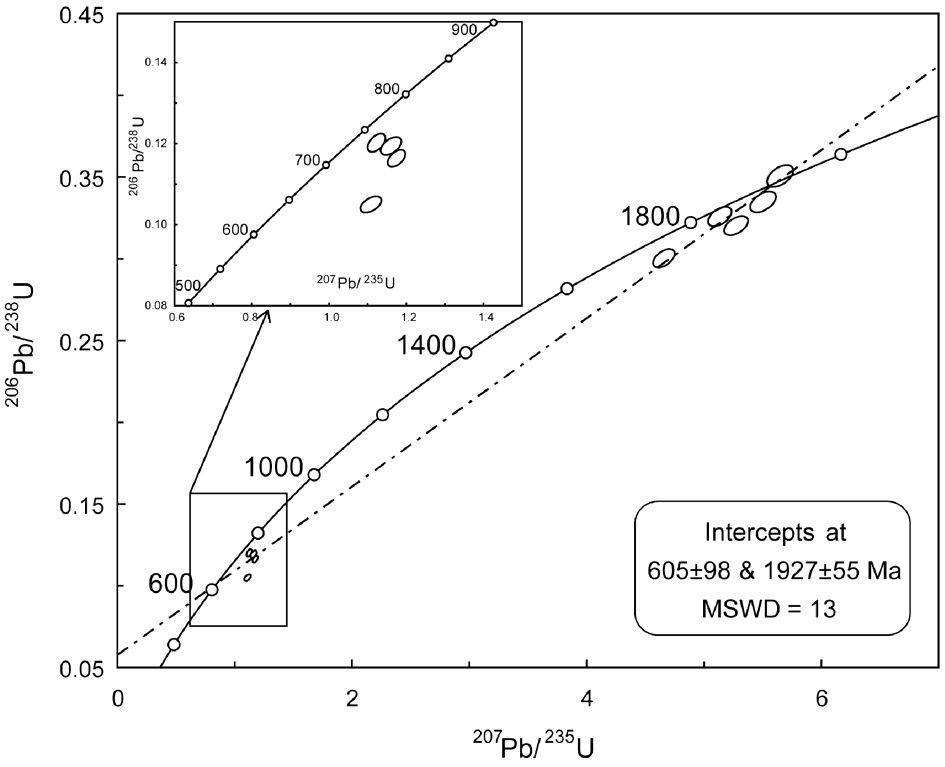
Zheng et al.(2004b)曾分析过7块辽宁复县麻粒岩包体中的锆石, 发现2.5~2.6Ga和1.85Ga是这些样品的主要年龄, 并记录着晚太古代时期的增生和早元古代时期的再造过程。其中有1块样品(LN9834)有新元古代年龄。这一样品的锆石呈浅紫色, 透明, 圆形且一般较小(45~130μm)。背散射/阴极发光显示一些颗粒具有明亮的核, 但是没有环带, 大部分颗粒没有内部结构(图 2a)。总共分析了9个点, 它们能被分为两组年龄, 其中5个点的207Pb/206Pb的加权平均年龄为1934±54Ma(MSWD=1.3), 剩余4个点为中度不谐和, 它们的206Pb/238U年龄变化范围为629~718Ma。所有的9个分析点获得了一条很好的不一致线, 给出了1927±55Ma的上交点年龄和605±98Ma的下交点年龄(图 3)。
|
图 2 复县基性麻粒岩包体和信阳橄榄岩包体中锆石背散射图像(圆圈代表LA-ICPMS U-Pb分析点) Fig. 2 Backscattered electron(BSE)images of analyzed zircons separated from the Fuxian mafic granulite xenolith and Xinyang peridotite xenolith(circles indicate the location of U-Pb) |
|
图 3 复县基性麻粒岩包体锆石U-Pb年龄谐和图 Fig. 3 Zircon U-Pb concordia for the Fuxian mafic granulite xenolith |
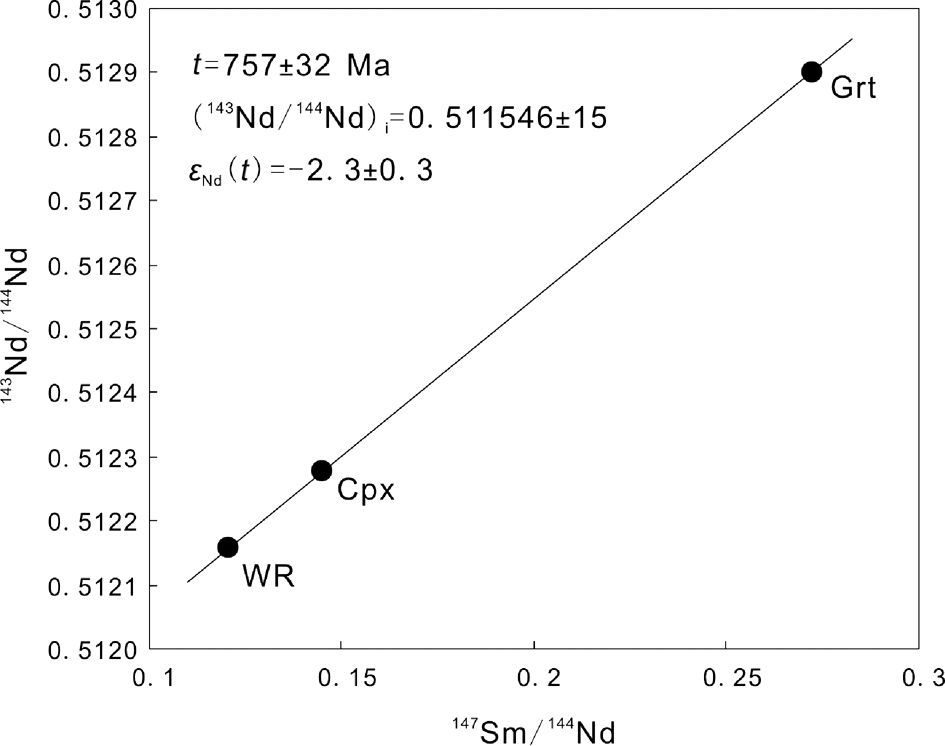
涉县石榴辉石岩全岩与单矿物的Sm-Nd同位素分析结果表明, 单斜辉石的Sm含量最低(2.52×10⁻⁶), 石榴石的Nd含量最低(7.28×10⁻⁶);同位素比值中全岩给出的147Sm/144Nd和143Nd/144Nd最小, 分别为0.1202和0.512158, 石榴石的最大, 分别为0.2722和0.512900。全岩及其组成的石榴石和单斜辉石共同获得了一条较好的内部等时线, 给出了757±32Ma的年龄, 其对应初始143Nd/144Nd=0.511546±15(εNd(t)=-2.3±0.3)(图 4)。
|
图 4 涉县石榴辉石岩包体Sm-Nd等时线年龄 Grt-石榴石;Cpx-单斜辉石;WR-全岩 Fig. 4 Sm-Nd reference isochron ages of the Shexian granet pyroxenite xenolith Grt-garnet; Cpx-clinopyroxene; WR-whole rock |
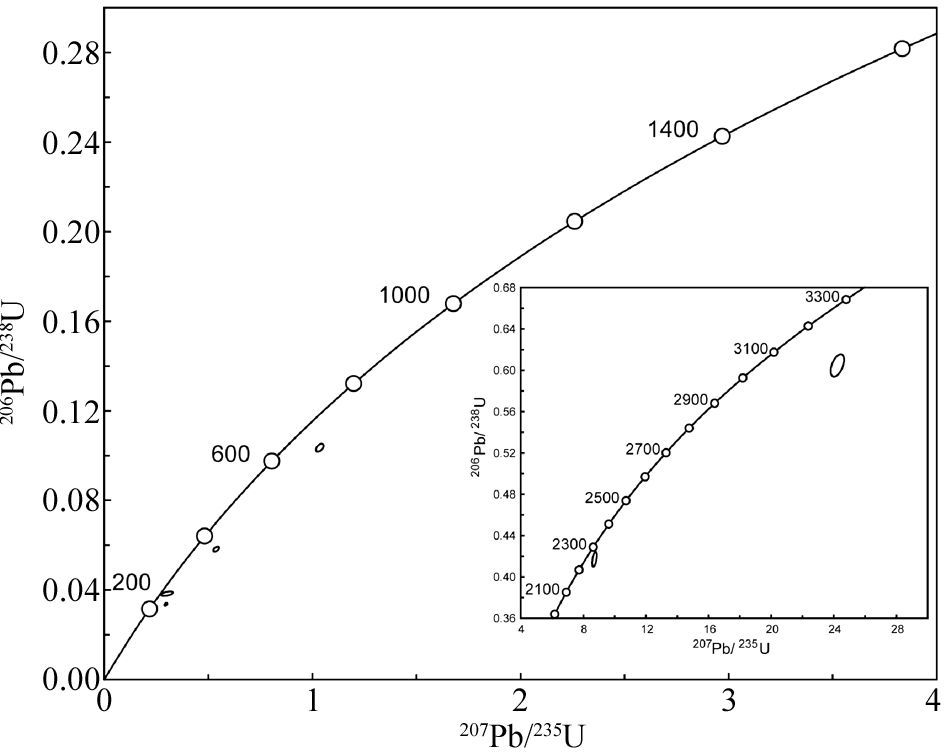
Zheng et al.(2006)分析了3块信阳橄榄岩包体中锆石, 发现~220Ma是这些样品的主要年龄, 记录着扬子深俯冲碰撞作用对华北南缘深部地幔的改造过程。在3块样品中只有1块有新元古代的年龄信息。这一样品(y974)的锆石呈浅紫色, 形态多为短柱状到圆形, 大小一般在40~105μm, 且平均的长宽比值为1.6。背散射/阴极发光显示, 其中三个颗粒具有核-边结构, 核部为环带结构, 边部显示无内部结构(图 2b)。总共分析了7个点(因分析点y974-25极不协和, 未用于投图, 图 5中显示为其他6个分析点), 其中5个分析点给出较分散的年龄, 它们的206Pb/238U年龄变化于213~771Ma, 其中213Ma的年龄较协和、771Ma年龄的协和度相对较差;其余两个点给出了中度不谐和的207Pb/206Pb年龄2363Ma和3188Ma。锆石的Hf同位素表明三个分析点y974-26(243Ma), y974-28(365Ma)和y974-30(635Ma)具有相同的初始Hf同位素组成, 表明它们遭受不同的Pb丢失但可能具有相同的来源或年龄, 且年龄要老于635Ma(Zheng et al., 2006)。
|
图 5 信阳橄榄岩包体锆石U-Pb年龄谐和图 Fig. 5 Zircon U-Pb concordia for the Xinyang peridotite xenolith |
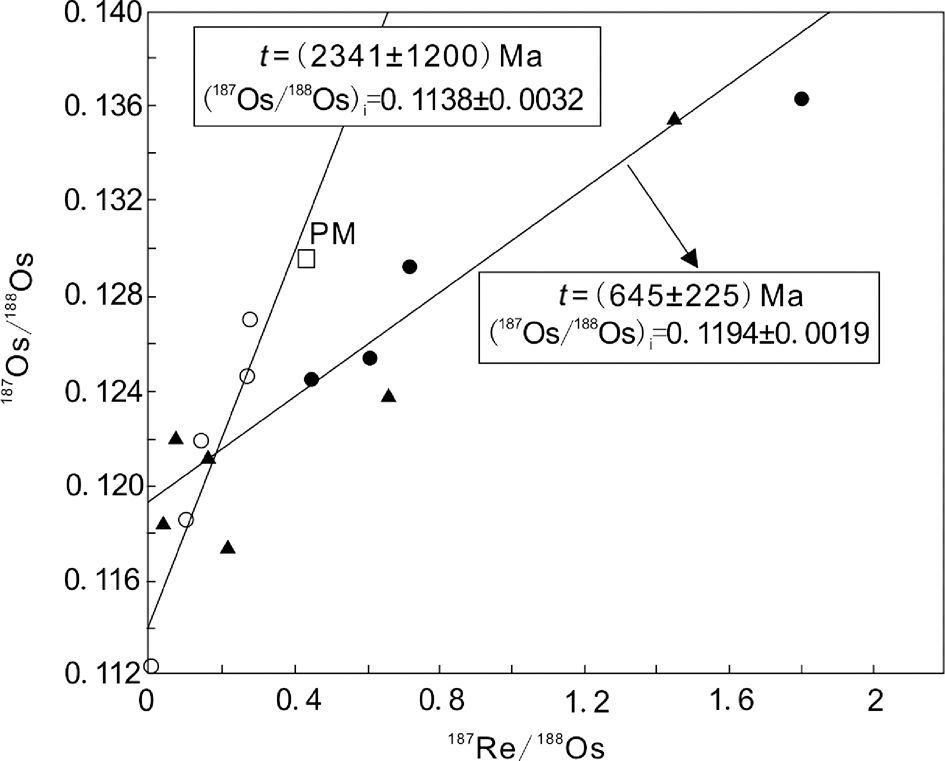
橄榄岩Re-Os同位素的模式年龄(tMA)与Re亏损年龄(tRD)它们分别记录的是熔体从地幔源区分离后, 残留的岩石圈地幔演化至今的时间, 和在假设Re在部分熔融过程中全部进入熔体条件下地幔发生熔融时的年龄(Pearson et al., 1995)。汉诺坝橄榄岩中硫化物的TMA变化范围为-3.5~2.2Ga, 填隙状硫化物中为-0.8~3.0Ga. 除去不具意义的年龄点, 包裹体硫化物给出了2.1Ga的可信年龄, 填隙物硫化物给出了1.4Ga和0.9Ga的可信年龄(余淳梅等, 2007)。同时包裹体硫化物的tRD变化范围为-10.3~2.1Ga, 其中仅2.1Ga的年龄与其tMA年龄(2.2Ga)较为一致, 填隙物硫化物中1.3Ga年龄也与其tMA年龄(1.4Ga)较为一致。除此之外, 填隙物硫化物还获得了0.7~0.9Ga的新元古代tRD年龄值。5个Re-Os比值小于原始地幔现代值的包裹体硫化物样品数据与原始地幔构成一条等时线, 给出的早元古代年龄2341±1200Ma;填隙物硫化物与受到后期扰动、Re-Os比值大于原始地幔现代值的包裹体硫化物样品所构成的参考等时线年龄则为新元古代645±225Ma(图 6)。
|
图 6 汉诺坝橄榄岩包体中硫化物Re-Os同位素参考等时线年龄 ●-受到后期扰动的包裹体硫化物; ▲-填隙状硫化物; ○-部分熔融后残留的包裹体硫化物;PM-原始地幔 Fig. 6 Re-Os reference isochron ages of sulfides from the Hannuoba peridotite xenoliths ●-enclosed sulfides undergone later stage affection; ▲-interstitial sulfides; ○-residual enclosed sulfides of mantle partial melting; PM-primitive mantle |
信阳橄榄岩包体锆石给出了中太古代(3188Ma)的最老年龄, 且Hf同位素显示地幔具有亏损的特征, 表明大量陆壳的抽取时间早于3.2Ga(Zheng et al., 2006)。这一亏损特征与河北3.5Ga的角闪岩具有正的εNd(t)值(+2.7)的性质(Jahn et al., 1987)是一致的。这些可能表明在>3.2Ga华北发生了增生事件, 形成了若干古陆核或微陆块(翟明国, 2010)。除涉县包体外, 其余三个地点包体都给出了2.3~1.9Ga的古元古代年龄, 且位于球粒陨石线下方的Hf同位素表明它们可能是岩石圈重熔改造的结果(Zheng et al., 2004b, 2006, 2008b, 2012), 这可能与华北广泛分布的古元古代的构造热事件有关(Zhai and Liu, 2003; 翟明国, 2004; Zheng et al., 2004b, 2006, 2012; Zhao et al., 2005; 郑建平, 2005; 路凤香和侯青叶, 2012; Zhao and Cawood, 2012)。以上不是本文讨论的重点, 本文重点关注的是新元古代的年龄记录。
在众多华北岩石包体研究中, 仅本文所报道资料的四个地区包体记录着新元古代的年龄信息, 如:复县基性麻粒岩锆石0.61Ga的下交点年龄(图 3), 涉县石榴石辉石岩全岩-单矿物的0.76Ga Sm-Nd内部等时年龄(图 4)、信阳橄榄岩锆石的新元古代(>0.64Ga)年龄(图 5)以及汉诺坝橄榄岩硫化物0.9~0.6Ga的Re-Os年龄(图 6)。另外, 杨进辉等(2004)也报道了在辽东半岛三叠纪辉绿岩中发现了904Ma的捕获岩浆锆石年龄。华北地表也零星出露有新元古代的岩浆活动, 这些报道的年龄主要集中在0.98~0.60Ga之间(周宝和, 1983; 邵济安等, 2002; 柳永清等, 2005; 高秋灵等, 2009; 王清海等, 2011; Peng et al., 2011a, b; Wang et al., 2011), 这表明华北深部年龄信息与其地表地质纪录基本是一致的。
整体来看, 华北(包括地表出露岩石和深源岩石包体)存在着0.98~0.60Ga新元古代的年龄记录, 但是这些年龄记录都很有限(见前面的文献)。而这一时期的岩浆活动在华南非常发育(Zhou et al., 2002a, b, 2006a, b; Li et al., 2003a, b; Zheng et al., 2004a, 2008a; Wang et al., 2006, 2012; Wu et al., 2006; Zhao and Zhou, 2007a, b; Zhao et al., 2010, 2011; Zhang and Zheng, 2012)。华北与华南这一显著的差异可能反映了二者在Rodinia超大陆的位置有所不同, 即华南与超大陆裂解中心的位置较近、而华北可能远离超大陆裂解的中心(Li, 1999; 彭澎等, 2002; Li et al., 2004;陆松年等, 2004)。此外, 华北地表地质所反映出来的新元古代年龄记录非常有限, 而华南地表存在着这一期的强烈岩浆活动, 说明它们对同一期岩浆活动的表现形式存在着不同, 归根结底在于华北在新元古代时期可能有厚的岩石圈(翟明国, 2008), 阻碍了岩浆作用在地表的发生, 而华南的岩石圈相对要薄很多, 有利于地表大规模岩浆活动的发生。因此, 我们认为弱的热事件和巨厚的岩石圈可能是造成华北新元古代记录不明显的根本原因。如果该认识正确的话, 则可能有利于对华北克拉通破坏、华南再造及其它们成矿背景差异的理解。
6 主要认识(1) 华北深部岩石圈存在着新元古代的年龄记录(0.9~0.6Ga), 这与地表地质记录的时间(0.98~0.60Ga)是基本一致的;
(2) 华北与华南新元古代岩浆活动的差异, 可能反应了二者在在Rodinia超大陆的位置有所不同, 即华南距离超大陆裂解中心的位置较近、而华北可能较远;
(3) 华北与华南岩浆活动表现形式的差异同时也可能反应了二者在新元古代时期具有不同的岩石圈厚度, 华北具巨厚的岩石圈、而华南当时的岩石圈可能比较薄。
致谢 感谢审稿人张拴宏研究员、彭澎研究员和郭江涛博士宝贵的修改意见。刘观亮研究员参加了涉县岩石包体的研究工作, 特此感谢。| [] | Andersen T. 2002. Correction of common lead in U-Pb analyses that do not report 204Pb. Chemical Geology, 192(1-2): 59–79. DOI:10.1016/S0009-2541(02)00195-X |
| [] | Belousova EA, Griffin WL, O’Reilly SY, Fisher NI. 2002. Igneous zircon: Trace element composition as an indicator of source rock type. Contributions to Mineralogy and Petrology, 143(5): 602–622. DOI:10.1007/s00410-002-0364-7 |
| [] | Chi JS, Lu FX. 1996. The Characteristics of the Kimberlite in North China Platform and Its Paleozoic Lithospheric Mantle. Beijing: Science Press: 1-292. |
| [] | Gao QL, Zheng JP, Zhang ZH, Xiong Q, Chen X. 2009. Complex evolution of the southern margin of the North China Craton: Evidence from LA-ICPMS U-Pb dating of zircons in Zhouzhuang meta-gabbro. Acta Petrologica Sinica, 25(12): 3275–3286. |
| [] | Hu BQ. 2001. Geological and geochemical characteristics of anatectic xenoliths and the model of the lithosphere in Xinyang, Henan. Ph. D. Dissertation. Wuhan: China University of Geosciences (in Chinese with English summary) |
| [] | Jackson SE, Pearson NJ, Griffin WL, Belousoval EA. 2004. The application of laser ablation-inductively coupled plasma-mass spectrometry to in situ U-Pb zircon geochronology. Chemical Geology, 211(1-2): 47–69. DOI:10.1016/j.chemgeo.2004.06.017 |
| [] | Jahn BM, Auvray B, Cornichet J, Bai YL, Shen QH, Liu DY. 1987. 3.5Ga old amphibolites from eastern Hebei Province, China: Field occurrence, petrography, Sm-Nd isochron age and REE geochemistry. Precambrian Research, 34(3-4): 311–346. DOI:10.1016/0301-9268(87)90006-4 |
| [] | Kusky TM, Windley BF, Zhai MG. 2007. Tectonic evolution of the North China Block: From orogen to craton to orogen. In: Zhai MG, Windley BF and Kusky T (eds.).Mesozoic Sub-continental Thinning Beneath Eastern North China.Geological Society, London, Special Publications, 280(1): 1–34. |
| [] | Li XH. 1999. U-Pb zircon ages of granites from the southern margin of the Yangtze Block: Timing of Neoproterozoic Jinning: Orogeny in SE China and implications for Rodinia Assembly. Precambrian Research, 97(1-2): 43–57. DOI:10.1016/S0301-9268(99)00020-0 |
| [] | Li XH, Li ZX, Ge WC, Zhou HW, Li WX, Liu Y, Wingate MTD. 2003a. Neoproterozoic granitoids in South China: Crustal melting above a mantle plume at ca. 825Ma?.Precambrian Research, 122(1-4): 45–83. DOI:10.1016/S0301-9268(02)00207-3 |
| [] | Li ZX, Li XH, Kinny PD, Wang J, Zhang S, Zhou H. 2003b. Geochronology of Neoproterozoic syn-rift magmatism in the Yangtze Craton, South China and correlations with other continents: Evidence for a mantle superplume that broke up Rodinia. Precambrian Research, 122(1-4): 85–109. DOI:10.1016/S0301-9268(02)00208-5 |
| [] | Li ZX, Evans DAD, Zhang S. 2004. A 90° spin on Rodinia: Possible causal links between the Neoproterozoic supercontinent, superplume, true polar wander and low-latitude glaciation. Earth Planetary Science Letters, 220(3-4): 409–421. DOI:10.1016/S0012-821X(04)00064-0 |
| [] | Liu YQ, Gao LZ, Liu YX, Song B, Wang ZX. 2006. Zircon U-Pb dating for the earliest Neoproterozoic mafic magmatism in the southern margin of the North China Block. Chinese Science Bulletin, 51(19): 2375–2382. DOI:10.1007/s11434-006-2114-0 |
| [] | Lu FX, Hou QY. 2012. The feature of lower crust of North China Craton (NCC) constrained by xenoliths. Earth Science Frontiers, 19(3): 177–187. |
| [] | Lu SN, Li HK, Chen ZH, Yu HF, Jin W, Guo KY. 2004. Relationship between Neoproterozoic cratons of China and the Rodinia. Earth Science Frontiers, 11(2): 515–523. |
| [] | Pearson DG, Carlson RW, Shirey SB, Boyd FR, Nixon PH. 1995. Stabilisation of Archaean lithospheric mantle: A Re-Os isotope study of peridotite xenoliths from the Kaapvaal craton. Earth and Planetary Science Letters, 134(3-4): 341–357. DOI:10.1016/0012-821X(95)00125-V |
| [] | Peng P, Liu WJ, Zhai MG. 2002. Response of North China Block to Rodinia supercontinent and its characteristics. Acta Petorlogica et Mineralogica, 21(4): 343–355. |
| [] | Peng P, Bleeker W, Ernst RE, Soderlund U, McNicoll V. 2011a. U-Pb baddeleyite ages, distribution and geochemistry of 925Ma mafic dykes and 900Ma sills in the North China Craton: Evidence for a Neoproterozoic mantle plume. Lithos, 127(1-2): 210–221. DOI:10.1016/j.lithos.2011.08.018 |
| [] | Peng P, Zhai MG, Li QL, Wu FY, Hou QL, Li Z, Li TS, Zhang YB. 2011b. Neoproterozoic (~900Ma) Sariwon sills in North Korea: Geochronology, geochemistry and implications for the evolution of the south-eastern margin of the North China Craton. Gondwana Research, 20(1): 243–254. DOI:10.1016/j.gr.2010.12.011 |
| [] | Shao JA, Zhang LQ, Li DM. 2002. Three Proterozoic extensional events in North China Craton. Acta Petrologica Sinica, 18(2): 152–160. |
| [] | Wang QH, Yang DB, Xu WL. 2012. Neoproterozoic basic magmatism in the southeast margin of North China Craton: Evidence from whole-rock geochemistry, U-Pb and Hf isotopic study of zircons from diabase swarms in the Xuzhou-Huaibei area of China. Science China (Earth Sciences), 55(9): 1461–1479. DOI:10.1007/s11430-011-4237-7 |
| [] | Wang XL, Zhou JC, Qiu JS, Zhang WL, Liu XM, Zhang GL. 2006. LA-ICP-MS U-Pb zircon geochronology of the Neoproterozoic igneous rocks from northern Guangxi, South China: Implications for tectonic evolution. Precambrian Research, 145(1-2): 111–130. DOI:10.1016/j.precamres.2005.11.014 |
| [] | Wang XL, Jiang SY, Dai BZ, Griffin WL, Dai MN, Yang YH. 2011. Age, geochemistry and tectonic setting of the Neoproterozoic (ca. 830Ma) gabbros on the southern margin of the North China Craton.Precambrian Research, 190(1-4): 35–47. |
| [] | Wang XL, Shu LS, Xing GF, Zhou JC, Tang M, Shu XJ, Qi L, Hu YH. 2012. Post-orogenic extension in the eastern part of the Jiangnan orogen: Evidence from ca. 800~760Ma volcanic rocks.Precambrian Research, 222-223: 404–423. |
| [] | Wu RX, Zheng YF, Wu YB, Zhao ZF, Zhang SB, Liu XM, Wu FY. 2006. Reworking of juvenile crust: Element and isotope evidence from Neoproterozoic granodiorite in South China. Precambrian Research, 146(3-4): 179–212. DOI:10.1016/j.precamres.2006.01.012 |
| [] | Yang JH, Wu FY, Zhang YB, Zhang Q, Wilde SA. 2004. Identification of Mesoproterozoic zircons in a Triassic dolerite from the Liaodong Peninsula, Northeast China. Chinese Science Bulletin, 49(18): 1958–1962. DOI:10.1007/BF03184289 |
| [] | Yu CM, Zheng JP, Griffin WL. 2006. Petrography and geochemistry of peridotite xenoliths from Hannuoba and significance for lithospheric mantle evolution. Journal of China University Geosciences, 17(1): 25–33. DOI:10.1016/S1002-0705(06)60003-4 |
| [] | Yu CM, Zheng JP, Griffin WL. 2007. In situ Re-Os isotope ages of sulfides in Hannuoba peridotitic xenoliths: Significance for the frequently-occurring mantle events beneath the North China Block. Chinese Science Bulletin, 52(20): 2847–2853. DOI:10.1007/s11434-007-0354-2 |
| [] | Zhai MG, Liu WJ. 2003. Palaeoproterozoic tectonic history of the North China Craton: A review. Precambrian Research, 122(1-4): 183–199. DOI:10.1016/S0301-9268(02)00211-5 |
| [] | Zhai MG. 2004. 2.1~1.7Ga geological event group and its geotectonic significance. Acta Petrologica Sinica, 20(6): 1343–1354. |
| [] | Zhai MG, Guo JH, Liu WJ. 2005. Neoarchean to Paleoproterozoic continental evolution and tectonic history of the North China Craton: A review. Journal of Asian Earth Sciences, 24(5): 547–561. DOI:10.1016/j.jseaes.2004.01.018 |
| [] | Zhai MG. 2008. Lower crust and lithospheric mantle beneath the North China Craton before the Mesozoic lithospheric disruption. Acta Petrologica Sinica, 24(10): 2185–2204. |
| [] | Zhai MG. 2010. Tectonic evolution and metallogenesis of North China Craton. Mineral Deposits, 29(1): 24–36. |
| [] | Zhai MG. 2011. Cratonization and the Ancient North China Continent: A summary and review. Science China (Earth Sciences), 54(8): 1110–1120. DOI:10.1007/s11430-011-4250-x |
| [] | Zhai MG, Santosh M. 2011. The early Precambrian odyssey of the North China Craton: A synoptic overview. Gondwana Research, 20(1): 6–25. DOI:10.1016/j.gr.2011.02.005 |
| [] | Zhang SB, Zheng YF. 2012. Formation and evolution of Precambrian continental lithosphere in South China. Gondwana Research, 23(4): 1241–1260. |
| [] | Zhao GC, Sun M, Wilde SA, Li SZ. 2005. Late Archean to Paleoproterozoic evolution of the North China Craton: Key issues revisited. Precambrian Research, 136(2): 177–202. DOI:10.1016/j.precamres.2004.10.002 |
| [] | Zhao GC, Cawood PA. 2012. Precambrian geology of China. : 222-223. |
| [] | Zhao JH, Zhou MF. 2007a. Geochemistry of Neoproterozoic mafic intrusions in the Panzhihua district (Sichuan Province, SW China): Implications for subduction-related metasomatism in the upper mantle. Precambrian Research, 152(1-2): 27–47. DOI:10.1016/j.precamres.2006.09.002 |
| [] | Zhao JH, Zhou MF. 2007b. Neoproterozoic adakitic plutons and arc magmatism along the western margin of the Yangtze Block, South China. Journal of Geology, 115(6): 675–689. DOI:10.1086/521610 |
| [] | Zhao JH, Zhou MF, Zheng JP, Fang SM. 2010. Neoproterozoic crustal growth and reworking of the Northwestern Yangtze Block: Constraints from the Xixiang dioritic intrusion, South China. Lithos, 120(3-4): 439–452. DOI:10.1016/j.lithos.2010.09.005 |
| [] | Zhao JH, Zhou MF, Yan DP, Zheng JP, Li JW. 2011. Reappraisal of the ages of Neoproterozoic strata in South China: No connection with the Grenvillian orogeny. Geology, 39(4): 299–302. DOI:10.1130/G31701.1 |
| [] | Zheng JP, Griffin WL, O’Reilly SY, Lu FX, Yu CM, Zhang M, Li HM. 2004b. U-Pb and Hf-isotope analysis of zircons in mafic xenoliths from Fuxian kimberlites: Evolution of the lower crust beneath the North China Craton. Contributions to Mineralogy and Petrology, 148(1): 79–103. DOI:10.1007/s00410-004-0587-x |
| [] | Zheng JP. 2005. The U-Pb dating ages and Hf isotopic compositions of zircon from various granulitic xenoliths: The formation and reworking of the lower crust beneath the North China. Bulletin of Mineralogy, Petrology and Geochemistry, 24(1): 7–16. |
| [] | Zheng JP, Sun M, Zhou MF, Robinson P. 2005. Trace elemental and PGE geochemical constraints of Mesozoic and Cenozoic peridotitic xenoliths on lithospheric evolution of the North China Craton. Geochimica et Cosmochimica Acta, 69(13): 3401–3418. DOI:10.1016/j.gca.2005.03.020 |
| [] | Zheng JP, Griffin WL, O’Reilly SY, Zhang M, Pearson N. 2006. Zircons in mantle xenoliths record the Triassic Yangtze-North China continental collision. Earth and Planetary Science Letters, 247(1-2): 130–142. DOI:10.1016/j.epsl.2006.05.011 |
| [] | Zheng JP, Griffin WL, O’Reilly SY, Hu BQ, Zhang M, Tang HY, Su YP, Zhang ZH, Pearson N, Wang FZ, Lu FX. 2008b. Continental collision and accretion recorded in the deep lithosphere of central China. Earth and Planetary Science Letters, 269(3-4): 496–506. |
| [] | Zheng JP. 2009. Comparison of mantle-derived matierals from different spatiotemporal settings: Implications for destructive and accretional processes of the North China Craton. Chinese Science Bulletin, 54(19): 3397–3416. |
| [] | Zheng JP, Griffin WL, Ma Q, O’Reilly SY, Xiong Q, Tang HY, Zhao JH, Yu CM, Su YP. 2012. Accretion and reworking beneath the North China Craton. Lithos, 149: 61–78. DOI:10.1016/j.lithos.2012.04.025 |
| [] | Zheng YF. 2003. Neoproterozoic magmatic activity and global change. Chinese Science Bulletin, 48(16): 1639–1656. DOI:10.1360/03wd0342 |
| [] | Zheng YF, Wu YB, Chen FK, Gong B, Li H, Zhao ZF. 2004a. Zircon U-Pb and oxygen isotope evidence for a large-scale 18O depletion event in igneous rocks during the Neoproterozoic. Geochimica et Cosmochimica Acta, 68(20): 4145–4165. DOI:10.1016/j.gca.2004.01.007 |
| [] | Zheng YF, Zhang SB. 2007. Formation and evolution of Precambrian continental crust in South China. Chinese Science Bulletin, 52(1): 1–12. DOI:10.1007/s11434-007-0015-5 |
| [] | Zheng YF, Wu RX, Wu YB, Zhang SB, Yuan H, Wu FY. 2008a. Rift melting of juvenile arc-derived crust: Geochemical evidence from Neoproterozoic volcanic and granitic rocks in the Jiangnan Orogen, South China. Precambrian Research, 163(3-4): 351–383. DOI:10.1016/j.precamres.2008.01.004 |
| [] | Zhou MF, Yan DP, Kennedy AK, Li YQ, Ding J. 2002a. SHRIMP U-Pb zircon geochronological and geochemical evidence for Neoproterozoic arc-magmatism along the western margin of the Yangtze Block, South China. Earth and Planetary Science Letters, 196(1-2): 51–67. DOI:10.1016/S0012-821X(01)00595-7 |
| [] | Zhou MF, Kennedy AK, Sun M, Malpas J, Lesher CM. 2002b. Neoproterozoic arc-related mafic intrusions along the northern margin of South China: Implications for the accretion of Rodinia. Journal of Geology, 110(5): 611–618. DOI:10.1086/341762 |
| [] | Zhou MF, Ma YX, Yan DP, Xia XP, Zhao JH, Sun M. 2006a. The Yanbian Terrane (Southern Sichuan Province, SW China): A Neoproterozoic arc assemblage in the western margin of the Yangtze Block. Precambrian Research, 144(1-2): 19–38. DOI:10.1016/j.precamres.2005.11.002 |
| [] | Zhou MF, Yan DP, Wang CL, Qi L, Kennedy A. 2006b. Subduction-related origin of the 750Ma Xuelongbao adakitic complex (Sichuan Province, China): Implications for the tectonic setting of the giant Neoproterozoic magmatic event in South China. Earth and Planetary Science Letters, 248(1-2): 286–300. DOI:10.1016/j.epsl.2006.05.032 |
| [] | 池际尚, 路凤香. 1996. 华北地台金伯利岩及古生代岩石圈地幔特征. 北京: 科学出版社: 1-292. |
| [] | 高秋灵, 郑建平, 张志海, 熊庆, 陈曦. 2009. 信阳周庄变辉长岩LA-ICPMS U-Pb定年与华北南缘复杂演化过程. 岩石学报, 25(12): 3275–3286. |
| [] | 胡宝群. 2001. 信阳深源包体的地质地球化学特征及其岩石圈模型. 博士学位论文. 武汉: 中国地质大学 |
| [] | 柳永清, 高林志, 刘燕学, 宋彪, 王宗秀. 2005. 徐淮地区新元古代初期镁铁质岩浆事件的锆石U-Pb定年. 科学通报, 50(22): 2514–2521. |
| [] | 路凤香, 侯青叶. 2012. 由深源捕虏体限定的华北克拉通下地壳特征. 地学前缘, 19(3): 177–187. |
| [] | 陆松年, 李怀坤, 陈志宏, 于海峰, 金巍, 郭坤一. 2004. 新元古时期中国古大陆与罗迪尼亚超大陆的关系. 地学前缘, 11(2): 515–523. |
| [] | 彭澎, 刘文军, 翟明国. 2002. 华北陆块对Rodinia超大陆的响应及其特征. 岩石矿物学杂志, 21(4): 343–355. |
| [] | 邵济安, 张履桥, 李大明. 2002. 华北克拉通元古代的三次伸展事件. 岩石学报, 18(2): 152–160. |
| [] | 王清海, 杨德彬, 许文良. 2011. 华北陆块东南缘新元古代基性岩浆活动: 徐淮地区辉绿岩床群岩石地球化学、年代学和Hf同位素证据. 中国科学(地球科学), 41(6): 796–815. |
| [] | 杨进辉, 吴福元, 张艳斌, 张旗, WildeSA. 2004. 辽东半岛南部三叠纪辉绿岩中发现新元古代年龄锆石. 科学通报, 49(18): 1878–1882. |
| [] | 余淳梅, 郑建平, GriffinWL. 2006. 汉诺坝橄榄岩捕虏体的单斜辉石LAM-ICPMS 分析及其岩石圈地幔演化意义. 地球科学, 31(1): 93–100. |
| [] | 余淳梅, 郑建平, GriffinWL. 2007. 汉诺坝橄榄岩捕虏体原位Re-Os同位素年龄与多发地幔事件. 科学通报, 52(15): 1814–1819. |
| [] | 翟明国. 2004. 华北克拉通2.1~1.7Ga地质事件群的分解和构造意义探讨. 岩石学报, 20(6): 1343–1354. |
| [] | 翟明国. 2008. 华北克拉通中生代破坏前的岩石圈地幔与下地壳. 岩石学报, 24(10): 2185–2204. |
| [] | 翟明国. 2010. 华北克拉通的形成演化与成矿作用. 矿床地质, 29(1): 24–36. |
| [] | 翟明国. 2011. 克拉通化与华北陆块的形成. 中国科学(地球科学), 41(8): 1037–1046. |
| [] | 郑建平. 2005. 捕掳体麻粒岩锆石U-Pb年龄和铪同位素: 华北地块下地壳的形成与再造. 矿物岩石地球化学通报, 24(1): 7–16. |
| [] | 郑建平. 2009. 不同时空背景幔源物质对比与华北深部岩石圈破坏和增生置换过程. 科学通报, 54(14): 1990–2007. |
| [] | 郑永飞. 2003. 新元古代岩浆活动与全球变化. 科学通报, 48(16): 1705–1720. |
| [] | 郑永飞, 张少兵. 2007. 华南前寒武纪大陆地壳的形成和演化. 科学通报, 52(1): 1–10. |