 2013, Vol. 29


2. 中国地质科学院矿产资源研究所, 北京 100037
2. Institute of Mineral Resources, Chinese Academy of Geological Sciences, Beijing 100037, China
在喜马拉雅造山带中,东西向展布的北喜马拉雅片麻岩穹隆(NHGD) 分布于雅鲁藏布江缝合带(YTS) 和藏南拆离系(STDS) 之间(图 1a),由一系列断续分布的串珠状穹窿体组成,在每一个穹窿中,自核部向边部依次由高级变质岩、低级变质或未变质的特提斯沉积岩系以及侵入其中的花岗岩组成,各岩石单元之间为韧性拆离断层环绕穹窿分布(图 1a)。花岗岩、混合岩和高级变质岩是其中重要组成部分,是中下地壳岩石随着喜马拉雅造山带构造演化发生高级变质和部分熔融作用的产物(Debon et al., 1986; Harris and Massey, 1994; Harrison et al., 1999; Zhang et al., 2004; Aoya et al., 2005; Aikman et al., 2008; King et al., 2011; Zeng et al., 2011; Gao et al., 2012; Hou et al., 2012)。除康玛穹窿还未报道过新生代淡色花岗岩外,其他穹窿中的淡色花岗岩都形成于新生代(44~10Ma) (Schärer et al., 1986; Harrison et al., 1997; Zhang et al., 2004; Aoya et al., 2005; Lee and Whitehouse, 2007; Aikman et al., 2008; King et al., 2011; Zeng et al., 2011; 高利娥等, 2013)。
马拉山穹窿位于北喜马拉雅穹窿的西部,由错布二云母花岗岩、马拉山二云母花岗岩和佩枯错复合淡色花岗岩体组成(图 1b),围岩为侏罗纪-白垩纪的泥质、钙质片岩和矽卡岩(Pan and Ding, 2004),在靠近花岗岩体的变泥质围岩中发育红柱石,可能与岩体侵位导致的接触变质作用相关。佩枯错淡色花岗岩是一个复合岩体,由形成于28.2±0.5Ma的电气石淡色花岗岩、形成于19.8±0.5Ma的二云母花岗岩和含石榴石淡色花岗岩组成(高利娥等, 2013)。构造解析表明:(1) 马拉山二云母花岗岩体的围岩经历了强烈变形,分别是早期南向逆冲推覆作用和晚期北向韧性剪切作用(Lee et al., 2000; Aoya et al., 2004, 2005)(2) 在围岩中形成以岩体为中心的巴罗式变质晕(Kawakami et al., 2007),但变质级较低,未见夕线石和混合岩化现象(Aoya et al., 2004, 2005)。在全岩地球化学特征上,错布二云母花岗岩与马拉山岩体相似,但明显不同于佩枯错淡色花岗岩(Aoya et al., 2005;高利娥等, 2013),表明马拉山二云母花岗岩的成因可能不同于早期的佩枯错淡色花岗岩。
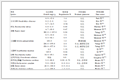
2 分析方法 2.1 LA-MC-ICP-MS锆石U-Pb定年为了进一步厘定马拉山二云母花岗岩的形成年代,在马拉山岩体的中部采集了代表性样品T0658和T0647(图 1b),从中挑选锆石,经过手工挑选、制靶和抛光,然后进行阴极发光(CL) 和扫描电镜背散射(BSE) 成像观察,揭示锆石的内部结构。阴极发光成像在中国地质科学院地质研究所北京离子探针中心进行。在中国地质科学院地质研究所大陆构造与动力学国家重点实验室进行了BSE图像和锆石内部包裹体的成分测试。通过对照阴极发光和BSE图像,鉴别锆石不同生长域差异特征,选取锆石U-Pb测试点。锆石U-Pb同位素定年测试在中国地质科学院矿产资源研究所成矿作用与资源评价重点实验室进行。所用仪器为德国Finnigan公司生产的Neptune型激光多接收等离子体质谱(LA-MC-ICPMS),并结合美国New Wave公司生产的UP213nm激光剥蚀系统,激光剥蚀所用斑束直径为25μm,频率为10Hz,能量密度约为2.5J/cm2,以He为载气。U和Th含量以锆石标样M 127 (U: 923×10-6; Th: 439×10-6; Th/U: 0.475) 为外标进行校正。在测试过程中,每测定10个样品点前后重复测量两次锆石标样GJ-1和一次锆石标样Plesovice。分析数据的离线处理(包括对样品和空白信号的选择、仪器灵敏度漂移校正、元素含量及U-Th-Pb同位素比值和年龄计算) 采用软件ICPMSDataCal完成(Liu et al., 2010),锆石年龄谐和图用Isoplot 3.0程序获得。测试结果见表 1。
|
表 1 马拉山二云母花岗岩(样品T0658和T0647) 的LA-MC-ICP-MS锆石U-Pb定年数据 Table 1 U-Pb isotopic data for the Malashan two-mica granite (sample T0658 and T0647) |
锆石Hf同位素测试是在中国地质科学院矿产资源研究所国土资源部成矿作用与资源评价重点实验室Neptune多接收等离子质谱和Newwave UP213紫外激光剥蚀系统(LA-MC-ICP-MS) 上进行的,实验过程中采用He作为剥蚀物质载气,剥蚀直径采用40μm,测定时使用锆石国际标样GJ1和Plesovice作为参考物质,分析点与U-Pb定年分析点为同一位置,或者选择结构相似的点。相关仪器运行条件及详细分析流程见侯可军等(2007)。分析过程中锆石标准GJ1和Plesovice的176Hf/177Hf测试加权平均值分别为0.282007±0.000007 (2σ,n=36) 和0.282476±0.000004 (2σ,n=27),与文献报道值(侯可军等, 2007; Morel et al., 2008; Sláma et al., 2008) 在误差范围内完全一致。根据LA-MC-ICP-MS锆石U-Pb定年的结果,马拉山二云母花岗岩的最早结晶年龄约为17.6Ma。所分析样品的Hf同位素的初始值按t=17.6Ma计算,分析结果见表 2。
|
|
表 2 马拉山二云母花岗岩(样品T0646、TMLS09和T0658) 锆石Hf同位素组成 Table 2 Hf isotope compositions of the Malashan two-mica granite (sample T0646, TMLS09 and T0658) |


为精确限定马拉山二云母花岗岩的地球化学特征,在马拉山岩体的西部采集了样品,分析了它们的全岩主量和微量元素组成。主量及微量元素的测试在国土资源部国家地质实验测试中心进行。主量元素通过XRF (X荧光光谱仪3080E) 方法测试,分析精度为5%。微量元素和稀土元素(REE) 通过等离子质谱仪(ICP-MS-Excell) 分析,含量大于10×10-6的元素的测试精度为5%,而小于10×10-6的元素精度为10%。个别在样品中含量低的元素,测试误差大于10%。分析结果列在表 3中。
|
|
表 3 马拉山二云母花岗岩(样品T0827、T0829和T0830) 的主量元素(wt%) 和微量元素(×10-6) 组成 Table 3 Major (wt%) and trace (×10-6) element compositions of the Malashan two-mica granite (sample T0827, T 0829 and T0830) |
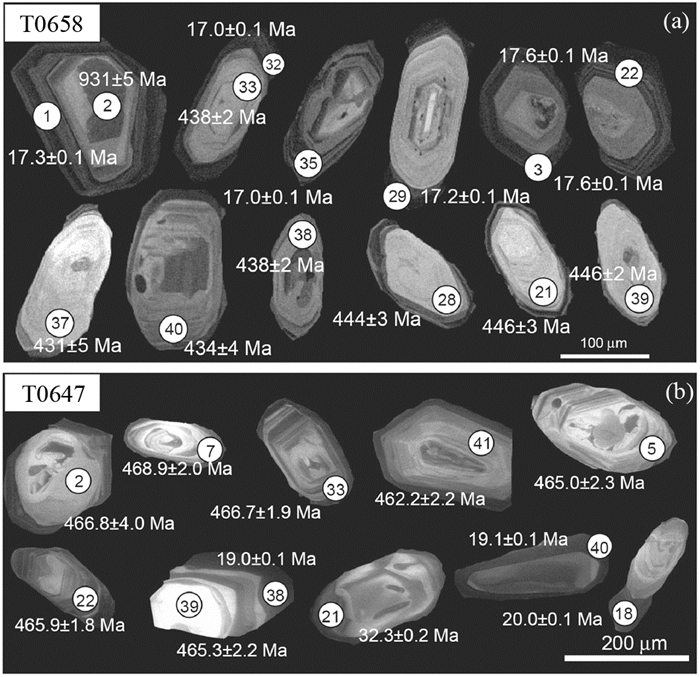
样品T0658和T0647分别位于马拉山二云母花岗岩体的东北和西南部,相距约7km (图 1b),矿物组成为石英、钾长石、斜长石、白云母、黑云母和少量副矿物,如锆石、磷灰石和独居石。在这两个样品中,大部分锆石为自形-半自形,长柱状,棱角清晰,粒度在100~200μm之间,长宽比一般为2:1,样品T0647中锆石的粒度稍大于T0658中锆石粒度。大部分锆石显示相似的核-边结构,核部表现为模糊化振荡环带,边部较窄(约5~40μm),显示典型的韵律生长环带,为岩浆锆石。少数锆石边部为灰黑色均匀增生边,可能为变质锆石。为精确确定马拉山二云母花岗岩的结晶年龄,我们对照高清晰CL和BSE图像,选择纯锆石岩浆增生边,进行U-Pb测试。同时,为了进一步排除测试中可能的混合年龄,在锆石U-Pb同位素组成测试之后,使用扫描电镜仔细鉴定测点的位置,确认边部测点是否处于边部和幔部的混合区域。
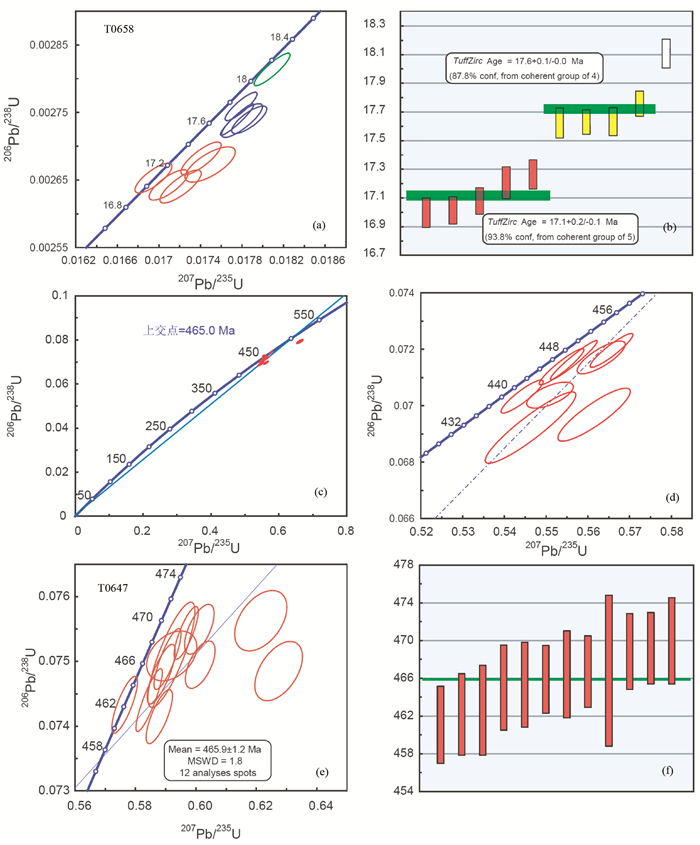
在样品T0658中,锆石的岩浆增生边较宽,有利于确定该岩体的结晶年龄(图 2a)。我们分别对锆石核部和边部开展了U-Pb同位素组成测试。其中,锆石核部U和Th含量较低,分别在78×10-6~447×10-6和3×10⁻⁶~316×10-6之间,Th/U (0.01~1.73) 变化较大,206Pb/238U年龄变化范围也较大,从330Ma到1194Ma (表 1),其中大部分年龄集中于431~492Ma之间,但偏离谐和线。在具有韵律生长环带的边部锆石域中,U和Th含量较高,分别在1340×10-6~8235×10-6和60×10-6~1510×10-6之间,Th/U=0.01~0.28,206Pb/238U年龄分布于16.5~35.0Ma之间(图 3a),激光剥蚀斑和BSE观察表明其中20.0Ma和35.0Ma为混合年龄。在上述锆石中,大部分锆石年龄集中于17.0~18.1Ma之间,在谐和图上,样品点相对集中分布于一致线的17.1Ma和17.6Ma附近区域。为减少Pb丢失对锆石U-Pb年龄的影响,采用IsoPlot中的TuffZir算法来计算锆石的U-Pb年龄(Ludwig and Mundil 2002)。TuffZir年龄值分别为17.1+0.2/-0.1Ma (5个测点,置信度为93.8%) 和17.6+0.1/-0.0Ma (4个测点,置信度为87.8%)(图 3b)。这两组年龄数据点在谐和线上相对集中分布,可信度高,可能代表了马拉山二云母花岗岩两次结晶年龄。核部锆石年龄都位于谐和线之下(图 3d),上交点年龄为465.0Ma (图 3c),代表二云母花岗岩的源岩中含大量的奥陶纪(?) 继承性锆石。
|
图 2 拉山二云母花岗岩T0658(a) 和T0647(b) 中锆石的阴极发光照片 Fig. 2 Cathodoluminescence (CL) showing the texture, spot, and respective age of zircon U-Pb dating for the Malashan two-mica granite T0658 (a) and T0647 (b) |
|
图 3 马拉山二云母花岗岩T0658 (a-d) 和T0647(e, f) 中锆石的LA-MC-ICP-MS U-Pb定年谐和图 Fig. 3 U-Pb concordia diagram for the Malashan two-mica granite T0658 (a-d) and T0647 (e, f) |
在样品T0647中,锆石边部很窄,无法准确测定它们的U-Pb年龄(图 2b),重点对锆石的核部进行了U-Pb测年。与样品T0658相似,锆石核部U和Th含量也较低,分别在25×10-6~373×10-6和6×10⁻⁶~263×10-6之间,Th/U=0.04~1.67,206Pb/238U年龄变化范围较大,从371Ma到1723Ma之间(表 1),其中大部分集中于461~476Ma之间。在谐和图上,样品点相对集中分布于一致线的465.9Ma附近区域(图 3e),平均年龄值为465.9±1.2Ma (12个测点,MSWD=1.8,图 3f),与样品T0658中的相似。这组年龄数据点在谐和图上相对集中分布,可信度高,典型的韵律生长环带表明二云母花岗岩的源岩中含大量的奥陶纪(?) 继承性锆石。同时,二云母花岗岩的源岩还含另外两组年龄更老的继承性锆石,为989~1033Ma和1723Ma。边部锆石很窄,U和Th含量高度变化,分别为388×10-6~4576×10-6和3×10⁻⁶~110×10-6,Th/U=0.01~0.10,206Pb/238U年龄分布于18.9~32.3Ma之间(图 2b),多数测点位于边部和核部的混合区域或者远离谐和线,不能用来限定二云母花岗岩的结晶年龄。
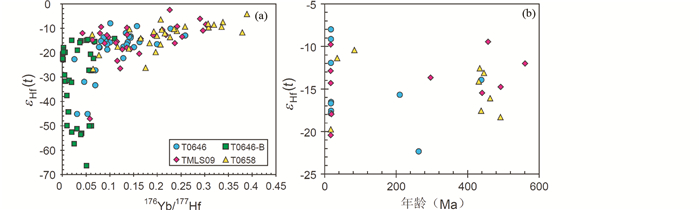
3.2 锆石Hf同位素组成为了确定马拉山二云母花岗岩锆石Hf同位素的组成特征,对样品T0646、T0646-B、T0658和TMLS09中结构相似的锆石进行了原位Hf同位素测试。T0646-B中锆石U-Pb年龄谐和度较差,数据未发表,样品T0646和TMLS09的锆石岩浆增生边的U-Pb年龄分别为17.6±0.1Ma和16.9±0.1Ma (Gao and Zeng, 2013)。在以下讨论中,主要关注马拉山二云母花岗岩结晶时,锆石岩浆增生边和继承性锆石之间Hf同位素组成的差异,锆石初始Hf同位素组成按t=17.0Ma来计算。由于部分结构相似锆石没有相应的年龄值和T0646-B的锆石U-Pb年龄谐和度较差,在图 4d和图 5b中都未显示这些锆石点的数据。从测试结果来看,部分锆石边部的176Yb/177Hf比值偏高(表 2),高达0.40。但边部锆石的176Yb/177Hf比值和εHf(t) 相关性不大(图 5a),随着176Yb/177Hf比值的增大,εHf(t) 值在-20~-5之间变化。为了保证Hf同位素组成的合理性,选择了176Yb/177Hf < 0.20的测点(图 4d和图 5b) 来探讨锆石Hf同位素组成的意义。在T0646、TMLS09和T0658三件样品中,Hf同位素比值稍有不同,但总体显示相似的特征:(1) 边部εHf(t) 值变化范围比较大,分别为-17.9~-8.0、-20.4~-9.8和-19.8~-11.4,地壳模式年龄tDM1分别对应于1047~1952Ma、1130~1593Ma和1216~1569Ma;(2) 核部εHf(t) 值稍低于边部,变化范围更大且与边部的εHf(t) 值有很大程度的重叠,分别为-27.2~-13.7、-26.5~-9.5和-26.7~-10.4,地壳模式年龄tDM1相近,分别为1264~1791Ma、1088~1807Ma和1151~1819Ma;(3) 样品T0646和TMLS09中存在更古老的核部,εHf(t) 值分别为-45.2~-33.4和-47.1,地壳模式年龄tDM1为2040~2475Ma和2575Ma。
|
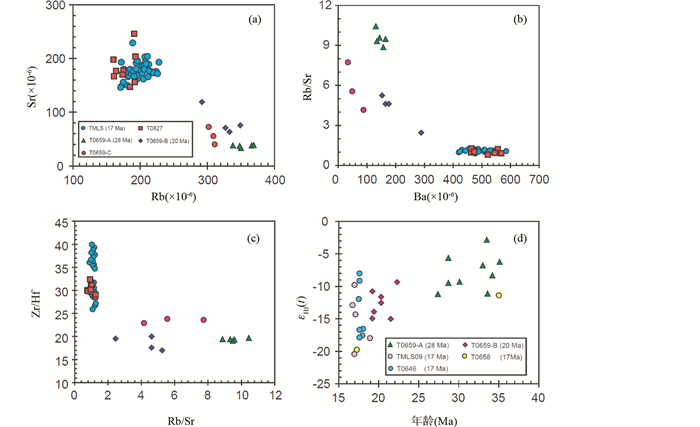
图 4 马拉山二云母花岗岩(样品TMLS、T0827) 和佩枯错淡色花岗岩(样品T0659-A、T0659-B、T0659-C) 的Rb-Sr (a)、Rb/Sr-Ba (b)、Rb/Sr-Zr/Hf (c) 系统关系和εHf(t)-t图解(d) 二云母花岗岩TMLS的数据来自Gao and Zeng, 2013; 佩枯错淡色花岗岩的数据来自Gao et al., 2013 Fig. 4 Rb-Sr systematics (a), Rb/Sr vs. Ba diagram (b), Rb/Sr-Zr/Hf systematics (c) and εHf(t) vs. age diagram (d) for the Malashan two-mica granite (sample TMLS, T0827) and the Paiku leucogranite (sample T0659-A, T0659-B, T0659-C) Two-mica granite (sample TMLS) contain all the published data from Gao and Zeng, 2013, and leucogranite (sample T0659-A, T0659-B, T0659-C) from Gao et al., 2013) |
|
图 5 马拉山二云母花岗岩(样品TMLS09、T0646、T0646-B和T0658) 的176Yb/177Hf-εHf(t) 系统关系(a) 和εHf(t)-年龄图解(b) Fig. 5 176Yb/177Hf vs. εHf(t) systematics (a) and εHf(t) vs. age diagram (b) for the Malashan two-mica granite (sample T0646, T 0646-B, TMLS09 and T0658) |
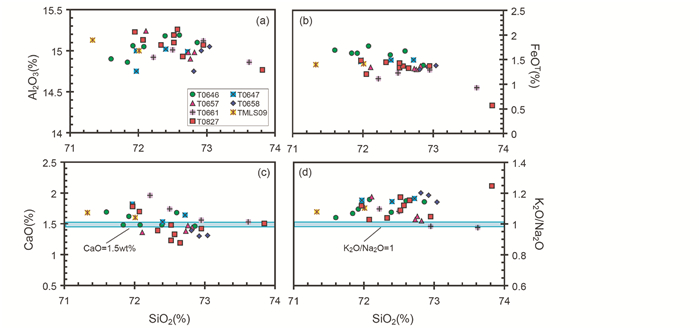
马拉山二云母花岗岩分布面积较大,为了准确厘定该岩体的地球化学特征,进行了系统采样。与已发表的数据(T0646、T0647、T0657、T0658、T0661和TMLS09序列样品) 相似(图 6)(为了减少图例,把二云母花岗岩T0827、T0829和T0830合称为T0827,如图 4和图 6),T0827、T0829和T0830具有较高的SiO2 (72.1%~73.8%),Al2O3(14.8%~15.3%)(图 6a) 和CaO (1.2%~1.8%)(图 6c),但较低的FeO、MgO、MnO和TiO2 (图 6b、表 3)。总体来看,马拉山二云母花岗岩属于富钾过铝质高钙淡色花岗岩(A/CNK>1.1,K2O/Na2O>1.0%)。
|
图 6 马拉山二云母花岗岩的Al2O3(a)、FeOT(b)、CaO (c) 和K2O/Na2O (d) 比值与SiO2的关系图解 除T0827外,其他数据来自Gao and Zeng, 2013 Fig. 6 Selected major oxides of Al2O3(a), FeOT (b), CaO (c) and K2O/Na2O ratio (d) plotted against SiO2 for the Malashan two-mica granite Except for T0827, the other data are from Gao and Zeng, 2013 |
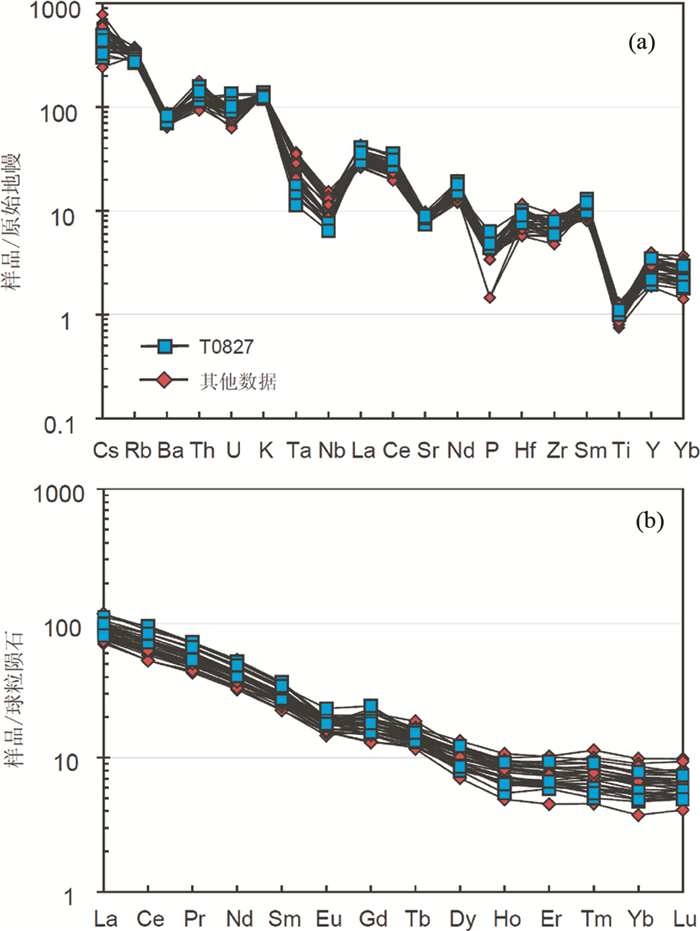
在微量元素特征上(图 7a、表 3),马拉山二云母花岗岩表现出较一致的特征。富集大离子亲石元素(LILE),但亏损高场强元素(HFSE)。从微量元素原始地幔标准化蜘蛛网图上看,Nb、Ta、U、Ti和P为负异常(图 7a)。虽然马拉山二云母花岗岩总体上富集LILE,但与蜘蛛网图上相邻元素相比,明显亏损Ba和Sr。与佩枯错淡色花岗岩相比,马拉山二云母花岗岩具有较高的Ba (>463×10-6)(图 4b) 和Sr (>147×10-6),较低的Rb ( < 194×10-6)(图 4a) 和Rb/Sr比值较低( < 1.3)。同时,随着Ba浓度的增加,Rb/Sr比值几乎保持不变,明显不同于佩枯错淡色花岗岩的Ba浓度与Rb/Sr比值之间的负相关关系。Nb/Ta和Zr/Hf比值都小于球粒陨石,分别为5.3~10.2和28.6~32.4(表 3)。综合马拉山二云母花岗岩已发表的数据,可以看出马拉山二云母花岗岩的Zr/Hf比值高度变化,从低于球粒陨石变化到高于球粒陨石(25.9~39.9)。
|
图 7 马拉山二云母花岗岩的原始地幔标准化蜘蛛网图(a) 和球粒陨石标准化稀土元素配分图(b)(标准化值据Sun and McDonough, 1989) 其他数据来自Gao and Zeng, 2013 Fig. 7 Primitive mantle-normalized trace element (a) and chondrite-normalized rare earth element (b) distribution patterns for the Malashan two-mica granite (sample T0827) (normalization values are from Sun and McDonough, 1989) Other data from Gao and Zeng, 2013 |
所有马拉山二云母花岗岩同样表现出一致的稀土元素特征:(1) 富集轻稀土(LREE),亏损重稀土(HREE),(La/Yb)N>12.5;(2) 在球粒陨石标准化稀土元素分布图上,显示较平直的重稀土分布特征,(Gd/Yb)N=2.9~5.0(图 7b);(3) 几乎无或弱负Eu异常,Eu/Eu*=0.7~0.9。
4 讨论 4.1 马拉山二云母花岗岩的结晶时限马拉山二云母花岗岩展布约10km,前人的研究得出结晶年龄跨度较大(30.2~17.2Ma)(Aoya et al., 2005; 张进江等, 2011),可能由于边部锆石较窄,部分年龄可能是混合年龄,不指示同一期部分熔融作用。最近研究表明,该岩体的结晶时代在岩体的不同部位存在细微的差别,如马拉山西侧的结晶年龄为17.6±0.1Ma,而东侧的结晶年龄为16.9±0.1Ma (Gao and Zeng, 2013),预示着该岩体可能是多次岩浆作用的结果。上述地质年代学数据揭示了马拉山中东部花岗岩的结晶年龄具有两期,分别为~17.6Ma和~17.1Ma (图 3 b),和最西部(T0646) 和最东部(TMLS09) 岩浆结晶年龄相似。这些数据表明,马拉山二云母花岗岩的结晶时间较长(从17.6Ma到16.9Ma) 或由两次间隔~0.7Myr的部分熔融作用形成,结晶时间为17.6Ma和16.9Ma。但目前已有的锆石U-Pb年龄数据还不能准确厘定形成马拉山二云母花岗岩的部分熔融作用方式,还需要开展更系统的年代学研究。
值得指出的是,Aoya et al.(2005)和张进江等(2011)也报道了马拉山二云母花岗岩的锆石U-Pb年龄,但结晶年龄跨度较大,分别为18.5~17.2Ma和30.2~17.3Ma。在本研究中,个别混合边部和核部的测点也给出35.3~20.0Ma的年龄(表 1),不指示同一期部分熔融作用。
上述年代学特征分析表明,马拉山二云母花岗岩的结晶时间较长,从17.6Ma到16.9Ma,或者经历了两期间隔~0.7Myr的部分熔融作用,分别发生在17.6Ma和16.9Ma,是两阶段具有“量子行为”岩脉汇聚的产物。
4.2 马拉山二云母花岗岩的地球化学特征马拉山二云母花岗岩的年代学特征显示该岩体可能经历了阶段性部分熔融作用。在岩石的地球化学特征上,无论是主量元素,微量元素、稀土元素还是同位素组成(图 4、图 6、图 7),该岩体表现出较高的一致性,表现为(1) 较高的SiO2 (>71.3%),Al2O3(>14.3%)(图 6a) 和CaO (1.2%~2.0%)(图 6c);(2) A/CNK>1.1,K2O/Na2O>1.0%,为富钾过铝质高钙淡色花岗岩;(3) 具有明显的Nb、Ta、U、Ti、P、Ba和Sr负异常(图 7a);(4) 富集轻稀土,亏损重稀土,几乎无或弱的负Eu异常(Eu/Eu*=0.7~0.9)(图 7b);和(5) 较均一的放射性同位素(Sr和Nd) 组成,其中87Sr/86Sr (t)=0.7391~0.7484,εNd(t)=-13.7~-14.4 (Gao and Zeng, 2013)。有趣的是,马拉山二云母花岗岩的Zr/Hf比值高度变化,从低于球粒陨石(25.9~32.4) 增加到高于球粒陨石(34.7~39.9),在球粒陨石的Zr/Hf比值处(Zr/Hf=34.3) 发生了间断(图 4c)。结合样品的分布位置和锆石的U-Pb年龄,马拉山二云母花岗岩Zr/Hf比值的分布没有呈现出一定的规律性,可能由于在源岩部分熔融过程中,继承性锆石的差异性溶解作用引起的。上述特征表明,二云母花岗岩可能代表至少两次相似深熔作用的产物。
4.3 马拉山二云母花岗岩的形成机制及其构造动力学意义在喜马拉雅造山带内,形成于28~10Ma淡色花岗岩为典型的S-型花岗岩,是变泥质岩近原地白云母脱水熔融的产物(Le Fort, 1981; Daniel et al., 1987; Inger and Harris, 1993; Harris and Massey, 1994; Harris et al., 1995; Harrison et al., 1997; Patiño Douce and Harris, 1998; Knesel and Davison, 2002; Zhang et al., 2004; King et al., 2011; Gao and Zeng, 2013)。与这些白云母脱水熔融形成的淡色花岗岩相比,马拉山二云母花岗岩Sr同位素组成较低,但Nd同位素组成相似。影响马拉山二云母花岗岩Sr-Nd同位素地球化学特征的因素包括围岩混染作用或部分熔融反应的差异。马拉山二云母花岗岩直接侵入到特提斯沉积岩系,引发围岩的接触变质作用,形成泥质和钙质片岩(Kawakami et al., 2007)。这些变泥质岩是马拉山二云母花岗岩侵位过程中同化混染作用的潜在物源。与马拉山花岗岩直接接触的石墨片岩的Sr同位素比值(87Sr/86Sr (t)=~0.7080) 远远低于二云母花岗岩(0.7391~0.7484),Nd同位素比值(εNd(t)=-13.3~-14.1) 与二云母花岗岩相同(-13.7~-14.4)。但是,二云母花岗岩的Sr-Nd同位素比值较均一,围岩混染作用不可能是导致马拉山二云母花岗岩独特Sr和Nd同位素组成的主要因素。因此,二云母花岗岩较低的Sr同位素组成可能反应了在形成马拉山二云母花岗质岩浆过程中,深部变泥质岩部分熔融反应与其他淡色花岗岩不同。
在喜马拉雅造山带的构造演化过程中,变泥质岩和角闪岩是两种易发生部分熔融作用的地壳物质。变泥质岩具有高Rb,低Sr和高Rb/Sr比值的特征,角闪岩正好相反。因此,变泥质岩和角闪岩部分熔融产生的熔体具有明显不同的Rb-Sr系统关系(Zeng et al., 2011)。实验岩石学研究(Patiño Douce and Harris, 1998; Knesel and Davison, 2002)、理论计算(Zeng et al., 2005a, b) 和野外观测(Zhang et al., 2004; King et al., 2011; Zeng et al., 2012) 都表明:随着温压条件和含水量的变化,变泥质岩在无水或含水条件下发生从白云母到黑云母的递进部分熔融作用,形成性质各异、具有复杂Rb-Sr关系的花岗质岩浆(Harris and Inger, 1992; Knesel and Davison, 2002; Zeng et al., 2005b)。花岗质岩浆的Rb-Sr关系是鉴定地壳岩石发生部分熔融作用类型的探针,可从地壳熔体的Rb-Sr系统关系来反推部分熔融类型和源岩性质(Inger and Harris, 1993; Knesel and Davison, 2002; Zeng et al., 2005b, 2011)。从Rb-Sr关系来看(图 4a),马拉山二云母花岗岩具有较高的Sr,较低的Rb和Rb/Sr比值( < 1.3)。在Rb/Sr-Ba系统关系中,随着Ba浓度的增加,马拉山二云母花岗岩Rb/Sr比值保持不变(图 4b),与水致白云母部分熔融作用的特征一致(Inger and Harris, 1993)。这表明与众多较老的喜马拉雅造山带新生代淡色花岗岩不同,马拉山二云母花岗岩是变泥质岩水致白云母熔融的产物,可能的部分熔融反应为7Qtz+15Pl+9Mus+xH2O→31M (Inger and Harris, 1993),其中Qtz为石英,Pl为斜长石,Mus为白云母,M为熔体。与白云母脱水熔融形成的熔体相比,水致白云母熔融产生的熔体具有明显不同的Rb-Sr地球化学特征。在变泥质岩中,长石和云母分别是Sr和Rb的主要寄主矿物,与长石和全岩相比,云母具有较高的Rb/Sr比值和87Sr/86Sr同位素组成。Ca为斜长石的必要组成元素,Sr、Ba和Eu可以通过类质同象的方式替换Ca。因此,在变泥质岩水致白云母熔融过程中,与白云母脱水熔融相比,由于较多斜长石的加入,熔体具有较高的Sr、Ba和Ca,较低的Rb和Sr同位素比值(Inger and Harris, 1993; Knesel and Davison, 2002; Zeng et al., 2005b)。如果年龄小于30Ma的喜马拉雅淡色花岗岩都源自相似的变泥质岩,那么与多数喜马拉雅淡色花岗岩相比,马拉山二云母花岗岩表现出较高的CaO (1.2%~2.0%)、Ba (>420×10-6) 和Sr (>146×10-6),较低的Rb ( < 228×10-6)、Rb/Sr ( < 1.3) 和Sr同位素比值以及弱Eu负异常等特征,与变泥质岩水致白云母熔融形成的熔体的地球化学特征一致。
在低温条件下,锆石在岩浆中的饱和浓度温度计(Watson and Harrison, 1983) 和独居石在岩浆中的饱和浓度温度计(Montel, 1993) 可以估算过铝质或偏铝质花岗岩的岩浆结晶温度。依据马拉山二云母花岗岩中Zr和LREE的浓度,估算的岩浆结晶温度分别为703~755℃和726~805℃ (Gao and Zeng, 2013, 表 3),比喜马拉雅造山带白云母脱水熔融形成熔体的温度高30~100℃。假设马拉山二云母花岗岩和其他喜马拉雅淡色花岗岩的源岩类似,如果没有外界流体加入,那么形成马拉山二云母花岗岩的部分熔融反应有较多的白云母参与,所形成熔体将具有较高的Rb和Sr同位素比值,这与事实不符,所以在形成马拉山二云母花岗岩的部分熔融反应中,应有流体的参与,这与围岩中发育矽卡岩相吻合,但有待进一步的研究来厘定流体的来源。在苦堆穹窿和南迦巴瓦地块也发育类似的高钙淡色花岗岩(Zhang et al., 2004; King et al., 2011; Zeng et al., 2012),表明在喜马拉雅碰撞造山带构造演化过程中,变泥质岩水致白云母部分熔融作用是另一重要的中下地壳的物理和化学响应方式。
从二云母花岗岩锆石Hf同位素测试结果(图 4d、图 5、表 2) 来看,所有样品都具有相似的εHf(t) 值,进一步表明该岩体是较均一的。但不论是继承性锆石核还是岩浆增生边,εHf(t) 值变化范围都较大。导致这种现象的可能原因有:(1) 二云母花岗岩的源岩为变泥质岩,在部分熔融过程中,源岩中副矿物(如石榴石) 发生差异性溶解,使得熔体中Hf同位素不平衡;(2) 二云母花岗岩的锆石中含有不同时期的古老继承性锆石(U-Pb年龄>400Ma, 表 1),在岩浆演化过程中,继承性锆石在花岗质熔体中差异溶解,导致锆石增生边的Hf同位素高度不一致,同时引起Zr/Hf比值的变化(图 4c);或(3) 马拉山二云母花岗岩是水致白云母部分熔融的产物,在部分熔融过程中,有外来流体的加入,流体携带Hf同位素不同,导致熔体的Hf同位素比值高度变化。已有研究表明,高场强元素在流体中具有比原来认识更高的活动性(Hanyu et al., 2002; Münker et al., 2004; Barry et al., 2006)。这三种因素,单独或共同作用都可能导致马拉山二云母花岗岩的锆石岩浆增生边的Hf同位素组成高度变化。但哪种因素起主导作用,还有待进一步的矿物地球化学测试来鉴别。二云母花岗岩的源岩为变泥质岩,含有多种来源、形成于不同时代的碎屑锆石,是导致锆石核部Hf同位素比值高度变化的主要因素。
在喜马拉雅造山带中,高Ca和Sr,低Rb和87Sr/86Sr比值熔体的发现,表明造山带具有比已有认识更复杂的部分熔融过程。水致部分熔融和脱水部分熔融作用形成的熔体具有不同的Rb-Sr、Rb/Sr-Ba系统关系和Sr同位素比值,这些元素之间的差异性是鉴定花岗岩成因类型的基本工具。实验岩石学表明:在大型碰撞造山带中,淡色花岗岩的地球化学特征受控于温度-压力-含水量。反过来,可以通过确定淡色花岗岩的元素地球化学特征来反演熔体所指示的深部构造岩浆过程。因此,在大型碰撞造山带中,可以利用淡色花岗岩的地球化学特征来揭示地壳物质深熔作用与构造转换之间的相互关系。在细致构造解析的基础上,Aoya et al.(2005)认为在喜马拉雅造山带,从南向逆冲推覆作用到北向伸展剪切作用的构造转换发生在马拉山二云母花岗岩的侵位过程中,提出深部地壳物质的深熔作用是导致喜马拉雅造山带发生中-上地壳伸展作用的关键因素。马拉山片麻岩穹窿位于N-S向藏南裂谷系的马拉山-吉隆裂谷之中。已有大量研究来限定藏南裂谷系E-W向伸展作用的启动时限(Coleman and Hodges, 1995; Blisniuk et al., 2001; Williams et al., 2001; Jolivet et al., 2003; Mitsuishi et al., 2012;Zhang et al., 2012b),最近的研究表明藏南裂谷系最早启动可能开始于19Ma (Mitsuishi et al., 2012; Zhang et al., 2012a)。结合佩枯错复合淡色花岗岩的年代学和地球化学数据,上述数据揭示在马拉山地区,变泥质岩深熔作用最早开始于~28Ma,表现为白云母脱水部分熔融作用,在~20Ma,部分熔融反应以水致白云母熔融为主,这种部分熔融反应类型的转换可能与喜马拉雅造山带东西向伸展作用的开启相关。
5 结论马拉山穹窿位于北喜马拉雅片麻岩穹窿西侧,主要由马拉山二云母花岗岩、错布二云母花岗岩和派枯错淡色花岗岩组成。马拉山二云母花岗岩的结晶时间较长,从17.6Ma到16.9Ma,或者经历了至少两期(~17.6Ma和~16.9Ma) 部分熔融作用,是两阶段具有“量子行为”岩脉汇聚的产物。在地球化学特征上,马拉山二云母花岗岩是较均一的岩体,是变泥质岩水致白云母部分熔融的产物。在马拉山地区,变泥质岩深熔作用最早开始于~28Ma,表现为白云母脱水部分熔融作用,在~20Ma,部分熔融反应以水致白云母熔融为主,喜马拉雅造山带东西向伸展作用的开启可能是导致部分熔融反应类型转换的关键因素。
致谢 感谢杨天南研究员和张建新研究员仔细审阅稿件,提出众多建设性修改意见。| [] | Aikman AB, Harrison TM, Ding L. 2008. Evidence for Early (>44Ma) Himalayan crustal thickening, Tethyan Himalaya, southeastern Tibet. Earth and Planetary Science Letters, 274(1-2): 14–23. DOI:10.1016/j.epsl.2008.06.038 |
| [] | Aoya M, Wallis SR, Kawakami T, Lee J, Wang Y. 2004. The Malashan metamorphic complex in southern Tibet: Dominantly top-to-the north deformation and intrusive origin of its associated granites. Himalayan Journal of Science, 2(4): 92–93. |
| [] | Aoya M, Wallis SR, Terada K, Lee J, Kawakami T, Wang Y, Heizler M. 2005. North-south extension in the Tibetan crust triggered by granite emplacement. Geology, 33(11): 853–856. DOI:10.1130/G21806.1 |
| [] | Barry TL, Pearce JA, Leat PT, Millar IL, le Roex AP. 2006. Hf isotope evidence for selective mobility of high-field-strength elements in a subduction setting: South Sandwich Islands. Earth and Planetary Science Letters, 252(3-4): 223–244. DOI:10.1016/j.epsl.2006.09.034 |
| [] | Bateman PC. 1992. Plutonism in the central part of the Sierra Nevada batholith, California: U. S. Geological Survey Professional Paper, 1483: 186. |
| [] | Blisniuk MP, Hacker RB, Glodny J, Ratschbacher L, Bill S, Wull Z, McWilliams MO, Calvert A. 2001. Normal faulting in central Tibet since at least 13.5Myr ago. Nature, 412(6847): 628–632. DOI:10.1038/35088045 |
| [] | Buddington AF. 1959. Granite emplacement with special reference to North America. Geological Society of America Bulletin, 70(6): 671–747. DOI:10.1130/0016-7606(1959)70[671:GEWSRT]2.0.CO;2 |
| [] | Coleman DS, Gray W, Glazner AF. 2004. Rethinking the emplacement and evolution of zoned plutons: Geochronologic evidence for incremental assembly of the Tuolumne Intrusive Suite, California. Geology, 32(5): 433–436. DOI:10.1130/G20220.1 |
| [] | Coleman M, Hodges K. 1995. Evidence for Tibetan Plateau uplift before 14Myr ago from a new minimal age for east-west extension. Nature, 374(6517): 49–52. DOI:10.1038/374049a0 |
| [] | Daniel C, Vidal P, Fernandez A, Le Fort P, Peuca JJ. 1987. Isotopic study of the Manaslu granite (Himalaya, Nepal): Inferences on the age and source of Himalayan leucogranites. Contributions to Mineralogy and Petrology, 96(1): 78–92. DOI:10.1007/BF00375529 |
| [] | de Silva SL, Gosnold WD. 2007. Episodic construction of batholiths: Insights from the spatiotemporal development of an ignimbrite flare-up. Journal of Volcanology and Geothermal Research, 167(1-4): 320–335. DOI:10.1016/j.jvolgeores.2007.07.015 |
| [] | Debon F, Le Fort P, Sheppard SMF, Sonet J. 1986. The four plutonic belts of the Transhimalaya-Himalaya: A chemical, mineralogical, isotopic, and chronological synthesis along a Tibet-Nepal Section. Journal of Petrology, 27(1): 219–250. DOI:10.1093/petrology/27.1.219 |
| [] | Dufek J, Bachmann O. 2010. Quantum magmatism: Magmatic compositional gaps generated by melt-crystal dynamics. Geology, 38(8): 687–690. DOI:10.1130/G30831.1 |
| [] | Gao LE, Zeng LS, Liu J, Xie KJ. 2009. Early Oligocene Na-rich peraluminous leucogranites in the Yardoi gneiss dome, southern Tibet: Formation mechanism and tectonic implications. Acta Petrologica Sinica, 25(9): 2289–2302. |
| [] | Gao LE, Zeng LS, Xie KJ. 2012. Eocene high grade metamorphism and crustal anatexis in the North Himalaya Gneiss Domes, Southern Tibet. Chinese Science Bulletin, 57(6): 639–650. DOI:10.1007/s11434-011-4805-4 |
| [] | Gao LE, Zeng LS. 2013. Fluxed melting of metapelite and the formation of Miocene high-CaO two-mica granites in the Malashan gneiss dome, southern Tibet. Geochimica et Cosmochimica Acta, in press. |
| [] | Gao LE, Zeng LS, Hou KJ, Guo CL, Tang SH, Xie KJ, Hu GY, Wang L. 2013. Episodic anatexis and the formation of Paiku composite leucogranite in the Malashan Gneiss Dome, Southern Tibet. Chinese Science Bulletin. DOI:10.1007/s11434-013-5792-4 |
| [] | Glazner AF, Bartley JM, Drew S, Coleman DS, Gray W, Taylor RZ. 2004. Are plutons assembled over millions of years by amalgamation from small magma chambers. GSA Today, 14: 4–11. |
| [] | Guo ZF, Wilson M. 2012. The Himalayan leucogranites: Constraints on the nature of their crustal source region and geodynamic setting. Gondwana Research, 22(2): 360–376. DOI:10.1016/j.gr.2011.07.027 |
| [] | Hanyu T, Tatsumi Y, Nakai S. 2002. A contribution of slab-melts to the formation of high-Mg andesite magmas, Hf isotopic evidence from SW Japan. Geophysical Research Letters, 29(22): 2051. |
| [] | Harris N, Massey J. 1994. Decompression and anatexis of Himalayan metapelites. Tectonics, 13(6): 1537–1546. DOI:10.1029/94TC01611 |
| [] | Harris N, Ayres M, Massey J. 1995. Geochemistry of granitic melts produced during the incongruent melting of muscovite: Implications for the extraction of Himalayan leucogranite magmas. Journal of Geophysical Research, 100(B8): 15767–15777. DOI:10.1029/94JB02623 |
| [] | Harris NBW, Inger S. 1992. Trace element modelling of pelite-derived granites. Contributions to Mineralogy and Petrology, 110(1): 46–56. DOI:10.1007/BF00310881 |
| [] | Harrison TM, Lovera OM, Grove M. 1997. New insights into the origin of two contrasting Himalayan granite belts. Geology, 25(10): 899–902. DOI:10.1130/0091-7613(1997)025<0899:NIITOO>2.3.CO;2 |
| [] | Harrison TM, Grove M, Lovera OM, Catlos EJ, D'Andrea J. 1999. The origin of Himalayan anatexis and inverted metamorphism: Models and constraints. Journal of Asian Earth Sciences, 17(5-6): 755–772. DOI:10.1016/S1367-9120(99)00018-8 |
| [] | Hou KJ, Li YH, Zou TR, Qu XM, Shi YR, Xie GQ. 2007. Laser ablation-MC-ICP-MS technique for Hf isotope microanalysis of zircon and its geological applications. Acta Petrologica Sinica, 23(10): 2595–2604. |
| [] | Hou ZQ, Zheng YC, Zeng LS, Gao LE, Huang KX, Li W, Li QY, Fu Q, Liang W, Sun QZ. 2012. Eocene-Oligocene granitoids in southern Tibet: Constraints on crustal anatexis and tectonic evolution of the Himalayan orogen. Earth and Planetary Science Letters, 349-350: 38–52. DOI:10.1016/j.epsl.2012.06.030 |
| [] | Hu GY, Zeng LS, Qi XX, Hou KJ, Gao LE. 2011. The Mid-Eocene subvolcanic field in the Lhunze-Qiaga area, Tethyan Himalaya, southern Tibet: A high-level magmatic suite related to the Yardio two-mica granite. Acta Petrologica Sinaca, 27(11): 3308–3318. |
| [] | Inger S, Harris N. 1993. Geochemical constraints on leucogranite magmatism in the Langtang Valley, Nepal Himalaya. Journal of Petrology, 34(2): 345–368. DOI:10.1093/petrology/34.2.345 |
| [] | Jolivet M, Brunel M, Seward D, Xu Z, Yang J, Malavieille J, Roger F, Leyreloup A, Aenand N, Wu C. 2003. Neogene extension and volcanism in the Kunlun fault zone, northern Tibet: New constraints on the age of the Kunlun fault. Tectonics, 22(5): 1052–1074. |
| [] | Kawakami T, Aoya M, Wallis SR, Lee J, Terada K, Wang Y, Heizler M. 2007. Contact metamorphism in the Malashan Dome, North Himalayan gneiss domes, southern Tibet: An example of shallow extensional tectonics in the Tethys Himalaya. Journal of Metamorphic Geology, 25(8): 831–853. DOI:10.1111/j.1525-1314.2007.00731.x |
| [] | King J, Harris N, Argles T, Parrish R, Zhang HF. 2011. Contribution of crustal anatexis to the tectonic evolution of Indian crust beneath southern Tibet. Geological Society of America Bulletin, 123(1-2): 218–239. DOI:10.1130/B30085.1 |
| [] | Knesel KM, Davidson JP. 2002. Insights into collisional magmatism from isotopic fingerprints of melting reactions. Science, 296(5576): 2206–2208. DOI:10.1126/science.1070622 |
| [] | Le Fort P. 1981. Manaslu leucogranite: A collision signature of the Himalaya: A model for its genesis and emplacement. Journal of Geophysical Research, 86(B11): 10545–10568. DOI:10.1029/JB086iB11p10545 |
| [] | Lee J, Hacker BR, Dinklage WS, Wang Y, Gans P, Calvert A, Wan JL, Chen WJ, Blythe AE, McClelland W. 2000. Evolution of the Kangmar dome, southern Tibet: Structural, petrologic, and thermochronologic constraints. Tectonics, 19(5): 872–895. DOI:10.1029/1999TC001147 |
| [] | Lee J, Whitehouse MJ. 2007. Onset of mid-crustal extensional flow in southern Tibet: Evidence from U/Pb zircon ages. Geology, 35(1): 45–48. DOI:10.1130/G22842A.1 |
| [] | Liu YS, Gao S, Hu ZC, Gao CG, Zong KQ, Wang DB. 2010. Continental and oceanic crust recycling-induced melt-peridotite interactions in the Trans-North China Orogen: U-Pb dating, Hf isotopes and trace elements in zircons from mantle xenoliths. Journal of Petrology, 51(1-2): 537–571. DOI:10.1093/petrology/egp082 |
| [] | Ludwig KR, Mundil R. 2002. Extracting reliable U-Pb ages and errors from complex populations of zircons from Phanerozoic tuffs. J. Conf. Abstr. 12th Goldschmidt Conf. |
| [] | Miller JS, Matzel JEP, Miller CF, Burgess SD, Miller RB. 2007. Zircon growth and recycling during the assembly of large, composite arc plutons. Journal of Volcanology and Geothermal Research, 167(1-4): 282–299. DOI:10.1016/j.jvolgeores.2007.04.019 |
| [] | Miller RB, Paterson SR. 1999. In defense of magmatic diapirs. Journal of Structural Geology, 21(8-9): 1161–1173. DOI:10.1016/S0191-8141(99)00033-4 |
| [] | Mitsuishi M, Wallis SR, Aoya M, Jeffrey Lee, Wang Y. 2012. E-W extension at 19Ma in the Kung Co area, S. Tibet: Evidence for contemporaneous E-W and N-S extension in the Himalayan orogen. Earth and Planetary Science Letters, 325-326: 10–20. DOI:10.1016/j.epsl.2011.11.013 |
| [] | Montel JM. 1993. A model for monazite/melt equilibrium and application to the generation of granitic magmas. Chemical Geology, 110(1-2): 127–146. |
| [] | Morel MLA, Nebel O, Nebel-Jacobsen YJ, Miller JS, Vroon PZ. 2008. Hafnium isotope characterization of the GJ-1 zircon reference material by solution and laser-ablation MC-ICPMS. Chemical Geology, 255(1-2): 231–235. DOI:10.1016/j.chemgeo.2008.06.040 |
| [] | Münker C, Wörner G, Yogodzinski G, Churikova Y. 2004. Behaviour of high field strength elements in subduction zones: Constraints from Kamchatka-Aleutian arc lavas. Earth and Planetary Science Letters, 224(3-4): 275–293. DOI:10.1016/j.epsl.2004.05.030 |
| [] | Pan GT, Ding J. 2004. 1:1500000 Geologic Map of the Tibetan Plateau and Adjacent Areas. Chengdu: Chengdu Cartographic Publishing House. |
| [] | Patiño Douce AE, Harris N. 1998. Experimental constraints on Himalayan Anatexis. Journal of Petrology, 39(4): 689–710. DOI:10.1093/petroj/39.4.689 |
| [] | Petford N, Cruden AR, McCaffrey KJW, Vigneresse JL. 2000. Granite magma formation, transport and emplacement in the Earth's crust. Nature, 408(6813): 669–673. DOI:10.1038/35047000 |
| [] | Pickett DA, Saleeby JB. 1994. Nd, Sr, and Pb isotopic characteristics of Cretaceous intrusive rocks from deep levels of the Sierra Nevada batholith, Tehachapi Mountains, California. Contributions to Mineralogy and Petrology, 118(2): 198–215. DOI:10.1007/BF01052869 |
| [] | Prince C, Harris N, Vance D. 2001. Fluid-enhanced melting during prograde metamorphism. Journal of the Geological Society, 158(2): 233–241. DOI:10.1144/jgs.158.2.233 |
| [] | Qi XX, Zeng LS, Meng XJ, Xu ZQ, Li TF. 2008. Zircon SHRIMP U-Pb dating for Dala granite in the Tethyan Himalaya and its geological implication. Acta Petrologica Sinica, 24(7): 1501–1508. |
| [] | Schärer U, Xu RH, Allègre CJ. 1986. U-(Th)-Pb systematics and ages of Himalayan leucogranites, south Tibet. Earth and Planetary Science Letters, 77(1): 35–48. DOI:10.1016/0012-821X(86)90130-5 |
| [] | Schoene B, Bowring SA. 2010. Rates and mechanisms of Mesoarchean magmatic arc construction, eastern Kaapvaal craton, Swaziland. GSA Bulletin, 122(3-4): 408–429. DOI:10.1130/B26501.1 |
| [] | Schoene B, Schaltegger U, Brack P, Latkoczy C, Stracke A, Gunther D. 2012. Rates of magma differentiation and emplacement in a ballooning pluton recorded by U-Pb TIMS-TEA, Adamello batholith, Italy. Earth and Planetary Science Letters, 355-356: 162–173. DOI:10.1016/j.epsl.2012.08.019 |
| [] | Sláma J, Košler J, Condon DJ, Crowley JL, Gerdes A, Hanchar JM, Horstwood MSA, Morris GA, Nasdala L, Norberg N, Schaltegger U, Schoene B, Tubrett MN, Whitehouse MJ. 2008. Plešovice zircon: A new nature reference material for U-Pb and Hf isotopic microanalysis. Chemical Geology, 249(1-2): 1–35. DOI:10.1016/j.chemgeo.2007.11.005 |
| [] | Sun SS, McDonough WF. 1989. Chemical and isotopic systematics of oceanic basalts: Implications for mantle composition and processes. In: Saunders AD and Norry MJ (eds.). Magmatism in the Ocean Basins. Geological Society, London, Special Publication, 42(1): 313–345. DOI:10.1144/GSL.SP.1989.042.01.19 |
| [] | Watson EB, Harrison TM. 1983. Zircon saturation revisited: Temperature and composition effects in a variety of crustal magma types. Earth and Planetary Science Letters, 64(2): 295–304. DOI:10.1016/0012-821X(83)90211-X |
| [] | Williams HM, Turner S, Kelley S, Harris N. 2001. Age and composition of dikes in Southern Tibet: New constraints on the timing of east-west extension and its relationship to postcollisional volcanism. Geology, 29(4): 339–342. DOI:10.1130/0091-7613(2001)029<0339:AACODI>2.0.CO;2 |
| [] | Xie KJ, Zeng LS, Liu J, Gao LE. 2010. Late-Eocene Dala adakitic granite, southern Tibet and geological implications. Acta Petrologica Sinica, 26(4): 1016–1026. |
| [] | Zeng LS, Saleeby JB, Asimow P. 2005a. Nd isotope disequilibrium during crustal anatexis: A record from the Goat Ranch migmatite complex, southern Sierra Nevada batholith, California. Geology, 33(1): 53–56. DOI:10.1130/G20831.1 |
| [] | Zeng LS, Asimow PD, Saleeby JB. 2005b. Coupling of anatectic reactions and dissolution of accessory phases and the Sr and Nd isotope systematics of anatectic melts from a metasedimentary source. Geochimica et Cosmochimica Acta, 69(14): 3671–3682. DOI:10.1016/j.gca.2005.02.035 |
| [] | Zeng LS, Liu J, Gao LE, Xie KJ, Wen L. 2009. Early Oligocene crustal anatexis in the Yardoi gneiss dome, southern Tibet and geological implications. Chinese Science Bulletin, 54(1): 104–112. DOI:10.1007/s11434-008-0362-x |
| [] | Zeng LS, Gao LE, Xie KJ, Zeng-Liu J. 2011. Mid-Eocene high Sr/Y granites in the Northern Himalayan Gneiss Domes: Melting thickened lower continental crust. Earth and Planetary Science Letters, 303(3-4): 251–266. DOI:10.1016/j.epsl.2011.01.005 |
| [] | Zeng LS, Gao LE, Dong CY, Tang SH. 2012. High-pressure melting of metapelite and the formation of Ca-rich granitic melts in the Namche Barwa Massif, Southern Tibet. Gondwana Research, 21(1): 138–151. DOI:10.1016/j.gr.2011.07.023 |
| [] | Zhang HF, Harris N, Parrish R, Kelley S, Zhang L, Rogers N, Argles T, King J. 2004. Causes and consequences of protracted melting of the mid-crust exposed in the North Himalayan antiform. Earth and Planetary Science Letters, 228(1-2): 195–212. DOI:10.1016/j.epsl.2004.09.031 |
| [] | Zhang JJ, Yang XY, Qi GW, Wang DC. 2011. Geochronology of the Malashan dome and its application in formation of the Southern Tibet Detachment System (STDS) and Northern Himalayan Gneiss Domes (NHGD). Acta Petrologica Sinica, 27(12): 3535–3544. |
| [] | Zhang JJ, Santosh M, Wang XX, Guo L, Yang XY, Zhang B. 2012a. Tectonics of the northern Himalaya since the India-Asia collision. Gondwana Research, 21(4): 939–960. DOI:10.1016/j.gr.2011.11.004 |
| [] | Zhang LY, Ding L, Yang D, Xu Q, Cai FL, Liu DL. 2012b. Origin of Middle Miocene leucogranites and rhyolites on the Tibetan Plateau: Constraints on the timing of crustal thickening and uplift of its northern boundary. Chinese Science Bulletin, 57(5): 511–524. DOI:10.1007/s11434-011-4813-4 |
| [] | 高利娥, 曾令森, 刘静, 谢克家. 2009. 藏南也拉香波早渐新世富钠过铝质淡色花岗岩的成因机制及其构造动力学意义. 岩石学报, 25(9): 2289–2302. |
| [] | 高利娥, 曾令森, 侯可军, 郭春丽, 唐索寒, 谢克家, 胡古月, 王莉. 2013.藏南马拉山穹窿佩枯错复合淡色花岗岩体的多期深熔作用.科学通报, 出版中 |
| [] | 侯可军, 李延河, 邹天人, 曲晓明, 石玉若, 谢桂青. 2007. LA-MC-ICP-MS锆石Hf同位素的分析方法及地质应用. 岩石学报, 23(10): 2595–2604. |
| [] | 胡古月, 曾令森, 戚学祥, 侯可军, 高利娥. 2011. 藏南特提斯喜马拉雅带始新世隆子-恰嘎次火山岩区:雅拉香波二云母花岗岩的高位岩浆体系. 岩石学报, 27(11): 3308–3318. |
| [] | 戚学祥, 曾令森, 孟祥金, 许志琴, 李天福. 2008. 特提斯喜马拉雅打拉花岗岩的锆石SHRIMP U-Pb定年及其地质意义. 岩石学报, 24(7): 1501–1508. |
| [] | 谢克家, 曾令森, 刘静, 高利娥. 2010. 西藏南部晚始新世打拉埃达克质花岗岩及其构造动力学意义. 岩石学报, 26(4): 1016–1026. |
| [] | 曾令森, 刘静, 高利娥, 谢克家, 文力. 2009. 藏南也拉香波穹隆早渐新世地壳深熔作用及其地质意义. 科学通报, 54(3): 373–381. |
| [] | 张进江, 杨雄英, 戚国伟, 王德朝. 2011. 马拉山穹窿的活动时限及其在藏南拆离系--北喜马拉雅片麻岩穹窿形成机制的应用. 岩石学报, 27(12): 3535–3544. |