 2013, Vol. 29


2. 中国科学院大学, 北京 100049;
3. 法国奥尔良大学地球科学研究所, 奥尔良 45071;
4. 法国皮埃尔和玛丽居里大学, 巴黎 UMR7072
2. University of Chinese Academy of Sciences, Beijing 100049, China;
3. Institut des Sciences de la Terre d'Orléans, Université d'Orléans, d'Orléans 45071, France;
4. Université Pierre-et-Marie-Curie, Paris UMR7072-CNRS, France
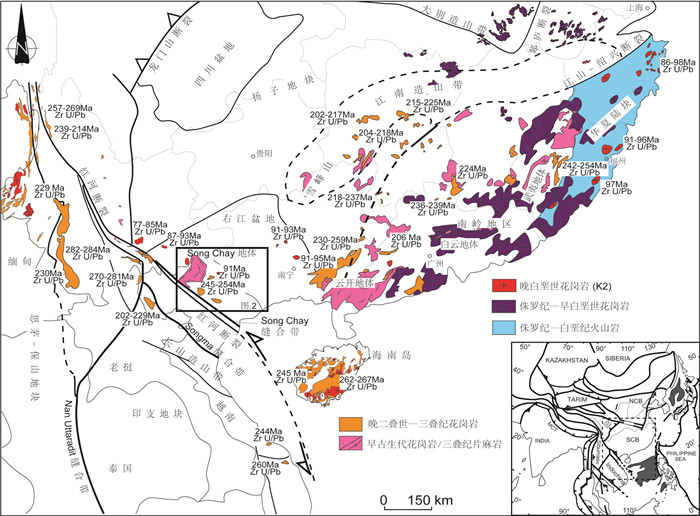
华南板块是由扬子克拉通和华夏陆块在新元古代碰撞拼贴而成(Charvet et al., 1996; Li et al., 1997)。碰撞拼合之后的华南板块, 经历了多期且复杂的构造演化(任纪舜, 1990; Faure et al., 1996; Lin et al., 2008; Shu et al., 2008; Wang et al., 2013)。早古生代末的加里东期(也称之为广西运动) 在华南板块东部表现明显:浅变质的早古生代地层、泥盆纪的区域不整合、早古生代晚期花岗岩大规模侵位以及浙-闽-赣-粤地区发育的麻粒岩相变质作用、混合岩化和糜棱岩化等等(浙江省地质矿产局, 1989; 江西省地质矿产局, 1984; 福建省地质矿产局, 1985; 广西壮族自治区地质矿产局, 1985; 广东省地质矿产局, 1988; 舒良树等, 1999; Faure et al., 2009)。事实上, 对现今华南大陆地质地貌影响最为深远的构造事件发生在中生代时期(Zhou and Li, 2000; Zhou et al., 2006; Li and Li, 2007)。早中生代的构造事件表现在晚三叠世华南地区的区域上地层不整合接触和二叠纪-三叠纪的深成岩体及华南大范围内的褶皱和冲断作用(邓希光等, 2004; Wang et al., 2007; Chu et al., 2012)。晚中生代, 华南经历了大规模的构造运动和岩浆事件, 包括广泛发育的花岗岩体(特别是南岭地区和长江中下游地区的岩体分部可以延展深入至陆内1000km), 东南沿海地区发育的双峰式火山岩, 脆性走滑断裂系及相关的拉分盆地的发育, 伸展成因的岩浆穹窿以及同构造陆源沉积作用(Li et al., 2001; Yan et al., 2003; 舒良树等, 2004; Shu et al., 2008及其相关的参考文献; 图 1)。众多复杂的构造事件的叠加给华南板块中生代陆内变形的解析带来了非常大的困难, 阻碍了我们对华南构造演化的认识。
|
图 1 华南板块和印支板块地质简图(据Lin et al., 2008修改) Fig. 1 Geological map of South China Block and Indochina Block (modified after Lin et al., 2008) |
近年的研究表明, 东亚环太平洋活动大陆边缘的形成、发展及中国东部由古亚洲洋和古特提斯洋构造域向环太平洋构造域的重要转变发生在印支期(郭令智等, 1983; 黄汲清和陈炳蔚, 1987; 任纪舜, 1984, 1990; 崔盛芹和李锦蓉, 1990; 赵越, 1994; 刘宝珺等, 1993; 崔盛芹, 1999; 马文璞, 1996; 刘文均, 1998; Carter et al., 2001; 万天丰, 2004; 吴冲龙等, 2006)。古地理资料也显示印支运动影响了整个华南板块及周缘地区, 造成了上三叠-下侏罗统与中-下三叠统之间区域性的地层缺失, 华南和印支陆块于印支晚期完成其碰撞/拼合历程(Deprat, 1914; Fromaget, 1932; Metcalfe, 1996, 2002; Cawood et al., 2005), 奠定了华南板块复杂而独具特色的早中生代地质构造, 早中生代既是华南乃至整个欧亚大陆东缘大地构造发生剧烈变动的时期, 也是东亚大地构造发展由特提斯体系域向太平洋体系域转折重要阶段(赵越等, 1994, 2004; 董树文等, 2007)。
近几十年来针对华南板块的早中生代构造-岩浆与沉积作用开展了大量研究工作, 但由于古生代来的多期次构造叠置及其对先期构造的改造, 仍对该区关键地质事件构造-岩浆-沉积作用的整体面貌缺乏深入理解, 对其动力学机制仍困惑不解而众说纷纭。除传统的华南加里东褶皱带(黄汲清和陈炳蔚, 1987; 任纪舜, 1990) 与中生代活化构造带(陈国达, 1956) 等观点以外, 近30年来又相继提出了多种观点或模式, 如:(1) 华南存在早中生代(印支期) 洋盆的阿尔卑斯型、多岛洋型碰撞造山或弧后造山模式(Hsü et al., 1990; 赵崇贺等, 1996; 何科昭等, 1996; 马文璞, 1996; 张伯友等, 1997; 殷鸿福等, 1999; 李继亮等, 1999); (2) 太平洋板块西向俯冲的安第斯型活动大陆边缘(Holloway, 1982; 郭令智等, 1983; 任纪舜等, 1990) 和岩石圈俯冲后撤伴随岩浆底侵作用模式(Zhou and Li, 2000); (3) Li and Li (2007)提议用太平洋板块早中生代的西向平板俯冲作用(a flat-slab subduction model), 认为起始于晚二叠世并持续到侏罗纪的俯冲作用导致了宽达1300km的褶冲体系和岩浆作用形成; (4)Wang et al.(2003, 2005, 2007) 和Carter et al.(2001, 2008) 强调特提斯构造对华南早中生代构造岩浆作用的控制, 认为华南早中生代时期不存在大洋消减拼合作用, 而以陆内碰撞变形为主, 其动力受控于华南板块周缘秦岭-大别、Lhasa-Sibumasu块体与印支陆块的同期构造事件(Metcalfe, 1996, 2002; Lepvrier et al., 2004; Cawood, 2005; 王岳军等, 2002, 2005; Wang et al., 2005, 2007; Carter et al., 2001, 2008), 也可能是一种多向挤压所造成的(Lin et al., 2008); (5) Chu et al. (2012)更强调华南板块内部的构造变形是以陆内造山的形式实现的, 其动力学来源于板块东缘古太平洋板块的西向俯冲作用而产生的远程效应。而晚中生代期间华南大陆的褶皱构造和岩浆作用则被普遍认为是太平洋板块西向俯冲作用的结果(Jahn et al., 1990; Charvet et al., 1994; Faure et al., 1996; Zhou et al., 2006; Sun et al., 2007)。上述众多观点表明当前对华南早中生代大地构造演化的理解仍有待于深入, 特别是华南大陆再造的提出, 为我们探索华南的构造演化提供了机遇。阐明华南中生代结构、构造及其演化仍是当前华南大地构造研究的前沿与热点科学问题, 它不仅有助于深化华南大地构造研究, 也对理解东亚构造背景与其裂解拼合过程有重要意义。
板块内部的造山带的形成通常被认为板缘作用的远程效应所致(Tapponnier and Molnar, 1979; Avouac et al., 1993)。华南板块周缘发育着一系列造山带, 北缘的桐柏-大别造山带被认为是早中生代大陆深俯冲作用的结果(黄汲清, 1945; Mattauer et al., 1985; Xu et al., 1992; Cong and Wang, 1995; Cong, 1996; 张国伟等, 1996; Ames et al., 1996; Rowley, 1997; Gilder et al., 1995, 1996; Wang et al., 2005)。华南板块的西南缘古特提斯洋沿Bentong -Raub (或昌宁-孟良) 构造带于晚古生代末俯冲消减; 羌塘-Sibumasu陆块于早中生代与华南板块碰撞造山而形成三江造山带, 并伴随一系列指向东或北东的冲断冲褶构造(Sengör and Hsü, 1984; Zhang et al., 1984; Metcalfe, 1996; 潘桂棠等, 1997; 钟大赉, 1998); 华南板块的西北缘甘孜-理塘洋于早中生代关闭并导致了义敦弧及龙门山前陆褶冲带的形成(许志琴等, 1992; 王二七等, 2001); 在华南板块南缘, 北印支陆块被认为大致沿Song Ma构造带于258~240Ma顺时钟旋转与华南板块拼合于一起而导致滇东北-十万大山-粤西南一带前陆盆地和上二叠统砾岩的发育(Lepvrier et al., 1997; Nam et al., 1998; Carter et al., 2001)。值得指出的是华南以雪峰山为代表的巨大陆内造山带则被认为是古太平洋沿东南沿海地区俯冲的结果(Chu et al., 2012)。这些造山带形成的时间不尽相同, 影响的范围也不相同, 这就使得华南板块内部地区所经历的各期变形强度有着明显的差异, 表现出来的叠加构造样式也不相同。因此对板缘造山带的构造分析是认识华南大陆再造的关键。
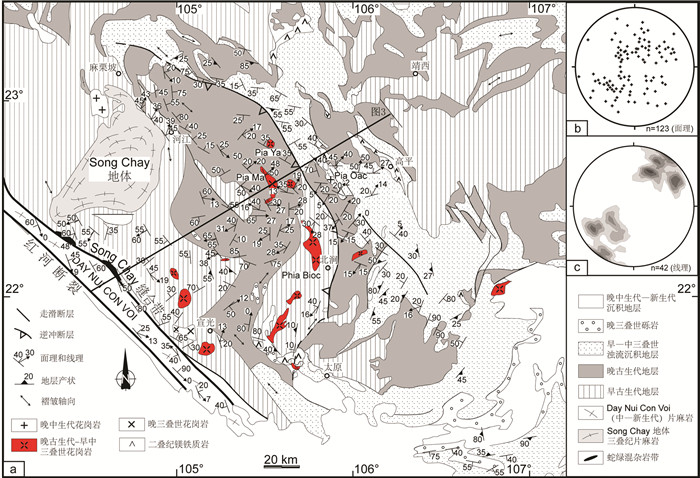
越南东北部Song Chay构造带呈WNW-ESE走向, 位于华南板块的南部(图 2)。受印支运动的影响, 发育一系列的构造和岩浆作用(Lepvrier et al., 2011)。该构造带位于特提斯构造域与太平洋构造域的交汇处, 保存了晚二叠世以来华南板块与周缘板块碰撞拼合印记, 记录了丰富的中生代变形构造形迹, 是研究华南板块南缘中生代构造变形的关键区域(Lepvrier et al., 2011及其相关参考文献)。该地区构造学的研究非常有限(Deprat, 1914; Fromaget, 1932; Yan et al., 2006; Lepvrier et al., 2011), 近期的工作大多集中在同位素年代学和地球化学上(Roger et al., 2000, 2012; Maluski et al., 2001; Yan et al., 2003; Hoa et al., 2008)。这些零散而不全面的工作为我们认识华南板块南缘的印支期事件带来了很大的困难(林伟等, 2011)。本文对Song Chay构造带进行详尽的构造解析, 结合精确的年代学数据对越南东北部地区的构造变形进行年代学约束, 并在此基础上讨论其地球动力学的成因背景。
|
图 2 Song Chay构造带构造地质图 Fig. 2 Structural geological map of Song Chay belt |
Song Chay构造带位于红河断裂以北的越南东北部地区(图 2)。“印支造山运动(Indosinian Orogeny)”一词最早就是指越南东北部地区晚三叠世的不整合事件(Deprat, 1914; Fromaget, 1932, 1941)。该地区出露的岩石地层单元从老到新分别为:(1) 新元古代-古生代浅海相灰岩沉积; (2) 泥盆纪至二叠纪灰岩, 硅质灰岩及陆源碎屑沉积; (3) 早-中三叠世的浊流沉积(砾岩, 砂岩, 页岩, 硅质岩等) 夹少量的灰岩; (4) 晚三叠世陆源磨拉石沉积不整合盖在之前的沉积序列之上; (5) 晚中生代的陆源红色砂岩层(图 2)。红河断裂和Song Chay断裂之间的大象山(Day Nui Con Voi) 构造带及沿着边界断裂的半地堑盆地构成了Song Chay构造带的南界(图 2)。
Song Chay构造带上构造学起源很早, Deprat (1914)对越南东北部地区广泛发育的褶皱山系进行了较为深入的研究, 并用薄皮构造的观点解释其为典型的、类似阿尔卑斯的推覆构造。Yan et al.(2006)对Song Chay地体在我国境内的都龙杂岩体进行了初步的构造学和年代学的研究, 用伸展成因的穹窿构造对都龙杂岩进行了剖析。野外剖面和露头尺度的构造学工作认为越南东北部地区为极性向北东的大型推覆体大多为近些年我们共同完成的结果(Lepvrier et al., 2011)。
越南东北部古生代至中生代花岗岩体侵位零星且分布广泛(图 2)。作为研究区最大的侵入体, 西北部出露Song Chay眼球状片麻岩体, 其原岩为斑状二长花岗岩, 岩体的侵位年龄为428±5Ma (Roger et al., 2000)。北涧(Bac Khan) 东面的Phan Ngame岩体的侵位年龄为438.7±3.5Ma (Tran and Halpin, 2011)。此外, 在越南北部还发育众多千米级大小的过铝质岩体, 例如Pia Ya花岗岩体, Pia Ma石英正长岩体, Pia Oac浅色二长花岗岩, Phia Bioc岩体以及宣光市(Tuyen Quang) 西部和太原市(Thai Nguyen) 北部众多小岩体(图 2)。北涧(Bac Khan) 北西边的Phia Bioc岩体侵入早古生代地层之中, LA-ICPMS所得锆石U-Pb年龄247~242Ma (Roger et al., 2012)。未变形的Pia Oac浅色二长花岗岩体, 前人用SIMS和LA-ICPMS分别对岩体中锆石进行测年, 获得岩体侵位年龄94~87Ma (王东升等., 2011; Roger et al., 2012)。碱性镁铁质岩石发育在高平(Cao Bang), 太原周围, 这些基性岩的岩体侵位时代为266~251Ma (Hoa et al., 2008)。
3 越南东北部地区构造格架Song Chay构造带沿NW-SE方向展布。根据对越南东北部地区的野外地质考察, 按照几何学特点和运动学特征把Song Chay构造带分为4个构造单元, 从南往北分别是:大象山(Day Nui Con Voi) 变质带, Song Chay蛇绿混杂岩带, 越北逆冲推覆带及前陆褶冲带(图 2)。
3.1 大象山(Day Nui Con Voi) 变质带大象山变质带长约250km、宽约20km, 呈北西-南东方向狭长展布。从几何形态上看, 大象山变质带是由其南侧的断层面向南西倾斜的红河断裂和北侧断层面向北西倾斜的Song Chay断裂所围限的地垒状变质带(Anczkiewicz et al., 2007; Searle et al., 2010; Palin et al., 2013)。其主体部分是由经历了麻粒岩相变质作用的片麻岩、石榴云母片岩、混合岩以及众多小规模的新生代花岗岩体所组成, 构成一个背形形态(图 3)。沿着红河断裂和Song Chay断裂发育有新生代糜棱化的片麻岩, 糜棱岩面理产状陡倾, 而线理则呈近水平展布并平行于红河和Song Chay断裂的区域构造走向(Leloup et al., 1993, 1995; Anczkiewicz et al., 2007)。该变质带上发育早中生代闪长岩(Faure et al., 2010; 林伟等, 2011)。

|
图 3 Song Chay构造带地质剖面图(剖面位置平行区域矿物拉伸线理方向, 如图 2中所示) Fig. 3 Cross sections though the Yunkai massif (location shown in Fig. 2) drawn parallel to the direction of the main mineral and stretching lineation (the pluton roots are hypothetic) |
在Song Chay地体的南缘沿着Song Chay断裂发育一套具有蛇绿混杂岩特征的构造混杂带(林伟等, 2011; Lepvrier et al., 2011)。出露红色泥质岩破碎带, 蛇纹岩以及薄层硅质岩作为团块赋存在强烈剪切破碎的泥质岩基质之中, 构成蛇绿混杂堆积。这条蛇绿混杂岩带被解释为一条缝合岩带, 是金沙江缝合带向南西的延伸部分(Faure et al., 2010; 林伟等, 2011; Lepvrier et al., 2011)。由于该蛇绿混杂岩带发育于红河断裂的北侧, 受新生代走滑影响较小, 因此可以近似地理解为华南板块经过早中生代构造拼合后的原位体系。
3.3 越东北逆冲推覆带该单元构成Song Chay构造带的主体部分(图 2)。越南东北部的逆冲推覆体是由Song Chay片麻岩地体, 早古生代浅变质沉积岩以及晚古生代-早中生代未变质的沉积岩构成(图 2、图 3)。Song Chay地体具有明显的穹窿形态, 由花岗片麻岩组成, 其原岩为早古生代的斑状-似斑状花岗岩(Roger et al., 2000; Carter et al., 2001)。Song Chay地体侵位于早古生代的地层之中, 由于NE向的逆冲推覆作用, 野外观察到与早古生代浅变质沉积岩为构造接触(图 3)。早古生代浅变质沉积岩以及晚古生代未变质的沉积盖层褶皱变形, 发育一系列具有NE极性的斜歪褶皱和平卧褶皱, 晚三叠世砾岩不整合盖在这套变形之上(图 2、图 3)。
3.4 前陆褶冲带前陆褶皱带位于麻栗坡-北涧(Bac Khan) 逆冲推覆断层以北, 并延伸至我国的广西靖西县一带(图 2)。这一构造单元主要由未变质的古生代和早-中三叠世地层组成。在越南境内, 晚古生代灰岩以及早-中三叠世的浊积岩变形明显, 褶皱轴面S或SW倾, 一系列逆冲推覆断层具有断层面SW倾的特点。上古生界向北东逆冲推覆到中-下三叠统之上(图 3)。而在中国广西地区, 三叠纪的薄层灰岩和砂岩也发生一系列轴面S或SW倾的褶皱变形。
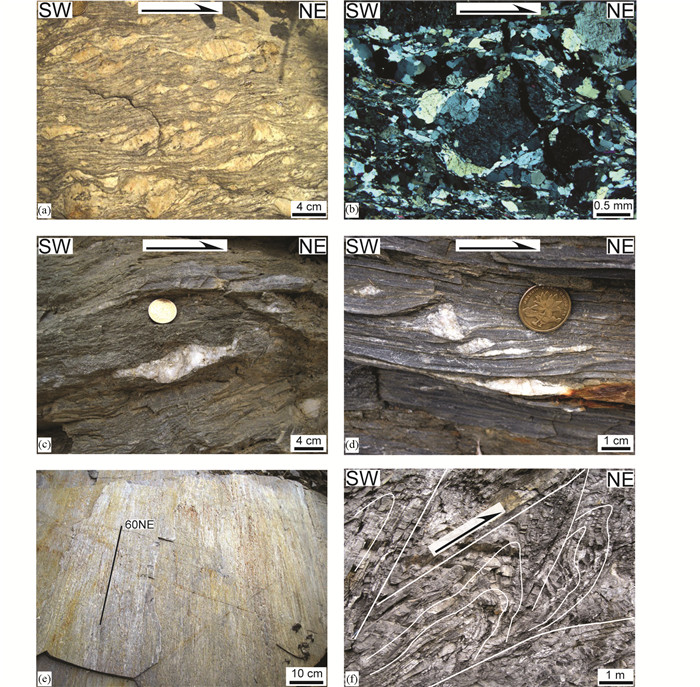
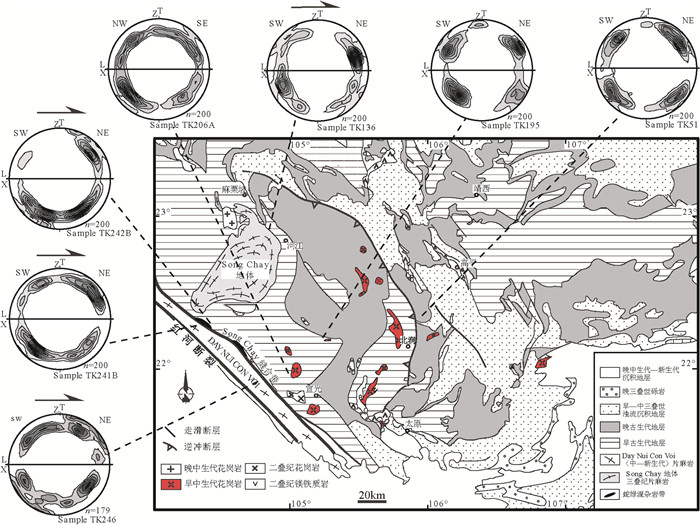
4 变形特征及其运动学从构造几何形态看Song Chay构造带是大型NE向逆冲推覆体, 推覆体源于其SW部Song Chay缝合带(图 3)。Song Chay地体作为越东北大型逆冲推覆体的一部分, 岩石清晰地记录了区域应力剪切变形特点及其所表征的运动学。Song Chay地体中, NE-SW向的矿物拉伸线理是其最为典型的几何学特点(图 2c)。沿此矿物拉伸线理, “σ”或“δ”形状的长石旋转残斑及强烈剪切变形的石英和黑云母形成的压力影, 均指示上部指向NE的剪切变形(图 4a, b, e)。在Song Chay地体北部早古生代浅变质碎屑岩和千枚岩局部也经历了明显的糜棱岩化现象, “σ”状的长英质脉体同样指示了上部指向NE运动学特征(图 4c, d)。相似的岩石变形特征在显微尺度上同样表现明显:沿NE-SW向矿物拉伸线理石英和云母构成的旋转残斑同样指示了上部向NE的变形特征(图 4b)。我们对石英光轴进行的测量结果显示了同样的变形特征和较低的变形温度(图 5)。此外, 该逆冲推覆作用具有向N (NE) 逐步减弱的特点(图 2)。北部的在前陆褶皱带中, 早-中三叠世的浊积岩表现为强烈的褶皱变形(图 4f)。斜歪和平卧褶皱具有向N或NE的极性。在广西靖西一带, 古生代厚层灰岩以及三叠纪薄层灰岩也记录该期变形, 因而认为这些变形是相同构造应力场下不同层次的变形结果。
|
图 4 Song Chay构造带构造变形特征照片 Fig. 4 Photographs of structures in the Song Chay belt |
|
图 5 石英C轴的优势定向(施密特网, 下半球投影) Fig. 5 Examples of quartz C axis lattice preferred orientation (Schmidt net, lower hemisphere) |
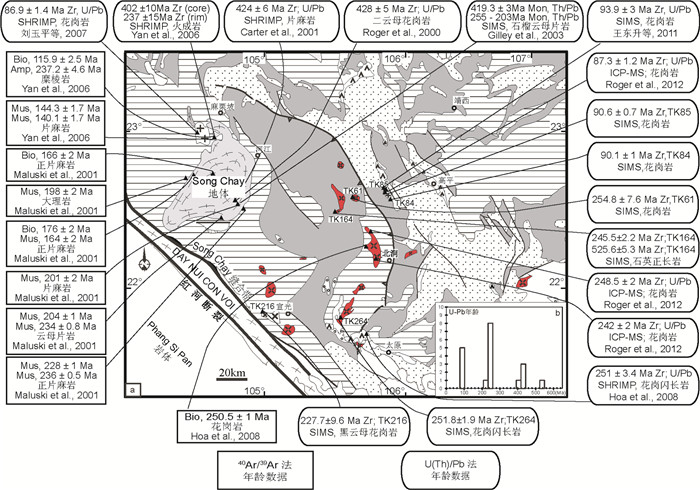
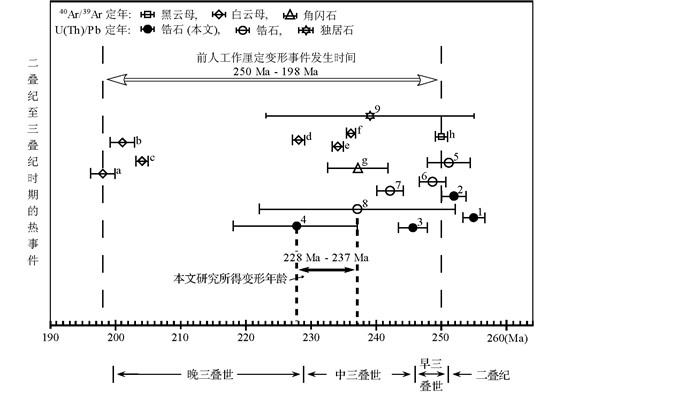
Song Chay构造带最显著的构造特征就是广泛发育NE-SW方向的矿物拉伸线理以及沿此方向上部指向NE的剪切变形, 这个变形无论是在逆冲推覆带还是前陆褶冲带均表现十分明显。我们认为其为印支造山事件的典型代表。但是印支造山作用起止时间缺乏严格的限定(Roger et al., 2000, 2012; Maluski et al., 2001; Carter et al., 2001; Gilley et al., 2003; Yan et al., 2006)。Maluski et al.(2001)和Yan et al.(2006)做了突出的定年工作, 他们对Song Chay (都龙) 地体的片麻岩和云母片岩做了大量的40Ar-39Ar和U -Pb年代学的工作(图 6a)。黑云母、白云母和角闪石矿物的40Ar-39Ar年代学分析得到237~115Ma非常大区间的年龄值。而锆石U-Pb年龄则反映了早古生代和早中生代两期事件(Roger et al., 2000; Yan et al., 2006)。Gilley et al.(2003)对Song Chay地体中石榴云母片岩的独居石进行了U-Th-Pb定年, 获得255~203Ma的年龄值。这个年龄结果仍然显得十分宽泛。虽然后续也有一些零星的定年工作, 但这些工作并没有建立在详细的构造分析, 特别是体现岩石变形所表现的运动学上(Carter et al., 2001; 刘玉平等, 2007; Hoa et al., 2008; 王东升等, 2011; Roger et al., 2012; 图 6a)。事实上, Song Chay构造带中所获得的年代学数据均落在一个非常宽泛的时间轴上(图 7)。特别是由于研究区经历了晚三叠世和晚白垩世及新生代构造热事件的影响, 导致一些地质学家认为在越南东北部地区中生代的构造事件表现为持续时间较长的热事件(Roger et al., 2000; Carter et al., 2001)。但是, 由于40Ar-39Ar法测年的矿物封闭温度较低(300~500℃), 这使得40Ar-39Ar年代学方法对温度较为敏感, 40Ar-39Ar法所得的年龄极易受该地区发育众多晚三叠世-晚白垩世花岗岩体的影响, 因此对所得的年龄结果对应于解释变形事件的时间需慎重考虑。通过详细的野外地质观察, 在越南东北部地区, 早古生代-中三叠世的地层卷入了印支期造山事件(图 2、图 3)。而晚三叠世发育陆源磨拉石沉积不整合地覆盖在之前变形的地层之上(图 2、图 3)。通过野外对地层变形、变质程度和相互间不整合关系的观察, 可以初步推断变形发育的时间在中-晚三叠世之间(Deprat, 1914; Fromaget, 1932, 1941)。
|
图 6 Song Chay构造带年代学(据Chen et al., 2013修改) Fig. 6 Structural map of Song Chay belt with available geochronological data (modified after Chen et al., 2013) |
|
图 7 Song Chay构造带变形年龄(据Chen et al., 2013修改) U (Th)/Pb数据:1-花岗闪长岩(TK61); 2-花岗闪长岩(TK264); 3-石英正长岩(TK164); 4-黑云母花岗岩(TK216); 5-辉长苏长岩(Hoa et al., 2008); 6、7-花岗岩(Roger et al., 2012); 8-火山岩(Yan et al., 2006); 9-石榴云母片岩(Gilley et al., 2003).40Ar/39Ar数据:a-大理岩(Maluski et al., 2001); b-片麻岩(Maluski et al., 2001); c-云母片岩(Maluski et al., 2001); d-正片麻岩(Maluski et al., 2001); e-云母片岩(Maluski et al., 2001); f-正片麻岩(Maluski et al., 2001); g-糜棱岩(Yan et al., 2006) Fig. 7 Geochronological data of Song Chay belt showing the age of deformation (modified after Chen et al., 2013) U (Th)/Pb data: 1-granodiorite (Sample TK61);2-granodiorite (Sample TK264);3-quartz-syenite (Sample TK164);4-biotite granite (Sample TK216);5-gabbronorite (Hoa et al., 2008); 6, 7-granite (Roger et al., 2012); 8-igneous rock (Yan et al., 2006); 9-garnet micaschist (Gilley et al., 2003). 40Ar/39Ar data: a-marble (Maluski et al., 2001); b-gneiss (Maluski et al., 2001); c-micaschist (Maluski et al., 2001); d-orthogneiss (Maluski et al., 2001); e-micaschist (Maluski et al., 2001); f-orthogneiss (Maluski et al., 2001); g-mylonitic rock (Yan et al., 2006) |
在越南东北部Song Chay构造带上出露许多花岗岩体, 这些花岗岩体为我们研究早中生代的构造演化和热事件提供了重要的信息。通过研究, 越南东北部地区的岩浆作用可分为四期:525~400Ma, 280~240Ma, 230~220Ma, 91~87Ma (Roger et al., 2000; Carter et al., 2001; Gilley et al., 2003; Yan et al., 2006; 刘玉平等, 2007; 王东升等, 2011; Chen et al., 2013; 图 6b)。早古生代的岩浆作用年代主要集中于430~420Ma, 这些岩体具有明显的面理化(Roger et al., 2000; Carter et al., 2001; Gilley et al., 2003; Yan et al., 2006; Chen et al., 2013; 图 6b)。晚古生代-早中生代的花岗岩(280~240Ma) 绝大部分岩体发生了明显的面理化, 仅少部分岩体未卷入变形, 如北涧花岗岩体和Pia Ma石英正长岩体, 因此前人将248~245Ma解释为越南东北部地区推覆变形的上限年龄(Roger et al., 2012)。230~220Ma以小岩株为表现型式的黑云母花岗岩(图 6b)。其虽然靠近Song Chay缝合带, 但没有遭受任何韧性变形。且从铪和氧同位素特征上看, 该期的岩浆岩的物质源于地壳, 代表了造山后加厚地壳熔融的产物(Chen et al., 2013)。我们对宣光西部的该期岩体进行了SIMS锆石U-Pb年龄定年工作, 测试结果得到227.7±9.6Ma的年龄, 其标志着造山作用的结束年龄的上限(Chen et al., 2013, 图 6b)。晚白垩世岩浆作用(91~87Ma) 主要表现在研究区中部的静足地区, 该期花岗岩体主要为铝质-过铝质S型花岗岩(王东升等, 2011; Roger et al., 2012)。在区域上与云南地区的都龙花岗岩体以及云南个旧地区的S型花岗岩地球化学特点和年龄相一致(刘玉平等, 2007; Cheng et al., 2010)。同样前人对Song Chay上部指向NE剪切变形的片麻岩和糜棱岩40Ar-39Ar年代学测量结果同样给出了从237~115Ma十分宽泛的结果(图 7)。即使笼统地认为变形期次为“印支期”, 这样的年龄结果也同样对构造事件缺乏较为精确的约束(Maluski et al., 2001; Yan et al., 2006)。以精确的锆石SIMS U-Pb定年, 并结合前人40Ar-39Ar年代学数据, 我们认为Song Chay构造带上的推覆变形时间可以进一步约束在237~228Ma之间(图 7)。虽然考虑到北涧花岗岩体和Pia Ma石英正长岩体未变形的特点, 我们并不能完全排除变形时间稍早一些的可能性(Roger et al., 2012)。综上所述, 我们认为越南东北部地区逆冲推覆构造, 也就是印支运动发生的时间在237~228Ma之间。40Ar-39Ar年代学之所以给出237~115Ma十分宽泛的年龄, 是因为受晚期岩浆作用影响的冷却年龄或混合年龄, 250.5±1Ma黑云母40Ar-39Ar年龄记录的是北涧岩体黑云母结晶后的冷却年龄, 大量晚三叠世及侏罗纪和早白垩世的40Ar-39Ar年龄都是晚三叠世岩浆作用之后的冷却年龄或混合年龄(Maluski et al., 2001; Yan et al., 2006)。这个现象在我国东部中生代构造事件中表现得相当普遍(Faure et al., 1999; Lin et al., 2000; Ratschbacher et al., 2000)。
6 讨论 6.1 华南板块南缘早中生代构造特点华南板块南缘印支期造山事件的界限至今仍饱受争议。至今大多数学者倾向于认同越南北部的Song Ma缝合带是华南板块同印支板块碰撞拼合的界限(Hutchison, 1989; Findlay, 1997; Findlay and Pham, 1997; Metcalfe, 2002; Tran and Vu, 2011), 但也有学者认为是越南北部的Song Da带(Sengör and Hsü, 1984)。而在华南板块南缘, 红河断裂带作为新生代大型左旋走滑的深大断裂(Tapponnier et al., 1990; Leloup et al., 1995; Harrison et al., 1996; Wang et al., 1998; Leloup et al., 2001), 并没有蛇绿岩物质的出露, 因此不是华南板块的边界。Song Ma缝合带在红河断裂的南边, 受新生代红河断裂百千米级大型左旋走滑的影响, 现今Song Ma缝合带以及其与红河断裂之间的构造关系很可能是新生代红河断裂走滑作用的结果, 因而不能视Song Ma缝合带为现今华南板块的边界。在越南东北部Song Chay构造带的南缘, 沿着Song Chay断裂, 出露蛇纹岩, 基性-超基性岩, 薄层灰岩以及硅质岩作为团块赋存在强烈破碎的砂岩和泥质岩构成的基底当中, 被认为是华南与大象山微陆块的构造拼合界线(Lepvrier et al., 2011)。
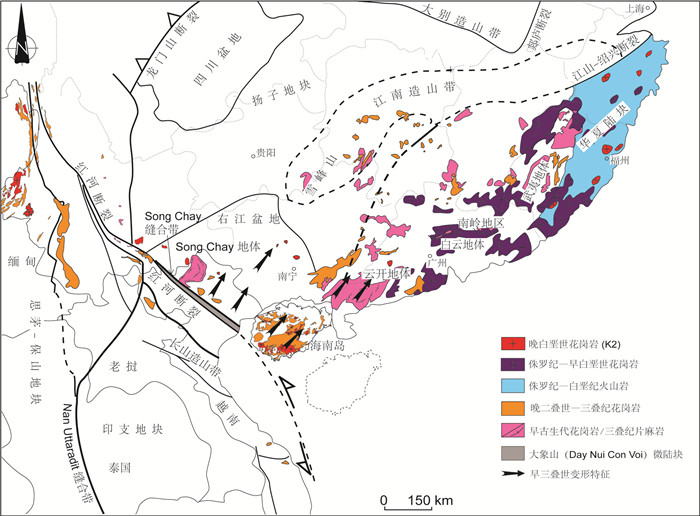
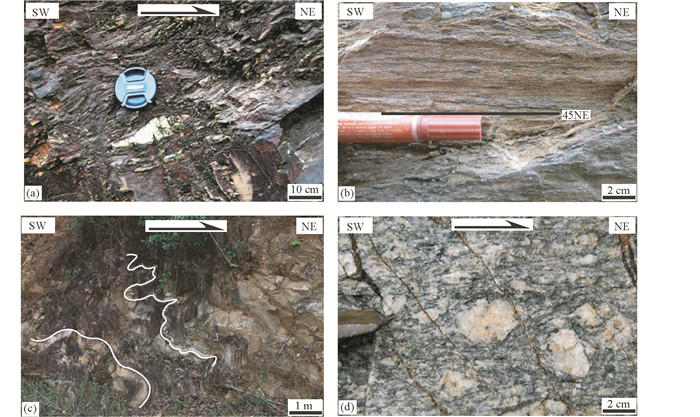
如前所述, 在Song Chay蛇绿混杂岩带北部的逆冲推覆带和前陆褶冲带发育了明显的NE-SW向矿物拉伸线理和上部指向NE的剪切变形(图 8)。我们的野外观察表明, 这一变形特征在前陆褶冲带向N和NE延伸到我国的广西南部地区同样有明显的表现。事实上, 在华南板块的南缘, 越南东北部-海南岛-粤西南构造带是华南与大象山微陆块在晚古生代-早中生代碰撞拼合的结合地带, 保存了晚二叠世以来印支板块同华南板块的碰撞拼合印记。粤西南的云开地块和越南东北地区的Song Chay地块是深变质岩的重要出露地区, 记录了丰富的、不同层次的早中生代(印支期) 构造形迹(广西壮族自治区地质矿产局, 1985; 广东省地质矿产局, 1988)。与Song Chay地块相类似, 前人对云开地块进行较为详细的构造学研究同样揭示了其主变形期事件表现为早中生代NE向的逆冲推覆构造(林庆华等, 1990; 邵建国等1995; 钟增球等, 1996; 彭松柏等, 2000, 2005; 李小明, 2004; 李小明等, 2005; 覃小锋等, 2006; Lin et al., 2008)。由此我们推断云开地块同越东北一样, 在早中生代构造事件中处于华南板块南缘相似的构造部位, 具有可以类比的变形特征(林伟等, 2011)。事实上, 相似的构造事件在华南板块南缘分布得相当普遍, 近年来我们对海南岛的野外考察发现浅变质早古生代地层中同样发育NE-SW方向的矿物拉伸线理以及沿此线理方向上部指向NE的剪切变形(图 9a, b)。与早古生代浅变质地层中发育的韧性变形不同的是, 晚古生代地层-中生代中地层大多以褶皱的型式表现出来, 体现了较浅层次的变形特征(图 9c)。值得指出的是古生代的花岗均发生了明显的面理化, 在面理上同样发育有NE-SW方向的矿物拉伸线理。沿着线理可见长英质斑晶构成σ形态, 显示出上部指向NE的运动学特征(图 9d)。由于晚三叠世的侵入岩并没有明显的变形。因此海南岛NE向的剪切变形发生的时间在早中生代, 与越南东北部和云开地区可以很好地对比(海南省地质调查院, 2008①)。
①海南省地质调查院.2008.海南岛1:50万地质图
|
图 8 华南板块南缘早中生代运动学图解(据Replumaz and Tapponnier, 2003, Lin et al. 2008修改) 箭头的方向代表着剪切运动的上部指向 Fig. 8 Kinematic map for the Early Mesozoic tectonic event in the south margin of South China Block (modified after Replumaz and Tapponnier, 2003, Lin et al., 2008) Arrows point to the sense of shear of the upper part |
|
图 9 华南板块南缘变形特征照片 Fig. 9 Photographs of structures in the south margin of SCB |
综上所述, 在华南板块南缘越南东北部-海南岛地区-粤西南早-中三叠世广泛发育NE-SW方向的矿物拉伸线理以及极性向北/北东的褶皱和逆冲推覆变形, 这期变形具有运动学上部指向北东的特征(图 8)。
6.2 早中生代构造事件的动力学机制越南东北部-海南岛-粤西南构造带整体上呈NW-SE走向展布于华南板块的南缘, 发育一系列向NE的逆冲推覆构造(林伟等, 2011)。古太平洋板块向NW的俯冲从构造样式上很难用于解释与俯冲方向近垂直的NE-SW方向上的变形(Chu et al., 2012)。华南板块南缘构造带的NE-SW方向上的变形具有从南向北有逐步减弱的趋势, 用华南板块北缘扬子板块向华北板块的俯冲机制来解释也很难与之匹配, 而且要跨越整个华南大陆板块(Wang et al., 2007)。无论从时空关系还是构造变形样式上将这一事件的动力学机制归结于早中生代华南板块同大象山微陆块的碰撞拼合更合乎推理(Lepvrier et al., 2008)。华南板块同大象山微陆块的相互作用关系和俯冲极性也存在着争议, 目前大多数学者支持华南板块向印支板块俯冲(林伟等, 2011; Lepvrier et al., 2011; Liu et al., 2012), 也有印支板块沿Song Ma缝合带向华南板块俯冲的看法(Lepvrier et al., 2004, 2008)。我们在越南东北部Song Chay构造带的野外观测以及几何学运动学的解析并结合越南东北部地区构造事件、岩浆作用以及构造变形的年代学研究, 进一步支持华南板块沿着Song Chay缝合带向S-SW俯冲于大象山(Day Nui Con Voi) 微陆块俯冲之下, 从而在俯冲盘形成Song Chay构造带向N和NE仰冲的构造。这一事件发生的时间在237~228Ma之间。如果我们将新生代张开的北部湾闭合, 则海南岛恰恰位于越东北的东部和云开地体之间(Replumaz and Tapponnier, 2003; 图 8)。结合我们区域上的分析可以看到, 沿着华南板块南缘均发育有相同的变形方式, 从Song Chay地块-云开地块可以追索近800km (图 8)。这样稳定的构造事件指示华南南缘早中生代具有一个统一的构造背景, 如果这个观察成立, 则Song Chay蛇绿混杂岩带经越南东北部东延至海南岛的南部现今的南海中, 并被其东部稍晚些时候的古太平洋向NW的俯冲所改造(Li and Li, 2007; Chu et al., 2012; 图 8)。
7 结论通过对越南东北部Song Chay构造带详细的野外考察以及精细的室内研究, 综合华南板块南缘云开地块和海南岛野外观察所取得的认识, 得到以下几点结论:
(1) 越南东北部Song Chay构造带的几何形态是个极性向NE方向的推覆体, 广泛发育NE-SW方向的线理, 沿着线理可观察到运动学上部指向北东的特征;
(2) Song Chay构造带上极性向NE的推覆体起源于Song Chay缝合带, 变形的时间发生在237~228Ma;
(3) 位于华南板块南缘的越南东北部以及广西和海南岛地区和云开地块在早中生代均发育极性向N/NE的褶皱和上部指向北东的变形。华南板块南缘的越南东北部-海南岛-粤西南构造带被一同卷入早-中三叠世同大象山微陆块的碰撞造山体系之中。其构造背景为华南板块沿Song Chay断裂及其东延部分向SW俯冲于大象山(Day Nui Con Voi) 微陆块之下而伴生的俯冲板块上部盖层向NE仰冲。
致谢 感谢越南河内国家大学N’guyen Van Vuong教授和Vu Van Tich教授在越南境内的野外工作中给予的帮助。| [] | Ames L, Zhou GZ, Xiong BC. 1996. Geochronology and isotopic character of ultrahigh-pressure metamorphism with implications for collision of the Sino-Korean and Yangtze cratons, Central China. Tectonics, 15(2): 472–489. DOI:10.1029/95TC02552 |
| [] | Anczkiewicz R, Viola G, Müntener O, Thirlwall MF, Villa IM, Quong NQ. 2007. Structure and shearing conditions in the Day Nui Con Voi massif: Implications for the evolution of the Red River shear zone in northern Vietnam. Tectonics, 26: TC2002. DOI:10.1029/2006TC001972 |
| [] | Avouac JP, Tapponnier P, Bai M, You H, Wang G. 1993. Active thrusting and folding along the Northern Tien Shan and Late Cenozoic rotation of the Tarim relative to Dzungaria and Kazakhstan. Journal of Geophysical Research, 98(B4): 6755–6804. DOI:10.1029/92JB01963 |
| [] | Bureau of Geology and Mineral Resources of Fujian Province. 1985. Regional Geology of Fujian Province. Beijing: Geological Publishing House: 1-671. |
| [] | Bureau of Geology and Mineral Resources of Guangdong Province. 1988. Regional Geology of Guangdong Province. Beijing: Geological Publishing House: 1-941. |
| [] | Bureau of Geology and Mineral Resources of Guangxi Zhuang Autonomous Region. 1985. Regional Geology of the Guangxi Zhuang Autonomous Region. Beijing: Geological Publishing House: 1-853. |
| [] | Bureau of Geology and Mineral Resources of Jiangxi Province. 1984. Regional Geology of Jiangxi Province. Beijing: Geological Publishing House: 1-921. |
| [] | Bureau of Geology and Mineral Resources of Zhejiang Province. 1989. Regional Geology of Zhejiang Province. Beijing: Geological Publishing House: 1-688. |
| [] | Carter A, Roques D, Bristow C, Kinny P. 2001. Understanding Mesozoic accretion in Southeast Asia: Significance of Triassic thermotectonism (Indosinian orogeny) in Vietnam. Geology, 29(3): 211–214. DOI:10.1130/0091-7613(2001)029<0211:UMAISA>2.0.CO;2 |
| [] | Carter A, Clift PD. 2008. Was the Indosinian orogeny a Triassic mountain building or a thermotectonic reactivation event?. Comptes Rendus Geoscience, 340(2-3): 83–93. DOI:10.1016/j.crte.2007.08.011 |
| [] | Cawood PA. 2005. Terra Australis Orogen: Rodinia breakup and development of the Pacific and Iapetus margins of Gondwana during the Neoproterozoic and Paleozoic. Earth-Science Reviews, 69(3-4): 249–279. DOI:10.1016/j.earscirev.2004.09.001 |
| [] | Chan KT. 1956. Examples of "Activizing region" in the Chinese platform with special reference to the 'Cathaysia' problem. Acta Geologica Sinica, 36(3): 3–35. |
| [] | Charvet J, Lapierre H, Yu YW. 1994. Geodynamic significance of the Mesozoic volcanism of southeastern China. Journal of Southeast Asian Earth Sciences, 9(4): 387–396. DOI:10.1016/0743-9547(94)90050-7 |
| [] | Charvet J, Shu LS, Shi YS, Guo LZ, Faure M. 1996. The building of South China: Collision of Yangtze and Cathaysia blocks, problems and tentative answers. Journal of Southeast Asian Earth Sciences, 13(3-5): 223–235. DOI:10.1016/0743-9547(96)00029-3 |
| [] | Chen ZC, Lin W, Faure M, Lepvrier C, N'guyen VV and Tich VV. 2013. Geochronology and isotope analysis of the Late Paleozoic to Mesozoic granitoids from northeastern Vietnam and implications for the evolution of the South China block. Journal of Asian Earth Sciences, under review. |
| [] | Cheng YB, Mao JW. 2010. Age and geochemistry of granites in Gejiu area, Yunnan Province, SW China: Constraints on their petrogenesis and tectonic setting. Lithos, 120(3-4): 258–276. DOI:10.1016/j.lithos.2010.08.013 |
| [] | Chu Y, Faure M, Lin W, Wang QC. 2012. Early Mesozoic tectonics of the South China block: Insights from the Xuefengshan intracontinental orogen. Journal of Asian Earth Sciences, 61: 199–220. DOI:10.1016/j.jseaes.2012.09.029 |
| [] | Cong BL, Wang QC. 1995. Ultra-high pressure metamorphic rocks in China. Episodes, 18(1-2): 91–94. |
| [] | Cong BL. 1996. Ultrahigh-pressure Metamorphic Rocks in the Dabieshan-Sulu Region of China. Beijing: Science Press: 1-224. |
| [] | Cui SQ, Li JR. 1990. Mesozoic and Cenozoic tectonic process of Northwest Pacific continental margin. Bulletin of the Chinese Academy of Geological Sciences(1): 92–96. |
| [] | Cui SQ. 1999. On global Meso-Cenozoic intracontinental orogenesis and orogenic belts. Earth Science Frontiers, 6(4): 283–293. |
| [] | Deng XG, Chen ZG, Li XH, Liu DY. 2004. SHRIMP U-Pb zircon dating of the Darongshan-Shiwandashan granitoid belt in southeastern Guangxi, China. Geological Review, 50(4): 426–432. |
| [] | Deprat J. 1914. Etude des plissements et des zones décrasement de la moyenne et de la basse Rivière Noire: Mèmoire du Service Géologique Indochine. 3: 59 |
| [] | Dong SW, Zhang YQ, Long CX, Yang ZY, Ji Q, Wang T, Hu JM, Chen XH. 2007. Jurassic tectonic revolution in China and new interpretation of the Yanshan Movement. Acta Geologica Sinica, 81(11): 1449–1461. |
| [] | Faure M, Sun Y, Shu L, Monié P, Charvet J. 1996. Extensional tectonics within a subduction-type orogen: The case study of the Wugongshan dome (Jiangxi Province, southeastern China). Tectonophysics, 263(1-4): 77–106. DOI:10.1016/S0040-1951(97)81487-4 |
| [] | Faure M, Lin W, Shu LS, Sun Y, Schärer U. 1999. Tectonics of the Dabieshan (eastern China) and possible exhumation mechanism of ultra high-pressure rocks. Terra Nova, 11(6): 251–258. |
| [] | Faure M, Shu LS, Wang B, Charvet J, Choulet F, Monié P. 2009. Intracontinental subduction: A possible mechanism for the Early Paleozoic Orogen of SE China. Terra Nova, 21(5): 360–368. DOI:10.1111/ter.2009.21.issue-5 |
| [] | Faure M, Lepvrier C, Lin W, N'guyen VV, Vu VT and Chu Y. 2010. Triassic tectonics in the southwestern margin of the South China Block and the welding of the South China-Indochina blocks. International Association for Gondwana Research Conference Series 9, Abstract Volume, 9-10 |
| [] | Findlay RH. 1997. The Song Ma anticlinorium, northern Vietnam: The structure of an allochthonous terrane containing an Early Palaeozoic island arc sequence. Journal of Asian Earth Sciences, 15(6): 453–464. DOI:10.1016/S0743-9547(97)00031-7 |
| [] | Findlay RH, Trinh PT. 1997. The structural setting of the Song Ma region, Vietnam and the Indochina-South China plate boundary problem. Gondwana Research, 1(1): 11–33. DOI:10.1016/S1342-937X(05)70003-4 |
| [] | Fromaget J. 1932. Surla structure des Indosinides. Comptes Rendus de 1'Académie des Sciences, 195: 538. |
| [] | Fromaget J. 1941. L'Indochine francaise, sa structure géologique, ses roches, ses mines et leurs relations possibles avec la tectonique. Bulletin Service Géologique de l'Indochine, 26: 1–140. |
| [] | Gilder SA, Coe RS, Wu HR, Kuang GK, Zhao XX, Wu Q. 1995. Triassic paleomagnetic data from South China and their bearing on the tectonic evolution of the western circum-Pacific region. Earth and Planetary Science Letters, 131(3-4): 269–287. DOI:10.1016/0012-821X(95)00030-G |
| [] | Gilder SA, Gill J, Coe RS, Zhao XX, Liu ZW, Wang GX, Yuan KR, Liu WL, Kuang GD, Wu HR. 1996. Isotopic and paleomagnetic constraints on the Mesozoic tectonic evolution of South China. J. Geophys. Res., 107(B7): 16137–16154. |
| [] | Gilley LD, Harrison TM, Leloup PH, Ryerson FJ, Lovera OM, Wang JH. 2003. Direct dating of left-lateral deformation along the Red River shear zone, China and Vietnam. Journal of Geophysical Research, 108(B2): 2127. DOI:10.1029/2001JB001726 |
| [] | Guo LZ, Shi YS, Ma RS. 1983. On the formation and evolution of the Mesozoic-Cenozoic active continental margin and island arc tectonics of the western Pacific Ocean. Acta Geologica Sinica, 57(1): 51–61. |
| [] | Harrison TM, Leloup PH, Ryerson FJ, Tapponnier P, Lacassin R and Chen W. 1996. Diachronous initiation of transtension along the Ailao Shan-Red River Shear zone, Yunnan and Vietnam. In: Yin A and Harrison TM (eds.). The Tectonic Evolution of Asia. New York: Cambridge University Press, 208-226 |
| [] | He KZ, Zhao CH, Tai DQ, et al. 1996. Discovery of Late Palaeozoic radiolarian silicolite in many places in northeastern Jiangxi ophiolitic mélange belt. Geoscience, 10(3): 303–308. |
| [] | Hoa TT, Izokh AE, Polyakov GV, Borisenko AS, Anh TT, Balykin PA, Phuong NT, Rudnev SN, Van VV, Nien BA. 2008. Permo-Triassic magmatism and metallogeny of Northern Vietnam in relation to the Emeishan plume. Russian Geology and Geophysics, 49(7): 480–491. DOI:10.1016/j.rgg.2008.06.005 |
| [] | Holloway NH. 1982. North Palawan block, Philippines-Its relation to Asian mainland and role in evolution of South China Sea. American Association of Petroleum Geologists, 66(9): 1355–1383. |
| [] | Hsü KJ, Li JL, Chen HH, Wang QC, Sun S, Şengör AMC. 1990. Tectonics of south China: Key to understanding West Pacific geology. Tectonophysics, 183(1-4): 9–39. DOI:10.1016/0040-1951(90)90186-C |
| [] | Huang TK. 1945. Major Tectonic Forms of China. Geological Memoirs, Series A, Number 20, The National Geological Survey of China: 1–165. |
| [] | Huang TK, Chen BW. 1987. The Evolution of the Tethys in China and Adjacent Regions. Beijing: Geological Publishing House: 1-78. |
| [] | Hutchison CS. 1989. Geological Evolution of South-East Asia. Oxford Monographson Geology and Geophysics, Vol. 13. Oxford, UK: Clarendon Press: 368. |
| [] | Jahn BM, Zhou XH, Li JL. 1990. Formation and tectonic evolution of southeastern China and Taiwan: Isotopic and geochemical constraints. Tectonophysics, 183(1-4): 145–160. DOI:10.1016/0040-1951(90)90413-3 |
| [] | Leloup PH, Harrison TM, Ryerson FJ, Chen WJ, Qi L, Tapponnier P, Lacassin R. 1993. Structural, petrological and thermal evolution of a Tertiary ductile strike-slip shear zone, Diancang Shan, Yunnan. Journal of Geophysical Research, 98(B4): 6715–6743. DOI:10.1029/92JB02791 |
| [] | Leloup PH, Lacassin R, Tapponnier P, Schärer U, Zhong DL, Liu XH, Zhang LS, Ji SC, Phan PT. 1995. The Ailao Shan-Red River shear zone (Yunnan, China), Tertiary transform boundary of Indochina. Tectonophysics, 251(1995): 3–84. |
| [] | Leloup PH, Arnaud N, Lacassin R, Kienast JR, Harrison TM, Phan Trong T, Replaumaz A, Tapponnier P. 2001. New constraints on the structure, thermochronology, and timing of the Ailao Shan-Red River shear zone, SE Asia. Journal of Geophysical Research, 106(B4): 6683–6732. DOI:10.1029/2000JB900322 |
| [] | Lepvrier C, Maluski H, Vuong N, Roques D, Axente V, Rangin C. 1997. Indosinian NW-trending shear zone within the Truong Son belt (Vietnam): 40Ar-39Ar Triassic and Cretaceous to Cenozoic overprints. Tectonophysics, 283(1-4): 105–128. DOI:10.1016/S0040-1951(97)00151-0 |
| [] | Lepvrier C, Maluski H, Van Tich V, Leyreloup A, Thi PT, van Vuong V. 2004. The Early Triassic Indosinian orogeny in Vietnam (Truong Son Belt and Kontum Massif): Implications for the geodynamic evolution of Indochina. Tectonophysics, 393(1-4): 87–118. DOI:10.1016/j.tecto.2004.07.030 |
| [] | Lepvrier C, van Vuong N, Maluski H, Thi PT, van Vu T. 2008. Indosinian tectonics in Vietnam. Comptes Rendus Geoscience, 340(2-3): 94–111. DOI:10.1016/j.crte.2007.10.005 |
| [] | Lepvrier C, Faure M, Nguyen VV, Van Vu T, Lin W, Thang TT. 2011. North-directed Triassic nappes in Northeastern Vietnam (East Bac Bo). Journal of Asian Earth Sciences, 41(1): 56–68. DOI:10.1016/j.jseaes.2011.01.002 |
| [] | Li JL, Sun S, Hao J, Chen HH, Hou QL, Xiao WJ. 1999. On the classification of collision orogenic belts. Scientia Geologica Sinica, 34(2): 129–138. |
| [] | Li JW, Zhou MF, Li XF, Fu ZR, Li ZJ. 2001. The Hunan-Jiangxi strike-slip fault system in southern China: Southern termination of the Tan-Lu fault. Journal of Geodynamics, 32(3): 333–354. DOI:10.1016/S0264-3707(01)00033-3 |
| [] | Li WY, Ma CQ, Liu YY, Robinson PT. 2012. Discovery of the Indosinian aluminum A-type granite in Zhejiang Province and its geological significance. Science China (Earth Sciences), 55(1): 13–25. DOI:10.1007/s11430-011-4351-6 |
| [] | Li XH, Zhao JX, Mc Culloch MT, Zhou GQ, Xing FM. 1997. Geochemical and Sm-Nd isotopic study of Neoproterozoic ophiolites from southeastern China: Petrogenesis and tectonic implications. Precambrian Research, 81(1-2): 129–144. DOI:10.1016/S0301-9268(96)00032-0 |
| [] | Li XM. 2004. Study on fission track method and the thermochronology of the Yunkaidashan. Ph. D. Dissertation. Guangzhou: Guangzhou Institute of Geochemistry CAS, 1-99 (in Chinese with English summary) |
| [] | Li XM, Wang YJ, Tan KX, Peng TP. 2005. Meso-Cenozoic uplifting and exhumation on Yunkaidashan: Evidence from fission track thermochronology. Chinese Science Bulletin, 50(6): 577–583. |
| [] | Li ZX, Li XH. 2007. Formation of the 1300-km-wide intracontinental orogen and postorogenic magmatic province in Mesozoic South China: A flat-slab subduction model. Geology, 35(2): 179–182. DOI:10.1130/G23193A.1 |
| [] | Lin QH, Li LY, Liang MG. 1990. Origin of granitic rocks in the Heshui-Sihe area, western Guangdong. Regional Geology of China, 9(2): 173–180. |
| [] | Lin W, Faure M, Monié P, Schärer U, Zhang LS, Sun Y. 2000. Tectonics of SE China: New insights from the Lushan massif (Jiangxi Province). Tectonics, 19(5): 852–871. DOI:10.1029/2000TC900009 |
| [] | Lin W, Wang QC, Chen K. 2008. Phanerozoic tectonics of south China block: New insights from the polyphase deformation in the Yunkai massif. Tectonics, 27: TC6004. DOI:10.1029/2007TC002207 |
| [] | Lin W, Faure M, Lepvrier C, et al. 2011. The Early Mesozoic thrust and folds sheet structure along the southern margin of South China block and its geodynamic. Chinese Journal of Geology, 46(1): 134–145. |
| [] | Liu BJ, Xu XS, Pan XN, Huang HQ, Xu Q. 1993. South China Ancient Continental Sedimentary Crust Evolution and Mineralization. Beijing: Science Press: 1-236. |
| [] | Liu JL, Tran MD, Tang Y, Nguyen QL, Tran TH, Wu WB, Chen JF, Zhang ZC, Zhao ZD. 2012. Permo-Triassic granitoids in the northern part of the Truong Son belt, NW Vietnam: Geochronology, geochemistry and tectonic implications. Gondwana Research, 22(2): 628–644. DOI:10.1016/j.gr.2011.10.011 |
| [] | Liu WJ. 1998. Evolution of sedimentation of South China plate in the Hercynian Indosinian stage. Journal of Chengdu University of Technology, 25(2): 328–336. |
| [] | Liu YP, Li ZX, Li HM, et al. 2007. U-Pb geochronology of cassiterite and zircon from the Dulong Sn-Zn deposit: Evidence for Cretaceous large-scale granitic magmatism and mineralization events in southeastern Yunnan Province, China. Acta Petrologica Sinica, 23(5): 967–976. |
| [] | Ma WP. 1996. Paleotethys in South China, Permian orogeny and the eastwards extension of interchange domain. Scientia Geologica Sinica, 31(2): 105–113. |
| [] | Maluski H, Lepvrier C, Jolivet L, Carter A, Roques D, Beyssac O, Thang TT, Thang ND, Avigad D. 2001. Ar-Ar and fission-track ages in the Song Chay massif: Early Triassic and Cenozoic tectonics in northern Vietnam. Journal of Asian Earth Sciences, 19(1-2): 233–248. DOI:10.1016/S1367-9120(00)00038-9 |
| [] | Mattauer M, Matte P, Malavieille J, Tapponnier P, Maluski H, Xu ZQ, Lu YL, Tang YQ. 1985. Tectonics of the Qinling Belt: Build-up and evolution of Eastern Asia. Nature, 317(6037): 496–500. DOI:10.1038/317496a0 |
| [] | Metcalfe I. 1996. Gondwanaland dispersion, Asian accretion and evolution of eastern Tethys. Australian Journal of Earth Sciences, 43(6): 605–623. DOI:10.1080/08120099608728282 |
| [] | Metcalfe I. 2002. Permian tectonic framework and palaeogeography of SE Asia. Journal of Asian Earth Sciences, 20(6): 551–566. DOI:10.1016/S1367-9120(02)00022-6 |
| [] | Nam TN, Toriumi M, Itaya T. 1998. P-T-t paths and post-metamorphic exhumation of the Day Nui Con Voi shear zone in Vietnam. Tectonophysics, 290(3-4): 299–318. DOI:10.1016/S0040-1951(98)00054-7 |
| [] | Palin RM, Searle MP, Waters DJ, Parrish RR, Roberts NMW, Horstwood MSA, Yeh MW, Chung SL, Anh TT. 2013. A geochronological and petrological study of anatectic paragneiss and associated granite dykes from the Day Nui Con Voi metamorphic core complex, North Vietnam: Constraints on the timing of metamorphism within the Red River shear zone. Journal of Metamorphic Geology, 31(4): 359–387. DOI:10.1111/jmg.2013.31.issue-4 |
| [] | Pang GT, Chen ZL, Li XZ, et al. 1997. Geological-Tectonic Evolution in the Eastern Tethys. Beijing: Geological Publishing House: 1-218. |
| [] | Peng SB, Zhang YM, Zhan MG, Chen FW, Qiu RZ. 2000. Dating of Sm-Nd, Rb-Sr isotopic systems and its dynamic significance for the Proterozoic augen granite in Yunkai area. Acta Petrologica Sinica, 16(1): 99–105. |
| [] | Peng SB, Jin ZM, Fu JM, Liu YH, He LQ, Cai MH, Wang YB. 2005. The petrochemistry, chronology and genesis of banded-augen (rapakivi) strong peraluminous granitoids in Yunkai orogenic belt, western Guangdong Province, China. Science Technology and Engineering, 5(17): 1238–1246. |
| [] | Qin XF, Pan YM, Li J, Li RS, Zhou FS, Hu GA, Zhong FY. 2006. Zircon SHRIMP U-Pb geochronology of the Yunkai metamorphic complex in southeastern Guangxi, China. Geological Bulletin of China, 25(5): 553–559. |
| [] | Qiu YX, Liang XQ. 2006. Evolution of basin-range coupling in the Yunkai dashan-Shiwan dashan area, Guangdong and Guangxi: With a discussion of several tectonic problems of South China. Geological Bulletin of China, 25(3): 340–347. |
| [] | Ratschbacher L, Hacker BR, Webb LE, McWilliams MO, Ireland T, Dong SW, Calvert A, Chateigner D, Wenk HR. 2000. Exhumation of the ultrahigh-pressure continental crust in east central China: Cretaceous and Cenozoic unroofing and the Tan-Lu fault. Journal of Geophysical Research, 105(B6): 13303–13338. DOI:10.1029/2000JB900040 |
| [] | Ren JS. 1984. The Indosinian orogeny and its significance in the tectonic evolution of China. Bulletin of the Chinese Academy of Geological Sciences, 6(2): 31–44. |
| [] | Ren JS. 1990. On the geotectonics of Southern China. Acta Geologica Sinica, 64(4): 3–16. |
| [] | Replumaz A, Tapponnier P. 2003. Reconstruction of the deformed collision zone between India and Asia by backward motion of lithospheric blocks. Journal of Geophysical Research, 108(B6): 2285. DOI:10.1029/2001JB000661 |
| [] | Roger F, Leloup PH, Jolivet M, Lacassin R, Trinh PT, Brunel M, Seward D. 2000. Long and complex thermal history of the Song Chay metamorphic dome (Northern Vietnam) by multi-system geochronology. Tectonophysics, 321(4): 449–466. DOI:10.1016/S0040-1951(00)00085-8 |
| [] | Roger F, Maluski H, Lepvrier C, Vu Van T, Paquette JL. 2012. LA-ICPMS zircons U/Pb dating of Permo-Triassic and Cretaceous magmatisms in Northern Vietnam: Geodynamical implications. Journal of Asian Earth Sciences, 48: 72–82. DOI:10.1016/j.jseaes.2011.12.012 |
| [] | Rowley DB. 1997. Ages of ultrahigh pressure metamorphism and protolith orthogneisses from the eastern Dabie Shan: U/Pb zircon geochronology. Earth and Planetary Science Letters, 151(3-4): 191–203. DOI:10.1016/S0012-821X(97)81848-1 |
| [] | Searle MP, Yeh MW, Lin TH, Chung SL. 2010. Structural constraints on the timing of left-lateral shear along the Red River shear zone in the Ailao Shan and Diancang Shan Ranges, Yunnan, SW China. Geosphere, 6(4): 316–338. DOI:10.1130/GES00580.1 |
| [] | Sengör AMC, Hsü KJ. 1984. The Cimmerides of Eastern Asia: History of the eastern end of Paleotethys. Mémoire de la Société Géologique de France, 147: 139–147. |
| [] | Shao JG, Peng SM, Peng SB. 1995. 40Ar/36Ar-39Ar/36Ar isochron dating for peripheral fauhs of Yunkai massif. Guangdong Geology, 10(2): 34–40. |
| [] | Shu LS, Lu HF, Jia D, Charvet J, Faure M. 1999. Study of the 40Ar/39Ar isotopic age for the Early Paleozoic tectonothermal event in the Wuyishan region, South China. Journal of Nanjing University (Natural Sciences), 35(6): 668–674. |
| [] | Shu LS, Zhou XM, Deng P, Yu XQ, Wang B, Zu FP. 2004. Geological features and tectonic evolution of Meso-Cenozoic basins in southeastern China. Geological Bulletin of China, 23(9-10): 876–884. |
| [] | Shu LS, Faure M, Wang B, Zhou XM, Song B. 2008. Late Palaeozoic-Early Mesozoic geological features of South China: Response to the Indosinian collision events in Southeast Asia. Comptes Rendus Geosciences, 340(2-3): 151–165. DOI:10.1016/j.crte.2007.10.010 |
| [] | Sun WD, Ding X, Hu YH, Li XH. 2007. The golden transformation of the Cretaceous plate subduction in the west Pacific. Earth and Planetary Science Letters, 262(3-4): 533–542. DOI:10.1016/j.epsl.2007.08.021 |
| [] | Tapponnier P, Molnar P. 1979. Active faulting and Cenozoic tectonics of the Tienshan, Mongolia, and Baykal regions. Journal of Geophysical Research, 84: 3425–3459. DOI:10.1029/JB084iB07p03425 |
| [] | Tapponnier P, Lacassin R, Leloup PH, Schärer U, Zhong DL, Wu HW, Liu XH, Ji SC, Zhang LS, Zhong JY. 1990. The Ailao Shan/Red River metamorphic belt: Tertiary left-lateral shear between Indochina and South China. Nature, 343(6257): 431–437. DOI:10.1038/343431a0 |
| [] | Wan TF. 2004. On the complex and mixed collision zones in China Continent. Earth Science Frontiers, 11(3): 207–220. |
| [] | Wang DS, Liu JL, Tran MD, Ngyuen QL, Guo Q, Wu WB, Zhang ZC, Zhao ZD. 2011. Geochronology, geochemistry and tectonic significance of granites in the Tinh Túc W-Sn ore deposits, Northeast Vietnam. Acta Petrologica Sinica, 27(9): 2795–2808. |
| [] | Wang EQ, Meng QR, Chen ZL, Chen LZ. 2001. Early Mesozoic left-lateral movement along the Longmen Shan fault belt and its tectonic implications. Earth Science Frontiers, 8: 375–384. |
| [] | Wang PL, Lo CH, Lee TY, Chung SL, Lan CY, Yem NT. 1998. Thermochronological evidence for the movement of the Ailao Shan-Red River shear zone: A perspective from Vietnam. Geology, 26(10): 887–890. DOI:10.1130/0091-7613(1998)026<0887:TEFTMO>2.3.CO;2 |
| [] | Wang YJ, Zhang Y, Fan WM, et al. 2002. Numerical modeling of the formation of Indo-Sinian peraluminous granitoids in Hunan Province: Basaltic underplating versus tectonic thickening. Science in China (Series D), 45(11): 1042–1056. DOI:10.1007/BF02911241 |
| [] | Wang YJ, Fan WM, Guo F, Peng TP, Li CW. 2003. Geochemistry of Mesozoic mafic rocks adjacent to the Chenzhou-Linwu fault, South China: Implications for the lithospheric boundary between the Yangtze and Cathaysia blocks. International Geology Review, 45(3): 263–286. DOI:10.2747/0020-6814.45.3.263 |
| [] | Wang YJ, Fan WM, Peng TP, Guo F. 2005. Element and Sr-Nd systematics of Early Mesozoic volcanic sequence in southern Jiangxi Province, South China: Petrogenesis and tectonic implications. International Journal of Earth Sciences, 42(1): 53–65. |
| [] | Wang YJ, Fan WM, Liang XQ, et al. 2005. SHRIMP zircon U-Pb geochronology of Indosinian granites in Hunan Province and its petrogenetic implications. China Science Bulletin, 50(13): 1395–1403. DOI:10.1360/982004-603 |
| [] | Wang YJ, Fan WM, Cawood PA, Ji SC, Peng TP, Chen XY. 2007. Indosinian high-strain deformation for the Yunkaidashan tectonic belt, South China: Kinematics and 40Ar/39Ar geochronological constraints. Tectonics, 26: TC6008. DOI:10.1029/2007TC002099 |
| [] | Wang YJ, Fan WM, Zhang GW, Zhang YH. 2013. Phanerozoic tectonics of the South China Block: Key observations and controversies. Gondwana Research, 23(4): 1273–1305. DOI:10.1016/j.gr.2012.02.019 |
| [] | Wu CL, Du YS, Mei LF, Zhou JY, Kong CF. 2006. Composite basin-and-range system and reformation of basin prototype in Indosinian-Yanshanian in South China. Oil and Gas Geology, 27(3): 305–315. |
| [] | Xu ST, Su W, Liu YC, Jiang LL, Ji SY, Okay AI, Sengor AMC. 1992. Diamond from the Dabie Shan metamorphic rocks and its implication for tectonic setting. Science, 256(5053): 80–82. DOI:10.1126/science.256.5053.80 |
| [] | Xu ZQ, Hou LW, Wang DK, Wang ZX. 1992. 'Xikang-Type' folds and their deformation mechanism: A new fold type in orogenic belts. Regional Geology of China(1): 1–9. |
| [] | Yan DP, Zhou MF, Song HL, Wang XW, Malpas J. 2003. Origin and tectonic significance of a Mesozoic multi-layer over-thrust system within the Yangtze Block (South China). Tectonophysics, 361(3-4): 239–254. DOI:10.1016/S0040-1951(02)00646-7 |
| [] | Yan DP, Zhou MF, Wang CY, Xia B. 2006. Structural and geochronological constraints on the tectonic evolution of the Dulong-Song Chay tectonic dome in Yunnan Province, SW China. Journal of Asian Earth Sciences, 28(4-6): 332–353. DOI:10.1016/j.jseaes.2005.10.011 |
| [] | Yin HF, Wu SB, Du YS, Peng YQ. 1999. South China defined as part of Tethyan archipelagic ocean system. Earth Science, 24(1): 1–12. |
| [] | Zhang BY, Zhao ZH, Shi MQ, Yang SF, Chen HL. 1998. Discovery of Permian island-arc basalts in the Cenxi area and the tectonic significance. Chinese Science Bulletin, 43(21): 1838–1842. DOI:10.1007/BF02883385 |
| [] | Zhang GW, Zhang BR, Yuan XC. 1996. Atlas of Evolution of Qinling Orogenic Belt and Three Dimension Structure of Lithosphere. Beijing: Science Press. |
| [] | Zhang ZM, Liou JG, Coleman RG. 1984. An outline of the plate tectonics of China. Geological Society America Bulletin, 95(3): 295–312. DOI:10.1130/0016-7606(1984)95<295:AOOTPT>2.0.CO;2 |
| [] | Zhao CH, He KZ, Zhou ZG, Le CS, Nie ZT, Tai DQ. 1996. New Understanding on geotectonic problem in South China block. Geoscience, 10(4): 512–517. |
| [] | Zhao Y, Yang ZY, Ma XH. 1994. Geotectonic transition from Paleoasian system and Paleotethyan system to Paleopacific active continental margin in eastern Asia. Scientia Geologica Sinica, 29(2): 105–119. |
| [] | Zhao Y, Xu G, Zhang SH, et al. 2004. Yanshanian Movement and conversion of tectonic regimes in East Asia. Earth Science Frontiers, 11(3): 319–328. |
| [] | Zhong DL. 1998. Paleotethys Orogenic Belt in Western Yunnan and Sichuang Provinces. Beijing: Science Press: 231. |
| [] | Zhong ZQ, You ZD, Zhou HW, Han YJ. 1996. The evolution and basic structural framework of the basement of the Yunkai Uplift. Regional Geology of China, 15(1): 36–42. |
| [] | Zhou XM, Li WX. 2000. Origin of late Mesozoic igneous rocks in southeastern China: Implications for lithosphere subduction and underplating of mafic magmas. Tectonophys, 326(3-4): 269–287. DOI:10.1016/S0040-1951(00)00120-7 |
| [] | Zhou XM, Sun T, Shen WZ, Shu LS, Niu YL. 2006. Petrogenesis of Mesozoic granitoids and volcanic rocks in South China: A response to tectonic evolution. Episodes, 29(1): 26–33. |
| [] | 陈国达. 1956. 中国地台"活化区"的实例并着重讨论"华夏古陆"问题. 地质学报, 36(3): 3–35. |
| [] | 崔盛芹, 李锦蓉. 1990. 西北太平洋大陆边缘中新生代构造过程. 中国地质科学院院报(1): 92–96. |
| [] | 崔盛芹. 1999. 论全球性中-新生代陆内造山作用与造山带. 地学前缘, 6(4): 283–293. |
| [] | 邓希光, 陈志刚, 李献华, 刘敦一. 2004. 桂东南地区大容山-十万大山花岗岩带SHRIMP锆石U-Pb定年. 地质论评, 50(4): 426–432. |
| [] | 董树文, 张岳桥, 龙长兴, 等. 2007. 中国侏罗纪构造变革与燕山运动新诠释. 地质学报, 81(11): 1449–1461. |
| [] | 福建省地质矿产局. 1985. 福建省区域地质志. 北京: 地质出版社: 1-671. |
| [] | 广东省地质矿产局. 1988. 广东省区域地质志. 北京: 地质出版社: 1-941. |
| [] | 广西壮族自治区地质矿产局. 1985. 广西壮族自治区区域地质志. 北京: 地质出版社: 1-853. |
| [] | 郭令智, 施央申, 马瑞士. 1983. 西太平洋中、新生代活动大陆边缘和岛弧构造的形成及演化. 地质学报, 57(1): 51–61. |
| [] | 何科昭, 赵崇贺, 邰道乾, 等. 1996. 赣东北蛇绿混杂岩带中多处发现含晚古生代放射虫硅质岩. 现代地质, 10(3): 303–308. |
| [] | 黄汲清. 1945.中国主要地质构造单位.地质专报, 甲种第20号, 经济部中央地质调查所, 1-165 |
| [] | 黄汲清, 陈炳蔚. 1987. 中国及邻区特提斯海的演化. 北京: 地质出版社: 1-78. |
| [] | 江西省地质矿产局. 1984. 江西省区域地质志. 北京: 地质出版社: 1-921. |
| [] | 李继亮, 孙枢, 郝杰, 陈海泓, 侯泉林, 肖文交. 1999. 论碰撞造山带的分类. 地质科学, 34(2): 129–138. |
| [] | 李小明. 2004.裂变径迹方法及云开大山热年代学研究.博士学位论文.广州:中国科学院广州地球化学研究所, 1-99 |
| [] | 李小明, 王岳军, 谭凯旋, 彭头平. 2005. 云开地块中新生代隆升剥露作用的裂变径迹研究. 科学通报, 50(6): 577–583. |
| [] | 林庆华, 李立源, 梁明国. 1990. 粤西合水、思贺地区花岗质岩石的成因. 中国区域地质, 9(2): 173–180. |
| [] | 林伟, FaureM, LepvrierC, 等. 2011. 华南板块南缘早中生代的逆冲推覆构造及其相关的动力学背景. 地质科学, 46(1): 134–145. |
| [] | 刘宝珺, 许效松, 潘杏南, 黄慧琼, 徐强. 1993. 中国南方古大陆沉积地壳演化与成矿. 北京: 科学出版社: 1-236. |
| [] | 刘文均. 1998. 海西-印支期华南板块的沉积特点. 成都理工学院学报, 25(2): 328–336. |
| [] | 刘玉平, 李正祥, 李惠民, 等. 2007. 都龙锡锌矿床锡石和锆石U-Pb年代学:滇东南白垩纪大规模花岗岩成岩-成矿事件. 岩石学报, 23(5): 967–976. |
| [] | 马文璞. 1996. 华南陆域内古特提斯形迹、二叠纪造山作用和互换构造域的东延. 地质科学, 31(2): 105–113. |
| [] | 潘桂棠, 陈智梁, 李兴振, 等. 1997. 东特提斯地质构造形成演化. 北京: 地质出版社: 1-218. |
| [] | 彭松柏, 张业明, 战明国, 陈富文, 邱瑞照. 2000. 云开元古宙眼球状花岗岩Sm-Nd和Rb-Sr同位素体系定年及其动力学意义. 岩石学报, 16(1): 99–105. |
| [] | 彭松柏, 金振民, 付建明, 刘云华, 何龙清, 蔡明海, 王彦斌. 2005. 云开造山带条带-眼球状(环斑) 强过铝花岗岩的岩石地球化学、年代及成因. 科学技术与工程, 5(17): 1238–1246. |
| [] | 覃小锋, 潘元明, 李江, 李容森, 周府生, 胡贵昂, 钟锋运. 2006. 桂东南云开地区变质杂岩锆石SHRIMP U-Pb年代学. 地质通报, 25(5): 553–559. |
| [] | 邱元禧, 梁新权. 2006. 两广云开大山-十万大山地区盆山耦合构造演化--兼论华南若干区域构造问题. 地质通报, 25(3): 340–347. |
| [] | 任纪舜. 1984. 印支运动及其在中国大地构造演化中的意义. 中国地质科学院院报, 6(2): 31–44. |
| [] | 任纪舜. 1990. 论中国南部的大地构造. 地质学报, 64(4): 3–16. |
| [] | 邵建国, 彭少梅, 彭松柏. 1995. 云开地块周边断裂带40Ar/36Ar-39Ar/36Ar等时线定年. 广东地质, 10(2): 34–40. |
| [] | 舒良树, 卢华复, 贾东, 夏菲, 福赫. 1999. 华南武夷山早古生代构造事件的40Ar/39Ar同位素年龄研究. 南京大学学报(自然科学), 35(6): 668–674. |
| [] | 舒良树, 周新民, 邓平, 余心起, 王彬, 祖辅平. 2004. 中国东南部中、新生代盆地特征与构造演化. 地质通报, 23(9-10): 876–884. |
| [] | 万天丰. 2004. 论中国大陆复杂和混杂的碰撞带构造. 地学前缘, 11(3): 207–220. |
| [] | 王东升, 刘俊来, TranMD, NgyuenQL, 郭强, 吴文彬, 张招崇, 赵志丹. 2011. 越南东北部静足(ī~nh Tŭc) 钨锡矿区花岗岩年代学、地球化学与区域构造意义. 岩石学报, 27(9): 2795–2808. |
| [] | 王二七, 孟庆任, 陈智樑, 陈良忠. 2001. 龙门山断裂带印支期左旋走滑运动及其大地构造成因. 地学前缘, 8(2): 375–384. |
| [] | 王岳军, ZhangYH, 范蔚茗, 席先武, 郭锋, 林舸. 2002. 湖南印支期过铝质花岗岩的形成:岩浆底侵与地壳加厚热效应的数值模拟. 中国科学(D辑), 32(6): 491–499. |
| [] | 王岳军, 范蔚茗, 梁新权, 彭头平, 石玉若. 2005. 湖南印支期花岗岩SHRIMP锆石U-Pb年龄及其成因启示. 科学通报, 50(12): 1259–1266. |
| [] | 吴冲龙, 杜远生, 梅廉夫, 周江羽, 孔春芳. 2006. 中国南方印支-燕山期复合盆山体系与盆地原型改造. 石油与天然气地质, 27(3): 305–315. |
| [] | 许志琴, 侯立玮, 王大可, 王宗秀. 1992. "西康式"褶皱及其变形机制--一种新的造山带褶皱类型. 中国区域地质(1): 1–9. |
| [] | 殷鸿福, 吴顺宝, 杜远生, 彭元桥. 1999. 华南是特提斯多岛洋体系的一部分. 地球科学, 24(1): 1–12. |
| [] | 张伯友, 赵振华, 石满全, 杨树锋, 陈汉林. 1997. 岑溪二叠纪岛弧型玄武岩的首次厘定及大地构造意义--两广交界古特提斯构造带的重要证据. 科学通报, 42(4): 413–416. |
| [] | 张国伟, 张本仁, 袁学诚. 1996. 秦岭造山带造山过程与岩石圈三维结构图丛. 北京: 科学出版社. |
| [] | 赵崇贺, 何科昭, 周正国, 乐昌硕, 聂泽同, 邰道乾. 1996. 关于华南大地构造问题的再认识. 现代地质, 10(4): 512–517. |
| [] | 赵越, 杨振宇, 马醒华. 1994. 东亚大地构造发展的重要转折. 地质科学, 29(2): 105–119. |
| [] | 赵越, 徐刚, 张拴宏, 等. 2004. 燕山运动与东亚构造体制的转变. 地学前缘, 11(3): 319–328. |
| [] | 浙江省地质矿产局. 1989. 浙江省区域地质志. 北京: 地质出版社: 1-688. |
| [] | 钟大赉. 1998. 滇川西部古特提斯造山带. 北京: 科学出版社: 231. |
| [] | 钟增球, 游振东, 周汉文, 韩郁菁. 1996. 两广云开隆起区基底的组成演化及其基本结构格局. 中国区域地质, 15(1): 36–42. |