 2013, Vol. 29


青藏高原的隆升与剥蚀可能诱发了新生代全球变冷等众多地质事件的形成(Molnar et al., 2010; Raymo and Ruddiman, 1992; Richter et al., 1992),一直以来是地球科学领域内研究热点。国内外学者在研究过程中采用了各种不同的高原隆升替代指标,如南北向正断层活动的时间(Blisniuk et al., 2001)、钾质火山岩的喷发时间(Chung et al., 1998; Turner et al., 1993; Wang et al., 2008b)、河流下切时间(Clark et al., 2005)、低温构造热年代学年龄(Rohrmann et al., 2012)、古植物(Spicer et al., 2003) 和稳定氧同位素古高程计(Currie et al., 2005; Quade et al., 2011; Rowley and Currie, 2006)。但是,上述不同的替代指标得出的高原隆升历史存在较大差异。就隆升时间来讲,从始新世到上新世(Harrison et al., 1992; Rowley and Currie, 2006; 李吉均等, 2001),甚至是更新世才完成最后隆升(葛肖虹等, 2006);就隆升幅度来讲,有整体隆升(Coleman and Hodges, 1995; Molnar et al., 1993),东西向穿时隆升(Chung et al., 1998)、高原向北生长(Tapponnier et al., 2001) 和高原中部先隆升再向四周扩展(Wang et al., 2008a)。
近年来,越来越多的学者意识到沉积盆地在研究青藏高原隆升历史方面的重要性(Dai et al., 2012; 张克信等, 2007)。高原隆升与剥蚀,沉积物在相邻的盆地中沉积。剥蚀导致了高原早期隆升历史无法在已经隆升的高原内部识别出来,而来自沉积盆地中的碎屑沉积物可以记录高原隆升的早期活动。不仅如此,由于高原不断生长,原先的沉积盆地也必然发生隆升,而通过沉积盆地中地层变形和剥露的时间可以获得它的隆升过程。因此,应用多种研究手段对沉积盆地性质进行综合考察,以获取沉积盆地中沉积物充填的精确年代、变形时间和热历史演化等信息,进而推断沉积盆地物源区及其本身发生隆升的时限(Dai et al., 2012; DeCelles et al., 1998; Fang et al., 2007; Hu et al., 2012; Liu and Wang, 2001; Najman, 2006; 宋春晖等, 2001; 张克信等, 2007; Wang et al., 2011b, 2012)。碎屑锆石U-Pb年龄谱图能有效地识别出潜在的物源区,已经成为盆地分析的一个重要手段(Wang et al., 2011b; Weislogel et al., 2010; Zhu et al., 2011)。碎屑磷灰石和锆石(U-Th)/He年龄能用来揭示源区或者盆地本身发生剥露的时间(Druschke et al., 2011; Reiners and Brandon, 2006)。
前人对青藏高原-喜马拉雅地区新生代沉积盆地开展了大量沉积学的工作,但是他们的研究区域主要集中在喜马拉雅盆地(DeCelles et al., 1998; Wang et al., 2002a)、可可西里盆地(Liu and Wang, 2001)、柴达木盆地(Zhuang et al., 2011)、高原东北缘盆地(张楗钰等, 2010)、囊谦盆地(Horton et al., 2002; 周江羽等, 2002) 等。而位于松潘甘孜内部的长沙贡玛盆地却很少受到关注,从而导致对该地区的隆升和剥露历史的理解非常有限。本文通过对该盆地碎屑锆石U-Pb年龄谱图、Lu-Hf同位素组成和碎屑磷灰石的(U-Th)/He年龄分析和对比,来探讨盆地内古近纪地层可能的物源区和盆地本身发生隆升的时间,进而试图获取松潘甘孜的隆升与剥蚀历史。
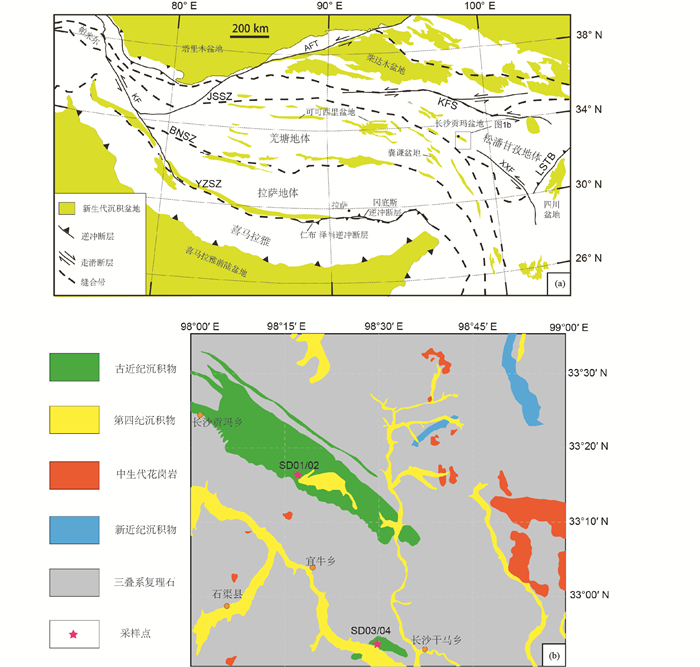
2 区域地质概况松潘甘孜地体是夹持于羌塘地体、柴达木-昆仑地体和扬子克拉通之间的三角形褶皱带,北界为阿尼玛卿-昆仑缝合带,南界为金沙江缝合带,东以龙门山与扬子克拉通块相邻(Yin and Harrison, 2000; Wang et al., 2011a; 图 1a)。松潘甘孜内出露的地质体主要是一套巨厚的三叠系复理石,出露面积>200, 000km2 (Nie et al., 1994; Weislogel et al., 2006)。三叠系之后的沉积物,仅零星出露古近纪地层。关于松潘甘孜三叠纪巨厚沉积岩形成的构造背景,目前认识不统一,至少有以下三种认识:(1) 沉积在洋壳基底之上的残留盆地(Pullen et al., 2008; Zhou and Graham, 1996);(2) 沉积在金沙江特提斯洋向北俯冲的弧后盆地之上(Burchfiel et al., 1995);(3) 沉积在扬子克拉通基底之上的,为东昆仑-西秦岭造山带的前陆盆地(胡健民等, 2005)。而该套三叠系复理石物源也较复杂,可能不同部位来自周围不同的造山带(Bruguier et al., 1997; Enkelmann et al., 2007; Weislogel et al., 2006, 2010; 兰中伍等, 2006; 刘飞等, 2006)。松潘甘孜内部主要出露中生代花岗岩。该地体的东南部为理塘和金沙江缝合线所限定的义敦岛弧,可能与发育在扬子西缘基础上的活动大陆边缘构造有关。
|
图 1 区域构造简图和地质图 (a)-青藏高原构造简图,显示新生代沉积盆地(据Horton et al., 2002修改);(b)-石渠地质简图,标出采样位置 Fig. 1 Regional simplified geological map (a)-simplified geological map of Tibetan Plateau, showing the major Cenozoic basins (modified after Horton et al., 2002). YZSZ-Yarlung Zangbo Suture Zone; BNSZ-Bangong-Nujiang Suture Zone; JSSZ-Jinsha Suture Zone; KFS-Kunlun fault system; AFT-Altyn Tagh fault; LSTB-Longmen Shan thrust belt; XXF-Xiangshuihe-Xiaojiang fault system. (b)-geological map of Shiqu area, showing locations of sample |
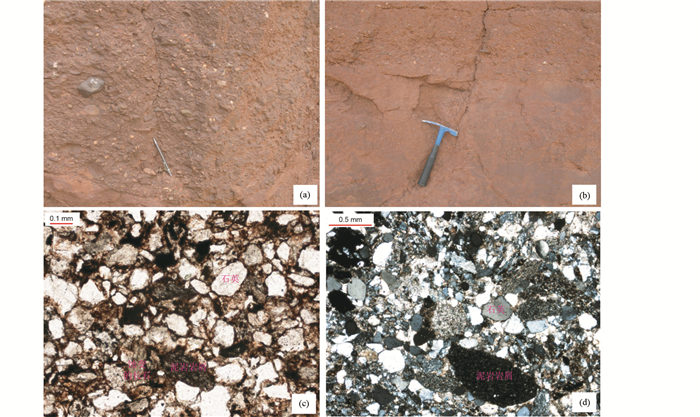
古近纪地层在松潘甘孜地体分布较少,主要集中在长沙贡玛盆地(图 1b)。该盆地边缘受长沙贡玛断裂带控制。而在区域上,它可能与囊谦盆地相似,都是在挤压-逆冲和走滑-拉分的构造环境中形成的古近纪盆地(周江羽等, 2002)。该套地层角度不整合覆盖在三叠纪地层之上。按岩性可分为三段。下段岩性为棕红色块状砾岩、棕红色中细粒岩屑砂岩、棕红色块状泥岩不等厚互层(图 2a, b)。砾石成分以砂岩为主,并含有板岩、灰岩、石英等,砾石分选差,砾径0.2~10cm不等,排列无方向,呈次棱角状至半圆状,基底式胶结。填隙物为砂、泥质(四川省地质矿产局区域地质调查队六分队, 1987①)。根据上述岩性组合,可以判断上段为冲积扇沉积环境。中段岩性主要为棕红色块状泥岩夹少量棕红色薄-中层长石岩屑砂岩,含白色薄-中层石膏。沉积构造主要有波状层理、粒序层理、平行层理等。因此,中段可能为湖泊沉积环境。上段岩性以棕红色块状砾岩、棕红色中层钙质岩屑石英砂岩、钙质含砾岩屑石英粗砂岩、长石岩屑砂岩为主,夹少量棕红色块状泥岩。砾石分选极差,砾径0.2~10 cm,砾石多呈角砾至次棱角状,少数呈次圆状。砾石成分主要为板岩、花岗岩、碳酸盐岩、石英等。推断上段为冲积扇沉积环境。
①四川省地质矿产局区域地质调查队六分队. 1987.中华人民共和国1:20万长沙贡玛幅和石渠幅区域地质调查报告
|
图 2 长沙贡玛盆地古近纪地层野外露头和砂岩显微照片 (a)-棕红色砾岩露头;(b)-棕红色砾岩与泥岩;(c)-样品SD02显微照片,单偏光;(d)-样品SD04显微照片,正交偏光 Fig. 2 Field photographs of the Paleogene strata in Changsha-Gongma basin and photomicrographs of sandstones (a)-outcrop of brown red conglomerate; (b)-brown red conglomerate interbeded with mudstone; (c)-photomicrograph of sample SD02, in plane polarized light; (d)-photomicrograph of sample SD04, in perpendicular polarized light |
样 品采自石渠县城东北约30km出的长沙贡玛盆地(图 1b)。岩性为细粒岩屑砂岩,石英含量约占55%,岩屑含量约占25%,长石含量约占8%,基质含量约占10%,锆石、磷灰石等其他矿物占约2%。岩屑主要为泥岩岩屑(图 2c, d),颗粒为次棱角状到次圆状,多晶石英较常见。我们选择了一个代表性样品SD02进行了锆石和磷灰石的挑选。该样品为长沙贡玛盆地古近纪地层下段的砂岩。在室内用颚式机和封闭式粉末制样机粉碎至60目以下。通过用水淘洗、重液和磁选,分离出无磁重矿物。在立体显微镜下从重矿物中挑选出锆石和磷灰石。锆石是随机挑选,黏在环氧树脂表面,制成锆石样靶,然后对其抛光直至锆石露出一半晶面。为了揭示锆石的内部结构、帮助选择适宜的测试点位,对锆石进行透射光、反射光显微镜和阴极发光图像分析。阴极发光在中国地质科学院北京离子探针中心扫描电镜及阴极发光实验室完成。
碎屑锆石U-Pb年龄在南京大学内生金属矿床成矿机制研究国家重点实验室完成。所用仪器为New Wave UP213激光剥蚀系统(LA) 和Agilent 7500a型等离子质谱仪(ICP-MS)。具体方法请参见Jackson et al. (2004)。分析时激光束斑直径为25μm。普通Pb校正采用Com-PbCorr#3_15软件(Andersen, 2002) 完成。锆石平均年龄、谐和图解以及年龄分布均用Isoplot程序完成。当锆石年龄 < 1000Ma时,采用206Pb/238U年龄;当锆石年龄>1000Ma时,采用206Pb/207Pb年龄。对于>1000Ma锆石年龄,采用谐和度 < 0%的年龄;而 < 1000Ma锆石年龄,则使用谐和度 < 20%的年龄(表 1)。
|
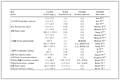
表 1 松潘甘孜长沙贡玛盆地古近纪砂岩(SD02) 碎屑锆石U-Pb年龄和Hf同位素组成 Table 1 U-Pb and Lu-Hf isotopic compositions of detrital zircons of sandstone (sample SD02) from the Changshagongma Basin, Songpan-Ganzi |


碎屑锆石Hf同位素测试在西北大学大陆动力学实验室Nu Plasma HR多接收器电感耦合等离子质谱仪(MC-ICPMS) 和Geo-Las200M激光剥蚀系统进行,分析束斑直径为44μm,激光脉冲速率为8Hz,激光脉冲能量为100mJ。分析测试的点与U-Pb分析点一致。锆石原位Lu-Hf同位素测定用176Lu/175Lu=0.02669和176Yb/172Yb=0.5886进行同量异位干扰校正计算测定样品中的176Lu/177Hf和176Hf/177Hf比值。测定时用国际标准锆石91500作外标。测试过程中,插入的91500标样的176Hf/177Hf平均值为0.282302±0.000032,与推荐值(0.282307±0.000031, 2σ) 很吻合(Wu et al., 2006)。εHf(t) 值和tDM的计算按照方法及衰变常数与上述情况一致。εHf(t) 值和tDM的计算按照Griffin et al. (2000)的方法,其中176Lu衰变常数参照Blichert-Toft and Albarède (1997)。
磷灰石(U-Th)/He年龄测定工作的前期处理和后期实验测试都是在加州大学圣克鲁斯分校中展开的。在显微镜下人工挑选晶形较好的磷灰石颗粒,并将它们拍照。所有颗粒均在透射光(单偏光和正交偏光下) 和反射光照射下进行挑选,以排除内部有包裹体的颗粒。只选择无包裹体,晶形完好和没有发生破裂的颗粒(Ehlers and Farley, 2003; Farley, 2002)。对选中的颗粒进行拍照,在照片上对颗粒的形态参数(长、宽等) 进行测量,以便计算颗粒的体积和进行α辐射校正。将颗粒包扎在Nb管子里面,然后将样品转让带有46个well的铜盘中。采用同位素稀释法,使用的仪器是Balzers QMS 200的四级杆质谱仪,对磷灰石颗粒进行He含量的测量。磷灰石颗粒在~1000℃下加热去气3min。磷灰石中U和Th的含量测定采样的是同位素稀释法。将去完氦气的磷灰石装入Teflon管子中,再添加229Th-233U稀释剂。往装有磷灰石的管子中,加入200μL的HNO3,之后放在加热板上加热2h,冷却1.5~3h后,再向每个管子中加入2.5mL的MiliQ水。将溶解好的样品进行U和Th含量的测量,所使用的是仪器是Thermo Scientific X-series四级杆电感耦合质谱仪。Durango标准磷灰石与样品一起进行了分析。磷灰石年龄的α校正参照了Farley et al. (1996)的方法。
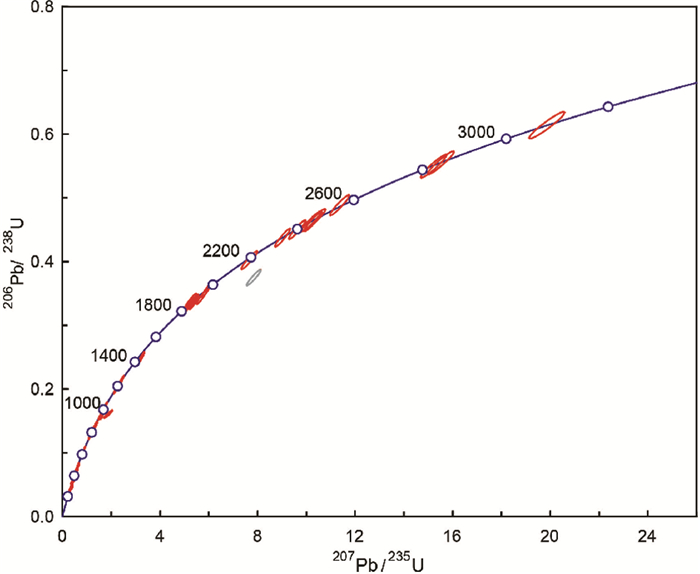
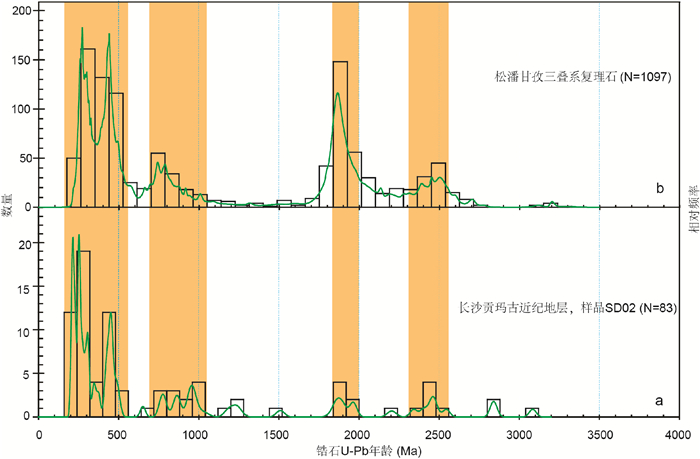
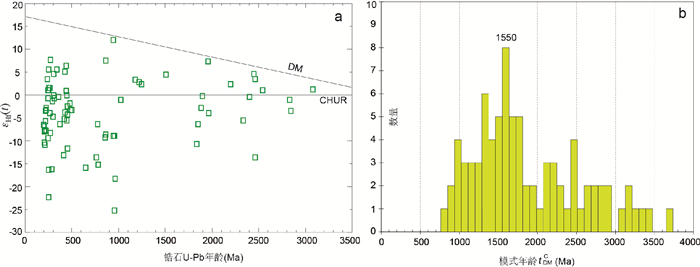
4 分析结果样品SD02的碎屑锆石大部分呈次棱角状到次圆状,极少数呈浑圆状,表明它们可能来自近源。阴极发光图像表明,多数锆石颗粒震荡环带发育,部分锆石环带较宽,粒径大小为50~150μm,以~100μm为主。对该样品中84个锆石颗粒进行了84个点位的U-Pb年龄和Hf同位素组成的原位测定。在207Pb/235U-206Pb/238U协和图上,绝大多数锆石在谐和线附近分布,仅有少数点偏离谐和曲线(图 3)。有83个锆石获得U-Pb谐和年龄,它们的年龄范围为200±3Ma到3084±11Ma (表 1、图 4a)。从其年龄谱图上可以分辨出四组峰值,分别为200~500Ma (50个,占60.2%),760~1040Ma (12个,占14.5%),1800~2000Ma (6个,占7.2%),2300~2600Ma (7个,占8.4%) (图 4a)。锆石颗粒的Hf同位素分析结果见表 1。其176Hf/177Hf值变化范围为0.280856~0.282820,计算得到的εHf(t) 值变化范围为-25.3~11.9 (图 5a),Hf模式年龄tDMC值变化范围为0.77~3.7Ga (表 1、图 5b)。
|
图 3 长沙贡玛盆地古近纪砂岩(SD02) 碎屑锆石U-Pb谐和图 Fig. 3 U-Pb concordia diagram for detrital zircons of sandstone (sample SD02), Changsha-Gongma Basin |
|
图 4 长沙贡玛盆地古近纪砂岩(SD02) 和松潘-甘孜三叠系沉积物(据Enkelmann et al., 2007; Weislogel et al., 2006, 2010) 碎屑锆石年龄谱图 Fig. 4 Detrital zircon U-Pb age probability plots for the Paleogene sandstone (sample SD02) from the Changsha-Gongma Basin and the Triassic sediments from Songpan-Ganzi (after Enkelmann et al., 2007; Weislogel et al., 2006, 2010) |
|
图 5 长沙贡玛盆地古近纪样品SD02碎屑锆石εHf(t) 与U-Pb年龄图(a) 及Hf模式年龄(b) Fig. 5 Plots of εHf(t) values vs. U-Pb ages (a) and Hf isotopic model ages (b) for detrital zircons from the Paleogene sandstone (sample SD02) |
碎屑磷灰石(U-Th)/He年龄见表 2。样品SD02的4个磷灰石单颗粒(U-Th)/He年龄结果较好,变化范围为17.43±0.33Ma (1σ) 到35.54±0.78Ma (1σ),平均年龄为21.3±8.8Ma。eU值变化为7.3×10⁻⁶~38.9×10⁻⁶ (eU=U+0.235×Th:U有效含量,用来衡量两种同位素衰变的参数; Farley et al., 2011; Flowers et al., 2009; Shuster et al., 2006)。该样品中4个颗粒(U-Th)/He年龄虽然变化较大,可能是在某些磷灰石中存在如锆石等U含量高的包体,而它们在磷灰石的溶解过程中,并不能发生溶解,从而导致获得较老的年龄。但是该样品四个磷灰石单颗粒的加权平均值可以看成是其(U-Th)/He年龄。
|
|
表 2 长沙贡玛盆地样品SD02磷灰石(U-Th)/He年龄 Table 2 Apatite (U-Th)/He ages from sample SD02, Changshagongma basin |
目前对于长沙贡玛盆地这套棕红色碎屑岩的年代并没有任何时代的约束。在1:20万的区调报告中(四川省地质矿产局区域地质调查队六分队, 1987),将该套地层与理塘县热鲁剖面进行岩性对比,从而将其年代定为晚白垩世-古近纪。
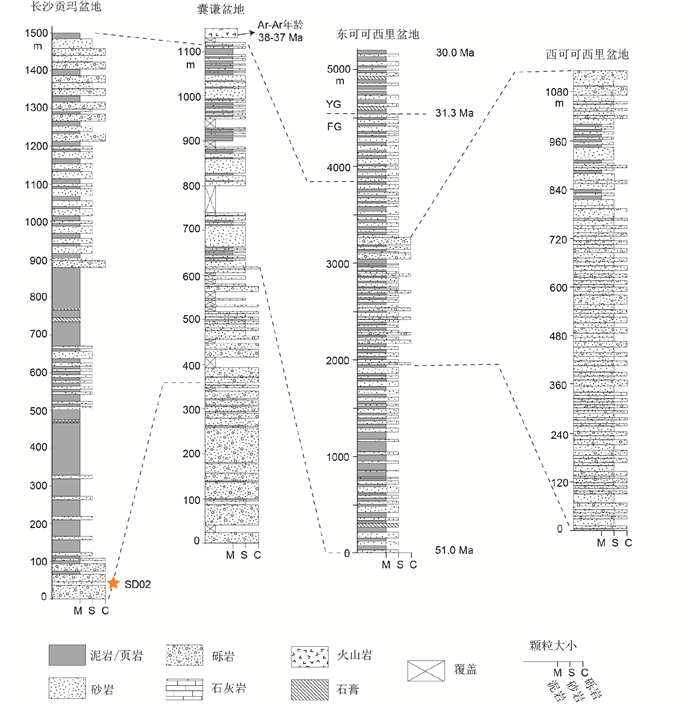
迄今,对位于长沙贡玛盆地以西的囊谦盆地和可可西里盆地开展了大量的沉积学、年代学的工作(Dai et al., 2012; Horton et al., 2002; Liu and Wang, 2001; Liu et al., 2003; Wang et al., 2008a; 周江羽等, 2002)。囊谦盆地地层岩性特征与长沙贡玛盆地相似,即下部为砂砾岩段,上部为泥砂岩段并含有石膏层和薄层灰岩。该套地层的沉积环境为冲积扇、河流和湖泊。根据与该套地层最上部互层的火山岩Ar-Ar年龄(38~37Ma) 和侵入地层中的侵入岩Ar-Ar年龄(51~49Ma),并结合地层中所发现的古生物化石,将该套地层年龄定为古近纪,盆地最后接受沉积的时间为始新世中期(Horton et al., 2002)。而长沙贡玛盆地中的这套紫红色碎屑岩在岩性上可以与囊谦盆地中上段进行对比(图 6),因此可以推测该套地层年代为古近纪。需要指出的是,囊谦盆地新生代地层遭受火山岩和侵入岩的改造,而长沙贡玛盆地目前没有发现火山岩夹层的报道。
|
图 6 长沙贡玛盆地、囊谦盆地和可可西里盆地新生代地层对比 长沙贡玛盆地修改自四川省地质矿产局区域地质调查队六分队, 1987;囊谦盆地修改自Horton et al. (2002); 东可可西里盆地修改自Liu et al. (2003); 西可可西里盆地修改自Dai et al. (2012) Fig. 6 Comparisons of Cenozoic lithologic sections from Changsha-Gongma Basin, Nangqian Basin, Hoh Xil Basin |
另外,该套地层与可可西里盆地风火山群中下部可以进行对比(图 6)。可可西里盆地新生代地层从下到上依次为风火山群、雅西措群和五道梁群(Liu and Wang, 2001; Liu et al., 2003)。其中风火山群由紫红色砂岩、泥岩和砾岩组成,厚约为4782.8m。雅西措群为砖红色泥岩、含石膏泥岩与紫红色粉砂岩、细砂岩韵律互成,厚度约为670m。五道梁群主要由一套内陆湖泊相灰岩、砂岩、未固结砂泥以及底砾岩沉积,厚度约为284m。根据磁性地层学定年结果表明风火山群年代为52.0~31.3Ma (始新世),雅西措群年代为31.3~23.8Ma (渐新世)。五道梁群的年代由生物地层学提供约束,为22Ma左右(中新世)(Liu and Wang, 2001; Liu et al., 2003)。上述对比表明,长沙贡玛盆地发生沉积的时代应该在古近纪。但是,必须指出的是目前对该套盆地的年代仅仅是通过岩性对比而推测的。相似的岩性组合并不一定代表它们具有等时性,且盆地之间距离较远。而本研究试图通过碎屑锆石的最小年龄来对地层年代的上限进行约束,但是目前所获取的锆石年龄最小为200±3Ma,对地层年代没有提供有力的约束。
5.2 物源分析及其初始物源区大陆地壳生长时限长沙贡玛盆地古近纪地层以棕红色砾岩、砂岩和泥岩为主,砾石分选极差,多呈次棱角状至次圆状,砾石成分以来自三叠纪地层中的砂岩、板岩为主。砂岩主要为岩屑砂岩和长石岩屑砂岩,颗粒为次棱角状到次圆状,岩屑成分主要为盆地周围三叠系泥岩。上述沉积特征表明该盆地古近纪沉积物是形成于近源快速堆积的陆内冲积扇环境。而它们的物源区则主要是盆地周缘的三叠系地层。
样品SD02碎屑锆石的年龄谱图中有四组峰值,分别为200~500Ma,760~1040Ma,1800~2000Ma,2300~2600Ma (图 4a)。这些峰值与松潘甘孜三叠系地层的U-Pb年龄峰值非常相似(图 4)。最年轻锆石的年龄为200Ma,比三叠系地层目前报道的最年轻锆石214±4Ma稍小(Enkelmann et al., 2007; Weislogel et al., 2006, 2010)。无侏罗纪和白垩纪年龄的锆石,与该地区鲜有侏罗纪和白垩纪岩浆事件吻合。同时表明,长沙贡玛盆地古近系地层物源区较为单一,主要来自其周缘的三叠系地层。
目前还缺乏松潘甘孜三叠系地层碎屑锆石Hf同位素的报道,从而无法将本研究中获得的Hf同位素组成与它们进行对比。这些碎屑锆石的Hf同位素可以用来揭示它们初始物源区大陆地壳生长的信息。样品SD02锆石Hf亏损地幔模式年龄在0.77~2.5Ga范围内有66个,占80%;2.5~3.7Ga区间内有17个,占20%(表 1、图 5b)。由此可以看出初始源区最强烈的地壳增生发生在元古代。碎屑锆石中εHf(t) 为正值的有25个,占30%,其对应的tDMC值为0.6~3.3Ga,部分锆石的U-Pb年龄值与tDMC相差200~300Ma。但是,这类锆石应该也不具有新生地壳性质,而是寄主岩浆源区来自壳幔相互作用的混合源区或者富集性地幔源区(第五春荣等, 2011)。εHf(t) 为负值的有58个,占70%,其锆石Hf地幔模式年龄明显大于锆石U-Pb年龄(表 1),表明这些锆石的形成是由先存地壳组分,特别是中元古代增生地壳的熔融作用形成。
5.3 松潘甘孜地块的隆升和剥蚀历史目前,对于松潘甘孜地体隆升历史的研究不多见。已有的热年代学研究表明松潘甘孜东部和南部(包括龙门山地区) 具有相似的冷却历史,即在侏罗纪和白垩纪经历缓慢冷却,在30Ma之后开始快速-中等的冷却(Roger et al., 2011; Roger et al., 2010)。Xu and Kamp (2000)指出在松潘甘孜东缘普遍经历了新近纪的剥露事件,与Kirby et al. (2002)的研究结果吻合。上述所提到的松潘甘孜东部新生代晚期的快速剥露事件可能是由局部构造活动或者是由松潘甘孜与四川盆地产生了明显的区域性地貌差异所造成的(Kirby et al., 2002; Wilson and Fowler, 2011; Xu and Kamp, 2000)。但是,上述研究主要是在松潘甘孜东部和南部以及龙门山地区,而对松潘甘孜中西部的研究较少。
长沙贡玛盆地面积虽小,然而它是松潘甘孜内部现存的几个新生代盆地之一。根据前文所述,长沙贡玛古近纪沉积物是近源快速堆积形成的,因此沉积地层年代能很好地指示源区(即松潘甘孜地体) 发生大规模隆升和剥蚀事件的时间。考虑到源区隆升与盆地沉积之间存在时滞(Najman, 2006),因此由这些古近纪的沉积物可以推断松潘甘孜地体很可能在白垩纪晚期-古近纪早期发生一次强烈的隆升和剥蚀。
碎屑磷灰石(U-Th)/He年龄能记录物源区或者沉积物本身发生隆升和剥蚀的时间。本文所获得的四个磷灰石(U-Th)/He加权平均年龄为21.3±8.8Ma,小于其沉积地层的年代,说明这些磷灰石沉积之后发生完全重置。因此,其年龄可能反映了沉积盆地内部所发生隆升的时间。也就是长沙贡玛盆地在渐新世晚期-中新世早期发生了隆升和剥蚀。此次隆升导致了盆地的部分沉积物发生剥蚀,从而使得磷灰石能通过其封闭温度。虽然在可可西里盆地中还没有相关碎屑(U-Th)/He年龄的报道,但是该盆地中的风火山群和雅西措群发生强烈变形,而以角度不整合覆盖在它们之上的五道梁组却只是表现很小或者微的角度倾斜(Wang et al., 2002b)。这说明可可西里盆地新生代地层的变形和隆升发生在五道梁群沉积之前,即发生在22Ma之前。以上事实表明,长沙贡玛盆地可能与高原中北部的可可西里盆地具有相似的隆升和剥蚀历史。但是两个盆地的形成背景不同,可可西里盆地是由唐古拉断裂控制的陆内前陆盆地(Li et al., 2012),而长沙贡玛盆地则与囊谦盆地较为相似,受早期挤压和后期走滑-拉分的构造背景控制(Horton et al., 2002; 周江羽等, 2002)。
松潘甘孜在晚白垩世-古近纪发生一次强烈隆升事件,这与目前高原中部,即拉萨地块和羌塘地块在该段时期内发生隆升事件相似(Rohrmann et al., 2012; Wang et al., 2007),表明了原西藏高原可能包括部分松潘甘孜地体。张克信等(2007)也认为松潘甘孜地体在晚白垩世-古近纪早期已经隆起,成为其周围盆地的物源区。长沙贡玛盆地在渐新世晚期-中新世早期发生隆升和剥蚀,可能反应了松潘甘孜地体同样经历了该期隆升,并进一步奠定了其现今地貌格局。但是导致该期隆升的地质事件并不清楚。
6 结论本文主要通过对长沙贡玛盆地中的一个岩屑砂岩样品碎屑锆石U-Pb年龄、Hf同位素组成以及磷灰石(U-Th)/He年龄进行了分析,并结合沉积学的工作,得出了以下结论:
(1) 长沙贡玛盆地中的地层与囊谦盆地和可可西里盆地古近纪地层在岩性上能很好地进行对比,从而推断长沙贡玛盆地棕红色碎屑岩的年代为古近纪;
(2) 长沙贡玛盆地以分选极差的砾岩、岩屑砂岩、长石岩屑砂岩和块状泥岩为主,表明该套古近纪沉积物是近源快速堆积形成的;
(3) 砂岩样品SD02碎屑锆石的年龄谱图中有四组峰值,分别为200~500Ma,760~1040Ma,1800~2000Ma,2300~2600Ma,与松潘甘孜三叠系地层的U-Pb年龄峰值非常相似,表明长沙贡玛盆地古近纪沉积物主要来自其周围的三叠纪地层;
(4) 砂岩样品SD02锆石Hf模式年龄主要在0.77~2.5Ga范围内,由此可以看出初始源区最强烈的地壳增生发生在元古代;
(5) 松潘甘孜在晚白垩世-古近纪发生一次强烈隆升,与高原中部,即拉萨地块和羌塘地块在该段时期内发生隆升事件相吻合,暗示了原西藏高原可能包括部分松潘甘孜地体;
(6) 长沙贡玛盆地可能在渐新世晚期-中新世早期发生了隆升和剥蚀可能反应了松潘甘孜地体同样经历了该期隆升,并进一步奠定了其现今地貌格局。
致谢 感谢南京大学的胡修棉教授对本文提出建设性的意见。孟俊和王一霖博士生一同参加了野外工作,在此表示感谢。| [] | Andersen T. 2002. Correction of common lead in U-Pb analyses that do not report 204Pb. Chemical Geology, 192(1-2): 59–79. DOI:10.1016/S0009-2541(02)00195-X |
| [] | Blichert-Toft J, Albarède F. 1997. The Lu-Hf isotope geochemistry of chondrites and the evolution of the mantle-crust system. Earth and Planetary Science Letters, 148(1-2): 243–258. DOI:10.1016/S0012-821X(97)00040-X |
| [] | Blisniuk PM, Hacker BR, Glodny J, Ratschbacher L, Bi SW, Wu ZH, McWilliams MO, Calvert A. 2001. Normal faulting in central Tibet since at least 13.5 Myr ago. Nature, 412(6847): 628–632. DOI:10.1038/35088045 |
| [] | Bruguier O, Lancelot JR, Malavieille J. 1997. U-Pb dating on single detrital zircon grains from the Triassic Songpan-Ganze flysch (Central China): Provenance and tectonic correlations. Earth and Planetary Science Letters, 152(1-4): 217–231. DOI:10.1016/S0012-821X(97)00138-6 |
| [] | Burchfiel BC, Zhiliang C, Yupinc L, Royden LH. 1995. Tectonics of the Longmen Shan and Adjacent Regions, Central China. International Geology Review, 37(8): 661–735. DOI:10.1080/00206819509465424 |
| [] | Chung S, Lo CH, Lee TY, Zhang YQ, Xie YW, Li XH, Wang KL, Wang PL. 1998. Diachronous uplift of the Tibetan plateau starting 40 Myr ago. Nature, 394(6695): 769–773. DOI:10.1038/29511 |
| [] | Clark MK, House MA, Royden LH, Whipple KX, Burchfiel BC, Zhang X, Tang W. 2005. Late Cenozoic uplift of southeastern Tibet. Geology, 33(6): 525–528. DOI:10.1130/G21265.1 |
| [] | Coleman M, Hodges K. 1995. Evidence for Tibetan Plateau uplift before 14 Myr ago from a new minimum age for east-west extension. Nature, 374(6517): 49–52. DOI:10.1038/374049a0 |
| [] | Currie BS, Rowley DB, Tabor NJ. 2005. Middle Miocene paleoaltimetry of southern Tibet: Implications for the role of mantle thickening and delamination in the Himalayan orogen. Geology, 33(3): 181–184. DOI:10.1130/G21170.1 |
| [] | Dai JG, Zhao XX, Wang CS, Zhu LD, Li YL, Finn D. 2012. The vast proto-Tibetan Plateau: New constraints from Paleogene Hoh Xil Basin. Gondwana Research, 22(2): 434–446. DOI:10.1016/j.gr.2011.08.019 |
| [] | DeCelles PG, Gehrels GE, Quade J, Ojha TP, Kapp PA, Upreti BN. 1998. Neogene foreland basin deposits, erosional unroofing, and the kinematic history of the Himalayan fold-thrust belt, western Nepal. Geological Society of America Bulletin, 110(1): 2–21. DOI:10.1130/0016-7606(1998)110<0002:NFBDEU>2.3.CO;2 |
| [] | Diwu CR, Sun Y, Liu YJ, Han W, Dai MN, Li YX. 2011. The protolith nature of quartz sandstone from Changlongshan Formation in Liujiang area, Qinhuangdao City: Evidence of U-Pb and Hf-isotope from detrital zircons. Acta Petrologica et Mineralogica, 30(1): 1–12. |
| [] | Druschke P, Hanson AD, Wells ML, Gehrels GE, Stockli D. 2011. Paleogeographic isolation of the Cretaceous to Eocene Sevier hinterland, east-central Nevada: Insights from U-Pb and (U-Th)/He detrital zircon ages of hinterland strata. Geological Society of America Bulletin, 123(5-6): 1141–1160. DOI:10.1130/B30029.1 |
| [] | Ehlers TA, Farley KA. 2003. Apatite (U-Th)/He thermochronometry: Methods and applications to problems in tectonic and surface processes. Earth and Planetary Science Letters, 206(1-2): 1–14. DOI:10.1016/S0012-821X(02)01069-5 |
| [] | Enkelmann E, Weislogel A, Ratschbacher L, Eide E, Renno A, Wooden J. 2007. How was the Triassic Songpan-Ganzi basin filled? A provenance study. Tectonics, 26(4): TC4007. |
| [] | Fang XM, Zhang WL, Meng QQ, Gao JP, Wang XM, King J, Song CH, Dai S, Miao YF. 2007. High-resolution magnetostratigraphy of the Neogene Huaitoutala section in the eastern Qaidam Basin on the NE Tibetan Plateau, Qinghai Province, China and its implication on tectonic uplift of the NE Tibetan Plateau. Earth and Planetary Science Letters, 258(1-2): 293–306. DOI:10.1016/j.epsl.2007.03.042 |
| [] | Farley KA, Wolf RA, Silver LT. 1996. The effects of long alpha-stopping distances on (U-Th)/He ages. Geochimica et Cosmochimica Acta, 60(21): 4223–4229. DOI:10.1016/S0016-7037(96)00193-7 |
| [] | Farley KA. 2002. (U-Th)/He dating: Techniques, calibrations, and applications. Noble Gas Geochemistry. Reviews in Mineralogy and Geochemistry, 47(1): 819–844. DOI:10.2138/rmg.2002.47.18 |
| [] | Farley KA, Shuste DL, Ketchamr RA. 2011. U and Th zonation in apatite observed by laser ablation ICPMS, and implications for the (U-Th)/He system. Geochimica Et Cosmochimica Acta, 75(16): 4515–4530. DOI:10.1016/j.gca.2011.05.020 |
| [] | Flowers RM, Ketcham RA, Shuster DL, Farley KA. 2009. Apatite (U-Th)/He thermochronometry using a radiation damage accumulation and annealing model. Geochimica et Cosmochimica Acta, 73(8): 2347–2365. DOI:10.1016/j.gca.2009.01.015 |
| [] | Ge XH, Ren SM, Ma LX, Wu GD, Liu YJ, Yuan SH. 2006. Multi-stage uplifts of the Qinghai-Tibet Plateau and their environmental effects. Earth Science Frontiers, 13(6): 118–130. |
| [] | Griffin WL, Pearson NJ, Belousova E, Jackson SE, van Achterbergh E, O'Reilly SY, Shee SR. 2000. The Hf isotope composition of cratonic mantle: LAM-MC-ICPMS analysis of zircon megacrysts in kimberlites. Geochimica et Cosmochimica Acta, 64(1): 133–147. DOI:10.1016/S0016-7037(99)00343-9 |
| [] | Harrison TM, Copeland P, Kidd WSF, Yin A. 1992. Raising Tibet. Science, 255(5052): 1663–1670. DOI:10.1126/science.255.5052.1663 |
| [] | Horton BK, Yin A, Spurlin MS, Zhou JY, Wang JH. 2002. Paleocene-Eocene syncontractional sedimentation in narrow, lacustrine-dominated basins of east-central Tibet. Geological Society of America Bulletin, 114(7): 771–786. DOI:10.1130/0016-7606(2002)114<0771:PESSIN>2.0.CO;2 |
| [] | Hu JM, Meng QR, Shi YR, Qu HJ. 2005. SHRIMP U-Pb dating of zircons from granitoid bodies in the Songpan-Ganzi terrane and its implications. Acta Petrologica Sinica, 21(3): 867–880. |
| [] | Hu XM, Sinclair HD, Wang JG, Jiang HH, Wu FY. 2012. Late Cretaceous-Palaeogene stratigraphic and basin evolution in the Zhepure Mountain of southern Tibet: Implications for the timing of India-Asia initial collision. Basin Research, 24(5): 520–543. DOI:10.1111/bre.2012.24.issue-5 |
| [] | Jackson SE, Pearson NJ, Griffin WL, Belousova EA. 2004. The application of laser ablation-inductively coupled plasma-mass spectrometry to in situ U-Pb zircon geochronology. Chemical Geology, 211(1-2): 47–69. DOI:10.1016/j.chemgeo.2004.06.017 |
| [] | Kirby E, Reiners PW, Krol MA, Whipple KX, Hodges KV, Farley KA, Tang WQ, Chen ZL. 2002. Late Cenozoic evolution of the eastern margin of the Tibetan Plateau: Inferences from 40Ar/39Ar and (U-Th)/He thermochronology. Tectonics, 21(1): 1–1. |
| [] | Lan ZW, Chen YL, Su BX, Liu F, Zhang HF. 2006. The origin of sandstones from the Songpan-Ganze Basin, Sichuan, China: Evidence from SHRIMP U-Pb dating of clastic zircons. Acta Sedimentologica Sinica, 24(3): 321–332. |
| [] | Li JJ, Fang XM, Pan BT, Zhao ZJ, Song YG. 2001. Late Cenozoic intensive uplift of Qinghai-Xizang Plateau and its impacts on environments in surrounding area. Quaternary Sciences, 21(5): 381–391. |
| [] | Li YL, Wang CS, Zhao XX, Yin A, Ma C. 2012. Cenozoic thrust system, basin evolution, and uplift of the Tanggula Range in the Tuotuohe region, central Tibet. Gondwana Research, 22(2): 482–492. DOI:10.1016/j.gr.2011.11.017 |
| [] | Liu F, Chen YL, Su BX, Lan ZW, Jiang LT. 2006. Geochemistry and zircon ages of Triassic detrital sedimentary rocks from the Ganze-Songpan block. Acta Geoscientica Sinica, 27(4): 289–296. |
| [] | Liu ZF, Wang CS. 2001. Facies analysis and depositional systems of Cenozoic sediments in the Hoh Xil basin, Northern Tibet. Sedimentary Geology, 140(3-4): 251–270. DOI:10.1016/S0037-0738(00)00188-3 |
| [] | Liu ZF, Zhao XX, Wang CS, Liu S, Yi HS. 2003. Magnetostratigraphy of Tertiary sediments from the Hoh Xil Basin: Implications for the Cenozoic tectonic history of the Tibetan Plateau. Geophysical Journal International, 154(2): 233–252. DOI:10.1046/j.1365-246X.2003.01986.x |
| [] | Molnar P, England P, Martinod J. 1993. Mantle dynamics, uplift of the Tibetan Plateau, and the Indian monsoon. Reviews of Geophysics, 31(4): 357–396. DOI:10.1029/93RG02030 |
| [] | Molnar P, Boos WR, Battisti DS. 2010. Orographic controls on climate and paleoclimate of Asia: Thermal and mechanical roles for the Tibetan Plateau. Annual Review of Earth and Planetary Sciences, 38(1): 77–102. DOI:10.1146/annurev-earth-040809-152456 |
| [] | Najman Y. 2006. The detrital record of orogenesis: A review of approaches and techniques used in the Himalayan sedimentary basins. Earth-Science Reviews, 74(1-2): 1–72. |
| [] | Nie SY, Yin A, Rowley DB, Jin Y. 1994. Exhumation of the Dabie Shan ultra-high-pressure rocks and accumulation of the Songpan-Ganzi flysch sequence, central China. Geology, 22(11): 999–1002. DOI:10.1130/0091-7613(1994)022<0999:EOTDSU>2.3.CO;2 |
| [] | Pullen A, Kapp P, Gehrels GE, Vervoort JD, Ding L. 2008. Triassic continental subduction in central Tibet and Mediterranean-style closure of the Paleo-Tethys Ocean. Geology, 36(5): 351–354. DOI:10.1130/G24435A.1 |
| [] | Quade J, Breecker DO, Daēeron M, Eiler J. 2011. The paleoaltimetry of Tibet: An isotopic perspective. American Journal of Science, 311(2): 77–115. DOI:10.2475/02.2011.01 |
| [] | Raymo ME, Ruddiman WF. 1992. Tectonic forcing of Late Cenozoic climate. Nature, 359(6391): 117–122. DOI:10.1038/359117a0 |
| [] | Reiners PW, Brandon MT. 2006. Using thermochronology to understand orogenic erosion. Annual Review of Earth and Planetary Sciences, 34(1): 419–466. DOI:10.1146/annurev.earth.34.031405.125202 |
| [] | Richter FM, Rowley DB, DePaolo DJ. 1992. Sr isotope evolution of seawater: The role of tectonics. Earth and Planetary Science Letters, 109(1-2): 11–23. DOI:10.1016/0012-821X(92)90070-C |
| [] | Roger F, Jolivet M, Malavieille J. 2010. The tectonic evolution of the Songpan-Garzê (North Tibet) and adjacent areas from Proterozoic to present: A synthesis. Journal of Asian Earth Sciences, 39(4): 254–269. DOI:10.1016/j.jseaes.2010.03.008 |
| [] | Roger F, Jolivet M, Cattin R, Malavieille J. 2011. Mesozoic-Cenozoic tectonothermal evolution of the eastern part of the Tibetan Plateau (Songpan-Garzê, Longmen Shan area): Insights from thermochronological data and simple thermal modelling. Geological Society, London, Special Publications, 353(1): 9–25. DOI:10.1144/SP353.2 |
| [] | Rohrmann A, Kapp P, Carrapa B, Reiners PW, Guynn J, Ding L, Heizler M. 2012. Thermochronologic evidence for plateau formation in central Tibet by 45Ma. Geology, 40(2): 187–190. DOI:10.1130/G32530.1 |
| [] | Rowley DB, Currie BS. 2006. Palaeo-altimetry of the Late Eocene to Miocene Lunpola basin, central Tibet. Nature, 439(7077): 677–681. DOI:10.1038/nature04506 |
| [] | Shuster DL, Flowers RM, Farley KA. 2006. The influence of natural radiation damage on helium diffusion kinetics in apatite. Earth and Planetary Science Letters, 249(3-4): 148–161. DOI:10.1016/j.epsl.2006.07.028 |
| [] | Song CH, Fang XM, Gao JP, Sun D, Fan MJ. 2001. Tectonic uplift and sedimentary evolution of the guide basin in the northeast margin of Tibetan Plateau in Cenozoic Era. Acta Sedimentologica Sinica, 19(4): 493–500. |
| [] | Söderlund U, Patchett PJ, Vervoort JD, Isachsen CE. 2004. The 176Lu decay constant determined by Lu-Hf and U-Pb isotope systematics of Precambrian mafic intrusions. Earth and Planetary Science Letters, 219(3-4): 311–324. DOI:10.1016/S0012-821X(04)00012-3 |
| [] | Spicer RA, Harris NBW, Widdowson M, Herman AB, Guo SX, Valdes PJ, Wolfe JA, Kelley SP. 2003. Constant elevation of southern Tibet over the past 15 million years. Nature, 421(6923): 622–624. DOI:10.1038/nature01356 |
| [] | Tapponnier P, Xu ZQ, Françoise R, Bertrand M, Nicolas A, Gérard W, Yang JS. 2001. Oblique stepwise rise and growth of the Tibet Plateau. Science, 294(5547): 1671–1677. DOI:10.1126/science.105978 |
| [] | Turner S, Hawkesworth C, Liu JQ, Rogers N, Kelley S, van Calsteren P. 1993. Timing of Tibetan uplift constrained by analysis of volcanic rocks. Nature, 364(6432): 50–54. DOI:10.1038/364050a0 |
| [] | Wang CS, Li XH, Hu XM, Jansa LF. 2002a. Latest marine horizon north of Qomolangma (Mt. Everest): Implications for closure of Tethys seaway and collision tectonics. Terra Nova, 14(2): 114–120. DOI:10.1046/j.1365-3121.2002.00399.x |
| [] | Wang CS, Liu ZF, Yi HS, Liu S, Zhao XX. 2002b. Tertiary crustal shortening and peneplanation in the Hoh Xil region: Implications for the tectonic history of the northern Tibetan Plateau. Journal of Asian Earth Sciences, 20(3): 211–223. DOI:10.1016/S1367-9120(01)00051-7 |
| [] | Wang CS, Zhao XX, Liu ZF, Lippert PC, Graham SA, Coe RS, Yi HS, Zhu LD, Liu S, Li YL. 2008a. Constraints on the early uplift history of the Tibetan Plateau. Proceedings of the National Academy of Sciences of the United States of America, 105(13): 4987–4992. DOI:10.1073/pnas.0703595105 |
| [] | Wang CS, Gao R, Yin A, Wang HY, Zhang YX, Guo TL, Li QS, Li YL. 2011a. A mid-crustal strain-transfer model for continental deformation: A new perspective from high-resolution deep seismic-reflection profiling across NE Tibet. Earth and Planetary Science Letters, 306(3-4): 279–288. DOI:10.1016/j.epsl.2011.04.010 |
| [] | Wang CS, Li XH, Liu ZF, Li YL, Jansa L, Dai JG, Wei YS. 2012b. Revision of the Cretaceous-Paleogene stratigraphic framework, facies architecture and provenance of the Xigaze forearc basin along the Yarlung Zangbo suture zone. Gondwana Research, 22(2): 415–433. DOI:10.1016/j.gr.2011.09.014 |
| [] | Wang JG, Hu XM, Jansa LB, Huang ZC. 2011b. Provenance of the Upper Cretaceous-Eocene deep-water sandstones in Sangdanlin, Southern Tibet: Constraints on the timing of initial India-Asia collision. The Journal of Geology, 119(3): 293–309. DOI:10.1086/659145 |
| [] | Wang Q, Wyman DA, Xu JF, Dong YH, Vasconcelos PM, Pearson N, Wan YS, Dong H, Li CF, Yu YS, Zhu TX, Feng XT, Zhang QY, Zi F, Chug ZY. 2008b. Eocene melting of subducting continental crust and early uplifting of central Tibet: Evidence from central-western Qiangtang high-K calc-alkaline andesites, dacites and rhyolites. Earth and Planetary Science Letters, 272(1-2): 158–171. DOI:10.1016/j.epsl.2008.04.034 |
| [] | Wang Y, Zhang XM, Sun LX, Wan JL. 2007. Cooling history and tectonic exhumation stages of the south-central Tibetan Plateau (China): Constrained by 40Ar/39Ar and apatite fission track thermochronology. Journal of Asian Earth Sciences, 29(2-3): 266–282. DOI:10.1016/j.jseaes.2005.11.001 |
| [] | Weislogel AL, Graham SA, Chang EZ, Wooden JL, Gehrels GE. 2010. Detrital zircon provenance from three turbidite depocenters of the Middle-Upper Triassic Songpan-Ganzi complex, central China: Record of collisional tectonics, erosional exhumation, and sediment production. Geological Society of America Bulletin, 122(11-12): 2041–2062. DOI:10.1130/B26606.1 |
| [] | Weislogel AL, Graham SA, Chang EZ, Wooden JL, Gehrels GE, Yang HS. 2006. Detrital zircon provenance of the Late Triassic Songpan-Ganzi complex: Sedimentary record of collision of the North and South China blocks. Geology, 34(2): 97–100. DOI:10.1130/G21929.1 |
| [] | Wilson CJL, Fowler AP. 2011. Denudational response to surface uplift in east Tibet: Evidence from apatite fission-track thermochronology. Geological Society of America Bulletin, 123(9-10): 1966–1987. DOI:10.1130/B30331.1 |
| [] | Wu FY, Yang YH, Xie LW, Yang JH, Xu P. 2006. Hf isotopic compositions of the standard zircons and baddeleyites used in U-Pb geochronology. Chemical Geology, 234(1-2): 105–126. DOI:10.1016/j.chemgeo.2006.05.003 |
| [] | Xu GQ, Kamp PJJ. 2000. Tectonics and denudation adjacent to the Xianshuihe fault, eastern Tibetan Plateau: Constraints from fission track thermochronology. Journal of Geophysical Research, 105(B8): 19231–19251. DOI:10.1029/2000JB900159 |
| [] | Yin A, Harrison TM. 2000. Geologic evolution of the Himalayan-Tibetan orogen. Annual Review Earth and Planetary Sciences, 28(1): 211–280. DOI:10.1146/annurev.earth.28.1.211 |
| [] | Zhang JY, Zhang KX, Ji JL, Luo MS, Chen FN, Xu YD, Wang YM. 2010. Oligocene-Pliocene sedimentary facies analysis and sedimentary evolution of Xunhua basin in northeastern margin of Qinghai-Tibet Plateau. Earth Science, 35(5): 774–788. |
| [] | Zhang KX, Wang GC, Chen FN, Xu YD, Luo MS, Xiang SY, Kou XH, Zhao LS. 2007. Coupling between the uplift of Qinghai-Tibet Plateau and distribution of basins of Paleogene-Neogene. Earth Science, 32(5): 583–597. |
| [] | Zhou D, Graham SA. 1996. Extrusion of the Altyn Tagh wedge: A kinematic model for the Altyn Tagh fault and palinspastic reconstruction of northern China. Geology, 24(5): 427–430. DOI:10.1130/0091-7613(1996)024<0427:EOTATW>2.3.CO;2 |
| [] | Zhou JY, Wang JH, Yin A, Spurlin MS, Horton BK. 2003. Depositional patterns and tectonic setting of Early Tertiary basins in the NE margin of the Tibetan Plateau. Acta Sedimentologica Sinica, 20(1): 85–91. |
| [] | Zhu DC, Zhao ZD, Niu Y, Dilek Y, Mo XX. 2011. Lhasa terrane in southern Tibet came from Australia. Geology, 39(8): 727–730. DOI:10.1130/G31895.1 |
| [] | Zhuang G, Hourigan JK, Ritts BD, Kent-Corson ML. 2011. Cenozoic multiple-phase tectonic evolution of the northern Tibetan Plateau: Constraints from sedimentary records from Qaidam basin, Hexi Corridor, and Subei basin, northwest China. American Journal of Sciences, 311(2): 116–152. |
| [] | 第五春荣, 孙勇, 刘养杰, 韩伟, 戴梦宁, 李永项. 2011. 秦皇岛柳江地区长龙山组石英砂岩物质源区组成--来自碎屑锆石U-Pb-Hf同位素的证据. 岩石矿物学杂志, 30(1): 1–12. |
| [] | 葛肖虹, 任收麦, 马立祥, 吴光大, 刘永江, 袁四化. 2006. 青藏高原多期次隆升的环境效应. 地学前缘, 13(6): 118–130. |
| [] | 胡健民, 孟庆任, 石玉若, 渠洪杰. 2005. 松潘-甘孜地体内花岗岩锆石SHRIMP U-Pb定年及其构造意义. 岩石学报, 21(3): 867–880. |
| [] | 兰中伍, 陈岳龙, 苏本勋, 刘飞, 张宏飞. 2006. 四川松潘-甘孜盆地砂岩的物质来源:来自锆石U-Pb (SHRIMP) 年龄证据. 沉积学报, 24(3): 321–332. |
| [] | 李吉均, 方小敏, 潘保田, 赵志军, 宋友桂. 2001. 新生代晚期青藏高原强烈隆起及其对周边环境的影响. 第四纪研究, 21(5): 381–391. |
| [] | 刘飞, 陈岳龙, 苏本勋, 兰中伍, 蒋丽婷. 2006. 松潘-甘孜地区三叠系碎屑沉积岩地球化学特征及其锆石年龄研究. 地球学报, 27(4): 289–296. |
| [] | 宋春晖, 方小敏, 高军平, 孙东, 范马洁. 2001. 青藏高原东北部贵德盆地新生代沉积演化与构造隆升. 沉积学报, 19(4): 493–500. |
| [] | 张楗钰, 张克信, 季军良, 骆满生, 陈奋宁, 徐亚东, 王岳明. 2010. 青藏高原东北缘循化盆地渐新世-上新世沉积相分析与沉积演化. 地球科学, 35(5): 774–788. |
| [] | 张克信, 王国灿, 陈奋宁, 徐亚东, 骆满生, 向树元, 寇晓虎, 赵来时. 2007. 青藏高原古近纪-新近纪隆升与沉积盆地分布耦合. 地球科学, 32(5): 583–597. |
| [] | 周江羽, 王江海, 尹安, SpurlinMS, HortonBK. 2002. 青藏东北缘早第三纪盆地充填的沉积型式及构造背景--以囊谦和下拉秀盆地为例. 沉积学报, 20(1): 85–91. |