 2013, Vol. 29


华北克拉通孔兹岩带是西部陆块内的一条古元古代碰撞构造带,由北部的阴山陆块和南部的鄂尔多斯陆块于~1.95Ga碰撞形成(Zhao et al., 1999, 2002, 2005;Zhai et al., 2000)。多年来许多研究者对孔兹岩带进行了深入而系统的成因矿物学、岩石学、变质演化、同位素年代学和构造解析等方面的研究(Condie et al., 1992;Lu and Jin, 1993;Liu et al., 1993;刘福来等,2002;Zhao et al., 2002;徐仲元等, 2003, 2011;Wan et al., 2006, 2009, 2013;Xia et al., 2006;Santosh et al., 2006, 2007, 2009;Dong et al., 2007, 2012;董春艳等, 2009a, b;Yin et al., 2009, 2011;Yin,2010;周喜文等,2010;Guo et al., 2012;王洛娟等,2011;Liu et al., 2012;Ma et al., 2012;Dan et al., 2012)。并在孔兹岩带的物质组成、地质事件演化序列、变质演化和原岩性质等方面取得了一系列重要的研究成果和进展。一些研究者(Santosh et al., 2006, 2007, 2009;Jiao and Guo, 2011;Guo et al., 2012;Liu et al., 2012)深入研究了土贵乌拉、东坡以及和林格尔等地的超高温变质岩,计算得到变质温度可达1000℃以上。另有部分研究者(周喜文等,2010;Yin,2010)对西段贺兰山-千里山地区的高压泥质麻粒岩采用相平衡模拟计算得到了顺时针的P-T轨迹,压力最高可达~15kbar。Yin et al.(2011)认为贺兰山富铝片麻岩的沉积时代晚于2.0Ga,西部陆块含有古-中太古代(3.34~3.10Ga)的古老地壳。Dan et al.(2012)提出贺兰山富铝片麻岩源岩是一系列阶段性岩浆事件的产物,其源区有古老地壳物质和地幔物质的添加,沉积环境是活动大陆边缘。Peng et al.(2012)认为凉城一带S-型花岗岩、紫苏花岗岩和辉长苏长岩是~1.93Ga的洋中脊俯冲过程中岩浆作用在地壳不同层次的产物,该过程与~1.93Ga超高温变质事件有密切的成因关系。
然而值得注意的是,近10年来有关孔兹岩带的研究分别集中在孔兹岩带的西段和东段,对于孔兹岩带中段的大青山-乌拉山变质杂岩的研究主要围绕同位素年代学的研究而展开,前人(吴昌华等,2006;Dong et al., 2012)研究获得大青山-乌拉山富铝片麻岩的沉积时代是古元古代(2.2~1.95Ga),而角闪岩相-麻粒岩相变质时代为1.95~1.85Ga。Wan et al.(2013)指出大青山-乌拉山变质基性岩记录的2.45~2.37Ga和1.97~1.92Ga两次岩浆事件是在古元古代的拉张环境下形成的。尽管前人(金巍等, 1991, 1992;Liu et al., 1993;李树勋等,1994)对大青山-乌拉山变质杂岩的物质组成与变质演化等方面的研究做了开拓性的工作,目前对于大青山-乌拉山变质杂岩的物质组成、岩石学、变质演化以及将变质演化与同位素年代学有机结合的研究仍相对薄弱,尤其是早期研究者依据传统地质温压计而建立的P-T轨迹有待进一步完善。考虑到近年来变质岩石学的主要发展之一是将基于内恰的热力学数据库的THERMOCALC程序应用于变质作用的研究(Powell and Holland, 1988,2008;Powell,1998;Holland and Powell, 1998,2003)。故本文以大青山-乌拉山变质杂岩中石拐地区出露的富铝片麻岩为重点研究对象,以野外地质观察和岩相学研究为基础,从成因矿物学和变质作用入手,结合传统地质温压计和相平衡模拟(P-T视剖面图)两种方法限定研究区富铝片麻岩不同变质阶段的P-T条件,进而构筑有效的P-T演化轨迹,为精细刻画大青山-乌拉山变质杂岩的变质演化历史提供新的科学依据。
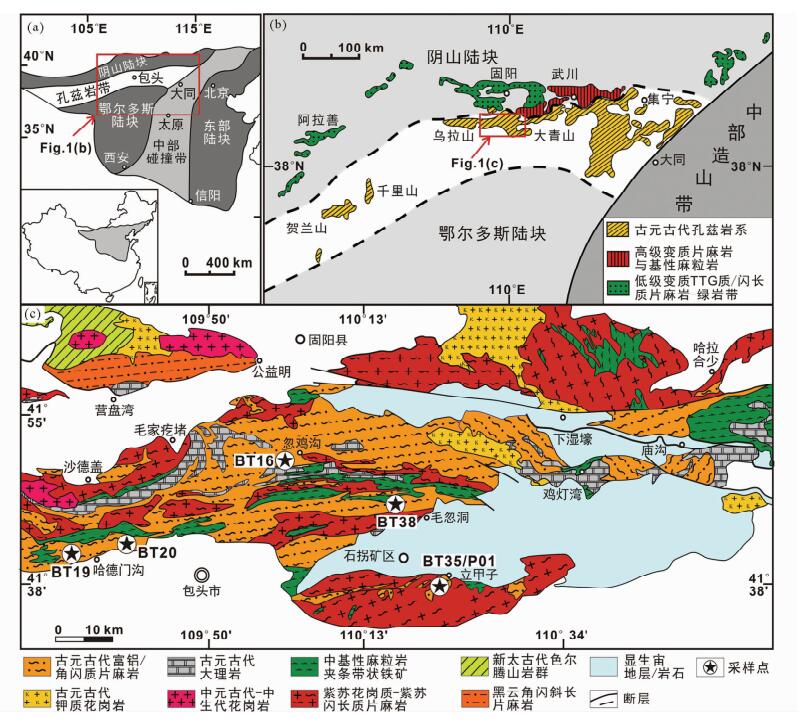
2 地质背景研究区位于黄河以北的内蒙古大青山-乌拉山地区,是华北克拉通北缘沿集宁-大青山-乌拉山-千里山-贺兰山一线展布的孔兹岩带的重要组成部分(图 1),其南侧和北侧为太古代鄂尔多斯陆块和阴山陆块,西侧分别是千里山变质杂岩和贺兰山变质杂岩,东侧与孔兹岩带的集宁变质杂岩相邻(图 1)。大青山地区出露的岩石类型以早前寒武纪变质岩系和显生宙沉积岩系为主,显生宙沉积岩系主要为侏罗纪含煤陆源碎屑岩系。此外,在局部地区有少量中元古代-中生代岩浆岩分布。
|
图 1 内蒙孔兹岩带在华北克拉通的分布和构造位置图(a,b,据Zhao et al., 2005)和大青山-乌拉山变质杂岩地质简图及采样位置(c,据Liu et al., 2007) Fig. 1 Distribution of khondalite belt from Inner Mongolia in North China Craton (a, b, after Zhao et al., 2005) and geological map of Daqingshan-Wulashan metamorphic complex featuring the sample locations (c, after Liu et al., 2007) |
区内早前寒武纪变质岩主要包括新太古代兴和岩群麻粒岩系、古元古代乌拉山岩群和美岱召岩群变质表壳岩系(孔兹岩系)、新太古代深变质岩浆岩、古元古代岩浆岩以及少量的古元古代(石榴)基性麻粒岩和斜长角闪岩。这些岩石单元曾先后被命名为太古宙桑干群、五台群;太古宙乌拉山群、集宁岩群;孔兹岩系和麻粒岩系,太古宙岩系、古元古代岩系和基底再造岩系。新太古代兴和岩群麻粒岩系,在区内出露广泛,主要出露于哈德门沟-贾浪沟-爬榆树-乌兰此老-五当召-后厂汉大坝一带。此外,在南部岩片的水涧沟、杨圪楞煤矿等地和北部阴山陆块内部的下湿壕-后腮忽洞-后哈拉站一带则呈大小不等的残片零星出露(图 1)。其主要由角闪二辉麻粒岩、含榴角闪二辉麻粒岩、黑云紫苏麻粒岩,磁铁紫苏麻粒岩、紫苏斜长麻粒岩、角闪紫苏二长麻粒岩、辉石斜长角闪岩和角闪斜长透辉岩夹条带状铁英岩所组成。在局部可以出现基性麻粒岩-中性麻粒岩-酸性麻粒岩的韵律层,总体上具有灰绿色、灰褐色外貌,并以厚层状产出为特征。成分上以中性麻粒岩为主,夹酸性麻粒岩、基性麻粒岩和条带状铁英岩层。大量的原岩恢复和岩石化学分析资料分析结果表明(董晓杰, 2012;刘平华等,2013),新太古代兴和岩群麻粒岩系为一套中基性火山沉积夹条带状铁建造。最新的高精度同位素定年结果表明,新太古代兴和岩群麻粒岩系不仅记录了2500~2450Ma高级变质事件,还记录了1950~1850Ma高级变质事件(Ma et al., 2012)。古元古代乌拉山岩群孔兹岩系主要分布在包头以北哈德门沟、忽鸡沟、大南沟、五当召和鸡灯湾等地,包括两个岩石单元,其上部岩石单元总体与孔兹岩系相当,主要为石榴黑云二长/斜长片麻岩、夕线石榴堇青黑云二长/斜长片麻岩、(石墨)大理岩、长石石英岩、黑云变粒岩等,而其下部主要是黑云角闪质片麻岩,包括含石英辉石斜长角闪岩、含石英钾长/二长角闪岩、斜长角闪岩、角闪斜长片麻岩、黑云角闪斜长片麻岩、黑云角闪二长片麻岩、黑云钾长/二长片麻岩夹辉石磁铁石英岩。近年来对乌拉山岩群高精度同位素定年结果表明,乌拉山岩群变质表壳岩的沉积时代为2000~1950Ma之间,其变质时代变化于1950~1850Ma (吴昌华等,2006;Xia et al., 2006;Wan et al., 2009;Dong et al., 2012;董春艳等, 2009a, b;及其参考文献)。美岱召岩群主要分布于研究区南部的萨拉齐-窑子湾一带,为一套绿片岩相变质的由石英岩、长石石英岩、黑云变粒岩、阳起变粒岩等组成的碎屑沉积地层。美岱召岩群底部石英岩中碎屑锆石的SHRIMP U-Pb年龄在3150~1999Ma之间,指示美岱召岩群最大沉积时代为小于1999Ma (Wan et al., 2009)。
太古代深变质岩浆岩主要分布在包头以东萨拉齐地区,在哈德门沟口、沙德盖、明安火车站和包头以北大庙等地均有零星分布,主要岩性为麻粒岩相变质的闪长质片麻岩、TTG质和花岗质片麻岩所组成。其中,花岗质片麻岩主要包括紫苏花岗质片麻岩、石榴花岗质片麻岩、眼球状钾长花岗质片麻岩和斜长花岗质片麻岩。近年来的高精度同位素定年结果表明,大青山-乌拉山地区太古代深变质岩浆岩的原岩形成时代主要为~2500Ma (Wan et al., 2013;刘建辉等,2013)。古元古代岩浆岩在区内多以形态各异、规模较小的侵入体和变形岩墙出露,其岩石成分变化也较大,在区域上分布广泛。根据其岩相特征、地球化学特征以及野外地质关系,可以划分为以下三个岩石系列:石英二长岩-石英正长岩系列;黑云角闪花岗岩系列和变质辉长辉绿岩系列。其中,变质辉长辉绿岩,主要分布在包头以东的萨拉齐地区,在沙德盖、大庙、明安火车站和五当召等地区有零星分布,包括的主要岩性为石榴基性麻粒岩、含榴角闪二辉麻粒岩、角闪二辉麻粒岩、辉石斜长角闪岩和斜长角闪岩。这些变质基性岩主要以变形岩墙和不规则透镜体形式分布于围岩紫苏花岗质片麻岩、石英闪长片麻岩和富铝片麻岩之中,它们的形成时代具有多期次的特征,主要包括2450Ma、1950Ma和1850Ma (Wan et al., 2013)。
区内中元古代-中生代岩浆岩主要为中元古代辉长岩-石英闪长岩和印支期花岗岩。其中,印支期花岗岩以沙德盖中粗粒黑云母花岗岩为代表,主要分布在沙德盖和查汗沟口牧场一带,出露面积为24km2,侵入在新太古代晚期-古元古代早期紫苏花岗质片麻岩中。其形成时代为~220Ma (侯万荣等,2011)。
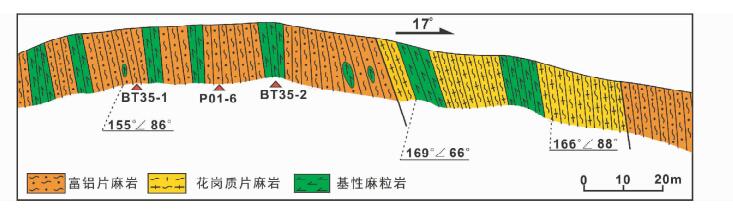
3 样品采集与分析方法本文研究样品包括固阳县忽鸡沟以南的夕线石榴堇青二长片麻岩(BT16-6),石拐区五当召镇的紫苏石榴黑云二长片麻岩(BT38-1),石拐区以南的立甲子剖面(图 2)采得的夕线石榴黑云二长片麻岩(BT35-1和P01-6)和角闪二辉麻粒岩(BT35-2)。
|
图 2 大青山-乌拉山变质杂岩立甲子实测地质剖面图 Fig. 2 Geological section of Daqingshan-Wulashan metamorphic complex in Lijiazi |
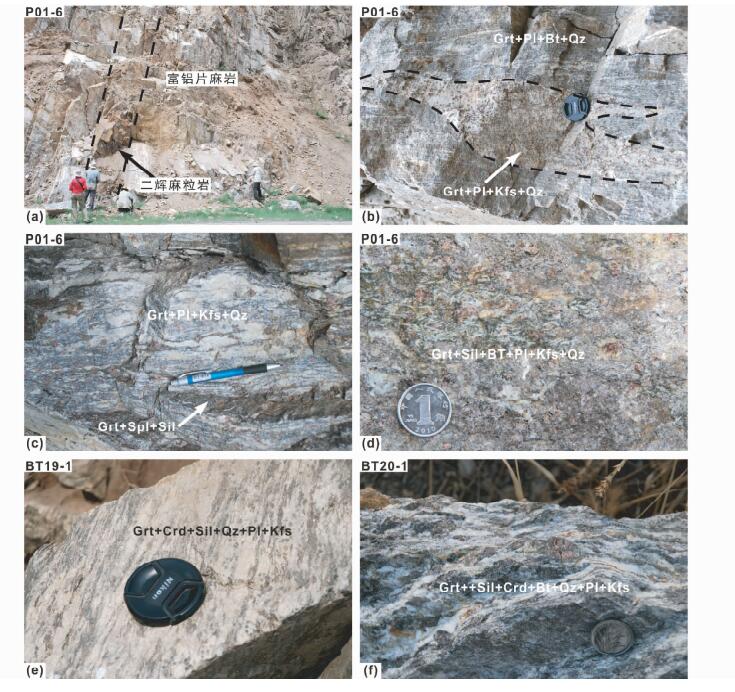
立甲子剖面出露的主要岩性包括夕线石榴黑云二长片麻岩,(石榴)黑云斜长片麻岩,角闪二辉麻粒岩和钾长花岗质片麻岩。其中夕线石榴黑云二长片麻岩与(石榴)黑云斜长片麻岩呈互层状产出,二者呈渐变关系接触,其片麻理产状近一致,走向约为17°,北西西倾向,倾角约70°。角闪二辉麻粒岩以透镜状或夹层状顺层产出于夕线石榴黑云二长片麻岩中(图 3),二者接触界线清晰。大规模肉红色钾长花岗质片麻岩,其内含二辉麻粒岩岩墙群和长轴近平行于片麻理的透镜体,透镜体长轴长约1~2.5m。
|
图 3 大青山-乌拉山变质杂岩中石拐地区代表性富铝片麻岩特征 (a)-夕线石榴黑云二长片麻岩与基性麻粒岩互层;(b)-石榴黑云斜长片麻岩内沿片麻理分布的石榴石浅色体;(c)-夕线石榴黑云二长片麻岩的矿物组合;(d)-肉眼可见含石榴石变斑晶和粗粒夕线石的矿物组合;(e)-夕线堇青石榴二长片麻岩的矿物组合;(f)-肉眼可见堇青石围绕石榴石边部形成退变反应边结构 Fig. 3 Characteristics of typical Shiguai Al-rich gneisses of Daqingshan-Wulashan metamorphic complex (a)-sillimanite-garnet gneisses interlayered with mafic granulites; (b)-garnet-biotite gneisses with garnet-bearing leucosome; (c)-the mineral assemblages of sillimanite-garnet gneisses; (d)-the observed garnet porphyroblasts and coarse sillimanite assemblage; (e)-the mineral assemblages of sillimanite-cordierite-garnet gneisses; (f)-garnet porphyroblasts rimmed by cordierite which is interpreted to be a representative retrograde structure |
大青山-乌拉山变质杂岩中石拐地区富铝片麻岩样品内矿物化学成分分析和显微结构特征的观察采用扫描电镜(配有能谱仪)和电子探针仪。扫描电镜(SEM)和能谱(EDS)分析实验在中国地质科学院国土资源部大陆动力学重点实验室进行。采用JSM-5610LV型扫描电镜(SEM)(日本电子公司JEOL生产)观察上述样品的显微结构特征,扫描电镜测试条件:电子束的电压为20kV,焦距20mm,束斑大小为41nm;采用英国牛津公司生产的能谱仪(EDS)对样品中矿物化学成分进行半定量测试,并采用英国牛津公司的INCA软件包进行实验操作(版本4.4)。采用北京大学造山带与地壳演化教育部重点实验室JXA-8100型电子探针仪对上述样品内各矿物化学成分进行定量分析,测试条件:加速电压15kV,束流1×10⁻⁸A,电子束斑为1μm,修正方法为PRZ,标样为美国SPI公司的53种标准矿物。分析结果如表 1-表 5。矿物代号根据Kretz (1983)和Whitney and Evans (2010)的资料。
|
表 1 大青山-乌拉山变质杂岩中富铝片麻岩内石榴石的化学成分(wt%) Table 1 Chemical composition of garnet in Al-rich gneisses of Daqingshan-Wulashan metamorphic complex (wt%) |
|
|
表 2 大青山-乌拉山变质杂岩内长石的化学成分(wt%) Table 2 Chemical composition of feldspar in Daqingshan-Wulashan metamorphic complex (wt%) |
|
|
表 3 大青山-乌拉山变质杂岩中富铝片麻岩中堇青石和尖晶石的化学成分(wt%) Table 3 Chemical composition of cordierite and spinel in Al-rich gneisses of Daqingshan-Wulashan metamorphic complex (wt%) |
|
|
表 4 大青山-乌拉山变质杂岩中富铝片麻岩中黑云母的化学成分(wt%) Table 4 Chemical composition of biotite in Al-rich gneisses of Daqingshan-Wulashan metamorphic complex (wt%) |
|
|
表 5 大青山-乌拉山变质杂岩中辉石的化学成分(wt%) Table 5 Chemical composition of pyroxene in Daqingshan-Wulashan metamorphic complex (wt%) |
大青山-乌拉山变质杂岩分布广泛且岩石种类复杂,以富铝片麻岩为主,并含少量基性麻粒岩。富铝片麻岩在包头市乌兰计镇、固阳县忽鸡沟、石拐区南部的石门沟和土默特右旗后湾村一带均有出露,是本文重点研究的岩石类型(图 3)。
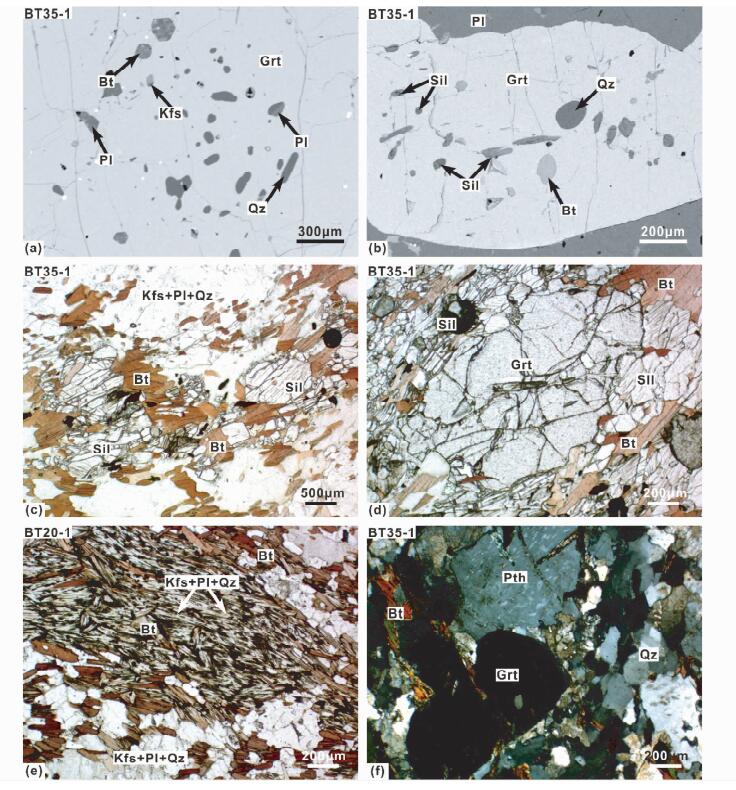
4.1 富铝片麻岩类夕线石榴黑云二长片麻岩(BT35-1和P01-6)中石榴石变斑晶粒径约3.5mm,多为浑圆粒状。石榴石核部常含有细粒黑云母、石英、长石、毛发状夕线石和尖晶石等矿物包裹体(图 4a,b),粒径5~45μm不等,其中大量毛发状夕线石包裹体可近定向排列,偶见锆石包裹体。基质黑云母、夕线石和斜长石等近定向排列形成片麻理。基质中亦可见钾长石和少量正条纹长石。部分石榴石边部出现由于晚期降温冷却由石榴石分解形成的细粒鳞片状黑云母。副矿物锆石、钛铁矿、磁铁矿、金红石和磷灰石等以粒间或基质矿物包裹体的方式产出。
|
图 4 大青山-乌拉山变质杂岩中石拐地区富铝片麻岩中M1和M2阶段典型矿物组合和结构构造图像 M1阶段(BSE图):(a)-包裹在石榴石核部早期的细粒黑云母、石英、斜长石和钾长石;(b)-石榴石中早期的毛发状夕线石、石英和黑云母;M2阶段:(c)-基质黑云母和夕线石近定向排列;(d)-石榴石和夕线石、黑云母共生;(e)-基质中黑云母脱水现象;(f)-石榴石与正条纹长石、黑云母和石英等共生 Fig. 4 Images of typical mineral assemblages and microstructures featuring M1and M2 metamorphic stages in Shiguai Al-rich gneisses of Daqingshan-Wulashan metamorphic complex M1 metamorphic stage (BSE images): (a)-early rounded biotite, quartz, plagioclase and K-feldspar enclosed in the garnet core; (b)-garnet porphyroblast contains inclusions of fibrolitic sillimanite, quartz and biotite grains; M2metamorphic stage: (c)-matrix biotite in association with coarse sillimanite distributed orientedly; (d)-garnet porphyroblast coexists with biotite and sillimanite; (e)-dehydration of the matrix biotite; (f)-garnet porphyroblast in association with perthite, biotite and quartz |
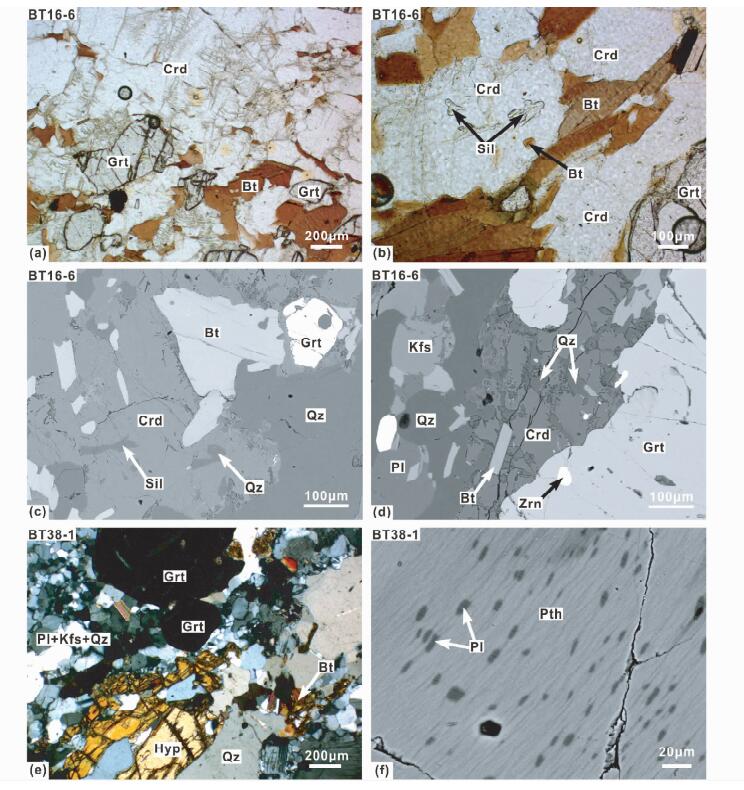
夕线石榴堇青二长片麻岩样品(BT16-6)(图 5a-d)中堇青石的含量很高(35%~40%),石榴石粒径约1.5~2.5mm,堇青石围绕石榴石边部形成特征的“黑眼圈”反应结构,主要由堇青石和黑云母组成,有时基质中大量堇青石内部有细粒残留的石榴石(粒径约0.3~0.8mm)、尖晶石、夕线石和石英(图 5c,d)。石榴石变斑晶可包裹细粒黑云母、石英和粗粒堇青石等。
|
图 5 大青山-乌拉山变质杂岩中石拐地区富铝片麻岩中M3阶段的典型矿物组合和结构构造图像 (a)-大量堇青石中含残留的石榴石和后期生成的黑云母;(b)-基质中的堇青石内含有残留的夕线石和黑云母,堇青石边部被大颗粒后期生成黑云母包围;(c)-大颗粒堇青石内含残留的夕线石和石英;(d)-由于后期减压降温,石榴石斑晶边部分解生成堇青石,堇青石内残留石英和黑云母;(e)-石榴石与基质中的紫苏辉石;(f)-正条纹长石中的钾长石主晶和斜长石客晶 Fig. 5 Images of typical mineral assemblages and microstructures featuring M3metamorphic stages in Shiguai Al-rich gneisses of Daqingshan-Wulashan metamorphic complex (a)-cordierite with relicts of garnet grains and late biotite; (b)-sillimanite and biotite relicts enclosed in cordierite in the matrix and cordierite is rimmed by large biotite grains; (c)-sillimanite, quartz and biotite relicts in the cordierite host; (d)-garnet porphyroblast surrounded by a cordierite corona enclosing biotite and quartz; (e)-garnet grains with large hypersthene in the martrix; (f)-perthite is consist of the K-feldspar host and the plagioclase guest |
紫苏石榴黑云二长片麻岩(BT38-1)中的紫苏辉石(粒径约0.5~2.5μm)多与石榴石变斑晶平衡共生(图 5e),石榴石可包裹细粒的黑云母、石英、尖晶石、磁铁矿和钛铁矿和较粗粒的紫苏辉石。尖晶石常与磁铁矿、钛铁矿、黑云母等矿物直接接触,与Bose et al.(2009)描述的印度东高茨地区含尖晶石榴麻粒岩中的尖晶石-磁铁矿-钛铁矿的显微结构类似。
4.2 基性麻粒岩角闪二辉麻粒岩样品(BT35-2)和前述夕线石榴黑云二长片麻岩(BT35-1和P01-6)以顺层状产出,二者呈渐变过渡的接触关系,主要组成矿物为透辉石、紫苏辉石、角闪石、斜长石,含少量石英,磁铁矿等。
4.3 变质演化与变质反应通过前述岩相学观察,根据岩石内矿物组合特征和变质反应的不同,将研究区的大青山-乌拉山变质杂岩中石拐地区富铝片麻岩样品可划分出4个变质阶段:早期进变质阶段(M1)、峰期变质阶段(M2)、峰期后近等温减压阶段(M3)和晚期降温冷却阶段(M4)。
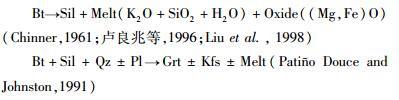
4.3.1 早期进变质阶段(M1)与世界上其它麻粒岩相变质地体类似,研究区富铝片麻岩可反映早期进变质历史的矿物化学特征和早期的反应结构被峰期后的退变质反应所叠加。仅可从石榴石斑晶核部细粒的矿物包裹体来推知早期可能的矿物组合为Grt核部+Bt+Qz+Pl±Sil±Kfs±Spl,其中夕线石可能是由叶腊石等低温矿物重结晶形成,可能发生的反应有:

|
峰期变质阶段以基质中大量粗粒柱状夕线石集合体,黑云母,斜长石,钾长石,石英和石榴石的生长为特征,峰期矿物组合是Grt+Sil+Bt+Qz+Pl+Kfs±Mag±Ilm。锆石、钛铁矿、磁铁矿、金红石、独居石和磷灰石是富铝片麻岩样品常见的副矿物。石榴石幔部和边部包裹大颗粒黑云母、石英和斜长石等表明石榴石可能是黑云母经脱水熔融形成的,可能发生的变质反应是:
|
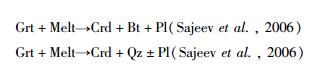
峰期后近等温减压阶段的矿物组合是Grt+Crd+Bt+Pl+Qz±Sil±Hyp,研究区富铝片麻岩样品中可观察到堇青石±夕线石±石英的后成合晶反应边,标志着峰期后M3变质阶段的发生。这种后成合晶反应结构的特征是石榴石斑晶边部围绕着堇青石的退变反应边,堇青石中可能含有残留的夕线石或石英反应物(图 5c,d),指示石榴石在减压过程中分解。部分石榴石边部分解形成的堇青石可包裹黑云母或斜长石,可能发生的反应是:

|
|
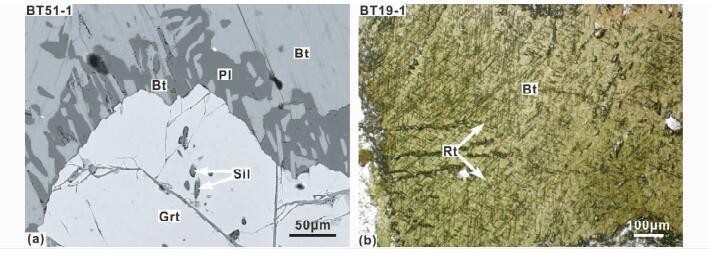
晚期降温冷却阶段(M4)的矿物组合是Grt+Bt+Pl+Qz+Mag±Kfs±Ilm,石榴石被由其分解形成的细粒鳞片状黑云母和斜长石等矿物围绕(图 6)。石榴石转变为黑云母+绿泥石组合并保留石榴石的假象,黑云母退变为绿泥石+钾长石组合并保留黑云母假象,或黑云母中的Ti出溶形成晚期金红石或钛铁矿(Cesare et al., 2008)。
|
图 6 大青山-乌拉山变质杂岩中石拐地区富铝片麻岩中M4阶段的典型矿物组合和结构构造图像 (a)-石榴石边部分解生成晚期细粒黑云母和斜长石;(b)-黑云母中有晚期针状金红石出溶 Fig. 6 Images of typical mineral assemblages and microstructures featuring M4metamorphic stages in Shiguai Al-rich gneisses of Daqingshan-Wulashan metamorphic complex (a)-garnet porphyroblast breaks down to late biotite and plagioclase; (b)-oriented needle-like rutile exsolved from biotite during the late cooling stage |
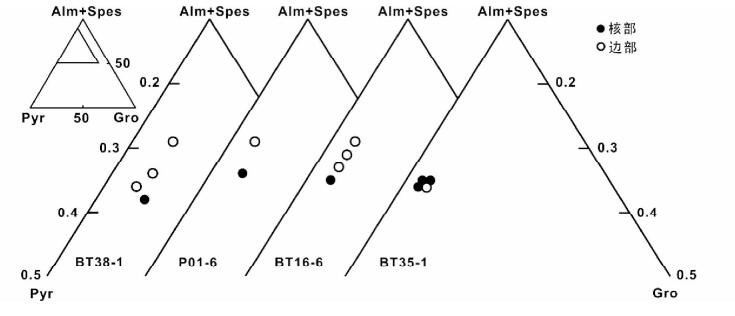
石榴石在大青山-乌拉山变质杂岩中石拐地区富铝片麻岩中均有产出,可呈斑晶与夕线石、黑云母、长石和石英等平衡共生,或呈细粒状包裹于基质长石、石英和堇青石等矿物中。对样品内石榴石微区化学成分进行测试。石榴石内XMg(Mg/(Fe+Mg2+))值在0.264~0.351之间(表 1)。不同样品中石榴石均富含铁铝榴石(60.1~69.0)和镁铝榴石(24.4~33.7)端元,并含少量钙铝榴石(2.2~5.8)和锰铝榴石(1.3~2.9)端元。Gro-(Alm+Spes)-Pyr成分图解显示石榴石从核部到边部成分变化规律(图 7),其中核部较富镁(0.319 < XMg < 0.351),而边部相对富铁(0.264 < XMg < 0.341)。此外,石榴石边部与黑云母或堇青石接触时的铁含量明显升高,而石榴石边部与石英或斜长石相接触的成分与核部成分相近。样品BT16-6中,和堇青石直接接触的石榴石边部较核部富铁,而边部镁含量降低,Mg-Fe成分的差异是因为石榴石与其周围的镁铁矿物发生了镁铁扩散交换。利用扫描电镜能谱仪对样品BT35-1中的石榴石斑晶进行线扫描,仅显示微弱的镁和钙的成分变化,该石榴石内边部的钙含量较核部明显降低,可能由于围绕石榴石边部生成的斜长石消耗石榴石的钙。然而,各样品中石榴石的核-幔部成分总体变化不大,可能的原因是石榴石斑晶在麻粒岩相(峰期温度大于800℃)变质作用下核-幔-边之间的成分发生扩散并趋于平衡。以上结果表明样品内石榴石的化学成分变化受寄主岩石化学成分影响,还与P-T条件变化(刘平华等,2010),石榴石在岩石中的构造位置有关。
|
图 7 大青山-乌拉山变质杂岩中石拐地区富铝片麻岩中石榴石的Pyr-(Alm+Spes)-Gro图解 Fig. 7 Gro-(Alm+Spes)-Pyr diagram of garnet in Shiguai Al-rich gneisses of Daqingshan-Wulashan metamorphic complex |
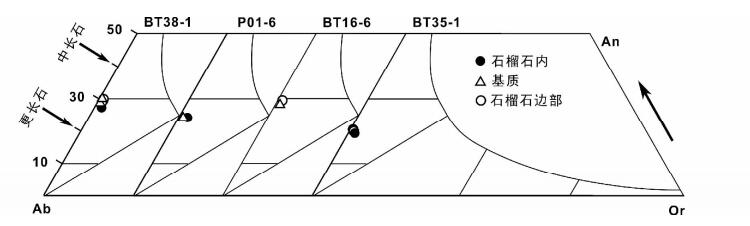
研究区富铝片麻岩中常见斜长石、钾长石和条纹长石,可呈细粒状包裹于石榴石变斑晶中,或基质中大颗粒长石与夕线石、石英和黑云母等矿物共生,分布在石榴石边部的细粒斜长石是石榴石在晚期降温阶段分解形成。An-Ab-Or图解(图 8)显示样品中斜长石均属于中长石-更长石组分(An端元含量为19.4~30.0),其成分因岩石类型不同而略有差异(表 2)。处于不同构造位置的长石化学成分总体变化较小,同种岩石类型中位于石榴石边部斜长石的CaO含量较基质中斜长石的高,而Na2O的含量相对较低。条纹长石主要是正条纹长石,样品BT35-1内条纹长石的钾长石主晶的Or端元组分为87.8,斜长石客晶更接近Ab端元(含量为87)。
|
图 8 大青山-乌拉山变质杂岩中石拐地区富铝片麻岩中斜长石的An-Ab-Or图解 Fig. 8 Ternary plot of An-Ab-Or for plagioclase in Shiguai Al-rich gneisses of Daqingshan-Wulashan metamorphic complex |
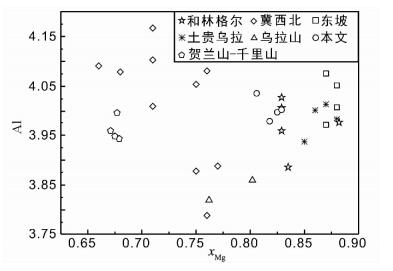
富铝片麻岩样品中堇青石多分布在石榴石斑晶周围或在基质中与黑云母和长石等共生,偶见堇青石内包裹残留的细粒夕线石、黑云母和石英,部分石榴石颗粒包裹浑圆状堇青石。样品内堇青石富镁,其XMg(Mg/(Fe+Mg2+))值在0.806~0.829之间(表 3),而MnO,ZnO,Cr2O3,CaO,NaO和K2O总含量很低( < 0.2%)。堇青石的成分受全岩成分及相邻矿物成分的影响(Aït-Djafer et al., 2009),该含堇青石的寄主岩石亦富MgO。此外,与石榴石边部相接触的堇青石内FeOT含量明显较基质中堇青石(不与镁铁矿物接触)低,可能与堇青石在后期降温过程中与周围石榴石发生Fe-Mg交换有关。基质中与黑云母相接触的堇青石含有较高的FeOT及较低的MgO (XMg=0.806)。堇青石化学成分含量低于97.46%,表明其结构孔道内含有少量CO2和/或H2O (Harley,1986;Sajeev et al., 2006;Santosh et al., 2007)。XMg-Al (a.p.f.u)图解(图 9)显示研究区样品与内蒙孔兹岩带东部和林格尔及土贵乌拉等地产出的超高温变质岩中堇青石XMg值相近(0.80~0.90),且均高于孔兹岩带西部千里山和贺兰山以及中部造山带的黄土窑地区产出的孔兹岩中堇青石XMg值,而在不同地区产出的孔兹岩内堇青石的Al含量变化较大。此外,堇青石的出现可能指示当时存在熔体(Sawyer,1999)。
|
图 9 研究区和其它地区富铝片麻岩中堇青石XMg-Al图解 数据来源:乌拉山(Liu et al., 1993);冀西北(刘福来和沈其韩,1999);土贵乌拉(Santosh et al., 2007);贺兰山-千里山(Yin,2010);东坡(Guo et al., 2012);和林格尔(Liu et al., 2012) Fig. 9 Plot of XMg versus Al for cordierite from Shiguai Al-rich gneisses of Daqingshan-Wulashan metamorphic complex and other areas Data sources: Wulashan (Liu et al., 1993); Northwest part of Hebei (Liu et al., 1999); Tuguiwula (Santosh et al., 2007); Helanshan-Qianlishan (Yin, 2010); Dongpo (Guo et al., 2011); Heling'er (Liu et al., 2012)) |
黑云母在研究区富铝片麻岩中的产出包括以细粒浑圆状包裹于石榴石斑晶,呈细粒鳞片状分布在石榴石边部和在基质中与粗粒夕线石、长石和石英等共生。黑云母内XMg(Mg/(Fe+Mg2+))含量变化较大(0.589~0.724)而TiO2含量普遍较高(>3.88%),AlⅥ的含量在0.048~0.185之间(表 4)。Fe-Mg图解(图 10a)显示黑云母内Fe
尖晶石是本区富铝片麻岩中最特征的副矿物之一,多呈不规则粒状,可包裹在石榴石内或与残留的夕线石共同包裹在基质堇青石中。尖晶石常和黑云母、磁铁矿或钛铁矿相接触,未见其与石英直接接触。尖晶石富含铁尖晶石组分(0.368 < XMg < 0.570),并含少量Cr2O3(1.00%~1.66%),而TiO2和MnO的含量均很低(表 3)。ZnO的含量均较高(可达12.17%),明显高于内蒙孔兹岩带超高温变质岩内尖晶石ZnO的含量(Santosh et al., 2006;Guo et al., 2012;Liu et al., 2012)。
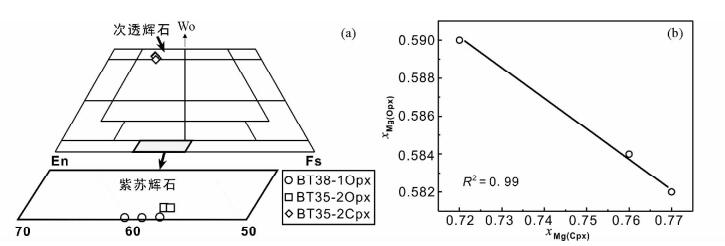
5.6 辉石辉石在紫苏石榴黑云二长片麻岩中可分布于基质中或在石榴石周围产出,亦可包裹在石榴石内部,在角闪二辉麻粒岩中分布均匀,在基质中与斜长石和角闪石共生。样品内紫苏辉石含有相对较低的Al2O3(1.12%~4.13%)。硅灰石-顽火辉石-斜方铁辉石(Wo-En-Fs)三角图解(图 11a)显示,样品内斜方辉石均落于紫苏辉石区域(En56-61),角闪二辉麻粒岩(BT35-2)较紫苏石榴黑云二长片麻岩(BT38-1)内的紫苏辉石更接近斜方铁辉石端元,而角闪二辉麻粒岩(BT35-2)内的单斜辉石成分投在次透辉石区域。角闪二辉麻粒岩中二辉石的Mg和Fe的分配呈线性关系(R2=0.99)(图 11b),表明二者平衡共生。斜方辉石内XMg(Mg/(Fe+Mg2+))值在0.581~0.644。对于样品BT38-1,包裹在石榴石斑晶内的紫苏辉石较石榴石边部和基质中的紫苏辉石更富镁(表 5)。
|
图 11 大青山-乌拉山变质杂岩中石拐地区富铝片麻岩中单斜辉石和斜方辉石的Wo-En-Fs图解(a)和XMg (Cpx)-XMg (Opx)图解(b) Fig. 11 Ternary plot of Wo-En-Fs for orthopyroxenes and clinopyroxenes from Shiguai Al-rich gneisses of Daqingshan-Wulashan metamorphic complex (a) and plot of XMg (Cpx) versus XMg (Opx) (b) |
采用合适的温度计和压力计和相平衡模拟对样品BT35-1,BT16-6,BT38-1和BT35-2,在不同变质阶段的P-T条件进行估算,传统地质温压计的相关计算均利用Reche and Martinez (1996)的“GPT”(Excel表格)。代表性的估算结果如表 6所示。
|
|
表 6 大青山-乌拉山变质杂岩样品的温度和压力条件的计算 Table 6 Geothermobarometry of Daqingshan-Wulashan metamorphic complex |
M1阶段矿物组合是石榴石核部及其包裹的细粒矿物Bt+Qz+Pl±Sil±Kfs±Spl。选择紫苏石榴黑云二长片麻岩(BT38-1)中石榴石斑晶核部及其包裹的小颗粒浑圆状黑云母和斜长石的成分估算M1阶段变质条件。采用石榴石-黑云母(GB)温度计(Holdaway,2000)计算得到温压条件为585~588℃。但由于小颗粒黑云母等包体受后期降温的影响,与相接触的石榴石发生Fe-Mg交换,估算的温度较实际温度偏低,仅可作为参考。
6.2 峰期变质阶段(M2) 6.2.1 传统温压计估算M2阶段的矿物组合为Grt+Sil+Bt+Qz+Pl+Kfs±Mag±Mag±Ilm,选择夕线石榴黑云二长片麻岩(BT35-1)中CaO含量最高的石榴石的成分及基质中的斜长石和远离石榴石并包裹于粗粒夕线石的黑云母估算M2阶段温压条件,利用石榴石-黑云母(GB)温度计(Thompson,1976;Holdaway and Lee, 1977;Perchuk et al., 1985;Holdaway,2000)和石榴石-夕线石-石英-斜长石(GASP)压力计(Newton and Haselton, 1981;Hodges and Spear, 1982;Ganguly and Saxena, 1984;Holdaway,2001)计算得到峰期变质阶段(M2)P-T条件为728~865℃和8.4~11.5kbar。
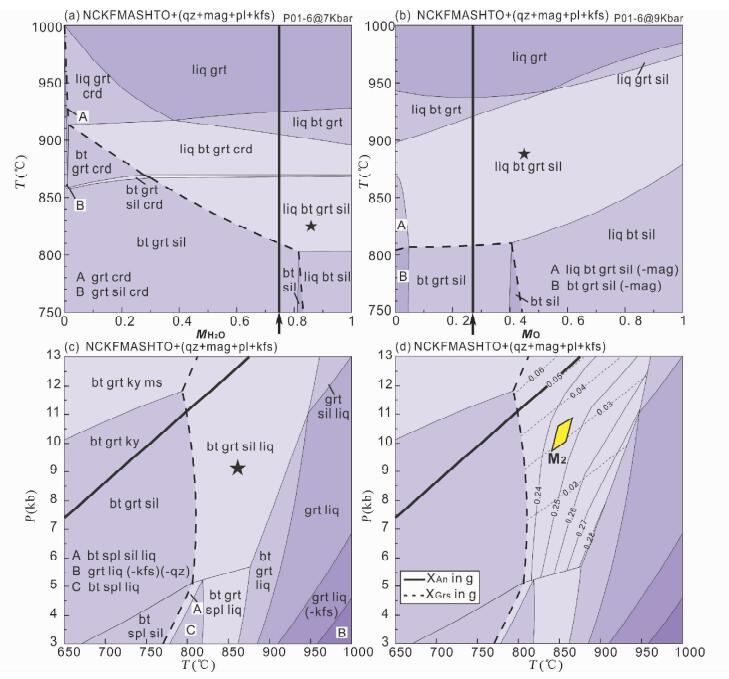
6.2.2 相平衡模拟利用程序THERMOCALC 3.33(Powell and Holland, 1988, 2009年更新)及内部一致热力学数据库(tcds55,Holland and Powell, 1998)对样品P01-6计算P-T视剖面图,选择Na2O-CaO-K2O-FeO-MgO-Al2O3-SiO2-H2O-TiO2-Fe2O3(NCKFMASHTO)化学体系。有关矿物固溶体的活度-成分关系参考如下文献:石榴石(White et al., 2007),钾长石和斜长石(Holland et al., 2003),黑云母和熔体(White et al., 2007),尖晶石(White et al., 2002),堇青石(Holland and Powell, 1998),钛铁矿和磁铁矿(White et al., 2000),石英和铝硅酸盐为纯端元组分。岩石中MnO含量很低( < 0.1%),故在相平衡计算中未予考虑。用于相平衡计算的各氧化物的摩尔百分数如表 7。后期的退变反应一般会伴随一些吸水反应,故烧失量不能代表退变质前岩石的水含量(陈意,2008;Korhonen et al., 2011, 2012),此外全岩分析过程中可能受到污染或氧化使氧含量偏差,故通过T-MH2O和T-MO图(图 12a, b)来综合限定H2O和O的摩尔百分含量。计算7kbar下样品P01-6的T-MH2O图,MH2O含量为0.75(~2.55mol%H2O)可保证峰期矿物组合在固相线以下的温度亦能稳定存在(Korhonen et al., 2012)。计算样品P01-6在9kbar下的T-MO图(图 12b),将MO含量设定为0.26(0.29mol%的Fe3+)。
|
|
表 7 样品P01-6用于相平衡模拟的各组分摩尔百分数(mol%) Table 7 Molar proportion of oxides for mineral equilibria modelling of sample P01-6 (mol%) |
|
图 12 样品P01-6的相平衡计算 (a)T-MH2O图(7kbar),实线代表所限定的H2O含量;(b)T-MO图(9kbar),实线代表限定的O含量;(c)P-T视剖面图,实线代表蓝晶石-夕线石相变线;(d)计算石榴石内z (g)(Ca/(Fe2++Mg+Ca))的等值线和斜长石内ca (pl)(Ca/(Na+Ca+K))限定该峰期矿物组合的温压条件,实线代表蓝晶石-夕线石相变线.所有图中星号代表峰期矿物组合的稳定域,虚线为固相线 Fig. 12 Calculated pseudosections for sample P01-6 (a) T-MH2O diagram at 7kbar. The black bar indicates MH2O content used for additional modelling based on observed equilibria. (b) T-MO diagram at 9kbar. The black bar indicates MO content used for P-T pseudosection. (c) P-T pseudosection based on the appropriate H2O and O contents. The black bar corresponds to kyanite-sillimanite equilibria line. (d) Calculated contours for z (g) (Ca/(Fe2++Mg+Ca)) in garnet and ca (pl) (Ca/(Na+Ca+K)) in plagioclase for peak assemblage in sample P01-6. The black bar corresponds to kyanite-sillimanite equilibria line. The dashed line on all figures is the solidus and the field for the peak assemblage is characterized by a black star |
计算样品P01-6的P-T视剖面图(图 12c),结果表明峰期矿物组合(Grt+Sil+Bt+Qz+Pl+Kfs+Liq+Mag)可稳定于800~900℃较窄的温度区间,而稳定压力范围较宽(5~13kbar)。石榴石随压力的降低而被消耗,低于5kbar时石榴石在670~820℃的范围内消失。根据样品P01-6内石榴石核幔部的z (g)值(z (g)=Ca/(Fe2++Mg+Ca))为0.033~0.034和基质斜长石的ca (pl)值(ca (pl)=Ca/(Na+Ca+K))为0.244计算成分等值线(图 12d),得到峰期矿物组合Grt+Sil+Bt+Qz+Pl+Kfs+Liq+Mag稳定的温压条件为T=840~860℃和P=10.0~10.5kbar,位于夕线石域。
综合考虑传统地质温压计和P-T视剖面的计算结果,由于1)传统的温压计是基于矿物端元反应之上,且温压计适用范围不同(吴春明等,2007),温压计本身存在一定的误差,而相平衡模拟是基于内部一致热力学数据库,提高了计算的准确度且局限性小;2)黑云母的Ti含量偏高,可能会影响温压计的计算结果(周喜文等,2003);3) GB温度计和GASP压力计的计算结果会受到岩石退变过程中石榴石和相邻黑云母间Fe-Mg扩散的影响。故认为相平衡模拟能更准确的限定峰期阶段(M2)的温压条件为T=840~860℃,P=10.0~10.5kbar。
6.3 峰期后近等温减压阶段(M3)峰后近等温减压阶段(M3)以石榴石边部转变为含堇青石的后成合晶(图 5d)为特征,矿物组合为Grt+Crd+Bt+Pl+Qz±Sil。根据石榴石和堇青石间的Fe-Mg交换,已有若干经验或实验标定的石榴石-堇青石(GC)温度计(Thompson,1976;Holdaway and Lee, 1977;Perchuk et al., 1985;Bhattacharya et al., 1988)和石榴石-堇青石-夕线石-石英(GCAQ)压力计(Thompson,1976;Wells and Richardson, 1979;Perchuk et al., 1985),选择夕线石榴堇青二长片麻岩样品(BT16-6)中石榴石边部和与其相邻的堇青石估算温压条件为647~697℃和5.6~6.1kbar,位于夕线石的稳定域内。对紫苏石榴黑云二长片麻岩(BT38-1)运用石榴石-斜方辉石(GO)温度计(Sen and Battacharya, 1984;Harley, 1985;Lee and Ganguly, 1988;Bhattacharya et al., 1991)和石榴石-斜方辉石-斜长石-石英(GOPQ)压力计(Newton and Perkins, 1982;Bhattacharya et. al., 1991)计算得到温压条件为697~734℃和5.7~6.0kbar。选择角闪二辉麻粒岩(BT35-2)中基质斜方辉石、单斜辉石,利用斜方辉石-单斜辉石(OC)温度计(Taylor, 1998)估算M2阶段温度条件为794~839℃。
考虑到峰后近等温减压阶段的石榴石-堇青石以及石榴石-斜方辉石矿物对可能受到晚期降温冷却阶段(M4)的影响而发生Fe-Mg离子的再交换反应,使估算的温度较实际温度偏低,可作为M3阶段温度的下限,而角闪二辉麻粒岩受晚期降温阶段影响较小,可作为M3阶段温度的上限,且根据岩相学观察,M3阶段处在夕线石稳定域,综合以上计算结果得到M3变质阶段的温压条件为T=720~800℃,P=5.6~6.1kbar。
6.4 晚期降温冷却阶段(M4)晚期降温冷却阶段(M4)矿物的典型代表是石榴石边部分解形成细粒鳞片状黑云母+斜长石的组合。选择夕线石榴黑云二长片麻岩(BT35-1)和夕线石榴堇青二长片麻岩样品(BT16-6)中边部石榴石的成分及其周围细粒的黑云母和斜长石,采用石榴石-黑云母(GB)温度计(Thompson,1976;Holdaway and Lee, 1977;Perchuk et al., 1985;Holdaway,2000)计算得到M4阶段的温度条件为616~661℃。利用石榴石-黑云母-斜长石-石英(GBPQ)压力计(Wu et al., 2004)计算得到M4阶段的压力条件为3.4~5.2kbar,处于夕线石的稳定域内。~650℃时晚期的熔体已完成结晶,在水饱和花岗岩固相线上对应的压力是3~4kbar (Fitzsimons,1996),故在估算的晚期冷却阶段的温压条件下熔体基本已结晶。
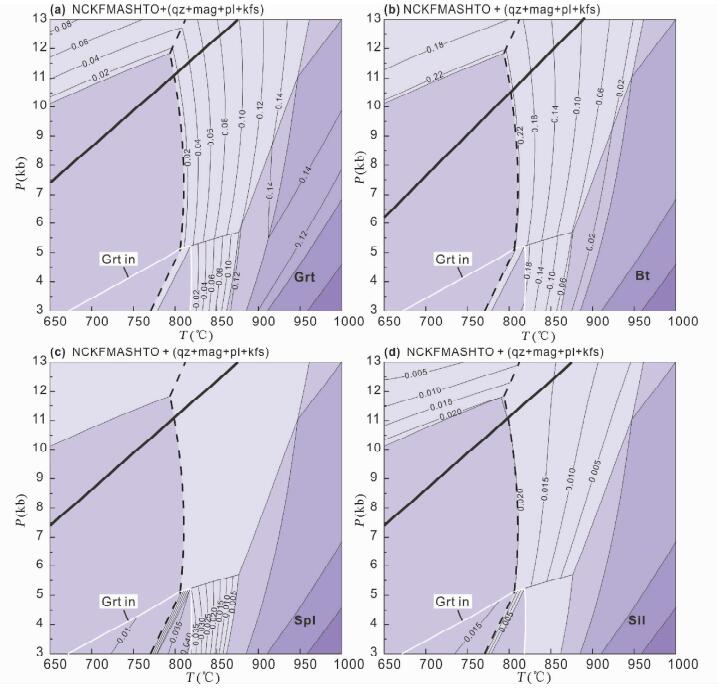
7 讨论 7.1 相平衡模拟对矿物生长关系的制约通过计算主要造岩矿物的摩尔百分含量,得到其在不同矿物组合内的变化趋势,各矿物在不同温压条件下生长的情况并反映变质反应中反应矿物和生成矿物的消长变化(Kelsey et al., 2008;Korhonen et al., 2011)。根据样品P01-6的P-T视剖面图(图 12c),计算得到石榴石、黑云母、尖晶石和夕线石摩尔百分含量的变化趋势(图 13),结果表明峰期矿物组合的稳定域内,石榴石、黑云母和夕线石的摩尔百分含量等值线与纵轴(P轴)近平行,表明三者含量对温度变化较敏感。此外,石榴石的摩尔百分数随温度的升高而增加(图 13a),而黑云母和夕线石则相反,进一步说明早期进变质阶段黑云母和夕线石反应生成石榴石,而生长过程中的石榴石也可包裹周围早期细粒的夕线石、黑云母和石英等矿物,这与岩相学观察结果一致,可能的反应为:Bt+Sil+Qz→Grt+Kfs+Melt。反之,亦能说明石榴石被由其分解形成的黑云母和夕线石等矿物包围的现象,二者的生长消耗了石榴石,发生上述反应的逆反应,也表明黑云母的生长伴随峰期及峰后降压阶段。与黑云母变化趋势类似,视域内尖晶石的摩尔百分数低于0.04mol%,其稳定存在的压力低于5.3kbar,且摩尔百分含量随压力降低而增多(图 13c)。注意到在石榴石的消失线以下,尖晶石的摩尔百分含量随温度升高而升高,而夕线石则相反,可能反映尖晶石生长的同时消耗了夕线石,可能发生的反应有Grt+Sil→Spl+Crd。
|
图 13 计算样品P01-6内主要矿物的摩尔百分含量等值线 (a)-石榴石的等值线从0.02到0.14mol之间变化;(b)-黑云母的等值线从0.02到0.22mol之间变化;(c)-尖晶石的等值线在0.005到0.040mol之间;(d)-夕线石的等值线在0.005到0.020mol之间.所有图中的虚线代表固相线,实线代表蓝晶石-夕线石相变线 Fig. 13 Calculated contours in mole percentage for main minerals in sample P01-6 (a)-calculated contours for garnet proportions (in mol%), isopleth range is from 0.02 to 0.14 at an interval of 0.02; (b)-calculated contours for biotite proportions (in mol%), isopleth range is from 0.02 to 0.22 at an interval of 0.04; (c)-calculated contours for spinel proportions (in mol%), isopleth range is from 0.005 to 0.040at an interval of 0.005; (d)-calculated contours for sillimanite proportions (in mol%), isopleth range is from 0.005 to 0.020 at an interval of 0.005. The dashed line on all figures is the solidus and the black bar corresponds to kyanite-sillimanite equilibria line |
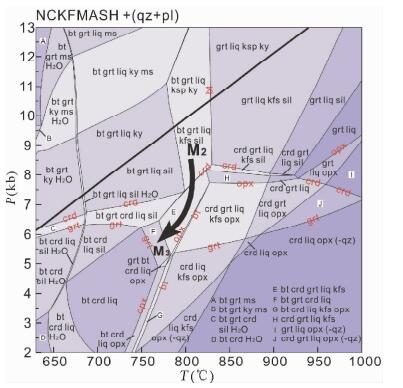
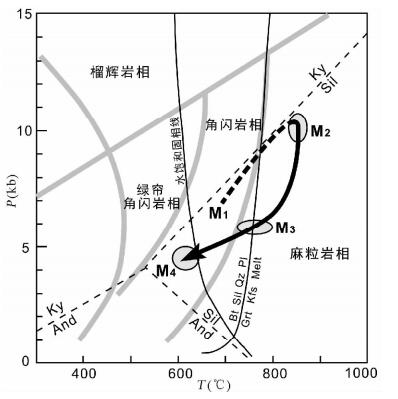
结合大青山-乌拉山变质杂岩中石拐地区富铝片麻岩的岩相学观察、变质反应序列以及传统温压计和P-T视剖面图的计算,得到富铝片麻岩样品在峰期麻粒岩相变质后经历了近等温减压(ITD)变质阶段,其变质演化为顺时针P-T轨迹(图 14、图 15),峰期(M2)阶段(Grt+Sil+Bt+Qz+Pl+Kfs±Mag±Ilm)温压条件为T=840~860℃和P=10.0~10.5kbar,表明研究区富铝片麻岩样品已进入下地壳30~35km深度处并经历了中-高压麻粒岩相变质作用的改造。在随后的快速折返过程出现一系列减压反应,以含堇青石矿物组合为特征,M3阶段可能的温压条件为T=720~800℃和P=5.6~6.1kbar,此时经麻粒岩相变质的富铝片麻岩已抬升折返到~15km的地壳深度。M2到M3变质阶段的温度略有降低,而压力显著降低,为典型的峰后近等温减压的变质阶段,反映了富铝片麻岩经历了快速折返的动力学过程。在随后的折返过程,研究区富铝片麻岩受到晚期角闪岩相退变质作用(M4)的叠加,该阶段的温压条件为T=616~661℃,P=3.4~5.2kbar。
|
图 14 大青山-乌拉山变质杂岩中石拐地区富铝片麻岩样品在NCKFMASH体系下的P-T视剖面图和P-T演化轨迹 设体系中石英过量且发生部分熔融前设水过量,富铝片麻岩(样品BT19-2)岩石成分为Al2O3,12.06;SiO2,64.32;CaO,2.70;MgO,5.65;FeO,4.52;Na2O, 3.27;K2O,1.85;H2O,5.64(摩尔百分比) Fig. 14 P-T pseudosection with the inferred P-T path of Shiguai Al-rich gneisses of Daqingshan-Wulashan metamorphic complex in the NCKFMASH system The values of the component oxides for sample BT19-2 are shown as the percentage molar weight: Al2O3, 12.06; SiO2, 64.32; CaO, 2.70; MgO, 5.65; FeO, 4.52; Na2O, 3.27; K2O, 1.85; H2O, 5.64 |
|
图 15 大青山-乌拉山变质杂岩中石拐地区富铝片麻岩样品变质作用P-T轨迹 变质相和变质亚相区域划分引自Spear (1993).铝硅酸盐矿物相变反应线据Salje (1986),饱和水变泥质岩固相线据Huang and Wyllie (1975);黑云母脱水熔融反应Bt+Sil+Qz+Pl=Grt+Kfs+Melt,据Le Breton and Thompson (1988) Fig. 15 P-T evolution of Shiguai Al-rich gneisses of Daqingshan-Wulashan metamorphic complex The division of metamorphic phases and sub-metamorphic phases after Spear (1993). Aluminosilicate triple point after Salje (1986), H2O-saturated metapelite solidus according to Huang and Wyllie (1975); Biotite dehydration-melting reaction Bt+Sil+Qz=Grt+Kfs+Melt from Le Breton and Thompson (1988) |
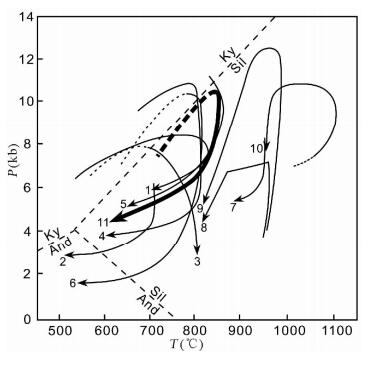
近年来,前人对内蒙孔兹岩带内变泥质岩的变质作用进行了大量的研究。刘福来等(2002)报道了凉城地区富铝片麻岩中的锆石含有蓝晶石+石榴石+钾长石+石英包裹体,代表进变质阶段的矿物组合,据此提出该岩石记录了早期较高的压力条件。卢良兆等(1992)结合系统的矿物化学和变质作用研究,指出集宁富铝片麻岩经历了两期变质作用,第一期变质作用的峰期温度条件为~850℃。Liu et al.(1993)对大青山-乌拉山变泥质岩研究揭示其压力最高可达8±0.5kbar,随后经历了温度略有升高而压力显著降低的近等温减压的变质阶段,峰期温度达~800℃,得到了典型的顺时针P-T轨迹。Yin (2010)系统研究了贺兰山-千里山高压泥质麻粒岩,认为其高压矿物组合为蓝晶石+钾长石,利用P-T视剖面计算得到了近等温减压的顺时针P-T轨迹,并将峰期变质温压条件限定在792~805℃和10.2~11.2kbar的范围内。刘福来和沈其韩(1999)对晋蒙边界的黄土窑-四方墩一带的富铝片麻岩研究亦得到典型的近等温减压的顺时针P-T轨迹,峰期温度达750~850℃,在峰后M3阶段形成含堇青石的低压麻粒岩相矿物组合。王洛娟(2011)认为大同孤山石榴石基性麻粒岩早期经历了高压变质阶段,结合传统地质温压计和P-T视剖面图的计算得到了顺时针的P-T轨迹。此外,部分研究者对孔兹岩带出露的少量超高温变质岩进行了深入研究,其典型矿物组合为假蓝宝石与石英直接接触,低Zn和Cr的尖晶石与石英直接接触,斜方辉石+夕线石+石英等。Santosh et al.(2009)根据P-T视剖面图的计算,提出土贵乌拉超高温变质岩经历了逆时针的P-T演化轨迹,其峰期变质温度可达950℃以上。而Guo et al.(2012)利用三元长石温度计和P-T视剖面方法认为大青山东坡一带出露的超高温变质岩峰期温度为910~980℃,记录了顺时针的P-T轨迹,与孔兹岩带富铝片麻岩经历顺时针的P-T演化历史类似。
本文通过对大青山-乌拉山变质杂岩中石拐地区富铝片麻岩进行详细的岩相学观察、结合传统地质温压计和P-T视剖面图的计算,认为研究区富铝片麻岩在峰期麻粒岩相变质后,变质温度最高达~860℃,又经历典型的近等温减压变质阶段,记录了顺时针的P-T演化轨迹(图 14、图 15),具造山带变质作用特点。此外,如前所述,孔兹岩带内变泥质岩普遍具有典型的近等温减压型顺时针P-T轨迹(图 16),前人认为这种顺时针P-T轨迹与地壳挤压增厚有关,反映碰撞造山过程中加厚下地壳折返至地表的动力学过程(England and Thompson, 1984;Condie et al., 1992;Brown,1993)。陆陆俯冲碰撞作用造成陆壳加厚,向下俯冲的陆壳物质经历了中-高压麻粒岩相变质作用的改造,变质压力达到最大值,随后由于重力均衡效应,变质地壳发生快速折返引起变质压力迅速降低,经历了近等温减压的退变质过程,以石榴石变斑晶边部出现堇青石±夕线石±石英的反应边结构为特征,表明岩石经历快速隆升作用,与构造抬升有关,进一步指示其形成于大陆碰撞环境。最后麻粒岩相变质的富铝片麻岩抬升至地壳浅部的过程再一次受到晚期角闪岩相退变质作用的改造。
|
图 16 孔兹岩带中-高压麻粒岩P-T演化轨迹 (1)-集宁变质杂岩(第一期变质事件;卢良兆等,1992);(2)-集宁变质杂岩(第二期变质事件;卢良兆等,1992);(3)-大青山-乌拉山变质杂岩(Liu et al., 1993);(4)-贺兰山高压泥质麻粒岩(Yin,2010);(5)-大同石榴石基性麻粒岩(王洛娟,2011);(6)-冀西北富铝片麻岩(刘福来和沈其韩,1999);(7)-东坡地区超高温变质岩(Guo et al., 2012);(8)-土贵乌拉超高温变质岩(Santosh et al., 2009);(9)-东坡一带超高温变质岩(Tsunogae et al., 2011)(10)-和林格尔超高温变质岩(刘守偈等,2008);(11)-大青山-乌拉山变质杂岩中石拐地区富铝片麻岩(本文).铝硅酸盐矿物相变反应线据Salje (1986) Fig. 16 Metamorphic P-T paths of medium-high pressure metapelites in Khondalite Belt (1)-Jining metamorphic complex (first metamorphic event; Lu et al., 1992); (2)-Jining metamorphic complex (second metamorphic event; Lu et al., 1992); (3)-Daqingshan-Wulashan Complex (Liu et al., 1993); (4)-high-pressure pelitic granulites in Helanshan (Yin, 2010); (5)-garnet-bearing mafic granulites from Datong (Wang, 2011); (6)-Al-rich gneisses in the northeast part of Hebei (Liu et al., 1999); (7)-ultrahigh-temperature granulites in Dongpo (Guo et al., 2012); (8)-ultrahigh-temperature granulites in Tuguiwula (Santosh et al., 2009); (9)-ultrahigh-temperature granulites in Dongpo (Tsunogae et al., 2011); (10)-ultrahigh-temperature granulites in Heling'er (Liu et al., 2008); (11)-Shiguai Al-rich gneisses of Daqingshan metamorphic complex (this study). Aluminosilicate triple point after Salje (1986) |
通过对大青山-乌拉山变质杂岩中石拐地区富铝片麻岩的成因矿物学和变质作用方面的分析讨论,得到结论如下:
(1)系统的岩相学观察和矿物成分分析结果表明, 石拐地区富铝片麻岩经历了四个变质演化阶段:早期进变质阶段(M1),标志性矿物组合为石榴石和包裹其内的Grt核部+Bt+Qz+Pl±Sil±Spl;峰期变质阶段(M2)的矿物组合为Grt+Sil+Bt+Qz+Pl+Kfs±Mag±Ilm,峰期后近等温减压的退变质阶段(M3)发生典型减压反应: Grt+Sil+Qz→Crd、Grt+Melt→Crd+Bt+Pl、Grt+Melt→Crd+Qz±Pl。其矿物组合为Grt+Crd+Bt+Pl+Qz±Sil±Hyp;晚期冷却阶段(M4)的矿物组合为Grt+Bt+Pl+Qz+Mag±Kfs±Ilm。
(2)利用相平衡模拟计算得到富铝片麻岩峰期变质矿物组合稳定存在的温压条件为T=840~860℃,P=10.0~10.5kbar,与传统温压计估算结果(728~865℃和8.4~11.5kbar)一致。得到峰期后近等温减压的退变质(M3)阶段的温压条件为T=720~800℃,P=5.6~6.1kbar。结果表明该变质演化应为近等温减压的顺时针P-T轨迹,具典型碰撞造山带变质演化特点。
(3)大青山-乌拉山变质杂岩中石拐地区富铝片麻岩可能是华北克拉通西部的古老陆块之间在碰撞造山过程中经历了麻粒岩相变质作用后折返至地表的产物。
致谢 北京大学造山带与地壳演化教育部重点实验室电子探针室舒桂明老师在矿物成分数据分析方面给予了指导和帮助;国土资源部大陆动力学重点实验室扫描电镜和能谱实验室陈方远老师在实验中给予建议和指导;郭敬辉,吴春明,杨崇辉和薛怀民老师提出了十分宝贵的建议和意见;肖玲玲博士在野外工作中给予了大量的帮助;在此一并表示衷心的感谢!| [] | Aït-Djafer S, Adjerid Z, Badani A, Ouzegane K, Kienast JR. 2009. Spinel-quartz high temperature paragenesis in Al-Fe granulites from the Ihouhaouene area (NW Hoggar, Algeria). Journal of African Earth Sciences, 55(1-2): 79–91. DOI:10.1016/j.jafrearsci.2009.02.004 |
| [] | Aydin F, Karsli O, Sadiklar MB. 2003. Mineralogy and chemistry of biotites from Eastern Pontide granitoid rocks, NE-Turkey: Some petrological implications for granitoid magmas. Chemie der Erde-Geochemistry, 63(2): 163–182. DOI:10.1078/0009-2819-00027 |
| [] | Azor A, Ballevre M. 1997. Low-pressure metamorphism in the Sierra Albarrana Area (Variscan Belt, Iberian Massif). Journal of Petrology, 38(1): 35–64. DOI:10.1093/petroj/38.1.35 |
| [] | Bhattacharya A, Mazumdar AC, Sen SK. 1988. Fe-Mg mixing in cordierite: Constraints from natural data and implications for cordierite-garnet geothermometry in granulites. American Mineralogist, 73(3-4): 338–344. |
| [] | Bhattacharya A, Krishnakumar KR, Raith M, Sen SK. 1991. An improved set of a-X parameters for Fe-Mg-Ca garnets and refinements of the orthopyroxene-garnet thermometer and the orthopyroxene-garnet-plagioclase-quartz barometer. Journal of Petrology, 32(3): 629–656. DOI:10.1093/petrology/32.3.629 |
| [] | Bose S, Das K, Ohnishi I, Torimoto J, Karmakar S, Shinoda K, Dasgupta S. 2009. Characterization of oxide assemblages of a suite of granulites from Eastern Ghats Belt, India: Implication to the evolution of C-O-H-F fluids during retrogression. Lithos, 113(3-4): 483–497. DOI:10.1016/j.lithos.2009.05.029 |
| [] | Brown M. 1993. P-T-t evolution of orogenic belts and the causes of regional metamorphism. Journal of the Geological Society of London, 150: 227–241. DOI:10.1144/gsjgs.150.2.0227 |
| [] | Cesare B, Satish-Kumar M, Cruciani G, Pocker S, Nodari L. 2008. Mineral chemistry of Ti-rich biotite from pegmatite and metapelitic granulites of the Kerala Khondalite Belt (southeast India): Petrology and further insight into titanium substitutions. American Mineralogist, 93(2-3): 327–338. DOI:10.2138/am.2008.2579 |
| [] | Chen Y. 2008. Multistage metamorphism of the Huangtuling granulite, Northern Dabie Orogen, eastern China: Implications for the tectonometamorphic evolution of Dabie Orogen. Ph. D. Dissertation. Beijing: Institute of Geology and Geophysics, Chinese Academy of Sciences (in Chinese with English summary) |
| [] | Chinner GA. 1961. The origin of sillimanite in Glen Clova, Angus. Journal of Petrology, 2(3): 312–323. DOI:10.1093/petrology/2.3.312 |
| [] | Condie KC, Boryta MD, Liu JZ, Qian XL. 1992. The origin of khondalites: Geochemical evidence from the Archean to Early Proterozoic granulite belt in the North China craton. Precambrian Research, 59(3-4): 207–223. DOI:10.1016/0301-9268(92)90057-U |
| [] | Dan W, Li XH, Guo JH, Liu Y, Wang XC. Integrated in situ zircon U-Pb age and Hf-O isotopes for the Helanshan khondalites in North China Craton: Juvenile crustal materials deposited in active or passive continental margin?. Precambrian Research, 222-223: 143–158. DOI:10.1016/j.precamres.2011.07.016 |
| [] | Dong CY, Liu DY, Li JJ, Wan YS, Zhou HY, Li CD, Yang YH, Xie LW. 2007. Palaeoproterozoic Khondalite Belt in the western North China Craton: New evidence from SHRIMP dating and Hf isotope composition of zircons from metamorphic rocks in the Bayan Ul-Helan Mountains area. Chinese Science Bulletin, 52(21): 2984–2994. DOI:10.1007/s11434-007-0404-9 |
| [] | Dong CY, Liu DY, Wan YS, Xu ZY, Liu ZH, Yang ZS. 2009a. Crustally derived carbonatite from the Daqinshan area: Zircon features and SHRIMP dating. Acta Geologica Sinica, 83(3): 388–398. |
| [] | Dong CY, Liu DY, Wan YS, Xu ZY, Wang W, Xie HQ. 2009b. Hf isotope composition and REE pattern of zircons from Early Precambrian metamorphic rocks in the Daqing Mountains, Inner Mongolia. Geological Review, 55(4): 509–520. |
| [] | Dong CY, Wan YS, Xu ZY, Liu DY, Yang ZS, Ma MZ, Xie HQ. 2012. SHRIMP zircon U-Pb dating of late Paleoproterozoic kondalites in the Daqing Mountains area on the North China Craton. Science China (Earth Sciences), 56(1): 115–125. |
| [] | Dong XJ. 2012. Composition and evolution of the Early Precambrian basement in Daqingshan region, Inner Mongolia. Ph.D.Dissertation. Changchun: College of Earth Sciences, Jilin University (in Chinese with English summary) |
| [] | England PC, Thompson AB. 1984. Pressure-temperature-time paths of regional metamorphism I.Heat transfer during the evolution of regions of thickened continental crust. Journal of Petrology, 25(4): 894–928. DOI:10.1093/petrology/25.4.894 |
| [] | Fitzsimons ICW. 1996. Metapelitic migmatites from Brattstrand Bluffs, East Antarctica: Metamorphism, melting and exhumation of the mid crust. Journal of Petrology, 37(2): 395–414. DOI:10.1093/petrology/37.2.395 |
| [] | Ganguly J, Saxena SK. 1984. Mixing properties of aluminosilicate garnets: Constraints from natural and experimental data, and applications to geothermo-barometry. American Mineralogist, 69(1-2): 88–97. |
| [] | Guo JH, Peng P, Chen Y, Jiao SJ, Windley BF. 2012. UHT sapphirine granulite metamorphism at 1.93~1.92Ga caused by gabbronorite intrusions: Implications for tectonic evolution of the northern margin of the North China Craton. Precambrian Research, 222-223: 124–142. DOI:10.1016/j.precamres.2011.07.020 |
| [] | Harley SL. 1985. Garnet-orthopyroxene bearing granulites from Enderby Land, Antarctica: Metamorphic pressure temperature-time evolution of the Archaean Napier Complex. Journal of Petrology, 26(4): 819–856. DOI:10.1093/petrology/26.4.819 |
| [] | Harley SL. 1986. A sapphirine-cordierite-garnet-sillimanite granulite from Enderby Land, Antarctica: Implications for FMAS petrogenetic grids in the granulite facies. Contributions to Mineralogy and Petrology, 94(4): 452–460. DOI:10.1007/BF00376338 |
| [] | Hodges KV, Spear FS. 1982. Geothermometry, geobarometry and the Al2SiO5 triple point at Mt. Moosilauke, New Hampshire. American Mineralogist, 67: 1118–1134. |
| [] | Holdaway MJ, Lee SM. 1977. Fe-Mg cordierite stability in high-grade pelitic rocks based on experimental, theoretical, and natural observations. Contributions to Mineralogy and Petrology, 63(2): 175–198. DOI:10.1007/BF00398778 |
| [] | Holdaway MJ. 2000. Application of new experimental and garnet Margules data to the garnet-biotite geothermometer. American Mineralogist, 85(7-8): 881–892. DOI:10.2138/am-2000-0701 |
| [] | Holdaway MJ. 2001. Recalibration of the GASP geobarometer in light of recent garnet and plagioclase activity models and versions of the garnet-biotite geothermometer. American Mineralogist, 86: 1117–1129. DOI:10.2138/am-2001-1001 |
| [] | Holland TJB, Powell R. 1998. An internally consistent thermodynamic dataset for phases of petrological interest. Journal of Metamorphic Geology, 16: 309–343. |
| [] | Holland TJB, Powell R. 2003. Activity-composition relations for phases in petrological calculations: An asymmetric multicomponent formulation. Contributions to Mineralogy and Petrology, 145(4): 492–501. DOI:10.1007/s00410-003-0464-z |
| [] | Hou WR, Nie FJ, Hu JM, Liu YF, Xiao W, Liu Y, Zhang K. 2011. Geochronology and geochemistry of Shadegai Granites in Wulashan area, Inner Mongolia and its geological significance. Journal of Jilin University (Earth Science Edition), 41(6): 1914–1927. |
| [] | Huang WL, Wyllie PJ. 1975. Melting reactions in the system NaAlSi3O8-KAlSi3O8-SiO2 to 35 kilobars, dry and with excess water. The Journal of Geology, 83(6): 737–748. DOI:10.1086/628165 |
| [] | Jiao SJ, Guo JH. 2011. Application of the two-feldspar geothermometer to ultrahigh-temperature (UHT) rocks in the Khondalite belt, North China craton and its implications. American Mineralogist, 96(2-3): 250–260. DOI:10.2138/am.2011.3500 |
| [] | Jin W, Li SX, Liu XS. 1991. A study on characteristics of Early Precambrian high-grade metamorphic rock series and their metamorphic dynamics. Acta Petrologica Sinica(4): 27–35. |
| [] | Jin W, Li SX, Liu XS. 1992. Early Precambrian metamorphic rocks and early earth crust evolution in Daqingshan, Inner Mongolia. Journal of Changchun University of Earth Sciences, 22(3): 281–289. |
| [] | Kelsey DE. 2008. On ultrahigh-temperature crustal metamorphism. Gondwana Research, 13(1): 1–29. DOI:10.1016/j.gr.2007.06.001 |
| [] | Kohn MJ, Spear FS, Valley JW. 1997. Dehydration-melting and fluid recycling during metamorphism: Rangeley Formation, New Hampshire, USA. Journal of Petrology, 38(9): 1255–1277. DOI:10.1093/petroj/38.9.1255 |
| [] | Korhonen FJ, Saw AK, Clark C, Brown M, Bhattacharya S. 2011. New constraints on UHT metamorphism in the Eastern Ghats Province through the application of phase equilibria modelling and in situ geochronology. Gondwana Research, 20(4): 764–781. DOI:10.1016/j.gr.2011.05.006 |
| [] | Korhonen FJ, Powell R, Stout JH. 2012. Stability of sapphirine+quartz in the oxidized rocks of the Wilson Lake terrane, Labrador: Calculated equilibria in NCKFMASHTO. Journal of Metamorphic Geology, 30(1): 21–36. DOI:10.1111/j.1525-1314.2011.00954.x |
| [] | Kretz R. 1983. Symbols for rock-forming minerals. American Mineralogist, 68(1-2): 277–279. |
| [] | N Le Breton, Thompson AB. 1988. Fluid-absent (dehydration) melting of biotite in metapelites in the early stages of crustal anatexis. Contributions to Mineralogy and Petrology, 99(2): 226–237. DOI:10.1007/BF00371463 |
| [] | Lee HY, Ganguly J. 1988. Equilibrium compositions of coexisting garnet and orthopyroxene: Experimental determinations in the system FeO-MgO-Al2O3-SiO2, and applications. Journal of Petrology, 29(1): 93–113. DOI:10.1093/petrology/29.1.93 |
| [] | Li SX, Xu XC, Liu XS, Sun DY. 1994. Early Precambrian Geology of Wulashan Region, Inner Mongolia. Beijing: Geological Publishing House: 1-78. |
| [] | Liu FL, Shen QH, Geng YS, Xu XC, Ma R. 1998. Genetic relationship of metamorphic reaction and dehydration-melting: Example from Al-rich gneiss of khondalite series on the border of Jin (Shanxi Province)-Inner Mongolia. Science in China (Series D), 41(1): 49–56. DOI:10.1007/BF02932420 |
| [] | Liu FL, Shen QH. 1999. Retrogressive textures and metamorphic reaction features of Al-rich gneisses in the granulite facies belt from northwestern Hebei Province. Acta Petrologica Sinica, 15(4): 505–517. |
| [] | Liu FL, Shen QH, Zhao ZR. 2002. Evolution of mineral assemblages of khondalite series in the process of prograde metamorphism, southeastern Inner Mongolia: Evidence from mineral inclusions in zircons. Geological Bulletin of China, 21(2): 75–78. |
| [] | Liu JH, Liu FL, Ding ZJ, Chen JQ, Liu PH, Shi JR, Cai J, Wang F. 2013. Zircon U-Pb chronology, geochemistry and their petrogenesis of Early Paleoproterozoic granitoid gneisses in Ulashan area, North China Craton. Acta Petrologica Sinica, 29(2): 485–500. |
| [] | Liu PH, Liu FL, Wang F, Liu JH. 2010. Genetic mineralogy and metamorphic evolution of mafic high-pressure (HP) granulites from the Shandong Peninsula, China. Acta Petrologica Sinica, 26(7): 2039–2056. |
| [] | Liu PH, Liu FL, Cai J, Liu JH, Shi JR, Wang F. 2013. Geochronological and geochemical study of the Lijiazi mafic granulites from the Daqingshan-Wulashan metamorphic complex, the central Khondalite Belt in the North China Craton. Acta Petrologica Sinica, 29(2): 462–484. |
| [] | Liu SJ, Li JH, Santosh M. 2008. Ultrahigh temperature metamorphism of Tuguiwula khondalite belt, Inner Mongolia: Metamorphic reaction texture and P-T indication. Acta Petrologica Sinica, 24(6): 1185–1192. |
| [] | Liu SJ, Tsunogae T, Li WS, Shimizu H, Santosh M, Wan YS, Li JH. 2012. Paleoproterozoic granulites from Heling’er: Implications for regional ultrahigh-temperature metamorphism in the North China Craton. Lithos, 148: 54–70. DOI:10.1016/j.lithos.2012.05.024 |
| [] | Liu XS, Jin W, Li SX, Xu XC. 1993. Two types of Precambrian high-grade metamorphism, Inner Mongolia, China. Journal of Metamorphic Geology, 11(4): 499–510. DOI:10.1111/jmg.1993.11.issue-4 |
| [] | Liu ZH, Xu ZY, Wang KY. 2007. Evidence of microstructures and fluid inclusions for the origin of polycrystalline quartz ribbons in high-grade metamorphic rocks in Daqingshan region. Science in China (Series D), 50(4): 496–504. DOI:10.1007/s11430-007-2061-x |
| [] | Lu LZ, Jin SQ, Xu XC, Liu FL. 1992. The Petrogenesis and Ore-Bearing Potential of Precambrian Khondalite Series in Southeast Inner Mongolia. Changchun: Jilin Science and Technology Press: 1-16. |
| [] | Lu LZ, Jin SQ. 1993. P-T-t paths and tectonic history of an Early Precambrian granulite facies terrane, Jining district, south-east Inner Mongolia, China. Journal of Metamorphic Geology, 11(4): 483–498. DOI:10.1111/jmg.1993.11.issue-4 |
| [] | Lu LZ, Xu XC, Liu FL. 1996. The Early Precambrian Khondalite Series in the North China. Changchun: Changchun Publishing House: 16-100. |
| [] | Ma MZ, Wan YS, Santosh M, Xu ZY, Xie HQ, Dong CY, Liu DY, Guo CL. 2012. Decoding multiple tectonothermal events in zircons from single rock samples: SHRIMP zircon U-Pb data from the Late Neoarchean rocks of Daqingshan, North China Craton. Gondwana Research, 22(3-4): 810–827. DOI:10.1016/j.gr.2012.02.020 |
| [] | Markl G, Bäuerle J, Grujic D. 2000. Metamorphic evolution of Pan-African granulite facies metapelites from Southern Madagascar. Precambrian Research, 102(1-2): 47–68. DOI:10.1016/S0301-9268(99)00099-6 |
| [] | Newton RC and Haselton HT. 1981. Thermodynamics of the garnet-plagioclase-Al2SiO5-quartz geobarometer. In: Newton RC, Navrotsky A and Wood BJ (eds.). Thermodynamics of Minerals and Melts. New York: Springer-Verlag, 131-147 |
| [] | Newton RC, Perkins D. 1982. Thermodynamic calibration of geobarometers based on the assemblages garnet-plagioclase-orthopyroxene (clinopyroxene)-quartz. American Mineralogist, 67(3-4): 203–222. |
| [] | AE Patiño Douce, Johnston AD. 1991. Phase equilibria and melt productivity in the pelitic system: Implications for the origin of peraluminous granitoids and aluminous granulites. Contributions to Mineralogy and Petrology, 107(2): 202–218. DOI:10.1007/BF00310707 |
| [] | Peng P, Guo JH, Windley BF, Liu F, Chu Z, Zhai MG. 2012. Petrogenesis of Late Paleoproterozoic Liangcheng charnockites and S-type granites in the central-northern margin of the North China Craton: Implications for ridge subduction. Precambrian Research, 222-223: 107–123. DOI:10.1016/j.precamres.2011.06.002 |
| [] | Perchuk LL, Aranovich LY, Podlesskii KK, Lavrant'eva IV, Gerasimov VY, Fed'kin VV, Kitsul VI, Karsakov LP, Berdnikov NV. 1985. Precambrian granulites of the Aldan shield, eastern Sibéria, USSR. Journal of Metamorphic Geology, 3(3): 265–310. DOI:10.1111/jmg.1985.3.issue-3 |
| [] | Powell R, Holland TJB. 1988. An internally consistent dataset with uncertainties and correlations: 3. Applications to geobarometry, worked examples and a computer program. Journal of Metamorphic Geology, 6(2): 173–204. DOI:10.1111/jmg.1988.6.issue-2 |
| [] | Powell R, Holland TJB, Worley B. 1998. Calculating phase diagrams involving solid solutions via non-linear equations, with examples using THERMOCALC. Journal of Metamorphic Geology, 16(4): 577–588. DOI:10.1111/j.1525-1314.1998.00157.x |
| [] | Powell R, Holland TJB. 2008. On thermobarometry. Journal of Metamorphic Geology, 26(2): 155–179. DOI:10.1111/jmg.2008.26.issue-2 |
| [] | Reche J, Martinez FJ. 1996. GPT: An excel spreadsheet for thermobarometric calculations in metapelitic rocks. Computers & Geosciences, 22(7): 775–784. |
| [] | Saha L, Bhowmik SK, Fukuoka M, Dasgupta S. 2008. Contrasting episodes of regional granulite-facies metamorphism in enclaves and host gneisses from the Aravalli Delhi Mobile Belt, NW India. Journal of Petrology, 49(1): 107–128. |
| [] | Sajeev K, Santosh M, Kim HS. 2006. Partial melting and P-T evolution of the Kodaikanal Metapelite Belt, southern India. Lithos, 92(3-4): 465–483. DOI:10.1016/j.lithos.2006.03.059 |
| [] | Salje E. 1986. Heat capacities and entropies of andalusite and sillimanite: The influence of fibrolitization on the phase diagram of the Al2SiO5 polymorphs. American Mineralogist, 71: 1366–1371. |
| [] | Santosh M, Sajeev K, Li JH. 2006. Extreme crustal metamorphism during Columbia supercontinent assembly: Evidence from North China Craton. Gondwana Research, 10(3-4): 256–266. DOI:10.1016/j.gr.2006.06.005 |
| [] | Santosh M, Tsunogae T, Li JH, Liu SJ. 2007. Discovery of sapphirine-bearing Mg-Al granulites in the North China Craton: Implications for Paleoproterozoic ultrahigh temperature metamorphism. Gondwana Research, 11(3): 263–285. DOI:10.1016/j.gr.2006.10.009 |
| [] | Santosh M, Sajeev K, Li JH, Liu SJ, Itaya T. 2009. Counterclockwise exhumation of a hot orogen: The Paleoproterozoic ultrahigh-temperature granulites in the North China Craton. Lithos, 110(1-4): 140–152. DOI:10.1016/j.lithos.2008.12.010 |
| [] | Sawyer EW. 1999. Criteria for the recognition of partial melting. Physics and Chemistry of the Earth, Part A: Solid Earth and Geodesy, 24(3): 269–279. DOI:10.1016/S1464-1895(99)00029-0 |
| [] | Sen SK, Bhattacharya A. 1984. An orthopyroxene-garnet thermometer and its application to the Madras charnockites. Contributions to Mineralogy and Petrology, 88(1-2): 64–71. DOI:10.1007/BF00371412 |
| [] | Spear FS, Hickmott DD, Selverstone J. 1990. Metamorphic consequences of thrust emplacement, Fall Mountain, New Hampshire. Geological Society of America Bulletin, 102(10): 1344–1360. DOI:10.1130/0016-7606(1990)102<1344:MCOTEF>2.3.CO;2 |
| [] | Spear FS. 1993. Metamorphic Phase Equilibria and Pressure-Temperature-Time Paths. Washington DC: Monograph Series, Mineralogical Society of America: 13–24. |
| [] | Taylor WR. 1998. An experimental test of some geothermometer and geobarometer formulations for upper mantle peridotites with application to the thermobarometry of fertile lherzorite and garnet websterite.Neues Jahrb. Mineral.. Abh, 172: 381–408. |
| [] | Thompson JB. 1976. Mineral reactions in pelitic rocks Ⅱ.Calculation of some P-T-X (Fe-Mg) phase relations. American Journal of Science, 276(4): 425–454. DOI:10.2475/ajs.276.4.425 |
| [] | Tsunogae T, Liu SJ, Santosh M, Shimizu H, Li JH. 2011. Ultrahigh-temperature metamorphism in Daqingshan, Inner Mongolia Suture Zone, North China Craton. Gondwana Research, 20(1): 36–47. DOI:10.1016/j.gr.2011.03.001 |
| [] | Wan YS, Song B, Liu DY, Wilde SA, Wu JS, Shi YR, Yin XY, Zhou HY. 2006. SHRIMP U-Pb zircon geochronology of Palaeoproterozoic metasedimentary rocks in the North China Craton: Evidence for a major Late Palaeoproterozoic tectonothermal event. Precambrian Research, 149(3-4): 249–271. DOI:10.1016/j.precamres.2006.06.006 |
| [] | Wan YS, Liu DY, Dong CY, Xu ZY, Wang ZJ, Wilde SA, Yang YH, Liu ZH, Zhou HY. 2009. The Precambrian khondalite belt in the Daqingshan area, North China Craton: Evidence for multiple metamorphic events in the Palaeoproterozoic era. Geological Society, London, Special Publications, 323(1): 73–97. DOI:10.1144/SP323.4 |
| [] | Wan YS, Xu ZY, Dong CY, Nutman A, Ma MZ, Xie HQ, Liu SJ, Liu DY, Wang HC, Cu H. 2013. Episodic Paleoproterozoic (~2.45, ~1.95 and~1.85Ga) mafic magmatism and associated high temperature metamorphism in the Daqingshan area, North China Craton: SHRIMP zircon U-Pb dating and whole-rock geochemistry. Precambrian Research, 224: 71–93. DOI:10.1016/j.precamres.2012.09.014 |
| [] | Wang LJ. 2011. Petrological and geochemical study of metamorphic complex in the easternmost part of the khondalite belt of the North China craton. Master Degree Thesis. Beijing: Institute of Geology and Geophysics, Chinese Academy of Sciences (in Chinese with English summary) |
| [] | Wang LJ, Guo JH, Peng P, Liu F. 2011. Metamorphic and geochronological study of garnet-bearing basic granulites from Gushan, the eastern end of the Khondalite Belt in the North China Craton. Acta Petrologica Sinica, 27(12): 3689–3700. |
| [] | Wells PRA, Richardson SW. 1979. Thermal evolution of metamorphic rocks in the Central Highlands of Scotland. Geological Society, London, Special Publications, 8(1): 339–344. DOI:10.1144/GSL.SP.1979.008.01.37 |
| [] | White RW, Powell R, Holland TJB, Worley BA. 2000. The effect of TiO2 and Fe2O3 on metapelitic assemblages at greenschist and amphibolite facies conditions: Mineral equilibria calculations in the system K2O-FeO-MgO-Al2O3-SiO2-H2O-TiO2-Fe2O3. Journal of Metamorphic Geology, 18(5): 497–511. DOI:10.1046/j.1525-1314.2000.00269.x |
| [] | White RW, Powell R, Clarke GL. 2002. The interpretation of reaction textures in Fe-rich metapelitic granulites of the Musgrave Block, central Australia: Constraints from mineral equilibria calculations in the system K2O-FeO-MgO-Al2O3-SiO2-H2O-TiO2-Fe2O3. Journal of Metamorphic Geology, 20(1): 41–55. DOI:10.1046/j.0263-4929.2001.00349.x |
| [] | White RW, Powell R, Holland TJB. 2007. Progress relating to calculation of partial melting equilibria for metapelites. Journal of Metamorphic Geology, 25(5): 511–527. DOI:10.1111/jmg.2007.25.issue-5 |
| [] | Whitney DL, Evans BW. 2010. Abbreviations for names of rock-forming minerals . American Mineralogist, 95(1): 185–187. |
| [] | Wu CH, Sun M, Li HM, Zhao GC, Xia XP. 2006. LA-ICP-MS U-Pb zircon ages of the khondalites from the Wulashan and Jining high-grade terrain in northern margin of the North China Craton: Constraints on sedimentary age of the khondalite. Acta Petrologica Sinica, 22(11): 2639–2654. |
| [] | Wu CM, Zhang J, Ren LD. 2004. Empirical Garnet-Biotite-Plagioclase-Quartz (GBPQ) geobarometry in medium-to high-grade metapelites. Journal of Petrology, 45(9): 1907–1921. DOI:10.1093/petrology/egh038 |
| [] | Wu CM, Xiao LL, Ni SQ. 2007. Main geothermometers and geobarometers in metapelites. Earth Science Frontiers, 14(1): 144–150. |
| [] | Xia XP, Sun M, Zhao GC, Wu FY, Xu P, Zhang JH, Luo Y. 2006. U-Pb and Hf isotopic study of detrital zircons from the Wulashan khondalites: Constraints on the evolution of the Ordos Terrane, Western Block of the North China Craton. Earth and Planetary Science Letters, 241(3-4): 581–593. DOI:10.1016/j.epsl.2005.11.024 |
| [] | Xu ZY, Liu ZH, Yang ZS. 2003. The discovery of Zaoergou angular uncomformity and establishment of Meidaizhao Group-complex in Daqing Mountains, Inner Mongolia: Paleaoproterozoic low-grade metamorphic strata on the Khondalite series. Geological Bulletin of China, 22(7): 480–486. |
| [] | Xu ZY, Liu ZH, Dong XJ, Dong CY, Wan YS. 2011. Discovery of kyanite garnet quartz feldspathic gneiss in the north side of Daqing Mts., Inner Mongolia, and its petrography, geochemistry and zircon SHRIMP dating. Geological Review, 57(2): 243–252. |
| [] | Yin CQ, Zhao GC, Sun M, Xia XP, Wei CJ, Zhou XW, Leung WH. 2009. LA-ICP-MS U-Pb zircon ages of the Qianlishan Complex: Constrains on the evolution of the Khondalite Belt in the Western Block of the North China Craton. Precambrian Research, 174(1-2): 78–94. DOI:10.1016/j.precamres.2009.06.008 |
| [] | Yin CQ. 2010. Metamorphism of the Helanshan-Qianlishan Complex and its implications for tectonic evolution of the khondalite belt in the western block, North China Craton. Ph. D. Dissertation. Hong Kong: University of Hong Kong |
| [] | Yin CQ, Zhao GC, Guo JH, Sun M, Xia XP, Zhou XW, Liu CH. 2011. U-Pb and Hf isotopic study of zircons of the Helanshan Complex: Constrains on the evolution of the Khondalite Belt in the Western Block of the North China Craton. Lithos, 122(1-2): 25–38. DOI:10.1016/j.lithos.2010.11.010 |
| [] | Zhai MG, Bian AG, Zhao TP. 2000. The amalgamation of the supercontinent of North China Craton at the end of Neo-Archaean and its breakup during late Palaeoproterozoic and Meso-Proterozoic. Science in China (Series D), 43(Suppl.): 219–232. |
| [] | Zhao GC, Wilde SA, Cawood PA, Lu LZ. 1999. Tectonothermal history of the basement rocks in the western zone of the North China Craton and its tectonic implications. Tectonophysics, 310(1-4): 37–53. DOI:10.1016/S0040-1951(99)00152-3 |
| [] | Zhao GC, Sun M, Wilde SA. 2002. Major tectonic units of the North China Craton and their Paleoproterozoic assembly. Science in China (Series D), 46(1): 23–38. |
| [] | Zhao GC, Sun M, Wilde SA, Li SZ. 2005. Late Archean to Paleoproterozoic evolution of the North China Craton: Key issues revisited. Precambrian Research, 136(2): 177–202. DOI:10.1016/j.precamres.2004.10.002 |
| [] | Zhou XW, Wei CJ, Lu LZ. 2003. Application of the garnet-biotite geothermometer in high grade metapelite: Al-rich rock from the Jingshan Group in North Jiaodong, China. Earth Science Frontiers, 10(4): 353–363. |
| [] | Zhou XW, Zhao GC, Geng YS. 2010. Helanshan high pressure pelitic granulite: Petrologic evidence for collision event in the western block of the North China Craton. Acta Petrologica Sinica, 26(7): 2113–2121. |
| [] | 陈意. 2008.北大别黄土岭麻粒岩变质演化:对大别造山带演化进程的指示意义.博士学位论文.北京:中国科学院地质与地球物理研究所 |
| [] | 董春艳, 刘敦一, 万渝生, 徐仲元, 刘正宏, 杨振升. 2009a. 大青山地区古元古代壳源碳酸岩:锆石特征及SHRIMP定年. 地质学报, 83(3): 388–398. |
| [] | 董春艳, 刘敦一, 万渝生, 徐仲元, 王伟, 颉颃强. 2009b. 内蒙古大青山地区早前寒武纪变质岩的锆石Hf同位素组成和稀土模式. 地质论评, 55(4): 509–520. |
| [] | 董晓杰. 2012.内蒙古大青山地区早前寒武纪基底组成与演化.博士学位论文.长春:吉林大学地球科学学院 |
| [] | 侯万荣, 聂凤军, 胡建民, 刘翼飞, 肖伟, 刘勇, 张可. 2011. 内蒙古乌拉山地区沙德盖岩体年代学、地球化学特征及成因探讨. 吉林大学学报(地球科学版), 41(6): 1914–1927. |
| [] | 金巍, 李树勋, 刘喜山. 1991. 内蒙大青山地区早前寒武纪高级变质岩系特征和变质动力学. 岩石学报: 27–35. |
| [] | 金巍, 李树勋, 刘喜山. 1992. 内蒙大青山早前寒武纪变质岩和早期陆壳的演化. 长春地质学院学报, 22(3): 281–289. |
| [] | 李树勋, 徐学纯, 刘喜山, 孙德育. 1994. 内蒙古乌拉山区早前寒武纪地质. 北京: 地质出版社: 1-78. |
| [] | 刘福来, 沈其韩. 1999. 冀西北麻粒岩相带富铝片麻岩的退变结构及其变质反应性质. 岩石学报, 15(4): 505–517. |
| [] | 刘福来, 沈其韩, 赵子然. 2002. 内蒙古东南部孔兹岩系进变质过程矿物组合演化--来自锆石中矿物包裹体的证据. 地质通报, 21(2): 75–78. |
| [] | 刘建辉, 刘福来, 丁正江, 陈军强, 刘平华, 施建荣, 蔡佳, 王舫. 2013. 乌拉山地区早古元古代花岗质片麻岩的锆石U-Pb年代学、地球化学及成因. 岩石学报, 29(2): 485–500. |
| [] | 刘平华, 刘福来, 王舫, 刘建辉. 2010. 山东半岛基性高压麻粒岩的成因矿物学及变质演化. 岩石学报, 26(7): 2039–2056. |
| [] | 刘平华, 刘福来, 蔡佳, 刘建辉, 施建荣, 王舫. 2013. 华北克拉通孔兹岩带中段大青山-乌拉山变质杂岩立甲子基性麻粒岩年代学及地球化学研究. 岩石学报, 29(2): 462–484. |
| [] | 刘守偈, 李江海, SantoshM. 2008. 内蒙古土贵乌拉孔兹岩带超高温变质作用:变质反应结构及P-T指示. 岩石学报, 24(6): 1185–1192. |
| [] | 卢良兆, 靳是琴, 徐学纯, 刘福来. 1992. 内蒙古东南部早前寒武纪孔兹岩系成因及其含矿性. 长春: 吉林科学技术出版社: 1-16. |
| [] | 卢良兆, 徐学纯, 刘福来. 1996. 中国北方早前寒武纪孔兹岩系. 长春: 长春出版社: 16-100. |
| [] | 王洛娟. 2011.华北克拉通孔兹岩带东端变质杂岩岩石学与地球化学研究.硕士学位论文.北京:中国科学院地质与地球物理研究所 |
| [] | 王洛娟, 郭敬辉, 彭澎, 刘富. 2011. 华北克拉通孔兹岩带东端孤山剖面石榴石基性麻粒岩的变质作用及年代学研究. 岩石学报, 27(12): 3689–3700. |
| [] | 吴昌华, 孙敏, 李惠民, 赵国春, 夏小平. 2006. 乌拉山-集宁孔兹岩锆石激光探针等离子质谱(LA-ICP-MS)年龄--孔兹岩沉积时限的年代学研究. 岩石学报, 22(11): 2639–2654. |
| [] | 吴春明, 肖玲玲, 倪善芹. 2007. 泥质变质岩系主要的矿物温度计与压力计. 地学前缘, 14(1): 144–150. |
| [] | 徐仲元, 刘正宏, 杨振升. 2003. 内蒙古大青山地区枣儿沟角度不整合的发现与美岱召岩群的建立--孔兹岩系之上的古元古代浅变质地层. 地质通报, 22(7): 480–486. |
| [] | 徐仲元, 刘正宏, 董晓杰, 董春艳, 万渝生. 2011. 内蒙古大青山北麓蓝晶石榴长英质片麻岩的发现:岩相学、地球化学和锆石SHRIMP定年. 地质论评, 57(2): 243–252. |
| [] | 周喜文, 魏春景, 卢良兆. 2003. 高温变泥质岩石中石榴石-黑云母地质温度计的应用--以胶北荆山群富铝岩石为例. 地学前缘, 10(4): 353–363. |
| [] | 周喜文, 赵国春, 耿元生. 2010. 贺兰山高压泥质麻粒岩--华北克拉通西部陆块拼合的岩石学证据. 岩石学报, 26(7): 2113–2121. |