 2012, Vol. 28


2. 中国科学院大学,北京 100049;
3. 中国科学院地质与地球物理研究所,北京 100029;
4. 中国科学技术大学地球和空间科学学院,合肥 230026;
5. 安徽省地质调查院,合肥 230001
2. University of Chinese Academy of Sciences, Beijing 100049, China;
3. Institute of Geology and Geophysics, Chinese Academy of Sciences, Beijing 100029, China;
4. School of Earth and Space Sciences, University of Science and Technology of China, Hefei 230026, China;
5. Anhui Institute of Geological Survey, Hefei 230001, China
旌德岩体为皖东南最大的复式岩基,其成因研究对理解华南地区的岩浆活动有重要的指示意义。周泰禧等(1988)最早对旌德岩体花岗闪长岩进行黑云母40Ar/39Ar定年,得到四个年龄值均在138.7~139.3Ma之间。在1:5万区调时,支利庚对旌德花岗闪长岩取样进行Rb-Sr等时线定年,得到147±3Ma的年龄(唐永成等,2010)。前人曾对该岩体的Sr-Nd同位素及地球化学特征进行研究,认为旌德岩体为地壳重熔产物(陈江峰等,1993;钱辉和夏军,2010;翁望飞等,2011),形成于构造应力由挤压向伸展的转换期,与太平洋板块向欧亚大陆板块的俯冲作用相关(钱辉和夏军,2010;翁望飞等,2011)。翁望飞等(2011)将旌德岩体划分为“C”型高钾钙碱性埃达克岩,认为其岩浆源自于印支期加厚地壳受地幔热物质上涌而形成的部分熔融物。
旌德岩体的年代学研究数据不多,仅有的两个数据年龄值差别也较大。由于钾氩同位素体系的封闭温度较低,而Rb-Sr全岩等时线年龄也常受到后期事件的干扰(Dallmeyer and VanBreeman, 1981; Sun et al., 2002),因此有必要用锆石原位微区分析方法对旌德岩体进行重新定年。对旌德岩体花岗闪长岩的成因研究目前也不够深入。值得关注的是,旌德岩体中广泛发育暗色包体,但是尚无相关研究报道。因此,有必要对岩体的年代学与成因做进一步研究。本文测定了花岗闪长岩和暗色包体的主微量元素、锆石U-Pb年龄和Hf同位素值,对旌德岩体的年龄进行了限定,给出了旌德岩体与暗色包体的成因解释。通过计算岩浆的锆饱和温度和氧逸度,综合分析岩石的地球化学特征和区域大地构造背景,对旌德岩体及其中的暗色包体的成因进行了探讨。
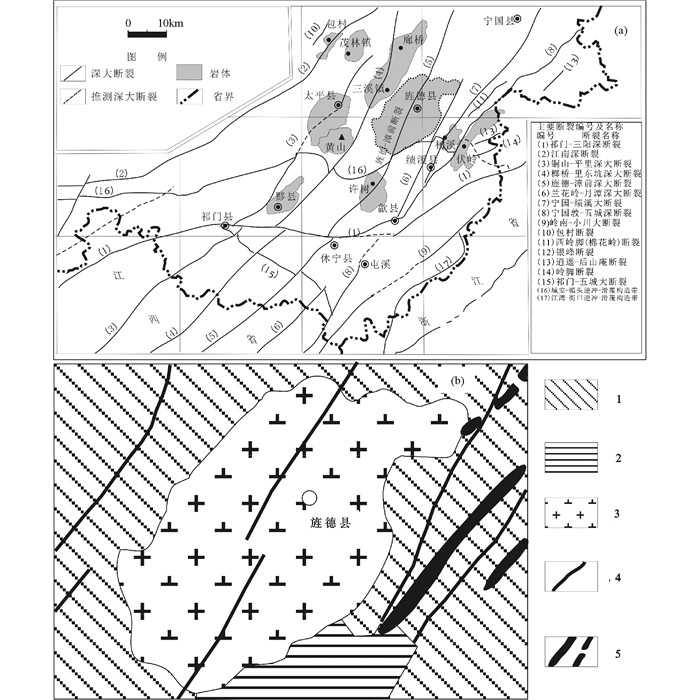
2 地质背景与样品特征旌德岩体(约E118°20′到E118°45′,N30°10′到N30°25′) 位于安徽省宣城市旌德县境内,岩体出露面积约199km2(图 1)。在构造上位于东至-广德复向斜中,侵入于上元古界震旦系和下元古界地层中(周泰禧等,1988),旌德-漳前深大断裂切过岩体。据唐永成等(2010)及1:5万区调报告,旌德岩体分为四期侵入(本文地质图未能区分):第一次为中细粒黑云母花岗闪长岩,分布于复式岩基的边部,常看成岩体的边缘相;第二次为中粒含斑黑云母花岗闪长岩,主体期结构;第三次为中粒(似斑状) 黑云母二长花岗岩,补充期结构;第四次为细粒(二长) 花岗岩,末期结构。本次研究对象为主侵入期的黑云母花岗闪长岩,含有暗色包体,样品采自旌德县云乐乡张村狮子山。
|
图 1 旌德岩体及邻近岩体所处地理位置与构造环境(a) 和旌德岩体地质简图(b)(据唐永成等,2010修改) 1-南华纪到早、中三叠世沉积盖层;2-中元古代(下部基底) 变质岩系;3-花岗闪长岩;4-深大断裂;5-褶皱背斜、向斜轴 Fig. 1 Location of Jingde pluton and adjacent plutons (a) and simplified geological map of Jingde pluton (b) (modified after Tang et al., 2010) |
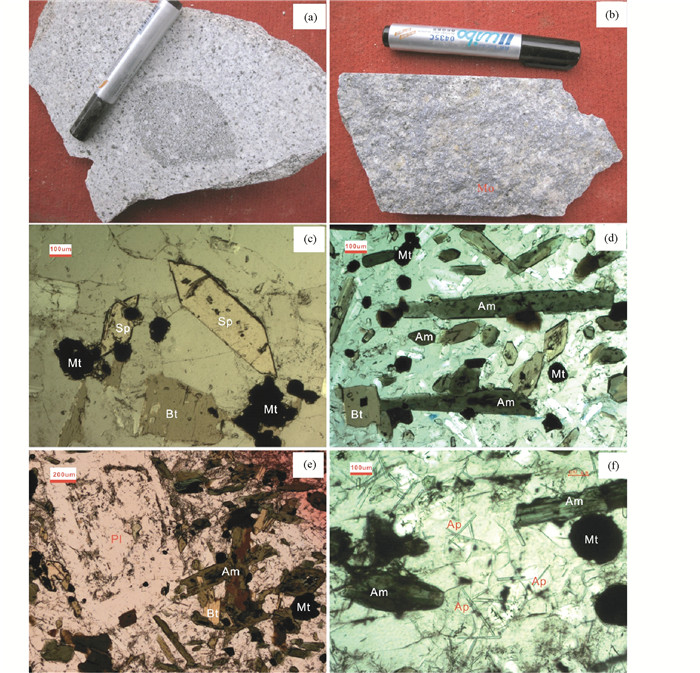
花岗闪长岩为灰白色,暗色包体颜色灰黑,常呈似球状分布在花岗闪长岩中(图 2a)。花岗闪长岩中可以发现浸染状辉钼矿(图 2b)。花岗闪长岩主要矿物组合为黑云母(5%)+钾长石(15%)+斜长石(50%)+石英(30%)。副矿物有榍石(图 2c)、磷灰石、磁铁矿等。暗色包体为典型的岩浆岩结构,但矿物颗粒小于花岗闪长岩,主要矿物组合为角闪石(30%)+黑云母(10%)+斜长石(45%)+石英(15%)(图 2d)。角闪石多为长柱状,黑云母为片状(图 2d, e)。包体中的斜长石斑晶常出现二次生长边(图 2e)。包体中同样含有磁铁矿、榍石、磷灰石等副矿物,磷灰石呈针状(图 2f)。
|
图 2 旌德花岗闪长岩与暗色包体的手标本照片与显微照片 (a)-花岗闪长岩与其中的暗色包体;(b)-花岗闪长岩中出现钼矿化;(c)-花岗闪长岩主要矿物为长石与石英,副矿物有榍石与磁铁矿等;(d)-暗色包体的主要矿物组成为斜长石+角闪石+黑云母.角闪石为长柱状,横截面为近似菱形的六边形.黑云母内部常包含斜长石片晶.副矿物磁铁矿呈球粒状;(e)-暗色包体中有斜长石斑晶,且斑晶呈现两期生长结构;(f)-暗色包体发育针状磷灰石.单偏光. Mo-辉钼矿;Sp-榍石;Mt-磁铁矿;Bt-黑云母;Am-角闪石;Pl-斜长石;Ap-磷灰石 Fig. 2 Hand specimen photos and microphotographs of the Jingde granodiorite and itsMMEs |
全岩的主量元素和微量元素分析在广州澳实矿物实验室完成。主量元素分析采用X射线荧光熔片法完成,分析精度分别为:SiO2,0.8%;Al2O3,0.5%;Fe2O3,0.4%;MgO,0.4%;CaO,0.6%;Na2O,0.3%;K2O,0.4%;MnO,0.7%;TiO2,0.9%;P2O5,0.8%。微量元素分析采用HF+HNO3溶解样品,加入Rh内标溶液,用PE Elan6000型ICP-MS完成测定,分析精度优于5%。
锆石的单矿物分选由河北廊坊地质调查院完成。在双目镜下观察分选好的锆石,将晶形好、无裂隙和包裹体的锆石挑出,用环氧树脂制靶。将锆石靶打磨,抛光,然后进行反射光、透射光显微照相和阴极发光(CL) 分析。锆石的阴极发光在中国科学技术大学理化科学实验中心扫描电镜实验室完成,所用仪器为FEI公司生产的Sirion200型电子显微镜。
锆石的微区原位U-Pb定年和微量元素分析在广州地球化学研究所同位素室国家重点实验室利用激光剥蚀电感耦合等离子体质谱(LA-ICP-MS) 完成。仪器采用美国Resonetics公司生产的RESOlution M-50激光剥蚀系统和Agilent 7500a型的ICP-MS联机。用He作为剥蚀物质的载气。用美国国家标准技术研究院人工合成硅酸盐玻璃标准参考物质NIST610进行仪器最佳化,使仪器达到最佳的灵敏度、最小的氧化物产率(CeO/Ce < 3%) 和最低的背景值。实验采用标准锆石TEMORA (Black et al., 2003) 作为测年外标,所测元素激光斑束直径为31μm,频率为8Hz。相关分析方法详见(涂湘林等,2011)。数据处理使用软件ICPMSDataCal 7.2 (Liu et al., 2008)。锆石的谐和年龄图绘制和年龄计算采用软件Isoplot3.0(Ludwig,2003)。
锆石的微区原位Lu-Hf同位素分析在西北大学大陆动力学国家重点实验室完成。所用质谱为Nu Plasma型多接收电感耦合等离子体质谱(MC-ICP-MS),激光剥蚀系统为193nm ArF准分子激光器的GeoLas 2005。激光斑束直径为44μm,激光脉冲频率为8Hz。具体分析方法和仪器参数详见Yuan et al. (2008)。用176Lu/175Lu=0.02655 (De Biévre and Taylor, 1993) 和176Yb/172Yb=0.58545(Chu et al., 2002) 作为校正因子来进行同质异位干扰校正,计算样品的176Lu/177Hf和176Hf/177Hf。以标准锆石MON-1、GJ-1、91500作为外标,其推荐的标准值依次为0.282739±0.000057,0.282015±0.000056,0.282307±0.000055。在进行εHf(t) 计算时,采用176Lu衰变常数λ=1.867x10⁻¹¹year-1(Söderlund et al., 2004),球粒陨石现今的176Hf/177Hf=0.282772和176Lu/177Hf=0.0332(Blichert-Toft and Albarède,1997)。在进行模式年龄计算时,采用现今的亏损地幔176Hf/177Hf=0.28325和176Lu/177Hf=0.0384(Griffin et al., 2000),现今平均大陆壳的176Lu/177Hf=0.015(Griffin et al., 2002)。
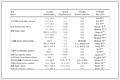
4 分析结果 4.1 全岩主微量元素特征花岗闪长岩和暗色包体的全岩主微量元素特征见表 1。
|
表 1 旌德花岗闪长岩与暗色包体的全岩主量元素(wt%) 与微量元素(×10-6) 组成 Table 1 Whole rock major elements (wt%) and trace elements (×10-6) data for the Jingde granodiorite and its MMEs |
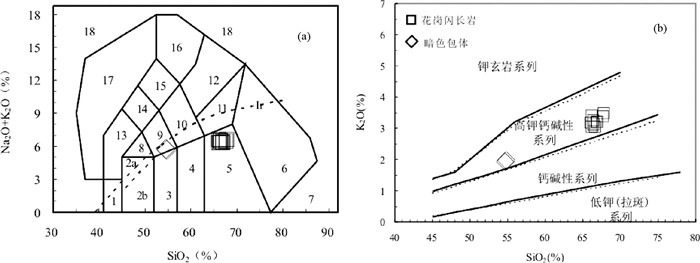
花岗闪长岩的SiO2含量为66.04%~67.80%, Na2O+K2O含量为6.32%~6.63%。暗色包体的SiO2含量为54.63%~54.77%, Na2O+K2O含量为5.65%~5.76%。在TAS分类图上,花岗闪长岩落于花岗闪长岩范围内,暗色包体落于二长闪长岩范围内(图 3a)。花岗闪长岩和暗色包体在K2O-SiO2图上都落于高钾钙碱性系列内(图 3b)。花岗闪长岩的Na2O与K2O含量基本相等(K2O/Na2O=0.90~1.10)。A/CNK=1.01~1.02,为弱过铝质;A/NK=1.74~1.83。在A/NK-A/CNK图解(图略) 上,花岗闪长岩落在岛弧花岗岩(IAG) 与大陆弧花岗岩(CAG) 的重叠区。暗色包体低钾(K2O/Na2O=0.50~0.54);Mg#=44~45。Rapp et al.(1999)认为由下地壳岩石部分熔融形成的熔体,其Mg#小于50,而地幔橄榄岩部分熔融的熔体具有较高的Mg#。暗色包体的Mg#小,可能指示暗色包体来源自下地壳。
|
图 3 花岗闪长岩与暗色包体的TAS图解(a,据Middlemost,1994) 与K2O-SiO2图解(b,实线据Peccerillo and Taylor, 1976;虚线据Middlemost,1985) Fig. 3 The plot of Jingde granodiorite and its MMEs on the TAS (a, after Middlemost, 1994) and K2O vs. SiO2 diagram (b, solid lines after Peccerillo and Taylor, 1976; dashed lines after Middlemost, 1985) |
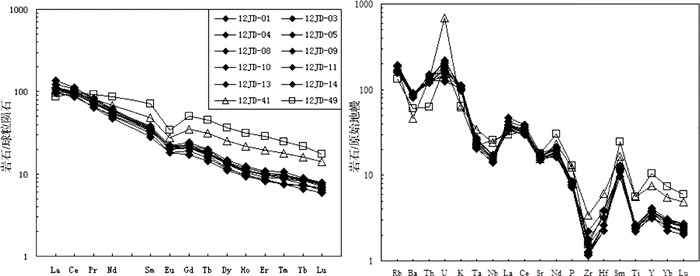
花岗闪长岩与暗色包体的微量元素图解见图 4。花岗闪长岩的10个样品的微量元素分析数据具有很好的一致性。REE球粒陨石标准化图呈现明显的右倾型。轻稀土富集,重稀土亏损,LREE/HREE=8.91~12.87,ΣREE=123.3×10-6~155.5×10-6。Eu呈弱的负异常,Eu/Eu*=0.73~0.83。在微量元素原始地幔标准化图上,高场强元素Nb、Ta、Zr、Hf、Ti相对亏损;Rb、K、Th、U相对富集。Ba相对于Rb和Th亏损。大离子元素富集和高场强元素亏损,指示花岗闪长岩应属地壳来源。
|
图 4 花岗闪长岩与暗色包体的REE球粒陨石标准化图与微量元素原始地幔标准化图(球粒陨石与原始地幔值据Sun and Mcnonough, 1989) Fig. 4 Chondrite-normalized REE patterns and primitive mantle-normalized trace elements patterns of Jingde granodiorite and MMEs (Chondrite and primitive mantle values after Sun and McDonough, 1989) |
暗色包体的两个样品微量元素分析数据存在一定的差异。包体12JD-41中含有花岗闪长岩脉,在送样进行主微量分析之前已经将12JD-41进行切割,挑选不含花岗闪长岩脉的部分送样分析。从数据结果来看,两个暗色包体样品的主量元素含量几乎完全一致,而微量元素含量却存在差异。包体12JD-41的REE含量落在花岗闪长岩与包体12JD-49之间。包体中12JD-41中若存在未切除干净的花岗岩闪长岩脉体会造成这种差异,但是包体12JD-41与12JD-49主量元素的一致性排除了这种可能。因为,若假设12JD-41为花岗闪长岩与暗色包体的混合物,以12JD-49代表暗色包体的初始值,根据REE的质量平衡计算,得到花岗闪长岩在“混合物”12JD-41中所占比例为31%~65%,这么高的比例,将使12JD-41的主量元素含量同样趋近于花岗闪长岩。但是,实际上12JD-41与包体12JD-49的主量元素含量几乎完全一致。故包体间微量元素的差异不可能是由脉体残留引起的,而是由于花岗闪长岩脉的存在,促进了包体12JD-41与花岗闪长岩之间的元素交换,即使脉体被切除,这种影响已经被记录在包体中,使包体的微量元素含量向花岗闪长岩靠近。这种程度的元素交换,虽然会显著影响微量元素的含量,但对于主量元素来说可以忽略不计。包体12JD-49中不含花岗闪长岩脉,其微量元素含量更能代表暗色包体的初始值。
暗色包体12JD-49的REE球粒陨石标准化图同样呈现右倾型,但是相比与花岗闪长岩比较平坦。除元素La外,其他REE的含量都要比花岗闪长岩高。ΣREE=173.6×10⁻⁶, LREE/HREE=4.33, Eu/Eu*=0.57。微量元素原始地幔标准化图的模式与花岗闪长岩基本一致,大离子亲石元素Rb、U富集,高场强元素Nb, Ta, Zr, Hf, Ti亏损。相比于花岗闪长岩,Ti, Y含量较高。
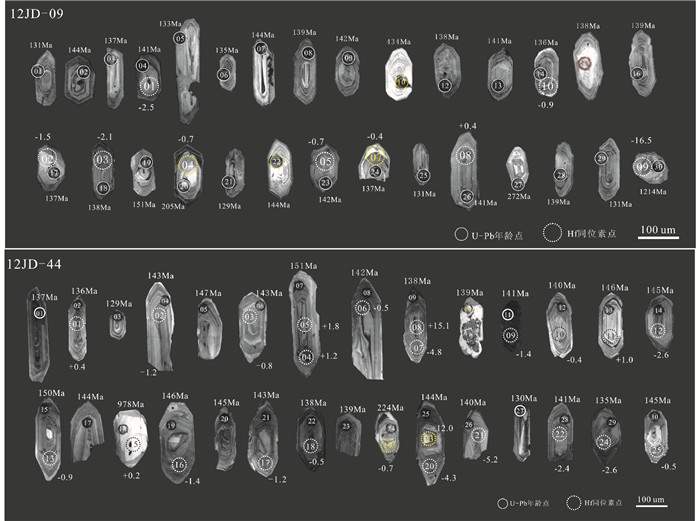
4.2 锆石U-Pb年龄本文中所测两个样品中的锆石形貌上多呈现规则的短柱状(图 5)。除个别锆石为继承锆石外,其余锆石CL图像显示振荡环带发育,Th/U均大于0.4。这些特征表明其为岩浆成因的锆石(Hoskin,2000;Sun et al., 2002;吴元保和郑永飞,2004)。观察锆石的透射光照片和反射光照片,避开有包裹体的部位或核部可能存在的继承锆石,在相对纯净的部位进行激光剥蚀来定年和测定Hf同位素。测试结果见表 2。
|
图 5 花岗闪长岩(12JD-09) 与暗色包体(12JD-44) 的锆石CL图像、U-Pb定年点与Hf同位素测试点 Small and solid circles indicate locations of LA-ICP-MS U-Pb dating, while big and dashed circles indicate LA-MC-ICP-MS Hf analyses positions Fig. 5 Cathodoluminescence (CL) images of zircon from Jingde granodiorite (12JD-09) and its MMEs (12JD-44) |
|
|
表 2 旌德花岗闪长岩与暗色包体的锆石LA-ICP-MS U-Pb定年结果 Table 2 LA-ICP-MS zircon U-Pb data of the Jingde granodirote and its MMEs |
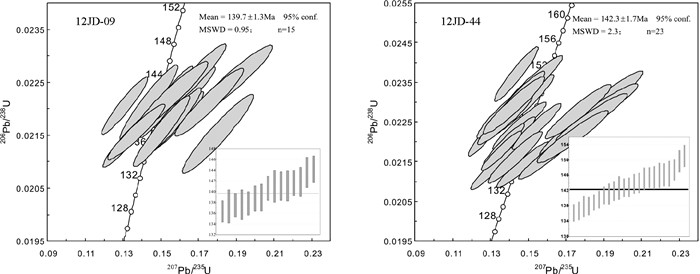
花岗闪长岩样品12JD-09进行了锆石U-Pb定年。锆石CL图像和测试点位置见图 5。在12JD-09的30个测试点中,有7个测试点(01、03、05、06、21、25、29) 由于激光剥蚀位置越过了锆石边缘,使得环氧树脂与锆石一起被剥蚀,所以这些点作为废弃数据,不参与讨论。测试点07、15、28的谐和度低于70%,舍弃。测试点19打在继承锆石核与新生锆石的交界部位,年龄无意义,舍弃。测试点10、20、27、30为继承锆石或捕获锆石,不参与计算。剩余15个测试点的年龄谐和度好,且分布较集中,年龄值在136~144Ma,平均值为139.7±1.3Ma (图 6)。
暗色包体样品12JD-44用来做锆石U-Pb定年。锆石CL图像和测试点位置见图 5。在分析的30个测试点中,测试点27越过锆石边界剥蚀到了树脂,为废弃年龄。测试点03对应的锆石颗粒很小,年龄较小(129Ma),为一孤立的年龄,可能是后期新生锆石,不能代表此次岩浆事件,故不参与年龄计算。测试点10对应的锆石CL图像斑驳,显示其不是正常的岩浆锆石,可能是后期遭遇了变质作用,故舍弃。测试点26、29谐和度过低,舍弃。测试点18、24为继承锆石或捕获锆石,不参与计算。剩余23个测试点年龄谐和度好,且年龄分布集中于136~151Ma,平均值为142.3±1.7Ma (图 6)。
|
图 6 花岗闪长岩(12JD-09) 与暗色包体(12JD-44) 的锆石U-Pb年龄谐和图 Fig. 6 Zircon concordia diagrams for the Jingde granodiorite (12JD-09) and its MMEs (12JD-44) Ellipse dimensions are 1σ |
暗色包体的锆石年龄平均值比花岗闪长岩稍高2~3Ma,但在误差范围内一致,说明它们是同期岩浆作用的产物。
4.3 锆石Hf同位素花岗闪长岩样品12JD-09和暗色包体12JD-44的锆石Hf同位素测试点位置见图 5。分析结果见表 3。
|
|
表 3 旌德花岗闪长岩与暗色包体的锆石Hf同位素组成 Table 3 Zircon Hf isotope data for the Jingde granodiorite and its MMEs |
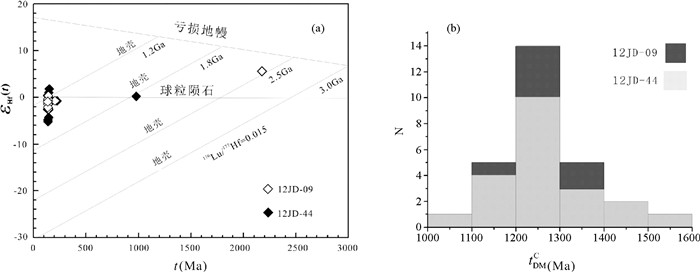
花岗闪长岩样品12JD-09进行U-Pb定年的锆石颗粒较小,在测量Hf同位素时,一些锆石被击穿。有9颗锆石取得了精确的数据,除去两个继承锆石(04、09),剩余7颗锆石给出了很一致的结果,可以代表此次岩浆事件。7颗锆石的176Yb/177Hf和176Lu/177Hf分别为0.015297~0.028633和0.000687~0.001242。锆石的176Lu/177Hf很小,说明锆石形成之后很少有放射性Hf的积累。锆石的176Hf/177Hf变化在0.282617~0.282697。根据各个锆石对应的206Pb/238U年龄计算得到它们的εHf(t) 为-2.5~+0.4,Hf同位素地壳模式年龄(tDMC) 为1170~1350Ma。
暗色包体12JD-44所得Hf数据比较完整。所得的25个数据中,点15、19为继承锆石。点08、23打在锆石的继承核上,不代表此次岩浆事件时的Hf同位素,没有对应的U-Pb年龄,数据无用。点05是重复数据,舍弃。剩余的20个数据的176Yb/177Hf为0.008773~0.033159,176Lu/177Hf为0.000412~0.001434。176Hf/177Hf的值变化在0.282540~0.282734,对应的εHf(t) 为-5.2~1.8。Hf同位素地壳模式年龄(tDMC) 为1090~1530Ma。
花岗闪长岩与暗色包体的Hf同位素地壳模式年龄分布基本一致,峰值都在1.2~1.3Ga,指示它们是同源物质(图 7)。李献华等(1991)统计前人数据,发现华南地壳幕式增长,主要有3期:2.5Ga或更早,1.8Ga,1.2~1.4Ga。旌德岩体的源区对应最后一期华南地壳的幕式生长。
|
图 7 花岗闪长岩与暗色包体的εHf(t)-t图(a) 和地壳模式年龄(tDMC) 分布图(b) Fig. 7 The plots of Jingde granodiorite and MMEs on the εHf(t) vs. U-Pb age diagram (a) and the distribution of Hf isotope crust model ages (tDMC)(b) |
酸性岩浆岩中常见暗色包体, 对其成因前人提出了多种认识:源区残留体或围岩捕掳体(Chappell et al., 1987;Chen et al., 1989;Chappell, 1996);岩浆早期结晶分异堆晶体(Clemens and Wall, 1988;Dodge and Kistler, 1990);岩浆液态熔离(Watson,1976);岩浆混合(Xu et al., 2004;Yang et al., 2004;Kaygusuz and Aydinçakir,2009;Zhao et al., 2010, 2012)。
由旌德花岗闪长岩与暗色包体锆石年龄的一致性,排除了包体是源区残留体或围岩捕掳体的可能。缓慢结晶时形成的磷灰石是短柱状的,而快速冷凝结晶时形成的磷灰石是针状的(Wyllie et al., 1962;Didier and Barbarin, 1991;Xu et al., 2004)。旌德岩体暗色包体中发育针状磷灰石,指示暗色包体的岩浆经历了一个快速冷却的过程。而岩浆早期分异结晶或岩浆液态熔离则不会使包体经历快速冷却的过程。
暗色包体在外形上常为椭球状。在结构上是典型的岩浆岩结构,角闪石和黑云母无定向排列,有斜长石斑晶,且多见榍石、磷灰石等副矿物。包体的矿物颗粒比寄主花岗闪长岩小。这些特征同样表明暗色包体不是岩浆早期结晶分异堆晶体。而前人研究表明,液态熔离常见于硅酸盐熔体与硫化物矿浆(黄智龙等,1999;Guzmics et al., 2012)、富Li、F挥发分熔体(王联魁等, 1983, 1987, 1997)、碳酸岩岩浆(Rankin and Lebas, 1974;Brooker and Kjarsgaard, 2011;Solovova and Girnis, 2012;Guzmics et al., 2012) 之间,或者基性岩浆与酸性岩浆之间(Roedder and Weiblen, 1970;Philpott,1971;Charlier et al., 2011)。但至今尚无实验或地质现象证明熔体结构如此相近的花岗闪长质岩浆与二长闪长质岩浆之间可以发生液态熔离。
岩浆混合作用可以合理地解释上述岩相学与年代学的特征。偏基性的岩浆与酸性岩浆接触时,由于酸性岩浆温度较低,偏基性岩浆淬冷结晶。所以包体中晶体矿物颗粒较小,且发育针状磷灰石。因为偏基性岩浆与酸性为同时期岩浆活动的产物,所以有一致的年龄。此外,暗色包体中可见花岗闪长岩脉体,称为反向脉(back vein)。这是由于淬冷边因突然冷凝收缩形成不规则裂缝,使花岗闪长岩熔体得以注如到包体中。反向脉的出现是岩浆混合的可靠证据(朱金初等,2006;王德滋和谢磊,2008)。
前人对岩浆混合成因的暗色包体与寄主岩的同位素研究很多,由于二者在岩浆混合时存在广泛的物质交换,很多学者观察到暗色包体与寄主岩石间的Sr、Nd同位素达到部分或完全平衡(Pin et al., 1990;Holden et al., 1991;Elburg,1996;Liao et al., 2011;Zhao et al., 2010, 2012;陈斌等,2009)。而锆石结晶早且稳定,包体与寄主岩之间的同位素交换不会影响锆石中的Hf同位素,故锆石的Hf同位素特征可以指示初始岩浆的性质。旌德岩体暗色包体的Hf同位素初始值(-5.2~1.8) 分布较集中,且与寄主岩的Hf同位素初始值(-2.5~0.4) 分布基本一致,说明两者来自相同源区。故旌德岩体中暗色包体为同源岩浆混合成因。
Vernon (1983)曾提出层状岩浆房对流模型来解释花岗岩中的暗色包体,认为岩浆房中存在着铁镁质和长英质两层岩浆,因为成分与温度的不均一性,发生对流,上部长英质岩浆房中的对流使得下层铁镁质岩浆团被带上并淬火冷凝成暗色包体;下部铁镁质岩浆房中的对流使得上层长英质岩浆团被拖入下部,并很快均一化混合。这是为什么常见暗色包体不见浅色包体的原因。这种模型可以视为同源岩浆混合的一种特殊形式。
5.2 岩体的温度与氧逸度旌德岩体中继承锆石的出现说明岩浆Zr达到饱和,根据Watson and Harrison (1983)提出的岩浆Zr饱和温度计公式TZr=12900/[2.95+0.85M+ln (496000/Zrmelt)]来计算锆石结晶时岩浆的温度,结果得到暗色包体与花岗闪长岩的岩浆锆饱和温度都在630~680℃。笔者在现有的岩石薄片中没有发现金红石矿物,但是若假定岩体中有金红石作为独立矿物相存在时,根据Watson et al. (2006)提出的锆石Ti含量温度计公式计算得到,花岗闪长岩(12JD-09) 的岩浆温度为630~720℃,平均温度为670℃;暗色包体(12JD-44) 的岩浆温度为600~720℃,平均温度为660℃。锆石Ti温度计与岩浆Zr饱和温度计给出的结果一致,温度都比正常的岩浆温度要低。锆石结晶处于岩浆分异演化的早期阶段,锆石结晶时岩浆的温度如此低,可能指示岩浆是由源区物质在富水与减压的条件下发生部分熔融形成的。
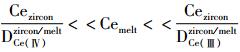
Ballard et al.(2002)提出锆石中Ce (Ⅳ)/Ce (Ⅲ) 是一种很好的氧逸度计,并推导出计算Ce (Ⅳ)/Ce (Ⅲ) 的公式(1):
根据Blundy and Wood (1994)提出的晶格扭曲模型,可以推导出分配系数与半径的关系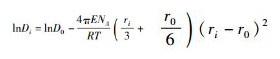

|
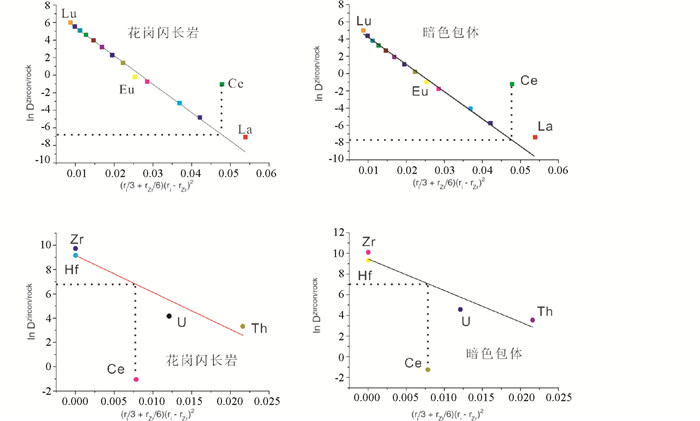
图 8 分配系数与离子半径函数的线性拟合 Fig. 8 The liner fitting between lnDi and function of ri |
拟合结果得到花岗闪长岩中的DCe (Ⅲ)zircon/melt为0.00111,而暗色包体中的DCe (Ⅲ)zircon/melt为0.000465。将DCe (Ⅲ)zircon/melt的数值带入公式(2),计算得到锆石的Ce (Ⅳ)/Ce (Ⅲ):花岗闪长岩为240~530,平均值315;暗色包体490~910,平均值620。旌德岩体中锆石的Ce (Ⅳ)/Ce (Ⅲ)>300,指示岩体具有高的氧逸度,岩体源区物质可能受到俯冲洋壳脱水产生的高氧逸度流体的交代(Mungall,2002)。氧逸度还可以作为一个经验性的指标来区分成矿岩体与不成矿岩体(Ballard et al., 2002),高氧逸度指示旌德岩体具有成矿的潜力。
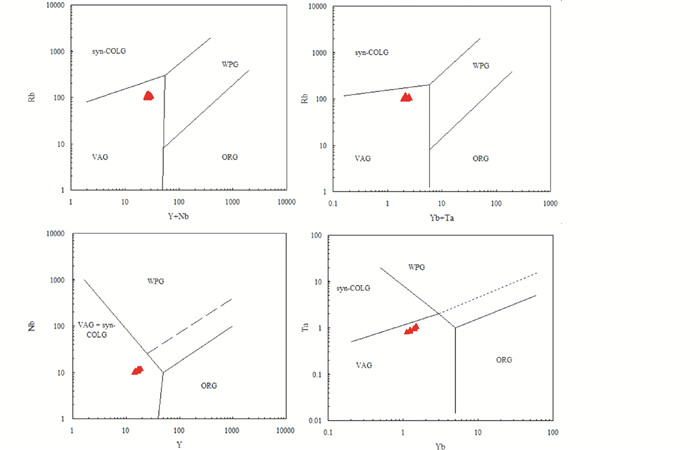
5.3 构造背景判别旌德花岗闪长岩在Pearce et al.(1984)的构造判别图上位于岛弧花岗岩区(图 9),在Sr/Y-Y图上落在经典的岛弧岩浆系列区(图略),表明旌德花岗闪长岩的源区受到了板块俯冲的影响,这与华南地区在当时所处的构造格局相一致,可能与来自与太平洋的斜向俯冲,也可能与江绍断裂的早期俯冲有一定的关系。旌德岩体位于江绍断裂带上,此断裂带被公认为是扬子-华夏两大板块的碰撞拼合带(例如:水涛等,1986;王鹤年和周丽娅,2006;舒良树,2012)。郭令智等(1996)认为古华南洋壳于中新元古代13(17)~9.8亿年向北俯冲于扬子板块东南边缘之下,形成江南火山岛弧和弧后盆地。旌德岩体的地壳模式年龄集中在14~12亿年,岩体的源区物质有可能为新生的江南火山岛弧。
|
图 9 花岗闪长岩的构造背景判别图解(据Pearce et al., 1984) WPG-板内花岗岩;ORG-洋中脊花岗岩;VAG-岛弧花岗岩;syn-COLG-同碰撞花岗岩 Fig. 9 Diagrams of tectonic environment for Jingde grnodiorite by trace elements (after Pearce et al., 1984) |
花岗闪长岩岩浆的低温和高氧逸度特征也支持其源区物质的岛弧成因。可能的情形为:在中新元古代,古华南洋壳向北俯冲于杨子板块之下,洋壳脱水产生的高氧逸度流体向上运移进入上覆地幔楔,促使地幔楔发生部分熔融生成岛弧岩浆岩,岛弧岩浆岩继承了流体的高氧逸度性质,在后续的碰撞过程中拼接成为新生弧壳。新生弧壳在减压或者有外来流体加入的条件下,可以在较低温度下发生部分熔融。在侏罗纪末期(~140Ma),这一条件得到实现,新生弧壳发生部分熔融,形成了旌德岩体,旌德岩体同样继承了弧壳的高氧逸度特征。前人研究表明,在140Ma左右,整个长江中下游地区(如铜陵矿集区、九瑞矿区) 爆发了十分强烈的花岗岩浆活动和铜金多金属成矿作用(Ling et al., 2009;Sun et al., 2011;Yang et al., 2011;陈江峰等,2005;翟裕生等,1992;蒋少涌等, 2008, 2010)。在旌德岩体中我们发现局部地区存在斑岩型钼矿及细脉状黄铜矿,指示该岩体可能有潜在的找矿前景。
华南地区在燕山期岩浆活动强烈。对此次岩浆事件形成的构造背景有多种不同的认识,主要有以下几种观点:(1) 与古太平洋俯冲相关的活动大陆边缘模式(Jahn et al., 1976;Holloway,1982;Sewell and Campbell, 1997;Zhou and Li, 2000;Zhou et al., 2006),(2) 陆-陆碰撞模式(Hsü et al., 1988,1990)、(3) 陆内伸展-裂谷模式(Gilder et al., 1991, 1996;Li,2000)。Sun et al.(2007)将太平洋板块对欧亚大陆的俯冲方向与中国东部岩浆活动的时间进行比较,发现中国东部白垩纪以来的主要地质活动与太平洋板块转向有着密切的关系。进一步的研究指出,太平洋板块向南西俯冲和相应的板块后撤,是形成华南晚侏罗世岩浆活动与成矿的关键(Wang et al., 2011)。由于俯冲板块较年轻,向南西的俯冲是低角度俯冲,俯冲的距离较远,远端达到了南岭地区,大约在165Ma起,俯冲板片后撤,形成了南岭高演化花岗岩和相关的矿床(Li et al., 2012)。随后形成了由南西向北东逐渐年轻的岩浆、矿床分布特征(Zhou et al., 2006;Wang et al., 2011;Sun et al., 2012a, b)。旌德位于华南的东北部,其花岗闪长岩的年龄为139.7Ma,是该地质事件中最年轻的,与太平洋斜向俯冲的模型吻合。
6 结论(1) 旌德岩体中花岗闪长岩含有闪长质暗色包体。花岗闪长岩与暗色包体锆石U-Pb年龄和Hf同位素的一致性、包体的岩浆岩结构、包体中淬冷条件下发育的针状磷灰石以及包体中存在的寄主岩反向脉,说明花岗闪长岩中的暗色包体为同源岩浆混合成因。
(2) 旌德岩体的源区有可能为中新元古代古华南洋壳向北俯冲于扬子板块之下形成的江南火山岛弧。旌德岩体高的氧逸度和低的温度也支持其源区物质的岛弧成因。
(3) 旌德岩体的年龄为139.7±1.3Ma,处于侏罗纪末期。岩体形成与太平洋板块对华南地区的南西向俯冲和相应的板块后撤有关。
致谢 LA-ICP-MS锆石U-Pb定年得到广州地化所李聪颖、张潺蝉和中国科学技术大学赵乘乘的帮助,锆石Hf同位素测试得到西北大学张红老师的帮助,在此表示衷心感谢。感谢匿名审稿人对本文完善提出的宝贵意见及建议。| [] | Ballard JR, Palin JM, Campbell IH. 2002. Relative oxidation states of magmas inferred from Ce (IV)/Ce (III) in zircon: Application to porphyry copper deposits of northern Chile. Contributions to Mineralogy and Petrology, 144(3): 347–364. DOI:10.1007/s00410-002-0402-5 |
| [] | Black LP, Kamo SL, Allen CM, Aleinikoff JN, Davis DW, Korsch RJ, Foudoulis C. 2003. TEMORA 1: A new zircon standard for Phanerozoic U-Pb geochronology. Chemical Geology, 200(1-2): 155–170. DOI:10.1016/S0009-2541(03)00165-7 |
| [] | Blichert-Toft J, Albarède F. 1997. The Lu-Hf isotope geochemistry of chondrites and the evolution of the mantle-crust system. Earth and Planetary Science Letters, 148(1-2): 243–258. DOI:10.1016/S0012-821X(97)00040-X |
| [] | Blundy J, Wood B. 1994. Prediction of crystal-melt partition coefficients from elastic moduli. Nature, 372(6505): 452–454. DOI:10.1038/372452a0 |
| [] | Brooker RA, Kjarsgaard BA. 2011. Silicate-carbonate liquid immiscibility and phase relations in the system SiO2-Na2O-Al2O3-CaO-CO2 at 0.1~2.5GPa with applications to carbonatite genesis. Journal of Petrology, 52(7-8): 1281–1305. DOI:10.1093/petrology/egq081 |
| [] | Chappell BW, White AJR, Wyborn D. 1987. The importance of residual source material (restite) in granite petrogenesis. Journal of Petrology, 28(6): 1111–1138. DOI:10.1093/petrology/28.6.1111 |
| [] | Chappell BW. 1996. Magma mixing and the production of compositional variation within granite suites: Evidence from the granites of southeastern Australia. Journal of Petrology, 37(3): 449–470. DOI:10.1093/petrology/37.3.449 |
| [] | Charlier B, Namur O, Toplis MJ, Schiano P, Cluzel N, Higgins MD, Vander Auwera JV. 2011. Large-scale silicate liquid immiscibility during differentiation of tholeiitic basalt to granite and the origin of the Daly gap. Geology, 39(10): 907–910. DOI:10.1130/G32091.1 |
| [] | Chen B, He JB, Ma XH. 2009. Petrogenesis of mafic enclaves from the north Taihang Yanshanian intermediate to felsic plutons: Evidence from petrological, geochemical and zircon Hf-O isotopic data. Science in China (Series D), 39(7): 922–934. |
| [] | Chen JF, Zhou TX, Li XM, Foland KA, Huang CY, Lu W. 1993. Sr and Nd isotopic constraints on source regions of the intermediate and acid intrusions from southern Anhui Province. Geochimica, 22(3): 261–268. |
| [] | Chen JF, Yu G, Yang G, Yang SH. 2005. A geochronological framework of Late Mesozoic magmatism and metallogenesis in the Lower Yangtze Valley, Anhui Province. Geology of Anhui, 15(3): 161–169. |
| [] | Chen YD, Price RC, White AJR. 1989. Inclusions in three S-type granites from southeastern Australia. Journal of Petrology, 30(5): 1181–1218. DOI:10.1093/petrology/30.5.1181 |
| [] | Chu NC, Taylor RN, Chavagnac V, Nesbitt RW, Boella RM, Milton JA, German CR, Bayon G, Burton K. 2002. Hf isotope ratio analysis using multi-collector inductively coupled plasma mass spectrometry: An evaluation of isobaric interference corrections. Journal of Analytical Atomic Spectrometry, 17(12): 1567–1574. DOI:10.1039/b206707b |
| [] | Clemens JD, Wall VJ. 1988. Controls on the mineralogy of S-type volcanic and plutonic rocks. Lithos, 21(1): 53–66. DOI:10.1016/0024-4937(88)90005-9 |
| [] | Dallmeyer RD, VanBreeman O. 1981. Rb-Sr whole-rock and 40Ar-39Ar mineral ages of the Togus and Hallowell quartz monzonite and Three Mile Pond granodiorite plutons, South-Central Maine: Their bearing on post-Acadian cooling history. Contributions to Mineralogy and Petrology, 78(1): 61–73. DOI:10.1007/BF00371144 |
| [] | De Biévre P, Taylor PDP. 1993. Table of the isotopic compositions of the elements. International Journal of Mass Spectrometry and Ion Processes, 123(2): 149–166. DOI:10.1016/0168-1176(93)87009-H |
| [] | Didier J and Barbarin B. 1991. Enclaves and Granite Petrology. Developments in Petrology. The Netherlands: Elsevier Science |
| [] | Dodge FCW, Kistler RW. 1990. Some additional observations on inclusions in the granitic rocks of the Sierra Nevada. Journal of Geophysical Research, 95(B11): 17841–17848. DOI:10.1029/JB095iB11p17841 |
| [] | Elburg MA. 1996. Evidence of isotopic equilibration between microgranitoid enclaves and host granodiorite, Warburton Granodiorite, Lachlan Fold Belt, Australia. Lithos, 38(1-2): 1–22. DOI:10.1016/0024-4937(96)00003-5 |
| [] | Gilder SA, Keller GR, Luo M, Goodell PC. 1991. Timing and spatial distribution of rifting in China. Tectonophysics, 197(2-4): 225–243. DOI:10.1016/0040-1951(91)90043-R |
| [] | Gilder SA, Gill J, Coe RS, Zhao XX, Liu ZW, Wang GX, Yuan KR, Liu WL, Kuang GD, Wu HR. 1996. Isotopic and paleomagnetic constraints on the Mesozoic tectonic evolution of South China. Journal of Geophysical Research, 101(B7): 16137–16154. DOI:10.1029/96JB00662 |
| [] | Griffin WL, Pearson NJ, Belousova E, Jackson SE, van Achterbergh E, O'Reilly SY, Shee SR. 2000. The Hf isotope composition of cratonic mantle: LAM-MC-ICPMS analysis of zircon megacrysts in kimberlites. Geochimica et Cosmochimica Acta, 64(1): 133–147. DOI:10.1016/S0016-7037(99)00343-9 |
| [] | Griffin WL, Wang X, Jackson SE, Pearson NJ, O'Reilly SY, Xu XS, Zhou XM. 2002. Zircon chemistry and magma mixing, SE China: In-situ analysis of Hf isotopes, Tonglu and Pingtan igneous complexes. Lithos, 61(3-4): 237–269. DOI:10.1016/S0024-4937(02)00082-8 |
| [] | Guo LZ, Lu HF, Shi YS, Ma RS, Sun Y, Shu LS, Jia D, Zhang QL. 1996. On the Meso-Neoproterozoic Jiangnan island arc: Its kinematics and dynamics. Geological Journal of Universities, 2(1): 1–13. |
| [] | Guzmics T, Mitchell RH, Szabó C, Berkesi M, Milke R, Ratter K. 2012. Liquid immiscibility between silicate, carbonate and sulfide melts in melt inclusions hosted in co-precipitated minerals from Kerimasi volcano (Tanzania): Evolution of carbonated nephelinitic magma. Contributions to Mineralogy and Petrology, 164(1): 101–122. DOI:10.1007/s00410-012-0728-6 |
| [] | Holden P, Halliday AN, Stephens WE, Henney PJ. 1991. Chemical and isotopic evidence for major mass-transfer between mafic enclaves and felsic magma. Chemical Geology, 92(1-3): 135–152. DOI:10.1016/0009-2541(91)90053-T |
| [] | Holloway NH. 1982. North Palawan Block, Philippines: Its relation to Asian Mainland and role in evolution of South China Sea. Am. Assoc. Petrol. Geol. Bull., 66(9): 1355–1383. |
| [] | Hoskin PWO. 2000. Patterns of chaos: Fractal statistics and the oscillatory chemistry of zircon. Geochimica et Cosmochimica Acta, 64(11): 1905–1923. DOI:10.1016/S0016-7037(00)00330-6 |
| [] | Hsü KJ, Sun S, Li JL, Chen HH, Pen HP, Sengor AMC. 1988. Mesozoic overthrust tectonics in south China. Geology, 16(5): 418–421. DOI:10.1130/0091-7613(1988)016<0418:MOTISC>2.3.CO;2 |
| [] | Hsü KJ, Li JL, Chen HH, Wang QC, Sun S, Şengör AMC. 1990. Tectonics of South China: Key to understanding West Pacific geology. Tectonophysics, 183(1-4): 9–39. DOI:10.1016/0040-1951(90)90186-C |
| [] | Huang ZL, Zhu CM, Xiao HY, Liu CQ. 1999. An experimental study of liquid immiscibility of lamprophyre-sulfide melt at high temperature and high pressure. Geological Review, 45(Suppl.1): 113–118, 1191. |
| [] | Jahn BM, Chen PY, Yen TP. 1976. Rb-Sr ages of granitic rocks in southeastern China and their tectonic significance. Geol. Soc. Am. Bull., 87(5): 763–776. DOI:10.1130/0016-7606(1976)87<763:RAOGRI>2.0.CO;2 |
| [] | Jiang SY, Li L, Zhu B, Ding X, Jiang YH, Gu LX, Ni P. 2008. Geochemical and Sr-Nd-Hf isotopic compositions of granodiorite from the Wushan copper deposit, Jiangxi Province and their implications for petrogenesis. Acta Petrologica Sinica, 24(8): 1679–1690. |
| [] | Jiang SY, Sun Y, Sun MZ, Bian LZ, Xiong YG, Yang SY, Cao ZQ, Wu YM. 2010. Reiterative fault systems and superimposed mineralization in the Jiurui metallogenic cluster district, Middle and Lower Yangtze River mineralization belt, China. Acta Petrologica Sinica, 26(9): 2751–2767. |
| [] | Kaygusuz A, Aydinçakir E. 2009. Mineralogy, whole-rock and Sr-Nd isotope geochemistry of mafic microgranular enclaves in Cretaceous Dagbasi granitoids, Eastern Pontides, NE Turkey: Evidence of magma mixing, mingling and chemical equilibration. Chemie Der Erde-Geochemistry, 69(3): 247–277. DOI:10.1016/j.chemer.2008.08.002 |
| [] | Li CY, Zhang H, Wang FY, Liu JQ, Sun YL, Hao XL, Li YL, Sun WD. 2012. The formation of the Dabaoshan porphyry molybdenum deposit induced by slab rollback. Lithos, 150: 101–110. DOI:10.1016/j.lithos.2012.04.001 |
| [] | Li XH, Zhao ZH, Gui XT, Yu YS. 1991. Sm-Nd isotopic and zircon U-Pb constraints on the age of formation of the Precambrian crust in Southeast China. Geochimica, 20(3): 255–264. |
| [] | Li XH. 2000. Cretaceous magmatism and lithospheric extension in Southeast China. Journal of Asian Earth Sciences, 18(3): 293–305. DOI:10.1016/S1367-9120(99)00060-7 |
| [] | Liao SY, Jiang YH, Jiang SY, Yang WZ, Zhou Q, Jin GD, Zhao P. 2011. Subducting sediment-derived arc granitoids: Evidence from the Datong pluton and its quenched enclaves in the western Kunlun orogen, Northwest China. Mineralogy and Petrology, 100(1-2): 55–74. |
| [] | Ling MX, Wang FY, Ding X, Hu YH, Zhou JB, Zartman RE, Yang XY, Sun WD. 2009. Cretaceous ridge subduction along the Lower Yangtse River Belt, eastern China. Economic Geology, 104(2): 303–321. DOI:10.2113/gsecongeo.104.2.303 |
| [] | Liu YS, Hu ZC, Gao S, Güenther D, Xu J, Gao CG, Chen HH. 2008. In situ analysis of major and trace elements of anhydrous minerals by LA-ICP-MS without applying an internal standard. Chemical Geology, 257(1-2): 34–43. DOI:10.1016/j.chemgeo.2008.08.004 |
| [] | Ludwig KR. 2003. User's Manual for A Geochronological Toolkit for Microsoft Excel. Berkeley Geochronology Center, Special Publication, Vol. 4 http://www.scirp.org/reference/ReferencesPapers.aspx?ReferenceID=598741 |
| [] | Middlemost EAK. 1985. Magmas and Magmatic Rocks: An Introduction to Igneous Petrology. London: Longman: 1-266. |
| [] | Middlemost EAK. 1994. Naming materials in the magma/igneous rock system. Earth-Science Reviews, 37: 215–224. DOI:10.1016/0012-8252(94)90029-9 |
| [] | Mungall JE. 2002. Roasting the mantle: Slab melting and the genesis of major Au and Au-rich Cu deposits. Geology, 30(10): 915–918. DOI:10.1130/0091-7613(2002)030<0915:RTMSMA>2.0.CO;2 |
| [] | Pearce JA, Harris NBW, Tindle AG. 1984. Trace element discrimination diagrams for the tectonic interpretation of granitic rocks. Journal of Petrology, 25(4): 956–983. DOI:10.1093/petrology/25.4.956 |
| [] | Peccerillo A, Taylor SR. 1976. Geochemistry of Eocene calc-alkaline volcanic rocks from the Kastamonu area, northern Turkey. Contributions to Mineralogy and Petrology, 58(1): 63–81. DOI:10.1007/BF00384745 |
| [] | Philpotts AR. 1971. Immiscibility between feldspathic and gabbroic magmas. Nature Physical Science, 229(4): 107–109. DOI:10.1038/physci229107a0 |
| [] | Pin C, Binon M, Belin JM, Barbarin B, Clemens JD. 1990. Origin of microgranular enclaves in granitoids-equivocal Sr-Nd evidence from Hercynian rocks in the massif-central (France). Journal of Geophysical Research, 95(B11): 17821–17828. DOI:10.1029/JB095iB11p17821 |
| [] | Qian H, Xia J. 2010. Geochemical features and origin of granites around Ningguo-Jingde in South Anhui. Geology of Anhui, 20(3): 183–188. |
| [] | Rankin AH, Lebas MJ. 1974. Liquid immiscibility between silicate and carbonate melts in naturally occuring ijolite magma. Nature, 250(5463): 206–209. DOI:10.1038/250206a0 |
| [] | Rapp RP, Shimizu N, Norman MD, Applegate GS. 1999. Reaction between slab-derived melts and peridotite in the mantle wedge: Experimental constraints at 3.8GPa. Chemical Geology, 160(4): 335–356. DOI:10.1016/S0009-2541(99)00106-0 |
| [] | Roedder E, Weiblen PW. 1970. Silicate liquid immiscibility in Lunar magmas, evidenced by melt inclusions in lunar rocks. Science, 167(3918): 641–644. DOI:10.1126/science.167.3918.641 |
| [] | Sewell RJ, Campbell SDG. 1997. Geochemistry of coeval Mesozoic plutonic and volcanic suites in Hong Kong. Journal of the Geological Society, 154(6): 1053–1066. DOI:10.1144/gsjgs.154.6.1053 |
| [] | Shu LS. 2012. An analysis of principal features of tectonic evolution in South China Block. Geological Bulletin of China, 31(7): 1035–1053. |
| [] | Shui T, Xu BT, Liang RH, Qiu YS. 1986. Shaoxing-Jiangshan suture zone: Matching belt of ancient lands. Chinese Science Bulletin, 31(6): 444–448. |
| [] | Söderlund U, Patchett JP, Vervoort JD, Isachsen CE. 2004. The 176Lu decay constant determined by Lu-Hf and U-Pb isotope systematics of Precambrian mafic intrusions. Earth and Planetary Science Letters, 219(3-4): 311–324. DOI:10.1016/S0012-821X(04)00012-3 |
| [] | Solovova IP, Girnis AV. 2012. Silicate-carbonate liquid immiscibility and crystallization of carbonate and K-rich basaltic magma: Insights from melt and fluid inclusions. Mineralogical Magazine, 76(2): 411–439. DOI:10.1180/minmag.2012.076.2.09 |
| [] | Sun SS and McDonough WF. 1989. Chemical and isotopic systematics of oceanic basalts: Implications for mantle composition and processes. In: Saunders AD and Norry MJ (eds.). Magmatism in the Ocean Basins. Geological Society of London Special Publication, 42(1): 313-345 |
| [] | Sun WD, Li SG, Chen YD, Li YJ. 2002. Timing of synorogenic granitoids in the South Qinling, Central China: Constraints on the evolution of the Qinling-Dabie orogenic belt. Journal of Geology, 110(4): 457–468. DOI:10.1086/340632 |
| [] | Sun WD, Ding X, Hu YH, Li XH. 2007. The golden transformation of the Cretaceous plate subduction in the west Pacific. Earth and Planetary Science Letters, 262(3-4): 533–542. DOI:10.1016/j.epsl.2007.08.021 |
| [] | Sun WD, Zhang H, Ling MX, Ding X, Chung SL, Zhou JB, Yang XY, Fan WM. 2011. The genetic association of adakites and Cu-Au ore deposits. International Geology Review, 53(5-6): 691–703. DOI:10.1080/00206814.2010.507362 |
| [] | Sun WD, Ling MX, Chung SL, Ding X, Yang XY, Liang HY, Fan WM, Goldfarb R, Yin QZ. 2012a. Geochemical constraints on adakites of different origins and copper mineralization. Journal of Geology, 120(1): 105–120. DOI:10.1086/662736 |
| [] | Sun WD, Yang XY, Fan WM, Wu FY. 2012b. Mesozoic large scale magmatism and mineralization in South China: Preface. Lithos, 150: 1–5. DOI:10.1016/j.lithos.2012.06.028 |
| [] | Tang YC, Cao JP, Zhi LG, Wang YG, Chen NF, Wang JW. 2010. Regional Geological and Mineral Evolution in South Anhui. Beijing: Geological Publishing House: 1-48. |
| [] | Tu XL, Zhang H, Deng WF, Ling MX, Liang HY, Liu Y, Sun WD. 2011. Application of RESOlution in-situ laser ablation ICP-MS in trace element analyses. Geochimica, 40(1): 83–98. |
| [] | Vernon RH. 1983. Restite, xenoliths and microgranitoid enclaves in granites. J. Proceed. Royal. Soc. N. S. W., 116: 77–103. |
| [] | Wang DZ, Xie L. 2008. Magma mingling: Evidence from enclaves. Geological Journal of China Universities, 14(1): 16–21. |
| [] | Wang FY, Ling MX, Ding X, Hu YH, Zhou JB, Yang XY, Liang HY, Fan WM, Sun WD. 2011. Mesozoic large magmatic events and mineralization in SE China: Oblique subduction of the Pacific plate. International Geology Review, 53(5-6): 704–726. DOI:10.1080/00206814.2010.503736 |
| [] | Wang HN, Zhou LY. 2006. A further understanding in geological structure of South China. Geological Journal of China Universities, 12(4): 457–465. |
| [] | Wang LK, Zhu WF, Zhang SL. 1983. Liquid segregation-one of the main modes of differentiation of the Nanling granite. Geological Review, 29(4): 365–373. |
| [] | Wang LK, Lu JL, Zhang SL, Yang WJ, Xu LX. 1987. Experimental investigation on the liquid segregation of granite in South China. Science in China (Series B)(1): 79–87. |
| [] | Wang LK, Wang HF, Huang ZL. 1997. Discovery on the three end-members' components of Li-F granite rock and its liquid-state separation origin. Geology and Prospecting, 33(3): 11–20. |
| [] | Watson EB. 1976. Two-liquid partition coefficients: Experimental data and geochemical implications. Contributions to Mineralogy and Petrology, 56(1): 119–134. DOI:10.1007/BF00375424 |
| [] | Watson EB, Harrison TM. 1983. Zircon saturation revisited: Temperature and composition effects in a variety of crustal magma types. Earth and Planetary Science Letters, 64(2): 295–304. DOI:10.1016/0012-821X(83)90211-X |
| [] | Watson EB, Wark DA, Thomas JB. 2006. Crystallization thermometers for zircon and rutile. Contributions to Mineralogy and Petrology, 151(4): 413–433. DOI:10.1007/s00410-006-0068-5 |
| [] | Weng WF, Cao C, Zhi LG, Cai LY, Xu SF, Wang BM. 2011. Geochemical characteristics and petrogenesis of high-K calc-alkaline adakite of the Yanshanian epoch in South Anhui. Geology and Exploration, 47(6): 967–981. |
| [] | Wu YB, Zheng YF. 2004. Genesis of zircon and its constraint on interpretation of U-Pb age. Chinese Science Bulletin, 49(16): 1589–1604. |
| [] | Wyllie PJ, Cox KG, Bigger GM. 1962. The habit of apatite in synthetic systems and igneous rocks. Journal of Petrology, 3(2): 238–243. DOI:10.1093/petrology/3.2.238 |
| [] | Xu XS, Fan QC, O'Reilly SY, Jiang SY, Griffin WL, Wang RC, Qiu JS. 2004. U-Pb dating of zircons from quartz diorite and its enclaves at Tongguanshan in Anhui and its petrogenetic implication. Chinese Science Bulletin, 49(19): 2073–2082. DOI:10.1360/04wd0137 |
| [] | Yang JH, Wu FY, Chung SL, Wilde SA, Chu MF. 2004. Multiple sources for the origin of granites: Geochemical and Nd/Sr isotopic evidence from the Gudaoling granite and its mafic enclaves, Northeast China. Geochimica et Cosmochimica Acta, 68(21): 4469–4483. DOI:10.1016/j.gca.2004.04.015 |
| [] | Yang SY, Jiang SY, Li L, Sun Y, Sun MZ, Bian LZ, Xiong YG, Cao ZQ. 2011. Late Mesozoic magmatism of the Jiurui mineralization district in the Middle-Lower Yangtze River Metallogenic Belt, eastern China: Precise U-Pb ages and geodynamic implications. Gondwana Research, 20(4): 831–843. DOI:10.1016/j.gr.2011.03.012 |
| [] | Yuan HL, Gao S, Dai MN, Zong CL, Günther D, Fontaine GH, Liu XM, Diwu CR. 2008. Simultaneous determinations of U-Pb age, Hf isotopes and trace element compositions of zircon by excimer laser-ablation quadrupole and multiple-collector ICP-MS. Chemical Geology, 247(1-2): 100–118. DOI:10.1016/j.chemgeo.2007.10.003 |
| [] | Zhai YS, Yao SZ, Lin XD. 1992. The Metallogenic Features of Fe and Cu (Au) in the Middle and Lower Reaches of the Changjiang River. Beijing: Geological Publishing House: 1-235. |
| [] | Zhao KD, Jiang SY, Zhu JC, Li L, Dai BZ, Jiang YH, Ling HF. 2010. Hf isotopic composition of zircons from the Huashan-Guposhan intrusive complex and their mafic enclaves in northeastern Guangxi: Implication for petrogenesis. Chinese Science Bulletin, 55(6): 509–519. DOI:10.1007/s11434-009-0314-0 |
| [] | Zhao KD, Jiang SY, Yang SY, Dai BZ, Lu JJ. 2012. Mineral chemistry, trace elements and Sr-Nd-Hf isotope geochemistry and petrogenesis of Cailing and Furong granites and mafic enclaves from the Qitianling batholith in the Shi-Hang zone, South China. Gondwana Research, 22(1): 310–324. DOI:10.1016/j.gr.2011.09.010 |
| [] | Zhou TX, Chen JF, Li XM, Foland KA. 1988. Has the Indo-Sinian magmatism occurred in Anhui Province?. Acta Petrologica Sinica, 4(3): 46–53. |
| [] | Zhou XM, Li WX. 2000. Origin of Late Mesozoic igneous rocks in southeastern China: Implications for lithosphere subduction and underplating of mafic magmas. Tectonophysics, 326(3-4): 269–287. DOI:10.1016/S0040-1951(00)00120-7 |
| [] | Zhou XM, Sun T, Shen WZ, Shu LS, Niu YL. 2006. Petrogenesis of Mesozoic granitoids and volcanic rocks in South China: A response to tectonic evolution. Episodes, 29(1): 26–33. |
| [] | Zhu JC, Zhang PH, Xie CF, Zhang H, Yang C. 2006. Magma mixing origin of the mafic enclaves in Lisong granite, NE Guangxi, western Nanling Mountains. Geochimica, 35(5): 506–516. |
| [] | 陈斌, 贺敬博, 马星华. 2009. 北太行山燕山期中酸性岩体中暗色包体的成因:岩石学、地球化学和锆石Hf-O同位素证据. 中国科学(D辑), 39(7): 922–934. |
| [] | 陈江峰, 周泰禧, 李学明, FolandKA, 黄承义, 卢伟. 1993. 安徽南部燕山期中酸性侵入岩的源区锶、钕同位素制约. 地球化学, 22(3): 261–268. |
| [] | 陈江峰, 喻刚, 杨刚, 杨胜洪. 2005. 安徽沿江江南晚中生代岩浆-成矿年代学格架. 安徽地质, 15(3): 161–169. |
| [] | 郭令智, 卢华复, 施央申, 马瑞士, 孙岩, 舒良树, 贾东, 张庆龙. 1996. 江南中、新元古代岛弧的运动学和动力学. 高校地质学报, 2(1): 1–13. |
| [] | 黄智龙, 朱成明, 肖化云, 刘丛强. 1999. 煌斑岩-硫化物熔体液态不混溶作用的高温高压实验研究. 地质论评, 45(S1): 113–118. |
| [] | 蒋少涌, 李亮, 朱碧, 丁昕, 姜耀辉, 顾连兴, 倪培. 2008. 江西武山铜矿区花岗闪长斑岩的地球化学和Sr-Nd-Hf同位素组成及成因探讨. 岩石学报, 24(8): 1679–1690. |
| [] | 蒋少涌, 孙岩, 孙明志, 边立曾, 熊永根, 杨水源, 曹钟清, 吴亚民. 2010. 长江中下游成矿带九瑞矿集区叠合断裂系统和叠加成矿作用. 岩石学报, 26(9): 2751–2767. |
| [] | 李献华, 赵振华, 桂训唐, 于津生. 1991. 华南前寒武纪地壳形成时代的Sm-Nd和锆石U-Pb同位素制约. 地球化学, 20(3): 255–264. |
| [] | 钱辉, 夏军. 2010. 皖南宁国-旌德一带花岗岩地球化学特征及成因. 安徽地质, 20(3): 183–188. |
| [] | 舒良树. 2012. 华南构造演化的基本特征. 地质通报, 31(7): 1035–1053. |
| [] | 水涛, 徐步台, 梁如华, 邱郁双. 1986. 绍兴-江山古陆对接带. 科学通报, 31(6): 444–448. |
| [] | 唐永成, 曹静平, 支利庚, 程乃福, 王建伟. 2010. 皖东南区域地质矿产评价. 北京: 地质出版社: 1-48. |
| [] | 涂湘林, 张红, 邓文峰, 凌明星, 梁华英, 刘颖, 孙卫东. 2011. RESOlution激光剥蚀系统在微量元素原位微区分析中的应用. 地球化学, 40(1): 83–98. |
| [] | 王德滋, 谢磊. 2008. 岩浆混合作用:来自岩石包体的证据. 高校地质学报, 14(1): 16–21. |
| [] | 王鹤年, 周丽娅. 2006. 华南地质构造的再认识. 高校地质学报, 12(4): 457–465. |
| [] | 王联魁, 朱为方, 张绍立. 1983. 液态分离--南岭花岗岩分异方式之一. 地质论评, 29(4): 365–373. |
| [] | 王联魁, 卢家烂, 张绍立, 杨文金, 徐立新. 1987. 南岭花岗岩液态分离实验研究. 中国科学(B辑)(1): 79–87. |
| [] | 王联魁, 王慧芬, 黄智龙. 1997. 锂氟花岗质岩石三端元组分的发现及其液态分离成因. 地质与勘探, 33(3): 11–20. |
| [] | 翁望飞, 曹诚, 支利赓, 蔡连友, 徐生发, 王邦民. 2011. 皖南燕山期高钾钙碱性埃达克岩厘定及岩石成因. 地质与勘探, 47(6): 967–981. |
| [] | 吴元保, 郑永飞. 2004. 锆石成因矿物学研究及其对U-Pb年龄解释的制约. 科学通报, 49(16): 1589–1604. |
| [] | 翟裕生, 姚书振, 林新多. 1992. 长江中下游地区铁铜(金) 成矿规律. 北京: 地质出版社: 1-235. |
| [] | 周泰禧, 陈江峰, 李学明, FolandKA. 1988. 安徽省印支期岩浆活动质疑. 岩石学报, 4(3): 46–53. |
| [] | 朱金初, 张佩华, 谢才富, 张辉, 杨策. 2006. 桂东北里松花岗岩中暗色包体的岩浆混合成因. 地球化学, 35(5): 506–516. |