 2012, Vol. 28


众所周知,定量地给出大陆地壳生长速率以及生长量随时间的演化是研究大陆地壳形成与演化的核心问题之一(Kemp et al., 2006; Condie et al., 2011; Hawkesworth et al., 2010)。由于地壳早期岩石经历了漫长多期的地质演化和改造,并遭受了长期风化剥蚀,使得许多古老岩石现今已不复存在。比如研究表明,虽然现今约有大于60%的大陆地壳形成于太古宙(Hawkesworth and Kemp, 2006a, b; Belousova et al., 2010),可是目前太古宙克拉通所占全球大陆面积还不足10%(Rudnick and Fountain, 1995),表明先前的太古宙克拉通可能已被大量改造。而细粒碎屑沉积岩和河流/黄土等沉积物是地壳物质的天然混合样品,同时它们可以记录地壳演化过程中没有得以保存或者很少出露岩石的信息。
由于碎屑锆石作为沉积岩和沉积物中最稳定的副矿物,且具有较强的抗风化性和抗干扰性,我们不仅可以从中获得单颗粒锆石的U-Pb形成年龄,由此直接指示沉积岩源区地壳物质的年龄及其分布;而且由于锆石具有极低的Lu含量,极强的稳定性使其Hf同位素组成较少受到后期地质事件的影响,借此可以获得可靠的碎屑锆石寄主岩石初始的Hf同位素组成,从而获知碎屑锆石寄主岩石的岩浆源区从亏损地幔提取出来的时间(tDM),定量地获得地壳生长演化历史。因此,分析碎屑锆石的U-Pb年龄和Hf同位素组成已成为目前研究大陆地壳生长和演化最为简捷、有效的工具(Hawkesworth and Kemp, 2006a, b; Wang et al., 2009; Yang et al., 2009; Hawkesworth et al., 2010; Condie et al., 2011)。
华北克拉通作为全球著名的克拉通之一,与其它克拉通相比,经历了约38亿年更为复杂的多阶段演化历史(翟明国, 2011)。本文对采自华北克拉通西部泾河和洛河河沙中的碎屑锆石进行Hf同位素组成分析,并结合已有的资料来探讨华北克拉通的地壳生长和演化规律。
2 地质背景华北是我国最大和最古老的克拉通,在鞍山地区至今保存着世界上为数不多的~3.8Ga岩石(Liu et al., 1992; Song et al., 1996; Wan et al., 2005)。多数学者认为,华北克拉通在始太古代已开始形成陆核,然后由多个独立块体拼贴而成,虽然对于其拼合时间以及拼合过程一直都存在很大的争议(Zhai et al., 2001, 2005; Zhao et al., 2001, 2005; Kusky and Li, 2003; Kusky, 2011; Zhai and Santosh, 2011)。
根据华北克拉通古老沉积岩或河流沉积物中碎屑锆石的年龄统计,华北克拉通早前寒武纪时期(>1.6Ga) 最突出的锆石U-Pb峰值年龄为~2.50Ga和~1.8Ga (Wan et al., 2011a)。其中~2.50Ga的岩石记录在华北克拉通广泛存在,这些岩石占整个太古代出露基底的85%,主要为TTG质片麻岩、壳源花岗岩以及少量的表壳岩石(Zhai et al., 2001, 2005; Zhao et al., 2001, 2005; Kusky and Li, 2003; Kusky, 2011; Zhai and Santosh, 2011)。对于~2.50Ga事件的性质,Zhai et al.(2001, 2005) 认为该事件代表一些微古陆块聚合成为统一的华北克拉通。Kusky and Li (2003)也认为华北陆块东、西部块体约于2.5Ga左右碰撞拼合。而对于~1.8Ga事件的性质,Zhao et al.(2001, 2005) 则认为在~1.85Ga,西部陆块与东部陆块沿中部带发生碰撞拼合,形成现今的华北克拉通统一结晶基底。而Kusky and Li (2003)则认为1.85Ga左右的吕梁运动为一陆内裂解事件, 其动力学机制可能与地幔柱关系密切。
传统观点认为华北克拉通的主体是在吕梁期(1.90~1.70Ga) 固结形成一个整体(赵宗溥, 1993),之后直至早中生代一直保持相对稳定,期间无大规模的岩浆活动, 沉积了巨厚的浅海相碎屑岩与碳酸盐岩(朱日祥等, 2011)。虽然部分沉积岩曾遭受了不同程度的变质作用(翟明国, 2009),但克拉通依然保持其稳定性。但是自早中生代以来, 华北克拉通,尤其是克拉通东部发生了大规模的岩浆活动和构造变形,岩浆活动最活跃时期为晚白垩世(132~120Ma)(Wu et al., 2005),与之相伴形成多种类型的沉积盆地,使得华北克拉通应该具有的稳定性遭到破坏(朱日祥等, 2011)。根据地球物理资料显示:华北克拉通的显生宙破坏在空间上是高度不均匀的,体现为克拉通现今地壳和岩石圈厚度存在明显的区域差异,东部普遍分布较薄的地壳( < 35km) 和岩石圈(60~100km),而克拉通西部、尤其是鄂尔多斯地块仍然保留着约的厚度约为200km岩石圈(Chen et al., 2009)。依据此而言,今日所谓的华北克拉通并非名符其实,大概只有其西部,即鄂尔多斯地块才真正地具有克拉通性质。
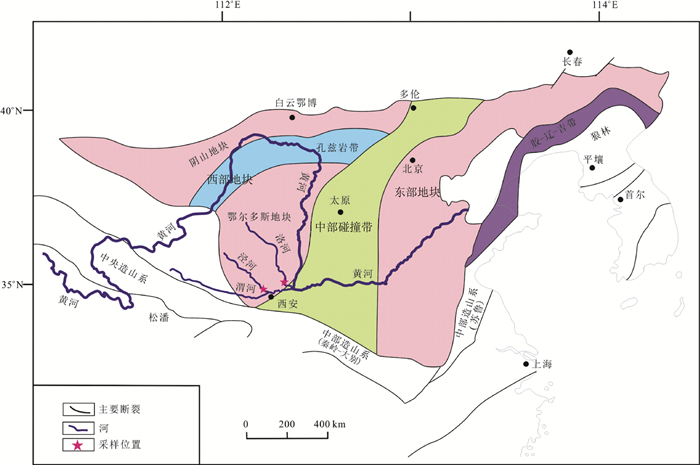
3 样品采集泾河是渭河的最大支流,发源于六盘山东麓,向东流经甘肃省平凉市及泾川县,经陕西省彬县及泾阳县,于高陵县汇入渭河,长451km,流域面积约45, 400km2。洛河,又称北洛河或洛水,发源于陕西省定边县,流经吴旗、志丹、甘泉、富县、洛川、黄陵等县,在大荔县东南汇入渭河,总长680km,流域面积26, 900km2。由此可见, 泾河和洛河广泛流经华北克拉通西南部的广大地区,最终都注入渭河。本文从泾河和洛河的下游各采集了一个河沙样品,分别记作JH和LH (图 1)。
|
图 1 华北克拉通地质简图(据Zhao et al., 2005修改) Fig. 1 Simplified map of the North China Craton (modified after Zhao et al., 2005) |
锆石原位Lu-Hf同位素测定在英国Nu公司生产的Nu Plasma HR多接收器等离子体质谱仪上完成,激光剥蚀系统为德国MicroLas公司生产的GeoLas200M。激光剥蚀的脉冲频率为10Hz, 激光束直径为44μm,能量密度为10J·cm-2,剥蚀时间约为50s。锆石原位Lu-Hf同位素测定用176Lu/175Lu=0.02669和176Yb/172Yb=0.5886进行同量异位干扰校正计算测定样品的176Lu/177Hf和176Hf/177Hf比值(Chu et al., 2002)。εHf(t) 的计算采用176Lu衰变常数为1.867×10⁻¹¹a (Albarède et al., 2006),球粒陨石现今的176Hf/177Hf=0.282785、176Lu/177Hf=0.0336(Bouvier et al., 2008);Hf亏损地幔模式年龄(tDM1) 的计算采用现今的亏损地幔176Hf/177Hf=0.28325和176Lu/177Hf=0.0384(Vervoort et al., 1999)。Hf同位素单阶段模式年龄tDM以亏损地幔为参考计算。两阶段Hf模式年龄(tDM2) 计算时, 平均地壳的176Lu/177Hf比值为0.015(Rudnick and Gao, 2003)。
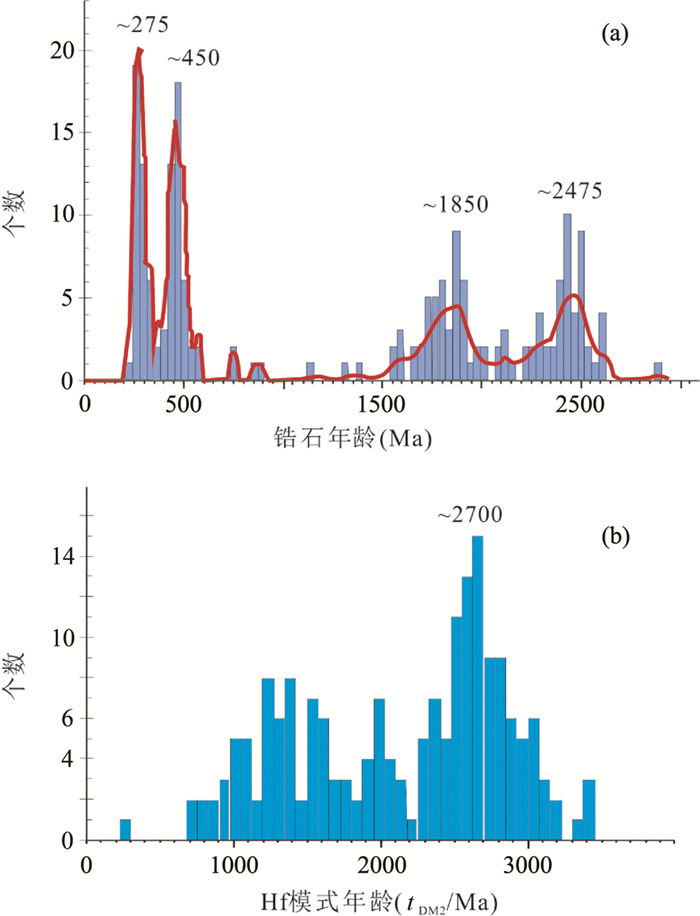
5 分析结果根据之前对泾河和洛河河沙中碎屑锆石U-Pb年龄分析结果显示(图 2a, b):有4个明显年龄峰值,分别为2.50~2.40Ga、1.90~1.80Ga、0.50~0.40Ga和0.35~0.25Ga (Diwu et al., 2012)。显示华北克拉通西部记录了与其中部和东部年龄特征类似的早前寒武纪构造-热事件期次,表明它们曾经历了相仿的地质演化过程。
|
图 2 泾河和洛河河沙中碎屑锆石U-Pb年龄(a, 引自Diwu et al., 2012) 以及对应的两阶段模式年龄频率分布图(b) Fig. 2 U-Pb concordia plots of concordant detrital zircons from the Jing River and Luo River (a, after Diwu et al., 2012) and corresponding Relative probability plots of two-stage Hf model ages |
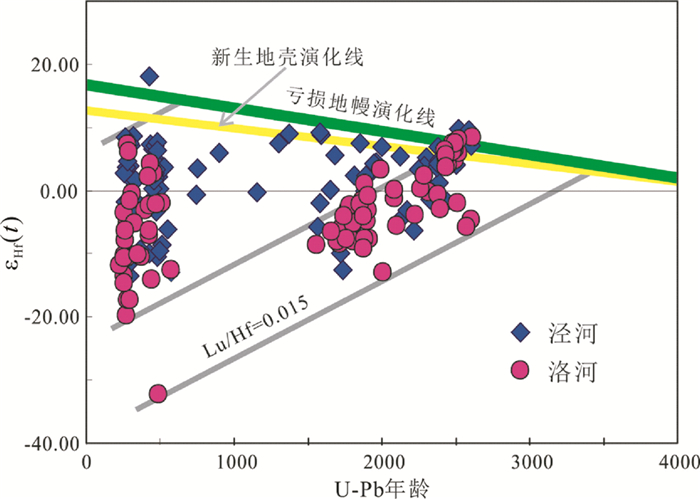
此次利用LA-MC-ICPMS方法共分析了187颗碎屑锆石Hf同位素。结果显示(表 1):样品中除个别锆石外,绝大多数碎屑锆石的176Lu/177Hf比值小于0.002,表明因Lu衰变形成的放射性成因Hf同位素的积累是很小的,可代表锆石形成时的初始Hf同位素比值。样品JH和LH具有明显类似的εHf(t) 值(图 3)。对于年龄为2.50~2.40Ga的一组锆石,其εHf(t) 值大多数为正值,并接近于同时代亏损地幔的演化线,且对应的两阶段模式年龄峰值为~2.7Ga,指示源区以新生地壳为主。其余各组碎屑锆石的εHf(t) 值绝大多数为负值,只有少量锆石具有较正的εHf(t),指示物质源区以再循环地壳为主。
|
图 3 泾河和洛河河沙中碎屑锆石Hf同位素组成 其中亏损地幔演化线和新生地壳演化线分别引自Griffin et al., 2000; Dhuime et al., 2011 Fig. 3 U-Pb age versus εHf(t) value plots of detrital zircons from the Jing River and Luo River The depleted mantle evolution cure taken from Griffin et al., 2000; the new crust evolution cure taken from Dhuime et al., 2011 |
|
表 1 泾河和洛河河沙中碎屑锆石Lu-Hf同位素组成 Table 1 Lu-Hf isotopic compositions of detrital zircons from the Jing River and Luo River |
所谓地壳生长是指从地幔中直接派生出的岩浆形成地壳的过程;或由地幔中派生出的岩浆结晶形成岩石,在很短的时间内( < 200Ma) 重熔而形成地壳物质的过程(Belousova et al., 2010; Hawkesworth et al., 2010)。对于利用锆石来判断地壳的生长来说,后一种定义应该更合适,更具有实际指导意义。因为在壳幔分离过程中,锆石的形成必然经历了至少两个阶段:最初岩浆从亏损地幔中抽取形成玄武质的原始地壳,而此时可能会有斜锆石结晶出来;然后原始地壳在熔融形成长英质岩浆的过程中才可能结晶形成锆石(Wang et al., 2009)。当然,对后一种定义也有人将其称之为新生地壳的再造。
与全岩的Sm-Nd同位素类似,要揭示每一颗碎屑锆石所代表的岩石是否具有新生地壳性质必然涉及到两个关键的参数:初始的εHf值和模式年龄。其中初始的εHf值就是指所测得样品的176Hf/177Hf值与同时期球粒陨石(CHUR)176Hf/177Hf值万倍偏差。简而言之,如果锆石的εHf(t) < 0, 表明它来自于古老地壳、或者源区以古老地壳物质为主体;如果锆石εHf(t)>0,表明它来源于亏损地幔、或者源区以亏损地幔物质占主导。尤其是当锆石的εHf(t) 值接近于同时期参考储库,比如亏损地幔时,表示该碎屑锆石所代表的寄主岩石具有新生地壳的特征(Zheng et al., 2006; 吴福元等., 2007;郑永飞等, 2007)。而所谓的模式年龄是根据一定模式前提假设计算所获得的样品从其源区分离至今的时间,因此模式年龄就是新生地壳生长较精确年龄。由于目前大多数研究者认为大陆地壳源自于亏损地幔,因而常以亏损地幔为参考源区计算全岩Nd同位素或者锆石的Hf模式年龄。此外,考虑到锆石的形成至少经历了两个阶段,因此通常用碎屑锆石的Hf同位素两阶段模式(tDM2) 年龄来代表地壳的形成年龄。然而,最近也有研究者提出应利用大陆岛弧火山岩作为新生地壳参考源区来计算锆石模式年龄,并根据13个现代岛弧火山的Hf同位素组成获得其现今新生地壳εHf(t) 值为13.2(Dhuime et al., 2011)。
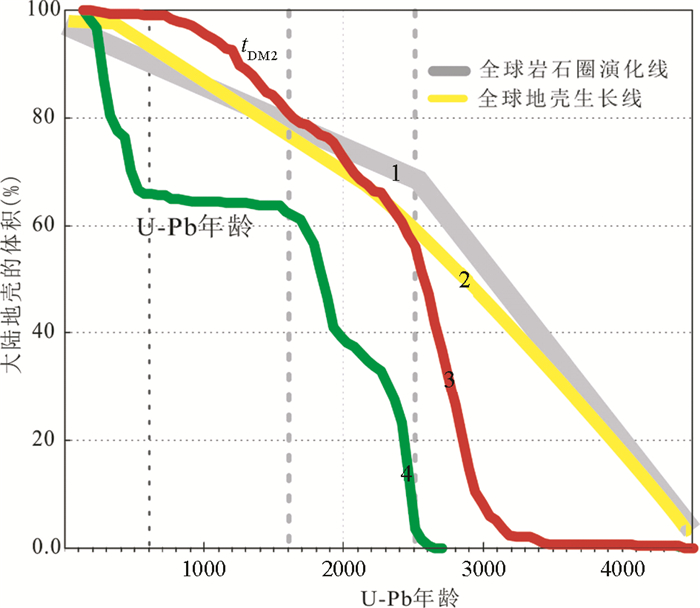
6.2 华北克拉通地壳生长 6.2.1 华北克拉通地壳生长速率以及与全球地壳演化对比为讨论华北克拉通整体地壳生长速率和演化,本文汇总泾河、洛河、滦河和永定河4个河沙样品中的381个碎屑锆石U-Pb年龄和Hf同位素数据结果,然后做各种地壳累积生长曲线。如图 4所示,根据碎屑锆石U-Pb年龄和模式年龄(tDM2) 绘制的地壳演化线存在较大差异,这主要是由于碎屑锆石U-Pb年龄只是反映源区岩浆活动期次随时间的累积分布。由该曲线可知(图 4),华北克拉通大约60%的岩浆活动发生在1.6Ga之前;而在古元古代至古生代早期(1.6~0.5Ga) 这段时间内,华北克拉通一直处于岩浆活动的沉寂期。但在早中生代, 华北克拉通又发生了大规模的岩浆活动,这可能与华北克拉通原有的稳定性遭到破坏有关(Wu et al., 2005)。由于碎屑锆石的U-Pb年龄并不能判断源区寄主岩石的形成代表的是新生地壳的形成还是古老地壳的改造,因此只有锆石Hf模式年龄可以近似代表新生地壳从亏损地幔提取的时间,也就是地壳的生长时间。由图 4所示,随着地质历史变化,华北克拉通地壳生长呈阶段性地增长。如在中太古代中期-新太古代末期(3000~2500Ma),华北克拉通的地壳生长速率较快。至新太古代末期大约已有60%现今大陆地壳形成。此后,陆壳呈较稳定速率增长,到新元古代末(600Ma),基本己形成华北克拉通现存大陆地壳。而显生宙陆壳的增生量几乎可以忽略。换而言之,显生宙华北克拉通基本没有显著的地壳生长,而是以古老地壳再循环为主。
|
图 4 全球岩石圈演化线(1-引自Belousova et al., 2010),以及全球(2-引自Belousova et al., 2010) 与华北克拉通大陆地壳生长曲线,其中分别依据河流碎屑锆石的U-Pb年龄(4) 和Hf同位素两阶段模式年龄(3) 绘制 其中滦河和永定河碎屑锆石U-Pb-Hf同位素数据引自Yang et al., 2009 Fig. 4 The global lithospheric architecture mapping curve (1-after Belousova et al., 2010), the global integrated crustal growth curve (2-after Belousova et al., 2010), and the crust growth curves based on U-Pb ages (4) and two-stage Hf crust formation ages (3) for detrital zircons from the rives of North China Craton The data of U-Pb-Hf compositions of detrital zircon from Luan River and Yongding River is cited from Yang et al., 2009 |
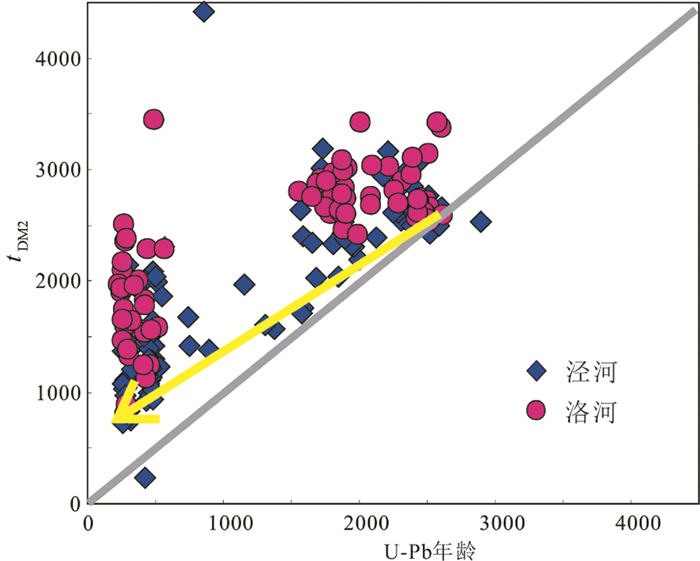
此外,以泾河、洛河河沙中的碎屑锆石U-Pb年龄和对应的Hf模式年龄(tDM2) 作图,如果河流中碎屑物质来自于新生地壳物质,那么河流所携带的沉积物中锆石U-Pb年龄和对应的Hf模式年龄应大致基本相同,会落在图 5所示的一致线附近。由图 5也可以看出,随着地球演化,显生宙沉积物中锆石的模式年龄越来越明显地偏离二者的一致线,这也说明泾河和洛河中显生宙的碎屑物质主要来自于较老地壳再循环物质源区。
|
图 5 泾河和洛河河沙中碎屑锆石U-Pb对Hf同位素两阶段模式年龄图 Fig. 5 Variation of U-Pb age versus Hf model ages (tDM2) of detrital zircons from the Jing River and Luo River |
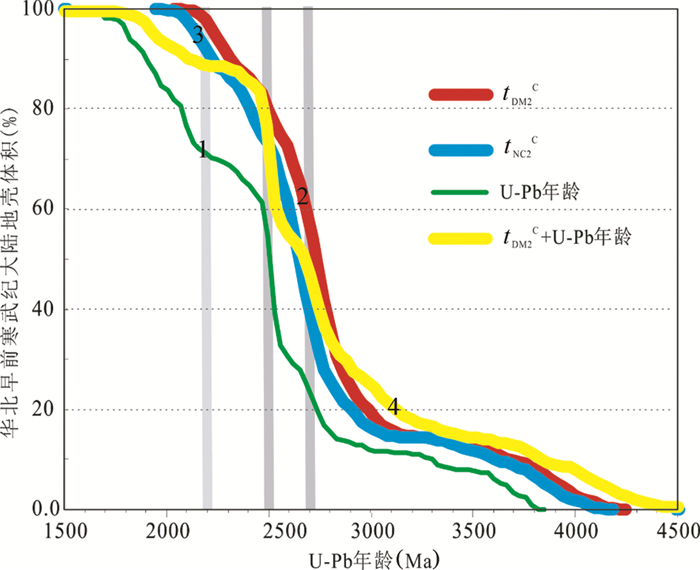
由图 4所示,及至早前寒武纪,华北克拉通与全球现今的地壳生长量基本相同,已有近80%左右的地壳形成(Belousova et al., 2010; Hawkesworth et al., 2010),表明现今大陆的绝大部分生长于太古宙和古元古代。然而,如前所述与全球地壳生长相比,华北克拉通中太古中期-新太古代末期是地壳迅速增长的时期。为进一步考察华北克拉通早前寒武纪地壳生长情况,本文又将参考文献Geng et al.(2012)汇总的古老岩石中的2553个(剔除数十个数据) 单颗锆石Hf同位素数据重新计算,然后再利用锆石U-Pb年龄和相应的亏损地幔和新生地壳模式年龄(tDM2和tNC2) 绘制华北克拉通早前寒武纪地壳演化线。由锆石U-Pb年龄的地壳演化线可知(图 6),~2.5Ga锆石约占所有前寒武纪锆石数量的40%, 这与华北克拉通西部泾河和洛河河沙(Diwu et al., 2012) 以及东部滦河和永定河河沙(Yang et al., 2009) 中碎屑锆石所记录的年龄数据统计结果一致。
|
图 6 华北克拉通早前寒武纪大陆地壳生长曲线,分别依据早前寒武纪岩石中锆石的U-Pb年龄(1),Hf同位素亏损地幔两阶段模式年龄(tDM2C)(2) 和大陆岛弧火山岩两阶段模式年龄(tNC2C) (Dhuime et al., 2011)(3),以及εHf(t) (4) 绘制 Fig. 6 The early Precambrian crust growth curves of North China Craton based on U-Pb ages (1), Deplete mantle two-stage Hf crust formation ages (tDM2C)(2), island arc rocks two-stage Hf crust formation ages (tNC2C) (Dhuime et al., 2011) (3) and εHf(t) (4) |
根据对怀安、登封等地~2.5Ga岩石中锆石Hf同位素分析获知,这些岩石中大多数锆石具有接近于同时代的亏损地幔Hf同位素组成εHf(t),且岩石的形成年龄和模式年龄接近( < 200Ma)。因此一些研究者提出在华北广泛出露的~2.5Ga岩石代表一期重要的地壳生长时期,并强调正是~2.5Ga地壳生长使得华北克拉通与全球许多其他古老克拉通在太古宙的地壳生长表现出明显不同,这或许正是华北克拉通特殊性之所在(Diwu et al., 2011; Liu et al., 2009)。华北克拉通西部泾河和洛河河沙中碎屑锆石Hf同位素特征也支持上述认识。
可是,一些研究者发现这些2.5Ga岩石的模式年龄峰值为~2.7Ga,且在河南鲁山(Diwu et al., 2010; Liu et al., 2009; Sun et al., 1994)、山东西部(Jahn et al., 1988; Wan et al.,2011b) 和胶东地区(Jahn et al., 2008),山西中条等地区均有~2.7Ga岩石出露, 且这些岩石也具有接近于同时代的亏损地幔全岩的Nd同位素或者锆石的Hf同位素组成(Jahn et al., 2008; Diwu et al., 2010; Wan et al., 2011b),因此一些研究者提出~2.7Ga才是华北克拉通真正的地壳生长时期,这反映出华北克拉通与全球其他许多典型克拉通2.7Ga的地壳增生,以及造山带形成和超级大陆循环在此时间上具有较强的一致性(Condie and Aster, 2010; Condie et al., 2011)。
这里要特别强调:基于模型假设的模式年龄(Nd、Hf) 可以提供定性信息,但并不能像U-Pb年龄那样提供精确的时间信息。因为2.7Ga的模式年龄只是一种参考。因为将Lu-Hf分析过程的精度,计算时的各种前提假设带来的误差考虑在内, 模式年龄的计算误差至少应该在100~200Ma。比如:虽然我们常用Griffin提出的亏损地幔演化模式(Griffin et al., 2000),认为在地球形成初期,亏损地幔具有与球粒陨石类似的Hf同位素组成;随着时间的推移,它呈线性的演化,及至现今其Hf同位素组成与MORB类似。可是,就目前所知,学者们根据(1) 岩石的Hf同位素组成;(2) Nd同位素与Hf同位素相关性;(3) 已有锆石Hf同位素数据提出的亏损地幔随时间的演化模式应该至少还有3种(Hawkesworth et al., 2010)。不止如此,如本文之前所提到的,最近也有研究者提出应利用大陆岛弧火山岩的Hf同位素作为新生地壳计算时的参考源区来考虑(Dhuime et al., 2011)。此外,Hf同位素的计算(tDM2) 还明显依赖于地壳源区Lu/Hf比值的选择,因为,相对于Sm/Nd而言,由于地幔分异过程中,Lu/Hf会发生明显改变。比如,采用上地壳和下地壳的Lu/Hf比值分别计算一个年龄为500Ma锆石的Hf模式年龄,其获得模式年龄的结果相差可达490Ma (Wang et al., 2009)。
此外,本文分别又利用前寒武纪岩石中锆石的Hf亏损地幔和大陆岛弧火山岩两阶段模式年龄(tDM2和tNC2) 绘制华北克拉通早前寒武纪地壳演化线,如图 6所示,二者绘制出的生长曲线基本一致,表明选择不同的参考源区对于绘制华北克拉通早前武纪大陆地壳的生长曲线影响不大,均显示出~2.7Ga也是华北克拉通早前寒武纪地壳生长的一个重要时期。如前文所述,εHf(t) 也是判断碎屑锆石源区是来自于新生地壳物质,还是来自于古老地壳物质改造或者再循环的一个重要参数,因此,本文再以εHf(t) 值为标准来绘制华北克拉通的地壳生长曲线。由于只要一个岩石具有接近于同时代的亏损地幔Hf同位素组成,且该岩石的形成年龄和模式年龄接近( < 200Ma), 那么就可以判定这个岩石的年龄代表新生地壳形成的年龄,所以可利用该锆石的U-Pb年龄来代表地壳生长时间。虽然有部分锆石的投点位于球粒陨石线与0.75倍同时期亏损地幔线之间, 其寄主岩浆源区可能来自于壳幔相互作用的混合源区或富集性地幔源区, 考虑到亏损地幔的Hf同位素储库还是应该占主导(Zheng et al., 2006; 吴福元等, 2007; 郑永飞等, 2007),所以本文还是利用该锆石的U-Pb年龄来代表地壳生长时间。而对于εHf(t) < 0的碎屑锆石,由于其来源于古老地壳物质的再循环,故而用这些锆石的Hf同位素两阶段模式年龄(tDM2) 来近似代表新生地壳从亏损地幔提取的时间。由图 6可见,由此绘制的生长曲线与利用锆石两阶段模式年龄得到的图线形状基本一致。
总之,根据上述讨论以及华北克拉通已有的资料,本文认为~2.7Ga和~2.5Ga分别为太古宙华北克拉通岩浆最活动时期;在早前寒武纪华北克拉通发生过两期明显的地壳生长,一期发生在~2.7Ga,以河南鲁山、山东西部和胶东等地区较广泛出露~2.7Ga岩石为代表;另一期发生在2.5Ga左右,以怀安、登封等地区~2.5Ga岩石为代表。当然,也有研究者持有不同意见,认为后一期岩石为华北克拉通~2.7Ga岩石再造的产物。
7 结论(1) 随着地质历史变化,华北克拉通地壳生长呈阶段性特点,如在中太古代中期-新太古代末期(3.0~2.5Ga) 地壳生长速率较快,大约已有60%现今大陆地壳形成。此后,陆壳呈较稳定速率增长,到新元古代晚期(600Ma) 己基本形成现存的华北克拉通大陆地壳。表明现今的华北克拉通大陆主要生长于太古宙和元古宙,而显生宙陆壳的增生量几乎可以忽略。
(2) 根据已有的地质事实以及各种地壳演化曲线,本文提出~2.7Ga和~2.5Ga分别曾经为华北克拉通太古宙岩浆最活动的时期,也是地壳快速生长的时期,这表明华北克拉通在新太古代曾发生过两期明显的地壳生长。
致谢 衷心地感谢张连昌研究员和两位审稿专家给予的宝贵修改意见和建议。| [] | Albarède F, Scherer EE, Blichert-Toft J, Rosing M, Simionovici A, Bizzarro M. 2006. γ-ray irradiation in the early Solar System and the conundrum of the 176Lu decay constant. Geochimica et Cosmochimica Acta, 70(5): 1261–1270. DOI:10.1016/j.gca.2005.09.027 |
| [] | Belousova EA, Kostitsyn YA, Griffin WL, Begg GC, O'Reilly SY, Pearson NJ. 2010. The growth of the continental crust: Constraints from zircon Hf-isotope data. Lithos, 119(3-4): 457–466. DOI:10.1016/j.lithos.2010.07.024 |
| [] | Bouvier A, Vervoort JD, Patchett PJ. 2008. The Lu-Hf and Sm-Nd isotopic composition of CHUR: Constraints from unequilibrated chondrites and implications for the bulk composition of terrestrial planets. Earth and Planetary Science Letters, 273(1-2): 48–57. DOI:10.1016/j.epsl.2008.06.010 |
| [] | Chen L, Cheng C, Wei Z. 2009. Seismic evidence for significant lateral variations in lithospheric thickness beneath the central and western North China Craton. Earth and Planetary Science Letters, 286(1-2): 171–183. DOI:10.1016/j.epsl.2009.06.022 |
| [] | Chu NC, Taylor RN, Chavagnac V, Nesbitt RW, Boella RM, Milton JA, German CR, Bayon G, Burton K. 2002. Hf isotope ratio analysis using multi-collector inductively coupled plasma mass spectrometry: An evaluation of isobaric. Journal of Analytical Atomic Spectrometry, 17(12): 1567–1574. DOI:10.1039/b206707b |
| [] | Condie KC, Aster RC. 2010. Episodic zircon age spectra of orogenic granitoids: The supercontinent connection and continental growth. Precambrian Research, 180(3-4): 227–236. DOI:10.1016/j.precamres.2010.03.008 |
| [] | Condie KC, Bickford ME, Aster RC, Belousova E, Scholl DW. 2011. Episodic zircon ages, Hf isotopic composition, and the preservation rate of continental crust. Geological Society of America Bulletin, 123(5-6): 951–957. DOI:10.1130/B30344.1 |
| [] | Dhuime B, Hawkesworth C, Cawood P. 2011. When Continents Formed. Science, 331(6014): 154–155. DOI:10.1126/science.1201245 |
| [] | Diwu CR, Sun Y, Lin CL, Wang HL. 2010. LA-(MC)-ICPMS U-Pb zircon geochronology and Lu-Hf isotope compositions of the Taihua complex on the southern margin of the North China Craton. Chinese Science Bulletin, 55(23): 2557–2571. DOI:10.1007/s11434-010-3273-6 |
| [] | Diwu CR, Sun Y, Guo AL, Wang HL, Liu XM. 2011. Crustal growth in the North China Craton at~2.5Ga: Evidence from in situ zircon U-Pb ages, Hf isotopes and whole-rock geochemistry of the Dengfeng complex. Gondwana Research, 20(1): 149–170. DOI:10.1016/j.gr.2011.01.011 |
| [] | Diwu CR, Sun Y, Zhang H, Wang Q, Guo AL, Fan LG. 2012. Episodic tectonothermal events of the western North China Craton and North Qinling Orogenic Belt in central China: Constraints from detrital zircon U-Pb ages. Journal of Asian Earth Sciences, 47: 107–122. DOI:10.1016/j.jseaes.2011.07.012 |
| [] | Geng YS, Du LL, Ren LD. 2012. Growth and reworking of the early Precambrian continental crust in the North China Craton: Constraints from zircon Hf isotopes. Gondwana Research, 21(2-3): 517–529. DOI:10.1016/j.gr.2011.07.006 |
| [] | Griffin WL, Pearson NJ, Belousova E, Jackson SE, van Achterbergh E, O'Reilly SY, Shee SR. 2000. The Hf isotope composition of cratonic mantle: LAM-MC-ICPMS analysis of zircon megacrysts in kimberlites. Geochimica et Cosmochimica Acta, 64(1): 133–147. DOI:10.1016/S0016-7037(99)00343-9 |
| [] | Hawkesworth CJ, Kemp AIS. 2006a. The differentiation and rates of generation of the continental crust. Chemical Geology, 226(3-4): 134–143. DOI:10.1016/j.chemgeo.2005.09.017 |
| [] | Hawkesworth CJ, Kemp AIS. 2006b. Using hafnium and oxygen isotopes in zircons to unravel the record of crustal evolution. Chemical Geology, 226(3-4): 144–162. DOI:10.1016/j.chemgeo.2005.09.018 |
| [] | Hawkesworth CJ, Dhuime B, Pietranik AB, Cawood PA, Kemp AIS, Storey CD. 2010. The generation and evolution of the continental crust. Journal of the Geological Society, 167(2): 229–248. DOI:10.1144/0016-76492009-072 |
| [] | Jahn BM, Auvray B, Shen QH, Liu DY, Zhang ZQ, Dong YJ, Ye XJ, Zhang QZ, Cornichet J, Mace J. 1988. Archean crustal evolution in China: The Taishan complex, and evidence for juvenile crustal addition from long-term depleted mantle. Precambrian Research, 38(4): 381–403. DOI:10.1016/0301-9268(88)90035-6 |
| [] | Jahn BM, Liu DY, Wan YS, Song B, Wu JS. 2008. Archean crustal evolution of the Jiaodong Peninsula, China, as revealed by zircon SHRIMP geochronology, elemental and Nd-isotope geochemistry. American Journal of Science, 308(3): 232–269. DOI:10.2475/03.2008.03 |
| [] | Kemp AIS, Hawkesworth CJ, Paterson BA, Kinny PD. 2006. Episodic growth of the Gondwana supercontinent from hafnium and oxygen isotopes in zircon. Nature, 439(7076): 580–583. DOI:10.1038/nature04505 |
| [] | Kusky TM, Li J. 2003. Paleoproterozoic tectonic evolution of the North China Craton. Journal of Asian Earth Sciences, 22(4): 383–397. DOI:10.1016/S1367-9120(03)00071-3 |
| [] | Kusky TM. 2011. Geophysical and geological tests of tectonic models of the North China Craton. Gondwana Research, 20(1): 26–35. DOI:10.1016/j.gr.2011.01.004 |
| [] | Liu DY, Nutman AP, Compston W, Wu JS, Shen QH. 1992. Remnants of≥3800Ma crust in the Chinese part of the Sino-Korean craton. Geology, 20(4): 339–342. DOI:10.1130/0091-7613(1992)020<0339:ROMCIT>2.3.CO;2 |
| [] | Liu DY, Wilde SA, Wan YS, Wang S, Valley JW, Kita N, Dong C, Xie HQ, Yang CX, Zhang YX, Gao LZ. 2009. Combined U-Pb, hafnium and oxygen isotope analysis of zircons from meta-igneous rocks in the southern North China Craton reveal multiple events in the Late Mesoarchean-Early Neoarchean. Chemical Geology, 261(1-2): 140–154. DOI:10.1016/j.chemgeo.2008.10.041 |
| [] | Liu F, Guo JH, Lu XP, Diwu CR. 2009. Crustal growth at < 2.5Ga in the North China Craton: Evidence from whole-rock Nd and zircon Hf isotopes in the Huai an gneiss. Chinese Science Bulletin, 54(24): 4704–4713. |
| [] | Rudnick RL, Fountain DM. 1995. Nature and composition of the continental crust: A lower crustal perspective. Reviews of Geophysics, 33(3): 267–309. DOI:10.1029/95RG01302 |
| [] | Rudnick RL, Gao S. 2003. 3.01: Composition of the continental crust. In: Heinrich DH and Karl KT (eds.). Treatise on Geochemistry. Oxford: Pergamon. |
| [] | Song B, Nutman AP, Liu DY, Wu JS. 1996. 3800 to 2500 Ma crustal evolution in the Anshan area of Liaoning Province, northeastern China. Precambrian Research, 78(1-3): 79–94. DOI:10.1016/0301-9268(95)00070-4 |
| [] | Sun Y, Yu ZP, Kröner A. 1994. Geochemistry and single zircon geochronology of Archaean TTG gneisses in the Taihua high-grade terrain, Lushan area, central China. Journal of Southeast Asian Earth Sciences, 10(3-4): 227–233. DOI:10.1016/0743-9547(94)90022-1 |
| [] | Vervoort JD, Patchett PJ, Blichert-Toft J, Albarède F. 1999. Relationships between Lu-Hf and Sm-Nd isotopic systems in the global sedimentary system. Earth and Planetary Science Letters, 168(1-2): 79–99. DOI:10.1016/S0012-821X(99)00047-3 |
| [] | Wan YS, Liu DY, Song B, Wu JS, Yang CH, Zhang ZQ, Geng YS. 2005. Geochemical and Nd isotopic compositions of 3.8Ga meta-quartz dioritic and trondhjemitic rocks from the Anshan area and their geological significance. Journal of Asian Earth Sciences, 24(5): 563–575. DOI:10.1016/j.jseaes.2004.02.009 |
| [] | Wan YS, Liu DY, Wang W, Song TR, Kröner A, Dong CY, Zhou HY, Yin XY. 2011a. Provenance of Meso-to Neoproterozoic cover sediments at the Ming Tombs, Beijing, North China Craton: An integrated study of U-Pb dating and Hf isotopic measurement of detrital zircons and whole-rock geochemistry. Gondwana Research, 20(1): 219–242. DOI:10.1016/j.gr.2011.02.009 |
| [] | Wan YS, Liu DY, Wang SJ, Yang EX, Wang W, Dong CY, Zhou HY, Du LL, Yang YH, Diwu CR. 2011b. ~2.7Ga juvenile crust formation in the North China Craton (Taishan-Xintai area, western Shandong Province): Further evidence of an understated event from U-Pb dating and Hf isotopic composition of zircon. Precambrian Research, 186(1-4): 169–180. DOI:10.1016/j.precamres.2011.01.015 |
| [] | Wang CY, Campbell IH, Allen CM, Williams IS, Eggins SM. 2009. Rate of growth of the preserved North American continental crust: Evidence from Hf and O isotopes in Mississippi detrital zircons. Geochimica et Cosmochimica Acta, 73(3): 712–728. DOI:10.1016/j.gca.2008.10.037 |
| [] | Wu FY, Lin JQ, Wilde SA, Zhang XO, Yang JH. 2005. Nature and significance of the Early Cretaceous giant igneous event in eastern China. Earth and Planetary Science Letters, 233(1-2): 103–119. DOI:10.1016/j.epsl.2005.02.019 |
| [] | Wu FY, Li XH, Zheng YF, Gao S. 2007. Lu-Hf isotopic systematics and their applications in petrology. Acta Petrologica Sinica, 23(2): 185–220. |
| [] | Yang J, Gao S, Chen C, Tang YY, Yuan HL, Gong HJ, Xie SW, Wang JQ. 2009. Episodic crustal growth of North China as revealed by U-Pb age and Hf isotopes of detrital zircons from modern rivers. Geochimica et Cosmochimica Acta, 73(9): 2660–2673. DOI:10.1016/j.gca.2009.02.007 |
| [] | Zhai MG, Bian AG, Zhao TP. 2001. The amalgamation of the supercontinent of North China Craton at the end of Neo-Archaean and its breakup during late Palaeoproterozoic and Meso-Proterozoic. Science in China (Series D), 43(Suppl.1): 219–232. |
| [] | Zhai MG, Guo JH, Liu WJ. 2005. Neoarchean to Paleoproterozoic continental evolution and tectonic history of the North China Craton: A review. Journal of Asian Earth Sciences, 24(5): 547–561. DOI:10.1016/j.jseaes.2004.01.018 |
| [] | Zhai MG. 2009. Two kinds of granulites (HT-HP and HT-UHT) in North China Craton: Their genetic relation and geotectonic implications. Acta Petrologica Sinica, 25(8): 1753–1771. |
| [] | Zhai MG. 2011. Cratonization and the Ancient North China Continent: A summary and review. Scientia Sinica (Terrae), 54(8): 1110–1120. |
| [] | Zhai MG, Santosh M. 2011. The early Precambrian odyssey of the North China Craton: A synoptic overview. Gondwana Research, 20(1): 6–25. DOI:10.1016/j.gr.2011.02.005 |
| [] | Zhao GC, Wilde SA, Cawood PA, Sun M. 2001. Archean blocks and their boundaries in the North China Craton: Lithological, geochemical, structural and P-T path constraints and tectonic evolution. Precambrian Research, 107(1-2): 45–73. DOI:10.1016/S0301-9268(00)00154-6 |
| [] | Zhao GC, Sun M, Wilde SA, Li SZ. 2005. Late Archean to Paleoproterozoic evolution of the North China Craton: Key issues revisited. Precambrian Research, 136(2): 177–202. DOI:10.1016/j.precamres.2004.10.002 |
| [] | Zhao ZP. 1993. Evolution of Precambrian Crust of Sino-Korean Platform. Beijing: Science Press: 357-388. |
| [] | Zheng YF, Zhao ZF, Wu YB, Zhang SB, Liu X, Wu FY. 2006. Zircon U-Pb age, Hf and O isotope constraints on protolith origin of ultrahigh-pressure eclogite and gneiss in the Dable orogen. Chemical Geology, 231(1-2): 135–158. DOI:10.1016/j.chemgeo.2006.01.005 |
| [] | Zheng YF, Chen RX, Zhang SB, Tang J, Zhao ZF, Wu YB. 2007. Zircon Lu-Hf isotope study of ultrahigh-pressure eclogite and granitic gneiss in the Dabie orogen. Acta Petrologica Sinica, 23(2): 317–330. |
| [] | Zhu RX, Chen L, Wu FY, Liu JL. 2011. Timing, scale and mechanism of the destruction of the North China Craton. Scientia Sinica (Terrae), 54(6): 789–797. |
| [] | 吴福元, 李献华, 郑永飞, 高山. 2007. Lu-Hf同位素体系及其岩石学应用. 岩石学报, 23(2): 185–220. |
| [] | 翟明国. 2009. 华北克拉通两类早前寒武纪麻粒岩(HT-HP和HT-UHT) 及其相关问题. 岩石学报, 25(8): 1753–1771. |
| [] | 翟明国. 2011. 克拉通化与华北陆块的形成. 中国科学(地球科学), 41(8): 1037–1046. |
| [] | 赵宗溥. 1993. 中朝准地台前寒武纪地壳演化. 北京: 科学出版社: 357-388. |
| [] | 郑永飞, 陈仁旭, 张少兵, 唐俊, 赵子福, 吴元保. 2007. 大别山超高压榴辉岩和花岗片麻岩中锆石Lu-Hf同位素研究. 岩石学报, 23(2): 317–330. |
| [] | 朱日祥, 陈凌, 吴福元, 刘俊来. 2011. 华北克拉通破坏的时间、范围与机制. 中国科学(地球科学), 41(5): 583–592. |