 2012, Vol. 28


2. 中国科学院广州地球化学研究所,广州 510640;
3. 中国科学技术大学地球和空间科学学院,合肥 230026
2. Guangzhou Institute of Geochemistry, Chinese Academy of Sciences, Guangzhou 510640, China;
3. School of Earth and Space Sciences, University of Science and Technology of China, Hefei 230026, China
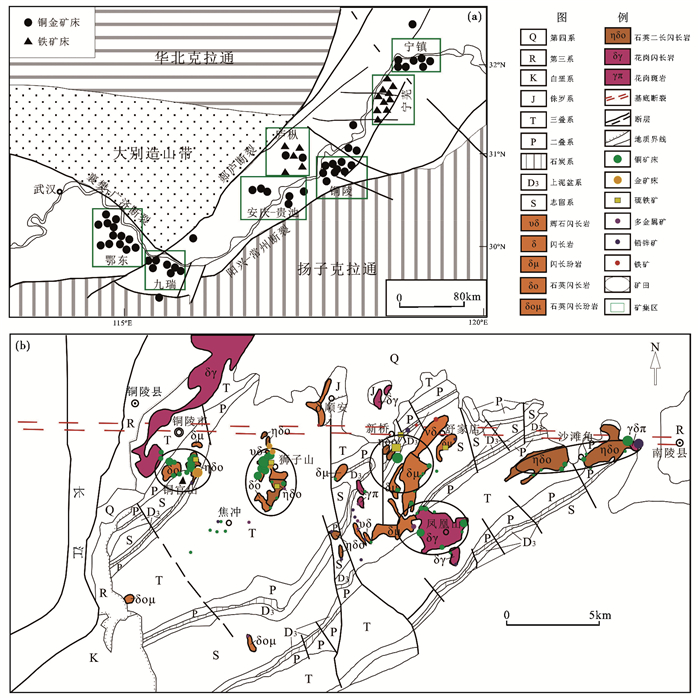
长江中下游成矿带是中国东部中生代形成的成矿特色鲜明的铁、铜、金、多金属成矿带,迄今已发现200多个铜、铁、金矿床(图 1a)。这些金属矿床主要集中在鄂东南、九瑞、安庆-贵池、庐枞、铜陵、宁芜和宁镇等矿集区(图 1a)(常印佛等,1991;Zhai et al., 1996)。其中,铜陵矿集区是长江中下游成矿带中地质研究程度较高地区之一,有多个大型铜、金矿床(图 1b)。地质学和年代学研究表明铜陵及长江中下游地区这些矿床在空间上和时间上与早白垩世闪长岩体密切相关(常印佛等,1991;Zhai et al., 1996;周涛发等,2008;吴淦国等,2008;Xie et al., 2009;Yang et al., 2011;Sun et al., 2003a;Mao et al., 2006;Wang et al., 2006)。地球化学研究进一步显示这些闪长岩体具有某些与Defant and Drummond (1990)最初定义的汇聚板块边界现代埃达克岩明显相似的成分特征(张旗等, 2001a, b;王元龙等,2004;汪洋等,2004;王强等,2003;Wang et al., 2003, 2004a, b,2006,2007a;Xu et al., 2002;Xie et al., 2008;Xie et al., 2009;Liu et al., 2010)。
|
图 1 铜陵矿集区地质略图 Fig. 1 Geological sketch map of the Tongling metallogenic district, East China |
过去十年内,铜陵及长江中下游地区含矿埃达克质岩成因存在分歧(张旗等, 2001a, b;王元龙等,2004;汪洋等,2004;王强等, 2002, 2003;Wang et al., 2004a, b,2006,2007a;Xu et al., 2002;侯增谦等,2007;Xie et al., 2008;Xie et al., 2009;Ling et al., 2009;Li et al., 2009;Liu et al., 2010;孙卫东等,2010)。依据比俯冲洋壳而来的埃达克岩具较高87Sr/86Sr比值和较低143Nd/144Nd比值,一些研究表明这些埃达克质岩是拆沉或加厚古老下陆壳部分熔融而成(张旗等, 2001a, b;汪洋等,2004;王强等, 2002, 2003;Wang et al., 2004a, b,2006,2007a;Xu et al., 2002;侯增谦等,2007)。但是,有些学者提出了不同的看法,比如,可能遭受地壳混染的玄武岩浆结晶分异作用(王元龙等,2004;Xie et al., 2008;Li et al., 2009),或幔源岩浆和壳源岩浆的混合,可能有来自古太平洋板块俯冲带来的混入端元成分(Xie et al., 2009;谢建成等,2012),或俯冲洋壳的部分熔融(Li and Li, 2007;Ling et al., 2009;Liu et al., 2010;孙卫东等,2010)。
在本次研究中,我们系统地报道了铜陵地区含矿埃达克质岩体新的元素和Sr-Nd-Pb同位素数据,从而更好的制约它们的成因及其与铜金成矿关系。
2 地质概况及样品铜陵地区大地构造位置属扬子板块北缘,为下扬子拗陷之相对隆起区(图 1a)。在稳定的前寒武纪基底之上的寒武纪至中三叠世地层形成了巨厚的沉积盖层,并成为铜、金、铁、硫等矿化的有利围岩。印支-燕山运动使本区沉积盖层发生褶皱隆起,形成一系列北东向“S”形褶皱,并伴有断裂拗陷(图 1b)(常印佛等,1991)。
铜陵地区沉积盖层除缺失中下泥盆统外,出露志留系-下三叠统的海相碎屑沉积岩、碳酸盐岩和蒸发岩,其上广泛分布中生代沉积-火山盆地(图 1b)(唐永成等,1998)。与成矿关系密切的地层是石炭系碳酸盐岩、二叠系石灰岩和黑色页岩以及三叠系碳酸盐岩和泥岩(常印佛等,1991;唐永成等,1998)。
铜陵地区岩浆岩体出露有70多个,大多数岩体分布于东西向展布的铜陵-南陵深断裂控制的岩浆成矿带上(图 1 b)(常印佛等,1991;唐永成等,1998)。岩浆岩主要为闪长岩类(埃达克质岩)。高精度锆石U-Pb定年(SHRIMP和LA-ICP-MS) 结果表明这些埃达克质岩体主要形成于早白垩世(145~136Ma;Xu et al., 2004;谢建成等,2008;吴淦国等,2008;Yang et al., 2011)。
安徽铜陵矿集区从西向东依次分布着铜官山、狮子山、凤凰山、新桥、沙滩角等矿田(图 1 b)。这里不仅有比较典型的矽卡岩型矿床,也有斑岩型矿床,在一些矿床中矽卡岩-斑岩矿化同时出现,例如冬瓜山深部矿体(唐永成等,1998),更引人注目还有不少层状矽卡岩矿体和/或层状块状硫化物矿体。成矿矿物的定年表明这些矿床形成于早白垩世(143~136 Ma;Sun et al., 2003a;Mao et al., 2006),与埃达克质岩体年龄相一致(Xu et al., 2004;谢建成等,2008;吴淦国等,2008;Yang et al., 2011)。
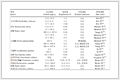
在本次研究中,采自于铜陵地区代表性含矿埃达克质岩体的14个新鲜露天或岩芯样品用于地球化学研究,其特征见表 1。
|
表 1 铜陵地区埃达克质岩样品特征 Table 1 Characteristics of samples from adakitic rocks in Tongling region |
全岩的主量元素、稀土元素和微量元素分别由澳实矿物实验室测定。全岩的主量元素的分析方法为X-射线荧光熔片法,各项元素的分析精度分别为:SiO2︰0.8%;Al2O3:0.5%;Fe2O3:0.4%;MgO:0.4%;CaO:0.6%;Na2O:0.3%;K2O:0.4%;MnO:0.7%;TiO2:0.9%;P2O5:0.8%。微量元素和稀土元素分析采用HF+HNO3密封溶解,加入Rh内标溶液后转化为1%HNO3介质,以ICP-MS测定,使用的仪器是PE Elan6000型电感耦合等离子质谱计,具体的操作方法和原理参考Qi et al.(2000)。REE含量测试误差小于7%,其余微量元素的误差小于10%。主量和微量元素分析结果见表 2。
|
|
表 2 铜陵地区埃达克质岩主量和微量元素组成(主量元素:wt%;稀土和微量元素:×10-6) Table 2 Major and trace elements compositions of the adakitic rocks in the Tongling region (Major elements: wt%; Trace elements: ×10-6) |
Sr、Nd和Pb同位素比值分析在中国科学技术大学化学地球动力学实验室和中科院地质与地球物理研究所进行。称重0.1g样品放入聚四氟乙烯管型瓶内。样品用3 mL HF+浓HCl+HNO3在Savillex PFA坩埚中溶解。用阳离子交换树脂(Bio-rad AG 50×8) 分离Rb、Sr和REE,在HCl+ HBr介质中用阴离子交换树脂(Bio-rad AG 1×8) 分离Pb。样品分离流程中所有的水和酸均经二次亚沸蒸馏。在Finnigan/ MAT262固体质谱计上用静态多接收方式对Sr、Nd和Pb同位素比值进行测定。在测试过程中,Sr和Nd同位素组成分别对86Sr/88Sr=0.119400和146Nd/144Nd=0.721900进行标准化,采用瑞利律进行同位素质量分馏校正,Nd同位素比值的质谱测定结果调整到LaJolla的143Nd/144Nd=0.511860。全流程本底分别为:Rb、Sr低于1ng。质谱分析87Sr/86Sr比值精度优于0.002%,143Nd/144Nd精度优于0.002%。Pb同位素比值测定以硅胶作为发射剂,用标准样NBS981控制测定时的质量分馏。根据NBS981的测定值和推荐值的差别,确定校正值为每质量单位0.1%,Pb的全流程空白低于1ng。最后由实测Sr、Nd和Pb同位素比值,结合样品年龄,扣除放射成因Sr、Nd和Pb的贡献,求得初始值87Sr/86Sr(t)、εNd(t) 和相应的Pb同位素初始比值。本次研究样品初始Sr、Nd和Pb同位素比值计算依据t=139Ma (Yang et al., 2011)。同位素分析结果见表 3和4。
|
|
表 3 铜陵地区埃达克质岩Sr和Nd同位素组成 Table 3 Nd and Sr isotopic compositions of the adakitic rocks from Tongling region |
|
|
表 4 铜陵地区埃达克质岩Pb同位素组成 Table 4 Pb isotopic compositions of the adakitic rocks from Tongling region |
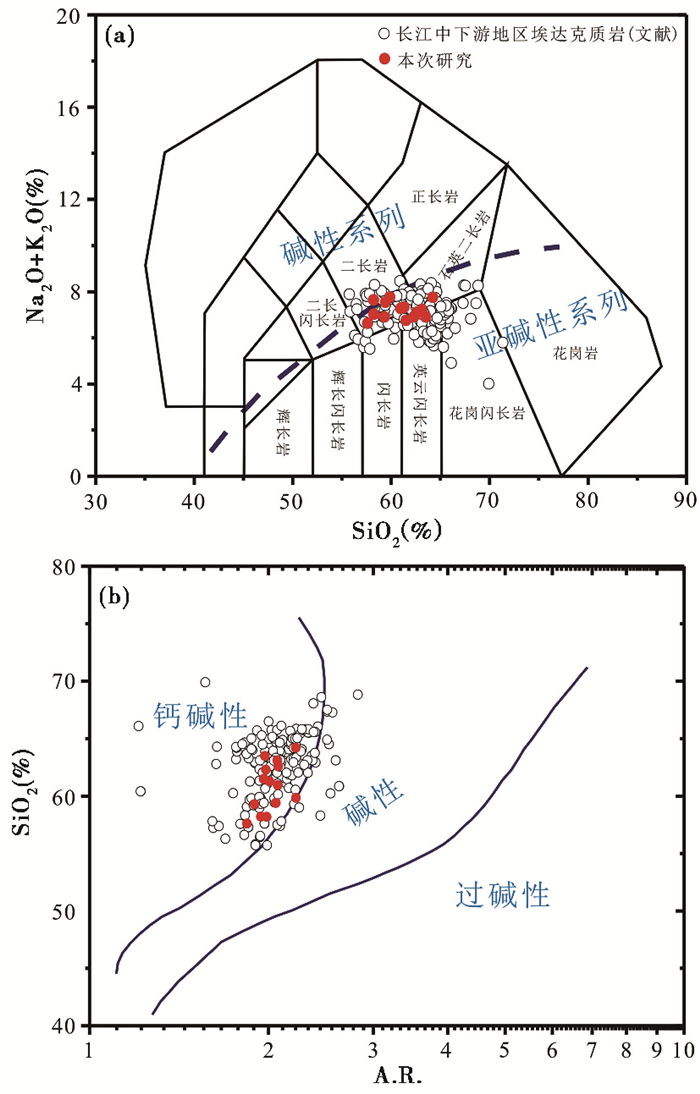
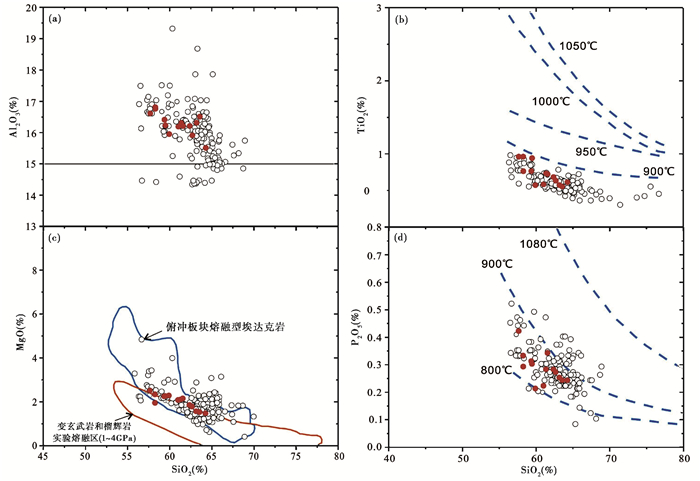
铜陵埃达克质岩样品SiO2含量变化范围在57.6%到64.2%,K2O含量为2.41%~3.52%,Na2O含量为3.66%~4.66%(表 2),全碱含量(Na2O+K2O) 在6.64%~7.78%,为二长-闪长岩类岩石,主要显示为亚碱性系列(图 2a),低A.R.值(1.84~2.63)[A.R.=(Al2O3+CaO+Na2O+K2O)/(Al2O3+CaO-Na2O-K2O)]显示钙碱性特征(图 2b)。铜陵埃达克质岩也具有高Al2O3(>15.3%)、MgO (1.47%~2.51%)、TiO2(0.55%~0.96%)、P2O5(0.21%~0.42%)、Th (5.11×10⁻⁶~10.1×10⁻⁶) 和Th/Ce比值(0.09~0.15),与俯冲板块熔融型埃达克岩特征相一致(Defant and Drummond, 1990;Drummond et al., 1996;Stern and Kilian, 1996;Aguillón-Robles et al., 2001)(图 3a-d)。
|
图 2 SiO2-(Na2O+K2O) 图解(a,据Middlemost,1994;碱性和亚碱性分类引自Irvine and Baragar, 1971) 和A.R.-SiO2图解(b) 长江中下游地区埃达克质岩数据许继峰等(2001),王强等(2002, 2003),王元龙等(2004),Wang et al.(2004a, b, 2006, 2007a),高庚等(2006),杨小男等(2007),李进文等(2007),蒋少涌等(2008),李亮和蒋少涌(2009),Xie et al.(2008),Xie et al.(2009);Li et al.(2008, 2009),Liu et al.(2010),谢建成等(2012) Fig. 2 SiO2-(Na2O+K2O) diagram (a, after Middlemost, 1994; the alkaline and sub-alkaline division after Irvine and Baragar, 1971) and A.R.-SiO2 diagram (b) Adakitic rocks of Lower Yangtze River Belt (LYRB) from Xu et al.(2001), Wang et al.(2002, 2003a, b, 2004a, b, 2006, 2007a), Wang et al.(2004), Gao et al.(2006), Yang et al.(2007), Li et al.(2007), Jiang et al.(2008), Li and Jiang (2009), Xie et al.(2008), Xie et al.(2009), Li et al.(2008, 2009), Liu et al.(2010), Xie et al.(2012) |
|
图 3 铜陵地区埃达克质岩哈克图解 TiO2,P2O5温度演化线来自Harrison and Watson (1984),Green and Pearson (1986);板块熔融型埃达克岩、变玄武岩和榴辉岩实验熔融区引自Defant and Kepezhinskas (2001).长江中下游地区埃达克质岩数据同图 2 Fig. 3 Harker diagrams for the adakitic rocks from Tongling area Temperature evaluation based on TiO2, P2O5 after Harrison and Watson (1984), Green and Pearson (1986), respectively. The fields of adakites from slab melting in subduction zone and experimental metabasalt and ecogite melts (1~4Ga) after Defant and Kepezhinskas (2001). Data sources for LYRB adakitic rocks are the same as in Fig. 2 |
铜陵埃达克质岩样品具高Ba (>640×10-6) 和Sr含量(>483 ×10-6,平均900×10-6)、高Sr/Y (>41.3) 和(La/Yb)N(>12.1)、低Yb (1.07×10⁻⁶~2.04×10⁻⁶,平均1.73×10⁻⁶) 和Y含量(11.2×10⁻⁶~20.2×10⁻⁶,平均17.1×10⁻⁶)(表 2),与那些典型的埃达克岩特征相似(Defant and Drummond, 1990;Kay and Kay, 1993;Martin et al., 2005)。
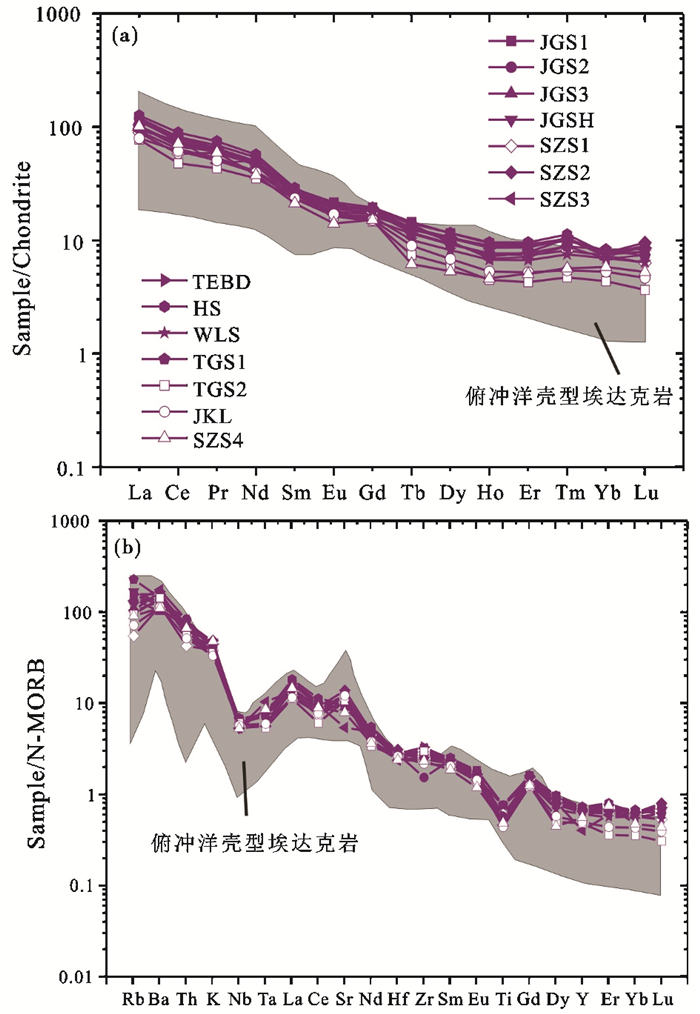
铜陵埃达克质岩样品稀土总量变化为121×10-6~205×10-6,(La/Yb)N值在12.1~17.7之间,反映轻重稀土分异明显(表 2)。球粒陨石标准化稀土配分模式显示具有一致的相对富集轻稀土和近平滑的重稀土配分模式,带有弱负Eu异常(平均Eu*/Eu=0.88)(图 4a)。在N-MORB标准化微量元素图解中,铜陵埃达克质岩显示具有Sr元素正异常,亏损Nb、Ta、Ti元素的相似的配分曲线(图 4b)。稀土配分模式和N-MORB标准化图解反映出与Austral火山带俯冲洋壳熔融型埃达克岩特征一致(Stern and Kilian, 1996;图 4a,b)。
|
图 4 铜陵地区埃达克质岩稀土元素模式图(a) 和微量元素蜘蛛图(b)(标准化值据Sun and McDonough, 1989) 俯冲洋壳熔融型埃达克岩引自Defant and Drummond (1990),Kay and Kay (1993),Stern and Kilian (1996),Aguillón-Robles et al.(2001) and Martin et al.(2005) Fig. 4 Rare earth element patterns (a) and spider trace element variation diagrams (b) (normalization values Sun and McDonough, 1989) The field of subducted oceanic crust-derived adakites was constructed using data from Defant and Drummond (1990), Kay and Kay (1993), Stern and Kilian (1996), Aguillón-Robles et al.(2001) and Martin et al.(2005) |
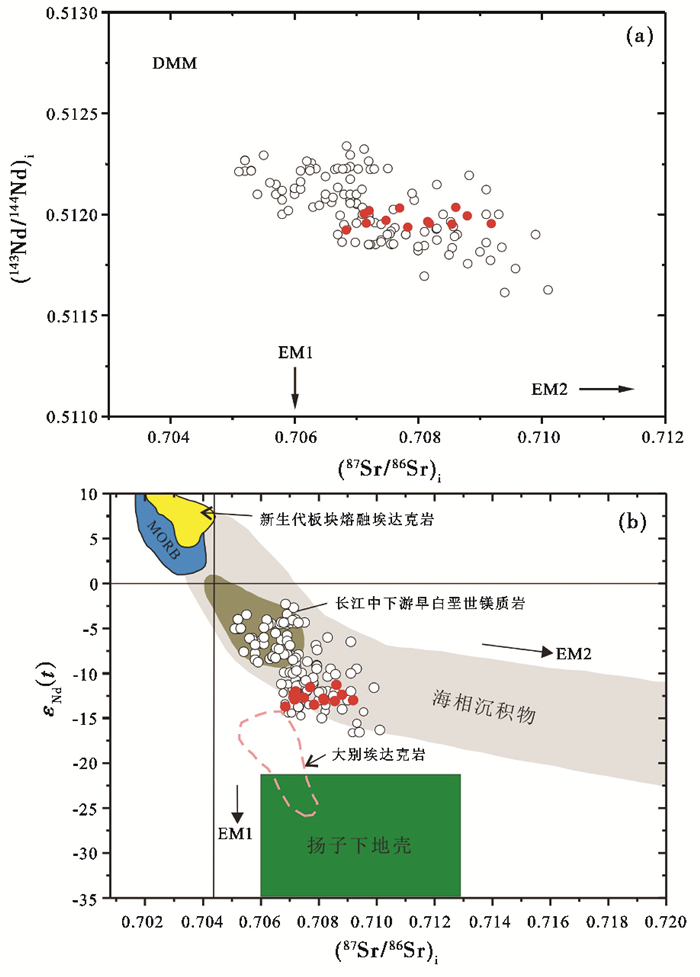
铜陵地区埃达克质岩样品Sr、Nd同位素数据见表 3。从表中可看出,这些样品的Rb、Sr、Sm和Nd含量变化范围分别为30.7×10⁻⁶~128×10-6、483×10-6~1247×10-6、4.85×10⁻⁶~6.61×10⁻⁶和24.7×10⁻⁶~40.1×10⁻⁶。其Nd、Sr同位素组成有较大的变化范围:初始(87Sr/86Sr)i变化在0.7068~0.7092,εNd(t) 变化在-11.3~-13.7,与长江中下游地区埃达克质岩相似(图 5;陈江峰等,1993;周涛发等,2001;Xu et al., 2002;王强等, 2002, 2003;王元龙等,2004;Wang et al., 2004a, b,2006,2007a;高庚等,2006;杨小男等,2007;李进文等,2007;蒋少涌等,2008;李亮和蒋少涌,2009;Xie et al., 2008;Li et al., 2008, 2009;Liu et al., 2010)。从图 5可以看出,所有样品呈负线性排列,趋向于EM2端元,明显不同于加厚或拆存下地壳而来的大别低镁和高镁埃达克岩(Wang et al., 2007b;Huang et al., 2008;Ling et al., 2011),大都落在海相沉积物区域内(Hofmann,2003),反映出沉积物在岩浆源区的重要作用(图 5b)。此外,铜陵及长江中下游地区埃达克质岩同位素特征相似于受俯冲板块而来的熔体或流体交代的岩石圈地幔部分熔融形成的早白垩世镁质岩(Yan et al., 2008)(图 5b)。由于长江中下游地区侵入岩均具有富集Nd同位素的特点(Chen et al., 2001),也说明DMM端元的贡献是不明显的(图 5a)。
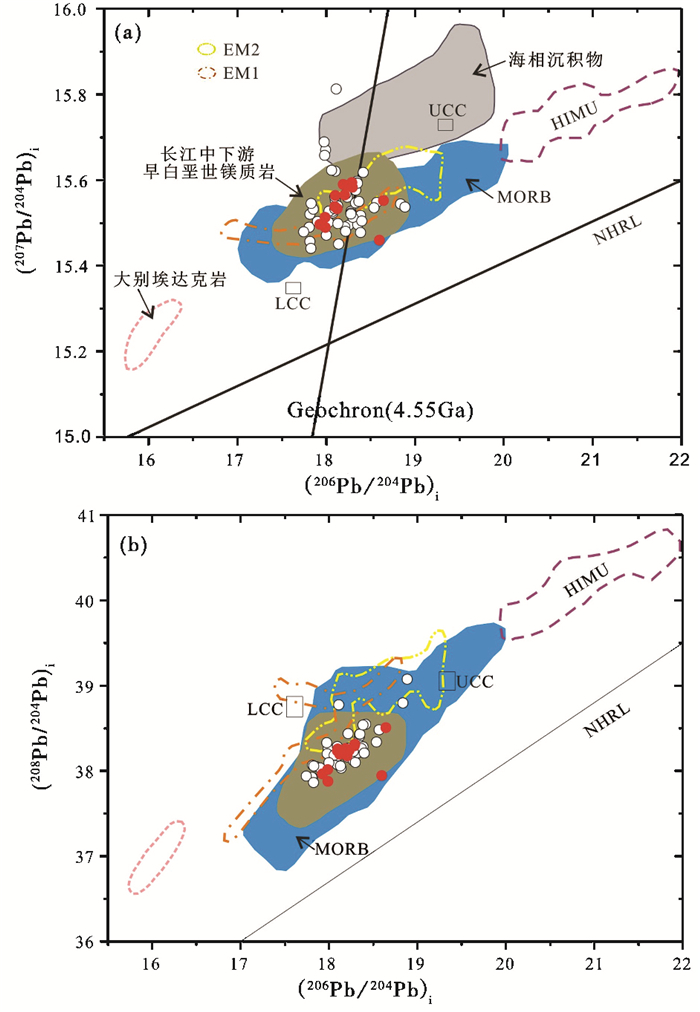
铜陵埃达克质岩Pb同位素数据见表 4,这些样品的U、Th和Pb含量变化范围分别为1.56×10⁻⁶~2.63×10⁻⁶、5.11×10⁻⁶~10.1×10⁻⁶和6.56×10⁻⁶~28.7×10⁻⁶。其Pb同位素组成变化范围分别为(206Pb/204Pb)i=17.93~18.64、(207Pb/204Pb)i=15.46~15.59、(208Pb/204Pb)i=37.88~38.51(表 4),具高放射性Pb同位素特征,均落在零等时线(Geochron) 的两侧并沿着北半球参考(NHRL) 分布,构成一个大致平行NHRL的正相关趋势,大多落在MORB区域(Hofmann,1997),近于EM1和EM2交集(Hofmann,1997),明显不同于HIMU、上、下陆壳(Hofmann,1997),与长江中下游埃达克质岩Pb同位素特征相一致(高庚等,2006;李进文等,2007;Zhou et al., 2007;Liu et al., 2010),相似于长江中下游地区早白垩世镁质侵入岩(图 6;Yan et al., 2008),而明显地高于大别埃达克岩(Huang et al., 2008),反映出其来源于洋壳而非古老下陆壳(图 6)。
|
图 6 铜陵地区埃达克质岩Pb同位素图解 数据来源:零等值线(Geochron)、北半球参考线(NHRL)、LCC和UCC (Zindler and Hart, 1986);MORB,HIMU,EM1和EM2(Hofmann,1997);大别埃达克岩(Huang et al., 2008);长江中下游地区埃达克质岩(高庚等,2006;李进文等,2007;Zhou et al., 2007;Liu et al., 2010);长江中下游地区早白垩世镁质岩和海相沉积物同图 5 Fig. 6 Initial Pb isotope ratios of the adakitic rocks in the Tongling area Data source: Geochron-zero isochron, the Northern Hemisphere Reference line (NHRL), LCC and UCC (Zindler and Hart, 1986); MORB, HIMU, EM1 and EM2 (Hofmann, 1997); Dabie adakites (Huang et al., 2008); LYRB adakitic rocks (Gao et al., 2006; Li et al., 2007; Zhou et al., 2007; Liu et al., 2010); Data sources for Early Cretaceous mafic rocks in the LYRB and Marine sediments are the same as in Fig. 5 |
铜陵埃达克质岩样品与长江中下游地区早白垩世埃达克质岩有相似的地球化学特征(周涛发等,2001;许继峰等,2001;王强等, 2002, 2003;王元龙等,2004;Wang et al., 2004a, b,2006,2007a;高庚等,2006;杨小男等,2007;李进文等,2007;蒋少涌等,2008;李亮和蒋少涌,2009;Xie et al., 2008, 2009;Li et al., 2008, 2009;Liu et al., 2010;谢建成等,2012)。如前所述,铜陵及长江中下游地区含矿埃达克质岩成因在过去十年内存在较明显的争论。
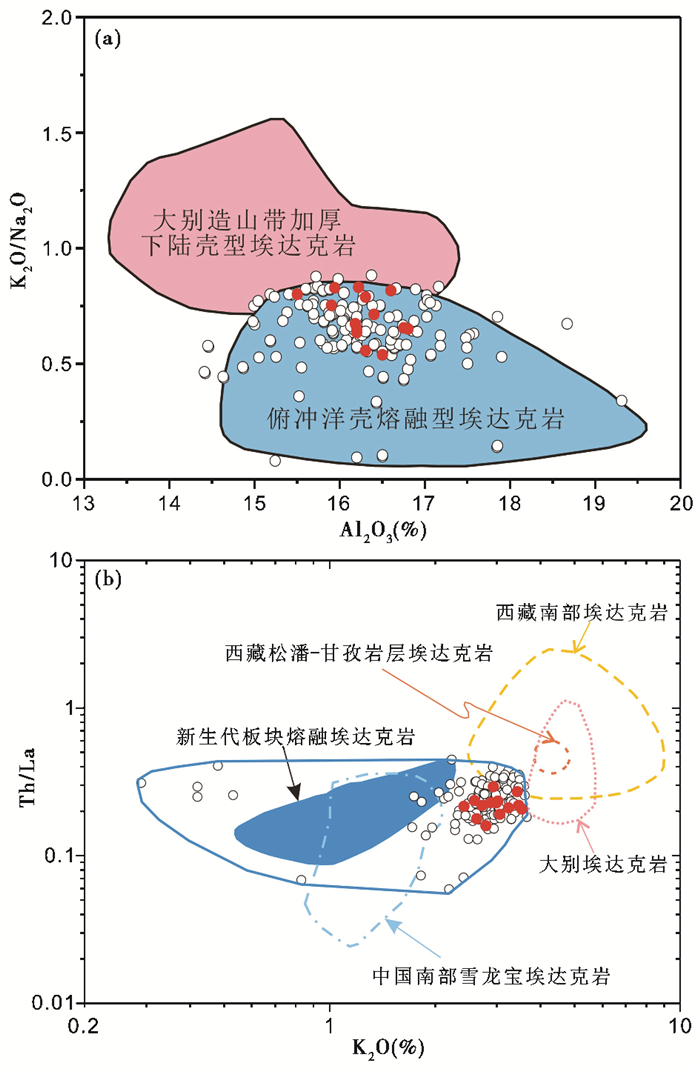
不同成因的埃达克岩具有不同的地球化学特征,比如,K2O、MgO、TiO2、P2O5、Th和U含量差异,K2O/Na2O、Th/Ce、Th/U、Sr/Y、Sr/La、Ce/Pb和(La/Yb)N等比值也不同。相对于高Al2O3含量(平均16.3%),铜陵埃达克质岩K2O/Na2O比值变化在0.54到0.83(平均值为0.70),与长江中下游埃达克质岩特征一致,落在俯冲洋壳熔融型埃达克岩区域内,明显低于大别造山带加厚下陆壳型埃达克岩(Wang et al., 2007b;Huang et al., 2008)(图 7a)。铜陵埃达克质岩有较低的Th/La比值(0.16~0.29,平均值为0.22) 和低K2O含量,与长江中下游埃达克质岩特征一致,可与俯冲洋壳熔融型埃达克岩(Stern and Kilian, 1996) 和雪龙宝埃达克岩(Zhou et al., 2006) 相比,不同于西藏和大别下陆壳而来的高钾埃达克岩(Hou et al., 2004;Wang et al., 2005, 2007b;Huang et al., 2008)(图 7b)。这种差异取决于源区是否存在角闪石。角闪石是主要含钾矿物,在变玄武质岩高压熔融时,残余相中角闪石比石榴子石和斜辉石含更高的K2O (Sen and Dunn, 1994;Rapp and Watson, 1995),因此,残余相角闪石的存在能降低熔体钾浓度,从而形成低钾硅质熔体。富钠贫钾洋壳型埃达克岩(低K2O/Na2O比值) 是MORB成分(如,角闪岩) 部分熔融的产物(残余相为石榴子石+斜方辉石+角闪石)(Defant and Drummond, 1990;Kay and Kay, 1993;Sen and Dunn, 1994;Rapp and Watson, 1995;Martin et al., 2005)。相反,干的镁质下陆壳岩石(如,榴辉岩) 部分熔融,产生无角闪石的榴辉岩残留体和高钾熔体(Liu et al., 2010;Huang and He, 2010)。
|
图 7 K2O/Na2O-Al2O3图解(a) 和Th/La-K2O图解(b) 数据来源:大别加厚下地壳埃达克质岩(Wang et al., 2007b;Huang et al., 2008);洋壳板块而来埃达克岩(Kamei et al., 2009);新生代板块熔融埃达克岩(Stern and Kilian, 1996);西藏南部埃达克岩(Hou et al., 2004);新生代下地壳西藏松潘-甘孜岩层埃达克岩(Wang et al., 2005);中国南部雪龙宝埃达克岩(Zhou et al., 2006);长江中下游地区埃达克质岩同图 2 Fig. 7 K2O/Na2O versus Al2O3 diagram (a) and Th/La versus K2O diagram (b) Data source: Thickened lower crust-derived adakitic rocks from the Dabie orogen (Wang et al., 2007b; Huang et al., 2008); Oceanic slab-derived adakites (Kamei et al., 2009); Cenozoic slab-derived adakites (Stern and Kilian, 1996) Potassic adakites from South Tibet (Hou et al., 2004); Cenozoic lower crust-derived adakites in the Songpa-Ganze Terrane (Wang et al., 2005); Adakites from the Xuelongbao in South China (Zhou et al., 2006); LYRB adakitic rocks are the same as in Fig. 2 |
铜陵埃达克质岩MgO含量为1.47%~2.51%,与SiO2含量呈明显的负线性关系,与长江中下游埃达克质岩特征一致,反映典型的俯冲洋壳熔融型埃达克岩特征(Defant and Kepezhinskas, 2001)(图 3c)。部分样品落在变玄武岩和榴辉岩实验熔融区(1~4GPa),暗示其在上升过程中与地幔发生不同程度的作用。Mg#值是判断是否存在地幔相互作用的一个有用的指标。不管熔融程度如何,玄武质下地壳熔融具有低Mg# ( < 0.4) 特征,而Mg#>0.4,则表明有地幔成分的参与(Rapp and Watson, 1995)。长江中下游地区埃达克质岩具有相当高的Mg#(0.35~0.76;许继峰等,2001;王强等, 2002, 2003;侯增谦等,2007;Xie et al., 2008;Li et al., 2008;Liu et al., 2010),表明有地幔成分的参与。
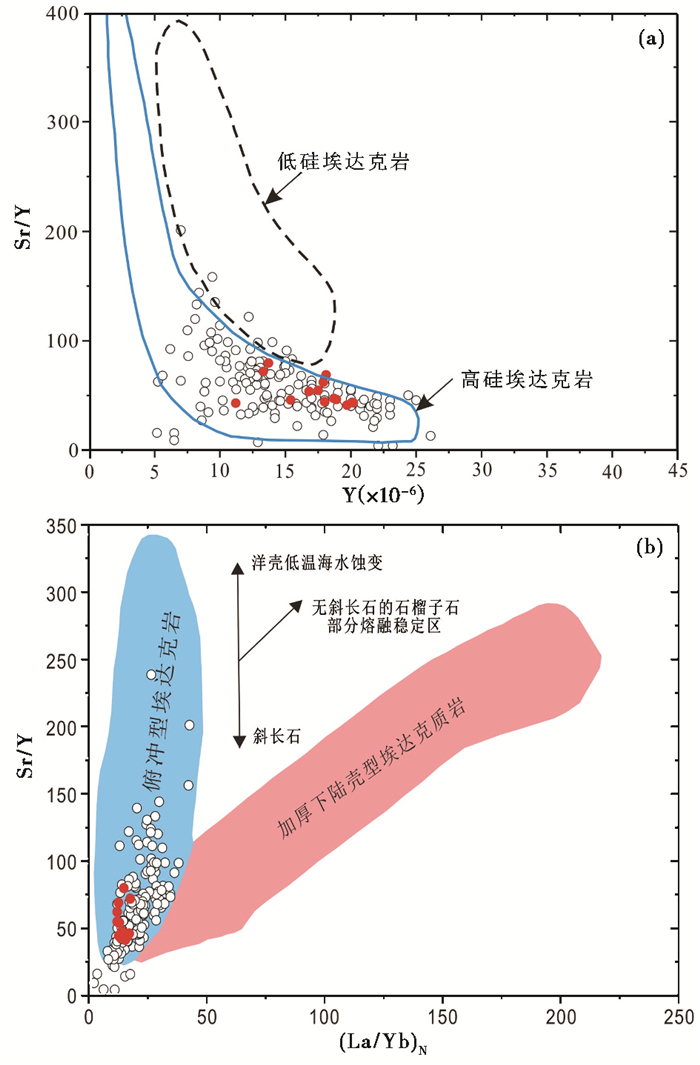
高Sr/Y和(La/Yb)N比值是判别埃达克岩的两个最重要参数(Defant and Drummond, 1990;Martin et al., 2005)。铜陵埃达克质岩具有相当低的(La/Yb)N比值(12.1~17.7,平均14.4),可变且相当高的Sr/Y比值(41.3~79.7,平均53.4),与长江中下游埃达克质岩特征一致,落在高硅埃达克岩区域,支持板块熔体的解释(Martin et al., 2005)(图 8a)。此外,铜陵埃达克质岩有低Cr和Ni含量不支持橄榄岩与熔体相互作用(表 2)。铜陵及长江中下游埃达克质岩可与俯冲洋壳型埃达克岩相比,明显不同于加厚下陆壳型埃达克质岩(图 8b)。虽然两者都呈明显的正线性相关,但长江中下游地区埃达克质岩和俯冲板块型埃达克岩的斜率约是加厚下陆壳型埃达克质岩的两倍,主要是低温海水蚀变洋壳部分熔融结果,与墨西哥Vizcaino Penisula地区新生代埃达克岩相一致(Aguillón-Robles et al., 2001)。
|
图 8 铜陵地区埃达克质岩Y-Sr/Y (a) 和Sr/Y-(La/Yb)N (b) 图解 高硅和低硅埃达克岩引自Martin et al.(2005);俯冲型埃达克岩引自Defant and Drummond (1990),Drummond et al.(1996),Stern and Kilian (1996),Aguillon-Robles et al.(2001);加厚下陆壳型埃达克岩引自Petford and Atherton (1996),Wang et al.(2007b),Huang et al.(2008),Zhao and Zhou 2008;长江中下游地区埃达克质岩同图 2 Fig. 8 Plots of Y vs. Sr/Y (a) and Sr/Y vs. (La/Yb)N (b) for the adakitic rocks in Tongling region Data for high and low SiO2 adakites are from Martin et al.(2005); slab derived adakites from Defant and Drummond (1990), Drummond et al.(1996), Stern and Kilian (1996), Aguillon-Robles et al.(2001); Thicked LCC-derived adakitic rocks from Petford and Atherton (1996), Wang et al.(2007b), Huang et al.(2008), Zhao and Zhou 2008. LYRB adakitic rocks are the same as in Fig. 2 |
陆壳Ce/Pb (约4~5;Taylor and McLennan, 1985;Rudnick and Gao, 2003) 比值比洋壳(~24;Sun and McDonough, 1989) 低。由于N-MORB亏损LREE (Sun and McDonough, 1989;Sun et al., 2008) 和海水蚀变富集Sr,蚀变洋壳比下陆壳有更高的Sr/La比值,因此,利用Ce/Pb-Sr/La图解可有效的判别来自俯冲洋壳和下陆壳的岩石(Liu et al., 2010)。铜陵埃达克质岩的Ce/Pb和Sr/La比值与长江中下游埃达克质岩相似,高于那些大别埃达克岩,暗示其起源于俯冲洋壳。铜陵埃达克质岩具有可变的Th含量(5.11×10-6~10.1×10-6),较低Th/U比值(2.62~5.75),与长江中下游地区埃达克岩一致(Ling et al., 2011),位于N-MORB熔体的区域,明显不同于MCC、LCC熔体(Rudnick and Gao, 2003)。因此,Th/U比值也是判别源于俯冲洋壳板块部分熔融的岩石的有用证据。
铜陵埃达克质岩的初始Sr-Nd同位素组成与长江中下游埃达克质岩一致,落在MORB和富集地幔之间(图 5),明显不同于扬子下地壳组成,表明板块熔体遭受富集地幔成分的混染作用(Ling et al., 2009, 2011)。其典型趋向于EM2端元,表明岩浆源区有俯冲沉积物加入(Liu et al., 2010)(图 5)。Pb同位素组成为这些埃达克岩的源区提供了重要的限制。铜陵埃达克质岩具有高放射性Pb特征,主要落在MORB区域,靠近EM1和EM2交集,明显不同于上、下陆壳,排除了陆壳的混染作用(Hofmann,1997)(图 6)。部分样品落在或接近海相沉积物的区域(图 6),也暗示俯冲沉积物的贡献。长江中下游埃达克质岩重氧同位素组成(δ18O=+7.55~+11.9;陈江峰等,1993;高庚等,2006;Zhou et al., 2007) 更进一步表明岩浆源区有沉积物加入。然而,沉积物通常有低Cu含量,因此它不可能是铜陵矿床的主要来源。
中国东部富集岩石圈地幔有EM1和EM2特征,其中华北克拉通以EM1为主,华南地块以EM2为主(Peng et al., 1986;Xu,2001),EM1和EM2过渡位于长江北部,接近于铜陵地区(Chung,1999)。埃达克岩浆形成在约800~900℃,没有足够的热完全熔融富集地幔。反而,埃达克岩浆可引起其上的富集地幔小程度部分熔融,比如,同化作用。
综上所述,这些明显的地球化学特征表明铜陵和长江中下游地区埃达克质岩起源于有限俯冲沉积物贡献的俯冲洋壳部分熔融,其上升过程中与富集地幔发生相互作用。我们的研究不支持拆沉或加厚古老下陆壳部分熔融而成的解释(Xu et al., 2002;王强等, 2002, 2003;Wang et al., 2004a, b,2006,2007a;侯增谦等,2007)。除了上述所及的化学和同位素特征,下陆壳通常在低氧逸度下有较低的Cu浓度(Rudnick and Gao, 2003),不利于Cu矿化(Sun et al., 2011, 2012)。
5.2 构造意义对于铜陵及长江中下游地区中酸性火成岩的形成环境长期存在争论,一种观点认为与古洋壳俯冲作用有关(Faure et al., 1996;Zhou and Li, 2000;邓晋福等,2000;汪洋等,2004;Zhou et al., 2006;Sun et al., 2007;Li and Li, 2007);另一种意见认为是陆内拉张作用的产物,与洋壳俯冲无关(张旗等, 2001a, b;王元龙等,2004;王强等, 2002, 2003;Wang et al., 2004a, b,2006,2007a;Yan et al., 2008;侯增谦等,2007;Xie et al., 2008;周涛发等,2008;Li et al., 2009)。近来研究表明在侏罗纪到白垩纪中国东部处在活动大陆边缘,与古太平洋板块密切相关(Zhou et al., 2006;Li and Li, 2007;Sun et al., 2007)。当古太平洋板块抵至扬子克拉通时,在北部和北西部,它受阻于大别造山带山根和华北克拉通(如,Huang and Zhao, 2006;Ernst et al., 2007)。中国东部晚侏罗世挤压到早白垩世扩展这一构造转换与依泽纳吉板块斜而浅俯冲转变为太平洋板块直而陡俯冲有关(Zhu et al., 2010)。最近,Ling et al.(2009, 2011) 认为太平洋和依泽纳吉板块之间的洋脊俯冲控制着长江中下游成矿带埃达克岩的分布,得到了地球化学方面的支持(Liu et al., 2010)。
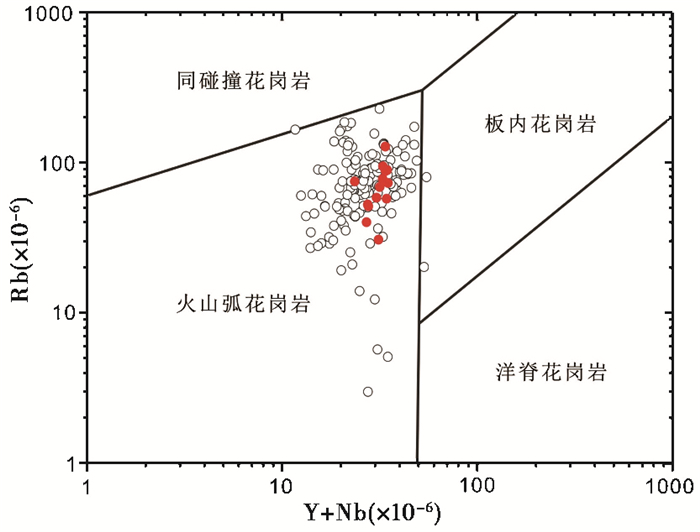
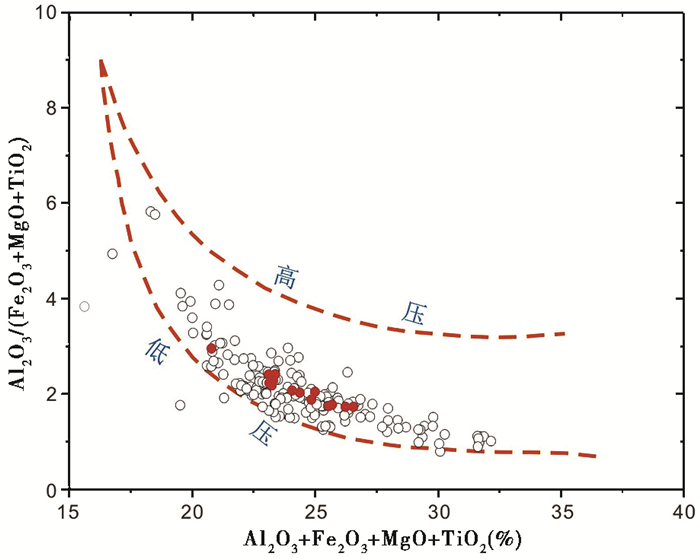
依据上述讨论,铜陵和长江中下游埃达克质岩形成于俯冲洋壳部分熔融。在(Y+Nb)-Rb构造判别图中,所有铜陵和长江中下游埃达克质岩样品均落在火山弧花岗岩范围内,暗示俯冲环境(图 9)。而这类岩石的形成需要高温条件(Martin,1998),SiO2含量和TiO2、P2O5含量相关图表明铜陵和长江中下游埃达克质岩形成于800~900℃高温环境(Harrison and Watson, 1984;Green and Pearson, 1986;图 3b, d)。铜陵埃达克质岩(Al2O3+Fe2O3+MgO+TiO2) 含量为20.0%~30.1%,Al2O3/(Fe2O3+MgO+TiO2) 比值变化在1.67~2.88,暗示熔体处在一个相对低压的环境(图 10)。因此,我们认为铜陵及长江中下游地区埃达克质岩浆形成于早白垩世高温和低压板块俯冲环境。
|
图 9 Rb-Y+Nb图解(据Pearce et al., 1984) 长江中下游地区埃达克质岩同图 2 Fig. 9 Rb-Y+Nb diagram (after Pearce et al., 1984) LYRB adakitic rocks are the same as in Fig. 2 |
|
图 10 (Al2O3+Fe2O3+MgO+TiO2)-Al2O3/(Fe2O3+MgO+TiO2) 图解 高压和低压曲线引自Patiňo Douce,1999.长江中下游地区埃达克质岩同图 2 Fig. 10 (Al2O3+Fe2O3+MgO+TiO2)-Al2O3/(Fe2O3+MgO+TiO2) diagram the area between the high and low pressure curves encompasses the range of depths at which mantle-crust interaction takes place after Patiňo Douce, 1999. LYRB adakitic rocks are the same as in Fig. 2 |
在长江中下游成矿带,岩浆活动对内生金属成矿作用的宏观制约方面多有论述(如:常印佛等,1991;王德滋等,1996;唐永成等,1998;Mao et al., 2006),但没有明确回答形成长江中下游Cu-Au成矿带的主导性宏观地质因素。王强等(2002, 2003) 及Wang et al.(2004a, b, 2006, 2007a) 根据其对该地区埃达克质岩的研究认为Cu-Au成矿作用与埃达克质岩有关,下地壳熔融形成的埃达克质岩浆及其形成时释放的流体是富集金属成矿的主要因素。侯增谦等(2007)则认为本区斑岩铜矿形成于中国大陆板内环境,与大洋板块俯冲无关;Mao et al.(2006)认为长江中下游矿集区铜、金矿床的形成可能与古太平洋板块或依泽纳吉板块向欧亚大陆俯冲有关;Ling et al.(2009, 2011) 和Liu et al.(2010)研究认为长江中下游成矿带中金属矿床的分布与太平洋和依泽纳吉板块之间的洋脊俯冲有关。
与在硅酸盐和氧化物矿物不相容性质不同,亲铜元素(如,铜和金) 在岩浆硫化物相中具高度相容性(Fleet et al., 1996;Ballard et al., 2002)。正常的弧岩浆岩的地幔源区的氧逸度不够高,其母岩浆中的Cu、Au含量也不高,所以不能形成大型Cu-Au矿床(Mungall,2002)。对于玄武质下地壳熔融产物而言,其氧逸度也不高(Carmichael,1991),所以,地壳熔融形成的埃达克质岩浆不一定能导致Cu、Au元素的富集。已有的研究工作显示,铜、金矿床往往有大量的幔源物质加入,这主要是因为在岩浆演化到酸性岩时铜、金会大量丢失,因此以酸性岩为主体的陆壳铜、金的丰度较低(Sun et al., 2004)。相比之下,由于Cu、Au为中度不相容元素(Sun et al., 2004),在洋壳中的含量一般在60×10-6~125 ×10-6(Sun et al., 2003b;前人估计的平均丰度在74×10-6,Hofmann,1988),远比地幔(30×10-6;McDonough and Sun, 1995) 和陆壳的平均丰度(27×10-6;Rudnick and Gao, 2003) 高,因此,洋壳部分熔融形成的岩浆应该具有系统偏高的铜含量,有利于成矿(Sun et al., 2011)。大量的研究已经证实,世界上的主要铜金矿床大都形成于板块汇聚边界的高氧逸度的环境(Sillitoe,1997;Ulrich et al., 1999;Oyarzun et al., 2001;Mungall,2002;Sun et al., 2004;Borisova et al., 2006;Chiaradia et al., 2009)。
铜陵和长江中下游埃达克岩成因上与俯冲蚀变洋壳的部分熔融有关,从而,熔体具有高氧逸度(Ballard et al., 2002;Kelley and Cottrell, 2009)。铜陵地区含矿侵入岩锆石微量元素组成研究显示高Ce正异常特征(Xie et al., 2009),暗示岩浆形成于氧化的环境。俯冲板片洋壳部分熔融产生的具高氧逸度埃达克岩熔体,受其影响地幔楔熔融,在地幔熔融时,Cu、Au等趋向集中在硫化物熔体中,只有当地幔熔融源区呈现高氧化态时,从而使得S元素进入硅酸盐熔体,此时,Cu、Au等成矿元素才能富集于硅酸盐熔体中(Wyborn and Sun, 1994)。因此,铜陵及长江中下游地区大规模Cu、Au成矿作用是俯冲洋壳部分熔融结果,为本区Cu、Au矿床勘探提供一个新方向。
6 结论(1) 铜陵埃达克质岩为二长-闪长岩类岩石,主要显示为亚碱性系列钙碱性特征,具高Al2O3、Ba、Sr及相对高MgO含量,低Yb、Y和可变的Th含量,高Sr/Y比值,低K2O/Na2O和相对低(La/Yb)N、Th/U比值,具有EM2相似的Sr-Nd-Pb同位素特征,与俯冲洋壳型埃达克岩一致,明显不同加厚或底侵下陆壳型埃达克岩。
(2) 铜陵和长江中下游地区埃达克岩处于高温(800~900℃) 和低压环境,与板块俯冲相关(Ling et al., 2009;Liu et al., 2010),俯冲洋壳的部分熔融形成了铜陵和长江中下游埃达克质岩浆作用和Cu、Au成矿作用。
致谢 感谢两位审稿专家中肯、建设性的意见,有助于我们提高文章的质量。感谢恩师常印佛院士的指导以及安徽省地矿局321地质队提供的野外工作帮助。| [] | Aguillón-Robles A, Calmus T, Benoit M, Bellon H, Maury RC, Cotton J, Bourgois J, Michaud F. 2001. Late Miocene adakites and Nb-enriched basalts from Vizcaino Peninsula, Mexico: Indicators of East Pacific Rise subduction below southern Baja California. Geology, 29(6): 531–534. DOI:10.1130/0091-7613(2001)029<0531:LMAANE>2.0.CO;2 |
| [] | Ballard JR, Palin JM, Campbell IH. 2002. Relative oxidation states of magmas inferred from Ce (IV)/Ce (III) in zircon: Application to porphyry copper deposits of northern Chile. Contributions to Mineralogy and Petrology, 144(3): 347–364. DOI:10.1007/s00410-002-0402-5 |
| [] | Borisova AY, Pichavant M, Polvé M, Wiedenbeck M, Freydier R, Candaudap F. 2006. Trace element geochemistry of the 1991 Mt. Pinatubo silicic melts, Philippines: Implications for ore-forming potential of adakitic magmatism. Geochimica et Cosmochimica Acta, 70(14): 3702–3716. |
| [] | Carmichael ISE. 1991. The redox states of basic and silicic magmas: A reflection of their source regions. Contributions to Mineralogy and Petrology, 106(2): 129–141. DOI:10.1007/BF00306429 |
| [] | Chang YF, Liu XP, Wu YC. 1991. The Copper-iron Belt of the Middle and Lower Reaches of the Changjiang River. Beijing: Geological Publishing House: 1-239. |
| [] | Chen JF, Zhou TX, Li XM, Foland KA, Huang CY, Lu W. 1993. Sr and Nd isotopic constraints on source regions of the intermediate and acidic intrusions from southern Anhui Province. Geochimica, 22(3): 26l–268. |
| [] | Chen JF, Jahn BM. 1998. Crustal evolution of southeastern China: Nd and Sr isotopic evidence. Tectonophysics, 284(1-2): 101–133. DOI:10.1016/S0040-1951(97)00186-8 |
| [] | Chen JF, Yan J, Xie Z, Xu X, Xing F. 2001. Nd and Sr isotopic compositions of igneous rocks from the Lower Yangtze region in eastern China: Constraints on sources. Physics and Chemistry of the Earth, 26(9-10): 719–731. DOI:10.1016/S1464-1895(01)00122-3 |
| [] | Chiaradia M, Merino NDA, Spikings RA. 2009. Rapid transition to long-lived deep crustal magmatic maturation and the formation of giant porphyry-related mineralization (Yanacocha, Peru). Earth and Planetary Science Letters, 258: 593–604. |
| [] | Chung SL. 1999. Trace element and isotope characteristics of Cenozoic basalts around the Tanlu fault with implications for the eastern plate boundary between north and south China. Journal of Geology, 107(3): 301–312. DOI:10.1086/314348 |
| [] | Defant MJ, Drummond MS. 1990. Derivation of some modern arc magmas by melting of young subducted lithosphere. Nature, 347(6294): 662–665. DOI:10.1038/347662a0 |
| [] | Defant MJ, Kepezhinskas P. 2001. Evidence suggests slab melting in arc magmas. EOS (Transactions, American Geophysical Union), 82(6): 65–69. |
| [] | Deng JF, Zhao GC, Zhao HL, Luo ZH, Dai SQ, Li KM. 2000. Yanshanian igneous petrotectonic assemblsge and orogenic-deep processes in East China. Geological Review, 46(1): 41–48. |
| [] | Drummond MS, Defant MJ and Kepezhinskas PK. 1996. Petrogenesis of slab-derived trondhjemite-tonalite-dacite/adakite magmas. 3rd Hutton Symposium on the Origin of Granites and Related Rocks, College Pk, Md, 205-215 |
| [] | Ernst WG, Tsujimori T, Zhang R, Liou JG. 2007. Permo-Triassic collision, subduction-zone metamorphism, and tectonic exhumation along the East Asian continental margin. Annual Review of Earth and Planetary Sciences, 35(1): 73–110. DOI:10.1146/annurev.earth.35.031306.140146 |
| [] | Faure M, Sun Y, Shu L, Monié P, Charvel J. 1996. Extensional tectonics within a subduction-type orogen: The case study of the Wugongshan Dome (Jiangxi Province, southeastern China). Tectonophysics, 263(1-4): 77–106. DOI:10.1016/S0040-1951(97)81487-4 |
| [] | Fleet ME, Crocket JH, Stone WE. 1996. Partitioning of platinum-group elements (Os, Ir, Ru, Pt, Pd) and gold between sulfide liquid and basalt melt. Geochimica et Cosmochimica Acta, 60(13): 2397–2412. DOI:10.1016/0016-7037(96)00100-7 |
| [] | Gao G, Xu ZW, Yang XN, Wang YJ, Zhang J, Jiang SY, Ling HF. 2006. Petrogenesis of the Baimangshan pyroxene diorite intrusion in Tongling area, Anhui Province: Constraints from Sr-Nd-Pb-O isotopes. Journal of Nanjing University (Natural Sciences), 42(3): 269–279. |
| [] | Green TH, Pearson NJ. 1986. Ti-rich accessory phase saturation in hydrous mafic-felsic compositions at high P, T. Chemical Geology, 54(3-4): 185–201. DOI:10.1016/0009-2541(86)90136-1 |
| [] | Harrison TM, Watson EB. 1984. The behavior of apatite during crustal anatexis: Equilibrium and kinetic considerations. Geochimica et Cosmochimica Acta, 48(7): 1467–1477. DOI:10.1016/0016-7037(84)90403-4 |
| [] | Hofmann AW. 1988. Chemical differentiation of the Earth: The relationship between mantle, continental crust, and oceanic crust. Earth and Planetary Science Letters, 90(3): 297–314. DOI:10.1016/0012-821X(88)90132-X |
| [] | Hofmann AW. 1997. Mantle geochemistry: The message from oceanic volcanism. Nature, 385(6613): 219–229. DOI:10.1038/385219a0 |
| [] | Hofmann AW. 2003. Sampling mantle heterogeneity through oceanic basalts: Isotopes and trace elements. In: Carlson RW (ed.). The Mantle and Core. Treatise on Geochemistry. Oxford: Elsevier-Pergamon: 61-101 |
| [] | Hou ZQ, Gao YF, Qu XM, Rui ZY, Mo XX. 2004. Origin of adakitic intrusives generated during Mid-Miocene east-west extension in southern Tibet. Earth and Planetary Science Letters, 220(1-2): 139–155. DOI:10.1016/S0012-821X(04)00007-X |
| [] | Hou ZQ, Pan XF, Yang ZM, Qu XM. 2007. Porphyry Cu-(Mo-Au) deposits no related to oceanic-slab subduction: Examples from Chinese porphyry deposits in continental settings. Geoscience, 21(2): 332–351. |
| [] | Huang F, Li SG, Dong F, He YS, Chen FK. 2008. High-Mg adakitic rocks in the Dabie orogen, Central China: Implications for foundering mechanism of lower continental crust. Chemical Geology, 255(1-2): 1–13. DOI:10.1016/j.chemgeo.2008.02.014 |
| [] | Huang F, He YS. 2010. Partial melting of the dry mafic continental crust: Implications for petrogenesis of C-type adakites. Chinese Science Bulletin, 55(22): 2428–2439. DOI:10.1007/s11434-010-3224-2 |
| [] | Huang JL, Zhao DP. 2006. High-resolution mantle tomography of China and surrounding regions. Journal of Geophysical Research, 111: B9305–B9325. DOI:10.1029/2005JB004066 |
| [] | Irvine TN, Baragar WRA. 1971. A guide to the chemical classification of the common volcanic rocks. Canadian Journal of Earth Sciences, 8(5): 523–548. DOI:10.1139/e71-055 |
| [] | Jiang SY, Li L, Zhu B, Ding X, Jiang YH, Gu LX, Ni P. 2008. Geochemical andSr-Nd-Hf isotopic compositions of granodiorite from the Wushna copper deposit, Jinagxi Province and their implications for petrogenesis. Acta Petrologica Sinica, 24(8): 1679–1690. |
| [] | Kay RW, Kay SM. 1993. Delamination and delamination magmatism. Tectonophysics, 219(1-3): 177–189. DOI:10.1016/0040-1951(93)90295-U |
| [] | Kelley KA, Cottrell E. 2009. Water and the oxidation state of subduction zone magmas. Science, 325(5940): 605–607. DOI:10.1126/science.1174156 |
| [] | Li JW, Pei RF, Zhang DQ, Mei YX, Zang WS, Meng GX, Zeng PS, Li TJ, Di YJ. 2007. Geochemical characteristics of the Yanshanian intermediate-acid intrusive rocks in the Tongling mineralization concentration area, Anhui Province, and their geological implications. Acta Geoscientica Sinica, 28(1): 11–22. |
| [] | Li JW, Zhao XF, Zhou MF, Vasconcelos P, Ma CQ, Deng XD, Sérgio de Souza Z, Zhao YX, Wu G. 2008. Origin of the Tongshankou porphyry-skarn Cu-Mo deposit, eastern Yangtze craton, eastern China: Geochronological, geochemical, and Sr-Nd-Hf isotopic constraints. Mineralium Deposita, 43(3): 315–336. DOI:10.1007/s00126-007-0161-3 |
| [] | Li JW, Zhao XF, Zhou MF, Ma CQ, Sérgio de Souza Z, Vasconcelos P. 2009. Late Mesozoic magmatism from the Daye region, eastern China: U-Pb ages, petrogenesis, and geodynamic implications. Contributions to Mineralogy and Petrology, 157(3): 383–409. DOI:10.1007/s00410-008-0341-x |
| [] | Li L, Jiang SY. 2009. Petrogenesis and geochemistry of the Dengjiashan porphyritic granodiorite, Jiujiang-Ruichang metalogenic district of the Middle-Lower Reaches of the Yangtze River. Acta Petrologica Sinica, 25(11): 2877–2888. |
| [] | Li ZX, Li XH. 2007. Formation of the 1300-km-wide intracontinental orogen and postorogenic magmatic province in Mesozoic South China: A flat-slab subduction model. Geology, 35(2): 179–182. DOI:10.1130/G23193A.1 |
| [] | Ling MX, Wang FY, Ding X, Hu YH, Zhou JB, Zartman RE, Yang XY, Sun WD. 2009. Cretaceous ridge subduction along the Lower Yangtze River Belt, eastern China. Economic Geology, 104(2): 303–321. DOI:10.2113/gsecongeo.104.2.303 |
| [] | Ling MX, Wang FY, Ding X, Zhou JB, Sun WD. 2011. Different origins of adakites from the Dabie Mountains and the Lower Yangtze River belt, eastern China: Geochemical constraints. International Geology Review, 53(5-6): 727–740. DOI:10.1080/00206814.2010.482349 |
| [] | Liu SA, Li SG, He YS, Huang F. 2010. Geochemical contrasts between early Cretaceous ore-bearing and ore-barren high-Mg adakites in central-eastern China: Implications for petrogenesis and Cu-Au mineralization. Geochimica et Cosmochimica Acta, 74(24): 7160–7178. DOI:10.1016/j.gca.2010.09.003 |
| [] | Mao JW, Wang YT, Lehmann B, Yu JJ, Du AD, Mei YX, Li YF, Zang WS, Stein HJ, Zhou TF. 2006. Molybdenite Re-Os and albite 40Ar/39Ar dating of Cu-Au-Mo and magnetite porphyry systems in the Yangtze River valley and metallogenic implications. Ore Geology Reviews, 29(3-4): 307–324. DOI:10.1016/j.oregeorev.2005.11.001 |
| [] | Martin H. 1998. Adakitic magmas: Modern analogues of Archaean granitoids. Lithos, 46(3): 411–429. |
| [] | Martin H, Smithies RH, Rapp R, Moyen JF, Champion D. 2005. An overview of adakite, tonalite-trondhjemite-granodiorite (TTG), and sanukitoid: Relationships and some implications for crustal evolution. Lithos, 79(1-2): 1–24. DOI:10.1016/j.lithos.2004.04.048 |
| [] | McDonough WF, Sun SS. 1995. The composition of the Earth. Chemical Geology, 120(3-4): 223–253. DOI:10.1016/0009-2541(94)00140-4 |
| [] | Middlemost EAK. 1994. Naming materials in the magma/igneous rock system. Earth Science Reviews, 37(3-4): 215–224. DOI:10.1016/0012-8252(94)90029-9 |
| [] | Mungall JE. 2002. Roasting the mantle: Slab melting and the genesis of major Au and Au-rich Cu deposits. Geology, 30(10): 915–918. DOI:10.1130/0091-7613(2002)030<0915:RTMSMA>2.0.CO;2 |
| [] | Oyarzun R, Márquez A, Lillo J, López I, Rivera S. 2001. Giant versus small porphyry copper deposits of Cenozoic age in northern Chile: Adakitic versus normal calc-alkaline magmatism. Mineralium Deposita, 36(8): 794–798. DOI:10.1007/s001260100205 |
| [] | Patiňo Douce AE. 1999. What do experiments tell us about the relative contributions of crust and mantle to the origin of granitic magmas? In: Castro A, Fernandez C and Vigneresse JL (eds.). Understanding Granites: Integrating New and Classical Techniques. Geological Society, London. Special Publications, 168(1): 55-75 |
| [] | Pearce JA, Harris NBW, Tindle AG. 1984. Trace element discrimination diagrams for the tectonic interpretation of granitic rocks. Journal of Petrology, 25(4): 956–983. DOI:10.1093/petrology/25.4.956 |
| [] | Peng ZC, Zartman RE, Futa K, Chen DG. 1986. Pb-, Sr-and Nd-isotopic systematics and chemical characteristics of Cenozoic basalts, eastern China. Chemical Geology, 59(1): 3–33. DOI:10.1016/0168-9622(86)90054-0 |
| [] | Petford N, Atherton M. 1996. Na-rich partial melts from newly underplated basaltic crust: The Cordillera Blanca Batholith, Peru. Journal of Petrology, 37(6): 1491–1521. DOI:10.1093/petrology/37.6.1491 |
| [] | Qi L, Hu J, Gregoire DC. 2000. Determination of trace elements in granites by inductively coupled plasma mass spectrometry. Talanta, 51(3): 507–513. DOI:10.1016/S0039-9140(99)00318-5 |
| [] | Rapp RP, Watson EB. 1995. Dehydration melting of metabasalt at 8~32kbar: Implications for continental growth and crust-mantle recycling. Journal of Petrology, 36(4): 891–931. DOI:10.1093/petrology/36.4.891 |
| [] | Rudnick RL and Gao S. 2003. Composition of the continental crust. In: Rudnick RL, Holland HD and Turekian KK (eds.). The Crust Vol. 3 Treatise on Geochemistry. Oxford: Elsevier-Pergamon, 1-64 |
| [] | Sen C, Dunn T. 1994. Dehydration melting of a basaltic composition amphibolite at 1.5 and 2.0GPa: Implications for the origin of adakites. Contributions to Mineralogy and Petrology, 117(4): 394–409. DOI:10.1007/BF00307273 |
| [] | Sillitoe RH. 1997. Characteristics and controls of the largest porphyry Cu-Au and epithermal Au deposits in the circum-Pacific region. Australian Journal of Earth Sciences, 44: 373–388. DOI:10.1080/08120099708728318 |
| [] | Stern CR, Kilian R. 1996. Role of the subducted slab, mantle wedge and continental crust in the generation of adakites from the Andean Austral volcanic zone. Contributions to Mineralogy and Petrology, 123(3): 263–281. DOI:10.1007/s004100050155 |
| [] | Sun SS and McDonough WF. 1989. Chemical and isotopic systematics of oceanic basalts: Implications for mantle composition and processes. In: Saunders AD and Norry MJ (eds.). Magmatism in Oceanic Basins. Geological Society, London, Special Publication, 42(1): 313-345 |
| [] | Sun W, Bennett VC, Eggins SM, Arculus RJ, Perfit MR. 2003b. Rhenium systematics in submarine MORB and back-arc basin glasses: Laser ablation ICP-MS results. Chemical Geology, 196(1-4): 259–281. DOI:10.1016/S0009-2541(02)00416-3 |
| [] | Sun WD, Xie Z, Chen JF, Zhang X, Chai ZF, Du AD, Zhao JS, Zhang CH, Zhou TF. 2003a. Os-Os dating of copper and molybdenum deposits along the Middle and Lower Reaches of the Yangtze River, China. Economic Geology, 98(1): 175–180. |
| [] | Sun WD, Arculus RJ, Kamenetsky VS, Binns RA. 2004. Release of gold-bearing fluids in convergent margin magmas prompted by magnetite crystallization. Nature, 431(7011): 976–978. |
| [] | Sun WD, Ding X, Hu YH, Li XH. 2007. The golden transformation of the Cretaceous plate subduction in the west Pacific. Earth and Planetary Science Letters, 262(3-4): 533–542. DOI:10.1016/j.epsl.2007.08.021 |
| [] | Sun WD, Hu YH, Kamenetsky VS, Eggins SM, Chen M, Arculus RJ. 2008. Constancy of Nb/U in the mantle revisited. Geochimica et Cosmochimica Acta, 72(14): 3542–3549. DOI:10.1016/j.gca.2008.04.029 |
| [] | Sun WD, Ling MX, Yang XY, Fan WM, Ding X, Liang HY. 2010. Ridge subduction and porphyry copper gold mineralization. Science China (Earth Sciences), 53(4): 475–484. DOI:10.1007/s11430-010-0024-0 |
| [] | Sun WD, Ling MX, Ding X, Chung SL, Zhou JB, Yang XY, Fan WM. 2011. The association between adakites and Cu-Au ore deposits. International Geology Review, 53(5-6): 691–703. DOI:10.1080/00206814.2010.507362 |
| [] | Sun WD, Ling MX, Chung SL, Ding X, Yang XY, Liang HY, Fan WM, Goldfarb R, Yin QZ. 2012. Geochemical constraints on adakites of different origins and copper mineralization. Journal of Geology, 120(1): 105–120. DOI:10.1086/662736 |
| [] | Tang YC, Wu YC, Chu GZ, Xing FM, Wang YM, Cao FY, Chang YF. 1998. Geology of Copper-gold Polymetallic Deposits along the Yangtze River, Anhui Province. Beijing: Geological Publishing House: 1-351. |
| [] | Taylor SR, McLennan SM. 1985. The Continental Crust: Its Composition and Evolution. Oxford: Blackwell Scientific Publications: 1-100. |
| [] | Ulrich T, Günther D, Heinrich CA. 1999. Gold concentrations of magmatic brines and the metal budget of porphyry copper deposits. Nature, 399(6737): 676–679. DOI:10.1038/21406 |
| [] | Wang DZ, Ren QJ, Qiu JS, Chen KR, Xu ZW, Zeng JH. 1996. Characteristics of volcanic rocks in the shoshonite province, eastern China, and their metallogenesis. Acta Geologica Sinica, 70(1): 23–34. |
| [] | Wang Q, Zhao ZH, Xu JF, Li XH, Xiong XL, Bao ZW, Liu YM. 2002. Yanshanian adakite-like rocks and metallization in the eastern part of Yangtze Block. Science in China (Series D), 32(Suppl.): 127–136. |
| [] | Wang Q, Xu JF, Zhao ZH, Xiong XL, Bao ZW. 2003a. Petrogenesis of the Mesozoic intrusive rocks in the Tongling area, Anhui Province, China and their constraint on geodynamic process. Science in China (Series D), 46(8): 801–815. DOI:10.1007/BF02879524 |
| [] | Wang Q, Zhao ZH, Xu JF, Li XH, Bao ZW, Xiong XL, Liu YM. 2003b. Petrogenesis and metallogenesis of the Yanshanian adakite-like rocks in the Eastern Yangtze block. Science in China (Series D), 46(Suppl.): 164–176. |
| [] | Wang Q, Xu JF, Zhao ZH, Bao ZW, Xu W, Xiong XL. 2004a. Cretaceous high-potassium intrusive rocks in the Yueshan-Hongzhen area of East China: Adakites in an extensional tectonic regime within a continent. Geochemical Journal, 38(5): 417–434. DOI:10.2343/geochemj.38.417 |
| [] | Wang Q, Zhao ZH, Bao ZW, Xu JF, Liu W, Li CF, Bai ZH, Xiong XL. 2004b. Geochemistry and petrogenesis of the Tongshankou and Yinzu adakitic intrusive rocks and the associated porphyry copper-molybdenum mineralization in southeast Hubei, East China. Resource Geology, 54(2): 137–152. DOI:10.1111/rge.2004.54.issue-2 |
| [] | Wang Q, McDermott F, Xu JF, Bellon H, Zhu YT. 2005. Cenozoic K-rich adakitic volcanic rocks in the Hohxil area, northern Tibet: Lower-crustal melting in an intracontinental setting. Geology, 33(6): 465–468. DOI:10.1130/G21522.1 |
| [] | Wang Q, Wyman DA, Xu JF, Zhao ZH, Jian P, Xiong XL, Bao ZW, Li CF, Bai ZH. 2006. Petrogenesis of Cretaceous adakitic and shoshonitic igneous rocks in the Luzong area, Anhui Province (eastern China): Implications for geodynamics and Cu-Au mineralization. Lithos, 89(3-4): 424–446. DOI:10.1016/j.lithos.2005.12.010 |
| [] | Wang Q, Wyman DA, Xu JF, Zhao ZH, Jian P, Zi F. 2007a. Partial melting of thickened or delaminated lower crust in the middle of eastern China: Implications for Cu-Au mineralization. Journal of Geology, 115(2): 149–161. DOI:10.1086/510643 |
| [] | Wang Q, Wyman DA, Xu JF, Jian P, Zhao ZH, Li C, Xu W, Ma JH, He B. 2007b. Early Cretaceous adakitic granites in the Northern Dabie complex, Central China: Implications for partial melting and delamination of thickened lower crust. Geochimica et Cosmochimica Acta, 71(10): 2609–2636. DOI:10.1016/j.gca.2007.03.008 |
| [] | Wang Y, Deng JF, Ji GY. 2004. A perspective on the geotectonic setting of early Cretaceous adakite-like rocks in the Lower Reaches of Yangtze River and its significance for copper-gold mineralization. Acta Petrologica Sinica, 20(2): 297–314. |
| [] | Wang YL, Wang Y, Zhang Q, Jia XQ, Han S. 2004. The geochemical characteristics of Mesozoic intermediate-acid intrusives of the Tongling area and its metallogenesis-geodynamic implications. Acta Petrologica Sinica, 20(2): 325–338. |
| [] | Wu GG, Zhang D, Di YJ, Zang WQ, Zhang XX, Song B, Zhang ZY. 2008. SHRIMP zircon U-Pb dating of the intrusives in the Tongling metallogenic cluster and its dynamic setting. Science in China (Series D), 51(7): 911–928. DOI:10.1007/s11430-008-0067-7 |
| [] | Wyborn D, Sun SS. 1994. Sulphur-undersaturated magmatism: A key factor for generating magma-related copper-gold deposits. AGS Research Newsletter, 21: 7–8. |
| [] | Xie GQ, Mao JW, Li RL, Bierlein FP. 2008. Geochemistry and Nd-Sr isotopic studies of Late Mesozoic granitoids in the southeastern Hubei Province, Middle-Lower Yangtze River belt, Eastern China: Petrogenesis and tectonic setting. Lithos, 104(1-4): 216–230. DOI:10.1016/j.lithos.2007.12.008 |
| [] | Xie JC, Yang XY, Du JG, Sun WD. 2008. Zircon U-Pb geochronology of the Mesozoic intrusive rocks in the Tongling region: Implications for copper-gold mineralization. Acta Petrologica Sinica, 24(8): 1782–1800. |
| [] | Xie JC, Yang XY, Sun WD, Du JG, Xu W, Wu LB, Wang KY, Du XW. 2009. Geochronological and geochemical constraints on formation of the Tongling metal deposits, Middle Yangtze metallogenic belt, east-central China. International Geology Review, 51(5): 388–421. DOI:10.1080/00206810802712004 |
| [] | Xie JC, Yang XY, Xiao YL, Du JG, Sun WD. 2012. Petrogenesis of the Mesozoic intrusive rocks from the Tongling ore cluster region: The metallogenic significance. Acta Geologica Sinica, 86(3): 423–459. |
| [] | Xing FM, Xu X, Li ZC. 1994. Discovery of the Early Proterozoic basement in the Middle-Lower Reaches of Yangtze River and its significance. Chinese Science Bulletin, 39(2): 136–139. |
| [] | Xu JF, Wang Q, Xu YG, Zhao ZH, Xiong XL. 2001. Geochemistry of Anjishan intermediate-acid intrusive rocks in Ningzhen area: Constraint to origin of the magma with HREE and Y depletion. Acta Petrologica Sinica, 17(4): 576–584. |
| [] | Xu JF, Shinjo R, Defant MJ, Wang Q, Rapp RP. 2002. Origin of Mesozoic adakitic intrusive rocks in the Ningzhen area of east China: Partial melting of delaminated lower continental crust. Geology, 30(12): 1111–1114. DOI:10.1130/0091-7613(2002)030<1111:OOMAIR>2.0.CO;2 |
| [] | Xu XS, Fan QC, O'Reilly SY, Jiang SY, Griffin WL, Wang RC, Qiu JS. 2004. U-Pb dating of zircons from quartz diorite and its enclaves at Tongguanshan in Anhui and its petrogenetic implication. Chinese Science Bulletin, 49(19): 2073–2082. DOI:10.1360/04wd0137 |
| [] | Xu YG. 2001. Thermo-tectonic destruction of the Archaean lithospheric keel beneath the Sino-Korean Craton in China: Evidence, timing and mechanism. Physics and Chemistry of the Earth, Part A-Solid Earth and Geodesy, 26(9-10): 747–757. DOI:10.1016/S1464-1895(01)00124-7 |
| [] | Yan J, Chen JF, Xu XS. 2008. Geochemistry of Cretaceous mafic rocks from the Lower Yangtze region, eastern China: Characteristics and evolution of the lithospheric mantle. Journal of Asian Earth Sciences, 33(3-4): 177–193. DOI:10.1016/j.jseaes.2007.11.002 |
| [] | Yang XN, Xu ZW, Zhang J, Wang YJ, Xu XS, Jiang SY, Ling HF, Liu LG, Chen DY. 2007. Geochronology and origin of Nanhongchong pluton in Shizishan ore-field, Anhui Province. Acta Petrologica Sinica, 23(6): 1543–1551. |
| [] | Yang XN, Xu ZW, Lu XC, Jiang SY, Ling HF, Liu LG, Chen DY. 2011. Porphyry and skarn Au-Cu deposits in the Shizishan orefield, Tongling, East China: U-Pb dating and in-situ Hf isotope analysis of zircons and petrogenesis of associated granitoids. Ore Geology Reviews, 43(1): 182–193. DOI:10.1016/j.oregeorev.2010.09.003 |
| [] | Zhai YS, Xiong YL, Yao SZ, Lin XD. 1996. Metallogeny of copper and iron deposits in the eastern Yangtse Craton, east-central China. Ore Geology Reviews, 11(4): 229–248. DOI:10.1016/0169-1368(96)00003-0 |
| [] | Zhang Q, Qian Q, Wang RQ, Wang Y, Zhao TP, Hao J, Guo GJ. 2001a. An east China plateau in Mid-Late Yanshanian Period: Implication from adakites. Chinese Journal of Geology, 36(2): 248–255. |
| [] | Zhang Q, Wang Y, Qian Q, Yang JH, Wang YL, Zhao TP, Guo GJ. 2001b. The characteristics and tectonic-metallogenic significances of the adakites in Yanshan Period from eastern China. Acta Petrologica Sinica, 17(2): 236–244. |
| [] | Zhao JH, Zhou MF. 2008. Neoproterozoic adakitic plutons in the northern margin of the Yangtze Block, China: Partial melting of a thickened lower crust and implications for secular crustal evolution. Lithos, 104(1-4): 231–248. DOI:10.1016/j.lithos.2007.12.009 |
| [] | Zhou MF, Yan DP, Wang CL, Qi L, Kennedy A. 2006. Subduction-related origin of the 750Ma Xuelongbao adakitic complex (Sichuan Province, China): Implications for the tectonic setting of the giant Neoproterozoic magmatic event in South China. Earth and Planetary Science Letters, 248(1-2): 286–300. DOI:10.1016/j.epsl.2006.05.032 |
| [] | Zhou TF, Yue SC, Yuan F, Liu XD, Zhao Y. 2001. A discussion on petrological characteristics and genesis of Yueshan intrusion, Anhui Province. Geological Journal of China Universities, 7(1): 70–80. |
| [] | Zhou TF, Yuan F, Yue SC, Liu XD, Zhang X, Fan Y. 2007. Geochemistry and evolution of ore-forming fluids of the Yueshan Cu-Au skarn-and vein-type deposits, Anhui Province, South China. Ore Geology Reviews, 31(1-4): 279–303. DOI:10.1016/j.oregeorev.2005.03.016 |
| [] | Zhou TF, Fan Y, Yuan F. 2008. Progress on petrogensis and metallogeny study of the mineralization belt of the Middle and Lower Reaches of the Yangtze River area. Acta Petrologica Sinica, 24(8): 1665–1778. |
| [] | Zhou XM, Li WX. 2000. Origin of Late Mesozoic igneous rocks in southeastern China: Implications for lithosphere subduction and underplating of mafic magmas. Tectonophysics, 326(3-4): 269–278. DOI:10.1016/S0040-1951(00)00120-7 |
| [] | Zhou XM, Sun T, Shen WZ. 2006. Petrogenesis of Mesozoic granitiods and volcanic rocks in South China: A response to tectonic evolution. Episodes, 29: 26–33. |
| [] | Zhu G, Niu M, Xie C, Wan Y. 2010. Sinistral to normal faulting along the Tan-Lu Fault Zone: Evidence for geodynamic switching of the East China continental margin. Journal of Geology, 118: 277–293. DOI:10.1086/651540 |
| [] | Zindler A, Hart SR. 1986. Chemical geodynamics. Annual Review of Earth and Planetary Sciences, 14(1): 493–571. DOI:10.1146/annurev.ea.14.050186.002425 |
| [] | 常印佛, 刘湘培, 吴言昌. 1991. 长江中下游铜铁成矿带. 北京: 地质出版社: 1-239. |
| [] | 陈江峰, 周泰禧, 李学明, FolandKA, 黄承义, 卢伟. 1993. 安徽南部燕山期中酸性侵入岩的源区锶、钕同位素制约. 地球化学, 22(3): 261–268. |
| [] | 邓晋福, 赵国春, 赵海玲, 罗照华, 戴圣潜, 李凯明. 2000. 中国东部燕山期火成岩构造组合与造山-深部过程. 地质论评, 46(1): 41–48. |
| [] | 高庚, 徐兆文, 杨小男, 王云健, 张军, 蒋少涌, 凌洪飞. 2006. 安徽铜陵白芒山辉石闪长岩体的成因: Sr-Nd-Pb-O同位素制约. 南京大学学报(自然科学版), 42(3): 269–278. |
| [] | 侯增谦, 潘小菲, 杨志明, 曲晓明. 2007. 初论大陆环境斑岩铜矿. 现代地质, 21(2): 332–351. |
| [] | 蒋少涌, 李亮, 朱碧, 丁昕, 姜耀辉, 顾连兴, 倪培. 2008. 江西武山铜矿区花岗闪长斑岩的地球化学和Sr-Nd-Hf同位素组成及成因探讨. 岩石学报, 24(8): 1679–1690. |
| [] | 李进文, 裴荣富, 张德全, 梅燕雄, 臧文拴, 孟贵祥, 曾普胜, 李铁军, 狄永军. 2007. 铜陵矿集区燕山期中酸性侵入岩地球化学特征及其地质意义. 地球学报, 28(1): 11–22. |
| [] | 李亮, 蒋少涌. 2009. 长江中下游地区九瑞矿集区邓家山花岗闪长斑岩的地球化学与成因研究. 岩石学报, 25(11): 2877–2888. |
| [] | 孙卫东, 凌明星, 杨晓勇, 范蔚茗, 丁兴, 梁华英. 2010. 洋脊俯冲与斑岩铜金矿成矿. 中国科学(地球科学), 40(2): 127–137. |
| [] | 唐永成, 吴言昌, 储国正, 邢凤鸣, 王永敏, 曹奋扬, 常印佛. 1998. 安徽沿江地区铜金多金属矿床地质. 北京: 地质出版社: 1-351. |
| [] | 王德滋, 任启江, 邱检生, 陈克荣, 徐兆文, 曾家湖. 1996. 中国东部橄榄安粗岩省的火山岩特征及其成矿作用. 地质学报, 70(1): 23–34. |
| [] | 王强, 赵振华, 许继峰, 李献华, 熊小林, 包志伟, 刘义茂. 2002. 扬子地块东部燕山期埃达克质(adakite-like) 岩与成矿. 中国科学(D辑), 32(增刊): 127–136. |
| [] | 王强, 许继峰, 赵振华, 熊小林, 包志伟. 2003. 安徽铜陵地区燕山期侵入岩的成因及其对深部动力学过程的制约. 中国科学(D辑), 33(4): 323–334. |
| [] | 汪洋, 邓晋福, 姬广义. 2004. 长江中下游地区早白垩世埃达克质岩的大地构造背景及其成矿意义. 岩石学报, 20(2): 297–314. |
| [] | 王元龙, 王焰, 张旗, 贾秀琴, 韩松. 2004. 铜陵地区中生代中酸性侵入岩的地球化学特征及其成矿-地球动力学意义. 岩石学报, 20(2): 325–338. |
| [] | 吴淦国, 张达, 狄永军, 臧文拴, 张祥信, 宋彪, 张忠义. 2008. 铜陵矿集区侵入岩SHRIMP锆石U-Pb年龄及其深部动力学背景. 中国科学(D辑), 38: 630–645. |
| [] | 谢建成, 杨晓勇, 杜建国, 孙卫东. 2008. 铜陵地区中生代侵入岩LA-ICP-MS锆石U-Pb年代学及Cu-Au成矿指示意义. 岩石学报, 24(8): 1782–1800. |
| [] | 谢建成, 杨晓勇, 肖益林, 杜建国, 孙卫东. 2012. 铜陵矿集区中生代侵入岩成因及成矿意义. 地质学报, 86(3): 423–459. |
| [] | 许继峰, 王强, 徐义刚, 赵振华, 熊小林. 2001. 宁镇地区中生代安基山中酸性侵入岩的地球化学:亏损重稀土和钇的岩浆产生的限制. 岩石学报, 17: 576–584. |
| [] | 杨小男, 徐兆文, 张军, 王云健, 徐夕生, 蒋少涌, 凌洪飞, 刘良根, 陈达源. 2007. 安徽狮子山矿田南洪冲岩体形成时代及成因机制研究. 岩石学报, 23(6): 1543–1551. |
| [] | 张旗, 钱青, 王二七, 王焰, 赵太平, 郝杰, 郭光军. 2001a. 燕山中晚期的中国东部高原:埃达克岩的启示. 地质科学, 36(2): 248–255. |
| [] | 张旗, 王焰, 钱青, 杨进辉, 王元龙, 赵太平, 郭光军. 2001b. 中国东部燕山期埃达克岩的特征及其构造-成矿意义. 岩石学报, 17(2): 236–244. |
| [] | 周涛发, 岳书仓, 袁峰, 刘晓东, 赵勇. 2001. 安徽月山岩体地球化学特征及成因机理分析. 高校地质学报, 7(1): 70–80. |
| [] | 周涛发, 范裕, 袁峰. 2008. 长江中下游成矿带成岩成矿作用研究进展. 岩石学报, 24(8): 1665–1778. |