 2012, Vol. 28


2. 香港大学地球科学系, 香港
2. Department of Earth Sciences, University of Hong Kong, Hong Kong, China
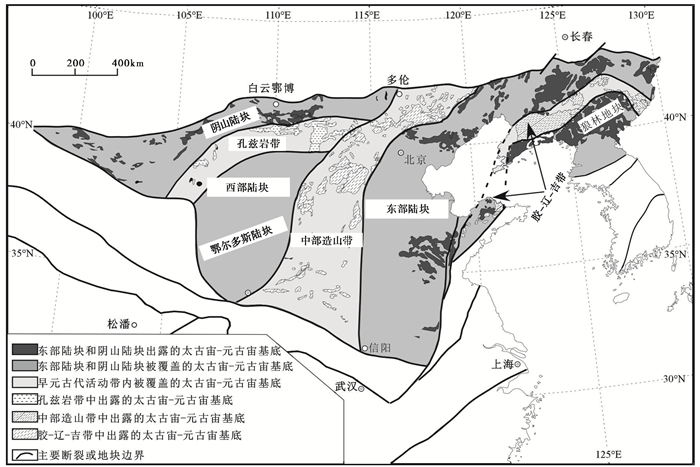
华北克拉通是中国最大和最古老的克拉通地块之一, 主要由太古宙到早元古代变质基底和中元古代到显生宙未变质盖层组成。近些年来, 国内外越来越多的学者认为华北克拉通基底是由独立的东部陆块和西部陆块沿着中部造山带碰撞拼合而形成的(图 1;Zhao et al., 2000, 2001, 2005;Guo et al., 2002, 2005;Liu et al., 2002, 2004, 2005, 2006;Wilde et al., 2002;Kusky and Li, 2003;Wang et al., 2004, 2007;Kröner et al., 2005a, 2006;Polat et al., 2005, 2006;Wilde and Zhao, 2005;Wu et al., 2005a;Li and Kusky, 2007;Trap et al., 2007)。然而, 关于两个陆块碰撞的时间以及构造过程还存在着激烈的争论。一部分学者提出在东部陆块西缘之下向东的俯冲形成了“安第斯型”岩浆弧, 在1.85Ga左右, 持续的俯冲导致了东西陆块的碰撞以及华北克拉通统一基底的形成(Zhao et al., 2000, 2005;Wilde et al., 2002;Kröner et al., 2005a, 2006;Wilde and Zhao, 2005;Zhang et al., 2007)。相反地, 另一部分学者则提出俯冲方向是向西的, 并且最终的碰撞发生在2.5Ga左右(Kusky and Li, 2003;Polat et al., 2006;Li and Kusky, 2007)。最近, Faure et al.(2007)和Trap et al.(2007, 2009) 提出了第三种模式, 他们认为在早元古代存在着两次碰撞事件, 第一次碰撞发生在2.1Ga, 导致了东部陆块和阜平陆块的拼合, 而第二次发生在1.85Ga的碰撞则完成了华北的最终克拉通化。
近十几年来, 来自不同国家的地质学家们为了解决以上的争议在中部造山带内做了大量的变质岩石学、地质年代学、地球化学以及构造地质学的研究(Guan et al., 2002;Zhao et al., 2002, 2008a, b;Guo et al., 2005;Kröner et al., 2005a, b, 2006;Liu et al., 2006;Trap et al., 2007, 2008;Zhang et al., 2007, 2009;Wang et al., 2010)。在以上提到的三个模式中, 1.85Ga碰撞模式得到了较多地质证据的支持, 它们包括:中部造山带内发现的高压麻粒岩和退变榴辉岩是1.92Ga侵位的辉长质岩墙在1.85Ga经历高压变质作用形成的(Kröner et al., 2006);造山带内广泛发育的遭受韧性变形的早元古代花岗质片麻岩说明主期变形作用发生在早元古代而不是太古宙(Kröner et al., 2005a, b);造山带内太古宙和早元古代岩石中发现的变质锆石(边) 给出了一致的变质年龄1.85Ga (Guan et al., 2002;Zhao et al., 2002, 2008a, b;Guo et al., 2005;Liu et al., 2006;Xia et al., 2006a;Trap et al., 2007, 2008;Zhang et al., 2009;Wang et al., 2010)。支持2.5Ga碰撞模式的主要地质证据则是位于中部造山带东缘的可能于晚太古代(2.5Ga) 形成的青龙前陆盆地(Kusky and Li, 2003;Li and Kusky, 2007)。
近几年来, 对中部造山带中段以及南段大量存在的浅变质表壳岩系(包括吕梁杂岩中的野鸡山群、五台杂岩中的滹沱群以及中条杂岩中的绛县群、上中条群、下中条群和担山石群) 的岩石地层学、岩相学、地球化学以及碎屑锆石U-Pb年龄和Hf同位素特征的研究取得了较大的进展。本文旨在总结以上这些成果从而讨论中部造山带在早元古代的盆地演化历史, 并对东西陆块碰撞时间的争议提出初步的看法。
2 区域地质华北克拉通包括了我国华北的大部、东北的南部、内蒙古、渤海湾以及黄海的北部, 总面积大约150万平方千米(图 1;Zhao et al., 2005)。西侧边界为早古生代祁连山造山带, 北侧为晚古生代中亚造山带, 南侧为中生代秦岭-大别造山带, 东侧为苏鲁超高压变质带(图 1;Zhao et al., 2005)。如上所述, Zhao et al.(2000, 2001) 根据岩石学、地球化学、构造学、变质岩石学和地质年代学上的差别把华北克拉通分为了东部陆块、中部造山带和西部陆块三个部分。随后, Zhao et al.(2005)又在西部陆块中识别出一条近东西向展布、长达1000km的早元古代碰撞型造山带, 称为孔兹岩带。因此, 西部陆块也就由北向南被进一步划分为阴山陆块、孔兹岩带和鄂尔多斯陆块(图 1)。此外, 东部陆块内的胶-辽-吉活动带也被认为是一条早元古代活动带(Zhao et al., 2005)。
|
图 1 华北克拉通构造划分图(据Zhao et al., 2005) Fig. 1 Tectonic subdivision of the North China Craton (after Zhao et al., 2005) |
近年来, 对于西部陆块内孔兹岩带中锆石的U-Pb年代学研究显示孔兹岩带中变质沉积岩的沉积时代和变质时代都是在早元古代, 其中碎屑锆石的年龄在2.3Ga到2.0Ga之间, 而变质锆石(边) 的年龄在2.0Ga到1.9Ga之间(Wan et al., 2006;Xia et al., 2006a, b;Santosh et al., 2007;Yin et al., 2009, 2011)。在东部陆块内, 大量的TTG片麻岩中锆石定年都给出了晚太古代(大约2.5Ga) 的结果(Geng et al., 2012)。中太古代到始太古代的岩石则仅在东部陆块的北部被发现, 包括冀北曹庄地区的含铬云母石英岩(碎屑锆石年龄3.85Ga到3.5Ga;Liu et al., 1992;吴福元等, 2005) 和鞍山地区的花岗岩和变质沉积岩(3.8Ga到3.3Ga;Wu et al., 2008)。在东部陆块西南部信阳地区中生代火山岩中的长英质麻粒岩包体中发现的3.6Ga年到2.9Ga的锆石则说明, 比晚太古代更老的地壳可能不仅限于东部陆块的北部(Zheng et al., 2004)。
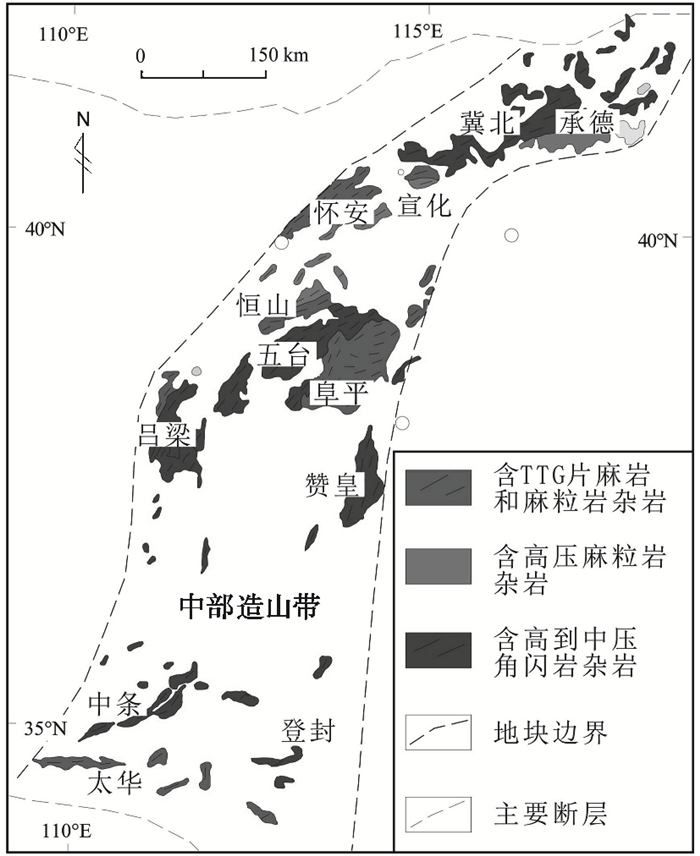
中部造山带呈近南北向展布, 长达1500km, 位于华北克拉通中部(图 2)。造山带内基底岩石主要包括晚太古代到早元古代TTG片麻岩、表壳岩(变质沉积岩和火山岩)、基性岩墙以及同构造和后构造花岗岩。该造山带内显示了一系列陆-陆碰撞带的特征, 包括大部分火成岩的地球化学特征显示它们形成于大陆边缘弧、岛弧或弧后构造背景(Kröner et al., 1988;Sun et al., 1992;Liu et al., 2002, 2004, 2005);五台群金刚库组的变质橄榄岩-辉长岩-辉绿岩-枕状玄武岩组合被认为是古老洋壳的残余(Wang et al., 1996;耿元生等, 1990;李继亮等, 1990;王凯怡等, 1997);高压麻粒岩和退变榴辉岩呈北东向沿恒山-怀安-宣化-承德一线出露(Guo et al., 2002, 2005;翟明国等, 1992, 1995;郭敬辉等, 1993;马军和王仁民, 1995;李江海等, 1998;魏春景等, 2001);造山带内的构造特征以多期变形、禁闭同斜褶皱、鞘褶皱、矿物拉伸线理、大规模推覆体和韧性剪切带为主(Wang et al., 2003;Trap et al., 2007, 2008;Zhang et al., 2007, 2009;李江海和钱祥麟, 1991;吴昌华和钟长汀, 1998;);造山带内的变质岩石都记录了顺时针等温降压P-T轨迹(Zhao et al., 2001)。
|
图 2 华北克拉通中部造山带变质杂岩分布简图(Zhao et al., 2000) Fig. 2 Simplified tectonic map showing the distribution of metamorphic complexes in the Trans-North China Orogen (after Zhao et al., 2000) |
华北克拉通中部造山带内浅变质表壳岩系主要分布于低级变质杂岩中, 包括登封杂岩中的登封群和嵩山群, 中条杂岩中的绛县群、下中条群、上中条群和担山石群, 吕梁杂岩中的吕梁群和野鸡山群以及五台杂岩中的五台群和滹沱群(图 2)。近年来的研究主要集中于中部造山带中段的滹沱群和野鸡山群以及南段中条杂岩中的浅变质表壳岩(Li et al., 2009;Liu et al., 2011a, b, c;李秋根等, 2008;刘树文等, 2009), 本节首先对它们的地层层序特征做一小结。
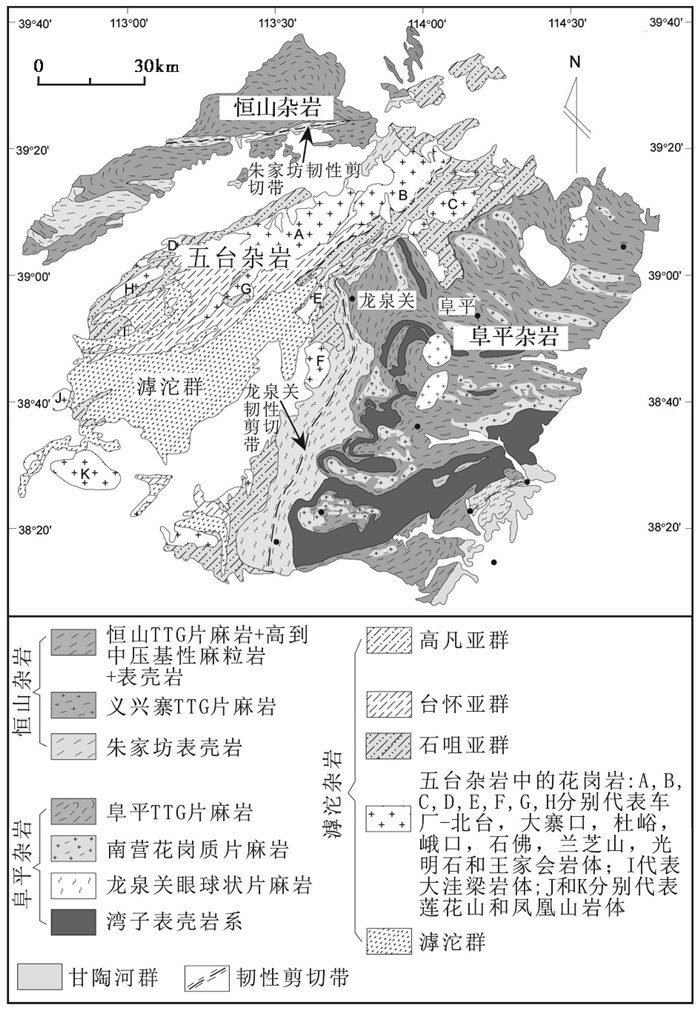
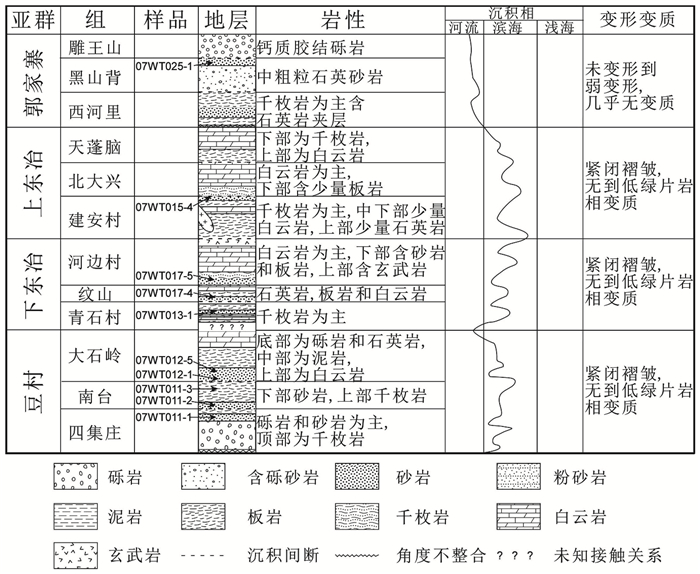
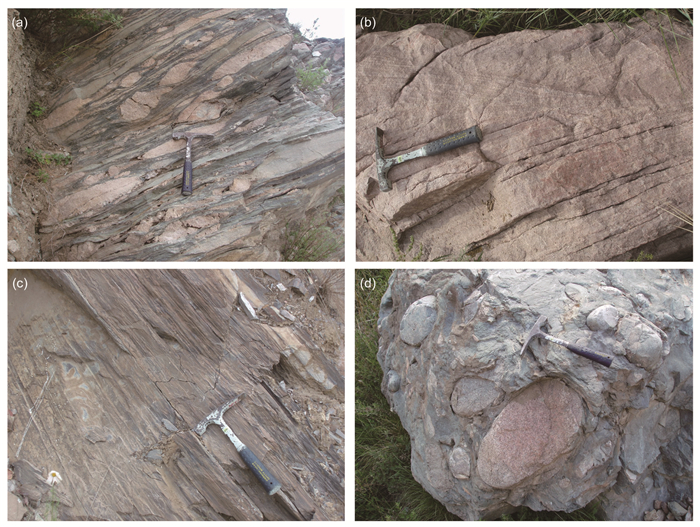
滹沱群位于五台杂岩的南部, 被认为是恒山-五台-阜平带最年轻的岩石地层单元(图 3)。本群面积大约为整个五台杂岩的四分之一, 从下到上被划分为豆村亚群、下东冶亚群、上东冶亚群和郭家寨亚群(图 4)。豆村亚群的主要岩石组合为绿片岩相变质的底砾岩、石英岩、板岩、千枚岩和火山碎屑岩。这些陆源沉积物在沉积相上显示出了从底部粗粒碎屑沉积物到顶部细粒硅质碎屑岩的变化, 这种变化被认为反映了地堑相关的沉积背景(苗培森等, 1999)。其中底砾岩中的砾石可分为石英岩砾石和花岗质砾石两种, 全部遭受了强烈的变形作用, 呈定向排布(Zhang et al., 2006)。石英岩中保存的波痕和交错层理指示了豆村亚群滨海到浅海的沉积环境(图 5)。豆村亚群之上的下东冶亚群主要由绿片岩相变质的浊积岩以及变质火山岩和白云岩夹层组成。上东冶亚群的岩石组合主要是绿片岩相变质的厚层碳酸盐岩以及硅质碎屑岩夹层。郭家寨亚群角度不整合覆盖在上东冶亚群之上, 岩石组合为几乎没有变质的磨拉石类沉积岩, 从下到上为粉砂质-砂质千枚岩、粗粒长石砂岩和砾岩(白瑾等, 1992)。这些磨拉石类沉积岩总体上呈现了楔形和向上粒度变粗的特征, 在北北西部最厚可以达到900m, 向南南东方向迅速尖灭(苗培森等, 1999)。
|
图 3 恒山、五台和阜平变质地体地质简图(据Zhao et al., 2007) Fig. 3 Simplified geological map of the Hengshan, Wutai and Fuping complexes (after Zhao et al., 2007) |
|
图 4 滹沱群地层划分(据白瑾, 1986修改) Fig. 4 Stratigraphic subdivision of the Hutuo Group (modified after Bai, 1986) |
|
图 5 豆村亚群典型的岩石组合 (a)-四集庄组底砾岩中定向排列的花岗质砾石;(b)-大石岭组砂岩中保留的交错层理;(c)-青石村组中保留的韵律层理;(d)-黑山背组中未变形的砾岩 Fig. 5 Different rock associations in the Doucun Subgroup (a)-oriented granitic pebbles preserved in the basal conglomerates of the Sijizhuang Formation; (b)-cross-bedding structures preserved in the Dashiling Formation; (c)-rhythmic bedding structures preserved in the Qingshicun Formation; (d)-undeformed conglomerates preserved in the Heishanbei Formation |
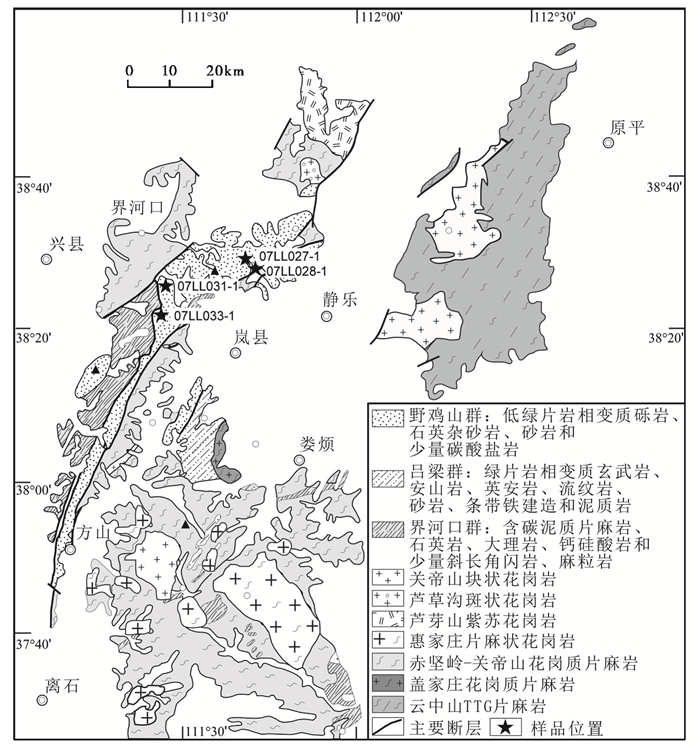
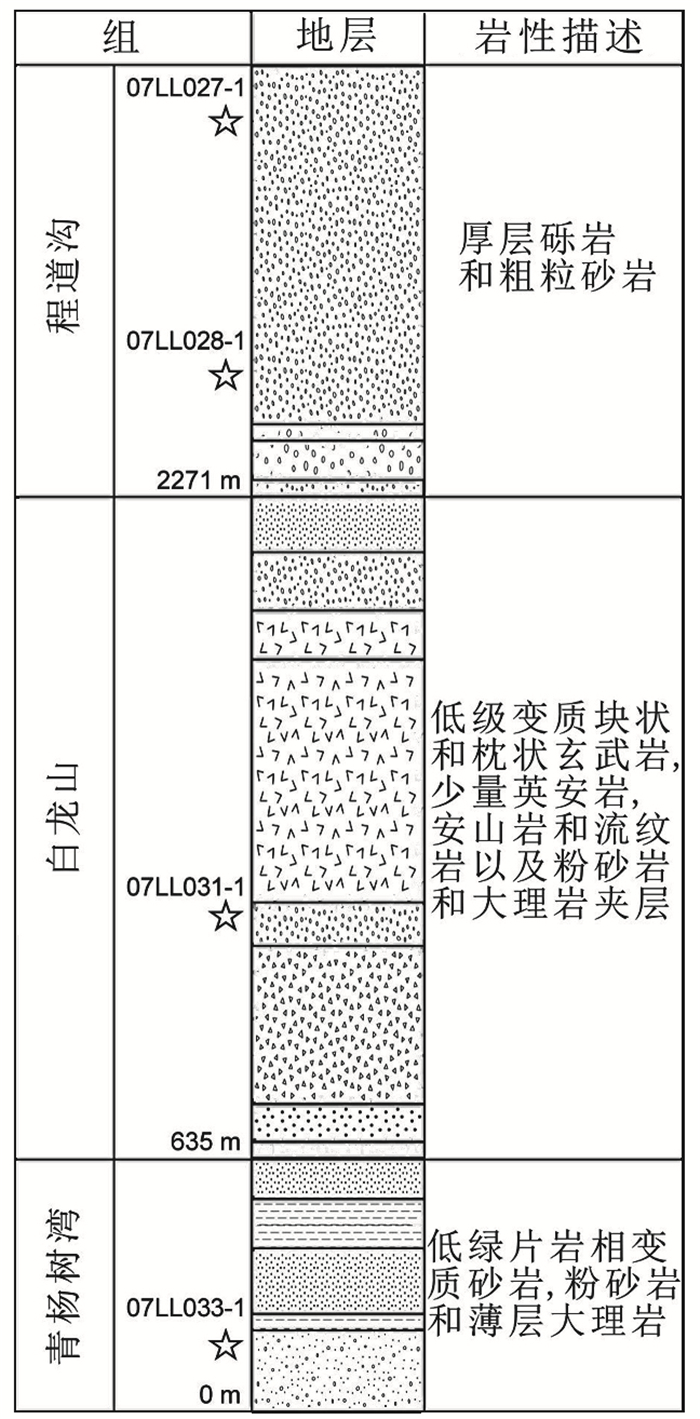
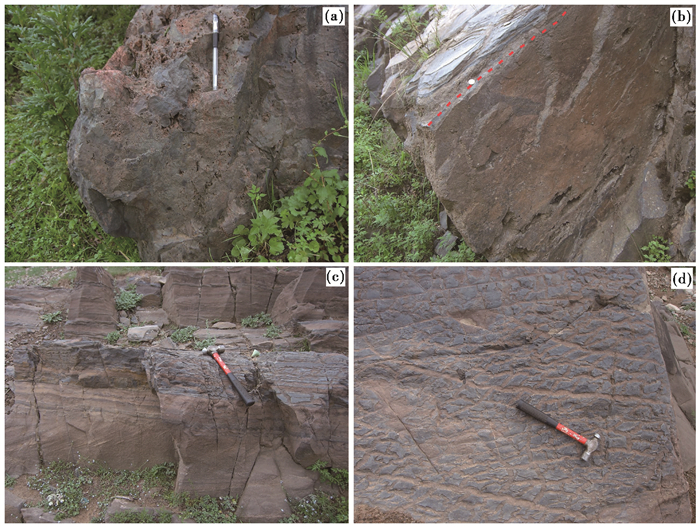
野鸡山群, 也叫岚河群或者黑茶山群, 呈北东-南西向展布在吕梁杂岩的西北部(图 6)。本群从下到上被分为了三个组, 分别是青杨树湾组、白龙山组和程道沟组(图 7)。青杨树湾组主要由低绿片岩相变质的长石砂岩、粉砂岩和薄层大理岩组成, 它们被认为形成于滨海到浅海沉积环境。白龙山组下部的岩石组合为绿片岩相变质的块状和枕状玄武岩以及少量的英安岩、安山岩、流纹岩和粉砂岩、大理岩夹层, 上部则变为类似于复理石组合的薄层细粒砂岩和粉砂岩。刘树文等(2009)根据白龙山组中复理石类砂岩整合覆盖在枕状玄武岩之上的特征认为它们是深水喷发的产物。程道沟组角度不整合覆盖在白龙山组之上, 主要由几乎没有变质的厚层砾岩和粗粒砂岩组成, 并保留了大型板状斜层理和泥裂等沉积构造(图 8), 表现了河流相沉积特征。程道沟组的碎屑沉积岩横向剖面显示出了楔形特征, 在北西西最厚向南东东方向减薄(张建中等, 1997)。
|
图 6 吕梁杂岩地质图(据Zhao et al., 2008b修改) Fig. 6 Geological map of the Lüliang Complex (modified after Zhao et al., 2008b) |
|
图 7 野鸡山群地层图(据山西省地质矿产局, 1989修改) Fig. 7 Stratigraphy of the Yejishan Group (modified after BGMRS, 1989) |
|
图 8 野鸡山群中下部典型的岩石组合 (a)-白龙山组中的枕状玄武岩;(b)-白龙山组中复理石类沉积岩整合覆盖在变质火山岩之上;(c)-程道沟组中保留的大型斜层理;(d)-程道沟组中保留的泥裂构造 Fig. 8 Different rock associations in the middle and upper sequences of the Yejishan Group (a)-pillow structure of the meta-volcanic rocks in the Bailongshan Formation; (b)-flysch-type sediment conformable overlies meta-volcanic rocks in the Bailongshan Formation; (c)-large scale oblique bedding in the Chengdaogou Formation; (d)-mud-breaking structure on bedding surface in the Chengdaogou Formation |
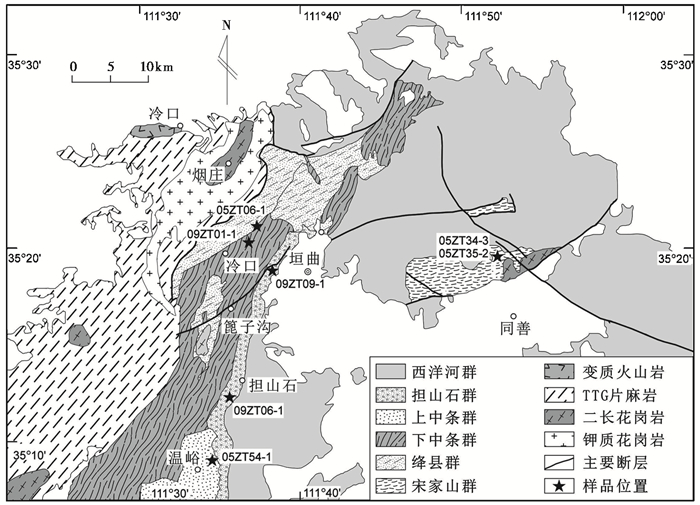
中条杂岩中的浅变质表壳岩系总体上遭受了绿片岩相变质, 从下到上包括绛县群、下中条群、上中条群和担山石群(孙大中和胡维兴, 1993;白瑾等, 1997)。绛县群沿北东向褶皱-逆冲带出露于中条杂岩的西北部, 与下覆的TTG片麻岩为构造接触关系(图 9)。孙大中等(1990)把绛县群划分为了下部的横岭关组和上部的铜矿峪组。横岭关组主要由石榴石白云母片岩、石榴石十字石片岩、黑云母片岩和少量的石英岩、石英片岩组成。上覆的铜矿峪组主要的岩石组合为变质火山岩和火山碎屑岩。
|
图 9 中条杂岩地质简图(据Sun et al., 1990修改) Fig. 9 Simplified geological map of the Zhongtiao Complex (modified after Sun et al., 1990) |
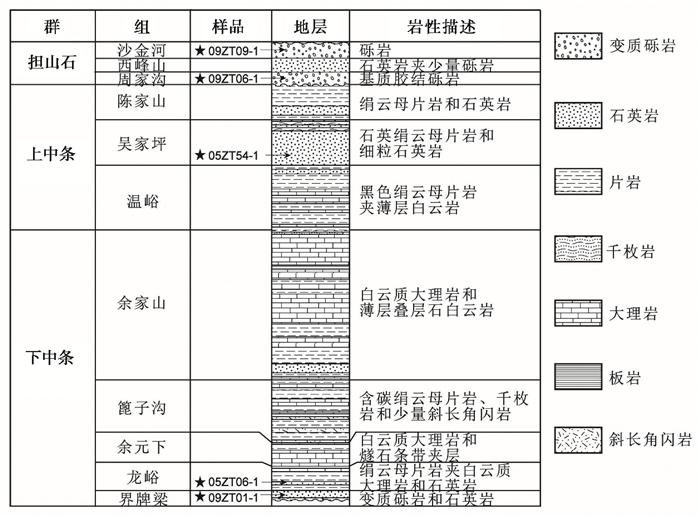
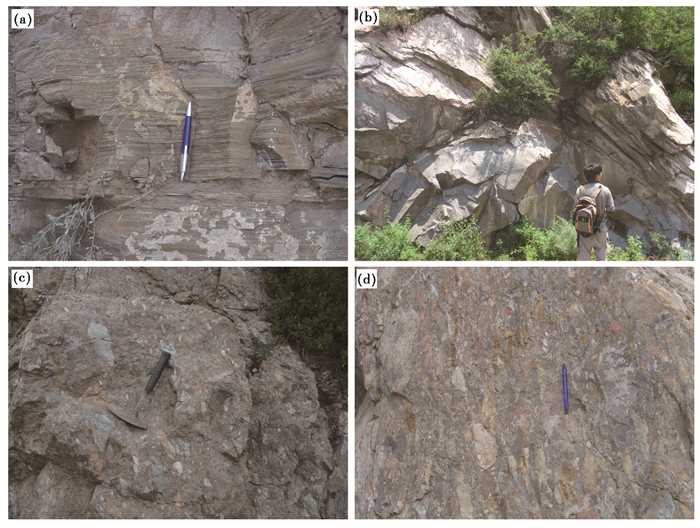
下中条群位于中条杂岩西部, 被分为了界牌梁组、龙峪组、余元下组、篦子沟组和余家山组(图 10)。最下部的界牌梁组包含了砾岩、含砾长石砂岩和少量的砂岩, 变质程度为绿片岩相。砾岩的砾石种类主要为大量的砾石级和少量的卵石级砂岩、花岗岩和火山岩砾石。界牌梁组中砂岩保留的波痕和交错层理指示了南东向的古流向(白瑾等, 1997)。之上的龙峪组岩石组合为绢云母片岩和白云质大理岩以及石英岩夹层, 指示了沉积盆地缓慢的沉降(图 11)。余元下组中白云质大理岩和燧石条带夹层被认为形成于更深的环境, 记录了区域性的海侵事件(白瑾等, 1997)。篦子沟组主要由含碳绢云母片岩、千枚岩和少量变质基性火山岩组成。最上部的余家山组则包含了厚层白云质大理岩和薄层叠层石白云岩。总体上, 下中条群沉积相从下到上的变化暗示了构造沉降相关的盆地深度的变化(白瑾等, 1997)。
|
图 10 中条杂岩下中条群、上中条群和担山石群的地层划分(据孙大众和胡维兴, 1993) Fig. 10 Stratigraphic subdivision of the Lower Zhongtiao, Upper Zhongtiao and Danshanshi groups (modified after Sun and Hu, 1993) |
|
图 11 下中条群、上中条群和担山石群典型的岩石组合 (a)-篦子沟组绢云母片岩中保留的水平层理;(b)-武家坪组中石英岩和绢云母片岩的接触关系;(c)-周家沟组变形砾岩中的燧石和石英岩砾石;(d)-砂金河组变形砾岩中的绢云母片岩和白云岩砾石 Fig. 11 Different rock associations in the Lower Zhongtiao, Upper Zhongtiao and Danshanshi groups (a)-horizontal beddings preserved in the sericite schists of the Bizigou Formation; (b)-contact between quartzites and sericite schists in the Wujiaping Formation; (c)-deformed conglomerates with cherts and quartzites clasts preserved in the Zhoujiagou Formation; (d)-deformed conglomerates with sericite schists and dolostone clasts preserved in the Shajinhe Formation |
上中条群总体上是一套厚层硅质碎屑岩和少量薄层白云岩的组合, 它们不整合覆盖在下中条群之上(图 10;孙大中和胡维兴, 1993)。本群被划分为了三个组, 最下部的温峪组包含了黑色泥岩和白云岩夹层。温峪组之上的武家坪组和陈家山组在岩石组合上较为相似, 主要由石英云母片岩和石英岩组成。本组中的石英岩保留了米级的交错层理和小尺度的韵律层理, 指示了滨海沉积环境。
担山石群呈北东向展布在中条杂岩西部, 主要由低绿片岩相变质的厚层砾岩和砂岩组成。孙大中和胡维兴(1993)把本组划分为了周家沟组、西峰山组和砂金河组。最底部的周家沟组由分选较差、基质胶结的砾岩组成(图 11)。之上的西峰山组则主要为石英岩和少量的砾岩。最上部的砂金河组则为厚层砾岩。担山石群中砾岩的砾石种类主要为燧石、石英岩和白云岩, 与下中条群和上中条群的岩石组合相似。槽状交错层理和大量砾岩的出现说明担山石群为河流相沉积的产物(孙大中和胡维兴, 1993)。
综上所述, 我们可以看到分布在中部造山带五台杂岩、吕梁杂岩和中条杂岩的浅变质表壳岩系在地层层序特征上具有某些相似性。滹沱群中的豆村亚群、下东冶亚群和上东冶亚群、野鸡山群中的青杨树湾组和白龙山组以及绛县群和下中条群, 它们的岩石组合都以滨海到浅海相沉积的细粒硅质碎屑岩以及少量的碳酸盐岩和火山岩为特征, 并总体上显示出水体向上变深的特征。在不整合之上, 滹沱群中的郭家寨亚群、野鸡山群中的程道沟组以及上中条群和担山石群, 都是以河流相沉积的山前磨拉石沉积为主, 而且它们变质变形的程度都要明显低于不整合之下的地层。这些特征表明, 中部造山带浅变质表壳岩系的上下两部分不是在同一个构造盆地中形成的, 对于它们的讨论要分别开来。
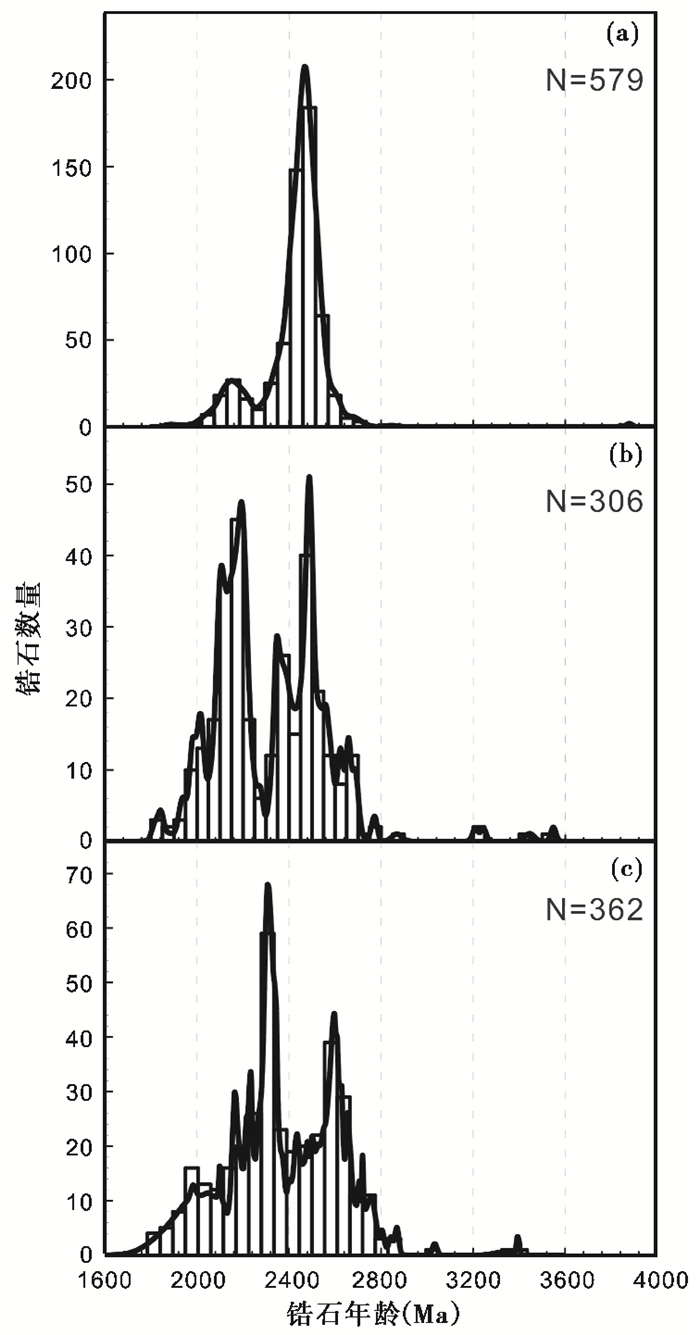
4 源区特征来自于中部造山带不同地区的浅变质表壳岩系的碎屑锆石显示了不同的U-Pb年龄和Hf同位素特征。中部造山带中段五台杂岩的滹沱群和和吕梁杂岩的野鸡山群的碎屑锆石年龄集中在2.56Ga和1.85Ga之间, 其中主要的峰值年龄在2.5Ga左右而次要的峰值年龄在2.15Ga左右(图 12a, b;Liu et al., 2011a, b)。这个年龄区段内的碎屑锆石数量分别占到了滹沱群和野鸡山群测试碎屑锆石总数的94%和87%。根据年龄的相似性以及其它的地质证据, 恒山-五台-阜平带内的晚太古代TTG片麻岩和早元古代花岗岩类被认为是滹沱群的主要物源区(Liu et al., 2011a), 而吕梁杂岩中的晚太古代到早元古代花岗岩类则被认为是野鸡山群的主要源区(Liu et al., 2011b)。相对地, 年龄在2.56Ga到1.85Ga的碎屑锆石在中部造山带南部的浅变质表壳岩系中占据的份额则相对较小(图 12c)。在中条杂岩中, 来自绛县群、下中条群、上中条群和担山石群的碎屑锆石中有71%的年龄是在这个区间内的(李秋根等, 2008;Liu et al., 2011c)。锆石年龄、Hf同位素的相似性以及其它的地质证据显示, 中条杂岩内的TTG片麻岩是区内浅变质表壳岩系的主要源区(李秋根等, 2008;Liu et al., 2011c)。因此, 中部造山带内2.56Ga到1.85Ga与弧相关的岩石是区内浅变质表壳岩系的主要源岩, 并且在这个年龄区间的碎屑锆石的比例从北向南有减少的趋势。
|
图 12 华北克拉通中部造山带中五台地体(a)、吕梁地体(b) 以及中条地体(c) 的碎屑锆石年龄柱状和概率分布图(据Liu et al., 2011a, b, c重新计算) Fig. 12 Age distributions and binned frequency histograms of detrital zircons from the Wutai Complex (a), Lüliang Complex (b) and the Zhongtiao Complex (recalculated after Liu et al., 2011a, b, c) |
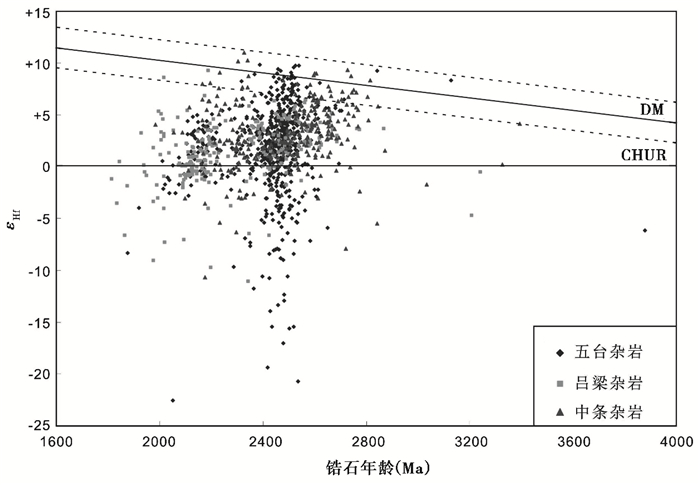
这些碎屑锆石的Hf同位素特征对于我们了解中部造山带的地壳演化过程也有一定的帮助。Griffin et al.(2000)认为来自初始地壳的锆石的εHf值在误差范围内应该与亏损地幔演化线重合。如果按照Griffin et al.(2004)的建议把初始地壳定义为在亏损地幔演化线上下两个单位之内的话, 大约有20%的年龄在2.56Ga到1.85Ga之间的碎屑锆石可以被解释为来自初始地壳(图 13)。特别值得注意的是, 年龄在2.16Ga到1.85Ga的碎屑锆石中, 吕梁杂岩野鸡山群的碎屑锆石仅有一颗给出了初始地壳的εHf值(图 13)。总体上来说, 这些晚太古代到早元古代碎屑锆石显示出很大的εHf值的变化范围, 从+10.9到-22.6, 反映了太古宙老地壳和初始地壳的混合。这样的碎屑锆石Hf同位素特征和中部造山带是一个“安第斯型”大陆边缘弧是吻合的(Zhao et al., 2007)。这些碎屑锆石的两阶段Hf模式年龄的峰值在2.92Ga到2.62Ga之间, 这与中部带岩浆锆石的两阶段Hf模式年龄(Geng et al., 2012) 以及Nd两阶段模式年龄(Wu et al., 2005a) 都是一致的。
|
图 13 华北克拉通中部造山带五台、吕梁和中条杂岩中碎屑锆石的εHf(t) 对年龄投图(数据来自Liu et al., 2011a, b, c) Fig. 13 Plots of εHf(t) vs. ages of detrital zircons from the Wutai, Lüliang and Zhongtiao complexes (Data after Liu et al., 2011a, b, c) CHUR-chondrite uniform reservoir; DM-depleted mantle |
中部造山带浅变质表壳岩系中碎屑锆石次要的年龄段是在2.85Ga和2.6Ga之间。在五台和吕梁杂岩中, 处于这个年龄段内的碎屑锆石分别占到了滹沱群和野鸡山群碎屑锆石总数的6%和11%(图 12a, b)。根据年龄上的相似性, 五台杂岩中龙泉关花岗岩和恒山、阜平杂岩中TTG片麻岩中2.85Ga到2.6Ga的岩石和继承(捕掳) 锆石很可能是这些锆石的源区(Liu et al., 2011a, 2011b)。相对地, 中条地区浅变质表壳岩系中具有2.85Ga到2.6Ga年龄的碎屑锆石占到了总数的27%(图 12c)。基于锆石年龄和Hf同位素的相似性, 中部造山带最南部太华杂岩中的TTG片麻岩和斜长角闪岩被认为是中条杂岩中这些碎屑沉积岩的次要源岩(Liu et al., 2011c)。从图 13中我们可以看到, 2.85Ga到2.6Ga的碎屑锆石有30%是在亏损地幔演化线两个单位以内的区域, 因此这些锆石可以被认为是来自初始地壳。比起晚太古代到早元古代的锆石, 这些中太古到晚太古代的锆石的εHf值的范围相对较小, 在+9.3到-8.0之间。这说明它们来自于始太古代到中太古代古老地壳与新生地壳的混合。它们的两阶段模式年龄的峰值集中在3.0Ga到2.7Ga之间, 这与中部带基底岩石中岩浆锆石的两阶段Hf模式年龄(Geng et al., 2012) 以及Nd两阶段模式年龄(Wu et al., 2005a) 也是一致的。
从图 13中, 我们还可以看到有很少几颗碎屑锆石的年龄老于3.1Ga, 这些锆石肯定来自于中部造山带以外的区域, 因为在中部造山带内还没有如此老的岩石或者锆石被发现。这些古老锆石的可能源区是东部陆块古太古代到中太古代的古老岩石, 因为它们具有相似锆石年龄以及Hf同位素特征(图 13)。这其中有两颗锆石的εHf值落在了亏损地幔演化线区域内, 而其他四颗锆石的εHf值则在+0.2和-6.2之间。
5 沉积年龄在最近十几年中, 锆石SHRIMP和TIMS定年技术被广泛应用在中部造山带浅变质表壳岩系中变质火山岩的定年工作中。例如, 耿元生等(2000)报道了野鸡山群白龙山组中变质火山岩的锆石TIMS年龄为2124±38Ma;杜利林等(2010)在滹沱群四集庄组底砾岩的玄武安山岩夹层中得到了2140±14Ma的SHRIMP年龄。在中条杂岩中, 绛县群和下中条群中变质火山岩原岩的结晶年龄分别被限制在了2154~2166Ma和大约2059Ma (孙大中和胡维兴, 1993)。然而, 这些变质火山岩全部位于中部造山带浅变质表壳岩系的下部, 由于浅变质表壳岩系的上部缺乏火山岩夹层和直接用来定年的矿物, 因此它们的沉积年龄还没有被很好地限定。特别值得注意的是, 无论是在中部造山带中段的五台杂岩和吕梁杂岩还是在南段的中条杂岩中, 浅变质表壳岩系下部和上部之间的不整合都暗示了一个重要的剥蚀事件以及上下两部分沉积年龄的不同。
Liu et al.(2011a, b, c) 对于这些表壳岩系不同岩石地层单元大量的碎屑锆石U-Pb定年工作限制了它们的最大沉积时代。其中, 滹沱群的豆村亚群、野鸡山群的青杨树湾组以及下中条群的最大沉积年龄分别被限制在2106±14Ma、2086±10Ma和2169±5Ma (Liu et al., 2011a, b, c)。这些年龄都与相应地层中变质火山岩的结晶年龄在误差范围内一致。在不整合之上, 浅变质表壳岩系上部的最大沉积年龄则显著变小。滹沱群的郭家寨亚群、野鸡山群的程道沟组和上中条群的最大沉积年龄分别被限制在了1877±24Ma、1835±24Ma和1848±23Ma (Liu et al., 2011a, b, c)。另一方面, 这些表壳岩系的最小沉积年龄则被切穿它们的未变质变形的花岗岩或者基性岩脉限制在了1.8Ga左右。
6 构造背景关于中部造山带中浅变质表壳岩系形成的构造背景一直以来就存在着争议, 一部分学者认为它们形成于与裂谷相关的盆地中(杜利林等, 2009, 2010;万渝生等, 2010), 而另一部分学者则认为它们形成于弧后盆地和前陆盆地中(Zhao et al., 2001;Wilde et al., 2004;Zhang et al., 2006;Faure et al., 2007;Trap et al., 2007)。根据最新获得的碎屑锆石年龄和Hf同位素以及岩石地球化学等资料, Liu et al.(2011a, b, c) 和Li et al.(2009)认为五台杂岩滹沱群的豆村亚群和下东冶亚群、吕梁杂岩野鸡山群的青杨树湾组和白龙山组以及中条杂岩中的绛县群和下中条群形成于西部陆块向东部陆块之下俯冲所形成的弧后盆地中, 主要证据总结如下:
第一, 以上提到的这些浅变质表壳岩系主要的岩石组合为变质碎屑岩以及少量的碳酸盐岩和变质火山岩, 并且在初始地幔均一化的蜘蛛网状图解中来自不同地区的火山岩显示了相似的Nb、Ta和Ti亏损的特征, 表明它们是与弧密切相关的(Liu et al., 2011a, b, c;孙大中和胡维兴, 1993;杜利林等, 2009)。
第二, 它们的碎屑锆石年龄图谱也具有相似性, 其中最主要的源区都是中部造山带晚太古代到早元古代与弧相关的岩石, 而东部陆块中古太古代到中太古代的古老岩石则是次要的源岩。这样一个弧相关岩石和克拉通来源的二元源区组合与典型的弧后盆地沉积如Tonto Basin Supergroup是相似的, 它的碎屑物质分别来自本地与弧相关的火山岩和北美克拉通(Condie et al., 1992)。
相对的, 滹沱群中上东冶亚群和郭家寨亚群、野鸡山群中的程道沟组以及上中条群和担山石群的地质特征以及碎屑锆石年龄则表明它们是形成于周缘前陆盆地中的, 主要证据为:
第一, 从弧后盆地到周缘前陆盆地的构造转换可以被浅变质表壳岩系上下两个部分之间的不整合所证明。
第二, 浅变质表壳岩系的上部在不同地区的岩石组合是相似的, 主要是厚层的变质砂岩以及砾岩, 这与典型周缘前陆盆地中的磨拉石类硅质碎屑岩组合类似。
第三, 我们在上一段中曾经提到, 浅变质表壳岩系上部的形成年龄被限制在1.85Ga和1.8Ga之间, 这与中部造山带中很多重要构造热事件的年龄是重合的。例如, 与地壳加厚相关的变形作用发生在1843Ma至1817Ma (Zhang et al., 2009), 顺时针等温降压变质作用的峰期年龄是在1849Ma至1814Ma (Guan et al., 2002;Zhao et al., 2002;Kröner et al., 2005a, 2006;Liu et al., 2006;Wang et al., 2010), 同碰撞花岗岩的侵位年龄是在1832Ma左右(Zhao et al., 2008b) 等。这些构造热事件都与碰撞导致的地壳加厚有关, 而褶皱逆冲带整体抬升, 造山带快速剥蚀也导致了几乎同时或稍晚的周缘前陆盆地的形成(Dickinson and Gehrels, 2008)。
第四, 浅变质表壳岩系上部的碎屑锆石年龄图谱说明几乎全部的碎屑物质都来自中部造山带与弧相关的岩石。这一特征与典型的Grenville造山带的前陆盆地也是一致的(Krabbendam et al., 2008)。
7 中部造山带构造盆地演化历史以上这些来自中部造山带浅变质表壳岩系的岩石地层学以及碎屑锆石U-Pb和Hf数据, 再结合前人的变质岩石学、地质年代学和岩石地球化学数据, 使得我们可以初步提出一个关于中部造山带构造盆地演化的模型。
从2.56Ga开始, 五台、吕梁和中条杂岩都属于在东部陆块西缘基础上发展起来的“安第斯型”大陆边缘弧的一部分, 它与西部陆块被一个广阔的大洋所分隔。随着大洋岩石圈持续的向东部陆块之下高角度俯冲, 大量的流体从俯冲板片中释放出来。上覆板片的下地壳由于流体的作用部分熔融从而产生了大量的花岗质岩浆侵位到了地壳上部, 形成了TTG类岩石以及其它花岗类岩石。
从2.1Ga左右开始, 由于东部陆块西缘之下持续的高角度俯冲, 在“安第斯型”岩浆弧之后由于拉张作用发展出了弧后盆地体系。在这些弧后盆地中, 细粒硅质碎屑岩, 包括大量的粉砂岩、细粒砂岩以及少量的碳酸盐岩在滨海到浅海相环境下沉积。碎屑锆石年龄图谱显示碎屑物质绝大多数来自“安第斯型”弧的产物, 而很小部分来自东部陆块。此外, 岩石圈地幔由于流体的持续加入从而部分熔融产生了基性到酸性岩浆, 部分喷发出了地表形成了弧后盆地中的玄武岩、玄武安山岩以及少量的中酸性火山岩。在随后的陆陆碰撞造山作用中, 这些沉积岩和火山岩经受了绿片岩相变质作用。
从1.85Ga开始, 东西部陆块之间的大洋闭合, 陆陆碰撞作用开始。陆陆碰撞通过大规模逆冲、等斜褶皱和不同规模的韧性剪切带导致了地壳显著的缩短和加厚。由于逆冲岩片的负荷作用, 形成前陆饶曲, 从而为前陆盆地沉积的形成提供了空间。造山带的快速抬升和剥蚀则为前陆盆地提供了大量的粗碎屑物, 其中尤以磨拉石类硅质碎屑岩为主。碎屑锆石年龄图谱显示前陆盆地中绝大部分的碎屑物来自于中部造山带中与弧相关岩石的剥蚀。
以上的构造盆地演化模式与Zhao et al.(2000, 2005, 2008b) 提出的华北克拉通演化模式一致, 即中部造山带是一个在东部陆块西缘基础上发展起来的“安第斯型”大陆边缘弧, 与西部陆块被一个大洋所分隔。东西陆块最终碰撞拼合形成统一的华北克拉通基底的时间是在1.85Ga左右。
致谢 本文为作者在香港大学地球科学系攻读博士学位期间工作的部分总结, 在这里特别要感谢我的导师赵国春教授和孙敏教授, 以及其他帮助过我的老师和同学。审稿人吴春明研究员提出了一些宝贵的修改意见, 在此深表感谢。| [] | Bai J. 1986. The Early Precambrian Geology of Wutaishan. Tianjin: Tianjin Science and Technology Press: 376-383. |
| [] | Bai J, Wang RZ, Guo JJ. 1992. The Major Geologic Events of Early Precambrian and Their Dating in Wutaishan Region. Beijing: Geological Publishing House: 29-33. |
| [] | Bai J, Yu ZX, Yan YY, Dai FY. 1997. Precambrian Geology of Zhongtiaoshan. Tianjin: Tianjin Science and Technology Press: 75-92. |
| [] | Bureau of Geology and Mineral Resource of Shanxi Province (BGMRS). 1989. Regional Geology of Shanxi Province. Beijing: Geological Publishing House: 55-85. |
| [] | Condie KC, Noll PD, Conway CM. 1992. Geochemical and detrital mode evidence for sources of Early Proterozoic sedimentary-rocks from the Tonto Basin Supergroup, Central Arizona. Sedimentary Geology, 77: 51–76. DOI:10.1016/0037-0738(92)90103-X |
| [] | Dickinson WR, Gehrels GE. 2008. Sediment delivery to the Dilleran foreland basin: Insights from U-Pb ages of detrital zircons in Upper Jurassic and Cretaceous strata of the Colorado Plateau. American Journal of Science, 308: 1041–1082. |
| [] | Du LL, Yang CH, Ren LD, Wan YS, Wu JS. 2009. Petrology, geochemistry and petrogenesis of the metabasalts of the Hutuo Group, Wutai Mountains, Shanxi, China. Geological Bulletin of China, 28: 867–876. |
| [] | Du LL, Yang CH, Guo JH, Wang W, Ren LD, Wan YS, Geng YS. 2010. The age of the base of the Paleoproterozoic Hutuo Group in the Wutai Mountains area, North China Craton: SHRIMP zircon U-Pb dating of basaltic andesite. Chinese Science Bulletin, 55: 1782–1789. DOI:10.1007/s11434-009-3611-8 |
| [] | Faure M, Trap P, Lin W, Monie P, Bruguier O. 2007. Polyorogenic evolution of the Paleoproterozoic Trans-North China Belt: New insights from the Luliangshan-Hengshan-Wutaishan and Fuping massifs. Episodes, 30: 96–107. |
| [] | Geng YS, Wu JS, Jin LG. 1990. The geological evolution of the Early Precambrian of the Taihang-Wutai mountains region, China. Bulletin of the Chinese Academy of Geological Sciences, 20: 29–31. |
| [] | Geng YS, Wan YS, Shen QH, Li HM, Zhang RX. 2000. Chronological framework of the Early Precambrian important events in the Lvliang Area, Shanxi Province. Acta Geologica Sinica, 74: 216–223. |
| [] | Geng YS, Du LL, Ren LD. 2012. Growth and reworking of the Early Precambrian continental crust in the North China Craton: Constraints from zircon Hf isotopes. Gondwana Research, 21: 517–529. DOI:10.1016/j.gr.2011.07.006 |
| [] | Griffin WL, Pearson NJ, Belousova EA, Jackson SE, van Achterbergh E, O'Reilly SY, Shee SR. 2000. The Hf isotope composition of cratonic mantle: LAM-MC-ICPMS analysis of zircon megacrysts in kimberlites. Geochimica et Cosmochimica Acta, 64: 133–147. DOI:10.1016/S0016-7037(99)00343-9 |
| [] | Griffin WL, Belousova EA, Shee SR, Pearson NJ, O'Reilly SY. 2004. Archean crustal evolution in the northern Yilgam Craton: U-Pb and Hf-isotope evidence from detrital zircons. Precambrian Research, 131: 231–282. DOI:10.1016/j.precamres.2003.12.011 |
| [] | Guan H, Sun M, Wilde SA, Zhou XH, Zhai MG. 2002. SHRIMP U-Pb zircon geochronology of the Fuping Complex: Implications for formation and assembly of the North China Craton. Precambrian Research, 113: 1–18. DOI:10.1016/S0301-9268(01)00197-8 |
| [] | Guo JH, Zhai MG, Zhang YG, Li YG, Yan YH, Zhang WH. 1993. Huaian-Mamjinggou Early Precambrian high-pressure granulite mélange: Geologcial characteristics, petrology and isotopic chronology. Acta Petrologica Sinica, 9: 1–13. |
| [] | Guo JH, O'Brien PJ, Zhai MG. 2002. High-pressure granulites in the Sanggan area, North China Craton: Metamorphic evolution, P-T paths and geotectonic significance. Journal of Metamorphic Geology, 20: 741–756. DOI:10.1046/j.1525-1314.2002.00401.x |
| [] | Guo JH, Sun M, Chen FK, Zhai MG. 2005. Sm-Nd and SHRIMP U-Pb zircon geochronology of high-pressure granulites in the Sanggan area, North China Craton: Timing of Paleoproterozoic continental collision. Journal of Asian Earth Sciences, 24: 629–642. DOI:10.1016/j.jseaes.2004.01.017 |
| [] | Krabbendam M, Prave T, Cheer D. 2008. A fluvial origin for the Neoproterozoic Morar Group, NW Scotland: Implications for Torridon-Morar Group correlation and the Grenville Orogen foreland basin. Journal of the Geological Society, 165: 379–394. DOI:10.1144/0016-76492007-076 |
| [] | Kröner A, Compston W, Zhang GW, Guo AL, Todt W. 1988. Age and tectonic setting of Late Archean greenstone-gneiss terrain in Henan Province, China, as revealed by single-grain zircon dating. Geology, 16: 211–215. DOI:10.1130/0091-7613(1988)016<0211:AATSOL>2.3.CO;2 |
| [] | Kröner A, Wilde SA, Li JH, Wang KY. 2005a. Age and evolution of a Late Archean to Paleoproterozoic upper to lower crustal section in the Wutaishan/Hengshan/Fuping terrain of northern China. Journal of Asian Earth Sciences, 24: 577–595. DOI:10.1016/j.jseaes.2004.01.001 |
| [] | Kröner A, Wilde SA, O'Brien PJ, Li JH, Passchier CW, Walte NP, Liu DY. 2005b. Field relationships, geochemistry, zircon ages and evolution of a Late Archaean to Palaeoproterozoic lower crustal section in the Hengshan Terrain of northern China. Acta Geologica Sinica, 79: 605–632. |
| [] | Kröner A, Wilde SA, Zhao GC, O'Brien PJ, Sun M, Liu DY, Wan YS, Liu SW, Guo JH. 2006. Zircon geochronology and metamorphic evolution of mafic dykes in the Hengshan Complex of northern China: Evidence for late Palaeoproterozoic extension and subsequent high-pressure metamorphism in the North China Craton. Precambrian Research, 146: 45–67. DOI:10.1016/j.precamres.2006.01.008 |
| [] | Kusky TM, Li JH. 2003. Paleoproterozoic tectonic evolution of the North China Craton. Journal of Asian Earth Sciences, 22: 383–397. DOI:10.1016/S1367-9120(03)00071-3 |
| [] | Li JH, Qian XL. 1991. A study on the Longquanguan shear zone in the northern part of the Taihang Mountains. Shanxi Geology, 6: 17–29. |
| [] | Li JH, Zhai MG, Li YG. 1998. Discovery of Archean high-pressure granulite in Luanping-Chengde, northern Hebei Province: Geological implications. Acta Petrologica Sinica, 14: 34–41. |
| [] | Li JH, Kusky TM. 2007. A Late Archean foreland fold and thrust belt in the North China Craton: Implications for early collisional tectonics. Gondwana Research, 12: 47–66. DOI:10.1016/j.gr.2006.10.020 |
| [] | Li JL, Wang KY, Wang QC, Liu XH, Zhao ZY. 1990. Early Proterozoic collision orogenic belt in Wutaishan area, China. Scientia Geologica Sinica, 25(1): 1–11. |
| [] | Li QG, Liu SW, Wang ZQ, Zhang F, Chen YZ, Wang T. 2008. LA-ICP-MS U-Pb geochronology of the detrital zircons from the Jiangxian Group in the Zhongtiao Mountain and its tectonic significance. Acta Petrologica Sinica, 24: 1359–1368. |
| [] | Li QG, Chen X, Liu SW, Wang ZQ, Zhou YK, Zhang J, Wang T. 2009. Evaluating the Provenance of Metasedimentary rocks of the Jiangxian Group from the Zhongtiao Mountain using whole rock geochemistry and detrital zircon Hf isotope. Acta Geologica Sinica, 83: 550–561. DOI:10.1111/acgs.2009.83.issue-3 |
| [] | Liu CH, Zhao GC, Sun M, Zhang J, He YH, Yin CQ, Wu FY, Yang JH. 2011a. U-Pb and Hf isotopic study of detrital zircons from the Hutuo Group in the Trans-North China Orogen and tectonic implications. Gondwana Research, 20: 106–121. DOI:10.1016/j.gr.2010.11.016 |
| [] | Liu CH, Zhao GC, Sun M, Wu FY, Yang JH, Yin CQ, Leung WH. 2011b. U-Pb and Hf isotopic study of detrital zircons from the Yejishan Group of the Lüliang Complex: Constraints on the timing of collision between the Eastern and Western blocks, North China Craton. Sedimentary Geology, 236: 129–140. DOI:10.1016/j.sedgeo.2011.01.001 |
| [] | Liu CH, Zhao GC, Sun M, Zhang J and Yin CQ. 2011c. U-Pb geochronology and Hf isotope geochemistry of detrital zircons from the Zhongtiao Complex: Constraints on the tectonic evolution of the Trans-North China Orogen. Precambrian Research, doi: 10.1016/j.precamres.2011.08.007 |
| [] | Liu DY, Nutman AP, Compston W, Wu JS, Shen QH. 1992. Remnants of 3800Ma crust in the Chinese part of the Sino-Korean craton. Geology, 20: 339–342. DOI:10.1130/0091-7613(1992)020<0339:ROMCIT>2.3.CO;2 |
| [] | Liu SW, Pan YM, Li JH, Li QG, Zhang J. 2002. Geological and isotopic geochemical constraints on the evolution of the Fuping Complex, North China Craton. Precambrian Research, 117: 41–56. DOI:10.1016/S0301-9268(02)00063-3 |
| [] | Liu SW, Pan YM, Xie QL, Zhang J, Li QG. 2004. Archean geodynamics in the Central Zone, North China Craton: Constraints from geochemistry of two contrasting series of granitoids in the Fuping and Wutai complexes. Precambrian Research, 130: 229–249. DOI:10.1016/j.precamres.2003.12.001 |
| [] | Liu SW, Pan YM, Xie QL, Zhang J, Li QG, Yang B. 2005. Geochemistry of the Paleoproterozonic Nanying granitic gneisses in the Fuping Complex: Implications for the tectonic evolution of the Central Zone, North China Craton. Journal of Asian Earth Sciences, 24: 643–658. DOI:10.1016/j.jseaes.2003.10.010 |
| [] | Liu SW, Zhao GC, Wilde SA, Shu GM, Sun M, Li QG, Tian W, Zhang J. 2006. Th-U-Pb monazite geochronology of the Luliang and Wutai complexes: Constraints on the tectonothermal evolution of the Trans-North China Orogen. Precambrian Research, 148: 205–224. DOI:10.1016/j.precamres.2006.04.003 |
| [] | Liu SW, Li QG, Zhang LF, Yang PT, Liu CH, Lü YJ, Wu FH. 2009. Geology, Geochemistry of metamorphic volcanic rock suite in Precambrian Yejishan Group, Lüliang mountains and its tectonic implications. Acta Petrologica Sinica, 25: 547–560. |
| [] | Liu SW, Zhang J, Li QG, Zhang LF, Wang W and Yang PT. 2011. Geochemistry and U-Pb zircon ages of metamorphic volcanic rocks of the Paleoproterozoic Lüliang Complex and constraints on the evolution of the Trans-North China Orogen, North China Craton. Precambrian Research, doi:10.1016/j.precamres.2011.07.006 |
| [] | Ma J, Wang RM. 1995. The discovery of coexisting kyanite+perthite assemblage in Xuanhua-Chicheng high-pressure granulits belt and its geological significance. Acta Petrologica Sinica, 11: 273–278. |
| [] | Miao PS, Zhang ZF, Zhang JZ, Zhao ZX, Xu SC. 1999. Paleoproterozoic stratigraphic sequence in the Wutai Mountain area. Regional Geology of China, 18: 405–413. |
| [] | Polat A, Kusky T, Li JH, Fryer B, Kerrich R, Patrick K. 2005. Geochemistry of Neoarchean (ca.2.55~2.50Ga) volcanic and ophiolitic rocks in the Wutaishan greenstone belt, central orogenic belt, North China craton: Implications for geodynamic setting and continental growth. Geological Society of America Bulletin, 117: 1387–1399. DOI:10.1130/B25724.1 |
| [] | Polat A, Herzberg C, Münker C, Rodgers R, Kusky T, Li JH, Fryer B, Dalaney J. 2006. Geochemical and petrological evidence for a suprasubduction zone origin of Neoarchean (ca.2.5Ga) peridotites, central orogenic belt, North China craton. Geological Society of America Bulletin, 118: 771–784. DOI:10.1130/B25845.1 |
| [] | Santosh M, Wilde SA, Li JH. 2007. Timing of Paleoproterozoic ultrahigh-temperature metamorphism in the North China Craton: Evidence from SHRIMP U-Pb zircon geochronology. Precambrian Research, 159: 178–196. DOI:10.1016/j.precamres.2007.06.006 |
| [] | Sun DZ, Hu WX, Tang M, Zhao FQ, Condie KC. 1990. Origin of Late Archean and Early Proterozoic rocks and associated mineral deposits from the Zhongtiao Mountains, east-central China. Precambrian Research, 47: 287–306. DOI:10.1016/0301-9268(90)90043-P |
| [] | Sun DZ, Hu WX. 1993. The Geochronological Framework and Crustal Structures of Precambrian Basement in the Zhongtiaoshan Area. Beijing: Geological Publishing House: 108-117. |
| [] | Sun M, Armstrong RL, Lambert RStJ. 1992. Petrochemistry and Sr, Pb and Nd isotopic geochemistry of Early Precambrian rocks, Wutaishan and Taihangshan areas, China. Precambrian Research, 56: 1–31. DOI:10.1016/0301-9268(92)90081-X |
| [] | Trap P, Faure M, Lin W, Monie P. 2007. Late Paleoproterozoic (1900~1800Ma) nappe stacking and polyphase deformation in the Hengshan-Wutaishan area: Implications for the understanding of the Trans-North-China belt, North China Craton. Precambrian Research, 156: 85–106. DOI:10.1016/j.precamres.2007.03.001 |
| [] | Trap P, Faure M, Lin W, Bruguier O, Monie P. 2008. Contrasted tectonic styles for the Paleoproterozoic evolution of the North China Craton: Evidence for a similar to 2.1Ga thermal and tectonic event in the Fuping Massif. Journal of Structural Geology, 30: 1109–1125. DOI:10.1016/j.jsg.2008.05.001 |
| [] | Trap P, Faure M, Lin W, Monie P, Meffre S, Melleton J. 2009. The Zanhuang Massif, the second and eastern suture zone of the Paleoproterozoic Trans-North China Orogen. Precambrian Research, 172: 80–98. DOI:10.1016/j.precamres.2009.03.011 |
| [] | Wan YS, Song B, Liu DY, Wilde SA, Wu JS, Shi YR, Yin XY, Zhou HY. 2006. SHRIMP U-Pb zircon geochronology of Palaeoproterozoic metasedimentary rocks in the North China Craton: Evidence for a major Late Palaeoproterozoic tectonothermal event. Precambrian Research, 149: 249–271. DOI:10.1016/j.precamres.2006.06.006 |
| [] | Wan YS, Miao PS, Liu DY, Yang CH, Wang W, Wang HC, Wang ZJ, Dong CY, Du LL, Zhou HY. 2010. Formation ages and source regions of the Palaeoproterozoic Gaofan, Hutuo and Dongjiao groups in the Wutai and Dongjiao areas of the North China Craton from SHRIMP U-Pb dating of detrital zircons: Resolution of debates over their stratigraphic relationships. Chinese Science Bulletin, 55: 1278–1284. DOI:10.1007/s11434-009-0615-3 |
| [] | Wang YJ, Fan WM, Zhang YH, Guo F. 2003. Structural evolution and 40Ar/39Ar dating of the Zanhuang metamorphic domain in the North China Craton: Constraints on Paleoproterozoic tectonothermal overprinting. Precambrian Research, 122: 159–182. DOI:10.1016/S0301-9268(02)00210-3 |
| [] | Wang YJ, Fan WM, Zhang YH, Guo F, Zhang HF, Peng TP. 2004. Geochemical 40Ar/39Ar geochronological and Sr-Nd isotopic constraints on the origin of Paleoproterozoic mafic dikes from the southern Taihang Mountains and implications for the ca.1800Ma event of the North China Craton. Precambrian Research, 135: 55–77. DOI:10.1016/j.precamres.2004.07.005 |
| [] | Wang YJ, Zhao GC, Fan WM, Peng TP, Sun LH, Xia XP. 2007. LA-ICP-MS U-Pb zircon geochronology and geochemistry of Paleoproterozoic mafic dykes from western Shandong Province: Implications for back-arc basin magmatism in the Eastern Block, North China Craton. Precambrian Research, 154: 107–124. DOI:10.1016/j.precamres.2006.12.010 |
| [] | Wang KY, Li JL, Hao J, Li JH, Zhou SP. 1996. The Wutaishan mountain belt within the Shanxi Province, northern China: A record of Late Archean collision tectonics. Precambrian Research, 78: 95–103. DOI:10.1016/0301-9268(95)00071-2 |
| [] | Wang KY, Li JL, Hao J, Li JH, Zhou SP. 1997. Late Archean mafic-ultramafic rocks from the Wutaishan, Shanxi Province: A possible ophiolitic mélange. Acta Petrologica Sinica, 13: 139–151. |
| [] | Wang J, Wu YB, Gao S, Peng M, Liu XC, Zhao LS, Zhou L, Hu ZC, Gong HZ, Liu YS. 2010. Zircon U-Pb and trace element data from rocks of the Huai'an Complex: New insights into the Late Paleoproterozoic collision between the Eastern and Western blocks of the North China Craton. Precambrian Research, 178: 59–71. DOI:10.1016/j.precamres.2010.01.007 |
| [] | Wei CJ, Zhang GG, Zhang AL, Wu TH, Li JH. 2001. Metamorphic P-T conditions and geological significance of high-pressure granulite from the Jianping complex, western Liaoning Province. Acta Petrologica Sinica, 17: 269–282. |
| [] | Wilde SA, Zhao GC, Sun M. 2002. Development of the North China Craton during the Late Archaean and its final amalgamation at 1.8Ga: Some speculations on its position within a global Palaeoproterozoic supercontinent. Gondwana Research, 5: 85–94. DOI:10.1016/S1342-937X(05)70892-3 |
| [] | Wilde SA, Zhao GC, Wang KY, Sun M. 2004. First SHRIMP zircon U-Pb ages for Hutuo Group in Wutaishan: Further evidence for Palaeoproterozoic amalgamation of North China Craton. Chinese Science Bulletin, 49: 83–90. DOI:10.1007/BF02901747 |
| [] | Wilde SA, Zhao GC. 2005. Archean to Paleoproterozoic evolution of the North China Craton. Journal of Asian Earth Sciences, 24: 519–522. DOI:10.1016/j.jseaes.2004.06.004 |
| [] | Wu FY, Zhao GC, Wilde SA, Sun DY. 2005a. Nd isotopic constraints on crustal formation in the North China Craton. Journal of Asian Earth Sciences, 24: 523–545. DOI:10.1016/j.jseaes.2003.10.011 |
| [] | Wu FY, Yang JH, Liu XM, Li TS, Xie LW, Yang YH. 2005b. Hf isotopes of the 3.8Ga zircons in eastern Hebei Province, China: Implications for early crustal evolution of the North China Craton. Chinese Science Bulletin, 50: 2473–2480. DOI:10.1360/982005-629 |
| [] | Wu FY, Zhang YB, Yang JH, Xie LW, Yang YH. 2008. Zircon U-Pb and Hf isotopic constraints on the Early Archean crustal evolution in Anshan of the North China Craton. Precambrian Research, 167: 339–362. DOI:10.1016/j.precamres.2008.10.002 |
| [] | Wu CH, Zhong CT. 1998. The Paleoproterozoic SW-NE collision model for the central North China Craton. Progress in Precambrian Research, 21: 28–50. |
| [] | Xia XP, Sun M, Zhao GC, Luo Y. 2006a. LA-ICP-MS U-Pb geochronology of detrital zircons from the Jining Complex, North China Craton and its tectonic significance. Precambrian Research, 144: 199–212. DOI:10.1016/j.precamres.2005.11.004 |
| [] | Xia XP, Sun M, Zhao GC, Wu FY, Xu P, Zhang JH, Luo Y. 2006b. U-Pb and Hf isotopic study of detrital zircons from the Wulashan khondalites: Constraints on the evolution of the Ordos Terrane, western block of the North China Craton. Earth and Planetary Science Letters, 241: 581–593. DOI:10.1016/j.epsl.2005.11.024 |
| [] | Yin CQ, Zhao GC, Sun M, Xia XP, Wei CJ, Zhou XW, Leung WH. 2009. LA-ICP-MS U-Pb zircon ages of the Qianlishan Complex: Constrains on the evolution of the Khondalite Belt in the Western Block of the North China Craton. Precambrian Research, 174: 78–94. DOI:10.1016/j.precamres.2009.06.008 |
| [] | Yin CQ, Zhao GC, Guo JH, Sun M, Xia XP, Zhou XW, Liu CH. 2011. U-Pb and Hf isotopic study of zircons of the Helanshan Complex: Constraints on the evolution of the Khondalite Belt in the Western Block of the North China Craton. Lithos, 122: 25–38. DOI:10.1016/j.lithos.2010.11.010 |
| [] | Zhai MG, Guo JH, Yang YH. 1992. Discovery and preliminary study of the Archean high-pressure granulites in the North China. Science in China (Series B), 12: 1325–1330. |
| [] | Zhai MG, Guo JH, Li HH, Yang YH, Li YG. 1995. Discovery of retrograded eclogites in the Archaean North China Craton. Chinese Science Bulletin, 40: 1590–1594. |
| [] | Zhang J, Zhao GC, Li SZ, Sun M, Liu SW, Xia XP, He YH. 2006. U-Pb zircon dating of the granitic conglomerates of the Hutuo Group: Affinities to the Wutai granitoids and significance to the tectonic evolution of the Trans-North China Orogen. Acta Geologica Sinica, 80: 886–898. |
| [] | Zhang J, Zhao GC, Li SZ, Sun M, Liu SW, Wilde SA, Kröner A, Yin CQ. 2007. Deformation history of the Hengshan Complex: Implications for the tectonic evolution of the Trans-North China Orogen. Journal of Structural Geology, 29: 933–949. DOI:10.1016/j.jsg.2007.02.013 |
| [] | Zhang J, Zhao GC, Li SZ, Sun M, Wilde SA, Liu SW, Yin CQ. 2009. Polyphase deformation of the Fuping Complex, Trans-North China Orogen: Structures, SHRIMP U-Pb zircon ages and tectonic implications. Journal of Structural Geology, 31: 177–193. DOI:10.1016/j.jsg.2008.11.008 |
| [] | Zhang JZ, Miao PS, Zhang ZF. 1997. Discussion on stratigraphic sequence of Paleoproterozoic Era in Luliang Mountains Area. Jour. Geol. & Min. Res. North China, 12: 1–8. |
| [] | Zhao GC, Cawood PA, Wilde SA, Sun M, Lu LZ. 2000. Metamorphism of basement rocks in the Central Zone of the North China Craton: Implications for Paleoproterozoic tectonic evolution. Precambrian Research, 103: 55–88. DOI:10.1016/S0301-9268(00)00076-0 |
| [] | Zhao GC, Wilde SA, Cawood PA, Sun M. 2001. Archean blocks and their boundaries in the North China Craton: lithological, geochemical, structural and P-T path constraints and tectonic evolution. Precambrian Research, 107: 45–73. DOI:10.1016/S0301-9268(00)00154-6 |
| [] | Zhao GC, Wilde SA, Cawood PA, Sun M. 2002. SHRIMP U-Pb zircon ages of the Fuping Complex: Implications for late Archean to Paleoproterozoic accretion and assembly of the North China Craton. American Journal of Science, 302: 191–226. DOI:10.2475/ajs.302.3.191 |
| [] | Zhao GC, Sun M, Wilde SA, Li SZ. 2005. Late Archean to Paleoproterozoic evolution of the North China Craton: Key issues revisited. Precambrian Research, 136: 177–202. DOI:10.1016/j.precamres.2004.10.002 |
| [] | Zhao GC, Kröner A., Wilde SA, Sun M, Li SZ, Li XP, Zhang J, Xia XP, He YH. 2007. Lithotectonic elements and geological events in the Hengshan-Wutai-Fuping belt: A synthesis and implications for the evolution of the Trans-North China Orogen. Geological Magazine, 144: 753–775. |
| [] | Zhao GC, Wilde SA, Sun M, Guo JH, Kröner A, Li SZ, Li XP, Zhang J. 2008a. Shrimp U-Pb zircon geochronology of the Huai'an Complex: Constraints on Late Archean to paleoproterozoic magmatic and metamorphic events in the Trans-North China Orogen. American Journal of Science, 308: 270–303. DOI:10.2475/03.2008.04 |
| [] | Zhao GC, Wilde SA, Sun M, Li SZ, Li XP, Zhang J. 2008b. SHRIMP U-Pb zircon ages of granitoid rocks in the Luliang Complex: Implications for the accretion and evolution of the Trans-North China Orogen. Precambrian Research, 160: 213–226. DOI:10.1016/j.precamres.2007.07.004 |
| [] | Zheng JP, Griffinb WL, O'Reilly SY, Lu FX, Wang CY, Zhang M. 2004. 3.6Ga lower crust in central China: new evidence on the assembly of the North China craton. Geology, 32: 229–232. DOI:10.1130/G20133.1 |
| [] | 白瑾. 1986. 五台山前寒武纪地质. 天津: 天津科技出版社: 376-383. |
| [] | 白瑾, 王汝铮, 郭进京. 1992. 五台山早前寒武纪重大地质事件及其年代. 北京: 地质出版社: 29-33. |
| [] | 白瑾, 余致信, 颜耀阳, 戴凤岩. 1997. 中条山前寒武纪地质. 天津: 天津科技出版社: 75-92. |
| [] | 杜利林, 杨崇辉, 任留东, 万渝生, 伍家善. 2009. 山西五台山区滹沱群变质玄武岩岩石学、地球化学特征及其成因意义. 地质通报, 28: 867–876. |
| [] | 杜利林, 杨崇辉, 郭敬辉, 王伟, 任留东, 万渝生, 耿元生. 2010. 五台地区滹沱群底界时代:玄武安山岩SHRIMP锆石U-Pb定年. 科学通报, 55: 246–254. |
| [] | 耿元生, 伍家善, 金龙国. 1990. 太行-五台山区早前寒武纪地质演化. 中国地质科学院院报, 20: 29–31. |
| [] | 耿元生, 万渝生, 沈其韩, 李惠民, 张如心. 2000.吕梁地区早前寒武纪主要地质事件的年代框架, 74: 216-223 |
| [] | 郭敬辉, 翟明国, 张毅刚, 李永刚, 阎月华, 张雯华. 1993. 怀安蔓菁沟早前寒武纪高压麻粒岩混杂岩带地质特征、岩石学和同位素年代学. 岩石学报, 9: 1–13. |
| [] | 李江海, 钱祥麟. 1991. 太行山北段龙泉关剪切带研究. 山西地质, 6: 17–29. |
| [] | 李江海, 翟明国, 李永刚, 张毅刚. 1998. 冀北滦平-承德一带晚太古代高压麻粒岩的发现及其构造地质意义. 岩石学报, 14: 34–41. |
| [] | 李继亮, 王凯怡, 王清晨, 刘小汉, 赵中岩. 1990. 五台山早元古代碰撞造山带初步认识. 地质科学, 25(1): 1–11. |
| [] | 李秋根, 刘树文, 王宗起, 张帆, 陈友章, 王涛. 2008. 中条山绛县碎屑锆石LA-ICP-MS U-Pb测年及其地质意义. 岩石学报, 24: 1359–1368. |
| [] | 刘树文, 李秋根, 张立飞. 2009. 吕梁山前寒武纪野鸡山群火山岩的地质学、地球化学及其构造意义. 岩石学报, 25: 547–560. |
| [] | 马军, 王仁民. 1995. 宣化-赤城高压麻粒岩带中蓝晶石-正条纹长石组合的发现及地质意义. 岩石学报, 11: 273–278. |
| [] | 苗培森, 张振福, 张建中, 赵祯祥, 续世朝. 1999. 五台山区早元古代地层层序探讨. 中国区域地质, 18: 405–413. |
| [] | 山西省地质矿产局. 1989. 山西省区域地质志. 北京: 地质出版社: 55-85. |
| [] | 孙大中, 胡维兴. 1993. 中条山前寒武纪年代构造格架和年代地壳结构. 北京: 地质出版社: 1-107. |
| [] | 万渝生, 苗培森, 刘敦义, 杨崇辉, 王伟, 王惠初, 王泽九, 董春艳, 杜利林, 周红英. 2010. 华北克拉通高凡群、滹沱群和东焦群的形成时代和物质来源:碎屑锆石SHRIMP U-Pb同位素年代学制约. 科学通报, 55: 572–578. |
| [] | 王凯怡, 李继亮, 郝杰, 柴育成, 周少平. 1997. 山西省五台山晚太古代铁镁质-超镁铁质岩:一种可能的古蛇绿混杂岩. 岩石学报, 13: 139–151. |
| [] | 魏春景, 张翠光, 张阿利, 伍天洪, 李江海. 2001. 辽西建平高压麻粒岩变质作用的P-T条件及其地质意义. 岩石学报, 17: 269–282. |
| [] | 吴福元, 杨进辉, 柳小明, 李铁胜, 谢烈文, 杨岳衡. 2005. 冀东3.8Ga锆石Hf同位素特征与华北克拉通早期地壳时代. 科学通报, 50: 1996–2003. |
| [] | 吴昌华, 钟长汀. 1998. 华北陆台中段吕梁期的SW-NE向碰撞. 前寒武纪研究进展, 21: 28–50. |
| [] | 翟明国, 郭敬辉, 阎月华, 李永刚, 张雯华. 1992. 中国华北高压麻粒岩的发现及初步研究. 中国科学(B辑), 12: 1325–1330. |
| [] | 翟明国, 郭敬辉, 李江海, 阎月华, 李永刚, 张雯华. 1995. 华北克拉通发现退变榴辉岩. 科学通报, 40: 1590–1594. |
| [] | 张建中, 苗培森, 张振福. 1997. 吕梁山区早元古代层序探讨. 华北地质矿产杂志, 12: 1–8. |