 2012, Vol. 28


在大型洋盆(如太平洋和特提斯洋)的消减过程中,洋内俯冲作用形成大洋岛弧是一普遍现象。在喜马拉雅造山带中,位于特提斯沉积岩系以北,残留一系列中生代洋内岛弧 (Robertson et al., 1994; Searle et al., 1999; Aitchison et al., 2000; McDermid et al., 2002; Maheo et al., 2004; Abrajevit et al., 2005; Jagoutz et al., 2006, 2007, 2009; Garrido et al., 2006; 韦栋梁等, 2007),代表了新特提斯洋长期俯冲和消减的产物。厘定这些洋弧的形成时代和地球化学性质对于理解新特提斯洋的消减过程、确定喜马拉雅地体的组成和限定印度-欧亚板块的碰撞时限等都具有重要意义。
自从20世纪80年代以来,已有大量的研究致力于厘定印度-欧亚大陆碰撞前的构造地质背景。在喜马拉雅造山带的西段,在Kohistan和Ladakh地区发育白垩纪Kohistan-Dras岛弧,代表着较大规模新特提斯洋内俯冲作用(Arbaret et al., 2000; Bignold et al., 2003, 2006; Khan et al., 2008; Burg et al., 2005, 2006; Garrido et al., 2006; Jagoutz et al., 2006, 2007, 2009; Dhuime et al., 2007, 2009)。但在喜马拉雅造山带的中段和东段,在有限数据的基础上,曾有学者怀疑该地区可能存在洋内岛弧(Allegre et al., 1984)。在详细的野外地质调查和地质年代学研究基础上,Aitchison及其研究组在泽当附近,厘定了一套代表侏罗纪洋内俯冲作用形成的岩石组合,并命名为泽当微地体(Aitchison et al., 2000; McDermid et al., 2002)。该地体主要由英云闪长岩、花岗闪长岩和斜长角闪岩组成。TIMS锆石U-Pb和角闪石Ar-Ar法地质年代学数据表明英云闪长岩形成于161±2.3Ma,经历了快速冷却和结晶作用(McDermid et al., 2002)。泽当东侧的英云闪长岩具有岛弧岩浆岩和高Sr/Y等特征,韦栋梁等(2007) 认为这些英云闪长岩是新特提斯洋壳俯冲到一定深度后发生部分熔融,形成的具有埃达克质特征的岩浆,并在熔融过程中可能卷入了少量大洋沉积物。但对于位于泽当西侧的花岗闪长岩和斜长角闪岩,还未有地球化学数据报道。为详细刻划该套岛弧岩浆岩的形成时代和地球化学特征,在野外地质调查和岩相学研究的基础上,通过SHRIMP锆石U-Pb地质年代学、全岩元素和放射性同位素(Sr和Nd)等地球化学研究,来确定其形成时代和地球化学特征,结合已有的数据,探讨其可能的形成机理以及构造动力学意义。
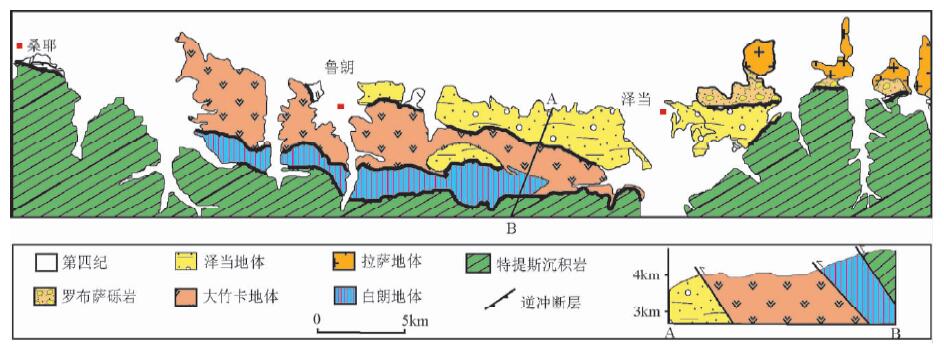
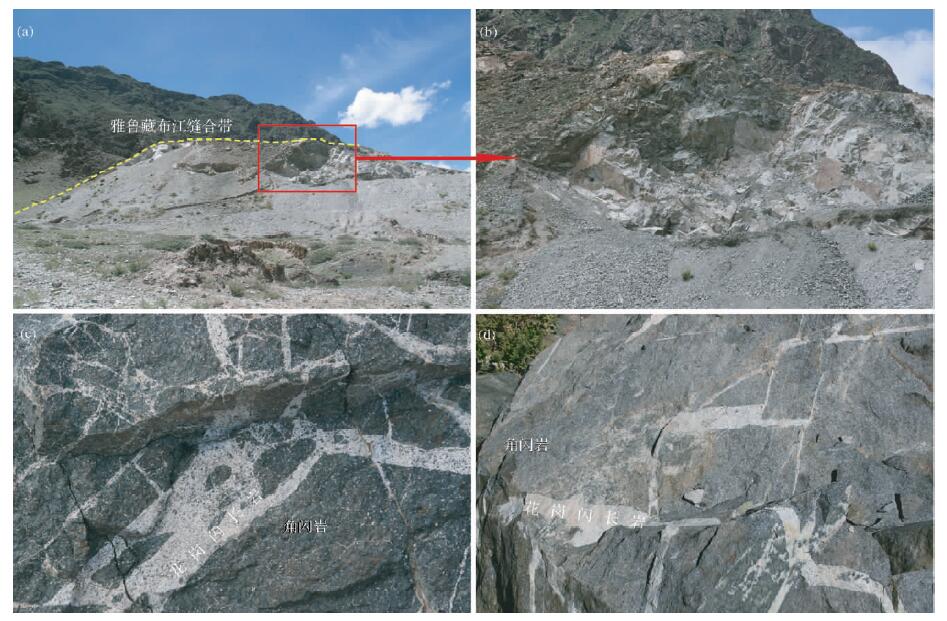
2 地质背景和样品描述雅鲁藏布江缝合带东段由一系列俯冲和增生杂岩体组成,主要包括泽当地体、大竹卡地体和白朗地体,分别代表残留洋弧、弧前蛇绿岩和俯冲增生杂岩(Aitchison et al., 2000)(图 1)。泽当微地体分布于泽当到桑耶之间,北侧为向南逆冲的冈底斯逆冲推覆带(Harrison et al., 2000),南侧以雅鲁藏布江缝合带与泽当蛇绿岩体断层接触(图 2)。该地体主要由岛弧火山岩和火山质岩石组成,包括玄武质安山岩、安山岩、安山角砾岩、英安岩、花岗闪长岩和其他的侵入体。Ar-Ar角闪岩和TIMS锆石U-Pb测年结果表明,泽当微地体中的英云闪长岩形成年龄是晚侏罗纪(McDermid et al., 2002),具有高Sr/Y比的特征(韦栋梁等,2007)。泽当微地体被认为是一个构造窗,夹持在冈底斯逆冲推覆系统(GT)和仁布-泽当逆冲推覆系统 (RZTS) (Harrison et al., 2000; Quidelleur et al., 1997; Yin et al., 1994, 1999)。
|
图 1 西藏雅鲁藏布江缝合带东段泽当及其相邻地区的地质简图(据McDermid et al., 2002以及野外实际地质调查绘制) Fig. 1 A simplified map showing the location and geology of Zedong and its vicinity, southern Tibet (after McDermid et al., 2002; and our field observations in this area) |
|
图 2 野外照片展示了雅鲁藏布江缝合带的位置、花岗闪长岩和角闪岩的产出位置及接触关系 Fig. 2 Photographs showing the location and occurrence of the granodiorite, magmatic amphibolite and the Yarlung Tsangpo suture zone to the west of Zedong |
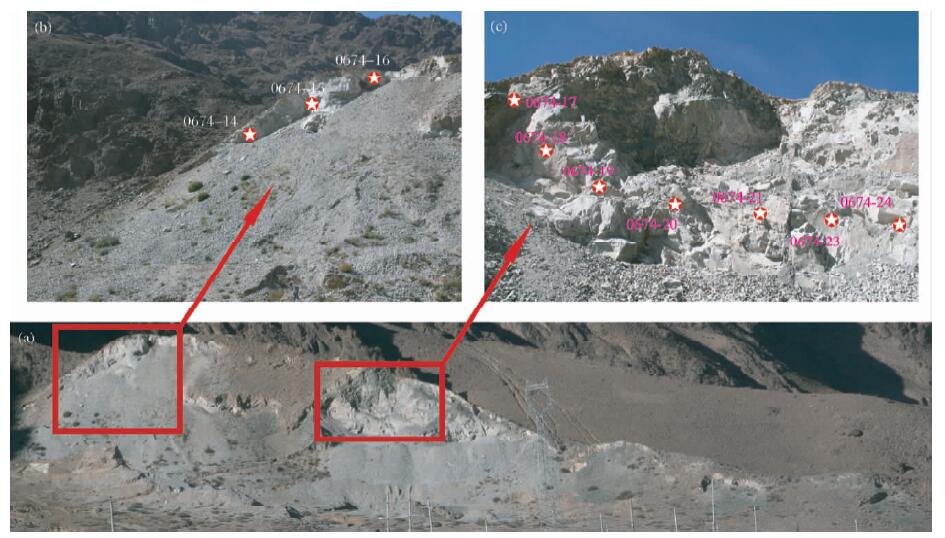
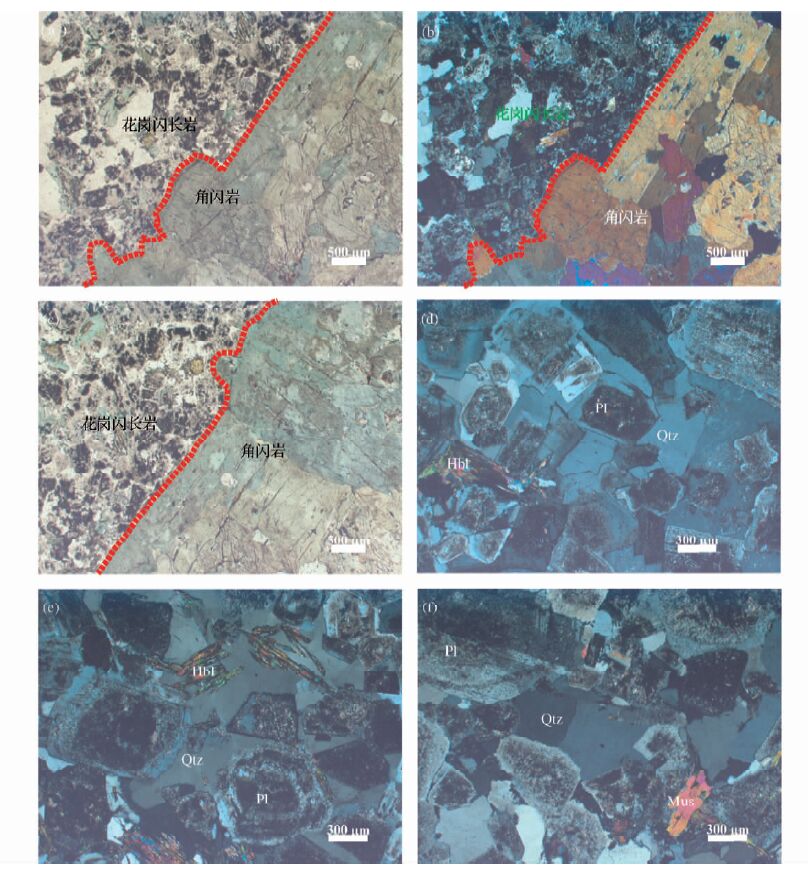
花岗闪长岩主要分布在泽当镇西部(图 3),东西长~3km,南北宽~300m。花岗闪长岩侵入到斜长角闪岩中。为了避开斜长角闪岩对其地球化学成分的影响,采样位置尽量远离斜长角闪岩。将所采样品从西侧到东侧依次编号为0674-14至0674-24号。花岗闪长岩呈淡绿色,主要由斜长石、角闪石、石英、和少量的黑云母组成,副矿物是榍石、磷灰石和锆石等(图 4)。大部分斜长石颗粒较自形,横切面为六边形,具明显的环带结构(图 4e),榍石为自形-半自形,磷灰石呈柱状及横切面六边形的自形晶,常与榍石和锆石共生。
|
图 3 泽当花岗闪长岩的采样位置图 Fig. 3 Photographs showing the sample locations of granodiorite to the west of Zedong |
|
图 4 泽当花岗闪长岩和斜长角闪岩的显微照片 (a)-样品0674-5、(b)-样品0674-30、(c)-样品0674-30:显示了花岗闪长岩与斜长角闪岩的接触关系;(d)-样品0674-15、(e)-样品0674-16、(f)-样品0674-19:显示了泽当花岗闪长岩的主要矿物组成是斜长石、石英、角闪石、黑云母以及少量的白云母等等,斜长石比较自形,具有环带结构.图中矿物代号:Pl-斜长石;Qtz-石英;Hbl-角闪石;Mus-白云母 Fig. 4 Microphotographs showing the typical texture and mineral assemblage of granodiorite and amphibolite in Zedong |
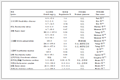
为确定泽当西花岗闪长岩的地球化学特征,进行了系统采样,分析了它们的全岩元素和微量元素组成。主量及微量元素的测试在国土资源部国家地质实验测试中心进行。主量元素通过XRF(X荧光光谱仪3080E)方法测试,分析精度为5%。微量元素和稀土元素(REE) 通过等离子质谱仪 (ICP-MS-Excell) 分析,含量大于10×10-6的元素的测试精度为5%,而小于10×10-6的元素精度为10%。个别在样品中含量低的元素,测试误差大于10%。分析结果列在表 1中。
|
表 1 泽当花岗闪长岩和斜长角闪岩元素组成(主量元素:wt%;微量和稀土元素:×10-6) Table 1 Chemical compositions of Zedong granodiorite and amphibolte (major elements: wt % ; trace elements :×10-6 |
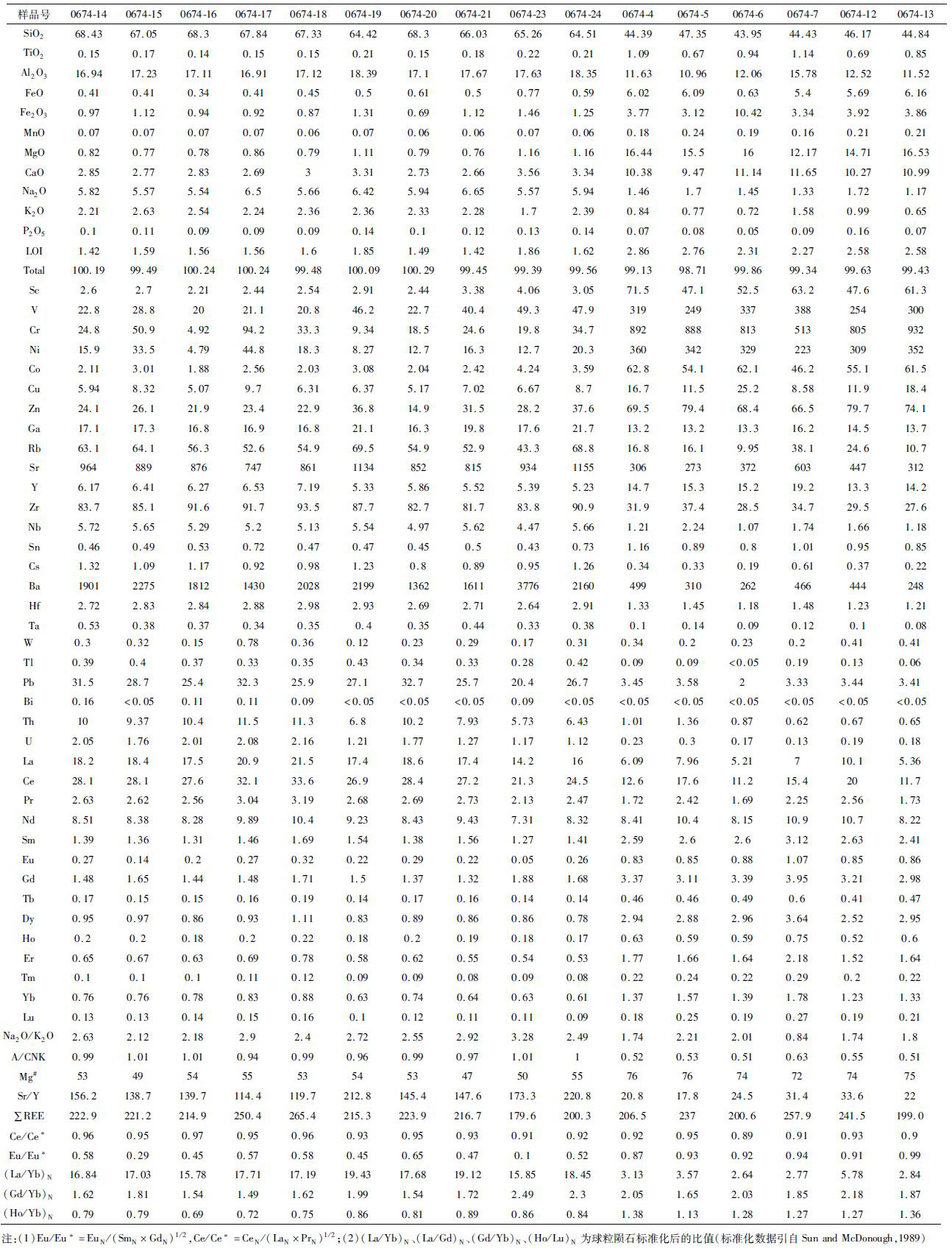
从具有代表性的样品T0674-16中分选出锆石,经过挑选、制靶和抛光,然后进行阴极发光和扫描电子显微镜成像观察, 揭示锆石的内部结构。阴极发光成像观察在北京离子探针中心进行。在中国地质科学院地质研究所,利用扫描电子显微镜进行了BSE图像和锆石内部包裹体的成分测试。通过阴极发光和BSE图像来查明锆石内部生长层的分布和结构,选取测试点。锆石U-Pb同位素定年测试在北京离子探针中心进行,所用仪器为高分辨率、高灵敏度离子探针SHRIMP II。分析时所用标样为91500或TEM锆石,每测定3个未知点,插入一次标样测定,以便及时校正,保障测试精度。数据处理、年龄计算和绘图使用的是ISOPLOT程序 (Ludwig, 2003)。测试结果见表 2。
|
|
表 2 泽当花岗闪长岩(T0764-16) SHRIMP 锆石U-Pb定年数据 Table 2 SHRIMP zircon U-Pb isotopic data of Zedong granodiorite |
Rb-Sr和Sm-Nd同位素分析在中国地质科学院地质研究所同位素实验室进行。通过同位素稀释法,利用Finnigan MAT-262质谱仪测试Sr同位素组成以及Rb、Sr、Sm和Nd的浓度。利用Nu Plasam HR MC-ICP-MS多接收等离子质谱仪 (Nu Instruments) 进行Nd同位素分析。Nd和Sr分析结果分别按146Nd/142Nd=0.7219和86Sr/88Sr=0.1194标准化,进行质量分馏校正。在分析样品期间,Sr同位素测试标准为NBS987,测试值为0.710247±12 (2σ)。Sr和Nd同位素的测试精度分别为±0.000010(n=21)和±0.000011 (n=21)。根据SHRIMP锆石U/Pb定年的结果,泽当西花岗闪长岩的结晶年龄约为160Ma。所分析样品的Sr和Nd同位素的初始值按t=160Ma计算,分析结果见表 3。
|
|
表 3 泽当花岗闪长岩的Sr和Nd同位素组成 Table 3 Sr and Nd isotope compositions for Zedong granodiorite |
 .其中在计算143Nd/144Nd(CHUR)时,143Nd/144Nd=0.512638,143Sm/144Nd=0.1967,λ=6.54×10-11a-1,t=160Ma
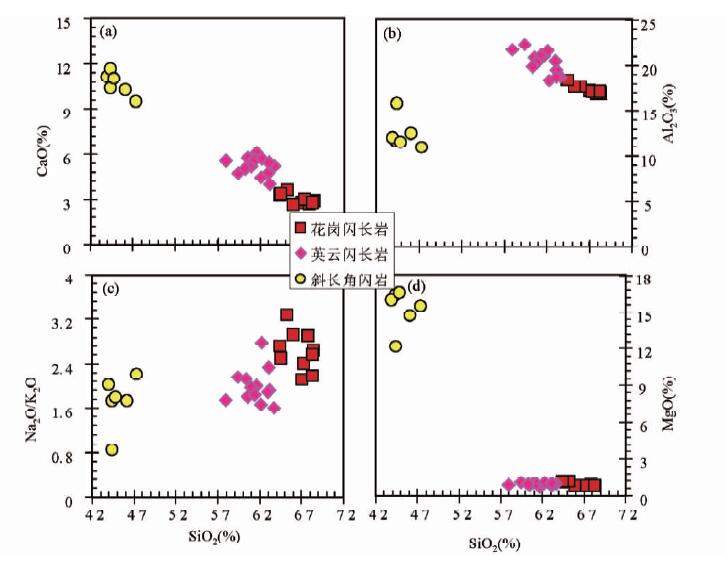
在主量元素组成上,泽当西花岗闪长岩的特征如下(表 1):SiO2和Al2O3含量较高(图 5b),分别在64.42%~68.43%和16.9%~18.4%之间,A/CNK比值较低,为0.93~1.01;TiO2、FeO、MgO和MnO含量较低,FeO<0.77%, MgO<1.16%;所有样品的Na2O/K2O>2(2.12~3.28,图 5c),表明泽当西花岗闪长岩为富钠花岗岩。在主量元素协变图解上,花岗闪长岩和英云闪长岩具有较好的线性关系(图 5),说明它们可能是来源于同一个源区,经历了不同的岩浆演化过程。
|
图 5 泽当花岗闪长岩、英云闪长岩与斜长角闪岩的主量元素地球化学特征 Fig. 5 Covariation diagram of selected major oxides of CaO (a), Al2O3(b), Na2O/K2O (c) and MgO (d) versus SiO2 in Zedong granodiorite, tonalite and amphibolite |
斜长角闪岩的主量元素特征如下:SiO2含量在43.95%~47.35%之间,CaO含量在9.47~11.65% 之间,Al2O3含量在10.96%~15.78%之间,样品中A/CNK比值为0.51~0.63;TiO2、FeO、MgO和MnO含量均较高,TiO2>0.67%,FeO>6.09%,MgO>12.2%,MnO>0.16%。
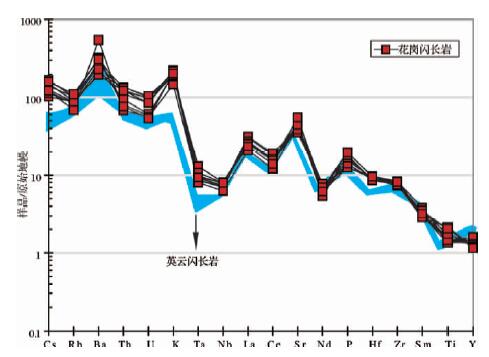
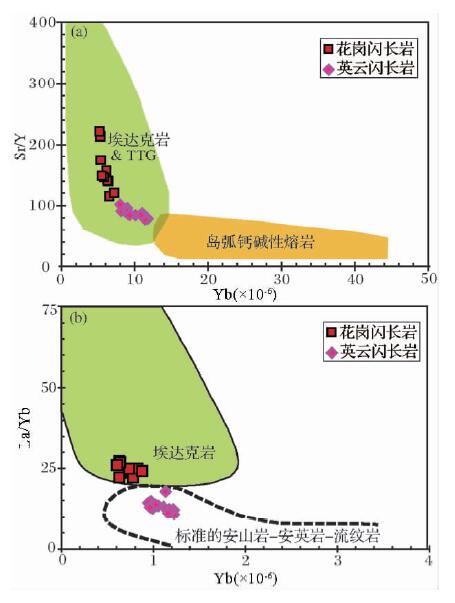
4.2 微量元素地球化学特征在微量元素组成上,花岗闪长岩与英云闪长岩表现出相似的特征(图 6):(1) 富Sr (747×10-6~1155×10-6)和Ba (1362×10-6~3776×10-6),Cr与Ni的含量较高,含较低的Y (<7.19×10⁻⁶)和Yb (<0.88×10⁻⁶); (2) 富集大离子亲石元素,强烈亏损Nb(<5.72×10⁻⁶)和Ta(<0.53×10⁻⁶)、Zr(<93.5×10⁻⁶)、Hf(<2.98×10⁻⁶)、Ti(<0.25%)等高场强元素(图 6);(3) 具有较高的Sr/Y和La/Yb比值,分别大于119.7和22.4,并且,在Sr/Y-Y和La/Yb-Yb图解(图 7)中,花岗闪长岩都落入埃达克岩区域内。上述数据表明,该套花岗闪长岩不仅具有岛弧岩浆岩的特征,而且具有埃达克岩的特征。
|
图 6 泽当花岗闪长岩与英云闪长岩的微量元素地球化学特征(标准化值据Sun and McDonough, 1989) Fig. 6 Trace element distribution diagram of Zedong granodiorite and tonalite (primitive mantle normalization values after Sun and McDonough, 1989) |
|
图 7 泽当花岗闪长岩与英云闪长岩的Sr/Y-Y图解(a)和La/Yb-Yb(b)图解(据Defant and Drummond, 1990) Fig. 7 Sr/Y-Y(a) and La/Yb-Yb (b) diagrams for Zedong granodiorite and tonalite (after Defant and Drummond, 1990) |
斜长角闪岩的微量元素特征如下:(1) 含有较低的Sr (273×10-6~603×10-6)、Y (13.3×10⁻⁶~19.2×10⁻⁶)和较低的Sr/Y值(17.8~33.6);(2) Cr和Ni的含量非常高,分别为513×10-6~932×10-6和223×10-6~360×10-6。
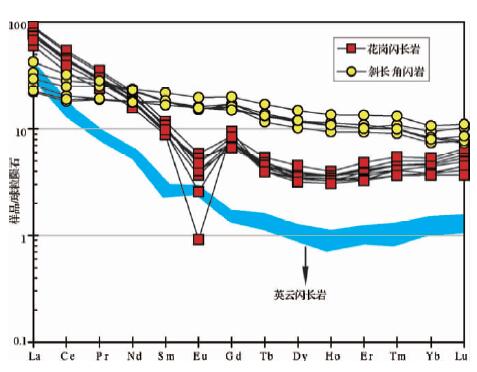
4.3 稀土元素地球化学特征泽当西花岗闪长岩的稀土元素总量较高,ΣREE=81.5×10⁻⁶~122.5×10⁻⁶,具有强分馏的稀土元素分配模式(图 8),富集LREE ((La/Dy)N=17.21~23.43),亏损HREE((La/Yb)N=15.7~19.5),但从Ho到Lu稀土分布样式微微上翘 ((Ho/Yb)N=0.69~0.90) (图 8),具有明显的Eu负异常 (Eu/Eu*=0.44~0.65)。花岗闪长岩与英云闪长岩的稀土配分模式基本一致,但花岗闪长岩的稀土总量明显高于英云闪长岩 (图 8)。与花岗闪长岩不同的是,英云闪长岩具有微弱的Eu正异常。这表明,在岩浆演化过程中,花岗闪长岩的岩浆经历了明显的、较高程度的斜长石分离结晶作用,相反地,英云闪长岩基本上没有经历斜长石分离结晶作用。
|
图 8 泽当花岗闪长岩、英云闪长岩与斜长角闪岩的稀土元素地球化学特征(标准化值引自Sun and McDonough, 1989) Fig. 8 Rare earth element distribution diagram for Zedong granodiorite, tonalite and amphibolite (chondrite normalization values after Sun and McDonough, 1989) |
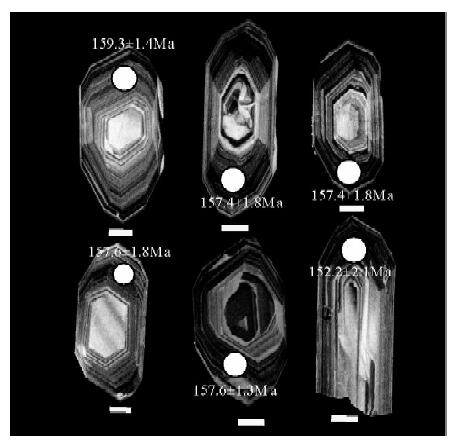
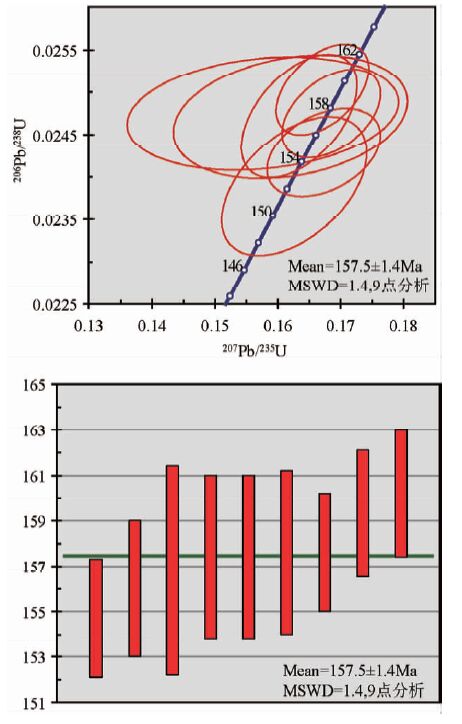
样品T0674-16为具有代表性的花岗闪长岩,主要由斜长石、角闪石、石英、和少量的黑云母组成(图 4d-f),副矿物是榍石、磷灰石和锆石等。大部分锆石为长柱状, 在阴极发光图像上(图 9),呈现出典型的韵律生长环带,为岩浆锆石。我们选取这些锆石进行了SHRIMP锆石U-Pb测年,来确定该花岗闪长岩的形成年龄。大部分锆石为自形-半自形、长柱状,棱角清晰,粒度在80~150μm之间, 个别可达250μm,长宽比一般为2:1, 个别可达4:1。在阴极发光和背散射图像锆石都显示明显的韵律环带结构。个别锆石呈次圆状、形态不规则。锆石U和Th含量分别在350×10-6~1342×10-6和245×10-6~914×10-6之间, Th/U值在0.549~1.273之间(表 2),测试的12个点中,206Pb/238U年龄在152.2~162.5Ma(表 2)之间,平均年龄值为157.5±1.4Ma, 置信度为95%, MSWD为1.4(图 10),Th/U比值大于0.1,较高的Th/U比值和清晰的韵律环带表明它们是岩浆成因的。这组年龄数据点在谐和图上相对集中分布, 可信度高, 为锆石的结晶年龄, 代表岩浆的结晶时代。
|
图 9 泽当花岗闪长岩的锆石阴极发光图像(CL)和U-Pb定年结果 比例尺为20μm Fig. 9 Cathodoluminescence (CL) images showing the texture and respective spots for SHRIMP U-Pb analysis on zircon grains from Zedong granodiorite |
|
图 10 泽当花岗闪长岩的SHRIMP 锆石U-Pb谐和图(a)和年龄分布图(b) Fig. 10 U-Pb concordia (a) and age distribution (b) diagrams for SHRIMP zircon U-Pb analytical results of Zedong granodiorite |
为确定泽当西花岗闪长岩的Sr和Nd同位素组成特征, 对10件花岗闪长岩进行了Sr和Nd同位素分析。分析结果列在表 3中。
花岗闪长岩具有较低的Rb (43.3×10⁻⁶~69.5×10⁻⁶)、但较高的Sr (747×10-6~1155×10-6),较高的Sm(1.27×10⁻⁶~1.69×10⁻⁶)和Nd(7.31×10⁻⁶~10.4×10⁻⁶)。Rb/Sr比值<0.072,Sm/Nd比值<0.174;初始Sr同位素比值较低且较均一, 变化范围为0.704469~0.704864;初始Nd同位素比值高,在0.512789和0.513160之间变化,εNd(t)在+5.1和+6.1之间变化(表 3)。这些数据表明,泽当花岗闪长岩应来源于亏损地幔或者具有亏损地幔特征的洋壳。与花岗闪长岩相比,英云闪长岩的初始εNd值(+6.7~+7.3)较高,但Sr同位素比值(0.704765~0.705020)(韦栋梁等2007)相似。
5 讨论泽当微地体由斜长角闪岩、英云闪长岩和花岗闪长岩组成。英云闪长岩的形成时代为161±2.3Ma (McDermid et al., 2002), 花岗闪长岩的形成时代为157.5±1.4Ma,两者在误差范围内,基本上一致,表明英云闪长岩和花岗闪长岩是近同时形成的,可能存在成因上的联系。在许多地球化学特征上,英云闪长岩和花岗闪长岩表现出相似性,但也存在明显的差别。两者都具有高Sr,低Y和高Sr/Y比的特征,都富集LILE,亏损HFSE的特征。但与英云闪长岩相比,花岗闪长岩更加富集LREE,REE的总量明显较高,具有高La/Yb比值,高度的Eu负异常等。在主量元素地球化学特征上,英云闪长岩比花岗闪长岩更加接近原始岩浆。如果花岗闪长岩的母岩浆是英云闪长岩,斜长石的分离结晶作用可解释花岗闪长岩中明显的Eu负异常、LREE和REE总量的升高(Zeng et al., 2011), 但不能解释:(1) 两种之间具有相似的Sr含量;(2) 英云闪长岩具有较低的Nb但较高的Y含量;和(3) 两者都具有HREE较平直的配分模式。这种差异性进一步要求从英云闪长岩向花岗闪长岩演化过程中,经历了明显的角闪石分离结晶作用。角闪石具有较高的Cr、Ni、Y、CaO,但较低的Sr。角闪石的分离结晶作用可解释上述特征。因此,在泽当洋内岛弧形成过程中,从英云闪长岩向花岗闪长岩演化过程中,经历了斜长石和角闪石的分离结晶作用。
花岗闪长岩的REE配分模式为向右倾斜的稀土配分模式(图 8),富集LREE,亏损HREE,(La/Yb) N值和(Gd/Yb) N值都较高,分别是大于15.7和大于1.5。由于石榴石与熔体之间的配分系数从Ho到Lu依次增高,导致熔体Ho到Lu元素含量依次降低。若仅有石榴石作为残留相时,熔体会强烈亏损HREE。不可能使熔体的HREE有较平坦的特征;若仅以角闪石作为残留相时,Ho-Lu元素在角闪石和熔体之间的配分系数变化不大 (Kelvin et al., 1997; Hilyard et al., 2000; Tiepolo et al., 2007),可导致熔体平坦的HREE配分模式。这表明花岗闪长岩和英云闪长岩在岩浆演化过程中都经历了角闪石分离结晶作用,或它们的母岩浆经历了与角闪石平衡的过程。
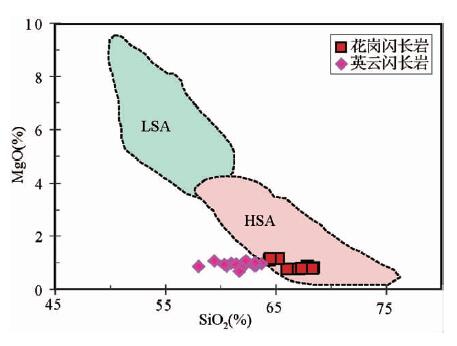
花岗闪长岩的SiO2含量在64.42%~68.43%之间,Na2O含量在5.5%~6.7%之间,Na2O/K2O的值2.12~3.28之间,Mg#在0.47~0.55之间,Cr的平均含量是37.6×10-6,Ni的平均含量是21.8×10-6,Sr的含量大于747×10-6, 并且具有较高的Sr/Y (>119.7)和La/Yb (>22.4),较低的Y (<7.19×10⁻⁶)和Yb (<0.88×10⁻⁶),轻重稀土强烈分异,HREE含量较低,这些特征与Martin et al. (2005) 提出的高硅埃达克岩(HSA)的定义相似(表 4、图 11),表明花岗闪长岩具有HSA的特征。Martin et al. (2005) 指出,高硅埃达克岩(HSA)代表着被地幔橄榄岩混染的大洋板片熔融体,而低硅埃达克岩(LSA)代表着来自板片部分熔融体交代的地幔橄榄岩部分熔融产生的熔体。高硅埃达克岩 (HSA) 的SiO2含量大于60%,低硅埃达克岩 (LSA) 的SiO2含量小于60%。本文中花岗闪长岩的SiO2含量是64.4%~68.4%,类似于高硅埃达克岩 (HSA)。但是,泽当花岗闪长岩明显经历了斜长石和角闪石分离结晶作用等岩浆过程,不代表原始熔体,不能直接反映源区的地球化学特征。
|
|
表 4 泽当花岗闪长岩、英云闪长岩与典型埃达克岩地球化学特征对比 Table 4 Geochemical comparison of Zedong granodiorite and tonalite with typical adakite |
|
图 11 泽当花岗闪长岩与英云闪长岩的MgO-SiO2相关图 高硅埃达克岩(HSA)和低硅埃达克岩(LSA)域据Martin et al. (2005) Fig. 11 MgO versus SiO2 diagram showing that Zedong granodiorite is located within high-SiO2 adakites (HSA) field, whereas the tonalite is out of HSA field |
泽当花岗闪长岩和英云闪长岩都具有岛弧岩浆岩的特征,应形成于与俯冲有关的构造环境。同时,泽当花岗闪长岩作为雅鲁藏布江缝合带泽当段的一部分与SSZ型蛇绿岩相伴产出,这也表明其产出于与俯冲相关的构造环境。已有的研究表明无论是增厚基性下地壳(包括古老基性物质或新近垫托的基性岩)还是俯冲的洋壳的部分熔融都可以形成埃达克质熔体(Defant and Drummond, 1990; Atherton and Petford, 1993; Yogodzinski et al., 1995; Rapp et al., 1999; Chung et al., 2003; Hou et al., 2004; Wang et al., 2005, 2008; Guo et al., 2007)。这些熔体通常具有高Si的特征,明显不同于经过熔体交代的地幔楔部分熔融形成的低硅埃达克质熔体(Rapp et al., 1999; Martin et al., 2009)。
泽当花岗闪长岩的形成时代是中侏罗世晚期,在这个时期,泽当及其附近区域应位于新特提斯洋中,不太可能存在陆壳,可以排除增厚大陆下地壳部分熔融作用。在Sr和Nd同位素系统特征上,泽当花岗闪长岩具有较低的Sr和较高的Nd同位素组成,和亏损地幔的相当,基本上没有陆壳物质的贡献。因此,泽当高Sr/Y比值花岗岩要么代表着俯冲洋壳的部分熔融,要么代表着在较高压力下,位于俯冲带上盘的新近垫托的基性岩的部分熔融作用,要么代表着非高Sr/Y比岩浆演化的产物(如角闪石分离结晶作用)。
从表 4中可以看到英云闪长岩的La/Yb比值较低,不符合埃达克岩的定义,这表明,英云闪长岩虽具有高Sr/Y比特征,并不是严格意义上的埃达克岩(图 11)。这进一步说明英云闪长岩和花岗闪长岩的母岩浆不是埃达克质岩浆,可以排除俯冲洋片的部分熔融作用,可能是在来自地幔楔部分熔融体的板底垫托作用下,新生基性下地壳重熔的产物。这些熔体先经历了较高程度的角闪石分离结晶作用,形成英云闪长岩,而后又经历了富钙长石组分斜长石的分离结晶作用,形成花岗闪长岩。
花岗闪长岩侵入到斜长角闪岩中,局部可观察到花岗闪长岩切穿角闪岩,表明花岗闪长岩的原始岩浆经过了一定距离的迁移。在主量元素协变图解(图 5)中,除了CaO-SiO2相关图解外,角闪岩与泽当西和泽当东的岩浆的主量元素基本不呈线性关系,这说明角闪岩与泽当西花岗闪长岩和泽当东英云闪长岩可能不是来自于同一原始岩浆,代表着较早形成的基性岩浆。但要确定与泽当英云闪长岩和花岗闪长岩之间的关系,有待进一步的地质年代学和同位素(Sr和Nd)地球化学的研究。
在印度-欧亚大陆汇聚过程中,除了新特提斯洋洋壳俯冲到欧亚大陆之下,还发育洋内俯冲系统,不仅形成以冈底斯岩基为代表的弧火山岩,而且在新特提斯洋内形成大洋岛弧岩浆岩。除了泽当侏罗纪残留洋弧外,在雅鲁藏布江缝合带西段,保留着白垩纪Kohistan-Dras洋内岛弧(Robertson et al., 1994; Searle et al., 1999)。同时,在大竹卡蛇绿岩的北侧,发育一系列年龄为早侏罗-中侏罗的闪长岩和花岗闪长岩(Wen et al., 2008; Ji et al., 2009),这些花岗质岩石具有非常亏损的Hf同位素组成(εHf=+11~+15)(Ji et al., 2009),是否是另一套残留洋弧,有待细致的野外调查和岩石地球化学的研究。总之,挟持在冈底斯岩基和雅鲁藏布江缝合带之间的,代表新特提斯洋洋内俯冲作用的残留洋弧可能比现今认为的更加广泛。识别和厘定这些残留洋弧的形成时代、岩石学和地球化学特征,将为深入理解南拉萨地块的组成和生长,印度和欧亚大陆复杂的碰撞过程提供新的数据和限定。
6 结论通过对泽当微地体中花岗闪长岩的年代学、岩相学和地球化学研究,结合前人的数据,获得以下认识:(1) 泽当西花岗闪长岩形成于157.5±1.4Ma;
(2) 这套岩石既具有岛弧岩浆岩的特征,又具有埃达克岩的特征。富集大离子亲石元素,亏损高场强元素 (如Nb、Ta、Ti、Y等),具有来自亏损地幔贡献的初始87Sr/86Sr值 (0.704065~0.704439)和较高的εNd值 (+5.01~+6.09);
(3) 花岗闪长岩很可能产出于洋内弧环境,与新特提斯洋北向俯冲有关;
(4) 虽然花岗闪长岩具有埃达克岩的特征,但花岗闪长岩及与其共生的英云闪长岩不代表原始岩浆,都经历了一定程度的分离结晶作用,可能是来自地幔楔部分熔融体的板底垫托作用下,新生基性下地壳重熔的产物。
致谢 感谢Curtin理工大学的高旻在装载样品,仪器调试和仪器监控方面所提供的帮助。还要感谢北京离子探针中心的张维在远程实验协助和数据处理方面所提供的帮助。锆石标准M257由Nasdala博士提供。感谢孟繁聪研究员和戚学祥研究员仔细审阅稿件和诸多建设性意见。| [] | Abrajevitch A, Ali JR, Aitchison JC, Badengzhu X, Davis AM, Liu JB, Ziabrev SV. 2005. Neotethys and the India-Asia collision: Insights from a palaeomagnetic study of the Dazhuqu ophiolite southern Tibet. Earth and Planetary Science Letters, 233: 87–102. DOI:10.1016/j.epsl.2005.02.003 |
| [] | Allegre CJ, Courtillot V, Tapponnier P, et al. 1984. Structure and evolution of the Himalaya-Tibet orogenic belt. Nature, 307: 17–22. DOI:10.1038/307017a0 |
| [] | Aitchison JC, Badengzhu, Davis AM, et al. 2000. Remnants of a Cretaceous intra-oceanic subduction system within the Yarlung-Zangbo suture (southern Tibet). Earth and Planetary Science Letters, 183: 231–244. DOI:10.1016/S0012-821X(00)00287-9 |
| [] | Arbaret L, Burg JP, Zeilinger G, Chaudhry N, Hussain S, Dawood H. 2000. Pre-collisional anastomosing shear zones in the Kohistan Arc, NW Pakistan. In: Khan MA, Treloar PJ, Searle MP and Jan MQ (eds.). Tectonics of the Nanga Parbat Syntaxis and the Western Himalaya. Geological Society of London, 170: 295–311. |
| [] | Atherton MP, Petford N. 1993. Generation of sodium-rich magmas from newly underplated basaltic crust. Nature, 362: 144–146. DOI:10.1038/362144a0 |
| [] | Bignold SA, Treloar PJ, Petford N. 2006. Changing sources of magma generation beneath intra-oceanic island arcs: An insight from the juvenile Kohistan island arc, Pakistan Himalaya. Chemical Geology, 233: 46–74. DOI:10.1016/j.chemgeo.2006.02.008 |
| [] | Bignold SM, Treloar PJ. 2003. Northward subduction of the Indian Plate beneath the Kohistan island arc, Pakistan Himalaya: New evidence from isotopic data. Journal of Geological Society, 160: 377–384. DOI:10.1144/0016-764902-068 |
| [] | Burg JP, Arbaret L, Chaudhry NM, Dawood H, Hussain S, Zeilinger G. 2005. Shear strain localization from the upper mantle to the middle crust of the Kohistan Arc (Pakistan). In: Bruhn D and Burlini L (eds.). High-strain Zones: Xtructure and Physical Properties. Special Publications, Geological Society, London, 245: 25–38. |
| [] | Burg JP, Jagoutz O, Hamid D, Hussain S. 2006. Pre-collision tilt of crustal blocks in rifted island arcs: Structural evidence from the Kohistan Arc. Tectonics, 25: 13. DOI:10.1029/2005TC001835 |
| [] | Chung SL, Liu DY, Ji JQ, Chu MF, Lee HY, Wen DJ, Lo CH, Lee TY, Qian Q, Zhang Q. 2003. Adakites from continental collision zones: Melting of thickened lower crust beneath southern Tibet. Geology, 31: 1021–1024. DOI:10.1130/G19796.1 |
| [] | Defant MJ, Drummond MS. 1990. Derivation of some modern arc magmas by melting of young subducted lithosphere. Nature, 347: 662–665. DOI:10.1038/347662a0 |
| [] | Dhuime B, Bosch D, Bodinier JL, Garrido CJ, Bruguier O, Hussain SS, Dawood H. 2007. Multistage evolution of the Jijal ultramafic-mafic complex (Kohistan, N Pakistan): Implications for building the roots of island arcs. Earth and Planetary Science Letters, 261: 179–200. DOI:10.1016/j.epsl.2007.06.026 |
| [] | Dhuime B, Bosch D, Garrido CJ, Bodinier JL, Bruguier O, Hussain SS, Dawood H. 2009. Geochemical architecture of the lower- to middle-crustal section of a Paleo-island Arc (Kohistan Complex, JijalKamila Area, Northern Pakistan): Implications for the evolution of an oceanic subduction zone. Journal of Petrology, 50: 531–569. DOI:10.1093/petrology/egp010 |
| [] | Garrido CJ, Bodinier JL, Burg JP, Zeilinger G, Hussain SS, Dawood H, Chaudhry MN, Gervilla F. 2006. Petrogenesis of mafic garnet granulite in the lower crust of the Kohistan paleo-arc complex (northern Pakistan): Implications for intra-crustal differentiation of island arcs and generation of continental crust. Journal of Petrology, 47: 1873–1914. DOI:10.1093/petrology/egl030 |
| [] | Guo ZF, Wilson M, Liu JQ. 2007. Post-collisional adakites in south Tibet: Products of partial melting of subduction-modified lower crust. Lithos, 96: 205–224. DOI:10.1016/j.lithos.2006.09.011 |
| [] | Harrison TM, Yin A, Grove M, Lovera OM, Ryerson FJ, Zhou X. 2000. The Zedong Window: A record of superposed Tertiary convergence in southeastern Tibet. Journal of Geophysical Research, 105: 19211–19230. DOI:10.1029/2000JB900078 |
| [] | Hilyard M, Nielsen RL, Beard JS, Patino-Douce A, Blencoe J. 2000. Experimental determination of the partitioning behaviour of rare earth and high field strength elements between pargasitic amphibole and nature silicate melts. Geochimica et Cosmochimica Acta, 64: 1103–1120. DOI:10.1016/S0016-7037(99)00379-8 |
| [] | Hou ZQ, Gao YF, Qu XM, Rui ZY, Mo XX. 2004. Origin of adakitic intrusives generated during Mid-Miocene east-west extension in southern Tibet. Earth and Planetary Science Letters, 220: 139–155. DOI:10.1016/S0012-821X(04)00007-X |
| [] | Jagoutz O, Muntener O, Burg JP, Ulmer P, Jagoutz E. 2006. Lower crust formation through focused flow in km-scale melt conduits: The zoned ultramafic bodies of the Chilas Complex in the Kohistan Island arc (NW Pakistan). Earth and Planetary Science Letters, 242: 320–342. DOI:10.1016/j.epsl.2005.12.005 |
| [] | Jagoutz O, Muntener O, Ulmer P, Burg J-P, Pettke T. 2007. Petrology and mineral chemistry of lower crustal intrusions: The Chilas Complex, Kohistan (NW Pakistan). Journal of Petrology, 48: 1895–1953. DOI:10.1093/petrology/egm044 |
| [] | Jagoutz O, Burg J-P, Hussain S, Dawood H, Pettke T, Iizuka T, Maruyama S. 2009. Construction of the granitoid crust of an island arc part Ⅰ: Geochronological and geochemical constraints from the plutonic Kohistan (NW Pakistan). Contributions to Mineralogy and Petrology, 158: 739–755. DOI:10.1007/s00410-009-0408-3 |
| [] | Ji WQ, Wu FY, Chung SL, Li JX, Liu CZ. 2009. Zircon U-Pb geochronology and Hf isotopic constraints on petrogenesis of the Gangdese batholith, southern Tibet. Chemical Geology, 262: 229–245. DOI:10.1016/j.chemgeo.2009.01.020 |
| [] | Khana SD, Walker DJ, Hall SA, Burke KC, Shah MT, Stockli L. 2008. Did Kohistan-Ladakh island arc collide first with India?. Geological Society of America Bulletin, 121: 366–384. |
| [] | Klein M, Stosch HG, Seck HA. 1997. Partioning of high field-strength and rare-earth elements between amphibole and quartz-dioritic to tonalitic melts: An experimental study. Chemical Geology, 138: 257–271. DOI:10.1016/S0009-2541(97)00019-3 |
| [] | Ludwig K. 2003. User's manual for Isoplot 3. 00: A geochronological toolkit for Microsoft Excel. Berkeley Geochronology Center Special Publication, 4: 1–70. |
| [] | Mahéo G, Bertrand H, Guillot S, Villa IM, Keller F, Capiez P. 2004. The South Ladakh ophiolites (NW Himalaya, India): An intra-oceanic tholeiitic arc origin with implication for the closure of the Neo-Tethys. Chemical Geology, 203: 273–303. DOI:10.1016/j.chemgeo.2003.10.007 |
| [] | Martin H, Smithies RH, Rapp RP, Moyen JF, Champion DC. 2005. An overview of adakite, tonalite-trondhjemite-granodiorite (TTG) and sanukitoid: Relationships and some implications for crustal evolution. Lithos, 79(1-2): 1–24. DOI:10.1016/j.lithos.2004.04.048 |
| [] | Martin H, Moyen JF, Rapp R. 2009. The sanukitoid series: Magmatism at the Archaean-Proterozoic transition. Transactions of the Royal Society of Edinburgh-Earth Sciences, 100: 15–33. DOI:10.1017/S1755691009016120 |
| [] | McDermid IRC, Aitchison JC, Davis AM, et al. 2002. The Zedong terrane: A Late Jurassic intra-oceanic magmatic arc within the Yarlung-Tsangpo suture zone, southeastern Tibet. Chemical Geology, 187: 267–277. DOI:10.1016/S0009-2541(02)00040-2 |
| [] | Moyen JF. 2009. High Sr/Y and La/Yb ratios: The meaning of the “adakitic signature”. Lithos, 112: 556–574. DOI:10.1016/j.lithos.2009.04.001 |
| [] | Quidelleur X, Grove M, Lovera OM, Harrison TM, Yin A, Ryerson FJ. 1997. Thermal evolution and slip history of the Renbu-Zedong Thrust, southeastern Tibet. Journal of Geophysical Research, 102: 2659–2679. DOI:10.1029/96JB02483 |
| [] | Rapp RP, Shimizu N, Norman MD, Applegate GS. 1999. Reaction between slab-derived melts and peridotite in the mantle wedge: Experimental constraints at 3. 8GPa. Chemical Geology, 160: 335–356. DOI:10.1016/S0009-2541(99)00106-0 |
| [] | Robertson AH, Degnan P. 1994. The Dras arc complex: Lithofacies and reconstruction of a Late Cretaceous oceanic volcanic arc in the Indus suture zone, Ladakh Himalaya. Sedimentary Geology, 92: 117–145. DOI:10.1016/0037-0738(94)90057-4 |
| [] | Searle MP, Asif Khan M, Fraser JE, Gough SJ. 1999. The tectonic evolution of the Kohistan-Karakoram collision belt along the Karakoram Highway transect, north Pakistan. Tectonic, 18: 929–949. DOI:10.1029/1999TC900042 |
| [] | Sun SS, McDonough WF. 1989. Chemical and isotopic systematics of oceanic basalts: Implications for mantle composition and processes. In: Saunders AD and Norry MJ (eds.). Magmatism in Oceanic Basins. Geological Society London Special Publications, 42: 313–345. DOI:10.1144/GSL.SP.1989.042.01.19 |
| [] | Tiepolo M, Oberti R, Zanetti A, Vannucci R, Foley SF. 2007. Trace-element partitioning between amphibole and silicate melt. Reviews in Mineralogy and Geochemistry, 67(1): 417–452. DOI:10.2138/rmg.2007.67.11 |
| [] | Wang Q, McDermott F, Xu JF, Bellon H, Zhu YT. 2005. Cenozoic K-rich adakitic volcanic rocks in the Hohxil area, northern Tibet: Lower-crustal melting in an intracontinental setting. Geology, 33: 465–468. DOI:10.1130/G21522.1 |
| [] | Wang Q, Wyman DA, Xu JF, Wan YS, Li CF, Zi F, Jiang ZQ, Qiu HN, Chu ZY, Zhao ZH, Dong YH. 2008. Triassic Nb-enriched basalts, magnesian andesites, and adakites of the Qiangtang terrane (Central Tibet): Evidence for metasomatism by slab-derived melts in the mantle wedge. Contributions to Mineralogy and Petrology, 155: 473–490. DOI:10.1007/s00410-007-0253-1 |
| [] | Wen DR, Liu DY, Chung SL, Chu MF, Ji JQ, Zhang Q, Song B, Lee TY, Yeh MW, Lo CH. 2008. Zircon SHRIMP U-Pb ages of the Gangdese Batholith and implications for Neotethyan subduction in southern Tibet. Chemical Geology, 252(3-4): 191–201. DOI:10.1016/j.chemgeo.2008.03.003 |
| [] | Wei DL, Xia B, Zhou GQ, Yan J, Wang R, Zhong LF. 2007. Geochemistry and Sr-Nd isotope characteristics of tonalites in Zetang, Tibet: New evidence for intro-Tethyan subduction. Science in China (Series D), 50(6): 836–846. DOI:10.1007/s11430-007-0034-8 |
| [] | Yin A, Harrison TM, Ryerson FJ, Chen WJ, Kidd WSF, Copeland P. 1994. Tertiary structural evolution of the Gangdese Thrust system in southeastern Tibet. Journal of Geophysical Research, 99: 18175–18201. DOI:10.1029/94JB00504 |
| [] | Yin A, Harrison TM, Murphy MA, Grove M, Nie S, Ryerson FJ, Wang XF, Chen ZL. 1999. Tertiary deformation history of southeastern and southwestern Tibet during the Indo-Asian collision. Geological Society of America Bulletin, 111: 1–21. DOI:10.1130/0016-7606(1999)111<0001:SSASLH>2.3.CO;2 |
| [] | Yogodzinski GM, Kay RW, Volynets ON, Koloskov AV, Kay SM. 1995. Magnesian andesite in the western Aleutian Komandorsky region: Implications for slab melting and processes in the mantle wedge. Geological Society of America Bulletin, 107: 505–519. DOI:10.1130/0016-7606(1995)107<0505:MAITWA>2.3.CO;2 |
| [] | Zeng LS, Gao LE, Xie K, Liu ZJ. 2011. Mid-Eocene high Sr/Y granites in the Northern Himalayan Gneiss Domes: Melting thickened lower continental crust. Earth and Planetary Science Letters, 303(3-4): 251–266. DOI:10.1016/j.epsl.2011.01.005 |
| [] | 韦栋梁, 夏斌, 周国庆, 闫俊, 王冉, 钟立锋. 2007. 西藏泽当英云闪长岩的地球化学和Sr-Nd同位素特征: 特提斯洋内俯冲的新证据. 中国科学(D辑), 37(4): 442–450. |