 2012, Vol. 28


青藏高原南部的喜马拉雅造山带是印度与欧亚大陆碰撞-俯冲作用的产物。近些年来,对欧亚大陆南缘拉萨地体的岩浆作用进行了广泛的研究,为新特提斯洋演化和喜马拉雅造山带形成模型的建立提供了重要信息 (Chung et al., 2005;莫宣学等,2005;Xia et al., 2011; Zhu et al., 2012a)。尽管拉萨地体的变质作用研究还比较少,但其成果也为拉萨地体南部的中、新生代构造演化提供了重要限定 (Zhang et al., 2010a; Searle et al., 2011; Guo et al., 2012)。
以往的研究认为,拉萨地体由前寒武纪变质基底、古生代至中生代的沉积岩和大量的中、新生代火成岩组成 (潘桂棠等, 2002, 2004, 2006)。在拉萨地体中出露的中、高级变质岩被认为是拉萨地体的古老变质基底,被命名为念青唐古拉岩群 (李璞,1955;Xu et al., 1985; 肖序常和李廷栋,2000;潘桂棠等, 2002, 2004, 2006),其原岩年龄被推测为太古代、元古代或前寒武纪等,而且认为该岩群经历了元古代的区域变质作用 (胡道功等, 2003, 2005;潘桂棠等,2004;尹光候等,2006; 谢尧武等,2007)。在拉萨地体东南部,即东喜马拉雅构造结附近,由于新生代强烈的地壳抬升和剥蚀作用,角闪岩相至麻粒岩相变质岩石出露到地表。这些岩石也曾被认为是拉萨地体的前寒武纪结晶基底,被命名为林芝岩群或波密岩群 (Geng et al., 2006; 尹光候等,2006)。但最近的研究表明,这套变质岩的原岩包括古生代至中生代的沉积岩,早古生代和中、新生代的岩浆岩,其变质作用发生在中、新生代 (王金丽等, 2008, 2009;董昕等,2009;Dong et al., 2010; Zhang et al., 2010a; Guo et al., 2012)。由于这套变质岩是由不同时代、不同类型的岩石组成,这里将其称之为林芝杂岩或林芝变质杂岩。本文对林芝杂岩中的变质沉积岩进行了系统的锆石U-Pb定年研究,获得了它们的继承碎屑锆石年龄谱和变质作用年龄,在此基础上分析了这些岩石的形成与变质时代,探讨了它们的物质源区与变质作用的构造意义。
1 区域地质背景与样品描述位于青藏高原南部的拉萨地体,夹持于班公-怒江缝合带和印度-雅鲁藏布缝合带之间,是一条巨型的构造-岩浆岩带 (Chang and Zheng, 1973;Allegre et al., 1984; Dewey et al., 1988)。一般认为,班公-怒江洋 (中特提斯洋) 在中生代向南俯冲导致拉萨地体北部经历了安第斯型造山作用,印度-雅鲁藏布江洋 (新特提斯洋) 在晚中生代向北俯冲导致拉萨地体南部经历了安第斯型造山作用,而印度与欧亚大陆在新生代早期的碰撞,导致拉萨地体南部叠加了新生代的碰撞造山作用 (Yin and Harrison, 2000;Ding et al., 2001;潘桂棠等, 2002, 2006;许志琴等,2006;侯增谦等,2008;Searle et al., 2011;Pan et al., 2012; Xu et al., 2012)。由于经历了上述多期造山作用,整个拉萨地体广泛发育中、新生代的岩浆岩,并在拉萨地体南部形成了巨型的冈底斯岩基 (Chung et al., 2003, 2005;Ding et al., 2003;Hou et al., 2004;Nomade et al., 2004;Qu et al., 2004, 2007; Kapp et al., 2005;莫宣学等,2005;Chu et al., 2006;Guo et al., 2007, 2011; He et al., 2007; Liao et al., 2007;Mo et al., 2007, 2008;Wen et al., 2008a, b;朱弟成等, 2008a, b; Zhu et al., 2009a, b, 2011a;Ji et al., 2009;Zhao et al., 2009;Zhang et al., 2010b; Xia et al., 2011; Zeng et al., 2012)。
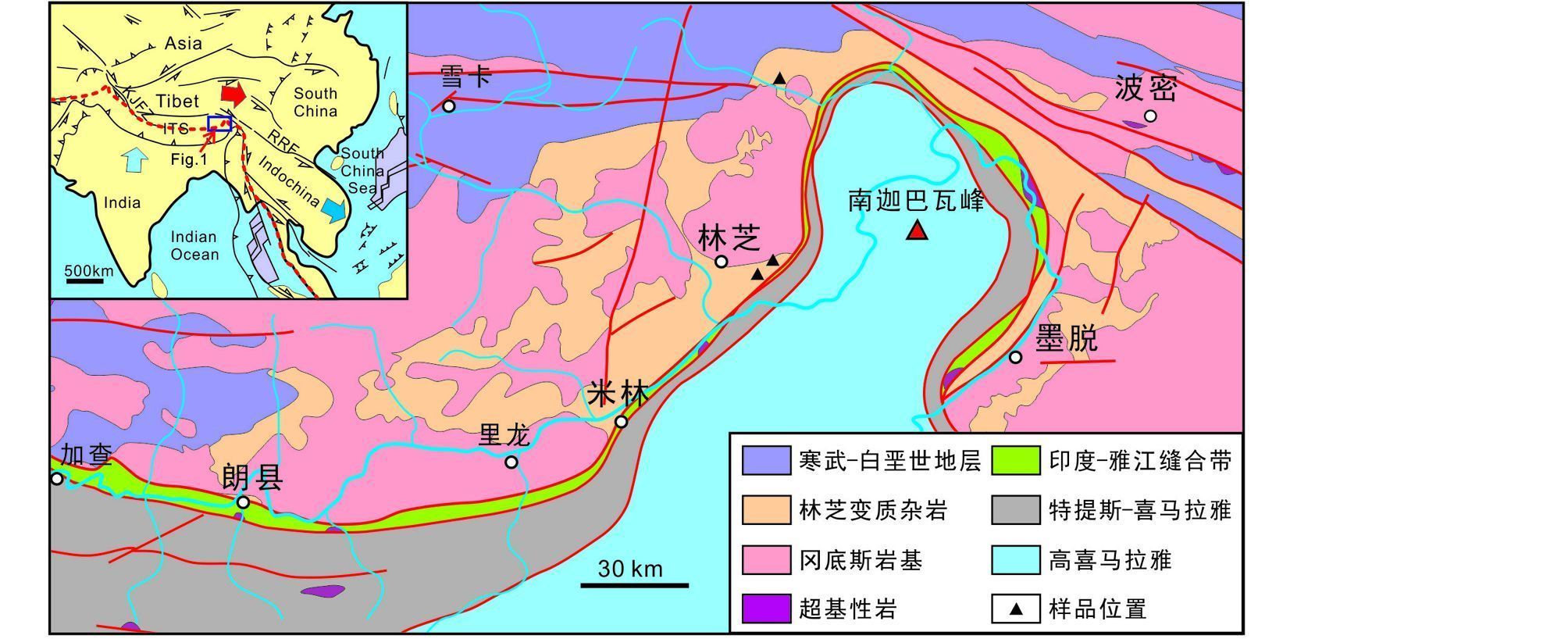
本文研究区位于拉萨地体东南部,东喜马拉雅造山带构造结附近,这里由三个构造单元组成:拉萨地体、印度-雅鲁藏布江缝合带和喜马拉雅带 (图 1)。印度-雅鲁藏布江缝合带呈向北凸出的马蹄状分布于北部的拉萨地体和南部的喜马拉雅带 (印度大陆) 之间。印度-雅鲁藏布江缝合带为蛇绿混杂岩带,主要由低角闪岩相变质的超镁铁岩、镁铁岩、石英岩、白云母石英片岩和大理岩组成,局部混合有来自缝合带两侧地块的变质岩 (Geng et al., 2006)。喜马拉雅带为印度大陆北缘,又分为高喜马拉雅结晶岩系和特提斯-喜马拉雅岩系。高喜马拉雅结晶岩系,又称南迦巴瓦岩群,分布于东喜马拉雅构造结的核部,主要由花岗质片麻岩和泥质片岩组成,并以出现含石榴石蓝晶石高压麻粒岩为特征,经历了早期的高压麻粒岩相变质和晚期的低压麻粒岩相、角闪岩相退变质作用,混合岩化作用强烈 (钟大赉和丁林,1995;Liu and Zhong, 1997;丁林和钟大赉,1999;Ding et al., 2001; 张泽明等,2007)。研究区的特提斯-喜马拉雅岩系分布于雅鲁藏布江缝合带与高喜马拉雅结晶岩系之间,经历了绿片岩相至角闪岩相低、中级变质作用。研究区的拉萨地体由林芝变质杂岩、古生代到中生代的沉积地层和中、新生代岩浆岩组成 (图 1)。林芝变质杂岩主要由片麻岩、片岩、大理岩和斜长角闪岩组成,经历了角闪岩相至麻粒岩相变质作用 (王金丽等, 2008, 2009;董昕等,2009;Dong et al., 2010; Zhang et al., 2010a; Guo et al., 2012)。
|
图 1 拉萨地体东南部及东喜马拉雅构造结地质简图 (据Zhang et al., 2012修改) Fig. 1 Sketch geological map of the southeastern segment of Lhasa terrane and the eastern Himalayan syntaxis (after Zhang et al., 2012) |
所研究的样品采自林芝县布久和鲁朗地区 (图 1),主要岩石类型为片麻岩和片岩。片麻岩包括黑云二长片麻岩,二云钾长片麻岩和石榴石黑云斜长片麻岩,变质矿物组合为斜长石+钾长石+石英+黑云母±白云母±石榴石 (图 2a-e)。片岩为二云母石英片岩,矿物组合为黑云母+白云母+石英+石榴石+夕线石 (图 2f)。上述共生矿物组合指示片麻岩和片岩经历了中压角闪岩相变质作用。

|
图 2 变质岩的显微照片 (a)-黑云二长片麻岩 (样品71-2),主要由钾长石、斜长石和石英组成,含少量黑云母;(b)-黑云母二长片麻岩 (样品74-4),由钾长石、斜长石、石英和黑云母组成;(c)-二云钾长片麻岩 (样品75-4),主要由石英和钾长石组成,含少量黑云母和白云母;(d)-黑云斜长片麻岩 (样品74-3),主要由斜长石和石英组成,含钾长石、黑云母和石榴石;(e)-二云二长片麻岩 (样品75-9),主要由钾长石、斜长石和石英组成,含少量黑云母、白云母和石榴石;(f)-二云母石英片岩 (样品75-2),主要由石英、黑云母组成,含少量白云母、石榴石和夕线石.矿物缩写:Bt-黑云母;Grt-石榴石;Kfs-钾长石;Ms-白云母;Pl-斜长石;Qz-石英;Sil-夕线石 (据Whitey and Evans, 2010) Fig. 2 Microphotographs of metamorphic rocks |
在河北廊坊区调队实验室用标准技术对所研究样品中的锆石进行分选。将选出的约200粒锆石置于环氧树脂中,制成样品靶,然后磨至约锆石一半厚度,用于阴极发光分析及定年分析。锆石LA-ICP-MS U-Pb同位素和微量元素原位分析在中国地质大学 (武汉) 地质过程与矿产资源国家重点实验室完成。所使用的ICP-MS为Elan6100DRC,激光剥蚀系统为德国Lamda Physik公司的Geolas200M深紫外 (DUV)193nm ArF准分子 (excimer) 激光剥蚀系统。激光束斑直径采约32μm。实验中采用He作为剥蚀物质的载气,哈佛大学标准锆石91500作为外标,29Si作为内标。采用ICPMSDataCal (V3.7) 软件对同位素比值数据进行处理,详细的仪器操作条件和数据处理方法见Liu et al.(2008, 2010)。本文不考虑谐和度大于10%的测点,同时对大于1000Ma的锆石,采用207Pb/206Pb年龄,对小于1000 Ma的锆石,采用206Pb/238U年龄。用ISOPLOT程序 (Ludwig, 2001) 进行锆石谐和图绘制和加权平均年龄计算。
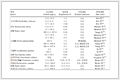
3 锆石U-Pb定年结果本文对林芝变质杂岩中的六个副变质岩样品进行了锆石U-Pb定年,其中五个样品为片麻岩,一个样品为片岩,分析结果见表 1。
|
表 1 林芝变质杂岩锆石LA-ICP-MS U-Pb定年结果 Table 1 LA-ICP-MS zircon U-Pb analytical data |
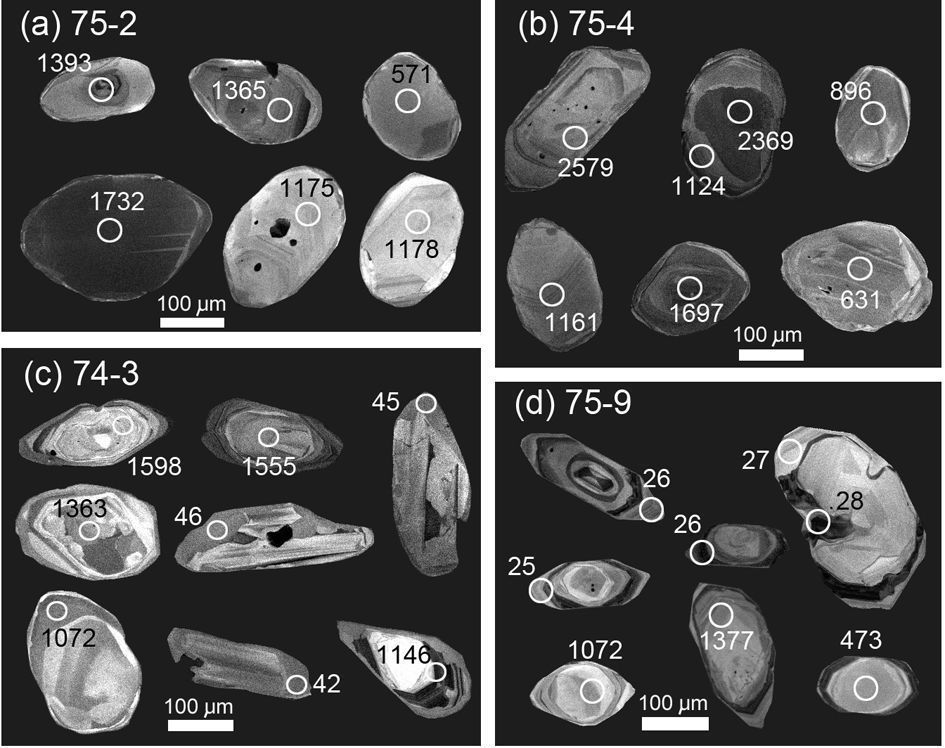
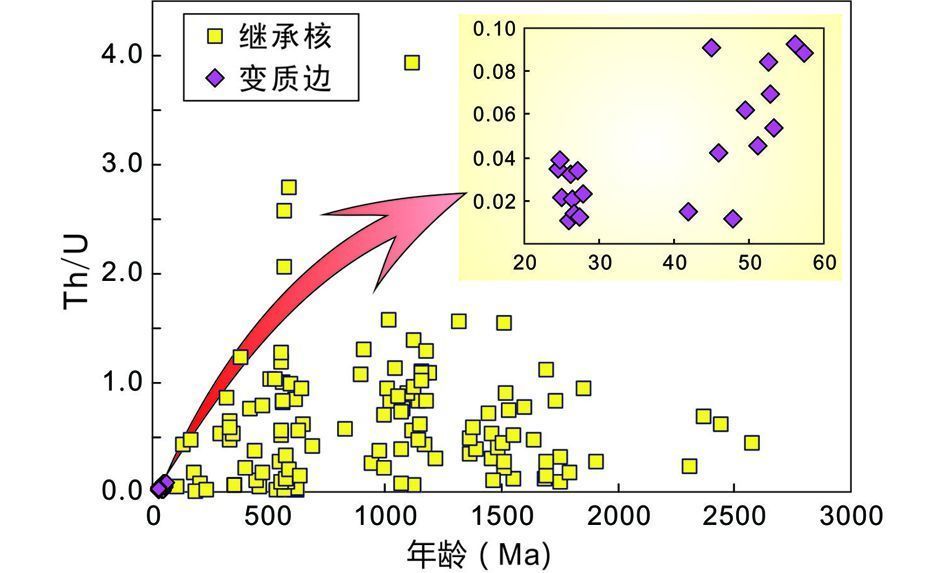
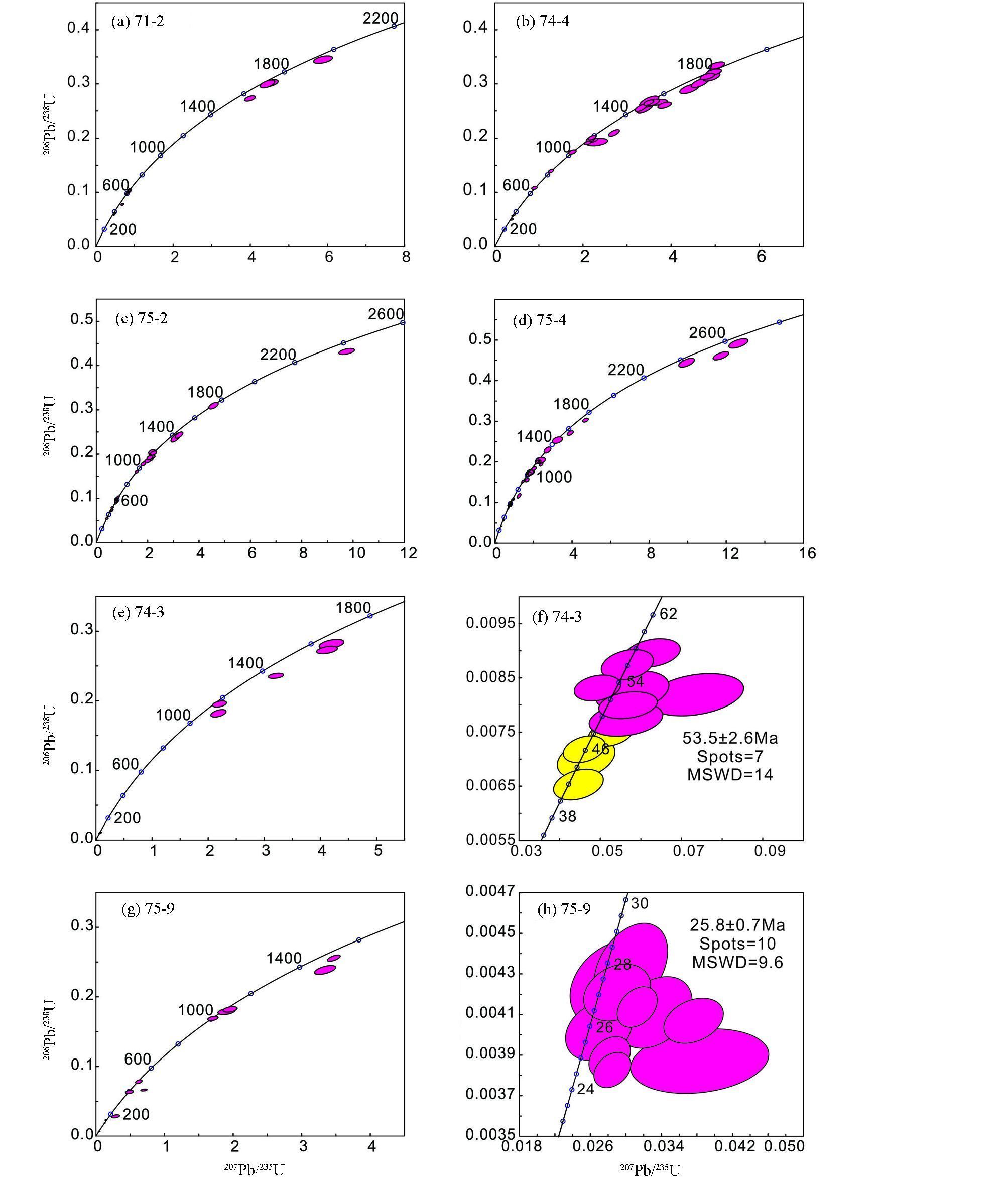
阴极发光图像显示,所研究六个样品中的锆石均具有核-边结构,即由一个继承的碎屑锆石核和一个变质生长边组成 (图 3)。继承锆石核多为椭圆形,多具有环带结构。锆石的变质边一般较窄,多不具环带结构。有两个样品的锆石边缘较宽,可以进行定年分析 (样品74-3和75-9;图 3c,d)。另外,个别锆石具有多期继承核,彼此显示出不同的发光特征 (如图 3b,第二颗锆石)。绝大部分继承锆石核具有较高的Th/U比值 (>0.1),而全部锆石的变质边和少量继承核具有较低的Th/U比值 (<0.1)(表 1和图 4)。上述的锆石内部结构、环带和Th/U比值特征表明,绝大多数的继承锆石核为岩浆结晶成因,而锆石的边缘为变质成因。
|
图 3 锆石的阴极发光图像和年龄分析点位及年龄值 Fig. 3 Cathodoluminescence images of the zircons, showing the analytical spots and their ages |
|
图 4 锆石的Th/U比值与年龄关系图 Fig. 4 Zircon Th/U versus U-Pb age diagram |
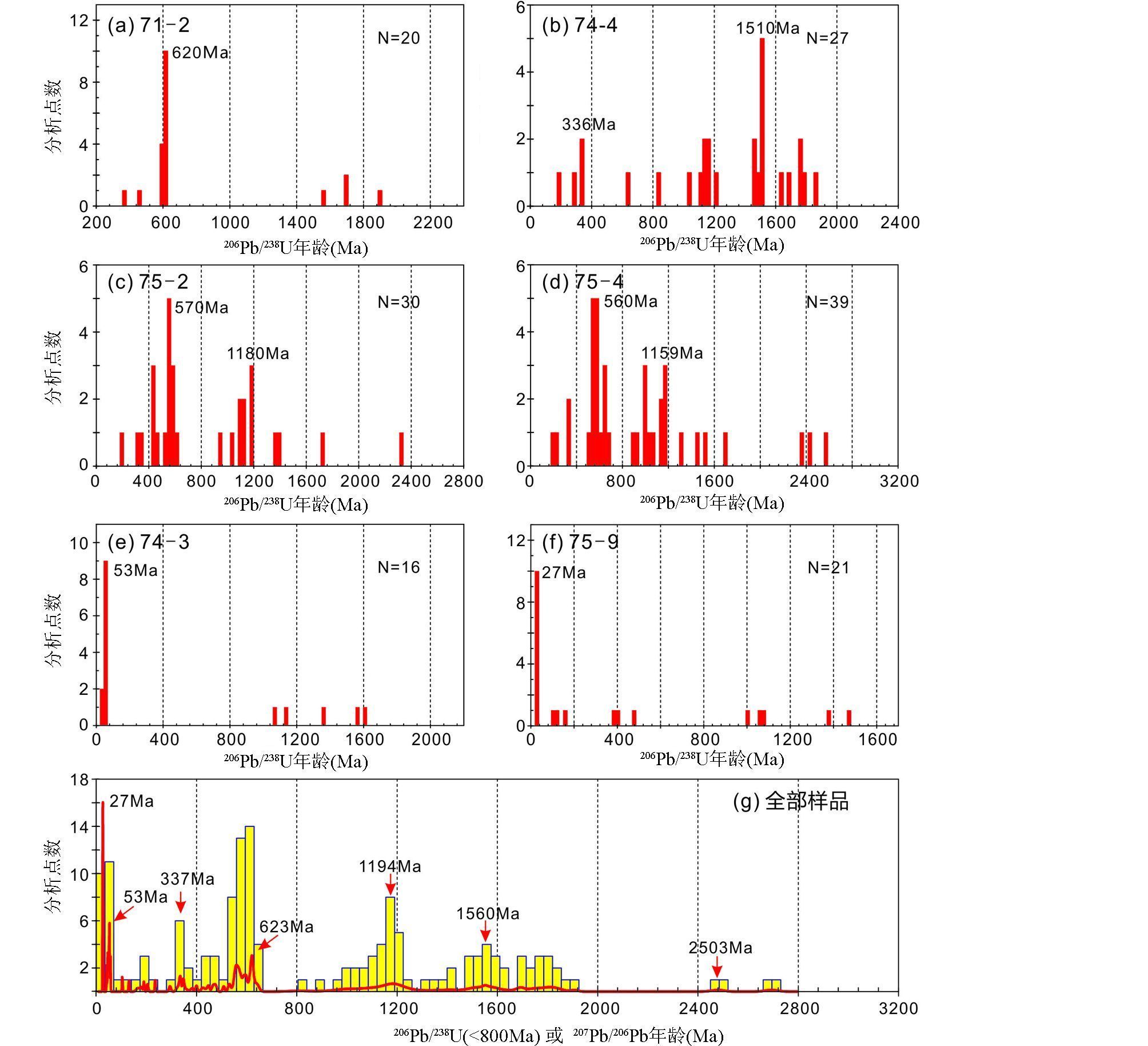
黑云二长片麻岩 (样品71-2) 中的继承锆石核给出了不同的206Pb/238U年龄,其范围在1909~358Ma之间,年龄峰值在620Ma (图 5a和图 6a)。黑云母二长片麻岩 (样品74-4) 中的继承锆石核给出的206Pb/238U年龄在1857~179Ma之间,两个主要年龄峰值分别在1510Ma和336Ma (图 5b和图 6b)。二云母石英片岩 (样品75-2) 中继承锆石核给出的206Pb/238U年龄在2313~205Ma之间,主要年龄峰值在1180Ma和570Ma (图 5c和图 6c)。二云钾长片麻岩 (样品75-4) 中继承锆石核获得的206Pb/238U年龄在2579~190Ma之间,主要年龄峰值在1159Ma和560Ma (图 5d和图 6d)。黑云斜长片麻岩 (样品74-3) 中继承锆石核的206Pb/238U年龄在1598~1072Ma之间,而变质边的206Pb/238U年龄在57~42Ma (图 5e,f和图 6e)。除去三个较小年龄分析点外 (图 5f中表示为黄色的分析点),其余七个分析点计算出的加权平均年龄为53.5±2.6Ma (图 5f)。二云二长片麻岩 (样品75-9) 中继承锆石核的206Pb/238U年龄在1465~104Ma之间,变质边的206Pb/238U年龄为28~25Ma,其加权平均年龄为25.8±0.7Ma (图 5g,h和图 6f)。
|
图 5 锆石U-Pb年龄谐和图 Fig. 5 Zircon U-Pb concordia diagrams |
|
图 6 锆石U-Pb或Pb-Pb年龄频率图 Fig. 6 Frequency diagrams of zircon U-Pb (or Pb-Pb) ages |
正如前面描述的,以前研究认为,拉萨地体中的中、高级变质岩为拉萨地体的前寒武纪结晶基底。同位素地球化学与年代学研究表明,拉萨地体很可能具有中元古代,甚至太古代的结晶基底。如Harris et al.(1988)在寒武纪的正片麻岩中获得了中元古代的Nd模式年龄。Chiu et al.(2009)和Zhu et al.(2009a, 2011a) 在三叠纪至白垩纪的岩浆岩中获得了中元古代至太古代的锆石Hf同位素地壳模式年龄。在拉萨地体北部那木错湖以西分布有一套高级变质岩,最初的锆石U-Pb定年获得了790~750Ma的原岩年龄 (Wu et al., 2004; 胡道功等, 2005),而角闪石Ar-Ar法定年却给出了更老的850Ma的变质年龄 (朱志勇等, 2004)。张泽明等 (2010)和Dong et al.(2011)研究表明,这套岩石中的变质基性岩具有900~850Ma的原岩年龄,所有岩石中的变质锆石给出了~670Ma的变质年龄。这是目前拉萨地体已知的最老岩浆和变质年龄,为拉萨地体具有古老结晶基底,并经历前寒武纪变质作用提供了确切证据。
本文所研究的林芝杂岩也被认为是前寒武纪结晶基底 (如李璞, 1955; Xu et al., 1985; 尹光候等, 2006)。但近来的研究表明,这些高级变质岩的原岩包括奥陶纪至石炭纪的沉积岩,以及早古生代的岩浆岩,它们在中、新生代经历了多期变质作用,变质作用时代从90Ma到30Ma (王金丽等, 2008, 2009; Dong et al., 2010; Zhang et al., 2010a)。最近,在拉萨地体中陆续发现了寒武至奥陶纪的岩浆岩 (如计文化等,2009;Dong et al., 2010; Zhu et al., 2012b),寒武系与奥陶系地层之间的角度不整合 (李才等,2010),表明拉萨地体中普遍存在晚泛非期的造山事件,林芝杂岩应该具有更古老的地壳物质组成。
由于本文所研究的岩石均经历了新生代的角闪岩相变质作用,部分继承锆石核的同位素体系有可能在变质过程中发生部分重置。因此,本文认为极少数继承锆石核所给出的中生代年龄 (<330Ma) 不具地质意义。本文的定年结果显示,有三件样品 (71-2,75-2和75-4) 给出了明显的新元古代晚期的年龄峰值 (图 6a,c, d),这给出了它们的沉积年龄上限。在另一个样品 (74-4) 和全部六个样的累积频率图上显示出~340Ma的石炭纪年龄峰值 (图 6b,g),这又指示它们的沉积年龄可能在中石炭世之后。对另外两个样品 (74-3和75-9),由于锆石核的分析点太少,并且年龄分散 (图 6e,f),无法进行形成年龄分析。基于现有资料,本文推测所研究的变质沉积岩的原岩形成于新元古代之后,而且不排除石炭纪之后的可能性,也不排除这些岩石具有不同的原岩年龄的可能性。
本研究表明,林芝变质杂岩变质沉积岩中继承的碎屑锆石年龄具有四个明显的峰值,分别在~1560Ma,~1190Ma,~620Ma和~340Ma (图 6g),这很可能表明林芝杂岩中的变质沉积岩来源于不同的物质源区。上述年龄峰值与全球性构造热事件具有较好的一致性。如前三个年龄峰值分别与Columbia、Rodinia和Gondwana超大陆的裂解或聚合事件相一致。而且,这样的年龄谱特征指示其物质源区来自Gondwana超大陆,进一步证明拉萨地体起源于Gondwana大陆北缘 (Chang and Zheng, 1973;Allègre et al., 1984; Dewey et al., 1988; Yin and Harrison, 2000)。
最近,对拉萨地体中的沉积岩和变质沉积岩进行了较深入的继承碎屑锆石定年研究,以其确定这些岩石的形成时代,以及拉萨地体的起源与构造演化。如Dong et al. (2010)的研究表明,林芝杂岩中副变质岩继承锆石的年龄峰值包括~1120Ma,~600Ma和~330Ma。但是,由于早古生代 (~500Ma) 正变质岩的存在,这些作者认为林芝变质杂岩的原岩形成于寒武纪或更早期。Zhu et al.(2011b, 2012a) 发现,拉萨地体古生代变质沉积岩中的继承锆石具有特征的1170Ma年龄峰值。这个峰值与西澳大利亚同时期沉积岩中碎屑锆石的年龄峰值一致,而不同于羌唐和特提斯喜马拉雅地体古生代沉积岩中继承碎屑锆石的年龄峰值 (~950Ma)。因此,这些作者认为拉萨地体可能起源于澳大利亚北缘,而并不是像大家普遍认为的,在新特提斯洋盆打开之前,拉萨地体与羌唐地体一起都位于印度大陆北缘 (Yin and Harrison, 2000)。
Guynn et al. (2012)和其他研究都认为,构成青藏高原的所有地体都缺少泥盆到石炭纪的火成岩和相关的碎屑锆石年龄记录,并认为这很可能是由于从奥陶到志留纪时期的持续板块汇聚,已经将所有洋盆关闭,导致组成青藏高原的所有地体,包括拉萨、羌唐、柴达木、祁连和阿尔金地体汇聚到塔里木-华北与印度克拉通之间,形成类似现代青藏高原的古造山高原。这个古造山高原的裂解发生在泥盆纪时期,导致了在羌唐地体以北形成了古特提斯洋盆 (Guynn et al., 2012)。但最近,晚泥盆世至早石炭世 (340~380Ma) 的岩浆岩被陆续发现在拉萨地体和相邻地区 (董昕等,2010;Dai et al., 2011)。本研究也表明,林芝杂岩中具有同时代的碎屑锆石年龄记录 (~340Ma),这表明拉萨地体经历了中古生代的岩浆与沉积作用,很可能暗示拉萨地体经历过与古特提斯洋形成有关的演化过程。最近,在拉萨地体中部发现了晚古生代造山作用的高压变质作用和岩浆作用证据,这很可能是晚古生代洋盆俯冲消减和南、北拉萨地体碰撞作用的产物 (杨经绥等,2006;Yang et al., 2009; Zeng et al., 2009)。
4.2 林芝杂岩的中、新生代变质作用与构造意义尽管以前的研究普遍认为拉萨地体的变质作用发生在前寒武纪,但并没有确切的变质年龄证据。近年来的研究表明,在拉萨地体的东南部,围绕东喜马拉雅构造结附近分布的林芝杂岩经历了中压角闪岩相至麻粒岩相变质作用,其变质作用发生在中、新生代。如董昕等 (2009)和Zhang et al.(2010b)在林芝岩群中获得了35Ma的角闪岩相变质年龄。王金丽等 (2009)和Zhang et al.(2010b)证明米林地区的林芝杂岩经历了麻粒岩相峰期和角闪岩相退变质作用,变质年龄在90~80Ma之间。Guo (2012)在林芝杂岩中获得了55Ma和40Ma的变质年龄。因此,林芝杂岩经历了中、新生代时期的复合变质作用。
正如前面描述的,在中生代,新特提斯大洋岩石圈向北部的拉萨地体之下俯冲,导致拉萨地体经历了长期的安第斯型造山作用,在拉萨地体南部形成了广泛分布的冈底斯岩基和同时代的火山岩。林芝杂岩的早期变质作用主要发生在晚白垩世,与冈底斯岩基的主要侵入时代一致。高级变质作用和岩浆作用的同时存在,进一步证明拉萨地体在印度-欧亚大陆碰撞前经历了强烈的安底斯型造山作用 (丁林和来庆洲,2003;Searle et al., 2011)。
尽管印度与欧亚大陆的碰撞时代还存在争议 (Aitchison et al., 2007; 莫宣学等,2007),但越来越多的证据表明,它们的碰撞作用发生在新生代早期,很可能是在55~45Ma (Sun et al., 2012)。在喜马拉雅造山带西段,已经发现了印度大陆深俯冲形成的超高压变质岩,这些岩石的变质时代在55~45Ma (O´Brien et al., 1999, 2001; Kaneko et al., 2003; Treloar et al., 2003; Leech et al., 2005; Ahmad et al., 2006; Parrish et al., 2006)。在喜马拉雅造山带中段和东段已经发现了高压榴辉岩或高压麻粒岩 (钟大赉和丁林, 1995; Liu and Zhong, 1997; Lombardo and Rolfo, 2000; Catlos et al., 2002; 李德威等, 2003; Groppo et al., 2007; Chakungal et al., 2010; Guilmette et al., 2011),但所获得的变质年龄多在40Ma之后 (Burg et al., 1998; Ding et al., 2001; Booth et al., 2004, 2009; Kohn et al., 2005, 2008; Liu et al., 2007, 2011; Cottle et al., 2009a, b; Corrie et al., 2010; Xu et al., 2010; Zhang et al., 2010b; Su et al., 2012; Zeng et al., 2012)。因此,有些学者提出印度大陆经历了穿时俯冲,即在造山带西段的俯冲作用发生在始新世早期,而在中、东段印度大陆的俯冲开始在始新世中晚期 (Guillot et al., 2007, 2008; Corrie et al., 2010; Oh, 2010)。但是,本研究和已有成果表明,喜马拉雅造山带东端的拉萨地体在早始新世 (55~40Ma) 经历了强烈的中压变质作用,这很可能是陆-陆碰撞造山作用的结果。因此,从变质作用发生时间的角度看,喜马拉雅造山带可能并不存在穿时性俯冲-碰撞作用。
地球上最壮观的板块汇聚事件就是印度大陆以每年18cm的速度向欧亚大陆运动、碰撞和碰撞后的继续俯冲。通常认为,轻的大陆板块发生碰撞后不能继续向下俯冲。但研究表明,至少有1000km宽的印度大陆岩石圈 (大印度) 已经被俯冲到欧亚大陆之下,俯冲所持续的时间已经有50Ma (如Ali and Aitchinson 2005; Capitanio et al., 2010; Douwe et al., 2011)。目前在喜马拉雅造山带所发现的高压和超高压变质岩及其形成年龄都很有限,这表明大量的陆壳岩石俯冲下去之后并没有再折返回到地表。那么是什么机制导致了大量轻的陆壳岩石发生持续俯冲,又是什么机理控制了少量高压、超高压变质岩的折返?这些是非常值得深入研究的重要问题。本文和已有的研究表明,拉萨地体在新生代的变质作用一起持续到渐新世 (~27Ma),为印度大陆持续俯冲导致青藏高原下地壳加厚造山提供了重要证据。
5 结论岩相学研究表明,拉萨地体东南部的林芝杂岩经历了中压角闪岩相变质作用。锆石U-Pb年代学研究表明,林芝杂岩中变质沉积岩的继承锆石具有新太古代,早中元古代 (~1560Ma)、晚中元古代 (~1190Ma) 和晚新元古代 (~620Ma) 的构造热事件记录,变质锆石记录了53Ma和27Ma的变质年龄。这些变质沉积岩的原岩应形成新元古代之后,也可能是在石炭纪以后,它们的物质源区主要是Gondwana大陆。林芝杂岩的早始新世变质作用很可能发生在印度与欧亚大陆的碰撞造山过程中,而早渐新世的变质作用发生印度大陆的持续俯冲造山过程中。因此,本研究进一步证明拉萨地体东南部的变质岩并不是前寒武纪变质基底,而是新元古代之后形成的沉积岩在新生代的造山过程中经历了多期变质作用。
致谢 感谢金振民院士在工作中的指导!感谢朱弟成教授审阅全文并提出重要修改意见。| [] | Ahmad T, Tanaka T, Sachan HK and Mukherjee PK. 2006. Petrogenesis of coesite bearing Tso Morari eclogites: Isotopic and elemental constraints. Journal of Asian Earth Sciences, 26: 121. DOI:10.1016/j.jseaes.2006.02.001 |
| [] | Aitchison JC, Ali JR and Davis AM. 2007. When and where did India and Asia collide?. Journal of Geophysical Research, 112: B05423. |
| [] | Ali JR and Aitchinson JC. 2005. Greater India. Earth Sciences Reviews, 72: 169–188. DOI:10.1016/j.earscirev.2005.07.005 |
| [] | Allegre CJ and other 34 authors. 1984. Structure and evolution of the Himalayan-Tibet orogenic belt. Nature, 307: 17–22. DOI:10.1038/307017a0 |
| [] | Booth A, Zeitler P, Kidd W, Wooden J, Liu Y, Idleman B, Hren M and Chamberlain P. 2004. U-Pb zircon constraints onthe tectonic evolution of southeastern Tibet, Namche Barwa area. American Journal of Science, 304: 889–929. DOI:10.2475/ajs.304.10.889 |
| [] | Booth AL, Chamberlain CP, Kidd WSF and Zeitler PK. 2009. Constraints on the metamorphic evolution of the eastern Himalayan syntaxis from geochronological and petrologic studies of Namche Barwa. Geological Society of America Bulletin, 121: 385–407. DOI:10.1130/B26041.1 |
| [] | Burg JP, Nievergelt P, Oberli F, Seward D, Davy P, Maurin JC, Diao ZZ and Meier M. 1998. The Namche Barwa syntaxis: Evidence for exhumation related to compressional crustal folding. Journal of Earth Sciences, 16: 239–252. |
| [] | Capitanio FA, Morra G, Goes S, Weinberg RF and Moresi L. 2010. India-Asia convergence driven by the subduction of the Greater Indian continent. Nature Geoscience, 3: 136–139. DOI:10.1038/ngeo725 |
| [] | Catlos EJ, Harrison TM, Manning CE, Grove M, Rai SM, Hubbard M and Upreti BN. 2002. Records of the evolution of the Himalayan orogen from in situ Th-Pb ion microprobe dating of monazite: Eastern Nepal and western Garhwal. Journal of Asian Earth Sciences, 20: 459–479. DOI:10.1016/S1367-9120(01)00039-6 |
| [] | Chakungal J, Dostal J, Grujic D, Duchene S and Ghalley KS. 2010. Provenance of the Greater Himalayan sequence: Evidence from mafic granulites and amphibolites in NW Bhutan. Tectonophysics, 480: 198–212. DOI:10.1016/j.tecto.2009.10.014 |
| [] | Chang CF and Zheng SL. 1973. Tectonic features of the Mount Jolmo Lungma region in southern Tibet, China. Scientia Geologica Sinica, 1: 1–12. |
| [] | Chiu HY, Chung SL, Wu FY, Liu D, Liang YH, Lin IJ, Iizuka Y, Xie LW, Wang Y and Chu MF. 2009. Zircon U-Pb and Hf isotopic constraints from eastern Transhimalayan batholiths on the precollisional magmatic and tectonic evolution in southern Tibet. Tectonophysics, 477: 3–19. DOI:10.1016/j.tecto.2009.02.034 |
| [] | Chu MF, Chung SL, Liu DY, O'Reilly SY and Pearson NJ. 2006. Zircon U-Pb and Hf isotope constraints on the Mesozoic tectonics and crustal evolution of southern Tibet. Geological Society of America, 34: 745–748. |
| [] | Chung SL, Liu DY, Ji WQ, Chu MF, Lee HY, Wen DJ, Lo CH, Lee TY, Qing Q and Zhang Q. 2003. Adakites from continental collision zones: Melting of thickened lower crust beneath southern Tibet. Geology, 31: 1021–1024. DOI:10.1130/G19796.1 |
| [] | Chung SL, Chu MF, Zhang Y, Lo CH, Lee TY, Lan CY, Li X, Zhang Q and Wang Y. 2005. Tibetan tectonic evolution inferred from spatial and temporal variations in post-collisional magmatism. Earth Science Reviews, 68: 173–196. |
| [] | Corrie SL, Kohn MJ and Vervoort JD. 2010. Young eclogite from the Greater Himalayan Sequence, Arun Valley, eastern Nepal: P-T-t path and tectonic implications. Earth and Planetary Science Letters, 289: 406–416. DOI:10.1016/j.epsl.2009.11.029 |
| [] | Cottle JM, Jessup MJ and Dennis L. 2009a. Geochronology of granulitized eclogite from the Ama Drime Massif: Implications for the tectonic evolution of the South Tibetan Himalaya. Tectonics, 28: TC1002. |
| [] | Cottle JM, Searle MP, Horstwood MSA and Waters DJ. 2009b. Timing of midcrustal metamorphism, melting, and deformation in the Mount Everest Region of southern Tibet revealed by U (-Th)-Pb geochronology. The Journal of Geology, 117: 643–664. DOI:10.1086/605994 |
| [] | Dai JG, Wang CS, Hébert R, Li YL, Zhong HT, Guillaume R, Bezard R and Wei YH. 2011. Late Devonian OIB alkaline gabbro in the Yarlung Zangbo Suture Zone: Remnants of the Paleo-Tethys?. Gondwana Research, 19: 232–243. DOI:10.1016/j.gr.2010.05.015 |
| [] | Dewey JF, Shackelton RM, Chang C and Sun Y. 1988. The tectonic evolution of the Tibetan Plateau. Philosophical Transactions of the Royal Society of London, 327: 379–413. DOI:10.1098/rsta.1988.0135 |
| [] | Ding L and Zhong DL. 1999. Metamorphism and tectonic implication of the high-pressure granulite from the Namche Barwa, Southern Tibet. Chinese in Science (Series D), 29(5): 385–397. |
| [] | Ding L, Zhong DL, Yin A, Kapp P and Harrison TM. 2001. Cenozoic structural and metamorphic evolution of the eastern Himalaya syntaxis (Namche Barwa). Earth and Planetary Science Letters, 192: 423–438. DOI:10.1016/S0012-821X(01)00463-0 |
| [] | Ding L, Kapp P, Zhong DL and Deng WM. 2003. Cenozoic volcanism in Tibet: Evidence for a transition from oceanic to continental subduction. Journal of Petrology, 44: 1833–1865. DOI:10.1093/petrology/egg061 |
| [] | Ding L and Lai QZ. 2003. New geological evidence of crustal thickening in the Gangdese block prior to Indo-Asian collision. Chinese Science Bulletin, 48(8): 836–842. |
| [] | Dong X, Zhang ZM, Wang JL, Zhao GC, Li F, Wang W and Yu F. 2009. Provenance and formation age of the Nyignchi Group in the southern Lhasa terrane, Tibetan Plateau: Petrology and zircon U-Pb geochronology. Acta Petrologica Sinica, 25(7): 1678–1694. |
| [] | Dong X, Zhang ZM and Santosh M. 2010. Zircon U-Pb Chronology of the Nyingtri Group, Southern Lhasa Terrane, Tibetan Plateau: Implications for Grenvillian and Pan-African Provenance and Mesozoic-Cenozoic Metamorphism. The Journal of Geology, 118: 677–690. DOI:10.1086/656355 |
| [] | Dong X, Zhang ZM, Geng GS, Liu F, Wang W and Yu F. 2010. Devonian magmatism from the southern Lhasa terrane, Tibetan Plateau. Acta Petrologica Sinica, 26(7): 2226–2232. |
| [] | Dong X, Zhang ZM, Santosh M, Wang W, Yui F and Liu F. 2011. Late Neoproterozoic thermal events in the northern Lhasa Terrane, South Tibet: Zircon chronology and tectonic implications. Journal of Geodynamics, 52: 389–405. DOI:10.1016/j.jog.2011.05.002 |
| [] | Douwe J, van Hinsbergen J, Kapp P, Dupont-Nivet G, Lippert PC, DeCelles PG and Torsvik TH. 2011. Restoration of Cenozoic deformation in Asia and the size of Greater India. Tectonics, 30: TC5003. |
| [] | Geng QR, Pan GT, Zheng LL, Chen ZL, Fisher RD, Sun ZM, Ou CS, Dong H, Wang XW, Li S, Lou XY and Fu H. 2006. The Eastern Himalayan syntaxis: Major tectonic domains, ophiolitic mélanges and geologic evolution. Journal of Asian Earth Sciences, 27: 265–285. DOI:10.1016/j.jseaes.2005.03.009 |
| [] | Groppo C, Lombardo B, Rolfo F and Pertusati P. 2007. Clockwise exhumation path of granulitized eclogites from the Ama Drime range (Eastern Himalayas). Journal of Metamorphic Geology, 25: 51–75. DOI:10.1111/jmg.2007.25.issue-1 |
| [] | Guillot S, Replumaz A, Hattori K and Strzerzynski P. 2007. Initial geometry of western Himalaya and ultrahigh pressure metamorphic evolution. Journal of Asian Earth Sciences, 30: 557–564. DOI:10.1016/j.jseaes.2007.01.004 |
| [] | Guillot S, Maheo G, de Sigoyer J, Hattori KH and Pecher A. 2008. Tethyan and Indian subduction viewed from the Himalayan high-to ultrahigh-pressure metamorphic rocks. Tectonophysics, 451: 225–241. DOI:10.1016/j.tecto.2007.11.059 |
| [] | Guilmette C, Indares A and Hebert R. 2011. High-pressure anatectic paragneisses from the Namche Barwa, Eastern Hiamlayan Syntaxis: Textural evidence for partial melting, phase equilibria modeling and tectonic implications. Lithos, 124: 61–81. |
| [] | Guo L, Zhang HF, Harris N, Pan FB and Xu WC. 2011. Origin and evolution of multi-stage felsic melts in eastern Gangdese belt: Constraints from U-Pb zircon dating and Hf isotopic composition. Lithos, 127: 54–67. DOI:10.1016/j.lithos.2011.08.005 |
| [] | Guo L, Zhang HF, Harris N, Parrish R, Xu WC and Shi ZL. 2012. Paleogene crustal anatexis and metamorphism in Lhasa terrane, eastern Himalayan syntaxis: Evidence from U-Pb zircon ages and Hf isotopic compositions of the Nyingchi Complex. Gondwana Research, 21: 100–111. DOI:10.1016/j.gr.2011.03.002 |
| [] | Guo ZF, Wilson M and Liu JQ. 2007. Post-collisional adakites in south Tibet: Products of partial melting of subduction-modified lower crust. Lithos, 96: 205–224. DOI:10.1016/j.lithos.2006.09.011 |
| [] | Guynn J, Kapp P, Gehrels GE and Ding L. 2012. U-Pb geochronology of basement rocks in central Tibet and paleogeographic implications. Journal of Asian Earth Sciences, 43: 23–50. DOI:10.1016/j.jseaes.2011.09.003 |
| [] | Harris NBW, Xu RH, Lewis CL, Hawkeworth CL and Zhang YQ. 1988. Isotope geochemistry of the 1985 Tibet Geotraverse, Lhasa to Golmud. Philosophical Transactions of the Royal Society of London, 327(Series A): 263–285. |
| [] | He SD, Kapp P, DeCelles PG, Gehrels GE and Heizler M. 2007. Cretaceous-Tertiary geology of the Gangdese arc in the Linzhou area, southern Tibet. Tectonophysics, 433: 15–37. DOI:10.1016/j.tecto.2007.01.005 |
| [] | Hou ZQ, Gao YF, Qu XM, Rui ZY and Mo XX. 2004. Origin of adakitic intrusives generated during Mid-Miocene east-west extension in southern Tibet. Earth and Planetary Science Letters, 220: 139–155. DOI:10.1016/S0012-821X(04)00007-X |
| [] | Hou ZQ, Wang EQ, Mo XX, Ding L, Pan GT and Zhang ZJ. 2008. Collisional Orogeny and Metallogenesis of the Tibetan Plateau. Beijing: Geological Publishing House. |
| [] | Hu DG, Wu ZH, Ye PS and Jiang W. 2003. SHRIMP U-Pb ages of zircons from dioritic gneiss in the Nyainqêntanglha Mountains, Tibet. Geological Bulletin of China, 22(11-12): 936–940. |
| [] | Hu DG, Wu ZH, Jiang W, Shi YR, Ye PS and Liu QS. 2005. SHRIMP zircon U-Pb dating and Nd isotope research of Nyainqentanglha group, Tibet. Science in China (Series D), 35(1): 29–37. |
| [] | Ji WH, Chen SJ, Zhao ZM, Li RS, He SP and Wang C. 2009. Discovery of the Cambrian volcanic rocks in the Xainza area, Gangdese orogenic belt, Tibet, China and its significance. Geological Bulletin of China, 28: 1350–1354. |
| [] | Ji WQ, Wu FY, Chung SL, Li JX and Liu CZ. 2009. Zircon U-Pb geochronology and Hf isotopic constraints on petrogenesis of the Gangdese batholith, southern Tibet. Chemical Geology, 262: 229–245. DOI:10.1016/j.chemgeo.2009.01.020 |
| [] | Kapp JLDA, Harrison TM, Kapp P, Grove M, Lovera OM and Ding L. 2005. Nyainqentanglha Shan: A window into the tectonic, thermal, and geochemical evolution of the Lhasa block, southern Tibet. Journal of Geophysical Research, 110: B08413.1–B08413.23. |
| [] | Kaneko Y, Katayama I, Yamamoto H, Misawa K, Ishikawa M, Rehman HU, Kausar AB and Shiraishi K. 2003. Timing of Himalayan ultrahigh pressure metamorphism: Sinking rate and subduction angle of the Indian continental crust beneath Asia. Journal of Metamorphic Geology, 21: 589–599. DOI:10.1046/j.1525-1314.2003.00466.x |
| [] | Kohn MJ, Wieland MS, Parkinson CD and Upreti BN. 2005. Five generations of monazite in Langtang gneisses: Implications for chronology of the Himalayan metamorphic core. Journal of Metamorphic Geology, 23: 399–406. DOI:10.1111/jmg.2005.23.issue-5 |
| [] | Kohn MJ. 2008. P-T-t data from central Nepal support critical taper and repudiate large-scale channel flow of the Greater Himalayan Sequence. Geological Society of America Bulletin, 120: 259–273. DOI:10.1130/B26252.1 |
| [] | Leech ML, Singh S, Jain AK, Klemperer SL and Manickavasagam RM. 2005. The onset of India-Asia continental collision: Early, steep subduction required by timing of UHP metamorphism in the western Himalaya. Earth and Planetary Science Letters, 234: 83–97. DOI:10.1016/j.epsl.2005.02.038 |
| [] | Li C, Wu YW, Wang M and Yang HT. 2010. Significant progress on Pan-African and Early Paleozoic orogenic events in Qinghai-Tibet Plateau: Discovery of Pan-African orogenic unconformity and Cambrian System in the Gandies area, Tibet, China. Geological Bulletin of China, 29(12): 1733–1736. |
| [] | Li DW, Liao QA, Yuan YM, Wang YS, Liu DM, Zhang XH, Yi SH, Cao SZ and Xie DF. 2003. Zircon U-Pb chronology of the Rimana granulite from the central part of the Himalayan orogen. Chinese Science Bulletin, 48(20): 1350–1354. |
| [] | Li P. 1995. Primary study of the eastern Tibetan geology. Chinese Science Bulletin, 7: 62–71. |
| [] | Liao ZL, Mo XX, Pan GT, Zhu DC, Wang LQ, Jiang XS and Zhao ZD. 2007. Spatial and temporal distribution of peraluminous granites in Tibet and their tectonic significance. Journal of Asian Earth Sciences, 29: 378–389. DOI:10.1016/j.jseaes.2006.07.011 |
| [] | Liu Y and Zhong D. 1997. Petrology of high-pressure granulites from the eastern Himalayan syntaxis. Journal of Metamorphic Geology, 15: 451–466. DOI:10.1111/j.1525-1314.1997.00033.x |
| [] | Liu Y, Yang Z and Wang M. 2007. History of zircon growth in a high-pressure granulite within the eastern Himalayan Syntaxis, and tectonic implications. International Geology Review, 49: 861–872. DOI:10.2747/0020-6814.49.9.861 |
| [] | Liu Y, Siebel W, Theye T and Massonne HJ. 2011. Isotopic and structural constraints on the Late Miocene to Pliocene evolution of the Namche Barwa area, eastern Himalayan syntaxis, SE Tibet. Gondwana Research, 19: 894–909. DOI:10.1016/j.gr.2010.11.005 |
| [] | Liu YS, Hu ZC, Gao S, Detlef G, Xu J, Gao CG and Chen HH. 2008. In situ analysis of major and trace elements of anhydrous minerals by LA-ICP-MS without applying an internal standard. Chemical Geology, 257: 34–43. DOI:10.1016/j.chemgeo.2008.08.004 |
| [] | Liu YS, Gao S, Hu ZC, Gao CG, Zong KQ and Wang DB. 2010. Continental and oceanic crust recycling-induced melt-peridotite interactions in the Trans-North China orogen: U-Pb dating, Hf isotopes and trace elements in zircons of mantle xenoliths. Journal of Petrology, 51: 537–571. DOI:10.1093/petrology/egp082 |
| [] | Lombardo B and Rolfo F. 2000. Two contrasting eclogite types in the Himalayas: Implications for the Himalayan orogeny. Journal of Geodynamics, 30: 37–60. DOI:10.1016/S0264-3707(99)00026-5 |
| [] | Ludwig KR. 2001. Users Manual for Isoplot/Ex: A Geochronoligical Toolkit for Microsoft Excel. Berkeley, CA: Berkeley Geochronology Center Special Publication: 1-50. |
| [] | Mo XX, Dong GC, Zhao ZD, Zhou S, Wang LL, Qiu RZ and Zhang FQ. 2005. Spatial and temporal distribution and characteristics of granitoids in the Gangdese, Tibet and implication for crustal growth and evolution. Geological Journal of China Universities, 11(3): 281–290. |
| [] | Mo XX, Hou ZQ, Niu YL, Dong GC, Qu XM, Zhao ZD and Yang ZM. 2007. Mantle contributions to crustal thickening during continental collision: Evidence from Cenozoic igneous rocks in southern Tibet. Lithos, 96: 225–242. DOI:10.1016/j.lithos.2006.10.005 |
| [] | Mo XX, Zhao ZD, Zhou S, Dong GC and Liao ZL. 2007. On the timing of India-Asia continental collision. Geological Bulletin of China, 26(10): 1240–1244. |
| [] | Mo XX, Niu YL, Dong GC, Zhao ZD, Hou ZQ, Zhou S and Ke S. 2008. Contribution of syncollisional felsic magmatism to continental crust growth: A case study of the Paleogene Linzizong volcanic succession in southern Tibet. Chemical Geology, 250: 46–67. |
| [] | Nomade S, Renne PR, Mo XX, Zhao ZD and Zhou S. 2004. Miocene volcanism in the Lhasa block, Tibet: Spatial trends and geodynamic implications. Earth and Planetary Science Letters, 221: 227–243. DOI:10.1016/S0012-821X(04)00072-X |
| [] | O'Brien P, Zotov N and Law R. 1999. First discovery of coesite in the Kaghan eclogites (Pakistan): Implications for Himalayan evolution. Terra Nova, 2: 109–111. |
| [] | O'Brien P, Zotov N, Law R, Khan AM and Jan MQ. 2001. Coesite in Himalayan eclogite and implication for models of India-Asia collision. Geology, 29: 435–438. DOI:10.1130/0091-7613(2001)029<0435:CIHEAI>2.0.CO;2 |
| [] | Oh CW. 2010. Systematic changes in metamorphic styles along the Dabie-Hongseong and Himalayan collision belts, and their tectonic implications. Journal of Asian Earth Sciences, 39: 635–644. DOI:10.1016/j.jseaes.2010.04.018 |
| [] | Pan GT, Li XZ, Wang LQ, Ding J and Chen ZL. 2002. Preliminary division of tectonic units of the Qinghai-Tibet Plateau and its adjacent regions. Geological Bulletin of China, 21(11): 701–707. |
| [] | Pan GT, Ding J and Yao DS. 2004. The Geological Map of the Tibetan Plateau and Surrounding Area on Scale 1:1500000. Chengdu: Chengdu Geological Press. |
| [] | Pan GT, Mo XX, Hou ZQ, Zhu DC, Wang LQ, Li GM, Zhao ZD, Geng QR and Liao ZL. 2006. Spatial-temporal framework of the Gangdese Orogenic Belt and its evolution. Acta Petrologica Sinica, 22(3): 521–533. |
| [] | Pan GT, Wang LQ, Li RS, Yuan SH, Ji WH, Yin FG, Zhang WP and Wang BD. 2012. Tectonic evolution of the Qinghai-Tibet Plateau. Journal of Asian Earth Sciences. DOI:10.1016/j.jseaes.2011.12.018 |
| [] | Parrish R, Gough SJ, Searle M and Dave W. 2006. Plate velocity exhumation of ultra high-pressure eclogites in the Pakistan Himalaya. Geology, 34: 989–992. DOI:10.1130/G22796A.1 |
| [] | Qu XM, Hou ZQ and Li YG. 2004. Melt components derived from a subducted slab in late orogenic ore-bearing porphyries in the Gangdese copper belt, southern Tibetan Plateau. Lithos, 74: 131–148. DOI:10.1016/j.lithos.2004.01.003 |
| [] | Qu XM, Hou ZQ, Zaw K and Li YG. 2007. Characteristics and genesis of Gangdese porphyry copper deposits in the southern Tibetan Plateau: Preliminary geochemical and geochronological results. Ore Geology Reviews, 31: 205–223. DOI:10.1016/j.oregeorev.2005.03.012 |
| [] | Searle MP, Elliott JR, Phillips RJ and Chung SL. 2011. Crustal-lithospheric structure and continental extrusion of Tibet. Journal of the Geological Society, 168: 633–672. DOI:10.1144/0016-76492010-139 |
| [] | Su W, Zhang M, Liu X, Lin J, Ye K and Liu X. 2012. Exact timing of granulite metamorphism in the Namche-Barwa, eastern Himalayan syntaxis: New constrains from SIMS U-Pb zircon age. International Journal of Earth Sciences, 101: 239–252. DOI:10.1007/s00531-011-0656-0 |
| [] | Sun ZM, Pei JL, Li HB, Xu W, Jiang W, Zhu ZM, Wang XS and Yang ZY. 2012. Palaeomagnetism of Late Cretaceous sediments from southern Tibet: Evidence for the consistent palaeolatitudes of the southern margin of Eurasia prior to the collision with India. Gondwana Research, 21: 53–63. DOI:10.1016/j.gr.2011.08.003 |
| [] | Treloar PJ, O'Brian PJ, Parrish RR and Khan AM. 2003. Exhumation of Early Tertiary, coesite-bearing eclogites from the Pakistan Himalaya. Journal of the Geological Society of London, 160: 367–376. DOI:10.1144/0016-764902-075 |
| [] | Wang JL, Zhang ZM and Shi C. 2008. Anatexis and dynamics of the Lhasa terrane in the eastern Himalayan syntaxis, Tibet. Acta Petrologica Sinica, 24(7): 1539–1551. |
| [] | Wang JL, Zhang ZM, Dong X, Liu F, Yu F, Wang W, Xu FJ and Sen K. 2009. Discovery of Late Cretaceous garnet two-pyroxene granulite in the southern Lhasa terrane, Tibet and its tectonic significances. Acta Petrologica Sinica, 25(7): 1695–1706. |
| [] | Wen DR, Chung SL, Song B, Iizuka Y, Yang HJ, Ji JQ, Liu DY and Gallet S. 2008a. Late Cretaceous Gangdese intrusions of adakitic geochemical characteristics, SE Tibet: Petrogenesis and tectonic implications. Lithos, 105: 1–11. DOI:10.1016/j.lithos.2008.02.005 |
| [] | Wen DR, Liu DY, Chung SL, Chu MF, Ji JQ, Zhang Q, Song B, Lee TY, Yeh MW and Lo CH. 2008b. Zircon SHRIMP U-Pb ages of the Gangdese Batholith and implications for Neotethyan subduction in southern Tibet. Chemical Geology, 252: 191–201. DOI:10.1016/j.chemgeo.2008.03.003 |
| [] | Whitney DL and Evans BW. 2010. Abbreviations for names of rock-forming minerals. American Mineralogist, 95: 185–187. DOI:10.2138/am.2010.3371 |
| [] | Wu ZH, Hu DG, Ye PS, Zhao X and Liu QS. 2004. Thrusting of the north Lhasa block in the Tibetan Plateau. Acta Geologica Sinica, 78: 246–259. |
| [] | Xia LQ, Li XM, Ma ZP, Xu XY and Xia ZC. 2011. Cenozoic volcanism and tectonic evolution of the Tibetan Plateau. Gondwana Research, 19: 850–866. DOI:10.1016/j.gr.2010.09.005 |
| [] | Xiao XC and Li TD. 2000. Tectonic Evolution and Uplift Mechanism of the Tibetan Plateau. Guangdong: Guangdong Scientific and Technological Press. |
| [] | Xie YW, Peng XJ, Qiangbazhaxi, Xiluolangjie, Cirenyangjin. 2007. Recent progress in the study of the Neoproterozoic-Cambrian Bomi Group in the Bomi-Zayüarea, eastern Tibet, China. Geological Bulletin of China, 26(1): 81–87. |
| [] | Xu RH, Schérer U and Allégre CJ. 1985. Magmatism and metamorphism in the Lhasa block (Tibet): A geochronological study. Journal of Geology, 3: 41–57. |
| [] | Xu WC, Zhang HF, Parrish R, Harris N, Guo L and Yuan HL. 2010. Timing of granulite-facies metamorphism in the eastern Himalayan syntaxis and its tectonic implications. Tectonophysics, 485: 231–244. DOI:10.1016/j.tecto.2009.12.023 |
| [] | Xu ZQ, Li HB and Yang JS. 2006. An orogenic plateau: The orogenic collage and orogenic types of the Qinghai-Tibet Plateau. Earth Science Frontiers, 13(4): 1–17. |
| [] | Xu ZQ, Ji SC, Cai ZH, Zeng LS, Geng QR and Cao H. 2012. Kinematics and dynamics of the Namche Barwa Syntaxis, eastern Himalaya: Constraints from deformation, fabrics and geochronology. Gondwana Research, 21: 19–36. DOI:10.1016/j.gr.2011.06.010 |
| [] | Yang JS, Xu ZQ, Geng QR, Li ZL, Xu XZ, Li TF, Ren YF, Li HQ, Liang FH and Chen SY. 2006. A possible new HP/UHP metamorphic belt in China: Discovery of eclogite in the Lhasa terrane, Tibet. Acta Geologica Sinica, 80(12): 1787–1792. |
| [] | Yang JS, Xu ZQ, Li ZL, Xu XZ, Li TF, Ren YF, Li HQ, Chen SY and Robinson PT. 2009. Discovery of an eclogite belt in the Lhasa block, Tibet: A new border for Paleo-Tethys?. Journal of Asian Earth Sciences, 34: 76–89. DOI:10.1016/j.jseaes.2008.04.001 |
| [] | Yin A and Harrison TM. 2000. Geologic evolution of the Himalayan Tibetan Orogen. Ann. Rev. Earth and Planetary Science Letters, 28: 211–280. DOI:10.1146/annurev.earth.28.1.211 |
| [] | Yin GH, Bao G, Yang SS and Hu WH. 2006. The granulites and ages of the Nyingchi Group Complex in the Nyingchi region, Xizang. Sedimentary Geology and Tethyan Geology, 26(3): 8–15. |
| [] | Zeng LS, Liu J, Gao LE, Chen FY and Xie KJ. 2009. Early Mesozoic high-pressure metamorphism within the Lhasa block, Tibet and implications for regional tectonics. Earth Science Frontiers, 16: 140–151. |
| [] | Zeng LS, Gao LE, Dong CY and Tang SH. 2012. High-pressure melting of metapelite and the formation of Ca-rich granitic melts in the Namche Barwa Massif, southern Tibet. Gondwana Research, 21: 138–151. DOI:10.1016/j.gr.2011.07.023 |
| [] | Zhang ZM, Zheng LL, Wang JL, Zhao XD and Shi C. 2007. Garnet pyroxenite in the Namjagbarwa Group-complex in the eastern Himalayan tectonic syntaxis, Tibet, China: Evidence for subduction of the Indian continent beneath the Eurasian plate at 80~100km depth. Geological Bulletin of China, 26(1): 3–12. |
| [] | Zhang ZM, Zhao GC, Santosh M, Wang JL, Dong X and Liou JG. 2010a. Two stages of granulite facies metamorphism in the eastern Himalayan syntaxis, South Tibet: Petrology, zircon geochronology and implications for the subduction of Neo-Tethys and the Indian continent beneath Asia. Journal of Metamorphic Geology, 28: 719–733. |
| [] | Zhang ZM, Zhao GC, Santosh M, Wang JL, Dong X and Shen K. 2010b. Late Cretaceous charnockite with adakitic affinities from the Gangdese batholith, southeastern Tibet: Evidence for Neo-Tethyan mid-ocean ridge subduction?. Gondwana Research, 17: 615–631. DOI:10.1016/j.gr.2009.10.007 |
| [] | Zhang ZM, Dong X, Geng GS, Wang W, Yui F and Liu F. 2010. Precambrian metamorphism of the northern Lhasa terrane, South Tibet and its tectonic implications. Acta Geologica Sinica, 84(4): 449–456. |
| [] | Zhang ZM, Dong X, Santosh M, Liu F, Wang W, Yiu F, He ZY and Shen K. 2012. Petrology and geochronology of the Namche Barwa Complex in the eastern Himalayan syntaxis, Tibet: Constraints on the origin and evolution of the north-eastern margin of the Indian Craton. Gondwana Research, 21: 123–137. DOI:10.1016/j.gr.2011.02.002 |
| [] | Zhao ZD, Mo XX, Dilek Y, Niu YL, DePaolo DJ, Robinson P, Zhu DC, Sun CG, Dong GC, Zhou S, Luo ZH and Hou ZQ. 2009. Geochemical and Sr-Nd-Pb-O isotopic compositions of the post-collisional ultrapotassic magmatism in SW Tibet: Petrogenesis and implications for India intra-continental subduction beneath southern Tibet. Lithos, 113: 190–212. DOI:10.1016/j.lithos.2009.02.004 |
| [] | Zhong DL and Ding L. 1995. Finding of the high-pressure granulite from the Namche Barwa, southern Tibet. Chinese Science Bulletin, 40(14): 1343. |
| [] | Zhu DC, Pan GT, Wang LQ, Mo XX, Zhao ZD, Zhou CY, Liao ZL, Dong GC and Yuan SH. 2008a. Spatial-temporal distribution and tectonic setting of Jurassic magmatism in the Gangdise belt, Tibet, China. Geological Bulletin of China, 27(4): 458–468. |
| [] | Zhu DC, Pan GT, Wang LQ, Mo XX, Zhao ZD, Zhou GY, Liao ZL, Dong GC and Yuan SH. 2008b. Tempo-spatial variations of Mesozoic magmatic rocks in the Gangdise belt, Tibet, China, with a discussion of geodynamic setting-related issue. Geological Bulletin of China, 27(9): 1535–1550. |
| [] | Zhu DC, Mo XX, Niu YL, Zhao ZD, Wang LQ, Liu YS and Wu FY. 2009a. Geochemical investigation of Early Cretaceous igneous rocks along an east-west traverse throughout the central Lhasa Terrane, Tibet. Chemical Geology, 268: 298–312. DOI:10.1016/j.chemgeo.2009.09.008 |
| [] | Zhu DC, Mo XX, Niu YL, Zhao ZD, Wang LQ, Pan GT and Wu FY. 2009b. Zircon U-Pb dating and in-situ Hf isotopic analysis of Permian peraluminous granite in the Lhasa terrane, southern Tibet: Implications for Permian collisional orogeny and paleogeography. Tectonophysics, 469: 48–60. DOI:10.1016/j.tecto.2009.01.017 |
| [] | Zhu DC, Zhao ZD, Niu YL, Mo XX, Chung SL, Hou ZQ, Wang LQ and Wu FY. 2011a. The Lhasa Terrane: Record of a microcontinent and its histories of drift and growth. Earth and Planetary Science Letters, 301: 241–255. DOI:10.1016/j.epsl.2010.11.005 |
| [] | Zhu DC, Zhao ZD, Niu YL, Dilek Y and Mo XX. 2011b. Lhasa terrane in southern Tibet came from Australia. Geology, 39: 727–730. DOI:10.1130/G31895.1 |
| [] | Zhu DC, Zhao ZD, Niu YL, Dilek Y, Hou ZQ and Mo XX. 2012a. The origin and pre-Cenozoic evolution of the Tibetan Plateau. Gondwana Research. DOI:10.1016/j.gr.2012.02.002 |
| [] | Zhu DC, Zhao ZD, Niu YL, Dilek Y, Wang Q, Ji WH, Dong GC, Sui QL, Liu YS, Yuan HL and Mo XX. 2012b. Cambrian bimodal volcanism in the Lhasa Terrane, southern Tibet: Record of an Early Paleozoic Andean-type magmatic arc in the Australian proto-Tethyan margin. Chemical Geology. DOI:10.1016/j.chemgeo.2011.12.024 |
| [] | Zhu ZY, Wang TW and Li C. 2004. Metamorphic characteristics of Nyainqentanglha Group in Jielangya area Bange, Tibet. Global Geology, 23(2): 128–133. |
| [] | 丁林, 钟大赉. 1999. 西藏南迦巴瓦峰地区高压麻粒岩相变质作用特征及其构造地质意义. 中国科学 (D辑), 29(5): 385–397. |
| [] | 丁林, 来庆洲. 2003. 冈底斯地壳碰撞前增厚及隆升的地质证据:岛弧拼贴对青藏高原隆升及扩展历史的制约. 科学通报, 48(8): 836–842. |
| [] | 董昕, 张泽明, 王金丽, 赵国春, 刘峰, 王伟, 于飞. 2009. 青藏高原拉萨地体南部林芝岩群的物质来源与形成年代:岩石学与锆石U-Pb年代学. 岩石学报, 25(7): 1678–1694. |
| [] | 董昕, 张泽明, 耿官升, 刘峰, 王伟, 于飞. 2010. 青藏高原拉萨地体南部的泥盆纪花岗岩. 岩石学报, 26(7): 2226–2232. |
| [] | 侯增谦, 王二七, 莫宣学, 丁林, 潘桂棠, 张中杰. 2008. 青藏高原碰撞造山与成矿作用. 北京: 地质出版社. |
| [] | 胡道功, 吴珍汉, 叶培盛, 江万. 2003. 西藏念青唐古拉山闪长质片麻岩锆石U-Pb年龄. 地质通报, 22(11-12): 936–940. |
| [] | 胡道功, 吴珍汉, 江万, 石玉若, 叶培盛, 刘琦胜. 2005. 西藏念青唐古拉岩群SHRIMP锆石U-Pb定年和Nd同位素研究. 中国科学 (D辑), 35(1): 29–37. |
| [] | 计文化, 陈守建, 赵振明, 李荣社, 何世平, 王超. 2009. 西藏冈底斯构造带申扎一带寒武系火山岩的发现及其地质意义. 地质通报, 28: 1350–1354. |
| [] | 李才, 吴彦旺, 王明, 杨韩涛. 2010. 青藏高原泛非-早古生代造山带研究重大进展--冈底斯地区寒武系和泛非造山不整合的发现. 地质通报, 29(12): 1733–1736. |
| [] | 李德威, 廖群安, 袁晏明, 万渝生, 刘德民, 张雄华, 易顺华, 曹树钊, 谢德凡. 2003. 喜马拉雅造山带中段日玛那麻粒岩锆石U-Pb年代学. 科学通报, 48(20): 1350–1354. |
| [] | 李璞. 1955. 西藏东部地质的初步认识. 科学通报, 7: 62–71. |
| [] | 莫宣学, 董国臣, 赵志丹, 周肃, 王亮亮, 邱瑞照, 张风琴. 2005. 西藏冈底斯带花岗岩的时空分布特征及地壳生长演化信息. 高校地质学报, 11(3): 281–290. |
| [] | 莫宣学, 赵志丹, 周肃, 董国臣, 廖忠礼. 2007. 印度-亚洲大陆碰撞的时限. 地质通报, 26(10): 1240–1244. |
| [] | 潘桂棠, 李兴振, 王立全, 丁俊, 陈智粱. 2002. 青藏高原及邻区大地构造单元初步划分. 地质通报, 21(11): 701–707. |
| [] | 潘桂棠, 丁俊, 姚东生, 等. 2004. 1:150万青藏高原及邻区地质图. 成都: 成都地图出版社. |
| [] | 潘桂棠, 莫宣学, 侯增谦, 朱弟成, 王立全, 李光明, 赵志丹, 耿全如, 廖忠礼. 2006. 冈底斯造山带的时空结构及演化. 岩石学报, 22(3): 521–533. |
| [] | 王金丽, 张泽明, 石超. 2008. 喜马拉雅造山带东构造结拉萨地块多期深熔作用及动力学. 岩石学报, 24(7): 1539–1551. |
| [] | 王金丽, 张泽明, 董昕, 刘峰, 于飞, 王伟, 徐方建, 沈昆. 2009. 西藏拉萨地体南部晚白垩纪石榴石二辉麻粒岩的发现及其构造意义. 岩石学报, 25(7): 1695–1706. |
| [] | 肖序常, 李廷栋. 2000. 青藏高原的构造演化与隆升机制. 广州:广东科技出版社. |
| [] | 谢尧武, 彭兴阶, 强巴扎西, 西洛朗杰, 次仁央金. 2007. 藏东波密-察隅地区新元古代-寒武纪波密群研究新进展. 地质通报, 26(1): 81–87. |
| [] | 杨经绥, 许志琴, 耿全如, 李兆丽, 徐向珍, 李天福, 任玉峰, 李化启, 梁凤华, 陈松永. 2006. 中国镜内可能存在一条新的高压/超高压 (?) 变质带--青藏高原拉萨地体中发现榴辉岩带. 地质学报, 80(12): 1787–1792. |
| [] | 许志琴, 李海兵, 杨经绥. 2006. 造山的高原-青藏高原巨型造山拼贴和造山类型. 地学前缘, 13(4): 1–17. |
| [] | 尹光候, 包钢, 杨淑胜, 胡清华. 2006. 西藏林芝地区林芝岩群麻粒岩及时代讨论. 沉积与特提斯地质, 26(3): 8–15. |
| [] | 张泽明, 郑来林, 王金丽, 赵旭东, 石超. 2007. 东喜马拉雅构造结南迦巴瓦岩群中的石榴辉石岩--印度大陆向欧亚板块之下俯冲至80~100km深度的证据. 地质通报, 26(1): 3–12. |
| [] | 张泽明, 董昕, 耿官升, 王伟, 于飞, 刘峰. 2010. 青藏高原拉萨地体北部的前寒武纪变质作用及构造意义. 地质学报, 84(4): 449–456. |
| [] | 钟大赉, 丁林. 1995. 西藏南迦巴瓦峰地区发现高压麻粒岩. 科学通报, 40(14): 1343. |
| [] | 朱弟成, 潘桂棠, 王立全, 莫宣学, 赵志丹, 周长勇, 廖忠礼, 董国臣, 袁四化. 2008a. 西藏冈底斯带侏罗纪岩浆作用的时空分布及构造环境. 地质通报, 27(4): 458–468. |
| [] | 朱弟成, 潘桂棠, 王立全, 莫宣学, 赵志丹, 周长勇, 廖忠礼, 董国臣, 袁四化. 2008b. 西藏冈底斯带中生代岩浆岩的时空分布和相关问题的讨论. 地质通报, 27(9): 1535–1550. |
| [] | 朱志勇, 王天武, 李才. 2004. 西藏班戈节浪地区念青唐古拉岩群变质作用特征. 世界地质, 23(2): 128–133. |