 2012, Vol. 28


2. 加利福尼亚大学地球与行星科学系, 伯克利 CA 94720;
3. 迈阿密大学地质系, 牛津 OH 45056
 , ZHAO ZhiDan1
 , ZHU DiCheng1, DONG GuoChen1, ZHOU Su1, MO XuanXue1, Don DePAOLO2, Yildirim DILEK3
2. Department of Earth and Planetary Science, University of California, Berkeley, CA 94720, USA;
3. Department of Geology, Miami University, Oxford, OH 45056, USA
雅鲁藏布缝合带是欧亚板块与印度板块的分界线。伴随着可能开始于早白垩世时期特提斯洋的北向俯冲和随后两个大陆的碰撞,形成了东西展布超过1500km的雅鲁藏布缝合带 (Allègre et al., 1984; Molnar and Tapponnier, 1975; Yin and Harrison, 2000; Zhu et al., 2011a)。用岩石学和地球化学方法鉴别蛇绿岩的构造属性,并与沉积和古生物方法联合,综合建立特提斯洋发育的历史和时空框架是雅鲁藏布蛇绿岩研究的重要内容。对雅鲁藏布蛇绿岩的基性岩石的研究表明,洋壳存在多种构造环境类型,包括洋中脊和大洋岛弧 (洋内弧)、洋岛 (包括洋内热点、地幔柱和大陆边缘的地幔柱Comei LIPS)、大陆边缘等构造环境 (如: 朱弟成等, 2008; Zhu et al., 2008; Hébert et al., 2011)。年代学研究则揭示出印度与亚洲大陆最后碰撞之前的特提斯洋不仅在早侏罗世已经存在 (178Ma; 周肃等, 2001),甚至可以上溯到晚泥盆世 (364Ma; Dai et al., 2011),这表明古特提斯洋从晚古生代持续演化到中、新生代。上述越来越多的新证据恢复了特提斯洋及其前身的真实面目,它可能经历了长期的发育和演化,且为各种构造环境并存的大洋,期间陆块的聚合和漂移、洋壳的新生和消减没有导致整个特提斯海域的消失 (Zhu et al., 2011b, 2012)。
对雅鲁藏布蛇绿岩的另一研究进展是求证现今印度洋与特提斯洋之间地幔域的继承和演化关系,进而鉴别我国西部地区蛇绿岩代表的特提斯构造域与北方的古亚洲洋构造域之间的分界线 (Mahoney et al., 1998; Xu and Castilo, 2002; Xu et al., 2004; 侯青叶等, 2006a, b; Hou et al., 2006c; 牛晓露等, 2006),这些结果进一步扩展了上述有关特提斯构造域的时-空演化范围,认为现今的印度洋属于特提斯洋的地幔构造域,意味着印度洋继承了特提斯洋地幔域的地球化学属性、以及大致的空间位置;特提斯构造域的存在甚至更早,可追溯到早古生代 (侯青叶等, 2006a, b; Hou et al., 2006c)。
在上述研究背景下,本文作为应用新的年代学和地球化学方法重新分析工作的一部分,主要介绍了日喀则蛇绿岩中典型的夏鲁蛇绿岩剖面的元素地球化学研究结果,并结合文献数据,综合整理了雅鲁藏布蛇绿岩的新资料,进一步强调雅鲁藏布蛇绿岩代表的新特提斯洋,是一个各种构造环境发育齐全并经历长期演化的特提斯洋。
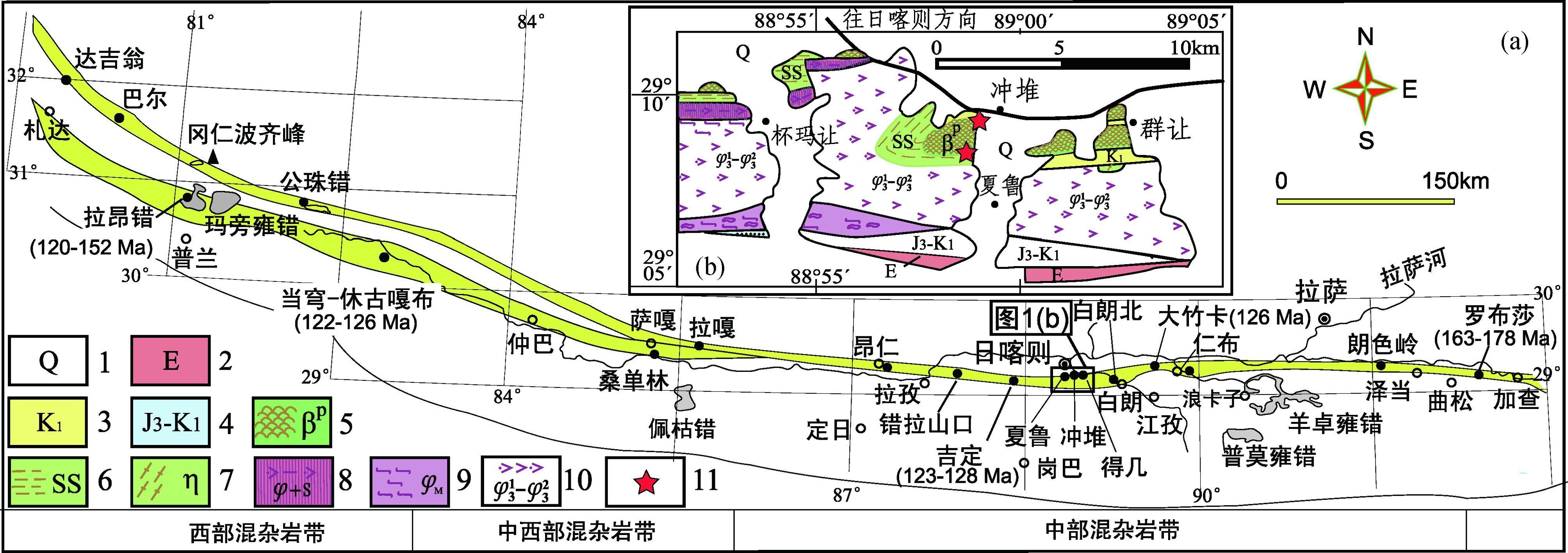
2 地质概况和样品雅鲁藏布缝合带位于印度大陆北缘和冈底斯岩基以南,总体表现为北倾的向南逆冲系;北侧出露冈底斯中新生代的中-酸性侵入岩和日喀则群 (K2) 弧前盆地沉积及错江顶群 (E1-2) 残余弧前盆地滨海相磨拉石,秋乌组 (E2) 残余弧前盆地相磨拉石、冈底斯组 (E3-N1) 冈底斯相磨拉石;南侧为蛇绿岩、蛇绿混杂岩及嘎学群 (J3-K1) 海相复理石、硅质岩及基性熔岩所组成的构造单元 (潘桂棠和丁俊, 2004)。日喀则蛇绿岩是出露最好和研究成果积累最多的地段,其时代主要是120~130Ma (Gopel et al., 1984; Malpas et al., 2003; Wang et al., 2006; 王冉等, 2006),晚于西段的拉昂错蛇绿岩 (147~152Ma; Miller et al., 2003; 李建峰等, 2008) 和东段的罗布莎及朗县蛇绿岩的年龄 (163~191Ma; 周肃等, 2001; 钟立峰等, 2006; 张万平等, 2011)。本文采样地点是位于日喀则东南方向约20km的夏鲁剖面。采样点位于巴冲村至夏鲁寺 (图 1)。剖面中基性岩 (辉绿岩和玄武岩) 部分出露完好,本次主要采集了灰绿色、灰色和紫红色的枕状、块状、气孔和杏仁状玄武质熔岩和中细粒的辉绿岩。选择12个样品进行了元素地球化学分析。为了对比,本文还收集了234套雅鲁藏布蛇绿岩的基性岩石的地球化学数据,进行了地球化学成分系统对比和构造环境判别。
|
图 1 雅鲁藏布蛇绿岩中西段分布简图 (a) 和研究区日喀则夏鲁地区地质简图 (b) (a) 和 (b) 分别修改自朱弟成等 (2008)和王希斌等 (1987).图例:1-第四系;2-第三纪;3-早白垩统;4-晚侏罗世-早白垩世;5-枕状熔岩;6-席状岩墙群;7-辉绿岩;8-橄榄岩和辉绿岩墙群;9-蛇纹混杂岩;10-斜辉橄榄岩和二辉橄榄岩;11-采样点.年龄文献:拉昂错 (Miller et al., 2003; 李建峰等, 2008); 休古嘎布 (韦振权等, 2006; 徐德明等, 2007); 吉定 (Wang et al., 2006; 王冉等, 2006); 大竹卡 (Malpas et al., 2003); 罗布莎 (周肃等, 2001; 钟立峰等, 2006) Fig. 1 Simplified map of central-western segment of the Yalung Zangpo ophiolite (a) and simplified geological map of the Xialu ophiolite, Xigaze (b) |
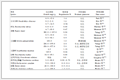
主量元素在中国地质大学 (北京) 地质过程与矿产资源国家重点实验室采用Leeman Labs.Inc公司的Prodigy型全谱直读型发射光谱仪 (ICP-AES) 测定,测定精度优于5%。微量元素在中国地质大学 (武汉) 地质过程与矿产资源国家重点实验室利用ICP-MS (Agilent 7700) 测定,测试精度优于5%~10%。测试过程中采用内标和外标综合控制测试质量的方法,同时测定空白样 (Blank)、USGS国际标准物质AGV-2、BHVO-2、BCR-2和GSR-1以及实验室内标In。备样的具体流程、仪器分析精密度和准确度见Gao et al. (2002)。岩石主、微量元素测试结果列于表 1。
|
表 1 日喀则夏鲁蛇绿岩中基性岩石的主量元素 (wt%)、微量元素 (×10-6) 组成 Table 1 Major (wt%) and trace (×10-6) element compositions of the basic rocks from Xialu ophiolite, Xigaze |
夏鲁剖面SiO2含量主要为46.3%~54.5%,总体属于玄武岩成分范围,仅有2个分别为53.52%和53.42%,为玄武安山岩,全部平均为51.1%,与印度洋洋脊玻璃质玄武岩的平均值50.9%相当。岩石具有低钛 (0.64%~1.5%)、低钾 (<0.69%) 和富钠 (2.5%~6.0%,除1个样品为0.73%) 的特征。TiO2含量与印度洋洋脊玻璃质玄武岩平均值1.19%相差不大,但低于印度洋洋脊玻璃质玄武岩。Al2O3的含量为13.3%~16.0%,总体具有高铝玄武岩的特征,与消减带典型的岩石相似 (张旗和周国庆, 2001)。岩石的烧失量普遍较高 (2.0%~7.5%),与岩石存在含水矿物结果一致,这同时也表明由于样品普遍遭受蚀变,岩石的K2O和Na2O含量特征可能与岩石形成后普遍受到富钾富钠流体 (可能为海水) 的蚀变作用有关。岩石富镁 (4.0%~8.7%)、富钙 (5.4%~16.5%),属于初始形成的基性岩石具有的斜长石与辉石成分组合特征。
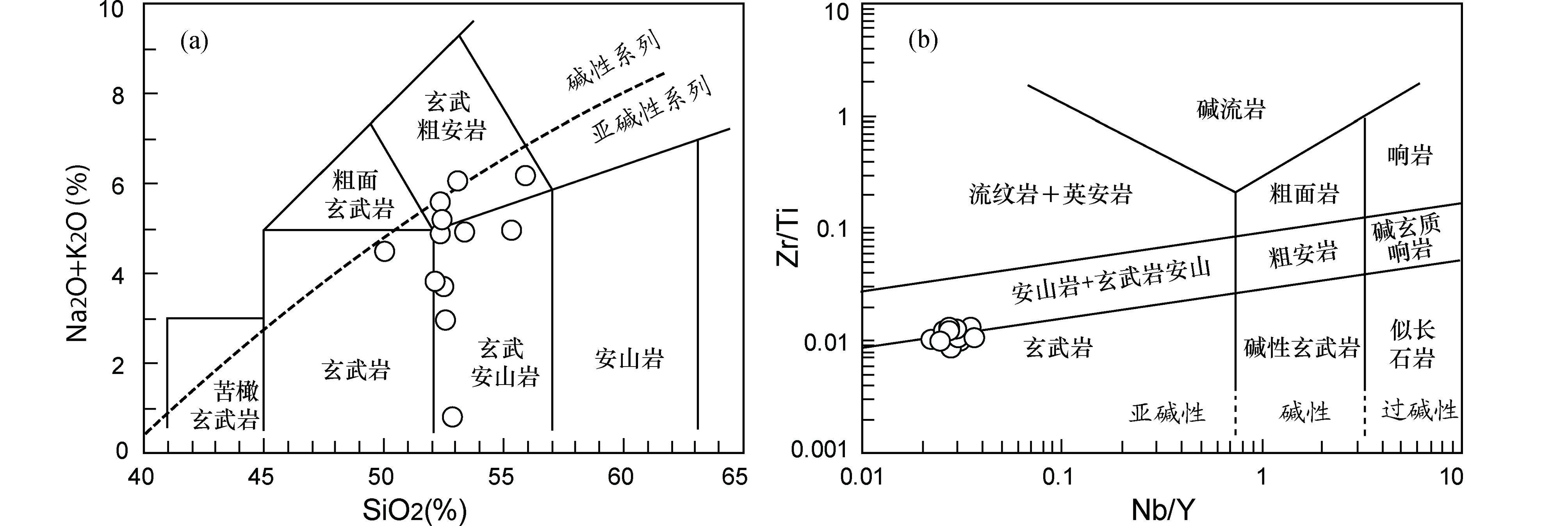
在TAS图解 (图 2a) 中,夏鲁样品几乎都落入玄武安山岩的成分范围,均为亚碱性系列。如前所述,由于样品普遍遭受富钾富钠流体的蚀变,其全碱含量和烧失量的增加都是导致岩石成分偏移的原因。为进一步确定岩石类型,应用了不活泼的高场强元素判别图 (图 2b),结果绝大多数岩石为玄武岩,少数处于与玄武安山岩的成分边界附近。因此,本文的岩石应为玄武质岩石,可以进一步用以判别构造环境。
|
图 2 鉴别日喀则夏鲁蛇绿岩基性岩石分类的TAS (a,据Le Maitre, 2002) 和Zr/Ti-Nb/Y图解 (b,据Pearce, 1996) Fig. 2 Plots of TAS (a, after Le Maitre, 2002) and Zr/Ti-Nb/Y (b, after Pearce, 1996) for the basic rocks of the Xialu ophiolite, Xigaze |
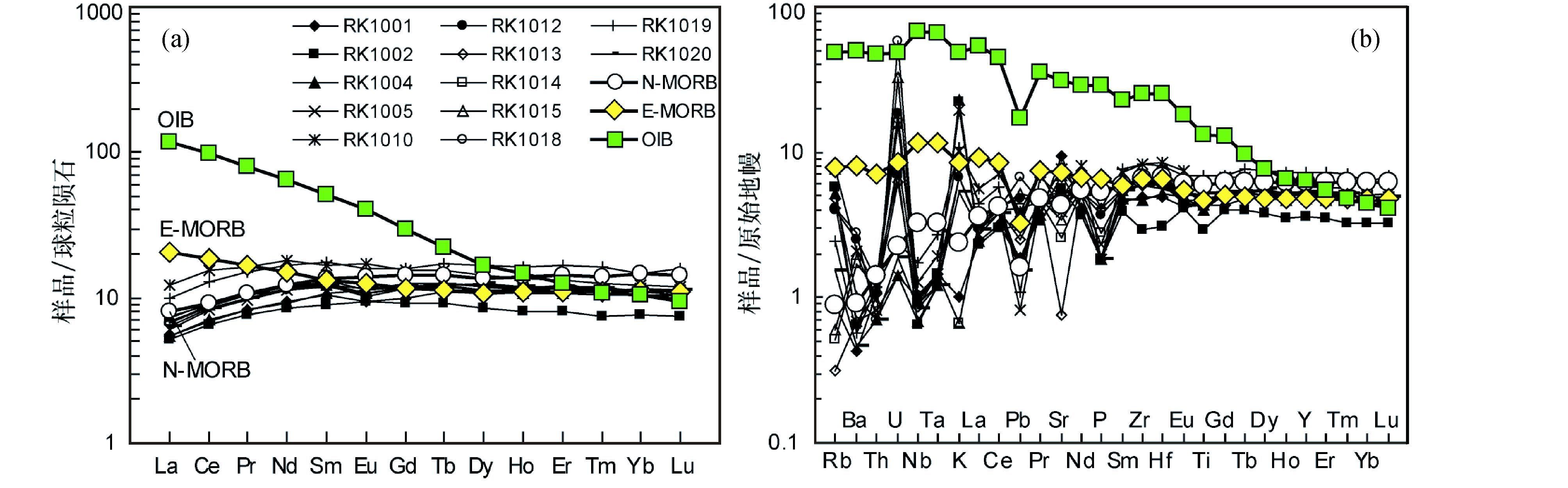
夏鲁玄武岩类的稀土元素和微量元素成分见表 1和图 3。这些基性岩显示总体平缓、轻稀土亏损的分布型式,其型式和成分与典型的亏损的正常洋中脊玄武岩 (N-MORB) 非常类似 (图 3a)。样品的原始地幔标准化微量元素分布型式 (图 3b) 可见,总体与N-MORB一致,明显不同于富集地幔和洋岛玄武岩的成分。但是与N-MORB成分相比,岩石显示了强不相容的大离子亲石元素 (Rb、Ba、U、K) 的明显富集和高场强元素 (Nb、Ta、P、Ti、Zr、Hf) 的明显亏损,出现了类似俯冲带玄武岩的特征。这一方面表明后期流体影响 (例如U含量变化大可能是易受后期蚀变的影响;Mahoney et al., 1998),但是高场强元素的亏损则不是后期交代作用影响的结果,而是岩石微量元素成分不同于典型正常洋中脊玄武岩,可能与它们形成于不同的构造环境有关。
|
图 3 日喀则夏鲁蛇绿岩基性岩石的稀土 (a) 和微量元素 (b) 成分图 球粒陨石的稀土元素标准化值引自Boynton (1984), 原始地幔标准化值和亏损地幔 (N-MORB)、富集地幔 (E-MORB)、洋岛玄武岩 (OIB) 的值引自Sun and McDonough (1989) Fig. 3 Chondrite-normalized REE (a) and primitive mantle-normalized trace element compositions (b) for the basic rocks of the Xialu ophiolite, Xigaze |
研究区样品具典型的N-MORB稀土元素地球化学特征,表明它们来自亏损的软流圈地幔;另外δNb [δNb=log (Nb/Y)+1.74-1.92log (Zr/Y)]均小于0,也进一步说明了岩浆源区与亏损地幔有关 (Fitton et al., 1997)。夏鲁12个样品显示了同样的亏损型稀土配分型式,表明这些火成岩具有同源岩浆系列的特征,来自同一亏损型地幔源区。岩石具有较高、但不均匀的MgO (4.0%~8.7%)、Cr (27×10-6~388×10-6) 和Ni (19×10-6~93×10-6) 含量,表明玄武质岩石经历了不同程度镁铁质矿物的分离结晶作用。
作为雅鲁藏布蛇绿岩带中段的重要组成部分,日喀则蛇绿岩的形成和演化对于认识新特提斯洋的形成演化史、研究和恢复古板块构造格局等具有重要意义。日喀则蛇绿岩在20世纪80年代晚期由中-法科学家合作研究,认为这些岩石为特提斯洋壳的一部分,在大陆边缘附近的洋中脊形成 (Nicolas et al., 1981; Xiao, 1984; Girardeau et al., 1985; Girardeau and Mercier, 1988),但当时的地球化学数据相当有限。自从Pearce et al. (1984)提出在大洋岩石圈俯冲的初期阶段,俯冲带的上部可以形成一种俯冲带上叠型 (SSZ型) 蛇绿岩后,许多学者对雅鲁藏布蛇绿岩的岩石学、地球化学和同位素年代学方面进行了进一步研究,认为雅鲁藏布蛇绿岩应属于SSZ蛇绿岩 (郝杰等, 1999; 朱弟成等, 2008; 张旗等, 2003; Aitchison et al., 2000; Huot et al., 2002; Ziabrev et al., 2003; Dubois-Côté et al., 2005; 叶培盛等, 2006; 钟立峰等, 2006; 陈根文等, 2003)。
Nb的负异常在一定程度上可以反应地幔源区含有岛弧火山岩的组分,而与典型的大洋中脊N-MORB有明显区别 (Pearce and Deng, 1983; 张旗和周国庆, 2001; 赖绍聪和刘池阳, 2003; 王保弟等, 2007; 朱弟成等, 2008)。由于Th、La与Nb具有相似的不相容性,并且与U、K相比,其活动性更低,所以本文采用Eisele et al. (2002)提出的方法来判断样品是否存在Nb异常。Nb异常指数的计算公式为:Nb/Nb*=NbPM/(ThPM×LaPM)1/2,PM代表利用原始地幔标准化后的数据进行计算。研究区样品的Nb异常指数为0.38~0.76,平均为0.55,小于1,显示负Nb异常。因而由负Nb异常和部分大离子亲石元素的富集,可以推断研究区蛇绿岩含有IAB的成分,即受到俯冲作用的影响。本文岩石的Th、Ta含量也显示了岛弧火山岩的地球化学特征 (张旗等, 1999)。
关于蛇绿岩的类型是一个十分复杂且存在争议的问题。在俯冲带之上的岛弧和弧前环境形成的是岛弧拉斑玄武岩 (IAT) 和玻安岩,不成熟的弧后盆地玄武岩兼有IAT和MORB的特征 (Weaver et al., 1979; Hawkins, 2003),成熟的弧后盆地玄武岩为MORB型,弧间盆地环境产出的岛弧蛇绿岩也具有IAT和MORB的性质 (张旗等, 1999)。目前来看,具有岛弧特征的亏损型MORB的日喀则 (德村-吉定) 块体,熔岩有玻安岩、IAT和MORB,为岛弧蛇绿岩残片;实际上,雅鲁藏布蛇绿混杂岩带中这种IAB型玄武岩不仅分布在该带中部,而是在东西延伸超过1500km的整个雅鲁藏布蛇绿混杂岩带内部,均存在IAB型玄武岩,朱弟成等 (2008)认为晚侏罗世-早白垩世期间很可能新特提斯从东到西均发生了洋内俯冲作用。
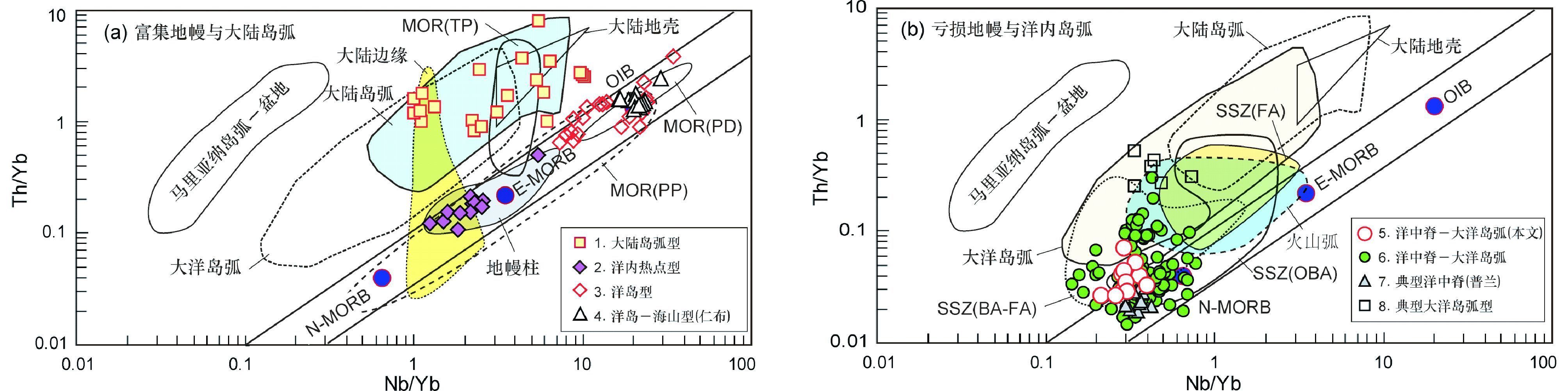
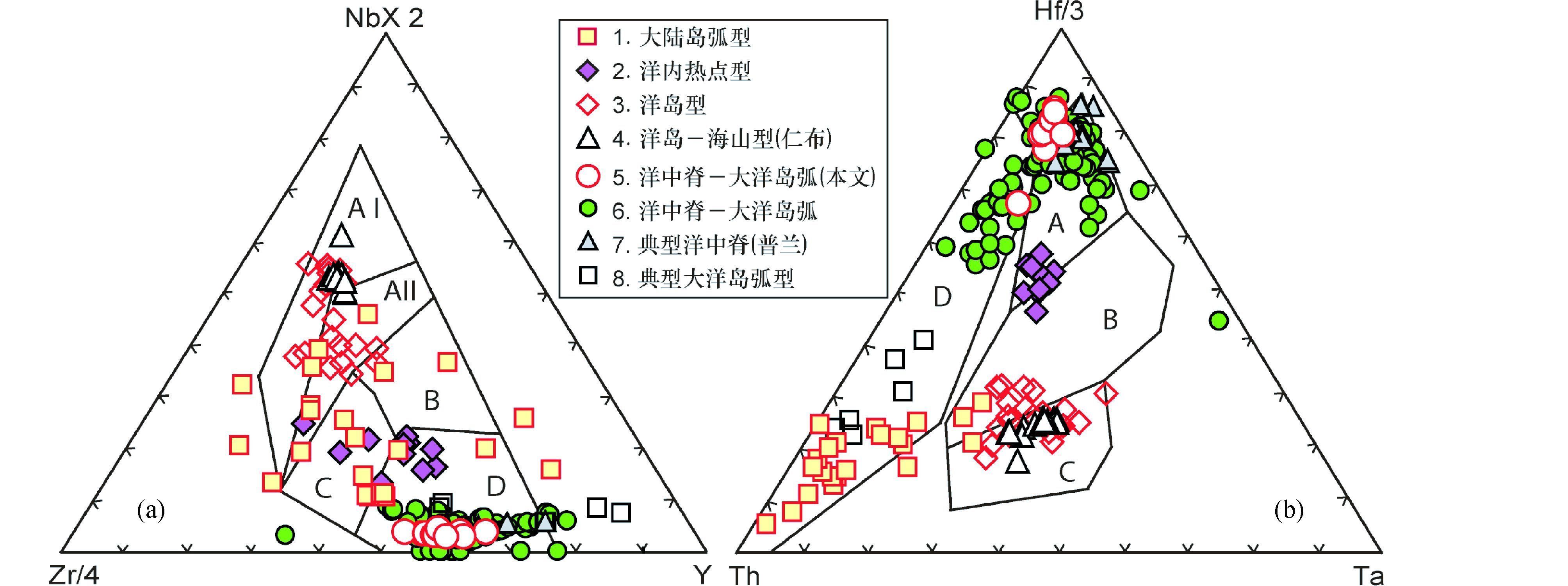
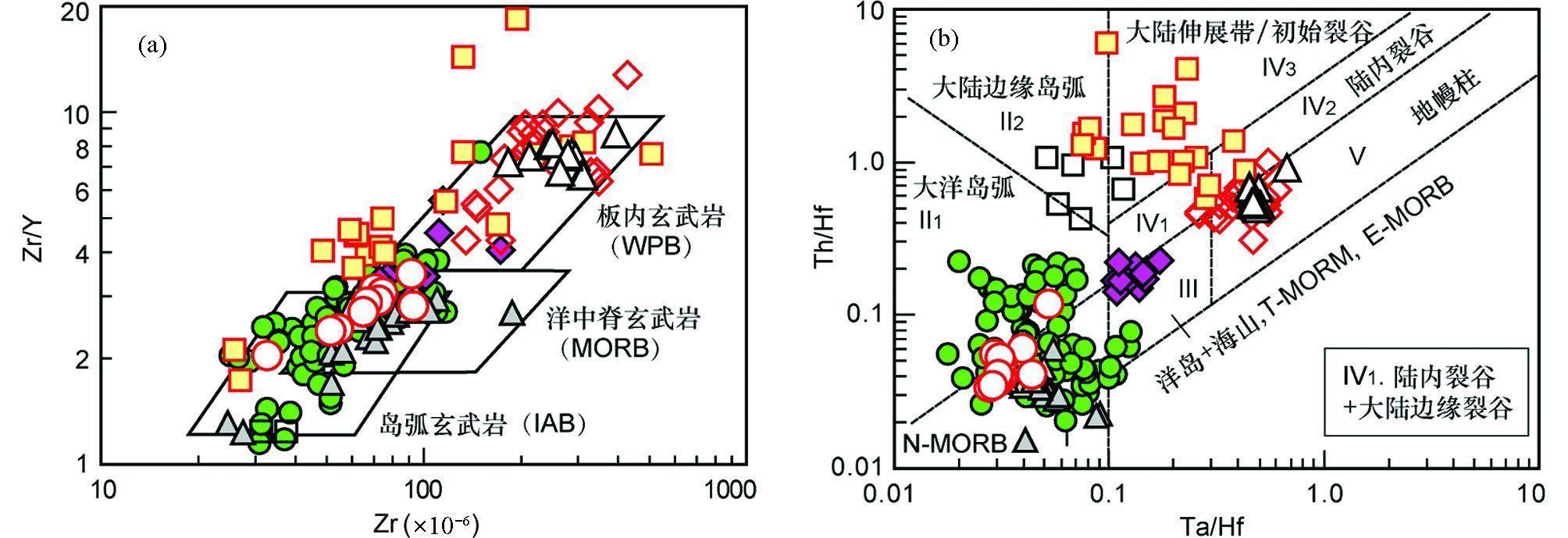
从一系列判别图 (图 4、图 5、图 6) 可以看出,本文的夏鲁蛇绿岩,具有N-MORB的性质 (图 5a、图 6),同时又向着大洋岛弧的成分区域偏移 (图 4b、图 6),表明本区蛇绿岩基性岩显示出N-MORB的性质,但又不同于N-MORB。夏鲁基性岩中Ti (4005×10-6~9220×10-6) 和V (182×10-6~295×10-6) 的含量与洋内岛弧Mariana Trough (Sinton and Fryer, 1987) 和Tonga-Kermadec岛弧 (Turner et al., 1997) 中玻璃的成分相似,表明研究区的岩石可能为洋内弧环境 (Dubois-Côté et al., 2005)。另外,微量元素原始地幔标准化配分图和REE球粒陨石标准化配分图均与Tonga弧的弧后盆地 (Lau盆地) 相一致 (Ewart et al., 1994a, b),说明本区蛇绿岩可能产于大洋内部的弧后盆地。因此日喀则蛇绿岩既非典型的洋中脊成因,又与岛弧型火山岩有一定区别,但显示了俯冲带物质参与的地球化学烙印,应属于SSZ型蛇绿岩;它们很可能形成于与洋内俯冲有关的边缘海 (弧后) 盆地环境,由于消减带之上的地幔对流导致新洋壳的产生而形成,是特提斯大洋岩石圈在俯冲过程中引发弧后次级扩张的产物 (Hébert et al., 2011)。
|
图 4 日喀则夏鲁蛇绿岩基性岩石Th/Yb-Nb/Yb构造环境判别图 (底图据Pearce, 2008; 各类岩石的成分区域引自Dilek and Furnes, 2011) 雅鲁藏布蛇绿岩的岩石样品,除夏鲁为本文数据,其余数据的文献来源同表 2.图中符号:MOR (TP)=靠近海沟的洋中脊, MOR (PD)=远离地幔柱的洋中脊, MOR (PP)=靠近地幔柱的洋中脊, SSZ (FA)=SSZ弧前型, SSZ (OBA)=SSZ大洋弧后型, SSZ (BA-FA)=SSZ弧后-弧前型 Fig. 4 Trace element composition Th/Yb-Nb/Yb for the tectonic setting discrimination for the basic rocks of the Xialu ophiolite, Xigaze (after Pearce, 2008) |
|
图 5 日喀则夏鲁蛇绿岩基性岩石构造环境判别图 (a)-Nb×2-Zr/4-Y图解:AI-板内碱性玄武岩;AII-板内碱性玄武岩和板内拉斑玄武岩;B-E-MORB;C-板内拉斑玄武岩和火山弧玄武岩;D-N-MORB和火山弧玄武岩; (b)-Hf/3-Th-Ta图解:A-N-MORB;B-E-MORB和板内拉斑玄武岩;C-板内碱性玄武岩;D-火山弧玄武岩.底图分别引自Meschede et al. (1986)和Wood (1980) Fig. 5 Trace element composition for the tectonic setting discrimination for the basic rocks of the Xialu ophiolite, Xigaze (after Meschede et al. (1986) and Wood (1980), respectively) |
|
图 6 玄武质岩石微量元素成分构造判别图 (a)-Zr/Y-Zr,原图引自Pearce and Norry (1979); (b)-Th/Hf-Ta/Hf, 原图汪云亮等 (2001).图例同图 5 Fig. 6 Trace element discrimination plots of tectonic setting of basaltic rocks (after Pearce and Norry (1979) and Wang et al. (2001), respectively) |
近年来的研究获得了很好的研究结果,表明雅鲁藏布蛇绿岩在东西延长1500km的范围内,存在多种洋壳类型和构造环境,研究者不再片面地从狭小的区域去固执于某一洋壳类型,而是全面分析所有结果,更好地还原了一个长期演化的、丰富多彩的特提斯洋 (Dupuis et al., 2005; Hébert et al., 2011)。本文选择2005年以来发表于文献的234套和本文12套数据 (见表 2分类和文献,共计246套),应用地球化学判别图解 (图 4、图 5、图 6),详细划分了雅鲁藏布蛇绿岩的构造环境类型,表中还计算了每种类型在全部246件样品中所占比例。以下简单归纳和讨论主要的洋壳类型 (由于多次引用图 4、图 5、图 6,每类不再多次显示)。
|
|
表 2 雅鲁藏布蛇绿岩的洋壳类型划分表 Table 2 Classification of the oceanic crust for the Yalung Zangpo ophiolite |
从日喀则地区的大竹卡、吉定,向西经过萨嘎和普兰地区拉昂错岩体,到西部达吉翁蛇绿岩中都有零星发现 (表 2,第1种)。这类岩石富集Th、明显具有大陆地壳成分的亲缘性 (图 4a、图 5、图 6b),可能代表了发育在大陆边缘或者增生楔附近的弧前盆地产出的玄武岩。
5.2.2 地幔柱-洋内热点型出现在仁布以西的蛇绿岩中,包括3个亚类。第一亚类显示了明显的类似地幔柱的E-MORB型洋壳 (表 2,第2种;图 4a、图 5、图 6),其成分也部分兼具N-MORB的特征 (图 5),可能代表了发育在洋内热点或者是靠近地幔柱的洋中脊,岩浆来源过程中伴有洋中脊和热点相互作用 (朱弟成等, 2008),类似于现今冰岛玄武岩 (Dilek and Furnes, 2011)。第二亚类是靠近OIB的碱性板内玄武岩,也出现于桑桑以西到达吉翁的蛇绿岩中 (表 2,第3种),成分属于洋岛玄武岩,构成洋岛和海山,岩浆来自于富集地幔源区,也可以产出在远离地幔柱的洋中脊构造环境中 (Dilek and Furnes, 2011)。第三亚类是产于仁布附近的典型洋底海山的OIB型板内碱性玄武岩 (表 2,第4种; Xia et al., 2008),成分类似于社会群岛 (Society Islands)、Kerguelen高原和Broken洋脊,岩浆来源于典型的富集地幔EM II。
目前在达吉翁、萨嘎桑单林、错拉山口北、吉定地区均发现洋内热点 (地幔柱) 型洋壳 (朱弟成等, 2008; Dupuis et al., 2005; Bedard et al., 2009; Zhang et al., 2005)。稀有气体同位素研究在吉定发现了十分类似夏威夷的地幔柱型岩浆作用 (辉绿岩的3He/4He高达31.57Ra; 吴茂炳等, 2003),支持这套蛇绿岩中存在地幔柱型岩浆作用的观点。从区域看,不仅在上述中西段存在OIB代表的洋内热点型洋壳,在藏东雅鲁藏布江大拐弯蛇绿岩的变基性岩类岩石中,也存在OIB特征的岩浆作用 (耿全如等, 2010)。
还有一个值得提出的问题,上述产出于蛇绿岩中的OIB与朱弟成等人发现的藏南措美大火成岩省 (Zhu et al., 2008, 2009) 之间是什么关系呢?如果措美大火成岩省同时发育在印度北缘的特提斯喜马拉雅和印度北缘的特提斯洋中,则可能存在更大规模的地幔柱-洋脊相互作用。
5.2.3 洋中脊-大洋岛弧型这是目前雅鲁藏布蛇绿岩中最多的一种岩石类型 (表 2,第5、6种),在雅鲁藏布蛇绿岩从西部达吉翁到东部罗布莎的广泛区域内,其稀土元素特征和某些微量元素 (图 5a) 完全类似于N-MORB,但是更多的微量元素特征则介于洋中脊和大洋岛弧之间 (图 4b、图 5b、图 6),因此其岩浆源区应是SSZ型的亏损地幔,具体的构造环境可以是与洋内岛弧相关的弧前-弧后盆地,即在阿尔巴尼亚和塞浦路斯都都存在的SSZ (BA-FA) 蛇绿岩 (Dilek and Furnes, 2011)。现有的数据中,超过一半样品 (139件,超过57%) 属于该类型。这也与普遍认为的岛弧类型的洋壳在大洋俯冲消减的过程中更加容易保留下来是一致的 (Zhu et al., 2012)。在该类型中,也有部分显示了典型的N-MORB特征 (表 2,第7种),在所有判别中,这些样品都一致显示了亏损的洋中脊特征,没有向洋内弧成分迁移,例如在普兰就产出这类玄武岩 (刘钊等, 2011)。这种典型洋中脊的存在意味着在上述的洋壳俯冲-保留过程中,典型的洋中脊也可以残留下来,但是数量较少。
5.2.4 典型大洋岛弧型这类岩石出现在吉定、休古嘎布和拉昂错蛇绿岩中 (表 2,第8种),其成分远离地幔演化趋势,趋近于马里亚纳岛弧-盆地代表的大洋岛弧、火山弧成分,也与东南亚地区的Luzon类似 (Dilek and Furnes, 2011),成分上也部分类似于大陆岛弧 (图 6b)。
上述研究表明,雅鲁藏布缝合带中可能保存下来了多种类型的洋壳残余。这意味着针对一个具体的地区,如果应用该地区发现的一种或者几种洋壳类型直接反演存在且只是存在对应的构造环境,显得不够全面。这是因为目前所见到的蛇绿岩仅仅是选择性保存下来的,一个大洋岩石圈的绝大多数记录都没有保留下来,若直接推论,可能会出现偏差。
6 结论本文对日喀则蛇绿岩夏鲁剖面基性岩石元素地球化学研究以及结合文献资料进行的综合分析表明:
(1) 夏鲁蛇绿岩中基性岩石为低钾亚碱性玄武质岩石,岩石具有低钛 (0.64%~1.5%)、低钾 (<0.69%)、富钠 (2.5%~6.0%)、烧失量普遍较高 (2.0%~7.5%) 的特征,表明样品普遍遭受蚀变。
(2) 夏鲁玄武岩类具有与N-MORB类似的稀土元素特征,微量元素总体与N-MORB一致,岩石显示富集大离子亲石元素 (如:Rb、Ba、U、K),亏损高场强元素 (如:Nb、Ta、P、Ti、Zr、Hf),具有从洋脊玄武岩向具有俯冲组分加入的岛弧岩浆作用偏移的特征。
(3) 日喀则蛇绿岩属于非典型的洋中脊成因,应为SSZ型蛇绿岩,可能形成于与洋内俯冲有关的SSZ型弧后或者弧前盆地中。
(4) 东西延伸超过1500km的雅鲁藏布蛇绿岩记录了多种洋壳类型,目前的数据表明至少存在大陆岛弧型、地幔柱-洋内热点型、洋中脊-大洋岛弧型和典型大洋岛弧型等四种类型。这暗示雅鲁藏布特提斯洋内存在多种构造环境,为一经历了长期演化的特提斯洋。
| [] | Aitchison JC, Badengzhu, Davis AM, Liu J, Luo H, Malpas JG, McDermid IRC, Wu H, Ziabrev S and Zhou MF. 2000. Remnants of a cretaceous intra-oceanic subduction system within the Yarlung-Zangbo suture (southern Tibet). Earth and Planetary Science Letters, 183: 231–244. DOI:10.1016/S0012-821X(00)00287-9 |
| [] | Allégre CJ, Coutillot V, Tapponier P and 32 others. 1984. Structure and evolution of the Himalaya-Tibet orogenic belt. Nature, 307: 17–22. DOI:10.1038/307017a0 |
| [] | Bédard é, Hébert R, Guilmette C, Lesage G, Wang CS and Dostal J. 2009. Petrology and geochemistry of the Saga and Sangsang ophiolitic massifs, Yarlung Zangbo Suture Zone, Southern Tibet: Evidence for an arc-back-arc origin. Lithos, 113: 48–67. DOI:10.1016/j.lithos.2009.01.011 |
| [] | Bezard R, Hébert R, Wang CS, Dostal J and Dai JG. 2011. Petrology and geochemistry of the Xiugugabu ophiolitic massif western Yarlung Zangbo suture zone, Tibet. Lithos, 125: 347–367. DOI:10.1016/j.lithos.2011.02.019 |
| [] | Boynton WV. 1984. Geochemistry of the rare earth elements: Meteorite studies. In: Henderson P (ed.). Rare Earth Element Geochemistry. Elsevier, 63-114 |
| [] | Chen GW, Xia B, Zhong ZH, Wang GQ, Wang H, Zhao TP, Wang JC, Qi L and Li SR. 2003. Geochemical characteristics and geological significance of boninites in the Deji ophiolite, Tibet. Acta Mineralogica Sinica, 23(1): 91–96. |
| [] | Dai J, Wang C, Hébert R, Li Y, Zhong H, Guillaume R, Bezard R and Wei Y. 2011. Late Devonian OIB alkaline gabbro in the Yarlung Zangbo Suture Zone: Remnants of the Paleo-Tethys?. Gondwana Research, 19: 232–243. DOI:10.1016/j.gr.2010.05.015 |
| [] | Dilek Y and Furnes H. 2011. Ophiolite genesis and global tectonics: Geochemical and tectonic fingerprinting of ancient oceanic lithosphere. Geological Society of America Bulletin, 123(3-4): 387–411. DOI:10.1130/B30446.1 |
| [] | Dubois-Côté V, Hébert R, Dupuis C, Wang CS, Li YL and Dostal J. 2005. Petrological and geochemical evidence for the origin of the Yarlung Zangbo ophiolites, southern Tibet. Chemical Geology, 214: 265–286. DOI:10.1016/j.chemgeo.2004.10.004 |
| [] | Dupuis C, Hébert R, Dubois-Côté V, Wang CS, Li YL and Li ZJ. 2005. Petrology and geochemistry of mafic rocks from mélange and flysch units adjacent to the Yarlung Zangbo Suture Zone, southern Tibet. Chemical Geology, 214: 287–308. DOI:10.1016/j.chemgeo.2004.10.005 |
| [] | Eisele J, Sharma M, Galer SJG, Blichert-Toft J, Devey CW and Hofmann AW. 2002. The role of sediment recycling in EM-1 inferred from Os, Pb, Hf, Nd, Sr isotope and trace element systematics of the Pitcairn hotspot. Earth and Planetary Science Letters, 196: 197–212. DOI:10.1016/S0012-821X(01)00601-X |
| [] | Ewart A, Bryan WB, Chappel BW and Rudnick RL. 1994a. Regional geochemistry of the Lau-Tonga arc and backarc systems. In: Hawkins JW, Parson LM, Allan JF et al. (eds.). Proceeding of the Ocean Drilling Program. Scientific Results, 135: 385-425 |
| [] | Ewart A, Hergt JM and Hawkins JW. 1994b. Major element, trace element, and isotope (Pb, Sr, and Nd) geochemistry of site 839 basalts and basaltic andesites: Implications for arc volcanism. In: Hawkins JW, Parson LM, Allan JF et al. (eds.). Proceeding of the Ocean Drilling Program. Scientific Results, 135: 519-531 |
| [] | Fitton JG, Saunders AD, Norry MJ, Hardarson BS and Taylor RN. 1997. Thermal and chemical structure of the Iceland Plume. Earth and Planetary Science Letters, 153: 197–208. DOI:10.1016/S0012-821X(97)00170-2 |
| [] | Gao S, Liu XM, Yuan HL, Hattendorf B, Gunther D, Chen L and Hu SH. 2002. Determination of forty two major and trace elements in USGS and NISTSRM glasses by laser ablation inductively coupled plasma mass spectrometry Geostandards. News Letter Journal of Geostandards and Geoanalysis, 26: 191–196. |
| [] | Geng QR, Peng ZM and Zhang Z. 2010. Geochemical study on metamorphosed mafic rocks in ophiolitic zone in the Yarlung Zangpo Great Bend, eastern Tibet, China. Geological Bulletin of China, 29(12): 1781–1794. |
| [] | Girardeau J, Mercier JCC and Wang XB. 1985. Petrology of the mafic rocks of the Xigaze ophiolite, Tibet: Implications for the genesis of the oceanic lithosphere. Contributions to Mineralogy and Petrology, 90: 309–321. DOI:10.1007/BF00384710 |
| [] | Girardeau J and Mercier JCC. 1988. Petrology and texture of the ultramafic rocks of the Xigaze ophiolite (Tibet): Constraints for mantle structure beneath slow-spreading ridges. Tectonophysics, 147: 33–58. DOI:10.1016/0040-1951(88)90146-1 |
| [] | Gopel C, Allere CJ and Xu RH. 1984. Lead isotopic study of the Xigaze ophiolite (Tibet): The problem of the relationship between magmatites (gabbros, dolerites, lavas), and tectonites (harzburgites). Earth and Planetary Science Letters, 69: 301–310. DOI:10.1016/0012-821X(84)90189-4 |
| [] | Hao J, Chai YC and Li JL. 1999. Original tectonic setting of the Tsangpo ophiolite and sedimentary evolution of the Xigaze forearc basin. Scientia Geologica Sinica, 34(1): 1–9. |
| [] | Hawkins JW. 2003. Geology of supra-subduction zones-Implications for the origin of ophiolites. Geological Society of America Special Paper, 373: 227–268. |
| [] | Hébert R, Bezard R, Guilmette C, Dostal J, Wang CS and Liu ZF. 2011. The Indus-Yarlung Zangbo ophiolites from Nanga Parbat to Namche Barwa syntaxes, southern Tibet: First synthesis of petrology, geochemistry, and geochronology with incidences on geodynamic reconstructions of Neo-Tethys. Gondwana Res., 2011. DOI:10.1016/j.gr.2011.10.013 |
| [] | Hou QY, Zhao ZD, Zhang BR, Zhang HF, Zhang L and Chen YL. 2006a. On the boundary of Tethyan tectonic domain on northeastern margin of the Tibetan Plateau. Acta Petrologica Sinica, 22(3): 567–577. |
| [] | Hou QY, Zhao ZD, Zhang HF, Zhang BR, Zhang L and Chen YL. 2006b. Discussion on the tectonic affinity of ancient oceanic mantle in Western Qinlin-Songpan continental tectonic node, China: From elemental and Sr-Nd-Pb isotopic evidence. Acta Petrologica Sinica, 22(12): 2901–2909. |
| [] | Hou QY Zhao ZD, Zhang HF, Zhang BR and Chen YL. 2006c. Indian Ocean-MORB-type isotopic signature of Yushigou ophiolite in North Qilian Mountains and its implications. Science in China (Series D), 49(6): 561–572. DOI:10.1007/s11430-006-0561-8 |
| [] | Huot F, Hebert R, Varfalvy V, Beaudoin G, Wang C, Liu Z, Cotton J and Dostal J. 2002. The Beimarang Mélange (southern Tibet) brings additional constraints in assessing the origin, metamorphic evolution and obduction processes of the Yarlung Zangbo ophiolite. Journal of Asian Earth Sciences, 21: 307–322. DOI:10.1016/S1367-9120(02)00053-6 |
| [] | Lai SC and Liu CY. 2003. Geochemistry and genesis of the island-arc ophiolite in Anduo area, Tibetan Plateau. Acta Petrologica Sinica, 19(4): 675–682. |
| [] | Le Maitre RW. 2002. Igneous Rocks: A Classification and Glossary of Terms. 2nd Edition. Cambridge University Press, 33-39 |
| [] | Li JF, Xia B, Liu LW, Xu LF, He GS, Wang H, Zhang YQ and Yang ZQ. 2008. SHRIMP U-Pb zircon dating of diabase in the La'nga Co ophiolite, Burang, Tibet, China, and its geological significance. Geological Bulletin of China, 27(10): 1739–1743. |
| [] | Liu Z, Li Y, Xiong FH, Wu D and Liu F. 2011. Petrology and geochemistry of MOR gabbro in the Pirang ophiolite of western Tibet, China. Acta Petrologica Sinica, 27(11): 3269–3279. |
| [] | Mahoney JJ, Frei R, Tejada MLG, Mo XX, Leat PT and Nägler TF. 1998. Tracing the Indian Ocean mantle domain through time: Isotope results from old West Indian, East Tethyan, and South Pacific seafloor. Journal of Petrology, 39: 1285–1306. DOI:10.1093/petroj/39.7.1285 |
| [] | Malpas J, Zhou MF, Robinson PT and Reynolds PH. 2003. Geochemical and geochronological constraints on the origin and emplacement of the YarlungZangbo ophiolites, Southern Tibet. In: Dilek Y and Robinson PT (eds.). Ophiolites in Earth History. London: Geological Society Special Publication, 218: 191-206 |
| [] | Meschede M. 1986. A method of discriminating between different types of mid-ocean ridge basalts and continental tholeiites with the Nb-Zr-Y diagram. Chemical Geology, 56: 20–218. |
| [] | Miller C, Thöni M, Framk W, Schuster R, Melcher F, Meisel T and Zanetti A. 2003. Geochemistry of tectonomagmatic affinity of the Yungbwa ophiolite, SW Tibet. Lithos, 66: 155–172. DOI:10.1016/S0024-4937(02)00217-7 |
| [] | Molnar P and Tapponier P. 1975. Cenozoic tectonics of Asia: Effects of a continental collision. Science, 189: 419–426. DOI:10.1126/science.189.4201.419 |
| [] | Nicolas A, Girardeau J, Marcoux J, Dupré B, Wang XB, Cao YG, Zhang H and Xiao XC. 1981. The Xigaze ophiolite (Tibet): A peculiar oceanic lithosphere. Nature, 294: 414–417. DOI:10.1038/294414a0 |
| [] | Niu XL, Zhao ZD, Mo XX, DePaolo DJ, Dong GC, Zhang SQ, Zhu DC and Guo TY. 2006. Elemental and Sr-Nd-Pb isotopic geochemistry for basic rocks from Decun-Angren ophiolites in Xigaze area, Tibet: Implications for the characteristics of the Tethyan upper mantle domain. Acta Petrologica Sinica, 22(12): 2875–2888. |
| [] | Pan GT and Ding J. 2004. Geological Map of Qinghai-Xizang (Tibet) Plateau and Adjacent Areas (1︰1500000). Chengdu: Chengdu Cartographic Publishing House. |
| [] | Pearce JA and Norry MJ. 1979. Petrogenetic implications of Ti, Zr, Y, and Nb. Variations in volcanic rocks. Contributions to Mineralogy and Petrology, 69: 33–37. DOI:10.1007/BF00375192 |
| [] | Pearce JA and Deng WM. 1983. The ophiolites of the Tibet Geotraverse, Lhasa to Golmud (1985) and Lhasa to Kathmandu (1986). In: Chang C et al. (eds.). The Geological Evolution of the Tibet. London: The Royal Society, 215-238 |
| [] | Pearce JA, Lippard SJ and Roberts S. 1984. Characteristics and tectonic significance of supra-subduction zone ophiolites. Marginal Basin Geology, 16: 77–94. |
| [] | Pearce JA. 1996. A user's guide to basaltic discrimination diagrams. In: Wyman DA et al. (eds.). Trace Element Geochemistry of Volcanic Rocks: Applications for Massive Sulphide Exploration. Geological Association of Canada Short Course Notes, 12: 79-113 |
| [] | Pearce JA. 2008. Geochemical fingerprinting of oceanic basalts with applications to ophiolite classification and the search for Archean oceanic crust. Lithos, 100: 14–48. DOI:10.1016/j.lithos.2007.06.016 |
| [] | Sinton JM and Fryer P. 1987. Mariana Trough Lavas from 188N: Implications for the origin of back-arc basin basalts. Geophysical Research B, 92: 12782–12802. DOI:10.1029/JB092iB12p12782 |
| [] | Sun SS and McDonough WF. 1989. Chemical and isotopic systematics of oceanic basalts: Implications for mantle composition and processes. In: Saunders AD and Norry MJ (eds.). Magmatism in Ocean basins. Geological Society, London, Special Publication, 42: 313-345 |
| [] | Turner SP, Hawkesworth CJ, Rogers NW, Bartlett J, Worthignton T, Hergt J, Pearce J and Smith I. 1997. 238U/230Th disequilibria, magma petrogenesis, and flux rates beneath the depleted Tonga-Kermadec island arc. Geochimica et Cosmochimica Acta, 6: 4844–4855. |
| [] | Wang BD, Xu JF, Zeng QG, Kang ZQ, Chen JL and Dong YH. 2007. Geochemistry and genesis of Lhaguo Tso ophiolite in south of Gerze area, Center Tibet. Acta Petrologica Sinica, 23(6): 1521–1530. |
| [] | Wang R, Xia B, Zhou GQ, Zhan YQ, Yang ZQ, Li WQ, Wei DL, Zhong LF and Xu LF. 2006. SHRIMP zircon U-Pb dating for gabbro from the Jiding ophiolite in Tibet. Chinese Science Bulletin, 51(14): 1776–1779. DOI:10.1007/s11434-006-2027-y |
| [] | Wang XB, Bao PS, Deng WM and Wang FG. 1987. Xizang (Tibet) Ophiolites. Beijing: Geological Publishing House: 1-137. |
| [] | Wang YL, Zhang CJ and Xiu SZ. 2001. Th/Hf-Ta/Hf identification of tectonic settings of basalts. Acta Petrologica Sinica, 17(3): 413–421. |
| [] | Weaver SD, Saunder AD, Pankhurst RJ and Tarney J. 1979. A geochemical of magmatism associated with the initial stages of back-arc spreading. Contributions to Mineralogy and Petrology, 68: 151–169. DOI:10.1007/BF00371897 |
| [] | Wei ZQ, Xia B, Zhang YQ, Wang R, Yang ZQ and Wei DL. 2006. SHRIMP zircon dating of diabase in the Xugugabu ophiolite in Tibet and its geological implications. Geotectonica et Metallogenia, 30(1): 93–97. |
| [] | Wood DA. 1980. The application of a Th-Hf-Ta diagram to problems of tectonmagmatic classification and to establishing the nature of crustal contanmination of basaltic lavas of the British Tertiary volcanic province. Earth and Planetary Science Letters, 50: 11–30. DOI:10.1016/0012-821X(80)90116-8 |
| [] | Wu MB, Ye XR, Liu CY, Zhou HW, Feng RH and Chang CY. 2003. Plume-type magmatism in the Yarlung Zangbo ophiolites, Tibet: Evidence from the helium and argon isotopic compositions. Geological Bulletin of China, 22(9): 670–674. |
| [] | Xia B, Yu HX, Chen GW, Qi L, Zhao TP and Zhou MF. 2003. Geochemistry and tectonic environment of the Dagzhuka ophiolite in the Yarlung-Zangbo suture zone, Tibet. Geochemical Journal, 37: 311–324. DOI:10.2343/geochemj.37.311 |
| [] | Xia B, Chen GW, Wang R and Wang Q. 2008. Seamount volcanism associated with the Xigaze ophiolite, Southern Tibet. Journal of Asian Earth Sciences, 32: 396–405. DOI:10.1016/j.jseaes.2007.11.008 |
| [] | Xiao XC. 1984. Les ophiolites de Xigaze au Tibet méridional et quelques problemes tectoniques les concernant. In: Mercier JL and Li GC (eds.). Mission franco-chinoise au Tibet 1980. Editions du Centre National de la Recherche Scientifique, Paris, 167-188 |
| [] | Xu DM, Huang GC and Lei YJ. 2007. Origin of the Xiugugabu ophiolite massif, SW Tibet: Evidence form petrology and geochemistry. Geotectonica et Metallogenia, 31(4): 490–501. |
| [] | Xu JF and Castillo PR. 2004. Geochemical and Nd-Pb isotopic characteristics of the Tethyan asthenosphere: Implications for the origin of the Indian Ocean mantle domain. Tectonophysics, 393: 9–27. DOI:10.1016/j.tecto.2004.07.028 |
| [] | Ye PS, Jiang W, Wu ZH, Hu DG and Liu QS. 2006. Geochemical characteristics of ophiolites in Zedang-Luobusha, Tibet and their tectonic significance. Geoscience, 20(3): 370–377. |
| [] | Yin A and Harrison TM. 2000. Geologic evolution of the Himalayan Tibetan Orogen. Annual Review of Earth and Planetary Sciences, 28: 211–280. DOI:10.1146/annurev.earth.28.1.211 |
| [] | Zhang Q, Qian Q and Wang Y. 1999. Geochemical study on igneous rocks. Earth Science Frontiers, 6(3): 113–120. |
| [] | Zhang Q and Zhou GQ. 2001. Ophiolites of China. Beijing: Science Press: 82-92. |
| [] | Zhang Q, Zhou GQ and Wang Y. 2003. The distribution of time and space of Chinese ophiolites, and their tectonic setting. Acta Petrologica Sinica, 19(1): 1–8. |
| [] | Zhang SQ, Mahoney JJ, Mo XX, Ghazi AM, Milani L, Crawford AJ, Guo TY and Zhao ZD. 2005. Evidence for a widespread Tethyan upper mantle with Indian-Ocean-type isotopic characteristics. Journal of Petrology, 46(4): 829–858. |
| [] | Zhang WP, Mo XX, Zhu DC, Yuan SH and Wang LQ. 2011. Chronology and geochemistry on gabbro and basalt of the ophiolite mélange in Lang County, Tibet, China. Journal of Chengdu University of Technology (Science and Technology Edition), 37(5): 501–512. |
| [] | Zhong LF, Xia B, Zhou GQ, Zhang YQ, Wang R, Wei DL and Yang ZQ. 2006. SHRIMP age determination of the diabase in Luobusa ophiolite, Southern Xizang (Tibet). Geological Review, 52(2): 224–229. |
| [] | Zhou S, Mo XX, Mahoney J J, Zhang SQ, Guo TY and Zhao ZD. 2002. Geochronology and Nd and Pb isotopic characteristics of gabbro dikes in the Luobusha ophiolite, Tibet. Chinese Science Bulletin, 47(2): 143–146. |
| [] | Zhu DC, Mo XX, Pan GT, Zhao ZD, Dong GC, Shi YR, Liao ZL and Zhou CY. 2008. Petrogenesis of the earliest Early Cretaceous basalts and associated diabases from Cona area, eastern Tethyan Himalaya in south Tibet: Interaction between the incubating Kerguelen plume and eastern Greater India lithosphere?. Lithos, 100: 147–173. DOI:10.1016/j.lithos.2007.06.024 |
| [] | Zhu DC, Mo XX, Wang LQ, Zhao ZD and Liao ZL. 2008. Hotspot-ridge interaction for the evolution of Neo-Tethys: Insights from the Late Jurassic-Early Cretaceous magmatism in southern Tibet. Acta Petrologica Sinica, 24(2): 225–237. |
| [] | Zhu DC, Chung SL, Mo XX, Zhao ZD, Niu YL, Song B and Yang YH. 2009. The 132Ma Comei-Bunbury large igneous province: Remnants identified in present-day SE Tibet and SW Australia. Geology, 37: 583–586. DOI:10.1130/G30001A.1 |
| [] | Zhu DC, Zhao ZD, Niu YL, Mo XX, Chung SL, Hou ZQ, Wang LQ and Wu FY. 2011a. The Lhasa Terrane: Record of a microcontinent and its histories of drift and growth. Earth and Planetary Science Letters, 301: 241–255. DOI:10.1016/j.epsl.2010.11.005 |
| [] | Zhu DC, Zhao ZD, Niu YL, Dilek Y and Mo XX. 2011b. Lhasa Terrane in southern Tibet came from Australia. Geology, 39: 727–730. DOI:10.1130/G31895.1 |
| [] | Zhu DC, Zhao ZD, Niu YL, Dilek Y, Hou ZQ and Mo XX. 2012. The origin and pre-Cenozoic evolution of the Tibetan Plateau. Gondwana Research. DOI:10.1016/j.gr.2012.02.002 |
| [] | Ziabrev SV, Aitchison JC, Abrajevitch AV, Badengzhu, Davis AM and Luo H. 2003. Precise radiolarian age constraints on the timing of ophiolite generation and sedimentation in the Dazhuqu terrane, Yarlung-Tsangpo suture zone, Tibet. Journal of the Geological Society, 160: 591–599. DOI:10.1144/0016-764902-107 |
| [] | 陈根文, 夏斌, 钟志洪, 王国强, 王核, 赵太平, 汪劲草, 张莉, 漆亮, 李荪蓉. 2003. 西藏得几蛇绿岩体中玻安岩的地球化学特征及其地质意义. 矿物学报, 23(1): 91–96. |
| [] | 耿全如, 彭智敏, 张璋. 2010. 雅鲁藏布江大拐弯蛇绿岩变基性岩类岩石地球化学再研究. 地质通报, 29(12): 1781–1794. |
| [] | 郝杰, 柴育成, 李继亮. 1999. 雅鲁藏布江蛇绿岩的形成与日喀则弧前盆地沉积演化. 地质科学, 34(1): 1–9. |
| [] | 侯青叶, 赵志丹, 张本仁, 张宏飞, 张利, 陈岳龙. 2006a. 青藏高原东北缘特提斯构造域界限的探讨. 岩石学报, 22(3): 567–577. |
| [] | 侯青叶, 赵志丹, 张宏飞, 张本仁, 张利, 陈岳龙. 2006b. 西秦岭-松潘构造结古洋地幔地球化学特征及构造归属探讨. 岩石学报, 22(12): 2901–2909. |
| [] | 赖绍聪, 刘池阳. 2003. 青藏高原安多岛弧型蛇绿岩地球化学及成因. 岩石学报, 19(4): 675–682. |
| [] | 李建峰, 夏斌, 刘立文, 徐力峰, 何观生, 王洪, 张玉泉, 杨之青. 2008. 西藏普兰地区拉昂错蛇绿岩中辉绿岩的锆石SHRIMP U-Pb年龄及其地质意义. 地质通报, 27(10): 1739–1743. |
| [] | 刘钊, 李源, 熊发挥, 吴迪, 刘飞. 2011. 西藏西部普兰蛇绿岩中的MOR型辉长岩:岩石学和年代学. 岩石学报, 27(11): 3269–3279. |
| [] | 牛晓露, 赵志丹, 莫宣学, DePaoloDJ, 董国臣, 张双全, 朱弟成, 郭铁鹰. 2006. 西藏日喀则地区德村-昂仁蛇绿岩内基性岩的元素与Sr-Nd-Pb同位素地球化学及其揭示的特提斯地幔域特征. 岩石学报, 22(12): 2875–2888. |
| [] | 潘桂棠, 丁俊. 2004. 青藏高原及邻区地质图 (1︰1500000). 成都: 成都地图出版社. |
| [] | 王保弟, 许继峰, 曾庆高, 康志强, 陈建林, 董彦辉. 2007. 西藏改则地区拉果错蛇绿岩地球化学特征及成因. 岩石学报, 23(6): 1521–1530. |
| [] | 王冉, 夏斌, 周国庆, 张玉泉, 杨之青, 李文铅, 韦栋梁, 钟立峰, 徐力峰. 2006. 西藏吉定蛇绿岩中辉长岩SHRIMP锆石U-Pb年龄. 科学通报, 51(1): 114–117. |
| [] | 王希斌, 鲍佩声, 邓万明, 王方国. 1987. 西藏蛇绿岩. 北京: 地质出版社: 1-137. |
| [] | 王云亮, 张成江, 修淑芝. 2001. 玄武岩类形成的大地构造环境的Th/Hf-Ta/Hf图解判别. 岩石学报, 17(3): 413–421. |
| [] | 韦振权, 夏斌, 张玉泉, 王冉, 杨之青, 韦栋梁. 2006. 西藏休古嘎布蛇绿岩中辉绿岩锆石SHRIMP U-Pb定年及其地质意义. 大地构造与成矿学, 30(1): 93–97. |
| [] | 吴茂炳, 叶先仁, 刘春燕, 周会武, 冯蓉晖, 常春英. 2003. 雅鲁藏布江蛇绿岩中地幔柱型岩浆作用--来自氦、氩同位素的证据. 地质通报, 22(9): 670–674. |
| [] | 徐德明, 黄圭成, 雷义均. 2007. 西藏西南部休古嘎布蛇绿岩的成因:岩石学和地球化学证据. 大地构造与成矿学, 31(4): 490–501. |
| [] | 叶培盛, 江万, 吴珍汉, 胡道功, 刘琦胜. 2006. 西藏泽当-罗布莎蛇绿岩的地球化学特征及其构造意义. 现代地质, 20(3): 370–377. |
| [] | 张旗, 钱青, 王焰. 1999. 造山带火成岩地球化学研究. 地学前缘, 6(3): 113–120. |
| [] | 张旗, 周国庆. 2001. 中国蛇绿岩. 北京: 科学出版社: 1-200. |
| [] | 张旗, 周国庆, 王焰. 2003. 中国蛇绿岩的分布、时代及其形成环境. 岩石学报, 19(1): 1–8. |
| [] | 张万平, 莫宣学, 朱弟成, 袁四化, 王立全. 2011. 西藏朗县蛇绿混杂岩中变辉绿岩和变玄武岩的年代学和地球化学. 成都理工大学学报 (自然科学版), 37(5): 501–512. |
| [] | 钟立峰, 夏斌, 周国庆, 张玉泉, 王冉, 韦栋梁, 杨之青. 2006. 藏南罗布莎蛇绿岩辉绿岩中锆石SHRIMP测年. 地质论评, 52(2): 224–229. |
| [] | 周肃, 莫宣学, MahoneyJJ, 张双全, 郭铁鹰, 赵志丹. 2001. 西藏罗布莎蛇绿岩中辉长辉绿岩Sm-Nd定年及Pb, Nd同位素特征. 科学通报, 46(16): 1387–1390. |
| [] | 朱弟成, 莫宣学, 王立全, 赵志丹, 廖忠礼. 2008. 新特提斯演化的热点与洋脊相互作用:西藏南部晚侏罗世-早白至世岩浆作用推论. 岩石学报, 24(2): 225–237. |