 2012, Vol. 28


2. 广州大学数学与信息科学学院, 广州 510006
2. School of Mathematics and Information Science, Guangzhou University, Guangzhou 510006, China
矿床特征 (如元素含量和矿体厚度等) 分布具有不规则性,可用复杂性科学中的分形模型描述。区域矿床研究的分形模型包括频数-大小分形模型 (Mandelbrot,1983;Agterberg,1995),品位-吨位模型 (Turcotte, 1997, 2002),自仿射分形模型 (Hurst et al., 1965;Mandelbrot,1985;王庆飞等,2007;Wang et al., 2011c),自相似分形模型 (Mandelbrot,1967;Deng et al., 2009),密度-面积分形模型 (Cheng et al., 1994),S-A分形模型 (Cheng et al., 2000;Zuo,2011) 以及多标度分形 (又称为多重分形)(Agterberg et al., 1996;Cheng,1999;Deng et al., 2007, 2008, 2010, 2011;Wang et al., 2008;Zuo et al., 2009)。其中品位-吨位模型是对矿床资源量进行预测研究的重要方法,该模型通常应用于区域尺度上的众多矿床 (Singer,1993;Singer et al., 2005),国外学者较早建立了大量矿床的品位-吨位模型 (Cox and Singer, 1986),Turcotte (1997)通过地质成矿过程建模获得品位与吨位的分形分布特点,进一步发展了品位-吨位模型。平均品位、边界品位及吨位是矿产资源评价与矿床开采中的重要参数,基于频数-大小分形模型,Wang et al.(2010a, b, 2011a, b) 建立了单个矿床矿石量、金属量、边界品位以及平均品位的相互关系模型;研究三者的内在关系不仅对储量预测和资源评价有参考价值,而且有助于成矿作用与矿床成因等方面的研究。
西南三江地区是我国重要的多金属富集区,分布有各类型金矿床,如北衙富碱斑岩型金矿、镇沅造山型金矿等 (邓军等, 2010a, 2011);本文选取典型矿床的局部地段,借助吨位-平均品位-边界品位分形模型,计算了所选矿床的吨位-边界品位曲线,并分析其特征,提出矿化分散指数,对比了其成矿特点。
2 吨位-平均品位-边界品位分形模型 2.1 频数-大小分形模型矿体参数遵循频数-大小分形模型,该模型为 (Mandelbrot,1983):

|
(1) |
式中r可以代表样品的元素含量gi或局部矿化带厚度ui等;N表示研究对象的数目,它等于或大于r;C是一个常数,等于N(≥1),代表规模不小于1的含矿空间总数;D是分形维数;以上公式也可改写成:

|
(2) |
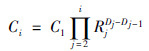
如果lnN和lnr能够用一段直线拟合,则符合简单分形模型;如果需要用若干段直线来拟合,则称为多标度分形。假设第i段的边界值为Ri(i=1,2,…,n),分维值为Di,常数Ci。元素含量gi和矿化带厚度ui的边界值分别为Gi和Ui,均用Ri来表示,则常数
|
(3) |
在一个分形模型中,若数据集里的最小值rmin等于1,则常数C等于研究对象的总数目Ca;若rmin不等于1,则在简单分形中用D和C去计算研究对象总数,即:

|
(4) |
在多标度分形中,研究对象的总数为:

|
(5) |
式中Ca可以代表工程总数Ne或所有样品总数Na或元素含量大于边界品位的样品总数Nc,rmin等于地质参数的最小值。
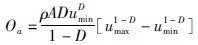
2.2 矿化区质量计算模型根据Wang et al.(2010b)建立的估算单个矿床资源量的分形模型,若矿化带厚度服从简单分形分布,并且是连续变量,则矿化带质量可表示为:
|
(6) |
式中ρ表示矿石体重 (t/m3);A表示矿化面积 (m2);umin与umax分别表示最小与最大矿化带厚度 (m);矿化带质量Oa(t)。
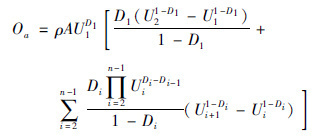
若矿化带厚度服从多标度分形分布,可分为n段,则矿化带质量表示为:
|
(7) |
式中U1为umin,Un为umax,Di表示第i段的分维值。
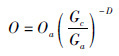
2.3 吨位-边界品位分形模型若从勘探工程中采样所获得的元素含量分布服从简单分形分布,则矿石量可表示为:
|
(8) |
式中矿石量为O(t),Gc与Ga分别表示边界品位与元素最低含量 (非零)(g/t)。
若元素含量服从多标度分形分布,假设Gc是若干段拟合直线中第i段的边界品位,则矿石量可表示为:
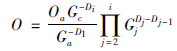
|
(9) |
式中Gj表示第j段的边界品位。
2.4 平均品位-边界品位分形模型根据公式 (1),若元素含量服从简单分形分布,假设元素含量g是连续变量,矿石的平均品位大于边界品位,则平均品位可表示为:

|
(10) |
式中Gmax表示最高品位。
若元素含量服从多标度分形分布,假设有n段拟合直线,且边界品位Gc位于第i段,则平均品位表示为:

|
(11) |
式中Ci、Cj和Cn分别为常数;Di、Dj和Dn分别为第i、j和n段的分维值;Gj、Gj+1和Gmax分别为第j、j+1和n+1段的边界品位。
2.5 矿化分散指数若ΔGc为边界品位之差,ΔO与ΔM分别为相对应的矿石量与金属量之差,则定义矿化分散指数 (MDI) 为:

|
(12) |
矿化分散指数可表示矿体在相同的边界品位变化的条件下,ΔO或ΔM的变化程度。若Ko与Km值越小,则矿化分散指数越低,说明矿石量与金属量变化越小,金属空间分布相对分散;反之,矿化分散指数越高,表示矿石量与金属量变化越大,金属空间分布相对集中,矿区主要为低品位矿石。矿化分散指数主要反映金属分布集中或分散以及矿石高低品位相对比例的特点,其与矿床的吨位、品位内涵不同,是对矿化强度另一个角度的刻画 (Wan et al., 2010)。
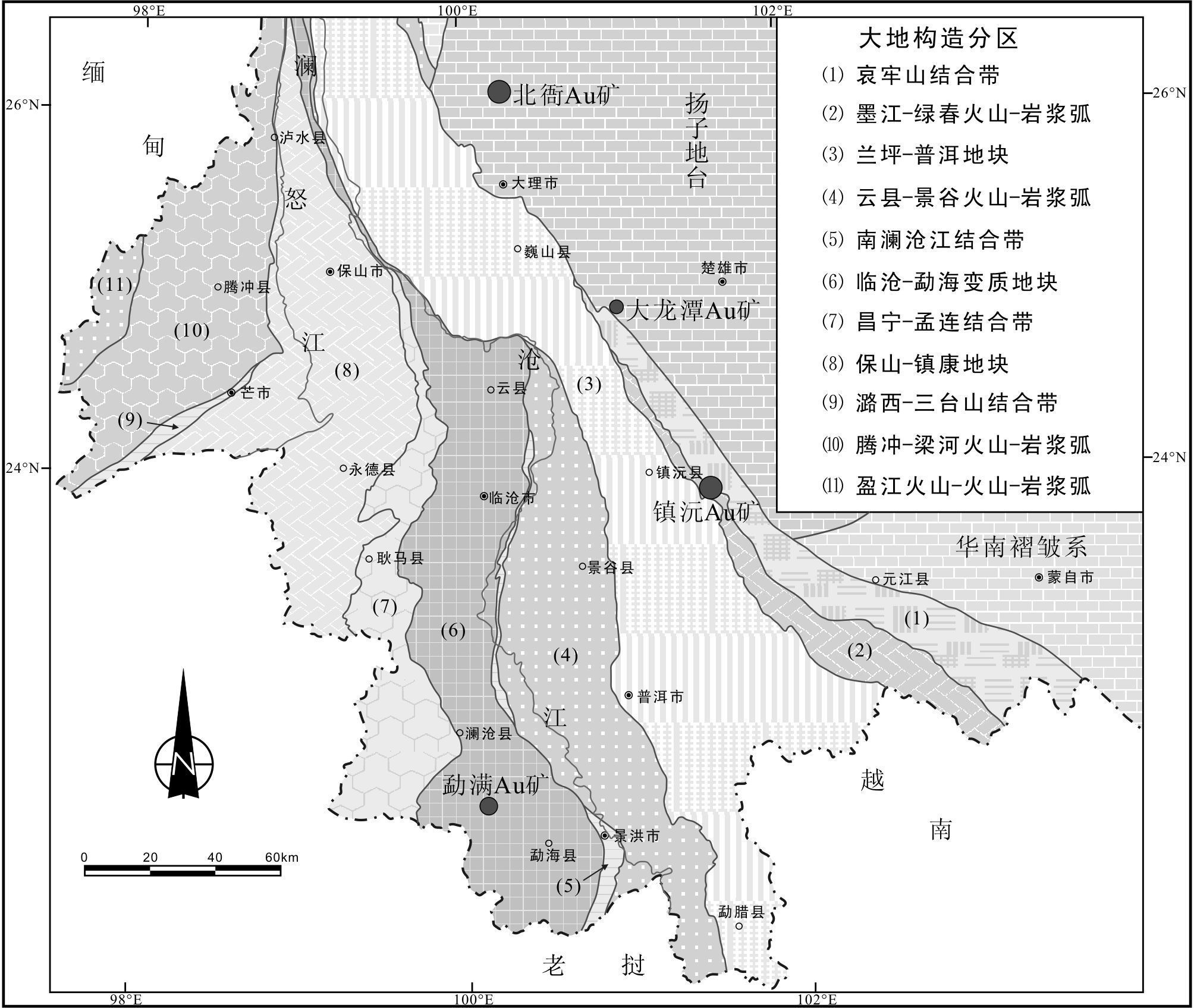
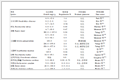
3 地质背景西南三江地区地处欧亚板块与印度板块结合部东侧,是特提斯构造域东段的组成部分 (邓军等,2010a; Wang et al., 2010c, d)。三江地区新生代金成矿系统划分为哀牢山造山型、金沙江-哀牢山富碱斑岩型和澜沧江-怒江热泉型三个主要子成矿系统。金矿床成矿作用明显受控于陆陆碰撞过程;金矿成矿作用与造山作用、富碱斑岩侵入作用、热泉作用密切相关,空间分布具有成带产出的特征。选取北衙金矿床万硐山矿段、镇沅金矿床冬瓜林矿段、大龙潭金矿床以及勐满金矿床热水塘矿段 (图 1) 进行解析。各矿床主要地质特征见表 1。北衙金矿床位于扬子地台西缘金沙江-哀牢山结合带东侧,盐源-丽江陆缘坳陷带与楚雄前陆盆地结合处 (Xu et al., 2007a, b, c;薛传东等,2008),是三江特提斯成矿域中典型的喜马拉雅期富碱斑岩型矿床。Xu et al.(2007a)对北衙矿区划分了五种主要矿床成因类型:斑岩型Cu-Au矿、岩浆型Fe-Au矿、沉积型多金属矿、矽卡岩型多金属矿、与喀斯特相关的古砂矿。万硐山矿段KT52矿体为矿区目前规模最大的Fe-Au矿体,空间上沿石英正长斑岩体边部及其与北衙组灰岩的接触带产出,矿体呈不规则似层状与透镜状,矿石工业类型主要为磁铁矿-赤铁矿型矿石。成矿年代定为35Ma左右 (Lu et al., 2012)。
|
图 1 西南三江地区南段地质图与选取金矿床位置 Fig. 1 Geological sketch map of the south Sanjiang, SW China and distribution of the analyzed gold deposits |
|
表 1 金矿床主要地质特征 Table 1 Geological features of the gold deposits |
镇沅金矿床位于哀牢山深大断裂与九甲-安定断裂夹持的哀牢山低级变质带内,分布在九甲-安定断裂上盘,由冬瓜林、老王寨、库独木、浪泥塘、搭桥箐五个矿段组成 (杨立强等,2010)。区域构造格架总体为NW向,其次为EW向,构造发展以多期推覆作用及韧性剪切作用为特征。镇沅金矿属造山型金矿 (杨立强等,2010),成矿物质与成矿流体主要来自深源,后期受到大气降水混合影响;有研究者提出矿床产出与矿区煌斑岩关系密切 (黄智龙等,1996;Huang et al., 2002)。冬瓜林矿段SⅢ31矿体赋存于上泥盆统库独木组灰色层状变质细粒石英杂砂岩中,分枝矿体规模较小,受两条北西向逆断层控制,呈透镜状、脉状产出,矿石工业类型主要为浸染状低温硫化物型黄铁矿-毒砂-辉锑矿型矿石。老王寨矿段煌斑岩中金云母40Ar-39Ar等时线年龄30.8±0.4Ma和34.3±0.2Ma,其中得到一个反等时线年龄26.4±0.2Ma,推测为成矿年龄 (Wang et al., 2001)。
大龙潭金矿床处于扬子地台川滇台背斜滇中中台陷南缘,楚雄凹陷与哀牢山造山带东侧红河断裂毗邻部位 (王锁青和王远航,2004)。NNW向大龙潭向斜为区域主体构造,伴随的断裂系统较为发育,主要表现为NW向的压剪、张性及近EW向剪性走滑脆性断裂。矿区两个主要赋矿层位是上新统三营组第二段和第三段,矿体主要呈顺层分枝复合透镜体状产于大龙潭向斜近核部、古凹地山麓河流相碎屑岩沉积组合中 (何云等,2008)。Ⅰ号矿体呈似层状产出于大龙潭向斜两翼,矿石工业类型主要为氧化硫化物型矿石。何云等 (2008)认为该矿床是层控中低温热液改造型金矿。
勐满金矿床为典型的热泉型矿床,位于三江褶皱系南端之临沧-景洪褶皱束南部,临沧-勐海花岗岩基西缘,新盘营-勐海复背斜南段。矿区中部逆冲断层将矿床分为北部的光贺矿段与南部的热水塘矿段。矿区构造主要表现为断裂形式,NW向断裂为主体构造。沿北西向断裂带常见温泉、热泉分布,勐满金矿区就位于热泉集中区附近。矿石工业类型主要为强硅化泥化蚀变的热泉型矿石。
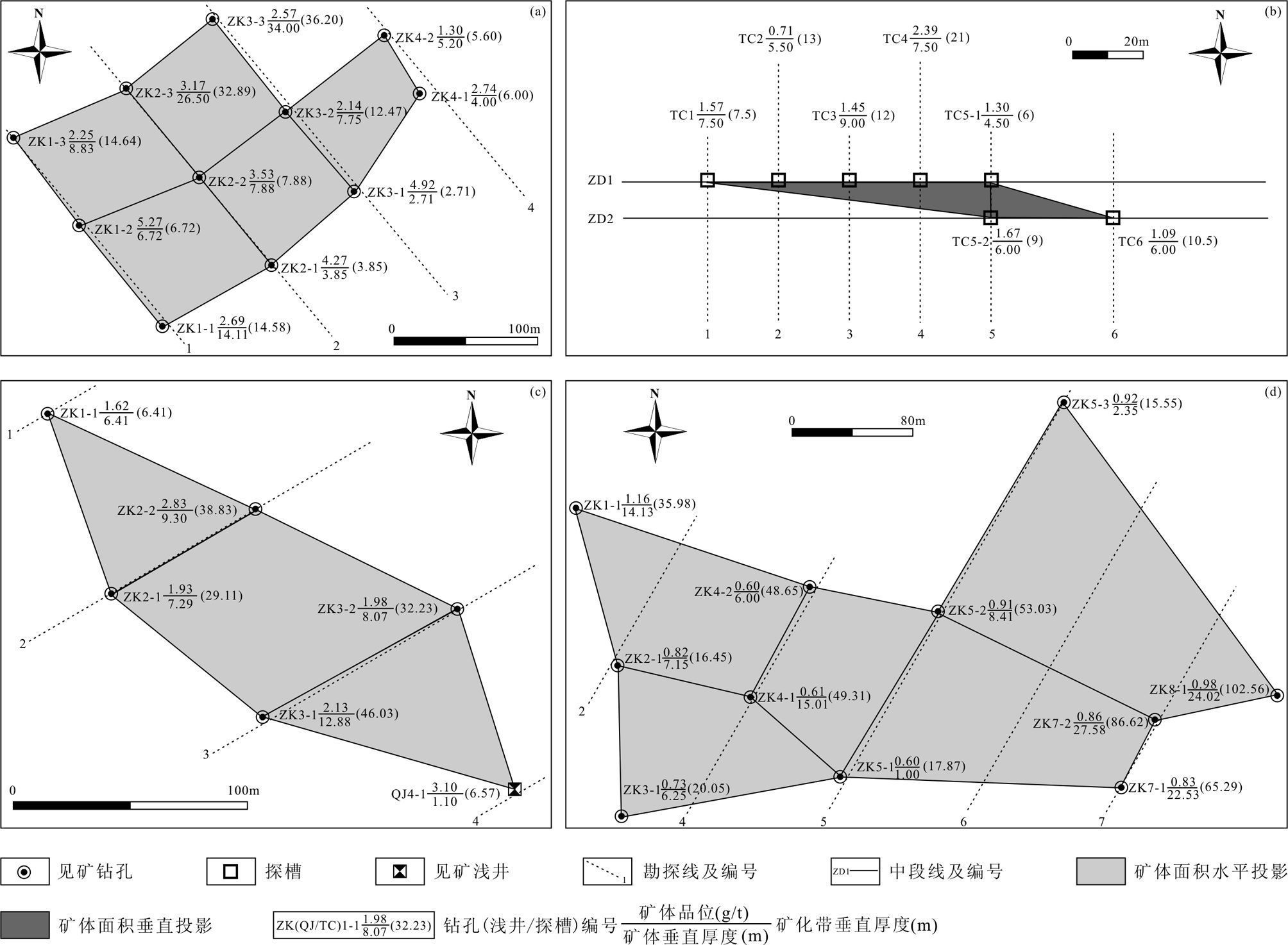
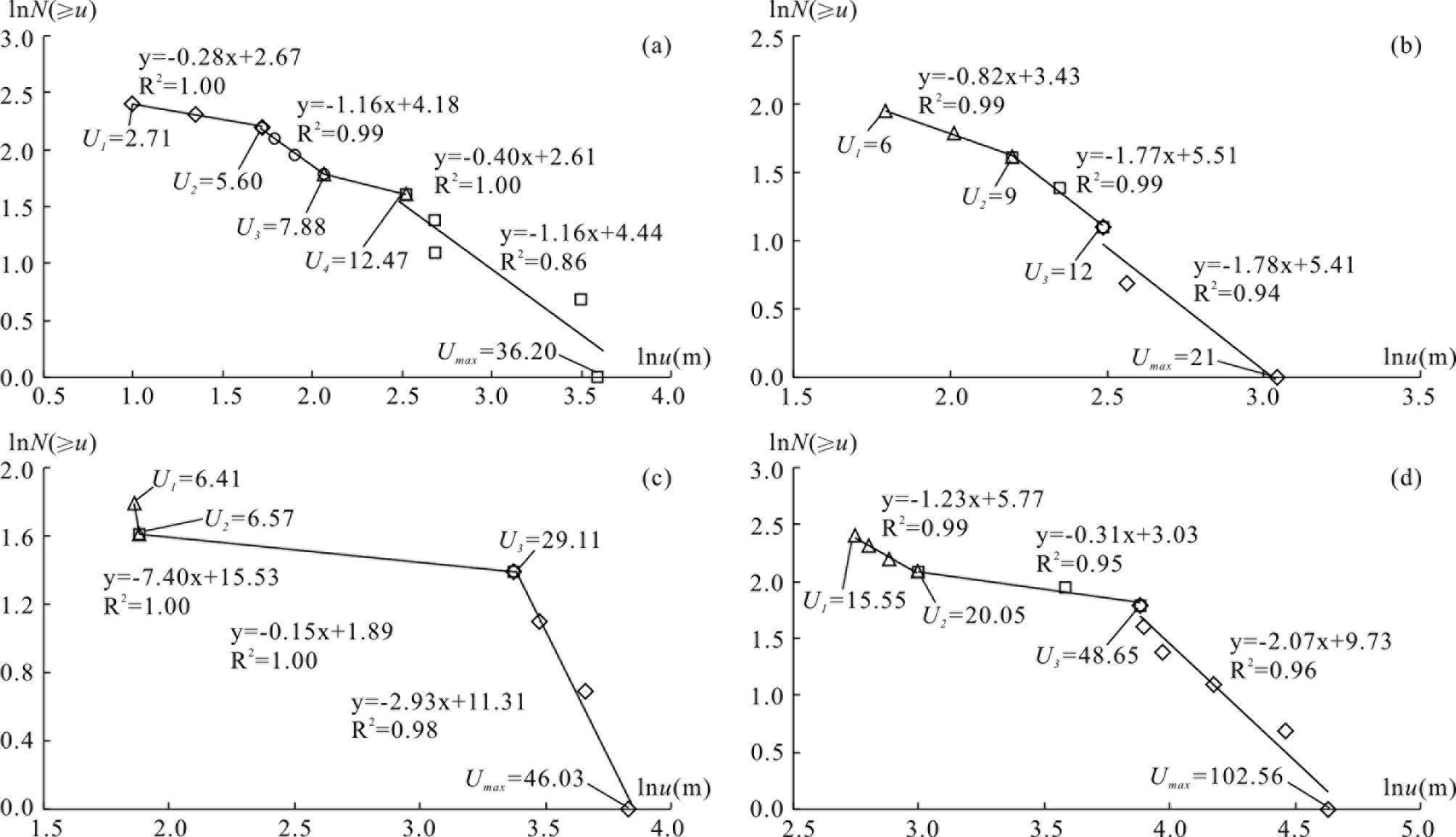
4 原始数据与计算结果北衙万硐山、镇沅冬瓜林、大龙潭和勐满热水塘四个金矿床的各项原始勘探数据见表 2。根据四个矿床的边界品位 (表 2) 可以分别计算出所选每个钻孔中的矿体垂直厚度和矿体品位 (图 2)。将四个矿床的金元素最低含量 (表 2) 作为Ga,分别计算出四个矿床所选每个钻孔的矿化带垂直厚度 (图 2),其分布的分形模型如图 3,已知矿石体重和所选区域的矿化面积,结合该分形模型和公式 (7) 可计算得到矿化带质量Oa。
|
|
表 2 云南三江地区万硐山、冬瓜林、大龙潭及热水塘金矿床勘探数据特征 Table 2 Characteristics of exploration data of the Wandongshan, Donggualin, Dalongtan and Reshuitang gold deposits in the Sanjiang area, Yunnan, SW China |
①云南地矿资源股份有限公司. 2006.云南省鹤庆县北衙铁金矿区万硐山矿段详查报告 (三期)
②云南省地质矿产局第三地质大队. 1993.云南省镇沅县镇沅金矿田冬瓜林矿段详细普查地质报告
③云南地矿资源股份有限公司. 2003.云南省南华县大龙潭金矿地质普查报告
④云南地矿资源股份有限公司. 2005.云南省勐海县勐满金矿普查地质报告
|
图 2 云南三江地区金矿床局部地段的储量计算投影图 (a)-万硐山金矿床 (水平投影);(b)-冬瓜林金矿床 (垂直纵投影);(c)-大龙潭金矿床 (水平投影);(d)-热水塘金矿床 (水平投影).万硐山、冬瓜林、大龙潭和热水塘四个矿床所选钻孔中的矿体最低品位 (即边界品位) 依次分别为1、0.5、0.5和0.5g/t,矿化带最低品位 (即金元素最低含量) 依次分别为0.22、0.2、0.02和0.04g/t Fig. 2 The horizontal longitudinal projection (HLP) and vertical longitudinal projection (VLP) for reserve estimation in the selected orebody area of the gold deposits, the Sanjiang area, Yunnan, SW China (a)-Wandongshan gold deposit (HLP); (b)-Donggualin gold deposit (VLP); (c)-Dalongtan gold deposit (HLP); (d)-Reshuitang gold deposit (HLP) |
|
图 3 金矿床中所选钻孔的矿化带垂直厚度分形模型 (a)-万硐山金矿床;(b)-冬瓜林金矿床;(c)-大龙潭金矿床;(d)-热水塘金矿床 Fig. 3 Fractal models of the mineralized zone thickness in the selected drillholes in the gold deposits (a)-Wandongshan gold deposit; (b)-Donggualin gold deposit; (c)-Dalongtan gold deposit; (d)-Reshuitang gold deposit |
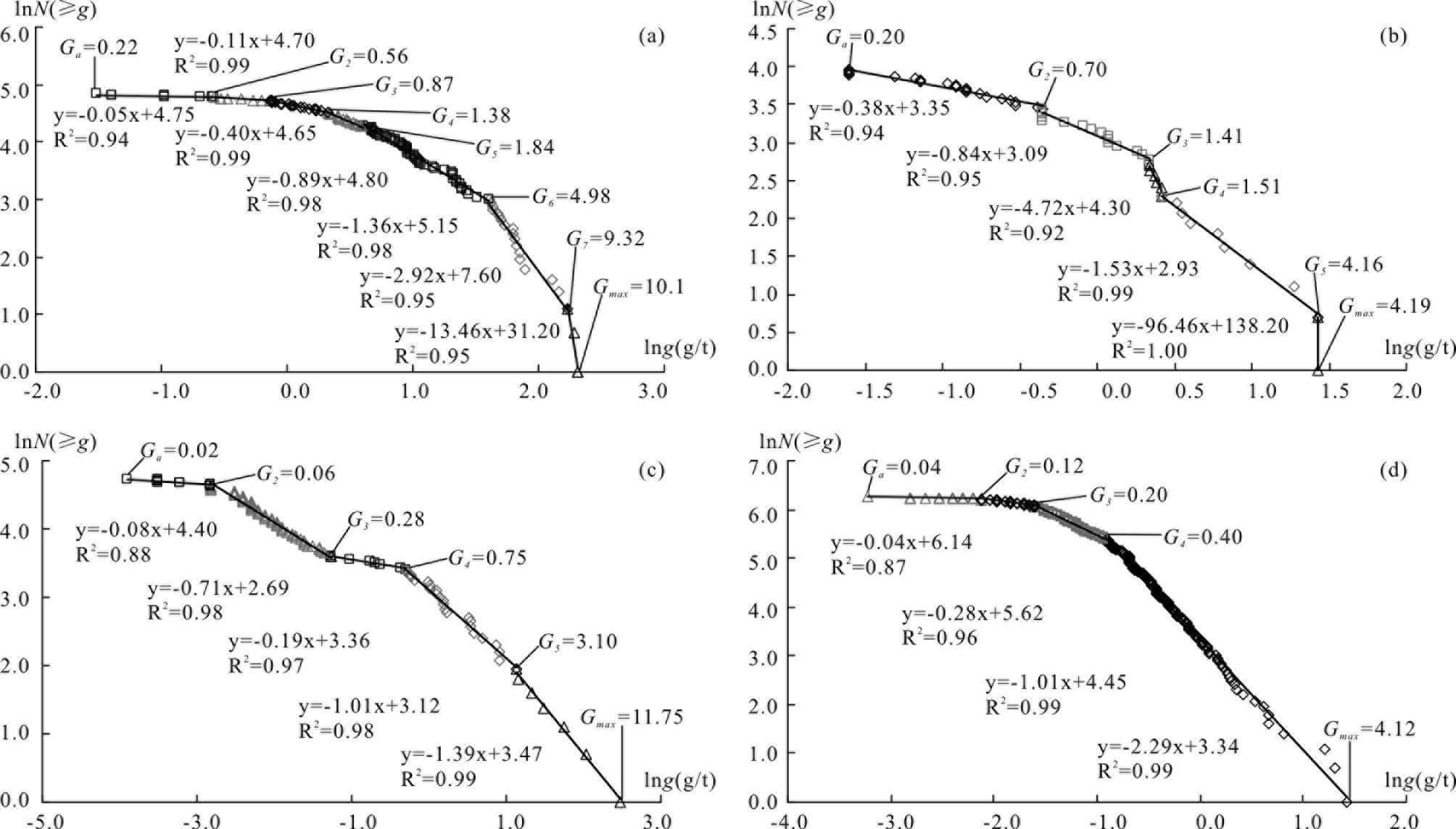
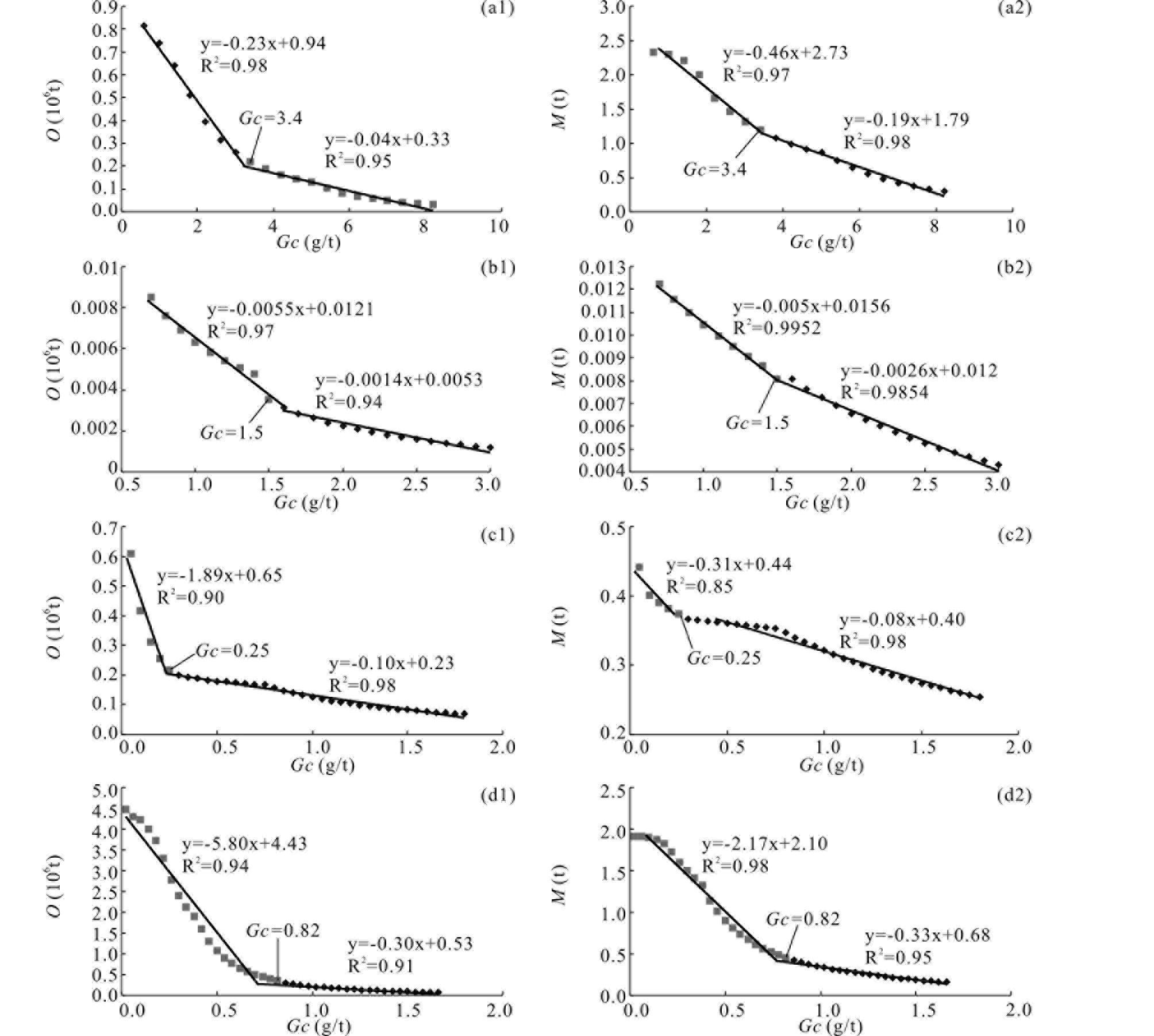
四个矿床的金元素含量分形模型如图 4,利用该模型和公式 (9) 得到Gc-O曲线 (图 5a1-d1),结合公式 (11) 获得Gc-M曲线 (图 5a2-d2)。分别建立了北衙金矿万硐山矿段KT52矿体、镇沅金矿冬瓜林矿段SⅢ31矿体、大龙潭金矿Ⅰ号矿体以及勐满金矿热水塘矿段的矿化带垂直厚度分形模型和金元素含量分形模型,获得吨位-边界品位曲线,得到四个矿床金矿化分散指数Ko1、Ko2与Km1、Km2(表 3)。矿化带垂直厚度分形模型、金元素含量分形模型、吨位-边界品位曲线均需要用多段进行拟合,分段的依据是相邻各段间的明显转折,当相邻两段间变化缓慢或转折不明显时,则通过局部微调使之达到相邻直线拟合优度之和最大来确定 (Wang et al., 2010a)。
|
图 4 所选金矿床钻孔样品中金元素含量分形模型 (a)-万硐山金矿床;(b)-冬瓜林金矿床;(c)-大龙潭金矿床;(d)-热水塘金矿床 Fig. 4 Fractal models of gold concentrations in the samples in the selected drillholes of the gold deposits (a)-Wandongshan gold deposit; (b)-Donggualin gold deposit; (c)-Dalongtan gold deposit; (d)-Reshuitang gold deposit |
|
图 5 边界品位 (g/t) 与矿石量 (106t)、金属量 (t) 相互关系曲线 (a1、a2)-万硐山金矿床;(b1、b2)-冬瓜林金矿床;(c1、c2)-大龙潭金矿床;(d1、d2)-热水塘金矿床 Fig. 5 Relationships between the ore tonnage, metal tonnage and cutoff grade, based on the tonnage-average grade-cutoff grade fractal models for the gold deposits (a1, a2)-Wandongshan gold deposit; (b1, b2)-Donggualin gold deposit; (c1, c2)-Dalongtan gold deposit; (d1, d2)-Reshuitang gold deposit |
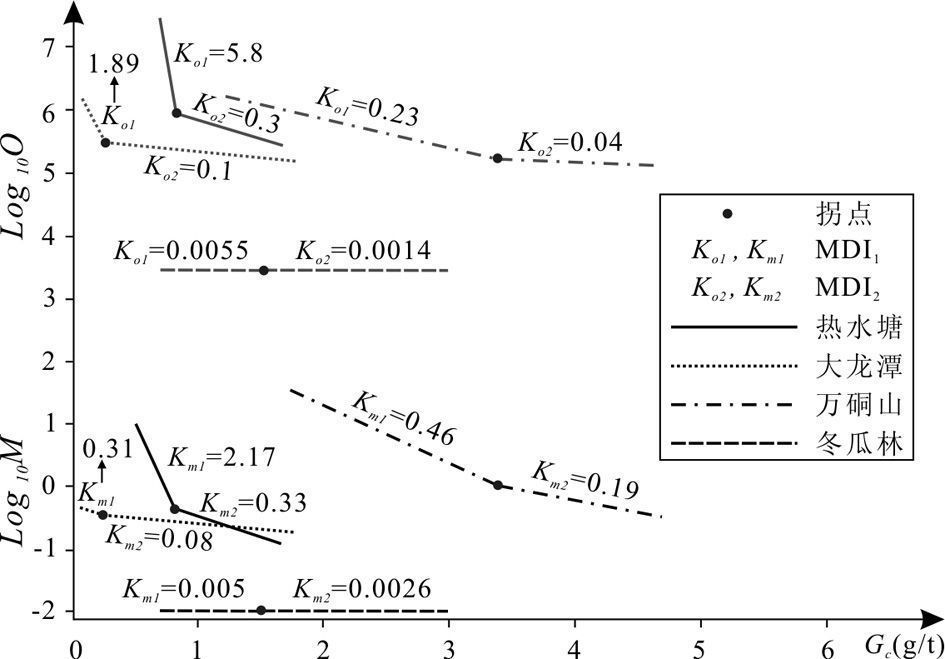
Gc-O和Gc-M曲线表示在不同边界品位下,矿石量和金属量的变化情况。如图 5a2-d2,a4-d4所示,四个矿床均可以分为低品位区间和高品位区间两个部分,都是随着边界品位Gc逐渐升高,矿石量O与金属量M由快速下降逐渐变为缓慢下降,不同类型金矿床在其高、低品位区间的矿化分散指数各不相同,各部分的矿化分散指数见表 3。四个矿床都是低品位区间的矿化分散指数 (MDI1,包括Ko1和Km1) 大于高品位区间的矿化分散指数 (MDI2,包括Ko2和Km2)(图 6);表明对于不同类型的金矿床,其低品位区间金属空间分布相对集中,而高品位区间金属空间分布相对分散;不同成矿类型矿床具有类似的分段特征,说明这可能是成矿作用的一个普遍性特征。Ko1和Ko2由高到低依次为热水塘、大龙潭、万硐山和冬瓜林,Km1和Km2由高到低依次为热水塘、万硐山、大龙潭和冬瓜林;矿化分散指数越高说明随着边界品位的提高,矿石吨位下降越快,代表相对高品位的区块较小;热水塘矿石品位范围为0.04~4.12g/t,整体品位比冬瓜林 (0.2~4.19g/t)、大龙潭 (0.02~11.75g/t) 和万硐山 (0.22~10.1g/t) 小。勐满热水塘强硅化泥化蚀变的热泉型金矿体品位较低,矿化分散指数较高,金属空间分布相对集中;而镇沅冬瓜林浸染状低温硫化物型黄铁矿-毒砂-辉锑矿型、大龙潭氧化硫化物型和北衙万硐山磁铁矿-赤铁矿型矿体品位较高,矿化分散指数较低,金属空间分布相对分散。
|
|
表 3 云南三江地区万硐山、冬瓜林、大龙潭及热水塘金矿床局部地段的矿化分散指数 Table 3 Mineralized dispersion indexes of the selected orebody area in the Wandongshan, Donggualin, Dalongtan and Reshuitang gold deposits, the Sanjiang area, Yunnan, SW China |
|
图 6 万硐山、冬瓜林、大龙潭及热水塘金矿床局部地段的矿化分散指数 Fig. 6 Mineralized dispersion indexes of the selected orebody area in the Wandongshan, Donggualin, Dalongtan and Reshuitang gold deposits |
(1) 本文计算了云南三江地区不同类型金矿体局部地段的吨位-边界品位曲线;显示吨位-平均品位-边界品位分形模型是研究矿床吨位与边界品位关系的便捷方法。
(2) 本文提出一个新的吨位-边界品位曲线刻画参数--矿化分散指数 (MDI),其表示矿体在相同的边界品位变化的条件下,矿石量或金属量的变化程度,可以反映出金属分布集中或分散的特征。
(3) 文中四个类型金矿床的吨位-边界品位曲线显示,它们高品位区间的矿化分散指数均低于低品位区间的,矿床高品位区间的金属空间分布更加分散。勐满热水塘热泉型矿体的矿化分散指数比其他工业类型矿体的高,其金属空间分布相对集中。
致谢 感谢云南地矿资源股份有限公司提供北衙万硐山、大龙潭和勐满热水塘部分勘探数据以及中国黄金集团镇沅金矿提供冬瓜林部分勘探数据。| [] | Agterberg FP. 1995. Power-law versus lognormal models in mineral exploration. In: Mitri HS (ed.). Computer Applications in the Mineral Industry. Proceedings, 3rd Canadian Conference on Computer Applications in the Mineral Industry, 17-26 |
| [] | Agterberg FP, Cheng QM and Brown A. 1996. Multifractal modelling of fractures in the Lac Bonnet Batholiths, Manitoba. Computer and Geosciences, 22: 497–507. DOI:10.1016/0098-3004(95)00117-4 |
| [] | Cheng QM, Agterberg FP and Ballantyne SB. 1994. The separation of geochemical anomalies from background by fractal methods. Journal of Geochemical Exploration, 51(2): 109–130. DOI:10.1016/0375-6742(94)90013-2 |
| [] | Cheng QM. 1999. The box-gliding method for multifractal modeling. Computers and Geosciences, 25: 1073–1079. DOI:10.1016/S0098-3004(99)00068-0 |
| [] | Cheng QM, Xu YG and Grunsky E. 2000. Integrated spatial and spectrum method for geochemical anomaly separation. Natural Resources Research, 9(1): 43–52. DOI:10.1023/A:1010109829861 |
| [] | Cox DP and Singer DA. 1986. Mineral deposits models. U.S. Geological Survey Bulletin, 1693: 379. |
| [] | Deng J, Wang QF, Wan L, Yang LQ and Liu XF. 2007. Singularity of Au distribution in altered rock type deposit: An example from Dayingezhuang gold ore deposit. In: Zhao PD (ed.). The 12th Conference of the International Association for Mathematical Geology. Beijing: China University of Geosciences Publishing House, 44-47 |
| [] | Deng J, Wang QF, Wan L, Yang LQ, Zhou L and Zhao J. 2008. Random difference of the trace element distribution in skarn and marbles from Shizishan orefield, Anhui Province, China. Journal of China University of Geosciences, 19(4): 123–137. |
| [] | Deng J, Wang QF, Wan L, Yang LQ, Gong QJ, Zhao J and Liu H. 2009. Self-similar fractal analysis of gold mineralization of Dayingezhuang disseminated-veinlet deposit in Jiaodong gold province, China. Journal of Geochemical Exploration, 102(2): 95–102. DOI:10.1016/j.gexplo.2009.03.003 |
| [] | Deng J, Wang QF, Yang LQ, Wang YR, Gong QJ and Liu H. 2010. Delineation and explanation of geochemical anomalies using fractal models in the Heqing area, Yunnan Province, China. Journal of Geochemical Exploration, 105(3): 95–105. DOI:10.1016/j.gexplo.2010.04.005 |
| [] | Deng J, Hou ZQ, Mo XX, Yang LQ, Wang QF and Wang CM. 2010a. Superimposed orogenesis and metallogenesis in Sanjiang Tethys. Mineral Deposits, 29(1): 37–42. |
| [] | Deng J, Yang LQ, Ge LS, Yuan SS, Wang QF, Zhang J, Gong QJ and Wang CM. 2010b. Character and post-ore changes, modifications and preservation of Cenozoic alkali-rich porphyry gold metallogenic system in western Yunnan, China. Acta Petrologica Sinica, 26(6): 1633–1645. |
| [] | Deng J, Wang QF, Wan L, Liu H, Yang LQ and Zhang J. 2011. A multifractal analysis of mineralization characteristics of the Dayingezhuang disseminated-veinlet gold deposit in the Jiaodong gold province of China. Ore Geology Reviews, 40(1): 54–64. DOI:10.1016/j.oregeorev.2011.05.001 |
| [] | Deng J, Yang LQ and Wang CM. 2011. Research advances of superimposed orogenesis and metallogenesis in the Sanjiang Tethys. Acta Petrologica Sinica, 27(9): 2501–2509. |
| [] | Feng CR, Wang YB, Li LY, Mo YD and Zhao HJ. 2008. Mengman hot spring type au deposit in Menghai, Xishuangbanna. Yunnan Geology, 27(2): 170–174. |
| [] | He Y, Yang LL and Zhou HS. 2008. The new knowledge of metallogenesis controlling factors of Dalongtang Au deposit of Nanhua, Chuxiong. Yunnan Geology, 27(4): 448–454. |
| [] | Huang ZL, Zhu CM and Wang LK. 1996. Chemical composition of lamprophyres and its relation of it to mineralization in the Laowangzhai gold deposit, Yunnan. Geological Exploration for Non-Ferrous Metals, 5(1): 22–27. |
| [] | Huang ZL, Liu CQ, Yang HL, Xu C, Han RS, Xiao YH, Zhang B and Li WB. 2002. The geochemistry of lamprophyres in the Laowangzhai gold deposits, Yunnan Province, China: Implications for its characteristics of source region. Geochemical Journal, 36: 91–112. DOI:10.2343/geochemj.36.91 |
| [] | Hurst HE, Black RP and Simaike YM. 1965. Long-Term Storage: An Experimental Study. London: Constable: 1-155. |
| [] | Li DM and Li BH. 2000. The mineralization of the gold deposits in the Ailao Mountains, Yunnan. Sedimentary Geology and Tethyan Geology, 20(1): 60–77. |
| [] | Li ZJ. 2010. Ore-forming geological condition for Beiya gold polymetallic deposit in Heqing, Yunnan Province. Mineral Resources and Geology, 24(3): 198–203. |
| [] | Lu YJ, Kerrich R, Cawood PA, McCuaig TC, Hart CJR, Li ZX, Hou ZQ and Bagas L. 2012. Zircon SHRIMP U-Pb geochronology of potassic felsic intrusions in western Yunnan, SW China: Constraints on the relationship of magmatism to the Jinsha suture. Gondwana Research. DOI:10.1016/j.gr.2011.11.016 |
| [] | Mandelbrot BB. 1967. How long is the coast of Britain? Statistical self-similarity and fractional dimension. Science, 156: 636–638. DOI:10.1126/science.156.3775.636 |
| [] | Mandelbrot BB. 1983. The Fractal Geometry of Nature. San Francisco: Freeman. |
| [] | Mandelbrot BB. 1985. Self-affine fractals and fractal dimension. Physica Scripta, 32(4): 257–260. DOI:10.1088/0031-8949/32/4/001 |
| [] | Singer DA. 1993. Development of grade and tonnage models for different deposit types. In: Kirkham RV, Sinclair WD, Thorpe RI and Duke JM (eds.). Mineral Deposit Modeling. Geological Association Canada Special Paper, 40: 21-30 |
| [] | Singer DA, Berger VI and Moring BC. 2005. Porphyry copper deposits of the world: Database, map, and grade and tonnage models. US Geological Survey Open File Report 2005, 1060. |
| [] | Turcotte DL. 1997. Fractals and Chaos in Geology and Geophysics. Cambridge University Press. |
| [] | Turcotte DL. 2002. Fractals in petrology. Lithos, 65: 261–271. DOI:10.1016/S0024-4937(02)00194-9 |
| [] | Wan L, Wang QF, Deng J, Gong QJ, Yang LQ and Liu H. 2010. Identification of mineral intensity along drifts in the Dayingezhuang deposit, Jiaodong gold province, China. Resource Geology, 60(1): 98–108. DOI:10.1111/rge.2010.60.issue-1 |
| [] | Wang CM, Deng J, Zhang ST, Xue CJ, Yang LQ, Wang QF and Sun X. 2010c. Sediment-hosted Pb-Zn deposits in Southwest Sanjiang Tethys and Kangdian area on the western margin of Yangtze Craton. Acta Geologica Sinica, 84(6): 1428–438. DOI:10.1111/acgs.2010.84.issue-6 |
| [] | Wang CM, Deng J, Zhang ST and Yang LQ. 2010d. Metallogenic province and large scale mineralization of VMS deposits in China. Resource Geology, 60(4): 404–413. DOI:10.1111/rge.2010.60.issue-4 |
| [] | Wang JH, Qi L, Yin A and Xie GH. 2001. Emplacement age and PGE geochemistry of lamprophyres in the Laowangzhai gold deposit, Yunnan, SW China. Science in China (Series D), 44(Suppl.): 146–154. |
| [] | Wang QF, Deng J, Wan L, Yang LQ and Gong QJ. 2007. Discussion on the kinetic controlling parameter of the stability of orebody distribution in altered rocks in the Dayingezhuang gold deposit, Shandong. Acta Petrologica Sinica, 23(4): 861–864. |
| [] | Wang QF, Deng J, Wan L, Zhao J, Gong QJ, Yang LQ, Zhou L and Zhang ZJ. 2008. Multifractal analysis of element distribution in skarn-type deposits in the Shizishan orefield, Tongling area, Anhui Province, China. Acta Geologica Sinica, 82(4): 896–905. |
| [] | Wang QF, Deng J, Liu H, Yang LQ, Wan L and Zhang RZ. 2010a. Fractal models for ore reserve estimation. Ore Geology Reviews, 37(1): 2–14. DOI:10.1016/j.oregeorev.2009.11.002 |
| [] | Wang QF, Deng J, Zhao J, Liu H, Wan L and Yang LQ. 2010b. Tonnage-cutoff model and average grade-cutoff model for a single ore deposit. Ore Geology Reviews, 38(1-2): 113–120. DOI:10.1016/j.oregeorev.2010.07.003 |
| [] | Wang QF, Wan L, Zhang Y, Zhao J and Liu H. 2011a. Number-average size model for geological systems and its application in economic geology. Nonlinear Processes in Geophysics, 18(4): 447–454. DOI:10.5194/npg-18-447-2011 |
| [] | Wang QF, Deng J, Liu H, Wang YR, Sun X and Wan L. 2011b. Fractal models for estimating local reserves with different mineralization qualities and spatial variations. Journal of Geochemical Exploration, 108: 196–208. DOI:10.1016/j.gexplo.2011.02.008 |
| [] | Wang QF, Deng J, Liu H, Wan L and Zhang ZJ. 2011c. Fractal analysis of the ore-forming process in a skarn deposit: A case study in the Shizishan area, China. In: Sial AN, Bettencourt JS, De Campos CP and Ferreira VP (eds.). Granite-Related Ore Deposits. Geological Society, London, Special Publications, 350: 89-104 |
| [] | Wang SQ and Wang YH. 2004. The Dalongtan Neogene microscopic disseminated gold deposit, Nanhua. Yunnan Geology, 23(3): 328–336. |
| [] | Xu XW, Cai XP, Xiao QB and Peters SG. 2007a. Porphyry Cu-Au and associated polymetallic Fe-Cu-Au deposits in the Beiya area, western Yunnan Province, South China. Ore Geology Reviews, 31(1-4): 224–246. DOI:10.1016/j.oregeorev.2005.03.015 |
| [] | Xu XW, Cai XP, Zhong JY, Song BC and Peters SG. 2007b. Formation of tectonic peperites from alkaline magmas intruded into wet sediments in the Beiya area, western Yunnan, China. Journal of Structural Geology, 29(8): 1400–1413. DOI:10.1016/j.jsg.2007.04.007 |
| [] | Xu XW, Zhang BL, Qin KZ, Mao Q and Cai XP. 2007c. Origin of lamprophyres by the mixing of basic and alkaline melts in magma chamber in Beiya area, western Yunnan, China. Lithos, 99(3-4): 339–362. DOI:10.1016/j.lithos.2007.06.011 |
| [] | Xue CD, Hou ZQ, Liu X, Yang ZM, Liu YQ and Hao BW. 2008. Petrogenesis and metallogenesis of the Beiya gold-polymetallic ore district, northwestern Yunnan Province, China: Responses to the Indo-Asian collisional processes. Acta Petrologica Sinica, 24(3): 457–472. |
| [] | Yang GL, Yang WG, Luo M, He ZH, Luo SS, Yang ZP and Wang X. 2007. Geochemical characteristics and genesis of the Mengman carlin type-like gold deposit in Menghai County, Yunnan Province. Geoscience, 21(4): 667–674. |
| [] | Yang LQ, Liu JT, Zhang C, Wang QF, Ge LS, Wang ZL, Zhang J and Gong QJ. 2010. Superimposed orogenesis and metallogenesis: An example from the orogenic gold deposits in Ailaoshan gold belt, Southwest China. Acta Petrologica Sinica, 26(6): 1723–1739. |
| [] | Yang WG, Guo YS, Wang XL, Gu XX and Wang GH. 2006. Discovery of the Dalongtan gold deposit in the Nanhua area, Yunnan, China and its geological characteristics. Geological Bulletin of China, 25(9-10): 1233–1237. |
| [] | Zuo RG, Cheng QM and Xia QL. 2009. Application of fractal models to characterization of vertical distribution of geochemical element concentration. Journal of Geochemical Exploration, 102(1): 37–43. DOI:10.1016/j.gexplo.2008.11.020 |
| [] | Zuo RG. 2011. Identifying geochemical anomalies associated with Cu and Pb-Zn skarn mineralization using principal component analysis and spectrum-area fractal modeling in the Gangdese Belt, Tibet (China). Journal of Geochemical Exploration, 111(1-2): 13–22. DOI:10.1016/j.gexplo.2011.06.012 |
| [] | 邓军, 侯增谦, 莫宣学, 杨立强, 王庆飞, 王长明. 2010a. 三江特提斯复合造山与成矿作用. 矿床地质, 29(1): 37–42. |
| [] | 邓军, 杨立强, 葛良胜, 袁士松, 王庆飞, 张静, 龚庆杰, 王长明. 2010b. 滇西富碱斑岩型金成矿系统特征与变化保存. 岩石学报, 26(6): 1633–1645. |
| [] | 邓军, 杨立强, 王长明. 2011. 三江特提斯复合造山与成矿作用研究进展. 岩石学报, 27(9): 2501–2509. |
| [] | 冯钞熔, 王应宝, 李云留, 莫运东, 赵含军. 2008. 西双版纳勐海勐满热泉型金矿. 云南地质, 27(2): 170–174. |
| [] | 何云, 杨丽兰, 周红升. 2008. 楚雄南华大龙塘金矿控矿因素新知. 云南地质, 27(4): 448–454. |
| [] | 黄智龙, 朱成明, 王联魁. 1996. 云南老王寨金矿区煌斑岩的化学成分及与金矿化关系初探. 有色金属矿产与勘查, 5(1): 22–27. |
| [] | 李定谋, 李保华. 2000. 云南哀牢山金矿床的成矿条件. 沉积与特提斯地质, 20(1): 60–77. |
| [] | 李志钧. 2010. 云南鹤庆北衙金多金属矿床成矿地质条件. 矿产与地质, 24(3): 198–203. |
| [] | 王庆飞, 邓军, 万丽, 杨立强, 龚庆杰. 2007. 山东大尹格庄金矿蚀变岩中矿体分布稳定性的动力学控制参量探讨. 岩石学报, 23(4): 861–864. |
| [] | 王锁青, 王远航. 2004. 南华大龙潭新近系微细浸染型金矿. 云南地质, 23(3): 328–336. |
| [] | 薛传东, 侯增谦, 刘星, 杨志明, 刘勇强, 郝百武. 2008. 滇西北北衙金多金属矿田的成岩成矿作用:对印-亚碰撞造山过程的响应. 岩石学报, 24(3): 457–472. |
| [] | 杨贵来, 杨伟光, 罗梅, 和中华, 罗石生, 杨柱平, 王翔. 2007. 云南勐海勐满金矿床的地球化学特征及成因. 现代地质, 21(4): 667–674. |
| [] | 杨立强, 刘江涛, 张闯, 王庆飞, 葛良胜, 王中亮, 张静, 龚庆杰. 2010. 哀牢山造山型金成矿系统:复合造山构造演化与成矿作用初探. 岩石学报, 26(6): 1723–1739. |
| [] | 杨伟光, 郭远生, 王训练, 顾雪祥, 王根厚. 2006. 云南南华地区大龙潭金矿之发现及其矿床地质特征. 地质通报, 25(9-10): 1233–1237. |