 2012, Vol. 28


2. 中国地震局地质研究所活动构造与火山实验室, 北京 100029
2. Key Laboratory of Active Tectonics and Volcano, Institute of Geology, CEA, Beijing 100029, China
研究表明(O’Reiley, 1981; Klemme and O’Neill, 2000),在上地幔温度下,大于1.6GPa时尖晶石相橄榄岩就会向石榴石相转变;而地幔温度和成分的变化也会显著影响相变深度(Grütter et al., 2006),在Cr饱和条件下,Sp/Gt相转变的压力可以达到2.4GPa(Klemme, 2004)。对于中国东部岩石圈,实验研究(樊祺诚等, 1997)和大量地质实例研究(Fan and Hooper, 1989;Fan et al., 2000; 樊祺诚等,2008; Su et al., 2011)表明,Sp/Gt相变发生在55~70km的范围。中国东部尽管发生了岩石圈减薄和克拉通破坏,但是岩石圈厚度仍有60~120km(Menzies et al., 1993, 2007; Xu, 2007;Zhu and Zheng, 2009),所以岩石圈下部岩石组成为仍然是石榴石相或者石榴石/尖晶石过渡相。由于对石榴石相橄榄岩有可靠的温压计(Xu et al., 1993; Huang and Xu, 2010),因此含石榴石地幔岩捕虏体是研究深部岩石圈动力学演化的关键样品之一。
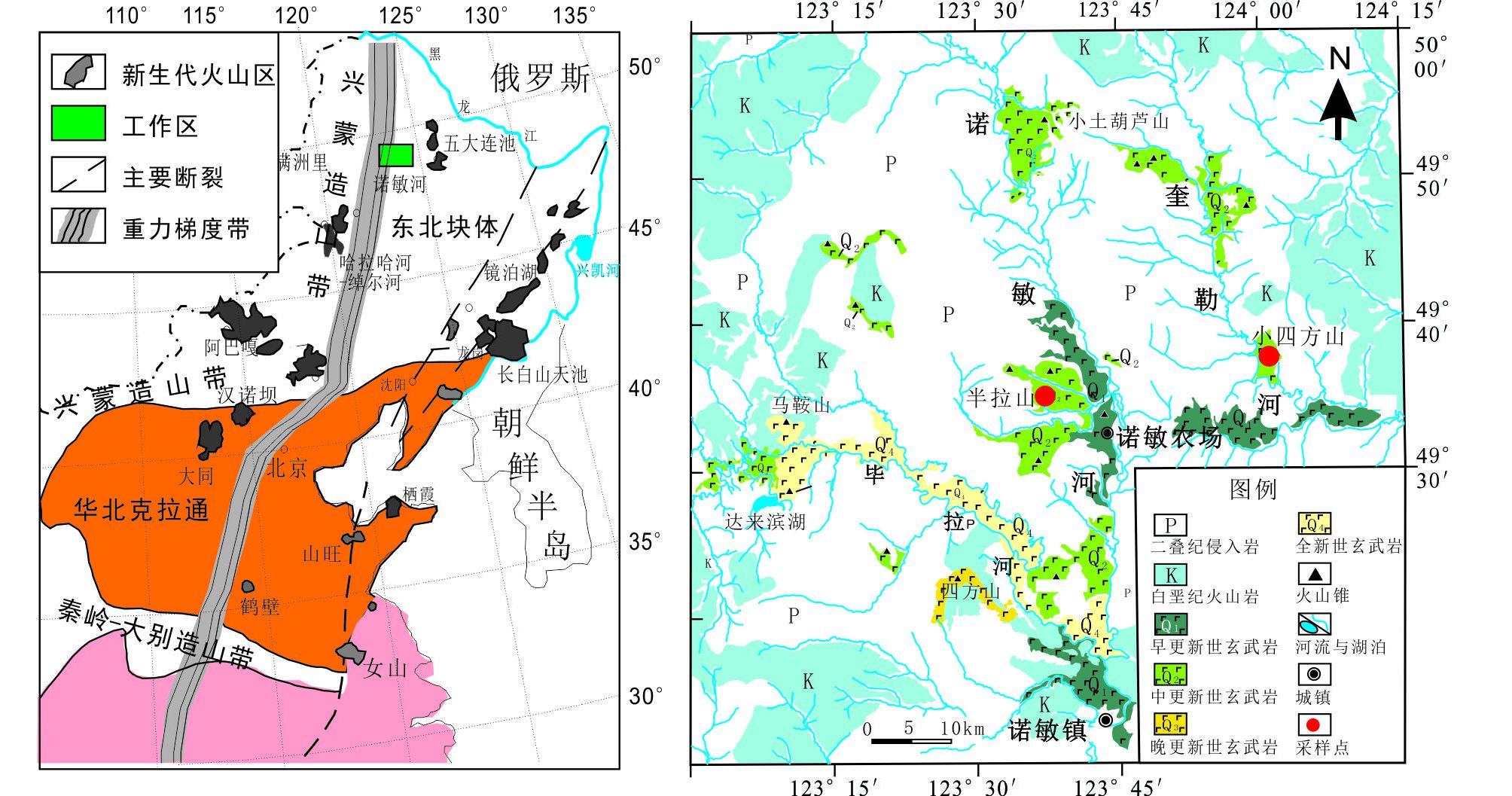
中国东部新生代发生大规模的岩浆活动,许多产地携带大量地幔岩捕虏体为研究岩石圈地幔组成和演化提供了直接证据。但大部分地幔岩捕虏体为尖晶石相橄榄岩,只有在中国东部少数几个地方和西秦岭等地发现有石榴石橄榄岩包体(Fan and Hooper, 1989;曹荣龙和朱寿华,1990;金淑燕和潘顺安,1998;喻学惠,1991;Su et al., 2011)。东北地区是我国新生代火山作用最强烈的地区,如天池火山、龙岗火山、镜泊湖火山、五大连池火山等(图 1左),但这些火山携带的多为尖晶石相地幔橄榄岩。直到最近几年才在大兴安岭中北部哈拉哈河-绰尔河第四纪火山(以下简称哈河火山区)中发现了石榴石相地幔橄榄岩(樊祺诚等,2008),为研究这一地区深部岩石圈地幔的组成和过程打开了窗口。本文根据我们在诺敏河第四纪火山岩中新发现的石榴石相和尖晶石相两种地幔橄榄岩,在岩石学、矿物学和温压平衡条件研究基础上,初步探讨大兴安岭地区岩石圈地幔的组成、结构和古地温特征。
|
图 1 诺敏河第四纪火山岩分布和采样位置图(据樊祺诚等,2012修改) Fig. 1 Map showing distribution of Quaternary volcanic rocks in the Nuomin river area and sampling locations of mantle xenoliths (modified after Fan et al., 2012) |
诺敏河火山区(图 1)位于大兴安岭北部东麓,在嫩江上游的诺敏河及其支流毕拉河、奎勒河流域,分布24座保存较好的第四纪火山,火山岩面积600多平方千米,火山岩类型属于钾质火山岩系列(樊祺诚等,2012)。本文研究的样品来自于两个地区:半拉山中更新世熔岩台地和小四方山中更新世火山锥(图 1右)。
半拉山(当地俗称羊圈)位于诺敏农场西北,为中更新世火山,玄武岩风化较强,玄武岩中被剥落的地幔岩捕虏体堆放于田间地头,唾手可得,捕虏体大小约5~30cm。小四方山火山位于奎勒河上游的黑桦梁子村,火山锥高约50m,破火山口朝向西,锥体西坡挖开的剖面出露大量地幔捕虏体,岩石类型与半拉山基本相同,但捕虏体大小相对较小(3~10cm)。
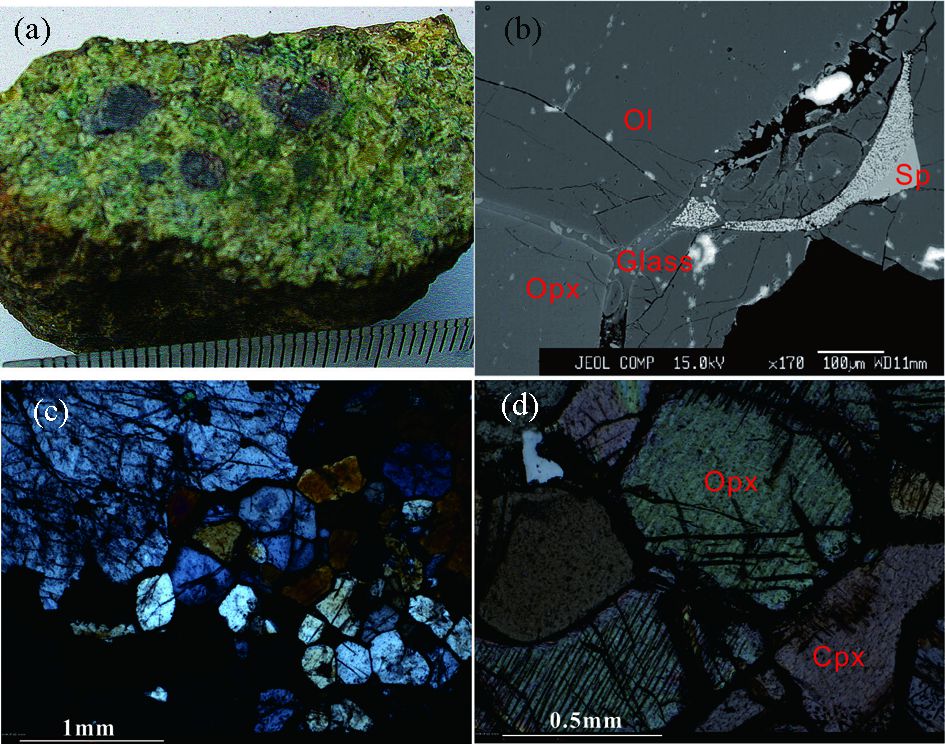
3 岩石学诺敏河地幔捕虏体的岩石类型主要是尖晶石相橄榄岩,其中以方辉橄榄岩为主,二辉橄榄岩相对较少;石榴石相橄榄岩捕虏体比较罕见(野外粗略估计约占1%),也是以方辉橄榄岩为主。地幔捕虏体一般呈浑圆状,表面有锈红色风化壳。绝大部分石榴石发育次变边,风化面呈土灰色,但是切开标本仍可以看到新鲜的石榴石呈玫瑰红色、粗粒状(0.5~1.5cm)(图 2a);一些捕虏体矿物边界和裂隙有熔体包裹体,并可能与尖晶石、辉石等反应形成反应边(图 2b);捕虏体以残斑结构为主,局部有重结晶特点(图 2c);部分辉石矿物显示出溶条带(图 2d)。
|
图 2 诺敏河地幔橄榄岩的岩相学特征 (a)-石榴石二辉橄榄岩,手标本;(b)-熔体-矿物反应,电子探针背散射图像;(c)-残斑结构,显微照片;(d)-辉石出溶结构,显微照片 Fig. 2 Petrographic features of the mantle xenoliths from Nuomin river |
根据显微镜下观察统计,石榴石橄榄岩矿物组成为Ol40~55Opx20~35Cpx0~10Grt5~25,尖晶石橄榄岩矿物组成为Ol45~65Opx30~40 Cpx0~15Sp0~10,大部分橄榄岩中单斜辉石极少(不到3%),所以岩石类型以方辉橄榄岩为主,这与邻区哈河第四纪火山岩中橄榄岩捕虏体的情况类似(赵勇伟和樊祺诚,2011)。以难熔方辉橄榄岩为主地幔橄榄岩捕虏体的存在,说明大兴安岭下岩石圈地幔具有难熔的残余地幔的特征。部分诺敏河捕虏体矿物和矿物粒间含有囊状熔体(图 2b),其特征与相邻的哈河地幔橄榄岩中的熔体(樊祺诚等,2008)相似。这可能说明本区上地幔经历了熔体与难熔橄榄岩的相互作用,少量相对饱满的二辉橄榄岩的成因可能与此过程有关(Zhang et al., 2002; Zhang, 2005; Tang et al., 2008, 2012)。橄榄岩中辉石出溶结构(图 2d)则记录了这种地幔演化过程的温度、压力的变化(Huang et al., 2007)。
4 矿物化学我们采用中国科学院地质与地球物理所SX500型电子探针对各类橄榄岩和辉石岩捕虏体的矿物成分做了系统的分析,分析用的样品为标准的0.03mm岩石薄片,表面碳质渡膜,仪器的工作条件为10kV加速电压、20mA电流、1μm束斑直径,分析结果见表 1。
|
表 1 诺敏河火山地幔捕掳体电子探针分析数据(wt%) Table 1 EPMA analyses (wt%) of mantle xenoliths from the Nuomin river volcanic field |
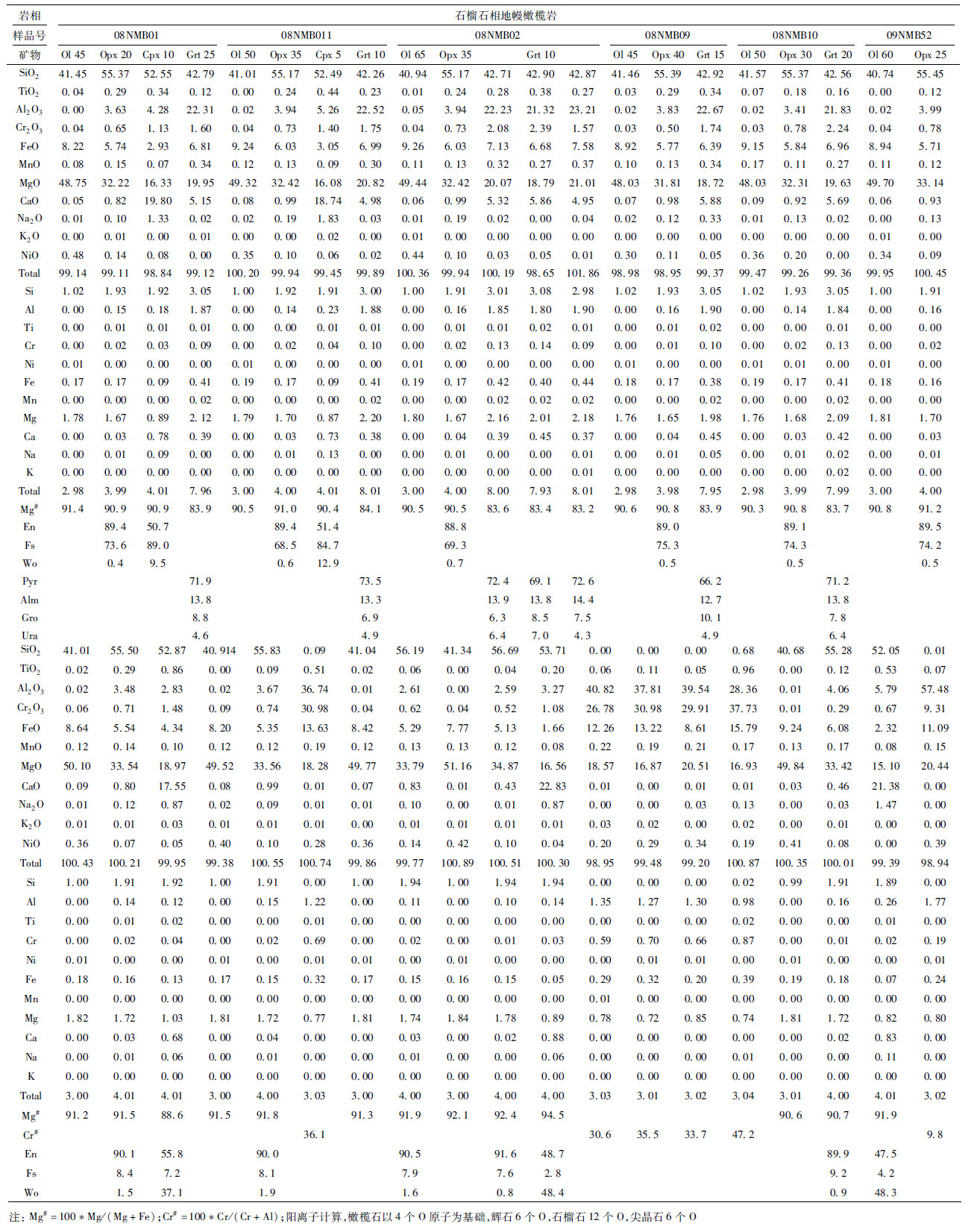
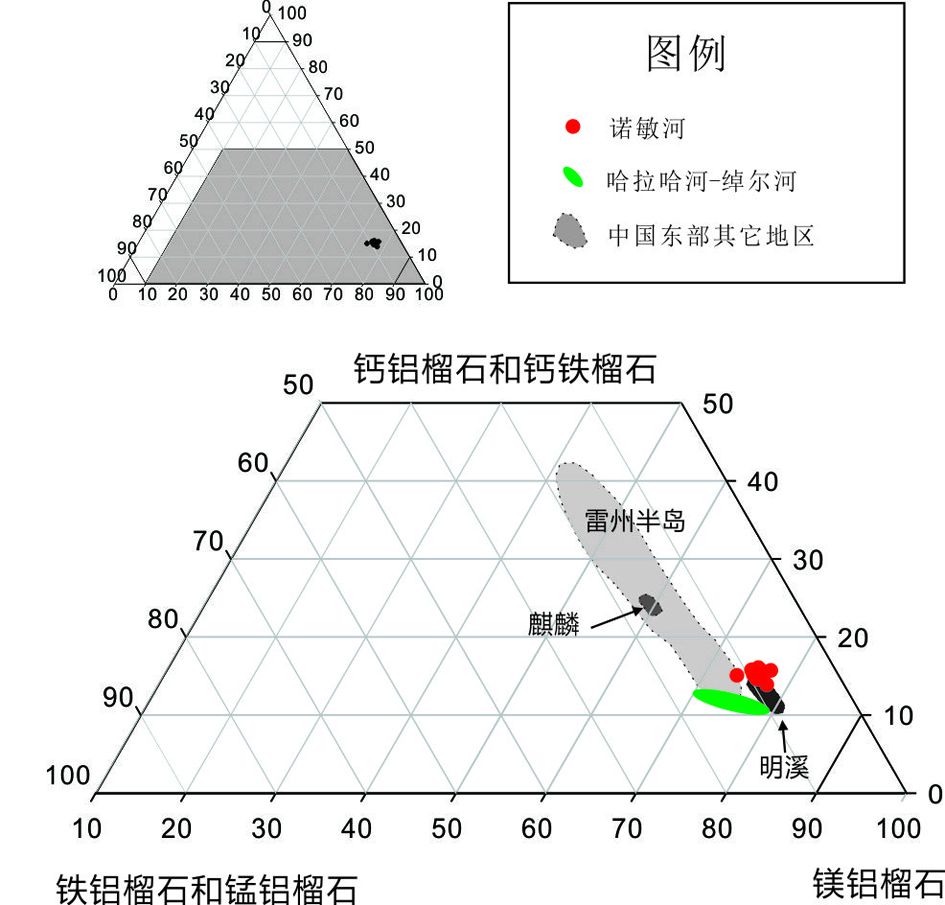
石榴石橄榄岩中的石榴石主要成分为镁铝榴石Pyr66~72,以及少量铁铝榴石Alm13~14、钙铝榴石Gro6~10、铬铝榴石Ura4~7,其它组分不超过5%。根据石榴石Pyr (Mg)、Gro+And (FeMn)、Alm+Spe (Ca)组分做三元图解(图 3),可以看出中国东部石榴石主要是镁铝榴石和铁铝榴石固溶体系列(Huang et al., 2007)。诺敏河石榴石落在中国东部石榴石分布范围的下方,更加富镁贫钙,大致与福建明溪和哈河(樊祺诚等,2008)的石榴石成分相当。
|
图 3 地幔石榴石矿物组成三元图解 (据Huang et al., 2007) Fig. 3 Chemical variation of garnet in mantle xenoliths (after Huang et al., 2007) |
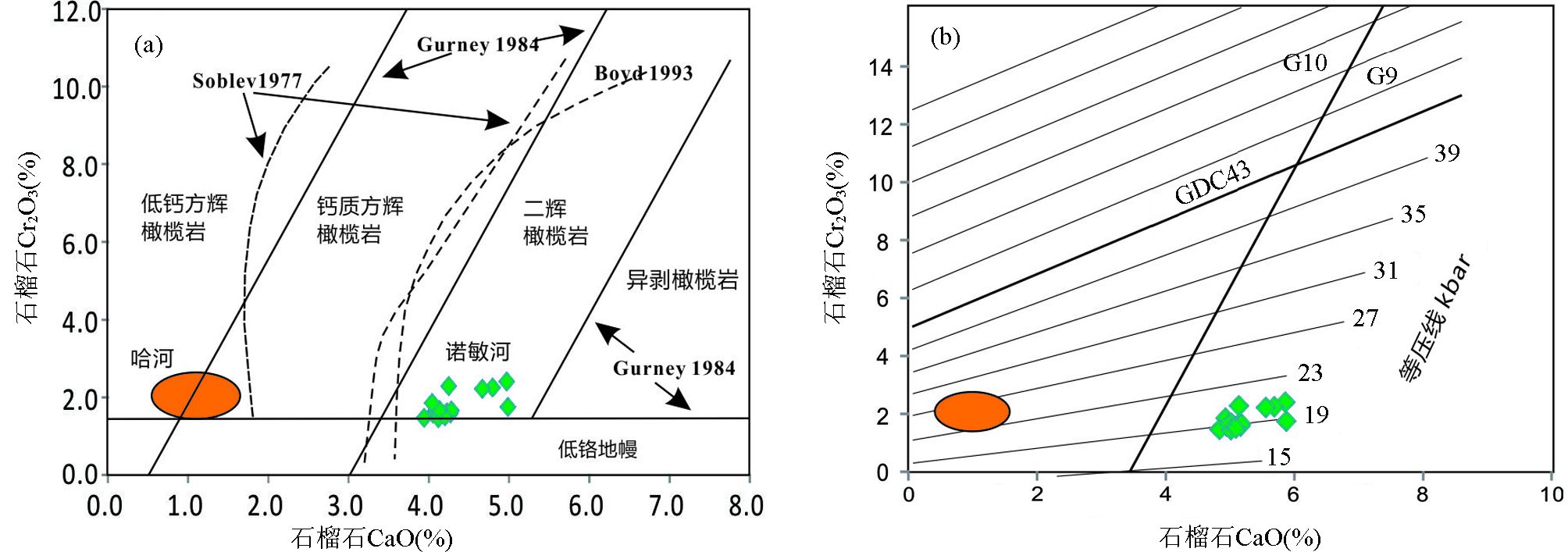
石榴石钙、铬组成反映了地幔构造背景和压力。CaO-Cr2O3关系图上(图 4a)诺敏地幔石榴石具有相对较高的Ca含量(5%~7%)和相对较低的Cr含量(1.6%~2.2%);而哈河仅有一个石榴石数据(CaO 5.6%、Cr2O3 1.8%)与诺敏河类似,其它石榴石钙含量更低(CaO 1.6%~2.3%)、而铬含量略高(Cr2O3 0.8%~2.8%),落在Sobolev(1977) 定义的低钙方辉橄榄岩区间。相应的石榴石CaO-Cr2O3压力关系图(图 4b),诺敏河火山落在18~22kb(1.9~2.3GPa)之间,而哈河火山地幔石榴石橄榄岩来源更深,大致在22~28kb,这个结果与下文温度压力计算基本吻合。
|
图 4 地幔石榴石CaO-Cr2O3相关关系分类图和平衡压力(据Grütter et al., 2006) Fig. 4 CaO-Cr2O3 classification diagram of mantle garnet and equilibrium pressures (after Grütter et al., 2006) |
石榴石相橄榄岩中的斜方辉石(Wo2En89Fs9)和尖晶石相橄榄岩中的斜方辉石(Wo1~2En90~92Fs8~9),均为顽火辉石(En>88),但成分略有变化,尖晶石相中更加富镁。斜方辉石中Al2O3的含量为3.5%~4%,个别样品低至2.6%,总体低于邻区哈河火山区。单斜辉石为绿色的铬透辉石(Wo1~2En90~92Fs8~9),Cr2O3含量为1%~1.5%,对应单位辉石分子中Cr原子含量为0.2~0.4,与邻区哈河火山捕虏体相似。辉石岩中的斜方辉石(Wo1~2En77~85Fs13~22)为古铜辉石,单斜辉石主要是普通辉石(Wo41~42En46~50Fs9~12),与橄榄岩明显不同。
诺敏河火山区尖晶石相橄榄岩中,除了样品08NMB23之外(Fo=90.6),其余样品的橄榄石镁指数普遍较高Fo91.3~92.4,属于难熔的高镁橄榄石(Zhang et al., 2007; 吴福元等,2008);对应尖晶石主要为褐红色的铬尖晶石,具有高铬低铝的特点(Cr2O3 12%~16%、Al2O3 28%~41%),铬指数Cr# 30.6~47.2,与中国东部方辉橄榄岩的铬尖晶石成分一致(Fan and Hooper, 1989),推测诺敏岩石圈上地幔的主体是难熔的残余地幔。与邻区哈河的尖晶石相地幔橄榄岩(赵勇伟和樊祺诚,2011)特征一致,暗示大兴安岭地区岩石圈地幔保留了较多古老的难熔残余地幔。
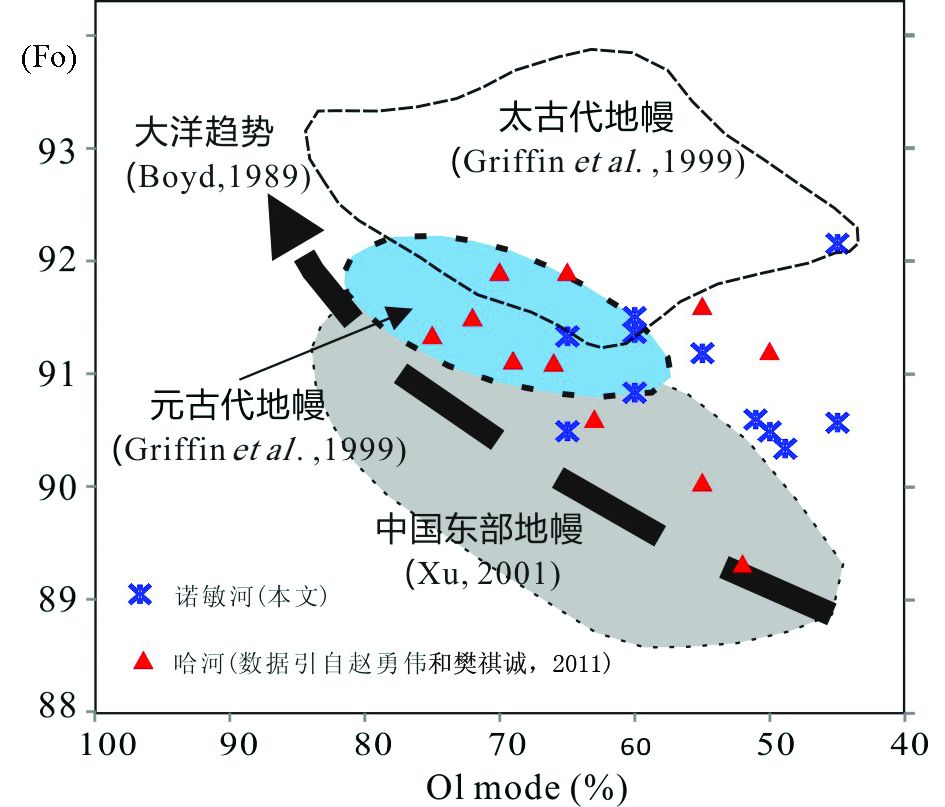
从橄榄石的百分含量(Ol mode %)与其Fo的相关图解(图 5)中,同样可以发现大兴安岭诺敏河与哈河地幔橄榄岩(包括石榴石相和尖晶石相两类橄榄岩)已经偏离Boyd (1989) 定义的大洋地幔趋势、靠近太古代和元古代地幔区域,而中国东部大部分玄武岩携带的地幔橄榄岩捕虏体覆盖在大洋趋势上(Xu,2001),表明大兴安岭岩石圈地幔具有接近古老地幔的特征。
|
图 5 Fo-olivine mode 图解 Fig. 5 Fo-olivine mode diagram |
温压计算的数据取舍,我们遵循两个原则:(1) 选择新鲜的矿物做电子探针分析,温压计算的矿物对要相邻。因为随着微区分析技术的发展,越来越多的证据显示矿物微观尺度的地球化学不均一性,所以要尽可能利用相邻矿物对的平衡关系,避免矿物地球化学不均一性影响;(2) 用矿物镁指数Mg#检验剔除异常矿物值(Huang and Xu, 2010;Wu and Zhao, 2011),因为地质温度计、压力计的理论依据是化学反应的热力学原理,平衡矿物间的元素分配系数是温度和压力的函数,而异常的矿物镁指数值不代表平衡反应结果。
适用于地幔岩地质温度和压力计很多,各有利弊,最近Huang and Xu (2010) 和Wu and Zhao (2011) 采做了系统的总结对比。对于石榴石二辉橄榄岩的温度,一般认为Wells(1977) 温度偏低,推荐用Brey and KöhLer (1990) 温度公式计算;对于压力,几种版本的石榴石-斜方辉石压力计Taylor (1998) 、Nickel and Green (1985) 、Brey et al. (2008) 都可用,为了方便与中国东部石榴石地幔比较,推荐用Nickel and Green (1985) 。石榴石方辉橄榄岩中缺少单斜辉石,不能用二辉石温度计,我们用Grt-Opx矿物对(Harley, 1984)同时计算了石榴石二辉橄榄岩和方辉橄榄岩的平衡温度,用于相互比较。温度、压力结果见表 2。
|
|
表 2 诺敏河石榴石相地幔岩温度(℃)和压力(GPa)计算结果 Table 2 P-T estimation of mantle xenoliths from Nuomin river Quarternary volcanic rocks |
比较上述温度压力计算结果(表 2),诺敏河石榴石二辉橄榄岩的压力为2.14~2.33GPa(相当于70~75km),温度为1114~1168℃。表 2对比显示石榴石方辉橄榄的温度与石榴石二辉橄榄岩大致相同,而压力大约低0.3GPa(相当于60~65km)。温度和压力计算显示,诺敏河比哈河(2.36GPa)压力略低,与前文石榴石CaO-Cr2O3关系(图 4b)的结果一致,相互印证,说明前者来源相对较浅。
由于尖晶石相橄榄岩中的单斜辉石极少,个别样品的平衡温压计算结果也不理想,故本文未采纳。
诺敏河石榴石二辉橄榄岩平衡温度和压力反映了比较高的地温梯度,与邻区哈河石榴石二辉橄榄岩的研究结果(樊祺诚等,2008)类似,表明大兴安岭地区现代岩石圈地幔具有大洋型地温梯度特征,与中国东部新生代火山岩地幔捕虏体研究结果(徐义刚等,1995;Xu et al., 1996; Lin et al., 1998;樊祺诚和隋建立,2009;Huang and Xu, 2010)一致,也与地球物探测结果大致吻合。地球物理探测研究表明,中国东部华北和东北地区地壳厚度为~40km(马杏垣,1989)、岩石圈厚度为80~90km(方盛明等,2001);An and Shi (2006) 等通过温度场反演岩石圈厚度为100 km左右;而全球深震探测研究(Ai and Zhang, 2003; Zhao, 2004)显示,西太平洋板片滞留在中国东部的660km地幔过渡带,俯冲板片向西到大兴安岭、太行山一带。这些地球物理证据,一方面说明大兴安岭地区岩石圈厚度比较薄,另一方面说明上地幔深部长期扰动的存在,所以能够获得比较高的地温梯度。
6 结论(1) 大兴安岭诺敏河第四纪火山岩中地幔岩捕虏体,包括石榴石相和尖晶石相两种地幔橄榄岩,它们均以方辉橄榄岩为主。两种地幔橄榄岩的岩石类型和矿物学特征(高Mg#橄榄石和高Cr#尖晶石)与南区哈河的地幔橄榄岩特征相一致。在橄榄石百分含量与Fo的相关图中,诺敏河样品落在太古代-元古代地幔区域,显示该区上地幔具有古老地幔的特点。
(2) 石榴石橄榄岩的平衡温压分别为1114~1168℃和2.14~2.33GPa,因此其来源深度为70~75km。这些数据暗示研究区具有较高的地温梯度,与中国东部新生代火山岩区的地温梯度相似。
致谢 电子探针分析得到中科院地质与地球物理研究所电子探针实验室的毛骞、马玉光的大力帮助,表示感谢。感谢两位审稿专家张招崇教授和汤艳杰副研究员对本文提出了宝贵的意见。| [] | Ai Y, Zheng T, Xu W, He Y and Dong D. 2003. A complex 660km discontinuity beneath Northeast China. Earth and Planetary Science Letters, 212(1-2): 63–71. DOI:10.1016/S0012-821X(03)00266-8 |
| [] | An M and Shi Y. 2006. Lithospheric thickness of the Chinese continent. Physics of the Earth and Planetary Interiors, 159(3-4): 257–266. DOI:10.1016/j.pepi.2006.08.002 |
| [] | Boyd FR. 1989. Compositional distinction between oceanic and cratonic lithosphere. Earth and Planetary Science Letters, 96(1-2): 15–26. DOI:10.1016/0012-821X(89)90120-9 |
| [] | Brey GP and KöhLer T. 1990. Geothermobarometry in four-phase lherzolites II. New thermobarometers, and practical assessment of existing thermobarometers. J. Petrol., 31(6): 1353–1378. DOI:10.1093/petrology/31.6.1353 |
| [] | Brey GP, Bulatov VK, Girnis AV and Lahaye Y. 2008. Experimental melting of carbonated peridotite at 6~10GPa. J. Petrol., 49(4): 797–821. |
| [] | Cao RL and Zhu SH. 1990. Ryacolite-olivine-diopside mineral assemblages of mantle metasomatism in garnet lherzolite xenoliths from Xilong, Zhejiang Province. In: Professional Committee for Mantle Mineralogy, Petrology and Geochemistry under China Society of Mineralogy, Petrology and Geochemistry (ed.). Collected Papers on Upper Mantle Characteristics and Dynamics of China. Beijing: Seismological Publishing House: 34-44. |
| [] | Fan QC and Hooper PR. 1989. The mineral chemistry of ultramafic xenoliths of eastern China: Implications for upper mantle composition and the paleogeotherms. J. Petrol., 30(5): 1117–1158. DOI:10.1093/petrology/30.5.1117 |
| [] | Fan QC, Liu RX, Xie HS, Zhang YM, Xu P and Lin ZR. 1997. Experimental study of spinel-garnet phase transition in upper mantle and its significance. Science in China (Series D), 40(4): 383–389. DOI:10.1007/BF02877569 |
| [] | Fan QC, Sui JL, Zhao YW, Sun Q, Li N and Du XX. 2008. Preliminary study on garnet peridotite xenolith of Quaternary volcanic rocks in middle Daxing’an Moutain Range. Acta Petrologica Sinica, 24(11): 2563–2568. |
| [] | Fan QC and Sui JL. 2009. Phase transition of upper mantle rock in eastern China and its significance. Earth Science, 34(3): 387–391. |
| [] | Fan QC, Zhao YW, Sui JL, Li DM and Wu Y. 2012. Studies on Quaternary volcanism stages of Nuomin river area in the Great Xing’an Range: Evidence from petrology, K-Ar dating and volcanic geology features. Acta Petrologica Sinica, 28(4): 1092–1098. |
| [] | Fan WM, Zhang HF, Baker J, Jarvis KE, Mason PRD and Menzies MA. 2000. On and off the North China Craton: Where is the Archaean keel? J. Petrol., 41(7): 933–950. DOI:10.1093/petrology/41.7.933 |
| [] | Fang SM, Yu QF and Zhang XK. 2001. Characteristics of the lithospheric bottom interface and seismicity in eastern China and its vicinity. Chinese Journal of Geophysics, 44(4): 48–53. |
| [] | Griffin WL, O' Reilly SY and Ryan CG. 1999. The composition and origin of sub-continental lithospheric mantle. In: Fei Y, Berta CM and Mysen BO (eds.). Mantle Petrology: Field Observations and High-Pressure Experimentation. Houston: Geochemical Society, 13-46 |
| [] | Grütter H, Latti D and Menzies A. 2006. Cr-saturation arrays in concentrate garnet compositions from kimberlite and their use in mantle barometry. J. Petrol., 47(4): 801–820. |
| [] | Harley SL. 1984. An experimental study of the partitioning of Fe and Mg between garnet and orthopyroxene. Contributions to Mineralogy and Petrology, 86(4): 359–373. DOI:10.1007/BF01187140 |
| [] | Huang XL, Xu YG, Lo CH, Wang RC and Lin CY. 2007. Exsolution lamellae in a clinopyroxene megacryst aggregate from Cenozoic basalt, Leizhou Peninsula, South China: Petrography and chemical evolution. Contributions to Mineralogy and Petrology, 154(6): 691–705. DOI:10.1007/s00410-007-0218-4 |
| [] | Huang XL and Xu YG. 2010. Thermal state and structure of the lithosphere beneath eastern China: A synthesis on basalt-borne xenoliths. Journal of Earth Science, 21(5): 711–730. DOI:10.1007/s12583-010-0111-3 |
| [] | Jin SY and Pan SA. 1998. Mantle-derived xenoliths of spinel-garnet lherzolite from Nushan and their implications for petro-physics. Earth Science, 23(5): 475–479. |
| [] | Klemme S and O’Neill HS. 2000. The near-solidus transition from garnet lherzolite to spinel lherzolite. Contributions to Mineralogy and Petrology, 138(3): 237–248. DOI:10.1007/s004100050560 |
| [] | Klemme S. 2004. The influence of Cr on the garnet-spinel transition in the Earth’s mantle: Experiments in the system MgO-Cr2O3-SiO2 and thermodynamic modelling. Lithos, 77(1-4): 639–646. DOI:10.1016/j.lithos.2004.03.017 |
| [] | Lin CY, Shi LB, Han XL and Zhang X. 1998. Thermal structure and rheology of the upper mantle beneath Zhejiang Province. Science in China (Series D), 28(2): 97–104. |
| [] | Ma XY. 1989. Lithospheric Dynamics Atlas of China. Beijing: China Cartographic Publishing House (in Chinese). |
| [] | Menzies MA, Fan W and Zhang M. 1993. Palaeozoic and Cenozoic lithoprobes and the loss of >120km of Archaean lithosphere, Sino-Korean craton, China. Geological Society, London, Special Publications, 76(1): 71–81. DOI:10.1144/GSL.SP.1993.076.01.04 |
| [] | Menzies M, Xu Y, Zhang H and Fan W. 2007. Integration of geology, geophysics and geochemistry: A key to understanding the North China Craton. Lithos, 96(1-2): 1–21. DOI:10.1016/j.lithos.2006.09.008 |
| [] | Nickel KG and Green DH. 1985. Empirical geothermobarometry for garnet peridotites and implications for the nature of the lithosphere, kimberlites and diamonds. Earth and Planetary Science Letters, 73: 758–170. |
| [] | O’Neill HSC. 1981. The transition between spinel lherzolite and garnet lherzolite, and its use as a geobarometer. Contributions to Mineralogy and Petrology, 77(2): 185–194. DOI:10.1007/BF00636522 |
| [] | Sobolev NV. 1977. Deep-Seated Inclusions in Kimberlites and the Problem of the Composition of the Upper Mantle. Ann Arbor, Michigan: Edwards Brothers, Inc. |
| [] | Su BX, Zhang HF, Tang YJ, Chisonga B, Qin KZ, Ying JF and Sakyi P. 2011. Geochemical syntheses among the cratonic, off-cratonic and orogenic garnet peridotites and their tectonic implications. International Journal of Earth Sciences, 100(4): 695–715. DOI:10.1007/s00531-010-0527-0 |
| [] | Tang YJ, Zhang HF, Ying JF, Zhang J and Liu XM. 2008. Refertilization of ancient lithospheric mantle beneath the central North China Craton: Evidence from petrology and geochemistry of peridotite xenoliths. Lithos, 101: 435–452. DOI:10.1016/j.lithos.2007.09.006 |
| [] | Tang YJ, Zhang HF, Ying JF, Su BX, Chu ZY, Xiao Y and Zhao XM. 2012. Highly heterogeneous lithospheric mantle beneath the Central Zone of the North China Craton evolved from Archean mantle through diverse melt refertilization. Gondwana Research. DOI:10.1016/j.gr.2012.1001.1006 |
| [] | Taylor WR. 1998. An experimental test of some geothermometer and geobarometer formulations for upper mantle peridotites with application to the thermobarometry of fertile lherzolites and garnet websterite. Neues Jahrbuch für Mineralogie Abhandlungen, 172: 381–408. |
| [] | Wells PRA. 1977. Pyroxene thermometry in simple and complex systems. Contributions to Mineralogy and Petrology, 62(2): 129–139. DOI:10.1007/BF00372872 |
| [] | Wu CM and Zhao GC. 2011. The applicability of garnet-orthopyroxene geobarometry in mantle xenoliths. Lithos, 125(1-2): 1–9. DOI:10.1016/j.lithos.2011.02.018 |
| [] | Wu FY, Xu YG, Gao S and Zheng JP. 2008. Lithospheric thinning and destruction of the North China Craton. Acta Petrologica Sinica, 24(6): 1145–1174. |
| [] | Xu X, O’Reilly SY, Zhou X and Griffin WL. 1996. A xenolith-derived geotherm and the crust-mantle boundary at Qilin, southeastern China. Lithos, 38(1-2): 41–62. DOI:10.1016/0024-4937(95)00043-7 |
| [] | Xu YG, Ross JV and Mercier JCC. 1993. The upper mantle beneath the continental rift of Tanlu, eastern China: Evidence for the intra-lithospheric shear zones. Tectonophysics, 225(4): 337–360. DOI:10.1016/0040-1951(93)90304-3 |
| [] | Xu YG, Lin CY, Shi LB, et al. 1995. A petrological paleogeotherm of the upper mantle of eastern China and its geological implications. Science in China (Series B), 25(8): 874–881. |
| [] | Xu YG. 2001. Thermo-tectonic destruction of the Archaean lithospheric keel beneath the Sino-Korean craton in China: Evidence, timing and mechanism. Physics and Chemistry of the Earth, Part A: Solid Earth and Geodesy, 26(9-10): 747–757. DOI:10.1016/S1464-1895(01)00124-7 |
| [] | Xu YG. 2007. Diachronous lithospheric thinning of the North China Craton and formation of the Daxin’anling-Taihangshan gravity lineament. Lithos, 96(1-2): 281–298. DOI:10.1016/j.lithos.2006.09.013 |
| [] | Yu XH. 1991. Mantle xenoliths and megacryst in ultramafic lamprophyres in Haoti, Gansu Province. Geological Science and Technology Information, 10(Suppl): 97–107. |
| [] | Zhang HF, Sun M, Zhou XH, Fan WM, Zhai MG and Yin JF. 2002. Mesozoic lithosphere destruction beneath the North China Craton: Evidence from major-, trace-element and Sr-Nd-Pb isotope studies of Fangcheng basalts. Contributions to Mineralogy and Petrology, 144(2): 241–254. DOI:10.1007/s00410-002-0395-0 |
| [] | Zhang HF. 2005. Transformation of lithospheric mantle through peridotite-melt reaction: A case of Sino-Korean craton. Earth and Planetary Science Letters, 237(3-4): 768–780. DOI:10.1016/j.epsl.2005.06.041 |
| [] | Zhang HF, Nakamura E, Sun M, Kobayashi K, Zhang J, Ying JF, Tang YJ and Niu LF. 2007. Transformation of subcontinental lithospheric mantle through peridotite-melt reaction: Evidence from a highly fertile mantle xenolith from the North China Craton. International Geology Review, 49(7): 658–679. DOI:10.2747/0020-6814.49.7.658 |
| [] | Zhao D. 2004. Global tomographic images of mantle plumes and subducting slabs: Insight into deep Earth dynamics. Physics of the Earth and Planetary Interiors, 146(1-2): 3–34. DOI:10.1016/j.pepi.2003.07.032 |
| [] | Zhao YW and Fan QC. 2011. Characteristics of lithospheric mantle beneath the Great Xing’an Range: Evidence from spinel peridotite xenoliths in the Halaha River and Chaoer River area. Acta Petrologica Sinica, 27(10): 2833–2841. |
| [] | Zhu R and Zheng T. 2009. Destruction geodynamics of the North China craton and its Paleoproterozoic plate tectonics. Chinese Science Bulletin, 54(19): 3354–3366. |
| [] | 曹荣龙, 朱寿华. 1990. 浙江西垄石榴石二辉橄榄岩包体中发现的透长石-橄榄石-透辉石地幔交代组合. 见:中国矿物岩石地球化学学会地幔矿物岩石地球化学专业委员会编.中国上地幔特征与动力学论文集. 北京: 地震出版社: 34–44. |
| [] | 樊祺诚, 刘若新, 谢鸿森, 张月明, 徐平, 林卓然. 1997. 上地幔尖晶石-石榴是相转变实验研究及其意义. 中国科学(D辑), 27(2): 109–114. |
| [] | 樊祺诚, 隋建立, 赵勇伟, 孙谦, 李霓, 杜星星. 2008. 大兴安岭中部第四纪火山岩中石榴石橄榄岩捕虏体的初步研究. 岩石学报, 24(11): 2563–2568. |
| [] | 樊祺诚, 隋建立. 2009. 中国东部上地幔岩石相转变及其意义. 地球科学, 34(3): 387–391. |
| [] | 樊祺诚, 赵勇伟, 隋建立, 李大明, 武颖. 2012. 大兴安岭诺敏河第四纪火山岩分期: 岩石学、年代学与火山地质特征. 岩石学报, 28(4): 1092–1098. |
| [] | 方盛明, 余钦范, 张先康. 2001. 中国东部及其邻域岩石圈底界面特征及地震活动性. 地球物理学报, 44(4): 48–53. |
| [] | 金淑燕, 潘顺安. 1998. 女山玄武岩中尖晶石-石榴石二辉橄榄岩包体及其岩石物理意义. 地球科学, 23(5): 475–479. |
| [] | 马杏垣. 1989. 中国岩石圈动力学图集. 北京: 中国地图出版社. |
| [] | 吴福元, 徐义刚, 高山, 郑建平. 2008. 华北岩石圈减薄与克拉通破坏研究的主要学术争论. 岩石学报, 24(6): 1145–1174. |
| [] | 徐义刚, 林传勇, 史兰斌, MercierJCC, RossJV. 1995. 中国东部上地幔地温线及其地质意义. 中国科学( B辑), 25(8): 874–881. |
| [] | 喻学惠. 1991. 甘肃宕昌好梯超镁铁煌斑岩中深源包体和巨晶. 地质科技情报, 10(增刊): 97–107. |
| [] | 赵勇伟, 樊祺诚. 2011. 大兴安岭岩石圈地幔特征——哈拉哈河-绰尔河橄榄岩捕虏体的证据. 岩石学报, 27(10): 2833–2841. |