 2012, Vol. 28


新生代时期,中国东部发育大面积以碱性玄武岩为主的新生代玄武岩,而碱性玄武岩中往往含有丰富的地幔橄榄岩捕掳体,它们是来自地球深部的直接样品,通过对其研究可以获取岩石圈地幔组成、性质、热状态等演化过程的有效信息。在内蒙古中东部及黑龙江西北部地区存在一条大致沿大兴安岭-太行山重力梯度带呈北北东向分布的、跨越华北克拉通和兴蒙造山带的新生代火山岩带。前人通过这些地区玄武岩中地幔橄榄岩捕掳体的研究,认为华北克拉通西部北缘总体为原始地幔经过不同程度熔体抽取和后期交代富集作用的饱满型-过渡型岩石圈地幔(杜蔚等,2006;周媛婷等,2010;王亚妹等,2011);大兴安岭中部绰尔河-哈拉哈河第四纪火山岩中含有石榴石橄榄岩和尖晶石橄榄岩,并且有相当数量古老岩石圈地幔的残留(樊祺诚等,2008;赵勇伟和樊祺诚,2011);五大连池-科洛一带保留有元古宙的岩石圈地幔,并且被SiO2不饱和的钾质玄武岩浆交代(Zhang et al., 2000)。总之,不同大地构造背景下的岩石圈地幔具有不同的性质,即华北西部北缘为新生过渡-饱满型岩石圈地幔,大兴安岭中部地区则存在相当数量的古老难熔型岩石圈地幔。
内蒙古阿巴嘎地区处在西伯利亚板块和华北板块之间的兴蒙造山带上,后者形成时代为显生宙(张栓宏等,2010)。现在一般认为大陆岩石圈地幔与大陆地壳是由于相同构造热事件所形成,因而大陆岩石圈地幔与上覆的大陆地壳应该具有相同的形成年龄(Griffin et al., 2003)。根据这一理论,阿巴嘎地区显生宙以来形成的岩石圈地幔应具有饱满的特点。张敏等(2010①)通过对阿巴嘎新生代玄武岩中地幔橄榄岩捕掳体详细的地球化学研究,也认为该地区岩石圈地幔是与大洋橄榄岩性质相似的年轻地幔。然而Deng and Macdougall(1992) 通过该区地幔橄榄岩捕掳体单矿物Sm-Nd等时线的研究,提出了年轻的造山带之下为古老的岩石圈地幔的结论;此外,蒙古达里干加地区橄榄岩捕掳体单斜辉石Nd同位素模式年龄也显示为元古宙(Wiechert et al., 1997)。因此,对阿巴嘎地区的岩石圈地幔性质的认识,存在着不同的观点。为此,本文通过对阿巴嘎地区新生代玄武岩中地幔橄榄岩捕掳体结构特征与详细的矿物化学研究,试图来进一步制约阿巴嘎地区岩石圈地幔的组成,并与周边地区岩石圈地幔特征对比,探讨岩石圈地幔的差异性演化。
①张敏,杨进辉,孙金风等. 2010. 内蒙古阿巴嘎地区新生代岩石圈地幔的性质. 2010年全国岩石学与地球动力学研讨会论文摘要,29
2 地质背景内蒙古锡林郭勒盟地区存在三大片不同面积的火山区,从西北往东南方向依次为:阿巴嘎火山区、贝力克火山区和达里诺尔火山区(陈生生等,2011)。本文样品采自阿巴嘎火山区,它处在华北板块和西伯利亚板块之间的兴蒙造山带上(图 1),后者是中亚造山带在东北(地理意义上包括东北及内蒙中东部)境内的部分,它并非是简单的西伯利亚板块和华北板块之间的缝合带,而是于古生代-中生代期间由不同小块体碰撞、拼接而成的构造堆叠区,根据不同块体的性质,从北到南依次可以分为额尔古纳地块、兴安地块、松嫩地块和佳木斯地块(李双林和欧阳自远,1998;葛文春等,2007)。

|
图 1 研究区位置图(据Xu and Bodinier, 2004;葛文春等,2007) Fig. 1 Location map of the studying area(after Xu and Bodinier, 2004;Ge et al., 2007) |
新生代之前,研究区主要以复杂的造山带构造演化及大面积中酸性火山岩的喷发和花岗岩的广泛侵入为特征(王荃等,1991;Windley et al., 2007;李锦轶等,2009);新生代期间,由于区域构造性质已经发生了重大转变即由挤压特征转变为引张体制,天山-阴山东西向断裂带和北北东向大兴安岭-太行山断裂带在这里交汇并且多次活动,从而导致了该地区强烈的火山作用,造就了上百座形态各异的火山锥体和上万平方千米的熔岩台地,往西北方向与蒙古人民共和国东南部达里干加新生代玄武岩相连,是内蒙地区乃至亚洲中东部面积最大的火山区之一(Wiechert et al., 1997;Kononova et al., 2002)。
3 岩石学特征研究区地幔橄榄岩捕掳体主要赋存于火山碎屑物和厚层熔岩两种介质中,但是爆发相火山碎屑物中的橄榄岩捕掳体无论数量还是大小尺度都远远大于溢流相碱性玄武岩中的橄榄岩捕掳体。捕掳体岩石类型主体为尖晶石二辉橄榄岩,此外还有极少量方辉橄榄岩、纯橄榄岩、橄榄二辉岩、尖晶石单斜辉石岩和单斜辉石巨晶,以及辉长岩、花岗闪长岩、石英长石片麻岩等壳源捕掳体(本文;张臣等,2006;张敏等,2010)。本文研究的14个地幔橄榄岩捕掳体,主要采自火山碎屑物中,岩石类型为尖晶石二辉橄榄岩。大部分样品由于经历氧化作用而使得颜色变为红褐色,手标本一般呈浑圆状、椭球状和圆饼状,少数呈次棱角状,与寄主岩石边界清晰,大小一般为4~7cm,最大直径可达12cm。
显微观察发现,捕掳体碎斑结构较为普遍,矿物明显分为粒径不同的两类: 小碎斑主要由橄榄石、辉石、尖晶石组成,粒径一般为0.5~1mm,局部可见夹角为120°的三联点现象(图 2a);大碎斑主要为橄榄石和斜方辉石,粒径一般为2~3mm,大多数橄榄石膝折带十分发育(图 2b)。单斜辉石边缘发育海绵边结构,这种现象可能与部分熔融或熔体/流体交代作用有关(图 2c)。个别样品呈现粒状镶嵌结构,颗粒之间边界平直,可能是大颗粒矿物重结晶作用的结果(路凤香等,1987)(图 2d)。少数捕掳体可见粒径大于3mm的原生粒状结构,颗粒之间为曲线接触(图 2e),基本上代表不受上地幔事件改造的结构(Harte, 1977)。个别样品具变晶结构,矿物具明显的压扁拉长定向排列的特征(图 2f)。总体上,捕掳体显微结构具有多样性现象,这可能暗示着岩石圈上地幔可能经历过复杂的地质过程。

|
图 2 橄榄岩显微照片 (a)-碎斑结构,残斑+无变形小颗粒;(b)-橄榄石膝折带;(c)-单斜辉石海绵边结构;(d)-重结晶颗粒边界平直形成典型的三联点镶嵌结构;(e)-粗粒结构;(f)-变晶结构,矿物压扁拉长具定向排列 Fig. 2 Microphotographs of peridotites in Abaga area (a)-porphyroclastic texture;(b)-kink bands in olivine;(c)-edged sponge at the margin of clinopyxene;(d)-mosaic granoblastic texture and triple junction;(e)-coarse texture;(f)-catablastic texture |
阿巴嘎地区尖晶石二辉橄榄岩捕掳体主要由四种矿物组成(橄榄石、单斜辉石、斜方辉石、尖晶石),没有发现含水矿物(如:角闪石、云母等),矿物组合如下:橄榄石(50%~65%)、单斜辉石(5%~15%)、斜方辉石(20%~30%)、尖晶石(3%~5%),表 1为捕掳体各矿物电子探针分析结果。矿物电子探针在中国科学院地质与地球物理研究所电子探针实验室完成,用法国CAMECA公司的Camebax-SX51型电子探针测试。测试条件如下:加速电压15kV,电流20nA,束斑直接为5μm,标样为:Na用钠长石、K用钾长石、Mg用橄榄石、Si用透辉石,Ca用硅灰石,Mn用蔷薇辉石,其余元素均用相应的氧化物标样。
|
表 1 研究区尖晶石相橄榄岩矿物电子探针分析结果(wt%) Table 1 Mineral composition of spinel perdotites in the studying area(wt%) |
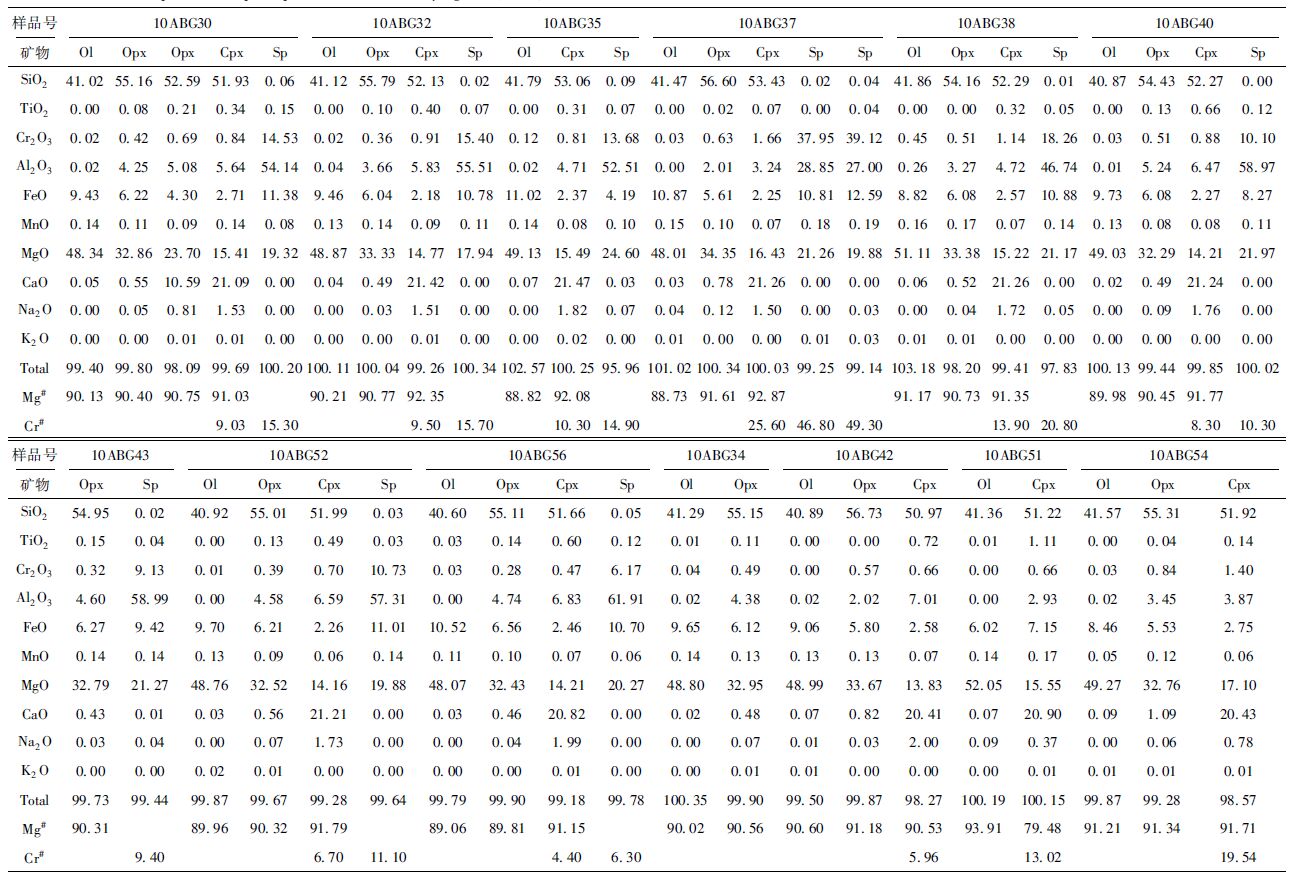
橄榄石薄片下呈无色,半自形-他形粒状,发育膝折带现象。据电子探针分析,橄榄石主要氧化物含量如下: SiO2(40%~42%)、FeO(6%~12%)、MgO(46%~52%)。橄榄石Fo为89~91,属于镁橄榄石类型,与前人发表的结果(Fo=90~92)相比(张臣等,2006),本文研究的橄榄石具有稍低的Fo值,总体上和华北西部北缘汉诺坝、阳原、集宁、大同等地橄榄岩捕掳体中的橄榄石Fo一致(Fan and Hooper, 1989;刘若新等,1981;Rudnick et al., 2004;周媛婷等,2010;陈曦和郑建平,2009;王亚妹等,2011)。与大兴安岭地区相比(赵勇伟和樊祺诚,2011;Zhang et al., 2000),橄榄石具有较低的镁值(Mg#为89~91),暗示着过渡型与饱满型并存的岩石圈地幔性质(郑建平,1999;Zheng et al., 2007)。
单斜辉石为绿色-翠绿色,薄片下呈浅绿色或无色,他形粒状,矿物边缘发育海绵边结构。据电子探针分析,主要氧化物含量如下:SiO2(50%~54%)、Al2O3(3%~8%)、FeO(2%~8%)、MgO(13%~18%)、CaO(20%~22%)、Na2O(0.3%~2%)。SiO2含量与新生地幔单斜辉石(49.03%~53.1%)类似,而不同于古老地幔单斜辉石(52.27%~56.39%);Al2O3含量变化较大,暗示着样品受部分熔融抽取的程度不同(郑建平,1999)。单斜辉石的Wo(43~49)、En(44~49)、Fs(3~11),落入透辉石范围内(图 3)。

|
图 3 辉石分类图(据Morimoto et al., 1988) Fig. 3 Classification diagram of pyroxene(after Morimoto et al., 1988) |
斜方辉石为褐色-茶褐色,薄片下呈无色-淡褐色,他形粒状。据电子探针分析:主要氧化物含量如下: SiO2(54%~57%)、Al2O3(2%~5%)、FeO(5%~7%)、MgO(32%~35%)。斜方辉石的Wo(0.7~2.2)、En(88~91)、Fs(8~11),属于顽火辉石。
尖晶石黑色,薄片下呈褐色-红褐色,一般呈他形粒状分布在橄榄石和辉石颗粒之间。据电子探针分析,尖晶石化学成分一般变化如下: Cr2O3(6.17%~18.26%)、Al2O3(27%~47%)和Cr6-20#,只有个别尖晶石铬高(Cr46-49#)。
5 平衡温度和压力的计算研究区橄榄岩捕掳体主体为碎斑结构,暗示着捕掳体经历了较强烈的剪切应力及塑性流变作用(郑建平,1999);部分样品中的橄榄石由于氧化作用而伊丁石化,也说明蚀变作用比较明显。因此在对捕掳体平衡温度和压力计算时,必须考虑捕掳体内矿物之间是否达到化学平衡。图 4可知,橄榄岩捕掳体斜方辉石和单斜辉石的Mg#值和Al2O3含量具有较好的线性关系(除样品09ABG42外),暗示着橄榄岩捕掳体各矿物化学大致处于平衡状态,因此可以用于计算平衡温度。

|
图 4 单斜辉石和斜方辉石中Al2O3相关图 Fig. 4 Diagram of Al2O3(opx)vs. Al2O3(cpx) |
在对橄榄岩捕掳体进行温度计算时,发现使用不同的地质温度计(Wood and Banno, 1973;Wells, 1977;Bertrand and Mercier, 1985;Brey et al., 1990),计算结果存在较大的差别,因此合理的选择地质温度计,对准确的反演岩石圈地幔热状态很关键。目前,Bertrand and Mercier (1985) 和Brey et al. (1990) 设计的辉石温度计是公认的计算结果较理想的地质温度计(徐义刚,1993;Huang and Xu, 2010),此外,对低于1100℃的温度区间,Wells(1977) 温度计也具有较好的计算效果(方同辉和马鸿文,1997)。因此,本文分别使用Brey et al.(1990) 和Wells(1977) 温度计进行计算(表 2),结果显示,研究区平衡温度具有较低的特点:774~886℃(Bery et al., 1990)和830~931℃(Wells, 1977),这种现象与相邻的达里干加地区地幔捕掳体类似(Wiechert et al., 1997;Kononova et al., 2002),都处在中国东部橄榄岩地幔捕掳体平衡温度的低温范围内(Fan and Hooper, 1989)。根据目前获得的中国东部新生代时期的地温梯度(Huang and Xu, 2010;Xu and Bodinier, 2004;Zheng et al., 2006),进一步推测阿巴嘎地区地幔橄榄岩捕掳体来源于地下40~55km的深度。
|
|
表 2 温度计算结果(P=15kb) Table 2 Equilibrium temperature of peridotite xenoliths (pressure=15kb) |
尖晶石橄榄岩捕掳体与寄主岩具有截然的接触关系,说明它是寄主岩浆上升过程中捕获的岩石圈碎块,因此可以用于反演岩石圈地幔组分、性质及热状态等特征。作为软流圈地幔与大陆地壳的中间纽带,大陆岩石圈地幔通常具有复杂而多变的性质,一般都经历了不同程度的部分熔融和地幔交代作用。由于Cr元素相容性大于Al,因此Cr/Cr+Al可以有效的指示部分熔融的程度。在Cr#(cpx)- Cr#(sp)图上(图 5),阿巴嘎与华北西部北缘同处在大兴安岭饱和型-过渡型地幔范围内,而显著区别于大兴安岭难熔型地幔。进一步根据尖晶石Cr#与部分熔融程度F之间的关系:F(%)=10×ln(Cr#)+24(Hellebrand et al., 2001),得出阿巴嘎地区捕掳体部分熔融程度小于16%,暗示着样品经历较低程度的部分熔融作用,也明显区别于大兴安岭地区难熔型地幔(F>15%),而与华北西部北缘相似(图 6)。

|
图 5 Cr#(cpx)- Cr#(sp)图 数据来自: 刘若新等,1981;Fan and Hooper, 1989;Wiechert et al., 1997;Zhang et al., 2000;Kononova et al., 2002;Rudnick et al., 2004;王亚妹等,2011;赵勇伟和樊祺诚,2011 Fig. 5 Diagram of Cr#(cpx) vs. Cr#(sp) Data from:Liu et al., 1981;Fan and Hooper, 1989;Wiechert et al., 1997;Zhang et al., 2000;Kononova et al., 2002;Rudnick et al., 2004;Wang et al., 2011;Zhao and Fan, 2011 |

|
图 6 部分熔融程度F(%)- Mg# (Ol)图(据Hellebrand et al., 2001) 数据来自:刘若新等,1981;Fan and Hooper, 1989;Wiechert et al., 1997;Zhang et al., 2000;Kononova et al., 2002;Rudnick et al., 2004;王亚妹等,2011;赵勇伟和樊祺诚,2011 Fig. 6 Diagram of melting degree F (%) vs. Mg# (olivine) (after Hellebrand et al., 2001) Data from Liu et al., 1981;Fan and Hooper, 1989;Wiechert et al., 1997;Zhang et al., 2000;Kononova et al., 2002;Rudnick et al., 2004;Wang et al., 2011;Zhao and Fan, 2011 |
研究区少数地幔捕掳体中的橄榄石为黄绿色,多数橄榄石呈现红褐色,后者明显受强烈氧化作用的影响。既有新鲜橄榄石,又有伊丁石化的橄榄石,这种现象排除了捕掳体在岩浆通道或地表环境下受氧化作用的影响,而更可能反应了岩石圈地幔源区的氧化环境。根据结构类型与矿物化学特征可以把橄榄岩捕掳体分为两类:一类是基本不受或轻微受后期改造的影响,表现为原生粒状结构,但此类样品很少;另一类是受到不同程度的构造-岩浆作用影响,表现为碎斑结构、粒状镶嵌结构和海绵边结构等,此外,颗粒之间的裂缝充填了大量的细粒填隙物质,局部细粒物质几乎取代辉石和尖晶石。这种细粒填隙物可能来自与软流圈上涌有关的玄武质流体/熔体或俯冲洋壳(Wiechert et al., 1997)。因此阿巴嘎地区岩石圈地幔经历了强烈的熔体-岩石圈相互作用,可能至少发生了以下两个地质过程:热蚀变与氧化作用,暗示着该区岩石圈上地幔经历了复杂的演化过程(张臣等,2006;张敏等,2010;Wiechert et al., 1997;Kononova et al., 2002)。
通过对比发现(表 3),阿巴嘎地区橄榄岩捕掳体岩石类型、结构等特征与汉诺坝、阳原、集宁、大同以及东北双辽、汪清、大石河等地区发现的地幔橄榄岩捕掳体类似(Fan and Hooper, 1989;刘若新等,1981;Rudnick et al., 2004;周媛婷等,2010;陈曦和郑建平,2009;吴福元等,2003;周琴等,2007),捕掳体橄榄石Mg#主体<91(图 6),表现为饱满型与过渡型地幔并存的特点。与大兴安岭岩石圈难熔型地幔相比,研究区样品具有较高的Al2O3和CaO含量,富集玄武质成分(图 7)。在橄榄石含量与Fo图解上,阿巴嘎地幔捕掳体落入Griffin et al.(1999) 定义的显生宙地幔范围内(图略),具有与年轻大洋地幔橄榄岩相似的特点。这也与张敏等(2010) 通过对阿巴嘎地区地幔捕掳体地球化学研究得出大陆岩石圈为年轻地幔是相吻合的。因此,阿巴嘎地区岩石圈地幔主体还是新生的饱满型与过渡型地幔,而不是古老的岩石圈地幔(Deng and Macdougall, 1992)。
|
|
表 3 阿巴嘎及周边地区新生代玄武岩中地幔橄榄岩捕掳体特征对比 Table 3 Characteristics of ultramafic xenoliths from Cenozoic basalts in Abaga and adjacent area |

|
图 7 地幔捕掳体全岩Al2O3-CaO图 数据来源:Wiechert et al., 1997;Zhang et al., 2000, ;Kononova et al., 2002;赵勇伟和樊祺诚,2011 Fig. 7 Diagram of Al2O3 vs. CaO in whole rock of peridotite xenoliths Data from:Wiechert et al., 1997;Zhang et al., 2000;Kononova et al., 2002;Zhao and Fan, 2011 |
研究区橄榄岩捕掳体主体为尖晶石二辉橄榄岩,缺少方辉橄榄岩,暗示着该地区可能不存在典型的地幔分层结构,推测这可能与软流圈的强烈上涌有关(张臣等, 2004, 2006;Ho et al., 2008)。我们收集了达里干加、大兴安岭和华北西部北缘的90个捕掳体样品,并且重新统一使用Brey et al.(1990) 和Wells (1977) 温度计进行计算,计算结果见表 3、图 8。虽然使用不同温度计计算的结果存在着一定的差别,但不同地区使用以上两种温度计其温度变化趋势是一致的,因此可以有效的对比这些地区岩石圈地幔的热状态。总体上,阿巴嘎、达里干加岩石圈地幔热状态与华北西部北缘相似,主体呈中低温型特点;而大兴安岭岩石圈地幔热状态则具有高温型和低温型的显著分层现象。地球物理资料显示,研究区一带软流圈普遍上隆,并且存在一个宽约50km根部较深的高阻体,地球物理场上表现为条带状重力异常(白登海等,1993)。因此,研究区岩石圈地幔经历了上涌软流圈熔体的强烈侵蚀和改造,而华北西部北缘也经历了类似的过程(图 8)(杜蔚等,2006;Tang et al., 2007, 2011;周媛婷等,2010;王亚妹等,2011)。

|
图 8 研究区及周边地区上地幔特征 数据来源:刘若新等,1981;杨建军,1988;Fan and Hooper, 1989; Wiechert et al., 1997; Zhang et al., 2000;Kononova et al., 2002;Rudnick et al., 2004;Xu and Bodinier, 2004;邵济安等,2007;王亚妹等,2011;赵勇伟和樊祺诚,2011 Fig. 8 The characteristics of the upper mantle beneath the Abaga and adjacent area Data from:Liu et al., 1981; Yang, 1988;Fan and Hooper, 1989;Wiechert et al., 1997;Zhang et al., 2000;Kononova et al., 2002;Rudnick et al., 2004;Xu and Bodinier, 2004;Shao et al., 2007;Wang et al., 2011;Zhao and Fan, 2011 |
大地构造背景上,研究区与哈拉哈河-绰尔河、五大连池-科洛地区同处于兴蒙造山带上,但与后二者保留有较多数量的难熔型古老地幔特征不同(Zhang et al., 2000;赵勇伟和樊祺诚,2011),阿巴嘎地区主体为过渡-饱满型新生地幔,暗示着兴蒙造山带新生代岩石圈地幔存在时空上的不均一性(图 8)。造成这种差异的原因可能有以下三种:(1) 兴蒙造山带是由多个块体拼接而成的,哈拉哈河-绰尔河和五大连池-科洛地区属于兴安地块,而阿巴嘎处在松嫩地块之上,前者在早古生代之后逐渐转为稳定,松嫩地块直到古生代晚期活动性才减弱,因此不同地块之间的活动强度和时间等因素的差异可能是造成地区之间岩石圈地幔性质差异的一个重要原因;(2) 从火山作用规模角度,阿巴嘎地区远远大于哈拉哈河-绰尔河和五大连池-科洛地区,因此新生代期间阿巴嘎地区上涌的软流圈对岩石圈地幔的侵蚀、改造强度远远大于其他地区,使得研究区绝大多数古老的岩石圈地幔被改造成了具有过渡-饱满型的新生地幔即强烈的软流圈-岩石圈之间的作用使部分古老的大陆岩石圈地幔具有年轻的大洋岩石圈地幔的属性(Zhang et al., 2007, 2009;Tang et al., 2008),破坏了岩石圈地幔与上覆地壳的耦合性(Pearson, 1999;O’Reilly et al., 2001);(3) 阿巴嘎地区复杂的上地幔演化过程(张臣等,2006)及与之相邻的达里干加地区地幔捕掳体内存在碳酸盐流体或包裹体(Wiechert et al., 1997;Kononova et al., 2002)表明,该区的验收期地幔橄榄岩可能发生了以下反应:碳酸盐熔体+OPX=CPX+OL+CO2 (Rudnick et al., 1993;Ionov et al., 1996),使得方辉橄榄岩转化为二辉橄榄岩,这可能也是该区岩石圈地幔不同于兴蒙造山带上其它地区的一个重要影响因素。
7 结论阿巴嘎地区新生代碱性玄武岩所携带的地幔橄榄岩捕掳体主要为尖晶石二辉橄榄岩,矿物组成有橄榄石、单斜辉石、斜方辉石和尖晶石。橄榄石为镁橄榄石(Fo89-91),单斜辉石种属为透辉石(Wo43-49En44-49Fs3-11),斜方辉石属于顽火辉石(Wo0.7-2.2En88-91Fs8-11),尖晶石为铬尖晶石(Cr6-20#)。捕掳体结构以碎斑结构为主,除此还有海绵边结构、重结晶结构、粗粒结构、变晶结构,部分橄榄石发育膝折带、三联点和伊丁石化现象,以及矿物的定向排列,这些特征暗示该区地幔经历了较强烈的熔体-岩石圈相互作用和复杂的演化过程。
阿巴嘎地区与华北西部北缘地幔捕掳体主体为尖晶石二辉橄榄岩,缺少方辉橄榄岩,暗示着不存在显著的地幔分层结构;并且橄榄岩平衡温度计算结果显示,它们具有相似的岩石圈地幔热状态,主体呈现中低温型特点。在矿物化学特征上,它们都具有较低的橄榄石Fo及部分熔融程度,全岩富集Al2O3、CaO等玄武质成分,暗示着它们具有饱满型-过渡型的岩石圈地幔特征。
虽然同处于兴蒙造山带上,但与保留有相当量古老残余的岩石圈地幔的大兴安岭哈拉哈河-绰尔河及五大连池-科洛地区相比,阿巴嘎地区岩石圈地幔主体却具有与华北西部北缘相似的新生过渡型-饱满型的岩石圈地幔特点,而古老岩石圈地幔残留较少,这种差异可能暗示着兴蒙造山带之下的岩石圈地幔存在时空上的不均一性。这种大尺度的岩石圈地幔不均一性可能与软流圈-岩石圈相互作用程度、上地幔复杂的地质演化及兴蒙造山带内部不同块体的活动强度、时间等性质有关。
致谢 感谢中国科学院地质与地球物理研究所电子探针实验室毛骞、马玉光在电子探针分析过程中的热情支持和帮助;感谢张招崇、汤艳杰两位审稿人对本文提出的宝贵修改意见。| [] | Bai DH, Zhang L and Kong XR. 1993. A magnetotelluric study of the Paleozoic collision zone in the east of Inner Mongolia: Ⅱ. Two-dimensional modelling. Chinese J. Geophys., 3(6): 773–783. |
| [] | Bertrand P and Mercier J. 1985. he mutual solubility of coexisting ortho- and clinopyroxene: Toward an absolute geothermometer for the natural system?. Earth and Planetary Science Letters,, 76: 109–122. DOI:10.1016/0012-821X(85)90152-9 |
| [] | Brey GP, Köhler T and Nickel KG. 1990. Geothermobarometry in four-phase lherzolites: I. Experimental results from 10 to 60 kb. Journal of Petrology, 31: 1313–1352. |
| [] | Chen SS, Fan QC, Zhao YW and Sui JL. 2011. Geological characteristics and genesis of basalt platform in beilike, Inner Mongolia. Seismology and Geology, 33(2): 430–439. |
| [] | Chen X and Zheng JP. 2009. Mineral chemistry of peridotite xenoliths in Yangyuan Cenozoic basalts: Significance for lithospheric mantle evolution beneath the North China Craton. Earth Science, 34: 203–219. |
| [] | Deng FL and Macdougall JD. 1992. Proterozoic depletion of the lithosphere recorded in mantle xenoliths from Inner Mongolia. Nature, 360(26): 333–336. |
| [] | Du W, Han BF, Zhang WH and Liu ZQ. 2006. The discovery of peridotite xenoliths and megacrysts in Jining, Inner Mongolia. Acta Petrologica et Mineralogica, 25(1): 13–23. |
| [] | Fan QC and Hooper PR. 1989. The mineral chemistry of ultramafic xenoliths of eastern China: Implications for upper mantle composition and the paleogeotherms. Journal of Petrology, 30: 1117–1158. DOI:10.1093/petrology/30.5.1117 |
| [] | Fan QC, Sui JL, Zhao YW, Li N and Du XX. 2008. Preliminary study on garnet peridotite xenolith of Quaternary volcanic rocks in middle Daxing’an Mountain Range. Acta Petrologica Sinica, 24(11): 2563–2568. |
| [] | Fang TH and Ma HW. 1997. Optimal geothermobarometers for constructing paleogeotherm. Geol. Sci. Tech. Info., 16(4): 93–100. |
| [] | Ge WC, Wu FY, Zhou CY and Zhang JH. 2007. Metallochronology of porphyry Cu, Mo deposits in the eastern Xing-Monogolian orogenic belt (XMOB) and its implication for metallogenic geodynamics. Chinese Science Bulletin, 52(20): 2047–2417. |
| [] | Griffin WL, Shee SR, Ryan CG, Win TT and Wyatt BA. 1999. Harzburgite to lherzolite and back again: Metasomatic processes in ultramafic xenoliths from the Welton kimberlite, Kimbreley, South Africa. Contrib. Mineral. Petrol., 134: 232–250. DOI:10.1007/s004100050481 |
| [] | Griffin WL, O’Reilly SY, Abe N, Aulbach S, Davies RM, Pearson NJ, Doyle BJ and Kivi K. 2003. The origin and evolution of Archean lithospheric mantle. Precambrian Research, 127: 19–41. DOI:10.1016/S0301-9268(03)00180-3 |
| [] | Harte B. 1977. Chemical carisations in upper mantle nodules from southern African kimberlites. Journal of Petrology, 85: 279–288. |
| [] | Hellebrand E, Snow JE, Dick HJB and Hofmann AW. 2001. Coupled major and trace elements as indicators of the extent of melting in mid-ocean-ridge peridolities. Nature, 410: 677–680. DOI:10.1038/35070546 |
| [] | Ho KS, Liu Y, Chen JC and Yang HJ. 2008. Elemental and Sr-Nd-Pb isotopic compositions of Late Cenozoic Abaga basalts, Inner Mongolia: Implications for petrogenesis and mantle process. Geochemical Journal, 42: 339–357. DOI:10.2343/geochemj.42.339 |
| [] | Huang XL and Xu YG. 2010. Thermal state and structure of the lithosphere beneath eastern China: A synthesis on basalt-borne xenoliths. Journal of Earth Science, 21: 711–730. DOI:10.1007/s12583-010-0111-3 |
| [] | Ionov DA, O’Reilly SY, Genshaft YS, et al. 1996. Carbonate-bearing mantle peridotite xenoliths from Spitsbergen: Phase relationships, mineral compositions and trace-element residence. Contributions to Mineralogy and Petrology, 125: 375–392. DOI:10.1007/s004100050229 |
| [] | Kononova VA, Kurat G, Embey-Isztin A, Perovov VA and Brandstätter F. 2002. Geochemistry of metasomatised spinel peridotite xenoliths from the Dariganga Plateau, South-eastern Mongolia. Mineralogy and Petrology, 75: 1–21. DOI:10.1007/s007100200012 |
| [] | Li JY, Zhang J, Yang TN, Li YP, Sun GH, Zhu ZX and Wang LJ. 2009. Crustal tectonic division and evolution of the southern part of the Northern Asian orogenic region and its adjacent areas. Journal of the Jilin University (Earth Science Edition), 39(4): 584–605. |
| [] | Li SL and Ouyang ZY. 1998. Tectonic framework and evolution of Xing’an-Mongolian orogenic belt (XMOB) and its adjacent region. Marine Geology & Quaternary Geology, 18(3): 45–54. |
| [] | Liu RX, Yang ME, Xu HJ, Guo JD and Wang WH. 1981. Preliminary study of ultramafic xenoliths from Cenozoic alkaline basalts in north china. Seismology and Geology, 3(3): 1–16. |
| [] | Lu FX. 1987. Mantle Petrology. Wuhan: China University of Geosciences Press: 92-105. |
| [] | Morimoto N, Fabries JA, Ferguson AK, et al. 1988. omenclature of pyroxenes. Mineralogical Magazine, 52: 535–550. DOI:10.1180/minmag |
| [] | O’Reilly SY, Griffin WL, Djomani PYH and Morgan P. 2001. Are lithospheres forever? Tracking changes in subcontinental lithospheric mantle through time. GSA Today, 11: 4–10. |
| [] | Pearson DG. 1999. The age of continental roots. Lithos, 48: 171–194. DOI:10.1016/S0024-4937(99)00026-2 |
| [] | Rudnick RL, Mcdonough WF and Chappell BW. 1993. Carbonatite metasomatism in the northern Tanzanian mantle: Petrographic and geochemical characteristics. Earth and Planetary Science Letters, 114: 463–475. DOI:10.1016/0012-821X(93)90076-L |
| [] | Rudnick RL, Gao S, Ling WL, Liu YS and McDonough WF. 2004. Petrology and geochemical of spinel peridotite xenoliths form Hannuoba and Qixia, North China Craton. Lithos, 77(9): 609–937. |
| [] | Shao JA, Zhang LQ, Mou BL and Han QJ. 2007. The Surge of the Great Xingan Range and Geochemical Background. Beijing: Geological Publishing House: 1-251. |
| [] | Tang YJ, Zhang HF, Nakamura E, Moriguti T, Kobayashi K and Ying JF. 2007. Lithium isotopic systematics of peridotite xenoliths from Hannuoba, North China Craton: Implications for melt-rock interaction in the considerably thinned lithospheric mantle. Geochimica et Cosmochimica Acta, 71: 4327–4341. DOI:10.1016/j.gca.2007.07.006 |
| [] | Tang YJ, Zhang HF, Ying JF, Zhang J and Liu XM. 2008. Refertilization of ancient lithospheric mantle beneath the central North China Craton: Evidence from petrology and geochemistry of peridotite xenoliths. Lithos, 101: 435–452. DOI:10.1016/j.lithos.2007.09.006 |
| [] | Tang YJ, Zhang HF, Nakamura and Ying JF. 2011. Multistage melt/fluid-peridotite interactions in the refertilized lithospheric mantle beneath the North China Craton: Constraints from the Li-Sr-Nd isotopic disequilibrium between minerals of peridotite xenoliths. Contributions to Mineralogy and Petrology, 161: 845–861. DOI:10.1007/s00410-010-0568-1 |
| [] | Wang Q, Liu XY and Li JY. 1991. Plate Tectonics between Cathaysia and Angaraland in China. Beijing: Geological Publishing House: 50-60. |
| [] | Wang YM, Griffin WL and Han BF. 2011. A preliminary study on the lithospheric mantle beneath the northern part of the western North China Craton. Acta Petrologica Sinica, 27(10): 2912–2926. |
| [] | Wells P. 1977. Pyroxene thermometry in simple and complex systems. Contributions to Mineralogy and Petrology, 62: 129–139. DOI:10.1007/BF00372872 |
| [] | Wiechert U, Ionov DA and Wedephol KH. 1997. Spinel peridotite xenoliths from the Atsagin-Dush volcano, Dariganga lava plateau, Mongolia: A record of partial melting and cryptic metasomatism in the upper mantle. Contributions to Mineralogy and Petrology, 126: 345–364. DOI:10.1007/s004100050255 |
| [] | Windley BF, Alexeiev D, Xiao WJ, Kröner A and Badarch G. 2007. Tectonicmodelsfor accretion of the Central Asian Orogenic Belt. Journal of the Geo1ogial Society, 164: 31–48. DOI:10.1144/0016-76492006-022 |
| [] | Wood BJ and Banno S. 1973. Garnet-orthopyroxene and orthopyroxene-clinopyroxene relationships in simple and complex systems. Contribution to Mineralogy and Petrology, 42: 109–124. DOI:10.1007/BF00371501 |
| [] | Wu FY, Ge WC, Sun DY and Guo CL. 2003. Discussion on the lithospheric thinning in eastern China. Earth Science Frontiers, 10(3): 51–60. |
| [] | Xu YG. 1993. Geothermometers applicable to the mantle xenoliths. Acta Petrologica Sinica, 9: 167–180. |
| [] | Xu YG and Bodinier JL. 2004. Contrasting enrichments in high- and low-temperature mantle xenoliths from nushan, eastern China: Results of a single metasomatic event during lithospheric accretion?. Journal of Petrology, 45: 321–341. DOI:10.1093/petrology/egg098 |
| [] | Yang JJ. 1988. The petrology study of Cenozoic basalt Ximeng region in the Inner Mongolia. Acta Petrologica Sinica, 4(2): 13–32. |
| [] | Zhang C, Han Bf, Tong Y and Li GC. 2004. General characteristics and origin of Cenozoic basalt from Abagaqi region, Inner Mongolia. Journal of Jilin University (Earth Science Edition), 34(1): 21–26. |
| [] | Zhang C, Liu SW, Han BF and Li GC. 2006. Characteristics of ultramafic xenoliths from Cenozoic basalts in Abagaqi area, Inner Mongolia. Acta Petrologica sinica, 22(11): 2801–2807. |
| [] | Zhang HF, Nakamura E, Kobayashi K, Zhang J, Ying JF, Tang YJ and Niu LF. 2007. Transformation of subcontinental lithospheric mantle through deformation-enhanced peridotite-melt reaction: Evidence from a highly fertile mantle xenolith from the North China craton. International Geology Review, 49: 658–679. DOI:10.2747/0020-6814.49.7.658 |
| [] | Zhang HF, Goldstein SL, Zhou XH, Sun M and Cai Y. 2009. Comprehensive refertilization of lithospheric mantle beneath the North China Craton: Further Os-Sr-Nd isotopic constraints. Journal of the Geological Society, 166: 249–259. DOI:10.1144/0016-76492007-152 |
| [] | Zhang M, Suddaby P, O’Reilly SY, Norman M and Qiu JX. 2000. Nature of the lithospheric mantle beneath the eastern part of the Central Asian fold belt: Mantle xenolith evidence. Tectonophysics, 328: 131–156. DOI:10.1016/S0040-1951(00)00181-5 |
| [] | Zhang SH, Zhao Y, Liu JP, Hu JM, Song B, Liu J and Wu H. 2010. Geochronology, geochemistry and tectonic setting of the Late Paleozoic-Early Mesozoic magmatism in the northern margin of the North China Block: A preliminary review. Acta Petrologica et Mineralogica, 29(6): 824–842. |
| [] | Zhao YW and Fan QC. 2011. Characteristics of lithospheric mantle beneath the Great Xing’an Range: Evidence from spinel peridotite xenoliths in the Halaha River and Chaoer River area. Acta Petrologica Sinica, 27(10): 2833–2841. |
| [] | Zheng JP. 1999. Meso-cenozoic mantle Replacement and lithospheric Thinning in Eastern China. Wuhan: China University of Geosciences Press: 13-68. |
| [] | Zheng JP, O’Reilly SY, Griffin WL, Lu FX, Zhang M and Pearson NJ. 2001. Relict refractory mantle beneath the eastern North China block: Significance for lithosphere evolution. Lithos, 57: 43–66. DOI:10.1016/S0024-4937(00)00073-6 |
| [] | Zheng JP, Griffin WL, O’Reilly SY, Yang JS, Li TF, Zhang M, Zhang RY and Liou JG. 2006. Mineral chemistry of peridotites from Paleozoic, Mesozoic and Cenozoic lithosphere: Constraints on mantle evolution beneath eastern China. Journal of Petrology, 47: 2233–2256. DOI:10.1093/petrology/egl042 |
| [] | Zheng JP, Griffin WL, O’Reilly SY, Yu CM, Zhang HF, Pearson N and Zhang M. 2007. Mechanism and timing of lithospheric modification and replacement beneath the eastern North China Craton: Peridotitc xenoliths from the 100Ma Fuxin basalts and a regional synthesis. Geochimca et Cosmochimca Acta, 71: 5203–5225. DOI:10.1016/j.gca.2007.07.028 |
| [] | Zhou Q, Wu FY, Chu ZY, Yang YH, Sun DY and Ge WC. 2007. Sr-Nd-Hf-Os isotopic charaeterizations of the Jiaohe peridotite xenoliths in Jilin Province and constraints on the lithospherie mantle age in northeastern China. Acta Petrologica Sinica, 23(6): 1269–1280. |
| [] | Zhou YT, Zheng JP, Yu CM, Chen X and Zhang HM. 2010. Peridotite xenoliths in Jining Cenozoic basalts: Mineral-chemistry and significance for lithsopheric mantle evolution beneath the North China Craton. Acta Petrologica et Mineralogica, 29(3): 244–257. |
| [] | 白登海, 张丽, 孔祥擩. 1993. 内蒙古东部古生代块体碰撞区的大地电磁测深研究——Ⅱ. 二维解释. 地球物理学报, 36(6): 773–783. |
| [] | 陈生生, 樊祺诚, 赵勇伟, 等. 2011. 内蒙古贝力克玄武岩台地火山地质及成因探讨. 地震地质, 33(2): 430–439. |
| [] | 陈曦, 郑建平. 2009. 河北阳原新生代玄武岩中橄榄岩捕虏体矿物化学: 华北岩石圈地幔演化. 地球科学, 34: 203–219. |
| [] | 杜蔚, 韩宝福, 张文慧, 刘志强. 2006. 内蒙古集宁新生代玄武岩中橄榄岩包体和巨晶的发现及意义. 岩石矿物学杂志, 25(1): 13–24. |
| [] | 樊祺诚, 隋建立, 赵勇伟, 李霓, 杜星星. 2008. 大兴安岭中部第四纪火山岩中石榴石橄榄岩捕虏体的初步研究. 岩石学报, 24(11): 2563–2568. |
| [] | 方同辉, 马鸿文. 1977. 建立古地温线的理想地质温度计. 地质科技情报, 16(4): 93–100. |
| [] | 葛文春, 吴福元, 周长勇, 张吉衡. 2007. 兴蒙造山带东段斑岩型Cu, Mo矿床成矿时代及其地球动力学意义. 科学通报, 52(20): 2047–2417. |
| [] | 李锦轶, 张进, 杨天南, 李亚萍, 孙桂华, 朱志新, 王励嘉. 2009. 北亚造山区南部及其毗邻地区地壳构造分区与构造演化. 吉林大学学报(地球科学版), 39(4): 584–605. |
| [] | 李双林, 欧阳自远. 1998. 兴蒙造山带及邻区的构造格局与构造演化. 海洋地质与第四纪地质, 18(3): 45–54. |
| [] | 刘若新, 杨美娥, 胥怀济, 郭金弟, 王文瑚. 1981. 华北地区新生代碱性玄武岩中超镁铁质捕掳体的初步研究. 地震地质, 3(3): 1–16. |
| [] | 路凤香. 1987. 地幔岩石学. 武汉: 中国地质大学出版社: 92-105. |
| [] | 邵济安, 张履桥, 牟保磊, 韩庆军. 2007. 大兴安岭的隆起与地球动力学背景. 北京: 地质出版社: 1-251. |
| [] | 王荃, 刘雪亚, 李锦轶. 1991. 中国华夏与安加拉古陆间的板块构造. 北京: 北京大学出版社: 50-60. |
| [] | 王亚妹, GriffinWL, 韩宝福. 2011. 华北克拉通西部陆块北缘新生代岩石圈地幔特征的初步研究. 岩石学报, 27(10): 2912–2926. |
| [] | 吴福元, 葛文春, 孙德有, 郭春丽. 2003. 中国东部岩石圈减薄研究中的几个问题. 地学前缘, 10(3): 51–60. |
| [] | 徐义刚. 1993. 适用于幔源包体的地质温度计. 岩石学报, 9: 167–180. |
| [] | 杨建军. 1988. 内蒙锡盟新生代玄武岩的岩石学研究. 岩石学报, 4(2): 13–32. |
| [] | 张臣, 韩宝福, 童英, 李德春. 2004. 内蒙古阿巴嘎旗地区新生代玄武岩基本特征及成因. 吉林大学学报(地球科学版), 34(1): 21–26. |
| [] | 张臣, 刘树文, 韩宝福, 李德春. 2006. 内蒙古阿巴嘎旗新生代玄武岩中超镁铁岩包体的特征. 岩石学报, 22(11): 2801–2807. |
| [] | 张拴宏, 赵越, 刘建平, 胡建民, 宋彪, 刘健, 吴海. 2010. 华北地块北缘古生代-早中生代岩浆活动期次、特征及构造背景. 岩石矿物学杂志, 29(6): 824–842. |
| [] | 赵勇伟, 樊祺诚. 2011. 大兴安岭岩石圈地幔特征-哈拉哈河-绰尔河橄榄岩捕虏体的证据. 岩石学报, 27(10): 2833–2841. |
| [] | 郑建平. 1999. 中国东部地幔置换作用与新生代岩石圈减薄. 武汉: 中国地质大学出版社: 13-68. |
| [] | 周琴, 吴福元, 储著银, 杨岳衡, 孙德有, 葛文春. 2007. 吉林蛟河地幔橄榄岩捕虏体的Sr-Nd-Hf-Os同位素特征与岩石圈地幔时代. 岩石学报, 23(6): 1269–1280. |
| [] | 周媛婷, 郑建平, 余淳梅, 陈曦, 张胡民. 2010. 内蒙古集宁新生代玄武岩中橄榄岩包体矿物化学特征及其地幔演化意义. 岩石矿物学杂志, 29(3): 244–257. |