 2018, Vol. 64
文章信息
- 曹秋红, 谢涛, 左可正
- CAO Qiuhong, XIE Tao, ZUO Kezheng
- 关于两个幂等矩阵组合群逆的探讨
- Discussions on the Group Inverses of Combinations of Two Idempotent Matrices
- 武汉大学学报(理学版), 2018, 64(3): 262-268
- Journal of Wuhan University(Natural Science Edition), 2018, 64(3): 262-268
- http://dx.doi.org/10.14188/j.1671-8836.2018.03.010
-
文章历史
- 收稿日期:2017-06-20


引用本文

|


 , a1, b1≠0)在条件(QP)n=0(n≥2)下的秩与系数的选取无关,进而证明了其群逆存在.另外, 还得到了组合aP +bQ +cPQ +dQP在条件(QP)n=0下的群逆表达式.
, where a1, b1, …, a2n∈ , a1, b1≠0, was proved to be independent with the choice of its coefficients and under the condition (QP)n=0(n≥2). Therefore, the existence of the group inverse of the combination was also obtained. In addition, the formula for the group inverse of the combination aP +bQ +cPQ +dQP was presented under the condition (QP)n=0.
, a1, b1≠0)在条件(QP)n=0(n≥2)下的秩与系数的选取无关,进而证明了其群逆存在.另外, 还得到了组合aP +bQ +cPQ +dQP在条件(QP)n=0下的群逆表达式.
, where a1, b1, …, a2n∈ , a1, b1≠0, was proved to be independent with the choice of its coefficients and under the condition (QP)n=0(n≥2). Therefore, the existence of the group inverse of the combination was also obtained. In addition, the formula for the group inverse of the combination aP +bQ +cPQ +dQP was presented under the condition (QP)n=0.
若P ∈

|
与
|
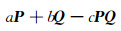
的可逆性与系数的关系,推广了前人的结果.随后, 对上述组合的各种广义逆的存在性、广义逆的表达式与系数的关系引起了热烈的讨论[15~20]. 2011年, 文献[21]证明了若P, Q是复数域上的两个不同的非零幂等矩阵, 且满足(QP)2=0, 则组合

|
(1) |
的群逆存在, 其中a, b≠0.另外, 文献[21]还得到了组合(1)的群逆表达式.
在上述研究的基础上,一个问题自然地被提出来,即若 P, Q是复数域上的两个不同的非零幂等矩阵, 且满足(QP)n=0或(PQ)n=0(n≥2), 则组合

|
(2) |

|
(3) |
的群逆是否存在, 其中a1, b1≠0?若组合(2)和(3)群逆存在, 其群逆表达式是怎样的?
本文运用矩阵零空间的性质证明了复数域上两个非零的幂等矩阵P, Q的组合(2)和(3)分别在条件(QP)n=0, (PQ)n=0(n≥2)下的秩与系数的选取无关,并进而证明了其群逆存在.另外,还得到了组合aP +b Q +cPQ +dQP在条件(QP)n=0或(PQ)n=0下的群逆表达式.本文证明组合(2)的群逆存在性的方法与文献[21]不同.
1 预备知识设

|
成立,则称X为A的一个群逆.若A存在群逆, 则其群逆唯一, 记A的群逆为Ag.对于A ∈
引理1[21] 设P, Q是

|
的群逆存在, 且

|
容易举例说明(PQ)2=0并不意味着(QP)2=0, 反之也成立.
引理2[21] 设P, Q是

|
的群逆存在, 且

|
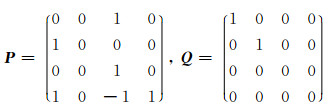
例1 令
|
则可得到P, Q是幂等矩阵, 且满足(QP)2≠0, (QP)3=0.另外, 若P, Q满足(QP)2=0, 则(QP)3=(QP)2 QP =0.因此条件(QP)3=0比条件(QP)2=0弱.条件(PQ)n=0比条件(PQ)n-1=0 (n≥2)弱.另外, 条件(PQ)n=0与(QP)n=0之间也没有蕴含关系.所以在条件(QP)n=0或(PQ)n=0下讨论组合(2)和(3)群逆的存在性及表达式是有意义的.
2 主要结论下面将证明复数域上两个非零幂等矩阵P, Q的组合(2)和(3)分别在条件(QP)n=0, (PQ)n=0(n≥2)下的秩与系数的关系,进而讨论其群逆的存在性.
定理1 设P, Q是
1) N(Φ)=N(P)∩N (Q);
2) r(Φ)是一个常数且r(Φ) =r (P + Q), 从而Φ可逆当且仅当P + Q可逆;
3) Φ存在群逆.
其中N(A)表示矩阵A的核空间, 即N(A) = {x
证 1)一方面, 设∀α∈N(P)∩N(Q), 则有Pα= Qα=0, 所以Φα=0, 因此
N(P)∩N(Q) ⊆N(Φ).另一方面, 设⊆α∈N(Φ), 则

|
(4) |
在(4)式两边左乘(QP)n-1Q, 并注意到(QP)n=0可得b1(QP)n-1Qα=0.
因为b1≠0, 所以

|
(5) |
在(4)式两边右乘(PQ)n, 并注意到(QP)n=0可得a1(PQ)nα=0.
因为a1≠0, 所以

|
(6) |
在(4)式两边左乘(QP)n-1, 并注意(5)式,则b1(QP)n-1α=0, 可得(QP)n-1α=0.依次在(4)式两边左乘(QP)n-2Q, (QP)n-2, (QP)n-3Q, (QP)n-3, …, QP, Q, 可得

|
同理依次在(4)式两边左乘

|
可得

|
从而α∈N(P)∩N(Q).所以N(Φ)⊆N(P)∩N(Q).因此N(Φ) =N(P)∩N(Q).
即结论1)成立.
2) 因为r(Φ) =n-dim(N (Φ)) =n-dim(N (P)∩N (Q))是一个常数, 所以r (Φ)与满足条件a1, b1≠0的系数ai, bj∈
3) 注意到

|
且Φ2的系数a12≠0, b12≠0, 即Φ2的系数满足定理的条件, 由结论1)和2)知

|
从而Φ的群逆存在.
定理2 设P, Q是
1) N(Φ) =N (P)∩N (Q);
2) r(Φ)是一个常数且r(Φ) =r(P + Q), 从而Φ可逆当且仅当P + Q可逆;
3) Φ存在群逆.
证 类似定理1的证明.
下面考虑组合aP +bQ +cPQ +dQP在条件(QP)n或(PQ)n下的群逆公式.
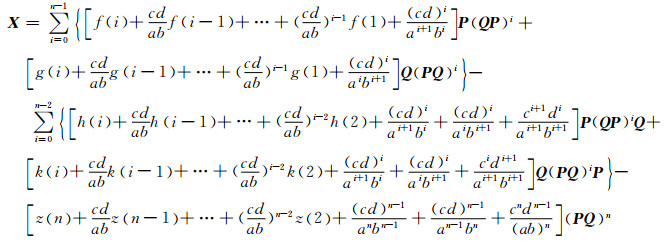
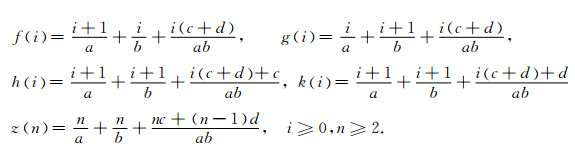
定理3 设a, b, c, d∈
|
其中,
|
证 令X = X1+ X2+ X3, 其中,
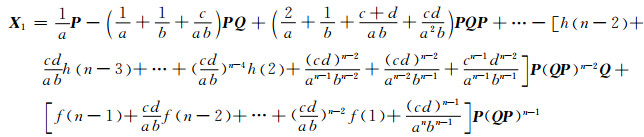
|
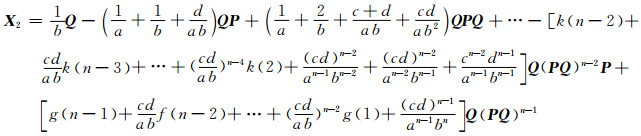
|

|
由(QP)n=0可知,
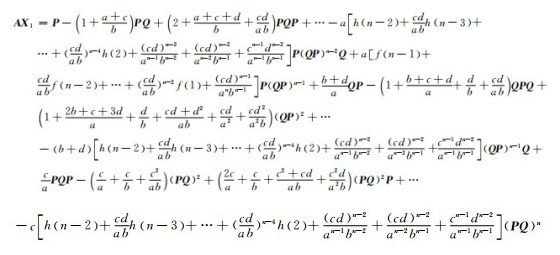
|
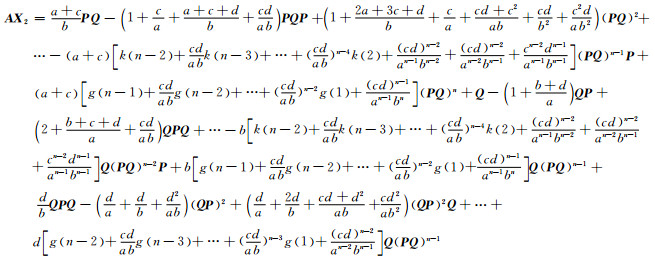
|

|
所以

|
又因为

|

|

|
所以,

|
因此AX = XA.
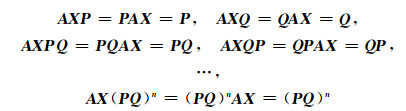
又因为
|
所以AXA = A, XAX = X.
故由群逆的惟一性知,X为A的群逆.
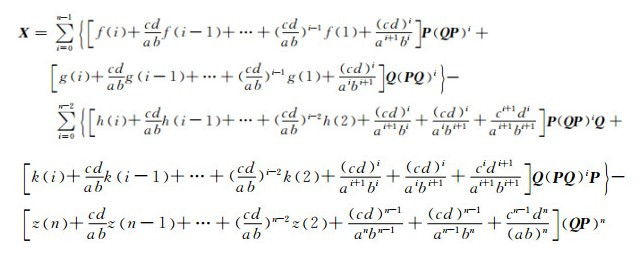
定理4 设a, b, c, d∈
|
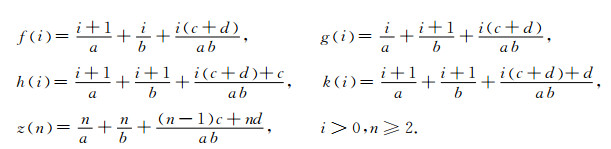
其中,
|
证 类似定理3的证明.
3 结论本文讨论了复数域上两个不同的非零幂等矩阵P, Q的组合

|
(其中a1, b1, …, b2n-1, a2n∈
| [1] |
CAMPBELL S L, MEYER C D. Generalized Inverse of Linear Transformations[M]. London: Pitman, 1979.
|
| [2] |
HARTWING R E, LEVINE J. Applications of the Drazin inverse to the Hill cryptographic system, Part Ⅲ[J]. Cryptologia, 1980, 4(2): 71-85. DOI:10.1080/0161-118091854906 |
| [3] |
MEYER C D. The condition number of a finite Markov chains and perturbation bounds for the limiting probabilities[J]. Siam Journal of Algebraic & Discrete Methods, 1980, 1: 273-283. |
| [4] |
SIMEON B, FUHRER C, RENTROP P. The Drazin inverse in multibody system dynamics[J]. Numer Math, 1993, 64(1): 521-536. DOI:10.1007/BF01388703 |
| [5] |
BAKSALARY J K, BAKSALARY O M. Nonsingularity of linear combinations of idempotent matrices[J]. Linear Algebra and Its Applications, 2004, 388(1): 25-29. DOI:10.1016/j.laa.2004.02.025 |
| [6] |
KOLIHA J J, RAKOĈEVIĆ V. The nullity and rank of linear combinations of idempotent matrices[J]. Linear Algebra and Its Applications, 2006, 418(1): 11-14. DOI:10.1016/j.laa.2006.01.011 |
| [7] |
ZUO K Z, XIE T. The nullity and rank of combinations of two outer inverses of a given matrix[J]. Missouri Journal of Mathematical, 2010, 22(1): 19-23. |
| [8] |
XIE T, ZUO K Z, ZHENG L Z, et al. The invertibility of combinations of idempotents[J]. Journal for Algebra and Number Theory Academia, 2012, 6: 377-385. |
| [9] |
DU H K, YAO X Y, DENG C Y. Invertibility of linear combinations of two idempotents[J]. Proceedings of the American Mathematical Society, 2006, 134(5): 1451-1457. DOI:10.1090/S0002-9939-05-08091-3 |
| [10] |
ZUO K Z, XIE T. Nonsingularity of combinations of idempotent matrices[J]. Journal of Mathematics, 2009, 29(3): 285-289. |
| [11] |
XIE T, ZUO K Z. Fredholmness of combinations of two idempotents[J]. European Journal of Pure and Applied Mathematics, 2010, 3(4): 678-685. |
| [12] |
BAKSALARY O M, BENÌTEZ J. Idempotency of linear combinations of three idempotent matrices two of which are disjoint[J]. Linear Algebra and Its Applications, 2004, 388(1): 67-78. |
| [13] |
YANG H, LIU X. The Drazin inverse of the sum of two matrices and its applications[J]. Journal of Computational and Applied Mathematices, 2011, 235(5): 1412-1417. DOI:10.1016/j.cam.2010.08.027 |
| [14] |
ZUO K Z, XIE T. Nonsingularity of the difference and the sum of two idempotents matrices[J]. Linear Algebra and Its Applications, 2010, 433(2): 476-482. DOI:10.1016/j.laa.2010.03.013 |
| [15] |
ZUO K Z, XIE T. Nonsingularity of the combinations of two orthogonal projectors[J]. Wuhan University Journal of Natural Science, 2012, 17(1): 7-11. DOI:10.1007/sl1859-012-0796-5 |
| [16] |
左可正, 谢涛. 两个幂等矩阵的组合的群逆[J]. 数学杂志, 2014, 34(3): 497-501. ZUO K Z, XIE T. The group inverses of combinations of two idempotent matrices[J]. Journal of Mathematics, 2014, 34(3): 497-501. |
| [17] |
谢涛, 左可正, 郑绿洲. 两个幂等矩阵组合的群逆[J]. 吉林大学学报(理学版), 2016, 54(1): 45-53. XIE T, ZUO K Z, ZHENG L Z. The group inverses of combinations of two idempotent matrices[J]. Journal of Jilin University (Science Edition), 2016, 54(1): 45-53. DOI:10.13413/j.cnki.jdxblxb.2016.01.09(Ch) |
| [18] |
XIE T, ZHU X K, ZUO K Z. The null and column spaces of combinations of two projectors[J]. Journal of Mathematical Research with Applications, 2016, 36(4): 407-422. DOI:10.3770/j.issn:2095-2651.2016.04.003 |
| [19] |
ZHANG S F, WU J D. The Drazin inverse of the linear combinations of two idempotents in the Banach algebra[J]. Linear Algebra and Its Applications, 2012, 436(9): 3132-3138. DOI:10.1016/j.laa.2011.10.022 |
| [20] |
谢涛, 左可正. 两个幂等矩阵组合的Group逆[J]. 武汉大学学报(理学版), 2015, 61(6): 554-562. XIE T, ZUO K Z. The group inverse of the combinations of two idempotent matrices[J]. Journal of Wuhan University(Natural Science Edition), 2015, 61(6): 554-562. DOI:10.14188/j.1671-8836.2015.06.009(Ch) |
| [21] |
LIU X J, WU L L, YU Y M. The group inverse of the combinations of two idempotent matrices[J]. Linear and Multilinear Algebra, 2011, 59(1): 101-115. DOI:10.1080/03081081003717986 |