 2021, Vol. 36
文章信息
- 赖建军, 苏志伟, 蒋璐, 江皓, 喻冰淇, 吴竞, 吴稚冰, 王佳浩
- Lai Jianjun, Su Zhiwei, Jiang Lu, Jiang Hao, Yu Bingqi, Wu Jing, Wu Zhibing, Wang Jiahao
- ExacTrac X线系统二种不同图像配准序列在头颈部肿瘤放疗中的应用研究
- Application of two diff erent image registration sequences in ExacTrac X-ray system for head and neck cancer radiotherapy
- 实用肿瘤杂志, 2021, 36(3): 263-267
- Journal of Practical Oncology, 2021, 36(3): 263-267
基金项目
- 浙江省基础公益研究计划项目(LGF20H160020);浙江省医药卫生科技计划项目(2020PY032)
-
通信作者
-
吴稚冰, E-mail: wu_zhibing@163.com
王佳浩, E-mail: 992096475@qq.com
-
文章历史
- 收稿日期:2020-07-29
 PDF
PDF


2. 杭州市肿瘤医院放疗科, 浙江 杭州 310002
2. Department of Radiaion Oncology, Hangzhou Cancer Hospital, Hangzhou 310002, China
头颈部恶性肿瘤是临床常见的肿瘤。头颈部解剖结构复杂,其放疗靶区剂量往往受限于临近的危及器官(organs at risk,OAR)。调强放射治疗(intensity-modulated radiation therapy,IMRT)具有较好的剂量跌落梯度,能给予肿瘤靶区更好的适形性和均匀性,更准确地照射肿瘤区域,并更好地保护周围危及器官,是目前头颈部放疗的主流技术方法[1]。IMRT疗效与分次治疗过程中不同解剖区域的位置精度密切相关,在实际临床应用中,患者定位摆位技术方法[2-4]、分次间体质量变化和肿瘤消退引起的解剖结构变化[5]和分次内器官移动导致的位置不确定性[6]等均会影响治疗位置精度。采用图像引导放疗(image guided radiotherapy,IGRT)技术进行位置监测并进行在线位置修正,已成为提高放疗位置精度的常用技术方法。
瓦里安Novalis TxTM型直线加速器(瓦里安医疗设备有限公司,美国)具有多种不同模式的图像引导放疗技术,包括KV级正交平片技术的ExacTrac X线系统(ExacTrac X-ray,ET)、KV级锥形束CT技术的机载影像系统(on-board imager,OBI)和MV平片技术的电子射野影像系统(electronic portal imaging device,EPID)等,其中基于KV级正交平片技术的ET系统因其成像速度快和成像剂量低的特点具有一定的临床应用优势。近年来,国内外多名学者通过比较分析锥形束CT(cone beam CT, CBCT)与ET在肿瘤放疗中的临床应用认为2种图像模式都可以提升患者治疗位置精度,认可ET在头颈部肿瘤中的临床应用可靠性[7-9]。ET具有多种不同的配准方法,目前并没有针对其不同配准方法的差异性相关的研究。本研究通过回顾性分析研究ET技术中2种常用配准方法差异,探讨ET技术临床最优的配准序列。
1 资料与方法 1.1 一般资料选择杭州市肿瘤医院2018年8月至2019年12月行IMRT的34例头颈部肿瘤患者为研究对象。男性14例,女性20例;年龄34~82岁,中位年龄63岁。
1.2 方法 1.2.1 摆位固定和模拟定位采用美国Civco公司生产的碳纤维头颈肩固定架、透明头枕和头颈肩热塑膜固定。使用荷兰Philip公司生产的Brilliance Big Bore CT模拟定位机扫描CT图像,扫描电压120 kV,探测器准直器0.75 mm,螺距0.982,层厚3 mm,层间隔3 mm,视野500 mm,矩阵512×512;扫描范围根据医嘱要求,有个体差异。
1.2.2 计划设计和传输使用美国瓦里安公司生产的Eclipse13.3放疗计划系统设计IMRT计划,将放疗计划、计划CT图像及靶区信息在ARIA网络系统进行治疗排程。
1.2.3 摆位图像采集和工作流程参与本研究的34例头颈部肿瘤患者,每周行1次图像引导放疗。患者在治疗床上固定后通过激光灯对准标记线摆位。ET系统采集双斜片后保存图像数据。随后行CBCT扫描并在线配准后将摆位误差发送至六维床修正后出束治疗。
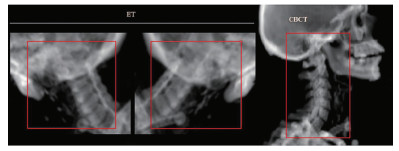
1.2.4 图像配准回顾性分析34例头颈部肿瘤放疗患者共计142组ET图像和142组CBCT图像资料。在ExacTrac 6.0软件上分别以ExacTrac全图像配准(ExacTrac-full image,ET-full)和ExacTrac兴趣区配准(ExacTrac-volume of interest,ET-VOI)技术进行图像配准,记录配准误差。在OBI系统上选择兴趣区(region of interest,ROI)骨配准技术进行图像配准并记录配准误差。所有患者图像的VOI和ROI均包含固定解剖区域和可移动解剖区域,包括后枕部、第一至第七颈椎椎体和下颌等部位,CBCT定义的ROI和ET定义的VOI包含的解剖区域一致(图 1)。
|
| 注 ET影像红框示ExacTrac兴趣区配准(ExacTrac-volume of interest, ET-VOI);CBCT影像红框示CBCT配准兴趣区(region of interest, ROI) 图 1 ET和CBCT配准兴趣区选择 Fig.1 A typical example of ET-VOI and CBCT ROI |
采用箱线图对ET ET-full技术、ET-VOI技术和CBCT兴趣区配准技术产生的142组六维度(3个平移方向和3个旋转方向)摆位误差数据进行摆位误差统计学图形描述。将CBCT兴趣区配准结果分别与ET-full和ET-VOI技术配准结果进行Pearson双变量相关性分析,相关性包括极弱相关或无相关(0≤r < 0.2)、弱相关(0.2≤r < 0.4)、中度相关(0.4≤r < 0.6)、强相关(0.6≤r < 0.8)和极强相关(r≥0.8)。所有分析均采用SPSS 22.0统计学软件进行,所有数据进行配对t检验。以P < 0.05为差异具有统计学意义。
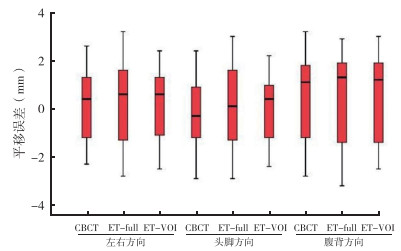
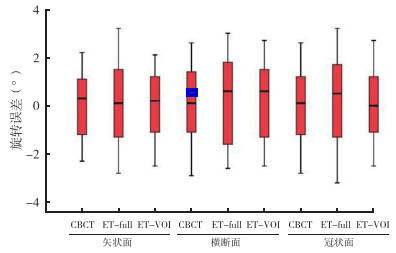
2 结果 2.1 摆位误差对34例头颈部肿瘤IMRT患者在不同图像和不同图像配准技术下进行摆位误差统计,在患者左右、头脚、矢状面、横断面和冠状面方向,相对于ET-full技术,ET-VOI技术和CBCT二者配准的摆位误差数据分布更为接近,在人体腹背方向上,三者之间数据分布相近(P < 0.05,图 2~3)。
|
| 图 2 2种ET配准技术和CBCT配准平移方向配准结果 Fig.2 Box plot of translational displacements from CBCT, ET-full image (ET-full) and ET-VOI |
|
| 图 3 2种ET配准技术和CBCT配准旋转方向配准结果 Fig.3 Box plot of rotational displacements from CBCT, ET-full image (ET-full) and ET-VOI |
平移方向数据显示,在左右和头脚方向上,ET-VOI技术和CBCT为强相关性(0.6≤r < 0.8,P < 0.01;表 1),ET-full技术为中度相关(0.4≤r < 0.6,P < 0.01),而在前后方向上ET-VOI技术和ET-full技术均与CBCT呈极强相关性(r≥0.8,均P < 0.01)。旋转方向数据显示,ET-VOI和ET-full技术均与CBCT呈强相关性(0.6≤r < 0.8,均P < 0.01;表 2),且ET-VOI技术与CBCT相关性大于ET-full技术与CBCT相关性。在头颈部肿瘤放疗中,ET-VOI技术配准摆位误差和CBCT具有更好的相关性。
| 组别 | 例数 | 左右方向 | 头脚方向 | 腹背方向 | |||||
| r值 | P值 | r值 | P值 | r值 | P值 | ||||
| ET-full | 101 | 0.49 | < 0.01 | 0.56 | < 0.01 | 0.92 | < 0.01 | ||
| ET-VOI | 101 | 0.68 | < 0.01 | 0.71 | < 0.01 | 0.90 | < 0.01 | ||
| 注 ET-full: ExacTrac全图像配准(ExacTrac-full image);ET-VOI: ExacTrac兴趣区配准(ExacTrac-volume of interest) | |||||||||
| 组别 | 例数 | 矢状面 | 横断面 | 冠状面 | |||||
| r值 | P值 | r值 | P值 | r值 | P值 | ||||
| ET-full | 101 | 0.73 | < 0.01 | 0.72 | < 0.01 | 0.68 | < 0.01 | ||
| ET-VOI | 101 | 0.74 | < 0.01 | 0.76 | < 0.01 | 0.71 | < 0.01 | ||
| 注 ET-full: ExacTrac全图像配准(ExacTrac-full image);ET-VOI: ExacTrac兴趣区配准(ExacTrac-volume of interest) | |||||||||
CBCT和ET是现代放疗中最常用的2种KV级图像引导放疗技术[7-13]。其中,CBCT容积图像技术可以获取丰富的三维解剖结构和较好的软组织分辨率受到临床青睐,与此同时,有一些因素影响CBCT在临床中的广泛应用,其中包括相对较高的患者成像辐照剂量和较长的图像采集时间[14-16]。ET技术采用双斜片技术采集患者摆位图像信息,虽然无法提供丰富的三维解剖结构和较好软组织分辨率,但具有低辐照剂量和快速成像的特点[17]。参与本研究的34例行IMRT头颈部肿瘤患者ET和CBCT各142组图像资料进行回顾性分析,2种ET配准技术配准结果均与CBCT差异较小,其中ET-VOI技术与CBCT数据结果分布更为接近,相关性更好。以广受临床青睐的CBCT技术为金标准[18-21],与ET-full比较,ET-VOI技术是一种更好的ET图像配准序列,在头颈部肿瘤ET图像引导放疗临床应用中,应优先选用ET-VOI配准序列。
本研究中,采用同样配准区域的前提下,ET与CBCT配准结果之间具有一定差异,产生差异的潜在原因可能为ET系统的影像中心与CBCT系统影像中心存在差异。因此,在本研究数据采集过程中,定期持续的设备质量控制工作尤为重要。为保障本研究数据的可靠性,将影像中心与等中心精度监测纳入月检流程,连续16个月的质控数据统计显示,ET系统影像中心与加速器等中心差异均方根(root mean square,RMS) < 0.3 mm,CBCT系统影像中心与加速器等中心差异RMS < 0.3 mm,ET系统的影像中心与CBCT系统影像中心精度之间存在的差异可以忽略不计。ET系统与CBCT系统采用不同的图像采集和配准算法,ET系统中使用双斜片与计划CT重建的数字重建图像(digitally reconstructured radiograph,DRR)配准,CBCT系统采用容积图像重建与计划CT图像配准,因此ET与CBCT的配准结果差异可能来源于不同的图像配准算法和图像采集技术。
本研究ET系统中2种不同的配准方法ET-full和ET-VOI的配准结果存在差异,其中ET-full配准技术包含整幅图像中的全部高密度结构,包括人体的骨骼结构和体外的其他高密度物质,图像解剖区域以外的高密度物质会对配准结果造成影响,而ET-VOI中只有指定兴趣区内的骨组织纳入ET-VOI配准结构,配准区域的对象选择更为精准。笔者认为,不同配准区域的选择是决定2种ET配准方法差异的主要因素。在最近的几项关于CBCT和ET的2种不同图像引导技术的比较研究中,ET技术中不同配准区域的选择对配准结果的影响并没有引起广泛重视[9, 22]。本研究充分考虑到不同配准区域产生不同配准结果的可能性,将ET的2种临床常用配准技术分别与CBCT进行比较分析显示,与ET-full比较,ET-VOI与CBCT数据结果分布更为接近,ET-VOI技术与CBCT具有更好的相关性,同时,ET-VOI技术下,可根据图像品质和临床需求自主选择感兴趣区域,推荐在临床广泛应用。
| [1] |
徐振华, 易峰涛, 黄颖. 鼻咽癌根治性放疗后出现单个器官寡转移后手术干预治疗的疗效观察[J]. 实用肿瘤杂志, 2020, 35(2): 97-98. |
| [2] |
Klopp AH, Eifel PJ. IMRT all the way[J]. Int J Radiat Oncol Biol Phys, 2019, 105(4): 692-693. DOI:10.1016/j.ijrobp.2019.07.051 |
| [3] |
Moretto F, Rampino M, Munoz F, et al. Conventional 2D (2DRT) and 3D conformal radiotherapy (3DCRT) versus intensity-modulated radiotherapy (IMRT) for nasopharyngeal cancer treatment[J]. Radiol Med, 2014, 119(8): 634-641. DOI:10.1007/s11547-013-0359-7 |
| [4] |
欧阳水根, 苏群, 陶娜, 等. 影像引导下不同体位子宫肿瘤IMRT摆位误差及其外放边界[J]. 中国医学物理学杂志, 2018, 35(10): 1122-1127. |
| [5] |
Hizam NDA, Ung NM, Jong WL, et al. Medical physics aspects of intensity-modulated radiotherapy practice in Malaysia[J]. Phys Med, 2019, 67(1): 34-39. DOI:10.1016/j.ejmp.2019.10.023 |
| [6] |
Surucu M, Shah KK, Roeske JC, et al. Adaptive radiotherapy for head and neck cancer: implications for clinical and dosimetry outcomes[J]. Technol Cancer Res Treatment, 2017, 16(1): 218-223. DOI:10.1177/1533034616662165 |
| [7] |
Clemente S, Chiumento C, Fiorentino A, et al. Is ExacTrac X-ray system an alternative to CBCT for positioning patients with head and neck cancers?[J]. Med Phys, 2013, 40(11): 1725. DOI:10.1118/1.4824056 |
| [8] |
Lewis BC, Snyder WJ, Kim S, et al. Monitoring frequency of intra-fraction patient motion using the ExacTrac system for LINAC-based SRS treatments[J]. J Appl Clin Med Phys, 2018, 19(3): 58-63. DOI:10.1002/acm2.12279 |
| [9] |
Oh SA, Park JW, Yea JW, et al. Evaluations of the setup discrepancy between BrainLAB 6D ExacTrac and cone-beam computed tomography used with the imaging guidance system Novalis-Tx for intracranial stereotactic radiosurgery[J]. PLoS One, 2017, 12(5): e0177798. DOI:10.1371/journal.pone.0177798 |
| [10] |
Posiewnik M, Piotrowski T. A review of cone-beam CT applications for adaptive radiotherapy of prostate cancer[J]. Phys Med, 2019, 59(1): 13-21. DOI:10.1016/j.ejmp.2019.02.014 |
| [11] |
Bell K, Licht N, Rübe C, et al. Image guidance and positioning accuracy in clinical practice: influence of positioning errors and imaging dose on the real dose distribution for head and neck cancer treatment[J]. Radiat Oncol, 2018, 13(1): 190-199. DOI:10.1186/s13014-018-1141-8 |
| [12] |
Yin FF, Wang Z, Yoo S, et al. Integration of cone-beam CT in stereotactic body radiation therapy[J]. Technol Cancer Res Treat, 2008, 7(2): 133-139. DOI:10.1177/153303460800700206 |
| [13] |
Van Herk M. Different styles of image-guided radiotherapy[J]. Semin Radiat Oncol, 2007, 17(4): 258-267. DOI:10.1016/j.semradonc.2007.07.003 |
| [14] |
Guckenberger M, Meyer J, Wilbert J, et al. Precision of image-guided radiotherapy (IGRT) in six degrees of freedom and limitations in clinical practice[J]. Strahlenther Onkol, 2007, 183(6): 307-313. DOI:10.1007/s00066-007-1695-0 |
| [15] |
高文颂, 胡广原, 张莉, 等. 子宫颈癌图像引导放疗不同时期分次内误差的研究[J]. 实用肿瘤杂志, 2019, 34(1): 72-75. |
| [16] |
Feygelman V, Walker L, Chinnaiyan P, et al. Simulation of intrafraction motion and overall geometrical accuracy of a frameless intracranial radiosurgery process[J]. J Appl Clin Med Phys, 2008, 9(4): 68-86. DOI:10.1120/jacmp.v9i4.2828 |
| [17] |
Moseley DJ, White EA, Wiltshire KL, et al. Comparison of localization performance with implanted fiducial markers and cone-beam computed tomography for on-line image-guided radiotherapy of the prostate[J]. Int J Radiat Oncol Biol Phys, 2007, 67(3): 942-953. DOI:10.1016/j.ijrobp.2006.10.039 |
| [18] |
Ding GX, Alaei P, Curran B, et al. Image guidance doses delivered during radiotherapy: Quantification, management, and reduction: Report of the AAPM Therapy Physics Committee Task Group 180[J]. Med Phys, 2018, 45(5): 184-199. DOI:10.1002/mp.12824 |
| [19] |
Kan MW, Leung LH, Wong W, et al. Radiation dose from cone beam computed tomography for image-guided radiation therapy[J]. Int J Radiat Oncol Biol Phys, 2008, 70(1): 272-279. DOI:10.1016/j.ijrobp.2007.08.062 |
| [20] |
Sun L, Jiang Z, Chang Y, et al. Building a patient-specific model using transfer learning for four-dimensional cone beam computed tomography augmentation[J]. Quan Imaging Med Surg, 2021, 11(2): 540-555. DOI:10.21037/qims-20-655 |
| [21] |
Dyer BA, Nair CK, Deardorff CE, et al. Linear accelerator-based radiotherapy simulation using on-board kilovoltage cone-beam computed tomography for 3-dimensional volumetric planning and rapid treatment in the palliative setting[J]. Technol Cancer Res Treat, 2019, 18(1): 1-6. DOI:10.1177/1533033819865623 |
| [22] |
Zeidan OA, Langen KM, Meeks SL, et al. Evaluation of image guidance protocols in the treatment of head and neck cancers[J]. Int J Radiat Oncol Biol Phys, 2007, 67(3): 670-677. |