 2026, Vol. 41
文章信息
- 祝豫, 张璐鑫, 常威, 董烁
- Zhu Yu, Zhang Luxin, Chang Wei, Dong Shuo
- 1994—2023年中国宫颈癌疾病负担趋势及年龄-时期-队列分析
- Trends in disease burden of cervical cancer in China from 1994 to 2023 and age-period-cohort analysis
- 实用肿瘤杂志, 2026, 41(5): 400-405
- Journal of Practical Oncology, 2026, 41(5): 400-405
-
通信作者
- 董烁, Email: 279005208@qq.com
-
文章历史
- 收稿日期:2026-01-05
 PDF


宫颈癌主要发生于子宫颈上皮。其发生和发展与高危型人乳头瘤病毒(human papillomavirus, HPV)持续感染密切相关。在宫颈癌病例中,高危型HPV检出率 > 99%,其中HPV16和HPV18型最为常见[1-2]。宫颈癌全球疾病负担不容忽视。根据国际癌症研究机构发布的最新数据,宫颈癌仍是全球女性第四大常见癌症,2022年全球新发病例66.2万例,死亡34.9万例[3]。近年来,宫颈细胞学筛查和HPV疫苗推广使部分发达国家的发病率和死亡率明显下降,但中低收入国家女性仍承担较重的宫颈癌死亡负担[4]。我国人口基数较大,因此宫颈癌防治仍面临较大的公共卫生压力。
国家癌症中心最新数据显示,宫颈癌仍是我国女性常见恶性肿瘤之一;2022年我国宫颈癌新发病例15.07万例,居女性恶性肿瘤第5位[5]。全球23%的新发宫颈癌病例和16%的死亡宫颈癌病例发生在中国。目前,宫颈癌是少数可以通过疫苗接种、筛查和规范治疗实现有效防控的肿瘤。世界卫生组织于2020年发布《加速消除宫颈癌作为公共卫生问题的全球战略》,提出到2030年实现“90-70-90”目标,即90%的女童到15岁时完成HPV疫苗全程接种,70%的女性到35岁时接受高性能检测方法筛查,并到45岁时再次接受筛查,90%的被识别出宫颈疾病的女性接受治疗,其中90%的癌前病变患者接受治疗,90%的浸润性宫颈癌患者得到规范管理[6]。这一战略的提出意味着宫颈癌防控已经从单纯减少发病和死亡,进一步上升到“消除宫颈癌”这一全球公共卫生目标。我国要实现这一目标,不仅需要继续推进HPV疫苗接种和适龄女性筛查,也需要持续掌握宫颈癌发病和死亡的长期变化趋势,尤其是在我国人口老龄化、女性生育行为和健康服务利用方式不断变化的背景下,仅观察总体发病率或死亡率,可能难以全面了解宫颈癌风险变化。因此,本研究利用全球疾病负担研究2023(Global Burden of Disease Study 2023,GBD 2023)数据库,采用年龄-时期-队列(age-period-cohort, APC)模型,分析我国宫颈癌发病和死亡中年龄、时期和出生队列的影响,为筛查策略、疫苗接种和资源分配提供依据。
1 资料与方法 1.1 数据来源本研究数据来源于GBD 2023数据库。GBD 2023数据库由全球疾病负担研究合作组在全球、区域、国家和次国家层面系统整合人口、死亡登记、癌症登记、监测系统和各类流行病学研究数据,对204个国家和地区及660个次国家地区的死亡、发病和预期寿命等指标进行统一估计[7-8]。GBD 2023数据库中宫颈癌对应《国际疾病分类》第10版(International Classification of Diseases, Tenth Revision; ICD-10)编码C53。通过数据库分析我国1994—2023年宫颈癌发病数、死亡数、粗发病率、粗死亡率、年龄标化发病率和年龄标化死亡率。年龄标化发病率和年龄标化死亡率的计算采用GBD研究推荐的世界标准人口进行直接标化[7]。
1.2 APC模型分析采用APC模型系统评估年龄、时期和出生队列对中国宫颈癌发病和死亡风险的独立影响。APC模型可将疾病率的变化分解为年龄效应、时期效应和队列效应,其中年龄效应反映随年龄增长的生物学变化和累积暴露,时期效应反映特定时期内影响所有年龄人群的环境、医疗和公共卫生因素变化,而队列效应则反映不同出生年代人群在终生暴露和生活方式方面的代际差异[9]。根据APC模型的分组方法,将研究对象按连续的5岁年龄组进行分组,并将研究年份划分为连续的5年时期区间,相应构建出生队列(出生年份=时期−年龄)。以中间年龄组、时期组和出生队列作为参照组,估计各年龄、时期和队列的率比(rate ratio, RR)及其95% CI。RR > 1表示该组别的发病或死亡风险高于参照组,RR < 1表示风险低于参照组[10]。APC模型分析采用美国国家癌症研究所提供的APC分析网络工具完成(https://analysistools.cancer.gov/apc/),画图采用R 4.5.3软件。
2 结果 2.1 中国宫颈癌发病和死亡负担分析1994—2023年,中国宫颈癌的发病数和死亡数总体呈上升趋势(表 1)。从1994年至2023年,发病数由88 596例增至124 686例,增长40.74%;死亡数由40 326例增至47 872例,增长18.71%;粗发病率由14.92/10万升至17.85/10万,增加19.65%;粗死亡率由6.79/10万升至6.86/10万,增加0.92%。从1994年至2023年,中国宫颈癌的年龄标化发病率和年龄标化死亡率总体呈下降趋势:年龄标化发病率由15.89/10万降至12.06/10万,下降24.09%;年龄标化死亡率由7.83/10万降至4.19/10万,下降46.52%。
| 年份 | 发病数(例) | 粗发病率(/10万) | 年龄标化发病率(/10万) | 死亡数(例) | 粗死亡率(/10万) | 年龄标化死亡率(/10万) |
| 1994 | 88 596 | 14.92 | 15.89 | 40 326 | 6.79 | 7.83 |
| 1995 | 89 371 | 14.97 | 15.62 | 40 158 | 6.73 | 7.61 |
| 1996 | 90 157 | 15.02 | 15.36 | 40 002 | 6.67 | 7.40 |
| 1997 | 91 222 | 15.14 | 15.17 | 40 084 | 6.65 | 7.24 |
| 1998 | 92 049 | 15.21 | 14.94 | 40 064 | 6.62 | 7.06 |
| 1999 | 93 323 | 15.36 | 14.86 | 40 116 | 6.61 | 6.90 |
| 2000 | 94 637 | 15.55 | 14.79 | 40 375 | 6.63 | 6.82 |
| 2001 | 96 218 | 15.78 | 14.70 | 40 620 | 6.66 | 6.73 |
| 2002 | 97 728 | 16.00 | 14.56 | 40 886 | 6.69 | 6.61 |
| 2003 | 99 434 | 16.23 | 14.42 | 41 197 | 6.72 | 6.48 |
| 2004 | 101 457 | 16.49 | 14.31 | 41 591 | 6.76 | 6.37 |
| 2005 | 103 436 | 16.70 | 14.10 | 41 931 | 6.77 | 6.18 |
| 2006 | 105 257 | 16.89 | 13.86 | 42 078 | 6.75 | 5.96 |
| 2007 | 107 105 | 17.04 | 13.65 | 42 397 | 6.75 | 5.79 |
| 2008 | 108 846 | 17.12 | 13.41 | 42 582 | 6.70 | 5.56 |
| 2009 | 110 452 | 17.12 | 13.18 | 42 537 | 6.59 | 5.30 |
| 2010 | 111 631 | 17.00 | 12.91 | 42 190 | 6.42 | 5.01 |
| 2011 | 112 841 | 16.88 | 12.65 | 42 039 | 6.29 | 4.79 |
| 2012 | 113 240 | 16.74 | 12.35 | 41 487 | 6.13 | 4.50 |
| 2013 | 113 968 | 16.69 | 12.15 | 41 612 | 6.09 | 4.34 |
| 2014 | 114 112 | 16.58 | 11.89 | 41 278 | 5.99 | 4.11 |
| 2015 | 114 319 | 16.49 | 11.71 | 41 340 | 5.96 | 3.99 |
| 2016 | 115 538 | 16.61 | 11.68 | 42 215 | 6.07 | 3.98 |
| 2017 | 117 255 | 16.81 | 11.67 | 43 016 | 6.17 | 3.94 |
| 2018 | 118 585 | 17.00 | 11.71 | 43 974 | 6.30 | 4.00 |
| 2019 | 119 336 | 17.24 | 11.82 | 45 127 | 6.52 | 4.35 |
| 2020 | 114 653 | 16.49 | 11.40 | 43 173 | 6.21 | 4.06 |
| 2021 | 119 413 | 17.13 | 11.76 | 45 469 | 6.52 | 4.16 |
| 2022 | 127 561 | 18.28 | 12.27 | 48 520 | 6.95 | 4.32 |
| 2023 | 124 686 | 17.85 | 12.06 | 47 872 | 6.86 | 4.19 |
| 变化率(%) | 40.74 | 19.65 | −24.09 | 18.71 | 0.92 | −46.52 |
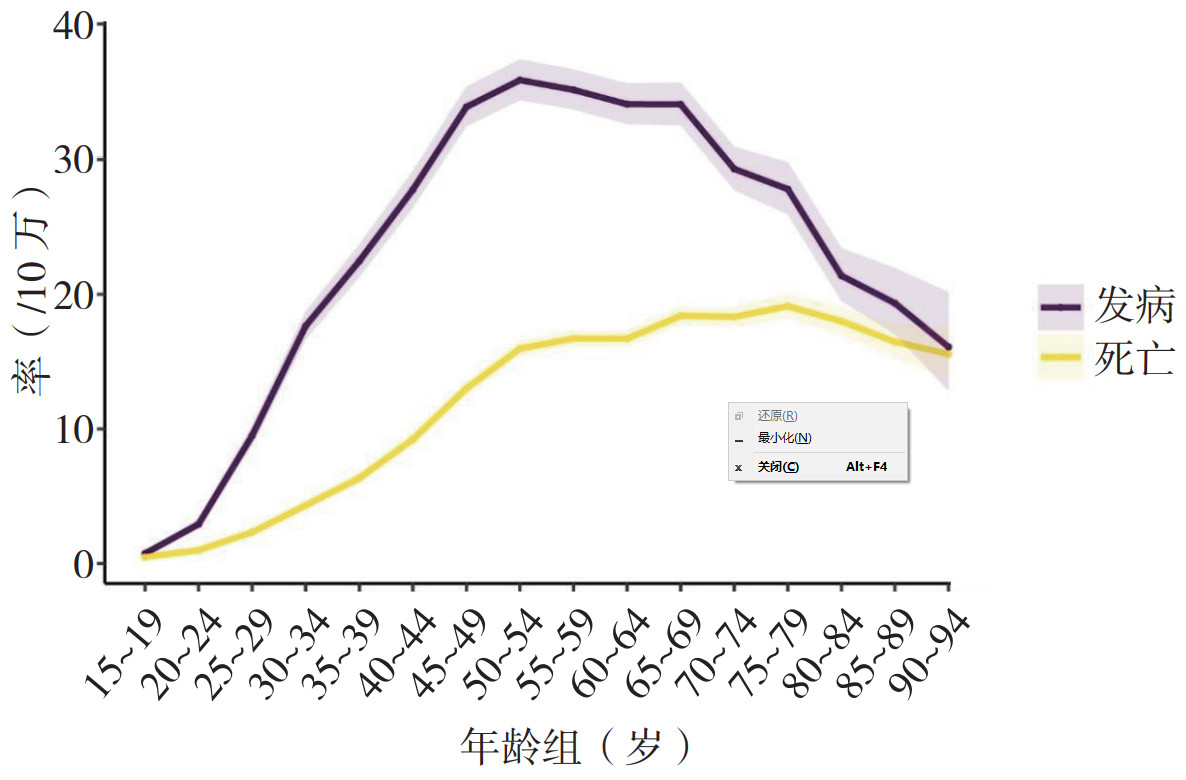
中国宫颈癌年龄别发病率和死亡率均先随年龄上升而增加,在中老年达到高峰后下降(图 1)。15~19岁发病率为0.74/10万,随年龄快速上升,至50~54岁达到峰值(35.91/10万),然后逐渐下降至90~94岁的16.09/10万。死亡率在青少年期较低,15~19岁为0.48/10万,随年龄稳步上升,在75~79岁达到峰值(19.11/10万),80岁后略有下降,90~94岁为15.56/10万。
|
| 图 1 1994—2023年中国宫颈癌发病和死亡率的纵向年龄曲线 Fig.1 Longitudinal age curves of the incidence and mortality rates of cervical cancer in China from 1994 to 2023 |
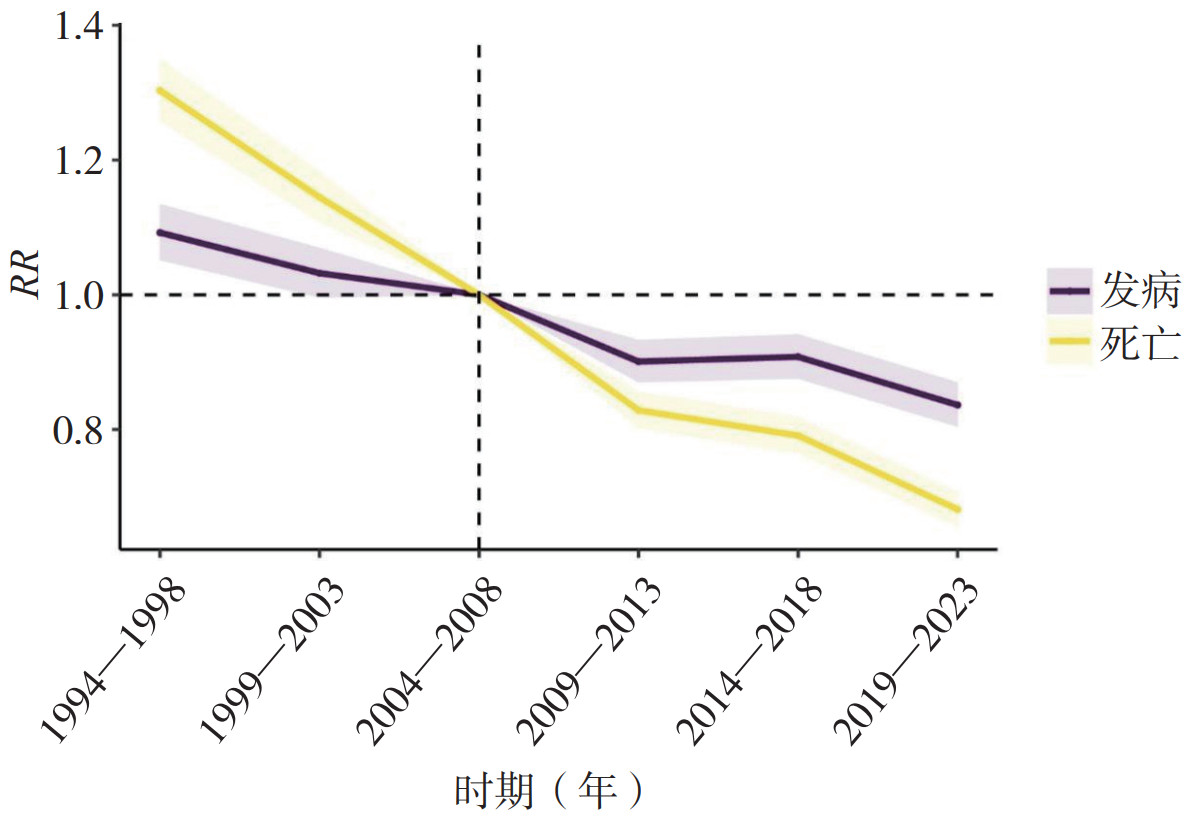
以2004—2008年作为参照时期,1994—1998年宫颈癌发病率的时期效应RR为1.09(95% CI:1.05~1.13),此后各时期RR总体呈下降趋势,2019—2023年降至0.84(95% CI:0.80~0.87,图 2)。死亡率的时期效应RR下降更明显,1994—1998年RR为1.30(95% CI:1.26~1.35),2019—2023年降至0.68(95% CI:0.66~0.71)。
|
| 注 RR:率比(rate ratio)。 图 2 1994—2023年中国宫颈癌发病和死亡率的时期效应 Fig.2 Period effects on the incidence and mortality rates of cervical cancer in China from 1994 to 2023 |
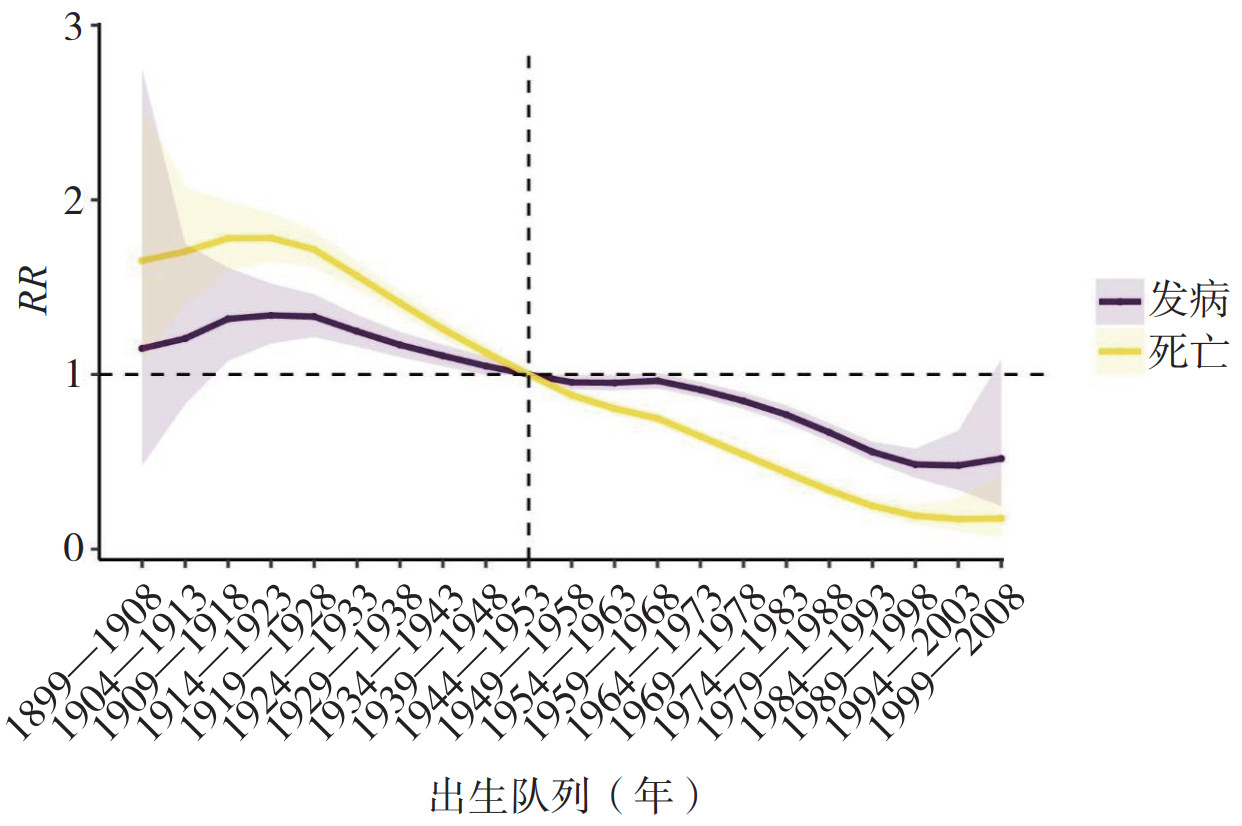
以1944—1953年出生队列为参照,中国宫颈癌发病的出生队列RR从1899—1908年的1.15(95% CI:0.48~2.74)降至1999—2008年的0.52(95% CI:0.25~1.08,图 3)。中国宫颈癌死亡的出生队列RR从1899—1908年的1.65(95% CI:1.08~2.53)降至1999—2008年的0.18(95% CI:0.07~0.42)。可估计函数的Wald χ2检验结果显示,净漂移=0、全时期RR=1、全队列RR=1及所有局部漂移=净漂移的零假设均被拒绝,提示宫颈癌发病和死亡的总体时间趋势、时期效应和队列效应均具有统计学意义,且不同年龄组的局部漂移存在差异(均P < 0.01,表 2)。
|
| 注 RR:率比(rate ratio)。 图 3 1994—2023年中国宫颈癌发病和死亡率的队列效应 Fig.3 Cohort effects on the incidence and mortality rates of cervical cancer in China from 1994 to 2023 |
| 零假设 | 发病 | 死亡 | |||
| χ2值 | P值 | χ2值 | P值 | ||
| 净漂移=0 | 132.93 | < 0.01 | 852.77 | < 0.01 | |
| 全时期RR=1 | 147.52 | < 0.01 | 878.28 | < 0.01 | |
| 全队列RR=1 | 361.91 | < 0.01 | 1 892.23 | < 0.01 | |
| 所有局部漂移=净漂移 | 108.56 | < 0.01 | 144.16 | < 0.01 | |
| 注 RR:率比(rate ratio)。 | |||||
1994—2023年,我国宫颈癌发病数、死亡数、粗发病率和粗死亡率总体上升,但年龄标化发病率和年龄标化死亡率下降。这与部分癌症和慢性病的研究结果一致,即绝对负担增加不一定反映个体风险同步升高[11]。年龄效应结果显示,我国宫颈癌发病和死亡风险随年龄上升,并分别在50~54岁和75~79岁达到峰值,随后下降。这与既往研究结果基本一致[12-13]。高危型HPV感染后,患者通常要经过较长时间才可能发展为宫颈癌。因此,宫颈癌的新发病例更多集中在中年女性,而不是感染HPV较常见的年轻女性[14]。50~54岁人群发病率最高,提示该年龄组应作为筛查和早诊干预的重点对象;筛查发现癌前病变并及时处理,可能有助于减少后续侵袭性病例的发生[15]。相比之下,死亡率峰值后移至75~79岁,可能与高龄患者确诊阶段较晚、合并疾病较多以及接受完整规范治疗的能力受限有关[16]。高龄人群发病率和死亡率出现下降,还可能受到竞争性死亡和诊断不足的影响,不能简单解释为真实风险降低[17]。因此,防控工作既应抓住中年女性的筛查窗口,也应强化高龄患者的治疗支持和随访管理。
本研究显示,控制年龄和出生队列后,1994—2023年中国宫颈癌发病与死亡的时期RR整体呈下行趋势。这和之前监测到的结果一致[18]。其中死亡降幅更大,提示除了发病风险在变,诊疗水平提升也发挥了作用[1]。近二十年来,诊疗规范和临床路径逐步完善,多学科协作模式持续推广,手术、放疗及同步放化疗在宫颈癌中的应用更多,中晚期患者的治疗效果有所改善[3]。癌前病变筛查和随访管理也在加强。部分高级别病变在变成浸润癌之前就被发现和处理。这是死亡风险持续下降的一个重要原因[19]。HPV疫苗接种和适龄人群筛查进一步减少宫颈癌发生及相关死亡[20]。这些年“两癌”筛查和机会性筛查覆盖面不断扩大,宫颈细胞学检查和HPV检测的服务可及性逐步提高,为宫颈癌的早期发现和及时干预创造了条件[21-22]。
本研究显示,控制年龄和时期后,早期出生队列的宫颈癌发病和死亡风险均较高,较晚队列风险逐步下降,其中死亡风险降幅更明显。早期女性多早婚早育,避孕和感染防控条件有限,筛查意识不强,高危型HPV感染及高级别病变易被延误,因此进入中老年后发病和死亡风险较高[23-26]。较晚出生的女性受教育水平和健康意识提升,初婚初育年龄推迟,生育数减少,对异常症状的关注度增强,高危暴露累积和诊治延迟减少,因此终身风险低于早期队列[27-29]。
综上所述,1994—2023年我国宫颈癌发病数和死亡数呈上升趋势,年龄标化发病率和年龄标化死亡率则有所下降。前者与人口增长及老龄化进程有关,后者提示防控和诊疗措施已显现出积极效果。后续工作仍应将50~54岁女性作为筛查和早诊早治的核心人群,同时重视75~79岁高龄患者的规范治疗、随访与支持照护,并持续推动HPV疫苗接种与适龄女性筛查协同开展,以进一步减轻宫颈癌的疾病负担。
利益冲突 所有作者声明无利益冲突
| [1] |
Wu SY, Jiao J, Yue XY, et al. Cervical cancer incidence, mortality, and burden in China: a time-trend analysis and comparison with England and India based on the Global Burden of Disease Study 2019[J]. Front Public Health, 2024, 12: 1358433. DOI:10.3389/fpubh.2024.1358433 |
| [2] |
Wu J, Jin QY, Zhang YM, et al. Global burden of cervical cancer: current estimates, temporal trend and future projections based on the GLOBOCAN 2022[J]. J Natl Cancer Cent, 2025, 5(3): 322-329. |
| [3] |
曹梦迪, 陈万青. GLOBOCAN 2022全球癌症统计数据解读[J]. 中国医学前沿杂志(电子版), 2024, 16(6): 1-5. |
| [4] |
Arbyn M, Weiderpass E, Bruni L, et al. Estimates of incidence and mortality of cervical cancer in 2018:a worldwide analysis[J]. Lancet Glob Health, 2020, 8(2): e191-e203. DOI:10.1016/S2214-109X(19)30482-6 |
| [5] |
Han BF, Zheng RS, Zeng HM, et al. Cancer incidence and mortality in China, 2022[J]. J Natl Cancer Cent, 2024, 4(1): 47-53. |
| [6] |
World Health Organization. Global strategy to accelerate the elimination of cervical cancer as a public health problem[M]. Geneva: World Health Organization, 2020: 7.
|
| [7] |
GBD 2023 Causes of Death Collaborators. Global burden of 292 causes of death in 204 countries and territories and 660 subnational locations, 1990-2023:a systematic analysis for the Global Burden of Disease Study 2023[J]. Lancet, 2025, 406(10513): 1811-1872. DOI:10.1016/S0140-6736(25)01917-8 |
| [8] |
GBD 2023 Disease and Injury and Risk Factor Collaborators. Burden of 375 diseases and injuries, risk-attributable burden of 88 risk factors, and healthy life expectancy in 204 countries and territories, including 660 subnational locations, 1990-2023:a systematic analysis for the Global Burden of Disease Study 2023[J]. Lancet, 2025, 406(10513): 1873-1922. DOI:10.1016/S0140-6736(25)01637-X |
| [9] |
Clayton D, Schifflers E. Models for temporal variation in cancer rates. Ⅰ: Age-period and age-cohort models[J]. Stat Med, 1987, 6(4): 449-467. DOI:10.1002/sim.4780060405 |
| [10] |
Rosenberg PS, Check DP, Anderson WF. A web tool for age-period-cohort analysis of cancer incidence and mortality rates[J]. Cancer Epidemiol Biomarkers Prev, 2014, 23(11): 2296-2302. DOI:10.1158/1055-9965.EPI-14-0300 |
| [11] |
GBD 2019 Asia and All Cancers Collaborators. Temporal patterns of cancer burden in Asia, 1990-2019:a systematic examination for the Global Burden of Disease 2019study[J]. Lancet Reg Health Southeast Asia, 2024, 21: 100333. DOI:10.1016/j.lansea.2023.100333 |
| [12] |
孙畅, MUSTAFE Abdalle Abdi, 刘冰青, 等. 全球子宫颈癌疾病负担及子宫颈癌筛查与管理质量分析[J]. 浙江大学学报(医学版), 2025, 54(3): 281-288. |
| [13] |
Li Z, Liu PL, Yin AJ, et al. Global landscape of cervical cancer incidence and mortality in 2022 and predictions to 2030:The urgent need to address inequalities in cervical cancer[J]. Int J Cancer, 2025, 157(2): 288-297. DOI:10.1002/ijc.35369 |
| [14] |
Walboomers JM, Jacobs MV, Manos MM, et al. Human papillomavirus is a necessary cause of invasive cervical cancer worldwide[J]. J Pathol, 1999, 189(1): 12-19. DOI:10.1002/(SICI)1096-9896(199909)189:1<12::AID-PATH431>3.0.CO;2-F |
| [15] |
Kultalahti H, Heinävaara S, Sarkeala T, et al. Effect of test history at ages 50-64 on later cervical cancer risk: a population-based case-control study[J]. Cancer Res Commun, 2023, 3(9): 1823-1829. DOI:10.1158/2767-9764.CRC-23-0191 |
| [16] |
Cohen PA, Jhingran A, Oaknin A, et al. Cervical cancer[J]. Lancet, 2019, 393(10167): 169-182. DOI:10.1016/S0140-6736(18)32470-X |
| [17] |
Cao W, Chen WQ. Cancer screening in the aging population: Where do we stand and what can we do?[J]. J Natl Cancer Cent, 2022, 2(3): 127-129. |
| [18] |
尚忠华, 蒋芝月, 黄朝晖, 等. 1990-2021年中国宫颈癌疾病负担趋势分析及2022-2035年预测研究[J]. 中国全科医学, 2025, 28(26): 3314-3320. |
| [19] |
李晓, 吕卫国. 子宫颈癌十年研究回顾[J]. 实用肿瘤杂志, 2024, 39(4): 298-304. DOI:10.13267/j.cnki.syzlzz.2024.046 |
| [20] |
Lei JY, Ploner A, Elfström KM, et al. HPV vaccination and the risk of invasive cervical cancer[J]. N Engl J Med, 2020, 383(14): 1340-1348. DOI:10.1056/NEJMoa1917338 |
| [21] |
Zhang JJ, Zhao YQ, Dai Y, et al. Effectiveness of highrisk human papillomavirus testing for cervical cancer screening in China: a multicenter, open-label, randomized clinical trial[J]. JAMA Oncol, 2021, 7(2): 263-270. DOI:10.1001/jamaoncol.2020.6575 |
| [22] |
王慧珂, 朱奕潼, 丁晗玥, 等. 在低卫生资源环境下消除宫颈癌: 从全球视角到中国视角[J]. 中国妇幼卫生杂志, 2023, 14(5): 1-7. |
| [23] |
Zhou YY, Chang M, Li CP, et al. Causal effect of age first had sexual intercourse and lifetime number of sexual partners on cervical cancer[J]. Heliyon, 2024, 10(1): e23758. DOI:10.1016/j.heliyon.2023.e23758 |
| [24] |
Tekalegn Y, Sahiledengle B, Woldeyohannes D, et al. High parity is associated with increased risk of cervical cancer: Systematic review and meta-analysis of case-control studies[J]. Womens Health, 2022, 18: 17455065221075904. |
| [25] |
Luvián-Morales J, Gutiérrez-Enríquez SO, Granados-García V, et al. Risk factors for the development of cervical cancer: analysis of the evidence[J]. Front Oncol, 2024, 14: 1378549. DOI:10.3389/fonc.2024.1378549 |
| [26] |
Okyere J, Aboagye RG, Ahinkorah BO, et al. Assessing the socioeconomic inequalities in cervical cancer screening in sub-Saharan Africa: a decomposition analysis[J]. Int J Equity Health, 2025, 24(1): 297. DOI:10.1186/s12939-025-02625-w |
| [27] |
Bayisa K, Chibsa SE, Tesfaye H, et al. Cervical cancer screening utilization and associated factors among women living with HIV in south west Ethiopia[J]. Sci Rep, 2025, 15(1): 35081. DOI:10.1038/s41598-025-18987-8 |
| [28] |
Yirsaw AN, Nigusie A, Andualem F, et al. Cervical cancer screening utilization and associated factors among women living with HIV in Ethiopia, 2024:systematic review and meta-analysis[J]. BMC Women's Health, 2024, 24(1): 521. DOI:10.1186/s12905-024-03362-y |
| [29] |
常怡宁, 戴钰, 李婷媛, 等. 西南低卫生资源地区女性自然人群中高危型人乳头瘤病毒感染现状分析: 基于四川省盐亭县的研究[J]. 实用肿瘤杂志, 2025, 40(3): 210-218. DOI:10.13267/j.cnki.syzlzz.2025.033 |