文章快速检索     高级检索
  中国水土保持科学   2025, Vol. 23 Issue (2): 116-126.  DOI: 10.16843/j.sswc.2024054
0

引用本文 

王玉石, 武昱鑫, 余新晓, 王旭, 贾国栋. 北方农牧交错带植被恢复下坡向对土壤可蚀性的影响[J]. 中国水土保持科学, 2025, 23(2): 116-126. DOI: 10.16843/j.sswc.2024054.
WANG Yushi, WU Yuxin, YU Xinxiao, WANG Xu, JIA Guodong. Effects of slope direction on soil erodibility under vegetation restoration in northern farming-pastoral ecotone[J]. Science of Soil and Water Conservation, 2025, 23(2): 116-126. DOI: 10.16843/j.sswc.2024054.

项目名称

国家重点研发计划“坝上–乌兰察布高原沙化土地近自然生态修复技术研究与示范”(2023YFF1305302)

第一作者简介

王玉石(1998—)男,博士研究生。主要研究方向:土壤侵蚀与水土保持。E-mail:w507612494@163.com

通信作者简介

贾国栋(1986—)男,博士,教授。主要研究方向:水土保持与生态水文。E-mail:Jiaguodong111@163.com

文章历史

收稿日期:2024-04-25
修回日期:2024-05-06
北方农牧交错带植被恢复下坡向对土壤可蚀性的影响
王玉石 , 武昱鑫 , 余新晓 , 王旭 , 贾国栋     
北京林业大学水土保持学院,100083,北京
摘要:针对北方农牧交错带植被恢复过程中发生的土壤侵蚀问题,对研究区内不同坡向各土地利用类型调查和分析,建立土壤可蚀性综合指数[1](CSEI)表征土壤抗侵蚀的能力,探究坡向对土壤可蚀性的影响,最终提出不同坡向植被恢复最佳选择的建议。结果表明:1)坡向对大部分林下植被特征有显著影响,北坡植被盖度比西坡高49.51%;东坡地上、地下生物量比西坡分别高24.54%和40.09%;南坡枯落物量高于西坡和北坡,东坡比西坡高34.11%,不同坡向林下植被特征值总体上西坡 < 北坡 < 南坡 < 东坡。2)坡向对土壤可蚀性有显著影响,坡向驱动植被特征的差异,进而影响土壤性质,导致土壤可蚀性发生相应响应。通过CSEI综合反映土地利用类型、坡向及其相互作用对土壤可蚀性的影响,西坡的CSEI最大(0.65),高于北坡、南坡和东坡的0.41、0.26和0.2。樟子松、柠条锦鸡儿、草木樨状黄耆和胡枝子可能分别是改善半阴坡、阴坡、阳坡、半阳坡土壤可蚀性的植被恢复最佳选择。
关键词坡向    土壤可蚀性    土壤可蚀性综合指数    植被恢复    农牧交错带    
Effects of slope direction on soil erodibility under vegetation restoration in northern farming-pastoral ecotone
WANG Yushi , WU Yuxin , YU Xinxiao , WANG Xu , JIA Guodong     
School of Soil and Water Conservation, Beijing Forestry University, 100083, Beijing, China
Abstract: [Background] The northern farming-pastoral ecotone is an ecologically fragile area and a region of severe soil erosion. Afforestation, which is mainly composed of man-made forests, struggles to effectively control soil erosion due to the varying influences of water, heat, wind, and sand in different habitats. Clarifying the differences in soil erodibility caused by different slope aspects and determining the impact of different vegetation restoration types on soil erodibility are crucial for the ecological restoration of this region. [Methods] This paper focuses on the Yangcao Gully watershed in Chongli district, Zhangjiakou city, Hebei province as the research area. During the 2021 vegetation growing season, a comprehensive survey was conducted on the understory vegetation characteristics of various vegetation restoration types (wasteland, grassland, shrubland, and forest land) within the research area. Plots were set up as 10x10 m2, and the survey indicators included vegetation height, richness, vegetation cover, aboveground biomass, belowground biomass, and litter biomass. A comprehensive soil erodibility index (CSEI) was established to characterize the soil's ability to resist erosion and to investigate the impact of slope aspect on soil erodibility. Data processing and statistical analysis were performed using Excel 2016 and SPSS Ver. 20. Principal component analysis, variance analysis, and Pearson correlation analysis were conducted using R language (R-3.5.1). Mapping was carried out using ArcGIS 10.4.1 and Origin 2021. [Results] 1) Slope direction has a significant effect on most understory vegetation characteristics.Compared to other slopes, the growth condition of the understory vegetation on the west slope is relatively poor, with the characteristic values of understory vegetation being lower than those of the other three slope aspects. The vegetation cover on the north slope is 49.51% higher than that on the west slope. The aboveground and belowground biomass on the east slope is 24.54% and 40.09% higher than that on the west slope, respectively. The amount of litter on the east slope is 34.11% higher than that on the west slope. 2) Slope aspect has a significant impact on soil erodibility. The east slope has the highest (saturated hydraulic conductivity) SHC, which is 311.16% and 187.10% greater than that of the west slope and north slope, respectively. The west slope has the highest soil disintegration rate (SDR), which is 1.60 times, 1.97 times, and 3.89 times that of the north slope, south slope, and east slope, respectively. The east slope has the highest mean weight diameter (MWD) of 3.65mm, which is 55.66%, 36.60%, and 10.14% higher than that of the west slope, north slope, and south slope, respectively. The east slope also has the highest SSSI, which is 28.23%, 13.34%, and 10.71% greater than that of the west slope, north slope, and south slope, respectively. 3) Land use types, slope aspects, and their interactions significantly affect the CSEI, which can more effectively reflect the changes in soil erodibility among different slope aspects and land uses. The CSEI values for the south slope (0.26) and east slope (0.20) are low, indicating a strong capacity to reduce soil erodibility. The north slope (0.41) has a weaker capacity, and the west slope (0.65) has the weakest. Compared to the wasteland (0.81), the CSEI of the other three land use types is significantly reduced, with the best reduction effect observed in shrublands (0.3), followed by forest lands (0.42), and grasslands (0.61). [Conclusions] The impact of slope aspect and different vegetation restoration types on soil erodibility during the vegetation recovery process is significant. Based on the differences in CSEI between various slope aspects and among different land use types within the same slope aspect, this study proposes the best vegetation restoration types for each slope aspect. In combination with the natural vegetation recovery conditions of the study area, Pinus sylvestris, Caragana korshinskii, Agalus melilotus and Lespedeza bicolor may be the best choices to improve the soil erodibility of semi-shade slope, shade slope, sunny slope and semi-sunny slope, respectively.
Keywords: slope directions    comprehensive soil erodibility    CSEI    vegetation restoration    farming-pastoral ecotone    

随着我国工业化进程的推进,土壤侵蚀的危害逐渐加剧,土壤侵蚀危害程度日益加深,发生面积日益加大,导致土壤养分流失和结构退化,制约着粮食生产、土地生产及环境质量可持续发展,已成为全球性的重大环境问题[12]。植被恢复是控制土壤侵蚀和水土流失的重要措施,可以改善土壤性质、提高土壤质量,促进土壤功能的恢复[34]。植被恢复引起的土地利用变化对于改善土壤质量具有重要作用[5]。此前有研究表明,植被恢复会驱动土地利用的显著变化,改善土壤性质和减小土壤可蚀性[6]。土壤可蚀性常用来表征土壤侵蚀性敏感程度,常用于植被恢复对土壤质量影响的效益评估。当前研究多集中在阐明植被恢复对土壤质量的影响[78],对于哪些植物恢复措施可以有效降低土壤可蚀性、提升生态效益尚不清楚[9]

土壤可蚀性是指土壤受雨滴击溅、径流冲刷以及壤中流等外营力作用而被分散和搬运的难易程度[10],是土壤抵抗侵蚀能力的集中体现。当前许多土壤侵蚀模型使用土壤可蚀性因子K来表示土壤可蚀性[9],但预测效果不太理想[11]。除K外,还采用土壤饱和导水率(saturated hydraulic conductivity,SHC)、土壤崩解速率(soil disintegration rate,SDR)、土壤团聚体稳定性指标平均质量直径(mean weight diameter,MWD)、土壤结构稳定指数(soil structural stability index,SSSI)来描述土壤可蚀性[3,1214]。单一土壤可蚀性指标不能全面客观反映土壤可蚀性,有必要综合多个土壤可蚀性指标,制定综合土壤可蚀性指数来准确定量土壤可蚀性[15]。除了土壤自身性质,研究发现地形因素也会显著影响土壤可蚀性[1618]。沙晓玮等认为,坡向是影响土壤可蚀性的基础模块,不同坡向的土壤结构差异引发土壤密度、饱和导水率和崩解速率的差异,进而改变土壤抗蚀能力。不同坡向上的土地利用方式存在明显差异,植被恢复带来的土地利用变化亦将改良土壤性质和植被发育状况,进而影响土壤可蚀性[19]。已有研究表明,植被恢复可以有效改良土地结构并降低土壤可蚀性。在撂荒地转变为草地、灌丛和林地的过程中,土壤有机质含量提升,团聚体结构更加稳定,进而导致土壤可蚀性的降低[2021]。Chen等[22]指出,对比撂荒地,草地和灌丛都有效的降低土壤可蚀性,植被对土壤可蚀性的影响大小取决于土壤自身性质和根系特征。在笔者的研究区,不同坡向上的植被恢复措施不同,这种情况进一步对土壤可蚀性造成影响。开展坡向和植被恢复引起的土壤可蚀性的研究对于合理布设植被恢复格局至关重要。

北方农牧交错带属于生态脆弱区和水土流失区,水土流失十分严重[17]。随着三北防护林工程、京津风沙源治理工程等实施,有效减少区域土壤侵蚀和土地沙化,并显著减缓风沙的侵袭[2324]。然而,以人工林为主的造林方式,受不同生境水、热、风、沙差异的影响,在一些生态脆弱区难以实现土壤侵蚀的有效治理,植被恢复工作较为困难,适宜树种的选择亟待解决。笔者以河北省张家口市崇礼区羊草沟流域为研究对象,在不同的土地利用、不同坡向条件下,通过加权和法计算各样地土壤可蚀性指数,明确不同坡向引起的土壤可蚀性差异,提出不同坡向降低土壤可蚀性的最佳植被配置,以期为北方农牧交错带甚至国内干旱半干旱区的土壤侵蚀研究及水土保持工作的开展提供理论及数据基础,促进区域生态环境建设及经济发展。

1 研究区概况

研究区位于河北省张家口市崇礼区羊草沟流域(E 114°58′ ~ 115°2′, N 41°4′ ~ 41°8′; 图1),流域面积10.6 km2,海拔1084 ~ 1575 m,地势东北高,西南低,属典型温带大陆性季风半干旱气候,年平均气温3.5 ℃,年平均降雨量为401.6 mm,雨季从6月到9月[17,21],土壤类型以棕壤和褐土为主。由于不合理的开垦与放牧,区域水土流失和沟壑侵蚀严重。2008年开始在荒山荒坡内实施封山育林和人工造林相结合的植被恢复与重建,经过十几年的恢复与演替,研究区逐渐形成现有的植被分布格局。当前乔木优势树种为落叶松(Larix gmelinii)、樟子松(Pinus sylvestris)、油松(Pinus tabuliformis);灌丛主要有山杏(Armeniaca sibirica)、沙棘(Hippophae ryanoids)等;草本主要有细柄草(Capillipedium parviflorum)、白羊草(Bothriochloa ischaemum)等[25],不同坡向植被种植与分布情况见表1

图 1 研究区位置图 Fig. 1 Location of the study area
表 1 不同坡向土地利用下的林下植被特征 Tab. 1 Understory vegetation characteristics of land use on different slope aspects
2 材料与方法 2.1 样品采集与处理

在2021年生长季期间,对研究区内各植被恢复类型(荒地、草地、灌木丛和林地)[26]进行全面调查,每类植被恢复分别划分东坡(半阳坡)、西坡(半阴坡)、北坡(阴坡)和南坡(阳坡)[2728]。笔者选取流域内典型植被群落,基于不同植被类型进行调查(荒地、草地1×1 m,灌丛5×5 m,林地10×10 m),标准调查样地共计39个。过去12年来,绝大多数的荒地已被改造成人工林和草地,仅在西坡找到荒地作为对照点。由于土壤侵蚀均发生在地表,因此选取林下植被特征进行调查研究,包括:植被高度、物种丰富度、植被盖度、地上生物量、地下生物量和枯落物生物量[29],所选样地的坡度和坡位相似。使用环刀法采集表层土样和原状土,使用枝剪采集地上地下生物量,收集枯落物,使用马氏瓶、环刀法进行恒定水头渗透性试验[30]测量土壤饱和度、SHC,使用不同孔径的筛子测量MWD[31]

2.2 土壤可蚀性指数计算

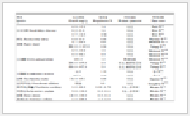
土壤可蚀性用SHC[31]、MWD[25]、SDR[32]、SSSI[33]K[3435]表示,计算结果见表2

表 2 不同坡向土壤可蚀性指标 Tab. 2 Soil erodibility indicators of different slopes.

为了进一步综合、精确评价本研究中不同坡向土地利用类型土壤可蚀性的差异,通过下式计算上述五项指标的土壤可蚀性综合指数(comprehensive soil erodibility index, CSEI):

$ {C}_{\mathrm{S}\mathrm{E}\mathrm{I}} = \sum\nolimits_{1}^{n}N C 。$ (1)

式中:NC分别为土壤可蚀性指数的权重和得分;n为指标个数[3637]

利用主成分分析法[13,32]确定各土壤可蚀性指标的权重,其中SHC、MWD、SSSI评分采用逆线性评分函数计算。SDR和K因子的得分采用线性评分函数计算[38]表3显示各个指标权重。

表 3 5项土壤可蚀性指标权重 Tab. 3 Weights of five soil erodibility indexes

使用Excel 2016和SPSS 20进行数据处理和统计,使用R语言(R-3.5.1)进行主成分分析、方差分析和Pearson相关性分析,使用ArcGIS 10.4.1和Origin 2021制图。

3 结果与分析 3.1 不同坡向林下植被特征的变化

表1图2可见,西坡除物种丰富度外,林下植被特征均小于其他3个坡向;北坡、南坡、东坡林下植被特征值较好,其中北坡植被盖度最大,南坡物种丰富度最大,东坡植被高度、地上生物量、地下生物量、枯落物量最大。西坡不同土地利用类型间各指标均存在显著差异(P < 0.05)。北坡、南坡和东坡的灌木林地枯落物生物量在同坡向的不同土地利用类型中最高。北坡和东坡植被高度高于西坡和南坡(P < 0.05);东坡植被物种丰富度比其他坡向低10%左右;北坡和东坡植被盖度明显大于西坡和南坡,北坡植被盖度比西坡高49.51%;地上生物量和地下生物量随着坡向逐渐增加,其中东坡地上地下生物量比西坡分别高24.54%和40.09%;南坡和东坡枯落物量高于西坡和北坡,东坡比西坡高34.11%。不同坡向对林下植被特征有一定影响,西坡相较于其他坡,林下植被生长状况较差。

图 2 不同坡向林下植被特征变化 Fig. 2 Understory vegetation characteristics change under different slope direction
3.2 不同坡向下土壤可蚀性指标的变化

表2可见,坡向对土壤可蚀性指标有显著影响。东坡SHC最大,比西坡和北坡大311.16%和187.10%;西坡SDR最大,分别是北坡、南坡和东坡的1.60倍、1.97倍和3.89倍;东坡MWD最大(3.65 mm),比西坡、北坡、南坡分别高55.66%、36.60%、10.14%;东坡的SSSI最大,分别比西坡、北坡、南坡大28.23%、13.34%、10.71%;4个坡向的K值几乎相同,都在0.28 ~ 0.30。

在同一坡向内,土地利用类型对土壤可蚀性的影响显著。在西坡,林地的SHC显著高于灌丛、草地和荒地,林地与荒地的SDR接近,显著大于草地和灌丛,灌丛的MWD显著最大,林地的SSSI最大;在北坡,林地的SHC分别比草地和灌丛高48.58%和54.13%,SDR比草地和灌丛高79.56%和41.51%,灌丛MWD最大;在南坡,林地与灌丛的SHC接近,显著大于草地,林地SDR比草地和灌丛高79.48%和65.81%,林地SSSI最大;在东坡,林地和灌丛的SHC接近,大于草地,林地SDR比草地和灌丛高36.84%和18.42%,草地MWD比灌丛和林地高14.83%和15.81%。

3.3 不同坡向下土壤可蚀性综合指数的变化

由土壤可蚀性的双因素方差分析结果(表4)可知,土地利用类型、坡向及其相互作用对CSEI影响显著。与上述5项土壤可蚀性指标相比,CSEI能更有效地反映不同坡向、土地利用之间土壤可蚀性的变化。总体而言,南坡(0.26)和东坡(0.20)的CSEI小,土壤可蚀性降低能力强,北坡(0.41)较弱和西坡(0.65)最弱(图3)。与荒地(0.81)相比,其他3种土地利用类型的CSEI显著降低,其中灌丛的降低效果最好(0.3),其次是林地(0.42)、草地(0.61)(图4)。在西坡,林地的CSEI最小(0.41),小于草地(0.47)、灌丛(0.50)和荒地(0.81);在北坡,灌丛的CSEI最小(0.32),小于林地(0.43)和草地(0.44);在南坡,草地的CSEI最小(0.19),小于林地(0.21)和灌丛(0.28);在东坡,灌丛的CSEI最小(0.16),小于林地(0.21)和草地(0.22)。

表 4 土壤可蚀性的双因素方差分析结果 Tab. 4 The two-way ANOVA result for soil erodibility
图 3 不同坡向的土壤可蚀性变化 Fig. 3 Variation of soil erodibility with slope aspects
D:荒地;G:草地;S:灌丛;W:林地;(a)西坡;(b)北坡;(c)南坡;(d)东坡 D: degraded land; G: grassland; S: shrubland; W: woodland; (a) west slope; (b) north slope; (c) south slope; (d) east slope 图 4 不同土地利用的土壤可蚀性变化 Fig. 4 Variation of soil erodibility with land use
4 讨论 4.1 坡向对林下植被特征变化的影响

植物的生长发育与不同坡向的分布及土壤特征之间存在着重要的关系[3940],坡向主要通过日照、湿度、温度、风速和土壤自身性质来影响植被特征[38]、水热平衡[28,37],植物在不同的坡向上生长不同,根据其栖息地表现出不同的塑性响应[30,35]。本研究中,不同坡向下的大部分林下植被特征差异显著,由于林下植物被上部较高的乔木和灌木遮挡,导致同一坡向不同土地利用类型间的植被特征也存在差异。在阴坡—半阴坡—半阳坡—阳坡梯度上,植被地上、地下生物量呈递增的趋势。这与张子鸣等[41]研究结果类似,可能跟阳坡接收的净太阳辐射较大,林内空气温度较高,进而直接影响到林木的光合速率有关。阴坡物种丰富度和植被盖度较好,这与李强[10]的研究结果一致,这可能与阴坡水分较为充足,土壤含水率高有关。西坡各指标坡内差异较大,可能是因为只有西坡有荒坡这一土地利用引起。

4.2 坡向对土壤可蚀性变化的影响

笔者研究表明,坡向对土壤可蚀性有显著影响,整体上各坡向的植被恢复较荒地都能够有效降低土壤可蚀性(P < 0.05),这与姚颖等[21]研究结果一致。植被根系可以固结土壤,改良土壤孔隙结构,减少土壤容重,拦蓄降雨冲刷,使降雨能更快渗透,削弱降雨对土壤的侵蚀作用,进而降低土壤可蚀性。同一坡向下不同植被恢复类型的土壤可蚀性差距较大,可能是由于研究区在旱季和雨季之间温度和降雨的变异性大,以及不同植物种的生理过程周期不同,导致土壤可蚀性变异性较大,李娅芸等[11]在黄土区的研究也得出相似的结论。本研究中,MWD大致表现为阳坡大于阴坡,这可能与阳坡含水量、SHC、有机质含量较高有关。因为土壤黏粒、有机质、菌丝等物质通常是土壤团聚体形成的主要胶结物质,凡是能够影响土壤有机质和黏粒含量的措施都会影响土壤团聚体含量及其组成和稳定性,特别是土壤大团聚体的形成。由于特殊的地理位置,阴坡和半阴坡受到全年大风的影响,导致环境的变化,使得阴坡、半阴坡SDR大,更容易受到侵蚀影响。土壤K值无明显坡向差异,这也说明在该地区,单一K因子无法准确定量描述各坡向土壤可蚀性情况,需要更多更综合的指数来反应坡向对土壤可蚀性的影响,准确刻画驱动土壤可蚀性变化的因素。CSEI的提出与建立,综合反应不同坡向间、同一坡向不同土地利用类型间的土壤可蚀性变化。阴坡、半阴坡土壤含水率相对较高,可为植物生长提供较好的土壤水环境,然而半阴坡、阴坡的CSEI较高,说明除水环境外,风速是该地区控制植被恢复的关键影响因素[1213],进一步影响土壤的可蚀性。未来可能需要丰富CSEI的内涵,将风蚀控制因素也纳入研究之中。

4.3 基于坡向的最优植被恢复类型及植物群落

笔者发现,温度、日照长度、辐射强度和种植密度都对植被生长有显著影响[6,1415]。基于各坡向与同一坡向内不同土地利用类型间CSEI的差异,笔者提出各坡向下最佳的植被恢复类型。值得注意的是,半阴坡的草本由于强风条件和沙质土壤,容易发生严重的浅层养分流失和水土流失[22]。因此,应慎重考虑将草本作为主要的恢复植被物种,林地CSEI最小,能起到明显的抗侵蚀作用,考虑将林地作为主要的植被恢复物种;阴坡土壤水分条件较好,灌丛CSEI最小。因此,考虑将灌丛作为主要的植被恢复物种;阳坡草地CSEI略小于林地和灌丛,但综合考虑土壤水分、土壤抗蚀性,草地是更合适的选择;半阳坡灌丛CSEI最小,结合光照、土壤水分的影响,灌丛是植被恢复的最佳选择。综上,半阴坡、阴坡、阳坡和半阳坡,林地、灌丛、草地、灌丛是最适合的植被恢复类型。结合研究区自然植被恢复状况,笔者认为樟子松、柠条锦鸡儿、草木樨状黄耆和胡枝子分别是改善半阴坡、阴坡、阳坡和半阳坡土壤可蚀性的最佳植被恢复选择。

5 结论

植被恢复过程中坡向和不同植被恢复类型对土壤可蚀性影响显著。坡向通过日照、湿度、温度、风速和土壤自身性质等影响土壤可蚀性。西坡的CSEI最大(0.65),高于北坡、南坡和东坡的0.41、0.26、0.2;植被恢复可以提高物种丰富度、植被盖度、地上地下生物量、枯落物生物量,进而有效降低土壤可蚀性。尤其是半阴坡的乔木,阴坡的灌木,阳坡的草本,半阳坡的灌木是最适合当前立地条件的植被恢复类型。建议半阴坡、阴坡、阳坡、半阳坡分别采用樟子松、柠条锦鸡儿、草木樨状黄耆和胡枝子的植被恢复配置,以达到最佳的土壤可蚀性改良。

6 参考文献
[1]
黄土高原刺槐林地根系与枯落物对土壤侵蚀的影响[J]. 水土保持学报, 2023, 37(2): 83.
WANG Dandan, XU Haichao, SHAN Zhijie, et al. Effects of Robinia pseudoacacia litter cover and roots on soil erosion in the loess Plateau, China[J]. Journal of Soil and Water Conservation, 2023, 37(2): 83.
[2]
WEN Hui, NI Shimin, WANG Junguang, et al. Changes of soil quality induced by different vegetation restoration in the collapsing gully erosion areas of southern China[J]. International Soil and Water Conservation Research, 2021, 9(2): 195. DOI:10.1016/j.iswcr.2020.09.006
[3]
黄土高塬沟壑区植被恢复对不同地貌部位土壤可蚀性的影响[J]. 自然资源学报, 2020, 35(2): 387.
CHEN Zhuoxin, WANG Wenlong, GUO Mingming, et al. Effects of vegetation restoration on soil erodibility on different geomorphological locations in the loess-tableland and gully region of the Loess Plateau[J]. Journal of Natural Resources, 2020, 35(2): 387. DOI:10.31497/zrzyxb.20200211
[4]
黄土丘陵区不同植被恢复对土壤入渗影响及适宜模型研究[J]. 水土保持学报, 2023, 37(2): 67.
MA Xueyan, MU Xingmin, WANG Shuangyin, et al. Study on the effects of different vegetation restoration on soil infiltration and suitable models in the Loess Hilly Region[J]. Journal of Soil and Water Conservation, 2023, 37(2): 67.
[5]
SINGH G, PANDA R K. Grid-cell based assessment of soil erosion potential for identification of critical erosion prone areas using USLE, GIS and remote sensing: A case study in the Kapgari watershed, India[J]. International Soil and Water Conservation Research, 2017, 5(3): 202. DOI:10.1016/j.iswcr.2017.05.006
[6]
青藏高原不同土地利用方式下的土壤质量评价[J]. 地球环境学报, 2023, 14(3): 339.
ZHAO Jin, LU Ruijie, MA Luo. Soil quality assessment under different land uses in Qinghai-Tibet Plateau[J]. Journal of Earth Environment, 2023, 14(3): 339.
[7]
曲安然. 华北石质山区不同人工林下土壤性质差异特征及土壤质量评价[D]. 郑州:河南农业大学,2023:367.
QU Anran. Soil properties differences and soil quality evaluation under different plantation forest in rocky mountainous areas of North China[D]. Zhengzhou:Henan Agricultural University,2023:367.
[8]
OLSON T C, WISCHMEIER W H. Soil-erodibility evaluations for soils on the runoff and erosion stations[J]. Soil Science Society of America Journal, 1963, 27(5): 590. DOI:10.2136/sssaj1963.03615995002700050035x
[9]
CHEN Shiqi, ZHANG Guanghui, ZHU Pingzong, et al. Impact of slope position on soil erodibility indicators in rolling hill regions of Northeast China[J]. Catena, 2022, 217: 106475. DOI:10.1016/j.catena.2022.106475
[10]
东祁连山高寒草甸土壤理化性质对海拔和坡向的响应及其与植被特征的关系[J]. 干旱区地理, 2022, 45(5): 1559.
LI Qiang, HE Guoxing, WEN Tong, et al. Response of soil physical and chemical properties to altitude and aspect of alpine meadow in the eastern Qilian Mountains and their relationships with vegetation characteristics[J]. Arid Land Geography, 2022, 45(5): 1559. DOI:10.12118/j.issn.1000-6060.2021.528
[11]
应用Le Bissonnais法研究黄土丘陵区不同植被区及坡向对土壤团聚体稳定性和可蚀性的影响[J]. 自然资源学报, 2016, 31(2): 287.
LI Yayun, LIU Lei, AN Shaoshan, et al. Research on the effect of vegetation and slope aspect on the stability and erodibility of soil aggregate in Loess Hilly Region based on Le Bissonnais method[J]. Journal of Natural Resources, 2016, 31(2): 287.
[12]
HUPET F, VANCLOOSTER M. Intraseasonal dynamics of soil moisture variability within a small agricultural maize cropped field[J]. Journal of Hydrology, 2002, 261(1/4): 86.
[13]
MENG Zhongju, DANG Xiaohong, GAO Yong, et al. Interactive effects of wind speed, vegetation coverage and soil moisture in controlling wind erosion in a temperate desert steppe, Inner Mongolia of China[J]. Journal of Arid Land, 2018, 10(4): 534. DOI:10.1007/s40333-018-0059-1
[14]
SUN Long, ZHANG Guanghui, LUAN Lili, et al. Temporal variation in soil resistance to flowing water erosion for soil incorporated with plant litters in the Loess Plateau of China[J]. Catena, 2016, 145: 239. DOI:10.1016/j.catena.2016.06.016
[15]
王敬贵,亢庆,邝高明,等. 尖山河小流域土壤可蚀性K值空间变异研究[J]. 生态环境学报,2014,23(4):555.
WANG Jinggui,KANG Qing,KUANG Gaoming,et al. Spatial variability of soil erodibility (K-factor) in Jianshan watershed of Yunnan province[J] Ecology and Environmental Sciences,2014,23(4):555.
[16]
ZHANG Xingqi, HU Maochuan, GUO Xinya, et al. Effects of topographic factors on runoff and soil loss in Southwest China[J]. Catena, 2018, 160: 394. DOI:10.1016/j.catena.2017.10.013
[17]
王慧琴. 华北北部区域土壤侵蚀时空演变与驱动力分析[D]. 北京:北京林业大学,2020:1107.
WANG Huiqin. The spatiotemporal variations and drivers analysis of soil erosion in the northern North China’s region[D]. Beijing:Beijing Forestry University,2020:1107.
[18]
吉林省中东部耕地土壤可蚀性因子的演变[J]. 吉林农业大学学报, 2021, 43(1): 82.
ZHANG Qi, CUI Jiahui, LI Rongxuan, et al. Evolution of arable soil erodibility factor in central and eastern Jilin province[J]. Journal of Jilin Agricultural University, 2021, 43(1): 82.
[19]
冀北山地植被恢复对不同坡位土壤可蚀性与养分的影响[J]. 水土保持学报, 2024, 38(4): 11.
SHA Xiaowei, WU Yuxin, JIA Guodong, et al. Effects of vegetation restoration on soil erodibility and nutrients at different slope sites in northern Hebei mountains[J]. Journal of Soil and Water Conservation, 2024, 38(4): 11.
[20]
黄土高原不同退耕年限刺槐林地土壤侵蚀阻力[J]. 农业工程学报, 2017, 33(10): 191.
SUN Long, ZHANG Guanghui, WANG Bing, et al. Soil erosion resistance of black locust land with different ages of returning farmland on Loess Plateau[J]. Transactions of the Chinese Society of Agricultural Engineering, 2017, 33(10): 191. DOI:10.11975/j.issn.1002-6819.2017.10.025
[21]
不同坡位山杏天然林生长和土壤理化性质比较[J]. 森林工程, 2019, 35(6): 36.
YAO Ying, LIU Jianming, LIU Zhongling, et al. Comparison on Armeniaca sibirica natural forest growth and soil physicochemical properties in different slope position[J]. Forest Engineering, 2019, 35(6): 36.
[22]
CHEN Xiaoyan, ZHOU Ji. Volume-based soil particle fractal relation with soil erodibility in a small watershed of purple soil[J]. Environmental Earth Sciences, 2013, 70(4): 1735. DOI:10.1007/s12665-013-2261-y
[23]
ZHANG Xiaofang, ADAMOWSKI J F, LIU Chunfang, et al. Which slope aspect and gradient provides the best afforestation-driven soil carbon sequestration on the China's Loess Plateau?[J]. Ecological Engineering, 2020, 147: 105782. DOI:10.1016/j.ecoleng.2020.105782
[24]
CHANG Xiaomin,SUN Libo,YU Xinxiao,et al. Windbreak efficiency in controlling wind erosion and particulate matter concentrations from farmlands[J]. Agriculture,Ecosystems & Environment,2021,308:107269.
[25]
基于土壤管理评估框架的云南坡耕地耕层土壤质量评价[J]. 农业工程学报, 2019, 35(3): 256.
CHEN Zhengfa, SHI Dongmei, JIN Huifang, et al. Evaluation on cultivated-layer soil quality of sloping farmland in Yunnan based on soil management assessment framework (SMAF)[J]. Transactions of the Chinese Society of Agricultural Engineering, 2019, 35(3): 256.
[26]
冬奥会崇礼赛区5种人工林枯落物及土壤水文特征[J]. 北京林业大学学报, 2022, 44(4): 66.
WU Yuxin, YU Xinxiao, PENG Xiuwen, et al. Hydrological characteristics of litter and soil of five types of plantation configuration patterns in the Chongli competition district of winter Olympic games[J]. Journal of Beijing Forestry University, 2022, 44(4): 66. DOI:10.12171/j.1000-1522.20210295
[27]
不同坡向高寒退化草地狼毒株高和枝条数的权衡关系[J]. 植物生态学报, 2014, 38(3): 281.
HOU Zhaojiang, ZHAO Chengzhang, LI Yu, et al. Trade-off between height and branch numbers in Stellera chamaejasme on slopes of different aspects in a degraded alpine grassland[J]. Journal of Plant Ecology, 2014, 38(3): 281.
[28]
不同坡向亚高山草甸土壤有机碳光降解特征及其对铁添加的响应[J]. 生态学杂志, 2024, 43(1): 33.
GUO Xiaoyu, CHENG Man, XU Maohong, et al. Effects of iron addition on photodegradation of soil organic carbon under different slope aspects in a subal-pine meadow[J]. Journal of Ecology, 2024, 43(1): 33.
[29]
川西高原不同坡向云、冷杉树轮对快速升温的响应差异[J]. 应用生态学报, 2016, 27(2): 354.
GUO Binde, ZHANG Yuandong, WANG Xiaochun. Response of Picea purpurea and Abies faxoniana tree rings at different slope aspects to rapid warming in western Sichuan, China[J]. Journal of Applied Ecology, 2016, 27(2): 354.
[30]
土壤可蚀性及其在侵蚀预报中的应用[J]. 自然资源学报, 1999, 4(4): 345.
LIU Baoyuan, ZHANG Keli, JIAO Juying. Soil erodibility and its use in soil erosion prediction model[J]. Journal of Natural Resources, 1999, 4(4): 345.
[31]
北京山区典型植被类型土壤饱和导水率及其影响因素[J]. 水土保持学报, 2022, 36(6): 171.
ZHANG Yi, LIN Yiyan, JIA Guodong, et al. Soil saturated hydraulic conductivity and its influencing factors of typical vegetation types in Beijing mountainous area[J]. Journal of Soil and Water Conservation, 2022, 36(6): 171.
[32]
ORTAS I, LAL R. Long-term phosphorus application impacts on aggregate-associated carbon and nitrogen sequestration in a Vertisol in the Mediterranean Turkey[J]. Soil Science, 2012, 177(4): 241. DOI:10.1097/SS.0b013e318245d11c
[33]
青藏高原土壤可蚀性K值的空间分布特征[J]. 水土保持通报, 2014, 34(4): 11.
LIU Bintao, TAO Heping, SHI Zhan, et al. Spatial distribution characteristics of soil erodibility K value in Qinghai-Tibet Plateau[J]. Bulletin of Soil and Water Conservation, 2014, 34(4): 11.
[34]
高寒矿区排土场不同坡向植被和土壤特征研究[J]. 土壤, 2020, 52(4): 831.
JIN Liqun, LI Xilai, SUN Huafang, et al. Characteristics of vegetations and soils under different aspects of slag mountain in alpine mining area[J]. Soils, 2020, 52(4): 831.
[35]
喀斯特退化天坑不同坡向植物群落系统发育与功能性状结构[J]. 生态学报, 2022, 42(19): 8050.
SHUI Wei, FENG Jie, LI Hui, et al. Phylogeny and functional traits structure of plant communities with different slope aspects in the degraded Karst Tiankeng[J]. Acta Ecologica Sinica, 2022, 42(19): 8050.
[36]
松花坝流域不同坡度及坡向土壤侵蚀的特征研究[J]. 西部林业科学, 2012, 41(6): 63.
CUI Jilin, CHEN Li, FANG Xiangjing. Soil erosion characteristics of different slope gradients and aspects in Songhuaba Watershed of Kunming[J]. Western Forestry Science, 2012, 41(6): 63.
[37]
WANG Hao, ZHANG Guanghui. Temporal variation in soil erodibility indices for five typical land use types on the Loess Plateau of China[J]. Geoderma, 2021, 381: 114695. DOI:10.1016/j.geoderma.2020.114695
[38]
WU Yuxin, YU Xinxiao, JIA Guodong. Seasonal variation of soil erodibility under vegetation restoration in the agro-pastoral ecotone of northern China[J]. Journal of Soil Science and Plant Nutrition, 2023, 23(2): 2331. DOI:10.1007/s42729-023-01183-w
[39]
高璐璐. 坡度、坡位、坡向对红松针叶内部分酶活性的影响[D]. 哈尔滨:东北林业大学,2011:10.
GAO Lulu. Effects of slope,slope positions,and slopes on part of enzyme activity in Pinus koraiensis needles[D]. Harbin:Northeast Forestry University,2011:10.
[40]
云南省土壤可蚀性及其空间分布特征[J]. 人民黄河, 2019, 41(8): 103.
LI Jixiao, DING Jianhong, TAO Yuquan, et al. Soil erodibility and its spatial distribution characteristics in Yunnan Province[J]. Yellow River, 2019, 41(8): 103. DOI:10.3969/j.issn.1000-1379.2019.08.020
[41]
张子鸣,郝珖存. 坡向对公路边坡土壤有机碳恢复的短期影响[J/OL].中国水土保持科学,1-12[2025-02-26]. http://kns.cnki.net/kcms/detail/10.1449.S.20240506.1517.002.html.
ZHANG Ziming, HAO Guangcun. Short-term effects of slope aspect on the soil organic carbon recovery of highway slopes[J/OL]. Science of Soil and Water Conservation, 1-12[2025-02-26]. http://kns.cnki.net/kcms/detail/10.1449.S.20240506.1517.002.html.
[42]
DE VENTE J, POESEN J, VERSTRAETEN G, et al. Predicting soil erosion and sediment yield at regional scales: Where do we stand?[J]. Earth-Science Reviews, 2013, 127: 16. DOI:10.1016/j.earscirev.2013.08.014