三门峡市水土资源与区域经济发展的协同性分析
李澜祥
1,2
,
张攀
2
,
王伟
3,
王伟
1,
徐建昭
3
1. 河海大学港口海岸与近海工程学院,210098,南京;
2. 黄河水利委员会黄河水利科学研究院,450003,郑州;
3. 河南省水土保持监测总站,450008,郑州
收稿日期:2024-04-15; 修回日期:2024-11-21
项目名称:河南省自然科学基金项目“沟道重力侵蚀动力-随机耦合机制”(242300421042); 河南省水利科技攻关项目“河南省小流域水土保持生态建设与沟域经济协同发展模式研究与应用”(GG202149)
摘要:为构建生态与经济协调发展提供理论基础,加强对水土资源与经济发展的耦合机制和互动关系的理解。以三门峡为研究区域,首先通过构建耦合协调度模型,分析2000—2020年水–土–经济的耦合协调度在时间上的变化趋势;然后采用通径分析,定量探究水土资源对经济发展的驱动作用。结果显示:土地资源与经济发展的耦合协调度自2004年逐渐增长,至2009年达到协调发展状态;而水资源与经济发展耦合协调度在2000—2012年期间濒临失调,从2012年起开始快速增长,并于2015年达到高度协调的程度;水土资源与经济发展的耦合协调度在2000—2014年呈波动上升的趋势,2015年后达到高度协调状态。水土资源对经济发展有重要促进作用,并且土地资源对经济的驱动作用更强烈。
关键词:水土资源 区域经济 协同发展 耦合协调度 三门峡市
Analysis of the synergy between soil and water resources and regional economic development in Sanmenxia city
1. College of Harbour, Coastal and Offshore Engineering, Hohai University, 210098, Nanjing, China;
2. Yellow River Institute of Hydraulic Research, 450003, Zhengzhou, China;
3. Henan Soil And Water Conservation Monitoring Station, 450008, Zhengzhou, China
在生态环境保护的背景下,水土资源的合理利用不仅关乎生态环境的可持续性,还直接影响到整体区域经济的增长,反过来区域经济发展会在一定程度上破坏该区域的水土资源[1]。研究水土资源与区域经济发展的协同性,对实现区域水土资源保护和经济可持续发展的目标具有重要的支撑作用。
水土资源与区域经济所组成的系统是一个集复杂性、不确定性、多层次性于一体的开放系统,各要素之间存在着多重关联,既相互促进又相互制约,协同演化[2]。关于水土资源与经济发展的关系的研究主要分为以下2点:1)水资源利用效率与经济增长的关系,通常基于耦合协调度模型或GIS空间统计分析手段实现。例如陈述等[3]建立水资源–经济–生态系统耦合协调度模型,并利用空间自相关分析,解析耦合协调度全局和局部相关性;李倩等[4]运用耦合协调度模型分析黄河流域南段14个供水区的水资源利用效率与经济高质量发展的协调水平。2)基于耦合协调度模型或基尼系数法分析水土资源与经济的关系。例如吕燕等[5]采用耦合协调度模型,研究雅鲁藏布江—布拉马普特拉河流域4个国家及尼泊尔1961—2014年的水土资源和经济发展耦合状况;彭发明等[6]采用熵权TOPSIS、基尼系数法对湖南省2005—2018年农业水土资源承载及农业经济发展状况进行量化分析;吴兆丹等[7]研究2004—2019年江苏省经济发展与水土资源的整体耦合协调度。研究者们努力寻求经济与生态两者兼得的办法,较少研究深入探讨水–土–经济3个系统之间的相互关系。这使得相关的部分水土保持工作陷入理论依据的盲区,而分析系统间协调性及其变化趋势是得出区域可持续发展理论的基础所在。
三门峡市作为河南省的重要经济区,同时是水土流失严重的区域之一。为此,本研究将以三门峡市为研究对象,利用系统耦合理论,构建耦合协调度指标体系和耦合协同模型,研究区域水土资源与经济发展的变化协调性,采用通径分析探究系统间的相互作用。研究结果阐释了水土资源与经济发展的协调机制和互动关系,为实现生态保护和高质量发展的目标任务提供理论支撑。
1 研究区概况
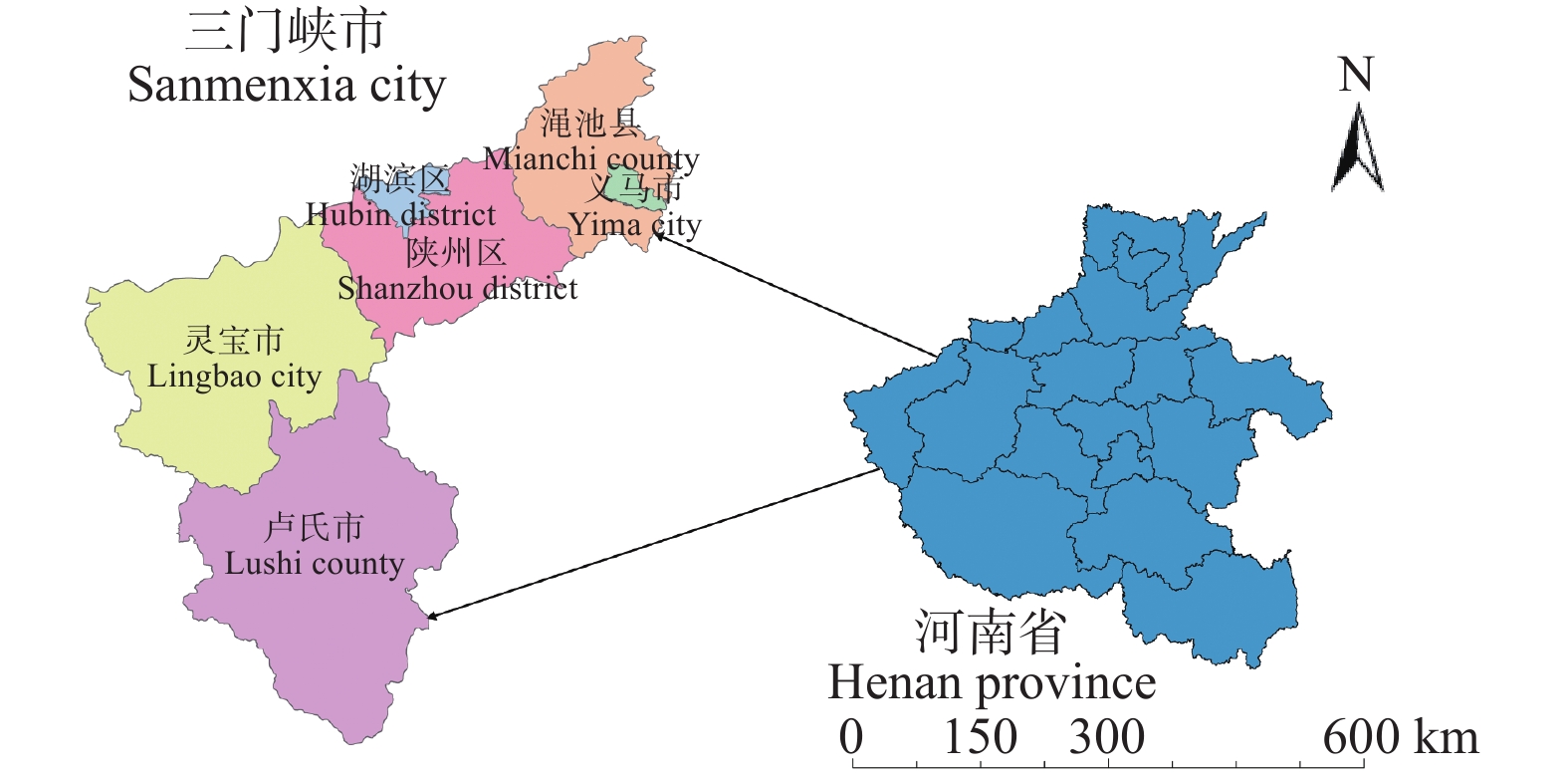
三门峡市位于河南省西部,地处豫晋陕黄河“金三角”地区,地貌特征复杂,以山地、丘陵和黄土塬为主(图1)。常用耕地面积为1.65×10³ hm2,林地面积4.31×10⁵ hm2,牧草地面积1.14×10³ hm2。根据三门峡市水资源公报,2021年全市水资源总量为32.2亿m3,地表水资源量为31.1亿m3,地下水资源量为13.4亿m3。据调查显示,到2021年末三门峡市土壤侵蚀总面积达3.41×10³ km2,均为水力侵蚀,约占全市土地总面积的1/3[8]。水土流失面积5.47×103 km2,是全省乃至全国水土流失比较严重的地区之一。近年来,在河南省水利厅支持和指导下,年均减少土壤流失量39.3万t,生态环境得到改善。然而,根据三门峡市统计年鉴发现,三门峡市区域生产总值从2000年开始始终保持不断增长的趋势,尤其是2000—2010年间增长尤为明显。在快速城镇化和经济快速发展的驱动作用下,水土流失问题仍然严峻,如何协调好水土资源利用与区域经济发展,已成为该地区亟待解决的关键问题,有必要进一步探究当地水–土–经济的协同效应。
2 研究方法
2.1 指标体系构建
根据典型性、层次性、稳定性及动态性原则,结合三门峡市的实际情况,增加供水综合能力、人均绿地面积[7],构建能够反映三门峡市的水–土–经济的综合评价指标体系(表1)。
表 1(Tab. 1)
表 1 三门峡市经济发展与水土资源耦合协调度评价指标及权重
Tab. 1 Evaluation indicators and weight of coupling coordination degree between economic development and land and water resources in Sanmenxia city
一级指标
Level I indicators |
二级指标
Level Ⅱ indicators |
指标类型
Indicator type |
指标特征与性质
Characteristics and nature of indicators |
指标权重
Indicator weight |
经济发展
Economic development |
地区总产值
Gross regional product,104 Yuan |
+ |
地区经济发展总体水平
Overall level of regional economic development |
0.0604 |
人均生产总值
Per capita gross domestic product,Yuan |
+ |
人民生活水平
People’s standard of living |
0.0637 |
地区财政收入
Regional revenues,104 Yuan |
+ |
地区财政收入水平
Level of regional revenues |
0.0676 |
社会消费品零售总额
Total retail sales of consumer goods,104 Yuan |
+ |
地区消费活动水平
Regional level of consumer activity |
0.0763 |
城镇居民可支配收入
Disposable income of urban residents,104 Yuan |
+ |
城镇居民收入水平
Income level of urban residents |
0.0623 |
农村居民可支配收入
Rural disposable income,104 Yuan |
+ |
农村居民收入水平
Income level of the rural population |
0.0781 |
城镇恩格尔系数
Urban Engel coefficient,% |
– |
城镇人民消费结构
Consumption structure of the urban population |
0.0566 |
农村恩格尔系数
Rural Engel coefficient,% |
– |
农村人民消费结构
Consumption structure of rural people |
0.0458 |
水资源
Water resources |
供水综合能力
Integrated water supply capacity,104m3/d |
+ |
水资源管理水平
Level of water resources management |
0.1026 |
|
全年供水总量
Total annual water supply, 104m3 |
+ |
水资源总体水平
Overall level of water resources |
0.0964 |
人均日生活用水量
Per capita daily domestic water consumption, L |
– |
水资源消耗状况
Status of water consumption |
0.0185 |
土地资源
Land resources |
人口密度
Population density, Persons/km2 |
– |
土地人口压力
Land demographic pressure |
0.0463 |
建成区绿化覆盖面积
Area covered by greening in built-up areas,hm2 |
+ |
地区环境绿化水平
Level of environmental greening of areas |
0.0760 |
公园绿化面积
Park green area,hm2 |
+ |
地区环境绿化水平
Level of environmental greening of areas |
0.0601 |
人均绿地面积
Green space per capita, hm2 |
+ |
人均绿地情况
Green space per capita |
0.0282 |
地均GDP
Per capita GDP, 104 Yuan/km2 |
+ |
土地资源使用情况
Use of land resources |
0.0605 |
|
表 1 三门峡市经济发展与水土资源耦合协调度评价指标及权重
Tab. 1 Evaluation indicators and weight of coupling coordination degree between economic development and land and water resources in Sanmenxia city
|
2.2 数据来源
本研究所用的经济发展的数据来自于《河南省统计年鉴2000—2020》,水资源和土地资源数据来自于《三门峡市统计年鉴2000—2020》和《三门峡市水土保持规划(2016—2030年)》。
2.3 研究方法
2.3.1 熵权法
采用客观赋权法中的熵权法计算评价指标体系中各指标的权重值[9],其计算步骤和公式为:
计算指标的信息熵:
|
$ { {e}}_{ {j}} = -\frac{1}{ {\mathrm{ln}}\; {m}}\sum\nolimits _{ {i} = 1}^{ {m}}{ {p}}_{ {{ij}}}\; {\mathrm{ln}}\; { {p}}_{ {{ij}}} 。$
|
(1) |
|
$ {p}_{ij} = \frac{{x}_{ij}}{\displaystyle\sum\nolimits_{i = 1}^{m}{x}_{ij}}。$
|
(2) |
计算各指标的权重:
|
$ { {w}}_{ {j}} = \frac{1-{ {e}}_{ {j}}}{ {k}-\displaystyle\sum\nolimits_{ {i} = 1}^{ {m}}{ {e}}_{ {j}}} 。$
|
(3) |
式中:$ {m} $为某项指标的数量;pij为计算指标的权重;$ {k} $为各个子系统的指标值。通过公式(1)—(3)计算得出各指标计算权重wj,其中水资源的指标权重$ { {a}}_{ {i}} $,土地资源的指标权重$ { {b}}_{ {i}} $,经济发展的指标权重$ { {c}}_{ {i}} $。
采用极差变换法对各指标进行量化,计算公式为:
|
$ {X}_{ {ij}}=\frac{ x_{ij}- {{\mathrm{min}}}x_{ij}}{ {{\mathrm{max}}}x_{ij}- {{\mathrm{min}}}x_{ij}}(正向指标)。$
|
(4) |
|
$ { {X'}}_{ {i} {j}} = \frac{{ {{\mathrm{max}}}}x_{ij}-x_{ {ij}}}{{\mathrm{max}}x_{{ ij}}-{ {{\mathrm{min}}}}x_{ij}} (逆向指标)。$
|
(5) |
式中:$x_{{ij}} $为系统指标的原始值;$ {\mathrm{m}\mathrm{a}\mathrm{x}}x_{ij} $、$ {\mathrm{m}\mathrm{i}\mathrm{n}}x_{ij} $分别为第$ {j} $个指标第$ {i} $年的最大值和最小值;$ X_{{ij}} $为指标标准化后的数值,介于0 ~ 1之间。
2.3.2 耦合协调模型
采用耦合协调模型计算水–土–经济三者之间耦合协调度,步骤如下:
根据熵权法计算水资源–土地资源–经济发展的综合评价指数:
|
$ {U}_{{\mathrm{a}}} = \sum\nolimits_{i = 1}^{m}{a}_{i}{x}_{i};$
|
(6) |
|
$ {U}_{{\mathrm{b}}} = \sum\nolimits_{i = 1}^{m}{b}_{i}{x}_{i} ;$
|
(7) |
|
$ {U}_{{\mathrm{c}}} = \sum\nolimits_{i = 1}^{m}{c}_{i}{x}_{i} 。$
|
(8) |
式中:$ {U}_{{\mathrm{a}}} $,$ {U}_{{\mathrm{b}}} $,$ {U}_{{\mathrm{c}}} $分别为水资源、土地资源和经济发展的综合评价指数。
设$ {f}_{{\mathrm{a}}} $,$ {f}_{{\mathrm{b}}} $,$ {f}_{{\mathrm{c}}} $分别为水资源、土地资源和经济发展的评价函数[10],引入耦合协调度模型:
|
$ {C} = {\left[\frac{\mathrm{\alpha }{f}_{{\mathrm{a}}}\cdot \mathrm{\beta }{f}_{{\mathrm{b}}}\cdot \mathrm{\gamma }{f}_{{\mathrm{c}}}}{{\left[\dfrac{\mathrm{\alpha }{f}_{{\mathrm{a}}}+\mathrm{\beta }{f}_{{\mathrm{b}}}+\mathrm{\gamma }{f}_{{\mathrm{c}}}}{3}\right]}^{3}}\right]}^{\tfrac{1}{3}}。$
|
(9) |
式中:$ {C} $为耦合度,进一步改进公式(9)计算系统间协调发展水平:
|
$ {D} = \sqrt{{C}{T}} 。$
|
(10) |
|
$ {T} = \mathrm{\alpha }{f}_{{\mathrm{a}}} + \mathrm{\beta }{f}_{{\mathrm{b}}} + \mathrm{\gamma }{f}_{{\mathrm{c}}} 。$
|
(11) |
式中:$ {D} $为协调发展度;$ {T} $为水资源–土地资源–经济发展的综合评价指数;$ \mathrm{\alpha } $,$ \mathrm{\beta } $,$ \mathrm{\gamma } $分别为经济发展、水资源和土地资源的权重,笔者假设三项同等重要,因此$ \mathrm{\alpha } $ = $ \, \mathrm{\beta } $ = $ \mathrm{\gamma } $ = $ \dfrac{1}{3} $。
2.3.3 通径分析
通径模型能够反映变量相互关系[11],可以通过比较通径系数绝对值的大小,直接比较各个自变量对因变量的作用[12]。
|
$ \left\{\begin{array}{c}{P}_{1Y}+{r}_{12}{P}_{2Y}+{r}_{13}{P}_{3Y}+\dots +{r}_{1k}{P}_{kY} = {r}_{1Y}\\
{{r}_{21}P}_{1Y}+{P}_{2Y}+{r}_{23}{P}_{3Y}+\dots +{r}_{2k}{P}_{kY} = {r}_{2Y}\\ {{r}_{31}P}_{1Y}+{{r}_{32}P}_{2Y}+{P}_{3Y}+\dots +{r}_{3k}{P}_{kY} = {r}_{3Y}\\ \dots \\ {{r}_{k1}P}_{1Y}+{r}_{k2}{P}_{2Y}+{r}_{k3}{P}_{3Y}+\dots +{P}_{kY} = {r}_{kY}\end{array}\right. 。$
|
(12) |
式中:$ {r}_{ij} $为解释变量$ \mathit{\mathit{\mathit{x_i}\mathit{\mathit{ }}}} $和$ \mathit{x_j} $的相关系数; $ {r}_{iy} $为$ \mathit{x_i} $和被解释变量Y的相关系数; $ P_{iY} $为直接通径系数。$ \mathit{x_i} $通过其他解释变量$ {x}_{j} $对被解释变量Y的间接通径为$ r_{ij}P_{jY} $,解释变量$ {x}_{i} $对被解释变量Y的决定系数为:
|
$ {R}_{(i)}^{2} = {P}_{ir}^{2}+2\sum\nolimits _{i\ne j}{P}_{iY}{r}_{ij}{P}_{jY} = 2{r}_{iY}{P}_{iY}-{P}_{iY}^{2}。$
|
(13) |
|
$ {P}_{rY} = \sqrt{1-({P}_{1Y}{r}_{1Y}+{P}_{2Y}{r}_{2Y}+{P}_{3Y}{r}_{3Y}+\dots +{P}_{kY}{r}_{kY})}。$
|
(14) |
式中,$ {P}_{rY} $为通径残差效应,如果$ {P}_{rY} $<0.1,说明通径分析模型有效。
3 结果与分析
3.1 水土资源与经济发展指标权重计算
表1显示供水能力的权重值最高,其次是全年供水总量,接着是农村居民可支配收入;相比之下,农村恩格尔系数、人均绿地面积、人均日生活用水量的权重值排在最后3位。
3.2 水土资源与经济发展指数分析
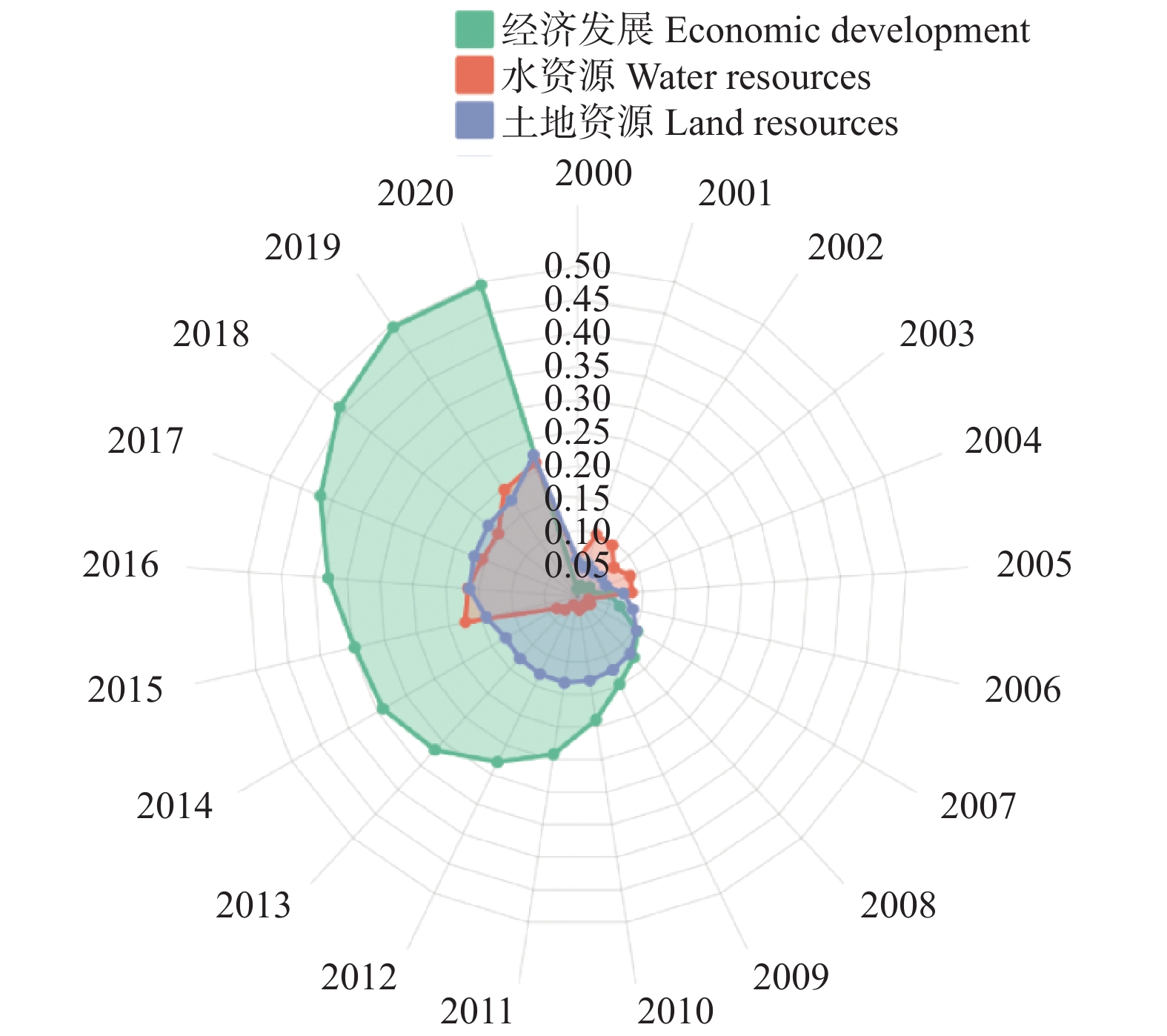
图2显示,三门峡市在2000—2020年间,经济发展水平呈现逐年提升的趋势。水资源在2006—2014年期间,由于三门峡市地下水过量的开采,地下水收支平衡遭到破坏,从而导致地下水位持续下降[13],同时由于行政区划的限制、技术水平的制约,三门峡市的水资源管理不够科学等原因导致该时期水资源的综合发展水平相对平缓[14]。2014年河南省开始实施严格的水资源管理制度[15],三门峡市水资源水平开始呈现波动上升趋势。土地资源综合发展方面,三门峡市在2000—2004年期间变化不大,从2004—2020年,土地资源综合水平呈逐步上升的趋势。
3.3 水土资源与经济发展耦合协调度分析
按照协调度的大小,对系统耦合协调发展程度类型进行划分[16-17](表2)。
表 2(Tab. 2)
表 2 三门峡市经济发展与水土资源协调发展度评判标准
Tab. 2 Evaluation criteria of economic development and coordinated development degree of land and water resources in Sanmenxia city
协调程度
Degree of coordination | 耦合协调度
Degree of coupling coordination | 耦合协调类型
Types of coupled coordination |
失调衰退型
Dysfunctional recession | 失调衰退
Recession | (0.0 ~ 0.1) | 极度失调衰退类
Extreme disorder and recession category |
| [0.1 ~ 0.2) | 严重失调衰退类
Severely dysfunctional decline category |
濒临失调
On the verge of dissonance | [0.2 ~ 0.3) | 中度失调衰退类
Moderately dysfunctional recession category |
| [0.3 ~ 0.4) | 轻度失调衰退类
Mildly dysfunctional recession category |
过渡型
Transition mode | | 濒临失调衰退类
Proximity to dysfunctional recession category |
| [0.5 ~ 0.6) | 勉强协调发展类
Barely coordinated development category |
协调发展型
Harmonized development | 基本协调
Basically coordinated | [0.6 ~ 0.7) | 初级协调发展类
Primarily-coordinated development category |
| [0.7 ~ 0.8) | 中级协调发展类
Intermediately-coordinated development category |
| 高度协调
Highly coordinated | [0.8 ~ 0.9) | 良好协调发展类
Well-coordinated development category |
| [0.9 ~ 1.0) | 优质协调发展类
Excellently-coordinated development category |
|
表 2 三门峡市经济发展与水土资源协调发展度评判标准
Tab. 2 Evaluation criteria of economic development and coordinated development degree of land and water resources in Sanmenxia city
|
3.3.1 土地资源与经济发展的协同关系
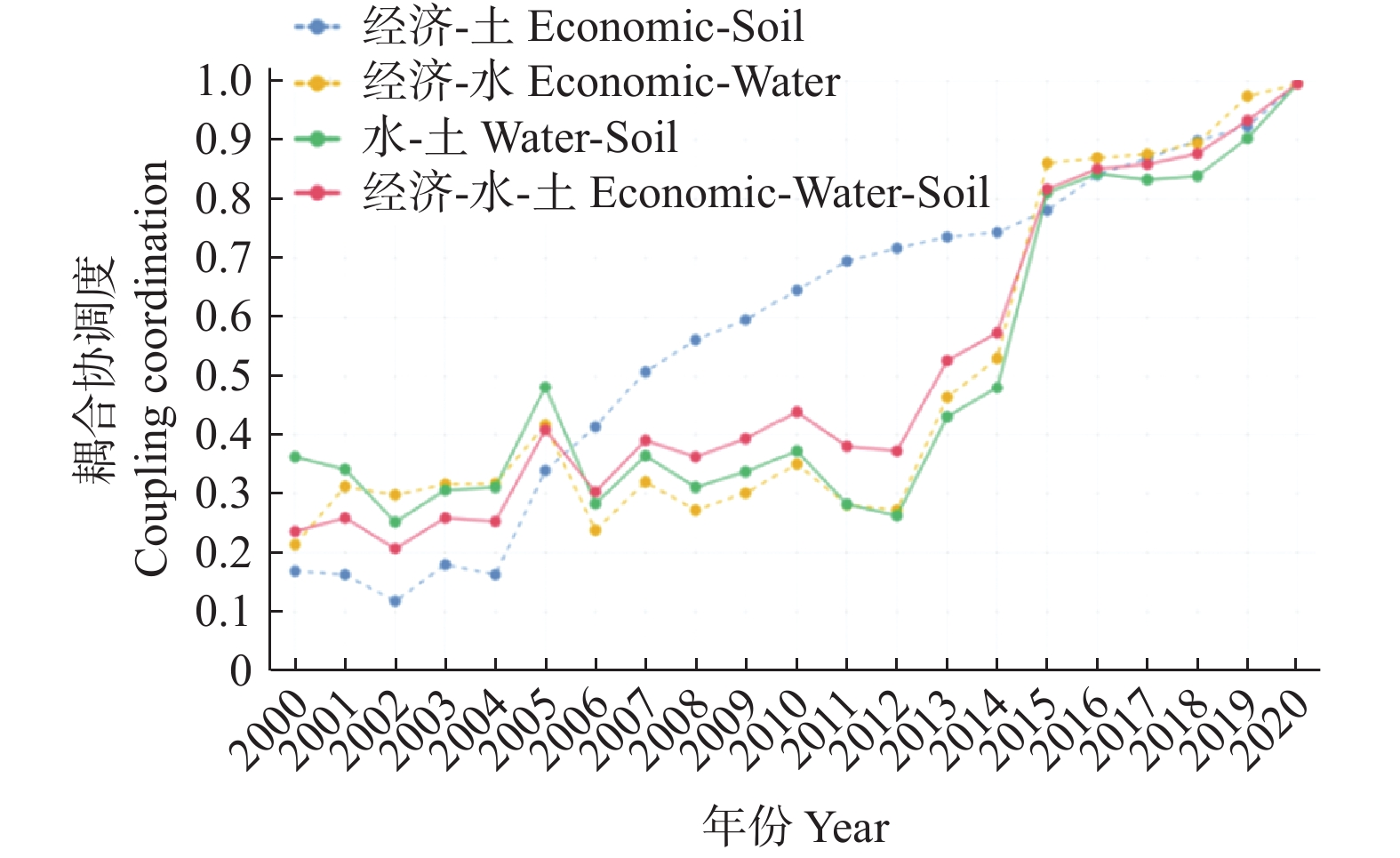
由图3可知,在2000—2004年期间,土地资源与经济发展耦合协调度较低且平稳,处于失调衰退的程度,表明此阶段牺牲土地资源用于经济发展。2004年以后,土地资源与经济发展的耦合协调度逐渐增长,2009年开始处于协调发展状态,2016年开始达到高度协调程度。这与三门峡市政府采取的一系列政策措施有关,如土地资源规划和管理、促进农业现代化等。这也说明土地资源与经济发展之间的关联越来越紧密。这一结果与张燕等[18]的研究结果相一致。
3.3.2 水资源与经济发展的协同关系
通过对水资源与经济发展耦合协调度分析,在2000—2012期间属于濒临失调的程度,究其原因,结合前面的图2可知,2000年以来经济发展综合评价指数呈现稳步上升态势,但是水资源综合评价指数波动幅度较大,且处于较低水平。这说明该阶段以牺牲水资源发展区域经济,水资源与经济协调发展受到阻碍。2012—2015期间水资源与经济发展的耦合度快速增长,从2015年开始处于高度协调发展状态,说明三门峡市2014—2015年开始重视水资源的利用和保护。通过回顾政策指导发现,2014年河南省颁布实施修订版的《中华人民共和国水土保持法》办法,同时三门峡市政府也发表“关于实行最严格水资源管理制度的实施意见”,一系列政策建议使得水资源与经济发展得到良好的协调发展。这一结果与现有文献的观点相符[19],研究表明水资源的利用对于经济可持续发展至关重要。
3.3.3 水资源与土地资源的协同关系
通过对水资源与土地资源耦合协调度分析。在2000—2012期间处于濒临失调和过渡阶段,这可能是由于资源需求和供给之间的不平衡、资源配置的不合理性等因素引起的。而2012年以后耦合协调度逐渐增长,2015年以后水土资源间的耦合协调度达到高度协调的程度,表明对水资源利用效率有所提高,促进三门峡市水土资源的协调发展[20]。
3.3.4 水–土–经济三者的协同关系
通过对水资源、土地资源、经济发展耦合协调度分析。2000—2014年,耦合协调度呈波动上升趋势,从失调衰退程度发展到过渡型程度,2014年以后耦合协调度稳定增长,2015年达到高度协调阶段。结合图2发现,2000年开始经济增长伴随着水土资源下降,突显出牺牲生态环境以换取经济发展的不可持续发展阶段性问题,这种情况从2014年之后开始好转,表明人们的环保意识在不断增强,促进水–土–经济协同发展。
3.4 水土资源对经济发展的促进作用
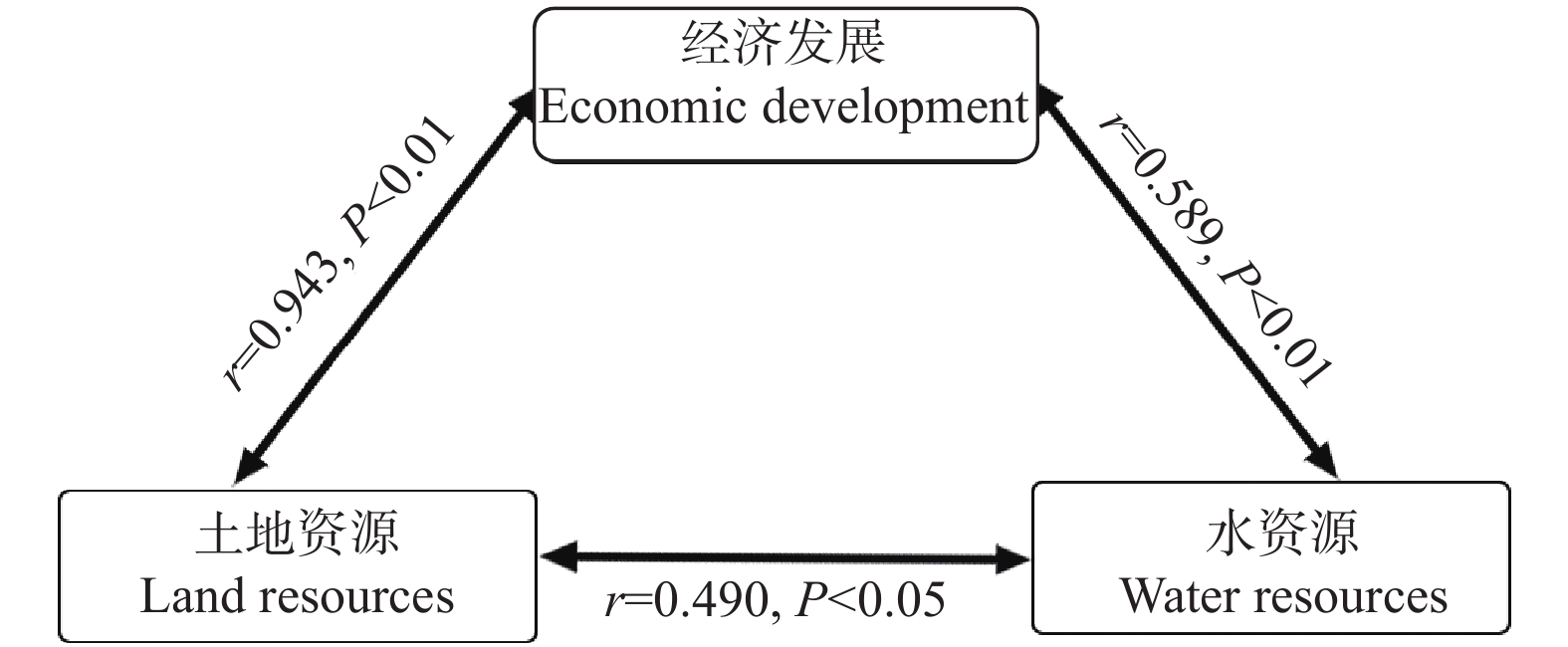
如图4所示,水资源与土地资源存在显著的正相关关系。一方面,水资源在农业灌溉、工业生产和城市供水等方面发挥着重要作用。另一方面,土地的不合理开垦和管理可能导致水资源的浪费和污染。经济发展与水资源、土地资源都存在显著正相关关系,随着经济的发展,人口增长和工业化进程和城市建设会带来对水土资源的需求增加。
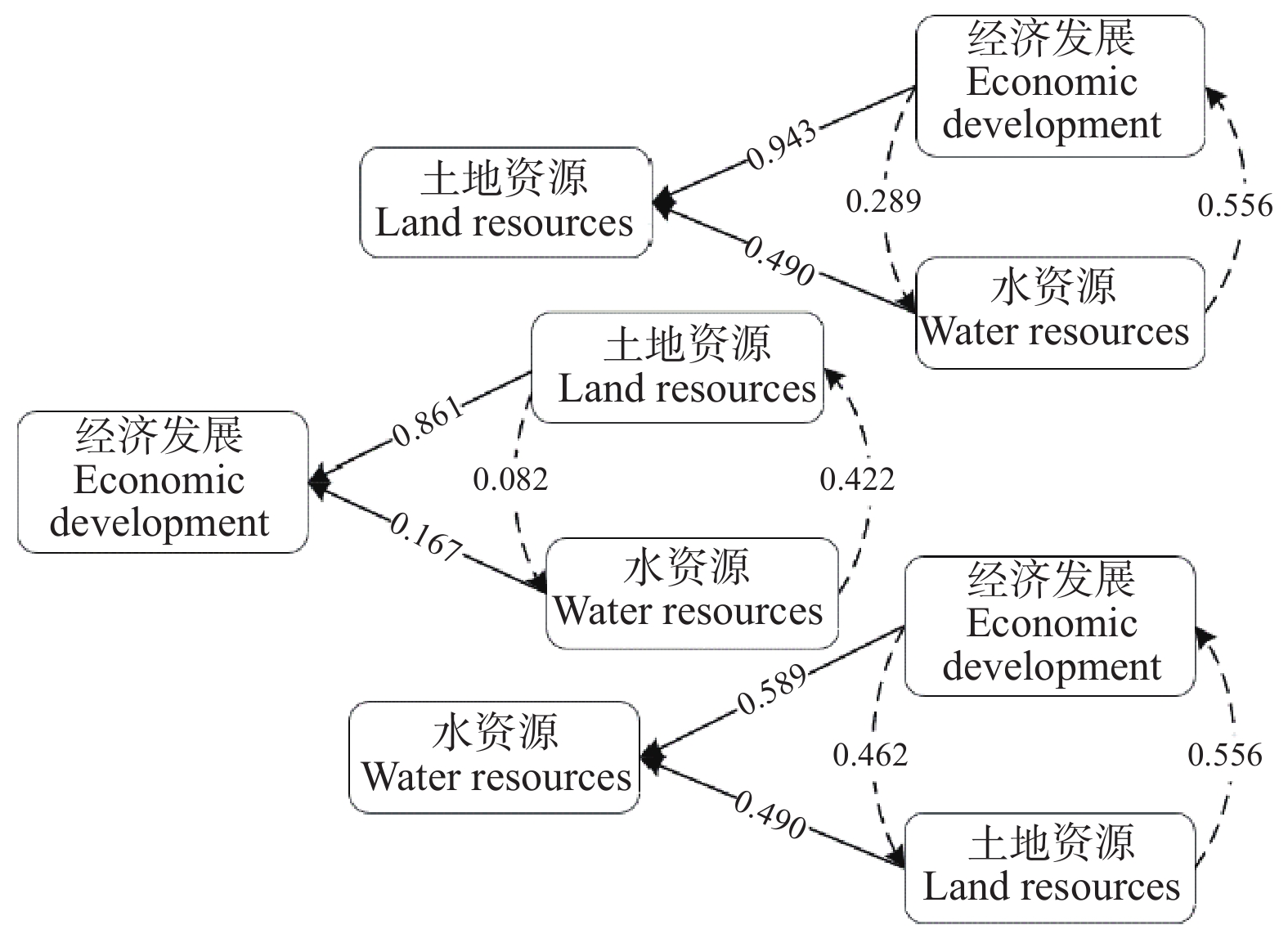
各系统的通径分析结果(图5)表明:经济发展、土地资源和水资源三者之间相互影响,并通过直接和间接效应形成复杂的因果关系网络。土地资源和水资源不仅对经济发展有直接推动作用,且土地资源的直接作用比水资源更显著,另外水土资源间的相互作用进一步强化对经济发展的间接影响。这意味着,合理的水土资源管理不仅能直接提升区域经济发展,还通过彼此协同作用增强整体系统的联动性。土地是一种不可再生的生产要素,其供给是相对固定的。相比之下,水资源虽然也是重要的生产要素,但通过有效的水资源管理和技术手段,可以更灵活地调整水资源的利用。同时,土地不仅是农业生产的基础,还可以用于工业、住宅、商业等多种用途。这使得土地在经济发展中具有更广泛的应用,对各个产业的支撑作用更为明显。水资源在某些地区可能主要用于农业或工业,而其利用范围相对较为狭窄。而且,土地资源在过去几十年中发挥了重要的作用,支撑农业、工业和城市化的快速发展。总的来说,土地资源和水资源均是经济发展必不可少的因素;相比之下,土地资源对经济发展的作用更大。
4 结论与讨论
水资源–土资源–经济发展的耦合协调度在 2015 年达到高度协调状态。在此之后,水资源、土资源和经济发展两两间的耦合协调度均处于协调发展状态。水–土–经济系统两两之间呈显著正相关,互相存在促进作用。相比水资源,土地资源对经济发展的驱动作用更强。因此,需要在今后研究中考虑土地的多功能性,制定并实施可持续土地利用规划,以确保土地资源的合理分配和有效利用。此外,政府相关部门须强调水资源的科学管理和节约利用,包括建立高效的灌溉系统、提高农业用水效率、加强水质监测与治理等措施;鼓励研究和实施水资源保护技术,确保水资源的可持续利用,以满足日益增长的工业和城市用水需求。
 2025, Vol. 23