As one of the most severe environmental issues globally, soil erosion results from which the natural environment deteriorates and humans utilize improperly[1-3]. Soil erosion leads to reservoir silting, water pollution, soil productivity decreasing, and global warming[4-7]. In addition, soil erosion reducing crop yields by decreasing soil nutrients also threatens the sustainability of the agricultural ecosystem[8-11]. China has to feed nearly a quarter of the world's population with just 7 percent of world's total farmland. Moreover, farmlands are more easily eroded than other types of land use due to unstable vegetation coverage, poor water storage capacity, and regular overturning tillage[12]. Therefore, ESWCMs (ecological soil and water conservation measures) by changing the surface topography, increasing coverage, improving soil physical properties[13-17], are necessary to apply on farmlands to reduce soil and water loss.
Compared to traditional tillage, ESWCMs may increase soil organic carbon (SOC) due to the reduction of mineralization of soil organic matter (SOM)[18]. Moreover, ESWCMs reduced soil bulk density, increased water content, and mitigated soil erosion[19]. Thus, many tillage measures belong to ESWCMs, such as contour tillage (CT), no-tillage with mulch (NTM), contour tillage with hedgerows (CTH), and collecting soil to form a ridge with no-tillage (CSNT) and micro basins tillage (MBT). CT significantly reduced runoff and soil loss when compared with traditional tillage[20], and MBT reduced runoff and sediment by about 63% and 96%, respectively[15]. Therefore, it is crucial to apply appropriate ESWCMs on farmlands against water erosion.
The benefits of ESWCMs were widely acknowledged. Numerous studies on the efficiencies of ESWCMs in reducing runoff and soil loss have been conducted in different scales, such as watershed scales[21], China [21-24], Mediterranean[25-26], and global scales[16, 27]. However, there is a lack of a comprehensive overview of ESWCMs on water erosion control on a regional scale with different soil types and erosion characteristics in China. A meta-analysis, a quantitative and scientific synthesis of research results[28], summarized massive amounts of data to derive consistent results by data collection, data organization, and data analysis. Meta-analysis had been increasingly used in ecological studies, such as the impacts of climate change on marine life[6], soil disturbing vertebrates on ecosystem patterns[29], primary forests on tropical biodiversity[30], and soil and water conservation[14]. This approach provided the tool to summarize the evidence for the effectiveness of interventions and scientific countermeasures and suggestions for environmental issues in different research areas[28].
Regional soil and water conservation districts are based on natural and social conditions, soil erosion type, and characteristics. According to the precipitation, soil types, and the effects of soil and water conservation, the following three regions with different typical soil and water conservation measures were selected as the study regions: 1) black soil region of Northeast China, 2) loess soil region of Northwest China, and 3) purple soil region of Southwest China. Extensive factors have been reported about the effects of ESWCMs on water erosion control, such as precipitation, slope gradient, and types of ESWCMs[31-34]. With the increase of slope gradient and precipitation, the water-holding capacity of CT and its capacity for conserving soil all decreased. In addition, grass hedgerows and micro-basins, belonging to effective ESWCMs, were suited for controlling water and soil loss on sloping lands in tropical and subtropical regions[35]. CTH, NTM, and CT significantly reduced surface runoff on sloping farmlands in the red soil slope farmland[36]. Therefore, the application of different ESWCMs should be based on the climate, topography, soil properties, and other relevant factors.
The effects of ESWCMs were introduced in this study to alleviate soil erosion in three typical soil erosion regions of China. We synthesized the research by compiling all peer-reviewed articles describing the responses of soil erosion to ESWCMs, then conducted a meta-analysis of the results from the collected literature. Finally, a mixed-effect model was used to identify the ESWCMs, slope, and precipitation for the greatest runoff and sediment reduction. Specific objectives of this study are as follows: 1) to establish a regional database of field plot data based on the effects of ESWCMs; 2) to quantify the impacts of different ESWCMs on soil and water loss at a regional scale; and 3) to identify the slope and precipitation for the greatest runoff and sediment reduction in the three regions.
1 Materials and methods
1.1 Data collection
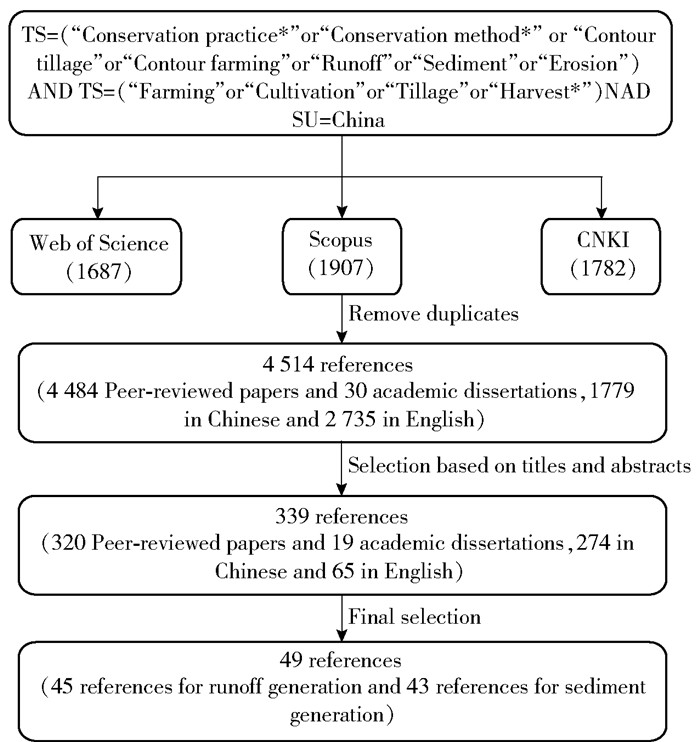
We conducted a review of literature from the electronic journal databases Web of Science, Scopus, and China National Knowledge Infrastructure (CNKI) to reduce publication bias. The following search terms were used: "Conservation practice" or "Conservation method", "Contour tillage" or "Contour farming", "Runoff" or "Sediment" or "Erosion", and "China" (Fig. 1). We selected the literature based on the following criteria: 1) test-plots were observed under natural or simulated precipitation conditions and exposed to the same topography; 2) either runoff or soil loss was included in the publications; 3) the number of replications, mean values, standard deviations or standard errors of plots with different ESWCMs were reported; 4) at least one of the factors was recorded associated with plots, such as location, precipitation, slope gradient, and ESWCMs; and 5) more than two data pairs were contained in each group.
In total, the compiled dataset was derived from 49 studies published, up to December 2020, including 408 runoff observations and 378 sediment observations. The collected data were mainly distributed in the black soil region of Northeast China, the loess soil region of Northwest China, and the purple soil region of Southwest China, since three regions represent China's soil and water loss regions. Data presented only in graphical form was extracted using WebPlotDigitizer 4.2. The ESWCMs were grouped into five main types, i.e., CSNT, CT, CTH, MBT, and NTM. According to the China Meteorological Administration (https://www.cma.gov.cn/), daily rainfall is classified into light rain, moderate rain, heavy rain, and rainstorm (GB/T 28592-2012). Based on the collected data and classification criteria of soil erosion, the slope gradients were classified into six groups[37]: 0-3°, >3°-5°, >5°-10°, >10°-15°, >15°-20°, and >20°-25°. The precipitation was classified into 3 levels (< 600 mm, 600- < 1 000 mm, and ≥1 000 mm) respectively, according to the condition of China based on natural or simulated rainfall conditions. In the light of the standard of soil texture classification system formulated by the U.S. Department of Agriculture, soil texture was divided into three groups based on the particle size, namely sand (≥0.050-2.000 mm), silt (0.002-0.050 mm), and clay (< 0.002 mm).
1.2 Data analysis
Compared with other methods, the numerator and denominator of LRR (Log response ratio) eliminate the influence of measures units, and samples with lower variance are given greater weight to improve the accuracy of LRR. Therefore, LRR is chosen in this paper. The LRR was calculated as follows:
|
$
L=\ln \left(\bar{X}_{\mathrm{t}} / \bar{X}_{\mathrm{c}}\right)
$
|
(1) |
|
$
V_{\mathrm{i}}=\frac{D_{\mathrm{t}}^2}{N_{\mathrm{t}} \bar{X}_{\mathrm{t}}^2}+\frac{D_{\mathrm{c}}^2}{N_{\mathrm{c}} \overline{\bar{X}}_{\mathrm{c}}^2}
$
|
(2) |
Where, L refers to LRR, with a dimension of 1;Xt refers to the mean runoff or sediment generated by plots with ESWCMs; mm, g; Xc refers to the mean runoff or sediment generated by plots with traditional tillage measures, mm, g; Vi refers to variance with dimension of 1; Dt and Dc refer to the standard deviations of Xt and Xc, respectively, with a dimension of 1; Nt and Nc are the number of replications for plots with ESWCMs and traditional tillage measures, times.
The cumulative LRR and 95% confidential interval (CI) were conducted using the software R with the Metafor Package[38]. LRRs, are represented as dots with 95% confidence intervals (CIs) as error bars. A negative LRR indicates a reduction in runoff or sediment due to the implementation of ESWCMs. The efficiency is not reaching a significant level when the CI crosses the invalid line (including 0). The ESWCMs are considered ineffective for soil erosion control when the LRR is >0. To understand the efficiencies of ESWCMs intuitively, percentage decline is cited and calculated based on LRR (percentage decline=(1-exp (LRR)) 100[24].
2 Results
2.1 Effects of ESWCMs on soil and water loss
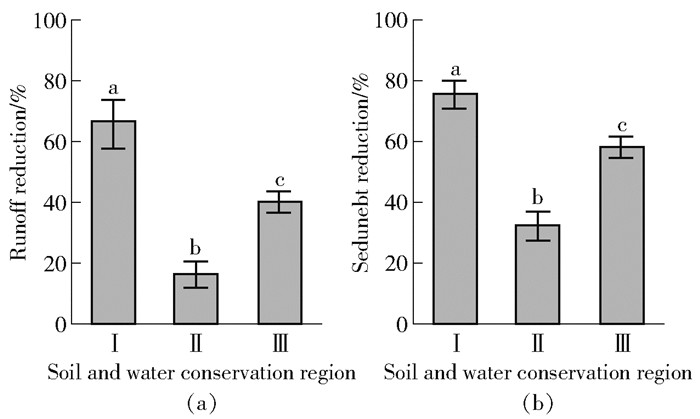
ESWCMs in the black soil region of Northeast China showed the most effective effects on reducing runoff (66.65%) (Fig. 2), while ESWCMs on reducing runoff in the loess soil region of Northwest China was the least efficient (16.36%). In terms of sediment reduction, ESWCMs in the loess soil region of Northwest China showed the lowest benefit (32.44%) while ESWCMs in the black soil region of Northeast China showed the highest efficiency (75.83%). In addition, ESWCMs revealed a significant difference in runoff and sediment reduction in the three regions(P < 0.05). Furthermore, the effect on sediment control was more obvious than that on runoff. The main reason was that soil loss occurred with runoff.
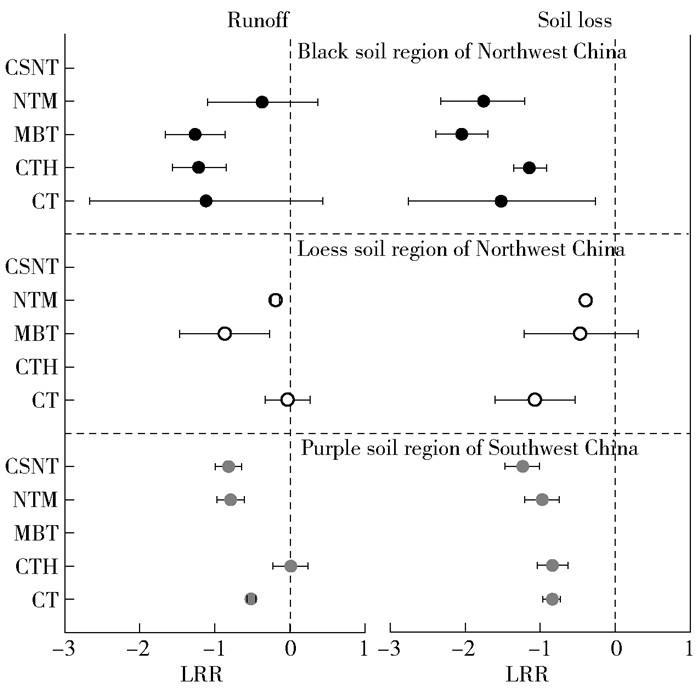
MBT was the most efficient measures in the black soil region of Northeast China in controlling water erosion(71.8% runoff and 87.0% sediment reduction) (Fig. 3). MBT conserved water and soil by shortening the slope length, reducing the slope gradients, and storing precipitation of the sloping lands. Regarding NTM and CT, the effects of measures in sediment and runoff were observed, while no significant differences were found in sediment reduction in two ESWCMs. This difference was probably attributed to the increase of surface coverage, which hindered the movement of soil particles, enhanced the infiltration of precipitation, leading to reduced sediment and increased runoff[25].
NTM relatively had a certain efficiency in the loess soil region of Northwest China on runoff and sediment reduction (17.3% and 32.5%) (Fig. 3). However, MBT was not recognized as the effective measures for reducing sediment because the value of its LRR was across 0. The possible reason was that MBT controlled water erosion by changing the microtopography with intense tillage operation, leading to a great soil detachment. CT (LRR = -1.06) in this region was slightly better than MBT (LRR = -0.45) and showed the best performance in sediment reduction (Fig. 3). However, ESWCMs were ineffective in controlling runoff and soil loss in the loess soil region of Northwest China. Therefore, terraces and fish-scale pits were always used to reduce water and soil loss in this region.
In the purple soil region of Southwest China, CSNT had the greatest efficiency of soil and water conservation (55.8% runoff and 71.4% sediment reduction) and followed by NTM (Fig. 3). Meanwhile, CTH failed to reduce runoff. CSNT was a unique farming method in which the ridge and ditch were built along the contour line in the soil tillage layer, and the crops were planted on the ridge. In terms of CSNT, water erosion was controlled by shortening the slope length and mitigating the scouring force of water.
2.2 Effects of ESWCMs on soil and water loss with different slope gradients
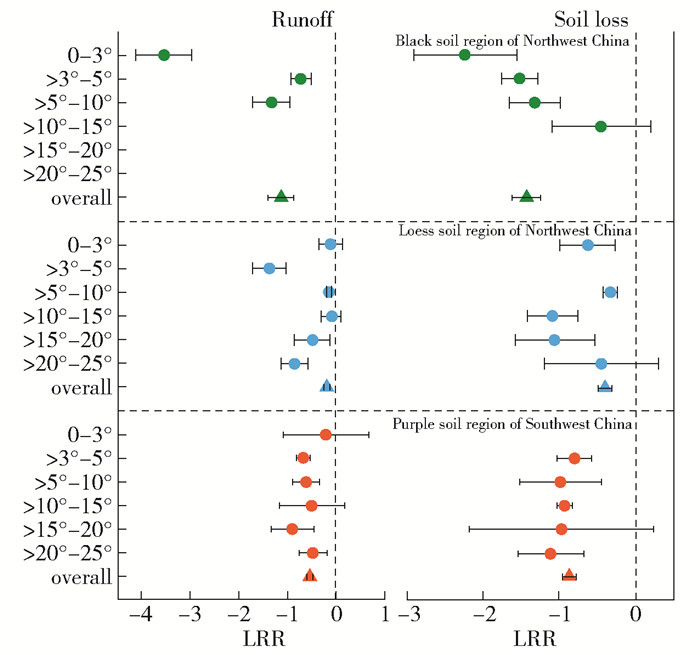
LRRs varied with different slope gradients on runoff and soil loss in three regions (Fig. 4). The overall LRR of ESWCMs in the black soil region of Northeast China was the most effective in reducing runoff and soil loss (runoff: LRR=-1.13, soil loss: LRR=-1.43), followed by that in the purple soil region of Southwest China (runoff: LRR=-0.53, soil loss: LRR=-0.92) and loess soil region of Northwest China (runoff: LRR=-0.19; soil loss: LRR=-0.41), demonstrating that applying ESWCMs in these three regions positively reduced soil loss and runoff (Fig. 4). In general, the efficiencies of water erosion control decreased as the slope gradient increased, and the effects on runoff were weaker than those on soil loss. In the black soil region of Northeast China, LRRs of ESWCMs on runoff and soil loss generally increased with the increase of slope gradients, indicating that the efficiency of controlling water erosion decreased as the slope increased (Fig. 4). However, the efficiency of ESWCMs on soil conservation generally increased with the slope increase in the loess soil region of Northwest China and purple soil region of Southwest China. Still, this trend was not observed in runoff reduction (Fig. 4). This may imply that the effect of ESWCMs on runoff may be influenced more by precipitation, soil texture, and cultivation measures than the slope gradients.
The two greatest reductions in soil loss were noted for ESWCMs, including two slope groups (0-3° and >3°-5°) in the black soil region of Northeast China (Fig. 4). The slope gradients ranging from 0 to 3 alsocaused the greatest reduction of runoff. However, the cross-zero 95% CIs for >10°-15° group showed that the efficiencies on soil loss failed the significance test. The slope gradients of the investigated black soil region of Northeast China were mainly ranged from 0 to 15, and the benefits of ESWCMs in soil loss decreased as slope gradient increased (Fig. 4).
Compared with the other two regions, the overall LRR of the loss soil region of Northwest China was the highest. In respect of runoff, the values of 95% CIs cross-zero for 0-3° and >10°-15° groups in the loss soil region of Northwest China indicated that the effects on runoff did not reach a significant level. In addition, the LRRs of different slope gradients on runoff were close to 0 except for >3°-5° and >15°-20° in the loess soil region of Northwest China. While the LRRs on soil loss were below 0 except for >20°-25°. Moreover, the effect of sediment yield reduction is most obvious at >10°-20°.
The LRR of ESWCMs on soil loss generally decreased as the slope gradient increased in the purple soil region of Southwest China, but this trend was not found in runoff reduction. In the purple soil region of Southwest China, the effect of runoff reduction in >15°-20° was the most obvious, while the sediment reduction of >15°-20° failed to pass the significance test. In addition, the LRRs of different slope gradients were < 0 except 0-3° on runoff and >15°-20° on soil loss in the purple soil region of Southwest China.
2.3 Effects of ESWCMs on soil and water loss with different precipitation
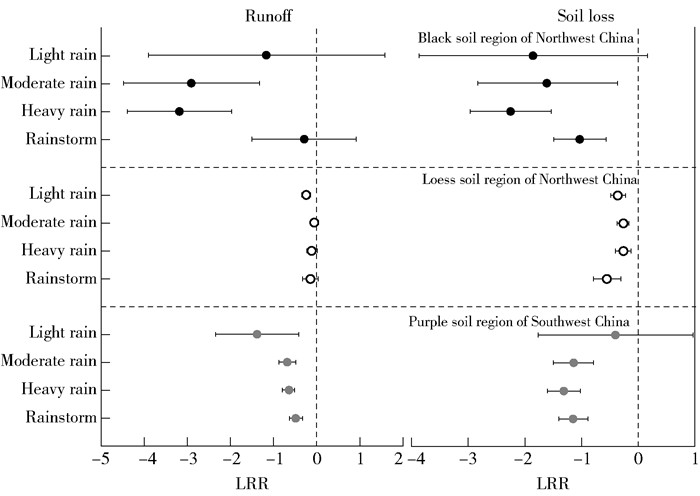
The effects of ESWCMs under different precipitation levels varied in three regions, which were affected by precipitation amount. LRR of soil and water conservation showed the least in the black soil region of Northeast China, followed in the purple soil region of Southwest China, and finally in the loess soil region of Northwest China under the condition of daily precipitation (Fig. 5). As shown that the efficiency of ESWCMs on soil erosion control was not obvious under rainstorms in the three regions (Fig. 5). The LRRs of sediment were across 0 in the black soil region of Northeast China and purple soil region of Southwest China under light rain, which implied that the effects on sediment were not significant under light rain.
The effect of ecological soil and water conservation measures was the most obvious under heavy rain (runoff: LRR = -3.18; soil loss: LRR = -2.25), while the efficiency under a light rain on runoff and sediment was not significant in the black soil region of Northeast China (Fig. 5). Except for rainstorms, the efficiency of ESWCMs in runoff increased as precipitation increased. In the loess soil region of Northwest China, the effect of ESWCMs was almost unchanged under all precipitation levels compared with traditional tillage. Under light rain, ESWCMs showed effective benefits. In the purple soil region of Southwest China, the efficiencies of ESWCMs in soil loss increased as precipitation amount increased, while those in runoff decreased as precipitation amount increased. The effect of reducing runoff was the most obvious under light rain, but it failed to pass the significance test in reducing sediment in the purple soil region of Southwest China.
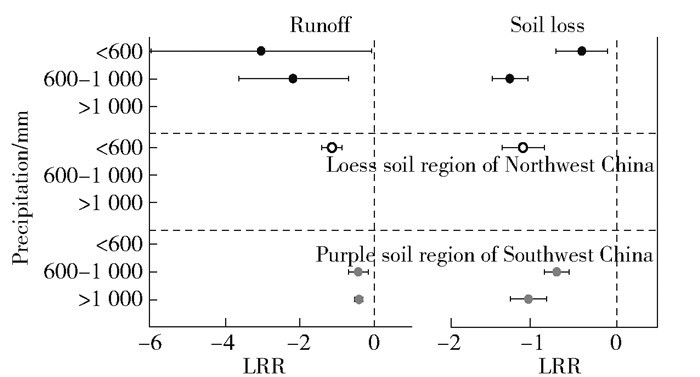
The annual precipitation reflected the overall local climate. Due to different climatic conditions, the annual precipitation was various. The annual precipitation of investigated black soil region of Northeast China, loess soil region of Northwest China, purple soil region of Southwest China was mainly < 600 mm, 600- < 1 000 mm, and ≥1 000 mm, respectively, which were consistent with the actual annual precipitation in the three regions (Fig. 6). Under the annual precipitation, the LRRs of ESWCMs were < 0, which indicated that ESWCMs were effective on soil and water conservation in the three regions. Under the condition of different annual precipitation, ESWCMs on runoff control showed more effective and larger variability in the black soil region of Northeast China than the other two regions.
2.4 Effects of ESWCMs on soil and water loss in three regions
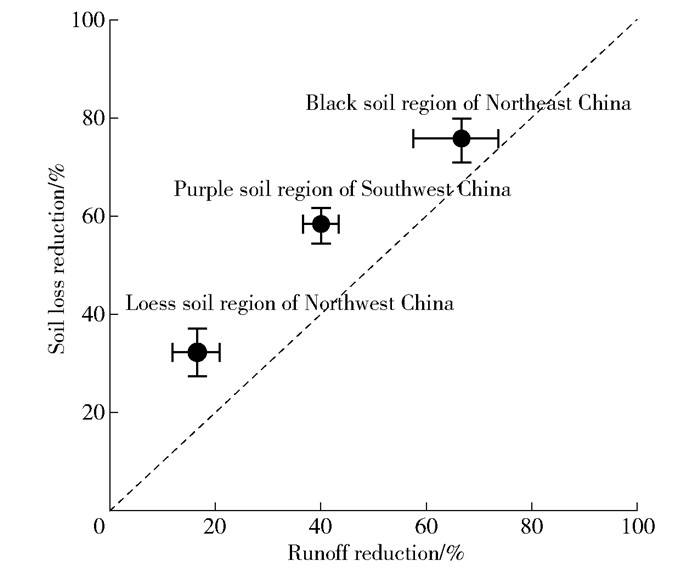
Due to the differences in climate and topography, the reduction differed across regions concerning both runoff and sediment (Fig. 7). The ESWCMs applied in the black soil region of Northeast China (75.8% for sediment reduction and 66.6% for runoff reduction) and purple soil region of Southwest China (58.3% for sediment reduction and 40.0% for runoff reduction) was more effective in reducing sediment and runoff than that those in the loess soil region of Northwest China (43.4% for sediment reduction and 16.4% for runoff reduction), which may be since topography, climate and soil properties were more suitable to apply ESWCMs to conserve water and soil. The ESWCMs plotted along the 1 ∶1 line indicated that soil loss reduction was stronger than runoff reduction.
3 Discussion
Various ESWCMs influenced the effects of soil erosion control at different levels (Fig. 2). The types of ESWCMs mainly depended on the topography, climate, and soil properties in the regional scales[39-40]. The main purpose of ESWCMs was to decrease the amount, velocity, and energy of surface runoff and prevent sediment transportation by increasing roughness, changing micro-topography, and improving soil properties [41]. This study provided reliable evidence for the effective reduction of runoff and soil loss under ESWCMs in three regions with different climatic conditions.
3.1 Cropping systems in three regions
The cropping system in the black soil region of Northeast China was mainly continuous cropping, supplemented by rotation. Rotation could be divided into three types: two-year rotation of rice and soybean, three-year rotation of rice and soybean, and three-year rotation of soybean and rice. The continuous cropping mode mainly included corn continuous cropping, rice continuous cropping, soybean continuous cropping. The rotation mode was mainly based on the rice bean wheel, with rice beans[42]. The purple soil region of Southwest China ripened twice a year, with a corn wheat rotation as the main crop[43]. Overall, the choice of tillage methods had a certain impact on soil erosion, and NT reduced runoff and soil erosion compared to tillage and reduced tillage. The difference in ridge orientation had a significant impact on runoff and soil erosion. In addition, CT and straw returning significantly reduced the loss. As a soil and water conservation measure, straw returning played a role in reducing runoff and soil erosion[44].
3.2 The influences of ESWCMs in three regions
In the black soil region of Northeast China, MBT showed the greatest effects on reducing runoff and soil loss (Fig. 3), and the results were similar to those of the previous studies[14]. MBT controlled soil erosion by shortening the slope length and reducing the slope gradient of sloping farmland, making the bottom of each shallow hole nearly horizontal. The shallow holes formed by MBT reduced soil loss and runoff by interception and increase crop yields by increasing the root biomass and density[45]. In addition, some studies established the best block space model, proposing that 6° was the most suitable maximum slope limit for MBT application compared to the terrain conditions of this region[46]. As one of the most important ESWCMs, NTM led to changes in vegetation coverage. The increase of vegetation coverage led to a significant reduction of runoff and soil loss with gentle slope gradients[25]. Besides, CT was mainly applied in the crop lands with gentle slope gradients.
In the loess soil region of Northwest China, the benefits of runoff and soil loss reduction for NTM were strong compared with other ESWCMs. NTM effectively controlled soil erosion not only by improving soil properties but also by increasing surface coverage. However, various ESWCMs presented the lowest benefit for reducing runoff and soil loss in the loess soil region of Northwest China (Fig. 2), which could be mainly attributed to the fact that this region was one of the most severely eroded regions in the world under formidable natural conditions and human activities. The serious soil and water loss in the loess soil region of Northwest China were mainly due to the combination of frequent rainstorms, serious soil erosion, complex erosion by wind and water, easy erosion of silty loam, long-term improper land use, and excessive land reclamation[47]. Gully erosion was easy to form in the loess soil region of Northwest China, mainly caused by steep slopes, sparse vegetation, drought, less precipitation, and extreme weather. The runoff collected in the erosion gully had a strong transport capacity, damaging the ridge of CT and CTH. Thus, more effective ecological engineering measures, such as terraces and fish-scale pits should be the key points to preventing and controlling soil erosion in this region[14].
CSNT was the most effective ecological soil and water conservation measures for controlling soil erosion in the purple soil region of Southwest China, with good economic effects (Fig. 3). The mechanism of CSNT in reducing soil erosion included the following two aspects. Firstly, as compared to the micro-topography formed by MBT, CSNT reduced soil loss by intercepting runoff and increasing infiltration. Secondly, CSNT applied on the ridges improved soil quality and resistance to erosion by increasing soil organic matter content and microbial biomass[48]. CSNT diminished runoff and soil loss by 55.89% and 67.87%, which was less effective than bench terraces[49]. However, the labor costs of CSNT were far less than that of the construction of terracing[40]. Terraced landscapes subjected to abandonment progressively increased gully erosion and caused terrace failure[50]. Moreover, in terms of production costs, conservation tillage could reduce 2-4 agricultural processes, save labor input by 50%-60%, and reduce comprehensive production costs by 10%-15% compared to traditional tillage[51]. Compared to traditional tillage, conservation tillage could reduce labor input by more than 1050 Yuan/hm2, reduce watering costs by more than 150 Yuan, and reduce fertilizer and other costs by more than 270 Yuan[52]. In terms of crop yield, in all studies on the effects of conservation tillage on crop yield, the proportion of increase and decrease in yield accounted for 60.96% and 24.32% respectively, with no significant impact accounting for 14.72%[53].
3.3 The influences of the slope gradients in three regions
As one of the main influencing factors of soil and water loss, slope showed a more obvious impact on soil and water loss under the condition of corrosive precipitation with high precipitation intensity. The effect of soil loss control generally decreased when ESWCMs were implemented on steeper slopes in the black soil region of Northeast China in this study. Previous studies also showed that the benefits of runoff and soil loss control fell as the slope gradient increased[54-55]. However, the velocities of runoff increased with the increase of slope gradients[54]. Consequently, the larger potential runoff velocity on a deep slope may mask the role of NTM in reducing runoff and soil loss[22].
The effects on runoff and soil loss for 0-3° in the black soil region of Northeast China were the most obvious, which may be easy to control runoff and sediment due to the gentle slope, little runoff, and sediment generation. The effect of >3°-5° on runoff reduction in the loess soil region of Northwest China was the most obvious, but the reason was not clear. In the purple soil region of Southwest China, the benefit of 3°-10° on reducing runoff and soil loss was significant, which may be due to the interaction of slope and precipitation.
3.4 The influences of the precipitation in three regions
The precipitation varied in three regions due to the distinctive characters of climate and terrain. Generally, runoff and sediment yield increased with the increase of precipitation[56]. While the results of this study were not the same as those of previous studies[57-58]. The main reason was that this study comprehensively considered the influencing factors, such as climate, topography, soil properties, and cultivation measures. The effects of ESWCMs on soil erosion control were not obvious under rainstorms in the black soil region of Northeast China and loess soil region of Northwest China (Fig. 5). The possible reason was that the rainstorm would break the ridge of the sloping lands, which led to the gully erosion and caused more serious runoff and soil loss. In addition, excessive precipitation caused by rainstorms was difficult to infiltrate, which could be lost as surface runoff and carry away sediment, thus aggravating soil erosion of the sloping lands.
Two adverse effects were shown as the increase of precipitation amount: on the one hand, precipitation will increase the splash ability of raindrops and the loose material on the slope; on the other hand, it will extend the turbulence of surface runoff and aggravate the erosion of surface water, thus increasing the sediment yield in sloping farmland[59]. Runoff was mainly generated by infiltration excess (Horton) and saturation excess (Dunne) runoff. The spatial variability of soil properties, early soil moisture, topography, and precipitation would lead to different surface runoff generation mechanisms[60]. In the loess soil region of Northwest China, the runoff on the slope was dominated by infiltration excess (Horton) runoff, which was a frequent pattern of runoff in arid and semi-arid regions of China. Infiltration excess runoff occurred when water entered the soil system faster than it absorbed, which meant precipitation exceeded the soil's infiltration capacity. However, abundant precipitation in summer and obvious characteristics of saturation excess (Dunne) runoff were noticed in the purple soil region of Southwest China. Saturation excess runoff was a prone runoff generation model in the humid areas of China. Once the soil moisture reached saturation in the humid regions, any additional precipitation would become saturation excess runoff. The effects of ESWCMs were closely related to runoff yield. Also, the ESWCMs played key roles in changing the micro-terrain, increasing the surface roughness and significantly reducing runoff yield.
3.5 The influences of the soil structure in three regions
The soil structure varied from region to region due to the difference in climate and topography. The higher the soil clay content, the more capacity in resisting soil erosion of the different ESWCMs. In addition, soil erosion mainly affected small size particles such as clay and silt[61].
Soil clay content in the black soil region of Northeast China was the highest compared with the other two regions. The high contents of clay and silt lead to strong soil cohesion, which enhances erosion resistance[62]. Soil and water conservation measures increase the content of clay and silt to improve the soil structure[63]. Therefore, the effects of ESWCMs were obvious in the black soil region of Northeast China, consistent with the previous research results[64]. However, even if ESWCMs were adopted, soil and water conservation effects were poor in the loess soil region of Northwest China, since the sand content in the loess soil region of Northwest China was the largest among the three regions.
4 Conclusions
The ESWCMs applied in the black soil region of Northeast China and purple soil region of Southwest China were more effective in reducing sediment and runoff than that those in the loess soil region of Northwest China. In addition, ESWCMs were generally more effective in reducing soil loss than reducing runoff in three regions. The efficiency of soil loss reduction decreased as the slope increased in the black soil region of Northeast China, and the effectiveness was the highest for the slope categories of 0-3° in the black soil region of Northeast China. The effects of ESWCMs were not suitable and even aggravated runoff and soil loss under rainstorms in three regions. This study provides a quantitative research basis for ESWCMs to control soil and water loss. The results also could be used as evidence for managers and decision-makers in making scientific land-use policies, reducing ecosystem degradation and improving ecosystem services.
 2024, Vol. 22