文章快速检索     高级检索
  中国水土保持科学   2024, Vol. 22 Issue (2): 138-145.  DOI: 10.16843/j.sswc.2019137
0

引用本文 

艾萨迪拉·玉苏甫, 阿不都拉·阿不力孜, 玉米提·哈力克, 努热曼古丽·图尔荪, 阿米娜·阿吾提, 魏志成. 棉花连作与棉花—伽师瓜轮作对土壤化学性质的影响[J]. 中国水土保持科学, 2024, 22(2): 138-145. DOI: 10.16843/j.sswc.2019137.
Asadilla YUSUP, Abdulla ABLIZ, Vmüt HALIK, Nuremanguli TUERSUN, Amina AWUT, WEI Zhicheng. Comparative analysis of soil chemical properties under cotton continuously-cropping and cotton-Jiashi melon rotated-cropping modes[J]. Science of Soil and Water Conservation, 2024, 22(2): 138-145. DOI: 10.16843/j.sswc.2019137.

项目名称

国家自然科学基金“胡杨林害虫脱叶‘地-空-星’遥感监测与预测研究”(31800469);科技部第三次新疆综合科学考察项目“塔里木河流域关键区生态事宜性调查”(2022xjkk0300)

第一作者简介

艾萨迪拉·玉苏甫(1990—),男,博士后。主要研究方向:干旱区生态修复与监测。E-mail:asadilla@xju.edu.cn

通信作者简介

阿不都拉·阿不力孜(1983—),男,讲师。主要研究方向:生态遥感与生态系统保育。E-mail:abdulla.abliz@xju.edu.cn

文章历史

收稿日期:2019-05-31
修回日期:2022-11-12
棉花连作与棉花—伽师瓜轮作对土壤化学性质的影响
艾萨迪拉·玉苏甫 1, 阿不都拉·阿不力孜 2, 玉米提·哈力克 1, 努热曼古丽·图尔荪 3, 阿米娜·阿吾提 4, 魏志成 1     
1. 新疆大学生态与环境学院, 绿洲生态教育部重点实验室, 830016, 乌鲁木齐;
2. 新疆大学旅游学院, 830046, 乌鲁木齐;
3. 喀什大学化学与环境科学学院, 844000, 新疆喀什;
4. 和田地区教育学院(师范学校), 848000, 新疆和田
摘要:为探索棉花连作与棉花—伽师瓜轮作模式对土壤的改良作用,在新疆伽师县选择试验区对比分析棉花连作与棉花—伽师瓜轮作种植模式下的土壤化学性质指标,以期为农业生产和种植模式的优化提供理论支持。在研究区分别从连作和轮作土壤表层(0~20 cm)、中层(20~40 cm)和底层(40~60 cm)采集土样,通过室内测定化学性质指标,结合统计分析、t检验和方差齐性检验,对比分析2种种植模式下的土壤有机质、总盐分、pH值、盐基离子质量分数及分布特征,探究土壤化学性质特征与养分的变化趋势。结果表明:1)连作和轮作种植模式下的土壤有机质质量分数分布特征有差异,在轮作土壤有机质平均质量分数排序为中层>表层>底层,连作土壤分别为表层>中层>底层;2)2种耕作模式下土壤有机质质量分数都随年限的增加,呈减少趋势。其中,连作土壤有机质质量分数低,变化幅度小,而轮作土壤有机质质量分数高,变化幅度较大;3)随种植年限的增加,轮作土壤总盐分质量分数在表层和中层存在减少趋势,连作土壤总盐分质量分数整体上存在增加趋势。综上,轮作模式对土壤表层和中层的有机质质量分数具有一定的增加作用,随着年限的增加表现为减少趋势。2种模式下的土壤盐分离子差异较小,但轮作土壤总盐分质量分数大于连作土壤,研究结果对该地区耕地土壤改良提高提供科学参考。
关键词棉花    伽师瓜    土壤化学性质    轮作种植    
Comparative analysis of soil chemical properties under cotton continuously-cropping and cotton-Jiashi melon rotated-cropping modes
Asadilla YUSUP 1, Abdulla ABLIZ 2, Vmüt HALIK 1, Nuremanguli TUERSUN 3, Amina AWUT 4, WEI Zhicheng 1     
1. College of Ecology and Environment, Ministry of Education Key Laboratory of Oasis Ecology, Xinjiang University, 830046, Urumqi, China;
2. College of Tourism, Xinjiang University, 830046, Urumqi, China;
3. College of Chemistry and Environmental Science, Kashi University, 844000, Kashi, Xinjiang, China;
4. Hotan Regional Education College (Normal School), 848000, Hotan, Xinjiang, China
Abstract: [Background] Jiashi county in Xinjiang is a typical cotton-growing area and is also famous for its fruit product of Jiashi melon. This paper aims to explore the rotated-cropping mode of these two agricultural products to investigate how it affects soil chemical properties and compare it to the cotton continuously-cropping mode, and also to provides theoretical support for optimizing agricultural production and planting mode. [Methods] Soil chemical properties index under cotton continuously-cropping (abbreviated as continuously-cropping) and cotton-Jiashi melon rotated-cropping (abbreviated as rotated-cropping) were compared and analyzed based on field soil sampling. The soil samples were collected from two kinds of cropping soil in the surface (0-20 cm), middle (20-40 cm), and bottom (40-60 cm) layers. Soil chemical indices were measured through indoor index analysis, and the distribution characteristics of soil organic matter, total salinity, pH, and salt base ions between the two cropping modes were compared based on t-test and homogeneity test. The variation trend of soil chemical properties and nutrients was explored. [Results] 1) The soil organic matter content distribution characteristics under the two cropping modes differed in the study area. The average organic matter content in the different layers of the rotated-cropping soil showed as middle > surface > bottom layer. In the continuously-cropping soil, the average organic matter content showed as surface > middle > bottom layer. 2) The organic matter contents in both modes showed a decreasing trend with the increase of cropping years. Among them, there was a low organic matter content in the continuously-cropping soil, and the variation was small. There was a high organic matter content in the rotated-cropping soil, but the variation was considerable. 3) With the increase of planting years, the total salt content in the soil surface and middle layers of the rotated-cropping showed a decreasing trend, while the continuously-cropping soil showed an increasing trend. [Conclusions] The results indicate that the organic matter content in the soil surface and middle layer increases in the rotated-cropping mode, and the content shows a decreasing trend with the increase of years. There is little difference in soil salt ion content between the two cropping modes, but the total salt content of the rotated-cropping soil was higher than that of the continuously-cropping soil. The results provide a scientific reference for optimizing the soil organic matter and the content of each salt base ion through the Jiashi melon and cotton rotated-cropping pattern.
Keywords: cotton    Jiashi melon    soil chemical properties    rotated cropping    

土壤化学性质能够综合反映土壤肥力,是影响作物产量的关键因素[1],其中有机质、氮、磷和钾等元素起到重要作用[2]。土壤有机质为植物提供多种营养元素的主要来源,是土壤团粒结构主要胶结物质,其含量受气候、地形地貌、植被类型、开发利用状况等众多因素的影响[3]

从20世纪80年代以来,新疆成为我国重要的棉花(Gossypium hirsutum)生产基地,2015年产量达到0.35亿t,占全国总产量的62.5%,种植面积为0.19亿hm2,占全国棉花种植面积的50.13%[4]。有关研究认为,随着棉花连作年限的增加会导致土壤酶活性下降、氮、磷、钾比例失调、含盐量不断上升,引起次生盐渍化问题,导致棉花产量减少,经济收益下降[5-6]。目前关于定量分析棉花不同连作年限的土壤理化特征,棉花、小麦及玉米轮作播种对土壤影响机制方面的研究较多[7-11],而棉花与当地特色农作物进行轮作对土壤化学特征影响的研究尚少。前期研究[12]报道,棉花轮作种植模式能够有效缓解常年连作导致的一系列土壤化学性质失衡、土壤肥力下降、产量锐减及病虫害频发等。

新疆喀什地区伽师县光热资源丰富,农业生产方式以种植早中熟棉花为主,种植面积均约为9万hm2,是喀什地区产棉大县之一[13]。由于土壤有机质、盐碱度和养分含量易受自然及人类因素的影响,导致伽师县耕地区92.1%的面积出现不同程度的盐渍化问题,以中强度的盐渍化面积占1/2以上,需要对其进行改良[14]。伽师瓜(Cucumis melo var. saccharinus)是属于葫芦科黄瓜属甜瓜亚属品种,是该区域特色的农产品之一,具有较好的耐盐性,适宜运输贮藏。播种期在3月下旬到6月中旬,生长期110~120 d,是新疆南部各地均有栽培珍贵的晚熟甜瓜,全疆多年平均种植面积为6.61万hm2,总产量为43万t[15]。2017年伽师县种植面积为1.27万hm2,不断走向规模化。因此,笔者以伽师县不同年限的棉花—伽师瓜轮作土壤和棉花连作土壤为研究对象,对比分析这2种种植模式下的土壤化学性质指标,探索当地特产的伽师瓜与棉花轮作种植模式是否起到改良土壤的作用,以期为当地农业生产水平的提高提供科学参考。

1 研究区概况

伽师县位于新疆维吾尔自治区西南部,喀什噶尔冲积平原的东南部,塔里木盆地西缘[16],区域范围为E 76°00′~78°00′,N 39°10′~40°00′,总面积约为6 600 km2,平均海拔1 208.6 m,地形为东西走向的开口形盆地,年均降雨量64.6 mm,年均蒸发量2 051.5 mm,年均气温11.7 ℃,夏季炎热,冬季寒冷,降水稀少,属于典型的温带大陆性干旱气候[17-18]。土壤性质以沙壤土为主,可分为灌淤土、潮土、草甸土、沼泽土、风沙土、棕漠土、盐土等7类[19],采样区土壤类型以潮土和草甸土,土壤质地以中壤和沙壤为主。

2 材料与方法 2.1 土壤样品采集

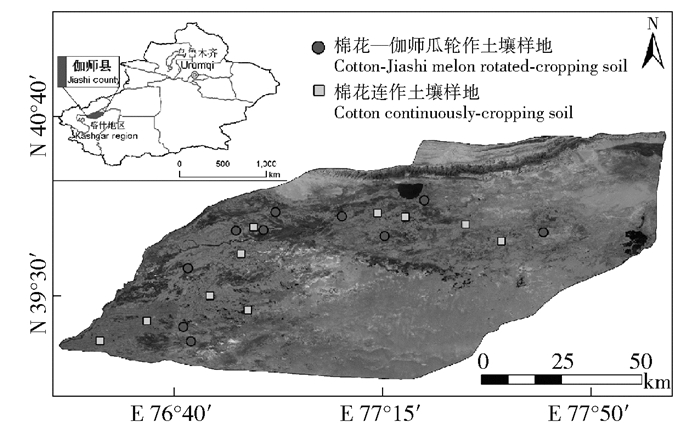
在伽师县内通过对农户进行咨询选择种植与管理制度基本一致的棉花—伽师瓜一年一轮作(简称轮作)和棉花连作(简称连作)的农田,并记录种植年限、施肥、和灌溉信息。在2016年4月期间,从耕作年限为3、6、9和12 a的轮作和连作农田采集土壤样品。具体为分别从土壤表层(0~20 cm)、中层(20~40 cm)、底层(40~60 cm)进行采样,共20个样点。其中轮作年限为3、6、9和12 a的农田分别有3、4、2和1个样点;连作年限为3、6、9和12 a的农田分别有2、3、3、2个样点。利用手持式GPS进行定位地理坐标(图 1)。

图 1 伽师县土壤采样点分布 Fig. 1 Sampling points distribution in Jiashi county
2.2 土壤样品处理分析方法

首先对土壤样品进行研磨,通过0.85 mm孔径的筛子剔除杂物。备用样品40 g与200 mL蒸馏水混合,经过浸泡和振荡使土壤盐分充分溶解,测定土壤盐分和pH值。通过双指示剂中和法测定CO32-和HCO3-;用AgNO3滴定法测定Cl-;用EDTA间接滴定法测定SO42-;用EDTA络合滴定法测定Ca2+、Mg2+;用差减法测定K++Na+;用残渣烘干法测定可溶性总盐分质量分数[19];用浓硫酸—重铬酸钾容量法—外加热法测定土壤有机质[20]。检测获取的数据利用SPSS 19.0软件进行统计分析。

3 结果与分析 3.1 土壤有机质质量分数分布特征

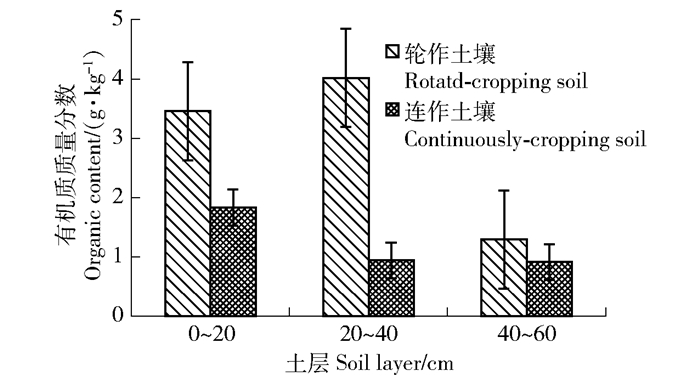
轮作土壤和连作土壤的平均有机质质量分数分别为2.92和1.23 g/kg,二者之间具有明显差异(表 1)。在不同土层中,轮作土壤有机质排序为:中层>表层>底层,上中层与底层之间的变化程度较大。连作土壤有机质排序为:表层>中层>底层。

表 1 轮作和连作土壤有机质质量分数 Tab. 1 Organic matter contents of the rotated-cropping and continuously-cropping soil

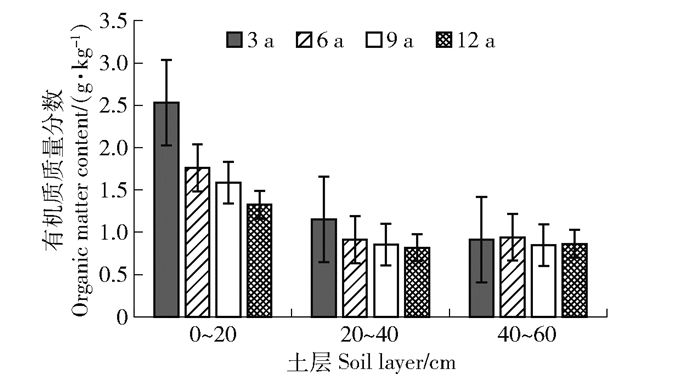
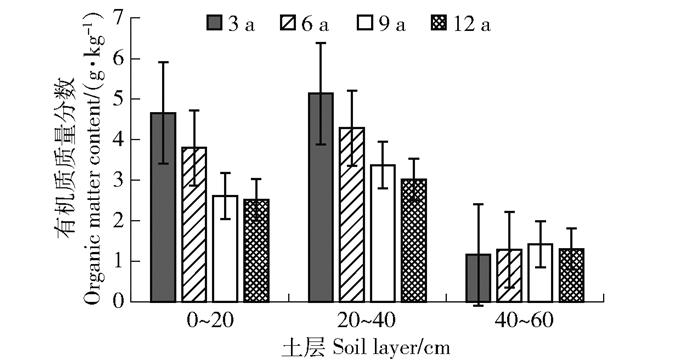
图 2可知,轮作土壤有机质质量分数均高于连作土壤,在表层>1.63 g/kg,中层>3.08 g/kg,底层>0.38 g/kg。2种种植类型中,表层峰度值(K)均 < 0,正态分布曲线较为平坦,其余正态分布曲线为分配数列次数较集中在众数位置的尖顶峰;偏度系数(SK)基本>0,分布曲线向右偏;2种土壤的变异系数属于中等变异程度。由图 3可知,连作土壤有机质随着年限的增加而降低,在表层明显减少,中层和底层略有减少。轮作土壤有机质质量分数在表层和中层分别为2.14和2.12 g/kg,底层增长0.28 g/kg(图 4)。随着年限的增加,2种土壤有机质在表层和中层减少,但轮作土壤中质量分数较高,在底层有增加趋势。

图 2 2种种植模式土壤有机质质量分数对比 Fig. 2 Comparison of soil organic matter content under two planting modes
图 3 连作土壤有机质质量分数变化 Fig. 3 Change trend of soil organic matter content in the continuously-cropping soil
图 4 轮作土壤有机质质量分数变化 Fig. 4 Change trend of soil organic matter content in the rotated-cropping soil
3.2 土壤盐分离子的统计

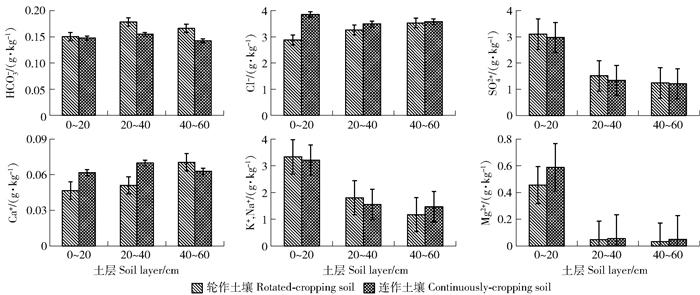
连作和轮作土壤各土层盐分离子质量分数差异较小。连作土壤中Cl-、Ca2+、Mg2+等离子质量分数较高;轮作土壤中HCO3-、SO42-、K++Na+等离子质量分数较高(图 5)。随着土壤深度的增加,HCO3-、Cl-离子的变化幅度较小,而SO42-、Ca2+、K++Na+、Mg2+等离子的变化幅度较大。

图 5 连作和轮作种植模式的土壤盐分离子质量分数对比 Fig. 5 Comparison of soil salt ions content between the continuously-cropping and rotated-cropping modes

表 2可知,连作土壤盐分离子在土壤不同深度有所差异,各阴离子在不同土层平均质量分数对比为HCO3-:中层>表层>底层;Cl-:表层>底层>中层;SO42-:表层>中层>底层;相互对比为SO42->Cl->HCO3-。各阳离子在不同土层平均质量分数对比为Ca2+:中层>底层>表层;K++Na+:表层>中层>底层;Mg2+:表层>中层>底层;相互对比为在表层土壤K++Na+>Mg2+和Ca2+,在中低层Ca2+>Mg2+。轮作土壤盐分离子之间也存在差异,各阴离子在不同土层平均质量分数分别为HCO3-:中层>底层>表层,Cl-:中层>底层>表层;SO42-:表层>中层>底层;均为SO42->Cl->HCO3-。各阳离子在不同土层平均分别为Ca2+:中层>底层>表层;K++Na+:表层>中层>底层;Mg2+:表层>中层>底层;均为K++Na+>Mg2+>Ca2+。轮作土壤阴离子变异系数为13.99%~64.52%,除Cl-外其他离子属于中等强度变异,SO42-质量分数最高,HCO3-质量分数最低;阳离子的变异系数为18.41%~51.21%,除Cl-外,其他离子属于中等强度变异;K++Na+质量分数最高,Ca2+质量分数最低。总盐分表现为,连作和轮作土壤平均总盐分分别为6.42和15.88 g/kg,轮作明显大于连作土壤。

表 2 轮作和连作土壤各层次盐分离子质量分数 Tab. 2 Contents of salt ions in different depths of the rotated-cropping and continuously-cropping soils

表 3可知,不同年限轮作土壤总盐分质量分数排序为3 a>6 a>9 a>12 a,随着年限的增加,总盐分呈现降低趋势,Cl-、SO42-均降低,其他离子质量分数基本不变。阴离子(Cl-)/2C(SO42-)比值排序为12 a>9 a>6 a>3 a;C(HCO3-)/(C(Cl-)+C(SO42-))比值均<1。连作土壤总盐分质量分数平均为6.42 g/kg,总盐分排序为:12 a>9 a>6 a>3 a,有上升趋势。pH值、Cl-增加,SO42-、K++Na+减少,其他离子质量分数基本不变。土壤中C(Cl-)/2C(SO42-)比值排序为12 a>9 a>3 a>6 a。轮作土壤pH值平均为8.03,12 a的相对较高,9 a的较低,呈微碱性土壤。连作土壤pH值平均为7.9,12 a的相对较高,6 a的较低,也呈微碱性土壤,变化幅度小。从变异系数(CV)来看,轮作土壤中总盐分、Ca2+、SO42-、K++Na+的变异系数,波动性小,属于中度变异,pH值为弱变异;HCO3-、Cl-的波动性较大。2种土壤中C(Cl-)/2C(SO42-)的比值均<0.2,说明土壤均以硫酸盐类盐渍土为主。C(HCO3-)/(C(Cl-)+C(SO42-))比值均<1,说明碳酸盐并非土壤盐分的主要成分。

表 3 不同年限轮作和连作土壤盐分离子质量分数 Tab. 3 Contents of salt ions in rotated-cropping and continuously-cropping soils in different years 

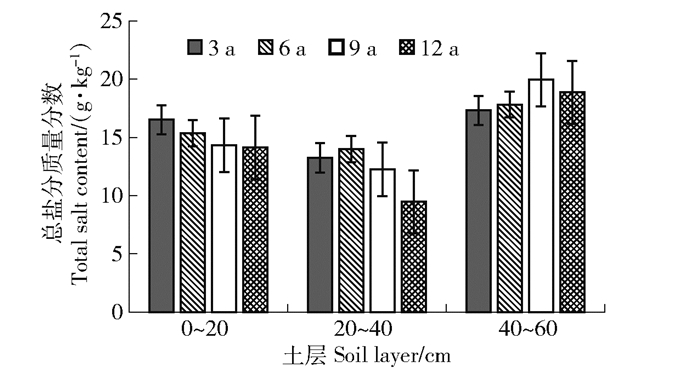
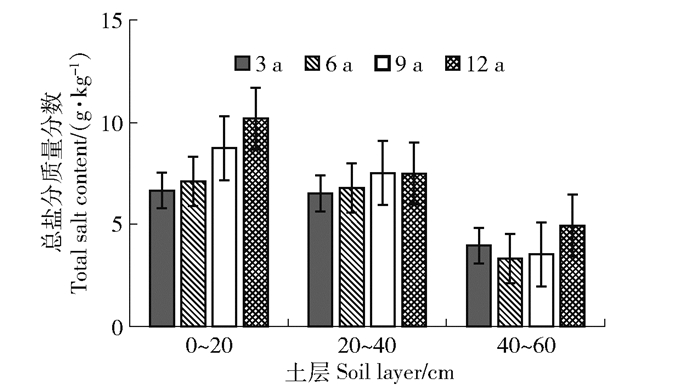
总盐分质量分数结果表示,轮作土壤不同深度平均总盐分明显大于连作土壤,2种采样点背景值存在差异。但是随着种植年限的增加,轮作土壤表层和中层的总盐分不断降低,底层略增加(图 6)。连作土壤表层和中层的总盐分明显上升(图 7)。

图 6 轮作土壤总盐分质量分数变化 Fig. 6 Changes of total salt content in the rotated-cropping soil
图 7 连作土壤总盐分质量分数变化 Fig. 7 Changes of total salt content in the continuously-cropping soil
3.3 连作和轮作种植模式对土壤化学性质的影响

连作和轮作土壤表层有机质质量分数差异呈极显著(P < 0.01),t值为5.898,大于临界值t0.01(21)=2.831。除有机质、Ca2+存在显著性差异外,其他指标之间无显著差异。土壤中层(有机质、Ca2+存在显著性差异;土壤底层有机质、Mg2+存在显著性差异外,HCO3-、K++Na+离子之间也存在差异(P < 0.05)。轮作土壤有机质质量分数比连作土壤高,主要积聚于土壤表中层,向下迁移缓慢;Ca2+在表中层差异显著,但底层土壤中无差异;HCO3-、K++Na+在底层土壤中有差异,其余指标之间没有显著差异。对连作和轮作土壤各指标进行比较,发现轮作种植方式增加了表层和中层土壤有机质(表 4)。

表 4 连作和轮作土壤指标之间的显著性差异结果 Tab. 4 Comparison results of significant differences in soil indexes between the rotated-cropping and continuously-cropping soils 
4 讨论

因地制宜的作物种植模式和正确的管理措施能够提高土壤有机质质量分数,改善土壤质地,优化土壤化学条件。通过对2种耕作模式的土壤有机质质量分数统计分析,轮作土壤有机质质量分数高于连作土壤,这表明轮作模式对提高有机质质量分数有一定的影响。按不同层次土壤有机质进行对比,不同种植方式下中层土壤之间的有机质差异较大,轮作土壤中层的有机质高于连作土壤,表层和底层土壤有机质差异小。这可能甜瓜根系主要分布于土壤30 cm深处范围,并且一般有机肥料也填埋在30 cm深处的范围,因此该类轮作种植模式主要对土壤中层起到改善作用,因此轮作土壤有机质质量分数由表层到底层呈先增加后减少的趋势,而连作土壤从表层到底层呈减少趋势,表层质量分数相对高。随着年限的增加2种耕作模式下有机质总质量分数均减少趋势,轮作土壤表层和中层有机质均高于连作土壤,但底层土壤中变化不明显。

通过对盐分离子质量分数统计分析,轮作土壤总盐分均高于连作土壤,随着年限的增加轮作土壤总盐分有下降趋势,而连作土壤有上升趋势,表明轮作种植对土壤含盐量的降低有影响。pH值、HCO3-、SO42+、K++Na+、Mg2+等离子没有显著差异,Cl-和Ca+离子在土壤表层和底层中有差异。轮作种植土壤的平均盐分离子质量分数比连作土壤高,表示伽师瓜耐盐性较强,适宜在盐分较高的土壤种植,其适合干旱区绿洲农田种植,且随着种植年限的增加,土壤盐分会有所下降。

5 结论

1) 棉花—伽师瓜轮作土壤中有机质质量分数高于棉花连作。2种种植方式土壤有机质随着年限增加呈逐渐减少趋势,且连作土壤有机质质量分数低,变化幅度小,而轮作土壤较高,但变化幅度相对较大。

2) 棉花-伽师瓜轮作土壤盐分离子略高,表示伽师瓜适宜盐分较高的土壤种植。随着种植年限的增加,轮作土壤总盐分不断减少,底层略有增加。连作土壤总盐分呈不断增加趋势。

6 参考文献
[1]
LI Yuxuan, ZHANG Weifeng, MA Lin, et al. An analysis of China's fertilizer policies: Impacts on the industry, food security, and the environment[J]. Journal of Environment Quality, 2013, 42(4): 972. DOI:10.2134/jeq2012.0465
[2]
郭旭东, 陈利顶, 傅伯杰. 土地利用/土地覆被变化对区域生态环境的影响[J]. 环境工程学报, 1999, 7(6): 66.
GUO Xudong, CHEN Liding, FU Bojie. Effects of land use/land cover changes on regional ecological environment[J]. Advances in Environmental Science, 1999, 7(6): 66.
[3]
吴乐知, 蔡祖聪. 中国土壤有机质含量变异性与空间尺度的关系[J]. 地球科学进展, 2006, 21(9): 965.
WU Lezhi, CAI Zucong. The relationship between the spatial scale and the variation of soil organic matter in China[J]. Advances in Earth Science, 2006, 21(9): 965. DOI:10.3321/j.issn:1001-8166.2006.09.011
[4]
新疆维吾尔自治区统计局: 新疆统计年鉴(2010) [M]. 北京: 中国统计出版社, 2011: 215.
Xinjiang Uygur Autonomous Region Statistics Bureau. Xinjiang statistical yearbook (2010) [M]. Beijing: China Statistics Press, 2011: 215.
[5]
陈丽娟, 冯起, 成爱芳. 民勤绿洲土壤水盐空间分布特征及盐渍化成因分析[J]. 干旱区资源与环境, 2013, 27(11): 99.
CHEN Lijuan, FENG Qi, CHENG Aifang. Spatial distribution of soil water and salt contents and reasons of saline soils development in the Minqin Oasis[J]. Journal of Arid Land Resources and Environment, 2013, 27(11): 99.
[6]
刘建国, 张伟, 李彦斌, 等. 新疆绿洲棉花长期连作对土壤理化性状与土壤酶活性的影响[J]. 中国农业科学, 2009, 42(2): 725.
LIU Jianguo, ZHANG Wei, LI Yanbin, et al. Effects of long-term continuous cropping system of cotton on soil physical-chemical properties and activities of soil enzyme in oasis in Xinjiang[J]. Scientia Agricultura Sinica, 2009, 42(2): 725. DOI:10.3864/j.issn.0578-1752.2009.02.044
[7]
满苏尔·沙比提, 玉苏甫·买买提, 阿依图尔荪·哈力穆拉提. 渭-库三角洲绿洲不同连作年限棉田土壤理化特征分析[J]. 土壤通报, 2017, 48(4): 868.
SABIT Mansur, MAMAT Yusup, HALMURAT Aytursun. Soil physical and chemical characteristics of cotton field with different continuous cropping years in Weigan-Kuqa river delta oasis[J]. Chinese Journal of Soil Science, 2017, 48(4): 868.
[8]
NACHIMUTHU G, HULUGALLE N, WATKINS M, et al. Irrigation induced surface carbon flow in a Vertisol under furrow irrigated cotton cropping systems[J]. Soil & Tillage Research, 2018, 183: 8.
[9]
STEVEN W. M, JAMES H. Economic analysis of no tillage and minimum tillage cotton-corn rotations in the Mississippi Delta[J]. Soil & Tillage Research, 2009, 102: 135.
[10]
刘芳婷, 范文波, 张金玺, 等. 盐分对棉花光合特性及根际土壤CO2浓度的影响[J]. 水土保持学报, 2019, 33(1): 208.
LIU Fangting, FAN Wenbo, ZHANG Jinxi, et al. Effects of salinity on photosynthetic characteristics of cotton and CO2 concentration in rhizosphere soils[J]. Journal of Soil and Water Conservation, 2019, 33(1): 208.
[11]
程学刚, 张彩虹, 杨焕祥, 等. 连作对杨树人工林土壤呼吸及各组分的影响[J]. 中国水土保持科学, 2017, 15(1): 105.
CHENG Xuegang, ZHANG Caihong, YANG Huanxiang, et al. Effects of continuous cropping on soil respiration and its components of poplar plantations[J]. Science of Soil and Water Conservation, 2017, 15(1): 105. DOI:10.16843/j.sswc.2017.01.013
[12]
张前兵, 艾尼娃尔·艾合买提, 于磊, 等. 绿洲区不同灌溉方式及灌溉量对苜蓿田土壤盐分运移的影响[J]. 草业学报, 2014, 23(6): 69.
ZHANG Qianbing, AHMAT Anwer, YU Lei, et al. Effects of different irrigation methods and quantities on soil salt transfer in oasis alfalfa field[J]. Acta Prataculturae Sinica, 2014, 23(6): 69.
[13]
赵俊, 刘新平, 刘向晖, 等. 塔里木河流域农牧系统耦合协调度分析[J]. 干旱区地理, 2015, 38(5): 1077.
ZHAO Jun, LIU Xinping, LIU Xianghui, et al. Analysis on coupling coordination degree between agriculture and animal husbandry systems in Tarim river basin[J]. Arid Land Geography, 2015, 38(5): 1077.
[14]
詹建立, 辛丽, 孙燕. 伽师瓜储藏期间病原菌的分类鉴定及生化特性研究[J]. 生物学杂志, 2013, 30(3): 29.
ZHAN Jianli, XIN Li, SUN Yan. Classification and identification of pathogenic bacteria of Jiashi muskmelon during storage and study of biochemical characteristics[J]. Journal of Biology, 2013, 30(3): 29.
[15]
王斐, 卢春生, 张平, 等. 欧洲李不同品种授粉结实性试验研究[J]. 新疆农业科学, 2010, 47(6): 1081.
WANG Fei, LU Chunsheng, ZHANG Ping, et al. The studies on pollinated setting of different P. domestica L. varieties[J]. Xinjiang Agricultural Sciences, 2010, 47(6): 1081.
[16]
肖启桃, 肖鹏. 伽师县甜瓜栽培技术[J]. 新疆农业科技, 1989, 57(3): 21.
XIAO Qitao, XIAO Peng. Melon cultivation techniques in Jiashi county[J]. Xinjiang Agricultural Science and Technology, 1989, 57(3): 21.
[17]
马凯, 王继勋, 卢春生, 等. 阿月浑子快速建园技术研究初报[J]. 西北农业学报, 2012, 21(3): 170.
MA Kai, WANG Jixun, LU Chunsheng, et al. Preliminary study on the rapid establishing orchard technique of Pistachio[J]. Acta Agricultural Boreali-occidentalis Sinica, 2012, 21(3): 170.
[18]
常小蓉, 陈述晖. 测土配方施肥技术在棉花生产中的应用[J]. 新疆农业科技, 2009, 186(3): 47.
CHANG Xiaorong, CHEN Shuhui. Application of soil testing and formula fertilization technology in cotton production[J]. Xinjiang Agricultural Science and Technology, 2009, 186(3): 47.
[19]
解丽娜, 贡璐, 朱美玲, 等. 塔里木盆地南缘绿洲土壤酶活性与理化因子相关性[J]. 环境科学研究, 2014, 27(11): 1306.
XIE Lina, GONG Lu, ZHU Meiling, et al. Soil enzyme activities and their correlation with physicochemical factors in the oasis of southern margin of Tarim Basin[J]. Research of Environmental Sciences, 2014, 27(11): 1306.
[20]
马国飞, 满苏尔·沙比提, 张雪琪. 托木尔峰自然保护区台兰河上游不同海拔灌木土壤理化性质研究[J]. 土壤通报, 2017, 48(6): 1288.
MA Guofei, SABIT Mansur, ZHANG Xueqi. Physicochemical properties of surface soil under different shrubs at various altitudes in upstream of Tailan river in mount Tuomuer[J]. Chinese Journal of Soil Science, 2017, 48(6): 1288.