文章快速检索     高级检索
  中国水土保持科学   2024, Vol. 22 Issue (2): 107-114.  DOI: 10.16843/j.sswc.2023054
0

引用本文 

丁琅, 郝勇, 邵严, 刘春艳, 刘俊麟. 茶树边坡抗冲性能影响因素分析[J]. 中国水土保持科学, 2024, 22(2): 107-114. DOI: 10.16843/j.sswc.2023054.
DING Lang, HAO Yong, SHAO Yan, LIU Chunyan, LIU Junlin. Analysis of influencing factors on the anti-scourability of tea tree slope[J]. Science of Soil and Water Conservation, 2024, 22(2): 107-114. DOI: 10.16843/j.sswc.2023054.

项目名称

国家自然科学基金“菌根改善枳根系构型的生长素调控机制”(32102315);茶树生物学与利用国家重点实验室开放基金“干旱胁迫下AM真菌对茶树氮代谢及氨基酸组分调控研究”(SKLTOF20200122);湖北省教育厅“百校百县-高效服务新农村振兴科技支撑行动”“茶树根系对山坡水土保持及地表岩土稳定性影响研究”(BXLBX0296)

第一作者简介

丁琅(1998—),男,硕士研究生。主要研究方向:岩土工程。E-mail:2294041313@qq.com

通信作者简介

郝勇(1980—),男,博士,高级工程师。主要研究方向:岩土工程。E-mail:518004@yangtzeu.edu.cn

文章历史

收稿日期:2023-02-24
修回日期:2023-09-10
茶树边坡抗冲性能影响因素分析
丁琅 1, 郝勇 1, 邵严 1, 刘春艳 2, 刘俊麟 1     
1. 长江大学城市建设学院,434023,湖北荆州;
2. 长江大学园艺园林学院,434023,湖北荆州
摘要:为研究茶树种植对边坡抗冲性能的作用并探究影响茶树边坡抗冲性能的因素,以远安县某茶场地域环境为对象设计边坡模型,进行冲刷试验、水稳性团聚体分布测定和根系分形扫描。结果显示:1)径流率先增大到峰值再波动并趋于稳定,最大径流率表现为茶树边坡(1.224)<原生植被边坡(1.280)<素土边坡(1.398);2)茶树边坡抗冲系数比原生植被边坡和素土边坡分别提升12.8%和53.2%;3)边坡土壤水稳性团聚体含量表现为茶树边坡>原生植被边坡>素土边坡;4)茶树发育情况整体优于原生植被,具体表现在覆盖度(茶树95%>原生植被87%)和分形维数2方面。经分析,茶树种植有利于提升边坡抗冲性能,抗冲性能受植被覆盖度、根系发育情况、水稳性团聚体含量、冲刷时间和冲刷深度的影响。
关键词茶树边坡    抗冲性能    水稳性团聚体    根系分形维数    
Analysis of influencing factors on the anti-scourability of tea tree slope
DING Lang 1, HAO Yong 1, SHAO Yan 1, LIU Chunyan 2, LIU Junlin 1     
1. School of Urban Construction, Yangtze University, 434023, Jingzhou, Hubei, China;
2. College of Horticulture and Gardening, Yangtze University, 434023, Jingzhou, Hubei, China
Abstract: [Background] Among the many geological disasters on slopes, most of them are caused by failure to take timely and appropriate reinforcement measures. In recent years, with the national emphasis on the ecological environment, the topic of vegetation slope protection has gradually risen. In the mountainous area of Yuan′an county, Hubei, due to the large number of newly reclaimed tea (Camellia sinensis) gardens and lack of management, some areas have suffered from serious soil erosion. Therefore, this paper studied the effect of tea tree planting on the anti-scour performance of slope and the main factors affecting the anti-scour performance of tea tree slope, which was of great significance for analyzing the effect of tea tree planting on slope soil and water conservation. [Methods] A slope model was designed based on the regional environment of a tea farm in Yuan′an county, and the artificial climate simulation system environment box (model CABR-MCB) was applied to simulate the rainfall erosion test under the condition of extremely heavy rain. Then the effect of tea tree planting on the erosion resistance of slope was studied by calculating the runoff rate and anti-scour coefficient. Then the factors affecting the anti-scour performance of tea tree slope were analyzed based on the results of water stability aggregate content determination and root fractal scanning. Finally, SPSS software was used to analyze the correlation and significance of each influencing factor against the anti-scour coefficient. [Results] The runoff rate and anti-scour coefficient were calculated according to the erosion test data. The results indicated that the runoff first increased to the peak value, and then fluctuated and tended to be stable. Tea tree slope had the best runoff rate, which was smaller than the native vegetation slope and the plain soil slope (1.224 < 1.280 < 1.398). Compared with the native vegetation slope and the plain soil slope, the anti-scour coefficient of tea tree slope increased by 12.8% and 53.2%, respectively. The determination results of water stable aggregate content were as follows: Tea tree slope > native vegetation slope > plain soil slope. The above-ground development (vegetation coverage) of tea tree slope was better than that of native vegetation slope (95% > 87%). The development of the underground part of the tea tree slope vegetation was also better than that of the native vegetation slope. [Conclusions] After analysis, tea planting is conducive to improving the scour resistance of slope, which is affected by vegetation coverage, root development, water stability aggregate content, scouring time and scouring depth. The results of this research may provide ideas for solving the problem of soil erosion caused by newly cultivated tea plantations in Yuan ′an area.
Keywords: tea tree slope    anti-scourability    water-stable aggregate    fractal dimension of root system    

植被护坡是一种利用植物进行边坡加固的新型护坡方式,能起到增强边坡稳定性,改善生态环境的效果[1-2]。现有研究[3-4]表明,边坡抗冲性能对于保证边坡稳定性具有重要意义,也是评判植被护坡效果的关键。植被对边坡抗冲性能的作用主要体现在茎叶部分对降水的拦截缓冲和根系与土壤的串联固结[5-7]

现有植被护坡抗冲性能的研究在植被选择方面,虽考虑到地域、气候因素:如黄土高原地区选用长芒草(Stipa bungeana),黑麦草(Lolium perenne),紫花苜蓿(Medicago sativa)[8-9]等植被护坡,却未考虑秋冬季节植物枯死后抗冲性能如何保证。笔者选取山茶科山茶属常绿灌木植物茶树(Camellia sinensis)作为护坡植被,能有效避免此类情况。在抗冲性能影响因素分析方面,对植被地上部分、地下部分及土体微观结构等方面的综合分析较少[10-12]。笔者针对地上、地下及微观结构部分选取植被覆盖度、根系发育情况及水稳性团聚体含量进行综合分析。

由于近年来新垦茶园缺乏合理规划,粗放管理,导致部分地区水土流失严重,研究茶树种植对边坡水土保持的作用具有重要意义。根据《茶经》记载,今湖北宜昌所属山南区为茶树适栽区之一,故以宜昌市远安县某茶场地域环境为对象设计模型。通过冲刷试验探明特大暴雨条件下茶树种植对边坡抗冲性能的影响,分析影响抗冲性能的因素,通过水稳性团聚体测定、分形扫描等手段验证,并利用SPSS软件进行回归分析。

1 研究区概况

远安县某茶场地处鄂西山地,海拔约1 010 m,大部分区域坡度在30°左右,地势西北高,东南低,属亚热带季风性气候,年降水量1 000~1 100 mm,年平均气温16 ℃,年平均日照时间1 830 h,年平均无霜期275 d左右。茶场区域土壤以黄棕壤为主,表层含较多杂质,局部岩石裸露,土层厚度60~200 cm,土壤质地较好,砂黏粒比例合理,酸碱度适宜。

2 材料与方法 2.1 试验设计

为还原茶场植被生长条件,模型土壤采自茶场,土壤物理性质见表 1。边坡采用种植箱(长57 cm,宽39 cm,高20 cm)模拟,分别搭建茶树边坡、原生植被边坡和素土边坡,坡度30°。

表 1 土壤物理性质 Tab. 1 Soil physical property

茶树采取双行密植方式种植。原生植被选取茶场区域分布较广的植株,包括蒌蒿(Artemisia selengensis)、牛筋草(Eleusine indica)及苦苣菜(Sonchus oleraceus)。根据夏振尧等[13]的研究,根系能大幅提高土体抗剪切强度。因此对原生植株进行根系分形扫描,分形维数分别为:蒌蒿1.49,牛筋草1.44,苦苣菜1.41;选取分形维数最大的蒌蒿作为原生植被代表,在种植箱中随机分布。素土边坡无植被覆盖。模型在相同条件下养护3个月后进行试验。

2.2 冲刷试验

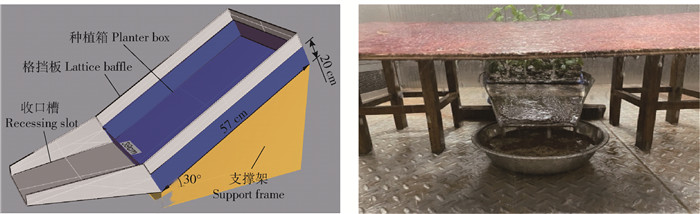
利用人工气候模拟系统环境箱(型号CABR-MCB)模拟降雨冲刷。设置平均降雨强度28.16 mm/h,时长1 h,降雨均匀系数k=0.89,降雨高度2 m,待雨量稳定后开始试验。自主设计径流收集装置,由格挡板,收口槽和支撑架组成(图 1)。每5 min收集1次径流,每组试验重复3次。

图 1 径流收集装置 Fig. 1 Runoff collecting device
2.3 水稳性团聚体分布测定

为研究微观结构对抗冲性能的影响,对茶树边坡A1,原生植被边坡A1,素土边坡A2分层取土进行团聚体分布测定。取样深度为0~5 cm的表层土Z1和>5 cm的亚表层土Z2(根据冲刷试验划分土层分界面为5 cm)。团聚体对抗冲性能的作用主要体现在水稳性方面,以0.25 mm为界,>0.25 mm的团粒为水稳性团聚体。水稳性团聚体分布采用湿筛法测定,每组试验重复3次。

2.4 根系分形扫描

为研究根系发育情况对抗冲性能的影响,选取代表植株按表层土和亚表层土切分根系。洗净后放入WinRHIZO根系分析系统扫描,获取根系图片及根长、根表面积等数据,计算分形维数D[14]

3 结果与分析 3.1 茶树种植对边坡抗冲性能的影响

根据冲刷试验计算径流率和抗冲系数。径流率反映降雨转化为径流的效率;抗冲系数反映每冲刷1 g干土所需的径流量,公式如下:

$ I=\frac{R_t}{t} \text {; } $ (1)
$ A_{\mathrm{s}}=\frac{It^{\prime}}{m_{\mathrm{s}}} 。$ (2)

式中:I为径流率,L/min;Rt为规定时间内收集径流量,L;t为接样时间,min;As为抗冲系数,L/g;t′为冲刷时间,min;ms为烘干泥沙质量,g。

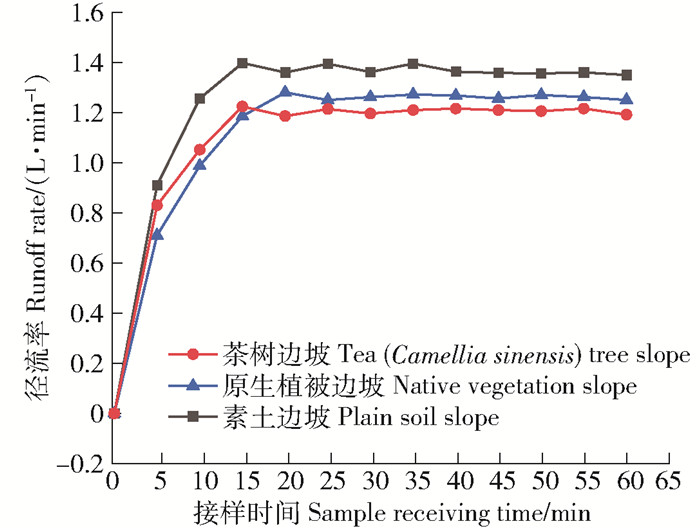
图 2看出,3种边坡径流率变化趋势一致:初始阶段急剧上升达到峰值,然后小幅波动,最终趋于稳定。峰值出现时间集中于15~20 min,该时间段内冲刷深度位于5 cm附近,因此模型边坡以5 cm为分界面划分表层土(Z1)和亚表层土(Z2)。径流率峰值表现为茶树边坡(1.224 L/min)<原生植被边坡(1.280 L/min)<素土边坡(1.398 L/min);波动稳定阶段径流率平均值表现为茶树边坡(1.21 L/min)<原生植被边坡(1.26 L/min)<素土边坡(1.37 L/min)。

图 2 径流率变化趋势 Fig. 2 Variation trend of runoff rate

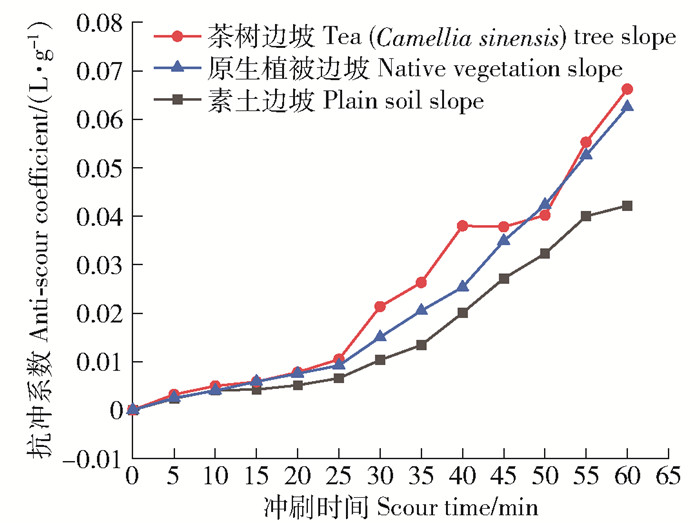
图 3看出,抗冲系数呈增大趋势,前期增幅较缓,后期变大。抗冲系数最大值表现为:茶树边坡(0.066 22 L/g)>原生植被边坡(0.062 50 L/g)>素土边坡(0.042 19 L/g)。经计算,茶树边坡平均抗冲系数(0.026 5 L/g)比原生植被边坡(0.023 5 L/g)提高12.8%,比素土边坡(0.017 3 L/g)提高53.2%。

图 3 抗冲系数变化趋势 Fig. 3 Variation trend of anti-scour coefficient

冲刷深度也是反映边坡抗冲性能的重要指标。试验结束时冲刷最大深度为素土边坡(8.3 cm)>原生植被边坡(7.7 cm)>茶树边坡(7.4 cm)。

综上,相较于素土和原生植被,茶树种植能有效提高边坡抗冲性能。

3.2 抗冲性能影响因素分析 3.2.1 冲刷时间与冲刷深度

特大暴雨作用条件下,随冲刷时间增加,径流率和抗冲系数规律性变化,均反映出抗冲性能随时间增加而增强的趋势。冲刷深度随试验进行逐渐加深:分界面之前,深度下移平均速率为茶树边坡0.32 cm/min,原生植被边坡0.27 cm/min,素土边坡0.35 cm/min;分界面之后,深度下移平均速率为茶树边坡0.058 cm/min,原生植被边坡0.06 cm/min,素土边坡0.069 cm/min;结合冲刷深度数据可得,深度变化速率及冲刷深度越小,抗冲性能越好。

3.2.2 植被覆盖度

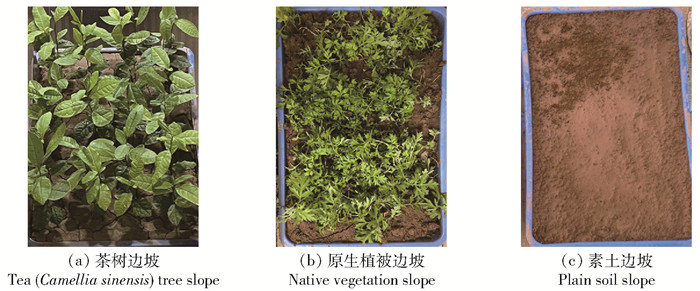
试验开始时,各边坡植被覆盖情况如图 4所示。经测量,植被覆盖度分别为茶树边坡95%,原生植被边坡87%,说明覆盖度越大抗冲性能越有优势。在冲刷深度分析中发现,茶树相对较高,茶树边坡冲刷最严重区域始终位于中部偏下范围;而原生植被较低矮,在试验初期能更好阻隔雨滴与坡面接触,冲刷最严重区域位于无植被范围,冲刷一段时间后,茎叶扰动,最严重区域逐渐向边坡中下部发展。这说明抗冲性能还受坡面植被高度的影响。

图 4 植被覆盖情况 Fig. 4 Vegetation coverage
3.2.3 根系发育情况

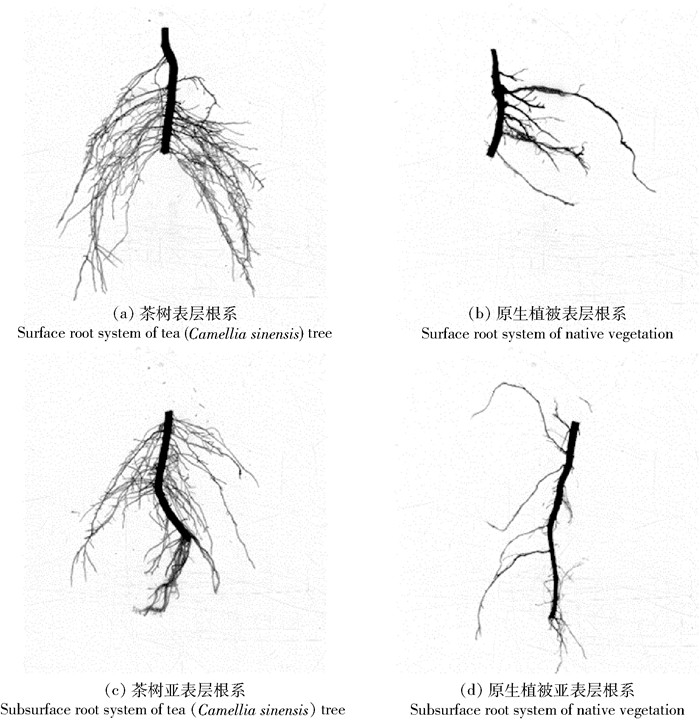
根系发育情况通过根长、根表面积、分形维数等指标体现。分形扫描见图 5,发育情况指标见表 2。可见,茶树根系比原生植被根系扩散幅度广,复杂程度高;且茶树根系各项指标均大于原生植被,说明茶树根系发育情况优于原生植被。将根系发育情况指标与抗冲系数进行相关性分析,其中根表面积和根尖数为显著正相关,根系分形维数、根体积和根平均直径为显著负相关。分析认为,过大的根体积、根直径会对边坡抗冲性能造成不利影响;而根尖数越多,根表面积越大,则有利于抗冲性能。

图 5 根系分形扫描 Fig. 5 Root fractal scanning
表 2 根系发育情况 Tab. 2 Root development
3.2.4 水稳性团聚体含量

水稳性团聚体含量ASi计算公式如下:

$ A_{\mathrm{Si}}=\frac{m_{\mathrm{t}}}{m_{\mathrm{c}}} \times 100 \% \text { 。} $ (3)

式中:ASi为水稳性团聚体质量分数,量纲为1;mt为水稳性团聚体质量,g;mc为湿筛前的样本质量,g。

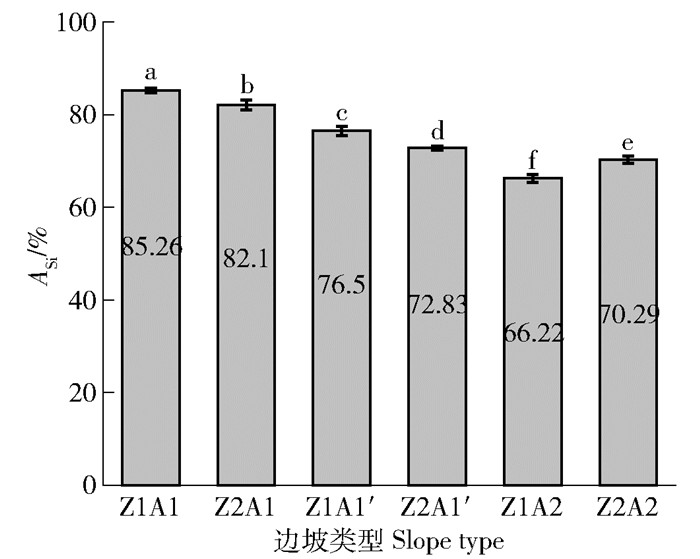
图 6看出,水稳性团聚体含量依次为Z1A1>Z2A1>Z1A1′ >Z2A1′>Z2A2>Z1A2;整体而言,茶树边坡大于原生植被边坡和素土边坡。通过相关性分析发现,抗冲系数与团聚体含量相关性不显著;植被边坡水稳性团聚体含量与根系发育情况、冲刷时间、冲刷深度显著相关;素土边坡水稳性团聚体含量与冲刷时间和冲刷深度显著相关。这说明水稳性团聚体在一定程度上影响边坡抗冲性能,但受到根系发育情况、冲刷时间和冲刷深度的制约。

Z1A1:茶树边坡表层土样,Z2A1:茶树边坡亚表层土样,Z1A1′:原生植被边坡表层土样,Z2A1′:茶树边坡亚表层土样,Z1A2:素土边坡表层土样,Z2A2:素土边坡亚表层土样;a-f为显著性差异标记,不同标记字母即为差异显著。 Z1A1: Tea tree slope surface soil sample; Z2A1: tea tree slope subsurface soil sample; Z1A1′: native vegetation slope surface soil sample; Z2A1′: tea tree slope subsurface soil sample; Z1A2: plain soil slope surface soil sample; Z2A2: plain soil slope subsurface soil sample. a-f is a significant difference marker, and different marking letters are significant differences. ASi: Content of water-stable aggregates. 图 6 水稳性团聚体质量分数 Fig. 6 Contents of water-stable aggregates
3.3 影响因素相关性分析

以抗冲系数为标准判断抗冲性能,对各因素进行回归分析(表 3)。

表 3 影响因素显著性 Tab. 3 Significances of influencing factors

拟合优度R2=0.964>0.6,拟合结果能真实反映各因素与抗冲性能的相关性。得到回归方程为:

$ \begin{gathered} A_{\mathrm{s}}^{\prime}=0.007+0.002 t^{\prime}-0.007 H+0.002 C- \\ 0.132 D+0.001 A_{\mathrm{si}} 。\end{gathered} $ (4)

式中:As′为抗冲系数拟合值,L/g;H为冲刷深度,cm;C为植被覆盖度,%。

对于抗冲性能,冲刷时间表现为极显著正相关,冲刷深度为极显著负相关,植被覆盖度为显著正相关,根系分形维数为显著负相关,水稳性团聚体含量为较不显著正相关。

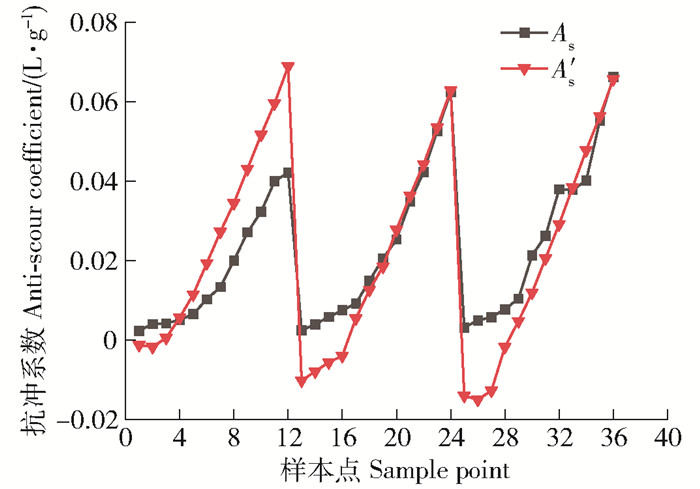
AsAs′对比见图 7。整体而言,变化趋势基本一致,拟合值略大于实测值。两值平均误差39.5%,误差较大情况出现在素土边坡样本和冲刷试验初期。

As为边坡模型抗冲系数实测值;As′为抗冲系数拟合值。 As is the measured anti-scour coefficient of slope model; As′ is the fitting value of the anti-scour coefficient. 图 7 结果对比 Fig. 7 Comparison of results
4 讨论与建议

根据前人研究[15-16],径流率越小,抗冲系数越大,表示抗冲性能越好。笔者发现本试验中,茶树边坡径流率峰值及稳定阶段平均值均小于原生植被边坡和素土边坡,茶树边坡平均抗冲系数大于原生植被边坡和素土边坡,与前人结论相符,证明茶树种植有利于提高边坡抗冲性能。

在抗冲性能影响因素的研究中发现:冲刷时间与抗冲性能极显著正相关,和李菊艳等[17]对边坡土壤流失率的研究结果相符。冲刷深度与抗冲性能极显著负相关,和孙吉书等[18]的试验结果“冲刷深度越大,抗冲性能越差”相符。植被覆盖度与抗冲性能显著正相关,与前人研究结论[19]一致;此外,在覆盖度研究中还发现,植被越低矮,对抗冲性能越有利。根系分形维数与抗冲性能显著负相关,与前人研究结论[20-21]“根系分形维数越大,在固土方面表现更好”不符。这可能因为分形维数由多因素决定,根体积和直径过大会造成不利影响,能否增强边坡抗冲性能主要取决于根系数量和根表面积。水稳性团聚体含量与抗冲性能正相关但不显著,一方面因为团聚体的发育与植被根系有关,长期种植更有利于团聚体累积[22-23];另一方面可能因为降雨强度太大,不利于团聚体发挥对抗冲性能的增强效果。

笔者研究存在一定局限:如试验茶树属于幼苗,对抗冲性能的增强效果可能不及成年茶树。后续研究可在本文基础上研究茶树龄期、种植排列方式、根土耦合特征、降雨量等因素与边坡抗冲性能的关系。

5 结论

1) 茶树种植对边坡抗冲性能有提升效果,能有效减弱边坡水土流失情况。

2) 冲刷时间、植被覆盖度对抗冲性能为有利影响,最大冲刷深度、根系分形维数为不利影响,水稳性团聚体含量影响较弱。

3) 植被护坡中,植株越低矮,越有利于抗冲性能;且过大的根直径、根体积不利于抗冲性能发挥,要增强抗冲性能,需保证根系数量和根表面积。

6 参考文献
[1]
王可钧, 李焯芬. 植物固坡的力学简析[J]. 岩石力学与工程学报, 1998, 17(6): 687.
WANG Kejun, LI Zhaofen. Brief mechanical analysis on bioengineering techniques for slope protection[J]. Chinese Journal of Rock Mechanics and Engineering, 1998, 17(6): 687. DOI:10.3321/j.issn:1000-6915.1998.06.012
[2]
冯俊德. 路基边坡植被护坡技术综述[J]. 路基工程, 2001(5): 20.
FENG Junde. Summarize of subgrade slope protection technique[J]. Subgrade Engineering, 2001(5): 20.
[3]
乔建刚, 董进国, 李明浩, 等. 生态混凝土植生与抗冲刷性能研究[J]. 硅酸盐通报, 2023, 42(3): 917.
QIAO Jiangang, DONG Jinguo, LI Minghao, et al. Study on planting performance and scouring resistance of Eco-concrete[J]. Bulletin of the Chinese Ceramics Society, 2023, 42(3): 917.
[4]
梅红, 胡国长, 王禄艺, 等. 边坡植被固土抗冲刷特性及其护坡机理研究[J]. 河北工程大学学报(自然科学版), 2022, 39(4): 86.
MEI Hong, HU Guochang, WANG Luyi, et al. Study on erosion resistance property of slope vegetation soil consolidation and slope protection mechanism[J]. Journal of Hebei University of Engineering (Natural Science Edition), 2022, 39(4): 86.
[5]
刘奥林. 多花木兰对边坡加固作用的研究[D]. 长沙: 中南林业科技大学, 2020: 14.
LIU Aolin. Study on strengthening effect of Mulan on slope[D]. Changsha: Central South University of Forestry and Technology, 2020: 14.
[6]
马新涌. 土工格室加固库岸边坡抗冲刷性研究[J]. 水利技术监督, 2022(9): 265.
MA Xinyong. Study on scour resistance of reservoir bank slope reinforced by geo-cell[J]. Technical Supervision in Water Resources, 2022(9): 265. DOI:10.3969/j.issn.1008-1305.2022.09.066
[7]
李钰峰, 孙微微, 张桥蓉. 麦冬草根系对边坡稳定性的影响分析[J]. 黑龙江交通科技, 2023, 46(4): 1.
LI Yufeng, SUN Weiwei, ZHANG Qiaorong. Effect of Ophiopogon japonicus root system on slope stability[J]. Communications Science and Technology Heilongjiang, 2023, 46(4): 1.
[8]
冯博, 贾小旭, 于冬雪, 等. 黄土高原北部草地土壤水分空间变异研究[J]. 土壤通报, 2019, 50(5): 1123.
FENG Bo, JIA Xiaoxu, YU Dongxue, et al. Spatial variability of soil moisture in northern grassland of the Loess Plateau[J]. Chinese Journal of Soil Science, 2019, 50(5): 1123.
[9]
邵伟华. 浦阳江堤防岸坡生态护坡植被体根系土设计及渗透特性试验研究[J]. 甘肃水利水电技术, 2022, 58(8): 52.
SHAO Weihua. Experimental study on the design and permeability characteristics of root soil of ecological slope protection vegetation on Puyangjiang Dike bank slope[J]. Gansu Water Resources and Hydropower Technology, 2022, 58(8): 52.
[10]
周正朝, 上官周平. 子午岭次生林植被演替过程的土壤抗冲性[J]. 生态学报, 2006, 26(10): 3270.
ZHOU Zhengchao, SHANGGUAN Zhouping. Soil anti-scourability during vegetation succession of Ziwuling secondary forest[J]. Acta Ecologica Sinica, 2006, 26(10): 3270.
[11]
谌芸, 何丙辉, 练彩霞, 等. 三峡库区陡坡根-土复合体抗冲性能[J]. 生态学报, 2016, 36(16): 5173.
CHEN Yun, HE Binghui, LIAN Caixia, et al. Root-soil system anti-scourability on steep slopes in Three Gorges Reservoir area[J]. Acta Ecologica Sinica, 2016, 36(16): 5173.
[12]
陈晏, 史东梅, 文卓立, 等. 紫色土丘陵区不同土地利用类型土壤抗冲性特征研究[J]. 水土保持学报, 2007, 21(2): 24.
CHEN Yan, SHI Dongmei, WEN Zhuoli, et al. Study on soil anti-scourability of different land use types in purple soil hilly region[J]. Journal of Soil and Water Conservation, 2007, 21(2): 24.
[13]
夏振尧, 周正军, 黄晓乐, 等. 植被护坡根系浅层固土与分形特征关系初步研究[J]. 岩石力学与工程学报, 2011, 30(2): 3641.
XIA Zhenyao, ZHOU Zhengjun, HUANG Xiaole, et al. Preliminary study of relationship between shallow soil reinforcement and fractal characteristics of vegetation roots in biotcchnical slope protection[J]. Chinese Journal of Rock Mechanics and Engineering, 2011, 30(2): 3641.
[14]
贾全全, 杨晓杰. 根系分形维数及其研究进展[J]. 安徽农业科学, 2011, 39(2): 652.
JIA Quanquan, YANG Xiaojie. Fractal dimension and its study extension to root systems[J]. Journal of Anhui Agricultural Sciences, 2011, 39(2): 652.
[15]
何聪, 吕刚, 王京行. 雨强和植被覆盖度对露天煤矿排土场坡面侵蚀过程的影响. 李叶鑫, 贺斯楠, 李宛倬, 贾宴泽[C]//中国煤炭学会, 中国矿业大学. 第3届国际土地复垦与生态修复学术研讨会论文摘要集. [出版者不详], 2021: 51. DOI: 10.26914/c.cnkihy.2021.070031.
HE Cong, LÜ Gang, WANG Jingxing. Effects of rainfall intensity and vegetation coverage on slope erosion of open-pit coal mine. LI Yexin, HE Sinan, LI Wanzhuo, JIA Yanze[C]// China Coal Society, China University of Mining and Technology. Abstracts of the 3rd International Symposium on Land Reclamation and Ecological Restoration. [s. n. ], 2021: 51. DOI: 10.26914/c.cnkihy.2021.070031.
[16]
史东梅, 陈晏. 紫色丘陵区农林混作模式的土壤抗冲性影响因素[J]. 中国农业科学, 2008, 41(5): 1400.
SHI Dongmei, CHEN Yan. The influencing factors of soil anti-scouribility of tree-crop intercropping land in purple soil hilly region[J]. Scientia Agricultura Sinica, 2008, 41(5): 1400.
[17]
李菊艳, 缪成波, 于萌, 等. 不同放牧制度对天山北坡草地抗冲性的影响[J]. 中国水土保持, 2022(5): 52.
LI Juyan, MIAO Chengbo, YU Meng, et al. Effects of different grazing systems on anti-scourability of grassland on the northern slope of Tianshan Mountains[J]. Soil and Water Conservation in China, 2022(5): 52.
[18]
孙吉书, 邱博超, 肖田. 降雨作用下路堤边坡水毁机理及影响因素分析[J]. 河北科技大学学报, 2021, 42(4): 415.
SUN Jishu, QIU Bochao, XIAO Tian. Analysis on water damage mechanism and influencing factors of embankment slope under rainfall[J]. Journal of Hebei University of Science and Technology, 2021, 42(4): 415.
[19]
MANEECHAROEN J, HTWE W, BERGADO D T, et al. Ecological erosion control by limited life geotextiles (LLGs) as well as with Vetiver and Ruzi grasses[J]. Indian Geotechnical Journal, 2013, 43(4): 388.
[20]
陈吉虎, 余新晓, 有祥亮, 等. 不同水分条件下银叶椴根系的分形特征[J]. 中国水土保持科学, 2006, 4(2): 71.
CHEN Jihu, YU Xinxiao, YOU Xiangliang, et al. Fractal characteristics of Tilia tomentosa's root system under different water conditions[J]. Science of Soil and Water Conservation, 2006, 4(2): 71.
[21]
张立芸, 段青松, 李永梅. 坡耕地山原红壤大豆根系构型及根土复合体力学特性[J]. 中国生态农业学报, 2022, 30(9): 1464.
ZHANG Liyun, DUAN Qingsong, LI Yongmei. Soybean roots architecture and mechanical properties of the root-soil complex in mountain red soil on sloping farmland[J]. Chinese Journal of Eco-Agriculture, 2022, 30(9): 1464.
[22]
管冠, 郭富鹏, 郭等等, 等. 生草栽培对赣南脐橙土壤团聚体及根系生长的影响[J]. 江苏农业科学, 2023, 51(5): 216.
GUAN Guan, GUO Fupeng, GUO Dengdeng, et al. Effects of raw grass cultivation on soil aggregate and root growth of navel orange in south of Jiangxi province[J]. Jiangsu Agricultural Sciences, 2023, 51(5): 216.
[23]
赵雅琦, 栾好安, 黄绍文. 不同种植年限对核桃园土壤团聚体稳定性及其有机碳组分的影响[J/OL]. 中国土壤与肥料[2023-06-13]. http://kns.cnki.net/kcms/detail/11.5498.S.20230606.1411.002.html.
ZHAO Yaqi, LUAN Haoan, HUANG Shaowen. Effects of different planting ages on soil aggregate stability and aggregate-associated organic carbon fractions in walnut orchards[J/OL]. Soil and Fertilizer Sciences in China[2023-06-13]. http://kns.cnki.net/kcms/detail/11.5498.S.20230606.1411.002.html.