冀西北间山盆地区切沟体积估算模型
吴可

,
李镇

,
齐志国
,
李炜
,
冯甜
,
秦占飞
1. 河北地质大学土地科学与空间规划学院, 050031, 石家庄;
2. 河北省国际科技合作基地: 河北地质大学河北省农业干旱遥感监测国际联合研究中心, 050031, 石家庄
收稿日期:2021-10-28; 修回日期:2022-11-06
项目名称:河北省自然科学基金项目"冀西北间山盆地区侵蚀沟空间格局及其对泥沙连通性的影响"(D2020403067); 河北省高层次人才资助项目"冀西北黄土丘陵区小流域侵蚀沟系统连通性特征及归因分析"(A202101050); 河北省普通高校青年拔尖人才项目"冀西北黄土丘陵区小流域切沟侵蚀特征及其对植被重建的响应"(BJ2018041); 河北地质大学第十七届学生科技基金科研项目"冀西北黄土丘陵区侵蚀沟空间格局-演化特征及归因分析"(KAY202101)
摘要:切沟体积是表征切沟侵蚀量、输水输沙能力的重要参数。笔者以冀西北山盆地区典型流域切沟为研究对象,使用Riegl三维激光扫描仪获取切沟点云数据,构建高分辨率DEM,提取切沟形态参数,分析切沟断面特征,构建并验证适宜的切沟体积估算模型。结果表明:1)切沟间的发育不均衡,不同切沟沟长、面积和体积相差较大,但同一参数在各个断面位置的参数值差别较小;2)面积、沟长和沟深与体积呈显著的正相关,相关系数较高,分别为0.949、0.870和0.814;3)基于V-L关系、V-A关系和V(A,D)关系建立对应的线性回归方程,其决定系数R2分别为0.770 6、0.915 9和0.974 8,模型验证结果显示,V(A,D)关系模型V=0.046 53A1.499+24.08D1.916-44.26在预测冀西北山盆地区切沟体积上更有优势。研究结果可为大空间尺度切沟侵蚀定量模拟及制图提供理论和技术支持,为水土保持工程提供科学理论依据。
关键词:切沟 形态特征 估算模型 误差 冀西北间山盆地区
Estimation model for gully volume in the basin of Northwest Hebei mountains
WU Ke
,
LI Zhen
,
QI Zhiguo
,
LI Wei
,
FENG Tian
,
QIN Zhanfei
1. School of Land Science and Space Planning, Hebei GEO University, 050031, Shijiazhuang, China;
2. International Science and Technology Cooperation Base of Hebei Province: Hebei International Joint Research Center for Remote Sensing of Agricultural Drought Monitoring, Hebei GEO University, 050031, Shijiazhuang, China
Abstract: [Background] Gully erosion is an important environmental hazard in the basin of Northwest Hebei mountains, which produces a tremendous amount of sediment-inducing siltation of downstream reservoirs and causes some flooding and pollution. Therefore, the prevention and control of gully erosion have become the top priority of soil and water conservation in recent years. Moreover, the erosion prone gully area and control gully erosion can be determined by modeling and mapping the gully erosion over a large scale, and the estimation model of the gully volume is the basic issue in the research of gully erosion. However, little research on modeling gully volume in this area has been published. The objective of this study is to develop a model to assess the gully volume using the morphological parameters of gullies. [Methods] In order to measure the morphological parameters of 17 gullies located at Yangyuan county, Hebei province, a 3-D laser scanner (Rigel) was used to obtain the point cloud data, and then the digital elevation model (DEM) with the pixel size of 0.15 m×0.15 m was created based on Delaunay triangulate irregular network (TIN) using ArcGIS 10.3. The morphological parameters were extracted from DEM and finally the gully length (L, m), area (A, m2), top width (TW, m), bottom width (BW, m), depth (D, m), cross-sectional area (CSA, m2) and volume (V, m3) were calculated. [Results] 1) The development of gullies were imbalance in this study area. The lengths, areas and volumes of gullies varied greatly, however the parameter values of the same parameter at each section just had little difference. 2) The Pearson correlation analysis showed that there was significant positive relationship between V and L, A and D, and the Pearson's correlation coefficient were 0.949, 0.870 and 0.814, respectively, indicating that L, A and D can be used to estimate the gully erosion amount at the large spatial scale. 3) There was power function relationship between V and L and A, and the determination coefficients of the regression equation were 0.770 6 and 0.915 9, respectively. Furthermore, the RMSE and MAE between the measured and predicted gully volumes suggested that the V=0.046 53A1.499+24.08D1.916-44.26(R2=0.974 8) was more preferred for predicting the volume of a gully, compared with the V-L and V-A relation. [Conclusions] Above results V(A, D) relationship can be used to assess the gully volume in the basin of Northwest Hebei mountains. The results of this study may provide a method and basis for assessing the gully volume over a large scale, and will be greatly helpful to assess the soil and water conservation.
Keywords:
gully morphological characteristics estimation model error basin of Northwest Hebei mountains
土壤侵蚀问题是多种生态矛盾的集中体现[1],会导致当地生态环境恶化和农业生产力下降[2-3]。土壤侵蚀防治已经成为各国科学家和政府重点关注的议题[4]。切沟侵蚀是水力侵蚀的一种重要类型,其对流域侵蚀产沙有重要贡献[5]。切沟侵蚀监测是侵蚀沟发育规律研究的基础,高精度GPS、高分遥感、三维激光扫描等技术的高速发展[6],为切沟侵蚀和演化特征研究提供技术支持[7-8]。国内外研究多侧重于利用监测数据分析切沟长度、宽度、和面积等二维参数的分异规律[9],而对断面特征参数,如断面面积,体积等三维参数研究较为薄弱。切沟体积可以用来表征侵蚀量,大空间尺度上切沟侵蚀的定量模拟仍是亟需解决的关键问题。高分遥感影像已经成为切沟侵蚀研究的重要数据源,通过目视解译法可获得切沟长度、宽度和面积等参数,但是探究蚀积问题需要具有立体像对数据的高分遥感影像,其数据价格昂贵[10]。近年来,国内外学者突破原有二维测量方法,使用三维激光扫描仪,获取点云数据,进而构建高精度DEM[11],但该测量方法不适于大空间尺度监测。相对于无法直接监测切沟侵蚀量[12]的二维信息遥感影像,该方法适用于探究小流域切沟三维形态特征,同时通过构建体积估算模型,弥补二维高分遥感影像无法监测侵蚀量的不足。当前切沟体积估算模型主要有2种,即切沟体积(V)和沟长(L)关系模型和切沟体积(V)和面积(A)关系模型。在我国,研究者分别在西南干热河谷[13]、东北黑土区[14]、黄土高原建立V-L关系模型;李镇等[15]在统计分析切沟形态参数的基础上认为,相比沟长,面积在预测切沟体积上更具优势;但相关研究在冀西北间山盆地区还未见报道。此外,当前体积估算模型多采用单一参数,且适用性仍需进一步验证。因此,结合切沟断面参数等与体积的相关性分析,找出主控因素,建立单或多参数体积估算模型,提高切沟体积的估算精度,仍是研究的重点。
冀西北山盆地区是严重的水土流失区,切沟发育导致土地减少,肥力下降,抑制区域经济的发展。笔者基于三维激光扫描技术获取辛堡乡典型流域的17条侵蚀沟点云数据集,经过降噪处理,生成0.15 m×0.15 m高分辨率DEM,建立并验证适宜的切沟体积估算模型,为该区域大空间尺度切沟侵蚀普查和定量模拟提供方法论。
1 研究区概况
研究区位于张家口市东南部坝下阳原县辛堡乡(图 1)。地形复杂,地势陡峭,属于山间盆地地貌形态,海拔处于811.3~1 237.77 m之间,属于温带季风气候,四季分明,夏、冬季温差较大,降雨集中,容易发生沟蚀;另外,辛堡乡境内地势南高北低、西高东低,紧临桑干河和壶流河,汇流现象明显,加快侵蚀沟发育。区域内自然资源丰富,农业发展主要以种植业和养殖业为主,区域植被覆盖较少,水土流失严重,侵蚀沟发育明显,主要以切沟为主。
2 数据来源与研究方法
2.1 切沟基础参数提取与计算
沟缘线附近及沟底植被会影响三维激光地形数据的精度。因此,选择植被覆盖较差的切沟进行测量,共计17条,主要分布于集水区土地利用类型为草地或裸地的位置。使用Riegl三维激光扫描仪获取带有地理坐标和高程的切沟地形点云数据集[16],室内通过降噪处理,去除明显误差点,最终构建0.15 m分辨率的DEM[17]。参照已有研究,0.15 m分辨率的DEM能够满足冀西北间山盆地区切沟形态参数的提取精度,且目视解译法提取切沟形态参数的误差可以控制在2个像元内。切沟形态特征常用切沟长度、宽度和深度等指标定量表征[18]。笔者基于目视解译法提取沟缘线,计算沟长和切沟面积,通过断面法[19],在ArcGIS 10.3中从沟头到沟口分生成断面图,提取和计算切沟断面形态参数,包括顶宽、底宽和沟深等,进一步计算切沟断面面积,如下式所示:
|
$
C_{\mathrm{SA}}=\frac{T_{\mathrm{w}}+B_{\mathrm{w}}}{2} \times D。$
|
式中:CSA为切沟断面面积,m2;Tw为顶宽,m;Bw为底宽,m;D为沟深,m。
计算切沟体积需要对DEM进行填洼处理,获取沟缘线的各点高程值,构建无洼池DEM1,使用ArcGIS软件Surface Volume功能,分别基于DEM和DEM1进行体积计算并求差值,最终得到切沟体积[17]。
2.2 切沟体积估算模型构建方法
分析参数之间的相关性,对于构建切沟体积估算模型具有重要意义。使用SPSS软件,对切沟各参数进行皮尔逊(Pearson)相关分析,选择与切沟体积具有显著相关的参数构建切沟体积估算模型,经对比、检验,确定最适合该研究区的切沟体积估算模型。
2.3 模型检验方法
均方根误差(Root mean square error,RMSE)和平均绝对误差(Mean absolute error,MAE)是用来检验模型可信度、准确性和有效性的2种模型检验方法。RMSE是用来衡量切沟体积的预测值与真实值与之间的偏差,其值越小说明模型准确性越高。MAE是切沟体积的预测值和观测值之间绝对误差的平均值,能更好地反映预测值误差的实际情况,其值越小说明模型准确性越高。笔者以研究区侵蚀沟为例,分别对以往学者构建的模型和本文新建模型进行模型检验,由此衡量不同切沟体积模型的精准度。
3 结果与分析
3.1 切沟形态参数统计分析
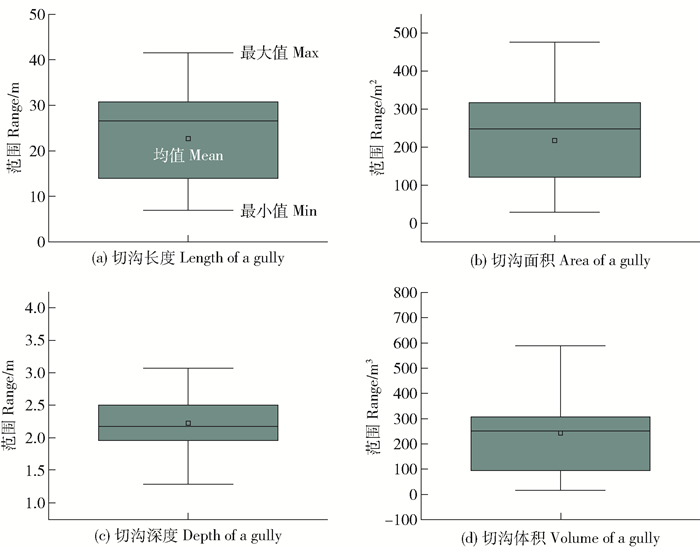
研究区切沟沟长L、面积A、沟深D和体积V的参数统计如图 2所示,可见,L在6.73~41.62 m范围,平均值为22.65 m;A在28.18~475.17 m2范围,平均值为218.07 m2;D在1.28~3.5 m,平均值为2.22 m;V在14.59 ~668.11 m3范围,平均值为246.12 m3;切沟面积和体积最大值最小值之间差值分别达到446.99 m2和653.52 m3。总体上来看,切沟间深度较接近,而长度、面积和体积等参数呈现发育不均,数值差别较大,这可能与切沟发育的地形、土地利用等因子有关。
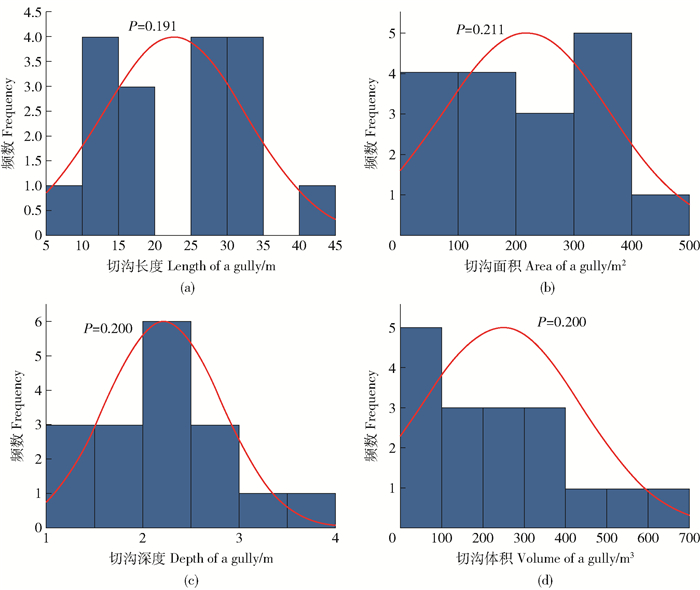
进一步如图 3所示,L主要集中在20~30 m之间,切沟面积主要集中在250~350 m2之间,D主要集中在1.5~2.0 m之间,V主要集中在0~210 m3最多。单样本K-S正态分布检验结果显示,L、A、D及V的P值分别为0.191、0.211、0.200和0.200,均>0.05,即该4个参数均服从正态分布。
切沟的沟头、沟中和沟口位置断面形态参数的统计结果如表 1所示,同一参数在不同断面位置的平均值和标准差波动较小,不同参数区别较大,在相同的断面位置上参数平均值呈现:顶宽>沟深>底宽。其中,沟中顶宽均值在7.86~9.16 m之间,标准差在3~4之间,沟头到沟口由大变小;沟口底宽均值在0.27~2.46 m之间,标准差在0.5~2之间,且从沟头到沟口逐渐减小;沟深均值在1.81~2.44 m之间,标准差在0.5~1之间,沟头到沟口由小变大。断面面积均值在沟中位置最大,沟头位置最小,且标准差均较大,在5.91~8.22之间。
表 1(Tab. 1)
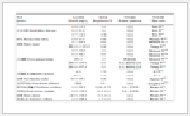
表 1 切沟断面形态参数表
Tab. 1 Shape parameters of a gully's section at different gully sections
| 参数Parameter |
断面位置Section position |
最大值Maximum |
最小值Minimum |
平均值Average value |
标准差Standard deviation |
|
沟头Head of a gully |
16.10 |
1.90 |
7.86 |
3.76 |
| 顶宽Top width/m |
沟中Middle of a gully |
14.00 |
2.60 |
9.16 |
3.59 |
|
沟口Outlet of a gully |
13.90 |
4.00 |
7.91 |
3.13 |
|
沟头Head of a gully |
8.20 |
0 |
2.46 |
1.83 |
| 底宽Bottom width/m |
沟中Middle of a gully |
3.10 |
0 |
1.12 |
0.96 |
|
沟口Outlet of gullies |
2.00 |
0 |
0.27 |
0.52 |
|
沟头Head of a gully |
3.00 |
0.60 |
1.81 |
0.65 |
| 沟深Depth/m |
沟中Middle of a gully |
4.10 |
1.10 |
2.39 |
0.82 |
|
沟口Outlet of a gully |
3.90 |
0.90 |
2.44 |
0.83 |
|
沟头Head of a gully |
23.10 |
1.10 |
9.94 |
6.61 |
| 断面面积Area/m2 |
沟中Middle of a gully |
30.50 |
1.90 |
13.20 |
8.22 |
|
沟口Outlet of a gully |
26.46 |
2.04 |
10.39 |
5.91 |
|
表 1 切沟断面形态参数表
Tab. 1 Shape parameters of a gully's section at different gully sections
|
3.2 切沟体积估算模型的构建
3.2.1 切沟形态参数相关分析
切沟形态参数间的皮尔逊相关分析结果如表 2所示,A、L、TW和D与切沟体积具有显著正相关,其中A与V的相关性最好,相关系数为0.949,其次是沟长和沟深,相关系数分别为0.870和0.814,表明冀西北间山盆地区切沟面积、沟长和沟深是影响切沟体积的主要因子,与沟长相比,切沟面积对切沟体积影响更大。
表 2(Tab. 2)
表 2 切沟形态参数之间的相关矩阵
Tab. 2 Correlation matrix of gully morphological characteristics
|
L |
A |
Tw |
Bw |
D |
V |
| L |
1 |
0.962** |
0.765** |
0.192 924 5 |
0.614** |
0.870** |
| A |
|
1 |
0.874** |
0.386 897 3 |
0.681** |
0.949** |
| Tw |
|
|
1 |
0.603* |
0.733** |
0.858** |
| Bw |
|
|
|
1 |
0.443 079 4 |
0.530* |
| D |
|
|
|
|
1 |
0.814** |
| V |
|
|
|
|
|
1 |
| 注:**在0.01级别(双尾),相关性显著*在0.05级别(双尾),相关性显著注。Notes: ** At level 0.01 (double tailed), the correlation is significant * At level 0.05 (double tailed), the correlation is significant. V: volume of a gully, m3; A: area of a gully, m2; L: length of a gully, m; Tw: average top width, m; Bw: average bottom width, m; D: average depth, m.
|
|
表 2 切沟形态参数之间的相关矩阵
Tab. 2 Correlation matrix of gully morphological characteristics
|
3.2.2 切沟体积估算模型构建
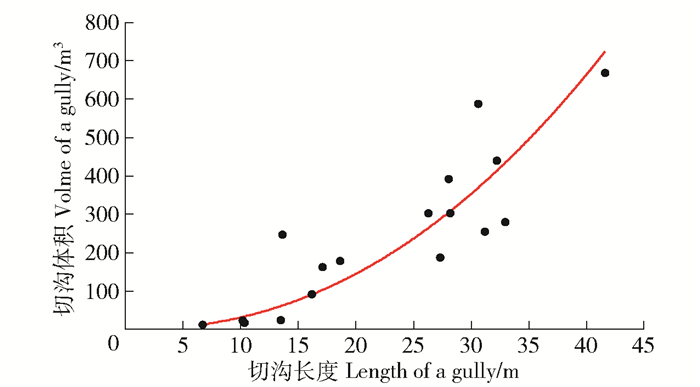
如图 4所示,与已有研究结果一致,V和L之间具有显著的幂函数关系:
|
$
\begin{gathered}
V=a L^b \text { 。} \\
\text { 即: }\ \ \ \ V=0.9665 L^{1.74}\left(R^2=0.7706\right) \text { 。}
\end{gathered}
$
|
a,b受降雨土壤岩性、土地利用等因子及沟道断面特征的影响。其中,b可以被看作是单位沟长上切沟断面面积的增长率,接近1,表明参数断面面积从沟头到沟口越接近于恒定[20]。对比我国已有研究,冀西北间山盆地区的b值比东北黑土和西南干热河谷区更大,与黄土区高原区的b值较接近。
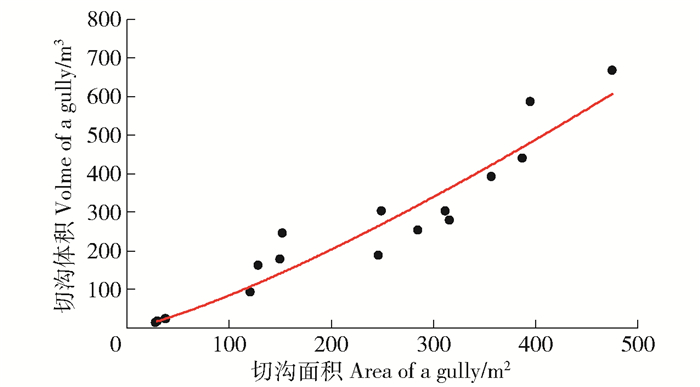
如图 5所示,考虑到切沟面积是影响切沟体积的主要因子,进而尝试建立其与切沟体积的回归关系:
|
$
\begin{gathered}
V=a A^b \text { 。} \\
\text { 即: }\ \ \ \ V=0.1558 A^{1.346}\left(R^2=0.9159\right) \text { 。}
\end{gathered}
$
|
参数b被看作为单位切沟面积上的沟深增长率,接近1说明沟深近似恒定。本文中,b值与黄土高原区较接近,大于东北黑土区,可能由于从沟头到沟口,沟深的增长率不同所致。回归方程的R2表明,与沟长相比,冀西北间山盆地区切沟的面积与体积之间具有更好的幂函数关系。这一结果与黄土高原、东北黑土区一致,V-A关系是预测切沟体积的更优模型。
在V-A关系模型基础上,尝试将D引入模型中,建立回归方程,表达式为:
|
$
\begin{gathered}
V=0.04653 A^{1.499}+24.08 D^{1.916}-44.26 \\
\left(R^2=0.9748\right)。\end{gathered}
$
|
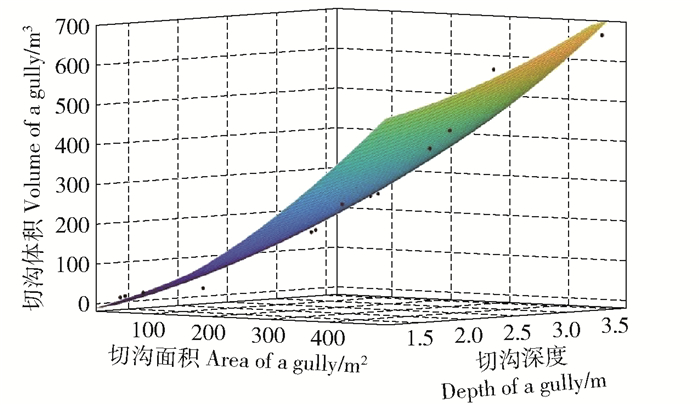
V(A, D)模型的R2为0.974 8,说明冀西北间山盆地区切沟体积估算模型应综合考虑切沟面积和切沟深度。对比3个体积估算模型的R2,V(A, D)模型的R2最大,如图 6所示,拟合效果最优,说明冀西北间山盆地区切沟体积与面积和沟深之间具有更好的幂函数关系。
3.3 体积估算模型验证分析
V-L、V-A、V(A, D)模型预测切沟体积的均方根误差和平均绝对误差,分别为96.04、58.15、35.81和68.13、43.41、22.96(表 3),说明V-A比V-L在预测切沟体积上有更好的表现,该结果与黄土高原区一致[21],V-A关系模型可为研究区利用二维高分遥感影像在大空间尺度定量模拟切沟侵蚀提供方法论。相比V-A比V-L模型,V(A, D)模型的均方根误差和平均绝对误差均更小,说明经验模型V(A, D)模拟求解的效果更好[22],因此,建议将V=0.046 53A1.499+24.08D1.916-44.26(R2=0.974 8)作为冀西北间山盆地区切沟体积估算模型。
表 3(Tab. 3)
表 3 切沟体积预测值与实测值的均方根误差(RMSE)和绝对平均误差(MAE)
Tab. 3 Root mean square error (RMSE) and absolute mean error (MAE) of predicted and measured volume
| 模型Model |
V-L |
V-A |
V(A, D) |
测量体积
Measured volume/m3 |
|
4 183.99 |
|
预测体积
Predicted volume/m3 |
4 192.42 |
4 102.22 |
4 249.61 |
| RMSE |
96.04 |
58.15 |
35.81 |
| MAE |
68.13 |
43.41 |
22.96 |
| R2 |
0.77 |
0.92 |
0.97 |
|
表 3 切沟体积预测值与实测值的均方根误差(RMSE)和绝对平均误差(MAE)
Tab. 3 Root mean square error (RMSE) and absolute mean error (MAE) of predicted and measured volume
|
4 结论
1) 切沟间的发育不均衡,不同沟长、面积和体积相差较大,但同一参数在各个断面位置的参数值差别较小。
2) 皮尔逊相关性分析表明,面积、沟长和沟深与体积呈显著的正相关,相关系数分别为0.949、0.870和0.814,是影响切沟体积的主要因子。
3) 回归分析显示,切沟体积和面积、沟长之间存在显著的幂函数关系,方程决定系数R2分别为0.770 6、0.915 9;基于面积和沟深参数建立V(A, D)模型,即V=0.046 53A1.499+24.08D1.916-44.26(R2=0.974 8);模型验证结果显示,V(A, D)模型在预测切沟体积上更有优势,建议将其作为冀西北间山盆地区切沟体积估算模型。
5 参考文献
| [1] |
张科利, 蔡强国, 柯奇画. 中国土壤侵蚀研究重大成就及未来关键领域[J]. 水土保持通报, 2022, 42(4): 373.
ZHANG Keli, CAI Qiangguo, KE Qihua. Major achievements and future key fields of soil erosion research in China[J]. Bulletin of Soil and Water Conservation, 2022, 42(4): 373. |
| [2] |
邹亚荣, 张增祥, 赵晓丽, 等. 中国土壤水蚀区环境背景因子分析[J]. 水土保持通报, 2001, 21(4): 19. ZOU Yarong, ZHANG Zengxiang, ZHAO Xiaoli. Factor analysis of environment background in water erosion of China[J]. Bulletin of Soil and Water Conservation, 2001, 21(4): 19. DOI:10.3969/j.issn.1000-288X.2001.04.005 |
| [3] |
王文龙, 王兆印, 雷阿林, 等. 黄土丘陵区坡沟系统不同侵蚀方式的水力特性初步研究[J]. 中国水土保持科学, 2007, 5(2): 11. WANG Wenlong, WANG Zhaoyin, LEI Alin, et al. Hydraulic characteristics of various patterns of erosion in the slopegully system in the loess region of hills[J]. Science of Soil and Water Conservation, 2007, 5(2): 11. |
| [4] |
吴红艳. 黄土丘陵区发育活跃期切沟形态特征与转换模型研究[D]. 陕西杨凌: 西北农林科技大学, 2016: 22.
WU Hongyan. Gully morphological characteristics and transformation models in the lossial hilly-gully region[D]. Yangling, Shaanxi: Northwest A & F University, 2016: 22.
|
| [5] |
张鹏, 郑粉莉, 陈吉强, 等. 利用高精度GPS动态监测沟蚀发育过程[J]. 热带地理, 2009, 29(4): 368. ZHANG Peng, ZHENG Fenli, CHEN Jiqiang, et al. Application of high-precision GPS to dynamic monitoring gully erosion processes[J]. Tropical Geography, 2009, 29(4): 368. DOI:10.3969/j.issn.1001-5221.2009.04.012 |
| [6] |
冯林, 李斌兵. 利用无人机倾斜影像与GCP构建高精度侵蚀沟地形模型[J]. 农业工程报, 2018, 34(3): 88. FENG Lin, LI Binbing. Establishment of high precision terrain model of eroded gully with UAV oblique aerial photos and ground control points[J]. Transactions of the CSAE, 2018, 34(3): 88. |
| [7] |
王让虎. 基于多源多尺度数据的东北典型黑土区侵蚀沟遥感监测体系研究[D]. 长春: 吉林大学, 2017: 43.
WANG Ranghu. Gully erosion monitoring at multiple scales based on multi-source remote sensing data of the typical black soil area, Northeast China[D]. Changchun: Jilin University, 2017: 43.
|
| [8] |
李镇, 张岩, 杨松, 等. QuickBird影像目视解译法提取切沟形态参数的精度分析[J]. 农业工程学报, 2014, 30(20): 179. LI Zhen, ZHANG Yan, YANG Song, et al. Error assessment of extracting morphological parameters of bank gullies by manual visual interpretation based on QuickBird imagery[J]. Transactions of the CSAE, 2014, 30(20): 179. DOI:10.3969/j.issn.1002-6819.2014.20.022 |
| [9] |
CASTILLO C, PEREZ R, JAMES M R, et al. Comparing the accuracy of several field methods for measuring gully erosion[J]. Soil Science Society of America Journal, 2012, 76: 1319. DOI:10.2136/sssaj2011.0390 |
| [10] |
马鼎, 李斌兵. 黄土沟壑区切沟植被的激光点云滤波及地形构建[J]. 农业工程学报, 2013, 29(15): 162. MA Ding, LI Binbing. Vegetation filtering in gully region of Loess Plateau based on laser scanning point cloud's intensity attenuation model and its terrain construct[J]. Transactions of the CSAE, 2013, 29(15): 162. |
| [11] |
ROMANESCU G, COTIUGA V, ASANDULESEI A, et al. Use of the 3-D scanner in mapping and monitoring the dynamic degradation of soils: Case study of the Cucuteni-Baiceni Gully on the Moldavian Plateau (Romania)[J]. Hydrology and Earth System Sciences, 2012, 16(3): 953. DOI:10.5194/hess-16-953-2012 |
| [12] |
DONG Yifan, DONG Hongxiong, ZHENG Ansu, et al. Critical topographic threshold of gully erosion in Yuanmou Dry-hot Valley in southwestern China[J]. Physical Geography, 2013, 34(1): 50. DOI:10.1080/02723646.2013.778691 |
| [13] |
ZHANG Tianyu, LIU Gang, DUAN Xingwu, et al. Spatial distribution and morphologic characteristics of gullies in the black soil region of Northeast China: Hebei watershed[J]. Physical Geography, 2016, 37(3): 228. |
| [14] |
李镇, 齐志国, 秦伟, 等. 利用高分立体影像构建东北黑土山地丘陵区切沟体积估算模型[J]. 农业工程学报, 2021, 37(7): 122. LI Zhen, QI Zhiguo, QIN Wei, et al. Gully volume estimation model using high-resolution satellite imaging in mountainous and hilly regions with black soil of Northeast China[J]. Transactions of the CSAE, 2021, 37(7): 122. |
| [15] |
李镇, 张岩, 尚国琲, 等. 晋西黄土区切沟断面特征及体积估算模型[J]. 农业工程学报, 2018, 34(6): 152. LI Zhen, ZHANG Yan, SHANG Guofei, et al. Characterizing gully cross section and modelling gully volume in hilly loess region of western Shanxi province[J]. Transactions of the CSAE, 2018, 34(6): 152. |
| [16] |
唐杰, 张岩, 范聪慧, 等. 使用高分遥感立体影像提取黄土丘陵区切沟参数的精度分析[J]. 农业工程学报, 2017, 33(18): 111. TANG Jie, ZHANG Yan, FAN Conghui, et al. Accuracy assessment of gully morphological parameters from high resolution remote sensing stereoscopic satellite images on hilly Loess Plateau[J]. Transactions of the CSAE, 2017, 33(18): 111. |
| [17] | |
| [18] | |
| [19] |
赵春敬, 焦菊英, 税军锋, 等. 西藏中南部侵蚀沟形态无人机航测与传统地面测量的对比分析[J]. 水土保持通报, 2019, 39(5): 120.
ZHAO Chunjing, JIAO Juying, SHUI Junfeng, et al. Comparative analysis on morphological characteristics of erosion gullies measured by an unnamed aerial vehicle and traditional ground survey in south central Tibet[J]. Bulletin of Soil and Water Conservation, 2019, 39(5): 120. |
| [20] |
KOMPANI Z M, SOUFI M, HAMZEHZARGHANI H, et al. The effect of some watershed, soil characteristics and morphometric factors on the relationship between the gully volume and length in Fars province, Iran[J]. Catena, 2011, 86(3): 150. |
| [21] |
赵春红, 高建恩. 坡面不同侵蚀沟断面特征及水力几何形态[J]. 水科学进展, 2016, 27(1): 22.
ZHAO Chunhong, GAO Jian'en. Cross-section characteristics and hydraulic geometry of different erosion gullies on slopes[J]. Advances in Water Science, 2016, 27(1): 22. |
| [22] |
FRANKL A, POENSE J, SCHOLIERS N, et al. Factors controlling the morphology and volume (V)-length (L) of permanent gullies in the northern Ethiopian Highlands[J]. Earth Surface Processes and Landforms, 2013, 38(14): 1672. |
 2023, Vol. 21