基于遥感的青岛市生态质量时空变化
邵子卿
1
,
囤兴建
2
,
张佳辰
1,
张子胥
1,
高鹏
1,
许景伟
2,
张义群
3
1. 山东农业大学林学院, 271018, 山东泰安;
2. 山东省林业科学研究院, 250014, 济南;
3. 山东省药乡林场, 271018, 山东泰安
收稿日期:2021-08-16; 修回日期:2022-06-14
项目名称:山东省农业科技资金(林业科技创新)“山东省海岸带脆弱区生态修复模式与效益评价研究”(2019LY006);国家林业和草原局科技创新平台项目“泰山森林生态系统国家定位观测研究站监测补助项目”(2018-LYPT-DW-053)
摘要:海岸带城市资源丰富、经济社会活动剧烈。探讨其生态质量时空变化格局与分布规律, 有利于促进海岸带城市的生态环境保护与治理。以青岛市2005、2009、2014和2019年遥感影像为基础数据, 通过提取绿度(NDVI)、湿度(WET)、干度(NDBSI)和热度(LST)等指标, 构建青岛市遥感生态指数(Remote sensing based ecological index, RSEI)模型, 研究分析青岛市生态质量时空变化特征。结果表明: 青岛市4年遥感生态指数I均值分别为0.433、0.468、0.470和0.578, 生态质量总体呈上升趋势; 生态质量空间上呈现郊区优于中心城区的特点, 等级以良好和中等等级为主, 生态环境改善和恶化的面积分别占总面积的64.43%和1.87%;RSEI模型与各分量指标的平均相关系数为0.803, 均高于各分量指标间的平均相关系数。其中对青岛市生态质量影响最大的指标是湿度和绿度, 其次是干度, 最小的是热度。RSEI模型能较好地反映各分量指标信息, 准确表征青岛市水土保持生态修复环境质量状况的变化。
关键词:RSEI模型 生态质量 生态修复 青岛市
Temporal and spatial changes of ecological quality in Qingdao city based on remote sensing
SHAO Ziqing
1,
DUN Xingjian
2,
ZHANG Jiachen
1,
ZHANG Zixu
1,
GAO Peng
1,
XU Jingwei
2,
ZHANG Yiqun
3
1. College of Forestry, Shandong Agricultural University, 271018, Tai'an, Shandong, China;
2. Shandong Academy of Forestry, 250014, Jinan, China;
3. Yaoxiang Forest Farm of Shandong Province, 271018, Tai'an, Shandong, China
Abstract: [Background] A good ecological environment is not only the most important premise of human development, but also the basic guarantee of human survival and the basis of social development. Coastal cities are rich in resources and have intense economic and social activities. Exploring the temporal and spatial change pattern and distribution law of their ecological quality is conducive to promoting the ecological environment protection and governance of coastal cities. [Methods] We extracted greenness (normalized difference vegetation index, NDVI), humidity (wetness, WET), dryness (normalized difference build and soil index, NDBSI) and heat (land surface temperature, LST) indexes from remote sensing images of Qingdao in 2005, 2009, 2014 and 2019, and constructed a remote sensing ecological index of Qingdao remote sensing based ecological index (RSEI) model. Further, we studied the temporal and spatial variation characteristics of ecological quality. [Results] The average I of Qingdao city in 2005, 2009, 2014 and 2019 were 0.433, 0.468, 0.470 and 0.578, respectively, and the overall ecological environment quality showed an upward trend. The proportions of areas with excellent ecological environment quality increased from 5.82% in 2005 to 6.14% in 2009, 15.93% in 2014 and 42.26% in 2019, respectively. The proportions of areas with poor ecological environment quality decreased from 39.1% in 2005 to 22.73% in 2009, 4.18% in 2014 and 1.79% in 2019 respectively. The ecological environment quality of Qingdao city was better in suburb than in central city. The eco-environmental grade was mainly medium and good. The deterioration of ecological environment quality was concentrated in the northern and western coastal areas of Jiaozhou city. The areas with improved eco-environmental quality were mainly distributed in Jimo city, the north of Laixi city and Pingdu city. The improvement and deterioration of ecological environment quality accounted for 64.43% and 1.87% of the total area. The average correlation coefficient between RSEI model and each component index were 0.803, which were higher than the average correlation coefficient between each component index. Among them, WET and NDVI had the greatest impact on the ecological quality of Qingdao city, followed by NDBSI, and LST has the least impact. [Conclusions] The RSEI model can better reflect the information of each component index, accurately characterize the changes of environmental quality of soil and water conservation ecological restoration in Qingdao city, which provide reference and guidance for the ecological restoration, treatment and development of coastal zone in Qingdao city.
Keywords:
remote sensing ecological index ecological quality ecological restoration Qingdao city
良好的生态环境既是人类发展最重要的前提,也是社会赖以发展的基础[1]。海岸带城市具备丰富的自然资源和地理优势,海岸带地区生态质量的好坏是影响其可持续发展的重要因素之一[2]。传统的遥感生态质量评价方法大多基于单一监测指标,难以较好地全面揭示生态环境的系统性变化[3]。近年来,一种以自然因子为主的多指标综合生态指数—遥感生态指数(remote sensing based ecological index,RSEI)被用于城市生态质量评价研究中[4],RSEI集成植被、湿度、温度和干度等多个评价因子,可避免人为权重设定的影响,并在森林、草地、流域和城市等多个生态类型的监测中得到一定程度的应用[5-9],但对于海岸带城市生态质量评价的研究较少。目前对海岸带城市的质量评价主要集中在生态安全和生态承载力方面[10-11],建立的评价模型更多考虑人为因素对生态质量的影响。山东半岛城市群,由于其海岸带资源丰富、开发利用程度高,海岸带城市生态质量受到较大影响。基于此,笔者以海岸带城市青岛市为研究区域,以青岛市2005、2009、2014和2019年遥感影像为基础数据,通过提取绿度(normalized difference vegetation index, NDVI)、湿度(wetness, WET)、干度(normalized difference build and soil index, NDBSI)和热度(land surface temperature, LST)等指标信息,构建青岛市RSEI模型,研究青岛市生态质量的时空变化,探讨海岸带水土保持生态修复对青岛市生态质量变化的影响效果,以期为青岛市海岸带生态修复与治理开发提供借鉴和指导。
1 研究区概况
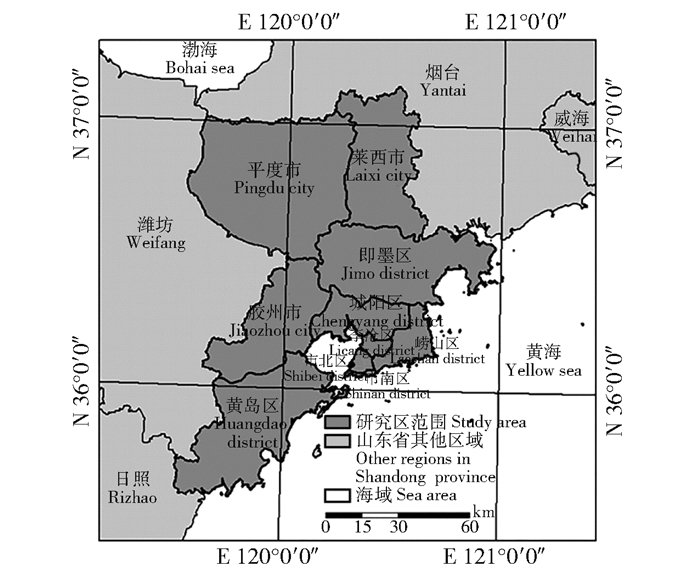
青岛市地处山东半岛南部,位于E 119°30′~121°00′、N 35°35′~37°09′,东、南濒临黄海,是中国沿海重要海岸带中心城市。青岛市森林、湿地、草地生态系统面积分别为1 628.53、1 103.21和218.36 km2,分别占青岛总面积的14.42%、9.77%和1.93%。2019年全市平均降水量421.6 mm,折合降水总量47.57亿m3;年平均气温12.2 ℃,最热的8月,平均气温25.1 ℃;最冷的1月,平均气温-1.2 ℃(图 1)。
2 材料与方法
2.1 数据处理
本研究数据主要来源于地理空间数据云(http://www.gscloud.cn/),笔者选取2005、2009、2014和2019年4期云量均<2%的Landsat TM/OLI系列卫星数据。为保证RSEI均值及其各分量指标计算的精准性,进行指标计算之前利用Envi 5.3对4期影像进行辐射定标、大气校正、几何校正、去条带等预处理。在此基础上,运用空间分析工具,获取2005—2019年青岛市生态质量等级变化数据,利用创建渔网工具,将网格信息与指标信息进行叠加分析,并提取网格中心点的数据,最后利用SPSS 24.0软件进行相关性分析。
2.2 RSEI指数计算
RSEI模型集合LST、NDVI、WET和NDBSI 4个分量指标。这4个指标能直观反映生态质量的优劣。LST与植被生长、农作物产量、城镇化等自然、人文现象及过程密切相关,代表热度[12];NDVI与植物生物量、叶面积指数以及植被覆盖度密切相关,代表绿度[13];湿度(WET)采用缨帽变换获得,可反映水体、土壤和植被的湿度[14];选用裸土指数和建筑指数的平均值来代表干度(NDBSI)[14]。由于4个分量指标具有不同的单位及量纲,所以将各指标进行归一化处理[12]。然后利用主成分分析法,将4个维度的数据进行综合处理,得到第1主成分(the first principal component,PC1),进而通过归一化处理得到遥感生态指数,其计算公式为
|
$
\begin{gathered}
I_0=1-\mathrm{PC} 1 ; \\
I=\left(I_0-I_{\min }\right) /\left(I_{\max }-I_{\min }\right){\rm{。}}
\end{gathered}
$
|
式中:I0为初始的生态指数;I为遥感生态指数;Imin为初始生态指数的最小值;Imax为初始生态指数的最大值。I值介于[0, 1]之间,值越高,代表生态质量越好,反之说明生态质量越差。
2.3 生态质量分级
根据《生态环境状况评价技术规范》中的分级标准,将I值划分为5个等级,即:生态质量差[0, 0.2)、较差[0.2, 0.4)、中等[0.4, 0.6)、良好[0.6, 0.8)、优秀[0.8, 1.0)。
3 结果与分析
3.1 生态质量RSEI模型检验
2005、2009、2014和2019年PC1的贡献度(荷载)分别为95.82%、97.83%、98.19%和98.52%,均>85%,表明PC1已集中4个分量指标的绝大多数特征信息,可用于构建RSEI模型。由表 1可知,I值与4个分量指标的相关系数均值为0.803,比相关系数最高的LST高6.9%,比最低的NDBSI高36.79%,比4个分量指标的平均值(0.667)高20.57%,显然,I值与各指标间的相关度更高,因此,利用RSEI模型来综合反映青岛市生态质量变化状况更为合理和准确[15]。
表 1(Tab. 1)
表 1 青岛市RSEI模型与各分量指标的相关系数矩阵
Tab. 1 Correlation matrix of RSEI and each index in Qingdao city
年份
Year |
指标
Index |
NDVI |
WET |
NDBSI |
LST |
I |
|
NDVI |
|
0.624 |
-0.535 |
-0.864 |
0.896 |
|
WET |
|
|
-0.472 |
-0.852 |
0.857 |
| 2005 |
NDBSI |
|
|
|
0.725 |
-0.742 |
|
LST |
|
|
|
|
-0.928 |
|
Mc |
0.674 |
0.649 |
0.577 |
0.814 |
0.856 |
|
NDVI |
|
0.712 |
-0.367 |
-0.904 |
0.946 |
|
WET |
|
|
-0.342 |
-0.889 |
0.805 |
| 2009 |
NDBSI |
|
|
|
0.114 |
-0.362 |
|
LST |
|
|
|
|
-0.939 |
|
Mc |
0.661 |
0.648 |
0.274 |
0.636 |
0.763 |
|
NDVI |
|
0.506 |
-0.960 |
-0.847 |
0.902 |
|
WET |
|
|
-0.169 |
-0.387 |
0.244 |
| 2014 |
NDBSI |
|
|
|
0.776 |
-0.867 |
|
LST |
|
|
|
|
-0.955 |
|
Mc |
0.771 |
0.354 |
0.635 |
0.670 |
0.742 |
|
NDVI |
|
0.678 |
-0.682 |
-0.800 |
0.841 |
|
WET |
|
|
-0.931 |
-0.890 |
0.766 |
| 2019 |
NDBSI |
|
|
|
0.965 |
-0.881 |
|
LST |
|
|
|
|
-0.920 |
|
Mc |
0.720 |
0.833 |
0.859 |
0.885 |
0.852 |
| Mc4 |
|
0.707 |
0.621 |
0.587 |
0.751 |
0.803 |
| 注:NDVI为绿度指标;WET为湿度指标;NDBSI为干度指标;LST为温度指标;Mc为平均相关度;Mc4为平均相关度的4年平均值。Notes:NDVI is the greenness index, WET is the humidity index. NDBSI is the dryness index and LST is the temperature index. Mc is the average correlation. Mc4 is the 4-year mean of mean correlation. |
|
表 1 青岛市RSEI模型与各分量指标的相关系数矩阵
Tab. 1 Correlation matrix of RSEI and each index in Qingdao city
|
3.2 生态质量时间变化特征
统计结果(表 2)显示,青岛市2005、2009、2014和2019年I均值分别为0.433、0.468、0.470和0.578,表明青岛市2005—2019年间生态质量呈现持续上升的趋势。其中2005—2009,2009—2014和2014—2019年的涨幅分别为8.0%、0.4%和22.9%。进一步分析发现,NDVI和WET为正值,对青岛市生态质量起正向作用,NDBSI和LST为负值,对生态质量起负向作用。
表 2(Tab. 2)
表 2 青岛市4个年份RSEI模型及各分量指标的统计值
Tab. 2 Statistics of RSEI models and each index in four years of Qingdao city
| 年份Year |
指标Index |
NDVI |
WET |
NDBSI |
LST |
I |
|
均值Mean |
0.611 |
0.558 |
0.396 |
0.430 |
0.433 |
| 2005 |
标准差Standard deviation |
0.126 |
0.111 |
0.151 |
0.100 |
0.097 |
|
对PC1载荷Load on PC1 |
0.548 |
0.596 |
-0.411 |
-0.419 |
— |
|
均值Mean |
0.633 |
0.620 |
0.483 |
0.578 |
0.468 |
| 2009 |
标准差Standard deviation |
0.137 |
0.075 |
0.145 |
0.077 |
0.091 |
|
对PC1载荷Load on PC1 |
0.598 |
0.599 |
-0.421 |
-0.367 |
— |
|
均值Mean |
0.642 |
0.685 |
0.536 |
0.519 |
0.470 |
| 2014 |
标准差Standard deviation |
0.290 |
0.033 |
0.241 |
0.234 |
0.121 |
|
对PC1载荷Load on PC1 |
0.572 |
0.602 |
-0.429 |
-0.397 |
— |
|
均值Mean |
0.740 |
0.749 |
0.472 |
0.467 |
0.578 |
| 2019 |
标准差Standard deviation |
0.204 |
0.158 |
0.157 |
0.078 |
0.077 |
|
对PC1载荷Load on PC1 |
0.634 |
0.656 |
-0.491 |
-0.466 |
— |
| 注:“—”表示I没有对PC1的荷载。Note: The “—” indicates that I has no load on PC1. |
|
表 2 青岛市4个年份RSEI模型及各分量指标的统计值
Tab. 2 Statistics of RSEI models and each index in four years of Qingdao city
|
对2005—2019年各等级所占面积和比例进行统计(表 3),结果发现,2005年青岛市生态质量等级以中等等级为主,其次是较差等级,优秀等级面积最少。2009年生态质量仍以中等等级为主,但较2005年增加29.15%,较差和差等级面积分别减少41.58%和67.70%。2014年中等等级面积相比2009年继续增加,良好和优秀等级面积分别增加161.35%和105.77%,较差和差等级面积分别减少81.79%和53.33%。到2019年,RSEI等级以中等和良好等级为主,生态质量良好等级的面积大幅增加,生态质量较差和差等级面积分别减少57.48%和45.03%。
表 3(Tab. 3)
表 3 青岛市2005—2019年各生态质量等级的面积和比例统计
Tab. 3 Statistics of areas and proportions of ecological quality grades in Qingdao city from 2005 to 2019
RSEI等级
RSEI level |
2005 |
|
2009 |
|
2014 |
|
2019 |
面积
Area/km2 |
|
面积
Area/km2 |
相比2005年变化
Compared with 2005/% |
|
面积
Area/km2 |
相比2009年变化
Compared with 2009/% |
|
面积
Area/km2 |
相比2014年变化
Compared with 2014/% |
| 差Poor [0, 0.2) |
50.68 |
|
16.37 |
-67.70 |
|
7.64 |
-53.33 |
|
4.20 |
-45.03 |
| 较差Inferior [0.2, 0.4) |
4 362.98 |
|
2 548.95 |
-41.58 |
|
464.11 |
-81.79 |
|
197.32 |
-57.48 |
| 中等Medium [0.4, 0.6) |
6 217.51 |
|
8 029.91 |
29.15 |
|
9 016.96 |
12.29 |
|
6 316.27 |
-29.95 |
| 良好Good [0.6, 0.8) |
618.04 |
|
673.53 |
8.98 |
|
1 760.27 |
161.35 |
|
4 699.74 |
166.99 |
| 优秀Excellent[0.8, 1.0) |
38.26 |
|
18.71 |
-51.10 |
|
38.50 |
105.77 |
|
69.93 |
81.64 |
| 合计Total |
11 287.47 |
|
11 287.47 |
|
|
11 287.47 |
|
|
11 287.47 |
|
|
表 3 青岛市2005—2019年各生态质量等级的面积和比例统计
Tab. 3 Statistics of areas and proportions of ecological quality grades in Qingdao city from 2005 to 2019
|
3.3 生态质量空间分布特征
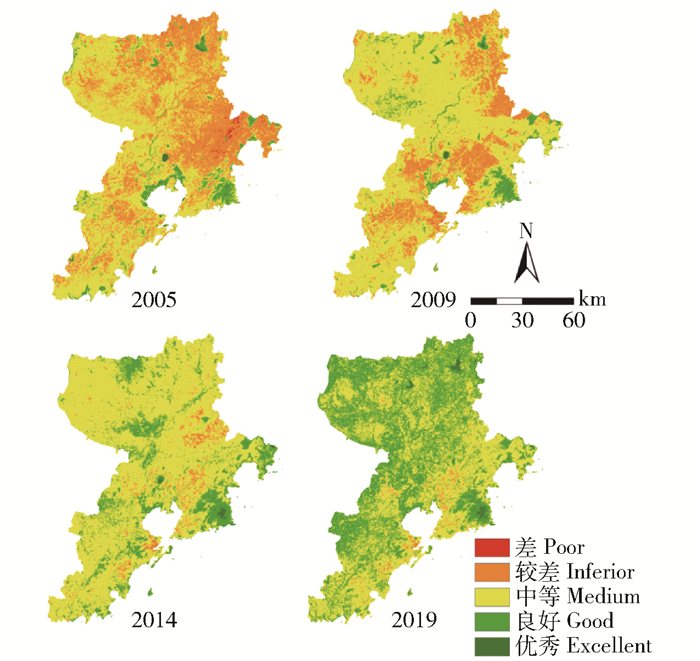
2005—2019年青岛市生态质量总体分布状况如图 2所示,2005年青岛市生态质量等级以中等和较差为主,中等等级分布在青岛市西部的胶州市、平度市,较差及差等级分布在即墨区及平度市东部。2009年中等等级面积大幅增加,主要分布在即墨区和黄岛区南部,较差及差等级分布在青岛市中部的城阳区、黄岛区北部。2014年中等等级占青岛市的绝大部分,良好及以上等级面积持续增加,主要分布在崂山区、即墨区东部。到2019年青岛市生态质量等级以良好和中等为主,分布较为均匀,较差及差等级主要集中在青岛市的中心城区。
由表 4可知,2005—2019年间,青岛市生态质量保持不变的区域面积为4 129.680 km2,占总面积的33.70%;生态质量状况提升的区域面积为7 896.754 km2,占64.43%,以等级增加一级为主;生态质量状况下降的地区面积为229.236 km2,只占总面积的1.87%。
表 4(Tab. 4)
表 4 青岛市2005—2019年生态质量等级转移变化
Tab. 4 Changes of ecological quality grades in Qingdao city from 2005 to 2019
类别
Category |
级差
Level change |
级差面积
Level area/km2 |
类面积
Category area/km2 |
类面积比例
Percentage/% |
| 变差Worsening |
-4 |
0 |
229.236 |
1.87 |
| -3 |
1.307 |
| -2 |
7.835 |
| -1 |
220.094 |
| 不变Unchanging |
0 |
4 129.680 |
4 129.680 |
33.70 |
| 变好Becoming better |
1 |
6 432.866 |
7 896.754 |
64.43 |
| 2 |
1 460.342 |
| 3 |
3.540 |
| 4 |
0.006 |
| 注:级差:生态质量等级变化的差值(例:-4代表生态质量等级由优秀变为差);级差面积:每个级差对应区域所占面积;类面积:3个类别分别所占面积。Notes: Level change: The difference in the change of eco-environmental quality grade (for example: -4 indicates that the eco-environmental grade changes from excellent to poor). Level area: Area occupied by the corresponding region of each level difference. Category area: Area occupied by the three categories respectively. |
|
表 4 青岛市2005—2019年生态质量等级转移变化
Tab. 4 Changes of ecological quality grades in Qingdao city from 2005 to 2019
|
4 讨论
4.1 各分量指标荷载值的变化特点
指标因子权重受所评价地区的地貌、人类活动、经济、政策等因素综合影响。对不同区域生态质量进行分析时,指标因子的荷载也会不同。罗春等[16]在研究常宁市生态变化时得出,植被状况对常宁市的生态质量起决定性作用;王东升等[13]研究阜新市的生态环境时指出植被状况及热度对阜新市生态质量的影响最大,湿度的影响最小。笔者研究表明,对青岛市生态质量影响最大的是湿度和绿度,其次是干度,影响最小的是热度。这与青岛市的地理位置密切相关,青岛市属海岸带城市,受海洋气候影响较大,常年空气湿度较大。
4.2 自然及人为因素对青岛市生态质量的影响
2005—2019年青岛市生态环境呈逐渐变好的趋势。这与青岛市水土保持生态修复与生态保护政策的推动是密不可分的。2005年青岛市在崂山区等5个地区建设全国生态示范区,并在全市开展环保专项行动,缓解城市热岛效应,使生态质量大幅提升。自2008年开始,由于许多大规模的修路筑坝、填海造地等不合理的土地围垦以及大面积的湿地规划为城市建设用地,使得湿地生态环境遭到破坏[17]。为缓解城市化对湿地造成的破坏,政府出台“环湾保护行动”计划,解决环湾区域突出的环境问题,改善环湾区域生态环境。至2013年,青岛市推进“国家森林城市”建设,开展大规模植树绿化和水土保持生态修复工程,有效修复城乡生态环境,增加植被覆盖率。2019年,在加快发展现代林业,建设绿色青岛的同时,推进“海绵城市”的建设[18],缓解城市雨岛效应,实现雨水资源的充分利用和生态环境平衡。
5 结论
1) 湿度和绿度对青岛市的生态质量影响最大,在未来的城市开发建设中,通过构建各级公园、公共绿地等,有效提升植被覆盖度,增强城市的水土保持能力。
2) 青岛市生态质量总体呈上升趋势,空间分布呈郊区优于中心城区的格局。生态质量恶化区域集中分布在胶州湾北部、西部沿海区域,生态质量改善的区域主要分布于即墨区,莱西市、平度市北部以及黄岛区和胶州市的交界处。
3) 由于海岸带城市生态系统的形成受多种因素的影响,遥感生态指数在一定程度上无法全面反映海岸带的生态质量。在今后研究中,需要结合多方面生态要素进行综合分析。
6 参考文献
| [1] |
赵其国, 黄国勤, 马艳芹. 中国生态环境状况与生态文明建设[J]. 生态学报, 2016, 36(19): 6328. ZHAO Qiguo, HUANG Guoqin, MA Yanqin. The ecological environment conditions and construction of an ecological civilization in China[J]. Acta Ecologica Sinica, 2016, 36(19): 6328. |
| [2] | |
| [3] |
孙从建, 李晓明, 张文强, 等. 基于遥感信息的吕梁山贫困区生态安全评价[J]. 中国环境科学, 2019, 39(12): 5352. SUN Congjian, LI Xiaoming, ZHANG Wenqiang, et al. Evaluation of ecological security in poverty-stricken region of Lüliang Mountain based on the remote sensing image[J]. China Environmental Science, 2019, 39(12): 5352. |
| [4] | |
| [5] |
REN Yin, WEI Xiaohua, WANG Darui, et al. Linking landscape patterns with ecological functions: A case study examining the interaction between landscape heterogeneity and carbon stock of urban forests in Xiamen, China[J]. Forest Ecology and Management, 2013, 293: 122. DOI:10.1016/j.foreco.2012.12.043 |
| [6] |
GIMENEZ M G, DE JONG R, DELLA P R, et al. Determination of grassland use intensity based on multi-temporal remote sensing data and ecological indicators[J]. Remote Sensing of Environment: An Interdisciplinary Journal, 2017, 45(198): 126. |
| [7] |
魏雨涵, 钱建平, 范伟伟, 等. 基于RSEI的漓江流域生态环境质量动态监测[J]. 中国水土保持科学, 2021, 19(1): 122. WEI Yuhan, QIAN Jianping, FAN Weiwei, et al. Dynamic monitoring of ecological environment quality in Lijiang River Basin based on RSEI[J]. Science of Soil and Water Conservation, 2021, 19(1): 122. |
| [8] | |
| [9] |
杨江燕, 吴田, 潘肖燕, 等. 基于遥感生态指数的雄安新区生态质量评估[J]. 应用生态学报, 2019, 30(1): 277. YANG Jiangyan, WU Tian, PAN Xiaoyan, et al. Ecological quality assessment of Xiong'an New Area based on remote sensing ecological index[J]. Chinese Journal of Applied Ecology, 2019, 30(1): 277. |
| [10] |
何晔宇, 匡耀求. 基于驱动力-压力-状态-影响-响应模型的粤港澳大湾区惠州海岸带生态安全评价分析[J]. 环境污染与防治, 2020, 42(3): 362. HE Yeyu, KUANG Yaoqiu. Evaluation and analysis of ecological security of coastal zone in Huizhou of Guangdong-Hong Kong-Macao Greater Bay Area based on DPSIR model[J]. Environmental Pollution & Control, 2020, 42(3): 362. |
| [11] |
崔昊天, 贺桂珍, 吕永龙, 等. 海岸带城市生态承载力综合评价: 以连云港市为例[J]. 生态学报, 2020, 40(8): 2567. CUI Haotian, HE Guizhen, LV Yonglong, et al. Integrated assessment of ecological carrying capacity in coastal cities: A case study in Lianyungang city[J]. Acta Ecologica Sinica, 2020, 40(8): 2567. |
| [12] | |
| [13] |
王东升, 王小磊, 雷泽勇. 基于遥感生态指数的阜新市生态质量评估[J]. 生态科学, 2020, 39(3): 88. WANG Dongsheng, WANG Xiaolei, LEI Zeyong. Ecological change assessment of Fuxin based on remote sensing ecological index[J]. Ecological Science, 2020, 39(3): 88. |
| [14] |
LI Ning, WANG Jiayao, QIN Fen. The improvement of ecological environment index model RSEI[J]. Arabian Journal of Geosciences, 2020, 13(12). |
| [15] | |
| [16] | |
| [17] | |
| [18] |
张辛华, 韩哲, 王睿, 等. 践行绿色发展理念建设会呼吸的城市: 青岛国际经济合作区海绵城市建设实践[J]. 建设科技, 2019(19): 75. ZHANG Xinhua, HAN Zhe, WANG Rui, et al. Implementing the concept of green development and building a breathing city: Construction practice of sponge city in Qingdao International[J]. Construction Science and Technology, 2019(19): 75. |
 2022, Vol. 20