文章快速检索     高级检索
  中国水土保持科学   2022, Vol. 20 Issue (6): 1-7.  DOI: 10.16843/j.sswc.2022.06.001
0

引用本文 

郭小雪, 田鹏, 杜敏, 赵广举, 穆兴民, 高鹏, 卢小燕. 黄土高塬沟壑区典型小流域不同雨型水沙关系特征[J]. 中国水土保持科学, 2022, 20(6): 1-7. DOI: 10.16843/j.sswc.2022.06.001.
GUO Xiaoxue, TIAN Peng, DU Min, ZHAO Guangju, MU Xingmin, GAO Peng, LU Xiaoyan. Relationship between runoff and sediment under different rainfall patterns in the small watershed on the tableland-gully region of the Loess Plateau[J]. Science of Soil and Water Conservation, 2022, 20(6): 1-7. DOI: 10.16843/j.sswc.2022.06.001.

项目名称

国家自然科学基金“黄土高塬沟壑区对比小流域植被恢复对水沙变化的驱动机制”(42177323);国家自然科学基金委黄河水科学研究联合基金“黄土高原水土保持措施潜力及其对河流水沙的调控机制”(U2243211);国家科技基础资源调查项目“中国南北过渡带综合科学考察”(2017FY100904)

第一作者简介

郭小雪(1996—), 女, 硕士研究生。主要研究方向: 流域水沙过程与土壤侵蚀。E-mail: nwafugxx@163.com

通信作者简介

田鹏(1982—), 女, 博士, 副教授。主要研究方向: 流域水沙过程与水土保持。E-mail: pengtian@nwsuaf.edu.cn

文章历史

收稿日期:2021-08-30
修回日期:2022-04-29
黄土高塬沟壑区典型小流域不同雨型水沙关系特征
郭小雪 1, 田鹏 2, 杜敏 3, 赵广举 1,3, 穆兴民 1,3, 高鹏 1,3, 卢小燕 4     
1. 西北农林科技大学 水土保持研究所 黄土高原土壤侵蚀与旱地农业国家重点实验室, 712100, 陕西杨凌;
2. 西北农林科技大学资源环境学院, 712100, 陕西杨凌;
3. 中国科学院 水利部 水土保持研究所, 712100, 陕西杨凌;
4. 内蒙古自治区鄂尔多斯水文勘测局, 017020, 内蒙古鄂尔多斯
摘要:探究不同降雨类型下流域产流产沙特征及水沙关系, 以黄土高塬沟壑区杨家沟小流域作为研究区, 采用K-means聚类算法和判别分析法对流域1981—2010年的184场次降雨事件进行分类, 用幂函数方法探究不同降雨类型的水沙关系特征。杨家沟小流域年径流量和输沙量都呈现显著减少趋势(P < 0.01), 相较1981—1989年, 二者在1990—2010年的均值分别减少50.32%和55.64%。场次降雨事件可划分为3种类型: A雨型(小雨量、中历时、中降雨强度)、B雨型(大雨量、长历时、小降雨强度)和C雨型(中雨量、短历时、大降雨强度), 其中A雨型是流域产流产沙的主要降雨类型。幂函数能较好地拟合不同雨型的径流深和输沙模数关系, A雨型的拟合效果优于B雨型。降雨量减少和植被覆盖率增加是杨家沟流域径流量及输沙量减少的主要原因, 降雨量、降雨强度、降雨历时对流域产流产沙能力有重要影响。
关键词降雨类型    产流产沙    水沙关系    黄土高塬沟壑区    杨家沟小流域    
Relationship between runoff and sediment under different rainfall patterns in the small watershed on the tableland-gully region of the Loess Plateau
GUO Xiaoxue 1, TIAN Peng 2, DU Min 3, ZHAO Guangju 1,3, MU Xingmin 1,3, GAO Peng 1,3, LU Xiaoyan 4     
1. State Key Laboratory of Soil Erosion and Dryland Farming on the Loess Plateau, Institute of Soil and Water Conservation, Northwest A&F University, 712100, Yangling, Shaanxi, China;
2. College of Natural Resources and Environment, Northwest A&F University, 712100, Yangling, Shaanxi, China;
3. Institute of Soil and Water Conservation, Chinese Academy of Sciences and Ministry of Water Resources, 712100, Yangling, Shaanxi, China;
4. Hydrological Survey Bureau of Ordos City of Inner Mongolia, 017020, Ordos, Inner Mongolia, China
Abstract: [Background] The Loess Plateau, one of the most severe soil erosive areas in the world, is discharging large amounts of sediment to the Yellow River, resulting in serious sedimentation of the downstream channel. Assessing the relationships between rainfall, runoff, and sediment in the watershed may provide critical insights for understanding hydrological and soil erosion processes which are vital to sustainable management of watershed. This study attempts to analyze characteristics of runoff and sediment yield and their relationship with different rainfall patterns in the Yangjiagou watershed on the tableland-gully region of the Loess Plateau. [Methods] This study applied the K-means clustering method and discriminant analysis method, and the rainfall events were classified using the runoff and sediment load data of the 184 rainfall events in the Yangjiagou watershed during 1981-2010. The power function was used to analyze the relationship of runoff and sediment. [Results] Annual runoff and sediment load demonstrated significant decreasing trend (P < 0.01). Average annual value of the runoff and sediment load decreased by 50.32% and 55.64% in 1990-2010 compared to those during 1981-1989, respectively. The rainfall events were divided into three patterns. Pattern A was characterized by low rainfall amount (13.30-29.20 mm), medium duration (4.00-12.63 h) and medium rainfall intensity (1.80-5.00 mm/h). It included 149 rainfall events, accounting for 81% of the total rainfall events. Pattern B comprised of 32 rainfall events, accounting for 17%, which were characterized by high rainfall amount (48.73-75.05 mm), long duration (24.38-38.31 h) and low rainfall intensity (1.32-2.73 mm/h). Only 3 rainfall events belonged to pattern C, accounting for 2% of the total, and was characterized by medium rainfall amount (15.45-60.85 mm), short duration (0.57-4.40 h) and heavy rain intensity (27.65-38.60 mm/h). Pattern A was major rainfall pattern in the studied watershed, pattern B was similar to pattern A, and pattern C was extreme rainfall events. The proportions of the accumulated rainfall, runoff and sediment load among different rainfall patterns followed the order: pattern A>pattern B>pattern C. The runoff and sediment yield were mainly contributed by pattern A. The relationship of runoff and sediment transport modulus was well fitted by the power function with the best fit of pattern. [Conclusions] The results reveal the basic characteristics of runoff and sediment yield for different rainfall patterns. Different rainfall patterns cause strong impact on runoff and sediment yield, and there was the strongest runoff and sediment yield capacity in pattern C, followed by pattern A and B. Decreased rainfall and increased vegetation cover result in the reduction of runoff and sediment yield in the studied watershed. The rainfall amount, duration and intensity significantly affect runoff and sediment yield.
Keywords: rainfall pattern    runoff and sediment    relationship between runoff and sediment    tableland-gully region of Loess Plateau    Yangjiagou watershed    

黄土高原地处我国西北部,水力侵蚀剧烈,水土流失严重,入黄泥沙约占黄河输沙量的90%[1]。黄土高塬沟壑区位于黄土高原南部,是黄土高原的主要侵蚀产沙区,该区年降水量集中,且植被覆盖率较低、土质疏松,加之塬面汇水冲刷、沟头下切等,使区域土壤侵蚀更为严重,是黄河泥沙的主要源区之一[2]。王万忠等[3]对黄土高原地区降雨与侵蚀产沙的调查研究发现,降雨引起的侵蚀量占总流失量的80%;因此,研究降雨特征对黄土高塬沟壑区产流产沙的影响具有重要意义。因降雨量、降雨历时和降雨强度等特征差异,不同降雨类型对流域产流产沙具有显著的影响[4-7]。目前,关于不同降雨类型产流产沙研究多见于黄土丘陵沟壑区和南方红壤区。晏清洪等[8]将黄土区桥子东沟流域的降雨事件划分为4种类型,其中大雨量、高降雨强度的场次降雨事件产流产沙能力最大。秦伟等[9]采用聚类分析的方法将红壤裸露坡地次降雨划分为3种雨型,结果表明短历时、高降雨强度、小雨量的降雨事件是引起该地区土壤侵蚀的主要降雨类型。但在黄土高塬沟壑区仍缺少在降雨类型划分的基础上研究不同雨型对产流产沙的影响。鉴于此,笔者选取黄土高塬沟壑区典型小流域杨家沟为研究区,基于流域1981—2010年长时间序列实测径流泥沙数据,通过多种数理统计方法对流域场次降雨事件进行分类,分析不同降雨类型下的产流产沙特征,识别该区产流产沙的主要降雨类型,以期为深入理解黄土高塬沟壑区次降雨产流产规律提供理论支撑。

1 研究区概况

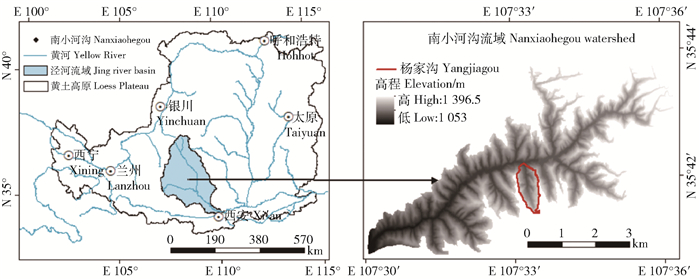
杨家沟流域是甘肃省庆阳市南小河沟流域(E 107°30′~107°37′,N 35°41′~35°44′)的一条支沟(图 1),位于泾河支流蒲河左岸[10],是黄河水利委员会西峰水土保持科学试验站于20世纪中期设立的黄土高塬沟壑区典型原型观测小流域。流域面积为0.87 km2,该区属半干旱大陆性季风气候[11],多年平均降雨量556 mm,年内降水分布极不均匀,5—9月降雨量占全年降雨量的60%以上。自1954年开始,杨家沟流域实施人工造林种草措施,主要以刺槐(Robinia pseudoacacia)、山杏(Armeniaca sibirica)为主,截至2014年,林草地面积达到流域总面积的82.6% [12]。自1958年至今,杨家沟流域土地利用方式未发生较大改变[13]

图 1 研究区域地理位置 Fig. 1 Geological location of the study area
2 数据与方法 2.1 数据来源

考虑到研究数据的准确性、完整性及连续性,笔者选取杨家沟流域雨量站的降水观测数据及径流站的径流泥沙观测数据,数据年限为1981—2010年汛期(5—9月),数据发布前经过多次人工校核,确保数据质量准确、可靠。依据将能够引起坡面小区产流产沙的降雨视为侵蚀性降雨的标准[14],笔者筛选得到184场次降雨事件。数据由黄河水利委员会西峰水土保持科学试验站监测,资料通过国家冰川冻土沙漠科学中心获取(http://www.ncdc.ac.cn)。

2.2 研究方法 2.2.1 次降雨类型划分

以杨家沟流域184场次降雨事件作为样本,以次降雨量(P)、降雨历时(D)和平均降雨强度(I)为特征指标,采用K-means聚类算法[15]对次降雨事件进行类型的划分,采用Fisher's判别函数确定最优聚类[16]。不同降雨类型的分类函数如下:

$D_{\mathrm{A}} =-0.275 P-0.710 D-0.295 I-1.264 ;$ (1)
$D_{\mathrm{B}} =-1.880 P+2.478 D-0.490 I-4.553 ;$ (2)
$D_{\mathrm{C}} =-6.418 P+8.374 D+19.856 I-54.742。$ (3)

式中:DADBDC为不同降雨类型的分类得分;P为降雨量,mm;D为降雨历时,h;I为降雨强度,mm/h。

2.2.2 径流-泥沙关系曲线

采用幂函数方法分析杨家沟流域不同降雨类型的输沙模数和径流深关系:

$M_{\mathrm{s}}=a H^b \text{。}$ (4)

式中:Ms为输沙模数,t/km2H为径流深,mm;ab为拟合曲线的系数,量纲为1。

3 结果与分析 3.1 杨家沟流域径流和输沙年际变化趋势特征

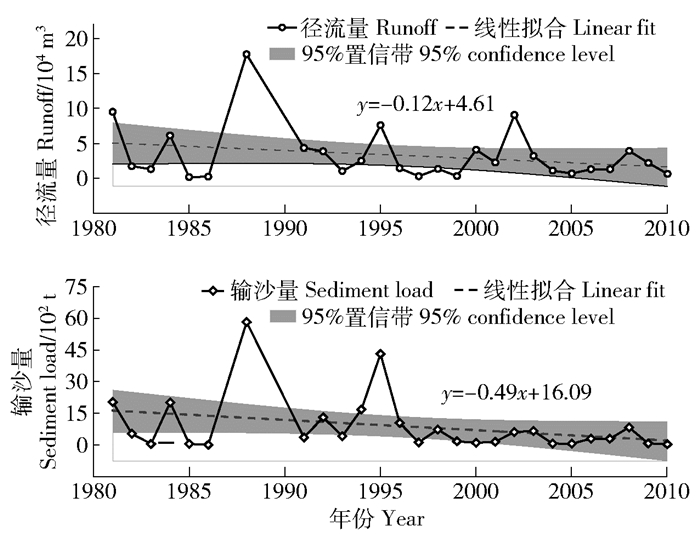
图 2为杨家沟流域1981—2010年径流量和输沙量的变化趋势。可见,流域径流量和输沙量分别以-0.12×10⁴ m3/a和-0.49×102 t/a的速率呈整体减少趋势,但在1988年受极端暴雨影响出现较高的峰值。进一步采用Spearman趋势检验法进行统计分析,径流量和输沙量减少趋势显著(P<0.01)。对比1990年前后的径流量和输沙量发现,径流量由5.21万m3减少至2.59万m3,减幅达50.32%,输沙量由1 496.29 t减少至663.72 t,减幅达55.64%。

图 2 1981—2010年杨家沟流域径流和输沙变化趋势 Fig. 2 Runoff and sediment load variations during 1981-2010 in the Yangjiagou watershed
3.2 次降雨类型划分及统计特征

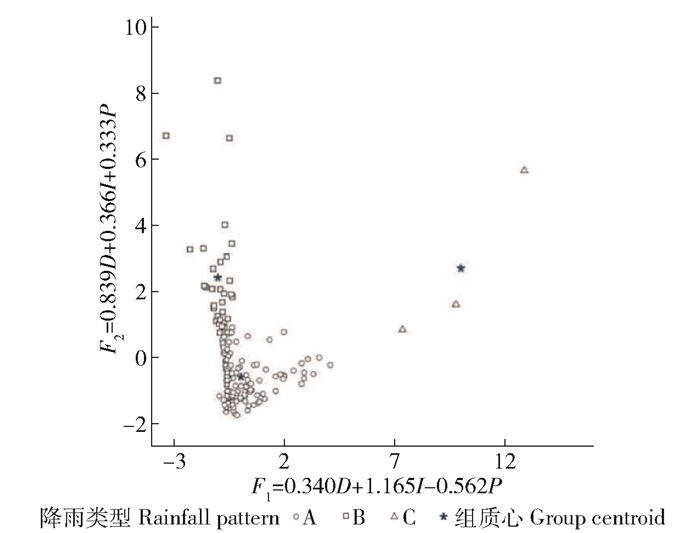
通过K-means聚类算法和判别分析法将流域184场次降雨分为A、B、C 3类(图 3)。不同雨型中,C雨型的判别函数散点相对较为分散,且与A、B雨型的散点分布存在明显分界,而A、B雨型的判别函数散点相对比较密集且边界相接。散点的分布位置表明A、B雨型部分事件的雨情较为相似,但与C雨型的降雨特征差异明显,由此表明C雨型为极端降雨事件类型。

F1F2为Fisher's判别函数;不同形状的点分别为不同降雨类型的判别函数散点。 F1 and F2 are the Fisher's discriminant function. Points with different shapes represent scatter of the discriminant function for different rainfall patterns. P: Rainfall, mm. D: Duration of rainfall, h. I: Rainfall intensity, mm/h. The same below. 图 3 杨家沟流域次降雨雨型判别分类散点图 Fig. 3 Scatter diagram of individual rainfall discrimination and classification in the Yangjiagou watershed

表 1可知,研究区主要降雨类型为A雨型,共包括149场降雨事件,其占总降雨场次的81%,为小雨量(13.30~29.20 mm)、中历时(4.00~12.63 h)、中降雨强度(1.80~5.00 mm/h)降雨;其次为B雨型,共包括32场降雨事件,其场次比例为17%,为大雨量(48.73~75.05 mm)、长历时(24.38~38.31 h)、小降雨强度(1.32~2.73 mm/ h)降雨;而C雨型出现频次最少,仅包括3场降雨事件,其场次比例仅为2%,为中雨量(15.45~60.85 mm)、短历时(0.57~4.40 h)、大降雨强度(27.65~38.60 mm/ h)降雨。

表 1 杨家沟流域不同降雨类型特征表 Tab. 1 Characteristics of different rainfall patterns in the Yangjiagou watershed
3.3 不同降雨类型的径流和输沙特征分析

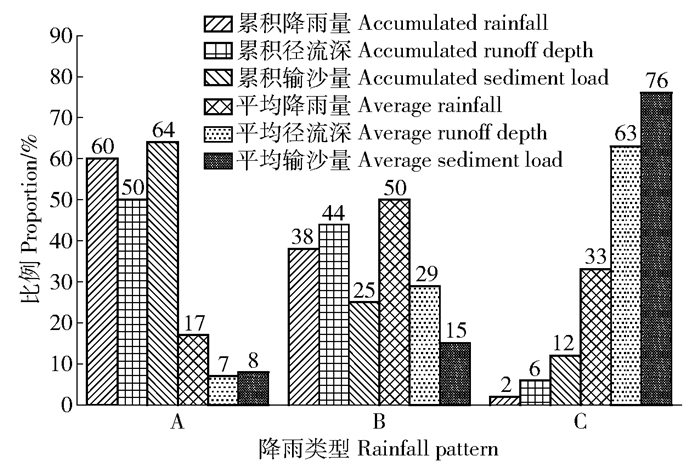
分析流域不同降雨类型的降雨量、径流深和输沙量的平均值及累积值占总降雨事件的比例,结果如图 4所示。A雨型的累积值所占比例都最大,但是其平均值所占比例都最小;B雨型的累计值所占的比例居中,但其平均降雨量所占比例最大;C雨型的累计值所占的比例都较小,平均径流深和平均输沙量所占比例都较大。该结果表明:A雨型对杨家沟流域多年产流产沙的贡献较高,其次是B雨型,C雨型是出现频次最少的降雨类型,但其平均径流深和输沙量所占比例都最高。由此表明,短历时强降雨频次较低的降雨类型对产流产沙的影响同样不容小觑。

图 4 不同降雨类型的降雨量、径流深和输沙量所占比例 Fig. 4 Proportion of rainfall, runoff depth and sediment load under different rainfall patterns
3.4 不同降雨类型的水沙关系

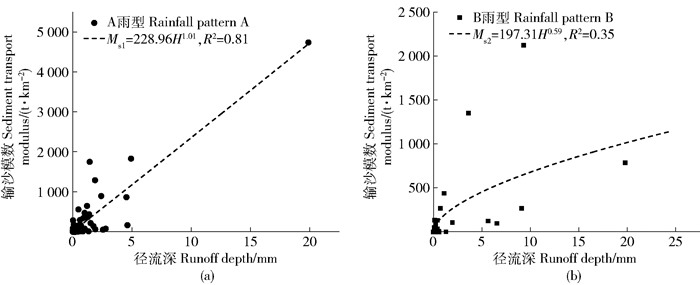
采用幂函数对不同雨型下径流深和输沙模数进行拟合,由于C雨型只有3场次降雨事件,样本数太少故不进行曲线拟合。如图 5所示,分别为A和B雨型的径流深—输沙模数的关系曲线,幂函数能较好地拟合A雨型的径流深和输沙模数关系,决定系数>0.8,表明A雨型具有较好的水沙关系。B雨型较A雨型具有较差的水沙关系拟合效果,决定系数仅为0.35,表明B雨型的水沙关系较差。

图 5 不同降雨类型的径流深和输沙模数曲线拟合 Fig. 5 Curve fitting of runoff depth and sediment transport modulus under different rainfall patterns
4 讨论

杨家沟流域在1981—2010年间径流量和输沙量整体呈现出下降趋势,这与袁静等[17]通过对比分析杨家沟和董庄沟流域径流及泥沙变化的研究结果相一致。分析研究区的气候要素特征变化发现,杨家沟流域在1981—2010年间降雨量呈减小趋势[18],同时,流域实施大规模的植树造林种草,植被覆盖度显著提升。由于植被林冠层的截留和地下根系的固结作用,流域径流量和输沙量呈现减少的趋势。笔者发现不同降雨类型对流域产流产沙的能力具有一定的影响,其中研究区的产流产沙贡献最多是A雨型,原因是由于A雨型为流域的主要降雨类型,其发生频次最多且累计降雨量所占比例最高,但是其平均径流深和输沙量所占比例都最小。这是由于A雨型具有小雨量、中降雨强度的特征,场次事件的降雨强度大多未超过土壤的下渗速率,导致地面产生的径流量较小,径流不仅是流域坡面和沟道侵蚀产沙的根本动力,而且是侵蚀泥沙输移的主要载体[19],因此A雨型的单场次事件的产沙量较其他2种雨型低。不同雨型的水沙关系存在差异,A雨型相比B雨型具有较好的水沙关系,这是由于B雨型降雨具有小降雨强度的特征,其单一场次产生的径流量和输沙量都较小,且水沙关系更容易受到植被拦蓄的影响[20]

5 结论

1) 在1981—2010年间,由于杨家沟流域降雨量减少以及植被覆盖率的增加导致流域径流量和输沙量呈现出显著下降趋势。

2) 研究区场次降雨事件可划分为3类:A雨型(小雨量、中历时、中降雨强度)、B雨型(大雨量、长历时、小降雨强度)、C雨型(中雨量、短历时、大降雨强度)。其中A雨型为杨家沟流域的主要降雨类型,由于该降雨类型发生频次较多,对流域产流产沙的贡献比例最高,其次是B雨型。

3) 幂函数能较好地拟合杨家沟流域不同雨型的径流深和输沙模数关系,A雨型的拟合度优于B雨型。

6 参考文献
[1]
任美锷, 史运良. 黄河输沙及其对渤海、黄海沉积作用的影响[J]. 地理科学, 1986, 6(1): 1.
REN Meie, SHI Yunliang. Sediment discharge of the Yellow River and its effect on sedimentation of the Bohai and Yellow sea[J]. Scientia Geographica Sinica, 1986, 6(1): 1.
[2]
DU Min, MU Xingmin, ZHAO Guangju, et al. Changes in runoff and sediment load and potential causes in the Malian river basin on the Loess Plateau[J]. Sustainability, 2021, 13(2): 443. DOI:10.3390/su13020443
[3]
王万忠, 焦菊英. 黄土高原降雨侵蚀产沙与黄河输沙[M]. 北京: 科学出版社, 1996: 121.
WANG Wanzhong, JIAO Juying. Rainfall and erosion sediment yield in the Loess Plateau and sediment transportation in the Yellow River basin[M]. Beijing: Science Press, 1996: 121.
[4]
BAGAGIOLO G, BIDDOCCU M, RABINO D, et al. Effects of rows arrangement, soil management, and rainfall characteristics on water and soil losses in Italian sloping vineyards[J]. Environmental Research, 2018, 166: 695.
[5]
FERREIRA C S S, KEIZER J J, SANTOS L M B, et al. Runoff, sediment and nutrient exports from a Mediterranean vineyard under integrated production: An experiment at plot scale[J]. Agriculture, Ecosystems and Environment, 2018, 256: 190.
[6]
WEI Wei, CHEN Liding, FU Bojie, et al. The effect of land uses and rainfall regimes on runoff and soil erosion in the semi-arid loess hilly area, China[J]. Journal of Hydrology, 2006, 335(3/4): 252.
[7]
FANG Nufang, SHI Zhihua, LI Lu, et al. The effects of rainfall regimes and land use changes on runoff and soil loss in a small mountainous watershed[J]. Catena, 2012, 99(4): 1.
[8]
晏清洪, 原翠萍, 雷廷武, 等. 降雨类型和水土保持对黄土区小流域水土流失的影响[J]. 农业机械学报, 2014, 45(2): 169.
YAN Qinghong, YUAN Cuiping, LEI Tingwu, et al. Effects of precipitation and erosion control practices on the rainfall-runoff-sediment delivery relationships of typical watersheds in the hilly-gully region on the Loess Plateau[J]. Transactions of CSAM, 2014, 45(2): 169.
[9]
秦伟, 左长清, 晏清洪, 等. 红壤裸露坡地次降雨土壤侵蚀规律[J]. 农业工程学报, 2015, 31(2): 124.
QIN Wei, ZUO Changqing, YAN Qinghong, et al. Regularity of individual rainfall soil erosion in bare slope land of red soil[J]. Transactions of the CSAE, 2015, 31(2): 124. DOI:10.3969/j.issn.1002-6819.2015.02.018
[10]
李蓝君, 宋孝玉, 夏露, 等. 黄土高原沟壑区典型造林树种蒸散发对气候变化的响应[J]. 农业工程学报, 2018, 34(20): 149.
LI Lanjun, SONG Xiaoyu, XIA Lu, et al. Response of evaporation and transpiration of typical afforestation tree species to climate changes in gully region of Loess Plateau[J]. Transactions of the CSAE, 2018, 34(20): 149.
[11]
陈卓鑫, 王文龙, 郭明明, 等. 黄土高塬沟壑区植被恢复对不同地貌部位土壤可蚀性的影响[J]. 自然资源学报, 2020, 35(2): 389.
CHEN Zhuoxin, WANG Wenlong, GUO Mingming, et al. Effects of vegetation restoration on soil erodibility on different geomorphological locations in the loess-tableland and gully region of the Loess Plateau[J]. Journal of Natural Resources, 2020, 35(2): 389.
[12]
夏露, 宋孝玉, 符娜, 等. 陇东黄土塬区不同下垫面条件下侵蚀产沙的降雨阈值[J]. 水科学进展, 2018, 29(6): 829.
XIA Lu, SONG Xiaoyu, FU Na, et al. Threshold standard of erosive rainfall under different underlying surface conditions in the Loess Plateau Gully Region of East Gansu, China[J]. Advances in Water Science, 2018, 29(6): 829.
[13]
陶敏, 陈喜. 黄土高塬沟壑区覆被变化生态水文效益分析[J]. 人民黄河, 2015, 37(3): 97.
TAO Min, CHEN Xi. Afforestation influence on soil moisture dynamics and runoff in the Loess Plateau[J]. Yellow River, 2015, 37(3): 97.
[14]
高磊, 饶良懿, 崔飞波, 等. 太行山土石山区侵蚀性降雨对典型植物措施产流产沙的影响[J]. 水土保持学报, 2017, 31(1): 7.
GAO Lei, RAO Liangyi, CUI Feibo, et al. Effect of erosive rainfall on runoff and sediment yield of typical plant measures in rocky mountain areas of Taihang[J]. Journal of Soil and Water Conservation, 2017, 31(1): 7.
[15]
MACQUEEN J. Some methods for classification and analysis of multivariate observations[J]. Berkeley Symposium on Mathematical Statistics and Probability, 1967, 1(14): 282.
[16]
HU Jinfei, GAO Peng, MU Xingmin, et al. Runoff-sediment dynamics under different flood patterns in a Loess Plateau catchment, China[J]. Catena, 2019, 173: 236.
[17]
袁静, 郜文旺, 袁文博. 典型对比小流域降水特征及其对径流泥沙的影响: 以南小河沟流域为例[J]. 中国水土保持, 2021(9): 43.
YUAN Jing, GAO Wenwang, YUAN Wenbo. Influence of precipitation on runoff and sediment of typical contrast small watershed: A case study of Nanxiaohegou watershed[J]. Soil and Water Conservation in China, 2021(9): 43.
[18]
王陇, 宋孝玉, 李蓝君, 等. 黄土高原沟壑区典型小流域径流变化趋势及归因分析[J]. 水土保持研究, 2021, 28(4): 48.
WANG Long, SONG Xiaoyu, LI Lanjun, et al. Variation trend and attribution analysis of runoff in typical small watershed in gully region of the loess[J]. Research of Soil and Water Conservation, 2021, 28(4): 48.
[19]
程然然. 黄土丘陵区两典型天然林和人工林生态水文过程研究[D]. 陕西杨凌: 中国科学院大学(中国科学院教育部水土保持与生态环境研究中心), 2020: 35.
CHENG Ranran. Eco-hydrological processes in the two typical natural forests and artificial forests in the loess hilly region of China[D]. Yangling, Shaanxi: University of Chinese Academy of Sciences (Research Center of Soil and Water Conservation and Ecological Environment, Chinese Academy of Sciences and Ministry of Education), 2020: 35.
[20]
韩向楠. 泾河流域水沙时空分异特征及其影响因素分析[D]. 重庆: 西南大学, 2019: 40.
HAN Xiangnan. Spatial and temporal variation of runoff and sediment in Jing river basin and the influencing factors[D]. Chongqing: Southwest University, 2019: 40.