主要DEM数据在陕西省水土流失动态监测中的适宜性分析
张发民

,
杨恺

,
李雄飞
,
刘政鸿
,
王传明
,
王蓉
陕西省水土保持勘测规划研究所(陕西省水土保持生态环境监测中心), 710004, 西安
收稿日期:2021-12-21; 修回日期:2022-04-22
项目名称:陕西省水利厅陕西省水保所(监测中心)陕西省省级水土流失动态监测项目
第一作者简介:张发民(1965—), 男, 学士, 高级工程师。主要研究方向: 灌溉管理, 水利工程建设与管理, 水土保持监测。E-mail:
404573696@qq.com
摘要:自2018年以来, 水利部开展了覆盖全国的水土流失动态监测工作。截至目前, 已获得3期全国范围内水土流失动态监测成果, 并公开发布。在水力侵蚀地区, 该项工作通过获取7个因子数据, 采用中国土壤流失通用方程(CSLE)计算区域内当年土壤侵蚀强度, 同时利用坡度、盖度、土壤侵蚀强度对各类信息进行分级统计。目前陕西省在开展本省省级监测区水土流失动态监测工作时所采用的地形因子(坡度、坡长)数据与1∶5万地形图在坡度分级上存在一定偏差, 导致区域土壤侵蚀强度与部分统计成果存在异常。以西安市长安区为例, 分别以SRTM1、NASADEM、ASTER GDEM较为常用的DEM数据源与1∶5万地形图在坡度分级上进行偏差分析, 结果表明: SRTM1生成的坡度数据与1∶5万地形图数据偏差最低, 且空间分布上明显优于NASADEM和GDEM数据, 较真实地反映区域内地形信息。为保证水土流失动态监测工作中间成果的合理性, 使其更能客观反映区域内水土流失情况, 推荐将SRTM1数据作为陕西省省级动态监测基础地形数据参与侵蚀计算与统计。
关键词:水土流失动态监测 中国土壤流失方程 数字高程模型 坡度
Suitability analysis of main DEM data for the dynamic monitoring of soil erosion in Shaanxi province
ZHANG Famin
,
YANG Kai
,
LI Xiongfei
,
LIU Zhenghong
,
WANG Chuanming
,
WANG Rong
Shaanxi Institute of Soil and Water Conservation Survey and Planning (Shaanxi Ecological Environment Monitoring Center for Soil and Water Conservation), 710004, Xi'an, China
Abstract: [Background] Since 2018, Ministry of Water Resources of the People's Republic of China has been doing dynamic monitoring of soil erosion across the country. Up to now, three phases of national dynamic soil erosion monitoring results have been obtained and released publicly. By obtaining seven factor data in the water erosion area, calculating the amount of soil erosion in the current year with the China Soil Loss Equation (CSLE; A=RKLSBET), we carried out a graded statistical analysis of various types of information at six levels: slight, mild, moderate, strong, extremely strong, and severe. At present, the topographic factor (slope, and slope length) data used in the dynamic monitoring of soil erosion in the provincial monitoring areas of Shaanxi province and the 1∶50 000 topographic map have certain deviation in the slope classification, especially in that of plain areas. The graded slope cannot accurately reflect the topographical features, and this will affect, to varying degrees, various data classified by the slope. [Methods] Taking Chang'an district of Xi'an as an example, we took the three commonly used DEM data of SRTM1, NASADEM and ASTER GDEM to perform a spatial calibration with the grid DEM generated by the elevation points and contour of a 1∶50 000 topographic map, which was followed by a fill-in analysis on these 4 kinds of DEM data, and generation of 6 grades of slope classification maps (< 5, ≥5°-8°, ≥8°-15°, ≥15°-25°, ≥25°-35°, and ≥35°). Finally, the 3 slope classification maps of SRTM1, NASADEM, ASTER GDEM and that of the grid DEM were used for deviation analysis. [Results] Compared with the grid DEM, the deviation of SRTM1 is the slightest of the three in spatial distribution, and is more accurate in reflecting the topographic information in the area. By SRTM1, the maximum deviation of the proportion of slope classification in plain areas was 1.15%, and that in mountainous areas was -4.80%. In contrast to this, the deviations of the other two DEM data in the proportion of slopes above 35° in mountainous areas were lower than -16%, which, obviously, cannot reflect accurately the distribution of high-grade slopes in mountainous areas. [Conculsions] The findings of the present study show that in the observed area, the STRM1 DEM is superior to the other two types of DEM data in terms of the degree of deviation of the slope classification ratio and the accuracy of spatial distribution. The data could be used as the basic topographic data for dynamic monitoring in Shaanxi province, specifically for various statistical analysis involving slope information, the calculation of soil erosion intensity, and objective and accurate reflection of the situation of soil erosion in the area.
Keywords:
dynamic monitoring of soil erosion Chinese soil loss equation digital elevation model slope
党的“十八大”以来,以习近平同志为核心的党中央站在战略和全局的高度,对生态文明建设和生态环境保护提出一系列新思想新论断新要求,为努力建设美丽中国,实现中华民族永续发展,走向社会主义生态文明新时代,指明了前进方向和实现路径。水土保持是国家生态文明建设的重要内容。水土保持动态监测是水土保持事业的重要组成部分,是贯彻落实中央生态文明建设决策部署的重要支撑,是贯彻落实新时期水利发展总基调的一项基础性工作,在生态环境保护中占有重要地位[1]。2018年以来的水土流失动态监测工作,已获取3期(2018年、2019年与2020年)全国范围内水土流失动态监测成果,并公开发布,为生态环境建设宏观决策与科学、合理、系统地开展综合治理工作提供了基础数据支撑。
水蚀区域水土流失动态监测工作主要分为2项:一是基于RS (remote sensing)、GIS[2](geographic information systems)技术,通过中国土壤流失通用方程[3](Chinese soil loss equation,CSLE),获取区域内土壤侵蚀强度,该方程基本形式为A=RKLSBET,式中包含因子为降雨侵蚀力因子(R)、土壤可蚀性因子(K)、地形因子[4](L、S)、生物措施因子(B)、工程措施因子(E)以及耕作措施因子(T);二是通过坡度、盖度、水土流失强度对区域内多类信息进行分级统计。在工作实践中,因受地形数据影响,陕西省省级动态监测区部分中间成果存在一定异常,主要体现在以下2方面:一是渭河河谷阶地同一区域单一地类侵蚀等级存在零星异常;二是监测区以坡度分级统计的各类信息存在异常,主要表现在水浇地存在零星高等级坡度栅格,上述异常存在不合理性,对监测区数据统计、整编造成不同程度影响。
因此,笔者从适宜性角度,基于1 ∶5万地形图的地形数据,对比分析3种公开版DEM数据,以期获取适用于陕西省省级动态监测区基础地形数据,从而客观真实反映区域内地形信息,保障中间计算成果的合理性,提升最终成果精度。
1 研究区概况
长安区隶属陕西省西安市,位于E 108°38′~109°14′,N 33°47′~34°18′之间,地处关中平原腹地,南为秦岭山地,北为渭河断陷谷地冲积平原区(包括坮塬)。辖区面积1 594 km2(民政部面积),属于暖温带半湿润大陆性季风气候区,雨量适中,四季分明,气候温和,秋短春长,境内主要河流有沣河、浐河,均属渭河水系。2020年动态监测成果显示区内土地利用以林地为主,耕地次之;水力侵蚀面积为163.63 km2,以轻度侵蚀为主。
2 数据与方法
2.1 数据源选取
目前应用较多的公开版30 m分辨率DEM数据主要有SRTM1、NASADEM和ASTER GDEM。
1) SRTM(shuttle radar topography mission,航天飞机雷达地形测量任务),由美国太空总署(National Aeronautics and Space Administration)和国防部国家测绘局(National Imagery and Mapping Agency)联合测量。2000年2月11日,美国发射的“奋进”号航天飞机上搭载SRTM系统,获取N 60°至S 60°之间总面积超过1.19亿km2的雷达影像数据,覆盖地球80%以上的陆地表面。此数据产品按精度可以分为SRTM1和SRTM3,分别对应的空间分辨率精度为30 m和90 m数据。笔者选取版本号为V4.1的30 m精度SRTM数据作为研究对象。
2) NASADEM数据是NASA LP DAAC(陆地进程分布式数据存档中心)于2020年对外公开发布的,该产品基于SRTM数据,通过优化算法对其进行再处理,提高了高程精度,并利用ASTER GDEM高程数据对缺失值进行了细分,数据覆盖面积范围为从N60°到S56°,达地球陆地表面积的80%左右,水平分辨率约为30 m。
3) ASTER GDEM(先进星载热辐射和反射仪全球数字高程模型)数据由日本METI和美国NASA联合研制并免费面向公众分发。数据覆盖范围为N83°至S83°之间的所有陆地区域,达到了地球陆地表面积的99%,其水平分辨率约为30 m。目前共有3版数据,2009年ASTER GDEM V1数据发布,其原始数据局部地区存在异常;ASTER GDEM V2数据采用了优化算法对V1数据进行了改进,该算法重新处理了150万幅影像,其中的25万幅影像是在V1版数据发布后新获取的影像;ASTER GDEM V3数据则是在V2数据的基础之上,新增了36万光学立体像对数据,主要用于减少高程值空白区域、水域数值异常。本文选取版本号为V3的ASTER GDEM数据作为研究对象。
2.2 技术路线
首先将分幅原始数据进行影像预处理,结合1 ∶5万地形图特征地物对其空间校准,以3次卷积算法重新采样为30 m水平分辨率DEM[5]数据,对其进行填洼分析并形成研究区内坡度图[6],并按照 < 5°、≥5°~8°、≥8°~15°、≥15°~25°、≥25°~35°, ≥35°6个等级[7]对坡度图重新分类,生成不同坡度等级专题图,同时保证不同数据源数据基础像元对齐方式相匹配。最终,通过与1 ∶5万地形图生成的坡度图[8]进行各坡度等级偏差分析,得出结论。详细技术路线见图 1。
3 结果与分析
将3种数据源DEM制成的坡度分级图以渭河断陷谷地冲积平原区(平原区)和秦岭山地(山区)2类地貌单元进行区域统计,并结合1 ∶5万地形图分析各坡度等级比例情况(表 1和图 2),评价3种数据源生成的坡度分级精度和空间分布。
表 1(Tab. 1)
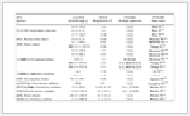
表 1 研究区3套DEM数据源坡度分级统计
Tab. 1 Three sets of DEM data source slope classification statistics in the study area
| % |
分区
Subarea |
坡度分级
Slope classification/(°) |
1∶5万地形图
1∶50 000 topographic map |
|
SRTM1 |
|
NASADEM |
|
ASTER GDEM |
比例
Percentage |
比例
Percentage |
偏差
Deviation |
比例
Percentage |
偏差
Deviation |
比例
Percentage |
偏差
Deviation |
平原区
Plain areas |
<5 |
90.63 |
|
89.62 |
-1.01 |
|
89.01 |
-1.62 |
|
66.03 |
-24.60 |
| ≥5~8 |
3.56 |
4.71 |
1.15 |
5.37 |
1.81 |
19.69 |
16.13 |
| ≥8~15 |
3.57 |
3.81 |
0.24 |
3.77 |
0.20 |
11.58 |
8.01 |
| ≥15~25 |
1.78 |
1.55 |
-0.23 |
1.51 |
-0.27 |
2.23 |
0.45 |
| ≥25~35 |
0.41 |
0.30 |
-0.11 |
0.33 |
-0.08 |
0.43 |
0.02 |
| ≥35 |
0.04 |
0.01 |
-0.03 |
0.01 |
-0.03 |
0.05 |
0.01 |
山区
Mountainous areas |
<5 |
0.57 |
|
0.72 |
0.15 |
|
0.99 |
0.42 |
|
1.75 |
1.18 |
| ≥5~8 |
0.89 |
1.08 |
0.19 |
1.29 |
0.40 |
1.77 |
0.88 |
| ≥8~15 |
4.97 |
5.27 |
0.30 |
6.48 |
1.51 |
8.36 |
3.39 |
| ≥15~25 |
18.56 |
21.82 |
3.26 |
26.43 |
7.87 |
26.18 |
7.62 |
| ≥25~35 |
32.66 |
33.56 |
0.90 |
38.63 |
5.97 |
36.17 |
3.51 |
| ≥35 |
42.35 |
37.55 |
-4.80 |
26.19 |
-16.16 |
25.77 |
-16.58 |
|
表 1 研究区3套DEM数据源坡度分级统计
Tab. 1 Three sets of DEM data source slope classification statistics in the study area
|
在山区,SRTM1地形数据在 < 5°、≥5°~8°、≥8°~15°、≥15°~25°、≥25°~35°, ≥35°6个坡度等级上的偏差分别为0.15%、0.19%、0.30%、3.26%、0.90%、-4.80%,均低于5%,较真实地反映出该区域坡度分布;NASADEM地形数据在≥15°~25°、≥25°~35°和≥35°3个坡度等级较1 ∶5万地形图的偏差分别为7.87%、5.97%和-16.16%,ASTER GDEM地形数据在这个3个坡度等级上的偏差分别是7.62%、3.51%和-16.58%,2种DEM数据在高坡度等级面积均减少16%以上,空间分布准确度上明显低于SRTM1 DEM,不能真实反映实际坡度分布。笔者认为,在计算土壤侵蚀强度时,由于高等级坡度范围的减少,山区水土流失强度也存在降低的可能。
在平原区,SRTM1与NASADEM数据在各坡度分布于与1 ∶5万地形图基本一致(图 3a、b和c),九成区域坡度为5°以下,除较明显的沟壑外,未见高等级坡度栅格,同时各坡度等级与1 ∶5万地形图比较,偏差均小于2%;而ASTER GDEM数据在 < 5°、≥5°~8°、≥8°~15°坡度等级的偏差分别达到-24.60%、16.13%、8.01%,存在大幅偏差(图 3d),特别是平原区域存在大量5°以上栅格。通过影像与坡度分级图对比,发现平原区高等级坡度栅格普遍出现在地表覆被落差较大的区域,如建构筑物、高大乔木以及桥梁等(图 4)。笔者认为该DEM数据无法有效消除地表覆被对高程信息的影响[10],导致平原区出现异常高等级坡度栅格,在其他5种因子一定的情况下,由于坡长坡度因子存在异常(图 5),势必影响利用CLSE计算平原区土壤侵蚀强度的结果,使其出现零星的中度以上高等级侵蚀栅格,同时以坡度分级统计的各类信息,尤其是水浇地也会存在5°以上的坡度统计信息。这些异常明显不符合实际的情况。
4 结论与讨论
通过3种不同数据源DEM与1 ∶5万地形图进行坡度分级比较,发现SRTM1、NASADEM地形数据在渭河断陷谷地冲积平原区各等级坡度分布符合实际,而ASTER GDEM地形数据受地表覆被影响,在该区域出现大量5°以上栅格,导致区域内单一地类土壤侵蚀强度等级出现异常(图 6b),同时影响以坡度分级统计的各类信息;在秦岭山地区域,SRTM1地形数据各等级坡度分布符合实际,NASADEM、ASTER GDEM地形数据在高等级坡度出现一定偏差,尤其集中在高等级坡度区域,不能真实反映实际坡度分布。
以研究区为例,SRTM1地形数据无论在坡度精度以及空间分布与实际地形特征的契合度均优于NASADEM与ASTER GDEM地形数据,较为真实反映区域内地形信息,不但有效的消除了同区域单一地类土壤侵蚀强度异常数据(图 6c),同时使坡度分级统计信息更加合理。从获取数据便捷性和数据精度等方面综合考虑,可以将SRTM1 DEM作为陕西省省级动态监测区域基础地形数据参与计算与统计。
笔者认为,在水土流失动态监测过程中,地形数据作为土壤侵蚀主导因子发挥着至关重要的作用,不仅直接参与土壤流失通用方程计算,亦是分坡度统计各类信息的重要参照和依据。SRTM1、NASADEM与ASTER GDEM等数字高程模型作为全球公开数据,可快速获取,同时水平分辨率也满足水土流失动态监测工作需要,可作为地形因子基础数据加以应用;但由于各类DEM数据垂直精度存在一定区域适宜性,为保障水土流失动态监测成果真实可靠,如何确定不同地貌单元下最优DEM数据将成为水土流失动态监测工作中必不可少的一部分。
5 参考文献
| [1] |
林祚顶, 李智广. 2018年度全国水土流失动态监测成果及其启示[J]. 中国水土保持, 2019(12): 1. LIN Zuoding, LI Zhiguang. The results of national soil erosion dynamic monitoring in 2018 and their enlightenment[J]. Soil and Water Conservation in China, 2019(12): 1. DOI:10.3969/j.issn.1000-0941.2019.12.003 |
| [2] |
高峰. 基于GIS和CSLE的区域土壤侵蚀定量评价研究[D]. 南宁: 广西师范学院, 2014: 39.
GAO Feng. Quantitative evaluation of regional soil erosion based on GIS and CSLE[D]. Nanning: Guangxi Normal University, 2014: 39.
|
| [3] | |
| [4] |
汪邦稳, 杨勤科, 刘志红, 等. 基于DEM和GIS的修正通用土壤流失方程地形因子值的提取[J]. 中国水土保持科学, 2007, 5(2): 18. WANG Bangwen, YANG Qinke, LIU Zhihong, et al. Extraction of RUSLE-LS factors using DEM data and GIS techniques[J]. Science of Soil and Water Conservation, 2007, 5(2): 18. DOI:10.3969/j.issn.1672-3007.2007.02.004 |
| [5] |
李蒙蒙, 赵媛媛, 高广磊, 等. DEM分辨率对地形因子提取精度的影响[J]. 中国水土保持科学, 2016, 14(5): 15. LI Mengmeng, ZHAO Yuanyuan, GAO Guanglei, et al. Effects of DEM resolution on the accuracy of topographic factor derived from DEM[J]. Science of Soil and Water Conservation, 2016, 14(5): 15. |
| [6] |
刘菊, 郑智礼, 孙拖焕. 基于DEM的坡度提取与分析[J]. 山西水土保持科技, 2013(3): 12. LIU Ju, ZHENG Zhili, SUN Tuohuan. Slope extraction and analysis based on DEM[J]. Soil and Water Conservation Science and Technology in Shanxi, 2013(3): 12. DOI:10.3969/j.issn.1008-0120.2013.03.005 |
| [7] |
中华人民共和国水利部. 土壤侵蚀分类分级标准: SL190—2007[S]. 北京: 中国水利水电出版社, 2008: 9.
Ministry of Water Resources of the People's Republic of China. Standards for classification and gradation of soil erosion: SL190—2007[S]. Beijing: China Water and Power Press, 2008: 9
|
| [8] |
谷振飞, 侯伟利. 基于MapGIS利用地形图制作坡度图[J]. 电子世界, 2021(3): 146. GU Zhenfei, HOU Weili. Making slope map with topographic map based on MAPGIS[J]. Electronics World, 2021(3): 146. |
| [9] | |
| [10] | |
 2022, Vol. 20


